Showing posts with label walter koenig. Show all posts

Tuesday, September 8, 2026

September 8, 1966: "Star Trek" Premieres

Back row, left to right: James Doohan as Scotty, Walter Koenig as Chekov,
Majel Barrett as Nurse Chapel, Nichelle Nichols as Uhura,
and George Takei as Sulu. Front row: DeForest Kelley as McCoy,
William Shatner as Kirk, and Leonard Nimoy as Spock.

September 8, 1966, 60 years ago: The TV series Star Trek first airs on NBC, with the episode "The Man Trap" -- a.k.a. "The Space Vampire."

NOTE: This is an adaptation of a post I wrote for the 50th Anniversary, in 2016.

The show was created by Gene Roddenberry (1921-1991), who had previously been a combat pilot in World War II and a Los Angeles police officer. He pitched it to the network as "Wagon Train to the stars," in essence a Western in space. But with his ship's Captain, he was inspired by C.S. Forester's novels about Captain Horatio Hornblower, and he liked to call his adventures "Hornblower in space."

The show had a pilot filmed in December 1964, titled "The Cage." NBC passed on the story, but approved the concept, and asked for a 2nd pilot. Except for Leonard Nimoy as Spock, it was a completely new cast that filmed "Where No Man Has Gone Before" in July 1965. The show was picked up, although that 2nd pilot didn't air until September 22, 1966, the 3rd episode to air.

As for the pilot, here's the affiliates you could have watched it on, if you were in what would now be considered a "major league" city (note that not all of these are still NBC affiliates, or operating under the same call letters as there were using in 1966):

* Channel 2: WGRZ, Buffalo; WSB, Atlanta; KPRC, Houston; KUTV, Salt Lake City.

* Channel 3: KYW, Philadelphia; WKYC, Cleveland; KSNV, Las Vegas; KCRA, Sacramento.

* Channel 4: WNBC, New York; WRC, Washington; WBZ, Boston; WDIV, Detroit; WTMJ, Milwaukee; WSMV, Nashville; WDAF, Kansas City, KFOR, Oklahoma City; WOAI, San Antonio; KCNC, Denver; KNBC, Los Angeles; KRON, San Francisco.

* Channel 5: WLTW, Cincinnati; WMC, Memphis; WMAQ, Chicago; KSDK, St. Louis; KXAS, Dallas; KING, Seattle.

* Channel 6: WFBM, Indianapolis; WDSU, New Orleans.

* Channel 7: WSVN, Miami.

* Channel 8: WFLA, Tampa; KGW, Portland, Oregon.

* Channel 9: WSOC, Charlotte.

* Channel 10: KGTV, San Diego.

* Channel 11: WBAL, Baltimore; WIIC, Pittsburgh, WTVD, Raleigh.

* Channel 12: WTLV, Jacksonville; KPNX, Phoenix.

The series depicted the USS Enterprise, a starship with a crew of 430, representing the Starfleet (one word) of the United Federation of Planets, a galactic version of the United Nations, headquartered on Earth, at some unspecified point in the future.
Since they didn't want to be locked into an exact time, they obscured this with the clever use of "Stardates." Despite at least 2 episodes suggesting that the series took place around 200 years later, later series would definitively place it 300 years in the future -- i.e., the 1st episode took place in the year 2266.

The ship's mission, partly invoking the late President John F. Kennedy's "New Frontier," was written by  Roddenberry, and recited near the start of each episode by William Shatner:

Space: The final frontier. These are the voyages of the starship Enterprise. Its five-year mission: To explore strange new worlds, to seek out new life and new civilizations, to boldly go where no man has gone before!

The show ran for 3 years, and led to a brief animated series and 6 movies. It has spun off several connected TV series.

Of the main cast, pictured above:

* DeForest Kelley, who played the Chief Medical Officer, Lieutenant Commander Leonard H. McCoy, a.k.a. "Bones," died on June 11, 1999, at the age of 79.

* James Doohan, who played the Chief Engineer, Lieutenant Commander Montgomery Scott, a.k.a. "Scotty," died on July 20, 2005, at 85.

* Majel Barrett, Roddenberry's wife, who played Nurse Christine Chapel (her rank was never stated on the original series), and also voiced the computers on every starship in every show for as long as she lived, died on December 18, 2008, at 76.

* Leonard Nimoy, who played the ship's half-human and half-Vulcan First Officer and Science Officer, Commander Spock, died on February 27, 2015, at 83.

* Nichelle Nichols, who played the Communications Officer, Lieutenant Nyota Uhura, died on July 30, 2022, at 90.

* George Takei, who played the Chief Helmsman, Lieutenant Hikaru Sulu, is 89.

* Walter Koenig, who played a navigator, Ensign Pavel Chekov, turns 90 next week. His character was created when the Soviet Union objected to the fact that, despite their pioneering status in spaceflight, there were no Russians in the Enterprise crew, and Roddenberry admitted they had a point. Koenig said, "When they thought I was Russian, 22 and single, I got more mail than anybody except Leonard (Nimoy). When they found out I was American, 31 and married, the mail dried up."

* And William Shatner, who played Captain James T. Kirk, is 95, and, by all appearances, still going strong.

(By the end of their movies' run in 1994, Kirk had been promoted to Admiral, and demoted back down to Captain; Spock, Scotty and Sulu had been promoted to Captain; and McCoy, Uhura, Chekov and Chapel to Commander.)

In a 2011 episode of the YouTube series Epic Rap Battles of History, "Epic" Lloyd Ahlquist played Captain Kirk, although his impersonation sounded more like one of Shatner's exaggerated acting. In non-speaking guest roles, Omar Garaibeh played Spock, and Jon Na played Sulu. Both were ERB crew members. Kirk's opponent was Christopher Columbus, played by "Nice" Peter Shukoff.

September 8, 1966 was a Thursday. The next day, the science fiction series The Time Tunnel and the superhero show The Green Hornet debuted.

*

The show had a cult following. Frank Sinatra, Elvis Presley, and Michael Jackson were all known to be fans of what's now come to be known to fans of "The Original Series" or "TOS." (There is no account of any of the individual Beatles being Trek fans. Nor is it known if President Lyndon B. Johnson, despite his strong support of the real-life space program, ever watched the show.) Sinatra later admitted to preferring The Next Generation. His cognitive decline was already underway when James Darren began playing holodeck-inspired Las Vegas lounge singer Vic Fontaine, practically an homage to Sinatra, on Deep Space Nine, so his thoughts on that are unknown.

The most famous story of a celebrity connection with the show came in early 1967, although it wasn't revealed for many years thereafter: Nichelle Nichols didn't like the shooting schedule, or the way she was being treated, and thought she could be treated better and make more money with her nightclub singing act, which was ongoing. At one point, she met Dr. Martin Luther King, and told her she was thinking of quitting the show.

He told her she couldn't quit. He admitted that he and his family were fans of the show, and that her presence, as both a black person and a woman on the command level of such a vessel, was of great symbolic value, and that she should stay because of that. She did.

But the show didn't get past its core support, and the ratings were never good. NBC was ready to cancel it after 2 seasons, but a fans' write-in campaign saved it. For its 3rd season, the show's budget was slashed, and it was put in a bad time slot. The ratings got worse, and nothing could save it to allow it to complete the ship's "five-year mission."

"We all thought it was over," Shatner said. And while Nimoy immediately went to another Paramount Pictures show, Mission: Impossible -- taking the master-of-disguise role played by Martin Landau, who was allegedly the studio's first choice to play Spock, but Roddenberry put his foot down and wanted Nimoy -- the other castmembers weren't so lucky. They were typecast. With his Southern accent, Kelley was often cast in Westerns, but that genre was in decline by 1969. Doohan got roles in 2 1970s Saturday-morning-kid-show sci-fi adventures. Nichols went on singing.

Everybody else got whatever they could get. Shatner, at one point, was so broke, he was homeless, living out of his car. He and Nimoy both played killers caught by the title character on Columbo.

But the fans wouldn't give up. Star Trek fan conventions began in 1972. And the show caught on in syndicated reruns. In 1973, Filmation decided to do an animated Star Trek series. They were going to pay Shatner and Nimoy starring amounts, but not the others. Nimoy put his foot down, and said he wouldn't do it unless the others got the same pay. They did, with the exception of Koenig, although he did write an episode. Star Trek: The Animated Series (TAS) ran on NBC for 22 episodes in 1973 and '74.

Paramount decided there was enough demand to form a 4th major TV network, and they wanted its flagship show to be a sequel series, titled Star Trek: Phase II. But the network fell apart, and they shifted to Star Trek: The Motion Picture. Premiering in 1979, it was directed by Roddenberry himself, and that was a bad choice: All the criticisms leveled at "The Cage" back in 1965 came back: It was long, too cerebral, not enough action.

It became known as "The Motionless Picture." It was compared to another dragged-out 1979 film, and was nicknamed "A Spock-alypse Now." And the story's similarity to the episode "The Changeling" got it nicknamed "Where Nomad Has Gone Before." While it was visually spectacular, it was a very expensive flop. And it almost killed the franchise.

In 1982, Star Trek II: The Wrath of Khan premiered. Nicholas Meyer directed, and it saved the franchise. It was a sequel to the TOS episode "Space Seed," with Ricardo Montalban, returning as Khan Noonien Singh. While Trek has had villainous species, including the Klingons, the Romulans, the Borg, the Dominion, and the Xindi, Khan remains the greatest single villain in its history.

Nimoy was tired of playing Spock, so the character was killed. This was a terrible shock to Trek fans, including myself, 12 years old at the time. And yet, in hindsight, it is one of the greatest sacrifices, one of the greatest death scenes, and is followed by one of the greatest funerals in film history.

What Nimoy really wanted to do was direct, and so, when TWOK was a hit, they let him direct Star Trek III: The Search for Spock. As traumatic as Spock's death was, and as weird as it was to see the opening credits go directly from Shatner to Kelley without mentioning Nimoy (except as director), deep down, we all knew he would be restored to life.

Except... we didn't know that the Enterprise was going to be destroyed. And by Christopher Lloyd? Reverend Jim from Taxi? Are you kidding? Well, Lloyd put on a spectacular performance as Klingon Commander Kruge, and it probably got him the role of Doc Brown in Back to the Future, which is how he's now remembered.

The trilogy was completed with Star Trek IV: The Voyage Home. Nimoy directed again, and the Enterprise Seven (or "The Magnificent Seven") are forced to travel back to the present day, 1986, to save Earth in their time. It's not the best Trek film, but it is the most fun, and the funniest. My grandmother, 62 years old when it was released, was not a science fiction fan, but even she liked "the one with the whales."

After 2 Nimoy-directed films, Shatner, who had done some directing, wanted to direct one. The result was Star Trek V: The Final Frontier, where the crew met Spock's brother, and "God." It tanked, and Shatner never directed within Trek again, although many other Trek actors and Trek-connected people have directed episodes, including Leonard's son, Adam Nimoy.

Star Trek VI: The Undiscovered Country, reflecting the end of the Cold War by showing the beginning of peace with the Klingons, may have been the best overall film in the franchise, and it was a fitting sendoff for the original crew -- or so we thought. Indeed, it was the last Trek film appearance for Kelley, Nichols and Takei.

*

The success of ST IV led to Paramount launching Star Trek: The Next Generation in 1987, taking place 100 years after TOS, in the 24th Century. This would result in the 1994 film Star Trek: Generations, where Shatner, Doohan and Koenig were on hand to "pass the torch" to the TNG crew, although it was only Shatner's Kirk who was transported to the time of the USS Enterprise-D, resulting in a death that should have been more heroic.

TNG ran until 1994, and produced 4 movies from 1994 to 2002; Star Trek: Deep Space Nine from 1993 to 1999; Star Trek: Voyager, 1995 to 2001; the prequel series Star Trek: Enterprise from 2001 to 2005. Then came the 3 horrible J.J. Abrams "Bad Reboot" movies from 2009 to 2016. And "legit Trek" didn't to much better. The prequel series Star Trek: Discovery (2017-24) and its sequel series Star Trek: Starfleet Academy (starting this year and getting cut off next year) were ripped by fans. And it wasn't just because it wasn't "their Trek": They were genuinely bad.

Star Trek: Picard had 2 bad seasons, starting in 2020, though the 3rd, in 2023, gave enough fan service" to make most TNG fans think that the crew of Jean-Luc Picard (Patrick Stewart) had a proper conclusion to their stories.

The franchise won a lot of fans back with the animated series Star Trek: Lower Decks (2020-24) and Star Trek: Prodigy (2021-24), and the prequel series Star Trek: Strange New Worlds (starting in 2022 and set to conclude as planned in 2027, showing the Enterprise under Anson Mount's Captain Christopher Pike as it transitions to Kirk, now played by Paul Wesley).

On its 60th Anniversary, Star Trek remains as popular as ever. As Gene Roddenberry liked to say, "The human adventure is just beginning."

But as David Gerrold, who's written for Star Trek and other science fiction, has said, "The final frontier is not space. The final frontier is the human soul. Space is merely the place where we are most likely to meet the challenge."

Thursday, March 29, 2018

Fascinating Star Trek Trivia

March 29, 1968, 50 years ago: Star Trek airs the episode "Assignment: Earth." Robert Lansing plays Gary Seven, an interstellar "James Bond" (or, if you prefer, "Jim Phelps" of Mission: Impossible, which would later include Trek's Leonard Nimoy), whose alien superiors have given him technological knowledge far beyond that of a 20th Century human.

Lansing would be the only guest star to be mentioned in the opening credits of a Trek episode, rather than in the closing credits. A young Teri Garr (misspelled "Terri" in the closing credits) plays his unwitting assistant, a young Secretary named Roberta Lincoln.

This was supposed to be the backdoor pilot for a show featuring Gary and Roberta, as Trek creator Gene Roddenberry thought the show was about to be canceled, and he thought he needed a fallback show.

It turned out to be the other way around: Assignment: Earth was not picked up, and, after initially canceling it, NBC acceded to the wishes of the show's ardent fans, and brought Star Trek back for a 3rd season.

In this episode, Nimoy, as Spock, tells Captain James T. Kirk, played by William Shatner, "Current Earth crises would fill a tape bank, Captain. There will be an important assassination today, an equally dangerous government coup in Asia, and, this could be highly critical, the launching of an orbital nuclear warhead platform by the United States, countering a similar launch by other powers."

Just 6 days after the episode aired, on April 4, 1968, Martin Luther King was assassinated, and a malfunction resulted in the failure of the unmanned Apollo 6 mission. Indeed, the footage used for this episode’s fictional missile launch was of a previous unmanned mission, Apollo 4.

So we have a definitive date for this episode, the only one of the 23rd or 24th Century Star Trek series for which this is true. Even "Tomorrow Is Yesterday" – in the past for this crew but the future for the world below – gets no more specific than that "next Wednesday" will be the launch of the 1st mission to land men on the Moon, and the launch of Apollo 11 did take place on a Wednesday, July 16, 1969.

The deviation from the history that we know is on the coup in Asia: The closest parallel was the "17 July Revolution" in Iraq, 3 months later, in which Saddam Hussein ended up second-in-command.

Also on March 29, 1968: Lucille Frances Ryan is born in Auckland, New Zealand. We know her by the stage name she took after her first marriage: Lucy Lawless. The former star of Xena: Warrior Princess, now appearing on Ash vs. Evil Dead, has never appeared in any form of Star Trek, but she did play a Cylon in the rebooted version of Battlestar Galactica.

*

We are now in the process of celebrating the 50th Anniversary of Star Trek -- specifically, what is now usually called Star Trek: The Original Series (or ST:TOS): September 8, 1966 to June 3, 1969.

This trivia is limited to TOS, and doesn't include Star Trek: The Animated Series (1973-74), the movies (1979-94), or appearances by the TOS characters in later series (as very old people or in flashbacks):

* James T. Kirk (William Shatner) defeated a seemingly unbeatable computer in 6 episodes: "What Are Little Girls Made Of?", "The Return of the Archons," "The Changeling," "The Apple," "The Ultimate Computer" and "For the World Is Hollow and I Have Touched the Sky." ("That Which Survives" doesn't count.)

* Kirk got his shirt ripped in 8 episodes: "Where No Man Has Gone Before" (the 2nd pilot), "The Naked Time," "Miri," "Court Martial," "Shore Leave," "Arena," "Amok Time" and "The Gamesters of Triskelion." But only in "The Savage Curtain" was damage done to his pants.

* Spock (Leonard Nimoy) said the word "fascinating" 74 times, plus once more in each of the 1st 2 movies, and once more in the Next Generation episode "Unification, Part II." Zachary Quinto used it once in the despicable J.J. Abrams reboot. Data (Brent Spiner) used it once on Star Trek: The Next Generation, but his early use of "intriguing" didn't catch on. Tuvok (Tim Russ) used "fascination" once on Star Trek: Voyager.

* In contrast, only 35 times did Spock use the word "illogical." And it wasn't until "The Omega Glory" that he used the specific phrase "highly illogical."

* The phrase "Live long and prosper" was used 4 times: By Spock in "Assignment: Earth" and "Is There in Truth No Beauty?"; by T'Pau in "Amok Time"; and by the simulation of Surak in "The Savage Curtain."

* Spock performed the Vulcan salute 7 times, the Vulcan nerve pinch 34 times, and the Vulcan mind meld 7 times -- including in "The Enterprise Incident," when he used it to fool Romulans into thinking he had killed Kirk with a "Vulcan death grip." The alternate (but not evil) Spock used the mind meld on McCoy in "Mirror, Mirror."

* Leonard "Bones" McCoy (DeForest Kelley) made 15 mentions of being a doctor, but only used the specific words, "I'm a doctor, not a... " 5 times: A bricklayer in "The Devil in the Dark," an escalator in "Friday's Child," a mechanic in "The Doomsday Machine," an engineer in "Mirror, Mirror" (to which chief engineer Montgomery Scott, played by James Doohan, responded, "Now, you're an engineer"), and a coal miner in "The Empath."

He never used it in any of the movies, although Karl Urban used it once in each of the 3 films in the Abrams reboot. As a kid, I had a 45 RPM record of a comic-book-style story, titled "Passage to Maouv," in which the actor voicing McCoy said, "I'm a doctor, not an animal trainer!"

McCoy also said, "I'm a surgeon, not a psychiatrist" in "The City On the Edge of Forever," although he was said to be an expert in space psychology in "Court-Martial." He used his status as a doctor to compare himself with a moon shuttle conductor in "The Corbomite Maneuver," an officer of the line in "A Taste of Armageddon," a physicist in "Metamorphosis," a magician in "The Deadly Years," a flesh peddler in "Return to Tomorrow," and a mechanic in "The Empath."

And, in "Amok Time," after McCoy kept answering questions about Spock's condition with, "I don't know," Kirk asked, "You keep saying that. Are you a doctor, or aren't you?"

The phrase was never used on The Next Generation -- not by Beverly Crusher (Gates McFadden), Katherine Pulaski (Diana Muldaur), or anyone else. But it was used once by Phlox on Enterprise (John Billingsley: An engineer), used twice by Julian Bashir on Deep Space Nine (Alexander Siddig: A botanist and an historian) , and was beaten to death by The Doctor on Voyager (Robert Picardo: An engineer twice, a decorator, a performer, a bartender, a voyeur, a counter-insurgent, a database, a Peeping Tom, a battery, a dragonslayer, a zookeeper, and a doorstop -- and another Emergency Medical Hologram, played by Andy Dick, said, "I'm a doctor, not a commando").

But the phrase goes back further than we thought. Like Nimoy and Doohan, Kelley appeared on the Western Bonanza, in his case 4 times. In the 1962 episode "The Decision," he played a doctor, Michael Jons (not "Jones"), in jail but currently the only man who could save the life of an injured Hoss Cartwright (Dan Blocker). Hoss' father, Ben (Lorne Greene), reminds him, "You're a doctor." Jons says, "I'm not a doctor, I'm a condemned murderer!" In a stunning coincidence, John Hoyt, who played Dr. Philip Boyce in "The Cage," played a judge in that episode. In an even bigger coincidence, the name of the newspaper in Virginia City, Nevada -- and this was true in real life, too -- was the Territorial Enterprise.

Before that, in 1955, Kelley appeared in an episode of The Millionaire, titled "The Iris Millar Story." He played a doctor, Michael Wells, the boyfriend of the titular character, an ambitious career woman (Virginia Grey). She wants to use the money to help him build his practice, so he can attract richer clients and become a man of influence. He tells her, "I am a doctor, not a politician."

And in 1933, Etienne Girardot played Dr. Doremus, a medical examiner, in the film The Kennel Murder Case. He tells the film's protagonist, private detective Philo Vance (William Powell), "I'm a doctor, not a magician." Moments later, he tells Vance, "I'm a doctor, not a detective."

* McCoy pronounced 23 people (and Tribbles, "a lot of them") dead, but he only used the specific phrase, "He's dead, Jim" 5 times: For Crewman Darnell in "The Man Trap," the unicorn dog in "The Naked Time," Scotty in "The Changeling" (Nomad had killed him, but then restored him to life), Prefect Hengist of Argelius II in "Wolf In the Fold" (an episode that also featured McCoy saying the only 2 examples of, "She's dead, Jim," of Kara the Argelian dancer and Lieutenant Karen Tracy), and Dr. Larry Marvick in "Is There In Truth No Beauty?"

Of Dr. Tristan Adams in "Dagger of the Mind" and Starnes in "And the Children Shall Lead"), McCoy says, "He's dead, Captain." On 3 occasions, he pronounced someone dead as a ruse: In "Amok Time" and "The Enterprise Incident" with Kirk, and in "I, Mudd" with Scotty. And in "Spectre of the Gun," he thought Chekov was dead, but he turned out to be wrong.

* Bones never said, "Damn it" until the movies; "Dammit, Jim!" and "Dammit, man!" to Spock became a trope later on. The show aired in the late 1960s, and censors had different standards then. The only word even closely fitting the definition of a profanity in the entire series was uttered by Kirk, and the producers had to fight the censors to keep it: At the end of "The City On the Edge of Forever," he said, through his grief and trauma over losing Edith Keeler (Joan Collins) in order to preserve the timeline, "Let's get the hell out of here."

And at the end of "Bread and Circuses," he said of the planet whose parallel development to Earth differed by having the Roman Empire survive into the 20th Century, Kirk says, "Caesar and Christ, they had them both." But he used the title "Christ" as an identifier of the historical figure, not as an exclamation.

* Scotty frequently dropped Scottish words like "lad," "lass," "bonny" and "a wee bit," and called the engines "my poor bairns" in "The Paradise Syndrome." Responding to a troublesome situation in "A Taste of Armageddon," he said, "Aye, the haggis is in the fire for sure." In "The Naked Time," he said, "I can't change the laws of physics!" But he never said, "I'm givin' her all she's got!"

* Hikaru Sulu was absent for several episodes in the 2nd season (1967-68), because George Takei was filming the John Wayne film The Green Berets.

* Pavel Chekov (Walter Koenig) confused things for "Russian inwentions" 6 times: The discovery of Sherman's Planet, the development of quatrotriticale, and Scotch whisky ("It was inwented by a little old lady in Leningrad!"), all in "The Trouble With Tribbles"; the phrase "Fool me once, shame on you; fool me twice, shame on me" in "Friday's Child"; the Cheshire cat for a creature from Minsk (which is actually in Belarus) in "Who Mourns for Adonais?"; and the Garden of Eden with "just outside Moscow" in "The Apple." In Star Trek VI: The Undiscovered Country, he said that Cinderella was an "ancient Russian story." (Variations on it go back to ancient Greece, but the story as we know it goes back to Naples, Italy in 1634.)

* Leningrad, of course, had its name changed back to St. Petersburg in 1991, but no one knew that would happen when the episode aired in 1967, or when Star Trek IV: The Voyage Home (which also mentioned Leningrad) premiered in 1986.

* Nobody, in any version of Star Trek, small or large screen, ever spoke the specific words, "Beam me up, Scotty." Kirk did say, "Beam me up, Mr. Spock" at the end of "The Squire of Gothos," but it was usually, "(number of people) to beam up," or something like that. The closest call was in Star Trek IV, when Kirk said, "Scotty, beam me up" -- not the other way around.

* Time travel was used in 5 episodes: "All Our Yesterdays" (to about 3000 BC and about AD 1700, albeit on a planet other than Earth), "The City On the Edge of Forever" (to 1930), "Assignment: Earth" (to 1968), "Tomorrow Is Yesterday" (to 1969), and "The Naked Time" (back 3 days). It's worth noting that, while "Assignment: Earth" took place after "Tomorrow Is Yesterday" from the Enterprise crew's perspective, the past sequence took place over a year before.

* Not the same thing, but worlds that seemed to be parallels of Earth's past were visited in 8 episodes: "Who Mourns for Adonais?" and "Plato's Stepchildren" (in each case, ancient Greece), "The Return of the Archons" (it looked like the late 19th Century), "Spectre of the Gun" (1881), "A Piece of the Action" (the late 1920s), "Patterns of Force" (the early 1940s), "Bread and Circuses" (it appeared to be the 1950s) and "Miri" (Spock estimated the world to be at around 1960).

So that's 13 episodes, and you can guess why it was done so often: It was cheaper to use mid-20th Century buildings already standing on the Paramount lot as sets. Indeed, Paramount used the same sets they used for Mayberry on The Andy Griffith Show. In "The City On the Edge of Forever," Shatner and Collins can be seen walking past a building with "Floyd's Barber Shop" written on it.

Time travel was also used in Star Trek IV: The Voyage Home. Later crews had their shares of time travel and, with the holodeck, simulations thereof.

* The Klingons appeared 7 times: "Errand of Mercy," "Friday's Child," "The Trouble With Tribbles," "A Private Little War," "Elaan of Troyius," "Day of the Dove" and "The Savage Curtain."

* The Romulans appeared 3 times: "Balance of Terror" (meaning they debuted onscreen before the Klingons did), "The Deadly Years" (in that case, only their ships were shown, not their people) and "The Enterprise Incident."

* The Orions were mentioned in "Journey to Babel," but the only actual male Orion shown was disguised as an Andorian. That episode introduced the blue-skinned, antennae-crowned Andorians, the piglike Tellarites, and Spock's parents, Vulcan Ambassador Sarek and his human wife, Amanda Grayson.

* An "Orion slave girl" appeared in only one episode, "Whom Gods Destroy." Her name was Marta, and she was played by former Batgirl Yvonne Craig. Vina (Susan Oliver) was depicted as one in the original pilot, "The Cage," and the footage was re-used for "The Menagerie," but she wasn't actually one of them.

And, contrary to Eddie Murphy's classic routine, Kirk never actually had sex with Marta, or any other "green bitch," though he did kiss her, and Marta, delusional, called Kirk "my lover" to Captain -- excuse me, Lord Garth (Steve Ihnat).

* So how many times did Kirk get "a piece of the action"? Split into passive and aggressive forms, his aggressive form tried to rape Yeoman Janice Rand (Grace Lee Whitney) in "The Enemy Within." In addition, he kissed former girlfriends in "Dagger of the Mind," "Court Martial" and (sort of) "Shore Leave." He also had a very unromantic reunion with a former girlfriend in "Turnabout Intruder."

He also kissed women in "The City On the Edge of Forever," "Mirror, Mirror," "Catspaw," "A Private Little War," "Return to Tomorrow," "By Any Other Name," "Bread and Circuses," "Plato's Stepchildren" (Shatner and Nichelle Nichols, playing Lieutenant Nyota Uhura, had the 1st interracial lip-lock on U.S. prime-time TV), "Wink of an Eye," "Elaan of Troyius," the aforementioned "Whom Gods Destroy," "The Mark of Gideon" and "Requiem for Methuselah." So that's 17 women he kissed, averaging better than 1 in every 5 episodes.

But only in "Bread and Circuses" (with the Roman slave Drusilla) and "The Paradise Syndrome" (he married Miramanee, who later told him, "I bear your child") was it implied that Kirk had sex during the episode. (This being the 1960s, NBC couldn't actually show such a scene.) Whether Kirk "performed a docking maneuver" in any other episode can be guessed, but not confirmed.

Miramanee (Sabrina Scharf) did not use the word "pregnant." McCoy used the word to describe the Tribbles. But he (or, rather, episode writer David Gerrold -- who later came out as gay, and thus should have known better even then) goofed: He said they were "bisexual," when the word should have been "asexual," meaning reproducing without the use of a partner. That may have been the 1st time the word "bisexual" was used on U.S. prime-time TV. Which leads to this:

* Despite the presence of Takei, Roger C. Carmel (who played Harry Mudd), and other actors later known to be gay, no character on TOS would have been depicted as such. But it has been retroactively suggested as such for Mudd (it would explain the earring, why he didn't seem to be affected by his charges' pheromones in "Mudd's Women," and why he hated his wife Stella in "I, Mudd"), and for Captain R.M. Merik and Proconsul Claudius Marcus in "Bread and Circuses." (The Proconsul said the matters of men would not concern Merik.)

And, in 2008, the fanmade series Star Trek: New Voyages showed Kirk's nephew Peter recovered from his attack by the Denevan Parasite in "Operation: Annihilate!" to become an Enterprise security officer and have a gay relationship -- both made problematic by the character's age.

Craig Huxley was 12 when he originally played the character in 1967; Bobby Rice was 25 when he first played the role in New Voyages, which seemed to be taking place only 2, maybe 3 years later. Even if Peter was 15 at the time we first saw him, and genius enough to get into Starfleet Academy almost immediately, there's no way a military academy would have let him graduate in just 3 years, so he couldn't have been an adult in the New Voyages episode.

* Married during the course of the show's run were an amnesiac Kirk in "The Paradise Syndrome" and McCoy in "For the World Is Hollow and I Have Touched the Sky." Kirk was subsequently widowed, and McCoy's marriage was soon annulled. Spock was supposed to be married in "Amok Time," but T'Pring (Arlene Martel) had other ideas.

And "Balance of Terror" began with Kirk presiding over the wedding of Lieutenant Robert Tomlinson (Stephen Mines) and Ensign Angela Martine (Barbara Baldavin), but the ceremony was interrupted, it was never completed, and Tomlinson died in the battle. Kirk never did get to perform a ship captain's prerogative of presiding over a wedding. In contrast, in The Next Generation, Captain Jean-Luc Picard presided over that of Chief Miles O'Brien (Colm Meaney) and Dr. Keiko Ishikawa (Rosalind Chao).

* Harry Mudd was the only specific antagonist seen twice, in "Mudd's Women" and "I, Mudd." He made a 3rd appearance in the Animated Series episode "Mudd's Passion." Otherwise, every episode was "self-contained": You didn't have to have seen any previous episode to understand the one you were watching at the time.

William Campbell was one of several guest actors who appeared twice, in his case as Squire Trelane in "The Squire of Gothos" and as Klingon Captain Koloth in "The Trouble With Tribbles." Koloth and Kirk certainly acted as though they had dealt with each other before (perhaps as a nod to Campbell's previous appearance), and Koloth was intended as a regular foil for Kirk, but he never appeared on the show again, as any character.

John Colicos was the 1st Klingon commander shown, as Kor in "Errand of Mercy." Michael Ansara, then married to I Dream of Jeannie star Barbara Eden, played Kang in "Day of the Dove." Colicos, Ansara and Campbell reprised their roles, with full ridge-headed makeup, as old Klingons in an episode of Deep Space Nine, "Blood Oath."

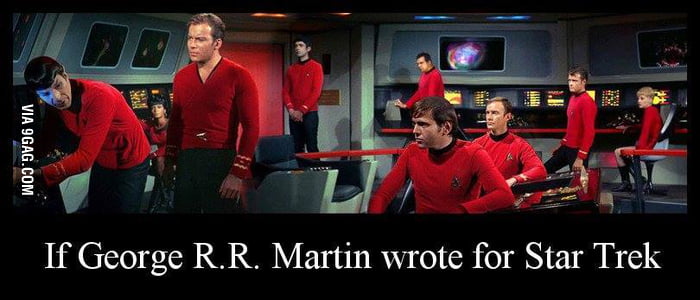
* There were 55 characters who died on the show, including 28 red-shirted officers, 8 in gold, and 7 in blue. Dead or doomed "redshirts" have become an Internet meme. There's the joke about how a Redshirt met a Stormtrooper from Star Wars, and the Stormtrooper fired and missed, and the Redshirt died anyway.

Then there's this one, invoking George R.R. Martin's willingness to kill any character on Game of Thrones:
* Kirk appeared to have been killed and revived in "Amok Time," "The Enterprise Incident" and "The Tholian Web." So did McCoy in "Shore Leave," Scotty in "The Changeling" and Chekov in "Spectre of the Gun."