Showing posts with label summit series. Show all posts

Sunday, January 11, 2026

January 11, 1976: Flyers vs. Red Army

January 11, 1976, 50 years ago: For once, there were a lot of Americans rooting for the Commies. But those Reds were shown just how tough Americans -- or, at least, Canadians -- could be.

First, let's take a step back, to 1972. A "Summit Series" was set up between National Hockey League All-Stars under the name "Team Canada" and an all-star team from the Soviet Union. It was set for 8 games, 4 in each country, and the Soviets shocked the Canadians by winning Game 1 rather easily.

After 5 games, it was Soviets 3 wins, Canada 1 win, and 1 tie. Canada won the last 3 games in Moscow to take the series, salvaging their pride, but the Soviets, previously ridiculed for being professionals in all but name picking on amateur teams in the Winter Olympics, had served noticed: They were as good as the free world's best.

There was another series in 1974, this time between the Soviets and a team of all-stars from the World Hockey Association. Given the lesser competition -- only 3 players from Canada '72, including Paul Henderson, who scored the winning goal of the series, played for this WHA team -- the Soviets won 4 games, Canada just 1, with 3 ties.

Super Series '76 was scheduled, with 2 Soviet club teams taking on NHL teams. One was the reigning Soviet Champions, CSKA Moscow. Translated into English, "CSKA" became "Central Sports Club of the Army." It was a team sponsored by the country's Red Army, and that's what they were called in the American media: "The Red Army."

The other was Krylya Sovetov, translated as "Soviet Wings." This suggests they were sponsored by the country's Air Force. Not quite: They were sponsored by the country's aircraft builders.

The Super Series began on December 28, 1975, at Madison Square Garden, and the Red Army pounded the New York Rangers, 7-3. This was understandable: Despite celebrating their 50th Season, the Broadway Blueshirts were in total disarray, having recently fired their head coach and general manager, Emile Francis; and traded away several key players, including goaltender Eddie Giacomin, defenseman Brad Park and center Jean Ratelle.

On December 29, the Soviet Wings beat the Pittsburgh Penguins, 7-4. Also not a surprise: The Pens were not a good team at the time. The next game got people's attention, though: On New Year's Eve, at the Montreal Forum, the Red Army took on the Montreal Canadiens, a team loaded with future Hall-of-Famers and one of the favorites to win the Stanley Cup. It ended in a 3-3 tie, and has been called one of the greatest games in the sport's history.

On January 4, 1976, an NHL team finally got a win. The Buffalo Sabres, who had advanced to the previous season's Stanley Cup Finals, beat the Wings, 12-6 at the Buffalo Memorial Auditorium. But the Russians re-established their dominance: On January 7, the wings went into the Chicago Stadium, and beat the Chicago Black Hawks, 4-2.

On January 8, the Red Army went into the Boston Garden and, playing a Boston Bruins team with Bobby Orr injured, Phil Esposito traded to the Rangers for Park and Ratelle, and Park and Ratelle not really settled in yet, dominated the Beantown Brats, 5-2. And on January 10, the Wings went out to Long Island, and beat the rising New York Islanders, 2-1.

There was one game left to play. On January 11, the Red Army went into The Spectrum in Philadelphia, to play the Philadelphia Flyers.

The Flyers had won the Stanley Cup in 1974, beating the Bruins in an upset, and again in 1975, beating the Sabres. They had a well-balanced team led by Captain Bobby Clarke and goaltender Bernie Parent. But they were also the most violent team hockey had ever seen, known as "The Broad Street Bullies."

There was a game in 1972 in Vancouver, when they were pelted with garbage by Canucks fans. Some of the players went into the stands to fight the fans, and got arrested. After the next game, which they won, along with some fights in the game, one of the players who had been arrested, defenseman Andre "Moose" Dupont sat for an interview in the locker room. He said, "It was a good night for us. We beat up their chicken forwards, we didn't get arrested, we scored goals, and we won. Now, the Moose drinks beer."

Philadelphia fans, enjoying their image as a city for tough people, loved this shit. They loved Dupont, and Dave "The Hammer" Schultz, and Ed Van Impe, and the brothers Jimmy and Joe Watson, and Tom "the Bomber" Bladon, and Bob "Hound" Kelly, every bit as much as they loved skill players like Clarke, Parent, and Bill Barber, all of whom ended up in the Hockey Hall of Fame, along with coach Fred Shero, general manager Keith Allen, and founding owner Ed Snider.

They were to take on the Red Army team with Vladislav Tretiak in goal, Viktor Kuzkin on defense, Boris Mikhailov and Vladimir Petrov at center, and Valeri Kharlamov on left wing. Each of these players would be elected to the International Ice Hockey Federation (IIHF) Hall of Fame, while Tretiak and Kharlamov were elected to the main Hall of Fame in Toronto.

The Flyers were the most hated team in hockey -- and, along with the Canadiens, 1 of the 2 best. But the other team was the Soviet Red Army. The Communists. America's enemy. On the other hand -- the third hand? -- of the 28 players who appeared in regular-season games for the Flyers that season, only 1 was an American, rookie right wing Paul Holmgren. The other 27 were Canadian. True, Canada is America's closest ally, but was it really patriotic to root for 27 Canucks and 1 American rookie who might not even get into the game?

Yes, yes it was. It in America. It was 1976, the Bicentennial year. And it was Philadelphia, birthplace of the nation through the Declaration of Independence, and birthplace of our system of government through the Constitution. And, as they so often did when they needed some good luck, the Flyers played Kate Smith's recording of "God Bless America" rather than "The Star-Spangled Banner." (Smith herself had sung in person a few times, but was not there on this occasion.) And the Philly fans belted it out along with the recording. Game on, you Commie bastards.

Shero had 2 slogans. One was, "We will win together now, and we will walk together forever." The other was, "Take the shortest route to the puck, and arrive in ill humor." In the 1st period, Van Impe was sent to the penalty box for hooking. When his penalty ended, with the score still 0-0, he went right at Kharlamov, and elbowed him in the head.

The referee, Lloyd Gilmour, did not call a penalty. Red Army coach Konstantin Loktev decided that his players were not going to be treated fairly, and, with the clock reading 11:21 of the 1st period (in other words, 9:39 to go), pulled his them off the ice. Bob Cole, calling the game for CBC (the Canadian Broadcasting Corporation), yelled, "They're going home! They're going home!"

Legend has it that Snider went to Vyacheslav Koloskov, the president of the Soviet Hockey Federation, and told him that his team would not get paid unless they returned to the ice. It wasn't true: NHL President Clarence Campbell, and tournament organizer Alan Eagleson (who later went to prison for embezzling from many of the players he represented) talked to Koloskov, and he talked to Loktev, and the Red Army players returned, taking a delay of game penalty.

And just 30 seconds into this power play, Reggie Leach deflected a shot past Tretiak to make it 1-0 Philadelphia. Toward the end of the period, Rick MacLeish scored to make it 2-0. Early in the 2nd period, the Red Army were on a power play when Joe Watson, known as a defensive defenseman, scored a shorthanded goal to make it 3-0. Shero told Joe he had "set Soviet hockey back 25 years."

Victor Kutyorgin scored for the Soviets in the period, but it was merely a consolation, not the start of a comeback. In the 3rd period, Larry Goodenough -- whose nickname, naturally was "Izzy" Goodenough -- tallied to make it 4-1. This would be the final score. And the Flyers, who had so deeply relied on Parent to win back-to-back Cups, did this with Wayne Stephenson playing the entire game in goal.

Tretiak said the Flyers won by playing "rude hockey." Loktev called them "a bunch of animals." They were both right. But the Flyers had won, and came away believing the Russians were skilled by soft. They were right, too.

The Flyers made it 3 straight trips to the Stanley Cup Finals, and printed up memorabilia reading, "HAT TRICK IN '76." But the Canadiens put a stop to that, sweeping them in 4 straight, for the 1st of 4 straight Stanley Cups.

The Flyers have never won another Cup. From 1976 to 2021, they were in 6 Stanley Cup Finals, and lost them all. And it wasn't because they got soft: For the rest of the 1970s, into the '80s, and even through the '90s, they were still one of the dirtier teams in the game. But bad management and bad luck have combined to give them a Cup drought that, even if they do it this season, will have lasted 47 years.

But their teams of 1974, '75 and '76 will always be remembered, for beating the Big Bad Bruins, and also for beating the Red Army when no one else could.

Sunday, September 7, 2025

Ken Dryden, 1947-2025

Kids these days, they look at some 26-year-old singer and call them "iconic." They keep using that word. It does not mean what they think it means.

Ken Dryden, the man, the mask, the pose, was iconic.

Kenneth Wayne Dryden was born on August 8, 1947 in Hamilton, Ontario, Canada, and grew up in Islington, Ontario, then a separate city, but now a part of Toronto. As such, he grew up as a fan of the Toronto Maple Leafs, which would come to seem odd. But then, when he was a young goaltender on the Canadiens, they had Frank Mahovlich, who had been perhaps the greatest player the Leafs have ever had.

He was a first cousin, twice removed, of Murray Murdoch, who played on the New York Rangers' 1928 and 1933 Stanley Cup winners, and was the longtime coach of Yale University's hockey team; and of Andy Blair (Andrew Dryden Blair), who played on the Leafs' 1932 Cup winners.

He had an older brother, Dave Dryden, who played a game for the Rangers in 1962, then 11 for the Chicago Black Hawks in the 1965-66 season, then regularly for the Hawks in the 1967-68 and 1968-69 seasons. He was an original member of the Buffalo Sabres in 1970, was an All-Star with them in 1974, then got lured by the not-so-reliable money of the World Hockey Association, mostly for the Edmonton Oilers, playing one last season in the NHL, 1979-80, after the WHA folded and the Oilers were 1 of the 4 surviving teams admitted. The brothers faced each other 8 times.

After starring in goal for the Etobicoke Indians of the Metro Junior B Hockey League and the Humber Valley Packers of the Metro Toronto Hockey League, Ken was drafted by the Boston Bruins in 1964, but his rights were quickly traded to the Montreal Canadiens. Instead of signing with the Canadiens, he went to Cornell University in Ithaca, New York, helping them win the 1967 National Championship.

He made his NHL debut on March 14, 1971, against the Pittsburgh Penguins at the Civic Arena in Pittsburgh. The Canadiens won the game 5–1, with Dryden stopping 35 of 36 shots. He played only six regular-season games, but rang up 1.65 goals-against average. This earned him the starting goaltending job for the playoffs ahead of veteran Rogatien "Rogie" Vachon.

The Canadiens advanced to the Stanley Cup Finals, against the Black Hawks. (The name was altered to one word, "Blackhawks," in 1986.) Their goalie Tony Esposito. The Canadiens had traded him, and also Vachon, who became a star with the Los Angeles Kings. They also traded the veteran Lorne "Gump" Worsley, who, despite being 41, had something left. They traded 3 future Hall of Fame goalies, 2 of them early in their careers, getting little in return. That's how much they believed in Dryden.

The Canadiens won Game 7, 3-2, and had their 17th Stanley Cup. Late in that game, Dryden made a spectacular toe-save on Jim Pappin, to prevent an equalizer. It was perhaps the most consequential (if not best) save in hockey history.

At this point, Dryden had played in 6 regular-season games, and 7 games in the Stanley Cup Finals. He was awarded the Conn Smythe Trophy as the Most Valuable Player of the Playoffs. The next season, he won the Calder Trophy as NHL Rookie of the Year. He remains the only player in the "big four" North American sports to be named Rookie of the Year after being named a postseason MVP. (Todd Worrell of the St. Louis Cardinals might have been so honored in 1985 and '86, if the Cardinals had hung on to win the World Series.)
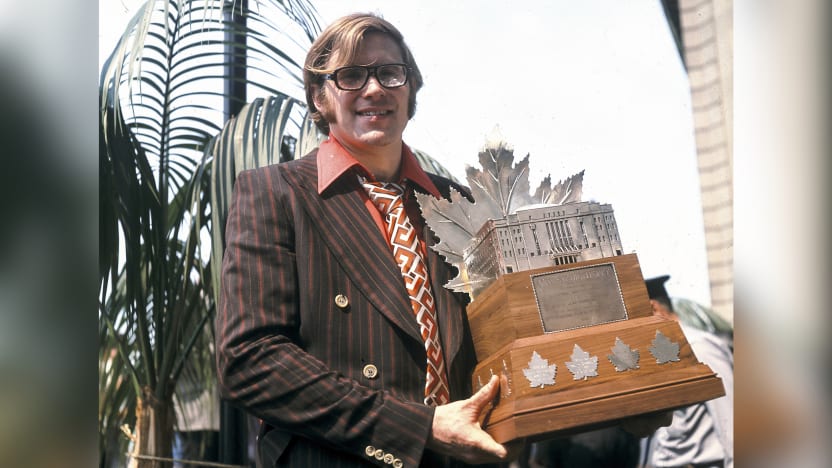
Dryden with the Conn Smythe Trophy.
Apparently, in the 1970s, Canadian men had no better taste
in clothing or hair than did American men.

He and Esposito were the 2 goalies selected for Team Canada in the "Summit Series" with the Soviet Union in 1972. Dryden played in Games 1, 4, 6 and 8; Esposito in Games 2, 3, 5 and 7. In a 50th Anniversary interview in 2022, he said, "I feel the history of that tournament, the legacy of that team just as strongly as all Canadian fans do. It never goes away. It's kind of like a good wine, I guess. Actually, the legacy of it grows."

The Canadiens did not win the Cup in 1972, but they did in 1973. Dryden missed the 1973-74 NHL season, so he could earn his law degree from McGill University in Montreal. The Canadiens did not win. He came back for 1974-75. They did not win. But they did for 1975-76, 1976-77, 1977-78 and 1978-79.

Serge Savard, a Hall of Fame defenseman for the Canadiens, said, "We looked at him and we thought he was coming from another planet. We didn’t see hockey players coming into the dressing room with books under their arms. After practice, he was going to McGill University."

As I was writing this, it occurred to me: Given his era, his talent, and his status as a thinking man and a thinking fan's man in his sport, Ken Dryden was the Tom Seaver of Hockey. Maybe he should have worn Number 41, as did a later Canadiens goalie, Jocelyn Thibault.

The "Flying Frenchmen" were so dominant that he could frequently stand in front of his goal, wearing what became the most famous goalie mask design ever, with its red, white and blue ovals, and in his familiar pose of resting his arms on top of his stick.

He then retired, having played 7 full seasons, and playing in the All-Star Game in 5 of them, and winning the Vezina Trophy as the League's top goalie in 5 of them. His Number 1 was retired by Cornell, and his Number 29 was retired by the Canadiens. He was elected to the Hockey Hall of Fame in 1983, named Number 26 on The Hockey News' list of the 100 Greatest Hockey Players in 1998 (5th among goalies, behind Terry Sawchuk, Jacques Plante, Glenn Hall and Patrick Roy), and named to the NHL's 100th Anniversary 100 Greatest Players in 2017.

Having abandoned his famed mask and pose at the age of 31 -- theoretically, he could have been only halfway through a career that would have surely earned him the title of the greatest goalie in hockey history -- he turned to more intellectual pursuits, including writing several books.

The Game, written about his final season and published in 1983, has been called one of the best books ever written about hockey. In 2019, he published Scotty: A Hockey Life Like No Other, a biography of his former coach, Scotty Bowman. No coach has led more Cup wins, 9, the 1st 5 with Dryden. In 2022, for the 50th Anniversary of the Summit Series, he published The Series: What I Remember, What It Felt Like, What It Feels Like Now.

He broadcast hockey for ABC for the 1980, 1984 and 1988 Winter Olympics, including the "Miracle On Ice" game in Lake Placid, New York in 1980. That meant that he was present for, arguably, the 2 most famous moments in the sport's history: The Soviet Union's losses to Canada in 1972 and America in 1980.

From 1997 to 2004, he served as President of the Leafs organization, and they got to within 1 game of the Stanley Cup Finals in 1999, getting back to the Conference Finals in 2002. But they got no closer. After leaving, he never worked in hockey again. With his law practice and his public service, he didn't need the money.
Honored at a 50th Anniversary celebration
of the 1971 Stanley Cup

After leaving the Leafs, he went into politics. He was elected as a member of the Liberal Party to the House of Commons for York Centre, a Toronto district, in 2004, and Prime Minister Paul Martin named him Minister of Social Development. He lost that post when the Conservative Party won the 2006 election, although Dryden was re-elected to his seat. He won again in 2008, but lost in 2011, and has not run for office again. In 2012, he was named an officer of the Order of Canada, the country's equivalent to a knighthood.

He went back to McGill as a lecturing professor. He became a television producer, having co-created and co-produced the six-part CBC-TV series We Are Canada, showcasing young, innovative Canadians to help celebrate the nation's 150th birthday in 2017. He participated in ceremonies honoring the Canadiens' 100th Anniversary in 2009, and the Boston Bruins' 100th Anniversary in 2024, since the Canadiens had been the opponents in the Bruins' 1st game in 1924.

Ken Dryden and his wife Lynda had two children, a son named Michael and a daughter named Sarah; and four grandchildren. Ken died of cancer in Toronto on Friday, September 5, 2025. He was 78 years old.

Canadian Prime Minister Mark Carney: "I am deeply saddened to learn of the passing of the Hon. Ken Dryden, a Canadian hockey legend and hall of famer, public servant and inspiration. Few Canadians have given more, or stood taller, for our country. Ken Dryden was Big Canada. And he was Best Canada. Rest in peace."

Larry Robinson, Hall of Fame defenseman for the Canadiens: "He was one of a kind back then. I was just very honored to play in front of him all those years. He sure as hell made me look a lot better." (Robinson also coached the New Jersey Devils to the 2000 Stanley Cup. Another Canadien teammate, Jacques Lemaire, coached the Devils to the 1995 Stanley Cup.)

Vladislav Tretiak, the opposing goalie in the 1972 Summit Series: "Ken Dryden will always be remembered by me first and foremost as a remarkable person -- intelligent, educated, kind, and open-minded. He represented that generation of Canadians who raised hockey to incredible heights worldwide, taking part in the 1972 Summit Series and shining in goal for the Montreal Canadiens."

See? Not just for Canada, or for North America, but Ken Dryden was an icon for hockey fans all over the world.

Wednesday, September 28, 2022

September 28, 1972: Canada Wins the Summit Series


September 28, 1972, 50 years ago: The "Summit Series" between Canada and the Soviet Union comes to a close with Game 8 at the Luzhniki Palace of Sports in Moscow.
Team Canada had made a big mistake in only letting NHL players play for them, meaning that Bobby Hull, who had signed a contract with the Winnipeg Jets of the new World Hockey Association, wasn't eligible. Also, Bobby Orr of the Boston Bruins was injured. If either of the Bobbys was able to play, it would have been a very different series.

But the Soviets, led by goaltender Vladislav Tretiak and left wing Valery Kharlamov, shocked the Canadians, who had to win the last 3 games of the series to win it. With 34 seconds left, Paul Henderson of the Toronto Maple Leafs scores to give Canada a 6-5 win and the series. It is the most famous goal in the sport's history.

Bill Goldsworthy of the Minnesota North Stars died in 1996. Gary Bergman of the Detroit Red Wings died in 2000. Jean-Paul Parise of the North Stars died in 2015. Bill White of the Chicago Black Hawks died in 2017. Stan Mikita of the Black Hawks died in 2018. Pat Stapleton of the Black Hawks died in 2020. Tony Esposito of the Black Hawks and Rod Gilbert of the New York Rangers died in 2021.

The remaining 20 Canadian players are still alive, 50 years later: Frank Mahovlich of the Montreal Canadiens (a legend in Toronto) is 84; Red Berenson of the Red Wings is 82; Jean Ratelle and Vic Hadfield, both of the New York Rangers, are about to turn 82; Phil Esposito of the Boston Bruins is 80; Paul Henderson of the Toronto Maple Leafs and Don Awrey of the Bruins are 79; Yvon Cournoyer of the Montreal Canadiens is 78; Wayne Cashman of the Bruins, Dennis Hull of the Black Hawks (Bobby's brother), Rod Seiling of the Rangers and Ron Ellis of the Toronto Maple Leafs are 77; Serge Savard of the Canadiens is 76; Pete Mahovlich of the Canadiens (Frank's brother) is about to turn 76; Ken Dryden of the Canadiens is 75; Brad Park of the Rangers, Guy Lapointe of the Canadiens and Mickey Redmond of the Red Wings are 74; Bobby Clarke of the Philadelphia Flyers is 73; and Gilbert Perreault of the Buffalo Sabres is 71.

Of the Soviet players, most of them came from Moscow and environs, and all were from Russia proper, except for Evgeni Paladiev, from Kazakhstan.

Viacheslav Solodukhin was a suicide in 1979, Valeri Kharlamov was killed in a car crash in 1981, Alexander Ragulin died in 2004, Gennadiy Tsygankov in 2006, Yevgeni Mishakov in 2007, Viktor Kuzkin in 2008, Evgeni Paladiev in 2010, Valeri Vasiliev in 2012, Vladimir Vikulov in 2013, Vladimir Petrov and Alexander Bodunov in 2017, Yuri Shatalov and Yevgeni Zimin in 2018, Alexander Gusev in 2020, and Vladimir Shadrin in 2021.

Still alive: Vyacheslav Starshinov is 82, Boris Mikhailov is about to turn 78, Yuri Lyapkin and Alexander Martynyuk are 77, Alexander Yakushev is 75; Vladimir Lutchenko, Yuri Blinov and Alexander Maltsev are 73; Yuri Lebedev and Vyacheslav Anisin are 71, and Vladislav Tretiak and Alexander Volchkov are 70.

UPDATE: Alexander Martynyuk died later in 2022. Ron Ellis died in 2024. Ken Dryden died in 2025.

Monday, August 23, 2021

Rod Gilbert, 1941-2021

If you're a hockey fan not old enough to remember the 1970s, the 1st name when you think of when you think of the New York Rangers is probably Mark Messier.

Or, if you're the kind of fan who watches hockey because he likes fights, you might think of Tie Domi, Joey Kocur, or Sean Avery.

But if you're older than I am, the 1st name you'll think of is Rod Gilbert, who remains the team's all time leading scorer, and possibly it's greatest all-time player.

Rodrigue Gabriel Gilbert (the name is French, so it's pronounced "Zheel-BEAR") was born on July 1, 1941 in Montreal, Quebec, Canada. He grew up there as a fan of the Montreal Canadiens, but it would be the New York Rangers who signed him.

They assigned him to one of their farm teams, the Guelph Biltmore Mad Hatters of the Ontario Hockey Association, outside Hamilton. In a 1960 game, he slipped on some garbage that was thrown onto the ice, and fell. A vertebra in his back was broken, and he was paralyzed. He underwent spinal fusion surgery to correct it, but a mistake was made, and there was hemorrhaging in his leg, and they nearly had to amputate.

He recovered, and debuted with the Rangers on November 27, 1960, at the old Madison Square Garden. The Rangers and the Chicago Black Hawks played to a 3-3 tie. He played the 1961-62 season with the Hatters, renamed the Guelph Royals, again playing just 1 game in the NHL season. But he was called up for good for the 1962-63 season, playing in all 70 games then on the schedule. He did so again in each of the next 2 seasons, scoring 24 and 25 goals, respectively. He was on his way to stardom.

But there was a roadblock, as his back troubles returned, and he required a 2nd spinal fusion surgery, missing half the 1965-66 season. He returned for 1966-67, the last season of the "Original Six Era," scoring 28. On February 24, 1968, 2 weeks after the Rangers moved into what was then known as "the New Madison Square Garden Center," he scored 4 goals in a game against the Canadiens.
He played on the right wing, on a forward line with Jean Ratelle at center and Vic Hadfield at left wing. This became known as the Goal-A-Game Line, or the "GAG Line," a play on a joke being a "gag line."

This line, and the play of defensemen Brad Park, Jim Neilson and Rod Seiling; and of goaltender Eddie Giacomin, helped lift the Rangers out of mediocrity. After getting all the way to overtime of Game 7 of the 1950 Stanley Cup Finals, they missed the Playoffs in 12 of the next 16 years, at a time when all you had to do to make the Playoffs was finish at least 4th in the 6-team league. In the 20 years after that Finals appearance, including 8 with Gilbert as a result, the Rangers appeared in a grand total of 42 Playoff games, winning just 10.

Finally, things began to turn around. The Rangers seemed to feed off the success of other teams in New York: The Jets winning Super Bowl III in 1969, the Mets winning the World Series later that year, and the Knicks, the Rangers' co-tenants at Madison Square Garden, winning the NBA Championship in 1970.

In 1970-71, Gilbert scored 30 goals for the 1st time. Dave Balon scored 36, Ratelle and Walt Tkaczuk 26 each, Hadfield 22, Bob Nevin 21 and Ted Irvine 20. Giacomin was awarded the Vezina Trophy as the NHL's top goalie. For the 1st time in 21 years, the Rangers won a Playoff series, beating the Toronto Maple Leafs, before losing the Stanley Cup Semifinals to the Black Hawks in 7 games.

In nearly all came together in 1971-72. Hadfield became the 1st Ranger to score 50 goals in a season, Ratelle and Gilbert each hit a respective career high with 46 and 43, Park and Tkaczuk each scored 24, Bill Fairbairn 22 and Bobby Rousseau 21. The Broadway Blueshirts beat the Canadiens in the Quarterfinals and the Black Hawks in the Semifinals. But they ran right into the Boston Bruins of Bobby Orr and Phil Esposito, and lost the Finals in 6 games.

That was as close to the Cup as the Rangers would get between 1950 and 1994. They lost in the Semifinals in 1973 and again in 1974, and were embarrassed by the 3rd-year expansion New York Islanders in the Preliminary Round in 1975.

Gilbert, Ratelle, Hadfield, Park and Seiling were picked for Team Canada in the 1972 Summit Series with the Soviet Union. Gilbert, Ratelle and Park each scored a goal, and Canada won the series, 4-3 with a tie.

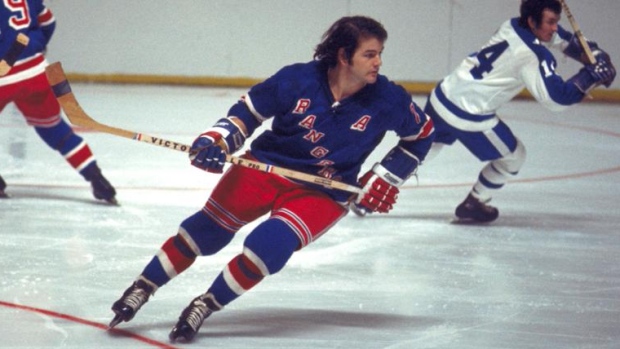
Early in the 1975-76 season, the Ranger team that had come so close and thrilled so many -- until 1994, it was the most popular Ranger team ever -- was broken up. First, Giacomin was traded to the Detroit Red Wings. Then came "The Trade," with the Rangers sending Ratelle, Park and Joe Zanussi to the Bruins for Esposito and Carol Vadnais.

On the surface, the trade made some sense. Esposito was losing playing time, and he wanted to play as close to full-time as possible. Getting Ratelle enabled the Bruins to get a scorer nearly on his level. Orr's injuries meant that his spectacular career was coming to a much-too-soon end, and Park was then seen as the NHL's 2nd-best defenseman. The Rangers got Espo, still a reliable offensive player, and Vadnais, who provided some toughness.

But the trade was hated, both in the New York Tri-State Area and in New England. When asked, 40 years later, when he got over being traded by the Rangers, Park said he still hadn't.

Esposito had worn Number 7 in Boston, and demanded it in New York. That was Gilbert's number, and he was the most popular Ranger of all time, and he refused to give it up. Esposito refused to play unless he got it. Gilbert felt he'd earned the right to keep it, and wouldn't budge. Finally, Esposito gave in, and switched to Number 77.

Gilbert's back troubles returned. In 1976, after still managing to play in 70 of a possible 80 games, he was awarded the Bill Masterton Memorial Trophy, awarded "to the player who best exemplifies the qualities of perseverance, sportsmanship, and dedication to ice hockey."

Before the 1977-78 season, at age 36, Gilbert got into a contract dispute with general manager John Ferguson. He signed, but he wasn't happy about the way he was treated, and his bad back was flaring up again. On November 23, 1977, in a 6-3 win over the Colorado Rockies (the team that became the New Jersey Devils in 1982) at The Garden, he had a goal and an assist. It seemed like as good a time as any to retire, and he did.

He had played in 8 NHL All-Star Games. He still holds, 44 years after his last game, the Ranger career records for goals (406), points (goals + assists, 1,021), game-winning goals (52), postseason goals (34), and games played by a forward (1,065). At the time he retired, the only right wing who had scored more points was Gordie Howe.

A change in management led to the repair of his relationship with the Rangers. On October 14, 1979, they retired his Number 7, the 1st player they honored this way. In 2018, he would be joined by his GAG Line mates Hadfield, 11 (shared with Messier); and Ratelle, 19.
Left to right: Rod Gilbert (7), Eddie Giacomin (1), Mike Richter (35),
Mark Messier (11), Brian Leetch (2), Adam Graves (9),
Andy Bathgate (9) and Harry Howell (3), on the occasion
of the number retirements for Bathgate and Howell, February 22, 2009.

(Frank Boucher, star of their 1928 and 1933 Stanley Cup winners and coach of their 1940 winners, had also worn 7, and it probably should have been retired for him before Gilbert was ever signed by the Rangers. It would have avoided the dispute between him and Esposito later on.)

In 1982, he was elected to the Hockey Hall of Fame. In 1991, he was awarded the Lester Patrick Trophy, named for the Rangers' 1st head coach and general manager, for service to hockey in America. In 2017, the NHL named him to their 100th Anniversary 100 Greatest Players.

Like boxers Jack Dempsey and Sugar Ray Robinson, and New York sports legends Mickey Mantle, Rusty Staub and Walt Frazier, he opened a restaurant in Manhattan: Gilbert's was on 3rd Avenue at 75th Street. And he made regular personal appearances for the Rangers' Garden of Dreams Foundation, working with children. The number of people coming forward today who met him through the Foundation who have testified to how nice he was is overwhelming.

He married twice, the 2nd time in 1991, to Judith Christy, in a ceremony performed at New York City Hall by Mayor David Dinkins. He had children Chantal, Justin, Holly and Brooke; and 7 grandchildren.

Rod Gilbert died yesterday, August 22, 2021, at the age of 80. As of this posting, a cause of death has not been disclosed.

* Chris Drury, who grew up in Trumbull, Connecticut, pitched a team there to win the 1989 Little League World Series, won the 2001 Stanley Cup with the Colorado Avalanche, later captained the Rangers, and is now the team's president and general manager: "Everyone in the Rangers organization mourns the loss of a true New York icon. Rod’s remarkable talent and zest for life personified this city and endeared him to hockey fans and non-hockey fans alike. Growing up a young Rangers fan, one of the first names I ever heard about was Rod Gilbert. He was synonymous with Rangers hockey. It was an incredible privilege to get to know Rod. His passion and dedication to the Rangers will forever be a source of inspiration for me."

* Howie Rose, Ranger and Met broadcaster who grew up in Queens: "This is crushing. Rod Gilbert has passed away. I can’t even explain how much he and his teammates meant to me as a young hockey fan, but Rod was the Rangers and vice versa. So involved with the NY community and a huge star in this town back in the day. A wonderful person. RIP."

* Linda Cohn, ESPN anchor who grew up on Long Island: "Extremely saddened to hear about the passing of ⁦@NYRangers  All Time Great and Hockey Hall of Famer Rod Gilbert at the age of 80. Rod always had a smile on his face. He was a true gentleman & a class act who made everyone feel appreciated. I already miss him."
Cohn and Gilbert

* Ron Duguay, whose 1st season with the Rangers was Gilbert's last: "Sadden with the passing of a good loyal friend Rod Gilbert He was the first person To greet me as a rookie as I entered MSG. He would always referred to me as 'Ronnie ' He was such a like able man to everyone! Going to games at MSG won’t be the same without him"

Until today, I had never heard Gilbert, or anyone else, called "Mr. Ranger." But he was that, and still is.