This Saturday, the football team at Louisiana State University -- hereafter to be referred to by its familiar initials, LSU -- takes on perhaps its biggest rival in the modern era, the University of Arkansas, at Tiger Stadium in Baton Rouge.
Buddy Songy, who hosts an LSU-themed radio talk show in Baton Rouge, calls LSU home games "Six days of foreplay, and one big bang on Saturday night." However, this game, due to being on national TV (ESPN), will be at 11:00 AM Central Time.
Before You Go. This is Louisiana football, but it will not be inside the climate-controlled Superdome. Actually, the Bayou State being warmer than New York and New Jersey will be to your advantage for once.
The Advocate, Baton Rouge's daily paper, is currently predicting low 70s throughout the weekend for daylight hours, and mid-50s for the evenings. They're predicting rain for Sunday, but Saturday should be clear.
Louisiana is in the Central Time Zone, so set your timepieces back an hour. However, in spite of the Confederate chapter of its past, you won't need a passport. You might
think you'll need it, especially in New Orleans, but you won't. You won't need to change your money, either. But the ability to speak fluent French, while hardly required, might help.
Tickets. LSU has gotten at least 96,000 fans for every home game this season and last season. Apparently, having a stadium with at least that many seats means that demand exceeds supply. Getting tickets will be difficult, especially since this is a rivalry game.
Upper level bench spots -- no seat backs -- will cost $70. Any other spot, with an actual seat, will be $80. Actually, considering how big the LSU program is, that's not a bad price.
Getting There. It's 1,364 miles from Times Square in New York to Tiger Stadium in Baton Rouge. Unless you really, really like driving, you're probably going to fly.
Google Maps says the fastest way from New York to New Orleans by road is to take the Holland Tunnel to Interstate 78 to Harrisburg, then I-81 through the Appalachian Mountains, and then it gets complicated from there.
No, the best way to go, if you must drive, is to take the New Jersey Turnpike/I-95 all the way from New Jersey to Petersburg, Virginia. Exit 51 will put you on I-85 South, and that will take you right through Charlotte and Atlanta, to Montgomery, Alabama. There, you'll switch to I-65 South, and take that into Mobile, where you'll switch to I-10 West, then, outside New Orleans, onto I-12 West, which will take you into Baton Rouge. Exit 155C is for the LSU campus.
You'll be in New Jersey for about an hour and a half, Delaware for 20 minutes, Maryland for 2 hours, inside the Capital Beltway (Maryland, District of Columbia and Virginia) for half an hour if you're lucky (and don' make a rest stop anywhere near D.C.), Virginia for 3 hours, North Carolina for 4 hours, South Carolina for about an hour and 45 minutes, Georgia for 3 hours, Alabama for 4 hours and 45 minutes, Mississippi for an hour and 15 minutes, and Louisiana for 2 hours and 15 minutes.
So we're talking about 25 hours. Throw in traffic in and around New York at one end, Washington and Atlanta in the middle, and New Orleans at the other end, plus rest stops, preferably in Delaware, and then one each State in Virginia, North Carolina, South Carolina, Georgia and Alabama, and it'll be closer to 29 hours. Still wanna drive? Didn't think so.
Flying? Good luck. You could get a round-trip fare from Newark to Louis Armstrong International Airport for about $500, but it won't be nonstop, and you'd still have to get to Baton Rouge. The city does have Baton Rouge Metro Airport, but getting in and out from anywhere other than New Orleans is not going to be easy.
Amtrak won't work, because it doesn't go to Baton Rouge, which is off the New Orleans-to-Los Angeles
Sunset Limited line. The bus doesn't sound much better. It takes 34 1/2 hours, counting the time change, changing buses in both Richmond and Atlanta. You'd have to leave Port Authority by 10:30 PM on Thursday night to get there by gametime -- or else take your chance with a bus that gets there at 5:30 PM on Saturday, half an hour before tipoff. Greyhound charges $466 round-trip, with a drop to $430 for advanced purchase. The station is at 1300 Florida Street.
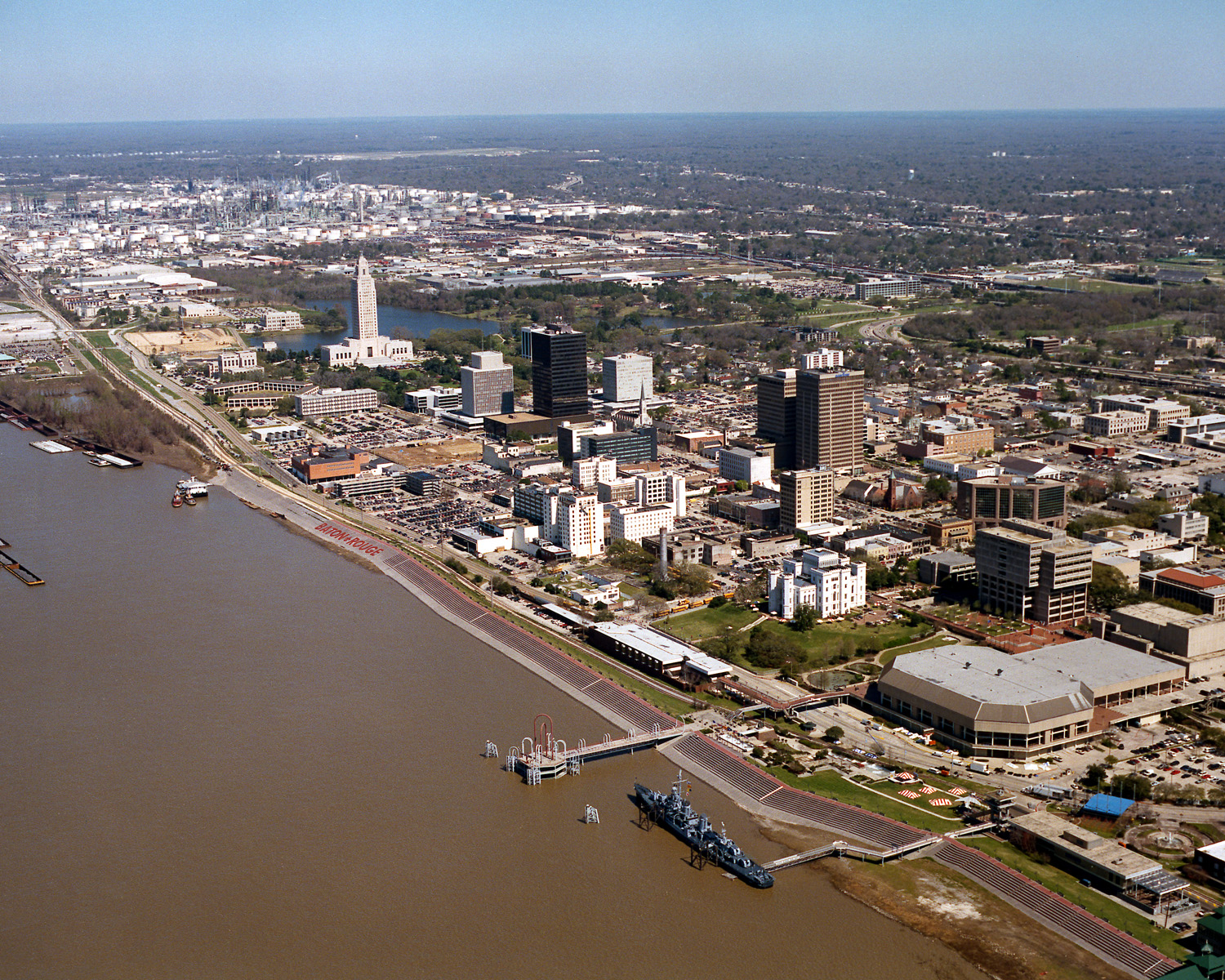
Once In the City. In 1699, French explorers saw a red pole marking the boundary between the hunting grounds belonging to the Houma and Bayogoula tribes, and named their settlement after that "red stick": Baton Rouge.
The city was incorporated 200 years ago, on January 16, 1817, after the War of 1812 and its climactic Battle of New Orleans ensured control stayed in American rather than British hands. It is home to about 230,000 people, with the metro area, more or less next-door to, but not part of, that of New Orleans, having about 830,000 people. The city is about 50 percent black, 42 percent white, 4 percent Hispanic and 4 percent Asian. The south side is mostly white, the north side mostly black.

Louisiana is in the Deep South, and has had its share of racial disturbances: The 1866 New Orleans Massacre, the 1868 St. Bernard Parish Massacre, the 1868 Opelousas Massacre, the 1873 Colfax Massacre, the 1874 Battle of Liberty Place, the 1874 Coshatta Massacre, and the 1900 Robert Charles Riot.
Because it is on the Mississippi River, Baton Rouge did take some flood damage from Hurricane Katrina in late August 2005. Unlike New Orleans, however, Baton Rouge is not below sea level, and recovered fairly quickly.
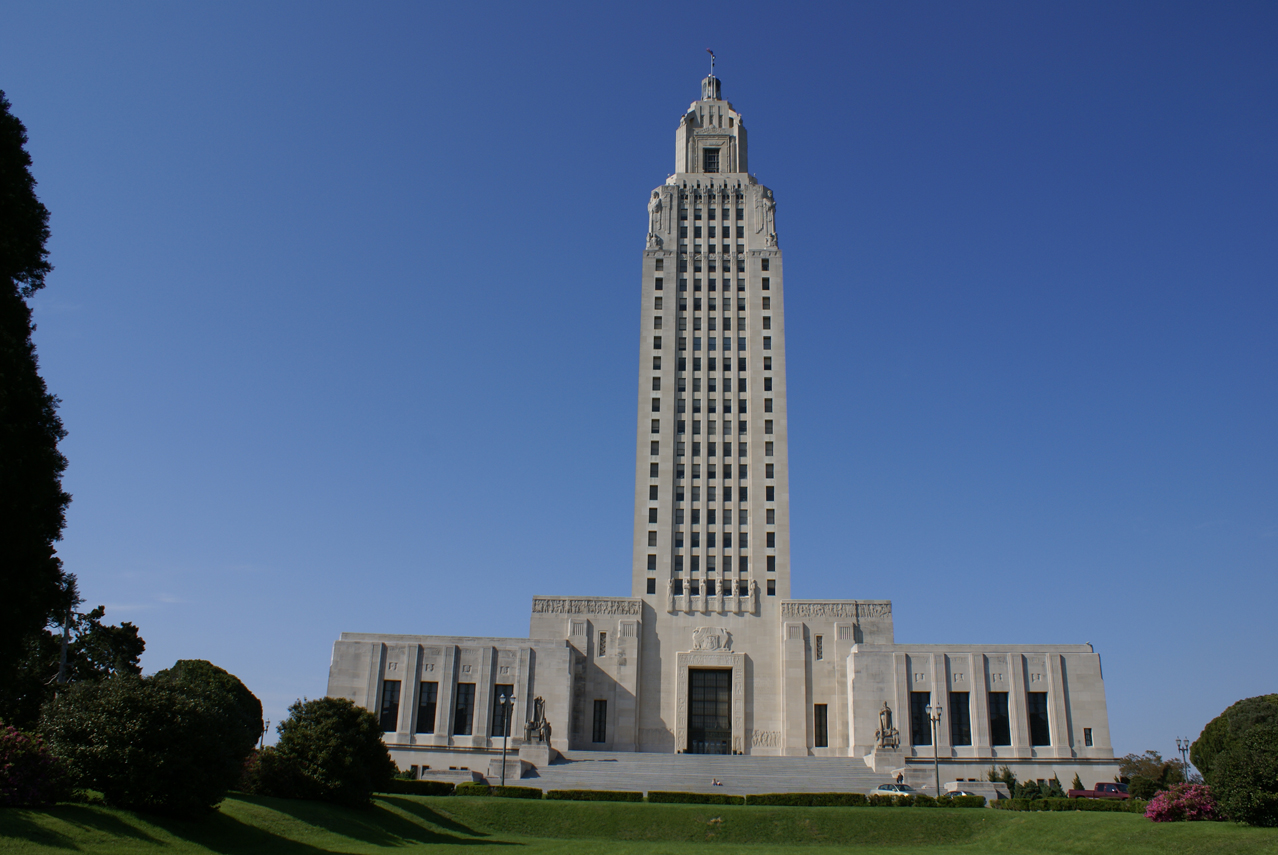
Louisiana was admitted to the Union as the 18th State on April 30, 1812. The sales tax is 4 percent. Baton Rouge is the State capital, and Louisiana has the tallest State Capitol building in the country, at 450 feet.
Huey Long's 450-foot 1932 Art Deco State Capitol
North Boulevard, for north and south, and the Mississippi River, for east and west, are the "zero points" for street addresses. The city has no beltway. ZIP Codes for the Baton Rouge area start with the digits 707 and 708. The Area Code is 225. Capital Area Transit System (CATS) runs buses and historic (or at least historic-style) streetcars. The fare is just $1.75. Cajun Electric Power Cooperative runs the electricity.
Once On Campus. The Louisiana State Seminary of Learning & Military Academy was founded in 1853, in Pineville. In 1860, William Tecumseh Sherman was named its superintendent. On January 26, 1861, Louisiana seceded from the Union, the 6th State to do so, and Sherman resigned, and was named a General in the Union Army. After the war, Sherman donated 2 cannons to the school. Louisiana was the 5th former Confederate State readmitted to the Union, on July 9, 1868.
The Pineville campus burned down in 1869. A few days later, they resumed operations in Baton Rouge, where the University's seat has remained. In 1874, the Louisiana State University and Agricultural & Mechanical College was founded. In 1877, it merged with the LSSLMA, which took the newer school's name.
The 1st female student was admitted to LSU in 1905. The current main campus opened in 1926, and Governor Huey Long vastly expanded it during his term in office, 1928 to 1932. After a long legal battle, the 1st black student was admitted in 1956. In 1969, at the height of the Vietnam War, mandatory ROTC for freshmen and sophomores was abolished.
LSU-Baton Rouge is the flagship institution of the Louisiana State University System, which also includes campuses (or should that be "campii"?) in New Orleans (a science-themed campus, established in 1931), Alexandria (1960), Shreveport and Eunice (both in 1967).
Notable non-sports alumni include:
* Entertainment: Actresses Joanne Woodward and Elizabeth Ashley;
Rocky theme composer Bill Conti, screenwriter (creator of
True Detective) Nic Pizzolatto, film critic Rex Reed. The rock band Better Than Ezra was formed at LSU.
* Literature: Rebecca Wells.
* Journalism: Edwin Newman and Don Lemon.
* Military: Generals John A. Lejeune (Marine Corps, namesake of the Corps base in North Carolina) and Claire Chennault (Air Force, leader of the Flying Tigers squadron in the Pacific Theater of World War II).
* Politics, representing Louisiana unless otherwise stated: Governors Jimmie Davis (previously a renowned country singer), Robert F. Kennon, John McKeithen, Edwin Edwards, Mike Foster and John Bel Edwards (no relation to Edwin); Senators Edwin Broussard, Russell Long, John Breaux, Mary Landrieu; Secretary of Labor Ray Marshall. Also, campaign operatives James Carville and Donna Brazile.
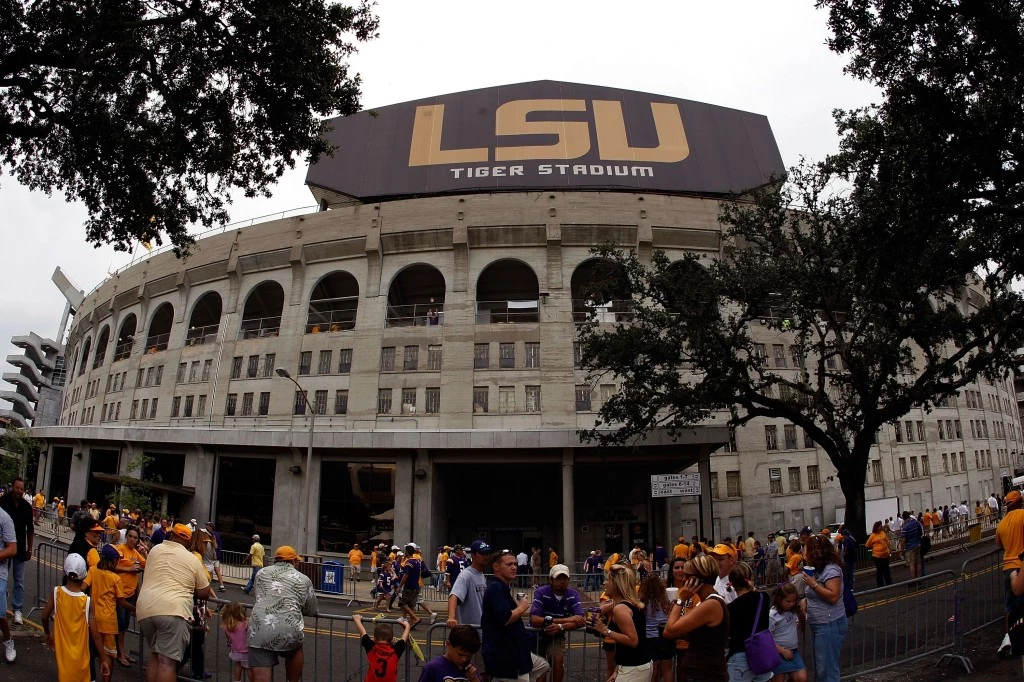
Going In. The address for Tiger Stadium is merely "Stadium Road." It is bounded by North Stadium Road on the north, Powerhouse Lane on the east, South Stadium Drive on the south, and West Stadium Road on the west. Confused yet? It's about 2 miles south of downtown, and Bus 14 will get you there. If you drive in, parking can be anywhere from $20 to $40.
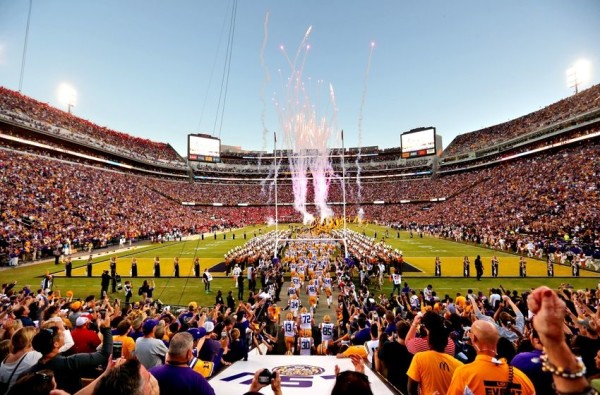
Like Clemson's Memorial Stadium, it is nicknamed Death Valley. It opened in 1924, after the Detroit Tigers' longtime home opened, but well before that ballpark adopted the name Tiger Stadium.
Speaking of ballparks, from this angle,
it looks a bit like Yankee Stadium.
Opening with 12,000 seats, it was expanded to 22,000 in 1931, 67,000 in 1953, 78,000 in 1978, 91,000 in 2000, and 102,321 in 2014. The field runs (more or less) north to south, and, unless most major college stadiums, especially in the South, has always been natural grass.
Bear Bryant led Alabama's Crimson Tide into Death Valley 16 times, winning 14. Nevertheless, he said, "Baton Rouge happens to be the worst place for a visiting team. It's like being inside a drum." In 2007, an ESPN poll named it the loudest stadium in college football - and there's no dome to hold the noise in. A 2016
USA Today poll named it the Southeastern Conference's best gamers experience.
This past October 6,
Thrillist compiled a list of their
Best
College Football Stadiums, the top 19 percent of
college football, 25 out of 129. Tiger Stadium came in 4th, and the article called it "an immersion in Southern football traditions that's crazier and more intense than anywhere in the SEC."
Due to Hurricane Katrina in 2005, the New Orleans Saints played 4 home games at Tiger Stadium, and Tulane University, once a major rival of LSU's but considerably downgraded in football, played 1.
Tiger Stadium has also hosted concerts. The Bayou Country Superfest is held there every Memorial Day Weekend, and Taylor Swift played it in 2015.
Food. There are many great food cities in America. New Orleans considers itself special in this regard. Baton Rouge is not New Orelans, though, and one of the stereotypes of Louisiana outside the Crescent City is that the people there will eat anything.
LSU's concession stands do reflect this, and you can decide for yourself whether that's a good thing. They serve "fry stak" -- apparently, Louisiana's answer to the blasphemy that is chicken fried steak -- Creole gumbo nachos, and crawfish poutine. Gag me with a spoon that has not been used to stir any of that!
One of the chefs that Aramark has hired to prepare food at Tiger Stadium has said, "Feed 'em, but don't feed 'em too much. If they eat too much, they can't cheer." Fair enough: Eat before and after the game, but not during, and then cheer as much as you like.
Team History Displays. LSU won the Southern Intercollegiate Athletic Association title in 1896 and 1908, and the Southern Conference title in 1932, the last season before the founding of the Southeastern Conference. They've won the SEC in 1935, 1936, 1958, 1961, 1970, 1986, 1988, 2001, 2003, 2007 and 2011. That's 11 SEC titles, and 14 Conference Championships overall.
Since the creation of the SEC Championship Game, they've won the West Division 8 times. They failed to advance to the Championship Game due to losing the head-to-head tiebreaker to Alabama in 1996, to Auburn in 1997, and to Arkansas in 2002; won the Division but lost the Championship Game to Georgia in 2005; and won the Championship Game, beating Tennessee in 2001 and 2007, and Georgia in 2003 and 2011.
They've been awarded the National Championship in 1958, led by coach Paul Dietzel and star running back Billy Cannon, clinching an undefeated season by beating Clemson in the 1959 Sugar Bowl; in 2003, under coach Nick Saban, beating Oklahoma in the BCS National Championship Game; and in 2007, under Saban's former assistant Les Miles, beating Ohio State. Their main scoreboard lists their National Championships on the left, and their Conference Championships on the right.
In 2011, they won a Number 1 vs. Number 2 battle with Alabama, by then coached by Saban, but a quirk in the BCS meant that, even though 'Bama didn't win its own Division, let alone its own Conference, it still ended up Number 2 in the final rankings, getting it a rematch with LSU in the National Championship Game, and Alabama won. This made Saban the only coach ever to win National Championships at 2 different schools.
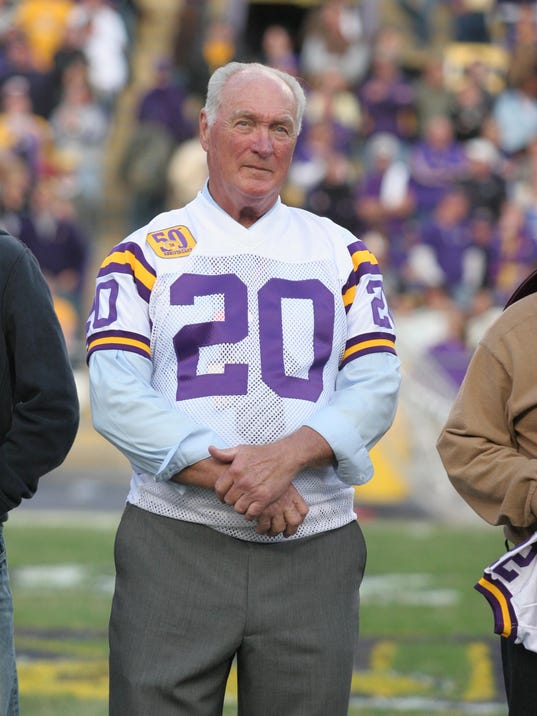
Only 2 LSU players have ever had their uniform numbers retired: Billy Cannon, 20, the running back who led them to the 1958 National Championship and won the 1959 Heisman Trophy; and Tommy Casanova, 37, a defensive back who starred in the 1969, '70 and '71 seasons.
Cannon cemented his Heisman win by returning a 4th quarter punt for a touchdown and then, as a defensive back, making a last-play game-saving tackle to beat the University of Mississippi on October 31, 1959. The touchdown became known as the Halloween Run. He won AFL Championships with the 1960 and '61 Houston Oilers and the 1967 Oakland Raiders, but only his last pro season, with the 1970 Kansas City Chiefs, the 1st year after the AFL-NFL merger, was in the NFL.
He married his high school sweetheart, went to medical school, and became a dentist. But he ran up gambling debts, and ran a counterfeiting operation. He ended up going to prison for it, and, struggling to re-start his dental practice after he got out, did so by becoming the dentist at the Louisiana State Penitentiary. He remains so, at age 80. The character in Frank Deford's novel
Everybody's All-American, Gavin Grey, played by Dennis Quaid in the film version, is said to be modeled on Cannon, and much of the movie was filmed on and around the LSU campus.
UPDATE: Billy Cannon died on May 20, 2018, just 6 months after I posted this.
By a weird coincidence, Casanova also went to medical school, after 6 years with the Cincinnati Bengals, 3 of them as an All-Pro. He became an eye surgeon, and was elected to the Louisiana State Senate, as a Republican, in 1995. He chose not to run for a 2nd term, and returned to his ophthalmology practice.
Number 18 is not retired at LSU, but it is part of a tradition. It was worn by Matt Mauck, the starting quarterback of their 2003 National Champions. He passed it to running back Jacob Hester. His senior year, 2007, was another National Championship. That got Les Miles' attention, and he established the tradition of the number going to a player chosen by the coaching staff, specifically for success on and off the field, and for a selfless attitude. This season 2 players have it (which is allowed under NCAA rules, due to teams frequently having more than 100 players): 1 offensive, fullback J.D. Moore; and 1 defensive, end Christian LaCouture.
There are 9 LSU players in the College Football Hall of Fame, listed here with their senior years: George "Doc" Fenton, quarterback, 1909; Abe Mickal, running back, 1935; Gaynell Tinsley, end, 1936; Ken Kavanaugh, end, 1939; Cannon, 1959; Jerry Stovall, running back, 1962; Casanova, 1971; Bert Jones, quarterback, 1972; and Charles Alexander, running back, 1978. Also elected to the Hall have been head coaches Mike Donahue, 1923-27; Lawrence "Biff" Jones, 1932-34; Bernie Moore, 1935-47; and Charlie McClendon, 1962-79 -- but not Paul Dietzel, 1955-61 and winning the National Championship in 1958.
LSU has a few major rivalries. They trail the one with Alabama 51-25-5.
A trophy in the shape of the adjoining States of Arkansas and Louisiana, called the Golden Boot, goes to the winner of the LSU-Arkansas game, usually played on Thanksgiving weekend since 1992. This time, however, it's being played this Saturday. LSU leads the rivalry 38-22-2.
(UPDATE: Through the 2019 season, LSU leads Arkansas 41-22-2, but trails Alabama 53-26-5.)
Before Arkansas, LSU's main rivals were the University of Mississippi, a.k.a. Ole Miss, and in-State rival Tulane University of New Orleans, 80 miles away. From 1935 to 1975, Tulane Stadium hosted the Sugar Bowl game, before the Superdome was opened and it was moved there, as were Tulane's home games.
The Green Wave used to be a big-time program, but have had only 5 winning seasons since 1981. With LSU in the SIAA from 1896 to 1922, the Southern Conference through 1932, and the SEC through 1966, they were independents from then until 1996, when they began playing in Conference USA. Tulane won league titles in 1920, 1925, 1929,1 930, 1931, 1934, 1939 and 1949, and then not again until their undefeated season of 1998, but, being in such a weak league, they didn't qualify for the NCAA Playoff. The 2014 was their 1st season in the new Yulman Stadium, and their last in C-USA, before joining their current league, the American Conference.
The Tigers and the Green Wave first played in 1893, and by 1949, LSU's lead in the series was only 23-18-5. Since then, LSU has gone 45-4-2, for a total of 68-22-7. They haven't met since 2009. The trophy they played for, still owned by LSU, was the Tiger Rag, and the game was called the Battle for the Rag.
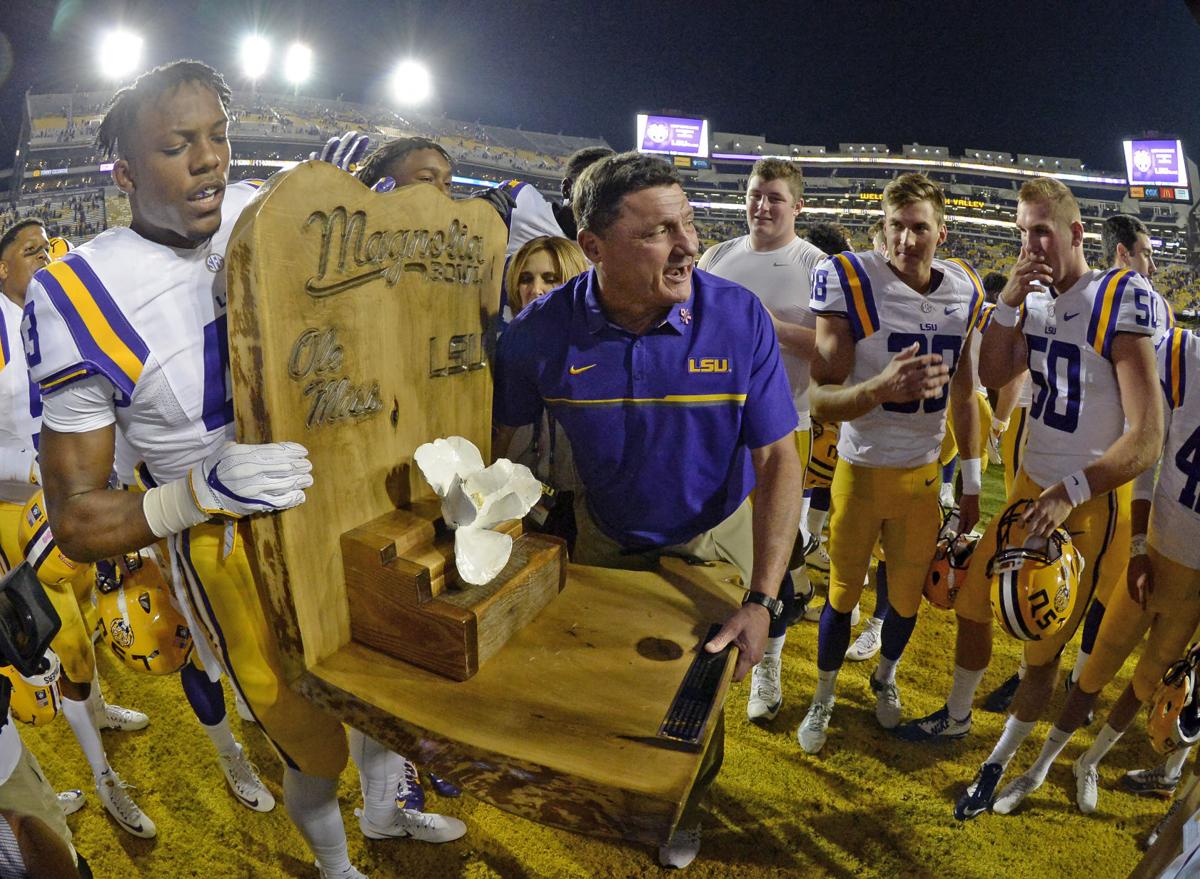
The game between LSU and Ole Miss is known as the Magnolia Bowl, and the winner receives the Magnolia Bowl Trophy. As previously mentioned, the best-known game was the 1959 contest with Billy Cannon's heroics. They first played in 1894, and LSU leads the series 61-41-4. LSU has won not only the 2016 and 2017 games, but 12 of the last 16.
Oddly, Ed Orgeron, who succeeded Miles as head coach at LSU in 2016, was previously head coach at Ole Miss from 2005 to 2007.
Ed Orgeron and players with the Magnolia Bowl Trophy
Ironically, LSU's most famous athlete may not be a football player, but a basketball player. Having played for them, under his father, LSU head coach Press Maravich, from 1968 to 1970, Pete Maravich set NCAA records that still stand for most career points and highest career points per game average -- despite there then being no 3-point rule, no shot clock, and no freshman eligibility (meaning that he scored all those points in 3 years, not 4).
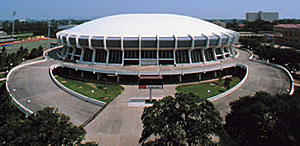
Maravich starred in the NBA, too, but injuries cut his career short in 1980. After his death in 1988, LSU's 13,215-seat Louisiana State University Assembly Center, opened in 1972 -- nicknamed the Deaf Dome, but it could be called "The House That Pistol Pete Built" -- was renamed the Pete Maravich Assembly Center. But he doesn't have a statue there. Who does? The other candidate for the title of the most famous LSU athlete: Shaquille O'Neal.
The Assembly Center is across North Stadium Road from the north end zone of Tiger Stadium. Elvis Presley sang there on June 17 and 18, 1974; July 2, 1976; and May 31, 1977.
Aside from the preceding, notable LSU athletes include:
* Basketball: Bob Pettit, Mahmoud Abdul-Rauf (still using his birth name of Chris Jackson while at LSU), Glen "Big Baby" Davis and Ben Simmons.
* Baseball: Paul Byrd, Mike Sirotka, Todd Walker, Brian Wilson (the reliever with the big beard, not the Beach Boy), Alex Bregman and Aaron Nola.
* Wrestling: Kevin Jackson, Olympic Gold Medalist in 1992, now the head coach at an even bigger college wrestling program, Iowa State.
Stuff. The LSU Sport Shop is on North Stadium Road, across from Tiger Stadium's northwest corner. The LSU Bookstore is at 2 Union Square, at Highland Road and Raphael Semmes Road, across Highland from the Student Union, about a 10-minute walk east of Tiger Stadium.
Chet Hilburn wrote
Legendary Tiger Stadium: The Thirty Greatest LSU Football Games, an update of his book
The Mystique of Tiger Stadium: 25 Greatest Games: The Ascension of LSU Football. This is probably as close as we can get to a definitive history of the program. In 2007, the DVD
Fields of Glory: LSU Tiger Stadium was released.
During the Game. LSU football games tend to come in 2 categories: Day games against teams that are rivals of LSU's, or night games. Neither, when mixed with Southern football, sounds like a safe combination.
However, there is also the concept of Southern hospitality. and LSU fans are Louisianans. Due to the multiracial and multiethnic nature of the State, they have to get along, and, with the help of their teams -- LSU, the Saints and the Pelicans -- they do. They have no interest in starting violence. Be nice to your hosts, and don't root for the visiting team, and you should be fine.
ESPN.com and
The Sporting News have both, in recent years, rated LSU as the best tailgate party school in the country. So if you drive down, and are willing to tailgate, be willing to share, and others will be, too. Tailgating is, as at many other Southern schools, practically a sacrament. So is drinking. As radio talk show host Buddy Songy said, "There's no alcohol allowed in Tiger Stadium, but beware of funny-looking radios." (He means "flasks disguised as other objects.")
Like a few NFL teams, including the Philadelphia Eagles, the Washington Redskins and the Dallas Cowboys, LSU usually prefers to wear their white jerseys at home, instead of their solid color, purple. This started in 1958, when Paul Dietzel realized that Georgia Tech, then also in the SEC (now in the ACC) had been doing it (and is one of the few other college teams that still does), so he ordered white jerseys for his players for home games. Since they won the National Championship, the tradition stuck.
Until 1983, when the NCAA made a new rule requiring teams to wear their solid color jerseys at home. In 1995, new LSU coach Gerry DiNardo lobbied the NCAA Football Rules Committee to drop the rule. They did, and in their 1st game allowed to wear white again, LSU, then unranked, beat Auburn, then ranked Number 6.
In addition, Tiger Stadium is unusual in that the field has yard markers every 5 yards, not just every 10 like most football fields do.
"Mike the Mascot" -- not "Mike the Tiger."
LSU has 2 Tiger mascots, a guy in a costume, and a live Tiger mascot in a cage, both named Mike. Since 1936, a series of Bengal tigers named Mike, after LSU trainer Mike Chambers, has been used. The 1st Mike lasted until 1956, having survived, among other things, being kidnapped and spray-painted green by Tulane students. After his death, he was stuffed and mounted, and put on display at the LSU Museum of Natural Science, at Murphy J. Foster Hall, 119 Dalrymple Drive, about a 5-minute walk northeast of the stadium.
Mike VI died of cancer last year, but, knowing that he didn't have long, the University got a replacement that would grow to adulthood before the next season. Mike VII debuted this past August, and, like his predecessor, is a Bengal-Siberian mix. Mike the Tiger's Habitat (read: "Cage") is on the north side of North Stadium Road, between the Stadium and the Assembly Center.
Mike VII in his Habitat, with Tiger Stadium in the background
Before every game, the players, coaches and cheerleaders walk down Victory Hill on North Stadium Drive. They used to bring Mike with them in his purple trailer, but now they leave him in his Habitat, and pass it. Thousands of people line the road to watch this variation on the tradition of college football players walking into their stadium.
The Louisiana State University Tiger Marching Band Pregame Show was created in 1964. The Band, a.k.a. The Golden Band from Tigerland, lines up along the end zone shortly before kick off. Then the band strikes up a drum cadence and begins to spread out evenly across the field. When the front of the band reaches the center of the field, the band stops and begins to play an arrangement of "Tiger Rag," the song better known by its chorus of "Hold That Tiger." While it does this, the band turns to salute the fans in all four corners of the stadium. Then the band, resuming its march across the field, begins playing "Touchdown for LSU."
The Golden Band from Tigerland
is now fully race-and-gender-integrated.
Before kickoff, the public address system plays "Callin' Baton Rouge" by Garth Brooks. After every new 1st down, the band plays "Tiger Rag," and the fans shout, "Go, Tigers!" In the French tradition of Louisiana, it gets spelled, "Geaux Tigers" on bumper stickers, T-shirts, etc.
In 2012, a new tradition was established: When LSU wins, the lights that illuminate the upper arches on the stadium's north end light up. They call it "Victory Gold."
After the Game. New Orleans has had a crime problem for almost 300 years. But Baton Rouge is not New Orleans. You, and your car if that's how you came down, should be safe.
You would think there'd be lots of good places to eat nearby, but there aren't. You might have to go to Highland Road, northeast of the stadium, to find chain restaurants, including fast food. Or, you could go about 3 blocks south of the stadium, and find Walk-On's Bistreaux & Bar, at 3838 Burbank Drive. Bogie's, at 705 E. Boyd Drive, and Reggie's, at 1176 Bob Pettit Blvd., are also well-known LSU bars. (Before Shaq and Pistol Pete, 1950s NBA legend Pettit was the most familiar name from LSU basketball.)
If your visit to Baton Rouge is during the European soccer season, which we are now in, there's no place all that close that shows games. Ivar's Sports Bar & Grill is 2 miles northeast of Tiger Stadium, at 2954 Perkins Road. The Londoner is even farther, 10 miles east at 4215 S. Sherwood Forest Blvd. So unless you've got a car, I would say forget about seeing your club on TV, unless they play in the morning and LSU plays at night, or you're staying overnight and they play on Sunday.
Sidelights. History? Atmosphere? Sports? Debauchery? N'Awlins has got it all. But Baton Rouge is not New Orleans: It's got about one-quarter of the spirit, and about 1/100th of the history. Indeed, the only professional sports teams in Louisiana are in New Orleans and its suburbs, and that's 80 miles to the southeast. These include the closest NFL team, the Saints; and the closest NBA team, the Pelicans.
The closest Major League Baseball team to Baton Rouge is the newly-crowned World Champion Houston Astros, 269 miles to the west. Houston is also home to the closest MLS team, the Dynamo. There is no professional soccer team in town. The closest NHL team is the Dallas Stars, 430 miles to the northwest.
According to
an April 2014 article in The New York Times, the Yankees are the most popular baseball team in Baton Rouge, with about 20 percent of locals calling them their favorite team. The Red Sox are 2nd, with around 15 percent. The Atlanta Braves are 3rd, getting around 10 percent.
In addition to the Assembly Center, Elvis sang in Baton Rouge early in his career, in 1955, at Baton Rouge High School (2825 Government Street) on May 2, and at the Plaquemine Casino Club (I can't find an address, or any mention of whether the building still stands) on July 1.
In addition to the aforementioned LSU Museum of Natural Science, Baton Rouge also has the Louisiana Art and Science Museum, downtown at 100 River Road South; and the Capitol Park Museum, also downtown, at 660 N. 4th Street.
There are 5 colleges in Louisiana that are in the NCAA Division I Football Bowl Subdivision (FBS), what used to be called Division I-A. There's LSU in Baton Rouge, Tulane in New Orleans, Louisiana Tech in Ruston, the University of Louisiana at Lafayette (known as the University of Southwestern Louisiana until the creation of the UL system in 1999), and the University of Louisiana at Monroe (formerly Northeast Louisiana University).
UPDATE: On
November 19, 2018,
Moneywise compiled
a list of their
Worst
College Football Stadiums, the bottom 19 percent of college football, 25 out of 129. Louisiana-Monroe was ranked 6th, and Louisiana-Lafayette 12th.
And there are 7 schools in the State that are the NCAA Division I Football Championship Subdivision (FCS), what used to be called Division I-AA. One is the private and Catholic University of New Orleans.
Four are public universities and, before the Civil Rights Movement, were all-white schools: Nicholls State University in in Thibodaux, McNeese State University in Lake Charles, Northwestern State University in Natchitoches, and Southeastern Louisiana University in Hammond. These 4, and UNO, are all in the Southland Conference.
Then there are the 2 historically black colleges and universities (HBCUs) in the Southwestern Athletic Conference (SWAC), which are arch-rivals due to the North-South divide in Louisiana, and meet every Saturday after Thanksgiving in the Bayou Classic at the Superdome: Grambling State University in Grambling, near Ruston; and Southern University in Baton Rouge.
Grambling (most people don't add the "State") was coached by Eddie Robinson from 1941 to 1997, and he won more games as a Division I head coach than anyone, before being surpassed by J-- P------ of P--- S----. He led them to 9 black college National Championships: 1955, 1967, 1972, 1974, 1975, 1977, 1980, 1983 and 1992.
More importantly, he almost singlehandedly made black college football something white professional coaches had to pay attention to, producing players like Paul "Tank" Younger, Willie Davis, Ernie Ladd, Buck Buchanan, Willie Brown, Gary "Big Hands" Johnson, Charlie Joiner and Doug Williams, who ended up succeeding him as head coach.
Subsequent coaches have added National Championships in 2000, 2001, 2002, 2005, 2008 and 2016, for a total of 15. In 1983, they replaced the old 18,000-seat Grambling Stadium with the more modern 19,600-seat Eddie Robinson Stadium. Ballock Street in Grambling, about 65 miles west of Shreveport, 217 miles northwest of Baton Rouge, and 296 miles northwest of New Orleans. (It's actually closer to Dallas than New Orleans: 250 miles to the east of Big D.)
Southern has won the black college National Championship 11 times: 1948, 1949, 1950, 1954, 1960, 1975, 1993, 1995, 1997, 1998 and 2003. Their contributions to the NFL include Rich "Tombstone" Jackson, Mel Blount, Harold Carmichael and Aeneas Williams.
They play ace the 28,500-seat Arnett W. Mumford Stadium. ("Ace" Mumford was their coach from 1936 to 1961, even before Eddie Robinson arrived at Grambling.) Swan Avenue & Robert Smith Blvd., 7 miles north of downtown Baton Rouge. Bus 70.
Louisiana has never produced a President. As a young man, Zachary Taylor lived in St. Francisville, 32 miles north of Baton Rouge and 112 miles northwest of New Orleans. But he's much more identified with Virginia, where he was born; and Kentucky, where he lived the last few years of his life.
But the State's greatest political icon remains Huey Pierce Long Jr., elected Governor in 1928. He built the 450-foot State Capitol, the city's tallest building, in the Art Deco style at 900 N. 3rd Street, opening in 1932, as he was leaving the Governorship to accept the U.S. Senate seat he'd won.
On June 13, 1935, this most colorful of colorful Southern politicians set a record (later broken by Strom Thurmond of South Carolina, in a vain attempt to stop the Civil Rights Act of 1957) for the longest filibuster in Senate history, 15 hours and 30 minutes. He was trying to require Senate confirmation of the National Recovery Administration's senior employees, so that his opponents in Louisiana's Democratic Party (the Republican Party was next to nothing in the South in those days) wouldn't get those jobs without what we would now call "extreme vetting."
He kept the filibuster going by, among other things, reading recipes, including his own, at one point famously intoning, "Now, I come to pot likker... " That's how it's spelled in
The Congressional Record. More frequently spelled "pot liquor," a.k.a. "collard liquor," it's the liquid that is left behind after boiling greens or beans. It doesn't sound like much, but it's actually very nutritious.
Originally a supporter of President Franklin D. Roosevelt, he soured on him, and thought that, with the Great Depression still going, his "Share the Wealth" platform would appeal to people who would be souring on FDR for re-election in 1936. Huey, nicknamed the Kingfish, liked to say, "Every man a king, but no man wears a crown." His critics said, "Except for Huey."
But he never got the chance to run for President: On September 8, 1935, he was assassinated outside the State Capitol he had built, but the nephew of a judge Long had fired. His bodyguards fired 60 shots, and the assassin died instantly. Huey hung on for 2 days. His last words were either, "God, don't let me die, I have so much to do," or, "I wonder what will happen to my poor university boys." (Given his ego, it was probably the former. LSU fans would probably prefer that it was the latter.) He was only 42 years old, and was buried on the Capitol grounds.
The Long family has a, well, long history in politics. Huey's wife Rose was appointed to the unexpired term of his Senate seat. His brother George moved to Oklahoma and was elected to their State House of Representatives, then moved back to Louisiana and was elected to Congress. Another brother, Earl, served 3 separate terms as Governor, then lost his last bid for re-election when he left wife Blanche (who served as a Democratic National Committeewoman) for the famous stripper Blaze Starr, as seen in the movie
Blaze. (Lolita Davidovich had the title role, and Paul Newman played Earl.)
Huey and Rose's son Russell was elected to the Senate in 1948, and served 6 terms, until 1986. Huey's cousin Gillis served in Congress from 1963 to 1985, and his widow Catherine was elected to serve out his last term. Another cousin, who was actually born with the name of Speedy Oteria Long, also served in Congress. Gerald Long, a 3rd cousin of Huey, Earl and George, is the only member of the family currently in public office, in the State Senate.
Blaze, based on Starr's memoir, is easily the most famous movie set in Baton Rouge, unless you count the movies based on Robert Penn Warren's 1946 novel
All the King's Men, whose Governor Willie Stark was, despite Warren's protestations, clearly based on Huey. It was filmed in 1949 with Broderick Crawford, and in 2006 with Sean Penn.
Several TV shows have been set in Louisiana, most of them in New Orleans.
Duck Dynasty, a "reality" show, is based in West Monroe, in the northern part of the State, far from New Orleans or Baton Rouge.
True Detective and
Queen Sugar filmed in several places in the State. In fictional towns,
True Blood was set in Bon Temps, and the
Scream films were set in Lakewood.
*
Louisiana State University is one of the defining places in the college football experience. It may have taken Hurricane Katrina for the New Orleans Saints to mean more to people in Louisiana than the LSU Tigers do. But it's still a special football program, and well worth a visit.