Showing posts with label rick rhoden. Show all posts

Wednesday, March 26, 2014

Miami's All-Time Baseball Team

Considering how much talent is in Florida from Tampa and St. Petersburg on north, it's a little surprising that South Florida isn't nearly as loaded. In fact, it's particularly weak in pitching, aside from an ace who is still the best lefthanded pitcher I've ever seen -- and another who could have been, if only.

Which reminds me of another really good lefty, Mike Cuellar. Which reminds me that, no, if a player grew up in Cuba and then lived in or around Miami after Castro took over, you can't count him for this team. Not Cuellar, not Luis Tiant, not Pedro Ramos. They have to have grown up, or at least played high-school ball, south of Lake Okeechobee.

Which would qualify Jose Canseco, born in Havana but grew up in Miami and attended the city's Coral Park High School. But for admitting his steroid use, frankly, I don't care what he achieved, he ain't gettin' on this list.

It would also qualify Rafael Palmeiro, born in Havana but grew up in Miami and attended the city's Andrew Jackson High School. Not that Palmeiro is going to make this team: For using steroids, and then so forcefully lying about it, he can take his 132 career OPS+, his 3,020 hits, his 569 home runs, and his 1,835 RBIs, and stick 'em all where he stuck his needle.

And then there's Alex Rodriguez, born in New York, but grew up (for want of a better choice of words) in Miami, attending Westminster Christian H.S. and the University of Miami. The debate I had in my head (a rough place, I know) was both whether to put A-Rod on any list (because of steroids) and where -- not just what city, but what position, shortstop or 3rd base.

But after getting the biggest PED-related suspension ever, marking the 2nd time he's been caught using steroids (or so they say), I've had enough of him, and am dropping him from this team. Meaning I need a new starting 3rd baseman.

18. Miami's All-Time Baseball Team

To be eligible, a player has to have been trained to play baseball in one of the following Counties in the State of Florida: Broward, Collier, Dade, Lee, Martin, Monroe, Palm Beach and St. Lucie. 

I'll start this team with a 1st baseman who, unlike Palmeiro, was naturally big, and didn't need steroids to hit home runs for the Baltimore Orioles. And he didn't need the bandbox that is Oriole Park at Camden Yards, either.

1B John "Boog" Powell of Key West. He may not be as easily associated with the southernmost point in the Lower 48 States as Ernest Hemingway and Jimmy Buffett, but his hitting was as intense as the former's writing, and his personal style is as relaxing as the latter's songs.

The 4-time All-Star was very nearly the Most Valuable Player of the American League in 1966 and '69, before winning it in '70. The Orioles won Pennants all of those years, and in '71, and also had a near-miss in '64 and AL Eastern Division titles in '73 and '74. He hit 339 home runs and had 3 100-RBI seasons and a career OPS+ of 134. Despite his size, he held his own among the great fielders on that Baltimore squad.

Since the opening of Camden Yards in 1992, he has run Boog's Barbecue on the Eutaw Street promenade between the right-field stands and the B&O Warehouse, starting a trend of ex-stars hosting barbecue stands at new ballparks that now includes Greg Luzinski in Philadelphia, Gorman Thomas in Milwaukee, Manny Sanguillen in Pittsburgh and Randy Jones in San Diego (plus Luis Tiant at the not-at-all-new Fenway Park).

If Boog could hit 303 home runs while playing his home games at Memorial Stadium (he hit 36 after leaving the O's), what could he have done in that bandbox on the Inner Harbor?

2B Robby Thompson of West Palm Beach. He finished 2nd in the National League's 1986 Rookie of the Year balloting to Todd Worrell, was an All-Star twice and a Gold Glove winner once, and hit 238 doubles despite playing the equivalent of just 9 full seasons. He led the NL in triples in 1989, helping the San Francisco Giants win their 1st Pennant in 27 years.

SS Bucky Dent of Hialeah. Okay, he'll never be considered a heavy hitter. But he got hits when they mattered, particularly between October 2 and 17, 1978, when he saved the Yankees' bacon in the AL East Playoff with the Red Sox and was the MVP of the World Series against the Dodgers. And he was a really good fielder, forming a fantastic double-play triad with Willie Randolph and Chris Chambliss.

Whatever they call him in New England, the man born Russell Earl O'Dey will always be Bucky Blessed Dent to me.

3B Lenny Harris of Andrew Jackson H.S. in Miami. A classic utility player, only once was he a regular starter (at 3rd base with the 1991 Los Angeles Dodgers, who nearly won the NL West). But over his 18-year career, he played every position except catcher: 485 games at 3B, 300 at 2B, 161 in RF, 157 in LF, 87 at 1B, 52 at SS, 3 in CF, and he even pitched a scoreless inning for the Cincinnati Reds in 1993.

He reached the postseason with 4 different teams, the 1995 NL Central Champion Reds, the 1999 NL West Champion Arizona Diamondbacks, the 2000 NL Champion Mets, and for his (eventual) hometown team, the 2003 World Champion Florida Marlins (his only ring).

Despite being a somewhat chunky utility player, he stole 131 bases. He is the all-time leader in pinch hits with 212, and is now a coach in the Marlins' system. Current Oriole hot-corner man Manny Machado might replace him on this team someday, but it's a little soon for that.

LF Mike Greenwell of Fort Myers. Ted Williams, Carl Yastrzemski, Jim Rice, Mike Greenwell, Manny Ramirez... As they used to sing on Sesame Street, "One of these things just doesn't belong here." (Yeah, and it's Manny, who couldn't field, looked ridiculous, and used steroids.)

While Greeny may have been only the 5th-best left fielder in Red Sox history (if anyone is old enough to remember Duffy Lewis and wants to bump him ahead of Greenwell, be my guest), he was a 2-time All-Star who came up as a late-season callup in the 1986 Pennant season, and helped them reach the postseason in 1988, '90 and '95. He batted .303 lifetime with a 120 OPS+, before injuries cut his career short at age 32.

In 1988, when the Red Sox won the AL East, he batted .325, hit 22 homers and had 119 RBIs, and finished 2nd in the AL MVP voting to Jose Canseco. When Canseco admitted his steroid use, Greenwell demanded that Canseco forfeit the MVP. So far, Canseco has refused. Greenwell is right, and for me to stick up for a Red Sock says a lot.

Honorable Mention to Warren Cromartie of Andrew Jackson H.S. in Miami. When he got good, starting in 1977 at age 23, the Montreal Expos got good. His hitting and fielding kept them in the NL East race every year through 1983, including the 1981 Division title. When Reggie Jackson's 1977 World Series performance led to the introduction the next season of the Reggie Bar, Cro joked that he wanted a candy bar, too. He got it: The CroBar, almonds in chocolate. It was sold at the Montreal Olympic Stadium, with the proceeds going to the Juvenile Diabetes Foundation.

But, in a precursor to the economic conditions – or, perhaps, to the attitude toward them – that would led the Expos to leave Montreal, they didn't offer him a new contract, and at age 30 he went to Japan and signed with that country’s most successful team, the Tokyo-based Yomiyuri Giants. In 1989, he was named MVP of Japan's Central League. He had a brief U.S. comeback with the Kansas City Royals in 1991, batting .313 as a 37-year-old pinch-hitter. A lifetime .281 hitter in the North American major leagues, he deserved better.

He now hosts a talk show on Miami all-sports radio station WAXY, and founded the Montreal Baseball Project, a group trying to get MLB back in the city -- ironically, considering it was Jeffrey Loria who ultimately led to the Expos getting moved when he stripped the organization and essentially moved its business operations to... Miami, when he bought the Marlins.

CF John Milton "Mickey" Rivers of Miami. Roger Kahn, one of the most literary-minded of all sportswriters, once noted the name of the epic poet of 17th Century Britain, and wrote that Mick the Quick "may be the only man named John Milton who has never heard of Paradise Lost."

But he stole 75 bases for the California Angels in 1975, and was obtained by the Yankees to be their new center fielder and leadoff hitter. In 3 full seasons in Pinstripes, he won 3 Pennants and 2 World Series. His .326 batting average led the 1977 World Champions, and he got all kinds of big hits for the Bronx Bombers, particularly against the Red Sox in the regular season and the Royals and Dodgers in the postseason. And that speed made him one of the finest defensive outfielders of his time.

Like his fellow Yankee Legends Casey Stengel and Yogi Berra, he said a lot of things that suggested he was walking a fine line between genius and madness, but ain't no sense worryin' about that.

Somewhat Honorable Mention to Deion Sanders of Fort Myers. We'll never know what "Prime Time" could have done if he'd stuck with baseball, although he was certainly better off trying to play both that and football than Bo Jackson turned out to be.

It's hard to believe, but he started out as a Yankee. (I wonder what George Steinbrenner thought of his off-the-field dress.) He played for the Atlanta Braves in their 1991 and '92 Pennant-winning seasons and in the 1992 World Series, alternating with the Falcons, Atlanta's NFL team, which he also helped to reach the Playoffs. That 1992 season was his best in baseball, batting .304 with 8 homers, 28 RBIs and 26 steals, and leading the NL with 14 triples in only 97 games.

On January 29, 1995, he played for the San Francisco 49ers in Super Bowl XXIX, topping Jackie Jensen and Chuck Essegian (who had played in the World Series and the Rose Bowl) by became the 1st (and still only) man to play in both the World Series and the Super Bowl (but only winning the latter). But after 1995, he would play in only 2 more major-league seasons.

He'll never be in the Baseball Hall of Fame, but he's now in the College Football and Pro Football versions. He's also a member of the Falcons's Ring of Honor, but not yet the Cowboys' version.

RF Andre Dawson of Southwest H.S. in Miami. He finally got elected to the Hall of Fame on his 9th try, and that was at least 6 too many. It hurt him -- in more ways than one -- to play his 1st 10 full seasons in Montreal, a city where baseball is the 3rd sport behind hockey and Canadian-style football, in a flying saucer they call the Olympic Stadium, with its rock-hard astroturf that wrecked his knees. 

Then came 8 seasons in real ballparks in actual "baseball cities," 6 at Wrigley Field in Chicago and 2 at Fenway Park in Boston, where he burnished his legend (I know, that sounds dirty), before closing his career with 2 seasons with his hometown Marlins.

"The Hawk" was NL Rookie of the Year in 1977, and MVP in 1987, leading the League with 49 homers, most in the NL between 1977 and 1998 (remember, at Wrigley, the wind blows out half the time and in the other half), and 137 RBIs. He was an All-Star and a Gold Glove winner 8 times each, and finished his career with a 119 OPS+, 2,774 hits, 503 doubles, 438 homers, and 314 stolen bases. The only players with at least as many stolen bases as Dawson who had more homers than he did are Willie Mays, Barry Bonds and Alex Rodriguez. And only Mays did it honestly.

How could anyone say this guy didn't belong in the Hall? If he'd spent his entire career in Chicago, or at least the time he spent with the Expos and Cubs combined being all with the Cubs, he would've been in sooner. Unfortunately, while he played in 2 NLCS, in with the 1981 Expos and the 1989 Cubs, he never reached the World Series.

On a personal note, on August 2, 1991, I was at Shea Stadium to see the Mets play the Cubs. The game went to extra innings, and Dwight Gooden was lifted after 9 strong. The reliever, Alejandro Pena, served one up, and Ryne Sandberg hit it into the Picnic Area, and 35,361 people got up to leave. (I guess Bud Harrelson, then managing the Mets, should've foreseen Lady Gaga: "Don't call my name, Alejandro." Pena would soon go to the Braves and give up the winning run in the World Series.) I turned back, as I so often do when leaving a stadium or arena, to get one last look (hey, you never know), just in time to see Andre Dawson crank one to dead center for the final score of Cubs 4, Mets 2.

And on May 14, 1994, I was in Boston, and saw Dawson hit a grand slam practically onto the Mass Pike, giving the Red Sox the lead in what turned out to be an 11-2 demolition of the Toronto Blue Jays. Why was I at these games? Those are stories for another time.

Honorable Mention to Dante Bichette of West Palm Beach. It's true that 201 of his 274 career home runs came while playing home games at altitude for the Colorado Rockies, but he also had seasons of at least 15 homers for the Angels, Brewers and Reds, none of whom played in hitters' parks. And he did have a .299 lifetime batting average, leading the NL in hits twice, 1995 and 1998.

Honorable Mention to Danny Tartabull of Carol City. Born in Puerto Rico as the son of Cuban-born right fielder Jose Tartabull (best known for a throw he made that sealed a win in the Red Sox' 1967 "Impossible Dream" season), he grew up in the Miami area and had a 133 career OPS+ with 5 100-RBI seasons and 262 homers despite playing the bulk of his career at Royals Stadium in Kansas City (now Kauffman Stadium and always a pitchers' park) and Yankee Stadium (great for lefty hitters but terrible for righthanders like Danny).

He was a member of the 1994 Yankees that had the best record in the AL when the strike hit, but was traded a year later for Ruben Sierra, who was traded a year after that for Cecil Fielder.

Unlike his father, Danny never played in the postseason. However, he did appear on Seinfeld, as did fellow Yankees Derek Jeter, Bernie Williams, Paul O'Neill and manager Buck Showalter (and, in a scene that never made it to air, George Steinbrenner), and ex-Met Keith Hernandez.

C Mike Napoli of Pembroke Pines. Now the 1st baseman for the defending World Champion * Red Sox, he previously reached the World Series with the 2011 Texas Rangers, and before that the postseason with the Los Angeles Angels of Anaheim. He's hit a least 20 homers in each of the last 6 seasons, and has a career OPS+ of 127.

Honorable Mention to Mike Stanley of Fort Lauderdale. After 6 years as a backup with the Texas Rangers, including catching Nolan Ryan's 7th no-hitter, he came to the Yankees, and was a big part of their revival that began in 1993. He batted .300 in 1993 and 1994, and was named an All-Star in 1995, as the Yanks finally made the Playoffs again.

Then, in a move that seemed to make no sense at the time, they let him go via free agency -- and he signed with the Red Sox, who had won the AL East that year! But the Yanks got Joe Girardi, and then Jorge Posada, and the rest is history.

The Stanley Steamer came back to the Yankees in 1997, and made the Playoffs again. Then he went back to the Red Sox, and helped them to the Playoffs in 1998 and '99, closing his career with the 2000 Oakland Athletics, another Playoff team. Despite playing big chunks of his career in ballparks unfriendly to righthanded hitters, he hit 187 home runs and had an OPS+ of 117.

Honorable Mention to Charles Johnson of Fort Pierce. He's here for his defense, winning 4 Gold Gloves. His best season with the bat was 2000, .304, 31 homers, 91 RBIs. He helped his hometown Marlins win the 1997 World Series, but was done at age 33. Injuries? Yes. Steroid-induced? Almost certainly not.

SP Steve Carlton of North Miami. In 1967, he helped the St. Louis Cardinals win the World Series. In 1968, he helped them win another Pennant. In 1971, he went 20-9. In 1972, Cards owner Gussie Busch offered him a contract for the season worth $50,000. Carlton wanted $60,000. Busch, a billionaire through his beer company, blew his stack over being asked to fork over an extra $10,000, and traded Carlton to the Philadelphia Phillies for Rick Wise.

Now, Wise was a good pitcher, but the Cards got rid of him too soon as well. That's why this was a bad trade: They didn't get what they could have out of the guy they got, and it was their fault, not his, and lost one of the greatest lefthanded pitchers ever, all over $10,000 -- even then, not an enormous amount.

In that 1972 season, Carlton went 27-10. The rest of the Phils' staff went just 32-87. Carlton also had a 1.97 ERA, and won the first of 4 Cy Young Awards (he was the first to win that many). When Carlton pitched, he told the Phils, "It's Win Day." He had 329 win days in his career, more than any lefthander ever except Warren Spahn, and an ERA+ of 115.

In 1983, he and Nolan Ryan vied to become the all-time strikeout leader. Ryan beat Carlton to Walter Johnson's longtime record of 3,508, but for a while, Carlton had the lead, until Ryan pulled away. Still, Carlton was the 2nd man to get to 4,000 strikeouts, finishing with 4,672. He reached the postseason 8 times, and helped the Phillies win the 1980 World Series (winning Game 2 and the clinching Game 6) and the 1983 Pennant.

He didn't talk to reporters -- in 1981, a joke went around that Steve Carlton and Fernando Valenzuela were the 2 best pitchers in baseball and neither of them spoke English -- but his pitching spoke volumes. He is in the Hall of Fame, and the Phillies have retired his Number 32, elected him to the Philadelphia Baseball Wall of Fame, and erected a statue of him outside Citizens Bank Park. When The Sporting News announced its 100 Greatest Baseball Players in 1999, he came in at Number 30.

SP Fred Norman of Andrew Jackson H.S. in Miami. His career record was just 104-103, but he went 24-11 over the Cincinnati Reds' 1975 and 1976 World Championship seasons.

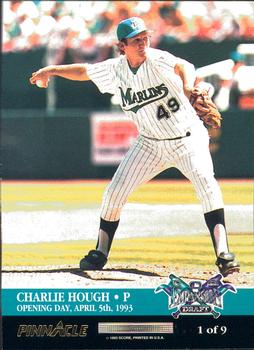
SP Charlie Hough of Hialeah. Actually born in Honolulu, Hawaii, and if I were doing an All-Hawaii team, I might have trouble filling it out – only 38 people born there have reached the majors – but it would have a heck of a good pitching staff, with Hough joined by 1986 Mets Ron Darling and Sid Fernandez (who did both grow up there), and also former Detroit Tiger starter Milt Wilcox (who grew up in Oklahoma).

Hialeah High School, alma mater to Hough and Bucky Dent, also produced Alan Wiggins, the ill-fated 2nd baseman for the Pennant-winning 1984 Padres, Pro Football Hall-of-Famer Ted Hendricks, CNN anchor Rick Sanchez, and singers Jon Secada and Harry Wayne Casey (leader of KC & the Sunshine Band).

Hough's career record is dead-even at 216-216, but he still won 216 games more than most people ever will. He helped the Dodgers win Pennants in 1974, '77 and '78, although he never won a ring, and in '77 he gave up Reggie Jackson's monstrous 3rd homer in Game 6 of the World Series. He spent a few years with good-but-not-great teams with the Texas Rangers and Chicago White Sox, and then came home to South Florida in the 1993 expansion draft.

On April 5, 1993, at Joe Robbie Stadium (now Sun Life Stadium), he started for the Marlins and beat his former team, the Los Angeles Dodgers, in the 1st major league game ever played in Florida -- and since he was the starting pitcher, that officially made him the 1st man ever to play in a major league game in Florida.

Like a lot of knuckleballers, he wore Number 49 to honor Hoyt Wilhelm. Also like a lot of knuckleballers, he lasted a long time, throwing his final pitch at age 46. 

SP Rick Rhoden of Delray Beach. A teammate of Hough's on the Pennant-winning Dodgers of 1974, '77 and '78, he did play for a World Champion -- sort of, being hurt most of the 1979 season and pitching just 1 game, 5 innings, for the eventual World Champion Pittsburgh Pirates.

In 1987, he went 16-10 for the Yankees, and on June 11, 1988, Billy Martin, in his 5th term and last month as Yankee manager, desperate to plug injury-caused holes, batted Rhoden -- a .238 lifetime hitter with 9 career home runs -- 7th as the designated hitter, in a game I saw live. The gamble paid off, as he hit a sacrifice fly to drive in a run, the last of his 75 career RBIs, and the Yankees beat the Baltimore Orioles, 8-6.

He is the only pitcher ever to appear in a game as a DH but not as a pitcher. (His former Pirate teammate John Candelaria started and won that game. Jay Buhner hit a grand slam, but was soon traded for Ken Phelps. But enough about that.) That sac fly was pretty much the last highlight for Rhoden, and the next year was his last in the majors. Still, his 151-125 record was better than Norman's and Hough's.

SP Gio Gonzalez of Hialeah. He'd be the ace of the Washington Nationals without Stephen Strasburg, going 15-9, 16-12, 21-8 and 11-8 the last 4 seasons, including the Nats' 1st-ever NL East title in 2012. He's only 28, but he's already a 2-time All-Star.

Honorable Mention to Herb Score of Lake Worth. Born in Queens but grew up in Palm Beach County, in 1955 he set a rookie record for strikeouts that still stands for the AL. In 1956, he was even better. Prior to the start of the 1957 season, he was 36-19 with 508 strikeouts for the Cleveland Indians, and had just turned 24 years old.

The Boston Red Sox offered the Indians $1 million cash for him -- about $8.3 million in today's money. They turned it down -- not knowing just how much financial trouble the franchise would have over the next 30 years. His future, and the team's, seemed limitless.

On May 7, 1957, his future was limited, when he was hit in the face by a line drive from the Yankees' Gil McDougald. Several bones were broken, and his vision was permanently impaired. Although he insisted that it was a sore arm the following spring that doomed his playing career, we'll forever wonder. He was 19-27 the rest of the way. He won 55 games -- about 250 less than he should have. He could have been the AL's version of Sandy Koufax, a lefty strikeout machine who dominated the 1960s.

He went on to become an Indians broadcaster, staying until their Pennants of 1995 and 1997. He was Northern Ohio's version of Phil Rizzuto, Richie Ashburn, Ron Santo and Joe Nuxhall -- except he was probably better as a player than any of them, but had the least chance to prove it. He is in the Indians' team Hall of Fame.

RP Scot Shields of Fort Lauderdale. Basically a setup man for the Angels, but he helped them reach the postseason in 2002 (World Champions), 2004, 2005, 2007 and 2009. He has a career ERA+ of 140 and a WHIP of 1.246. In Game 3 of the 2005 ALDS, when Randy Johnson spit the very expensive bit for the Yankees, Shields was the winning pitcher in relief of Paul Byrd. He has been terrible this season, though (0-3 with a 5.62 ERA), and at 34 he could be nearing the end of the line.

MGR Dick Howser of West Palm Beach. An All-American shortstop at Florida State University, he became the prototypical good-field-no-hit infielder in the 1960s with the Kansas City Athletics and then the Yankees. An All-Star as a rookie in 1961, batting .280 and stealing 37 bases, that was pretty much his peak as a player.

He became a Yankee coach and got a pair of World Series rings that way. He managed the Yankees to the AL East title in 1980, but resigned when George Steinbrenner insisted he fire some coaches following an embarrassing ALCS loss to the Royals.

But when the Royals fired manager Jim Frey the next season, Howser went back to Kansas City, and got them into the postseason in 1981 (the 2nd-half AL West title in that split season), 1984 (AL West) and 1985 (the only major-league World Championship ever won by a Kansas City baseball team). He managed the AL to victory in the 1986 All-Star Game, but sadly that was his last game. He resigned due to cancer, and died less than a year later.

The Royals made his Number 10 the 1st they ever retired. Florida State named their baseball stadium for him, and both they and the Royals dedicated statues of him outside their ballparks. The baseball equivalent of the Heisman Trophy is the Dick Howser Trophy.

Honorable Mention to Skip Bertman of Miami Beach, who played at the University of Miami, and was an assistant coach there before becoming the head coach of 5 National Championship teams at Louisiana State University: 1991, 1993, 1996, 1997 and 2000.

Finally, an Honorable Mention to all those Cuban-born players who still can't go home, and have taken up residence in Miami, especially the following: Bert Campaneris, Jose Cardenal, Leo Cardenas, Paul Casanova, Tito Fuentes, Tony Gonzalez, the brothers Livan and Orlando "El Duque" Hernandez, Minnie Minoso, Tony Oliva, Camilo Pascual, Tony Perez, Pedro Ramos, Cookie Rojas, Diego Segui, Jose Tartabull, Tony Taylor and Luis Tiant. And to those who died before they could return: Sandy Amoros, Mike Cuellar and Zoilo Versalles.

Sunday, July 21, 2013

Top 5 Reasons You Can't Blame the Yankees for Trading Jay Buhner for Ken Phelps

NOTE: Twelve years after writing this post, aside from the fact that Buhner's Mariner teammate Edgar Martinez has since been elected to the Baseball Hall of Fame, I wouldn't change a word of this post.

July 21, 1988, 25 years ago: The Yankees trade outfielder Jay Buhner, pitcher Rick Balabon, and a player to be named later, who turned out to be pitcher Troy Evers (that part of the trade was completed on the following October 12), to the Seattle Mariners for 1st baseman/designated hitter Ken Phelps.

Let's get the less-renowned players out of the way. Balabon had been a big prospect, but was awful between A-ball and Double-A in 1987. At the time of the trade, he was 21 and looking shaky. He got to Triple-A in the Mariners' system with Calgary in 1991, but never topped 11 wins in the minors, and his control was shot.

Evers had gone 10-1 with a 1.18 ERA for "Short-Season A-ball" Oneonta in 1985, and 13-5 for Class A Fort Lauderdale in 1987. But he'd already missed nearly all of 1986 with an injury, so the Yankees felt they could let him go, without giving much up. He topped out with the Mariners' Double-A team in Williamsport in 1990, going 4-12, got hurt again, and never pitched professionally again except for 1 season in an independent league.

Balabon was 24 and Evers 26 when they threw their last pitches in "organized ball." So, whatever they were (and are) as human beings, as ballplayers, they were no great loss to the Yankees.

The key was Buhner. At the time of the trade, Jay Campbell Buhner was 23 years old, going on 24. He was a righthanded hitter, born in Louisville, Kentucky, and grew up in the Houston suburb of League City, Texas. He had a very good season at Triple-A Columbus in 1987, and had played 7 games for the Yankees late that season. Thus far in 1988, he had come to the plate 76 times for the Yankees, batting .188, hitting 3 home runs, with 13 RBIs.

I was there at the old Yankee Stadium when he hit his 2nd major league home run (I previously thought it was his 1st), a grand slam that gave the Yankees an 8-6 win over the Baltimore Orioles on June 11. From May 15 to July 6, he had been the Yankees' regular center fielder, as Claudell Washington had gone into decline.

It's important to remember that Buhner was righthanded, and that Yankee Stadium (1988 being the 1st season of the outfield distances that it had until it closed, and even that was an improvement over what it had before, and the new Stadium has had those distances since it opened as the replacement) was not conducive to righthanded power hitting. It was much better for lefthanded hitters. With Don Mattingly having a bad back, and other injuries hitting the team, the Yankees needed a good lefthanded DH/pinch-hitter.

At the time of the trade, Kenneth Allen Phelps was 33 years old, going on 34. He was a lefthanded hitter, born and raised in Seattle. He debuted with the Kansas City Royals, having a 3-game "cup of coffee" in their 1980 Pennant season. He played 21 more games for them in 1981, and 10 for the Montreal Expos in 1982, before his hometown Mariners (keeping in mind that they weren't his hometown team while he was growing up, they didn't play their 1st game until he was 22) got him in 1983. By 1988, he had already had 3 seasons of at least 24 home runs, and in his last 2 seasons, he'd gotten 64 and 68 RBIs. These are decent totals.

But his highest batting average at that point was .259 in 1987. He was a one-dimensional player: He didn't really hit for singles, doubles or triples; he didn't hit to the opposite field; he wasn't much of a baserunner, being kind of a chubby guy who stole 10 bases in his entire career; and as for his fielding, well, there's a reason he was frequently a DH. (Well, 2 reasons: The Mariners had a pretty good 1st baseman in Alvin Davis.)
After the trade? Here's what Phelps did for the Yankees: Batted .224 for the rest of 1988, with 10 homers and 22 RBIs; continued to not hit well in 1989, and was traded on August 30 to the Oakland Athletics for Scott Holcomb, a 21-year-old pitcher who hadn't yet reached the majors -- and, as it turned out, never would.

Phelps wouldn't do much for the A's, either, and in 1990 they traded him to the Cleveland Indians, and that was it for him in the majors. Lifetime batting average: .239. Home runs: 123 -- not exactly a big total for a guy known for his power, especially since he played with short right-field porches at the Kingdome and Yankee Stadium.

Here's what Buhner did for the Mariners: 14 seasons, 307 home runs, 4 postseason berths.

The trade loomed pretty large to Yankee Fans who watched the team fall apart in 1989, after 4 years of close-but-no-cigar contention, and begin 4 years of doldrums. Buhner's bat would have been a big help, wouldn't it?

It got worse after the 1995 American League Division Series, when the Yankees lost to the Mariners, with Buhner batting .458 with a homer and 3 RBIs in those 5 games. You'll notice that the Seinfeld episode in which Frank Costanza (played by Jerry Stiller) yells about this trade to George Steinbrenner (Larry David), "The Caddy," aired on January 26, 1996, less than 3 months after that series.

It's been 25 years since The Boss pulled off this moronic trade. How could he do it? How could the Yankees as an organization have let such a stupid thing happen?

Top 5 Reasons You Can't Blame the Yankees for Trading Jay Buhner for Ken Phelps

5. Injuries. Although the Yankees stayed in the AL Eastern Division race most of the way in 1988, they had a bunch of injuries. I mentioned the game in which Buhner hit the grand slam. Here's the lineup the Yankees had on Opening Day that season (April 5, an 8-0 win over the Minnesota Twins):

LF Rickey Henderson
2B Willie Randolph
1B Don Mattingly
DH Gary Ward
RF Dave Winfield
CF Roberto Kelly
3B Mike Pagliarulo
C Joel Skinner
SS Rafael Santana.

Okay, the bottom 2 weren't good hitters -- so bad that they actually batted after a pitcher in the June 11 game. But they were good on defense. And the 1st 7 were all good, either for getting on base or for hitting home runs (or both). Now, here's the lineup for the June 11 game:

3B Wayne Tolleson
2B Bobby Meacham
RF Dave Winfield
1B Jack Clark
CF Jay Buhner
LF Gary Ward
DH Rick Rhoden
SS Rafael Santana
C Joel Skinner

And you thought the 2013 Yankees had issues with injuries. Clark and Ward were both good hitters, but not good fielders, yet neither was the DH in this game. Tolleson and Meacham were both shortstops by trade, yet neither of them is playing his natural position here. Tolleson played shortstop for the Yankees and wore Number 2, but he was no Derek Jeter. Hell, he was no Frank Crosetti. Career OPS+: 66. Meacham wasn't a whole lot better, at 73. And neither fielded anywhere near as well he would have needed to in order to offset his offensive weakness. To be blunt: If Wayne Tolleson and Bobby Meacham are your first 2 hitters, you're in deep trouble.

(To be fair, though, Tolleson stole at least 17 bases in a season 4 times, peaking at 33 in 1983 -- for the Texas Rangers; Meacham stole 25 bases in 1985, and twice led the AL in sacrifice hits, but played his last big-league game later in '88, finished in the majors at age 28.)

In what turned out to be his last masterstroke before being fired as a big-league manager for the final time later that month, Billy Martin put pitcher Rick Rhoden in as the DH, and it worked: He hit a sacrifice fly that got a run home.

But of the 9 starters, 6 were out of position (in bold), and 5 were simply not major league hitters (in italics). Rhoden's career OPS+ of 60 was decent for a pitcher, but his lifetime batting average of .238 and on-base percentage of .253 barely justified his presence in the lineup. But he was healthy, and not the batting disaster that Tolleson, Meacham, Santana and Skinner had become. The only guy in that lineup who could hit and was playing his preferred position was Winfield.

So bringing in a lefty bat with power was necessary. Whereas the Yankees had Winfield, Clark, Ward, and even Henderson to provide power from the right side. (Yes, Henderson: Despite playing most of his career in parks not conducive to righthanded power, he hit close to 300 homers.) For the 1988 Yankees, Jay Buhner was surplus to requirements.

4. Ken Phelps. As I said, at the time of the trade, Phelps had already had 3 seasons of at least 24 home runs, and in his last 2 seasons he'd gotten 64 and 68 RBIs. He had a lefty swing that was tailor-made for Yankee Stadium.

As a Mariners' fan website puts it:

Phelps was known as a very selective batter. He hit for power, struckout often (many on "called" strikes) and walked regularly, leading to a very good on-base percentage. Current Oakland Athletics GM Billy Beane and his vision of “Moneyball" would have loved Phelps if he played in the late 1990's/early 2000's.

If Phelps had been 22 instead of 34, and had started out in the Yankee system, and had tailed off the same way, today he'd be thought of in the same vein as his contemporaries Steve Balboni, Dan Pasqua and Kevin Maas, guys who were great prospects but flamed out quickly. But he was brought in at age 34 (for all intents and purposes), and his reputation was dragged down.

Still, the move was totally justifiable at the time: Trading a righthander who had proven nothing in the majors when you had righthanders who had proven themselves good hitters, for a lefthander who had proven things. The Yankees traded something they didn't seem to need for something that looked like something they did need.

3. Jay Buhner -- in 1988. As I said, he hadn't proven much. He had made a grand total of 99 plate appearances in the major leagues. His batting average as a Yankee was .199; on-base, .255; slugging, .319; OPS+, 58.

That's right: His on-base percentage plus slugging percentage, adjusted for park effects, compared to his contemporaries, was lower than that of his teammate Rick Rhoden, a pitcher. In other words, in 1988, you could be blunt, and say that Jay Buhner stunk; or you could be charitable, and say he wasn't ready for the major leagues.

Well, what about what he did afterward? Huh? The Yankees could have used that, couldn't they?

2. Jay Buhner -- after 1988.  Here's his career totals: BA, .254. OBP, .359. Slugging, .494. OPS, .852. OPS+, 124. Hits, 1,273. Doubles, 233. Triples, 19. Home runs, 310. RBIs, 965.

Decent stats, sure. The fact that his 1995, '96 and '97 HR & RBI stats were 40 & 121, 44 & 138, and 40 & 109 makes it look worse for the Yankees.

But as a wise man once said, Statistics are like bikinis: What they reveal can be great, but what they don't reveal is more important. Let's look beyond those basic stats:

His highest batting average for a single season was .272, in 1993. People who say that Phil Rizzuto doesn't belong in the Baseball Hall of Fame cite his .273 lifetime batting average. Well, Phil Rizzuto had a higher lifetime batting average than "good hitter" Jay Buhner -- and could run, and could field.

Mickey Mantle and Reggie Jackson are Yankee Legends who were criticized for striking out too much. Well, Mickey's highest single-season strikeout total was 126; Reggie's top total as a Yankee wasn't much more, 133; Buhner led the AL in strikeouts in 1996 with 159 and in '97 with 175.

And let's keep in mind: The Yankees were nowhere near contention for the next 4 seasons, 1989 through '92. And the Yankees traded for Jesse Barfield after this. Would Buhner have given the Yankees much more than Barfield at that time? Would having Buhner in those 4 seasons have helped much? I doubt it.

Yeah, but Buhner helped the Mariners reach the postseason 4 times, right? Well, look at his teammates: Ken Griffey Jr., future Hall-of-Famer; Edgar Martinez, nearly a HOFer; Tino Martinez, who was traded away after 1995 but consistently put up All-Star-quality numbers, including in 1995; Alex Rodriguez, you know his story; Mike Cameron, All-Star; John Olerud, wasn't a Mariner for long but played very well for them. And that's not even considering their pitching: Randy Johnson, Aaron Sele, Jamie Moyer, eventually Freddy Garcia. Buhner was never the most, or the 2nd-most, or even the 3rd-most important player on his own team.

And look at Buhner's decline:

1997 Age 33, 665 plate appearances, OPS+ of 132
1998 34, 286, 109
1999 35, 343, 105
2000 36, 430, 127
2001 37, 53 100

Wow, his appearances really dropped. And so did his production. Injuries. And he was famously bald. Steroids? As far as is publicly known, he was clean... but he does fit the profile. Remember, he didn't just go from 430 plate appearances to 53; that 2000 season was the anomaly for Buhner after 1997.

Let's be honest here: If Jay Buhner was the Yankees' right fielder from 1993 to 2001, you know the Yankee Haters would claim that his decline "proves" that he was using performance-enhancing drugs.

Ah, but Buhner wasn't the Yankees' right fielder from 1993 to 2001, was he?

1. Paul O'Neill. If Buhner had been the Yankees' right fielder from 1989 (a year in which Winfield was out the entire way with an injury) through 1992, instead of former Toronto Blue Jay slugger Jesse Barfield (who gave the Yankees 3 decent seasons, but was hurt, and really came to the team at the wrong time in its history), the Yankees wouldn't have traded Roberto Kelly to the Cincinnati Reds for O'Neill. Kelly might well have been traded for somebody -- Bernie Williams was on the way up, and became the Yankees' regular center fielder until 2006 -- but he wouldn't have been traded for O'Neill.
 
Paulie became one of the cornerstones of the new Yankee Dynasty, playing well and doing so consistently, playing while hurt, pushing himself to come through in big moments. No, he wasn't a Hall-of-Famer, but he was a better all-around player than Buhner: He could hit for average (batting .300 6 times), he could hit to the opposite field, he was a decent baserunner (stole double figures 5 straight seasons, including 22 at age 38 in his final season), and he was a much better-fielding right fielder than Buhner.

Nobody says Kelly for O'Neill was a bad trade -- unless, of course, they're a Cincinnati Reds fan, or a major Yankee Hater. So don't think of the 1988 trade as Jay Buhner for Ken Phelps. Think of it as Jay Buhner for Paul O'Neill.

Would you make that trade? I'd make it in a New York minute.
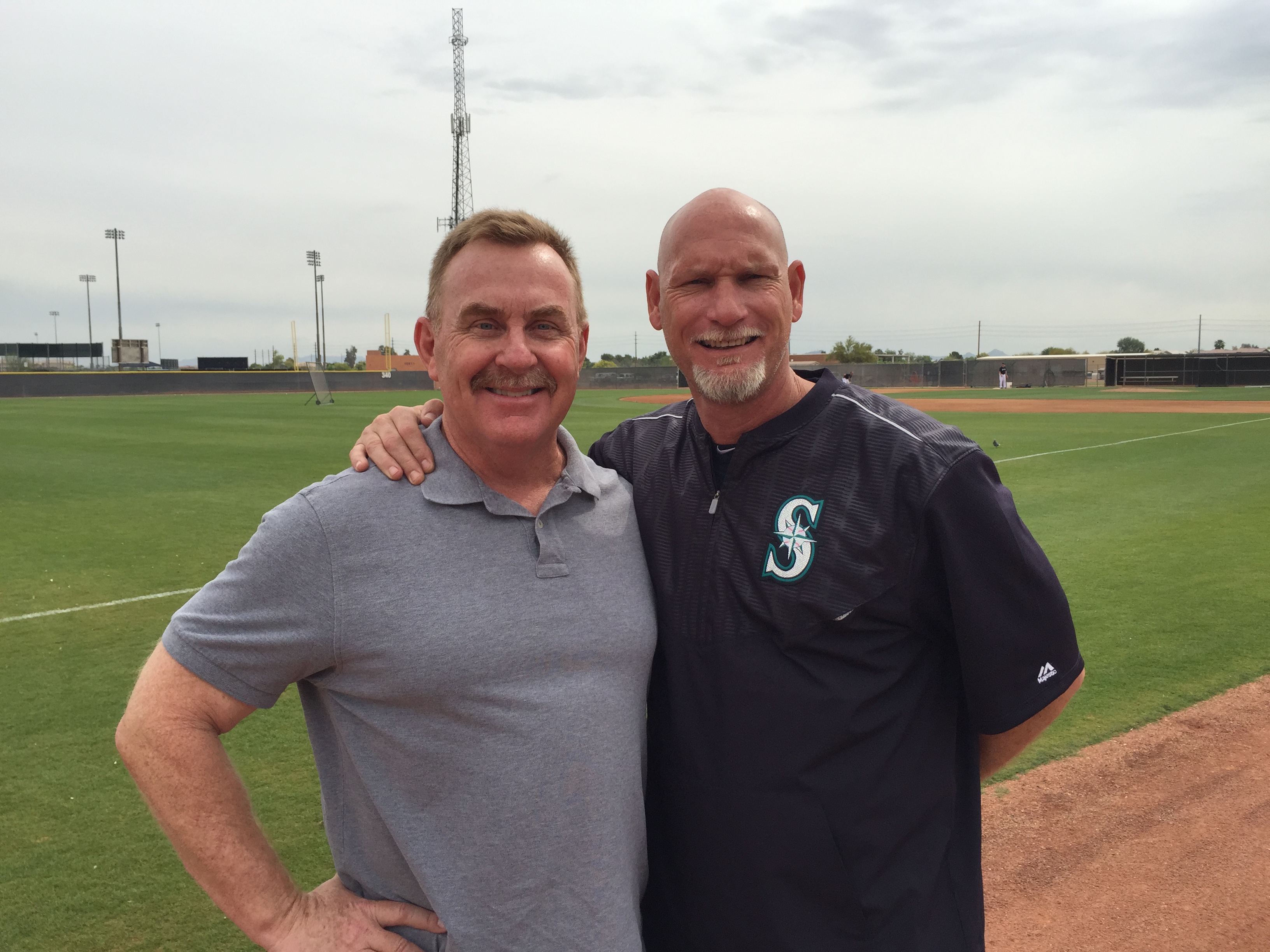
A recent photo of Phelps and Buhner

In case you're wondering: Today, Buhner is still living in the Seattle area, living off his baseball earnings, acting as an official spokesman for a local car dealership, and indulging in his passion for fishing. Can't fault him for any of that. Phelps, who actually is from near Seattle, is living near Phoenix, broadcasting for a minor-league team.

Tuesday, August 24, 2010

Miami's All-Time Baseball Team

Tonight, the Mets start a 3-game series against the Florida Marlins at Citi Field.

Considering how much talent is in Florida from Tampa and St. Petersburg on north, it's a little surprising that South Florida isn't nearly as loaded. In fact, it's particularly weak in pitching, aside from an ace who is still the best lefthanded pitcher I've ever seen -- and another who could have been, if only.

Which reminds me of another really good lefty, Mike Cuellar, which reminds me that, no, if a player grew up in Cuba and then lived in or around Miami after Castro took over, you can’t count him for this team. Not Cuellar, not Luis Tiant, not Pedro Ramos. They have to have grown up, or at least played high-school ball, south of Lake Okeechobee.

Which would qualify Jose Canseco, born in Havana but grew up in Miami and attended the city's Coral Park High School. But for admitting his steroid use, frankly, I don't care what he achieved, he ain't gettin' on this list.

It would also qualify Rafael Palmeiro, born in Havana but grew up in Miami and attended the city's Andrew Jackson High School. Not that Palmeiro is going to make this team: For using steroids, and then so forcefully lying about it, he can take his 132 career OPS+, his 3,020 hits, his 569 home runs, and his 1,835 RBIs, and stick it where he stuck his needle.

I'll start this team with a 1st baseman who, unlike Palmeiro, was naturally big, and didn't need steroids to hit home runs for the Baltimore Orioles. Or the bandbox that is Oriole Park at Camden Yards, either.

Miami’s All-Time Baseball Team

1B John "Boog" Powell of Key West.
He may not be as easily associated with the southernmost point in the Lower 48 States as Ernest Hemingway and Jimmy Buffett, but his hitting was as intense as the former's writing, and his personal style is as relaxing as the latter's songs.

The 4-time All-Star was very nearly voted the Most Valuable Player of the American League in 1966 and '69 before winning it in '70. The Baltimore Orioles won Pennants all of those years, and in '71, and also had a near-miss in '64 and AL Eastern Division titles in '73 and '74. He hit 339 home runs and had 3 100-RBI seasons and a career OPS+ of 134. Despite his size, he held his own among the great fielders on that Baltimore squad.

Since the opening of Oriole Park at Camden Yards in 1992, he has run Boog's Barbecue on the Eutaw Street promenade between the right-field stands and the B&O Warehouse, starting a trend of ex-stars hosting barbecue stands at new ballparks that now includes Greg Luzinski, Gorman Thomas, Manny Sanguillen and Randy Jones (plus Luis Tiant at the not-at-all-new Fenway Park). If he could hit 303 home runs while playing his home games at Memorial Stadium (he hit 36 after leaving the O’s), what could he have done in that bandbox on the Inner Harbor?

2B Robby Thompson of West Palm Beach. He finished 2nd in the National League's 1986 Rookie of the Year balloting to Todd Worrell, was an All-Star twice and a Gold Glove winner once, and hit 238 doubles despite playing the equivalent of just 9 full seasons. He led the NL in triples in 1989, helping the San Francisco Giants win their 1st Pennant in 27 years.

SS Bucky Dent of Hialeah. Okay, he'll never be considered a heavy hitter. But he got hits when they mattered, particularly between October 2 and 17, 1978, when he saved the Yankees' bacon in the AL East Playoff with the Red Sox, and was the MVP of the World Series against the Dodgers. And he was a really good fielder, forming a fantastic double-play triad with Willie Randolph and Chris Chambliss. Whatever they call him in New England, the man born Russell Earl O'Dey will always be Bucky Blessed Dent to me.

3B Alex Rodriguez of Westminster Christian High School in Miami. The debate I had in my head (a rough place, I know) was both whether to put A-Rod on any list (because of steroids) and where. What city? Born in New York, but grew up (for want of a better choice of words) in Miami. What position? Since he is now more identified with the Yankees than with any other team, and will likely have played more games at 3rd than at shortstop by the time he's retired (currently 1,272 at short and 970 at 3rd), this is where he goes.

As of right now, at age 34, he has a .303 lifetime batting average, an OPS+ of 146, 2,644 hits, 472 doubles, 604 home runs, and 1,803 RBIs. He is 3 RBIs away from his 14th 100-RBI season, his 13th in a row. He has led the American League in home runs 5 times, RBIs twice, runs scored 5 times, and batting, hits and doubles once each.

He is a 13-time All-Star, and has won 3 MVP awards, finishing 2nd 2 other times. Believe it or not, his postseason batting average is .302, his postseason OPS .977, with 13 homers and 35 RBIs. He has reached the postseason 8 times (this season will almost certainly make it 9), including 3 times with the Seattle Mariners. He's only played on 1 Pennant winner, but the Yankees would not have won the 2009 World Series without his postseason contributions. He has answered all the questions.

Some people will never forgive him for using steroids for the 3 years that he's admitted, 2001-03, while he was with the Texas Rangers. Many of these same people are willing to overlook the proven steroid use of David Ortiz and Manny Ramirez, and the suspected steroid use of such Yankee nemeses as Curt Schilling, Luis Gonzalez, Ivan Rodriguez and Mike Piazza.

Because he came clean, unlike Barry Bonds and some others, A-Rod will almost certainly reach the Hall of Fame, and his Number 13 will be retired by the Yankees, and he will have a Plaque in Monument Park. You don’t have to like it. He'll never be one of my 100 favorite Yankees. But he has done what he came to New York to do: Win a championship.

LF Mike Greenwell of Fort Myers. Ted Williams, Carl Yastrzemski, Jim Rice, Mike Greenwell, Manny Ramirez... As they used to sing on Sesame Street, "One of these things just doesn't belong here." Yeah, and it's Manny, who couldn't field, looked ridiculous, and used steroids.

While Greeny may have been only the 5th-best left fielder in Red Sox history (if anyone is old enough to remember Duffy Lewis and wants to bump him ahead of Greenwell, be my guest), but he was a 2-time All-Star who came up as a late-season callup in the 1986 Pennant season, and helped them reach the postseason in 1988, '90 and '95. He batted .303 lifetime with a 120 OPS+, before injuries cut his career short at age 32.

In 1988, when the Red Sox won the American League East, he batted .325, hit 22 homers and had 119 RBIs, and finished 2nd in the AL Most Valuable Player voting to Canseco. When Canseco admitted his steroid use, Greenwell demanded that Canseco forfeit the MVP. So far, Canseco has refused. Greenwell is right, and for me to stick up for a Red Sock says a lot.

Honorable Mention to Warren Cromartie of Andrew Jackson High School in Miami. When he got good, starting in 1977 at age 23, the Montreal Expos got good. His hitting and fielding kept them in the NL East race every year through 1983, including the 1981 Division title, the only one the Expos/Nationals franchise has ever been officially awarded.

But, in a precursor to the economic conditions – or, perhaps, to the attitude toward them – that would led the Expos to leave Montreal, they didn't offer him a new contract, and at age 30 he went to Japan and signed with that country's most successful team, the Tokyo-based Yomiyuri Giants. In 1989, he was named MVP of Japan’s Central League. He had a brief U.S. comeback with the Kansas City Royals in 1991, batting .313 as a 37-year-old pinch-hitter. A lifetime .281 hitter in the North American major leagues, he deserved better.

CF John Milton "Mickey" Rivers of Miami. Roger Kahn, one of the most literary-minded of all sportswriters, once noted the name of the author of the 17th Century British epic Paradise Lost, and wrote that Mick the Quick "may be the only man named John Milton who has never heard of Paradise Lost."

But he stole 75 bases for the California Angels in 1975, and was obtained by the Yankees to be their new center fielder and leadoff hitter. In 3 full seasons in Pinstripes, he won 3 Pennants and 2 World Series. His .326 batting average led the 1977 World Champions, and he got all kinds of big hits for the Yankees, particularly against the Red Sox in the regular season and the Royals and Dodgers in the postseason. And that speed made him one of the finest defensive outfielders of his time.

Like Casey Stengel and Yogi Berra, he said a lot of things that suggested a fine line between genius and madness, but ain't no sense worryin' about that.

Somewhat Honorable Mention to Deion Sanders of Fort Myers. We'll never know what "Prime Time" could have done if he'd stuck with baseball, although he was certainly better off trying to play both that and football than Bo Jackson turned out to be. It's hard to believe, but he started out as a Yankee. (I wonder what George Steinbrenner thought of his off-the-field dress.)

He played for the Atlanta Braves in their 1991 and '92 Pennant-winning seasons and in the 1992 World Series, alternating with the Falcons, Atlanta's NFL team, which he also helped to reach the Playoffs. That 1992 season was his best in baseball, batting .304 with 8 homers, 28 RBIs and 26 steals, and leading the NL with 14 triples in only 97 games.

On January 29, 1995, he played for the San Francisco 49ers in Super Bowl XXIX, topping Jackie Jensen and Chuck Essegian (who had played in the World Series and the Rose Bowl) by became the 1st (and still only) man to play in both the World Series and the Super Bowl (but only winning the latter). But after 1995, he would play in only 2 more major-league seasons. He'll never be in the Baseball Hall of Fame, but he becomes eligible for the Pro Football version this winter.

RF Andre Dawson of Southwest High School in Miami. He finally got elected to the Hall of Fame on his 9th try, and that was at least 6 too many. It hurt him -- in more ways than one -- to play his 1st 10 full seasons in Montreal, a city where baseball is the 3rd sport behind hockey and Canadian-style football, with a flying saucer they call the Olympic Stadium, with its rock-hard astroturf that wrecked his knees. Then came 8 seasons in real ballparks in actual "baseball cities," 6 at Wrigley Field in Chicago and 2 at Fenway Park in Boston, where he burnished his legend (I know, that sounds dirty), before closing his career with 2 seasons with his hometown Marlins.

"The Hawk" was NL Rookie of the Year in 1977, and MVP in 1987, leading the League with 49 homers, most in the NL between 1977 and 1998 (remember, at Wrigley, the wind blows out half the time and in the other half), and 137 RBIs. He was an All-Star and a Gold Glove winner 8 times each, and finished his career with a 119 OPS+, 2,774 hits, 503 doubles, 438 homers, and 314 stolen bases. The only players with at least as many stolen bases as Dawson who had more homers than he did are Willie Mays and, uh, Barry Bonds.

How could anyone say this guy didn't belong in the Hall? If he'd spent his entire career in Chicago, or at least the time he spent with the Expos and Cubs combined all with the Cubs, he would've been in sooner. Unfortunately, while he played in 2 NLCS, in with the 1981 Expos and the 1989 Cubs, he never reached the World Series.

Honorable Mention to Dante Bichette of West Palm Beach. It's true that 201 of his 274 career home runs came while playing home games at altitude for the Colorado Rockies, but he also had seasons of at least 15 homers for the Angels, Brewers and Reds, none of whom played in hitters' parks. And he did have a .299 lifetime batting average, leading the NL in hits twice, 1995 and 1998.

Honorable Mention to Danny Tartabull of Carol City. Born in Puerto Rico as the son of Cuban-born right fielder Jose Tartabull (best known for a throw he made that sealed a win in the Red Sox' 1967 "Impossible Dream" season), he grew up in the Miami area, and had a 133 career OPS+ with 5 100-RBI seasons, and 262 homers despite playing the bulk of his career at Royals Stadium in Kansas City (now Kauffman Stadium and always a pitchers' park) and Yankee Stadium (great for lefty hitters but terrible for righthanders like Danny).

He was a member of the 1994 Yankees that had the best record in the AL when the strike hit, but was traded a year later for Ruben Sierra, who was traded a year after that for Cecil Fielder. Unlike his father, Danny never played in the postseason. However, he did appear on Seinfeld, as did fellow Yankees Derek Jeter, Bernie Williams, Paul O'Neill and manager Buck Showalter (and, in a scene that never made it to air, George Steinbrenner), and ex-Met Keith Hernandez.

UT Lenny Harris of Andrew Jackson High School in Miami. A classic utility player, only once was he a regular starter (at 3rd base with the 1991 Dodgers who nearly won the NL West). But over his 18-year career, he played every position except catcher: 485 games at 3B, 300 at 2B, 161 in RF, 157 in LF, 87 at 1B, 52 at SS, 3 in CF, and even pitched a scoreless inning for the Reds in 1993.

He reached the postseason with 4 different teams, the 1995 NL Central Champion Reds, the 1999 NL West Champion Diamondbacks, the 2000 NL Champion Mets and the 2003 World Champion Marlins (his only ring). Despite being a utility player (and despite being somewhat chunky), he stole 131 bases. He is the all-time leader in pinch hits with 212, and is now the roving minor-league hitting instructor for the Dodgers.

C Charles Johnson of Fort Pierce. Not a lot to choose from here, the next-best being former Yankee Mike Stanley of Fort Lauderdale. Johnson's here for his defense, winning 4 Gold Gloves. His best season with the bat was 2000, .304, 31 homers, 91 RBIs. He helped his hometown Marlins win the 1997 World Series, but was done at age 33. Injuries? Yes. Steroid-induced? Almost certainly not.

SP Steve Carlton of North Miami. In 1967, he helped the St. Louis Cardinals win the World Series. In 1968, he helped them win another Pennant. In 1971, he went 20-9. In 1972, Cards owner Gussie Busch offered him a contract for the season worth $50,000. Carlton wanted $60,000. Busch, a billionaire through his beer company, blew his stack over being asked to fork over an extra $10,000, and traded Carlton to the Philadelphia Phillies for Rick Wise.

Now, Wise was a good pitcher, but the Cards got rid of him too soon as well. That's why this was a bad trade: They didn't get what they could have out of the guy they got, and it was their fault, not his, and lost one of the greatest lefthanded pitchers ever, all over $10,000 -- even then, not an enormous amount.

In that 1972 season, Carlton went 27-10. The rest of the Phils' staff went just 32-87. Carlton also had a 1.97 ERA, and won the 1st of 4 Cy Young Awards (he was the first to win that many). When Carlton pitched, he told the Phils, "It's Win Day." He had 329 win days in his career, more than any lefthander ever except Warren Spahn, and an ERA+ of 115.

In 1983, he and Nolan Ryan vied to become the all-time strikeout leader. Ryan beat Carlton to Walter Johnson's longtime record of 3,508, but for a while, Carlton had the lead, until Ryan pulled away. Still, Carlton was the 2nd man to get to 4,000 strikeouts, finishing with 4,672. He reached the postseason 8 times, and helped the Phillies win the 1980 World Series (winning Game 2 and the clinching Game 6) and the 1983 Pennant.

He didn't like to talk to reporters. In 1981, a joke went around that the 2 best pitchers in baseball didn't speak English: Fernando Valenzuela and Steve Carlton. But his pitching spoke volumes. He is in the Hall of Fame, and the Phillies have retired his Number 32, elected him to the Philadelphia Baseball Wall of Fame, and erected a statue of him outside Citizens Bank Park.

SP Ken Johnson of West Palm Beach. Not an especially good pitcher, but South Florida hasn't produced very many good ones, and he was, in my opinion, the 5th-best starter. (Remember, I list the starting pitchers in chronological order.) He went 91-106 with a 102 ERA+ over a 13-year career, peaking in 1965 when he went 16-10 for the Houston Astros and Milwaukee Braves.

On April 23, 1964, pitching for the Astros (then still the Houston Colt .45's), he pitched a complete-game, 9-inning no-hitter... and lost. The game's only run scored, by Pete Rose, on 2 errors, the 1st one made by Johnson himself. He got into 1 postseason game, with the 1961 Cincinnati Reds, and seemed headed for more with the 1969 Chicago Cubs, but...

SP Fred Norman of Andrew Jackson High School in Miami. His career record was just 104-103, but he went 24-11 over the Cincinnati Reds' 1975 and 1976 World Championship seasons.

SP Charlie Hough of Hialeah. Actually born in Honolulu, Hawaii, and if I were doing an All-Hawaii team, I might have trouble filling it out – only 36 people born there have reached the majors – but it would have a heck of a good pitching staff, with Hough joined by 1986 Mets Ron Darling and Sid Fernandez (who did both grow up there), and also former Detroit Tiger starter Milt Wilcox (who grew up in Oklahoma).

Hialeah High School, alma mater to Hough and Bucky Dent, also produced Alan Wiggins, the ill-fated 2nd baseman for the Pennant-winning 1984 Padres, Pro Football Hall-of-Famer Ted Hendricks, CNN anchor Rick Sanchez, and singers Jon Secada and Harry Wayne Casey (leader of KC & the Sunshine Band).

Hough's career record is dead-even at 216-216, but he still won 216 games more than most people ever will. He helped the Dodgers win Pennants in 1974, '77 and '78, although he never won a ring, and in '77 he gave up Reggie Jackson's monstrous 3rd homer in Game 6 of the World Series. He spent a few years with good-but-not-great teams with the Texas Rangers and Chicago White Sox, and then came home to South Florida in the 1993 expansion draft.

Like a lot of knuckleballers, he wore Number 49 to honor Hoyt Wilhelm. Also like a lot of knuckleballers, he lasted a long time, throwing his final pitch at age 46. On April 5, 1993, at Joe Robbie Stadium, he pitched for the Marlins and beat his former team, the Los Angeles Dodgers, in the 1st major league game ever played in Florida.

SP Rick Rhoden of Delray Beach. A teammate of Hough's on the Pennant-winning Dodgers of 1974, '77 and '78, he did play for a World Champion -- sort of, being hurt most of the 1979 season and pitching just 1 game, 5 innings, for the eventual World Champion Pittsburgh Pirates.

In 1987, he went 16-10 for the Yankees, and on June 11, 1988, Billy Martin, in his 5th term and last month as Yankee manager, desperate to plug injury-caused holes, batted Rhoden -- a .238 lifetime hitter with 9 career home runs -- 7th as the designated hitter in a game I saw in person. The gamble paid off, as he hit a sacrifice fly to drive in a run, the last of his 75 career RBIs, and the Yankees beat the Baltimore Orioles, 8-6.

He is the only pitcher ever to appear in a game as a DH but not as a pitcher. (His former Pirate teammate John Candelaria started and won that game. Jay Buhner hit a grand slam, but was soon traded for Ken Phelps. But enough about that.) That sac fly was pretty much the last highlight for Rhoden, and the next year was his last in the majors. Still, his 151-125 record was better than Norman's and Hough's.

Honorable Mention to Herb Score of Lake Worth. Born in Queens but grew up in Palm Beach County, in 1955 he set a rookie record for strikeouts that still stands for the AL. In 1956, he was even better. Prior to the start of the 1957 season, he was 36-19 with 508 strikeouts for the Cleveland Indians, and had just turned 24 years old. The Boston Red Sox offered the Indians $1 million cash for him. They turned it down. His future seemed limitless.

On May 7, 1957, his future was limited, when he was hit in the face by a line drive from the Yankees' Gil McDougald. Several bones were broken, and his vision was permanently impaired. Although he insisted that it was a sore arm the following spring that doomed his playing career, we'll forever wonder. He was 19-27 the rest of the way. He won 55 games -- about 250 less than he should have. He could have been the AL's version of Sandy Koufax, a lefty strikeout machine. He went on to become an Indians broadcaster, staying until their Pennants of 1995 and 1997. He was Northern Ohio's version of Phil Rizzuto, Richie Ashburn, Ron Santo and Joe Nuxhall -- except he was probably better as a player than any of them, but had the least chance to prove it. He is in the Indians' team Hall of Fame.

RP Scot Shields of Fort Lauderdale. Basically a setup man for the Angels these last 10 seasons, but he's helped them reach the postseason in 2002 (World Champions), 2004, 2005, 2007 and 2009. He has a career ERA+ of 140 and a WHIP of 1.246.

In Game 3 of the 2005 ALDS, when Randy Johnson spit the very expensive bit for the Yankees, Shields was the winning pitcher in relief of Paul Byrd. He has been terrible this season, though (0-3 with a 5.62 ERA), and at 34 he could be nearing the end of the line.

MGR Dick Howser of West Palm Beach. An All-American shortstop at Florida State University, he became the prototypical good-field-no-hit infielder in the 1960s with the Kansas City Athletics and then the Yankees. An All-Star as a rookie in 1961, he batted .280 and stole 37 bases, but that was pretty much his peak as a player.

He became a Yankee coach, and got a pair of World Series rings that way. He managed the Yankees to the AL East title in 1980, but resigned in disgust when George Steinbrenner insisted he fire some coaches following an embarrassing ALCS loss to the Royals.

But when the Royals fired manager Jim Frey the next season, Howser went back to Kansas City, and got them into the postseason in 1981 (the 2nd-half AL West title in that split season), 1984 (AL West) and 1985 (the only major-league World Championship ever won by a Kansas City baseball team). He managed the AL to victory in the 1986 All-Star Game, but sadly that was his last game.

He resigned as Royals manager due to cancer, and died less than a year later. They made his Number 10 the 1st number they ever retired. Florida State named their baseball stadium for him, and both they and the Royals dedicated statues of him outside their ballparks. The baseball equivalent of the Heisman Trophy is the Dick Howser Trophy.

Honorable Mention to J. Stanley "Skip" Bertman of Miami Beach, who played at the University of Miami, and was an assistant coach there before becoming the head coach of 5 National Championship teams at Louisiana State University: 1991, 1993, 1996, 1997 and 2000.

Finally, an Honorable Mention to all those Cuban-born players who still can't go home, and have taken up residence in Miami, especially the following: Bert Campaneris, Jose Cardenal, Leo Cardenas, Paul Casanova, Tito Fuentes, Tony Gonzalez, the brothers Livan and Orlando "El Duque" Hernandez, Minnie Minoso, Tony Oliva, Camilo Pascual, Tony Perez, Pedro Ramos, Cookie Rojas, Diego Segui, Jose Tartabull, Tony Taylor, Luis Tiant. And to those who died before they could return: Sandy Amoros, Mike Cuellar and Zoilo Versalles.