Showing posts with label qmjhl. Show all posts

Wednesday, July 1, 2020

Top 5 Reasons You Can't Blame Marcel Aubut for the Quebec Nordiques Moving to Denver

July 1, 1995, 25 years ago: The deal to move the Québec Nordiques to Denver is made official, approved by the National Hockey League. They become the Colorado Avalanche.

Previously, Denver had been home to the Denver Spurs of the World Hockey Association in the 1975-76 season, then the Colorado Rockies of the NHL from 1976 to 1982. The Spurs failed after 1 season, the Rockies after 6. The Rockies moved to the Meadowlands, becoming the New Jersey Devils.

Starting in the WHA in 1972, the Nordiques reached the Finals in 1975, losing to the Houston Aeros. They made the Finals again in 1977, and beat the Winnipeg Jets. They made the Playoffs in their last 5 seasons in the WHA, and were 1 of the 4 teams that were absorbed into the NHL in 1979.

They didn't do so well. They only won 2 regular-season Division titles, in the Adams Division in 1985 and the Northeast Division in 1995. They got to the Conference Finals in 1982 and 1985, but fell apart by 1987.

They went 12-61-7 in 1989-90, by which time Marcel Aubut had gone from team president under their ownership group to majority owner; 16-50-14 in 1990-91, and 20-48-12 in 1991-92. They got back to the Playoffs in 1993 and 1995. But even though they were once again finding success on the ice, they were losing money, and ended up moving.

The Avalanche have been considerably more successful than their predecessors, either the Nordiques or the previous Denver teams. In just their 1st season, 1995-96, they did something they never came all that close to doing in Québec City: They won the Stanley Cup. The players did the right thing: They took the Cup back to Québec City, where it hadn't been won by a native team ever, except for the 1912 and 1913 Quebec Bulldogs.

The Avs won another Cup in 2001, beating, with some irony, the former Denver NHL team, the Devils. They've also reached the Conference Finals in 1997, 1999, 2000 and 2002. After a down period, they won a Playoff round last season, and got to Game 7 of the Conference Semifinals.

Québec City, meanwhile, has done their best to get a new team. They've built a new arena, the Videotron Centre. They've got a fan movement going. And they've seen several NHL teams have pathetically low attendance, including, in recent times, the Avalanche. But also the Carolina Hurricanes (who used to be a WHA-NHL team, the New England/Hartford Whalers), the Arizona Coyotes (who used to be a WHA-NHL team, the original version of the Winnipeg Jets), the Atlanta Thrashers (who moved to become the new Winnipeg Jets), the Florida Panthers, the New York Islanders, and, alas, the Devils.

But NHL Commissioner Gary Bettman hates Canada, and knows that a team in Québec City won't generate as much revenue as, say, a Sun Belt team. He's been proven right with the Tampa Bay Lightning, the Dallas Stars, the Anaheim Ducks and, ugh, the Vegas Golden Knights. But he's also been proven wrong with Miami (the Panthers), Atlanta and Arizona.

As for Québec City hockey, they have the Québec Remparts of the Québec Major Junior Hockey League, reaching that league's Finals in 2006 and 2015, although they lost both times. They've reached the Playoffs every season of their existence, since their establishment in 1997. And, by QMJHL standards, they're very well-supported.

Maybe it's time to move a team to Québec. The NHL overlooked Bettman's love of the Sun Belt and his hatred of Canada, and righted a wrong, and allowed the Atlanta-to-Winnipeg move of 2011. And, while Minnesota isn't in Canada (no matter how cold it gets there), they allowed an expansion team to replace the North Stars, who had moved to Dallas, righting a wrong there. Maybe they can do it again, for Québec City.

The move of the Nordiques was wrong, wasn't it? Sure, the Avs have done well at times, but shouldn't Denver have waited for the expansions of the end of the 20th Century? It was just 3 more seasons for the Nashville Predators, 4 more for the Thrashers, and 5 more for the Columbus Blue Jackets and the Minnesota Wild.

It was wrong for Aubut to sell the Nordiques to someone who would move the team out of Québec City, right? T-shirts reading "Marcel Aubut: Wanted Dead or Alive" were often seen in Québec in the late 1990s. And he walked away with $15 million from the sale (about $25 million in today's money). All Nordiques fans got was... those lousy T-shirts?

Top 5 Reasons You Can't Blame Marcel Aubut for the Québec Nordiques Moving to Denver

First, some reasons that didn't make the final cut: The Best of the Rest.

Marcel Aubut. He had already kept them afloat once, and gotten them what should have been their biggest break: Surviving the WHA and entering the NHL.

Not every good WHA team survived. The Houston Aeros made the Playoffs in each of the league's 1st 6 seasons, making the Finals 3 times, winning 2 titles, but they didn't even make it to the last season of 1978-79, much less to the merger.

The Cleveland Crusaders, the Minnesota Fighting Saints and the San Diego Mariners each made the Playoffs 3 times. So did the franchise that began as the Ottawa Nationals, and became the Toronto Toros and the Birmingham Bulls, once in each city. But none of these teams got to the final WHA season.

The Cincinnati Stingers, the Indianapolis Racers, and the Philadelphia Blazers/Calgary Cowboys franchise each made the Playoffs twice. The Chicago Cougars, the Los Angeles Sharks and the Phoenix Roadrunners each made it once, but none was still in business for the final WHA season.

The Nordiques were defending champions in 1977-78, but were still on the verge of folding when they were bought by the Carling-O'Keefe Brewery. They appointed Aubut, then a noted Québec City lawyer, as their new president.

To his credit, since 1995, he has tried to get a new team for the city. He was instrumental in helping get the Videotron Centre built. He does seem to be sorry for what he did, unlike most team owners who cause their team to move, due to either their greed, their mismanagement, or factors beyond their control. Keep that in mind as we go on: Sometimes, there are factors beyond the team owner's control.

He was respected enough to have been elected President of the Canadian Olympic Committee -- the 1st Francophone ever so honored. He was re-elected in 2014.  He resigned in 2015, after allegations of sexual harassment. He has apologized for his behavior, and has never been criminally charged, nor sued.

Gary Bettman. If he wants an NHL team to move, it moves, as we have seen.

However, for once, an NHL team moved from a cold weather city, especially in Canada, to a city in America's South or West, and Bettman was not the person most responsible. No question about it, he didn't want the Nordiques to stay in Québec City. But even if he had, I'm not sure there's much he could have done about it. There were other factors at work, as you will soon see.

The Montréal Canadiens. The rivalry between the Habs and the Nords was vicious at times, peaking in a long, nasty fight in a Playoff game at the Montreal Forum on April 20, 1984, known as the Good Friday Massacre.
In French, it is known as La Bataille du Vendredi Saint.

The Nords beat the Habs in the Playoffs in 1982 and 1985; but lost to them in 1984, 1987 and 1993. And they just couldn't compete with them for the hearts and minds of the Province of Québec. All those Stanley Cups the Canadiens won before the Nordiques were even founded. All those legends, including Georges Vezina, Howie Morenz, Maurice and Henri Richard, Doug Harvey, Jacques Plante, and Jean Beliveau, who grew up near Québec City. He and Plante both played for the Quebec Aces of the old Quebec Senior Hockey League.

And even when the Nords were succeeding in the WHA, the Habs won 6 Cups in the 1970s. Yvan Cournoyer, Ken Dryden, Guy Lafleur, Larry Robinson. Finally, Québec City native Patrick Roy starred for them in goal -- and then, to rub it in, Roy joined the team after the move to Colorado, and helped them win 2 Cups. (Lafleur ended his career with the Nords, but it was hardly the same thing.)

No matter how much the media tried to make the Nords the team of French speakers and Québec
nationalists, and the Habs the team of English speakers and Canadian nationalists, it just didn't work in the Nords' favor. The Canadiens would always be the Province's favorite team. Or, being that it's Canada, its favourite team.

It was pretty much the same thing as New England: The Whalers would never be as popular as the Boston Bruins, not even in Connecticut. Even in North and Central Jersey, the Devils still haven't eliminated fandom for the New York Rangers. The Anaheim Ducks have the same problem, with many people in Orange County not yet giving up on the Los Angeles Kings.

Eric Lindros. If he had signed with the Nords, would they have stayed? Maybe not: Eventually, he would have demanded a salary that Aubut probably could not have paid. Or, maybe his presence would have driven up revenues enough to pay his salary and save the team.

But it was never going to happen. Whether it was his decision, or that of his parents, Carl and Bonnie, who would later drive the Philadelphia Flyers' management nuts (and Ed Snider and Bob Clarke didn't need the help), Lindros wasn't going to play for the Nordiques. Upon his election to the Hockey Hall of Fame in 2016, he told ESPN he didn't have a problem with the city, or with its fans, or with having to learn French. It was all about Aubut: "I was not going to play for that individual, period."
Eric Lindros, making peace with Québec City, 2017

Now, the Top 5:

5. Le Colisée de Québec. It had been built in 1949, for the Quebec Aces of the Quebec Senior Hockey League, with 10,034 seats. When the Nordiques arrived in 1972, capacity was roughly the same.

A condition for them entering the NHL was a larger arena. An expansion got capacity up to 15,750, but it remained an old-time arena. By the time the Nords left in 1995, only the Montreal Forum, Maple Leaf Gardens in Toronto, and the Buffalo Memorial Auditorium were older; the Gardens was the only one of those left at the start of the 1996-97 season, and in the 1998-99 season, even that was closed.
The arena in its last years, known as Colisée Pepsi

A new arena was necessary, and it was not soon in coming. Denver had that part of the answer:

4. Denver. If an NHL team was going to move in 1995, Denver was a great place to go. It was a city of about 600,000 people with a metropolitan area of about 3 million. It had the McNichols Sports Arena, built in 1975, and by 1995 having a capacity of 17,171; and a plan to build a new arena, which became the Pepsi Center (ironically, having the same sponsor that the Colisée would have in its last years), which opened in 1999 and seated 18,007 for hockey. (UPDATE: In 2020, it was renamed the Ball Arena. Good name for an NBA venue, not so much for the NHL.)
Pepsi Center

True, both the NHL and the WHA had failed in Denver in the 1970s. But the 1990s had seen the city embrace baseball, with the Colorado Rockies name revived; and keep its interest in football with the Broncos and basketball with the Nuggets. Colorado was ready to try hockey again.

3. The Québec Major Junior Hockey League. It's not just the Remparts. It has teams from all over the Province, from Gatineau on the Québec side of the Ottawa River across from the national capital to Rimouski in the Gaspé Peninsula, a span of 456 miles. Because of the QMJHL, the people of Québec don't really miss the Nordiques.

LHJMQ (Ligue de hockey junior majeur du Québec) also includes teams in the Provinces of New Brunswick, Nova Scotia and Prince Edward Island. That nearly doubles the span, to 835 miles. 

2. Demographics. Québec City is home to 532,000 people. There are cities in North America with fewer people and at least one major league sports team. But, as is the case with pretty much every major Canadian city except Montreal, Toronto and Vancouver, the metropolitan area doesn't have much in the way of suburbs. What suburbs it does have makes the overall population rise to only about 800,000.
Québec City

It simply isn't big enough of a metropolitan area to support a major league team, in any sport. Certainly not in the NHL, with 41 home games a year to sell to fans, in the cold Winter months.

But the big culprit is politics. And I don't mean NHL politics, led by dictator Gary Bettman. I mean actual politics. A very nasty form, which is tinged by national pride (for both a real country and a proposed country), language, and even religion, all of it carrying accusations of discrimination:

1. The Parti Québecois. First, they won the Provincial election in 1976, and launched a sovereignty referendum in 1980. It failed by a vote of 60 percent to 40. Then they lost the 1985 election. But they regained power in 1994, partly due to the federal government's alleged slights to the Province and its culture.

Behind party leader and Premier (like the Governor of one of our States) Jacques Parizeau, the PQ (or "Pequistes") launched a new referendum in 1995, and both sides campaigned very hard for it, including with competing rallies in downtown Montreal, the city where it was always going to be decided, and with ugly charges on both sides. In the end, on October 30, 1995, the vote was nearly an even 50-50 split.
Jacques Parizeau, Premier of Québec 1994-96,
very nearly the 1st President of the Republic of Québec

It just barely failed. With a turnout of 93.5 percent of registered voters, here was the result: Non, 2,362,648 votes, or 50.58 percent; Oui, 2,308,360 votes, or 49.42 percent. The number of spoiled ballots, ballots that could not be accepted for whatever reason, was larger than the Non side's margin of victory, 54,288 votes -- shades of what would happen in Florida 5 years later.

That was 4 months after the Nordiques moved. That was the PQ's only concern in 1995: Separating from Anglophone Canada. Prior to the move, or to the rumors of a move, the PQ were not the least bit interested in building a new arena to keep the Nordiques, or modernizing the old one. They just wanted to stick it to the federal government in Ottawa, to "protect the French language," and to promote Québec's status from that of a "distinct society" within Canada to an independent nation of its own.

Anything else was simply pas notre département. This would also include building a new ballpark for the Montreal Expos: They weren't willing to do that, either, any more than the City of Montreal was.

The PQ was more interested in stepping to Ottawa than in stepping up for its own people. Said people finally accepted this in 2003, and restored the Liberal Party to power in the Provincial election. By then, restoring the Provincial capital to the NHL had ceased to be a priority.

VERDICT: Not Guilty. Marcel Aubut is no saint, but he's also not a major reason why the Québec Nordiques moved. And he still has a chance, and apparently still has the desire, to get the city restored to the NHL.

Friday, March 3, 2017

How to Go to a Hockey Game in New Brunswick, Canada

Next Friday, the most popular team in the Canadian Province of New Brunswick, the Saint John Sea Dogs of the Quebec Major Junior Hockey League, will host the Charlottetown Islanders.

Yes, the QMJHL may, and does, also include teams from Atlantic Canada, a.k.a. the Maritime Provinces: New Brunswick, Nova Scotia, Prince Edward Island, and Newfoundland and Labrador.

Yes, it's called New Brunswick. No, aside from the name, it has no connection with the New Jersey city that's home to Rutgers University.

I originally had this set for February 28, for their March 7 home game against their Provincial rivals, the Acadie-Bathurst Titan. But the weather on that day was forecast to be nasty: "Snow of varying intensity" through the day and low 20s by night. So I moved it back.

Before You Go. New Brunswick is in Canada, so you will need a passport. And you will need to change your money. At last check, US$1.00 = C$1.32, and C$1.00 = US 76 cents. And I advise you to call your bank and let them know that you will be in a foreign country, so they won't see credit or debit card purchases from a foreign country pop up and think your card has been stolen.

The Maritime Provinces, a.k.a. Atlantic Canada, are 1 hour ahead of the Eastern Time Zone. So a game starting at 7:00 PM their time would by 6:00 our time. Adjust your timepieces accordingly.

Saint John -- usually spelled out, unlike the Newfoundland capital, which usually gets shortened to "St. John's" and has the apostrophe-S on the end -- is in Canada, and this is winter. It's also a seafront city, where wind can be an issue. On Friday, the temperatures are expected to be in the mid-30s by day, and the mid-teens by night, but it's also expected to be the 3rd of 7 straight days with no new snow, so it's a big improvement over my original plan, for the Tuesday night game. Still, bundle up.

Also, remember that they use the metric system. A speed limit of 100 kilometers per hour means 62 miles an hour. And don't be fooled by the seemingly low gas prices: That's per liter, not per gallon, and, in spite of Canada being a major oil-producing nation, you'll actually be paying more for gas up there. So, in order to avoid both confusion and "sticker-shock," get your car filled up before you reach the border.

Tickets. Their arena seats 6,308 people. This is a minor-league game, and not against a Provincial rival, so they probably won't sell out. You should be able to get a ticket. Seats are C$29 between the goals and C$19 behind them.

Getting There. St. John, New Brunswick is 607 miles from Times Square, and 71 miles from the nearest border crossing, at Calais, Maine. Air Canada can fly you from New York to Montreal and then to Saint John International Airport, but it would cost over $1,000 round-trip, and your flight back would have to be at 5:15 AM. No good. VIA Rail goes there, but not on the day you'd need. On Greyhound, you'd first have to get to Montreal. There's 1 bus each day, each way, between Montreal and Saint John: Outbound, leaving 9:30 PM and arriving 2:40 PM; inbound, leaving 3:40 PM and arriving 12:05 AM; cost, C$273. That's nuts.

So it looks like you'll have to drive. Start out as if you're going to Boston: Take Interstate 95 North to New Haven. Take Exit 48, Interstate 91 North to Hartford. Take Exit 30, Interstate 84 East into Massachusetts. You'll merge with Interstate 90 East, the Massachusetts Turnpike, and take that until you reach Interstate 495, Boston's outer beltway.

But instead of continuing on the Mass Pike to Boston, take Exit 11A onto I-495 North, into Boston's northern suburbs, until you reunite with I-95 North at Salisbury, just before reaching the New Hampshire State Line. You'll cross New Hampshire and go into Maine. Take Exit 182A onto U.S. Route 1A, turn left on State Route 46, right on State Route 9, then follow this rural route all the way to Baring, where you'll meet up with U.S. Route 1. Turn left at International Avenue, and you'll reach the Border.

Don't get cute. Show your passport. If they ask for any other ID, show them that. If you have anything that could be considered a weapon, even a pair of nail clippers, it's probably best to mention that. Don't make any wiseass remarks about Canada. When they ask you your purpose for visiting Canada, tell them you' re visiting Halifax as a tourist. (That is the truth.) Presuming you don't do or say anything stupid, you should get across with no trouble.

International Avenue becomes New Brunswick Provincial Route 1. Take this to Exit 122, which will put you on Main Street. Almost immediately, turn right on Union Street, then right on Smythe Street, then right on Long Wharf, which becomes Station Street. The arena will be on your left.

If all goes well, you should be in New York State (not counting Manhattan) for half an hour, in Connecticut for 2 hours, in Massachusetts for an hour and 15 minutes, New Hampshire for 15 minutes, Maine for 4 hours and 45 minutes, Customs for 15 minutes or less, and New Brunswick for an hour and 15 minutes. Given rest stops in Connecticut and just after arriving in Maine, it should take about 12 hours.

Once In the City. Like the New Jersey city of the same name, which is home to Rutgers University, the Canadian Province of New Brunswick is named for the German city of Braunschweig. This was the hometown of Britain's King George I, who reigned from 1714 to 1727, and his House of Hanover, which continued under all 4 King Georges, King William IV, and Queen Victoria until her death in 1901.
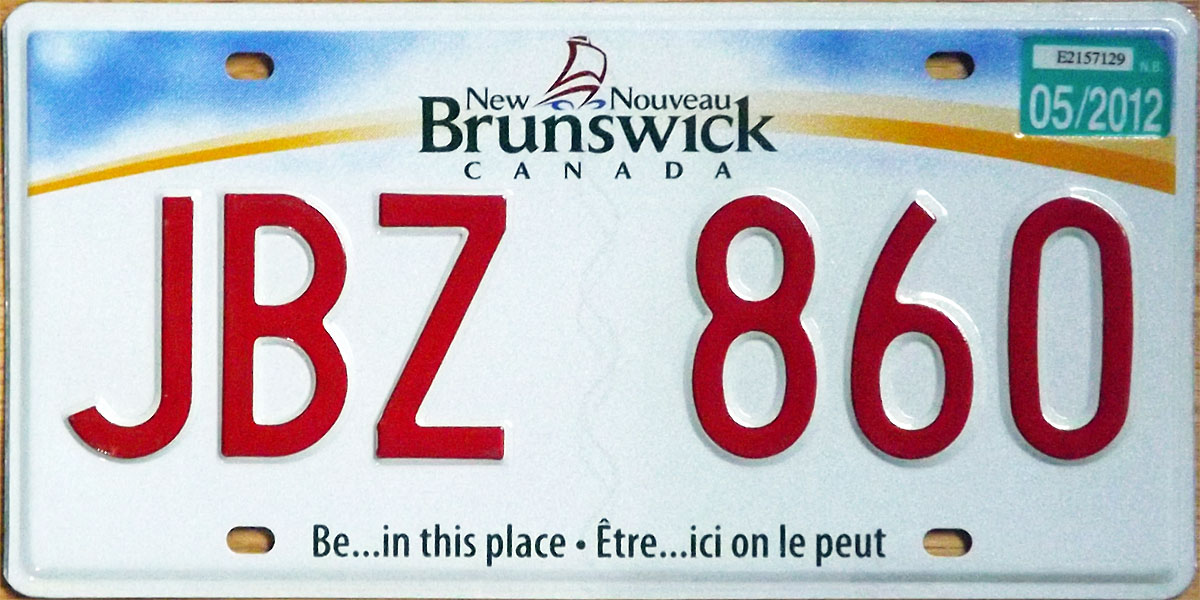
Home to around 750,000 people, New Brunswick is about 22 percent Francophone, but only about 5,000 French-first people live in and around Saint John. The Province's license plates do say both "New Brunswick" and "Nouveau Brunswick." The Province is about 96 percent white, with scattered black, Asian and Aboriginal/Native/First Nations people. There are less than 800 Hispanic people in the Province. The Harmonized Sales Tax (HST) is 15 percent. All New Brunswick mailing addresses have a Postal Code that begins with E. The Area Code is 506.

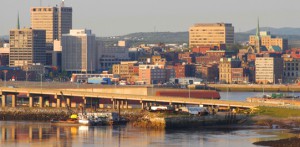
The French explorer Samuel de Champlain founded Saint John in 1604, naming it for John the Baptist. It is home to about 67,000. Just last year, Moncton surpassed Saint John to become the Province's largest city, with 71,000 people. (Like New Brunswick, New Jersey, Moncton is known as the "Hub City.")

Saint John is "Canada's Irish City," as a result of taking so many immigrants during the Irish Potato Famine of the late 1840s. But Protestants (including Irish) still out number Catholics. 47 percent to 40.

The capital of New Brunswick is Fredericton, 68 miles northwest of Saint John, and home to 56,000 people. The drinking age in New Brunswick is 19. Its leading newspaper is the Saint John-based Telegraph-Journal.
Saint John Transit runs the bus service in town (no rail, either above or below ground, local or commuter), and fares, depeinding on distance, range from C$2.50 to C$3.50. Bay Ferries runs a ferry service across the Bay of Fundy from Saint John to Digby, Nova Scotia. The Province has no beltway.

There is no "centerpoint" (or "centrepoint") for street addresses, but address numbers go up heading north and east. Like many Canadian cities, Saint John has a climate-controlled walkway, in their case above-ground, known as the Inside Connection. The arena is connected to it.
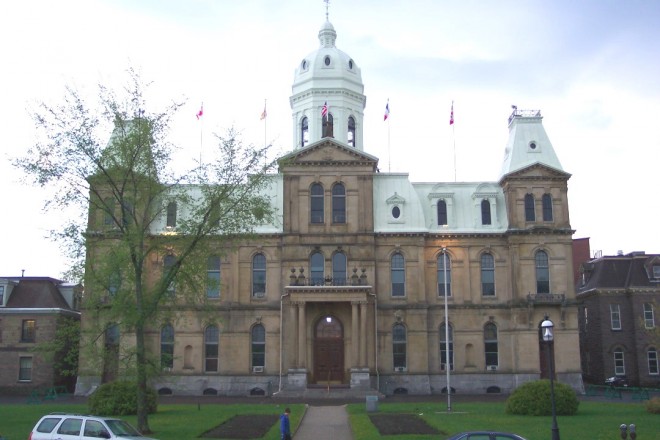
Legislative Assembly of New Brunswick, in Fredericton

Going In. Harbour Station bills itself as "Atlantic Canada's Enetertainment Centre!" With 6,308 seats for hockey, 7,305 for basketball, and 7,586 for concerts, it opened in 1993, at 99 Station Street, at the intersection of Sewell Street. Parking is only C$3.00. The Saint John Sea Dogs, of the Quebec Major Junior Hockey League, were founded in 2005, as the successors to the American Hockey League's Saint John Flames (1993-2003).
You're most likely going to enter from the west or south, since the north is bordered by Route 1 and a railroad. The rink is aligned southwest-to-northeast.
The Saint John Mill Rats were a founding franchise of the National Basketball League of Canada, in 2011, and they also set up shop at the Harbour Station, changing their name to the Saint John Riptide this season, renaming themselves for the nearby Bay of Fundy, famous for having the world's highest tides. The arena survived a small fire shortly before a Mill Rats game in 2014.

Food. The arena's website says only that, "Food services are available at 7 locations on the concourse, including TIM HORTON'S." (Emphasis theirs, not mine.) In other words, you may be better off eating before and after the game, rather than during.

Team History Displays. The Sea Dogs won the President's Cup, the QMJHL championship, and the Memorial Cup, the championship of Canadian junior hockey, in 2011. They won the President's Cup again in 2012. They have also won Division Championships in 2010, 2011, 2012 and 2016. They have banners for all of these achievements.
They have no retired numbers. The former Sea Dog that Devils fans would most easily recognize is former New Jersey defenseman Eric Gelinas, now in the Colorado Avalanche's minor-league system.

Harbour Station also honors (or "honours") the Saint John Flames, for their 2001 AHL title, the Calder Cup; and its 1998 Division and Conference titles.
UPDATE: In 2018, the Acadie-Bathurst Titan, playing out of Bathurst in the QMHJL, became the 2nd team from New Brunswick to win the Memorial Cup.

Stuff. Being a minor-league team, the Sea Dogs don't have a large team store, only a few souvenir stands. There are no books or videos about them.

During the Game. Your safety will not be an issue. The people of Saint John won't be bothered by a New Yorker showing up, especially if he's going to, as they say in another sport, root, root, root for the home team.

The Sea Dogs hold auditions for National Anthem singers, as opposed to having a regular. A "sea dog" is a seal, and the team's original mascot was a black seal named Splash.
Splash

However, in 2009, Fleaburn, the dog mascot of the departed Flames (his name a play on the fire theme), was brought back. Though why his hat resembles a basketball more than a hockey puck is a mystery.
Fleaburn, you dog.

After the Game. As with your entry, your exit is most likely to be by the west or south entrances. But there aren't many places nearby to get a postgame meal, or even a pint. Vito's, at 2 Peel Plaza (Union Street and Chipman Hill), was the only place that even showed up on Google Maps. You may have to go further east on Union Street to find a place.

Rocky's Sports Bar, at 7 Market Square (corner of St. Patrick and King Streets), is 5 blocks from the arena, and is said to be the best sports bar in the Province.

Sidelights. There is one other pro hockey team in New Brunswick. The Moncton Wildcats play at the Moncton Coliseum, built in 1973, about 90 miles to the northeast. They won the QMJHL title in 2006 and 2010. The Coliseum is also the home of the Moncton Miracles, of the National Basketball League of Canada, arch-rivals of the Saint John Riptide.
Moncton Coliseum

Professional baseball and soccer are not particularly big in New Brunswick. Indeed, a website titled Canadian Soccer Blog couldn't find a single bar in the Province to add to its The Ultimate Guide to Canadian Soccer Pubs, although the aforementioned Rocky's was cited on another page.

However, Moncton Stadium, opened in 2010 on the campus of the Universite de Moncton, hosted 7 matches of the 2015 Women's World Cup, including a Round of 16 match in which Australia eliminated Brazil. With 10,000 permanent seats, but expandable to up to 20,725, it's hosted 3 regular-season games in the Canadian Football League's "Touchdown Atlantic" series.
Moncton Stadium, with temporary end-zone bleachers
and the CFL's notorious 25-yards-deep end zones
taking out the curves of the running track

UPDATE: The Canadian Premier League, an attempt at a top-flight soccer league for the country, was founded in mid-2017, with the hopes of beginning play in Spring 2019. A team could be established to play at Moncton Stadium.

Other colleges in the Province include the University of New Brunswick, with campuses (campii?) in Saint John and Fredericton; and Mount Allison University, 120 miles to the northeast in Sackville,

Neither Elvis Presley nor The Beatles ever performed in the Province of New Brunswick. Harbour Station remains the Province's most significant concert venue.

The New Brunswick Museum, at 1 Market Square across from Rocky's, is the oldest continuously-open museum in Canada. Fort Howe was a site briefly taken over by the Continental Army during the War of the American Revolution in June 1777, until the British drove them out. Magazine Street at Webster Street. The Carleton Martello Tower is a historic site, dating to the War of 1812. 454 Whipple Street, across the Saint John River on the city's West Side, 3 miles south of downtown. Neither of these historic sites is reachable by public transit, but Fort Howe is a mile's walk, including over the Main Street overpass over Route 1. And New Brunswick's historic sites do not include any birthplaces or residences for Prime Ministers, as none has ever come from there.

Like East Brunswick, New Jersey, Saint John has an indoor shopping mall named Brunswick Square. It has a tower that is the tallest building in the city, 265 feet high. 39 King Street, corner of Germain Street. It is tied for the title of the tallest building in the Province, with Assumption Place in Moncton.

Any TV shows set in the Province would only be familiar to Canadians, not to Americans. The movie filmed there most likely to be familiar to Americans is Children of a Lesser God, for which deaf actress Marlee Matlin won an Oscar.

*

Saint John is not much like St. John's University in Queens; and New Brunswick, Canada is not much like New Brunswick, New Jersey. But it is worth a visit, especially for a hockey fan.

Monday, February 13, 2017

How to Go to a Hockey Game In Nova Scotia

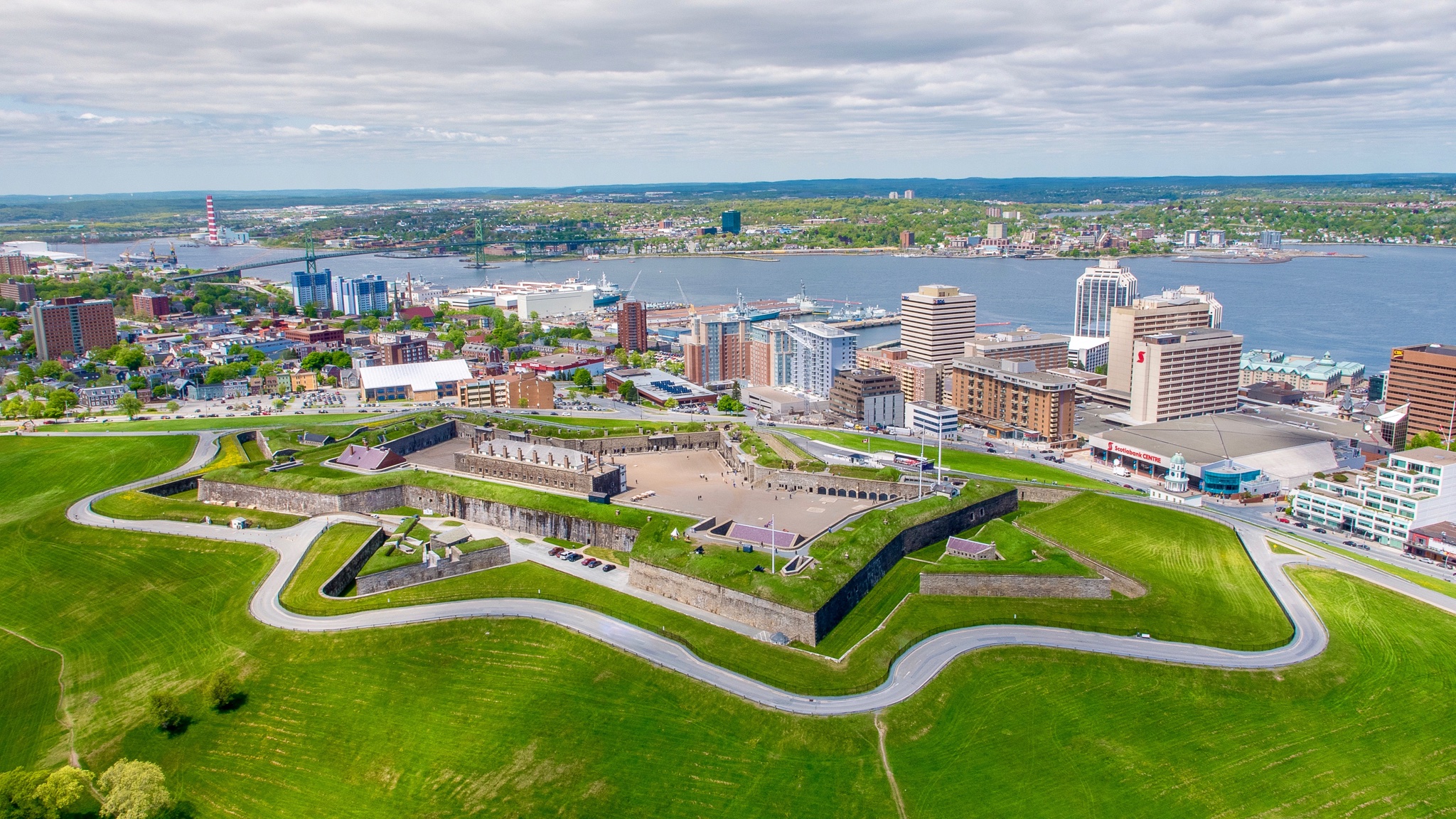
Citadel Hill, overlooking downtown Halifax,
including the Scotiabank Centre.

Ah, why not try doing trip guides for all 10 Canadian Provinces, too? Nova Scotia will make 6.

Next Monday night, the biggest sports team in the Province, the Halifax Mooseheads, will play a Quebec Major Junior Hockey League (QMJHL) game against the Moncton Wildcats of New Brunswick.

Before You Go. Nova Scotia is in Canada, so you will need a passport. And you will need to change your money. At last check, US$1.00 = C$1.31, and C$1.00 = US 76 cents. And I advise you to call your bank and let them know that you will be in a foreign country, so they won't see credit or debit card purchases from a foreign country pop up and think your card has been stolen.

The Maritime Provinces, a.k.a. Atlantic Canada, are 1 hour ahead of the Eastern Time Zone. So a game starting at 7:00 PM their time would by 6:00 our time. Adjust your timepieces accordingly.

Despite being in Canada, and an oceanfront city where wind can be an issue, and with this being Winter, the weather is not expected to be all that bad. Temperatures are expected to be in the 30s throughout the day, and no precipitation (either rain or snow) predicted until the 23rd.

Also, remember that they use the metric system. A speed limit of 100 kilometers per hour means 62 miles an hour. And don't be fooled by the seemingly low gas prices: That's per liter, not per gallon, and, in spite of Canada being a major oil-producing nation, you'll actually be paying more for gas up there. So, in order to avoid both confusion and "sticker-shock," get your car filled up before you reach the border.

Tickets. The Scotiabank Centre seats 10,595, and the Mooseheads rank 2nd in the league in attendance -- but that's only 6,546 per game. Getting tickets shouldn't be hard: You might be able to walk up to the window on the day of the game and get one. Adult tickets are $19 (Canadian), $16 for seniors, $12 for students with a valid ID, and $10 for kids age 12 and under.

Getting There. It's 862 road miles from Times Square in Manhattan to the Scotiabank Centre in downtown Halifax. It would be about 160 miles less as the crow flies, but you won't be able to do that unless a bridge is ever built connecting Cape Cod and Yarmouth, Nova Scotia. It's 330 miles from downtown Halifax to the closest border crossing, at Calais, Maine. If you can afford to fly, you should.

Air Canada can fly you from Newark to Halifax Stanfield International Airport for under $700 round-trip. (Robert Stanfield was a Premier of Nova Scotia, and Leader of the national Progressive Conservative Party, and thus the Leader of the Opposition from 1967 to 1976, against Prime Ministers Lester Pearson and Pierre Trudeau, who also had airports named for them, in Toronto and Montreal, respectively.) However, your flight probably won't be nonstop: You'd have to change planes in either Montreal or Ottawa, both of which would be a bit out of the way.

But that's better than going there by train:

Penn Station, on Amtrak's Adirondack: 8:15 AM Sunday
Gare Centrale, Montreal: 7:11 PM Sunday
Leave Montreal, on VIA Rail's Ocean: 7:00 PM Monday
Halifax Railway Station, 1161 Hollis Street, downtown: 5:51 PM Tuesday
Game: 7:00 PM Tuesday
Halifax: 1:00 PM Wednesday
Gare Centrale, Montreal: 10:03 AM Thursday
Leave Montreal: 10:20 AM Thursday
Penn Station: 8:50 PM Thursday

That's about 22 hours just from Montreal to Halifax - and another 22 hours back. Note that this doesn't give you much time to get from the train station to the arena on Tuesday night. New York to Montreal and back is $138. Montreal to Halifax and back is C$276, or US$211. The total is US$349. And using Amtrak and VIA Rail means you'd have to spend almost 24 full hours in Montreal (hardly a bad thing if you can afford a hotel), you would have a shade over an hour to get from the Halifax station to the arena, you'd have to stay overnight in Halifax, and you'd have 17 minutes to change trains in Montreal -- and that's if the train from Halifax is on time! You might as well stay overnight in Montreal again -- which, again, is great if money is no object, but it might be.

How about the bus? Greyhound also serves the Halifax Railway Station. But this schedule is also ridiculous. There's only 1 bus per day leaving Montreal, at 9:30 PM, arriving at Halifax at 6:20 PM the next day, giving you even less time to get to the arena -- and it costs C$344. One way. And you still have to get to Montreal. Forget that.

So it looks like you'll have to drive. Start out as if you're going to Boston: Take Interstate 95 North to New Haven. Take Exit 48, Interstate 91 North to Hartford. Take Exit 30, Interstate 84 East into Massachusetts. You'll merge with Interstate 90 East, the Massachusetts Turnpike, and take that until you reach Interstate 495, Boston's outer beltway.

But instead of continuing on the Mass Pike to Boston, take Exit 11A onto I-495 North, into Boston's northern suburbs, until you reunite with I-95 North at Salisbury, just before reaching the New Hampshire State Line. You'll cross New Hampshire and go into Maine. Take Exit 182A onto U.S. Route 1A, turn left on State Route 46, right on State Route 9, then follow this rural route all the way to Baring, where you'll meet up with U.S. Route 1. Turn left at International Avenue, and you'll reach the Border.

Don't get cute. Show your passport. If they ask for any other ID, show them that. If you have anything that could be considered a weapon, even a pair of nail clippers, it's probably best to mention that. Don't make any wiseass remarks about Canada. When they ask you your purpose for visiting Canada, tell them you' re visiting Halifax as a tourist. (That is the truth.) Presuming you don't do or say anything stupid, you should get across with no trouble.

International Avenue becomes New Brunswick Provincial Route 1. Take this to River Glade, where you'll get on the Trans-Canada Highway. You'll take that around Moncton and into Nova Scotia. At Truro, take Provincial Route 102 South to Fall River, and take Provincial Route 118 South into Dartmouth, and cross the Angus L. Macdonald Bridge into downtown Halifax. (Macdonald was Premier from 1933 to 1940, and again from 1945 to 1954. In between, he served in the wartime cabinet of Prime Minister Mackenzie King.)

If all goes well, you should be in New York State (not counting Manhattan) for half an hour, in Connecticut for 2 hours, in Massachusetts for an hour and 15 minutes, New Hampshire for 15 minutes, Maine for 4 hours and 45 minutes, Customs for 15 minutes or less, New Brunswick for 3 and a half hours, and 2 hours and 15 minutes in Nova Scotia. Given rest stops in Connecticut, at each end of Maine, and around the New Brunswick-Nova Scotia Province Line, it should take about 17 hours.

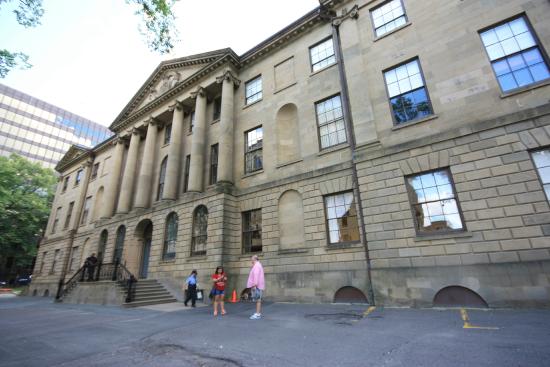
Once In the City. "Scotia" was the Latin name for Scotland. Therefore, Nova Scotia is "New Scotland," or "Nouvelle-Écosse" in French. Halifax, with a population of about 400,000, was named for George Montagu-Dunk, 2nd Earl of Halifax, essentially the founding father of Nova Scotia in 1749. (With a founder's name like "Dunk," maybe the city should be more interested in basketball than in hockey.) Halifax is the capital of the Province, and the capitol building, Province House, is 2 blocks east from the arena, down Carmichael Street.
Province House

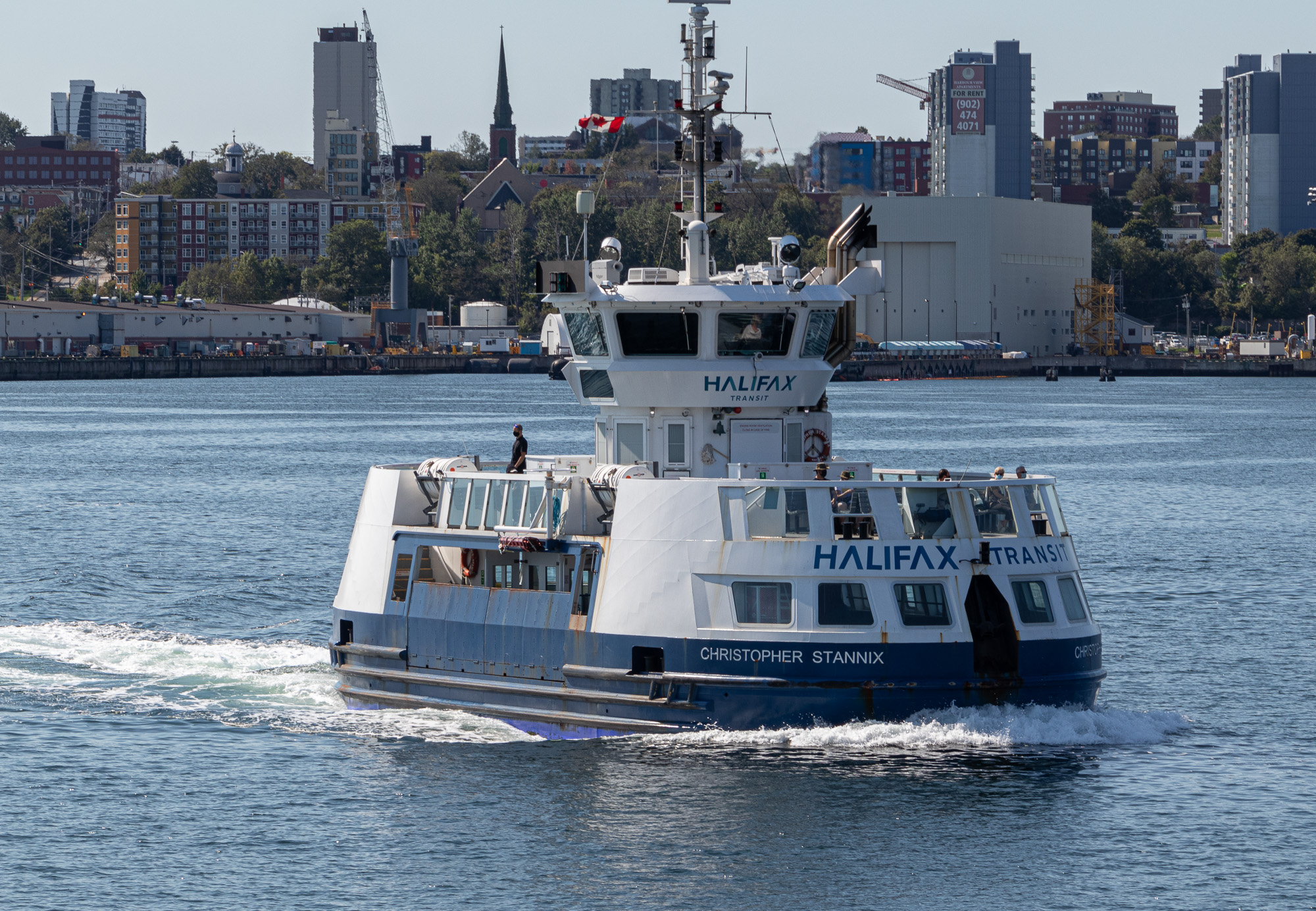
Halifax Transit runs buses and the Halifax-Dartmouth Ferry Service, but there's no subway or above-ground light rail service. A single adult fare is $2.50. The Province has a 15 percent harmonized sales tax (HST). The Chronicle Herald is the city's single daily newspaper.
The Halifax-Dartmouth Ferry

Street addresses increase going north and west. Like Montreal's RESO and Toronto's PATH, Halifax has an "underground city," called Downtown Halifax Link, so people can get around while being protected from the cold.

The drinking age in Nova Scotia is 19. Postal Codes in Nova Scotia begin with the letter B. Like Prince Edward Island, Nova Scotia uses Area Codes 902 and 782. The Province has no beltway. Nova Scotia Power runs the electricity.

The Province is 92 percent Anglophone, 4 percent Francophone, and all other first languages adding up to about 5 percent. Only Digby County, in the west, retains a French-speaking majority. The Province is about 91 percent white (including 55 percent from the British Isles), 3.7 percent Aboriginal/Native/First Nations, 2.5 percent Asian, 2.3 percent black, and only 0.2 percent Hispanic.
Yes, Canada had a Provincial version
of our State Quarter program.

Many Loyalists who did not want to be American -- and some black people who did not want to be slaves -- after the Revolution fled to Canada, and, in particular, to Nova Scotia. On July 25, 1784, the Shelburne Riots broke out, following a black minister's baptism of a white married couple. The British authorities arrested the perpetrators, and what's been called North America's first race riot was ended.

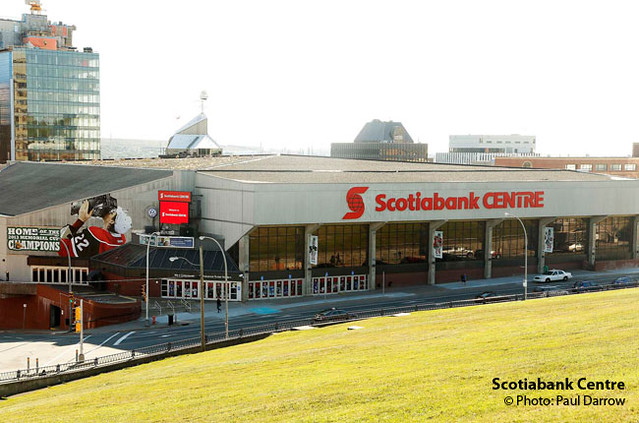
Going In. The Halifax Mooseheads play at the Scotiabank Centre, at 1800 Argyle Street. (More of that Scottish connection.) Don't be fooled by its exterior appearance: Most of the arena structure is below ground, due to the hilly nature of Halifax. If you drive in, parking is C$5.00.
Across Brunswick Street, to the west, is the Old Town Clock, and the Halifax Citadel National Historic Site. (More on that in "Sidelights.") Across Duke Street, to the north, is the Scotia Square shopping mall. Just 7 blocks to the east is the Halifax Ferry Terminal, offering boat service to Alderney and Woodside in Dartmouth, a.k.a. "The Darkside," across Halifax Harbour.

The arena opened in 1978. It was known as the Halifax Metro Centre until 2014, when the naming rights were bought by one of Canada's largest banks. It is small by major league standards, but large by minor-league ones, and the largest arena in the Maritime Provinces: It seats 10,595 for hockey, though it can be expanded to up to 13,000 for concerts.
The famous orange seats at the Halifax Metro Centre,
before the renaming and renovation.

The arena has been home to a series of minor-league hockey teams: The Nova Scotia Voyageurs (1978-84), the Nova Scotia Oilers (1984-88), the Halifax Citadels (1988-93), and the Halifax Mooseheads (a.k.a. The Beasts of the East, since 1994). The Mooseheads may catch the attention of longtime Devils fans, since their colors are the Devils' original colors, red and green.

It's also hosted a series of minor-league basketball teams: The Halifax Windjammers (1991-94), the Halifax Rainmen (2007-15), and the Halifax Hurricanes of the National Basketball League of Canada (since 2015).

It hosted the CIS (Canada's version of the NCAA) Men's Basketball Championship every year from 1984 to 2007, again in 2011 and 2012, and will again this year and next.

It hosted the World Figure Skating Championship in 1990; the Memorial Cup, the championship of Canadian junior hockey, in 2000; the CIS University Cup, Canada's college hockey championship, in 2015 and 2016.

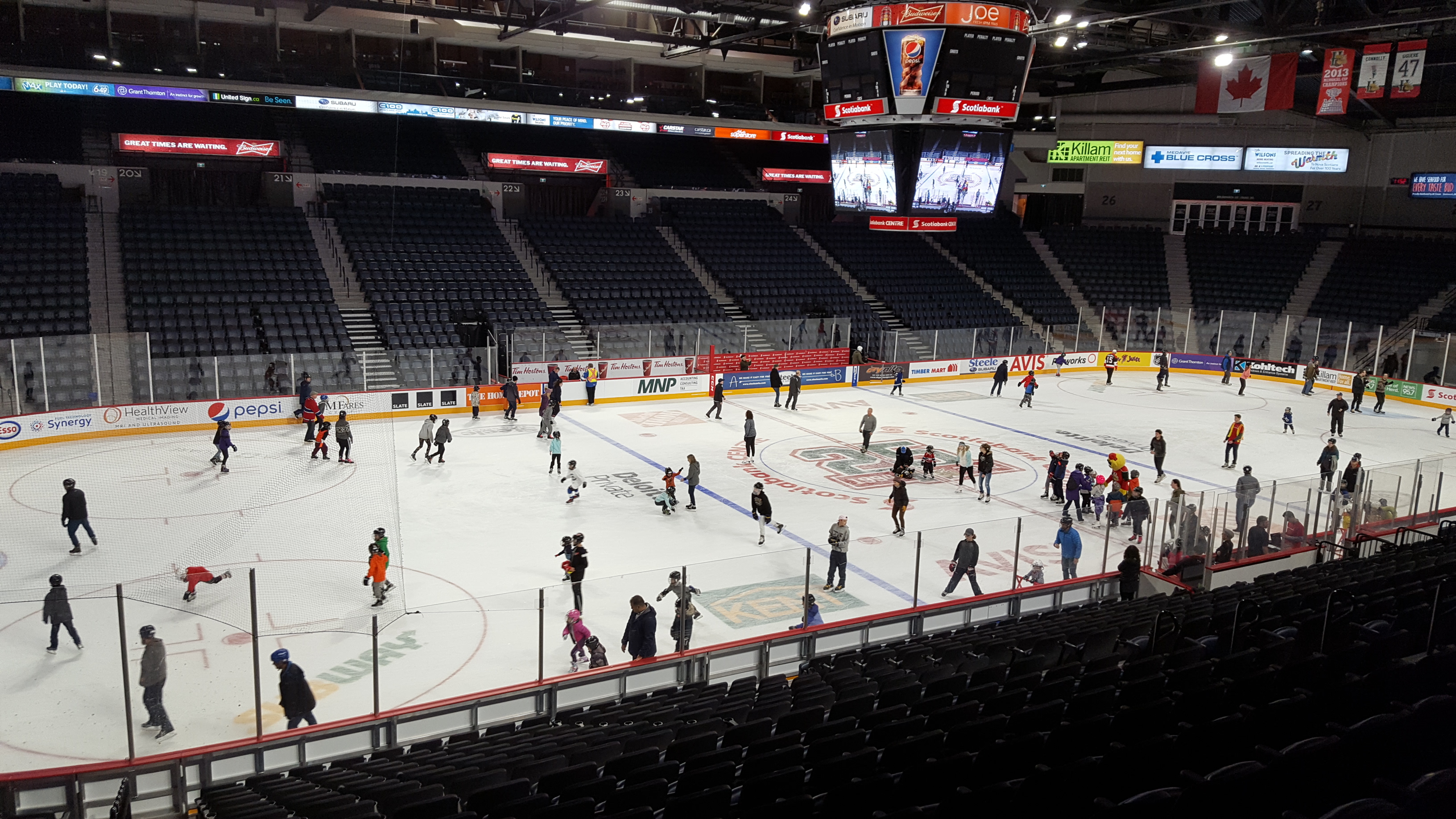
The rink runs north-to-south. The Mooseheads attack twice at the south end.
The navy blue seats, after the 2014 renaming and renovation

Due to its concert volume -- Ozzy Osbourne sold a 2007 show out in 9 minutes, and Elton John sold 2 2008 shows out in 42 minutes -- and its age (nearly 40 years old), there has been talk of building a new arena to seat least 15,000. So far, though, it's just an idea, and the city seems more interested in building a stadium for a Canadian Football League expansion team.

Food. Centerplate runs the concessions. No, they don't spell it "Centreplate" up there. Stands are along the sidelines only, not in the concourse behind either goal.

On the east, Argyle Street side, they have Halifax Poutine (yitch) behind Section 4; Halifax Popcorn, Budweiser Bar and Beer Solutions at 5; Taste 902 (named for the city's Area Code, "featuring local products") and Halifax Confectionery (candy and ice cream) at 6; Pizza and Halifax Kettle Corn at 7; another Budweiser Bar, Halifax BBQ and Halifax Coffee at 8; Halifax Grill (including poutine), Halifax Links (sausages) and Halifax Asian at 9; another Halifax Popcorn at 10; and King of Donair (Asian) at 11.

On the west, Brunswick Street side, they have another Budweiser Bar at 19; Halifax BBQ and Halifax Links at 20; another Pizza and another Budweiser Bar at 21; Mill Street Brewery and Halifax Fries at 22; and another Budweiser Bar, another Halifax Grill, and another Halifax Popcorn at 23.

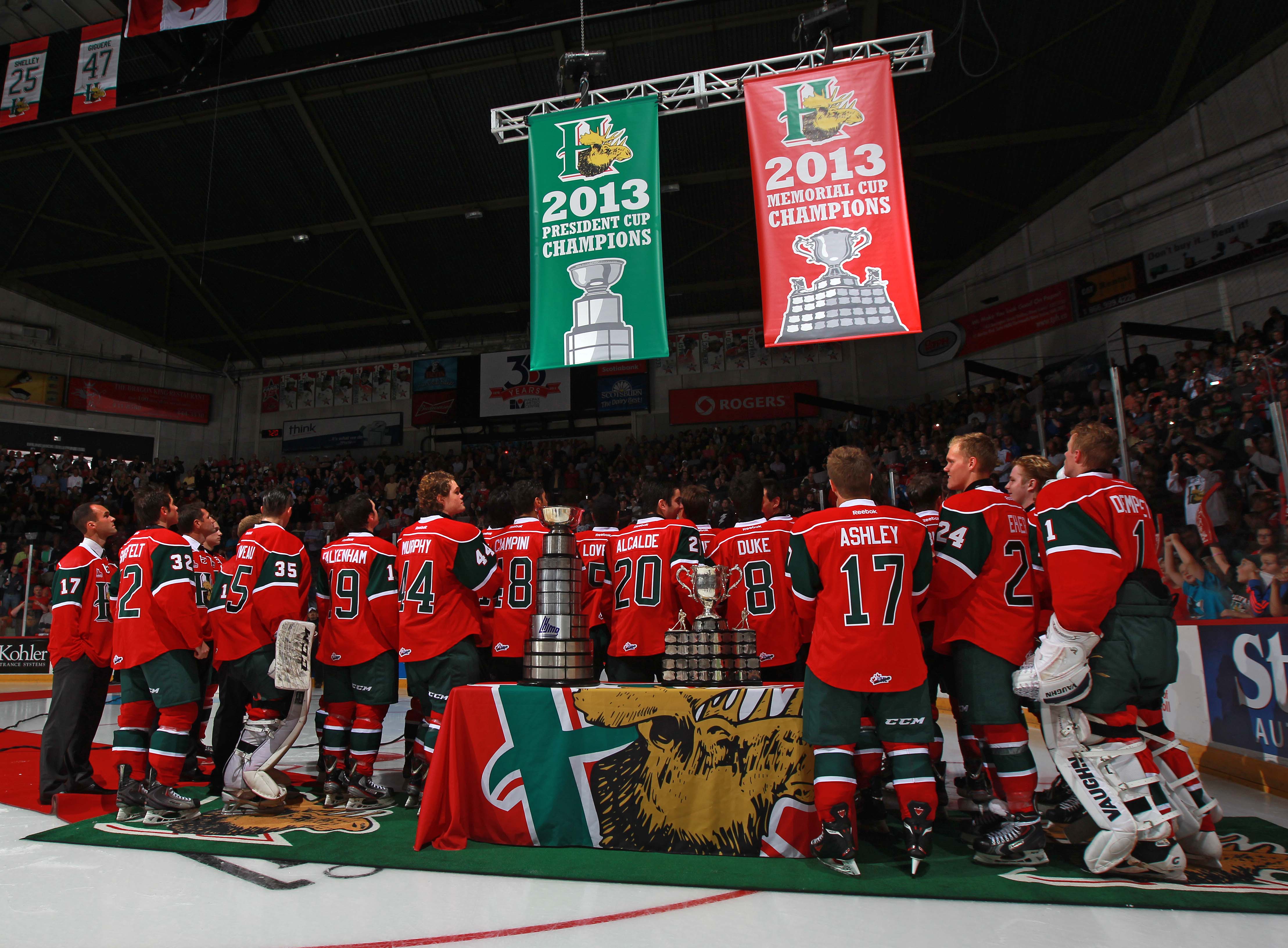
Team History Displays. Founded in 1994, the Mooseheads don't play in Quebec, but they do play in the Quebec Major Junior Hockey League. They have won divisional titles in 2001, 2003, 2005, 2008, 2013 and 2014. They won the President's Cup, the Playoff championship of the QMJHL, and the Memorial Cup, in 2013.
They have 4 banners for retired numbers:

* 18, left wing Alex Tanguay, 1996-99, a 2001 Stanley Cup winner with the Colorado Avalanche, and currently a free agent.

* 25, left wing Joey Shelley, 1995-97, an original member of the Columbus Blue Jackets in 2000-01, a Ranger in 2009-10, and now working in the Jackets' front office.

* 47, goaltender Jean-Sebastien Giguere, 1995-97, famed for his trips to the Stanley Cup Finals in 2003 (where he won the Conn Smythe Trophy as Playoff MVP even though the Devils won the Cup and Martin Brodeur had 3 shutouts in the Finals) and 2007 (where the Ducks beat the Ottawa Senators), now out of hockey.

* And a banner for Pat Connolly, longtime Halifax-based sportswriter and sportscaster. The retired number banners are flanked by the 2013 title banners.

Other notable former Mooseheads are Boston Bruins Cup-winning left wing Brad Marchand, former Anaheim Ducks Cup-winning defenseman Joe DiPenta, and Colorado Avalanche center Nathan MacKinnon, a Halifax native whose hat trick clinched the 2013 Memorial Cup win. It remains the only Memorial Cup won by a team from Nova Scotia. (UPDATE: After the Avalanche won the 2022 Stanley Cup, the Mooseheads retired Number 22 for MacKinnon.)

Stuff. There is no big team store. At an arena this size, for a minor-league team, it isn't really practical. So smaller souvenir stands will have to do. Don't expect to find any team videos. Two books can be mentioned: Hockey's Home: Halifax-Darmouth, published in 2002 by Martin Jones; and The Mooseheads: The History of Halifax's Favourite Hockey Team, published in 2005 by Dan Robertson -- both before the Mooseheads' annus mirabilis of 2013.

During the Game. There is no rivalry between the Mooseheads (a.k.a. The Beasts of the East) and any of the New York Tri-State Area teams, as neither the Devils, nor the Rangers, nor the Islanders have a farm team in the QMJHL. Rather than resisting Americans checking their city and their team out, they may be very welcoming.

This game against Moncton is a promotion, Family Day. There may be a lot of screeching kids in the audience. This, plus the stereotypical politeness of Canadians, means you should watch your language. Speaking of language, while the Maritimes have many French-Canadians, the signs and announcements will all be in English, not French.

Peter Baylis is the team's regular singer of "O, Canada." However, this being the 150th Anniversary of Canadian independence (or "Confederation"), he will be traveling the country this year, singing the National Anthem on 150 public occasions. So he may not be there on Monday.

The team has 2 mascots: A Moose named Mac, and a... thing named Hal, obviously short for "Halifax." On January 9, 2016, Hal had a little accident. The fans' main chant is, "Go, Moose, go!" Probably an outgrowth of the Montreal and Toronto chants that they saw on TV a thousand times: "Go, Habs, go!" and "Go, Leafs, go!"
Hal and Mac

After the Game. It's Canada, they don't hate New York or New Jersey, and you are a visitor, with no reason to root for the visiting team. You're going to be safe going out.

The Scotia Square Mall, across Duke Street to the north, has a food court, but it may be closed by the time the game lets out. Just south of the arena, the Midtown Tavern & Lounge is at 1744 Grafton Street, and The Five Fishermen is at 1740 Argyle Street. A block south, The Wooden Monkey is at 1707 Grafton Street, and Canadian chain The Keg Steakhouse + Bar is at 1712 Market Street.

If you visit Halifax during the European soccer season, on the day of a game (there won't be many on Monday), the leading "footy pub" in Nova Scotia is The Maxwell's Plum, 2 blocks south of the Scotiabank Centre, at 1600 Grafton Street at Sackville Street.

Sidelights. For a city its size -- the entire Province has only about 925,000 people, so it would easily be the smallest metropolitan area in any of the 5 major league sports -- Halifax has a lot to offer.

Before the Metro/Scotiabank Centre was built, the home of Halifax hockey was the Halifax Forum, built in 1927, seating 5,600 people, and still used for hockey by St. Mary's University and (while they build a new arena) Dalhousie University. 2901 Windsor Street, about a mile and a half northwest of downtown. Bus 1.
There is another QMJHL team in Nova Scotia, the Cape Breton Screaming Eagles. Since 1997, they have played at an arena named Centre 200, because it opened in 1985, on the 200th Anniversary of the founding of its city, Sydney. The Cape Breton Highlanders, a National Basketball League of Canada team named for a famous regiment of the Canadian Army, also play there. 481 George Street, in the Cape Breton region, easternmost Nova Scotia, 250 miles east of downtown Halifax.

For years, the city has been trying to get a stadium built, so it can get an expansion team in the Canadian Football League, and possibly a professional soccer team as well. They almost got a team in 1984, but it failed, because they couldn't get a 30,000-seat stadium ready. The current plan would keep that team's name, the Atlantic Schooners, and let it represent all 4 Maritime Provinces, a.k.a. "Atlantic Canada."

Part of the problem is that they can't agree on a location. One possibility is north of the Forum. (It would be in addition to the old arena, not to be put on the site after tearing it down. The Forum is safe for now.) Another is at the Dartmouth Sportsplex, across the Harbour from downtown.

The likeliest site is at the Wanderers Grounds, longtime home of Halifax rugby, west of the Citadel, and thus technically still downtown. This is also being considered for the site of a minor-league baseball park, which Halifax has never had. 5755 Sackville Street.

UPDATE: On June 20, 2017, the City Council approved the building of a 7,000-seat stadium at the Wanderers Grounds, which opened in Spring 2018. The Canadian Premier League, Canada's attempt at a "top flight" soccer league, is planning to begin play in Spring 2019, and Halifax is represented by a team named for the grounds: HFX Wanderers FC. 5711 Sackville Street, across from the Citadel.
Until then, the biggest stadium in town was Huskies Stadium, home of St. Mary's, seating 5,000 but expandable to 11,000, and that just wasn't enough. 923 Robie Street, in the South End, about a mile south of downtown. Bus 1.
Yes, the running track is blue.

There are 2 other major colleges in Nova Scotia. Acadia University is in Wolfville, 57 miles northwest of downtown Halifax. In 1979 and 1981, they won the Vanier Cup as Canada's national college football champions. St. Francis Xavier University is in Antigonish, 132 miles northeast. They won the 1966 Vanier Cup, and the hockey equivalent in 2004.

Neither Elvis Presley nor The Beatles ever performed in Halifax, or anywhere else in the Maritime Provinces. Elvis sang in Ottawa and Vancouver, The Beatles sang in Montreal, and they both sang in Toronto.

The Old Town Clock is one of the best-known Halifax landmarks. Prince Edward, Duke of Kent and Strathearn, commander-in-chief of all military forces in British North America, son of King George III, and father of the eventual Queen Victoria, wanted it built to resolve the habitual tardiness of the local garrison. It has operated since 1803, at Brunswick & Carmichael Streets, across Brunswick from the Scotiabank Centre.
The Halifax Citadel National Historic Site is a living history museum, dating to 1749 but depicting the Victorian period (Queen Victoria's reign, 1837 to 1901, including 1867, the year of Confederation). It is particularly known for its "Victoria Christmas" pageantry. 5425 Sackville Street, on Citadel Hill, overlooking downtown.

The Maritime Museum of the Atlantic is the oldest maritime museum in the country, and includes the hydrographic surveyor ship CSS Acadia. 1675 Lower Water Street, on the Harbour. Not a part of its complex, but adjoining it, is HMCS Sackville, a corvette (small warship) that served in World War II and is now a museum ship.

Nova Scotia has produced 3 Prime Ministers of Canada. However, all served long ago, none of them have houses preserved as a historic site, and none of them are buried in the Province. Halifax native Sir John Thompson, a former Premier of Nova Scotia, served as Prime Minister from December 5, 1892 to December 12, 1894. Charles Tupper of Amherst, was the shortest-reigning Prime Minister: 69 days, May 1 to July 8, 1896. Robert Borden of Grand-Pre was Prime Minister from October 10, 1911 to July 10, 1920, including all of World War I. (Earlier in his life, he was a teacher, including a short time in Matawan, New Jersey. He is now on Canada's $100 bill.)

The tallest building in Nova Scotia is in Halifax, but it's not very tall. The Fenwick Tower stands 321 feet, at 5595 Fenwick Street in the South End, just south of downtown.

Most TV shows and films set in Nova Scotia are Canadian shows that most Americans wouldn't recognize. There is one notable exception: The History Channel's nonfiction series The Curse of Oak Island, trying to solve a mystery about an island in Mahone Bay, about 50 miles west of Halifax. There is a road bridge to the island. The 1948 film Johnny Belinda as set in the Province.

*

Halifax is a small city, but it has quite a bit to see, including natural beauty, history, and a hockey team with a passionate fan base. It's not easy to get to, but it is well worth a visit.