Showing posts with label moses malone. Show all posts

Monday, June 15, 2026

June 15, 1986: The Draft Day Debacle of the Philadelphia 76ers

Moses Malone

June 15, 1986, 40 years ago: For fans of the Philadelphia 76ers, this is a day which lives in infamy.

The Sixers had made the Playoffs in each of the last 10 seasons. In 7 of them, they had reached the NBA Eastern Conference Finals. In 4 of them, they had reached the NBA Finals. And in 1983, they had won the NBA Championship.

In 1986, they lost in the First Round. By this point, they were an aging team. Julius Erving was 36 years old, and was soon to announce that the next season would be his last. Bob McAdoo and Bobby Jones were both 34, and the season that had ended just a week before would prove to be the last in the NBA for each of them.

Still, there was reason to hope that their run of success could continue. Moses Malone was 31. Maurice Cheeks was 29. Andrew Toney was 28. There was young talent on the roster, including 23-year-old Charles Barkley. And they had obtained the Number 1 pick in the NBA Draft in a trade with the Los Angeles Clippers.

Except that, 2 days before the Draft, 76ers owner Harold Katz traded that top pick, to the Cleveland Cavaliers, for Roy Hinson. The Cavs ended up using the pick on Brad Daugherty. To make matters worse, on the same day, Katz traded Malone and Terry Catledge to the Washington Bullets for Jeff Ruland and Clifford Robinson.

There was nothing wrong with wanting healthy versions of Roy Hinson, Jeff Ruland and Clifford Robinson. But Ruland only played 5 games for the Sixers before getting hurt, and retired, although he made a comeback 5 years later. And Hinson and Robinson did little in Philadelphia.

In contrast, Malone was still an All-Star as late as 1989, and still playing as late as 1995; while Daugherty made 5 All-Star Teams, and, arguably, should be in the Basketball Hall of Fame along with Malone.

The 76ers have never been the same, making only 1 NBA Finals, in 2001 with Allen Iverson. Otherwise, with Barkley, Iverson, Joel Embiid and James Harden, and under 3 different ownership regimes, the Philadelphia 76ers have been one of the most underachieving teams in North American sports.

From the NBA Finals of 1984 to that of 2025, the count of NBA Championships is as follows: Los Angeles Lakers 9, Chicago Bulls 6, San Antonio Spurs 5, Golden State Warriors 4, Boston Celtics 4, Detroit Pistons 3, Miami Heat 3, Houston Rockets 2, Dallas Mavericks 1, Cleveland Cavaliers 1, Toronto Raptors 1, Milwaukee Bucks 1, Denver Nuggets 1, Seattle SuperSonics/Oklahoma City Thunder 1. The other 16 teams, including the Philadelphia 76ers, none. And of those 16 teams, 6 didn't even exist in 1983.

From 1983, when the Philadelphia 76ers won the NBA Championship, until 2008, when the Phillies won their next World Series, no Philadelphia professional sports team won a World Championship. Could this be the Curse of Harold Katz? No, it's usually called the Curse of Billy Penn: The suggestion was that the construction of One Liberty Place in 1987, making it taller than the statue of William Penn atop City Hall, caused Penn's spirit to put a curse on the city's teams.

Wednesday, May 31, 2023

May 31, 1983: Moses Malone Gets Julius Erving a Ring

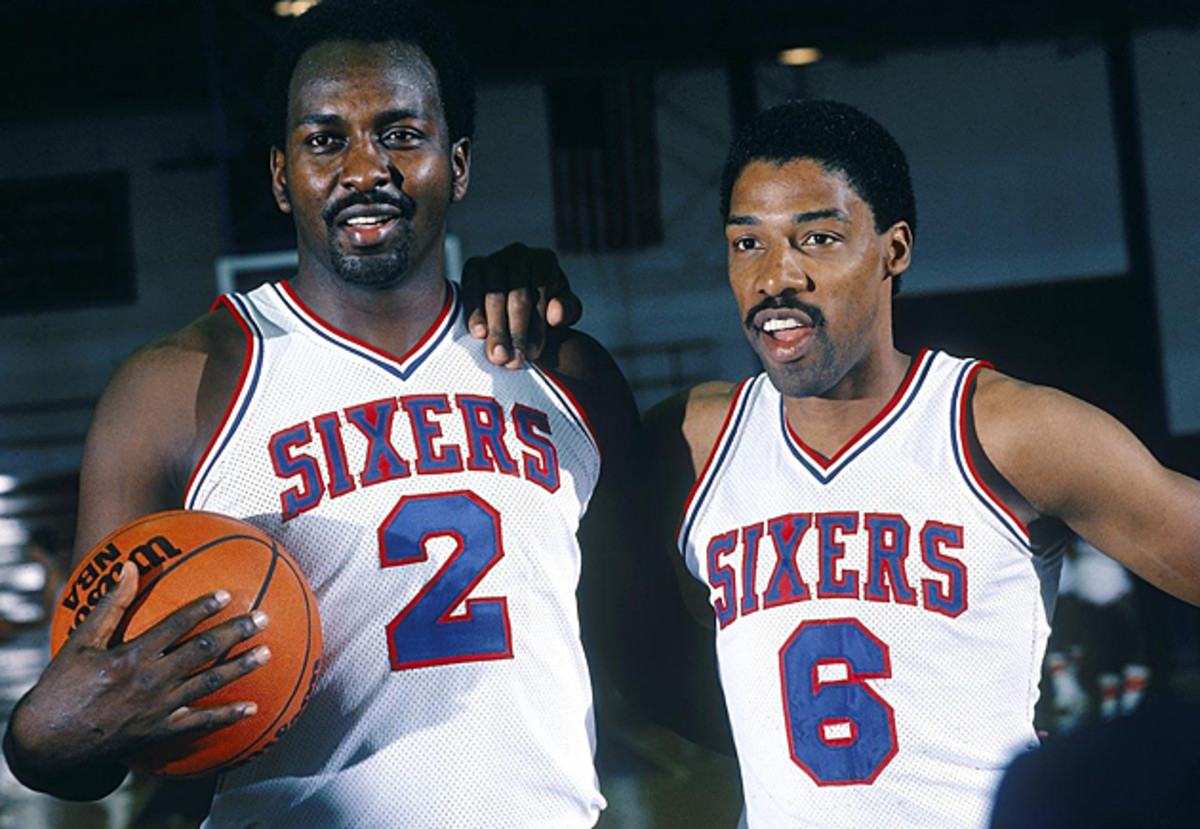
Moses Malone (left) and Julius Erving. Big Mo and Dr. J.

May 31, 1983, 40 years ago: The Philadelphia 76ers, and Julius Erving, finally win an NBA Championship, on the massive shoulders of the man who, for most of the early 1980s, was the best basketball player in the world.

Not Erving. Not Kareem Abdul-Jabbar or Magic Johnson of the Los Angeles Lakers, whom the Sixers beat in these Finals. Not Larry Bird of the Boston Celtics, whom the Sixers beat to get into the Finals.

His name was Moses Malone.

It was a story of 2 men, who couldn't have been more different in style, but who combined to get a precious result for one of basketball's greatest cities.

Both players started out in the American Basketball Association. Erving began with the Virginia Squires in 1971, and went to the New York Nets in 1973. Known as "Doctor J," his stunning moves led the Long Island team to the ABA Championship in 1974 and 1976. But when the Nets were invited into the NBA for the 1976-77 season, the territorial indemnification fee they had to pay to the New York Knicks forced them to dump Erving's salary. They traded him to the 76ers.

The 76ers, previously the Syracuse Nationals until 1963, and NBA Champions in 1967, reached the NBA Finals in 1977, but lost it to the Portland Trail Blazers. For 1978, the team adopted the slogan of "We owe you one," but they lost the Eastern Conference Finals to the Washington Bullets.

By 1980, Erving had cut back some on the superhuman moves (but not entirely: There was a basket in the NBA Finals that got the tag "The Move"), and became a better defensive player in the process. But the 76ers again lost the Finals, this time to the Lakers. They blew a 3-games-to-1 lead in the Conference Finals in 1981, to the Celtics. They beat the Celtics to get into the NBA Finals in 1982, but, again, lost to the Lakers.

Dr. J had 2 "red, white and blue rings," but, still no "real ring." And even fans in New England, Celtic fans who'd hated Philadelphia basketball teams going back to Warriors, who debuted in 1946 and moved to San Francisco in 1962, began to feel bad for him.

Enter Moses Malone. In 1974, he became the 1st player to jump from high school directly to the pros, signing with the ABA's Utah Stars. In 1976, after brief stopovers with the ABA's Spirits of St. Louis and the NBA's Buffalo Braves, he was traded to the Houston Rockets, and was named NBA Most Valuable Player in 1979 and 1982. He got the Rockets to their 1st NBA Finals berth in 1981, where they lost to the Celtics.

After the 1981-82 season, he was a free agent. The Sixers knew that enough was enough: They had to go for it, and opened the vault for Malone. Head coach Billy Cunningham and assistant coach Matt Guokas, both rookie forwards on the 76ers' 1967 title team, now had Malone at center, Erving and Bobby Jones as forwards, and Maurice Cheeks and Andrew Toney as guards. There was good scoring, and truly rugged defense. Toney was so good against the Celtics, he became known as the Boston Strangler.

The Sixers went 65-17, by 7 games over the Lakers the best record in the NBA. Malone, a native of the Norfolk, Virginia area, was asked how he thought the Playoffs would go. He said, "Fo', fo', fo'." In other words, he thought the Sixers would sweep all three series in four straight games. It had never been done.

In the Conference Semifinals, the Sixers did, indeed, sweep the New York Knicks in 4 straight. Malone led the team in scoring in all 4 games: 38 points, 30, 28 and 29. Knicks coach Hubie Brown, making a point about talent, if not one about proper pronunciation, said, "Moses Malone is a real man. They cannot pay him a-nough."

The Sixers won the 1st 3 games of the Eastern Conference Finals against the Milwaukee Bucks, although none of those 3 was easy. They were 7-0 in the Playoffs. The Bucks won Game 4, 100-94, ending the sweep dream. But the Sixers closed it out in Game 5, 115-103.

The Sixers went into the NBA Finals like a steamroller. The Lakers did not: Rookie sensation James Worthy broke his leg late in the regular season, and missed the entire Playoffs. Bob McAdoo -- like Worthy, Abdul-Jabbar and Johnson, on his way to the Basketball Hall of Fame -- was also hurt, though he was playing through it.

Indeed, in a 1996 ESPN discussion as to what was the greatest team in NBA history, the '83 76ers got nominated, and Bob Ryan of The Boston Globe, who chose the '86 Celtics, said of the '83 76ers, "There's a team out there that could have beaten them," citing the injuries to Worthy and McAdoo.

How much difference could those 2 have made? Perhaps enough to deny those Sixers entry into the "greatest team ever" conversation, but not enough to deny them the title. The Sixers won Game 1 at The Spectrum, 113-107, with Malone scoring 27. They won Game 2, 103-93, with Malone scoring 24. With all the focus on Malone, Erving could relax a little, and played some of the best basketball of his career.

The series moved out to Inglewood, California. Basketball pundits like to say that a series is never over until a home team loses at least once. But the Sixers mopped up the Forum floor with the Lakers in Game 3, 111-94. Malone had 28 points and 19 rebounds. A sweep was now a fait accompli, and Malone accomplished it with 24 points and 23 rebounds in Game 4. He had controlled the entire postseason, which ended with a 115-108 76ers victory. The joke was easy: Moses had led them to the Promised Land.

Moses Malone had carved his name into the marble of NBA history, winning the MVP of both the regular season and the Finals. And Julius Erving finally had an NBA Championship. Pretty much anybody who wasn't a hardcore Laker fan was happy.

The 76ers remained a strong team for 3 more years. But on June 15, 1986, team owner Harold Katz traded Malone, and they traded the top pick the Draft. They've never been the same since, making only 1 NBA Finals, in 2001 with Allen Iverson. Otherwise, with Charles Barkley, Iverson, and Joel Embiid, and under 3 different ownership regimes, the Philadelphia 76ers have been one of the most underachieving teams in North American sports.

From the NBA Finals of 1984 to that of 2022, the count of NBA Championships is as follows: Los Angeles Lakers 9, Chicago Bulls 6, San Antonio Spurs 5, Golden State Warriors 4, Detroit Pistons 3, Boston Celtics 3, Miami Heat 3, Houston Rockets 2, Dallas Mavericks 1, Cleveland Cavaliers 1, Toronto Raptors 1, Milwaukee Bucks 1. The other 18 teams, including the Philadelphia 76ers, none. And of those 18 teams, 5 didn't even exist in 1983.

"Trust the process"? The 76ers acquired James Harden in 2022, but Harden is no Moses Malone. And Embiid is no Julius Erving.

Sunday, June 25, 2017

Top 10 Athletes from Virginia

June 25, 1788: Virginia becomes the 10th State to ratify the Constitution of the United States, thus joining the Union.

Top 10 Athletes from Virginia

You know how we sometimes say about a great athlete, "He's not human!" Well, the greatest athlete from Virginia might not have been human. It might have been a horse: Secretariat, born at The Meadow, a horse farm outside Bowling Green, Caroline County, Virginia. Genuine Risk, who in 1980 became only the 2nd filly to win the Kentucky Derby (and only 1 other has done it since), was born at Catoctin Stud in the Washington suburb of Waterford.

At any rate, in spite of Virginia being a Southern State, basketball dominates this list, not football. And the Norfolk-Virginia Beach-Hampton Roads area dominates, not the suburbs of Washington, D.C., or the State capital of Richmond.

Honorable Mention to Ken Clay of Lynchburg. He was a relief pitcher who helped the Yankees win the 1977 and 1978 World Series.

Honorable Mention to Wendy Gebauer of Reston, and Kim Maslin-Kammerdeiner of Fairfax, both suburbs of Washington, D.C. They were members of the U.S. team that won the 1st Women's World Cup in soccer, in 1991.

Honorable Mention to Ali Krieger of Dumfries, also a D.C. suburb. She was a member of the U.S. team that won the 2015 Women's World Cup.

Honorable Mention to Jonathan Clay Redick of Roanoke -- his parents called him "J" for short, but one of his baby sisters turned it into "J.J." -- who won the James E. Sullivan Memorial Award as the outstanding amateur athlete in America in 2005, as a basketball player at Duke University. While still Duke's all-time leading scorer, and they retired his Number 4, his pro career has been a letdown, although he did reach the 2009 NBA Finals with the Orlando Magic. He will play the 2017-18 season with the Philadelphia 76ers.

Honorable Mention to Andrew Rodriguez of Alexndria. The linebacker for the Army football team overcame a severe back injury to not only play again, but win the 2011 Sullivan Award. He has remained in the U.S. Army, and is unlikely ever to play pro ball, especially since his father, David M. Rodriguez, is a retired 4-star General (and also a former West Point football and baseball player), and all the branches of the armed forces the Army like to train the sons of "flag officers" to be flag officers as well.

Honorable Mention to Pernell Whitaker of Norfolk. "Sweet Pea" boxed his way to a Gold Medal at the 1984 Olympics in Los Angeles. He 1st held a championship, the IBF Lightweight title, in 1989; and last did so, the WBA Super Welterweight title, in 1995.

Honorable Mention to Dwight Stephenson of Hampton. The center helped the University of Alabama win back-to-back National Championships at the University of Alabama. A 5-time Pro Bowler, he helped the Miami Dolphins win the 1982 and 1984 AFC Championships, though they lost the Super Bowl each time. He was named to the Pro Football Hall of Fame, the NFL's 1980 All-Decade Team, and the Miami Dolphin Honor Roll.

Honorable Mention to Ralph Sampson of Harrisonburg. The center led the University of Virginia to the 1980 NIT title and the 1981 NCAA Final Four, winning 3 National Player of the Year awards. They retired his Number 50.

A 4-time All-Star, he was the 1984 NBA Rookie of the Year, MVP of the 1985 All-Star Game, and helped the Houston Rockets win the 1986 Western Conference Final, losing in the Finals. Injuries cut his career short, but he still had enough, college and pro combined (basketball does it that way, even though football doesn't), to be elected to the Basketball Hall of Fame.

Honorable Mention to Dell Curry of Grottoes. A 16-year NBA veteran who got his Number 30 retired by Virginia Tech, and was also a renowned high school baseball player, he will probably be best remembered for being the father of Steph Curry -- Wardell Stephen Curry II. Another son, Seth Curry, also plays in the NBA.

Somewhat Honorable Mention to Burress of Norfolk. He caught 553 passes for 8,499 yards and 64 touchdowns in regular-season play. And that doesn't count the greatest service he could have provided to football: Catching a last-minute touchdown pass from Eli Manning to win Super Bowl XLII for the Giants, and end the New England Cheatriots' bid for 19-0.

What happened to him after that is the stuff of both tragedy and farce. But he's cleaned up his life, and is now an assistant coach with, appropriately enough, the team that plays its home games in the stadium where he wrote his name into history, the Arizona Cardinals.

10. Allen Iverson of Hampton. At 6-foot-1, he is one of the shortest great basketball players ever. A star at Georgetown University in Washington, he became an 11-time NBA All-Star, including winning 2 All-Star Game Most Valuable Player awards. He was a 4-time scoring champion, a 3-time steals leader, and league MVP in 2001, when he led the Philadelphia 76ers to their only Finals appearance since the man at Number 5 on this list led them to their last title.

His Number 3 has been retired by the 76ers, and has been elected to the Basketball Hall of Fame. Clearly, some practice paid off for him.

But he's not the highest-ranking former Georgetown University basketball player on this list. The man at Number 8 on this list is.

9. Grant Hill of Reston. Although born in Dallas while his father Calvin Hill was a running back for the Dallas Cowboys, he great up in the D.C. suburbs, because his father finished his career with the Washington Redskins, and the family stayed there. A member of Duke University's National Championship basketball teams in 1991 and 1992, he got them back into the National Final in 1994. Duke retired his Number 33.

Like his father in his sport, Grant was Rookie of the Year in his, in the NBA in 1995. He was a 7-time All-Star, but injuries and bad luck with his teams' management decisions -- the Detroit Pistons, the Orlando Magic and the Phoenix Suns -- meant that he never got that elusive NBA title. He did, however, win an Olympic Gold Medal in 1996.

He is married to R&B singer Tamia, has done some acting, and is now a minority owner of the Atlanta Hawks. He is eligible for the Basketball Hall of Fame, and, considering that it includes collegiate achievements, he should be in it.

But he is not the highest-ranking Duke University athlete, or even basketball player, on this list. The man at Number 7 is.

8. Alonzo Mourning of Chesapeake. The successor to Patrick Ewing as the great center on the Georgetown University basketball team, he was Big East Conference Player of the Year in 1992. When he was drafted by the Charlotte Hornets, a Reebok commercial imagined all the honors he would receive, including the retirement of his Number 33.

Well, that did happen -- but it was the Miami Heat that retired it, after a career in which the center was a 7-time NBA All-Star, a 2-time Defensive Player of the Year, and a 2006 NBA Champion. He is in the Basketball Hall of Fame.

7. Clarence "Ace" Parker of Portsmouth. When he died in 2013, at the age of 101, he was the oldest living former Major League Baseball player, having played shortstop for Connie Mack's Philadelphia Athletics in 1937 and '38. But baseball wasn't his best sport: Football was. Ironically, in football, he played for teams named the Brooklyn Dodgers and the New York Yankees.

He was a star athlete at Duke University in Durham, North Carolina, half a century before Mike Krzyzewski's basketball team made that cool. He played baseball, football and basketball there. He finished 6th in the 1936 Heisman Trophy balloting, as a quarterback and safety, and Sammy Baugh was the only quarterback taken ahead of him in the 1937 NFL Draft.

He was a 2-time All-Pro, led the NFL in passing yards in 1938, and in 1940 led it in interceptions -- made, not thrown. He was also named NFL Most Valuable Player in 1940. He was named to the All-AAFC Team in 1946, and probably would have had more honors had his career not been interrupted by World War II, in which he was an officer in the U.S. Navy, well before the man at Number 2 on this list was born. Alas, no team for which he played survived the 1940s, so there is no team around to have retired his Number 7.

He later returned to Durham, managing the Durham Bulls minor-league baseball team, and serving as head baseball coach and assistant football coach at Duke. He was elected to the Pro Football Hall of Fame, the 1st member of any of the 4 major pro sports' Halls of Fame to live to be at least 100 years old. (Amos Alonzo Stagg lived to be 102, but he was in the College Football Hall of Fame, never having worked in pro ball.) He was also elected to the Sports Halls of Fame of both Virginia and North Carolina, and was a charter inductee into the Duke University Sports Hall of Fame in 1975.

6. Willie Lanier of Richmond. One of several players from HBCUs (Historically Black Colleges and Universities) to play for the AFL's Kansas City Chiefs (Morgan State University in Baltimore -- Buck Buchanan of Grambling State in Louisiana was another), Willie was the greatest linebacker in AFL history, and one of the top NFL linebackers in his era.

A 2-time All-AFL player and a 6-time NFL Pro Bowler (that's 8 All-Star Teams), he arrived too late to play for the Chiefs team that won the 1966 AFL Championship and lost Super Bowl I, but he led the defense that won the 1969 AFL Championship and won Super Bowl IV. He was named to the College and Pro Football Halls of Fame, the NFL's 75th Anniversary All-Time Team, and the Kansas City Chiefs Hall of Fame. The Chiefs retired his Number 63.

5. Moses Malone of Petersburg. In 1974, he became the 1st high school basketball player to jump directly to the pros, signing with the ABA's Utah Stars. He played the ABA's last 2 seasons, then 19 more in the NBA, proving remarkably durable.

He was an ABA All-Star in his rookie season, 1974-75, then an NBA All-Star 12 straight times. He was a 6-time rebounding leader and a 3-time Most Valuable Player: 1979, 1982 and 1983. He got the Houston Rockets into their 1st NBA Finals in 1981.

The Philadelphia 76ers, desperate for a title after some agonizing close calls, made the trade that brought Big Mo in, and he joined with Julius "Dr. J" Erving, Bobby Jones and Andrew Toney to build one of the greatest teams ever. In his Hampton Roads accent, Malone predict a sweep of all 3 Playoff series: "Fo', fo', fo'." It didn't quite work out, as they went 12-1. (The 2002 Los Angeles Lakers went 15-1, and this year's Golden State Warriors topped that with 16-1. Going undefeated has never been done, not even by the old Boston Celtics in the 2-round era.) But they did win the title, with Malone winning the Finals MVP, and the Sixers haven't done it since.

His Number 24 is retired by the Rockets, and his Number 2 (Jones wore 24) by the 76ers. He was named to the Basketball Hall of Fame, and is 1 of 5 players named to both the ABA All-Time Team and the NBA's 50th Anniversary 50 Greatest Players.

4. Bruce Smith of Norfolk. No Virginia native has ever won the Heisman Trophy. A man named Bruce Smith won it in 1941, but he was a running back at the University of Minnesota. This Bruce Smith might have been better. You know what he did as a defensive end for 19 years in the NFL? As Dennis Hopper said in a Nike commercial, "Bad things, man! I mean bad things!"

He -- not Michael Vick -- is the greatest athlete in Virginia Tech history, winning the 1984 Outland Trophy as the best interior lineman in college football. Playing professionally, mostly with the Buffalo Bills, and toward the end for the Washington Redskins, he was an 11-time Pro Bowler. He starred on the Bills' 4 consecutive AFC Championship teams (but, of course, losing all 4 Super Bowls. And, while the statistic of sacks was not kept by the NFL until 1982 -- it is believed that Deacon Jones is the real all-time leader -- officially, Bruce Smith had more sacks than any player in the League's history: An even 200.

He was named to the College and Pro Football Halls of Fame, the NFL's 1980s and 1990s All-Decade Teams, and the Buffalo Bills Wall of Fame. Virginia Tech does not retire numbers, but the Bills retired his Number 78.

3. Arthur Ashe of Richmond. If we were going by importance, rather than by achievement, he would easily be at Number 1. It was considerable appropriateness that he went to UCLA, the school that also produced the 1st black player in modern baseball, Jackie Robinson; and the 1st 2 players to break the color line in the NFL, Kenny Washington and Woody Strode. He also received coaching from the 1st great Hispanic tennis player, who lived in Los Angeles: Ricardo "Pancho" Gonzales.

He was the 1st black male tennis player to be ranked Number 1 in the world, in 1968. That year, he became the 1st to win the U.S. Open. In 1970, he became the 1st to win the Australian Open. In 1975, he became the 1st to win Wimbledon. (He didn't quite get the "career Grand Slam," getting only as far as the Quarterfinals in the French Open, in 1970 and 1971.)

Althea Gibson was the 1st black person to win the French (in 1956), Wimbledon (1957 and '58) and the U.S. (1957 and '58). And the Williams sisters have won so many titles, it's hard to keep track. But Ashe remains the only black man to win the Australian, the U.S., and Wimbledon. The only one to win any of those, and he won all of them. I checked: Yannick Noah won the French, but none of the others.

Ashe's importance goes beyond what he did to raise the profile and acceptance of black athletes at home. He also helped break down the barriers of apartheid in South Africa. And, due to his own misfortune, he became an advocate for AIDS research.

For this reason, as he was dying in 1992, Sports Illustrated named him its Sportsman of the Year. Early in 1993, after his death, they put him on the cover again -- but it was hardly "The Dreaded SI Cover Jinx," as he was doomed anyway. Nevertheless, ESPN named its annual Award for Courage after him. President Bill Clinton posthumously awarded him the nation's highest civilian honor, the Presidential Medal of Freedom.

2. David Robinson of Manassas. Like his father before him, he entered the U.S. Navy (he was born in Key West, Florida, while his father was stationed there), after growing up in and around D.C. He graduated from the U.S. Naval Academy, and became the greatest basketball ever to play at one of the service academies, sweeping the player of the year awards in 1987. He wanted to serve on a submarine, but at 7 feet even, was way too tall. After serving his 2-year commitment, he was discharged so that he could play pro ball.

A center for the San Antonio Spurs, "The Admiral" (he actually left the Navy with the rank of Lieutenant Junior Grade) was a 10-time NBA All-Star, Rookie of the Year in 1990, rebounding leader in 1991, blocked shots leader and Defensive Player of the Year in 1992, scoring leader in 1994, Most Valuable Player in 1995, and, finally having another great player alongside him in Tim Duncan, an NBA Champion in 1999, and retired as an NBA Champion in 2003. That year, Sports Illustrated named him and teammate Tim Duncan as their Sportspeople of the Year. He won Olympic Gold Medals in 1992 (the Dream Team) and 1996.

He was named to the Basketball Hall of Fame, and, while still active and not yet an NBA Champion, to the NBA's 50th Anniversary 50 Greatest Players. 50 was also his uniform number, which the Spurs retired.

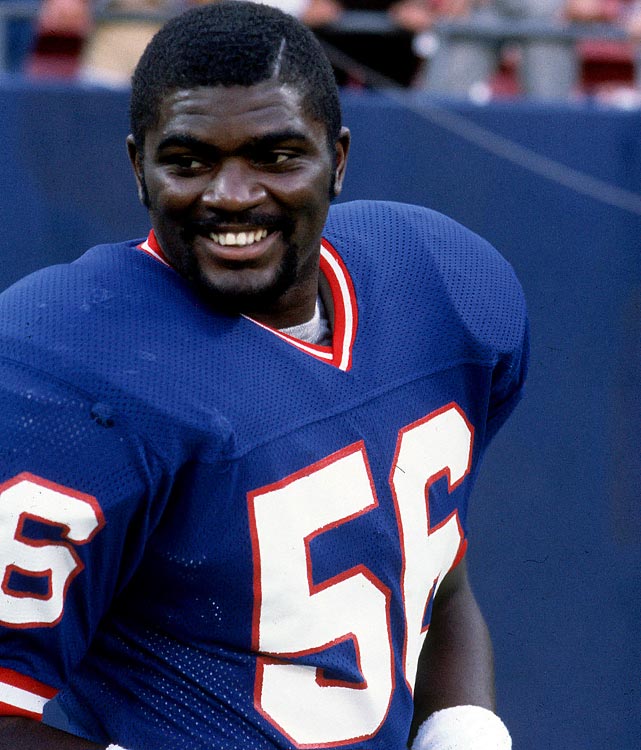
1. Lawrence Taylor of Williamsburg. The town is famous for its roles in the American Revolution and the American Civil War, but L.T. got medieval on a few asses.

The linebacker was an All-American at the University of North Carolina, and they retired his Number 98. He was a 10-time Pro Bowler, the NFL Most Valuable Player in 1986 (a rare feat for a defensive player), and a 2-time Super Bowl winner with the New York Giants. More than that, he was a symbol for defensive players in the 1980s, an era of reckless abandon, which included his runaway cocaine use, and his career-ending leg break of Washington Redskins quarterback Joe Theismann.
He was named to the Pro Football Hall of Fame, the NFL's 75th Anniversary All-Time Team and its 1980s All-Decade Team, and the New York Giants Ring of Honor, with his Number 56 retired. In 1999, The Sporting News named its 100 Greatest Football Players. He came in at Number 4. In 2010, the NFL Network named its 100 Greatest Players. He came in at Number 3. In each case, he was the highest-ranking defensive player.

Monday, September 14, 2015

Moses Malone, 1955-2015

Moses Malone was a big man. Big in physical size. Big in physical presence. Big in importance in basketball history.

Remember the fuss made 3 months ago, when the Golden State Warriors won their 1st NBA title in 40 years? If not for Malone, the Philadelphia 76ers would now be closing in on 50 years.

*

Moses Eugene Malone was born on March 23, 1955 in Petersburg, Virginia, the site of a major battle in the American Civil War, where the Union's breakthrough led to the fall of Richmond and of the Confederacy itself.

Moses led Petersburg High School to State Championships and undefeated seasons in his junior and senior years, 1972-73 and 1973-74. He was headed to the University of Maryland, then riding high in the wake of All-Americans Len Elmore and John Lucas, the latter eventually becoming a Houston Rocket teammate of Moses'.

But the Utah Stars of the American Basketball Association drafted him, even though he hadn't gone to a single college class yet. Hardly any players had ever played professional basketball without playing in college. To that point, none had gone from high school straight to a major league, and the ABA certainly thought of itself as a major league.

Moses signed with the Stars, who had just reached the ABA Finals for the 2nd time, having won the title in 1971. This would be the only league title a Utah team would win in any major, or even semi-major, sport until Real Salt Lake won the 2009 MLS Cup.

Moses went from playing high school ball in Virginia to signing a 5-year contract worth an even $1 million. That's $200,000 a year -- about $968,000 in today's money. Apparently, the Stars couldn't afford him, as they folded after the 1974-75 season. He was sold to the Spirits of St. Louis to help pay off the Stars' debts.

When the ABA folded in 1976, the Spirits were not among the teams that were absorbed into the NBA, and Moses' status was up for grabs. His NBA rights were held by the New Orleans Jazz. He could have ended up going back to Utah, as the Jazz moved there in 1979. But can you imagine Moses Malone and Pete Maravich on the same team?

It didn't happen, because the Jazz, who also needed cash badly, traded Moses to the Portland Trail Blazers in a complicated deal. But the Blazers already had Bill Walton and Maurice Lucas, and thought they didn't need another big man. They were right in the short term, as they won the 1977 NBA title. But in the long run, they were wrong, as both Walton and Lucas were plagued with injury for the rest of their careers.

Indeed, if you think about it, a Blazer team that still had Moses Malone in 1984 probably wouldn't have drafted Sam Bowie. Instead, they drafted Bowie, because they needed a big man, and didn't draft Michael Jordan because they already had a perceived similar player in Clyde Drexler. Result: The Blazers haven't won an NBA title since 1977, and Jordan's Chicago Bulls beat Drexler's Blazers in the 1992 Finals.

So before Moses ever played a game for Portland, they traded him to the Buffalo Braves. What's that, you've never heard of the Buffalo Braves? They made the Playoffs 3 straight years in the 1970s, led by Bob McAdoo and Ernie DeGregorio. With Moses Malone added to the mix, they should have become an NBA power. But they only played Moses twice, and he essentially said, "Play me or trade me." So they traded him, to the Houston Rockets, for their 1st round draft picks in 1977 and 1978.

He had now been with 6 professional basketball organizations, and he wast just 21 years old. This sort of thing would have been real fodder for discussion on ESPN's Around the Horn and Pardon the Interruption if it had happened in the 21st Century.

Moses found a home in Houston, and set a record with 437 offensive rebounds in a regular season. He was not yet 22 years old. Put it another way: He was better than LeBron James, and he did it before LeBron was even born. The Rockets got all the way to the Eastern Conference Finals before someone said, "What the hell? Houston shouldn't be in the East!" He collected 15 offensive rebounds in a Conference Semifinal game against the Washington Bullets, setting an NBA Playoff record.

The Rockets were defeated by the Philadelphia 76ers in the Conference Finals, before losing the NBA Finals to the Blazers. The next season, the Sixers gave their fans the slogan, "We owe you one." But they were unable to deliver, losing to the Los Angeles Lakers in the 1980 and '82 NBA Finals and the Boston Celtics in the 1981 East Finals.

Moses was named NBA Most Valuable Player in 1979, and in 1981 he got the Rockets to their 1st Conference Championship -- this time in the Western Conference, where they always belonged -- and into their 1st NBA Finals, where they lost to the Celtics. Along the way, he collected 21 offensive rebounds in a regular-season game against the Seattle SuperSonics, a new record. A Sports Illustrated cover, reflecting his ability to grab rebounds, a.k.a. "boards," called him the Chairman of the Boards.

*

Moses became a free agent after the 1981-82 season, another MVP season for him, and, desperate for a big man to stand alongside stylish forward Julius "Dr. J" Erving so that they could finally win an NBA title for the 1st time since 1967, the 76ers paid through the nose to get him.

Moses won the MVP again, making him the 1st athlete in any major league sport to win the award in back-to-back years with 2 different teams. To this day, only Barry Bonds has matched it -- in 1992-93, before he is known to have used steroids. Moses Malone didn't need no steroids.

The Playoffs approached, and a reporter asked Moses for a prediction. Very calmly, the 6-foot-10, 215-pound center said, in his Virginia accent, "Fo', fo', fo'." Three rounds, best-4-out-of-7, all to be won by the Sixers in four straight games. It had never been done before, but, after what Moses had done with the Rockets and the Sixers the last 3 seasons, few doubted it could be done.

In the 1st round, the 76ers swept the New York Knicks, and Knick coach Hubie Brown told an interviewer, "Moses Malone is a real man. They cannot pay him a-nough."

Not "enough," "a-nough." It could have just been Hubie being tired and not ready to pronounce the word properly. Or it could just be that Moses was so valuable to the Sixers, he transcended proper pronunciation.

The Sixers then moved on to the Milwaukee Bucks, and the Bucks won a game. But only 1, as the Sixers won in fi' instead of fo'.

Then came a Finals rematch with the Lakers. Big men for the Sixers had not been able to handle Kareem Abdul-Jabbar in 1980 and 1982. But 1983 would be different. Not just because the Sixers had Moses: McAdoo, the former Buffalo star, had been a factor the year before, but would not be this time, due to injury. James Worthy, the Lakers' rookie sensation, would also be out with an injury. The Lakers were nowhere near full strength, and Moses took advantage.

Game 1 at the Spectrum in Philadelphia was close: 113-107. Game 2 was less so: 103-93. The series moved out to the Forum in the Los Angeles suburb of Inglewood, and the Sixers won, 111-94. Game 4 was close most of the way, but it ended 115-108.

The Philadelphia 76ers had won the NBA Championship. Big Mo, Dr. J., Little Mo (Maurice Cheeks), Bobby Jones and Andrew Toney had gotten their rings. Billy Cunningham, a rookie forward on the previous Sixer title in 1967, had now also won one for them as a head coach.

And nobody held it against Moses that his prediction was off by 1 game. The '83 76ers' 12-1 Playoff record has only been topped once, by the 2001 Lakers, who, with the league and the Playoffs expanded, went 15-1 on the way to the title.

The Sixers were unable to follow up, losing in the 1984 Playoffs to the New Jersey Nets -- the only NBA Playoff series the former Long Island team of the ABA would win until 2002. The Pistons lost the 1985 East Finals to the Celtics, and in 1986, Moses sustained an orbital fracture, knocking him out for the season.

June 15, 1986, a date which lives in Delaware Valley sports infamy. The Sixers had the 1st pick in the draft, due to a smart trade. But team owner and NutriSystem founder Harold Katz then made a dumb trade, trading that pick to the Cleveland Cavaliers for Roy Hinson. There was nothing wrong with having a healthy Hinson on your team, but the Cavs used the pick on Brad Daugherty, who became one of the best centers of his era.

No matter, the Sixers still had Moses Malone -- except, on the same day, they traded him, Terry Catledge, and not one but two 1st round picks to the Washington Bullets for Jeff Ruland and Cliff Robinson.

Before this date: 9 years, 6 Conference Finals, 4 NBA Finals, and an NBA Championship. After this date: 29 years, 1 trip to the Conference Finals, including the 2001 NBA Finals, and no title. One of the NBA's oldest and proudest franchises has never been the same. It could be called the Curse of Katz.

*

Moses was 31, and was hardly done. On April 8, 1987, he dropped his 3rd career 50-point game -- unfortunately for me, on the New Jersey Nets, leading the Bullets to victory. In 1988, he was named to his 12th All-Star Game.

Then, troubled by a back injury, he bounced around some more. He went to the Atlanta Hawks, in 1991 to the Milwaukee Bucks, in 1993 back to the Sixers (in the hope that he could mentor 7-foot-6 Shawn Bradley, as he already had with a young Charles Barkley; but, by then, it was too late to help them), and spent his final NBA season, 1994-95, with the San Antonio Spurs, backing up David Robinson.

In the ABA and the NBA combined, he was an All-Star 13 times, scored 29,580 points (only Kareem and Wilt Chamberlain were ahead of him at the time), and grabbed 17,834 rebounds, leading the NBA 6 times. His NBA-only totals: 27,409 points and 16,212 rebounds. In the 69-year history of the NBA, only 4 players have at least 27,000 points and at least 16,000 rebounds: Moses, Kareem, Wilt Chamberlain and Elvin Hayes. (Kareem holds the points record, 38,387, having surpassed Wilt at 31,419; Wilt still holds the rebounding record, 23,924, well ahead of Kareem's 2nd-best 17,440.)

The Rockets retired his Number 24. With Bobby Jones already having it on the Sixers, they gave him Number 2, and have retired it. He was elected to the Basketball Hall of Fame in 2001, his 1st year of eligibility. He, Rick Barry, George Gervin, his 76er teammate Erving, and his 76er coach Cunningham were the only 5 players named to both the ABA All-Time Team and the NBA's 50th Anniversary 50 Greatest Players.
Moses was divorced from a woman named Alfreda, and their relationship was stormy. On 2 known occasions, she charged him with domestic abuse. They had 2 sons. He helped fund a recreation center in Houston, and was briefly an assistant coach with the Sixers.

Moses was in Norfolk, Virginia, not far from his hometown of Petersburg, for a celebrity golf tournament, but failed to show for it yesterday morning. He was found dead in his hotel room. He was 60 years old. The coroner has announced that he died from heart disease.

Tributes came from the ownership of the teams with which he is most identified. Leslie Alexander of the Houston Rockets: "Everyone in the organization is deeply saddened by the passing of Moses Malone. Moses was a true gentleman and one of the great Rockets and greatest NBA players, of all time. He will be forever missed. Our deepest condolences go out to his family and friends."

Scott O'Neill, CEO of the Philadelphia 76ers: "No one person has ever conveyed more with so few words -- including three of the most iconic in this city's history. "His generosity, towering personality and incomparable sense of humor will truly be missed."

Moses Malone Jr.: "He taught us so much about life. He came from nothing. He taught us how to work hard and respect people, love your family and always do the right thing. He's a good person. He was always there to help people. He cared about people who had less than him."

Moses was not related to his fellow Basketball Hall-of-Famer, Karl Malone, a.k.a. the Mailman. Nor was he related to another NBA All-Star, Jeff Malone.

Moses died within days of the death of another late 1970s 76ers big man, Darryl Dawkins; and a few months after the one he was traded for, Caldwell Jones.

George McGinnis, take care of yourself!

UPDATE: Moses Malone was buried at Memorial Oaks Cemetery in Houston.