This is mostly about sports, and then mostly about baseball. It will favor the New York Yankees, the New Jersey Devils, Rutgers University football, and the London soccer club Arsenal. You got a problem with that? Make your own blog.
October 1, 1950, 75 years ago: Dick Sisler hits a home run off Don Newcombe in the top of the 10th inning at Ebbets Field, and the Phillies beat the Brooklyn Dodgers 4-1, to clinch the National League Pennant. It is the only Pennant the Phils would win in a 65-year stretch from 1915 to 1980.
This was the 2nd of 3 straight seasons in which the National League race came down to the last day of the regular season with the Dodgers involved. The year before, they had to win to clinch and eliminate the St. Louis Cardinals, and they did. The year after, they had to win to force a Playoff with their arch-rivals, the New York Giants, and they did -- for all the good that ended up doing them.
Dodger pinch-hitter Tommy "Buckshot" Brown is the last living player from this game, 72 years later. For the Phillies, the last survivor, backup infielder Ralph "Putsy" Caballero, died in 2017. Bob Miller and Curt Simmons, neither of whom appeared in this game, are the last 2 living 1950 Whiz Kids.
Richard Alan Sisler was born on November 2, 1920 in St. Louis. His father was George Sisler of the St. Louis Browns, one of the best all-around players of his generation: A .340 lifetime hitter whose 1920 total of 257 hits stood as a major league record for 84 years, a 4-time American League leader in stolen bases, and, according to contemporary observers, the best-fieldling 1st baseman of his time.
His brother Dave Sisler would be a major league pitcher, and his brother George Sisler Jr. became a longtie baseball executive. Oddly, George Sr. was a scout for the Dodgers at the time, and was in the ballpark when Dick hit the home run. A reporter asked George how he felt, and he said, "I felt awful and terrific at the same time."
A 1st baseman and left fielder, Dick debuted with the Cardinals in 1946, contributing to a World Series-winning team a a rookie. He was traded to the Phillies in 1948. That 1950 season was his only selection to the All-Star Game. He was traded to the Cincinnati Reds in 1952, and back to the Cardinals later that year, last playing in the majors with them in 1953. He finished his career with a .276 batting average, and just 55 home runs, but 1 of them won a Pennant.
Dick went into coaching, and won another Pennant in 1961, on the staff of Fred Hutchinson of the Cincinnati Reds. When Hutchison left the team late in the 1964 season due to cancer, Dick stepped in as interim manager. Ironically, his Reds were a big reason why his former team, the Phillies, did not win the Pennant that season. But it was his other former team, the Cardinals, who did.
When Hutch died, Dick was named the official manager, and won 89 games in 1965, but was fired after the season, anyway. The Cardinals brought him onto the coaching staff of his former teammate Red Schoendienst, and, together, they won the 1967 World Series, and lost the 1968 World Series. He later coached for the San Diego Padres and, in 1979 and '80, under Joe Torre on the Mets.
He spent most of the 1980s working in the Cardinal farm system, helping to build a team that won 3 Pennants and the 1982 World Series. He died on November 20, 1998, at the age of 78.
The Dick Sisler Game was is also the last major league game as a manager for Burt Shotton, who'd managed the Dodgers to Pennants in 1947 and 1949, and eased the path of Jackie Robinson as he and general manager ranch Rickey reintegrated baseball.
An outfielder, Shotton had played in the major leagues from 1909 to 1923, including 1915 to 1917 with the St. Louis Browns, where he was a teammate of George Sisler -- hence, George's scouting for the Dodgers. Shotton had previously managed the Phillies from 1928 to 1933, and the Reds in 1934, and had also coached for the Cardinals and the Cleveland Indians.
He left the Indians after the 1945 season. When Rickey needed a manager for 1947 after Leo Durocher's yearlong suspension, he asked for Shatoon, who told Rickey, "I romised my wife I would never put on another uniform." So Rickey talked him into managing in a suit, like Connie Mack.
Speaking of whom...
Also on this day, the Philadelphia Athletics complete a massively disappointing 102-loss season by beating the Washington Senators, 5-3 at Shibe Park. It is the last game for A's manager Connie Mack: Approaching his 88th birthday, his sons Earle, Roy and Connie Jr., agreeing on little else, agree to gang up on him and force him to finally retire as manager -- something he, as also the owner, did not want to do.
Before the A's move to Kansas City, the Phillies, new owners of the ballpark, will rename it Connie Mack Stadium, and will erect a statue of him outside.
Having first played in what we would now call Major League Baseball in 1886, the 1st term of Grover Cleveland, and made it to 1950, the 2nd term of Harry Truman, Connie Mack was involved in 4,490 regular-season games, far and away a major league record. (Vin Scully was on hand for 10,766 games over 67 seasons, but that was as a broadcaster.)
Shotton and Mack were the last managers to wear street clothes during a game. Although no rule specifically mandates that a manager must wear a uniform, there is now a rule that states that, aside from medical and security personnel, no one is allowed on the field of play during a game unless they are wearing some form of baseball uniform.
Pitcher Bobby Shantz is the last living man to have been managed by Connie Mack, and the last player to have played for the Philadelphia Athletics, 75 years after Mack's last game, and 71 years after the A's moved to Kansas City.
November 21, 1788: North Carolina becomes the 12th State to ratify the Constitution of the United States.
Note: The dates on the State Flag are as follows: May 20, 1775: The Mecklenburg Declaration of Independence, in which Mecklenburg County, including present-day Charlotte, declared independence from Britain, for all the authority that had; and April 12, 1776: The Halifax Resolves, called by the Provincial Congress of North Carolina, recommending independence, and helping pave the way for the nationwide Declaration on July 4.
Top 10 Athletes From North Carolina
Honorable Mention to Buck Leonard of Rocky Mount. He may have been the best baseball player from the state, but without definitive Major League statistics, we can't be sure. But he was elected to the Baseball Hall of Fame, and was 1 of 5 players who played all or mainly in the Negro Leagues who was named to The Sporting News' 100 Greatest Baseball Players. (The others were Satchel Paige, Josh Gibson, Cool Papa Bell and Oscar Charleston.)
Honorable Mention to Steph Curry of Charlotte. Wardell Stephen Curry II grew up there while his father, Dell Curry, played for the Charlotte Hornets. Already a 5-time All-Star, a 2-time Most Valuable Player, and a 2-time NBA Champion for the Golden State Warriors, he is likely to make the Top 10 if I do this list again in, say, 5 years.
Indeed, you could make a damn good basketball team out of the guys from North Carolina who didn't make the Top 10. Sam Jones of Laurinburg, a 5-time All-Star and a 10-time NBA Champion with the Boston Celtics, who retired his Number 24. Walt Bellamy of New Bern, a 4-time All-Star, and a Hall-of-Famer twice over, in his own right and as a member of the U.S. team that won the Gold Medal at the 1960 Olympics in Rome.
More recently, Cedric "Cornbread" Maxwell of Kinston, 1981 (Finals MVP) and 1984 NBA Champion with the Boston Celtics, who retired his Number 31. Bob McAdoo of Greensboro, 1975 NBA MVP and 1982 and 1985 NBA Champion with the Los Angeles Lakers. Bobby Jones of Charlotte, 1983 NBA Champion with the Philadelphia 76ers, who retired his Number 24. Dominique Wilkins of Washington, Number 21 retired by the Atlanta Hawks. And Meadowlark Lemon, perhaps the most famous of all the Harlem Globetrotters. All of those are in the Basketball Hall of Fame.
Also Lou Hudson of Greensboro, Number 23 retired by the Hawks. Phil Ford of Rocky Mount, Number 12 retired by North Carolina. Buck Williams of Rocky Mount, Number 52 retired by the New Jersey (now Brooklyn) Nets. Brad Daugherty of Black Mountain, Number 43 retired by the Cleveland Cavaliers. John Lucas of Durham, All-American at Maryland, 1976 ACC Athlete of the Year, helped the Houston Rockets reach the 1986 NBA Finals. (His son, John Lucas III, grew up in Houston while his father played there, and would thus qualify for Texas.)
Honorable Mention to Julie Shea of Raleigh. The North Carolina State runner was awarded the 1979-80 Honda-Broderick Cup as female collegiate athlete of the year. She later served on the Raleigh City Council.
Honorable Mention to Megan Hodge of Durham. The Penn State volleyball player was awarded the Honda-Broderick Cup for the 2009-10 schoolyear, and won a Silver Medal with the U.S. team at the 2012 Olympics in London.
Honorable Mention to Kim Jacob of Raleigh. The University of Alabama gymnast won the Honda Broderick Cup as the outstanding female college athlete in the 2013-14 schoolyear.
Honorable Mention to Tracey Bates of Raleigh, a member of the U.S. team that won the 1st Women's World Cup in 1991. Now using her married name of Tracey Leone, she is one of the most highly-regarded coaches in U.S. women's soccer.
Honorable Mention to Wes Ferrell of Greensboro. He went 193-128 as a major league pitcher, was a 2-time All-Star (and it would have been more if the All-Star Game had begun earlier than 1933), pitched a no-hitter in 1931, and hit more home runs than any other pitcher in baseball history: 37. (Babe Ruth, of course, did not stay a pitcher.)
Both the Cleveland Indians and the Boston Red Sox have elected him to their team Halls of Fame. Unfortunately, the closest he ever came to a Pennant was with the 1938 Yankees, and he was injured and unable to pitch in the World Series.
Honorable Mention to Rick Ferrell of Greensboro. An 8-time All-Star, including in the 1st 6 All-Star Games, Rick batted .281 in his career, and retired as the major leagues' all-time leader in games caught, 1,918. He was elected to the Hall of Fame on that basis, although there are people who believe that the wrong Ferrell brother was elected. The closest he came to a Pennant was just missing with the 1945 Washington Senators.
Honorable Mention to Jim Beatty of Charlotte. On February 10, 1962, at the Los Angeles Invitational at the Los Angeles Sports Arena, he became the 1st man to break the 4-minute mile indoors: 3 minutes, 58.9 seconds. He never won an Olympic medal, though.
Honorable Mention to Charlie Justice of Asheville. Until Lawrence Taylor (who I included on the Virginia version of this list), "Choo-Choo" was the greatest football player the University of North Carolina ever had, so nicknamed because he reminded a teammate of a runaway train. He finished 2nd in the Heisman Trophy voting twice, to Doak Walker of Southern Methodist in 1948 and to Leon Hart of Notre Dame in 1949. North Carolina retired his Number 22.
Injuries cut short his professional career with the Washington Redskins, but he was nonetheless named to their 70th Anniversary 70 Greatest Redskins in 2002, a year before his death.
Honorable Mention to Charlie Sanders of Richlands. The Hall of Fame tight end had his Number 88 retired by the Detroit Lions.
Honorable Mention to Carl Eller of Winston-Salem. The Hall of Fame tight end was a National Champion teammate of Bobby Bell at the University of Minnesota, and opposed him for the Minnesota Vikings in Super Bowl IV. He was elected to the College and Pro Football Halls of Fame and the Minnesota Vikings Ring of Honor.
Honorable Mention to Dwight Clark of Charlotte. The 2-time Pro Bowler put the San Francisco 49ers into their 1st Super Bowl with "The Catch" off a Joe Montana pass to win the 1981 NFC Championship Game. He helped the 49ers win Super Bowls XVI and XIX, and they retired his Number 87.
Honorable Mention to Madison Bumgarner of Hickory. "MadBum" is only 28, but is already 104-76 in his major league pitching career. A 4-time All-Star, he has helped the San Francisco Giants win the 2010, 2012 and 2014 World Series. Given a minimum of 25 innings pitched, he holds the record for lowest career World Series ERA (0.25), and lowest career postseason road ERA (0.50). He is also the only pitcher ever to hit 2 grand slams.
He was named Most Valuable Player of both the National League Championship Series and the World Series in 2014, winning Game 7 with 5 innings of scoreless relief on 2 days' rest. Sports Illustrated named him their Sportsperson of the Year. He could well rise up this list.
Honorable Mention to Darren Holmes of Asheville. The relief pitcher reached the postseason with the 1995 Colorado Rockies, the 1999 Arizona Diamondbacks, the 2000 St. Louis Cardinals and the 2002 and '03 Atlanta Braves. He won only 1 Pennant, but that 1 is why he's here: He was a member of the 1998 World Champion Yankees. He is now the pitching coach of the Colorado Rockies.
Dishonorable Mention to Christopher Trotman "Trot" Nixon of Durham. With his Boston Red Sox teammates, he was named one of Sports Illustrated's 2004 Sportspeople of the Year. But we know members of that team cheated. He may have been one of them.
The Petty and Earnhardt families, both from North Carolina, were auto racers, and auto racing is not a sport, therefore they are disqualified from this discussion.
Now, the Top 10:
10. Gaylord Perry of Williamston. Or should that be "Dishonorable Mention"? He claimed to use the spitball, but was he full of spit, or full of something else? Despite publishing a memoir titled Me and the Spitter while still in the middle of his career, he wasn't caught throwing an illegal pitch until his 21st season in the major leagues.
A 5-time All-Star, he became the 1st man ever to win the Cy Young Award in both Leagues, in the American League with the 1972 Cleveland Indians, and in the National League with the 1978 San Diego Padres, which also, at the time, made him the oldest pitcher ever to win the Cy. He pitched a no-hitter for the San Francisco Giants in 1968.
In spite of his long career, long enough to win 314 games and strike out 3,534 batters, he only reached the postseason 3 times: The World Series as a rookie with the 1962 Giants, the NL Championship Series with the 1971 Giants, and the ALCS with the 1980 Yankees. He was elected to the Baseball Hall of Fame, the Giants retired his Number 36, and both the Giants and the Indians elected him to their team Halls of Fame.
Honorable Mention to Jim Perry of Williamston. Gaylord's lefthanded older brother won 215 games in the majors, giving them 529 wins, more than any brother combination before them, and only Phil and Joe Niekro have surpassed them.
Jim was a 3-time All-Star, won the 1965 AL Pennant with the Minnesota Twins and the 1975 AL Western Division title with the Oakland Athletics (his final season), and, with the 1970 Twins, won the Cy Young Award, making Gaylord's award in 1972 the 1st, and still only, time any of the major awards (also including the Most Valuable Player and the Rookie of the Year) have been won by 2 brothers. Both brothers are still alive: Jim just turned 82, and Gaylord is 79.
9. Enos Slaughter of Roxboro. A 10-time All-Star, he helped the St. Louis Cardinals win 4 National League Pennants in 6 years, including winning the 1942, '44 and '46 World Series. In Game 7 of the '46 Series, he made the most famous baserunning move in baseball history, scoring from 1st base on a single by Harry Walker (who did, to be fair, advance to 2nd with the play at the plate) to score the go-ahead run in the 8th inning. It became known as Slaughter's Sprint and The Mad Dash.
He said he didn't purposely spike Jackson Robinson in 1947. He did later get along with black teammates. He helped the Yankees win the 1956 and 1958 World Series. His lifetime batting average was an even .300. He was elected to the Baseball Hall of Fame, and the Cardinals retired his Number 9 (he wore 17 with the Yankees) and dedicated a statue of him outside Busch Stadium.
8. David Thompson of Shelby. Before there was Luke of Star Wars, Thompson was such an aerial basketball artist that he was called the Skywalker. He led the North Carolina State team that ended the UCLA dynasty in the 1974 NCAA Semifinal, then beat Al McGuire's Marquette in the Final, to get N.C. State its 1st National Championship. He was National Player of the Year in 1975, and was a 3-time Atlantic Coast Conference Player of the Year. That last achievement is something that no UNC or Duke player can claim.
He then went to the Denver Nuggets, leading them to the Finals in the ABA's last season, enough to get him named the league's last Rookie of the Year and to the ABA All-Time Team. They went into the NBA, where he was named a 4-time All-Star. On the last day of the 1978 regular season, he scored 73 points, at the time a record for any player other than Wilt Chamberlain.
Injuries and drugs would cut his career short. After getting clean, he got involved in youth programs. He became such a role model that no less than Michael Jordan asked him to give his induction speech at the Basketball Hall of Fame. Thompson was inducted himself in 1996. His Number 44 is the only one retired by N.C. State. Dan Issel was already wearing 44 on the Nuggets, so Thompson wore 33, and the Nuggets retired that number for him.
7. Hoyt Wilhelm of Cornelius. In his 1st major league at-bat, with the 1952 New York Giants, he hit a home run. In his 2nd, he hit a triple. He never hit another home run or another triple in a career that lasted until 1972. He didn't need to: He was the 1st man elected to the Baseball Hall of Fame on the basis of relief pitching.
He did start some games, including pitching a no-hitter against the Yankees for the Baltimore Orioles in 1958. He remains the last pitcher to pitch a complete-game no-hitter against the Yankees. (It took 6 pitchers to finish a no-hitter against them for the Houston Astros in 2003.) He went 143-122 for his career.
But he gained his fame in relief, with a knuckleball that drove hitters (and his own catchers and managers) crazy. He made 8 All-Star Teams, helped the Giants win the World Series in 1954, and the Atlanta Braves win the 1st-ever National League Western Division title in 1969. He broke Cy Young's career record for most games pitched, 906, with the 1967 Chicago White Sox. With the 1970 Braves, he became the 1st pitcher to appear in 1,000 games, raising the record to 1,070. (Today, there are 16 pitchers to appear in 1,000 games, with Jesse Orosco leading with 1,252.)
He was named to the Baseball Hall of Fame and the Baltimore Orioles Hall of Fame. His 2.52 career ERA is the lowest of any pitcher in the post-1920 Lively Ball Era. No team has retired his number, and he didn't always wear Number 49, but that number became so identified with him that other knuckleballers took it up, including Tim Wakefield, and Tom Candiotti, who played Wilhelm in the film 61* (though he wore 15, as Wilhelm did with the Orioles).
6. Luke Appling of High Point. A 7-time All-Star, he batted .388 in 1936, the highest average for a shortstop in the 20th Century. He won the American League battle title that year, and again in 1943. He batted .310 for his career, and had 2,749 hits, though only 45 were home runs. Oddly, he is often given credit (as is the later slugger Ralph Kiner) for coming up with the saying, "Home run hitters drive Cadillacs, singles hitters drive Fords."
But he is in the Baseball Hall of Fame, and the Chicago White Sox retired his Number 4 and dedicated a statue of him at Guaranteed Rate Field.
5. Sonny Jurgensen of Wilmington. It's funny how, with all the great basketball players who have gone to Duke University, the school's greatest athlete from the State that they're actually in is a football player.
Christian Adolph Jurgensen III was not only a quarterback at Duke, but a fine defensive back, and led them to the 1954 ACC title and a win over Nebraska in the 1955 Orange Bowl. He became Norm Van Brocklin's backup on the Philadelphia Eagles, winning the 1960 NFL Championship. Van Brocklin retired, and Sonny became the starter in 1961, making the 1st of 5 Pro Bowl teams, leading the NFL in passing yards 5 times and in touchdown passes twice.
But in 1964, the Eagles named Joe Kuharich as head coach. Kuharich was a massive prude, and Sonny liked the nightlife, so Joe traded Sonny to the Washington Redskins for their starting quarterback of the time, Norm Snead. This trade was so dumb! How dumb was it? Over the rest of the decade, the Eagles floundered, while the Redskins got better, eventually becoming the team (albeit quarterbacked by Billy Kilmer, with Sonny as an aging backup) that won the 1972 NFC Championship.
Sonny Jurgensen had the highest career "quarterback rating" of any player before the 1978 rule changes that opened up the passing game: 82.6. Vince Lombardi, who coached the Redskins in the last season of his life, 1969, said, "If we would have had Sonny Jurgensen in Green Bay, we'd never have lost a game." And this is a man who had Bart Starr, the only man to quarterback 5 NFL Championship teams without cheating. Although the thought of Sonny Jurgensen and Paul Hornung playing together on Saturday night before they played together on Sunday afternoon is a scary thought.
Sonny also threw more touchdown passes in the 1960s than any other quarterback -- more than Starr, more than Johnny Unitas, more than Joe Namath. Guess which quarterback threw more interceptions in the 1960s than any other. Did I telegraph the punch enough? It was Norm Snead. And Joe Kuharich traded Sonny for Norm.
(The Eagles haven't won a title since 1960. Are they under the Curse of Sonny, for this trade? Or are they under the Curse of the Dutchman, for not naming Van Brocklin head coach after his 1960 retirement as a player, giving the job first to Nick Skorich and then to Kuharich? What could they have done with Van Brocklin coaching and Jurgensen quarterbacking? We'll never know.)
(UPDATE: A few weeks after I wrote this, the Eagles won Super Bowl LII. With intended starter Carson Wentz injured after going 11-2, Nick Foles took them the rest of the way, and won the title. Maybe the Eagles having 1 good quarterback, such as Ron Jaworski, Randall Cunningham or Donovan McNabb, was never enough: Maybe, as with Van Brocklin and Jurgensen, they needed 2.)
Sonny was named to the College and Pro Football Halls of Fame, the NFL's 1960s All-Decade Team, the Philadelphia Eagles Hall of Fame and the Washington Redskins Ring of Fame. He and Hall of Fame linebacker Sam Huff formed a beloved broadcasting team for the Redskins.
The Redskins don't officially retire numbers (Sammy Baugh's 33 is the lone exception), but Jurgensen's Number 9 has only been given out once since he retired after the 1974 season. That was in 2002, by new head coach Steve Spurrier, to one of his former University of Florida quarterbacks, Shane Matthews. He also gave Number 7, worn by Joe Theismann, to another of his Florida quarterbacks, Danny Wuerffel. Redskin fans were so angry that, before the regular season started, Spurrier got the message, and switched Wuerffel to 17 (there was no outcry over getting him Kilmer's number) and Matthews to 6. At 83, Sonny remains that beloved in the Potomac Valley.
4. Jim "Catfish" Hunter of Hertford. An 8-time All-Star, he reached 7 postseasons, winning the World Series with the Oakland Athletics in 1972, 1973 and 1974, and the Yankees in 1977 and 1978, also winning a Pennant with the '76 Yankees and a Division title with the '71 A's.
He pitched a perfect game with the A's in 1968, and won the American League Cy Young Award in 1974. There are 4 pitchers who won 200 major league games before their 31st birthday: Cy Young, Christy Mathewson, Walter Johnson, and Catfish Hunter. Unfortunately, a shoulder injury cut his career short, and he ended just 224-166. But he was still elected to the Baseball Hall of Fame, and the A's retired his Number 27. (The Yankees gave him Number 29, and have not retired it, or given him a Plaque in Monument Park at Yankee Stadium. They should.)
His status as the man who opened baseball's free agent era isn't really a factor here, but it did help him earn a status as 1 of 2 professional athletes -- imprisoned boxer Rubin "Hurricane" Carter is the other -- to have had a song written about him by Bob Dylan: "Catfish, million-dollar man, nobody can throw a ball like Catfish can." I cite the song even though it has him striking out his once-and-future teammate, my favorite athlete of all time, Reggie Jackson.
3. Bobby Bell of Shelby. It's hard to imagine a guy that big, especially back then, as a quarterback, but he was one in high school. He went to the University of Minnesota, and helped them win the National Championship as a center and a defensive tackle in 1960 and 1962. He won the 1962 Outland Trophy as "the nation's outstanding interior lineman."
With the Kansas City Chiefs, he was moved to linebacker. His coach, Hank Stram, said, "He could play all 22 positions on the field, and play them well." He was a 9-time All-Star, 6 times in the AFL and 3 in the NFL. He helped them win the 1966 and 1969 AFL Championships at Super Bowl IV. He was the 1st linebacker to return 6 interceptions for touchdowns, and only Derrick Brooks has matched that feat.
Minnesota and the Chiefs both retired Number 78 for him. He was named to the College and Pro Football Halls of Fame, the AFL All-Time Team, the NFL 1970s All-Decade Team, The Sporting News' 1999 list of the 100 Greatest Football Players (ranking 66th), and the NFL Network's 2010 list of the 100 Greatest Players (ranking 69th).
2. James Worthy of Gastonia. "Big Game James" was the leader of the North Carolina team that won the 1982 National Championship. A 7-time All-Star, he won the 1985, 1987 and 1988 NBA Championships with the Los Angeles Lakers, and won the Bill Russell Award as Finals MVP in 1988.
His Number 52 was retired by North Carolina, and his Number 42 was retired by the Lakers. (Their Number 52 was being worn by, and was eventually retired for, Jamaal Wilkes.) He was named to the Basketball Hall of Fame and the NBA's 50th Anniversary 50 Greatest Players.
He is not the most famous member of that '82 Tar Heel team, but after seeing Space Jam and Worthy's turn as a Klingon captain on Star Trek: The Next Generation, I can say with confidence that Worthy is the best actor to have played on that team.
1. Michael Jordan of Wilmington. No, he's not the greatest basketball player who ever lived. That's Wilt Chamberlain, as I'll explain when I do this for Pennsylvania in a few days. But he did define an era of basketball.
He hit the shot that gave North Carolina the winning margin in the 1982 National Championship Game, as a freshman. He was National Player of the Year in 1984, giving up his senior year to turn pro.
At the 1984 Olympics in Los Angeles, he was a member of the best amateur basketball team that has ever been assembled. When the International Olympic Committee allowed professionals starting in 1992 in Barcelona, he was the centerpiece of the U.S. "Dream Team" that may have been the best team ever assembled, under any circumstances, in any sport. (It was so good, that year's college player of the year, Christian Laettner, was the 12th man, and is the only one not yet in the Basketball Hall of Fame.)
He played 15 seasons in the NBA, and was a 14-time All-Star -- the only time not making it was in 1994-95, when he ended the 1st of his 3 "retirements" too late to qualify for the All-Star Game. He won the 1985 NBA Rookie of the Year award, 5 NBA MVP awards, 3 All-Star Game MVP awards, and 6 Bill Russell Awards as MVP of the NBA Finals. Whether he deserved all 6 of those is debatable, but the fact is that he got into 6 NBA Finals, won them all, and none of them got to a Game 7.
His Number 23 was retired by North Carolina and the Chicago Bulls. The Bulls dedicated a statue of him outside the United Center. In 1991, Sports Illustrated named him its Sportsman of the Year. He was named to the NBA's 50th Anniversary 50 Greatest Players before his 34th birthday. Of course, he was elected to the Basketball Hall of Fame.
In 2016, President Barack Obama awarded him the nation's highest civilian honor, the Presidential Medal of Freedom. He also awarded it to Jordan's coach, Dean Smith, in 2013; and early black golf star Charlie Sifford in 2014. George H.W. Bush awarded it to Richard Petty in 1992.
True, Jordan never won a title without Phil Jackson and Scottie Pippen. And he got all the calls. And he made a fool of himself coming out of his 2nd retirement to play for the Washington Wizards. And, so far, he has been a busy as the owner of the Charlotte Hornets. And his personal life turned out to be messy. And the contrast between his "Republicans buy sneakers, too" copout in 1990 and LeBron James' "I Can't Breathe" T-shirt and tweet calling Donald Trump "U bum" should not be forgotten.
Nobody's perfect. Not even Michael Jordan. But for millions of people who never saw Wilt, Russell, Oscar, Clyde, Kareem, Dr. J, or young Magic, he still is basketball.
The Atlanta Braves have the widest area of any team, now that the Arizona Diamondbacks have taken Arizona and New Mexico out of the Colorado Rockies' region. The Braves take the entire States of Georgia, South Carolina, North Carolina and Alabama, and much of the States of Tennessee and Mississippi.
This team? It could be the best of the bunch, since the warm weather allows practice all year long, thus explaining why Southern teams do so well in college baseball, compared to their Northeastern and Midwestern counterparts.
It's got a pretty good pitching staff, sensational outfielders and shortstops. Until 2010 or so, it was a little weak behind the plate. The first time around, my runner-up was Jody Davis of Gainesville, Georgia, the catcher for the 1984 Playoff-bound Chicago Cubs. But that has already changed, and it may change further in the next few years.
1B Willie McCovey of Mobile, Alabama. And that's not pronounced "MOH-bull," it's "Mo-BEEL." "Stretch" is in the Hall of Fame, his Number 44 has been retired by the San Francisco Giants, he's in the 500 Home Run Club, he has a statue outside AT&T Park, he has a 147 lifetime OPS+, he won the 1959 National League Rookie of the Year and 1969 NL Most Valuable Player. (Nope, Tom Seaver didn't win it that year.) When The Sporting News announced its 100 Greatest Baseball Players in 1999, he came in at Number 56.
The Atlanta region is so loaded at 1st base, the starting lineup couldn't be cracked by Bill Terry of Atlanta (though he was often called "Memphis Bill," so he may have grown up in Cardinals territory). The Giants retired his Number 3. When The Sporting News announced its 100 Greatest Baseball Players in 1999, he came in at Number 59.
Also not getting in, except as Honorable Mentions: Johnny Mize of Demorest, Georgia and Frank "Big Hurt" Thomas of Columbus, Georgia (the White Sox retired his Number 35 and dedicated a statue of him at U.S. Cellular Field). With Thomas' recent election, that's 4 HOFers at this position. (The Big Hurt even finished with the same number of homers as McCovey, 521.)
Actually, Thomas made it 7, along with the aforementioned and 3 legends from the Negro Leagues: Walter "Buck" Leonard of Rocky Mount, North Carolina (that town is closer to Washington than to Atlanta, but North Carolina's baseball tastes tilt toward Atlanta, partly due to its Southernness, partly due to the Durham Bulls having once been a Braves farm team); George "Mule" Suttles of Blocton, Alabama; and Ben Taylor of Anderson, South Carolina.
Of course, a lot of what we think about Leonard, a.k.a. "the black Lou Gehrig" -- he, too, was a 1st baseman who batted lefthanded and wore Number 4, but unlike Gehrig lived to a ripe old age -- is not what we know. Still, The Sporting News named him to their 100 Greatest Baseball Players in 1999. Having played in both Washington and Pittsburgh with the Homestead Grays, he is honored on the Washington Wall of Stars at Nationals Park. Leonard admitted that Taylor was his mentor, and Taylor had also been a fine pitcher in the years before the formal establishment of the Negro Leagues in 1920. Suttles was one of the top sluggers in Negro League history.
2B Frank White of Greenville, Mississippi. A 5-time All-Star, 8 Gold Gloves (his last, legitimately, at age 36), his Number 20 has been retired by the Kansas City Royals, and the Royals have never reached the postseason without him -- with him, 7 times, including losing the World Series in 1980 and winning it in 1985. He also collected over 2,000 hits, so he wasn't a "good field, no hit" player, either.
Certainly, Jackie Robinson would be a better choice. But, while he was born in Cairo, Georgia, he was moved by his mother to Pasadena, California when he was 1 year old, so he qualifies for Los
Angeles, not Atlanta.
Honorable Mention to Brandon Phillips of Stone Mountain, Georgia. He'll only give you 18 home runs a year, but he had his 1st 100+ RBI season last year (his 3rd of at least 94), to go with his 3rd All-Star appearance and his 4th Gold Glove. He's helped the Cincinnati Reds reach 3 of the last 4 postseasons.
Honorable Mention to Dan Uggla of Columbia, Tennessee. A 3-time All-Star, in 8 seasons he's got 231 doubles and 231 home runs. He's helped the Braves reach the last 2 postseasons.
SS Luke Appling of Atlanta, Georgia. They called this Hall-of-Famer "Old Aches and Pains," but he sure put a hurt on a few pitchers. He won 2 American League batting titles (his .388 average in 1936 is a record for post-19th Century shortstops), had a .310 lifetime batting average, and 2,749 hits including 440 doubles.
He was not much of a slugger, but who cares when you can still hit .301 at age 42. Not to mention that he played his home games at the old Comiskey Park, a terrible park for hitters, for the Chicago White Sox, who retired his Number 4. Oddly, in 1982, he hit a home run (albeit over a 275-foot left-field fence) at an old-timer's game at RFK Stadium in Washington. He was 75, and lived to be 83.
Honorable Mention to Joe Sewell of Titus, Alabama. Won the World Series as a rookie with the 1920 Cleveland Indians and as a veteran with the 1932 Yankees. Batted .312 lifetime, and like Appling wasn't a home-run hitter, but hit 436 doubles. Oh yeah, and he struck out 114 times. In his entire career. That's in 8,329 plate appearances. Amazing.
3B Al Rosen of Spartanburg, South Carolina. Like the general manager who signed him for the Indians, Hank Greenberg -- and like another Greenberg protege, Ralph Kiner, briefly Rosen's teammate -- he had to quit the game too soon because of a bad back. He hit 192 homers in only 10 seasons.
He had a career OPS+ of 136. In 1953, he won the AL MVP award, missing the batting title and thus the Triple Crown by .001: .336, 43 homers, 145 RBIs, despite playing his home games at cavernous Cleveland Municipal Stadium. He only played 5 games for the Indians' 1948 World Championship team, but was a key cog in their 1954 Pennant winners. Too bad he could only play 2 more years, leaving at age 32.
He later became the general manager of the Yankees, winning the 1978 World Series. He was also a postseason-building executive for the Giants and the Houston Astros. If he'd been able to play even to age 36, batting at the same rate, he'd be in the Hall of Fame, as he would be if they combined the player and executive categories. The Indians haven't retired his Number 7, but they have inducted him into their team Hall of Fame.
LF Joe Jackson of Greenville, South Carolina. How do I pick a guy who's not in the Hall of Fame, and played his last game at age 30, and that last game having been 94 years ago so I couldn't possibly have seen him play, and there's precious little film footage of him playing ,so how can I really get an idea of how good he was, over 3 Hall-of-Famers who qualify here?
Namely, Henry "Heinie" Manush of Tuscumbia, Alabama (a Senators star who was honored on the Washington Wall of Stars); Billy Williams of Whistler, Alabama (the Cubs retired his Number 26); and Jim Rice of Anderson, South Carolina (the Red Sox retired his Number 14)? How can I take such a guy over those 3 HOFers?
Well, the guy is Shoeless Joe Jackson, that's how. He had a career OPS+ of 170. That's 8th all-time, behind Babe Ruth, Ted Williams, Barry Bonds *, Lou Gehrig, Rogers Hornsby, Mickey Mantle and Dan Brouthers. (Okay, he never played into a decline, but, still, 8th all-time!)
He batted .408 at age 21. His 1,772 hits included 307 doubles and 168 triples, and he had just had his best home-run year in 1920, with 12 (and a .382 average) at the dawn of the Lively Ball Era, when, uh, the other shoe dropped. Think about that: When he was banned, Shoeless Joe was actually getting better. He played the 1917 World Series to win, and the White Sox did.
That he accepted money to throw the 1919 Series, he confessed; that he actually played not to win is debatable. If Commissioner Kenesaw Mountain Landis had accepted the verdict of the jury, that he was "Not Guilty" of fraud, and let him play again -- or even if he'd just suspended him for the rest of the 1921 season, meaning he missed the entire year when he was 31, but could then have resumed playing -- who knows what he could have done. When The Sporting News announced its 100 Greatest Baseball Players in 1999, he came in at Number 35, so, clearly, they didn't hold his "crime" against him.
In my other blog, "Otherwise Sports," I speculated on what could have happened to him, and to the White Sox, had Shoeless Joe and the rest of the "Eight Men Out" played the '19 Series to win.
Moises Alou was born in Atlanta, while his father Felipe played for the Braves, but grew up and played high school ball in the Dominican Republic. Still, I can't put him ahead of Shoeless Joe, or Heinie Manush, or Billy Williams, or Jim Rice.
Nor can I rank Vincent "Bo" Jackson of Bessemer, Alabama ahead of those guys. We'll never know what the 1985 Heisman Trophy winner out of Auburn University could have done in either baseball or football if he had stuck with one or the other, although that could also be a question for me to tackle in Otherwise Sports.
While James "Cool Papa" Bell of Starkville, Mississippi was the subject of legends about his speed while playing in the Negro Leagues, we just don't have complete stats, or even film of him playing, to know with any certainty how good he was. Still, like Buck Leonard, he's in the Hall of Fame and TSN's 100 Greatest Baseball Players: Bell at 66, Leonard at 47.
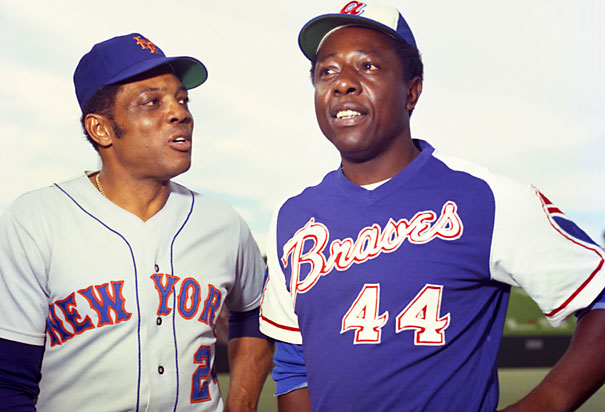
CF Willie Mays of Fairfield, Alabama. How do you sum this guy up? Not briefly. He was one of 3 men to play in 24 All-Star Games. He was the 2nd National Leaguer, after Mel Ott, to hit 500 home runs, and the first to hit 600. From 1966 (when he passed Jimmie Foxx at 534) to 1972 (when Hank Aaron passed him at 648), he was 2nd on the all-time home run list, finishing with 660. He was the 2nd man to have both 500 homers and 3,000 hits.
He played in the World Series at age 20, 23 and 31 with the Giants (1951 and '54 in New York, '62 in San Francisco), and closed his career at age 42 (in 1973) with another World Series appearance, with the Mets.
"The Say Hey Kid" was a sensational hitter and baserunner, and as for his defense, well, he wasn't just the man who made the most famous defensive play in the history of sports, a.k.a. "The Catch" in the 1954 World Series. People who followed the Giants, both in New York and in San Francisco, have said that he made great catches all the time.
He was named to the Hall of Fame and the All-Century Team. His Number 24 was retired officially by the Giants and unofficially by the Mets. He has a statue outside AT&T Park, and the park's mailing address is 24 Willie Mays Plaza. When The Sporting News announced its 100 Greatest Baseball Players in 1999, he came in at Number 2, the highest-ranking player then living, and the highest-ranking National Leaguer.
And he had the best song any ballplayer's ever had, in the Giants' 1954 title season, in which you can hear the Big Band sound morphing into Rock and Roll (or, at least, into Rhythm & Blues) right before your very ears.
Honorable Mention to another legendary Negro Leaguer in the Baseball Hall of Fame, Norman "Turkey" Stearnes, said by some to be the all-time leading home run hitter in Negro League play. A longtime member of the Detroit Stars, he is honored with a plaque at Comerica Park in Detroit.
Somewhat honorable mention to Josh Hamilton of Raleigh, North Carolina. He became a folk hero for hitting some tremendous blasts in 2008, as a member of the Texas Rangers. He batted .304 that year, hit 32 home runs that year, and led the AL with 130. In 2010, he led the Rangers to their 1st Pennant, winning the AL batting title at .359, and receiving the MVP. He made 5 straight All-Star teams, and led the Rangers to 2 straight Pennants (though they lost the World Series both times) and 3 straight postseasons, before going to the Los Angeles Angels of Anaheim last year.
So why has he got only 182 home runs? Because in 2003, he failed a drug test. In 2004, he failed 2 more. He ended up with suspension after suspension, and at the ages of 22, 23, 24 and 25, when he should have been becoming a major league star, he wasn't even eligible. He had at least one relapse with cocaine, in 2009, after he became a folk hero; and he's had at least 2 relapses with alcohol since then. He'll be 33 in May, but he should already be approaching Hall of Fame-worthy numbers. Is he already in the "What a waste" category? You decide.
RF Henry Aaron of Mobile, Alabama. Another of the 3 men to play in 24 All-Star Games. (Stan Musial, who qualifies for the Pittsburgh team, is the other.) He hit a home run in the Pennant-clinching game in 1957, resulting in Milwaukee's 1st major-league Pennant (after a few minor-league ones) and still the only World Series the city has ever won.
Nobody has more career total bases, extra-base hits, or runs batted in. And, if we're being honest, he is still the Home Run King, with 755. He collected 3,771 hits, which means he had over 3,000 hits even without his record home run total. In fact, he was the first man to get 500 homers and 3,000 hits, in 1970, beating Mays to the distinction by a few weeks.
He was named to the Hall of Fame and the All-Century Team. His Number 44 was retired by both the Braves and the Brewers, following his 1975-76 return to Milwaukee. He has statues outside Miller Park in Milwaukee and Turner Field in Atlanta -- whose mailing address is 755 Hank Aaron Drive. (Presumably, the Braves will move the statue to their new Cobb County Ballpark in 2017, and get the address moved there, too, after Turner Field is demolished at age 21.) When The Sporting News announced its 100 Greatest Baseball Players in 1999, he came in at Number 5.
Face it, if you don't like Hank Aaron -- whether doubting his still holding the record in 2014, or sending him nasty letters not wanting him to have the record in 1973-74 -- then there's no place for you in baseball. Oh yeah, he was also the coolest person ever mentioned on Happy Days -- Sorry, Fonz.
Honorable Mention to Oscar Gamble of Montgomery, Alabama. Sadly, not only does he no longer have the most fabulous hairstyle in the history of sports -- an Afro that even ABA players had to admit was the froest of the fro -- but he's completely bald. Then again, he's 64 years old.
The Big O hit an even 200 home runs in his career, topping out at 31 with the White Sox "South Side Hit Men" of 1977. His career OPS+ was a nifty 127.
He was around for some of the most interesting events of the Silly Seventies: The last game at Connie Mack Stadium (Phillies fans riot and tear the park apart), 2 Opening Days at Veterans Stadium (the first-ball drop from the helicopter, Kiteman), Ten-Cent Beer Night in Cleveland, Frank Robinson's debut as the first black manager in the major leagues, Chris Chambliss' homer to win the 1976 AL Pennant, Gaylord Perry becoming the first Cy Young winner in both leagues (when both were with the Padres in 1978), and the Thurman Munson Memorial Game in 1979 (having just returned to the Yankees, although he went 0-for-4 in that game).
He was also with the Yankees when Dave Righetti pitched his 4th of July no-hitter in 1983, and back with the White Sox, against the Yankees, when Tom Seaver won his 300th game in 1985.
He went from the Texas Rangers to the Yankees on July 30, 1979, in a package that included Mickey Rivers going the other way. Oscar wasn't a whacked-out-quote machine like Mick the Quick was, but he came up with this gem: "They don't think it be like it is, but it do."
DH Ty Cobb of Royston, Georgia. Now I don't have to justify taking the racist Cobb, whose most common position was center field, over the black Mays, who had the much better glove, anyway.
We grew up hearing that the Georgia Peach had a .367 lifetime batting average and 4,191 hits, both records. It turned out that there was an error in tabulation, so it's .366 and 4,189. We already knew that he no longer held the record for most hits in a career, or stolen bases in a career (892), or stolen bases in a season (96), but that lifetime batting average is still far and away a record. He won 11 batting titles. He batted .357 at age 40. He hit 724 doubles and 117 triples. His career OPS+ was 168, and that's without being a home run hitter.
He led the balloting at the 1st Hall of Fame induction in 1936, so, technically, he was the first man elected to the Baseball Hall of Fame. He was elected to the All-Century Team in 1999, even though his last game was 71 years earlier, and most of those voting couldn't possibly have seen him play. That same year, when The Sporting News announced its 100 Greatest Baseball Players, he came in at Number 3, behind Mays at 2 and Babe Ruth at 1.
The Detroit Tigers cast a plaque in his honor that was on the outside wall of Tiger Stadium, and has been moved to Comerica Park, and have made a notation for him on their retired number wall, even though he played before numbers were worn. (I have seen footage of him at an old-timers' game, wearing a Tiger jersey with the Number 25 on it.) They've also got a statue of him at Comerica, and the Braves erected a statue of Georgia's greatest native ballplayer outside Fulton County Stadium, moving it to Turner Field.
A lot of people still think Cobb was the greatest player ever. Certainly, as long as he lived, he was one of those who thought he was the best ever.
C Rick Ferrell of Guilford, North Carolina. Brother of Wes Ferrell, a really good pitcher, and I'm not the only person who thinks the wrong brother got into the Hall of Fame. Rick got in, and while it is true that he made 7 All-Star teams and batted .300 4 times, he was never an exceptional player.
He never reached the postseason, although he came very close in his last full season, with the 1945 Washington Senators. But for most of his career, with the St. Louis Browns, Red Sox and Senators, he was the 3rd-best catcher in the AL behind Mickey Cochrane and Bill Dickey. Nothing special. But he's the best catcher ever to come from a State in the Braves' region.
Actually, I could have named Josh Gibson, who was born in Buena Vista, Georgia. However, he and his family moved to Pittsburgh when he was 11, so his father could take a job at a steel mill, and he was 16 before he played any kind of organized baseball -- not to be confused with "Organized Ball," which never let him in -- and that was in Pittsburgh, so he qualifies for their regional team, not Atlanta's. If there's a dispute as to a player's eligibility, it's not where he was born that matters, it's where he was trained to become a player.
But Ferrell may be replaced as the starting catcher on this team within a few years. Former Brave, new Yankee, Brian McCann of Duluth, Georgia hit 117 homers and made 7 All-Star teams before turning 30 a few weeks ago. Matt Wieters of Goose Creek, South Carolina is a 2-time All-Star and 2-time Gold Glove for the Baltimore Orioles, and has hit at least 22 home runs in each of the last 3 seasons. And Gerald "Buster" Posey of Leesburg, Georgia has already won the 2010 NL Rookie of the Year and the 2012 NL MVP, helping the Giants win the World Series both years. His career OPS+ is 143. And he won't even turn 27 for another few days.
SP Leroy "Satchel" Paige of Mobile, Alabama. We'll never know for sure what he could have done had he been allowed in the majors as soon as his talent would have allowed. We do know that, at the official age of 42, he helped the Cleveland Indians win the 1948 World Series.
Officially, he is the oldest man ever to play in Major League Baseball, making one appearance for the Athletics in Kansas City, where he'd starred for the Negro Leagues' Kansas City Monarchs, in 1965 when records suggest he was 59, although it was 1 game, 3 innings. Still, he was an effective pitcher with the Browns at age 46, playing 1 more full season.
How did he pitch so well for so long? Illegal pitches? He denied it: "I ain't never thrown an illegal pitch. But sometimes, I throw a pitch that ain't never been seen by this generation."
He was the 1st player elected to the Hall of Fame on the basis of a Negro League career, and when The Sporting News announced its 100 Greatest Baseball Players in 1999, he came in at Number 19.
He gave us "Satchel Paige's Rules For Living":
1. Avoid fried foods, which angry up the blood.
2. If your stomach disputes you, lie down and pacify it with cool thoughts.
3. Keep the juices flowing by jangling around gently as you move.
4. Go light on the social vices, such as carrying on in society. The social ramble ain't restful. (Satch had a bit of trouble with this rule himself.)
5. Avoid running at all times. (You can tell Satch was a pitcher.)
6. Don't look back. Something might be gaining on you.
After the 1934 season, Satch led a team of black all-stars against a team of white all-stars led by Dizzy Dean, who had just led the St. Louis Cardinals to the World Championship, on a "barnstorming tour." These were the 2 best pitchers on Earth at the time, although Carl Hubbell might have had something to say about that. When the tour was over, Diz put his Southern prejudices behind him and said, "Satch, if you an' me was on the same team, we'd clinch the Pennant by the 4th of July, and I'd take you fishin' until World Series time."
SP Early Wynn of Hartford, Alabama. Hall of Fame, 300 wins despite pitching his first 6 full seasons with the Washington Senators. He won 23 games and a Pennant with the 1954 Indians. He won 22 games, a Pennant and the Cy Young Award with the 1959 Chicago White Sox, at age 39.
He was known to throw at hitters, but he at least had a sense of humor about it: When asked if he would throw at his own mother, he said, "I'd have to: Mom could really hit the curveball." When The Sporting News announced its 100 Greatest Baseball Players in 1999, he came in at Number 100.
SP Gaylord Perry of Williamston, North Carolina. Unlike Satchel Paige, he stopped being coy about illegal pitches long enough to write a book titled Me and the Spitter. How much of what he did came from doctoring the ball? Hard to say, but he became the 1st man to win Cy Young Awards in both leagues (Cleveland in 1972, San Diego in 1978), the oldest man to win a Cy Young (39 in '78, breaking Wynn's record, but his has since been broken), a member of the 300 Win Club and the 3,000 Strikeout club, had a career ERA+ of 117 and a WHIP of 1.181.
He won 20 games 5 times, and at age 43 managed to win 10 games for a terrible Seattle Mariners team in 1982 (including his 300th, against the Yankees, for whom he pitched 10 games in 1980).
He only reached the postseason twice, in his rookie year with the 1962 Giants and again with the 1971 Giants, but any way you slice it -- or smear it -- he was an all-time great. Hall of Fame, the Giants retired his Number 36 and elected him to their team Hall of Fame. When The Sporting News announced its 100 Greatest Baseball Players in 1999, he came in at Number 97.
SP Jim "Catfish" Hunter of Hertford, North Carolina. Interesting that he and Wynn both came from towns pronounced "Hartford," but they were very different men, the biggest differences being that Wynn was great into his early 40s, and Catfish would never have thrown at a batter.
Catfish won his 200th game the day before his 31st birthday. The only other pitchers to win that many before turning 31 were Cy Young, Walter Johnson and Christy Mathewson. Unfortunately, overwork led to a shoulder injury that limited him to only 24 more wins. But first with the Oakland Athletics (perfect game in 1968, World Champs 1972, '73, '74) and then with the Yankees (Pennant '76, World Champs '77 and '78), the Cat was one of the best big-game pitchers ever.
Because A's owner Charlie Finley, a notorious cheapskate, made a big mistake regarding an item in Catfish's contract, he became baseball's first big free agent, and George Steinbrenner showed him the money. It worked, never better than in 1978, when Catfish bounced back from a procedure on his shoulder to win 6 straight down the stretch, making the great Yankee comeback possible. He won the pivotal Game 3 of the ALCS and the clinching Game 6 of the World Series. Career WHIP of 1.134. Hall of Fame. A's retired his Number 27. The Yankees haven't retired the Number 29 he wore with them or given him a Monument Park Plaque, but they should.
SP Jimmy Key of Huntsville, Alabama. I couldn't quite make it an all-HOF rotation, but that's mainly because an injury finished Key at 37. He was 186-117 for his career, for a super winning percentage of .614. ERA+ of 122, WHIP of 1.229.
He reached the postseason with the Toronto Blue Jays in 1985, '89, '91 and '92 (winning the '92 World Series), and in '95 and '96 with the Yankees (winning the clinching Game 6 in the '96 Series). He should have made it with the Jays in '87 (but they choked) and the Yanks in '93 (fell a little short) and '94 (strike). He made it once more in '97 with the Orioles, but then he got hurt. Because he pitched most of his career in Canada, and was overshadowed by bigger names in New York, he's never gotten the credit he deserves.
Honorable Mention to R.A. Dickey of Nashville, Tennessee. Robert Allen didn't debut in the majors until he was 26, had a good season at 28, then didn't have another until he was 35, with the Mets. But in 2012, at 37, he went 20-6, started the All-Star Game, and won the Cy Young Award. Then the Mets, as they so often do, made a bonehead deal, and sent him to the Blue Jays, where he went 14-13, remembering that pitching in the American League is hard. He's 39 now.
Honorable Mention to Jake Peavy of Mobile, Alabama. He'll be 33 in May, and has already won 132 games. Twice, while with the San Diego Padres, led the NL in strikeouts, and has 1,869 for his career. His career WHIP is 1.177. He helped the Padres reach the postseason in 2005 and '06, and won the World Series last year with the Red Sox.
Honorable Mention to Adam Wainwright of Brunswick, Georgia. Despite spending his 1st full season, 2006, as a reliever (Met fans will remember him pitching the last postseason inning their club has yet seen), and missing all of the Cardinals' World Championship season of 2011 due to injury, he's won 99 games at age 32. He led the NL with 19 wins in both 2009 and 2013, is a 2-time All-Star, a 2-time Gold Glove, and while he's never won the Cy Young Award, he's finished in the top 3 of the voting 3 times.
Honorable Mention to David Price of Blackman, Tennessee. (No, I didn't make that town's name up. It's outside Murfreesboro.) The Rays have reached the postseason 4 times in their history, and he's been their ace for all of them. In 2012 -- not a postseason year for the Rays -- he led the AL in wins (20-5), winning percentage (.800) and ERA (2.56), and winning the Cy Young Award. He's only 28, but is already 71-39.
RP Hoyt Wilhelm of Cornelius, North Carolina. Clay Carroll of Clanton, Alabama saved 37 games in 1972, a major league record (which lasted all of 1 year), and was a big part of the Cincinnati Reds' Big Red Machine of the 1970s, but he doesn't get the nod here.
Wilhelm was the game's first true master of the knuckleball, and won 143 games despite being a reliever for most of his career. His 2.52 career ERA is the lowest of any pitcher, starter or reliever, in the post-1920 Lively Ball Era. His 227 saves were a record until Rollie Fingers came along. He had a career ERA+ of 147, and a WHIP of 1.125. He was the first pitcher to appear in 1,000 games. Strangely, he hit a home run in his 1st big-league at-bat and a triple in his 2nd, and never hit another of either. He was a rookie on the 1954 Giants' World Champions, and never reached another postseason until the '69 Braves, coming close with the '60 Orioles and the '64 and '67 White Sox.
The 1st reliever elected to the Hall of Fame, Wilhelm inspired a lot of knuckleballers to wear his usual Number 49, including Tim Wakefield and Tom Candiotti, who played Wilhelm in the film 61*. Ironically, in 1961, Wilhelm was wearing Number 15 for the Orioles, and Candiotti portrays him as such.
Honorable Mention to Craig Kimbrel of Huntsville, Alabama. The Braves' closer the last 3 years (leading the NL in saves each time), he's helped them reach the postseason the last 2. He's already got 139 saves, so if anybody's ever going to catch Mariano Rivera, this could be the guy. (If so, it still won't make him better than Mo.) In 2012, he had an ERA of 1.01 and a WHIP of 0.654. No, those aren't misprints or typos: One point oh one, and oh point six.
MGR George Stallings of Augusta, Georgia. Barely played in the majors, but managed the New York Highlanders (forerunners of the Yankees) to a 2nd-place finish in 1910, then couldn't get along with the owners. (So it wasn't just in the Steinbrenner era.) Managed the Boston Braves to their "miracle" World Championship in 1914, after having been in last place on the 4th of July.
If you're going up against this all-time team, y'all better have some big guns y'self, y'hear?
With the Mets in Atlanta to play the Braves, this is a good time to do...
Atlanta's All-Time Baseball Team
The Atlanta Braves have the widest area of any team, now that the Arizona Diamondbacks have taken Arizona and New Mexico out of the Colorado Rockies' region. The Braves take the entire States of Georgia, South Carolina, North Carolina and Alabama, and much of the States of Tennessee and Mississippi.
This team? Pretty good pitching staff, sensational outfielders and shortstops, but a little weak behind the plate. My runner-up was... Jody Davis?
1B Willie McCovey of Mobile, Alabama. And that's not pronounced "MOH-bull," it's "Mo-BEEL." "Stretch" is in the Hall of Fame, Number 44 retired by San Francisco Giants, 500 Home Run Club, statue outside AT&T Park, 147 lifetime OPS+, 1959 National League Rookie of the Year, 1969 NL Most Valuable Player (nope, Tom Seaver didn't win it that year).
The Atlanta region is so loaded at 1st base, the starting lineup couldn't be cracked by Bill Terry of Atlanta (though he was often called "Memphis Bill," so he may have grown up in Cardinals territory; the Giants retired his Number 3); Johnny Mize of Demorest, Georgia or Frank "Big Hurt" Thomas of Columbus, Georgia (the White Sox retired his Number 35 and will dedicate a statue of him at U.S. Cellular Field next season). That's 3 HOFers at this position, and Thomas will make it 4. (The Hurt even finished with the same number of homers as McCovey, 521.)
Actually, Thomas will make it 7, along with the aforementioned and 3 legends from the Negro Leagues: Walter "Buck" Leonard of Rocky Mount, North Carolina (that town is closer to Washington than to Atlanta, but North Carolina's baseball tastes tilt toward Atlanta, partly due to its Southernness, partly due to the Durham Bulls having once been a Braves farm team); George "Mule" Suttles of Blocton, Alabama; and Ben Taylor of Anderson, South Carolina.
Of course, a lot of what we think about Leonard, a.k.a. "the black Lou Gehrig" -- he, too, was a 1st baseman who batted lefthanded and wore Number 4, and at least he lived to a ripe old age -- is not what we know. Still, The Sporting News named him to their 100 Greatest Baseball Players in 1999. Having played in both Washington and Pittsburgh with the Homestead Grays, he is honored on the Washington Wall of Stars at Nationals Park.
Leonard admitted that Taylor was his mentor, and Taylor had also been a fine pitcher in the years before the formal establishment of the Negro Leagues in 1920. Suttles was one of the top sluggers in Negro League history.
2B Frank White of Greenville, Mississippi. A 5-time All-Star, 8 Gold Gloves (his last, legitimately, at age 36), Number 20 retired by the Kansas City Royals, and the Royals have never reached the postseason without him -- with him, 7 times, including losing the World Series in 1980 and winning it in 1985. Also collected over 2,000 hits, so he wasn't a "good field, no hit" player, either.
Certainly, Jackie Robinson would be a better choice. But, while he was born in Cairo, Georgia, he was moved by his mother to Pasadena, California when he was 1 year old, so he qualifies for Los Angeles, not Atlanta.
SS Luke Appling of Atlanta, Georgia. They called this Hall-of-Famer "Old Aches and Pains," but he sure put a hurt on a few pitchers: He won 2 American League batting titles (his .388 average in 1936 is a record for post-19th Century shortstops), .310 lifetime batting average, 2,749 hits including 440 doubles.
He was not much of a slugger, but who cares when you can still hit .301 at age 42. Not to mention that he played his home games at the old Comiskey Park, a terrible park for hitters, for the Chicago White Sox, who retired his Number 4. Oddly, in 1982, he hit a home run (albeit over a 275-foot left-field fence) at an old-timer's game at RFK Stadium in Washington. He was 75, and lived to be 83.
Honorable Mention to Joe Sewell of Titus, Alabama. Won the World Series as a rookie with the 1920 Cleveland Indians and as a veteran with the 1932 Yankees. Batted .312 lifetime, and like Appling wasn't a home-run hitter, but hit 436 doubles. Oh yeah, and he struck out 114 times. In his entire career. That's in 8,329 plate appearances. Amazing.
3B Al Rosen of Spartanburg, South Carolina. Like the general manager who signed him for the Indians, Hank Greenberg -- and like another Greenberg protege, Ralph Kiner, briefly Rosen's teammate -- he had to quit the game too soon because of a bad back.
He hit 192 homers in only 10 seasons. He had a career OPS+ of 136. In 1953, won the AL MVP award, missing the batting title and thus the Triple Crown by .001: .336, 43 homers, 145 RBIs, despite playing his home games at cavernous Cleveland Municipal Stadium. He only played 5 games for the Indians' 1948 World Championship team, but was a key cog in their 1954 Pennant winners. Too bad he could only play 2 more years, leaving at age 32.
Later, he became the general manager of the Yankees, winning the 1978 World Series. Was also a postseason-building executive for the Giants and the Houston Astros. If he'd been able to play even to age 36, batting at the same rate, he'd be in the Hall of Fame, as he would be if they combined the player and executive categories. The Indians haven't retired his Number 7, but they have inducted him into their team Hall of Fame.
LF Joe Jackson of Greenville, South Carolina. How do I pick a guy who's not in the Hall of Fame, and played his last game at age 30, and that last game having been 90 years ago so I couldn't possibly have seen him play and there's precious little film footage of him playing so how can I really get an idea of how good he was, over 3 Hall-of-Famers who qualify here?
Namely, Henry "Heinie" Manush of Tuscumbia, Alabama (Senators star honored on the Washington Wall of Stars); Billy Williams of Whistler, Alabama (Cubs retired his Number 26); and Jim Rice of Anderson, South Carolina (Red Sox retired his Number 14)? How can I take such a guy over those 3 HOFers?
When it's Shoeless Joe Jackson, that's when. He had a career OPS+ 170. He batted .408 at age 21. His 1,772 hits included 307 doubles and 168 triples, and he had just had his best home-run year in 1920, with 12 (and a .382 average) at the dawn of the Lively Ball Era, when, uh, the other shoe dropped. Shoeless Joe was actually getting better. He played the 1917 World Series to win, and the White Sox did.
That he accepted money to throw the 1919 World Series, he confessed; that he actually played not to win is debatable. If Commissioner Kenesaw Mountain Landis had accepted the verdict of the jury, that he was "Not Guilty" of fraud, and let him play again -- or even if he'd just suspended him for the rest of the 1921 season, meaning he missed the entire year when he was 31, but could then have resumed playing -- who knows what he could have done.
Moises Alou was born in Atlanta, while his father Felipe played for the Braves, but grew up and played high school ball in the Dominican Republic. Still, I can't put him ahead of Shoeless Joe, or Heinie Manush, or Billy Williams, or Jim Rice. Nor can I rank Vincent "Bo" Jackson of Bessemer, Alabama ahead of those guys. We'll never know what the 1985 Heisman Trophy winner out of Auburn University could have done in either baseball or football if he had stuck with one or the other, although that could also be a question for me to tackle in Otherwise Sports.
While James "Cool Papa" Bell of Starkville, Mississippi was the subject of legends about his speed while playing in the Negro Leagues, we just don't have complete stats, or even film of him playing, to know with any certainty how good he was. Still, like Buck Leonard, he's in the Hall of Fame and TSN's 100 Greatest Baseball Players.
CF Willie Mays of Fairfield, Alabama. How do you sum this guy up? Not briefly. He's 1 of 3 men to play in 24 All-Star Games. The 2nd National Leaguer, after Mel Ott, to hit 500 home runs, and the first to hit 600. From 1966 (when he passed Jimmie Foxx at 534) to 1972 (when Hank Aaron passed him at 648), he was 2nd on the all-time home run list, finishing with 660. He was the 2nd man to have both 500 homers and 3,000 hits.
He played in the World Series at age 20, 23 and 31 with the Giants (1951 and '54 in New York, '62 in San Francisco), and closed his career at age 42 (in 1973) with another World Series appearance, with the Mets. "The Say Hey Kid" was a sensational hitter and baserunner, and as for his defense, well, he wasn't just the man who made the most famous defensive play in the history of sports, a.k.a. "The Catch" in the 1954 World Series, still the last that the Giants have won.
Hall of Fame, All-Century Team, Number 24 retired officially by the Giants and unofficially by the Mets, a statue outside AT&T Park, and the park's mailing address is 24 Willie Mays Plaza. And he had the best song any athlete's ever had, by The Treniers in 1954, in which you can hear the Big Band sound morphing into Rock and Roll (or, at least, into Rhythm & Blues) right before your very ear.
Honorable Mention to another legendary Negro Leaguer in the Baseball Hall of Fame, Norman "Turkey" Stearnes, said by some to be the all-time leading home run hitter in Negro League play. A longtime member of the Detroit Stars, he is honored with a plaque at Comerica Park in Detroit.
RF Henry Aaron of Mobile, Alabama. Another of the 3 men to play in 24 All-Star Games. (Stan Musial is the other.) He hit a home run in the Pennant-clinching game in 1957, resulting in Milwaukee's 1st major-league Pennant (after a few minor-league ones) and still the only World Series the city has ever won.
Nobody has more career total bases, extra-base hits, or runs batted in. And, if we're being honest, he is still the Home Run King, with 755. He collected 3,771 hits, which means he had over 3,000 hits even without his record home run total. In fact, he was the 1st man to get 500 homers and 3,000 hits, in 1970, beating Mays to the distinction by a few weeks.
Hall of Fame, All-Century Team, Number 44 retired by both the Braves and the Brewers, following his 1975-76 return to Milwaukee, statues outside Miller Park in Milwaukee and Turner Field in Atlanta -- whose mailing address is 755 Hank Aaron Drive.
Face it, if you don't like Hank Aaron -- whether doubting his still holding the record in 2010 or sending him nasty letters not wanting him to have the record in 1973-74 -- then there's no place for you in baseball. Oh yeah, he was the coolest person ever mentioned on Happy Days -- Sorry, Fonz.
DH Ty Cobb of Royston, Georgia. Now I don't have to justify taking the racist Cobb, whose most common position was center field, over the black Mays, who had the much better glove, anyway.
We grew up hearing that the Georgia Peach had a .367 lifetime batting average and 4,191 hits, both records. Turned out there was an error in tabulation (a 1910 game in which he got 2 hits was counted twice), so it's .366 and 4,189, and he no longer holds the record for most hits in a career, or stolen bases in a career (892), or stolen bases in a season (96), but that lifetime batting average is still far and away a record. 11 batting titles. Batted .357 at age 40. 724 doubles and and 117 triples. Career OPS+ of 168.
He led the balloting at the first Hall of Fame induction in 1936, so, technically, was the 1st man elected to the Baseball Hall of Fame. Elected to the All-Century Team in 1999, even though his last game was 71 years earlier and most of those voting couldn't possibly have seen him play.
The Detroit Tigers cast a plaque in his honor that was on the outside wall of Tiger Stadium, and has been moved to Comerica Park, and have made a notation for him on their retired number wall, even though he played before numbers were worn. (I have seen footage of him at an old-timers' game, wearing a Tiger jersey with the Number 25 on it.)
They've also got a statue of him at Comerica, and the Braves erected a statue of Georgia's greatest native ballplayer outside Fulton County Stadium, moving it to Turner Field. A lot of people still think Cobb was the greatest player ever. Certainly, as long as he lived, he was one of those who thought he was the best ever.
C Rick Ferrell of Guilford, North Carolina. He was the brother of Wes Ferrell, a really good pitcher, and I'm not the only person who thinks the wrong brother got into the Hall of Fame. Rick got in, and while it is true that he made 7 All-Star teams and batted .300 4 times, he was never an exceptional player.
He never reached the postseason, although he came very close in his last full season, with the 1945 Washington Senators. But for most of his career, with the St. Louis Browns, Red Sox and Senators, he was the 3rd-best catcher in the AL behind Mickey Cochrane and Bill Dickey. Nothing special. But he's the best catcher ever to come from a State in the Braves' region.
Actually, I could have named Josh Gibson, who was born in Buena Vista, Georgia. However, he and his family moved to Pittsburgh when he was 11, so his father could take a job at a steel mill, and he was 16 before he played any kind of organized baseball -- not to be confused with "Organized Ball," which never let him in -- and that was in Pittsburgh, so he qualifies for their regional team, not Atlanta's. If there's a dispute as to a player's eligibility, it's not where he was born that matters, it's where he was trained to become a player.
SP Leroy "Satchel" Paige of Mobile, Alabama. We'll never know for sure what he could have done had he been allowed in the majors as soon as his talent would have allowed. We do know that, at the official age of 42, he helped the Cleveland Indians win the 1948 World Series.
Officially, he was the oldest player ever to appear in a Major League Baseball game, making an appearance for the Athletics in Kansas City, where he'd starred for the Negro Leagues' Kansas City Monarchs, in 1965 when records suggest he was 59, although it was 1 game, 3 innings. Still, he was an effective pitcher with the Browns at age 46, playing 1 more full season.
How did he pitch so well for so long? Illegal pitches? He denied it: "I ain't never thrown an illegal pitch. But sometimes, I throw a pitch that ain't never been seen by this generation."
The 1st player elected to the Hall of Fame on the basis of a Negro League career, he gave us "Satchel Paige's Rules For Living":
*1. Avoid fried foods, which angry up the blood.
*2. If your stomach disputes you, lie down and pacify it with cool thoughts.
*3. Keep the juices flowing by jangling around gently as you move.
*4. Go light on the social vices, such as carrying on in society. The social ramble ain't restful. (Satch had a bit of trouble with this rule himself.)
*5. Avoid running at all times. (You can tell Satch was a pitcher.)
*6. Don't look back. Something might be gaining on you.
After the 1934 season, Satch led a team of black all-stars against a team of white all-stars led by Dizzy Dean, who had just led the St. Louis Cardinals to the World Championship, on a "barnstorming tour." These were the 2 best pitchers on Earth at the time, although Carl Hubbell might have had something to say about that. When the tour was over, Diz put his Southern prejudices behind him and said, "Satch, if you an' me was on the same team, we'd clinch the Pennant by the 4th of July, and I'd take you fishin' until World Series time."
SP Early Wynn of Hartford, Alabama. Hall of Fame, 300 wins despite pitching his 1st 6 full seasons with the Washington Senators. He won 23 games and a Pennant with the 1954 Indians. He won 22 games, a Pennant and the Cy Young Award with the 1959 Chicago White Sox, at age 39. Known to throw at hitters, he at least had a sense of humor about it: When asked if he would throw at his own mother, he said, "I'd have to: Mom could really hit the curveball."
SP Gaylord Perry of Williamston, North Carolina. Unlike Satchel Paige, he stopped being coy about illegal pitches long enough to write a book titled Me and the Spitter. How much of what he did came from doctoring the ball? Hard to say, but he became the first man to win Cy Young Awards in both leagues (Cleveland in 1972, San Diego in 1978), the oldest man to win a Cy Young (39 in '78, breaking Wynn's record, but his has since been broken), a member of the 300 Win Club and the 3,000 Strikeout club, had a career ERA+ of 117 and a WHIP of 1.181.
He won 20 games 5 times, and at age 43 managed to win 10 games for a terrible Seattle Mariners team in 1982 (including his 300th, against the Yankees, for whom he pitched 10 games in 1980). He only reached the postseason twice, in his rookie year with the 1962 Giants and again with the 1971 Giants, but any way you slice it -- or smear it -- he was an all-time great. Hall of Fame, the Giants retired his Number 36 and elected him to their team Hall of Fame.
SP Jim "Catfish" Hunter of Hertford, North Carolina. He won his 200th game the day before his 31st birthday. The only other pitchers to win that many before turning 31 were Cy Young, Walter Johnson and Christy Mathewson. Unfortunately, overwork led to a shoulder injury that limited him to only 24 more wins. But first with the Oakland Athletics (perfect game in 1968, World Champs 1972, '73, '74) and then with the Yankees (Pennant '76, World Champs '77 and '78), the Cat was one of the best big-game pitchers ever.
Because A's owner Charlie Finley, a notorious cheapskate, made a big mistake regarding an item in Catfish's contract, he became baseball's first big free agent, and George Steinbrenner showed him the money. It worked, never better than in 1978, when Catfish bounced back from a procedure on his shoulder to win 6 straight down the stretch, making the great Yankee comeback possible. He won the pivotal Game 3 of the ALCS and the clinching Game 6 of the World Series.
Career WHIP of 1.134. Hall of Fame. A's retired his Number 27. The Yankees haven't retired the Number 29 he wore with them or given him a Monument Park Plaque, but they should.
SP Jimmy Key of Huntsville, Alabama. I couldn't quite make it an all-HOF rotation, but that's mainly because an injury finished Key at 37. He was 186-117 for his career, for a super winning percentage of .614. ERA+ of 122, WHIP of 1.229.
He reached postseason with the Toronto Blue Jays in 1985, '89, '91 and '92 (winning the '92 World Series), and in '95 and '96 with the Yankees (winning the clinching Game 6 in the '96 Series). Should have made it with the Jays in '87 (but they choked) and the Yanks in '93 (fell a little short) and '94 (strike). Made it once more in '97 with the Baltimore Orioles, but then he got hurt. Because he pitched most of his career in Canada, and was overshadowed by bigger names in New York, he's never gotten the credit he deserves.
RP Hoyt Wilhelm of Cornelius, North Carolina. Clay Carroll of Clanton, Alabama saved 37 games in 1972, a major league record (which lasted all of 1 year), and was a big part of the Cincinnati Reds' Big Red Machine of the 1970s, but he doesn't get the nod here.
Wilhelm was the game's 1st true master of the knuckleball, and won 143 games despite being a reliever for most of his career. His 2.52 career ERA is the lowest of any pitcher, starter or reliever, in the post-1920 Lively Ball Era. His 227 saves were a record until Rollie Fingers came along. Career ERA+ of 147, WHIP of 1.125.
He was the 1st pitcher to appear in 1,000 games. Strangely, he hit a home run in his 1st big-league at-bat and a triple in his 2nd, and never hit another of either. He was a rookie on the 1954 Giants' World Champions, and never reached another postseason until the '69 Braves, coming close with the '60 Orioles and the '64 and '67 White Sox.
Wilhelm was the 1st reliever in the Hall of Fame, and thus inspired a lot of knuckleballers to wear his usual Number 49, including Tim Wakefield and Tom Candiotti, who played Wilhelm in the film 61*. Ironically, in 1961, Wilhelm was wearing Number 15 for the Orioles, and Candiotti portrays him as such.
MGR George Stallings of Augusta, Georgia. He barely played in the majors, but managed the New York Highlanders (forerunners of the Yankees) to a 2nd-place finish in 1910, then couldn't get along with the owners. (So it wasn't just in the Steinbrenner era.) Managed the Boston Braves to their "miracle" World Championship in 1914, after having been in last place on the 4th of July.
If you're going up against this all-time team, y'all better have some big guns y'self, y'hear?
Central New Jersey, where men are men, and the women also root for the Yankees., United States
Born in North Jersey. Raised in Central Jersey. Yankee Fan and Rutgers fan since 1977. Devils fan since they arrived in 1982. Arsenal fan since 2008. Former Nets fan, now an NBA free agent. No NFL team. Single, interested in changing that status. No children, but uncle to two teenage girl athletes and one in the making. Liberal Democrat and damn proud of it. Hopefully, in sports as well as politics, I can live up to the words of the late John Spencer on "The West Wing": "We are going to raise the level of debate in this country, and let that be our legacy."