Showing posts with label lefty grove. Show all posts

Tuesday, December 12, 2023

December 12, 1933: A Dark Day In Sports

A colorized photo of Ace Bailey, included in a composite photo
of a Maple Leafs' Centennial Team, 2016

December 12, 1933, 90 years ago: A dark day in sports history. First, Connie Mack breaks up his team. Then, one of the best players in hockey almost dies on the ice.

The 1st time that Mack had broken up the Philadelphia Athletics, in 1914-15, it was because he couldn't keep up with the salaries being offered by the Federal League teams. This time, it was personal.

In 1925, the A's went 88-64, and were only 8 1/2 games behind the 1st-place Washington Senators. But the rise of the "Murderers' Row" Yankees delayed Philadelphia's return to greatness. In 1929, they began a run of 3 seasons in which they won 313 games, and game within a Game 7 loss in 1931 of winning 3 straight World Series.

But Mack lost all of his non-baseball holdings in the stock market Crash of 1929. He couldn't fund the A's with any other income. So, after the 1932 season, despite a strong 94-60 record (but 13 games behind the Pennant-winning Yankees), he began to sell of his 2nd generation of stars.

On September 28, 1932, he sent left fielder Al Simmons, 3rd baseman Jimmy Dykes, and center fielder Mule Haas are all sold to the Chicago White Sox, for $100,000. Simmons would be elected to the Baseball Hall of Fame, and Dykes and Haas would have been perennial All-Stars had the All-Star Game been founded before 1933.

But the big day was December 12, 1933, when Mack made 3 separate moves:

* Pitchers Lefty Grove and Rube Walberg, and 2nd baseman Max Bishop, are traded to the Boston Red Sox for Bob Kline and Rabbit Warstler and $125,000. Along with Carl Hubbell, Grove was 1 of the 2 best lefthanded pitchers in the game, and would go to the Hall of Fame. Walberg was the 3rd starter on the A's, behind Grove and George Earnshaw, but would have been the ace on many teams.

Key to this deal was the fact that Tom Yawkey had recently turned 30 and come into his inheritance, and had bought the Red Sox, and could afford to spend whatever he wanted to build a championship team. He did try, but the Yankees' dynasty that was restarted in 1936 thwarted his early efforts.

* Catcher Mickey Cochrane was traded to the Detroit Tigers for Johnny Pasek and $100,000. The Tigers subsequently named Cochrane player-manager, and won the next 2 American League Pennants.

* Finally, before the ink was dry on the previous 2 trades, Mack traded Pasek and Earnshaw to the White Sox for Charlie Berry and $100,000. So, in 1 day, Mack sold off his 3 best pitchers.
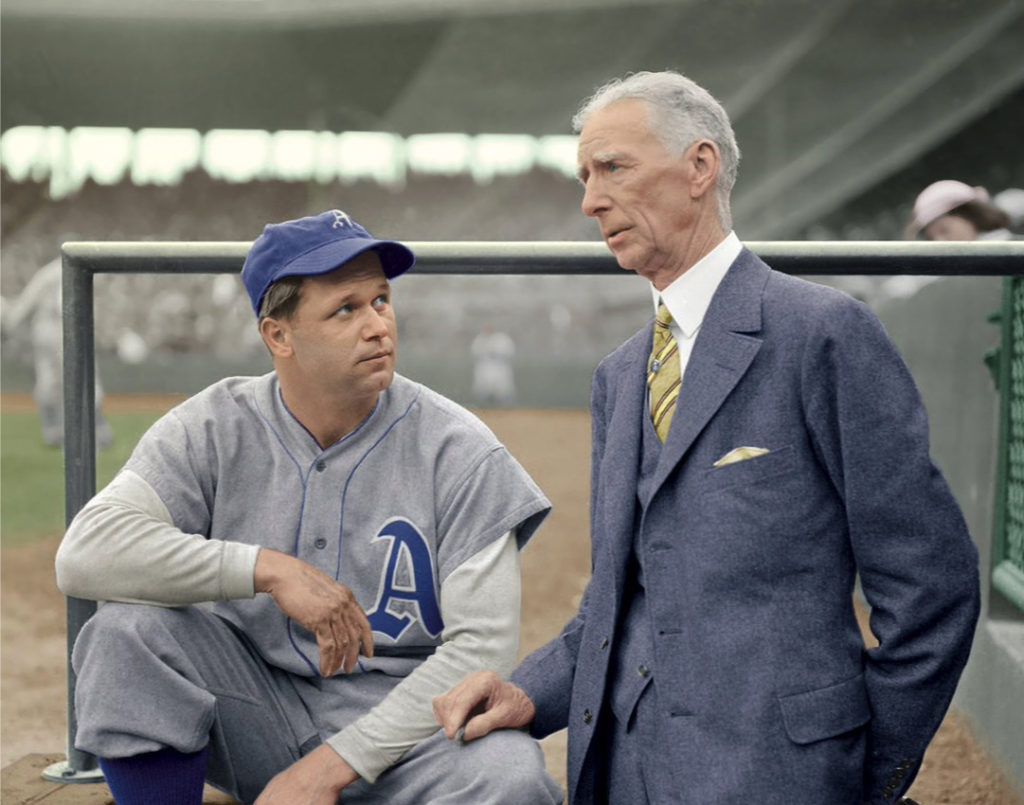
Jimmie Foxx (left) and Connie Mack

The A's went from 94-60 in 1932 to 79-72 in 1933, to 68-82 in 1934, to 58-91 in 1935. On December 10, 1935: 1st baseman Jimmie Foxx and pitcher Johnny Marcum were traded to the Red Sox for Gordon Rhodes, George Savino and $150,000. Foxx was the best righthanded slugger in the game, and would go to the Hall of Fame. Marcum was the Mackmen's best pitcher following the '33 fire sale, and Mack dumped him, anyway.

The A's never recovered, and the Mack family ended up selling the A's in 1954, to a buyer who moved them to Kansas City. They failed there as well, and Charlie Finley bought them in 1960, moving them to Oakland in 1968. After 5 straight AL Western Division titles, 1971-75, including 3 straight World Series wins, 1972-74, he broke them up, and the team crashed. New owner Walter Haas rebuilt them in the early 1980s, but the pitching collapsed, preventing a new dynasty. The A's rebuilt again, and won 3 straight Pennants, 1988-90, but after another Division title in 1992, were broken up again.

The pattern held: By 2000, the "Moneyball" regime built a team that reached the Playoffs 5 times in 7 years, but won no Pennants. They sold off, rebuilt, and made 3 straight Playoffs, 2012-14. They couldn't afford to keep it going, sold off, rebuilt, and made 3 straight Playoffs, 2018-20. They couldn't afford to keep it going, and sold off. In 2022, the A's lost 102 games, their most since the Finley fire sale bottomed out at 108 in 1979.

Now, it appears that the A's are moving to Las Vegas, probably for the 2025 season. If they do move, how long will it be before they win again? And, if so, how long before they have a 9th fire sale?

One thing is for sure: The A's are not moving back to Philadelphia, where the Phillies, having won the 2022 NL Pennant, are overwhelmingly popular. The city can certainly support one winning team, but not two teams. But, wherever they go, or if they stay, at some point, the A's will go back to their Philadelphia roots, and break it all down and start all over again.

*

Also on December 12, 1933, perhaps the ugliest game in National Hockey League history was played. But it led to one of the game's greatest moments.

The Boston Bruins were hosting the Toronto Maple Leafs at the Boston Garden. The Bruins still had most of the players who had led them to the 1929 Stanley Cup, including 2 of the greatest defensemen the game has ever known, Eddie Shore and Aubrey "Dit" Clapper. The Leafs, winners of the Cup in 1932, had another, Francis "King" Clancy.

This game, which the Leafs would win 4-1, was in the 2nd period. The Leafs had taken 2 quick penalties, and sent Clancy, defenseman George "Red" Horner, and right wing Irvine Wallace "Ace" Bailey out to defend the 5-on-3 Bruin power play.

Shore, who helped the Bruins win the Stanley Cup in 1929, rushed up the ice. Clancy, charitably listed at 5-foot-7 and 155 pounds, and a winner of the Cup with the Ottawa Senators in 1922, '23 and '27, and with the Leafs in '32, followed him, and checked him into the boards.

Shore got up, and, in his daze, he figured the closest Leaf player to him must have been the one who did it. He guessed wrong: The closest Leaf player to him was Bailey. Shore hit him from the side, and he landed head-first on the ice.
Horner skated over, knowing full well that it wasn't Bailey who had checked Shore, and yelled, "What did you do that for, Eddie?" Shore, not realizing the enormity of what he had done, gave Horner a big grin. What happened next is in dispute: The first source I saw on the story said that Horner hit Shore over the head with the blade of his stick. Another source said that Horner punched Shore, knocking him out in an instant.

Whatever the truth was, Shore was also out cold. The Boston crowd booed the hell out of Horner, who was already known as one of the dirtiest players in the game. But so was Shore, who, with his attitude, his receding hairline, and the fact that he was admired but not especially liked, was practically the Ty Cobb of hockey.

But it quickly became apparent that Bailey was hurt worse. Both men regained consciousness, and were carried off the ice together. Shore apologized. Bailey seemed to forgive him, saying, "It's all part of the game," and then passed out again.

Bailey was taken to Boston City Hospital. He was diagnosed with a fractured skull and an extradural clot on the brain. His father, listening to the game on the radio in Toronto, packed a gun, and immediately boarded a train for Boston, intending to kill Shore.

Leafs owner Conn Smythe found out about this, and talked to his general manager, Frank Selke. Selke had a friend working with the Boston Police, who met Bailey's father at the hotel, and talked him out of the murder plot.

Nevertheless, the BPD said they would charge Shore with manslaughter if Bailey died. Within 24 hours, he underwent 2 spinal taps to relieve intracranial pressure. There was at least one news report that Bailey had died. But, through several procedures, he came out of his coma after 10 days. He hung on, through Christmas and New Year's. In mid-January 1934, he was released from the hospital.

NHL President Frank Calder suspended Horner for 6 games, and Shore indefinitely. Once he was confident that Bailey was going to live, Calder set Shore's suspension at 16 games, or 1/3rd of the season at the time (48 games). Bailey never played again.

Walter Gilhooly, sports editor of the Ottawa Journal, recommended that a benefit game be played, to offset Bailey's loss of income. Calder agreed. The Leafs would host the game, and put their team out against a team made up of players from the rest of the League, 2 from each of the other 8 teams then in it.

The game was played at Maple Leaf Gardens on February 14, 1934. Here were the lineups:

* From the Toronto Maple Leafs, coached by Dick Irvin, once a great player, and the father of eventual Hall of Fame broadcaster Dick Irvin Jr.: Number 1, goaltender George Hainsworth, formerly a star with the Montreal Canadiens; 2, defenseman Red Horner; 3, defenseman Alex Levinsky; 4, defenseman Clarence "Hap" Day; 5, center Andy Blair; 7, defenseman King Clancy; 8, left wing Harold "Baldy" Cotton; 9, right wing Charlie "the Bomber" Conacher; 10, center Joe Primeau; 11, left wing Harvey "Busher" Jackson; 12, left wing Hector "Hec" Kilrea; 14, center Bill Thoms; 15, right wing Ken Doraty; 16, right wing Charlie Sands; 17, left wing Frank "Buzz" Boll.

NHL All-Stars, coached by Lester Patrick of the New York Rangers, also once a great player:

* From the Chicago Black Hawks: 1, goaltender Charlie Gardiner; and 7, defenseman Lionel Conacher, brother of Charlie.

* From the Boston Bruins: 2, defenseman Eddie Shore; and 9, center Nelson "Nels" Stewart, better known as a Montreal Maroon.

* From the Ottawa Senators: 3, right wing Frank Finnigan; and 17, defenseman Al Shields.

* From the Montreal Canadiens: 4, left wing Aurele Joliat; and 16, center Howie Morenz. Morenz, known as "the Babe Ruth of Hockey" -- like Ruth, he had several nicknames -- normally wore 7, but Lionel Conacher was considered the greatest all-around athlete in Canada, and had priority.

* From the Detroit Red Wings: 5, left wing Herbie Lewis; and 14, right wing Larry Aurie.

* From the New York Rangers: 6, defenseman Ivan "Ching" Johnson; and 15, right wing Bill Cook. Somebody decided that the Irish-Canadian Johnson looked Chinese, and nicknamed him Ching. He had seniority over Aurie, who also wore 6; but Lewis had seniority over Cook, who wore 5 with the Rangers.

* From the Montreal Maroons: 10, center Reginald "Hooley" Smith; and 18, right wing Jimmy Ward.

* From the New York Americans: 11, center Norman Himes; and 12, defenseman Norman "Red" Dutton.

Before the game, the other teams' players posed at center ice in their regular sweaters. Then they were given white jerseys with "NHL" on them. And the Leafs had special jerseys, too, with "ACE" on them.
The selection of Shore was controversial. When he skated up to receive his Number 2 jersey, the crowd of 14,074 was silent. Then he skated over to the Leafs bench, where Bailey was sitting in a suit, long coat and fedora. Shore offered his hand, and Bailey shook it. The crowd roared, and the players tapped their sticks on the ice, in what was already a long-established hockey salute.
The ceremony concluded with Smythe giving Bailey his Number 6 jersey, and announced that it would be retired.

Bailey dropped a puck for a ceremonial faceoff, and the game began. Charlie Conacher already had an injured knee, and left the game early. Other than that, there wasn't much hitting, and no penalties were called. Cotton and Jackson scored to put the Leafs up 2-0, before Stewart scored to make it 2-1 Leafs at the end of the 1st period.

Jackson scored again early in the 2nd period. Morenz and Finnigan scored to tie it up. But it was all Leafs the rest of the way: Day scored halfway through the 2nd, and Kilrea, Doraty and Blair scored in the 3rd. The Leafs won, beating the entire rest of the NHL, 7-3.

The game raised $20,909 for Bailey's family, about $426,000 in 2022 money. Bailey applied to the NHL to be a referee, but was turned down. Smythe hired him to work in the team's front office. He worked there, in one capacity or another, until a later owner, Harold Ballard, already perhaps the most hated man in the history of Canadian sports, fired him in 1986. Bailey lived until 1992.

A later player, Garnet Bailey, no relation, played in the NHL from 1969 to 1978, and was known as Ace Bailey. He was working as a scout for the Los Angeles Kings when he died in the destruction of United Airlines Flight 175 at the South Tower of the World Trade Center on September 11, 2001.

Shore continued to play with the Bruins through their 1939 Stanley Cup win. In 1940, he bought the minor-league Springfield Indians of Massachusetts, and remained their owner until his death in 1986. Both he and Bailey were elected to the Hockey Hall of Fame.

Bailey wanted the benefit game to become an annual event, for injured players. That didn't happen. But additional benefit games were held for the families of Morenz, who died of heart trouble in 1937, and the Canadiens' Albert "Babe" Siebert, who drowned in 1939. Both of those games were played at the Montreal Forum: The former was a combined Montreal team, Canadiens and Maroons, against the rest of the NHL. The Maroons folded in 1938, so it was just the Canadiens against the rest of the NHL in Siebert's benefit. Both times, the NHL All-Stars won. In 1947, the NHL finally established an annual All-Star Game.

Monday, April 2, 2018

Philadelphia's 10 Greatest Athletes

The Mets were supposed to start a 3-game series with the Philadelphia Phillies at Citi Field this afternoon. It will be a 2-games series starting tomorrow, and today's game has been moved to be part of a single-admission doubleheader on July 9.

Continuing the series I began with St. Louis. I'm using the same rules, which is that, unlike when I did this for the States, only players for a metro area's teams are uses. So you won't see Joe Frazier or any other boxer. Or tennis legend Bill Tilden, or the rowing Kelly family that produced Olympic Gold Medalist John and his son Jack -- not to mention John's daughter, Princess Grace Kelly or Monaco; or her son, Prince Albert II, an Olympic yachtsman who married an Olympic swimmer.

Honorable Mention to Philadelphia Athletics in the Baseball Hall of Fame, who did not make this list: Eddie Collins, Eddie Plank, George "Rube" Waddell, Albert "Chief" Bender, Frank "Home Run" Baker, Mickey Cochrane and Al Simmons.

Honorable Mention to Philadelphia Phillies in the Baseball Hall of Fame, who did not make this list: Sam Thompson, Billy Hamilton, Ed Delahanty, Nap Lajoie, Chuck Klein, Richie Ashburn, Robin Roberts, Jim Bunning and Jim Thome. If Pete Rose is ever reinstated and makes the Hall, he can be added.

Honorable Mention to Philadelphia Eagles in the Pro Football Hall of Fame, who did not make this list: Bill Hewitt, Alex Wojciechowicz, Pete Pihos, Tommy McDonald, Norm Van Brocklin, Sonny Jurgensen, Jim Ringo, Bob Brown, Claude Humphrey, Reggie White and Brian Dawkins.

When The Sporting News listed its 100 Greatest Football Players in 1999, White came in  22nd, while Van Brocklin, until Peyton Manning the only quarterback to lead 2 different franchises to an NFL Championship, wasn't listed at all. When the NFL Network listed its 100 Greatest Players in 2010, 11 years and several great players' added credentials later, White was promoted to 7th, while Van Brocklin was listed at 83rd.

Honorable Mention to Philadelphia Warriors in the Basketball Hall of Fame, who did not make this list: Joe Fulks, Andy Philip, Paul Arizin, Neil Johnston, Tom Gola and Guy Rodgers.

Honorable Mention to Philadelphia 76ers in the Basketball Hall of Fame, who did not make this list: Hal Greer, Chet Walker, Billy Cunningham, Maurice Cheeks, Moses Malone, Charles Barkley and Allen Iverson.

Honorable Mention to Philadelphia Flyers in the Hockey Hall of Fame, who did not make this list: Bernie Parent, Bill Barber, Mark Howe, Eric Lindros and Mark Recchi.

10. Grover Cleveland Alexander, pitcher, Philadelphia Phillies, 1911-17. He was only with the Phils for the 1st 7 seasons of his career, but they were spectacular seasons. He led the National League in wins 6 times, ERA 4 times, and strikeouts 6 times. In 1915, he helped the Philadelphia Phillies win their 1st Pennant. He won Game 1 of the World Series. The Phillies wouldn't win another Series game for 65 years.

In 1916, he pitched 16 shutouts, despite the Phils' Baker Bowl having only a 280-foot right field foul pole. In 1918, fearing that they would lose him to World War I, the Phils traded him to the Chicago Cubs, and he helped them win the Pennant.

But he did have to go off to war. He returned to baseball, and he was still a great pitcher, but he was never the same man. In 1926, the Cubs traded him to the Cardinals, not yet their arch-rivals. He helped the Cards win the Pennant, then beat the Yankees in Games 2 and 6 of the World Series, before being called on to save the day in Game 7. His bases-loaded fanning of Tony Lazzeri in the 7th inning is the most famous strikeout in baseball history, and he finished the game off.

In 1938, he was elected to the Baseball Hall of Fame. Since he pitched before uniform numbers were worn, the Phillies honored him with a "P" monogram, resembling their team logo of the era, in place of a retired number, and elected him to the Philadelphia Baseball Wall of Fame. In 1999, 69 years after his last game and 49 years after his death, The Sporting News ranked him 12th on their 100 Greatest Baseball Players, trailing only Walter Johnson and Christy Mathewson among pitchers.

9. Julius Erving, forward, Philadelphia 76ers, 1977-87. An All-Star 5 times in the ABA and 11 times in the NBA, "Doctor J" became the stylish symbol of 1970s and early '80s basketball. He did something no one thought possible. Philly fans' favorite athletes are the tough guys, the ones who get knocked down, get back up, and do the business. Dr. J. showed them that a man could do that and still look cool. He showed them that it was okay to love a pretty boy.

He got the Sixers into 4 NBA Finals, winning the title in 1983. They retired his Number 6, and dedicated a statue to him outside The Spectrum, moving it to the Wells Fargo Center. He was named to the Basketball Hall of Fame, and was 1 of only 5 players named to the ABA All-Time Team (he was easily the greatest player in that league's 9-year history) and the NBA's 50th Anniversary 50 Greatest Players.

8. Steve Van Buren, running back and cornerback, Philadelphia Eagles, 1944-51. "Moving Van" made 6 Pro Bowls, getting the Eagles to 3 straight NFL Championship Games, as the best running back in the NFL, and as a deadly tackler as a defensive back.

They lost to the Chicago Cardinals in 1947. Then "Supersonic Steve" braved the elements. The day of the 1948 Championship Game, 10 inches of snow fell on Philadelphia, and he almost didn't get to Shibe Park. Somehow, he got through the snow outside, and the snow inside, scoring the game's only touchdown to get the Eagles their 1st World Championship. In 1949, the weather struck again. A rare Southern California rainstorm hit the Los Angeles Coliseum, but he led the Eagles to victory over the Rams. To put it another way: In those 2 seasons, the Eagles won 2 titles; it would take them another 69 years to win another 2.

Injuries forced him to retire after playing his last game in 1951, with 5,860 rushing yards and 69 rushing touchdowns, both records at the time. He was the 1st Eagles player elected to the Pro Football Hall of Fame, in 1965. He was named to the NFL's 1940s All-Decade and 75th Anniversary Team. The Eagles retired his Number 15, and named him to their Hall of Fame and their 75th Anniversary Team.

In 1999, he came in 77th on The Sporting News' 100 Greatest Football Players. Somehow, by 2010, he had grown in the estimation of football historians, because the NFL Network raised his ranking to 58th.

7. Robert "Lefty" Grove, pitcher, Philadelphia Athletics, 1925-33. Here are Grove's won-lost records 1927 to 1933: 20-13, 24-8, 20-6, 28-5, 31-4, 25-10 and 24-8. That's 172-54, or an average of 24-8. This included the American League Pennants of 1929, 1930 and 1931, and the World Series wins of 1929 and 1930. All this before Connie Mack's fractured finances forced him to sell of the A's stars, including Grove to the Boston Red Sox for 1934.

Grove also led the AL in strikeouts his 1st 7 seasons in the major leagues, and in earned run average 9 times, the 1st 5 in Philadelphia. His ERA+ for his career was 148, 151 in his Philly years. That is insane for a starting pitcher. It would be amazing for a reliever. And he did this after the dawn of the Lively Ball Era.

He was elected to the Baseball Hall of Fame, and in 1999 was named to both The Sporting News' 100 Greatest Baseball Players and the Major League Baseball All-Century Team.

6. Jimmie Foxx, 1st base, Philadelphia Athletics, 1925-35. He was only the 2nd man to hit 500 home runs, and his 534 was 2nd-most all-time until 1966. Like Grove, starred on the A's dynasty, where he hit 302 of those home runs, including 58 in 1932, still a record for honest righthanded hitters. Also like Grove, Mack sold him to the Boston Red Sox, and he had a few more good years there.

He was elected to the Baseball Hall of Fame, and named to The Sporting News' 100 Greatest Baseball Players. The Oakland edition of the Athletics hangs banners honoring their World Series wins in Philadelphia, but they don't retire numbers from that period, so Foxx' 3 and Grove's 10 remain in the team's circulation.

5. Bobby Clarke, center, Philadelphia Flyers, 1969-84. Philly fans may have hated "Bob" Clarke, the general manager; but they still love "Bobby" Clarke, the player turned team legend.

The Flyers' 1st great player, and still their all-time greatest, he made 8 NHL All-Star Games, won 3 Hart Trophies as Most Valuable Player, and led the team to the Stanley Cup Finals 4 times, winning it in 1974 and 1975. His overtime winner in Game 2 in 1974, against the Boston Bruins at the Boston Garden, is considered a turning point in team history.

He scored 358 goals and 852 assists. He also helped Team Canada beat the Soviet Union in the 1972 "Summit Series" and in hockey's 1st version of a "World Cup," the 1976 Canada Cup. And he did all of this while dealing with diabetes.

He was awarded the Lester Patrick Trophy for advancement of hockey in America in 1980, while still playing. The Flyers retired his Number 16, and dedicated a statue of Clarke and Bernie Parent lifting the 1974 Stanley Cup, outside the Wells Fargo Center.

He was named to the Hockey Hall of Fame, and to lists of the 100 Greatest Players produced by The Hockey News in 1998 for its 50th Anniversary and the NHL in 2017 for its 100th Anniversary. And, unlike some of these guys, spent his entire major league career in Philadelphia, producing a higher rank than he would have if he were compared to their entire careers.

4. Steve Carlton, pitcher, Philadelphia Phillies, 1972-86. As great as Alexander and Grove were in the short term, Carlton was as good, and for longer. He was a 10-time All-Star, and the 1st man to win the Cy Young Award at least 4 times: 1972, 1977, 1980 and 1982.

In 1971, the Phillies stunk, and were desperate for pitching, sending Rick Wise to the St. Louis Cardinals for Carlton in a "my headache for your headache" trade. In 1972, Carlton went 27-10, a 162-game pace for 118 wins; otherwise, they went 32-87, a pace for 117 losses. On days when he was scheduled to pitch, he told his teammates, "It's Win Day."

By 1976, the Phils had a lot more Win Days. He helped them begin a string of 8 seasons with 6 Playoff berths, and was the starting and winning pitcher in Game 6 of the 1980 World Series, the 1st title the Fightin' Phils ever won -- their ultimate Win Day. He had 329 Win Days, 241 of them for the Phillies.

He was elected to the Baseball Hall of Fame in his 1st year of eligibility. The Phillies retired his Number 32, named him to the Philadelphia Baseball Wall of Fame, and dedicated a statue of him outside the left field corner at Citizens Bank Park. In 1999, The Sporting News listed him 30th on their list of the 100 Greatest Baseball Players.

3. Mike Schmidt, 3rd base, Philadelphia Phillies, 1972-89. A 12-time All-Star, a 10-time Gold Glove winner, a leader of the National League in home runs 8 times and in RBIs 4 times, he has been called the greatest 3rd baseman who ever lived. His 548 home runs led all National Leaguers, and all righthanded hitters, in his generation. (Among American Leaguers and lefthanders in his generation, only Reggie Jackson had more.)

He was named National League Most Valuable Player in 1980, 1981 and 1986 -- the last of these, in spite of the Mets finishing 21 1/2 games ahead of the Philadelphia Phillies. In 1980, he was named MVP of the World Series, the Phillies' 1st title. In 1983, as part of the team's Centennial, fan balloting named him the greatest player in franchise history -- and he still had 163 home runs, an MVP, and a Pennant ahead of him. All told, he helped the Phillies reach the postseason 6 times -- and they'd only done so twice before.

His Number 20 was retired, and he was easily elected to the Baseball Hall of Fame in his 1st year of eligibility. In 1999, he was named to the Major League Baseball All-Century Team, and was ranked 28th on The Sporting News' list of the 100 Greatest Baseball Players, making him not only the highest-ranking 3rd baseman, but the highest-ranking player who debuted after 1967.

Fast facts with which you can amaze your friends: On June 23, 1971, Rick Wise pitched a no-hitter for the Phillies, and the last out was a line drive to 3rd baseman John Vuckovich; on August 15, 1990, Terry Mulholland pitched a no-hitter for the Phillies, and the last out was a line drive to 3rd baseman Charlie Hayes; in between was the entire career of Mike Schmidt, but he never played in a winning no-hitter.

2. Chuck Bednarik, center and linebacker, Philadelphia Eagles, 1949-62. Despite the name of his birthplace -- Bethlehem, Pennsylvania -- he seemed more demon than divinity. He was called "Concrete Charley," but not because he was such a tough hitter on the football field. It was because selling concrete, which he turned out to be very good at, was his off-season job.

The son of Slovakian immigrants came from the mining region of the Lehigh Valley, and was a gunner on a B-24 bomber in the U.S. Army Air Force in World War II. Doesn't sound like an obvious Ivy Leaguer, does he? Surprise: He not only got into the University of Pennsylvania -- and the Ivy League schools have never given out athletic scholarships, so he got in on brains -- but was an All-American for them, finishing 3rd in the Heisman Trophy voting in 1948, an astounding achievement for a center or a linebacker, and he was both.

He was drafted by the Eagles, and was the only player to bridge their 1949 and 1960 NFL Championships. He continued going both ways, even as the NFL adopted "two-platoon football," meaning players would play on only offense or only defense. He was "the Last of the Sixty-Minute Men," and, at age 35, played 58 of the 60 minutes of the 1960 NFL Championship Game, at his former college home of Franklin Field on the Penn campus, tackling Jim Taylor of the Green Bay Packers and holding him down as the clock ran out.

A 1969 poll for the 100th Anniversary of college football named him the greatest collegiate center of all time. He was a 10-time All-Pro in his 14 seasons. The Eagles elected him to their Hall of Fame and their 75th Anniversary Team, and retired his number -- which, in a neat coincidence, happened to be 60. He was elected to the College and Pro Football Halls of Fame, and to the NFL's 1950s All-Decade Team and 75th Anniversary Team.

When The Sporting News listed its 100 Greatest Football Players in 1999, he came in 54th. When the NFL Network listed its 100 Greatest Players in 2010, 11 years and several great players' added credentials later, he was promoted to 35th. His legend had grown.

In a City that puts so much value on toughness, Chuck Bednarik was the toughest bastard of them all.

1. Wilt Chamberlain, center, Philadelphia Warriors 1959-62 and Philadelphia 76ers 1965-68. True, Wilt only played 6 seasons of professional sports in his hometown. But that did include the Sixers' 1966-67 NBA Championship season, when they may have been the greatest team in NBA history.
Here is what Wilton Norman Chamberlain did just in the 1961-62 season, the Warriors' last in Philadelphia before moving to the San Francisco Bay Area. He played all but 4 minutes of the season, including overtimes, meaning that he averaged 48.5 minutes per game, and a regulation game is only 48 minutes long. He led the league in rebounds per game with 25.7. And he averaged 50.4 points per game. We make a big deal about players scoring 50 points in a single game -- Wilt averaged that over the entire season.

On March 2, 1962, at HersheyPark Arena in Hershey, Pennsylvania, Wilt scored 100 points in a 169-147 Warriors win over the Knicks. This included the defiance of his difficulties with shooting free throws, as he set records that still stand with 32 attempts and 28 successfully. He also did it having gotten no sleep the night before. There is no surviving video, just a radio broadcast, so we can't know how many of his shots would have been for 3 points under today's rules. For all we know, those shots might have been worth 120 points under today's rules -- and the next-best single-game point totals in NBA history are 81 by Kobe Bryant, 78 by Wilt Chamberlain, and 73 by both Wilt Chamberlain and David Thompson.

Among records he set as a Philadelphia player, he still holds those for points in a game (100), for a season (4,029), and per game for a season (50.4); for rebounds in a game (55, against the Boston Celtics of Bill Russell, in 1960), for a season (2,149, also in 1960-61), and per game for a season (27.2, in that same 1960-61 season). In 1967-68, his last season in Philadelphia, he led the league in assists. As a center. No one else has ever done that, not in the NBA, not in the WNBA, not in the NCAA (men or women).

He was the 1960 Rookie of the Year. He was an All-Star 13 times, including all 6 seasons in Philly. He was MVP of the regular season 4 times, all with Philadelphia teams, in 1960, 1966, 1967 and 1968. He was MVP of the All-star Game in 1960.

He was the easiest of choices for the Basketball Hall of Fame, and for the NBA's 50th Anniversary 50 Greatest Players. The Warriors and 76ers have both retired his Number 13, and a dual statue of him stands outside the 76ers' new arena, the Wells Fargo Center. It shows 2 figures: Wilt in full height, throwing down a dunk, and seated in street clothes and smiling, holding a ball, as if offering it to the viewer. Of course, he deserves a dual statue: He wasn't quite as tall as 2 adult men, but, culturally, he was twice as big as anybody he played against.

Friday, April 28, 2017

Top 10 Athletes from Maryland

First in a series. Of, yes, 51.

April 28, 1788: Maryland ratifies the Constitution, and gains Statehood.

April 28, 2017, 229 years later: The Yankees begin a 3-game series against Maryland's Major League Baseball team, the Baltimore Orioles.

Top 10 Athletes from Maryland

For the record, neither the State of Maryland, nor any college therein, has ever produced a Heisman Trophy winner. The State has, however, produced 2 of the greatest racehorses ever: 1950s champion Nashua, at Belair Stud in the D.C. suburb of Collington; and 1990s champion Cigar, at Country Life Farm in Bel Air, Harford County.

Honorable Mention to Kevin Durant of Seat Pleasant, Prince George's County. He's the best the State has now, but he's still got a ways to go to catch Hall-of-Famers and all-time legends.

UPDATE: He subsequently helped the Golden State Warriors win the NBA Championship, and won the Bill Russell Award as Finals MVP. That didn't get him into the Top 10, though.

Honorable Mention to Jessica Long of Baltimore, a Paralympic swimmer who won the 2006 Sullivan Award as the nation's outstanding amateur athlete.

DeMatha Catholic High School in the D.C. suburb of Hyattsville has produced a lot of great athletes, but a lot of them are from the District, and thus can't be counted here. This includes basketball star Adrian Dantley and track Olympic Gold Medalist Derek Mills. Basketball star Danny Ferry grew up in Hyattsville, but wasn't good enough in the pros to crack this Top 10. Nor was Steve Farr from La Plata, Maryland, or Brett Cecil of Dunkirk, both pitchers who went to DeMatha. Nor were the football-playing brothers Brian and Byron Westbrook of Fort Washington.

Honorable Mention to Courtney Kupets of Gaithersburg, the University of Georgia gymnast who won the Honda-Broderick Cup as America's best female collegiate athlete in 2009. She won a Silver and a Bronze Medal at the 2004 Olympics in Athens.

Honorable Mention to Katie Ledecky of Bethesda, who won a Gold Medal in swimming at the 2012 Olympics in London, and 4 more at the 2016 Olympics in Rio de Janeiro, and then the 2017 Honda-Broderick Cup.

Honorable Mention to these players who, in addition to those who made the Top 10, came from Maryland (in each of these cases, from Baltimore or its suburbs) and helped the Yankees win the World Series: Jim Spencer of Linthicum (1978), Jeff Nelson of Baltimore (1996, 1998, 1999 and 2000), Denny Neagle of Gambrills (2000), and Mark Teixeira of Severna Park (2009).

10. Frank Baker of Trappe, on the Eastern Shore. Playing in the Dead Ball Era, he hit just 96 home runs. It was 2 particular home runs that he hit for the Philadelphia Athletics against the New York Giants in the 1911 World Series that earned him the nickname "Home Run" Baker.

He batted .307 lifetime. He starred with Connie Mack's "$100,000 Infield" on the A's, then became one of the first big stars signed by Jacob Ruppert after he began to build the Yankees into a champion. He played in the era before there was an All-Star Game, but he won Pennants in 1910, '11, '13, '14, '21 and '22; and World Series in 1910, '11 and '13. (He retired before the Yankees could win their 1st Series in '23.) He was elected to the Baseball Hall of Fame.

9. Joe Gans of Baltimore City. Nat Fleischer, long the boss of The Ring magazine, "the Bible of Boxing," called him the greatest lightweight boxer ever. He was Lightweight Champion of the World from 1902 to 1908. (He wasn't quite the 1st black champion in any weight class: George Dixon won the Bantamweight title in 1890, and was either that or Featherweight Champion, on and off, until 1900.)

Not counting draws, "no contests" and "no decisions," his fight record was 145-10. He was nicknamed the Old Master. Unfortunately, this nickname was only half-right: He never got to be old. He lost his title because he was beginning to suffer from tuberculosis, which killed him in 1910, when he was only 35. He was elected to the International Boxing Hall of Fame. (Dixon, also in the Hall, had died from the effects of drinking in 1908, only 37.)

8. Leon Day of Baltimore City. One of the stars of the Negro Leagues in the years before, and immediately after, Jackie Robinson changed everything, he pitched the Newark Eagles to a Pennant in 1946 and the Baltimore Elite Giants to one in 1949. He was elected to the Baseball Hall of Fame.

7. Sugar Ray Leonard of Palmer Park, Prince George's County. He was an Olympic Gold Medalist in 1976, the Welterweight Champion of the World 1979-82, the Middleweight Champion briefly in 1987, and the Super Middleweight Champion 1988-90.

His fights with Roberto Duran, Thomas Hearns and Marvelous Marvin Hagler are the stuff of legend. He was named The Ring magazine Fighter of the Year in 1979 and 1981, and Sports Illustrated Sportsman of the Year for 1981. He was elected to the International Boxing Hall of Fame.

6. Robert "Lefty" Grove of Lonaconing, in the Western Panhandle. Won 300 games as a pitcher. Perhaps the key figure, outside of manager-general manager Connie Mack himself, in the Philadelphia Athletics' dynasty of 1929-31. He was elected to the Baseball Hall of Fame, and in 1999 was named to both The Sporting News' 100 Greatest Baseball Players and the Major League Baseball All-Century Team.

5. Jimmie Foxx of Sudlersville, on the Eastern Shore. Only the 2nd man to hit 500 home runs, his 534 was 2nd-most all-time until 1966. Like Grove, starred on the A's dynasty. Also like Grove, was purchased by the Boston Red Sox, and had a few more good years there.

He was elected to the Baseball Hall of Fame, and named to The Sporting News' 100 Greatest Baseball Players. The Oakland edition of the Athletics hangs banners honoring their World Series wins in Philadelphia, but they don't retire numbers from that period, so Foxx' 3 and Grove's 10 remain in the team's circulation.

4. Al Kaline of Baltimore City. An 18-time All-Star for the Detroit Tigers, he collected his 3,000th career hit against the Orioles, at Memorial Stadium in his hometown, in 1974. Won the 1968 World Series. His Number 6 was the 1st number retired by the Tigers. He was named to the Baseball Hall of Fame and The Sporting News' 100 Greatest Baseball Players.

He remains the most popular athlete in Detroit history, ahead of Ty Cobb, Doak Walker, Barry Sanders, Isiah Thomas, Gordie Howe and Steve Yzerman.

3. Cal Ripken of Aberdeen. It's interesting that Maryland has produced the most popular athletes in the histories of 3 metropolitan areas: New York, Detroit, and Baltimore itself. Like Kaline, Ripken is a member of the 3,000 Hit Club; unlike Kaline, he didn't get his 3,000th in Baltimore. (He got it in Minneapolis.)

He won the World Series and the American League Most Valuable Player award in 1983, won another MVP in 1991, and is best known for his record of 2,632 consecutive games played. The Orioles retired his Number 8. He was named to the Baseball Hall of Fame, The Sporting News' 100 Greatest Baseball Players, and the Major League Baseball All-Century Team. Sports Illustrated named him their Sportsman of the Year for 1995.

2. Michael Phelps of Towson, Baltimore County. The greatest swimmer of all time, he won 28 Olympic medals, 23 of them Gold, 13 of those in individual events. 2003 Sullivan Award winner. Sports Illustrated Sportsman of the Year for 2008.

The International Swimming Hall of Fame is in Fort Lauderdale, Florida. He has not yet been retired long enough to be eligible for it. But he'll get in. He's the Babe Ruth of swimming.

Of course, the very fact that we refer to someone as "the Babe Ruth of (something)" shows you who's Number 1 on this list, and on so many others.

1. George Herman "Babe" Ruth of Baltimore City. Baseball Hall of Fame. Major League Baseball All-Century Team. Number 3 retired by the Yankees. 10 Pennants. 7 World Championships. 714 home runs. A one-man revolution.

In 1999, The Sporting News released its list of the 100 Greatest Baseball Players. Editor John Rawlings admitted to Bob Costas in the accompanying TV special that the debate was always about who would fit in slots 2 through 100, and that Number 1 was never in question.
He didn't actually say this -- that was Art LaFleur, playing his ghost in the film The Sandlot -- but... Heroes get remembered, but legends never die.

Wednesday, October 29, 2014

October 29, 1939: In Memory of Babe Siebert

October 29, 1939, 75 years ago: The Babe Siebert Memorial Game is played at the Montreal Forum. It raised $15,000 for his family -- about $257,000 in today's money.

Charles Albert Siebert grew up in Zurich, Ontario, on the shore of Lake Huron. He played left wing and won Stanley Cups with the 1926 Montreal Maroons and the 1933 New York Rangers. With Nels Stewart and Hooley Smith, he formed one of the first named forward lines in hockey, the S-Line.

In 1934, playing for the Boston Bruins, he played in the 1st All-Star benefit game for an NHL player, Ace Bailey of the Toronto Maple Leafs, whose career was ended by a vicious check by Bruin defenseman Eddie Shore. Indeed, Bruins general manager Art Ross traded for Siebert specifically to convert him to a defenseman and play in place of the suspended Shore. When Shore returned, they formed a formidable defensive pairing.

But the 2 stars couldn't get along, and, in 1936, the Bruins traded him to the Montreal Canadiens. He was immediately named Captain, and won the 1937 Hart Trophy as NHL MVP. The following fall, he played in another All-Star benefit game, this time for Canadiens superstar Howie Morenz, who had died in March from complications from leg surgery. (The Habs had slumped since his injury, and this, plus the thought that he would never play again, and all the well-wishers coming in and bringing him booze, brought on a heart attack. With today's medicine, he would have had his leg in an immobilizer, been out of the hospital the next day, and would have been back on the ice at the start of the next season, presuming he didn't want to retire. He was only 34, so he should have had several years left if he so chose.)

Siebert's wife Bernice was left a paraplegic following complications during the birth of their 2nd child. He spent most of his income on her medical bills and various means of making life more convenient for her. Fans at the Forum routinely saw him carry his wife to her seat before every home game, and then carry her out after. This made him immensely popular with fans, especially women.

In 1939, 35 years old and plagued with injuries, he retired. This made him, probably, the last NHL player other than a goaltender to wear Number 1. He was immediately offered the Canadiens' head coaching position.

He never got the chance to coach a game. On August 25, 1939, while vacationing with his family and swimming with his daughters Judy and Joan, then just 11 and 10 years old, at a family cottage on the shore of Lake Huron, he drowned attempting to retrieve an inflatable tire they were playing with.

The league organized an all-star benefit game to aid Siebert's widow and daughters. It was the third such benefit game in NHL history, and, as I said, Siebert had played in the 1st 2. The Canadiens faced an all-star team composed of the best players from the remaining teams. The All-Stars won, 5-2. Though only about 6,000 fans showed up, the organizers met their target of $15,000.

Albert "Babe" Siebert should not be confused with Earl Seibert (note the different spelling), a defenseman who also played in the 1930s, and most of the 1940s. He won the Cup with the 1933 Rangers and the 1938 Chicago Blackhawks, and he was the player who got tangled up along the boards with Morenz, and, until his own death in 1990, blamed himself -- unfairly, since it wasn't the broken leg that killed him. Seibert is also in the Hockey Hall of Fame, as is his father, Oliver Seibert (the 1st father & son in the Hall), and in 1998, as part of its 50th Anniversary celebrations, The Hockey News ranked him Number 72 on their list of the 100 Greatest Hockey Players. (Babe Siebert didn't make the list.)

Babe Siebert was buried in Woodland Cemetery in Kitchener, Ontario, outside Hamilton. Kitchener is the hometown of New Jersey Devils Hall-of-Famer Scott Stevens.

*

October 29, 1860: In the match for the 1860 whip-pennant‚ emblematic of the championship of the U.S.‚ the Atlantics top the Eckfords‚ 20-11. Both clubs are from Brooklyn, until 1898 a separate city from New York. With the game tied at 5-5 after 5 innings‚ the Atlantics score 6 in the 6th‚ 5 in the 7th‚ and 4 in the 8th to win.

As agreed upon‚ in order to maintain neutrality, all umpires are players from a 3rd club. The umpire chosen for this game is Asa Brainard, the star pitcher for another Brooklyn team, the Exceslior club. That he was chosen to umpire such an important game at the age of 19 shows how highly regarded he must already have been.

After the shocking death of teammate Jim Creighton in 1862, Brainard would succeed him as the best pitcher in baseball. Forced out by the arrival of Candy Cummings (not the inventor of the curveball, as some would have you believed, but a very good practitioner of it), he left for the National club of Washington, D.C. (not the forerunners of today's Washington Nationals). In 1869, he became the pitcher – not the only single pitcher, but he tossed more than 70 percent of their innings in those 1869 and '70 seasons – for the Cincinnati Red Stockings, the first openly professional team, and his name, Asa, became the source of the pitching term “Ace.”

When the National Association was formed in 1871, Red Stockings founder Harry Wright took 5 of his players to Boston and formed the Boston Red Stockings, the team that would eventually become the Atlanta Braves. Brainard took the other half of the team with him back to the capital and formed the Washington Olympics.

But he suffered from tuberculosis, and, like many such people in that era, he traveled to Denver for its dry, thin air. It did him no good: He died there in 1887, just a few weeks after the famed gunfighter and dentist John Henry "Doc" Holliday also died from tuberculosis in Colorado.

There is a bias among voters for the Baseball Hall of Fame against the true pioneers of the game. Only 8 men who played so much as 1 game before the NL's 1876 founding are in the Hall: Knickerbockers member and original rules compiler (and no less than co-writer) Alexander Cartwright, Harry and George Wright from the Cincinnati & Boston Red Stockings/Braves, Al Spalding and Cap Anson from the Chicago White Stockings/Cubs, Candy Cummings who didn't last long into the NL, Jim "Orator" O'Rourke who later starred for the Giants, and James "Deacon" White who went on the play for several teams. Until White was elected in 2013, the last one elected was Harry Wright, all the way back in 1953. (George Wright was the last survivor of these, living until 1937.) 

There are quite a few players from the pre-NL, or even pre-NA era, who have been overlooked. Coming to mind are Brainard and Creighton from the Excelsiors; Joe Start, Lip Pike, George Zettlein and Dickey Pearce of the Atlantics; and Bobby Matthews of the New York Mutuals, who also had Start and Pike at times. Brainard, for his stardom in both the amateur and the early professional era, is a particular omission that should be corrected at the next available opportunity.

*

October 29, 1866: The final championship match of the season is between the Irvington club of New Jersey and the host Atlantics‚ with the 2 clubs playing a rubber match to determine the champion of the 1866 season.

The Atlantics break a 5-5 tie by scoring 7 in the 10th inning and winning‚ 12-6, to keep the Championship. This is the closest a team playing its home games in New Jersey will come to being a sport’s “world champion” until the New York Giants win Super Bowl XXI, 120 years later.

October 29, 1889, 125 years ago: The National League Champion New York Giants win their 2nd consecutive World Championship by taking this year's best-of-11 matchup in 9 games. After spotting the American Association Champion Brooklyn Bridegrooms (the once-and-future Dodgers were so named because 3 of their players had gotten married in the 1887-88 off-season) 2 runs in the 1st‚ the Giants rally to win 3-2 behind Hank O'Day's pitching -- the same Hank O'Day who would be the umpire who ruled against them in the Fred Merkle Game 19 years later. Slattery scores the winning run in the 7th inning‚ coming in from second as catcher Doc Bushing misses a two-out 3rd strike.

The next season, the 'Grooms would join the NL, and win the Pennant. They would win 2 more Pennants before the Giants won another, in 1899 and 1900. But over the next 40 years, the Superbas/Robins/Dodgers would win just 2 Pennants, while the Giants would win 13. And the Yankees, not even formed yet, would win 11. Ah, but over the last 17 years of New York's 3-team availability, it would be a different story: The Yankees would win 12 Pennants, the Dodgers 7, the Giants only 2.

October 29, 1898: Because of NL interest in curbing rowdyism on the field‚ information is provided indicating that there were 62 expulsions during the season. Bill Dahlen of the Chicago Colts (soon to become the Cubs) and Patsy Tebeau of the Cleveland Spiders (soon to collapse and go out of business) tied for the lead with 6 thumbings each. Dahlen was also suspended for 3 days.

*

October 29, 1920: The Yankees sign Red Sox manager Ed Barrow as business manager – the job that will, in a few years, begin to be called “general manager” – completing the front office team that will build the game's most successful record. Hugh Duffy, the Boston Braves star who batted a record .438 in 1894, replaces Barrow at Fenway Park.

Barrow had managed the Red Sox to the 1918 World Series, and, regarding the hitting and pitching talents of Babe Ruth, said, “I’d be a fool to turn the best lefthanded pitcher in the game into an outfielder.”

The choice had already been made for him, but he would help the Yankees win 14 Pennants and 10 World Series in his 26 seasons as Yankee GM. Shortly before his death in 1953, he was elected to the Hall of Fame. At the Yankees’ next home opener, a plaque was dedicated in his memory and hung on the outfield wall near the Monuments, and would later be moved to Monument Park.

He is buried in Kensico Cemetery in Valhalla, Westchester County, New York, along with several other baseball-connected personalities: The Yankee owner who hired him, Jacob Ruppert; a Yankee slugger he signed, Lou Gehrig; the Boston owner and Broadway promoter who previously hired him, Harry Frazee; the Governor of New York who sometimes threw out the first ball at big Yankee games, Herbert Lehman; the opera singer who often sang the National Anthem at Yankee games, Robert Merill; and the Brooklyn-born comedian who remained a Dodger fan after they moved West to his own new home of Hollywood, and was a member of the first ownership group of the Seattle Mariners, Danny Kaye.

October 29, 1921: The Harvard University football team loses to Centre College of Danville, Kentucky, ending a 25-game winning streak. This is considered one of the biggest upsets in college football, as the “Praying Colonels” (no, I’m not making that mascot name up) were the 1st team from outside the old Northeast (Jim Thorpe's Pennsylvania-based Carlisle counts) to beat one of the old “Big Three” of Harvard, Yale and Princeton.

Today, Harvard, like all the Ivy League teams, is in the FCS, the Football Championship Subdivision, what used to be known as Division I-AA. Since the official founding of the Ivy League as a sports conference in 1955, Harvard has won its football championship 14 times, including sharing last year's title with Princeton (its most recent outright win being in 2011).

Centre would prove that their 1921 win over Harvard was no fluke: On 4 consecutive Saturdays in 1924, the Colonels defeated Kentucky, Tennessee, Alabama, and Georgia. Their biggest star of 1921, Bo McMillin, was a rough Texan who was one of the 1st good NFL quarterbacks, and would coach Indiana to its 1st football title in the Big Ten in 1945. Today, however, Centre are in Division III, but have won their league 12 times, including 6 times from 1980 to 1990. Their last title was in 2003.

October 29, 1931: For the 1st time under the current format, as voted by the Baseball Writers' Association of America, the Most Valuable Player award is given, in the American League. The choice is an easy one, and is unanimous: Robert "Lefty" Grove of the Philadelphia Athletics, who had maybe the best season any pitcher has ever had, going 31-4 with a 2.08 ERA, and helping the A's win their 3rd straight Pennant.

The 1st official NL MVP will be Frankie Frisch, 2nd baseman for the Pennant-winning Cardinals. The Fordham Flash batted .311 and led the NL in stolen bases, before leading them to victory over the A's in the World Series, avenging the previous season's defeat. He will become player-manager in 1934, and lead "the Gashouse Gang" to another World Championship, his 4th as a player, also including 1921 and 1922 with the Giants. He and Grove, who'd won the Series with the A's in 1929 and 1930, will both become easy choices for the Hall of Fame.

*

October 29, 1950: King Gustav V of Sweden dies of flu complications at age 92. As the host of the 1912 Olympics in Stockholm, he presented decathlon and pentathlon champion Jim Thorpe with a laurel wreath and, according to legend, said, “You, sir, are the greatest athlete in the world,” coining a phrase that has become an unofficial title for the Olympic decathlon champ. Thorpe’s response is said to have been, “Thanks, King.” Gustav V was the great-grandfather of the current monarch, King Carl XVI Gustaf.

October 29, 1953: Denis Charles Potvin is born in Hull, Quebec, across the Ottawa river from the Canadian capital of Ottawa, Ontario. One of the greatest defensemen in hockey history, he was the Captain of the New York Islanders’ 4 straight Stanley Cups of 1980 to 1983. Arguably the team’s greatest player ever, certainly its most important, his Number 5 has been retired, and he was the first Isles player elected to the Hockey Hall of Fame. His brother Jean Potvin also played for the Isles for a time, and his cousin Marc Potvin also played in the NHL.

However, his name is best remembered for an incident in the Ranger-Islander rivalry. On February 25, 1979, the teams played at Madison Square Garden, and Potvin checked Ranger All-Star Ulf Nilsson into the boards, breaking Nilsson’s ankle. In spite of the fact that no penalty was called, and the fact that Nilsson has always maintained that it was a clean hit, and that fact that then-Ranger coach Fred Shero also said it was a clean hit, the moron Ranger fans have spent 30 years chanting, “Potvin sucks!” – against all opponents, not just the Islanders. This led to some confusion, years later, when Felix Potvin (no relation) would tend goal for various teams, including the Islanders for a time.

In retaliation, Islander fans have done a “Rangers suck!” chant for every home game, regardless of opponent, and New Jersey Devils fans do the same. Ranger fans also had a chant of “Beat your wife, Potvin, beat your wife!” Denis Potvin usually beat the Rangers instead.

Part of Ranger mythology is that Potvin’s hit knocked Nilsson out for the season, and that’s why they lost the Stanley Cup Finals to the Montreal Canadiens. In fact, Nilsson returned in time for those Finals, in which the Rangers won Game 1 at the Montreal Forum, but then dropped the next 4, including all 3 at the Garden.

October 29, 1959: Michael Alfred Gartner is born in Ottawa. Mike Gartner was a right wing who starred for several hockey teams, including the Washington Capitals, who retired his Number 11. But he never appeared in the Stanley Cup Finals, being traded by the Rangers at the trading deadline in 1994, in a trade that helped them win the Cup, to the Toronto Maple Leafs, who made it to the Western Conference Finals before losing.

Among players who have never won a Cup, he is 2nd to Phil Housley in games played and 2nd to Marcel Dionne in goals, with 708.

*

October 29, 1961: Joel Stuart Otto is born in Elk River, Minnesota. The center won a Stanley Cup with the Calgary Flames in 1989.

October 29, 1964, 50 years ago: Ground is broken for the current Madison Square Garden, on top of Penn Station at 32nd Street & 7th Avenue.

October 29, 1968: Johan Olav Koss is born in Drammen, Norway. The speed skater won a Gold Medal at the Winter Olympics in 1992 and 3 more at the 1994. He and American speed skater Bonnie Blair were named Sportspeople of the Year by Sports Illustrated in 1994.

October 29, 1969: The first-ever computer-to-computer link is established on ARPANET, thus making this a possible birthdate for the Internet.

*

October 29, 1970: Edwin van der Sar is born in Voorhout, South Holland, the Netherlands. The goalkeeper starred in his native land for Ajax Amsterdam (winning 4 league titles, 3 Dutch Cups, the domestic “Double” in 1998 and the Champions League in 1995), in Italy for Juventus (where he was the first non-Italian to be their starting goalie) and in England for Fulham, before going to Manchester United (where he backstopped them to 4 Premiership titles and the 2008 Champions League). He has now retired.

October 29, 1971: Winona Laura Horowitz is born in Winona, Minnesota. Her hippie parents named her for her birthplace. Sometimes, that works, as with Florence Nightingale. Sometimes it doesn't, as with David and Victoria Beckham's son Brooklyn.

She renamed herself Winona Ryder, after 1960s rocker Mitch Ryder. She is bets known for playing Veronica Sawyer in Heathers. You don’t like that? “Lick it up, baby, lick it up!”

October 29, 1972: Dwayne Tyrone Wade Jr. is born in Chicago. He led the Miami Heat to the 2006 NBA Championship with Shaquille O'Neal, and the 2012 and 2013 titles with LeBron James, and remains one of the league’s top stars.

Also on this day, Gabrielle Monique Union is born in Omaha, Nebraska. She played Alice Kramden to Cedric the Entertainer’s Ralph in the 2005 film version of The Honeymooners. She was formerly married to Michigan and Jacksonville Jaguars running back Chris Howard, and was one of several actress who had been linked to Derek Jeter. She is now, interestingly enough, married to the aforementioned Dwayne Wade.

Also on this day, Tracee Joy Silberstein is born in Los Angeles. The daughter of singer Diana Ross (and sister of actress Rhonda Ross Kendrick), she acts under the name Tracee Ellis Ross. She starred as Joan Clayton on the Fox sitcom Girlfriends. That show has often been compared to a sitcom of the previous decade, Living Single, with Joan compared to Queen Latifah’s character Khadijah James, not least because both characters’ fathers were played by basketball player turned actor Michael Warren (Officer Bobby Hill on Hill Street Blues). She now stars on the ABC sitcom Blackish.

October 29, 1973: Robert Emmanuel Pirès is born in Reims, France, the son of a Portuguese father and a Spanish mother. The midfielder was a member of France’s World Cup winners in 1998, and the Arsenal champions of 1998 (League and FA Cup “Double”), 2002 (another Double) and 2004 (undefeated League season).

"Super Rob" recently signed with FC Goa on India's west coast -- not surprisingly, as the city was a Portuguese colony before it was a British one, and still has a large Portuguese community. The Indian Super League is going for a higher profile in this, its 2nd season of operation: Goa's manager is Brazilian legend Zico, and they also have Andre Santos, who, unlike Pirès, did very little to help Arsenal while he was there. Pires' countryman David Trezeguet, Spanish World Cup hero Joan Capdevila, and Italian legend Alessandro del Piero have also joined teams in the ISL.

October 29, 1974, 40 years ago: Robert Allen Dickey is born in Nashville, Tennessee. It's bad enough that he has the name "Dickey," but instead of "Bob," "Bobby" or "Rob," he prefers to call himself "R.A." In baseball, "R.A." is a longtime slang term, short for "Red Ass," meaning a player who's always angry.

Baseball has never truly trusted knuckleball pitchers, and Dickey didn't make his major league debut until 2001, with the Texas Rangers. As late as the dawn of the 2010 season, when he signed with the Mets, he was 35-year-old journeyman from whom little was expected. But pitching in the spacious confines of Citi Field helped him, and in 2012 he won 20 games, had the best season by a Met pitcher since David Cone in 1988, and won the Cy Young Award. He became a superstar.

And what did the Mets do with this superstar? Immediately traded him, of course, to the Toronto Blue Jays, along with 2 other players, for 4 players, including Travis d'Arnaud, whom they think will be their catcher of the future. This trade hasn't yet worked out for the Mets. As for the Jays, this trade, and some other offseason pickups, led many "experts" to pick them for the Playoffs in 2013. Then, Dickey and the other new mound acquisitions discovered something they'd forgotten: Pitching in the American League is hard.

Dickey's career record is 89-82, including 14-13 each of the last 2 seasons. Take away his 20-6 season in 2012, and it's 69-76. His career ERA is 3.98, his ERA+ 104, his WHIP 1.299. In only 2 of his 9 full seasons has he been better than 2 games over .500, and in only 3 has he had an ERA+ over 105. In other words, he's really no better than an average pitcher who had 1 incredible season and made the most of it.


*

October 29, 1981: Bill Giles‚ the Philadelphia Phillies' vice president for the past 11 years‚ heads a group of investors which purchases the club for just over $30 million‚ the highest price paid to date for an MLB club.

Giles is the son of longtime National League President Warren Giles. He turned over day-to-day operation of the club to David Montgomery in 1997, and since 2000 has been NL president himself, although this is a powerless, purely ceremonial role, pretty much limited to awarding the trophy named for his father to the NL’s Pennant winner.

Also on this day, Amanda Ray Beard is born in Newport Beach, California. The swimmer won Gold Medals at the 1996 and 2004 Olympics.

October 29, 1983: Maurice Edward Clarett is born in Youngstown, Ohio. As a freshman, the running back helped Ohio State win the 2002 National Championship. Then, figuring freshmen are allowed to come out for the NBA Draft, he tried to make himself eligible early for the NFL Draft, and racked up over $1 million in legal fees.

When he was finally drafted, in 2005 by the Denver Broncos, he was released before ever stepping onto the field, even in an exhibition game, and remained in debt. In 2006, he was arrested for armed robbery, and plea-bargained. Released from prison in 2010, his only pro playing experience has been in 2010 and '11 for the Omaha Nighthawks of the United Football League. He has become an advocate for mental health, citing his own issues with it, and a motivational speaker. He has also repaired his relationship with Ohio State. Although it seems incredibly unlikely that he'll ever again be involved with pro football, unless it's in a coaching or advisory role, he seems to be okay now.

October 29, 1984, 30 years ago: Eric Craig Staal is born in Thunder Bay, Ontario. The All-Star center is the Captain of the Carolina Hurricanes, with whom he won the 2006 Stanley Cup. In May 2009, he scored the winning goal with 31 seconds left in regulation in Game 7 to give the 'Canes a first-round Playoff series win against the New Jersey Devils. For this, I hate his guts.

He has 3 brothers who play pro hockey: Carolina teammates Jordan and Jared (Jordan won the 2009 Stanley Cup with the Pittsburgh Penguins), and Marc of the New York Rangers (therefore someone who sucks).

*

October 29, 2006: Silas Simmons passes away at the Westminster Suncoast retirement community in St. Petersburg, Florida. The 111-year old Delaware native was a southpaw hurler in the Negro Leagues for 17 years, and played for the Homestead Grays, New York Lincoln Giants, and Cuban All-Stars. He is believed to be the oldest professional baseball player who ever lived. The longest-lived major leaguer was Chester "Red" Hoff, who pitched in the 1910s and lived to be 107. (The oldest living former major leaguer now is Mike Sandlock, a catcher for the 1940s Braves, who just turned 99.)

October 29, 2008: After a 2-day delay for rain, Game 5 of the World Series is resumed at Citizens Bank Park. It begins in the bottom of the 6th, with the game tied 2-2. Geoff Jenkins doubles, is bunted to 3rd by Jimmy Rollins, and driven in by a Jayson Werth single. Rocco Baldelli ties the game with a home run in the 7th. Later in the inning, Utley takes a grounder, fakes a throw to 1st, then throws Jason Bartlett out at home for the 3rd out in a play later described as having saved the Series for the Phillies.

In the bottom of the 7th, Pat Burrell leads off with a double. Eric Bruntlett, pinch-running for Burrell, scores on a single by Pedro Feliz to put the Phillies up by a run again, 4–3.

In the top of the 9th, Brad Lidge gives up a single and a stolen base, but faces Eric Hinske with the chance to give the city its 1st World Championship in any sport since the 1983 76ers. Harry Kalas, the Hall of Fame voice of the Phils, had the call:

One strike away, nothing-and-two to Hinske. Fans on their feet. Brad Lidge stretches. The 0–2 pitch! Swing and a miss! Struck him out! The Philadelphia Phillies are 2008 World Champions of baseball!

Brad Lidge does it again, and stays perfect for the 2008 season, 48-for-48 in save opportunities! And let the city celebrate! Don't let the 48-hour wait diminish the euphoria of this moment and celebration! Twenty-five years in this city that a team has enjoyed a World Championship, and the fans are ready to celebrate. What a night! Phils winning, 4–3, Brad Lidge gets the job done once again!


Harry would die early the next season. He deserved that title.

October 29, 2012: Hurricane Sandy hits the New York Tri-State Area, causing devastation all over the Jersey Shore, Staten Island, Brooklyn, Queens and Long Island, and causing flooding in Lower Manhattan. In some places, power was out for a week. (It was a Monday, and power wasn't restored to my residence until the following Monday.) In terms of damage, it was the 2nd-worst hurricane in American history, behind Katrina, which nearly destroyed New Orleans in 2005. In terms of lives lost, there are 286 that were blamed either directly or indirectly on the "superstorm."

In sports terms, the main effect around here was that the Nets' 1st game as a Brooklyn team, scheduled for November 1 against the Knicks at the Barclays Center, was postponed, and was instead played on November 3, the regularly-scheduled 2nd game against the Toronto Raptors. The Nets won, 107-100. The New York City Marathon was also canceled, for the 1st time in its history.