Showing posts with label glasgow. Show all posts

Wednesday, November 30, 2022

November 30, 1872: The 1st International Football Match

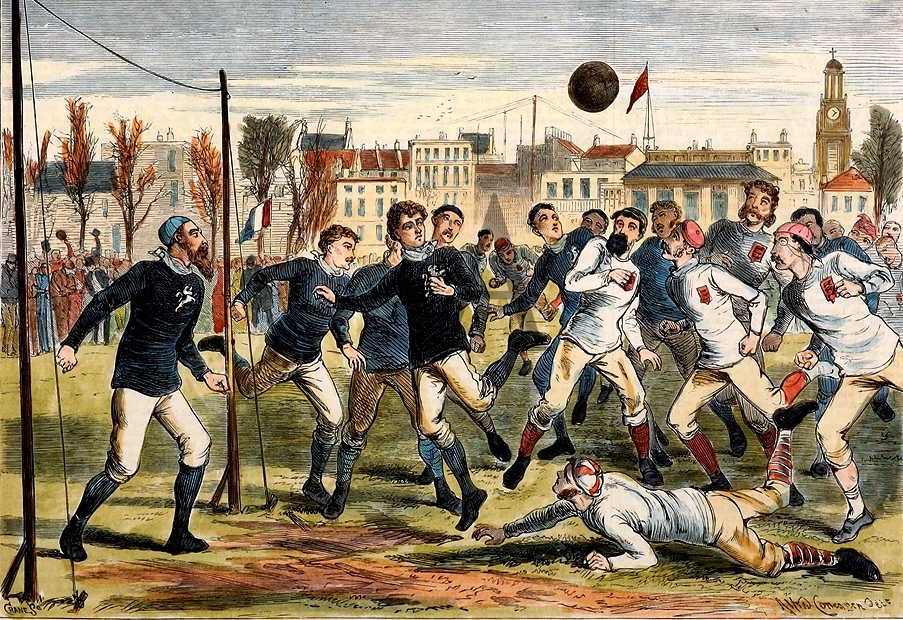
Artist's depiction. England in white, Scotland in blue.

November 30, 1872, 150 years ago: For the 1st time, soccer teams representing the best players in their respective countries play each other.

As comedian Jason Sudeikis asked, when introducing the character of Ted Lasso, an American football coach who'd gotten a job coaching an English "football" (soccer) team, "How many countries are there in this country?" By "this country," he meant the United Kingdom of Great Britain and Northern Ireland. The answer is four: England, Scotland, Wales and Northern Ireland -- with the Republic of Ireland being its own nation, not in the United Kingdom.

Charles Alcock, a soccer and cricket star of the era, had organized the 1st FA Cup in England the preceding year, and had also organized matches between teams representing the football associations of both his native England and Scotland. But these were matches between English players and Scottish players for teams in and around London, and were not what would now be called "full internationals."
So Alcock proposed a match between the truly best players from each country. It was set for November 30, 1872, at Hamilton Crescent, the home ground of the West of Scotland Cricket Club, in Glasgow.

The England team wore white caps, white shirts, white shorts, and blue socks:

* Goalkeeper: Robert Barker, of Wouldham, Kent, and Watford-based club Hertfordshire Rangers.
* Fullback: Harwood Greenhalgh, of Mansfield, Nottinghamshire, and Notts County.
* Halfback: Reginald Welch, of Kensington, West London, and London team Wanderers. He was the only one of these players to have also played in the 1st FA Cup Final, won by Wanderers 8 months earlier.
* Forward: Frederick Maddison, of Westminster, London, and Oxford University.
* Forward: William Maynard, of London, and 1st Surrey Rifles F.C.
* Forward: John Brockbank, of Whitehaven, Cumberland, and Cambridge University.
* Forward: Charles Clegg, of Sheffield, Yorkshire, and Sheffield Wednesday.
* Forward: Arnold Kirke Smith, also of Sheffield, and Oxford University.
* Forward and Captain: Cuthbert Ottaway, of Dover, Kent, and Oxford University. He was named Captain because Alcock was injured and unable to play. But Alcock did select every player.
* Forward: Charles Chenery, of Lambourne, Berkshire, and the original Crystal Palace F.C. of South London (not the current team of that name).
* Forward: Charles Morice, of London, and Harrow Chequers.

Ottaway died of tuberculosis in 1878, only 27 years old. He remains the only Englishman to represent a university in 5 different sports. Welch lived until 1939.

The Scotland team wore red cowls, navy blue shirts (which would become traditional for them), white shorts, and socks of navy and white stripes, and was represented by the top Scottish club team of the time, Queen's Park of Glasgow.

Scotland captain Robert Gardner, an organizer in Scottish sports on the same level that Alcock was for England, attempted to gain the services of the top two Scottish players from the London area, who had both played in the 1872 FA Cup Final: Arthur Kinnaird of Wanderers and Henry Renny -Tailyour of Royal Engineers. As it turned out, both were unavailable. Here's the team he did select, starting with himself:

* Goalkeeper: Robert Gardner, of Glasgow. He was described years later as the best goalkeeper in the world, although, given that England and Scotland were pretty much the only countries then playing the sport, that doesn't say much.
* Fullback: William Ker, of the Scottish capital of Edinburgh.
* Fullback: Joseph Taylor, of Glasgow.
* Halfback: James Thomson, of Annan, Dumfries.
* Halfback: James Smith, of Aberdeen.
* Forward: Robert Smith, of Aberdeen.
* Forward: Robert Leckie, of Killearn, Stirlingshire.
* Forward: Alex Rhind, of Aberdeen.
* Forward: Billy MacKinnon, of Glasgow, described as "a brilliant dribbling artist," perhaps the first player to use the overhead, or what became known as the "bicycle," kick.
* Forward: Jerry Weir, of Glasgow.
* Forward: David Wotherspoon, of Hamilton, South Lanarkshire.
Robert Gardner

James Smith died in 1876, only 32, from what's listed only as "a long illness," although he was listed as having played for South London team South Norwood in that calendar year. Weir died in 1887, of typhoid fever. Gardner also died in 1887, just short of turning 40. Leckie also died in 1887, just after turning 40. Taylor died in 1888, only 37. I cannot find a cause of death for any of them. MacKinnon was the last survivor of the game, living until 1942.

The referee was William Keay, a Scot. Given the tenor of the times, when athletes were supposed to conduct themselves as "sporting" and "gentlemen," he must have been acceptable to Captain Ottaway as well as to Captain Gardner.

The game was attended by 4,000 people, and the same price of admission was charged as for the FA Cup Final: One shilling. In 2022 British money, that's about £24.10. In U.S. money, about $31.70. A more than reasonable price for such historic events.

The match was scheduled to kick off at 2:00. A delay meant that it got underway at 2:20. The field, or pitch, was a bit muddy, having been pelted with the infamous Scottish rain for 3 days.

The Scotsman, a national newspaper still in business today, wrote, "During the first half of the game the English team did not work so well together, but in the second half they left nothing to be desired in this respect." The Scots had a goal disallowed, because the umpire decided that the ball did not clear the tape that was used to represent a crossbar.

At halftime, as was traditional at the time, the teams rotated their goalkeeping duties. England put Maynard in goal, and moved Barker to Maynard's place on the forward line. Gardner was moved into Robert Smith's place, and Smith moved into goal.

England never had a serious attempt on goal. Scotland had one more, late in the game, when Leckie launched a shot that landed on top of the tape. Final score: England 0, Scotland 0.

The Aberdeen Journal wrote, "It was allowed to be the best game ever seen in Scotland." A sports-themed magazine titled The Field wrote, "The match was in every sense a signal success as the play was throughout as spirited and a pleasant as can possibly be imagined."

A return match was played on March 8, 1873, at the Kennington Oval in South London. This time, there was scoring, and lots of it. William Kenyon-Slaney of England set the tone by scoring in only the 2nd minute, and England beat Scotland, 4-2.

Scotland gained their 1st win over England in 1874. They achieved celebrated wins over England in 1928, at Wembley Stadium in London, giving their side the name "The Wembley Wizards"; and in 1967, when a team led by Manchester United's Denis Law beat essentially the same England team that had won the World Cup the year before, winning the British Home Championship and becoming "Wembley Wizards II."

These 2 countries have played each other more often than any other. As of November 30, 2022, England have won 48 matches, to Scotland's 41, with 26 draws.

Saturday, January 2, 2021

January 2, 1971: The Ibrox Disaster

Stairway 13 after the disaster

January 2, 1971, 50 years ago today: The Ibrox Disaster occurs, at Ibrox Park in Glasgow, Scotland. (It was renamed Ibrox Stadium in 1997.) There were 66 deaths, over 200 injuries.

The stadium opened in 1899, as the home of Rangers Football Club, a soccer team for the Protestant citizens of Glasgow. Their arch-rivals were Celtic Football Club, a team founded by and for Irish Catholics living in Glasgow.

These 2 teams -- Rangers in blue shirts, like their counterparts in New York hockey and Texas baseball, Celtic in green and white stripes, giving them the nickname "The Hoops" -- have dominated Scottish soccer, and, together, are known as "The Old Firm."

But perhaps no 2 teams in all of sport hate each other as much, because religion is thrown into the mix. It has made both teams much bigger than they ordinarily would have been. Celtic, not the University of Notre Dame, are the most famous Catholic-themed sports team in the world. They can call upon that heritage in ways that Rangers have tried to do with the world's Protestants, but just can't.

There had previously been a disaster at Ibrox on April 5, 1902, during a British Home Championship match between Scotland and England that ended 1-1. A section of the newly built West Tribune Stand collapsed, killing 25 people and injuring about 500 others. In 1961, 2 people were killed in a crush on the narrow Stairway 13, the exit closest to Copland Road subway station. In 1967, 8 fans were injured there. In 1969, there was an incident there, injuring 26 people.
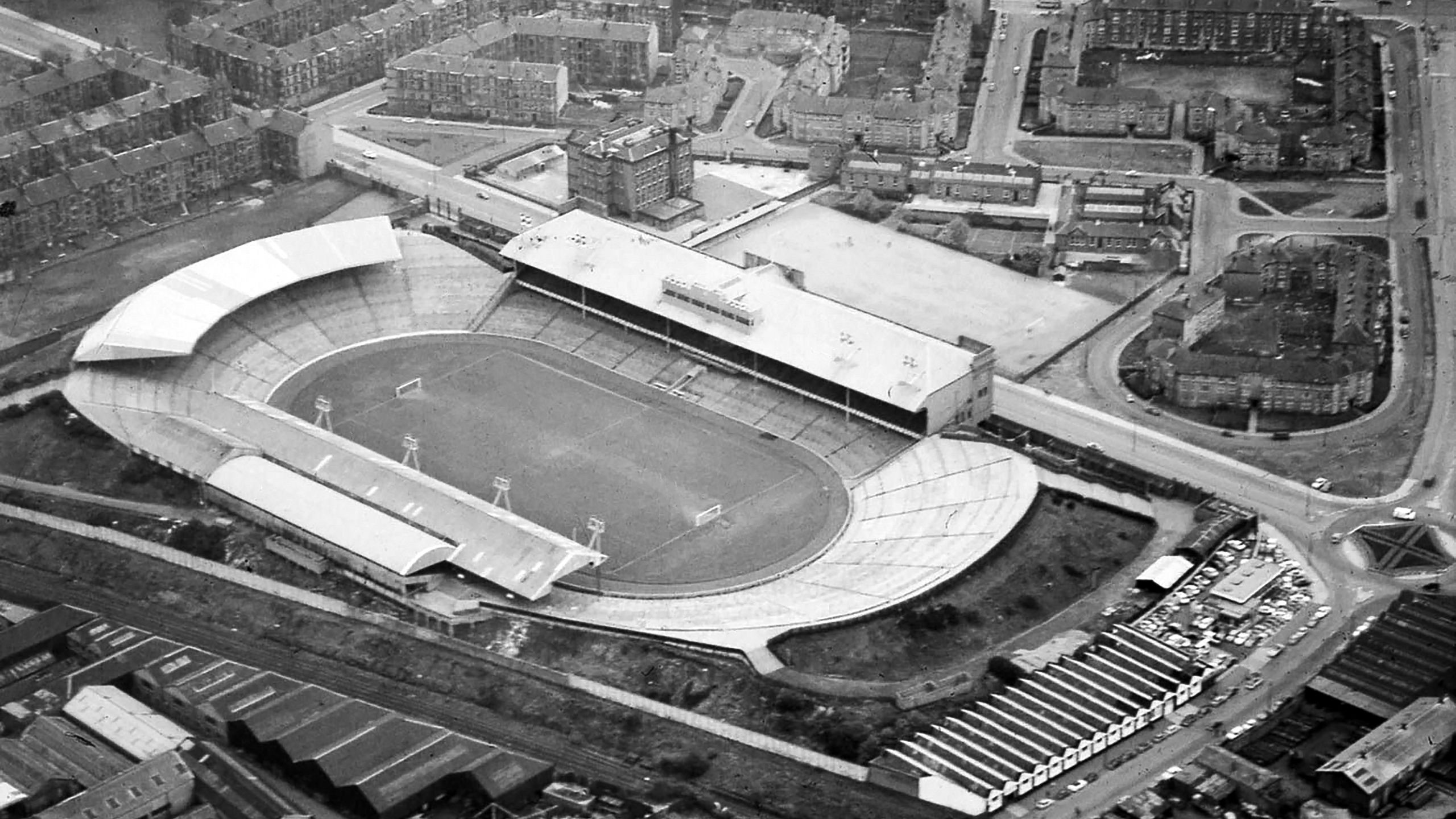
Ibrox Park, as it was named, and would have appeared, in 1971

On January 2, 1971, the teams took the pitch at Ibrox, and over 80,000 people attended. The game remained scoreless until the 90th minute, when Jimmy "Jinky" Johnstone, often regarded as Celtic's greatest player ever, scored. And so, many of the Rangers fans got up to leave.

But in stoppage time, Colin Stein (like Celtic's manager, John "Jock" Stein, that's pronounced "STEEN," and isn't Jewish or German), scored an equalizer for Rangers. Hearing the roar of the fans who hadn't left, some of those who did turned around and tried to go back to see what had happened.

This proved fatal on Stairway 13. It is widely believed that someone tripped and fell, causing a domino effect. Bodies ended up being stacked up to 6 feet deep. Among the 66 deaths were 31 teenagers, and 5 children who were schoolmates from Fife.

The incident happened so late that the on-pitch people, including the players, and the fans still in the stands, didn't know what happened until after the game was over. The players for Celtic included 18-year-old forward Kenny Dalglish, who would become a star for the team, and later for Liverpool Football Club. He would be present for the Heysel Stadium Disaster of 1985, where 39 died; and the Hillsborough Stadium Disaster of 1989, which would surpass the Ibrox Disaster of 1971 as the deadliest sporting disaster in the history of the British Isles.

Rangers F.C. were sued, and, knowing the case was unwinnable, settled. Ibrox soon underwent a renovation, including a new Stairway 13. While the Hillsborough Disaster was the catalyst for all English stadiums converting to all-seater, the Ibrox Disaster led to most Scottish stadiums doing so far sooner, and Ibrox was all-seater by 1981. Today, it seats 50,817.
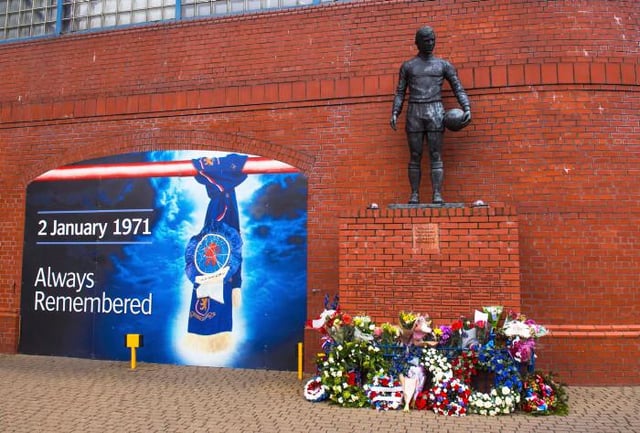
A recent photo of Ibrox Stadium

In 2001, on the 30th Anniversary of the tragedy, a monument with the names of the victims was dedicated. It includes a statue of John Grieg, their Captain in 1971, and often regarded as their greatest player ever.
In 2011, on the 40th Anniversary, Grieg and Billy McNeill, Celtic's Captain at the time (though he was injured and didn't play in the game in question), led the current versions of their respective teams out for a pregame ceremony.
Foreground: McNeill (left) and Grieg.
Background: 2011 Captains Scott Brown (left) and David Weir.
Celtic won the game, 2-0.

The teams still play each other on New Year's Day when it can be arranged. When they do, they put their hate aside and commemorate the tragedy.

Thursday, April 25, 2019

Billy McNeill, 1940-2019

One of the giants of British soccer has come to the end of a long battle, and a well-earned rest.

William McNeill (no middle name) was born on March 2, 1940, in Bellshill, about 10 miles east of Glasgow, Scotland. This little town of 20,000 people, has produced many soccer legends, including Hughie Gallacher, Matt Busby, Brian McClair and Ally McCoist; and also boxing champion Scott Harrison and singer Sheena Easton.

Billy McNeill was signed by Glasgow soccer team Celtic in 1957, from a nearby junior team, Blantyre Victoria. The team was not very good at the time, until the arrival of a new manager, a centre-half who had helped the team win "The Double," both the league title and the Scottish Cup, in 1954: John "Jock" Stein. (That's pronounced "steen," like it was Scandinavian, not "stine," like it was Jewish.)

The Scottish top flight has long been dominated by 2 teams from Glasgow: Celtic and Rangers. In the Scottish Football League Division One (1890-1946), Division A (1946-55), Division One again (1955-75), Premier Division (1975-98), Premier League (1998-2013) and Premiership (since 2013), here is the title count: Rangers 54, Celtic 49, Edinburgh team Heart of Midlothian (a.k.a. Hearts) 4, Edinburgh team Hibernian (a.k.a. Hibs) 4, Aberdeen 4, and everybody else... 7. Or, to put it another way: The 2 Glasgow giants, known as "The Old Firm," 103, and everybody else 19.

The origin of the term "The Old Firm" is in dispute, but it may go back to a sportswriter comparing them to "two old, firm friends" leading up to the 1904 Scottish Cup Final. If this was ever true, it is has long since become a lie. No pair of teams in British Isles soccer hates each other more.

Rangers Football Club was founded in 1872, and didn't start out as a symbol for anything other than men who enjoyed football (soccer). But in 1912, shipbuilders Harland and Wolff, which hired only Protestants, never Catholics, saw sectarian trouble at their hometown shipyard at Belfast, Northern Ireland, and set up a new one in the Govan section of Glasgow, taking some of their Ulster Protestant men with them.

Seeing this, many Glasgow Protestants began working there. Since Rangers were the closest team, the Northern Irish transplants followed the lead of their new Glasgow workmates, and became Rangers fans. With World War I coming on, and the Eastern Rising and the Irish Civil War that followed, Rangers became a team representative of British Unionism and the Scottish establishment. To this day, their Ibrox Stadium, on the city's West Side, has fans waving Union Jacks much more often than the Scottish Saltire, the Cross of St. Andrew.

The Celtic Football Club -- sometimes abbreviated to "CFC," but, when said in full, "The" is always used, much like "The... Ohio State University" -- was founded in 1887, specifically to deliver money and other resources to the poor Irish Catholics on Glasgow's East Side, where Celtic Park, a.k.a. "Parkhead," would be built.

Their crowds began to match those of Rangers, and, seeing Rangers as the team of the Protestants that were oppressing them, their fans began to wave the green-white-orange tricolor that is the flag of the Republic of Ireland. Saltires are as rare at Parkhead as they are at Ibrox.

In response to this, Rangers fans ended up hating Celtic and their fans as much as vice versa. From the 1920s until 1989, Rangers never signed a player they knew to be Catholic, until finally breaking the barrier with formerly Celtic star Maurice "Mo" Johnston, who ended up being verbally abused by, and receiving death threats from, not just his old fans, but those who were supposed to be cheering him with his new team. He failed there after just 2 years, and bounced around, ending his career in America with the Kansas City Wizards (now known as Sporting Kansas City).

No soccer team in Ireland -- either in the Republic or in Northern Ireland -- is as popular in its homeland as Celtic or Rangers are there. Some English teams, particularly those who've had success with Irish players such as Arsenal, Liverpool and Manchester United, are popular in Ireland, but neither as much as Celtic and Rangers.

The competitive rivalry between the teams is incredibly close: Rangers have won 160 competitive matches, Celtic have won 157, and there have been 99 draws. But it gets incredibly nasty. Rangers fans have been known to chant profane things about the Pope -- whoever the Pope is at the time -- and Celtic fans have returned the favor by saying the same things about Queen Elizabeth II, even though she's half-Scottish herself.

But when Jock Stein arrived in 1965, Celtic had won just 1 league title since 1938 (and he was there for that one, in 1954). Over that same span, Rangers had won 11. Things turned around: With McNeill scoring the winning goal, Celtic defeated Dunfermline 3-2 in the 1965 Scottish Cup Final. The Scottish Footballer of the Year award was first awarded, and it was awarded to McNeill.

Stein named McNeill his Captain. Together, they led "The Hoops" (named for their green and white horizontal stripes) well: From 1966 to 1974, they won 9 straight league titles (a feat Rangers would match in 1997), They also won 7 Scottish Cups and 6 Scottish League Cups.

And then came 1967. The European Cup, the tournament now known as the UEFA Champions League, was first run in the 1955-56 season. No British team had yet won it, or even reached the Final. On aggregate, Celtic beat FC Zurich of Switzerland 5-1 (including a stunning 3-0 away win), Nantes of France 6-2 (including 3-1 away), Vojvodina of Yugoslavia (now in Serbia) 2-1, and Dukla Prague of Czechoslovakia (now in the Czech Republic) 3-1.

The Final was set for Estadio Nacional in Lisbon, Portugal, with Celtic playing Internazionale Milano, who had won the Cup in 1964 and 1965, becoming known as "La Grande Inter." Celtic took the pitch with this starting XI, all of them from within 30 miles of Glasgow: Goalkeeper Ronnie Simpson, right back Jim Craig, left back Tommy Gemmell, central midfielder Bobby Murdoch, centreback and Captain Billy McNeill, centreback John Clark, right wing Jimmy "Jinky" Johnstone (often called the greatest player in Celtic history), centre forward Willie Wallace, centre forward Stevie Chalmers, central midfielder Berti Auld, and left wing Bobby Lennox.

Simpson saved a shot from Sandro Mazzola, a 2nd-generation Italian calcio star (that's what Italians call soccer, and his father Valentino Mazzola had starred for Turin team Torino in the 1940s), before Craig fouled Renato Cappellini, resulting in Inter being awarded a penalty in only the 7th minute.

The score remained 1-0 to Inter past the hour mark, because of Inter's renowned defensive style, known as catenaccio -- "padlock." Auld hit the crossbar, and Johnstone headed a shot over it. Giuliano Sarti saved a free kick from Gemmell, and he hit the bar with the rebound. Entering the 63rd minute, the Hoops were dominating, but the Nerazzurri (Black & Blue) were winning.

Finally, Celtic broke the padlock. Craig passed from the right wing to Gemmell, who fired from 25 yards, and Sarti couldn't stop it. 1-1. Celtic kept up the attack, until the 84th minute. Murdoch had a shot, and Chalmers saw that he could deflect it in. The final score was 2-1 to Celtic. They were the 1st British team to win the European Cup.

They had won the League, the Cup, the League Cup, and now the European Cup -- not just a Double, not just a Treble, but a Quadruple. Counting the Glasgow Cu, a minor trophy, they became the 1st European team to win 5 trophies in a season. They remain the only team in Europe ever to pull either of these feats off, and would become known as "The Lisbon Lions." In reference to Protestant songs about King William III, who suppressed a Catholic revolt in Ireland in 1690, Celtic fans honored their Captain by singing, "There's only one King Billy, and it's McNeill!"

King Billy McNeill got Celtic back into the European Cup Final in 1970, losing to Feyenoord of Rotterdam, who thus became the 1st Dutch team to win it. He retired after the 1975 season, having played 822 games for the team, which remains a record.

He appeared for the Scotland national team 29 times, scoring 3 goals, but never at the World Cup. Scotland did not qualify in 1962, 1966 or 1970. Scotland had perhaps its best World Cup team ever in 1974, with 4 Celtic players making the squad: Johnstone, midfielder David Hay, defender Danny McGrain and young forward Kenny Dalglish. But McNeill was 34, and past his prime.

It shouldn't have surprised anyone that he went into management. He took Aberdeen to 2nd place and the Scottish Cup Final in 1978, and that showed Celtic that he was ready to take charge. As boss at Parkhead, he won the League in 1979, 1981 and 1982, the Scottish Cup in 1980, and the Scottish League Cup in 1983.

He was lured away by English team Manchester City, and he got them promoted back to Division One in 1985. He managed 3 years at Maine Road, then the 1986-87 season at Aston Villa, but he couldn't save them from relegation. He returned to Celtic for 4 more years, including a League and Cup Double in 1988 and another Cup in 1989. He went into football media, briefly taking one last management job, as caretaker manager at Hibernian in 1998.

Since 1963, he had been married to Liz Callaghan, a former professional dancer. They had 5 children. In 2002, he was voted Celtic's greatest Captain. He was elected to the Scottish Football Hall of Fame in 2004. In 2015, a statue of him holding up the European Cup was dedicated outside Celtic Park.
But he had already begun to fall victim to dementia, and was unable to participate in 50th Anniversary celebrations for the Lisbon Lions. Billy McNeill died this past Monday, April 22, 2019, in the Glasgow suburb of Newton Means. He was 79 years old.

He was preceded in death among the Lisbon Lions of 1967 by manager Jock Stein in 1985 (famously suffering a heart attack while managing Scotland against Wales in a "Home Nations Championship" match in Cardiff), Bobby Murdoch in 2001, Ronnie Simpson in 2004, Jinky Johnstone in 2006 and Tommy Gemmell in 2017. There are 6 surviving players: Stevie Chalmers is 83, Bertie Auld is 81, John Clark and Willie Wallace are 78, Jim Craig is about to turn 76, and Bobby Lennox is 75.

UPDATE: Billy McNeill's final resting place is not publicly known.