Showing posts with label european cup. Show all posts

Saturday, June 13, 2026

June 13, 1956: The 1st European Cup Final

Francisco Gento with the 1956, 1957, 1958,
1959, 1960 and 1966 European Cups

June 13, 1956, 70 years ago: The Final of the 1st European Champion Clubs' Cup is held at the Parc des Princes in Paris, France.

On April 27, 1895, for the 1st time, the Champions of 2 different European soccer leagues met. It was an All-British affair, played at Tynecastle Park in Edinburgh, Scotland. The hosts, Scottish Champions Heart of Midlothian, a.k.a. "Hearts," took on the English Champions, Sunderland, from the North-East. Actually, it was an All-Scottish contest: Known as "The Team of All Talents," every one of Sunderland's players was Scottish. (The Wearside city is less than 60 miles from the England-Scotland "border.") Sunderland won, 5-3.

In 1897, the Challenge Cup was founded, competed for by teams from across the Austro-Hungarian Empire, which included not just the entirety of present-day Austria and Hungary, but all of present-day Czechia, Slovakia, Slovenia, Croatia and Bosnia, and parts of present-day Poland, Ukraine, Romania and Italy. Vienna Cricket and Football Club won the 1st one. The tournament ran until 1911.

The Mitropa Cup was founded in 1927. As the name suggests -- "Mitropa" is an abbreviation of "Mitteleuropa," or "Middle Europe" -- it was played for by teams in Central Europe only. Sparta Prague won the 1st one. This tournament continued despite the rise of the European Cup and other tournaments, until 1992, when the European Cup became the Champions League.

In 1930, the Coupe des Nations was founded, held in Geneva, Switzerland, and was won by Újpest of Budapest, Hungary. But the Great Depression doomed this early effort at a continent-wide soccer championship tournament.

In 1949, with the Depression and World War II behind them, France, Spain, Portugal and Italy came together and founded the Latin Cup. Barcelona won the 1st one. This tournament did not long survive the establishment of the European Cup, being dissolved in 1957.

But the real key came in 1948, with the South American Championship of Champions, won by Vasco da Gama of Rio de Janeiro, Brazil. Gabriel Hanot, editor of the French sports-themed newspaper L'Equipe, wanted such a tournament for Europe.

Once again, Hungary had a major role. After beating England badly, both home and away, and reaching the Final of the 1954 World Cup, Hungary's national team was established as a power. On December 13, 1954, a small measure of revenge was taken when England's titleholders, Wolverhampton Wanderers, beat Hungary's, Honvéd of Budapest, 3-2 in Wolverhampton, outside Birmingham. "Wolves" manager Stan Cullis called his team "Champions of the World."

Since the rest of Europe was sick of hearing England brag about their teams, both club and national, especially after their pathetic performances in the 1950 and '54 World Cups, the "football associations" of the various European countries finally listened to Hanot's request for a real European championship, to be played in the 1955-56 season, by each European country's 1954-55 Champions.

Wolves did not compete in the tournament -- because they didn't win England's Football League Division One in 1954-55. Chelsea, of West London, did. But they also chose not to compete. Of the 4 British "Home Nations," only Scotland sent their Champions. With some irony, it was Hibernian, a.k.a. Hibs, Edinburg rival of Hearts, who set everything in motion 60 years earlier.

Only 16 teams competed. So there were only 4 rounds, with home-and-away legs, of this single-elimination tournament. In the Round of 16, Partisan of Belgrade, Yugoslavia, beat Sporting Clv.ube de Portugal, of Lisbon; Vörös Lobogó of Budapest, now named MTK, beat Anderlecht of Belgium; Real Madrid of Spain beat Servette of Switzerland, hosts of the 1930 Coupe des Nations; Hibernian beat Rot-Weiss Essen of West Germany; Djurgården of Stockholm, Sweden beat Gwardia Warszawa of Warsaw, Poland; Stade de Reims of France beat Aarhus of Denmark; Rapid Wien of Vienna, Austria beat PSV Eindhoven of the Netherlands; and AC Milan of Italy beat Saarbrücken, of the Saar Protectorate, a section of Germany then governed by France, but soon returned to West Germany.

In the Quarterfinals, Hibs beat Djurgården; Reims beat Vörös Lobogó; Real Madrid beat Partizan; and Milan beat Rapid. In the Semifinals, Reims beat Hibs, and Real Madrid beat Milan.

The Final was set for June 13, at the Parc des Princes in Paris. The original stadium on the site opened in 1897. This was the 2nd, opening in 1932. A 3rd was built on the site, and opened in 1972. Today, it is the home of the leading "football club" in France, Paris Saint-Germain.
The 1932-1972 version of the Parc des Princes

Reims, wearing red shirts with white sleeves like North London team Arsenal, were managed by Albert Batteux, captained by Robert Jonquet, and featured the best player in France, a son of Polish immigrants, Raymond Kopa.
Raymond Kopa, in uniform for France
at the 1958 World Cup

Real Madrid, dressed in all white, and thus known as Los Blancos and Los Merengues, were even more loaded. Manager José Villalonga could call on Captain Miguel Muñoz, and the man who may have then been the best player in the world, the Argentine forward known as El Saeta Rubia (The Blond Arrow): Alfred Di Stéfano.
Alfred Di Stéfano, in the all-whites of Real Madrid

Arthur Ellis of England, the referee at the Final of the 1950 World Cup, was chosen to officiate at this match as well. With 38,239 paying customers looking on, he blew his whistle at 8:30 PM local time -- also 8:30 PM in Madrid, 7:30 PM in London, and 2:30 PM in New York -- and the match was on.

Reims, with a lineup of all Frenchmen, didn't waste any time showing Real Madrid that they belonged on the same pitch. Michel Leblond scored just 6 minutes into the match. Jean Templin made it 2-0 in the 10th minute. But the Spanish side, all Spaniards except for Di Stéfano, were unfazed: The Arrow himself tallied in the 14th minute. Héctor Rial equalized at the half-hour, and it remained 2-2 at halftime.

Michel Hidalgo, a Normandy native with a Spanish father, gave Reims the lead shortly after the hour. But Marcos Alonzo Imaz, a centreback known as Marquitos, made it 3-3 in the 67th minute. It began to look like a replay might be necessary, until the 79th minute, when Di Stéfano made it 4-3 in Real's favor.

And so it remained when Ellis blew the final whistle. Real Madrid were the 1st true Champions of Europe, and could make a case for being the best side in the world. It would take until 1960 for an Intercontinental Cup to be founded, to be contested by the winners of the European Cup and the South American continental championship, now named the Copa Libertadores.

In 1992, the Union of European Football Associations renamed their signature tournament the UEFA Champions League, although the trophy retains the name "European Cup" (and the nickname "Ol' Big Ears," because of its large handles). In 1998, UEFA began admitting teams that had finished high in their leagues, but had not won them.

Real Madrid won the 1st 5 European Cups, and have won it more than any other team, 15 times, most recently in 2024.

Francisco "Paco" Gento played on each of those 1st 5 winners, and also on their next in 1966. He was the 1st man to play on 6 European Cup winners. He was also the last survivor of both the 1956 and 1957 European Cup winners, living until January 18, 2022.

When Real Madrid won the 2024 Champions League title, it added 4 players to Gento's formerly unique status of playing on 6 European Cup winners: Team Captain Nacho Fernández, Luka Modrić, Dani Cavajal and Toni Kroos. Kroos had won 1 with Bayern Munich, 5 with Real Madrid. The others each won all of theirs with Real Madrid.

Monday, January 8, 2024

Mário Zagallo, 1931-2024; Franz Beckenbauer, 1945-2024

A caption out of date since 2018.

There are 3 men who have won soccer's World Cup as both a player and a manager. And 2 of them have just died.

Take care of yourself, Didier Deschamps (France, 1998 as player, 2018 as manager).

Mário Jorge Lobo Zagallo was born on August 9, 1931 in Atalaia, Alagoas, Brazil; and grew up in Rio de Janeiro. He served his mandatary time in the Brazilian Army, and was stationed at the Estádio do Maracanã during the 1950 World Cup Final, which Brazil famously lost to Uruguay. A left wing, he played his entire club career in Rio: WIth Flamengo from 1951 to 1958, winning the Rio de Janeiro State Championship in 1953, '54 and '55; and with Botafogo from then until 1965.
Wearing "The Botafogo Star"

With the national team, "The Selection" (O Seleção), he made 33 appearances, scoring 5 goals, and winning the World Cup in 1958 and 1962. He was the last surviving player from the 1958 team, with Pelé as a 17-year-old star. His death leaves Amarildo as the last surviving player from the 1962 team.

He went into management, and led Botafogo to the State Championship in 1967 and 1968, and to the national league title, the Campeonato Brasileiro Série A, in 1968. In 1970, following a controversy over team selection, João Saldanha was fired as national team manager, and Zagallo was hired. With Pelé up top, he led Brazil to perhaps the greatest performance in the sport's history, and won the World Cup for the 3rd time. Thus, they got to keep the trophy, the Jules Rimet Trophy, permanently, and a new Rimet Trophy was designed.
Zagallo with the new trophy (left) and the old trophy (right)

He returned to Rio, and led Fluminense to the Rio State Championship in 1971. "La Flu" lost Zagallo to their arch-rivals, Flamengo, and he led "La Fla" to the State Championship in 1972. He went back to Botafogo 3 times, managed Flamengo twice more, and also managed Rio team Vasco da Gama twice.

Overseas, he managed the Kuwait national team to the Arabian Gulf Cup in 1976, Al-Hilal to the Saudi Premier League title, and managed the national teams of Saudi Arabia and the United Arab Emirates.

He was named a coordinator for Brazil in 1994, and was on hand for their 4th World Cup win. He managed them into the 1998 World Cup Final, but lost to France. Brazil won their 5th in 2002, under Luis Felipe Scolari. After that Zagallo managed Brazil in 1 more game, a win over South Korea.

Mário Zagallo married Alcina de Castro in 1955. They had 4 children, and remained together until her death in 2012. He died this past Friday, January 5, 2024, at the age of 92.
*
Zagallo was a very good player and an all-time great manager. Franz Beckenbauer was the other way around.
Franz Anton Beckenbauer Jr. was born on September 11, 1945, in Munich, Bavara, in a Germany only 4 months removed from V-E Day. As a boy, he rooted for the top team in his hometown, TSV 1860 Munich. But it was Fußball-Club Bayern München e. V. -- "Bayern" meaning "Bavarian" -- that signed him, and as their star rose, 1860's fell. (1860 were founding members of German's Bundesliga, meaning "federal league," in 1963, but were relegated to the 2nd division in 1986, and are now in the 3rd division.)
In the 1964-65 season, Beckenbauer made his first-team debut with Bayern, and they won the 2nd division and gained promotion to the Bundesliga, and have never left it. Indeed, they have dominated it: In the ensuing 58 seasons, they have won it 32 times, including the last 11. With a punishing defense, including with Beckenbauer as sweeper and Sepp Maier in goal, and Gerd Müller scoring goals, Bayern won 3 straight European Cups (the tournament now known as the UEFA Champions League) in 1974, '75 and '76.
Beckenbauer played on the West Germany team that lost to England in the 1966 World Cup Final, reached the Semifinals of the 1970 World Cup, and won Euro 1972. In 1974, with the World Cup on home soil, and the Final on his home ground of the Olympiastadion in Munich, Beckenbauer captained West Germany against the Netherlands, led by Johan Cruiff. The contrast could not have been more stark: The Dutch, in their bright orange shirts, were flashy and attacking; while the Germans, in all white, were plain, conservative, and defensive.
West Germany came from behind to win, 1-0, their 2nd World Cup win. (The 1st was in 1954.) It was a crushing defeat for the Netherlands, but for West Germany, it was another step on the road to recovery from World War II. They reached the Final of Euro 1976, losing to Czechoslovakia.
Individually, in the balloting for the World Player of the Year award, the Ballon d'Or (Golden Ball), Beckenbauer finished 3rd in 1966, won it in 1972, finished 2nd in 1974 and 1975, and won it in 1976. After finishing the 1976-77 season with Bayern, he did what any good European or South American player would do at that time: Come to America for the money. He joined Pelé on the New York Cosmos, led them to the North American Soccer League title, and won the league's Most Valuable Player award. He won the title with them again in 1978 and 1980. He went back to Germany, and won the Bundesliga with Hamburger SV in 1982. It was his 8th league title.
"Der Kaiser" went into management, and took West Germany to the Final of the 1986 World Cup, losing to Argentina; to the Semifinal of Euro 88, where the Netherlands got their revenge and beat them, and then won the Final; and to the Final of the 1990 World Cup, avenging their defeats in the '82 and '86 Finals, beating Argentina. (They'd lost to Italy in the '82 Final, with Beckenbauer neither playing nor managing.)
Beckenbauer managed Olympique de Marseille to the title in France's Ligue 1 in 1991, then went back to Bayern, leading them to the Bundesliga in 1994 and the UEFA Cup (the tournament now known as the UEFA Europa League) in 1996. He later served as Bayern team president, and is regarded as his country's greatest sports hero.
He was married 3 times, and had 5 children. He died yesterday, January 7, 2024, at the age of 78, after years of heart trouble.

Saturday, October 21, 2023

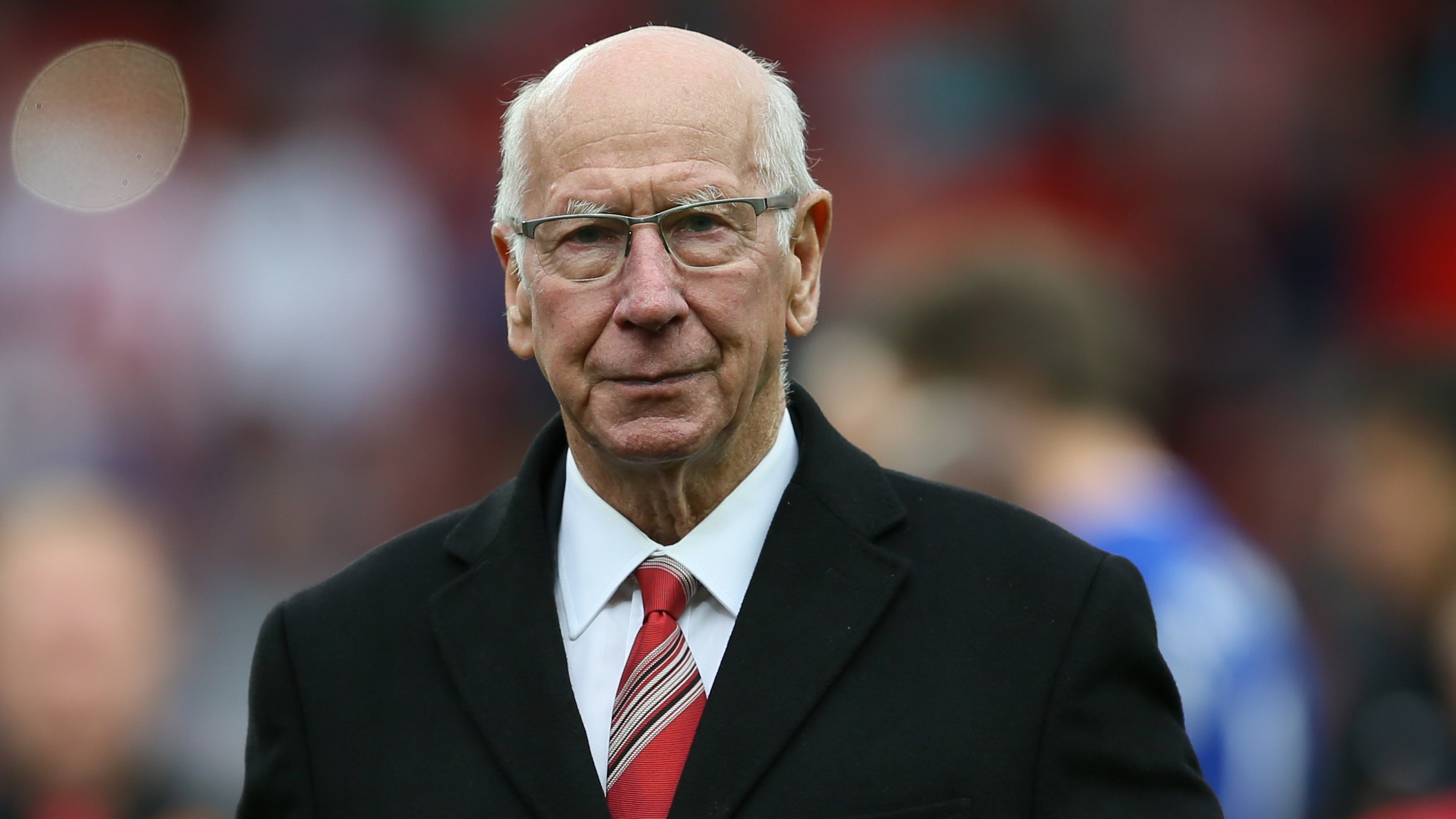
Bobby Charlton, 1937-2023

One of sport's greatest living legends lives no more. And most Americans have never heard of him.

Robert Charlton (no middle name) was born on October 11, 1937 in Ashington, Northumberland, in the North-East of England. A cousin of Newcastle United legend Jackie Milburn, it was Manchester United that took an interest in the young forward.

He became one of manager Matt Busby's "Busby Babes" that won the English Football League in 1957. They also won the League in 1956, but Charlton did not make his senior debut until the 1956-57 season, specifically on October 6, 1956. In that game, he scored 2 goals in a 4-2 United win over, ironically, the South London team known as Charlton Athletic. United nearly became the 1st team in the 20th Century to "do The Double," but they lost the 1957 FA Cup Final in controversial fashion to Birmingham club Aston Villa.

In 1958, they advanced to the Semifinal of the European Cup, beating Red Star Belgrade in the Quarterfinal. But on their way back, their plane crashed after takeoff following a refueling stop in Munich, Germany, ending the would-be dynasty. Of the 44 people on board, 23 died. There were 17 people connected with the club on board, and 8 players died, while 2 others were so badly hurt that they never played again.

Busby himself was badly hurt, and would not return to the team until the next season started. Bobby survived with minor injuries, and recovered in time to play in the FA Cup Final, which a weakened United lost to Bolton Wanderers.
By 1963, United were still not doing well in he League, but they won the FA Cup, beating Leicester City in the Final. In 1965, Bobby, Scotsman Denis Law and Northern Irishman George Best had become "United's Holy Trinity," and they won the League title. They won it again in 1967, and became the 1st English team to win the European Cup, defeating Benfica of Lisbon, Portugal in the Final, 4-1. (Celtic, of Glasgow, Scotland, were the 1st British team to win it, the year before.)
Left to right: Charlton, Best, Busby, Law
He was selected for England in the 1958 World Cup, but didn't play. Many Englishmen believe that the Munich Air Disaster prevented England from winning the World Cup in 1958 and 1962, forgetting that Brazil would have wrecked them as they wrecked everybody else. Bobby did play in 1962, and in 1966 was joined by his brother Jack, who starred for Leeds United (and later famously managed the Republic of Ireland national team), and his Man United teammate Nobby Stiles. England won on home soil, with Bobby scoring twice in the Semifinal against Portugal, and then winning the Final over West Germany.

Bobby won 2 Golden Balls in 1966: As outstanding player of the World Cup, and the Ballon d'Or as world player of the year. He continued to play for Man United through 1973, scoring 249 goals. His receding hairline earned him the nickname "Captain Combover," before he finally accepted reality and went fully bald. He played for England again in the 1970 World Cup, and became the national side's all-time leading scorer, a record recently broken by later Man United player (and fellow victim of hair loss) Wayne Rooney, and recently surpassed again by Tottenham Hotspur player Harry Kane (now with Bayern Munich, and still with all his hair).

Bobby was knighted for his service to sport and country, and was one of the most beloved figures in the history of soccer, possibly England's greatest player ever -- or, at least, one of the top two, alongside his 1966 Captain, West Ham United defender Bobby Moore. For fans not old enough to have seen Milburn, or 1930s Everton star Dixie Dean, he remains England's definitive Number 9. And, unlike many other attacking players for Man U, he was never once accused of diving to win a penalty.
He met his wife, Norma Ball (no relation to England teammate Alan Ball) at an ice rink in Manchester in 1959, and they married in 1961. They had two daughters, Suzanne and Andrea. Suzanne was a weather forecaster for the BBC. They went on to have grandchildren, including Suzanne's son Robert, who was named in honor of his grandfather.

A statue of Charlton, Law and Best, United's "Trinity," was unveiled outside their stadium, Old Trafford, in 2008, on the 40th Anniversary of their European Cup triumph. In 2016, Old Trafford's south stand was renamed the Sir Bobby Charlton Stand. (The north stand is the Sir Alex Ferguson Stand, the west stand is the Stretford End, and the east stand is the Scoreboard End.)
Unfortunately, the heavy balls of his era meant that, like several of his contemporaries, Sir Bobby Charlton was diagnosed with dementia as he got older. He died today, October 21, 2023, at the age of 86.

With his death:

* There are no more survivors from the Manchester United players in the Munich Air Disaster, and only 4 surviving passengers: Stewardess Rosemary Cheverton; Eleanor Miklos, wife of travel agent Bela Miklos, who was killed; Vera Lukić, the wife of a Yugoslav diplomat; and her daughter, Vesna Lukić.

* There are 4 surviving players from Manchester United's 1963 FA Cup winners: Dennis Law, Pat Crerand, Johnn Giles and David Gaskell.

* There are 4 surviving players from United's 1965 Football League Champions: Law, Crerand, John Aston and Willie Anderson.

* There are 5 surviving players from United's 1967 Football League Champions: Those preceding 4, and Alex Stepney.

* There are 5 surviving players from United's 1968 European Cup winners: Crerand, Aston, Stepney, Brian Kidd and David Sadler. Law was injured and did not play.

* Sir Geoff Hurst is the last player from the 1966 England World Cup squad to have played in the Final. Terry Paine, Ian Callaghan and George Eastham are also still alive from the roster, making 4. (Bobby's brother Jack had died in 2020.)

* And there are 5 English players left from the end-of-the-20th Century selections for the 100 Greatest Players of All Time: Kevin Keegan, Gary Lineker, Michael Owen and David Beckham.

Tuesday, January 18, 2022

Francisco Gento, 1933-2022

Francisco Gento with the 1956, 1957, 1958,
1959, 1960 and 1966 European Cups

A sports legend has left us, and most Americans have never even heard of him.

Francisco Gento López was born on October 21, 1933, in Guarnizo, in Cantabria in northern Spain. Playing the position of outside left, what would now be called left midfielder or left wing, he debuted for local team Racing Santander in 1952. A flu epidemic struck them before a game with Spain's leading soccer team, Real Madrid, and he was forced into the starting lineup. He impressed them more than his own team, and he was purchased 3 days later.

After a difficult 1st season, Real Madrid's president, and namesake of their stadium, Santiago Bernabéu, was ready to sell him off. But the team's best player, Alfredo Di Stéfano, told him, "He is quick, and hits the ball like a cannon. That can't be learned. It's innate. We can teach him the rest."

Gento fulfilled Di Stéfano's faith in him. Known as La Galerna del Cantábrico (The Gale of the Cantabrian Sea), his speed and passing helped Real win 12 La Liga titles between 1954 and 1969. But the true measure of success for Madridistas is the European Cup, known since 1992 as the UEFA Champions League. They won the tournament  the 1st 5 times it was held: 1956, 1957, 1958, 1959 and 1960.

The Cup was won by Benfica of Lisbon, Portugal in 1961 and 1962; by AC Milan of Italy in 1963; and by Internazionale of Milan, a.k.a. Inter, in 1964 and 1965. Once kings of Europe ("Real" means "royal"), Real Madrid went out of the Cup in the 1st round in 1961 (to arch-rival FC Barcelona, no less), lost the Final to Benfica in 1962, in the Preliminary Round in 1963, lost the Final to Inter in 1964, and went out in the Quarterfinal in 1965.

So Real were determined to win it in 1966. With "Paco" Gento as Captain, they beat Feyenoord of Rotterdam, the Netherlands in the Preliminary Round. In the 1st Round, they beat Kilmarnock of Scotland. In the Quarterfinal, they beat Anderlecht of Belgium. In the Semifinal, they dethroned Inter. And in the Final, at Heysel Stadium in Brussels, Belgium, they beat Yugoslavian Champions Partizan Belgrade, 2-1.

(Heysel would host the European Cup Final again in 1985, with disastrous results: A wall collapse led to the deaths of 39 people, but the game went ahead anyway, and Juventus beat Liverpool, 1-0.)

It was the 6th European Cup for Real Madrid, and the 6th for Gento. To this day, he remains the only player ever to win the European Cup/Champions League 6 times.

He was named to the Spain team at the 1962 and 1966 World Cups, but not the 1964 European Championship that Spain won.

He retired in 1971, and went into coaching. In 1979, he got Palencia promoted to the 1st Division. He later became a club ambassador, and was named honorary president of the team after Di Stéfano died in 2014.

Real Madrid have now won the European Cup 13 times, more than any other team, most recently in 2018. Gento lived to see all of them. He died today, January 18, 2022, at the age of 88. He is survived by his wife Mari Luz, sons Francisco and Julio, and granddaughters Aitana and Candela.

He was the last survivor of both the 1956 and 1957 European Cup winners. With his death, there are now:

* 2 surviving players from the 1958 European Cup: José Santamaría and Juan Santisteban.

* 3 surviving players from the 1959 European Cup: Santamaría, Santisteban and Antonio Ruiz.

* 4 surviving players from the 1960 European Cup: Santamaría, Santisteban, Ruiz, and Darcy Silveira (a.k.a. Canário).

* And 7 surviving players from the 1966 European Cup: Santamaría, José Araquistáin, Enrique Pérez Díaz (a.k.a. Pachín), Manuel Sanchís Martínez, José Martínez Sánchez (a.k.a. Pirri), Fernando Serena and Amancio Amaro. 

Sunday, November 1, 2020

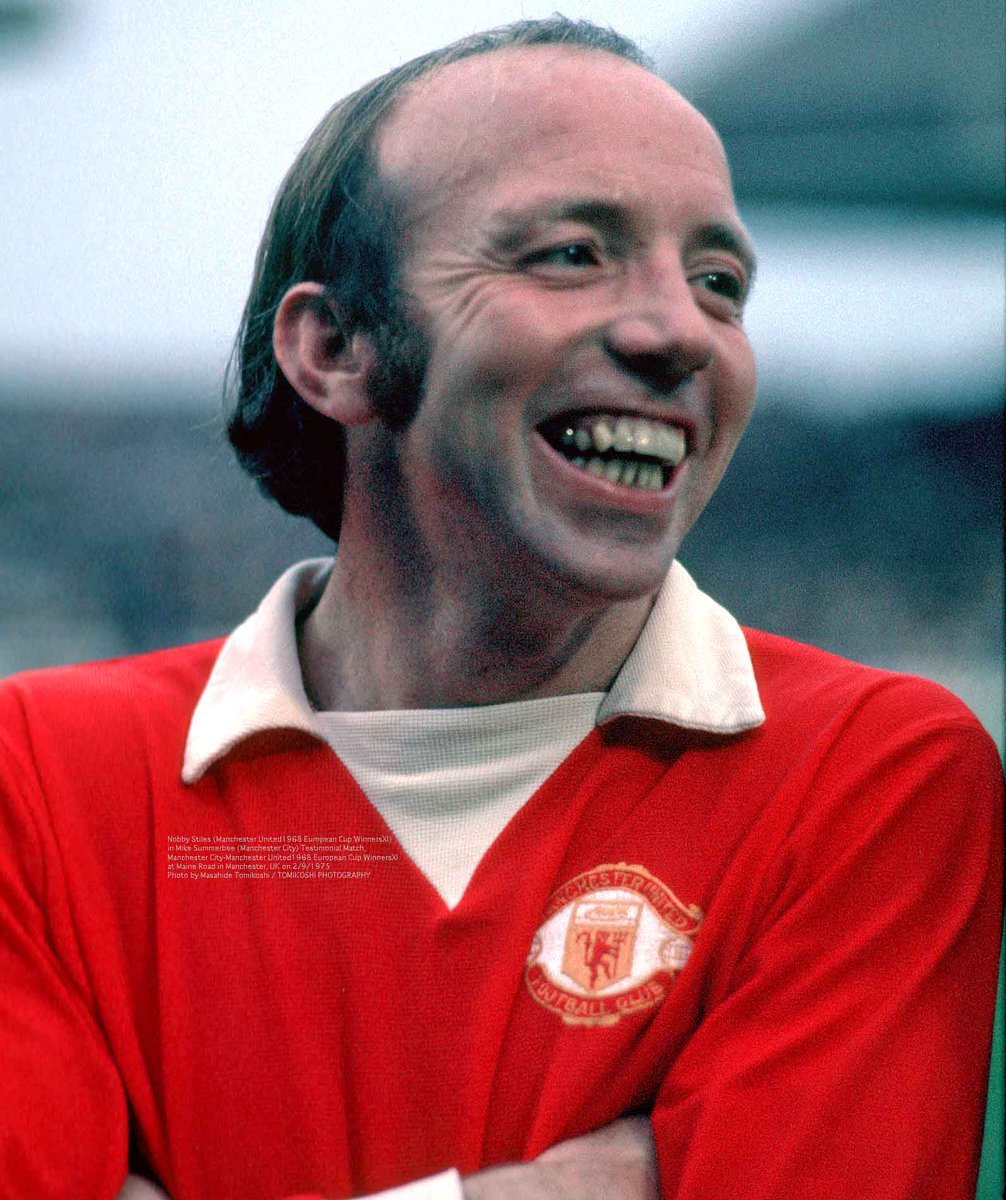
Nobby Stiles, 1942-2020

The 2020 march of death rolls on. Today, before the Premier League game between Arsenal and Manchester United, at United's Old Trafford, which Arsenal won 1-0, a moment of silence was held. Not just because it was United's last game before November 11, known as Veterans Day here but Remembrance Day over there, but because of the loss of one of United's greatest heroes.

Norbert Peter Stiles was born on May 18, 1942 in the Collyhurst section of Manchester, England, then part of Lancashire, but since 1974 a part of the Metropolitan County of Greater Manchester. He was born in the cellar of the family home, during a Nazi air raid on Manchester. "Nobby" supported Manchester United as a boy, and at age 15, he was selected as a midfielder for England Schoolboys. In 1959, United offered him an apprenticeship.

He was short, even by the standards of the time, he was already missing his front teeth, and he was already going bald, which led him -- and later his United teammate Bobby Charlton -- to try a combover hairstyle. All of this combined to give him a troll-like look, scaring some defenders. The dentures he wore in games didn't help, and may even have inspired part of the look of Mike Myers' character Austin Powers.

But Matt Busby, the United manager who was still rebuilding the team following the Munich Air Disaster of 1958, couldn't afford to turn such a talent away on looks. He gave Nobby his debut in 1960, and became a pioneer in what's now known as the "holding midfielder" position.

But Busby was never shy about dropping a player he felt wasn't performing. Struggling in the League in the 1963 season, United still made it to the FA Cup Final at the old Wembley Stadium. Busby dropped Stiles from the squad, and it worked: United beat Leicester City, 3-1.

Nobby got the message, and got it together, both professionally and personally. A month after the Final, he married Kay Giles, sister of his then-teammate Johnny Giles. The Irish midfielder was soon sold to Leeds United, where Don Revie was building a great team that included Charlton's brother Jack. Nobby and Kay had 3 children.

Nobby helped United win the Football League Division One title in 1965, alongside such luminaries as Charlton, Scottish striker Denis Law, Northern Irish winger George Best, English centreback Bill Foulkes, and English goalkeeper Alex Stepney. He was key: As Best put it, "Every team has a hard man. We had Nobby Stiles."

He was first selected for the England national team on April 10, 1965, alongside the Charlton brothers, in a 2-2 draw with a Scotland team that included Law. This got the attention of manager Alf Ramsey, and he saw Stiles as, in his words, a spoiler. On February 23, 1966, Stiles scored the only goal of the game in an international friendly against West Germany at Wembley. Thinking it a sign of things to come, Ramsey selected him for the side in the upcoming World Cup on home soil.

In spite of a bad tackle against France midfielder Jacques Simon in the Group Stage, leading to calls for his drop, Ramsey stuck by Stiles, and he played every minute of every game England played in the tournament. In the Semifinal against Portugal, he guarded Eusébio, who was shaping up to be the hero of the tournament, limiting him to only a late penalty that he took, but he was not the player who won it.

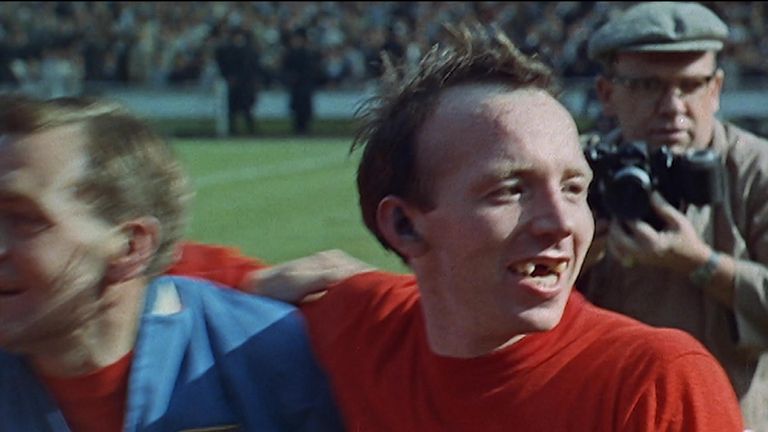
England went on to beat West Germany in extra time in the Final, 4-2. When it was over, and the Jules Rimet Trophy was passed around, Nobby danced a jig with it, creating an iconic moment. Nobby and the other 21 players on the England team were national, and international, heroes.
*

United won the League again in 1967, qualifying them for the European Cup. In 1956-57, Busby's young team, known as the Busby Babes, reached the Semifinal, before losing to Real Madrid. In 1957-58, they had just eliminated Red Star Belgrade in the Quarterfinal, when they made a refueling stop in Munich, and, upon takeoff, their plane crashed, killing 8 players and ending the careers of 2 others. Following Busby's rebuild, they got back into the tournament in 1965-66, and got to the Semifinals, but lost to Partizan Belgrade, Red Star's arch-rivals.

In 1967, Celtic of Glasgow, Scotland became the 1st British team to win the tournament. In 1967-68, United were looking to become the 1st English team to do it, especially since the Final was set to be at Wembley. In the 1st Round, they beat Hibernians, champions of Malta. In the 2nd Round, they beat the defending champions of Yugoslavia, FK Sarajevo. In the Quarterfinals, they beat the champions of Poland, Górnik Zabrze.

In the Semifinal, they played Real Madrid, already 6-time winners of the European Cup, and the team that ended United fans' dream in 1957. United won 1-0 in the 1st leg at Old Trafford. In the 2nd leg, at Estadio Santiago Bernabéu in Madrid, Real were 3-1 up, thus 3-2 up on aggregate, and looked like they were going to the Final. But goals by John Sadler in the 73rd minute and Foulkes in the 78th made it 3-3 in the game and 4-3 to United on aggregate. They were in the Final.

Their opponents were Benfica of Lisbon, Portugal, featuring Eusébio. They had won the tournament in 1961 and 1962, and lost in the Final 1963 and 1965. Again, Stiles managed to shut "The Black Panther" down. Bobby Charlton scored in the 53rd minute, but Jaime Graça equalized, and sent the game to extra time. At the start of extra time, United struck quickly: Best scored in the 92nd, and Brian Kidd, filling in for the injured Law, tallied in the 94th. That would be it: Manchester United won 4-1, and were the 1st English team to officially be Champions of Europe. 

Time was marching on, though: Ramsey selected Stiles for the England team at Euro 1968, but instead made Alan Mullery of North London team Tottenham Hotspur his holding midfielder. This was one of the first in a series of bad guesses that made England fans wonder how Ramsey made so many good guesses through the 1966 World Cup Final. England lost to Yugoslavia in the Semifinal.

Ramsey again selected Stiles for the 1970 World Cup, but again as backup to Mullery. He didn't play in a single game, and England went out in the Quarterfinal to West Germany. Stiles never played for England again, and his 28 caps turned out to be the fewest selections for England among the 1966 team.

In 1971, United sold him to North Yorkshire team Middlesbrough. In 1973, Bobby Charlton retired, took the manager's job at Lancashire team Preston North End, and made Stiles a player-coach. In 1975 Charlton resigned when a player was sold without his say-so, and Stiles was named caretaker manager. He lasted a week before he decided he didn't want to work with people that Charlton couldn't work with. Things must have been worked out, because he returned to manage them from 1977 to 1981.

In 1981, he came to the North American Soccer League, and led the original version of the Vancouver Whitecaps until 1984, winning a Division title that season, and reaching the Semifinals of the Playoffs. But the League folded thereafter. He managed West Midlands team West Bromwich Albion, but was unsuccessful.

In 1989, he returned to Manchester United as youth team coach, working for manager Alex Ferguson, and guiding some of the players known as "Fergie's Fledglings": David Beckham, Ryan Giggs, Paul Scholes, Nicky Butt, and the brothers Gary and Phil Neville. These English boys would become the backbone of a team that led United to many trophies in the years to come. (Presuming you think they were won fairly. I'm not saying Stiles had anything to do with them not being won fairly.)

In 1968, after the European Cup win, he released a memoir, Soccer My Battlefield. In 2003, he released another, After the Ball.

His health began to fail. He auctioned off his winners' medals. In 2013, he was diagnosed with prostate cancer. In 2016, he was diagnosed with dementia, making him one of many of the English players of the 1960s whose headings of the much-heavier leather balls of the time gave them brain injuries.

These would include his 1966 World Cup teammates Jack Charlton, Ray Wilson and Martin Peters; his 1970 teammate Jeff Astle of West Bromwich Albion; and Gerd Müller of the West Germany team that eliminated them in 1970. (Müller was not on the '66 team that lost the Final to England.) Not long ago, Bobby Charlton was diagnosed with it as well.

Nobby Stiles died this past Friday, October 30, 2020, from the combined effects of cancer and dementia. He was 78.

* Manchester United's official Twitter feed: "Nobby was a titan of the club’s history, cherished for his heart and personality on and off the pitch. He will be sorely missed by us all."

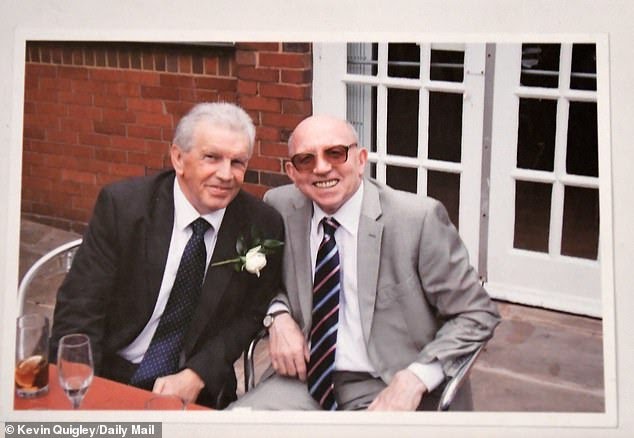
* Johnny Giles, United teammate and brother-in-law: "What a great lad. Honestly, the best. My sister married a good ‘un, and how he loved her."
Johnny Giles and Nobby Stiles

* Bobby Charlton: "I've had the privilege to have been in their company many times. The two of them are greats. I wish Bobby well and my thoughts also go out to Nobby's family. We're all saddened by that news."

With Nobby's death, there are now:

* 5 players from Manchester United's 1965 Football League Champions: Bobby Charlton, Denis Law, Pat Crerand, John Aston and Willie Anderson.

* 6 players from their 1967 Football League Champions: Charlton, Law, Crerand, Aston, Anderson and Alex Stepney.

* 6 players from their 1968 European Cup winners: Charlton, Crerand, Aston, Stepney, Brian Kidd and David Sadler. Law was injured, and did not play.

* And 4 players from the England team that won the 1966 World Cup: Bobby Charlton, George Cohen, Geoff Hurst and Roger Hunt. Jimmy Greaves, Ron Flowers, Terry Paine, Ian Callaghan and George Eastham are still alive, but did not play in the Final.

Saturday, April 18, 2020

Norman Hunter, 1943-2020

The ranks of the World Cup heroes of 1966 continue to shrink. The heavy balls of the time didn't help. The Coronavirus doesn't, either.

Norman Hunter (no middle name) was born on November 29, 1943 in Gateshead, across the River Tyne from Newcastle, in the North-East of England. He was being trained as an electrical fitter when Yorkshire soccer team Leeds United signed him at the age of 15.

Manager Don Revie gave him his first team debut in 1962, pairing him at centreback with Jack Charlton. Together with goalkeeper Gary Sprake, fellow defender Paul Reaney, midfielders Bobby Collins, Billy Bremner and Albert Johanneson. Leeds won promotion to the Football League Division One in 1964, and the following year, finished 2nd, and reached the FA Cup Final.

This was the start of a stretch that would see Leeds nicknamed the "Nearly Men," as they nearly won so much. While they did win the League title in 1969 and 1974, the FA Cup in 1972, the League Cup in 1968, and the Inter-Cities Fairs Cup (the tournament now known as the UEFA Europa League) in 1968 and 1971, they had several near-misses.

They finished 2nd in the League in 1965, '66, '70, '71 and '72. They lost the FA Cup Final in 1965, '70 and '73. They lost the Fairs Cup Final in 1967, the European Cup Winners' Cup Final in 1973, and the European Cup (the tournament now known as the UEFA Champions League) in 1975. So their record in cup finals was 4-6.

What's more, Revie let his players break the rules, to the point where they became universally known as "Dirty Leeds," a name which persisted long after all the players involved had retired. Essentially, Leeds then were like Manchester United became in the 1990s: Anybody who didn't love them hated their guts.

Bremner was known for being among the earliest players in the English league to "dive" in the penalty area, in the hope of fooling the referee into thinking he had been knocked down, to award Leeds a penalty kick.

Bremner, Giles, Charlton and Paul Madeley were known for rough play. And Hunter was a beast. Legend has it that he once broke his leg in training, and when a teammate told the trainer, "Norman's broken a leg," the trainer said, "Whose?"

Before the 1972 FA Cup Final against North London team Arsenal, at the original Wembley Stadium in London, a Leeds fan unfurled a banner that read NORMAN BITES YER LEGS. He was known as "Norman Bites Yer Legs Hunter" from then onward.
But he wasn't totally without class. Leeds won that Final, 1-0, on a diving header (unlike Bremner's dives, a legal play) by Allan Clarke. Mick Jones (no relation to either the Foreigner guitarist or the Clash guitarist with that name) had injured his elbow, and was getting treatment when his teammates walked up the famed 39 steps to the royal box at the old Wembley to receive their winner's medals. So Hunter went back down, and helped Jones walk up the steps to receive his medal.

Revie was English, but he wasn't myopic. He had no qualms about looking across borders and seas for talent. Sprake and Terry Yorath were Welsh. Collins, Bremner, Peter Lorimer, Jim Storrie, Willie Bell, Joe Jordan, Gordon McQueen, brothers Eddie and Frank Gray, and David Harvey, Sprake's replacement in goal, were Scottish. Giles was Irish. and Johanneson was from South Africa, one of the earliest black players to make a mark in England's Football League.

*

But Hunter was English. Alf Ramsey, manager of the England national team, gave him his debut in 1965, as a substitute for Joe Baker against Spain in Madrid, and he helped England win 2-0. But with his usual Leeds defense partner Jack Charlton usually paired up with West Ham United captain Bobby Moore, Hunter rarely saw action for the Three Lions.

He was named to the squad for the 1966 World Cup, on home soil, but didn't get to play, as Moore and Charlton played every minute of every game, including the Final, which went to extra time as England beat West Germany. Bobby Charlton, Jack's brother, who played his club football for Manchester United, was the team's leading scorer.

Originally, only the players who played in the Final got winner's medals. It took until a 2009 ceremony, at the Prime Minister's official residence at 10 Downing Street in London, for the reserves, including Hunter, to get medals. FIFA, the governing body for world soccer, later changed the rules, so that every player got one, and retroactively awarded medals to surviving reserves, and to the families of those who had died.

Hunter would eventually play for the England senior team 28 times. In 1968, he scored the winning goal against Spain to qualify England for the European Championship tournament, and started in the Semifinal, which England lost 1-0 to Yugoslavia.
Ramsey named him to the squad for the 1970 World Cup, but his only appearance was as a late substitute in the Quarterfinal loss to West Germany. And it was his mistake that led to Poland's goal to forge a 1-1 draw, and prevent England from qualifying for the 1974 World Cup, leading to Ramsey's firing.

*

In Leeds' 1973-74 League title-winning season, they began with a 29-match unbeaten run, a mark that stood until the Arsenal "Invincibles" 30 years later. Hunter was named the Professional Footballers' Association's Player of the Year.

This title qualified Leeds for the 1974-75 European Cup. This turned out to be the only thing they could contend for, since Don Revie had been hired to replace Ramsey as the England manager. Leeds hired Brian Clough, who had managed Derby County to the title in 1972, but had long held a grudge against Revie for a perceived slight and for Leeds' dirty play. But he was determined that, together, they could win the European Cup, something that each had gotten to the Semifinal of without the other, but no further.

The opening match of the season was the Charity Shield, now known as the Community Shield. Every year, at Wembley, the holders of the League title and the FA Cup play each other. The 1974 edition was brutal, and Leeds' Bremner and Liverpool's Kevin Keegan got into a fight, and both got sent off. Both took their shirts off and threw them into the crowd, earning each of them fines and 11-game suspensions, among the longest in the League's history. The game ended 1-1, and Liverpool won it on penalties.

Without Bremner, by then the Captain, Leeds were in deep trouble. Clough reminded Bremner of this, telling him he was the 1st Englishman ever sent off in the Charity Shield. Bremner, who had just captained Scotland in the World Cup (which England didn't even qualify for), reminded Clough, "I'm not fookin' English!"

As we would say today, Clough lost the dressing room early. With Bremner still suspended, and Leeds languishing in the middle of the League table, Clough was fired after just 44 days in charge. Jimmy Armfield, a former star at Lancashire team Blackpool, and 1966 World Cup teammate of Hunter's, now managing Manchester-area team Bolton Wanderers, was hired, and got them off the deck. They finished 9th, but only 8 points off the lead (at a time when a win was 2 points, instead of the current 3), and just 5 points out of qualifying for the next season's UEFA Cup (Europa League).

They got to the Quarterfinal of the FA Cup before losing to Ipswich Town. In the European Cup, they beat FC Zürich of Switzerland, Újpest of Hungary, Anderlecht of Belgium and Barcelona of Spain, to reach the Final, at the Parc des Princes in Paris, against Bayern Munich. Leeds fans brought a banner to the stadium, with "Norman Bites Yer Legs" in English for themselves, German for the opposition, and French for the hosts.
The banner, translated

Bayern were defending champions, so this was no easy task. Twice, Leeds thought they had earned penalties, but were denied by the referee. The game remained scoreless into the 62nd minute, when Lorimer put the ball in the net for Leeds. But the goal was waved off, as Bremner was offside. Leeds fans were outraged, and, despite their team having already knocked 2 Bayern players out of the game with injuries, Bayern went on to win 2-0.

To this day, Leeds fans insist that they were the cheated, not the cheaters. They have some sympathy, as, in spite of their "dirty" image and the fact that half the team wasn't English, they were representing England abroad, and Bayern, too, had a reputation for cheating (and still do). In addition to their more familiar theme song, "Marching On Together," Leeds fans sing, "We are champions, champions of Europe!"

They're not. Their players did purposely injure 2 of Bayern's. Neither penalty shout was justified. And Bremner was offside. And both Bayern goals were legitimate. Bayern won fair and square, which doesn't happen as often as it should. (In Germany, they speak of Der Bayern Dusel: "The Bavarian Luck.")

That Final was the last gasp for the team that Don Revie built. Leeds went into a long decline. In 1976, Hunter signed for Bristol City of Gloucestershire, and ended his career as player-manager at Barnsley in Yorkshire from 1980 to 1982.

He continued managing at Barnsley until 1984, and got them promoted from the 3rd to the 2nd division. He later managed at Yorkshire team Rotherham United, and assisted his former Leeds teammates Yorath at another Yorkshire team, Bradford City, and Giles at Birmingham-area team West Bromwich Albion.

Starting in 1993, he worked at BBC Radio Leeds and Yorkshire Radio, as a studio pundit for Leeds matches. Leeds honored him with "The Norman Hunter Suite," a luxury box in the West Stand at their stadium Elland Road.

In 1998, the Football League included Hunter on its list of 100 Football League legends. Also included were Bremner and Giles; John Charles, who played for Leeds before they got there; and Eric Cantona, who played for Leeds after they left. In 2004, Hunter published a memoir, titled Biting Talk. He had been married since 1968 to Susan Harper, and they had a son Michael, and a daughter Claire.
A few days ago, he was stricken with COVID-19. Norman Hunter died yesterday, April 17, 2020, at the age of 76.

Leeds United have announced that the South Stand at Elland Road will be renamed the Norman Hunter Stand. The North Stand is named for Revie, the West Stand is named for Charles, and the East Stand is still available for naming. It could be named for Bremner, who died in 1997, and has a statue outside, but, as yet, is unnamed.

With Hunter's death, there are 8 living players from Leeds' 1969 Football League Champions: Paul Reaney, Terry Cooper, Jack Charlton, Allan Clarke, Mick Jones, Johnny Giles, Eddie Gray and Peter Lorimer. (UPDATE: Charlton died on July 10, 2020, dropping the number to 7.)

There are 9 living players from Leeds' 1972 FA Cup win: Reaney, Charlton, Lorimer, Clarke, Jones, Giles, Gray, David Harvey and Mick Bates. (UPDATE: Charlton's death leaves 8.)

There are 12 living players from Leeds' 1974 Football League Champions: Harvey, Reaney, Lorimer, Clarke, Giles, Gray, Jones, Bates, Trevor Cherry, Gordon McQueen, Joe Jordan and Duncan McKenzie.

(UPDATE: Cherry died on April 29, 2020, just 12 days after Hunter, at age 72. No cause was listed, but since there was no mention of COVID-19, we can't say that it was the cause. His death drops the number of surviving 1974 Leeds Champions to 11.)

And from England's 1966 World Cup winners, there are 11 players still alive. George Cohen, Nobby Stiles, Geoff Hurst, Roger Hunt, and Bobby and Jack Charlton played in the Final. Jimmy Greaves, Ron Flowers, Terry Paine, Ian Callaghan and George Eastham are still alive, but did not play in the Final. (UPDATE: Jack Charlton's death leaves 10.)

Wednesday, May 29, 2019

List of Arsenal Cup Finals, 1927-2019

Today, Arsenal lost the UEFA Europa League Final, in truly pathetic fashion. For importance of game, divided by performance, it may have been the worst game in the 123-year history of the team.

The team could have added to its long list of glories. They did not.

Arsenal Cup Finals

April 23, 1927, FA Cup Final, at the original Wembley Stadium, West London: Arsenal lose to Cardiff City of Wales, 1-0. In their 1st Cup Final, Arsenal are victimized by a freak play. Hughie Ferguson of Cardiff is stopped by Arsenal goalkeeper Dan Lewis, but the ball squeezes through his elbow and back into the net. This is the only time a team from outside England has won the FA Cup.

April 26, 1930, FA Cup Final, Wembley: Arsenal defeat Huddersfield Town of Yorkshire, 2-0. The goals are scored by Alex James and Jack Lambert -- no relation to the later legendary Pittsburgh Steeler linebacker. It is The Arsenal's 1st major trophy. They win their 1st Football League title the next season.

April 23, 1932, FA Cup Final, Wembley: Arsenal lose to Newcastle United of the North-East, 2-1. Bob John of Arsenal opens the scoring. Newcastle's 1st goal comes when Jimmy Richardson stopped an errant pass at the end line, or over it (thus it was out of bounds, and should have been a goal kick to Arsenal) as many people thought, and crosses it back to Jack Allen, who scores it, and later adds the winner.

This may have been the 1st time in a big game that Arsenal had been robbed by the officials. It would not be the last.

April 25, 1936, FA Cup Final, Wembley: Arsenal defeat Sheffield United of Yorkshire, 1-0. Ted Drake is the scorer.

May 4, 1941, Football League War Cup Final, Wembley: Arsenal and Preston North End of Lancashire play to a 1-1 draw. A replay is necessary.

May 31, 1941, Football League War Cup Final Replay, Ewood Park, Blackburn, Lancashire: Arsenal lose 2-1 to Preston.

May 15, 1943, Football League War Cup Final, Stamford Bridge, West London: Arsenal lose 4-2 to Blackpool of Lancashire.

April 29, 1950, FA Cup Final, Wembley: Arsenal defeat Merseyside club Liverpool, 2-0. Reg Lewis scores both goals.

May 3, 1952, FA Cup Final, Wembley: Arsenal lose 1-0 to Newcastle. Right back Walley Barnes twists his knee in the 35th minute, with the score still 0-0. No substitutes were allowed in English soccer until 1968, so The Arsenal were down to 10 men for the last 55 minutes of the game.

George Robledo, a Chilean playing in England, scores the goal. Arsenal would win the League the next season, but didn't play for a major trophy again for 15 years.

March 2, 1968, Football League Cup Final, Wembley: Arsenal lose 1-0 to Leeds United of Yorkshire. The League Cup began in 1960.

March 15, 1969 League Cup Final, Wembley: Arsenal lose 3-1 to Swindon Town of Wiltshire in extra time. The pitch (field) was a mess because of a previous event. Then, half the Arsenal team was stricken by the flu -- similar to the lasagne story at Tottenham in 2006, although not with sinister implications.

Then it rained. On the day before the game, the Arsenal players who felt well enough to get out of bed went to look at the pitch, and told the officials it was unplayable, and the game should be postponed. It wasn't. The officials screwing Arsenal over did not begin with Arsène Wenger becoming their manager, or even with the start of the Premier League in 1992.

Despite Swindon being a 3rd division team, they led Arsenal from the 35th minute until the 86th, when Bobby Gould scored. But the weakened players couldn't handle extra time on a bad pitch, and allowed 2 goals by Don Rogers, the 1st one on a defensive error by centreback Ian Ure, who would be abused by Arsenal fans for this mistake for the rest of his career.

This may still be the most disastrous loss in Arsenal history, ahead of the famous losses to Walsall in the 1933 FA Cup and the 1983 League Cup, and "The Wrexham Disaster" in the 1992 FA Cup.

April 22, 1970, Inter-Cities Fairs Cup Final, 1st Leg, Stade Constant Vanden Stock, Anderlecht, Belgium: Arsenal lose 3-1 to Anderlecht. Trailing 3-0 in the 82nd minute, Ray Kennedy scoring a goal giving them a lifeline -- or a "Ray of hope," as the newspapers called it. But Arsenal would have to win by at least 2 goals in the home leg to take this trophy -- 3 if Anderlecht got an away goal.

April 28, 1970, Inter-Cities Fairs Cup Final, 2nd Leg, Arsenal Stadium, Highbury, North London: Arsenal beat Anderlecht, 3-0. Eddie Kelly scored in the 25th minute, and then came John Radford in the 75th and Jon Sammels just 1 minute later. Thus, Arsenal won 4-3 on aggregate. Given the away goals rule, Sammels' goal was not necessary, but it was welcomed.

The Fairs Cup began in 1958. It was renamed the UEFA Cup for the 1971-72 season, and the UEFA Europa League for the 2010-11 season.

May 8, 1971, FA Cup Final, Wembley: Arsenal beat Liverpool 2-1. Regulation ended scoreless, and Steve Heighway gave Liverpool the lead in extra time. But Arsenal followed with goals by Eddie Kelly and the iconic blast and lie-on-the-ground celebration by Charlie George. Having already won the League, by beating Tottenham away 5 days earlier, Arsenal thus clinch "The Double."

May 6, 1972, FA Cup Final, Wembley: Arsenal lose to Leeds 1-0. The Centenary Cup Final had a pregame ceremony where many previous Cup Final heroes were introduced. But, having just missed another League title, Arsenal fall short of successfully defending the Cup, losing on a diving header by Allan Clarke.

Starting goalkeeper Bob Wilson was injured, and his replacement, Geoff Barnett, has been blamed for allowing the goal. This is unfair: I've seen the video many times, and it was a great shot. Wilson wouldn't have stopped it, either.

May 6, 1978, FA Cup Final, Wembley: Arsenal lose to Suffolk team Ipswich Town 1-0. Liam Brady is played even though injured, and Roger Osborne scores the only goal, in the 77th minute.

May 12, 1979, FA Cup Final, Wembley: Arsenal beat Manchester United 3-2. Brian Talbot and Frank Stapleton score in the 1st half, and Arsenal lead 2-0 late. But United score in the 86th and the 88th to tie it. Then Alan Sunderland scores in the 89th to win it. Brady assisted on all 3 Arsenal goals. It becomes known as "The Five-Minute Final."

May 10, 1980, FA Cup Final, Wembley: Arsenal lose to East London team West Ham United 1-0. Trevor Brooking scores early, and the Gunners can't equalize. The Hammers remain the last team from outside the top division to win the Cup -- and this remains their last major tropy.

May 14, 1980, European Cup Winners' Cup Final, Heysel Stadium, Brussels, Belgium: Arsenal play Spanish team Valencia to a 0-0 draw, then lose 5-4 on penalties. Brady is soon lured away by the money of Juventus. A year later, Stapleton is lured away by Manchester United.

In 1985, Heysel would host the European Cup Final, at which 39 fans were killed due to a wall collapse inside. The game was played anyway, and Juventus (with Brady already having been sold) beat Liverpool. I've talked to some Arsenal fans who were at the 1980 Final, and they said the stadium was already unsuitable for a major event then.

April 5, 1987, League Cup Final, Wembley: Arsenal beat Liverpool 2-1. There was a daunting statistic: Liverpool had never lost when Ian Rush scored, and, sure enough, he opened the scoring for the Scousers. It looked like Arsenal's bid for a 1st trophy in 8 years would end with a bit of a hangover from their dramatic Semifinal win over arch-rival Tottenham.

But Charlie Nicholas, one of the highest-profile, and thus most disappointing, acquisitions in Arsenal history, justified the team's 1983 faith in him by scoring twice, netting the winner in the 83rd minute.

April 24, 1988, League Cup Final, Wembley: Arsenal lost 3-2 to Luton Town of Bedfordshire. In one of their few seasons in the top division, Luton won their only major trophy, as a ghastly mistake by backup Arsenal centreback Gus Caesar gifted Danny Wilson an equalizer in the 82nd minute, and Mark Stein got the winner at the death.

As with Ian Ure in the League Cup Final 19 years earlier, Caesar was never forgiven by Arsenal fans. As with Ure, Arsenal would find some glory in the next few years -- in this case, the League title in 1989 and 1991 -- but he wouldn't be a part of it.

April 18, 1993, League Cup Final, Wembley: Arsenal beat Sheffield Wednesday of Yorkshire, 2-1. This was the 1st match in the history of European soccer in which players wore uniform numbers of their own choosing and their names on the back. Previously, numbers were assigned to positions, not players, and thus putting names on the back would have been cost-prohibitive.

John Harkes of Wednesday, a native of Kearny, Hudson County, New Jersey, becomes the 1st American to score a goal at Wembley, and gives the Owls the lead in the 8th minute. But Paul Merson equalizes in the 20th, and Steve Morrow wins it in the 68th.

Ironically, Morrow did not receive his winner's medal at the postgame ceremony. Arsenal Captain Tony Adams tried to pick him up and carry him off the pitch on his shoulders, but slipped, and Morrow landed on his arm and broke it. He was given his medal at the FA Cup Final the next month.

May 15, 1993, FA Cup Final, Wembley: Arsenal and Wednesday play to a 1-1 draw. By a weird turn of events, the only time this has ever happened, the opponents for the FA Cup Final are the same opponents as were in the League Cup Final. Arsenal take a 1-0 lead on an Iran Wright goal, but Wednesday find an equalizer. The game goes to a replay. It will be the last time: From the 1993-94 season onward, if the Final is still tied at the end of extra time, it will go to a penalty shootout.

May 20, 1993, FA Cup Final Replay, Wembley: Arsenal beat Wednesday 2-1. As he had in the 1st game, Ian Wright opens the scoring. Former Tottenham star Chris Waddle equalizes for Wednesday. Extra time is played, and just when it looks like there will be penalties, in the 119th minute, Arsenal take a corner, and rarely-used centreback Andy Linighan heads the ball into the net.

His partner in central defense was David O'Leary, making his 722nd and last appearance for The Arsenal, still a team record.

May 4, 1994, European Cup Winners' Cup Final, Parken Stadium, Copenhagen, Denmark: Arsenal beat Parma of Italy, 1-0. Given the presence in the Parma lineup of Gianfranco Zola, Faustino Aspirlla and Thomas Brolin, and the absence from the Arsenal lineup of Wright, suspended due to yellow card accumulation, Parma were solidly favored.

But a mistake in the 20th minute led to an Alan Smith goal, and "the famous back four" of right back Lee Dixon, centrebacks Tony Adams and Steve Bould, and left back Nigel Winterburn held on for the quintessential "One-nil to The Arsenal" victory. Along with the League title win over Liverpool in 1989, this is considered manager George Graham's masterstroke.

May 10, 1995, European Cup Winners' Cup Final, Parc des Princes, Paris: Arsenal lose 2-1 to Real Zaragoza of Spain. The worst Arsenal season in 19 years included a 12th-place finish, and Graham being fired, not for poor performance but for managerial improprieties. Arsenal were still in the CWC, due to being defending Champions. The game went to extra time, but Zaragoza's Turkish midfielder Mohamed Ali Amar, who went by the nom de soccer Nayim, lobbed the ball over Arsenal goalkeeper David Seaman in the last minute.

Nayim played 5 seasons for Tottenham. To this day, Tottenham fans sing Nayim's name, because his goal defeated and embarrassed Arsenal, even though the game in question had nothing to do with Tottenham.

May 16, 1998, FA Cup Final, Wembley: Arsenal beat Newcastle 2-0. Having already won the League, this clinches The Double. There would be no repeat of the upset wins of 1932 and 1952 for "The Toon," as Paul Merson in the 1st half and Nicolas Anelka in the 2nd dusted them.

This was Arsenal's 1st cup final under manager Arsène Wenger. Under him, Arsenal would play in 13 cup finals. Under all other managers combined: 24, not counting replays and 2-legged finals.

It would also be their last game at the old Wembley. The old stadium, which opened in April 1923, the same month as the original Yankee Stadium, was closed in 2000, demolished, replaced with a new one, and opened in time for the 2007 FA Cup Final.

May 17, 2000, UEFA Cup Final, Parken Stadium: Arsenal lose to Galatasaray of Istanbul, Turkey, 4-1 on penalties following a scoreless game. The Copenhagen stadium, site of the 1994 Cup Winners' Cup Final, would not be the site of a 2nd great Arsenal win on this occasion.

May 12, 2001, FA Cup Final, Principality Stadium, Cardiff, Wales (then named the Millennium Stadium): Arsenal lose to Liverpool, 2-1. With Wembley having been closed, this was now the biggest stadium in the United Kingdom, and thus, for the 1st time, the Final was held outside England, and wouldn't return until the new Wembley opened in 2007.

As with Arsenal against Newcastle, Liverpool found the 3rd time against Arsenal to be the charm. Liverpool committed some blatant handballs, but they weren't called. Still Freddie Ljungberg gave Arsenal the lead in the 72nd minute. But Michael Owen scored in the 83rd and the 88th, giving Liverpool the win.

May 4, 2002, FA Cup Final, Principality Stadium: Arsenal beat Chelsea of West London, 2-0. As with the year before, the game was scoreless well into the 2nd half. As with the year before, Arsenal broke the deadlock, this time with a screamer by Ray Parlour in the 70th minute. But unlike the year before, Arsenal managed to get a 2nd, by Ljungberg in the 80th, and that that iced it. Four days later, Arsenal beat Manchester United at Old Trafford, and won their 3rd Double.

May 17, 2003, FA Cup Final, Principality Stadium: Arsenal beat Southampton of Hampshire, 1-0. Robert Pires, who seemed to specialize in scoring against Southampton, did so again, in the 38th minute, and Arsenal held on.

May 21, 2005, FA Cup Final, Principality Stadium: Arsenal beat Manchester United, 5-4 on penalty kicks after a 0-0 draw. The season before, Man U had beaten Arsenal in the Semifinal before winning the Final and taking the Cup away. Earlier this season, they had cheated their way to ending Arsenal's 49-game League unbeaten streak.

This was a very rough game, as were most AFC-MUFC games, but Arsenal held on, and extended the game to penalties. Ruud van Nistelrooy and Lauren traded successful conversions, but Jens Lehmann stopped Paul Scholes, and that made the difference. Ljungberg scored for Arsenal. Both 3rd round shooters made theirs, Cristiano Ronaldo and Robin van Persie. So did both 4th round shooters, Wayne Rooney and Ashley Cole. Roy Keane made his in the 5th round, but Patrick Vieira, in his last act as an Arsenal player, made his, and Arsenal got the Cup back.

May 17, 2006, UEFA Champions League Final, Stade de France, Saint-Denis, outside Paris: Arsenal lose 2-1 to FC Barcelona. Arsenal's 1st game for the European Cup was ruined in the 18th minute, when goalkeeper Jens Lehmann was wrongly sent off for how he stopped Samuel Eto'o, making him the 1st player ever sent off in a European Cup/Champions League Final.

Then Wenger made a key mistake: He had to take an attacking player off, so that he could sent in backup keeper Manuel Almunia, but he chose Pires, instead of a younger, less-proven player like Cesc Fàbregas or Aleksandr Hleb.

Incredibly, Arsenal took the lead in the 37th minute, on a goal by a defender, no less, Sol Campbell. The 10 Gunners held the lead against the 12 Blaugrana until the 76th minute, when Eto'o scored a goal that was clearly offside. In the 80th, Juliano Belletti scored the winner.

This was probably the most crushing defeat in Arsenal's history, and it was the end of the era: Not only was it the final season for Highbury, but it was the final game in Arsenal's colors for Campbell (though he would briefly return in 2010), Pires, Cole and Dennis Bergkamp. Henry remained for 1 more year.

February 25, 2007, League Cup Final, Principality Stadium: Arsenal lose 2-1 to Chelsea. As was his habit, Wenger started mostly kids in a League Cup match: The only players in his starting XI who were in his usual XI were Fàbregas and Kolo Touré. In contrast, Chelsea manager Jose Mourinho had all of his usual starters at the start.

It almost worked: Theo Walcott scored in the 12th minute. But Didier Drogba, the diving master from the Ivory Coast, equalized in the 20th. In the 63rd, Abou Diaby went for the ball, and accidentally kicked Chelsea captain John Terry in the jaw. As Terry is one of the most execrable people in the sport in the last 20 years, this earned Diaby goodwill that his performance never did. Drogba scored the winner in the 84th.

February 27, 2011, League Cup Final, new Wembley Stadium, London: Arsenal lose 2-1 to Birmingham City. It wasn't Arsenal's 1st visit to the new Wembley: That was the 2009 FA Cup Semifinal, a 2-1 loss to Chelsea.

For once, Wenger went against his kids-in-the-League-Cup policy, and went for it. Like everyone else, he had heard the whine of "Arsenal haven't won a trophy in X years" reach 6, and he wanted it.

But Fàbregas was unavailable due to injury, and Arsenal really could have used him. Birmingham City, known for being a dirty team -- their Martin Taylor had infamously broken Diaby's leg in 2006 -- were terrible, and would be relegated at the end of the season. Even a half-strength Arsenal team should have handled them.

But Nikola Zigic scored for the Brummies in the 28th. van Persie scored in the 39th, and it remained 1-1 until the 89th, when Zigic shot, and, in attempt to block it, goalkeeper Wojciech Szczęsny
collided with centreback Laurent Koscielny, allowing a loose ball that Obafemi Martins fired into the net.

It was probably the most humiliating Arsenal loss since the 1969 edition of the event, against Swindon Town. And it was the beginning of the idiotic #WengerOut movement.

May 17, 2014, FA Cup Final, Wembley: Arsenal beat Hull City of Yorkshire, 3-2 in extra time. The trophy drought had reached 9 years. And when Hull scored 2 goals in the 1st 8 minutes, it looked as if it would be extended to a 10th season, and perhaps be the end of the line for Wenger.

But Santi Cazorla scored in the 17th. A long lull followed, including halftime. Koscielny scored in the 71st to tie it. It went to extra time, and, in the 109th minute, off a cheeky backheel by Olivier Giroud, Aaron Ramsey scored. He copied Charlie George's 1971 celebration, sliding on the (new) Wembley turf and lying on his back.

The last 12 minutes of the game were agony for Arsenal fans, especially those of us in America who had joined, thanks to the growth of satellite TV, since the last trophy, and had never won one with the team. When it was over, there was so much joy and relief. And yet, Wenger looked happier than any of us.

May 30, 2015, FA Cup Final, Wembley: Arsenal beat Aston Villa of Birmingham, 4-0. I watched this game at Mulligan's in Hoboken, New Jersey, just across the Hudson River from Manhattan. There, the TV screens are on the ground floor and the bathroom is in the basement. I was trying to hold it until halftime, but I couldn't make it. I was finishing up, washing my hands, in the 40th minute, when a huge roar went up. Since there were about 100 Arsenal fans in the place, and only 6 people wearing Villa colors, I knew it was an Arsenal goal.

As I got up the stairs, I yelled, "Who scored it?" The answer came back: "Walcott!" Perfect: The previous season, in the 3rd Round game against Tottenham, Theo Walcott had scored, but had also gotten injured, and missed the rest of the season. That injury cost Arsenal dearly in the League, but not in the Cup. Still, he missed it. Watching the halftime highlights, I saw the goal, and the look of elation on his face. It was easy to see just how much this meant to him.

The 2nd half started a little nervy. It looked like "a movie I'd seen before": An Arsenal player (sometimes Walcott) would score in the 1st half, and they'd hang on for dear life before allowing an equalizer. Not this time: Alex Sanchez scored a beauty in the 50th, Captain and centreback Per Mertesacker scored in the 62nd, and Giroud finished it off in the 90th.

The pressure was off -- but then, having won it the season before, there wasn't as much pressure anyway. This win was nice, and I'm glad Arsenal got it. But it would never mean as much to me as the one before did. It sure meant a lot to Theo, though.

May 27, 2017, FA Cup Final, Wembley: Arsenal beat Chelsea, 2-1. Chelsea had been a "bogey team" for Arsenal since the 2004 Champions League Quarterfinal: It seemed, the bigger the game, the better Chelsea was, and the less effectiveness Arsenal had. Not this time: Alexis scored in the 4th minute to settle our nerves early.

But, again, it seemed like one of those hang-on-for-dear-life games. Sure enough, in the 76th minute, Diego Costa, who had succeeded Drogba as Chelsea's Master of Cheating, equalized. It looked like a game of "Name Your Poison": Would you rather lose in regulation, in extra time, or on penalties?

What do we say to the God of Defeat? Aaron Ramsey, once again, said, "Not today." As in 2014, he took a Giroud pass and put it into the net, this time a header in the 79th. Chelsea were completely deflated, and it was 3 FA Cups in 4 years.

February 25, 2018, League Cup Final, Wembley: Arsenal lose 3-0 to Manchester City. Every previous Arsenal cup final defeat had been by 1 goal or on penalties. Sergio Aguero scored in the 18th, but it was still only 1-0 as the hour mark approached, so there was hope. But Vincent Kompany scored in the 58th, and that was it. David Silva's goal in the 65th was just a cherry on their sundae.

May 29, 2019, UEFA Europa League Final, Bakı Olimpiya Stadionu, Baku, Azerbaijan: Arsenal lose 4-1 to Chelsea. In spite of having an obvious penalty denied early on, Arsenal were the better team in the 1st 35 minutes, but began to break down.

New manager Unai Emery needed to straighten them out at halftime. He didn't: Former Arsenal forward Olivier Giroud scored in the 49th, and it was all downhill from there. Alex Iwobi scored in the 69th to make it 3-1 and give some hope to those Gooners who somehow made it to Baku against long odds, but it wasn't going to happen.

Overall: Won 17, lost 21, drawn 1. 2-6 in European Finals, 15-15-1 in domestic ones.