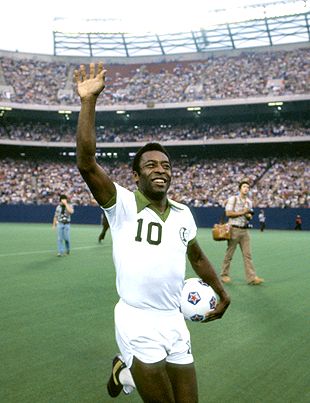
of the 1978 Yankee Yearbook.
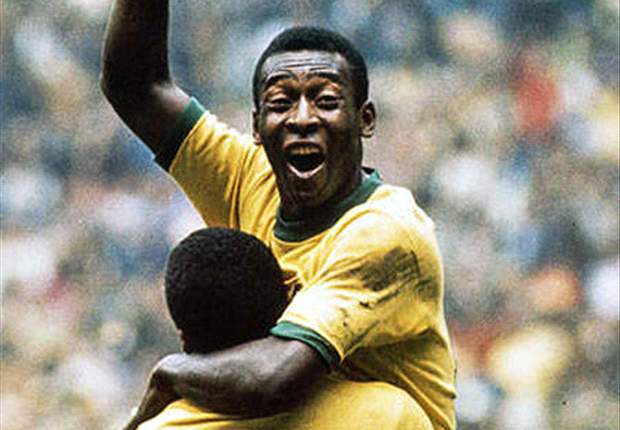
Edson Arantes do Nascimento is born in Três Corações (Three Hearts), Minas Gerais, Brazil. The most famous native of his country, we know him as
. If he is not the greatest soccer player who ever lived, he is certainly the most celebrated.
He played his final 3 seasons in America, with the New York Cosmos, playing home games at Downing Stadium on Randall’s Island in 1975, Yankee Stadium in The Bronx in 1976, and Giants Stadium in the Meadowlands of East Rutherford, New Jersey in 1977, leading them to the NASL Championship that season.
When he got the entire stadium to "Say it with me, three times: Love! Love! Love!" prior to his testimonial match on October 1, 1977 -- playing the 1st half for the Cosmos, and the 2nd half for Santos -- heavyweight boxing champion Muhammad Ali, who liked to call himself "The Greatest" and generally refused to take a back seat to anyone, said, "Now I understand: He
greater than me." President Jimmy Carter, on his 53rd birthday, was also on hand.
These kids today who say that Lionel Messi is the best player ever? They don't know. These kids today who say Cristiano Ronaldo is the best player ever? He's not even the best Ronaldo to have played for Real Madrid in the 21st Century. They don't know: Pelé is the greatest. It's why the Brazilians call him O Rei: The King.
In a rematch at Elysian Fields in Hoboken, New Jersey‚ the New York Club (a.k.a. the New York Nine) again beats Brooklyn‚ this time 39-17. The
publishes a box score of the game showing 12 outs for each side during the game‚ 8 players on each‚ and 3 umpires.
Neither of these clubs leave any records behind, but it is likely that this game is not considered a "New York game," as would be defined over the next few months by the Knickerbocker club.
October 23, 1869: John William Heisman is born in Cleveland. He coached several college football teams, his tenure at Georgia Tech being the best-remembered. Upon his death in 1936, the national player of the year trophy first awarded the year before was named the Heisman Memorial Trophy in his memory.
October 23, 1876: The
Chicago Tribune publishes season-ending batting percentages, based on the new method of dividing number of at-bats into number of hits. This differs from batting average in cricket, which is the number of runs a player has scored divided by the number of times he has been put ou.
Roscoe "Ross" Barnes of the Chicago White Stockings leads with a .429 average‚ thanks in part to the fair-foul rule. The following season‚ the rule is changed so that a ball hit in fair territory and rolls foul before passing 1st or 3rd base is a foul ball.
October 23, 1886: The American Association Champion St. Louis Browns win the World Championship by beating the National League Champion Chicago White Stockings, 4-3 in 10 innings. This is the beginning of the rivalry between the teams now known as the St. Louis Cardinals and the Chicago Cubs, often (but hardly universally) considered the greatest in the National League.
Pitching his 4th game in 6 days‚ John Clarkson holds St. Louis hitless for 6 innings as Chicago builds a 3-0 lead. The Browns tie the game in the 8th‚ and Curt Welch scores "the $15‚000 run" on a wild pitch by Clarkson in the 10th. St. Louis wins the entire gate receipts from the series ($13‚920)‚ with each of 12 players getting about $580 -- about $12,000 in today's money.
Walter Arlington Latham, a.k.a. Arlie or "The Freshest Man On Earth," was the last survivor of the 1886 St. Louis Browns, living until 1952.
October 23, 1894: Raymond Bloom Bressler is born in Coder, Pennsylvania. “Rube” Bressler was a pitcher-turned-outfielder, and a member of the Cincinnati Reds team that won the 1919 World Series. He had a .301 lifetime batting average and batted over .300 5 times.
Like his teammate, future Hall-of-Famer Edd Roush, he was interviewed by Lawrence S. Ritter for his book
The Glory of Their Times. And, like Roush, he insisted that the Reds would have won that Series even if the White Sox hadn’t thrown it. He died in 1966, a few weeks after the book was published.
*
October 23, 1905, 110 years ago: Gertrude Caroline Ederle is born in Manhattan (although many reference books had said 1906). In 1924, she was part of a U.S. women’s swimming relay team that won an Olympic Gold Medal in Paris. In 1925, she swam the 21 miles from the southern tip of Manhattan Island to New Jersey's Sandy Hook in just 7 hours. She was just getting warmed up.
On August 6, 1926, she not only became the 1st woman to swim the English Channel, but broke the existing men’s record for fastest swim of it, lowering it from 16½ to 14½ hours. Already hard of hearing, she eventually went deaf, and spent much of her life teaching deaf children to swim. She lived to be 98.
October 23, 1910: The Philadelphia Athletics win the World Series for the 1st time, defeating the Chicago Cubs. The Cubs finish a streak of 4 Pennants in 5 seasons, and the A’s have just begun an equal streak.
Mordecai "Three-Finger" Brown comes back to face Jack Coombs‚ who takes a 2-1 lead into the 7th. The A's get to Brown for 5 runs and a 7-2 win. The crowd of 27‚374 at Shibe Park is the largest in World Series history to this point. The A's .316 batting average is a World Series record.
For this Series‚ cork-center balls were secretly used for the first time‚ and will be used in the majors starting next year. Previously‚ rubber-center balls were used. And yet, it would be another 10 years before what we now call "The Lively Ball Era" began.
The A's already have 3rd baseman Frank Baker, shortstop Jack Barry and 2nd baseman Eddie Collins. But 1st baseman John "Stuffy" McInnis is still a year away from becoming a starter. When he does, those 4 will become known as "The $100,000 Infield." My, how quaint the figure now sounds -- about $2.4 million in today's money, combined, for those 4. Baker is also a year away from the achievement that will get him nicknamed "Home Run" Baker. Collins, Baker, pitcher Albert "Chief" Bender, and manager/part-owner Connie Mack will be elected to the Hall of Fame.
The last survivor of the Philadelphia A's teams that won the 1910, '11, '13 and '14 American League Pennants was center fielder Amos Strunk, who lived until 1979. The Phillies, discovering that he was the last living player who'd played at the first game at Shibe Park on April 12, 1909, invited him to attend the last game at what had been renamed Connie Mack Stadium on October 1, 1970. He angrily refused, even though he lived just outside Philadelphia in Drexel Hill, still angry with Mack after 60 years, and not willing to be associated with him in any way, even though Mack himself had been dead for 14 years.
October 23, 1915, 100: Dr. William Gilbert Grace dies of a heart attack. He was 67. I don’t know much about cricket, but the native of Bristol, in England's West County, played at the top level of the sport for a record 44 seasons, from 1865 to 1908, and was regarded as the game’s first modern batsman, and by many as its greatest player ever – which certainly suggests that he was the greatest of its early years.
Although he was a practicing physician, he was usually referred to publicly by his initials, “W.G. Grace,” rather than “Dr. Grace.”
October 23, 1923: A benefit game is played at the Polo Grounds for 2 founders of the New York Giants, now destitute: Original owner John B. Day, a tobacco magnate whose fortune was wiped out in the Players' League revolt of 1890; and original manager Jim Mutrie, the man who gave the team originally known as the New York Gothams their long-term name by calling his players, "My big boys, my giants,"
The Giants played the Baltimore Orioles of the International League, and win, 9-0. Day, already ill with cancer, died in 1925, age 77. Mutrie died in 1938, age 86.
October 23, 1925, 90 years ago: John William Carson is born in Corning, Iowa. Or, as Ed McMahon would later say, "And now, ladies and gentlemen, heeeeeeeeeeeeeeeere's Johnny!"
Host of
The Tonight Show from 1962 to 1992, Johnny Carson made his share of sports jokes. For example: "Well, it's fall again, and now, we here in Los Angeles can forget about the Dodgers, and concentrate on forgetting the Rams."
Every year, around Christmastime, Johnny would break out the ideal toy: Dickie the Stick! Dickie the Stick was a very versatile toy. One time, Johnny demonstrated that, "With Dickie the Stick, you can hit a baseball like Reggie Jackson! Or scratch like Pete Rose!"
Also on this day, Frederick Alexander Shero is born in Winnipeg, Manitoba. "Freddie the Fog" played 145 games as a defenseman for the New York Rangers between 1947 and 1950, but is much better known as a coach. He led the Philadelphia Flyers to the 1974 and 1975 Stanley Cups – the only ones that franchise has ever won. He also coached the Rangers to the 1979 Stanley Cup Finals, their only trip there between 1972 and 1994.
His philosophy of hockey was simple: "Take the shortest route to the puck, and arrive in ill humor." Before the clinching Game 6 on May 19, 1974, he told his Flyer players, "We will win together now, and we will walk together forever." He was right. When the Flyers were building their new arena in 1995 and '96, they named their "buy a brick" program "Walk Together Forever."
He did not live to see the replacement for The Spectrum, dying in 1990. His son, Ray Shero, was general manager of the Pittsburgh Penguins when they won the 2009 Stanley Cup, and is now GM of the Devils.
*
October 23, 1931: The Brooklyn Baseball Club of the National League announces that Wilbert Robinson has been fired as manager, and the club will be called the Robins only in the past tense. Max Carey‚ a no-nonsense sort who had been a star outfielder for the Pittsburgh Pirates‚ will take over next year. The team reverts to its previous name: The Brooklyn Dodgers.
Robinson was not yet done, though. He was named the president of the Atlanta Crackers of the Southern Association, and held that post until his death. He had been involved in professional baseball in one form or another in 50 seasons. And, not long before both men died in 1934, he made peace with his arch-rival, former friend and teammate, John McGraw.
Also on this day, James Paul David Bunning is born in Southgate, Kentucky, outside Cincinnati. He is one of the few pitchers to win at least 100 games in both Leagues, and one of the few to pitch no-hitters in both Leagues, including a perfect game against the Mets at Shea Stadium in 1964. It was on Father’s Day, and he had 6 children. He would go on to have 9.
He served his native Kentucky in both houses of Congress, but in the last few years, the very conservative Republican was one of the Senate’s nuttier voices. Then again, pitching for the Phillies prior to 2007 (except for 1980) could do that to you. He is, however, a member of the Baseball Hall of Fame, and the Phillies have retired his Number 14.
October 23, 1935, 80 years ago: Juan Antonio Rodríguez is born in Rio Piedras, Puerto Rico. Known as Chi-Chi
Rodríguez, he never won a major, but he won 8 PGA tournaments, and was popular for sinking a putt and then slashing with his golf club like it was a sword.
On the sitcom WKRP in Cincinnati, newsman Les Nessman (played by Richard Sanders) would mispronounce his name: Instead of the correct, "Chee Chee Rod-REE-gez," he'd pronounce it, "Chigh Chigh ROD-rih-GUEZ."
October 23, 1938: Alan John Gilzean is born in Coupar Angus, Scotland. The striker won the 1962 Scottish League title with Dundee. With North London club Totenham Hotspur, he won the FA Cup in 1967, the League Cup in 1971 and 1973, and the UEFA Cup in 1972.
October 23, 1939: Zane Grey dies of heart failure in Altadena, California. He was 67. He had played minor-league baseball, and once he failed at that, he became a sportswriter. Eventually, he became a writer of Western novels, including
Last of the Plainsmen, and was a favorite of another frustrated athlete, President Dwight D. Eisenhower. On
M*A*S*H, Colonel Sherman T. Potter (played by Harry Morgan) was also a big fan of Grey's novels.
*
October 23, 1945, 70 years ago: Brooklyn Dodger president Branch Rickey announces the signing of Jackie Robinson by the Dodger organization. Robinson signs a contract for 1946 for the Dodgers’ top farm team, the Montreal Royals of the International League.
Rickey also signs Negro League pitcher Johnny Wright on this day. But after playing with Montreal in 1946 -- as much to be a roommate and companion for Robinson as for any talent he might have had -- Rickey realized (as did Robinson) that, unlike Robinson, Wright did not have the temperament to make it in white pro ball.
He returned to the Negro Leagues with the Homestead Grays for 1947, retired after the 1948 season, worked in a gypsum plant, and died in 1990, at the age of 73.
October 23, 1947: Kazimierz Deyna is born in Starogard Gdański, Poland. An attacking midfielder, he starred for his country's greatest soccer club, Legia Warsaw, winning the national league, the Ekstraklasa, in 1969 and 1970, and getting them to the Semifinal of the European Cup in 1970, the best performance any Polish club has had in the tournament now named the UEFA Champions League.
He also played on the Poland team that reached 3rd Place at the 1974 World Cup, the nation's best performance in that competition. He also played for Poland in the 1978 World Cup, and later played in England for Manchester City, and in America with the San Diego Sockers. He was killed in a car crash in San Diego in 1989. He was only 41. Legia retired his Number 10, and he was voted Poland's greatest player ever.
October 23, 1955, 60 years ago: Estadio Quisqueya opens in Santo Domingo. Seating 11,379, it is the national stadium of the Dominican Republic. It is home to their national soccer team, and to 2 teams in the Dominican Winter Baseball League.
Leones del Escogido (Lions) have won 17 Pennants and 4 Caribbean Series, all but the 1st Pennant since moving into Estadio Quisqueya. Tigers del Licey (Tigers) have won a League-record 24 Pennants and 10 Caribbean Series, all but the 1st 4 Pennants since moving in.
October 23, 1957: Martin Luther King III is born in Montgomery, Alabama. In January 2011, it was reported that he was part of a group looking to buy the Mets from the Wilpon family. He denied it, saying his group was only trying to increase diversity in baseball management.
Since the Mets have now won a Pennant, it's difficult to say they would have been better off being run by this group. Besides, until this season, he'd have been talking less about his father's dream and more about his own nightmare!
*
October 23, 1961: Andoni Zubizarreta Urreta is born in Vitoria-Gasteiz, Spain. A Basque goalkeeper, he helped the leading soccer team in the Basque Country of Spain, Athletic Bilbao, win La Liga in 1983 and 1984, also winning the 1984 Copa del Rey for a Double.
He moved on to Barcelona, winning the Copa del Rey in 1988 and 1990; the European Cup Winners' Cup in 1989; La Liga in 1991, 1992, 1993 and 1994; and Barcelona's most cherished prize, their 1st European Cup, in 1992.
He played for Spain in the 1986, 1990, 1994 and 1998 World Cups. He was recently fired as a Barcelona official in an intraclub shakeup.
October 23, 1962: The Baltimore Civic Center opens. It is home to the NBA's Baltimore Bullets from 1963 to 1973, hosting the NBA Finals in 1971, though the Bullets got swept by the Milwaukee Bucks. Various minor-league hockey teams have played there, but the closest Baltimore has ever come to a major league one is the short-lived Baltimore Blades of the World Hockey Association in 1974-75. The Beatles performed there in 1964, and Elvis Presley did so in 1971 and 1977.
Now named the Royal Farms Arena, after a Wawa-type store chain native to Maryland, the arena's only current tenant is an indoor soccer team called the Baltimore Blast. It seats less than 12,000 people in a horseshoe pattern, and with a stage at one end, much like the Convention Hall of the now-gone Philadelphia Civic Center and Boardwalk Hall in Atlantic City, the chance of increasing seating capacity is minimal. There are plans to build a new arena in downtown Baltimore, but none has moved forward.
Also on this day, not far from Baltimore, Doug Flutie is born in suburban Manchester, Maryland, later moving to the Orlando suburb of Melbourne Beach, Florida and the Boston suburb of Natick, Massachusetts. Almost singlehandedly, he turned Boston College from a pretender to Division I-A grandeur into an Eastern football powerhouse.
Had there been a Big East Conference in 1984, BC would have won it, and even without the thrilling 47-45 day-after-Thanksgiving game in the rain which he won with a last-second pass to his college roommate Gerard Phelan, Flutie would likely have won that year’s Heisman Trophy.
But the NFL balked at him because of his height, 5-foot-9¾. The USFL’s New Jersey Generals tried him out, and then he was signed by the Chicago Bears, desperate for someone to step in for the injured Jim McMahon. His hometown New England Patriots – their 60,000-seat former home of Foxboro Stadium was used by BC for games too small for their on-campus Alumni Stadium, then half that size – also gave him a shot.
But it was in Canada where he achieved professional success, winning the Grey Cup with the Vancouver-based British Columbia Lions in 1992 and the Toronto Argonauts in 1996 and 1997. He was named the CFL’s Most Outstanding Player 6 times in 7 years from 1991 to 1997.
Finally, in 1998, when he was 36, the NFL could ignore him no longer, and he got the Buffalo Bills into the Playoffs. In 1999, he got the Bills into the Playoffs again, but coach Wade Phillips – who said he was acting on the orders of owner Ralph Wilson – benched him in favor of Rob Johnson for a Playoff game against the Tennessee Titans. The Titans won, on the play known as the “Music City Miracle.”
The Bills have not made the Playoffs since, leading to talk of a “Flutie Curse.” In fact, the Bills are the only NFL team not to have qualified for the Playoffs in the 21st Century. However, they have not gone as far as the schedule will let them since the 1965 AFL Championship, losing the ’66 AFL Title Game and 4 AFC Title Games, and then, of course, there's the 4 straight Super Bowls lost in the early 1990s. So if there really is a "curse" on the Bills, it goes back a lot further than Flutie.
He went to the San Diego Chargers, and closed his career on January 1, 2006 with his hometown Patriots. In his first attempted kick in NFL play, Flutie executed a dropkick for a field goal, the only one in NFL play since 1941.
He is now a motivational speaker, and the drummer for the Flutie Brothers Band. He is a member of the College Football Hall of Fame, and is the only non-Canadian in the Canadian Football Hall of Fame. A short stretch of road connecting the Natick Mall in his hometown of Natick and the Shoppers' World Mall in Framingham is named Flutie Pass.
October 23, 1965, 50 years ago: Alois Terry Leiter is born in Toms River, New Jersey. Al and his brother Mark Leiter, who also became a major league pitcher, grew up in nearby Berkeley Township and attended Central Regional High School. He both began and ended his career with the Yankees, won the World Series with the Toronto Blue Jays in 1992 and 1993, another with the Florida Marlins in 1997, and a National League Pennant with the Mets, the team he grew up rooting for, in 2000.
He won Game 1 of the 1993 World Series and hit a double in the game. He started Games 1 and 5 in the 2000 World Series, stood to win Game 1 before the bullpen blew it, and gave it everything he had in Game 5 before the Yankees won it. He pitched a no-hitter for the Marlins in 1996, just 3 days before Dwight Gooden pitched his for the Yankees. He won 162 games in his career, despite much of his early career being riddled with injuries. He has since become a broadcaster.
October 23, 1967: The franchise known today as the Brooklyn Nets plays its first game. As the New Jersey Americans, the host the Pittsburgh Pipers at the Teaneck Armory, still stands. The Pipers, led by future Hall-of-Famer Connie Hawkins, win, 110-107, and will go on to win the 1st American Basketball Association title.
October 23, 1969: William James O'Brien is born in the Dorchester section of Boston. The successor to Joe Paterno at Penn State, he, like Paterno, is a graduate of Rhode Island's Ivy League school, Brown University. On the staff of the New England Patriots when they lost those Super Bowls to the Giants, he is now the head coach of the NFL's Houston Texans.
*
October 23, 1972: Tiffeny Carleen Milbrett is born in Portland, Oregon. The forward played on the U.S. women's soccer teams that won the 1996 Olympic Gold Medal and the 1999 Women's World Cup. She is now a coach.
October 23, 1973: Christian Eduard Dailly is born in Dundee, Scotland. A centreback, he helped hometown club Dundee United win the Scottish Cup in 1994, and Glasgow Rangers win the Scottish Premier League in 2009, and the Scottish Cup in 2008 and 2009, making for a Double in 2009.
He captained the Scotland national team 12 times, playing for them in their last World Cup appearance in 1998. His son Harvey Dailly has recently signed with Dundee United.
October 23, 1974: Sander Westerveld is born in Enschede, the Netherlands. After starring in goal for hometown club Twente Enschede, he helped Liverpool win a unique cup Treble in the 2000-01 season: The FA Cup, the League Cup, and the UEFA Cup, making a sensational save on Andy Johnson of Birmingham City in the penalty shootout to win the League Cup. He is now a coach in South Africa.
October 23, 1975, 40 years ago: Keith Adam Van Horn is born in Fullerton, Orange County, California. A 3-time Western Athletic Conference Player of the Year with the University of Utah, he played for several teams, but was generally considered to be a lazy player. He did reach the NBA Finals with the New Jersey Nets in 2002 and the Dallas Mavericks in 2006.
Also on this day, Michelle Denise Beadle is born in Rome, Italy, and grows up outside San Antonio, Texas. The co-host of SportsNation on ESPN2, she formerly hosted Ultimate Road Trip on the YES Network. I met her at a function for the show, a fundraiser for the Jorge Posada Foundation at a Blimpie on the East Side. I also met that season's Roadtrippers, including T-shirt king "Bald Vinny" Milano, and Laura Posada. Apparently, Jorge showed up right after I left. (I didn't make it onto the show's tape.)
October 23, 1978: John Derran Lackey is born in Abeline, Texas. Like his future teammate Josh Beckett, he would drive the Yankees crazy in the postseason before we saw just how much of a creep he was with the Red Sox. A 2007 All-Star, he led the AL In ERA that season.
He won the World Series with the 2002 Anaheim Angels and the 2013 * Red Sox. In 2002, he became the 1st rookie since Babe Adams of the 1909 Pirates to start and win Game 7 of a World Series.
Exiled from the Sox for being, like Beckett, one of the Sox players who was caught eating fried chicken and drinking beer in the clubhouse during their season-ending loss to Tampa Bay in 2011, he now pitches for the St. Louis Cardinals. His career record is 165-127, and he's appeared in the postseason 8 times.
Also on this day, James Richard Bullard is born in East Ham, East London. The midfielder played for several teams, and is known for his sense of humor -- not for his success on the pitch, as his greatest achievement is helping Wigan Athletic reach, but not win, the 2006 League Cup Final.
October 23, 1979: At a hotel in Bloomington, Minnesota, not far from Metropolitan Stadium, then home of the Twins and the Vikings, Billy Martin is involved in a barroom altercation with Joseph Cooper‚ a marshmallow salesman from the Chicago suburbs. Cooper requires 15 stitches to close a gash in his lip. Billy’s 2nd tenure as Yankee manager soon ends.
Somehow, I think Billy, despite his small frame, got seen as a bully because Cooper has always been listed as "a marshmallow salesman." I can find no record of what happened to Cooper after his fight with Billy. He was 52 years old at the time, so, if he's still alive, he'd be 86 now -- not impossible, but unlikely.
What was Billy doing in Minnesota, anyway? He didn't live there, he wasn't managing the Twins (though he did, in the 1969 season, getting them to the AL West title before being fired due to, you guessed it, a fight), and the season was over, so the Yankees didn't have to play the Twins at that time.
Also on this day, Robert Allan Smith is born in the Los Angeles suburb of Torrance, California. "Bud" Smith pitched a no-hitter as a Cardinal rookie, blanking the San Diego Padres on September 3, 2001. But he couldn't stick in the majors, and hasn't thrown a pitch in so much as an independent league since 2007.
*
October 23, 1980: Pedro Antonio Liriano is born in Fantino, Dominican Republic. He briefly appeared for the Milwaukee Brewers in 2004 and the Philadelphia Phillies in 2005.
October 23, 1981: Despite an uncharacteristic poor performance (9 hits‚ 7 walks), Los Angeles’ sensational Mexican rookie Fernando Valenzuela goes the distance in the Dodgers' 5-4 come-from-behind win in Game 3 of the World Series over the Yankees. The deciding run scores on a double play.
Yankee starter Dave Righetti lasts just 2 innings‚ walking 2 and allowing 5 hits‚ but it is reliever George Frazier who takes the loss. Ron Cey hits a 3-run homer for the Dodgers. Starters Valenzuela and Righetti are the 1st 2 Rookies of the Year, of any position, to oppose each other in the World Series since Willie Mays and Gil McDougald in 1951.
Also on this day, recently fired Met manager Joe Torre signs a 3-year contract to manage the Atlanta Braves. This tenure will be a bit more successful than his time in Flushing. However, after this World Series, the Yankees will not reach the Series again, and Torre will still not have reached it as either a player or a manager, until they come together 15 years later.
Also on this day, Louis Benjamin Francisco is born in the Los Angeles suburb of Santa Ana, California. The outfielder reached the postseason with the 2007 Cleveland Indians (as a rookie), and the Phillies in 2009, '10 and '11.
Ben Francisco last played in the majors with the Yankees in 2013, and was released by a Mexican League team this past May. He is probably done.
October 23, 1986: Game 5 of the World Series. Bruce Hurst outduels Dwight Gooden, and the Red Sox beat the Mets, 4-2. The Series goes back to Shea, and the Sox only have to win 1 of the last 2 to win their first World Championship in 68 years. The Mets are 1 loss away from one of the most humiliating defeats in the history of baseball.
October 23, 1987: Félix Antonio Doubront is born in Carabobo, Venezuela. He won a World Series with the Red Sox * in 2013. He now pitches for the Oakland Athletics.
Also on this day, Kyle Benjamin Gibson is born in Greenfield, Indiana. He pitches for the Minnesota Twins.
*
October 23, 1991: The Atlanta Braves even the Series at 2 games apiece with a 3-2 win over the Minnesota Twins in Game 4 at Fulton County Stadium. Journeyman catcher Jerry Willard's sacrifice fly in the bottom of the 9th is the deciding blow. Terry Pendleton and Lonnie Smith stroke solo homers for the Braves‚ while Mike Pagliarulo does the same for the Twins.
October 23, 1992: Álvaro Borja Morata Martín is born in Madrid, Spain. The striker, usually listed as Álvaro Morata, helped hometown club Real Madrid with Spain's La Liga in 2012, the Copa del Rey in 2011 and 2014, and the UEFA Champions League in 2014.
They sold him to Juventus of Turin, and they won the Italian Double by taking Serie A and the Coppa Italia. They nearly made it a European Treble, but lost the Champions League Final to Barcelona, Real's arch-rivals.
October 23, 1993: Game 6 of the World Series, at the SkyDome in Toronto. The Toronto Blue Jays lead the Philadelphia Phillies 3 games to 2, but trail 6-5 in the bottom of the 9th.
Mitch Williams comes in to close it out for the Phils, but allows 2 runners, before Joe Carter comes to bat. Carter would go on to hit 396 home runs in regular season play, so he was no Bucky Dent, or Bernie Carbo, or Geoff Blum. He hit more home runs than Chris Chambliss, or Bobby Thomson, or Kirk Gibson, or Carlton Fisk. So giving up a home run to him was no shame, though you don't want to lose the World Series on
any pitch to
any player.
Carter sends a screaming liner down the left-field line, just clearing the fence, and just fair. Home run. Toronto 8, Philadelphia 6. The Jays have won back-to-back World Championships.
Only Bill Mazeroski, who ended a World Series Game 7 with a home run in 1960, has ever hit a bigger home run than this.
Williams, a.k.a. the Wild Thing, has often been blamed for losing the Series. But it was Game 6, so if the Phils had won, they still would have had to play Game 7, on the road, against the defending World Champions. The rest of the Philly bullpen hadn't been much better in this Series. Where the Phils really lost the Series was in Game 4, when they blew a 14-9 lead at Veterans Stadium and lost 15-14. The Jays were very experienced, already accomplished, at home, and the better team. Besides, the Phils wouldn't have gotten into the World Series without Williams.
When the Vet closed in 2003, Williams was one of the in-uniform attendees, and was cheered, rather than subjected to the well-known venom of "the Philadelphia Boo-Birds." All was forgiven.
And in the 21 years from 1994 to 2014, the Phillies played 46 postseason games. The Jays, none. It took the Jays until 2015 to get back into the Playoffs; until they did, they'd gone longer without making the Playoffs than any other team.
*
October 23, 1995, 20 years ago: The Yankees name Bob Watson their new General Manager‚ replacing Gene Michael, who becomes Director of Scouting. Now, they just need a new manager, to replace the recently resigned Buck Showalter.
Also on this day, plans are approved for a new $320 million stadium, with a retractable roof and real grass, for the Seattle Mariners. By mid-1999, they will be out of the ugly gray Kingdome, and in the shiny new Safeco Field, and their long-term stay in the Pacific Northwest will be secure.
October 23, 1996: Game 4 of the World Series. The Braves rock Yankee starter Kenny Rogers and lead 6-0 at Atlanta-Fulton County Stadium. They close to within 6-3, but in the top of the 8th, they are 4 outs away from being down 3 games to 1 in the Series, their great season coming to a very disappointing close.
But they get 2 runners on, and backup catcher Jim Leyritz comes to bat against Braves closer Mark Wohlers. Wohlers throws pitches at 98 and 99 miles per hour, and Leyritz manages to foul them off. Then Wohlers dials it down a little, throwing an 86-mile-per-hour slider. Leyritz, a postseason hero for the Yankees a year earlier with his 15th-inning walkoff homer in the Division Series against Seattle, knocks it over the left-field fence to tie the game.
The Yankees load the bases in the 10th, and third baseman Wade Boggs, whom Torre had benched in favor of Charlie Hayes due to his usual magnificent hitting having failed him, is sent up to pinch-hit. Boggs draws one of the most important walks in baseball history, and it’s 7-6 Yanks. An error makes the final score 8-6 Yanks.
Not since the 1929 Cubs had a team blown a 6-run lead in a Series game. The Yankees were in serious trouble, but now the Series is tied, and anything can happen. In this 1996 season, lots of anythings have already happened for the Yankees.
The Yankees traded him in 1997. He helped the San Diego Padres reach the World Series in 1998 -- against the Yankees. In 1999, the Yankees reacquired him, and he helped them with another World Series, hitting what turned out to be the last home run of the 20th Century in Game 4. This led NBC's Bob Costas to say, "You could send this guy to a resort in the spring and summer, as long as he comes back for October." His career ended in 2000 with the Los Angeles Dodgers.
Leyritz has had his ups and downs since. In 2006, he admitted that he'd used amphetamines while playing -- legal at the time, and not nearly as performance-enhancing as steroids. (So if you want to invalidate the Yankees' 1996 and 1999 World Championships because of this, you can't.) In 2007, he killed another driver in a drunken crash. He ended up serving 10 days in jail and a year's probation. In 2009, he was charged with domestic violence for hitting his wife, although she later dropped the charges (but also dropped him through divorce -- they had 4 children).
In 2011, he was a coach for the Newark Bears of the Atlantic League. In 2012, he worked for the Yankee front office. He now hosts a radio show in Los Angeles. He is about to turn 51 years old.
Also on October 23, 1996, former Yankee pitcher Bob Grim dies at age 66. The New York native was the American League Rookie of the Year in 1954, and won the World Series with them in 1956.
*
October 23, 1997: Rookie Livan Hernandez wins for the 2nd time as the Florida Marlins hold off the Cleveland Indians for an 8-7 victory in Game 5. Down 8-4‚ the Indians fight back with 3 in the 9th, but strand the tying runner on base. Moises Alou hits a 3-run homer for Florida‚ while Sandy Alomar matches him for the Tribe.
This Series’ games in Cleveland are 3 of the 4 coldest in Series history. They are the first Series games to have been played in a snowfall since 1906. And, despite the Indians having reached the postseason in 1998, ’99, 2001 and ’07, and the Cincinnati Reds doing so in 1999 (sort of), 2010 and 2012, this Game 5 remains the last World Series game played in the State of Ohio.
October 23, 1999: The Yankees beat the Braves‚ 4-1‚ to take the opening game of the World Series. Orlando “El Duque” Hernandez holds Atlanta to 1 hit in 7 innings for the victory. The Braves' only run comes on a 4th inning homer by Chipper Jones.
*
October 23, 2001: Game 5 of the American League Championship Series at Yankee Stadium. After 116 regular season wins, breaking the American League record and tying the major league record, the Seattle Mariners are down 3 games to 1. Their manager, former Yankee outfielder and manager Lou Piniella, has predicted, “We’re going back to Seattle for Game 6.”
Sweet Lou was a terrific player for the Yankees, and was often a good manager, but as a prophet, he was no Joe Namath or Mark Messier. More like Patrick Ewing: The prediction blows up in his face. Yankees 12, Mariners 3.
Yankee Fans, feeling every bit as arrogant as Mariner fans had all season – but unlike M’s fans, they had earned it – chant “One-sixteen! One-sixteen! One-sixteen!” And “Over-rated!” And, for the Mariners’ sensational Japanese “rookie” Ichiro Suzuki, “Sayonara!” It is the Yankees’ 38th American League Pennant, and one the City of New York really needed after the 9/11 attacks, 6 weeks earlier.
October 23, 2002: Adolph Green dies at age 87. With Betty Comden, he wrote several Broadway musicals. The songs they wrote include “New York, New York” (as in, “It’s a wonderful town” – sometimes “It’s a hell of a town”) and “Theme From New York, New York” (as in, “Start spreadin’ the news... “)
October 23, 2003: The Florida Marlins move to 1 game away from a World Championship as they defeat the Yankees‚ 6-4‚ to take a 3-games-to-2 lead in the World Series. Winning pitcher Brad Penny's 2-run single gives Florida a lead they never surrender. Jason Giambi hits a pinch-hit homer in the 9th to bring the Yankees within 2 runs‚ but Bernie Williams' attempt for a game-tying homer falls short at the warning track in center field.
The Yankees were a run away from going up 3 games to 1 last night, before Jeff Weaver screwed up. Now, the Yankees are in deep trouble.
October 23, 2004: The Boston Red Sox take the opener of the World Series with an 11-9 win over the St. Louis Cardinals. Mark Bellhorn's 2-run 8th inning homer is the deciding blow, as Boston bounces back after blowing an early 7-2 lead. David Ortiz also homered for the Sox‚ while Larry Walker connected for St. Louis.
Also on this day, Robert Merrill dies at age 87. The legendary Brooklyn-born opera singer had been the Yankees’ National Anthem singer in the 1970s, ‘80s and ‘90s. On Old-Timers’ Day, he would walk up to the microphone wearing Number 1½.
Also on this day, Bill Nicholson dies at age 85. No, not the 1940s and ‘50s slugging outfielder known as “Swish” for his many strikeouts. This was the longtime player and manager of the Tottenham Hotspur Football Club of North London. “Spurs” have won just 2 League Championships in their history, in 1951 with “Bill Nick” as a player and in 1961 with him as their manager.
He also managed them to the FA Cup in 1961 (making them the first English team in the 20th Century to accomplish “The Double”), 1962 and 1967; the European Cup Winners’ Cup in 1963, and the UEFA Cup in 1972. But he resigned early in the 1974-75 season, "burned out" (as Dick Vermeil would later say when he left the Philadelphia Eagles job) over several things, including the disgraceful behavior of Tottenham fans in Rotterdam, the Netherlands, when they lost the UEFA Cup Final to host club Feyenoord, and causing Spurs to become the 1st British club to get banned from Europe. (Much like George Steinbrenner's 1990 ban from baseball, it was permanent, but they were reinstated after 2 years.)
October 23, 2005, 10 years ago: Scott Posednik's walkoff home run in the bottom of the 9th inning off Brad Lidge gives the Chicago White Sox a 7-6 victory over the Houston Astros, and a 2-games-to-0 lead in the World Series. Paul Konerko's grand slam in the 7th puts Chicago in a short-lived lead, before Morgan Ensberg hits a solo homer for Houston.
Lidge had already given up a game-losing homer to Albert Pujols in the NLCS before the Astros won the Pennant in the next game. Lidge would recover -- but not with the Astros.
October 23, 2006: Extending his scoreless streak to 24 1/3 postseason innings, dating back to 2003 with the Twins, Kenny Rogers blanks the Cardinals for 8 innings, when the Tigers win 3-1, to even the World Series at a game apiece. The "Gambler's" recent play-off success comes under suspicion as TV cameras spot an unknown dark spot on the right-hander's pitching hand in the 1st inning, which he claims to be only mud.
October 23, 2010: Game 6 of the NLCS at Citizens Bank Park. The San Francisco Giants win the Pennant, defeating the Phillies 3-2. Juan Uribe breaks the tie with an 8th-inning home run off Ryan Madson. The Phils' bid for a 3rd straight Pennant is done, and they have yet to get so close again.
October 23, 2013: Game 1 of the World Series. Having rallied their city following the bombing at the Boston Marathon in April, much as the Yankees did for New York after the 9/11 attack in 2001, the "Boston Strong" Red Sox beat the Cardinals 8-1.
David Ortiz, the big fat lying cheating steroid user, hits yet another postseason home run. But a more obvious cheat is that of Sox starter Jon Lester, who was caught with a foreign substance on his glove. He claimed it was rosin, which is legal, and the Cards chose not to press the matter. But this is a New England sports team, so are you going to believe them?
This was the Sox' 9th straight win in World Series play. The record is 14, set by the Yankees from 1996 to 2000. The Yankees had also won 12 straight from 1927 to 1932 (before losing in Game 1 in 1936), and 10 straight from 1937 to 1941. The Cincinnati Reds won 9 straight from 1975 to 1990, and haven't appeared in the Series again, so, technically, their streak is still intact.
Also on this day, Bill Mazer dies in Danbury, Connecticut at age 92. "The Amazin'," the longtime sports anchor of WNEW/WNYW-Channel 5 in New York, had practically invented sports-talk radio, in 1964 on WNBC -- nearly a quarter of a century before AM 660 became WFAN. Before the 'FAN, before ESPN, before blogs, there was Bill Mazer.