Taylor Ham: See "Pork Roll," the correct name for the stuff.
Tolja: Contraction of "I told you so."
Traffic Circle: The bane of many a New Jersey driver's existence. In Britain, they're called "roundabouts." I am not bragging, but we invented the damn things: The 1st was the Airport Circle, where U.S. Routes 30 and 130 and New Jersey Route 38 came together in Pennsauken, Camden County, in 1927.
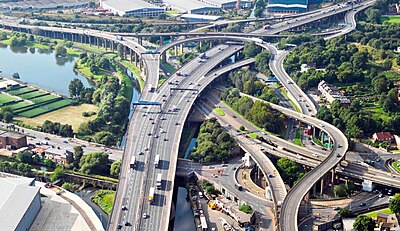
Many of these bastards, but by no means all of them, were eliminated in the 1980s, 1990s and 2000s, replaced by grade-separated interchanges. The Brunswick Circle in New Brunswick, Middlesex County, was never actually a traffic circle, but since Super Bowl XLII, I like to call it Patriot Circle, because the 2 highways that form it are Routes 18 and 1.
Tramcar: See "Wildwoods, The."
Trenton: The Capital of the State of New Jersey since 1790, where it had previously been Burlington. The State House, with its familiar gold dome, opened that same year. Trenton is also the seat of Mercer County. Its name has become synonymous with political corruption.

Downtown Trenton, with the State House at left
Outside the government office area, it has grown increasingly poor, as, like Camden and Paterson, the advances of American cities since 1990 has seemed to have passed it by.
Trenton Makes, The World Takes: See "Pennsylvania, Crossings Into."
Trenton-Morrisville Toll Bridge: See "Pennsylvania, Crossings Into."
Trenton Thunder: The highest-ranking professional baseball team in New Jersey, they have played at Samuel J. Plumeri Field at Arm & Hammer Park (originally Mercer County Waterfront Park, and Plumeri was the team's 1st owner) since it opened in 1994, and in the Class AA Eastern League, 2 steps below the major leagues.

They had previously played in London, Ontario. In the inaugural season of 1994, they were a farm team of the Detroit Tigers; from 1995 to 2002, of the Boston Red Sox; and since 2003, of the Yankees. They have won 12 Division titles: 1995, 1996, 1999, 2006, 2007, 2008, 2010, 2012, 2016, 2017, 2018 and 2019 (including the last 4 years). And they have won 4 EL Pennants: 2007, 2008, 2013 and 2019.
They are not the 1st professional baseball team to call Trenton home. The capital previously had a team known as the Senators (1936-41), the Packers (1942-44), the Spartans (1945) and the Giants (1946-50). In 1948 and 1949, they won Pennants as members of the Class B Interstate League, and a New York Giants farm team. Willie Mays played for them in 1950, but that was their last season.
It was also the last season for the original version of the Newark Bears (a former Yankee farm team), the Negro Leagues' Newark Eagles, and the Jersey City Giants (another New York Giant farm team). The growth of television killed a lot of minor league teams, and also hurt the Negro Leagues as much as the long-delayed fall of the color bar did.)
Between 1950 and 1994, the only minor-league baseball teams in New Jersey played at Roosevelt Stadium in Jersey City. But the 1994 season saw the establishment of the Thunder, and the New Jersey Cardinals of the Class A New York-Penn League, a St. Louis Cardinals farm team. They played at Skylands Stadium in Augusta, Sussex County, and won the Pennant that 1st season. They lasted until 2005, and were succeeded by the Sussex Skyhawks of the independent Can-Am League from 2006 to 2010, and the Sussex County Miners began play there in the independent Frontier League in 2015.
The success of the Thunder and the Cardinals led to a boom in minor-league ball in New Jersey. The 1998 season saw the beginnings of the independent Atlantic League, which had the new version of the Newark Bears, the Somerset Patriots (in Bridgewater, Somerset County), and the Atlantic City Surf.
That year also saw the Can-Am League welcome the New Jersey Jackals, on the campus of Montclair State University in Essex County (although Yogi Berra Stadium, and its accompanying museum, are on a part of the campus in Little Falls, Passaic County). And in 2001, the Atlantic League welcomed the Camden Riversharks, while the Philadelphia Phillies' team in the South Atlantic League became the Lakewood BlueClaws.
But boom turned to bust. The Sussex ballpark is already on its 3rd team. The Surf folded after the 2008 season, and their Surf Stadium now sits all but abandoned. The Bears folded after the 2013 season, the Riversharks after 2015 season. The former's Riverfront Stadium, across from Newark Broad Street Station, and the latter's Campbell's Field, under the Ben Franklin Bridge, were both demolished in 2019. Only the Thunder, the BlueClaws, the Patriots, the Miners and the Jackals remain.
Triple Bypass: See "Pork Roll."
Trump, Donald: See "Atlantic City."
Turnpike, The: The State's most important artery, its economic engine, the New Jersey Turnpike was the brainchild of Governor Alfred E. Driscoll -- as was the Garden State Parkway. The idea was to take traffic off U.S. Route 1. It worked, sort-of: Route 1 still gets a hell of a lot of traffic.

There are 12 Rest Areas, each named for someone famous who lived nearby, including poet Walt Whitman, Presidents Woodrow Wilson and Grover Cleveland, inventor Thomas Edison, early American statesman Alexander Hamilton and football coach Vince Lombardi.
The first segment, from Exit 1 in Pennsville, Salem County, to Exit 5 in Westhampton, Burlington County, opened on November 5, 1951. It was extended to Exit 11 in Woodbridge, Middlesex County, on November 30; to Exit 15E in Newark, Essex County on December 20; and all the way up to Exit 18 in Ridgefield, Bergen County on January 15, 1952.
The Newark Bay Extension, connecting Exit 14 in Newark with the Holland Tunnel in Jersey City, Hudson County, opened on April 4, 1956. The Pearl Harbor Memorial Turnpike Extension, connecting the New Jersey and Pennsylvania Turnpikes, opened on May 25, 1956. The Western Spur, which accesses the Meadowlands Sports Complex, opened in 1970.
From 1958, the Turnpike was bannered as part of Interstate 95 from Exits 10 to 18. In 1995, I-95 was extended down to Exit 7A. In 2018, following construction in both New Jersey and Pennsylvania, I-95 as officially extended over the Pennsylvania Turnpike extension, joining the New Jersey Turnpike at Exit 6, finally providing uninterrupted service for that highway for 1,908 miles from Miami to Houlton, Maine.
Twin Span: Nickname for the Delaware Memorial Bridge, connecting New Castle, New Castle County, Delaware and Pennsville, Salem County, New Jersey. (See also "State Line.") It is operated by the Delaware River and Bay Authority, and the toll is $5.00.
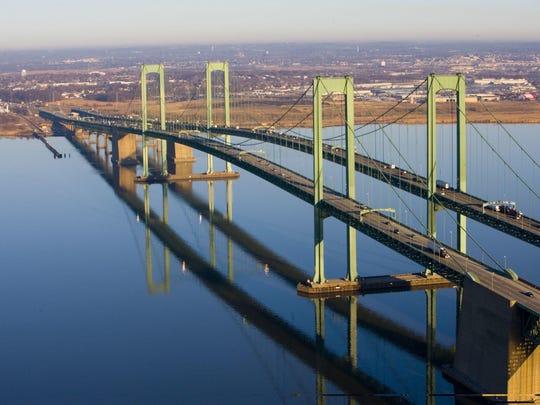
A ferry was established as a stopgap measure. Some stopgap: After debating whether a bridge or a tunnel should be built, Congress approved construction of a bridge in 1946. It finally opened on August 16, 1951, bannered as U.S. Route 40 (which had been using the ferry). Soon, it became the southern end of the Turnpike, and in 1956 the Delaware Turnpike opened, connecting each State's most important highway.
The opening of the Turnpikes put too many cars on it, and a 2nd bridge was ordered. On September 12, 1968, what's now the westbound span (toward Delaware) was opened, with the original span carrying eastbound traffic (toward New Jersey). In addition to Route 40, the Twin Span now carried Interstate 295. Turnpike Exit 1. (The Parkway has an Exit 0, while the Turnpike doesn't; but the Turnpike has an Exit 1, and the Parkway doesn't.)
Two Guys: Founded by brothers Sidney and Herbert Hubschman in Harrison, Hudson County in 1946, "Two Guys From Harrison" was a discount appliance store, much like Crazy Eddie would later be, without the screaming TV pitchman.
The name was a compromise: The brothers had started by selling appliances in the RCA plant in Harrison, and a competitor said, "We can't compete with those two bastards from Harrison!" Since no newspaper would print advertising with the word "bastard" in it, the name became "Two Guys From Harrison," and it was shortened to "Two Guys" sometime between 1959 and 1967, by which point they had branched out into pretty much anything else a department store would sell.

Uhlerstown-Frenchtown Bridge: "Pennsylvania, Crossings Into."
University of New Jersey at Durham, The: One of the more printable nicknames for Duke University in Durham, North Carolina, due to a large number of students from the New York Tri-State Area, including New Jersey. Known for its basketball success, and for the overweening arrogance this produces in its fans.
Jim Valvano, who played basketball at Rutgers before coaching North Carolina State University to the National Championship, said Duke fans didn't bother him because, "They're all from Jersey, like me." (Not quite: He was from Seaford, Long Island, New York.)
Founded in 1838 as Trinity College, it was renamed Duke University in 1924 following an endowment by tobacco and electricity magnate James Buchanan Duke. His daughter, Doris Duke, was a noted socialite and philanthropist in Hillsborough, Somerset County.
Upper Black Eddy-Milford Bridge: "Pennsylvania, Crossings Into."
Valli, Frankie: Born Francesco Stephen Castelluccio on May 3, 1934 (he often fudged it to May 3, 1937 to make himself seem younger) in Newark, he struggled for years, under various names for himself and his group, until hitting it big in the Summer of 1962, as The Four Seasons, taking the name from a bowling alley in Union Township, Union County that refused to hire them 2 years earlier.
From 1962 to 1967, the hits kept coming, and, outside of Motown Records, they were the biggest vocal group in America. And they were a real band, too: Bob Gaudio on keyboards, Tommy DeVito on lead guitar, and Nick Massi on bass guitar. Nick left in 1965, and was replaced by Joe Long. On occasion, they would be listed as "Frankie Valli and the Four Seasons," with Buddy Saltzman playing drums on most of their hits and on their live appearances.

The original Four Seasons lineup. Left to right: Tommy DeVito,
Frankie Valli, Bob Gaudio and Nick Massi
By 1968, times had changed, and an attempt at matching them by recording psychedelia fell flat. By 1975, Valli and Gaudio were the only original members left, but they made a comeback, showing that disco did not have to suck. In 1978, Valli had one last big hit, singing the theme from the film Grease, a period piece musical, whose original Broadway version did not have that theme.
Gaudio was born in 1942 in The Bronx, and grew up in Bergenfield, Bergen County. DeVito was born in 1928 in Belleville, Essex County, also the hometown of the top female vocalist from New Jersey, Connie Francis (born 1938). Long was born in 1941 in Elizabeth, Union County. All of these (including Frankie and Connie) are still alive. Massi was born in 1927 in Newark, and died in 2000. Saltzman was born in 1924, in Bridgeton, Cumberland County, South Jersey, and died in 2012. (UPDATE: DeVito died in 2020.)
As Billy Joel, whose 1983 hit "Uptown Girl" was an obvious homage to the Seasons, put it, "As far as I'm concerned, the Four Seasons kick ass all over the Beach Boys. When we were kids, did we sing, 'I wish they all could be California girls?' No, we sang, 'Walk like a man!'"
Vernon Valley Great Gorge: New Jersey's only major ski resort. It opened as Great Gorge in 1965. Vernon Valley was built adjacent in 1968, and in 1971 they were merged. It was bought by the Mountain Creek Company in 1998, at the same time as the adjacent Action Park.
Occasionally, New Jerseyans, like New Yorkers, would go to the Catskills, the "mountain" range in New York State, northwest of New York City. On other occasions, New Jerseyans, like New Yorkers and Philadelphians, would go to the Poconos, the "mountain" range in northeastern Pennsylvania, west of New York and north of Philly.
We used to watch New York (or Philly) TV, and see commercials for "The Nevele" (1903-2009, the name was "eleven" spelled backwards, in Warwarsing, Ulster County, New York) and "Beautiful Mount Airy Lodge" (1941-2001, reborn in 2009 as Mount Airy Casino Resort, in Mount Pocono, Monroe County, Pennsylvania). But Vernon Valley Great Gorge was the only such place in New Jersey. (It was about as close to those resorts -- 47 miles from The Nevele and 64 miles from Mount Airy -- as it was to New York City and most of New Jersey's people.)
A 2014 New York Times article suggested that Caribbean cruises and vacations becoming cheaper killed "The Catskills" and "The Poconos" as we once knew them. Atlantic City's casino rebirth, and the aging of these resorts' clientele, may also have had something to do with it.
Walt Whitman Bridge: See "Pennsylvania, Crossings Into."
War of the Worlds: On October 30, 1938, on his CBS radio show Mercury Theatre of the Air, actor Orson Welles broadcast a re-imagining of War of the Worlds, the science fiction story by H.G. Wells. (No relation: Note the different spelling.)
In the original 1897 story, creatures from the planet Mars attack London, and (spoiler alert) are ultimately killed, not by any of Earth's military forces or private citizens, but by their susceptibility to our diseases. This would hold true for the 1953 film version set in Los Angeles, and the 2005 film version set in Boston.
Orson Welles' version had the creatures landing in Grover's Mill, a rural area in West Windsor, Mercer County, and advance from there toward New York, including attacking the recently-built Pulaski Skyway. The story still ends with microbes saving the day.
Throughout the broadcast -- at the beginning, at the returns from commercial breaks, and at the end -- Welles noted that this was a radio play, not real life. And it would have been very easy for someone frightened by this broadcast to turn the dial -- say, to CBS' arch-rival, NBC -- and discover no mention of the attack.
But some people were scared enough to get out their shotguns and pitchforks, or to evacuate, feeling very silly when they found out there was no threat. Welles ended up having to publicly apologize for scaring people.
Grover's Mill has embraced its unexpected fame. A monument to the broadcast is in Van Nest Park on Cranbury Road, just off Grover's Mill Pond, about a mile and a half east of New Jersey Transit's Princeton Junction station. (This is County Route 615, and should not be confused with the Cranbury Road that runs through East and South Brunswick, which is County Route 535). Turnpike Exit 8.
Washington Crossing Bridge: "Pennsylvania, Crossings Into."
Water Ice: As the website for TLC's Polish Water Ice says:
Polish Water Ice is not the same as Italian Water Ice. Polish Water Ice is a creamy soft-serve water ice treat that is 100% fat free, 100% cholesterol free, 100% dairy free and 100% delicious.
With its great taste, comes Polish Water Ice’s uniqueness. Rather than serving a stored product, Polish Water Ice is made fresh while you wait. It couldn’t be any fresher!
Other Polish Water Ice products include The Polish Freeze which is Polish Water Ice combined with custard, The Polish Chiller, The Freeze and The Ice Cap!
It seems to be considerably more popular in Philadelphia and South Jersey than it does in New York, North Jersey and Central Jersey, where Italian ice is more popular.Wawa: A Pennsylvania-based chain of convenience stores that Central Jersey and South Jersey have come to embrace. They make sandwiches, salads, soups, chicken dishes, etc. So, if you live in Central or South Jersey, it's where you go in the middle of the night and you wake up hungry and there's nothing in the fridge, and a bag of chips from 7-Eleven just won't be enough to do the business for you.
In particular, they are known for their sandwiches. Being Pennsylvania-based, they call 'em "hoagies" instead of "submarines" or "subs." They come in 6 or 4 inches, the 4-incher known as a "Shortie."
They started out as a dairy, so you can get milk and ice cream there. And they have coffee-style drinks that are every bit as good as Dunkin Donuts (but cheaper) and Starbucks (but significantly cheaper). And their mashed potatoes are as good as those found at any diner.
They are now all over Central and South Jersey, with U.S. Route 9 having a slew of them, from Old Bridge all the way down to Cape May. They have only begun to make their presence known in North Jersey. So far, the only Wawas north of Interstate 78 are in Hackettstown in Warren County; Parsippany in Morris County; Irvington in Essex County; Kearny in Hudson County: and Garfield, Lodi and Hackensack in Bergen County. They have not yet crossed the Hudson River into New York City. The technical term for this is a "damn shame."
West Jersey: See "Pennsyltucky."
What Exit: See "Exit."
Wildwoods, The: A series of towns on the Jersey Shore, in Cape May County. From north to south, they are: North Wildwood (connected to the mainland by New Jersey Route 147), Wildwood (connected by New Jersey Route 47), Wildwood Crest, Wildwood Gables, and Diamond Beach (connected by Ocean Drive).
In 1963, Philadelphia rock and roll singer Bobby Rydell had a hit song with "Wildwood Days," showing that Wildwood was already Philly's favorite beach town, despite the fact that it's 90 miles from Center City, and the Atlantic City Expressway wasn't opened until 1964, so it wasn't an easy trek. It must have been considered worth it, though, because nobody doubted it when Bobby sang, "Every day's a holiday, and every night is Saturday night." (The song hit Number 17 nationally, and was actually a bigger hit in Australia, reaching Number 14.)
The boardwalk is full-service, and includes Morey's Piers, the biggest amusement park on the Shore, bigger than Casino Pier in Seaside Heights. Since 1949, the center lane of the boardwalk is reserved for The Sightseers Tramcar. Since 1971, it's had speakers warning boardwalkers to, "Watch the Tramcar, please." Even its website is https://watchthetramcarplease.com/tramcar/ A single ride is $3.50, while a day pass is $7.00.

"Watch the Tramcar, please."
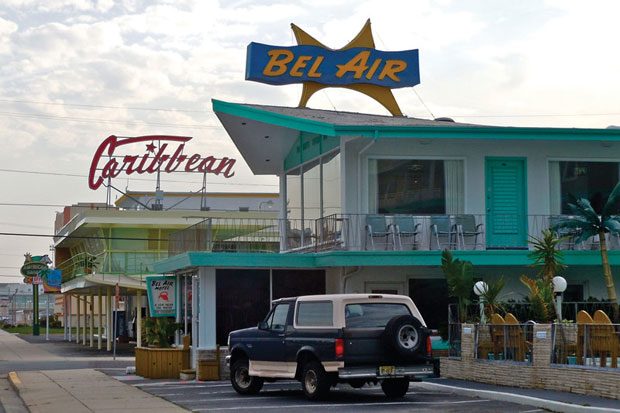
The Wildwoods are also known for their "Doo-Wop Motels," built in the 1950s and 1960s, the early days of rock and roll, and having kept the architectural styles, colors and signage from that era, although they didn't begin to be called "Doo-Wop" until the 1990s, by which point the 1950s nostalgia wave that began in the early 1970s had faded.
Woodbridge: A large Township in northeastern Middlesex County. It includes the neighborhoods of Avenel, Colonia, Port Reading, Sewaren, Iselin, Hopelawn and Keasbey. It also includes the Woodbridge Center Mall, which is often called just "Woodbridge" by people from other towns.

Wooder: South Jersey talk for "water." It has nothing to do with sexual arousal.
There will be one more installment, Volume 6, detailing the crossings from New Jersey into New York City.