Showing posts with label conservative movement. Show all posts

Wednesday, August 19, 2026

August 19, 1976: Regrets at the Republican Convention

Ford welcomes Reagan to the rostrum,
as Nancy Reagan (left) and Nelson Rockefeller (right) look on

August 19, 1976, 50 years ago: The Republican National Convention wraps up, at the Kemper Arena in Kansas City, Missouri. Hearing the speakers talk of upcoming victory, in the Presidential election and in the Congressional elections, you'd never know they were 2 years out from a President of their Party having to resign in disgrace, a year and a half out from badly losing in the Congressional races, and looking at a country still in a recession. They were not only confident, they were arrogant.
The Kemper Arena, now the Hy-Vee Arena

Gerald Ford, who became President when Richard Nixon resigned, had been President for a shade over 2 years, with a hell of a mess dumped into his lap. The results had been mixed: Certainly, the country was better off than when he took office, but it was hardly in great shape. The month before, he had ridden the celebrations of the country's Bicentennial, which had helped him. But little else had gone his way.

His pardon of Nixon, just 1 month into his Presidency, had angered millions of Americans. His refusal to support a federal bailout of a bankrupt New York City had infuriated millions, and his reversal on that issue had angered millions of others, without winning many of the first group back.

Conservatives in the Republican Party hated that he had chosen former Governor Nelson Rockefeller of New York as his Vice President, and refused to support him for a term of his own if he ran with Rockefeller on the ticket. He could have reminded him that he was now the leader of the Party, and that he wouldn't be bullied. Instead, he was, telling Rockefeller that he would be dropped. He chose Senator Bob Dole of Kansas.

None of it was enough. Ronald Reagan, who had recently wrapped up 2 terms as Governor of California, was the darling of the conservative movement. He challenged Ford in the Primaries, and the final Delegate total was very close. This remains the last major-party convention at which the nominee was not absolutely certain. Ford got 1,187 Delegates, Reagan 1,070.

Ford's acceptance speech was too dull to quote here. And he kept making the mistake of pointing out the differences in the last 2 years, reminding everyone that he had succeeded Richard Nixon, a fellow Republican. He could have compared the current situation to 1968, the last full year under a Democratic Administration, with war abroad and riots at home, but he didn't.

And then, as the balloons were falling, and everybody was reacting with tepid applause, he made a gracious gesture. Reagan had not had the chance to make a speech on his own behalf. So Ford asked Reagan to come down and make a speech.

Standing behind the podium, with the Presidential seal still affixed, Reagan looked more like a President than Ford ever had. He sounded more like one, too: Whatever else could be said about either man, Reagan, who had been an actor, was a better public speaker than Ford, who had been a lawyer, but not a trial lawyer, used to addressing crowds. Ford had become a good politician, but until he actually got the office, he had never intended to run for President, and he was not made for moments like these.

Reagan was. He spoke of being asked to write a letter for a time capsule, to be opened in Los Angeles in 2076, America's Tricentennial. He spoke of the world in 1976 being a battle between freedom and tyranny, with nuclear missiles as the potential deciding factor:

Those who would read this letter a hundred years from now will know whether those missiles were fired. They will know whether we met our challenge. Whether they will have the freedom that we have known up until now will depend on what we do here. Will they look back with appreciation and say, "Thank God for those people in 1976 who headed off that loss of freedom? Who kept us now a hundred years later free? Who kept our world from nuclear destruction?"

And if we fail, they probably wont get to read the letter at all, because it spoke of individual freedom, and they wont be allowed to talk of that or read of it.

This is our challenge, and this is why were here in this hall tonight. Better than we've ever done before, we've got to quit talking to each other and about each other, and go out and communicate to the world that we may be fewer in numbers than we've ever been, but we carry the message they're waiting for. We must go forth from here united, determined and what a great general said a few years ago is true: There is no substitute for victory. Mr. President.

Reagan's speech got a standing ovation. But a lot of people left the Arena thinking, "We've nominated the wrong guy."

Ford began the Convention far behind the Democratic nominee, former Governor Jimmy Carter of Georgia. The Convention helped. He eventually closed the gap to a virtual dead heat on Election Day. Carter won a very close race.

Would Reagan have won? This time, the Republicans were still tainted with scandal and recession. Reagan's message of tax cuts and Cold War aggressiveness would not have flown in 1976.

Four years later, it was a different world. And while Reagan looked finished after 1976, in 1980, America was ready for him. All 3 men had their moment where they were the man of the moment. For Ford, it was 1974, but not 1976. For Carter, it was 1976, but not 1980. For Reagan, it was 1980, but not 1976.

The Kemper Arena still stands, right on the State Line with Kansas City, Kansas. Originally named for local banker and philanthropist Rufus Kemper, it is now named the Hy-Vee Arena, after a supermarket chain. 

Wednesday, November 19, 2025

November 19, 1955: National Review Is First Published

November 19, 1955: The weekly magazine National Review is first published by its editor, William F. Buckley Jr.

Modern American conservatism, from Senator Joseph R. McCarthy onward, has been based on lies and hysterics. Buckley tried to change that. But, as is so often the case, telling the truth got him into just as much trouble.

Even his name wasn't originally correct: When born on November 24, 1925 -- 4 days after an eventual ideological opponent, Robert F. Kennedy -- in Manhattan, it was with the name William Francis Buckley. At some point, it was changed to William Frank Buckley Jr.

William Frank Buckley Sr. was a lawyer and an oil developer, whose work took him and his family to Mexico, and when it was time to send his son to his first school, it was a boarding school in Paris. Thus, he spoke Spanish first, French second, and English third. Which seems odd for someone who became so skilled with the English language, and seemed to have such a "patrician" accent.

"Bill" Buckley was an officer in the U.S. Army during World War II, but was never transferred off U.S. soil. He attended Yale University, where both its joys and its frustrations would serve him well. He served 2 years in the early CIA, which helped to inspire his later spy novels. His character Blackford Oakes was, basically, an upper-class American ripoff of James Bond.

Buckley married Patricia Taylor, and settled on an estate (they called it a "farm," perhaps for tax purposes, as rich people sometimes do) in Sharon, Connecticut, far enough from Midtown Manhattan (100 miles) to be isolated, but close enough to be near the corridors of power. Despite being an old-style Catholic and 1 of 10 siblings, he had only 1 child, a son named Christopher, who also became an acclaimed author.

In 1951, William F. Buckley Jr. wrote his 1st book, God and Man at Yale -- known thereafter to the conservative movement by its initials, GAMAY. He attacked several officials and professors at the school as "leftists," including McGeorge Bundy, who would go on to become National Security Adviser to 2 Democratic Presidents.

In a review titled "The Attack on Yale" for the November 1951 issue of The Atlantic, Bundy wrote: "In the end Mr. Buckley's indictment of Yale's economics texts turns out to be a self-indictment. This chapter shows him to be a twisted and ignorant young man whose personal views of economics would have seemed reactionary to Mark Hanna." (Hanna was the Senator from Ohio who managed the conservative Republican campaigns of President William McKinley, who died half a century earlier.) This was in Part I of Bundy's review. Part II began with "The worst is yet to come."

In 1955, with several fellow reactionaries -- including L. Brent Bozell Jr. (who had married Bill's sister, Patricia Buckley, and whose son, L. Brent Bozell III, had just been born, and would later write for the magazine), Russell Kirk (who had published the anthology The Conservative Mind 2 years earlier), Revilo P. Oliver (the noted historian's name is a palindrome, reading the same forwards and backwards), and Whittaker Chambers (the ex-Communist ex-editor for Time magazine, whose testimony had sent Alger Hiss to prison) -- Buckley founded National Review.

(Its 1st drama critic was 23-year-old Garry Wills, who became one of America's greatest historians, and not so conservative. A biographer of multiple Presidents, his books about Richard Nixon and Ronald Reagan were highly critical.)

Buckley's introductory essay made the magazine's mission clear:

Let's face it: Unlike Vienna, it seems altogether possible that did National Review not exist, no one would have invented it. The launching of a conservative weekly journal of opinion in a country widely assumed to be a bastion of conservatism at first glance looks like a work of supererogation, rather like publishing a royalist weekly within the walls of Buckingham Palace. It is not that, of course; if National Review is superfluous, it is so for very different reasons: It stands athwart history, yelling Stop, at a time when no one is inclined to do so, or to have much patience with those who so urge it.

National Review is out of place, in the sense that the United Nations and the League of Women Voters and the New York Times and Henry Steele Commager are in place. It is out of place because, in its maturity, literate America rejected conservatism in favor of radical social experimentation.

Of course, there was a reason for this: Conservatism caused the stock market Crash of 1929, just 26 years earlier, and the subsequent Great Depression of the 1930s, which led to the political backlash that caused the election of Franklin D. Roosevelt as president, and his Administration's radical social experimentation, which saved the nation's economy and perhaps worldwide capitalism itself. Unlike conservatives following the economic downturns of 1973-76, 1990-93, 2001-04, 2007-09, and 2020-21, Buckley was not asking people to forget that the Depression happened on conservatives' watch.

Rather, he was asking people to accept his position, which was that the time for radical social experimentation ended once the immediate economic emergency ended, and that a return to the kind of conservatism that brought the economic prosperity of the 1920s was what was needed today (1955). Of course, as I said, that kind of conservatism caused the Depression.

Buckley once wrote, "I want discretion in the sense that I want intelligence, and no crackpottery. But I want some positively unsettling vigor, a sense of abandon, and joy, and cocksureness that may, indeed, be interpreted by some as indiscretion." In 1957, he published a nasty review that Chambers wrote for Ayn Rand's right-wing novel Atlas Shrugged.

Nevertheless, in 1958, Oliver left the magazine, and joined candy executive Robert W. Welch Jr. to become one of the founders of the John Birch Society, which seemed to encourage crackpots, to the point where, in 1963, both Bob Dylan and the Chad Mitchell Trio wrote songs making them look like paranoid psychotics. (The Trio's song included the line, "There's no one left but thee and we, and we aren't sure of thee!")

And yet, in 1957, 3 years after Brown v. Board, 1 year after the Southern Manifesto, and a few weeks before the Little Rock Crisis, Buckley published an editorial titled "Why the South Must Prevail":

The central question that emerges... is whether the White community in the South is entitled to take such measures as are necessary to prevail, politically and culturally, in areas where it does not predominate numerically? The sobering answer is Yes – the White community is so entitled because, for the time being, it is the advanced race.

NR did improve its record on race -- somewhat. It denounced the 1968, 1972 and 1976 Presidential campaigns of Governor George Wallace of Alabama. But it has also, perennially, called for the end of affirmative action. In 1965, at Oxford University in England, Buckley himself infamously took the segregationist side in a debate with black writer James Baldwin.

In the 1980s, NR opposed sanctions against the apartheid government of South Africa, because that government was anti-Communist -- and, like all white-supremacy governments, including in the Southern U.S., it falsely took the official tack that civil rights activists were motivated by Communism.

The Spanish Fascist leader Francisco Franco was a hero in the Buckley household, celebrated as a conservative and Catholic bulwark against the officially atheist worldwide Communist movement, known to its opponents as "the Red Menace." In 1957, Buckley declared in his magazine, "General Franco is an authentic national hero." NR writer James Burnham echoed this sentiment in a 1975 obituary declaring "Francisco Franco was our century's most successful ruler."

(He wasn't. Within 3 years, Spain had a free election, and the voters chose a liberal government. Spanish voters have chosen conservative governments since, but never again a Fascist one.)

In his 1997 book Nearer, My God: An Autobiography of Faith, Buckley condemned the 1960s rulings that he viewed as "the Supreme Court's war against religion in the public school," and argued that Christian faith was being replaced by "another God... multiculturalism." He disapproved of the liturgical reforms following the Second Vatican Council of 1962-66.

On April 4, 1966, the program Firing Line, hosted by Buckley, premiered on NET, and continued on its successor network, PBS, until 1999. In addition to the various NR writers, and conservative activists -- Milton Friedman, Friedrich Hayek, Phyllis Schlafly, and so on -- Buckley invited people no one would have expected, like liberal activists Saul Alinsky, Julian Bond and Noam Chomsky; Watergate-busting reporters Bob Woodward and Carl Bernstein; Democratic political candidates like Jimmy Carter (not yet President), Jesse Jackson and John Kerry; and even figures from the 1960s "left," like Norman Mailer, Allen Ginsberg, Timothy Leary and Huey Newton.

In August 1968, ABC News invited Buckley and Gore Vidal, a liberal-leaning author and, like Ginsberg, one of the few openly gay celebrities of the time, to debate each other during the controversy-strewn Democratic Convention in Chicago. Even people who would normally have agreed with Vidal politically found themselves sympathizing with Buckley, because Vidal was completely rude, even telling Buckley, "Shut up a minute!"

Buckley compared New Left youths carrying pro–Viet Cong flags to pro-Nazis, which is ridiculous, because the Nazis, as Fascists, were a right-wing movement, not a left-wing one. Vidal responded by saying, "As far as I'm concerned, the only sort of pro- or crypto-Nazi that I can think of is yourself."

This set Buckley off: Remembering his gay-baiting pre-Vatican II Catholicism, and his service in World War II against the Nazis, he said, "Now, listen, you queer: Stop calling me a crypto-Nazi, or I'll sock you in the goddamned face, and you'll stay plastered!" (And by "plastered," he didn't mean "drunk.") And ABC either didn't have a seven-second delay to "bleep out" any profanities, or didn't use it, and Buckley's use of the word "goddamned" stayed on the broadcast -- to this day, a rarity on American television, at any hour of the day.

Buckley and Vidal were the same age, the former born just 9 days before the latter, so there was no age advantage. And, with his Army and CIA training, if there had been a fight, it would have seemed like Buckley would be heavily favored. But someone who knew Buckley mentioned that he had recently broken his left arm, and he could be seen on the videotape tucking that arm in, using his right hand to keep his earpiece in. He might not have won a fight on that occasion.

After Watergate, Buckley rallied the conservative movement behind Ronald Reagan, and was very pleased with how the Reagan Administration turned out. In that Administration's time, and also later in its wake, there would be copies of Buckley's work.

Debuting on NBC in 1982, The McLaughlin Group was a more freewheeling, if host-controlled, version of Firing Line. The American Spectator was founded in 1972, as more of a gut-punching magazine, and by the time Bill Clinton began his successful run for President in 1992, it was willing to embrace any conspiracy theory against him and other liberals, no matter how ridiculous. The Weekly Standard was founded in 1996, as a cheekier, less Ivy-ish version of National Review. Debuting the same year, Fox News Channel made Firing Line seem very quaint by comparison.

I used to read National Review, even though I agreed with very little in it, because it was so well-written, and, probably upon Buckley's insistence, the sense of humor was still there. And it wasn't a mean, bullying, frat-boy sense of humor, either, like The American Spectator had.

In 1995, on PBS, Michael Kinsley of the liberal-leaning magazine The New Republic moderated a Firing Line-sponsored debate on the subject of religion in public life. As captain of one side, favoring more of it, was Buckley. As captain of the other side, favoring less of it but otherwise a conservative, was controversial lawyer Alan Dershowitz.

During his opening remarks, Kinsley told the theater audience, "I should warn you: Some of these panelists are under the delusion that they have a special pipeline to God." Several people, including Buckley, laughed. Kinsley continued: "And some of these panelists are under the delusion that they are God." More people laughed. Buckley was one of them. Dershowitz was not.

But age and ill health caught up with Buckley. He retired Firing Line in 1999. And he gave up editorial control of National Review in 2005. Without him to hold it back, it totally embraced the insanity -- the "crackpottery," as Buckley once put it -- of the Republican Party in the 21st Century.

William F. Buckley Jr. died on February 27, 2008, at the age of 82. Surprising no one who knew him, his death came less than a year after his wife's.

Buckley's son, Christopher Buckley, became a novelist, and was chief of staff to George H.W. Bush while he was Reagan's Vice President.

Firing Line was revived in 2018, again on PBS, hosted by Margaret Hoover, a former Fox News correspondent, and a great-granddaughter of President Herbert Hoover. 

Sunday, November 2, 2025

November 2, 1965: John Lindsay Is Elected Mayor of New York

November 2, 1965, 60 years ago: John Vliet Lindsay, a liberal Republican Congressman, is elected Mayor of New York City. He defeats the Democratic nominee, City Comptroller Abraham D. Beame.

A few days short of his 43rd birthday at the time of his election, he had served in World War II, in battles in both the European and the Pacific Theaters of Operations, rising to the rank of 1st Lieutenant in the U.S. Army. In 1958, he was elected to Congress, representing the East Side of Manhattan, the district nicknamed the Perfumed Stockade, and re-elected in 1960, '62 and '64.

He was handsome and well-spoken, and, up to this point, people found him eminently likable. His basic decency allowed him to connect with liberals, moderates and minorities. However, he was elected as a plurality Mayor in a 3-way race. He got the nominations of the Republican and Liberal Parties, and got 45 percent of the vote. Democratic nominee Beame got 41 percent.

William F. Buckley Jr., publisher of National Review magazine and founder of the Conservative Party of the State of New York, got 13 percent, despite the fact that he didn't even live in the City, said he didn't want to. He even said he didn't want the job: He just wanted to make a point that conservatives should have a choice between Democrats and liberal Republicans.

Lindsay would proclaim, "New York is a fun city." and was lampooned as "Mayor Linseed" on the Batman TV series that soon premiered. (The equivalent to Governor Nelson Rockefeller would be "Governor Stonefellow.") But Fun City would not respond well to him: The day of his Inauguration, January 1, 1966, was the day the Transport Workers Union's contract ran out, and the Subway employees went on strike. After 11 days, Lindsay caved in to the union, and his support never recovered.

Seeming to have pandered to civil rights groups and the antiwar movement, and responding too slowly to a blizzard early in 1969, his own party dumped him for re-election that year. But he secured the Liberal Party's nomination in New York State's odd four-party structure, and rode the "miracles" of the Mets and Jets to victory.

But his 2nd term was even more troubling than his 1st, as the City spiraled downward in crime and corruption that, try as he might, he couldn't stop. I've often thought that Lindsay and Rockefeller, also a liberal Republican, should have switched jobs: Rocky could have governed what University of Massachusetts historian Vincent J. Cannato, writing in 2002 about about Lindsay's terms, titled The Ungovernable City; while Lindsay would have been better off in Albany.

But many people thought Lindsay was merely using the Mayoralty as a stepping-stone for the Presidency -- a charge also leveled at Rockefeller. In the end, neither ever came close to it. Indeed, dumped by the Republicans, Lindsay ran in the Democratic Primaries in 1972, and was laughed out of the race. My mother, a City native, likes to say that she knew Lindsay was really a Democrat before he did.

Lindsay did not dare run for a 3rd term in 1973. Having regained the Comptroller's post in 1969, Abe Beame ran for Mayor again, and was elected. But things got even worse, and he wouldn't even get nominated for a 2nd term. Lindsay was ill for a long time, lost his fortune due to his medical bills, and died at age 79 at the end of 2000. Beame died a few days later, at 94, also a tragic figure.

Monday, October 20, 2025

Understanding Trump Fans

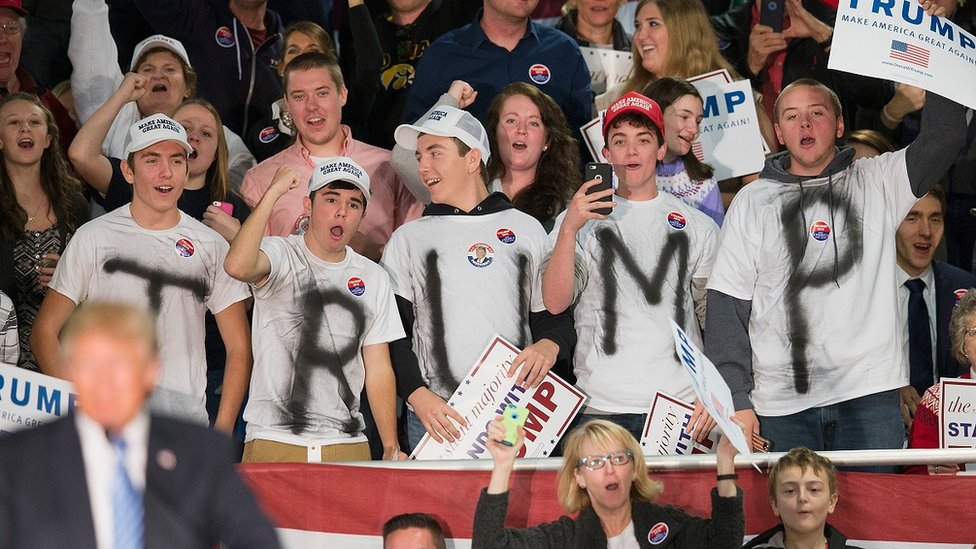
On Saturday, about 7 million people came out on the 1st "No Kings Day" (perhaps the first of many) to protest the policies of Donald Trump, who is acting like both a king and a dictator. The New York Police Department estimated that 100,000 people came into the City to demonstrate.

Trump and his surrogates -- in the Administration, in Congress, in the media, and elsewhere -- called them "radicals," "Marxists," and other words that they either don't understand or do and were lying about it, and said there would be violence.

There was no violence. The NYPD announced that the total number of arrests they made in connection with the demonstrations in the 5 Boroughs was zero. Exactly none.

How did Trump respond to 7 million people telling him they didn't want him acting like a king or a dictator like he's been doing? He posted an artificial-intelligence video of him, piloting a fighter jet, wearing a crown, and dropping poop bombs on the demonstrators.

Trump has the mind of a 14-year-old, until you tell him he can't have something, then his reaction is that of a 2-year-old.

*

And how many counter-protestors were there? I wasn't able to attend any of the demonstrations, for reasons I won't get into here, although I wanted to. But I heard from someone who attended one in Central Jersey, where 200 showed up to protest. She said there were maybe a dozen counter-protestors, and they didn't last very long, and left quickly.

There are people on my side of the political divide who say they don't understand the appeal of Trump.

I understand it. He's the first politician in their memories -- unless they're Southern and really old -- who has come out and told them that it's okay to be bigots, okay to hate people for being women, or nonwhite, or not your religion, or gay, etc. He has validated their core principle.

No other politician has done that. Richard Nixon, Ronald Reagan, George W. Bush, and Congressional leaders like Newt Gingrich and Mitch McConnell? They all danced around it, kind of hinted that it was okay to be a bigot. But they never basically said, "It's okay. Look at me. I'm one of you! I hate them, too! So vote for me, and I'll give you policies that will hurt them!" And they were too damned stupid to know that the same policies would hurt them.

My first thought was that it's like a drug to them. But a better analogy is that they're like compulsive gamblers. Even degenerate gamblers, We almost never hear the word "degenerate" these days, unless we're referring to pathetic, ever-losing gamblers who can't stop. Compulsive gamblers sometimes win, often enough to keep the idea going; degenerate gamblers hardly ever do, and cling incredibly tightly to the few that they actually get.

And, like degenerate gamblers, Trump fans -- a better word for them than "supporters" -- never get it through their thick skulls that the occasional wins that they treasure come with dozens of losses. And as long as they keep Trump as their "bookie," they're never going to break even.

And yet, they don't care: As long as they see the feminists, the blacks, the Hispanics, the Muslims, the LGBTs, etc. lose, they'll be like, "Well, I can't afford to pay my bills, I can't afford to keep my house, and I can't afford my family's medication, but at least those (whatever slur they want to use)s aren't getting ahead of me!"

As they used to say on Match Game, Dumb Donald is so dumb. But he will survive in politics as long as he has enough fans who are even dumber than he is. Because that's his one talent: Selling himself to the gullible, to people who are dumber than he is.

Monday, September 15, 2025

In the Better Timeline...

I've heard people who are fans of science fiction, including time travel stories, say things like, "We are living in the worst timeline."

I've also heard people who are fans of the TV show The Good Place use that show's Season 1 finale shocker to describe the real world in which we now live: They've come to realize that this is the Bad Place: Hell.

The idea being that, maybe, there's another world where a historical event happened differently, leading to a better timeline, or that maybe we died, and began living in what would be, to us, considered Hell.

There's an old bit:

Heaven is where the police are British, the chefs are French, the mechanics are German, the lovers are Italian, and it is all organized by the Swiss.

Hell is where the police are German, the chefs are British, the mechanics are French, the lovers are Swiss, and it is all organized by the Italians.

And Trump has been President continuously since 2009, because there was a coup after President Black Man was elected.

In the better timeline...

* On November 2, 1968, a plane had mechanical difficulties, and Anna Chennault couldn't get on it to fly to Paris and sabotage the Vietnam War peace talks.

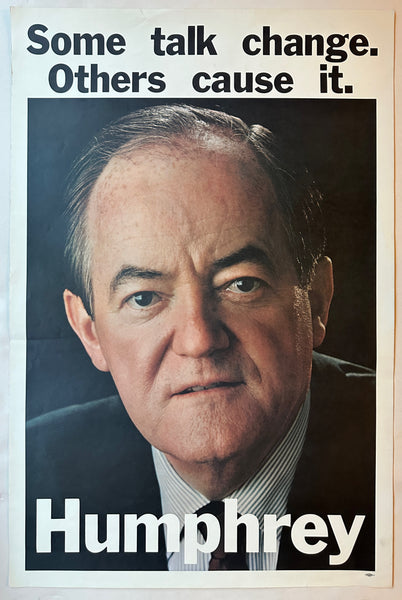
* Hubert Humphrey was elected President. The peace talks continued. Lyndon Johnson got a peace deal by Christmas. Humphrey took office without having to worry about Vietnam. He placed the call to the astronauts on the Moon, not Richard Nixon. There was no Kent State Massacre. Humphrey took us one step closer to universal health care, with MediKid, a children's version of Medicare. He replaces the retiring Chief Justice Earl Warren with former Attorney General Nicholas Katzenbach, the man who, as Robert F. Kennedy's Deputy, got George Wallace out of the schoolhouse door in 1963.

*  With Nixon out of the way, Ronald Reagan was free to be the representative of both the traditional conservative movement and the evangelicals, and ended 12 years of the New Frontier and the Great Society. Reagan's Vice President was chosen because he was a part of the "Southern Strategy": Senator John Tower of Texas.

* It was the Reagan Administration that bugged the Democratic National Committee headquarters at the Watergate, and Bob Woodward and Carl Bernstein of The Washington Post got right on it. It was also Reagan and company who orchestrated the coup in Chile in 1973. Mark Felt was still at the FBI, and, as "Deep Throat," he spilled the beans, and Reagan was impeached, and removed on August 9, 1974. The conservative and evangelical movements were struck a blow from which they could not recover in the short term.

* Tower became President, and couldn't stop the recession Reagan's tax cut had caused. The evangelicals abandoned him, because of his apparent womanizing and alcoholism. With the Reagan scandals hanging over him, he had no chance in 1976, and Jimmy Carter was elected.

* As President-elect, Carter met with the new Speaker of the House, Thomas "Tip" O'Neill of Massachusetts, and the new Senate Majority Leader, Robert Byrd of West Virginia. In our timeline, by his own admission, "I treated Congress like the Georgia legislature, and they treated me like the Governor of Georgia." In this timeline, they get off on the right foot, and, with the Kennedy-Harkin Bill, sponsored by Representative Tom Harkin and Senator Edward M. "Ted" Kennedy of Massachusetts, universal health coverage passes on October 18, 1977. (I chose the date because it's the day the Yankees ended a 15-year World Series drought.) 

* With Nixon defeated in 1968, Henry Kissinger never becomes a person of influence in the American government. He's not there to, along with others like David Rockefeller, convince Carter to let the Shah of Iran into America for cancer treatment. Instead, Carter is warned by his Secretary of State, Cyrus Vance, and Humphrey's, George Ball, not to do it, and he agrees. While Iran remains a problem from 1979 onward, there is no Iran Hostage Crisis.

* There is still a Soviet invasion of Afghanistan. This time, though, with no hostage crisis, and no resulting OPEC actions that have jacked up gas prices and caused overall inflation, Carter's announcement of a boycott of the 1980 Olympics in Moscow is treated as a principled action, and widely supported. Ted Kennedy sees no reason to run for President, gets his drinking under control, and his separation and divorce from Joan is relatively quiet. Unopposed in the Democratic Primaries, Carter rolls to re-election over former Representative and Republican National Committee Chairman George H.W. Bush.

* In a bipartisan gesture, Carter makes his one and only appointment to the Supreme Court the 1st woman, a Republican, Sandra Day O'Connor.

* Having gotten the Camp David Accords and the Panama Canal Treaty, then a 2nd term, Carter mediates the reunification of Vietnam under a coalition government committed to free elections, and ends the civil wars in Nicaragua and El Salvador. He gets a peace agreement between Israel and Jordan, there is no Israeli incursion into Lebanon, and that nation, Jordan and Egypt work with Yassir Arafat to turn the West Bank into the Republic of Palestine, with a capital to be built in East Jerusalem. It is nicknamed "Israel's Marshall Plan," and Carter is awarded the 1982 Nobel Peace Prize.

* Having achieved several domestic aims in his 1st term, there wasn't a whole lot for Carter to do in his 2nd. His Vice President, Walter Mondale, won a narrow victory over Senate Minority Leader Bob Dole of Kansas. There was no Iran-Contra Scandal.

* In 1986, Chief Justice Katzenbach retired. In his place, Mondale appointed the leading Democrat on the Senate Judiciary Committee, Joe Biden of Delaware. And there was no bitter partisan fight over the nominations to the Supreme Court of Robert Bork in 1987. Because, in 1987, to replace Lewis Powell on the Court, Mondale nominated Laurence Tribe, and the popular Harvard Law School professor was easily confirmed.

* By 1987, the economy had slowed, and the stock market crash that October sends the nation into recession. Complaints about "kitchen table issues" and crime lead to the election in 1988 of the darling of the tax-cut movement, Representative from New York, and former professional quarterback, Jack Kemp.

* It became one of the great ironies of American political history that President Kemp should be best remembered not for the tax cut he signed into law, or the recession it deepened, or for the budget reconciliation bill he signed to alleviate it, raising taxes, and causing those who had once been his foremost advocates to abandon him as "a traitor to the cause."

It was the Persian Gulf War. It could have been worse: He could have been dumb enough to press on to Baghdad, but his Secretary of State -- 1980 Republican Presidential nominee George H.W. Bush -- warned him against it, and he agreed. Kemp also presided over the closing of the Cold War, as first the Berlin Wall, then the Soviet Union, fell.

* There was no bitter partisan fight over the nomination to the Supreme Court of Clarence Thomas in 1991. Because, not desperate to pander to the conservative movement as the elder Bush was in our timeline, Kemp would have considered Thomas' record, and found him to be under-qualified to replace anyone, let alone Thurgood Marshall, the 1st black Justice on the Court.

Instead, he appointed Amalya Lyle Kearse to be the 1st black woman on it. (In our timeline, Carter appointed her to the federal bench, and Reagan thought enough of her to make her a finalist for the seat that went to O'Connor in 1981.) Kemp "crossed the aisle" to appoint her, being strong on civil rights. The joke was, because he'd played pro football, he had showered with more black people than most Republicans had ever actually met.

* Kemp responded to the beating of Rodney King by working with Democratic leaders to come up with a Crime Bill that not only would properly respond to escalating crime in the inner cities, but also hire more and better police officers. He knew it had to be done, but he also wanted to take crime off the table for the 1992 election. The officers who beat King were convicted on the 1st try, and there was no riot in Los Angeles.

* The 1992 Presidential election has been called one of the best ever. Kemp, only 57 and still full of vigor, was opposed by Governor Bill Clinton of Arkansas. It was a conservative idea man vs. a liberal idea man, both very popular with college-age voters, who didn't yet have to go out and get a job. People who did turned to Clinton, because the recession was still going on, and the Republicans' attempts to blame Mondale for starting it weren't working anymore. With Vietnam a non-issue after 1968, Clinton didn't have it as part of his problems. But with universal coverage passed, Clinton couldn't campaign on that, either. The election was very close, but Clinton won a narrow victory.

* Without an evangelical movement to stand in his way, the more ridiculous accusations against Clinton never gained traction. But with much of what our timeline's Clinton wanted to do having already been done, there seemed little for him to do domestically after getting his budget passed. With Israel at peace with every neighbor except Syria and not-so-neighboring Iran, he was able to end the genocides in Rwanda and Bosnia. But while his economic and peace achievement got him a 2nd term in 1996, over Senator Phil Gramm of Texas, there seemed little reason beyond ambition for him to run again. His 2nd term looked like it would be dull.

* It wasn't. Conservative journalists broke the scandal of his affair with Monica Lewinsky. With the country in peace and prosperity, on January 26, 1998, Clinton came clean, and, deciding that Vice President Al Gore could be President, but only he could be the one to work on his failings to his family, he became the 1st President ever to resign the office. He spared the nation a drawn-out story, and there was little celebrating among the Republicans, for whom the evangelical movement was just a quirky memory.

* Gore's environmental and tech initiatives helped, but while he proved an able administrator, he wasn't much of a politician. With the evangelical movement ruined, and the Bush name unable to regain momentum following the defeats for Governor of George W. in Texas and Jeb in Florida in 1994, the Republican nominee in 2000 was Senator John McCain of Arizona. He defeated Gore in a close election.

* On August 6, 2001, McCain read a Presidential Daily Briefing titled "Bin Laden Determined to Attack Inside U.S." He took it seriously. On September 11, he announced to the nation that a major terrorist attack had been foiled. On September 14, he gave a press conference at Austin J. Tobin Plaza at the World Trade Center in New York, one of the saved targets, and warned Afghanistan to turn Osama bin Laden over to the U.S. It did. McCain also worked with Iraqi rebels, and Saddam Hussein was toppled from power in late 2003, without a large U.S. military presence.

* The Democrats thought they had to counter McCain's various foreign policy achievements with their own war hero and foreign policy expert. This was Senator John Kerry of Massachusetts. But, with most of the things our timeline's Democrats wanted already long established in law, and with most of the things our timeline's Democrats wanted prevented already done so, there seemed little reason to vote for him. McCain won in a landslide.

* But the recession that began in 2007 due to the Republicans' deregulations turned into a full-blown crash in 2008. With Hillary Clinton teaching at Yale Law School, and not in the Senate, Senator Barack Obama of Illinois cruised to victory in the Democratic Primaries. The Republican Primaries were a mess, as McCain's Vice President, Senator Dan Quayle of Indiana, was seen as insufficiently intelligent and mature for someone 60 years old. His demand for "a return to honor and integrity" following the 1998 Clinton scandal got him on the ticket, but his actions and words since nearly derailed him in the Primaries. Obama beat him in a landslide, becoming the 1st black President. With Biden on the Supreme Court, his running mate, lending experience and "gravitas," is Senator Patrick Leahy of Vermont.

* Obama solved the recession. But there was no reason to fight for "Obamacare": Something better had already been passed. There was no reason to kill Osama bin Laden: He was rotting away in the "supermax" federal prison in Colorado. What could he run on in 2012? In part, civil rights, including for women, by convincing Congress to codify Roe v. Wade into law and approve a renewal of the Equal Rights Amendment; and gay rights, including replacing Clinton's "Don't Ask, Don't Tell" with an Executive Order allowing openly gay military personnel.

* Obama put Sonia Sotomayor and Elena Kagan on the Supreme Court. With them joining a liberal wing that included Joe Biden, Laurence Tribe, Amalya Lyle Kearse, and Clinton appointees Ruth Bader Ginsberg and Stephen Breyer, the 2 conservative McCain appointees of 2005, John Roberts and Samuel Alito, are all but powerless. The cases of Citizens United v. FEC, Shelby County v. Holder and Burwell v. Hobby Lobby Stores, Inc. go in the liberals' favor; while Obergefell v. Hodges goes the same way.

* In 2011, Donald Trump brings up the issue of Obama's birth certificate. Only this time, every living former President -- Carter, Mondale, Clinton, Gore and McCain (Kemp having died in 2009) -- signs a joint statement denouncing this as the rantings of a bigot, and saying it has no place in 21st Century America.

* With fewer achievements, Obama's win over former Governor Mitt Romney of Massachusetts is a close one. His 2nd term amounts to little more than holding the fort.

* On June 16, 2015, Donald Trump comes down the escalator in the lobby of Trump Tower in Midtown Manhattan, ready to begin a press conference to announce his campaign for President of the United States. When he gets there, he is arrested by the FBI. It seems that Jeffrey Epstein chose to save his own skin as much as he could, and ratted Trump out. Before the 2016 election can be held, Trump is convicted of over 100 felonies, from the "Epstein Island" charges to business fraud.

* Governor John Kasich of Ohio is elected President in 2016, since Obama had no obvious successor, given that Vice President Leahy was 76 years old and not interested in the Presidency himself. Kasich governs as a traditional Republican, with tax cuts, deregulation, and the appearance of a strong foreign policy. There is little about him that is racist, and nothing like the neo-Nazi march in Charlottesville ever happens. Because of earlier policing initiatives by Presidents Kemp and Clinton, many of the victims of police brutality in our timeline live out their lives. There is no Black Lives Matter movement, because nearly everybody in America agrees with that principle.

* Because of previous appointments to the Supreme Court, Kasich gets to make only one, replacing the late Ruth Bader Ginsburg with Neil Gorsuch in 2020. The Heritage Foundation wanted Brett Kavanaugh, but Kasich rejected their choice based on his inexperience and his personal behavior.

* When COVID hits in March 2020, Kasich follows the suggestions in the "pandemic playbook" that the Obama Administration left behind. Over 300,000 people die, but people take his word for it that things could have been even worse than that. By November, because people took him seriously in March, the crisis is over, and Kasich is re-elected over the 1st Jewish nominee for President of any major American party, Senator Al Franken of Minnesota.

* Kasich's 2nd term dealt mainly with the economic fallout of COVID, and the early 2020s are a time of recession. He aids Ukraine in its defense against Russia. He appoints Amy Comey Barrett to replace Stephen Breyer on the Supreme Court in 2022, so the next appointment will decide the 5-4 majority. For this reason, Biden, Tribe and Kearse refuse to retire.

* Noting that these Justices, in 2024, are, respectively, 81, 83 and 87 years old, the Democratic nominee for President made the Court a big issue, saying that abortion rights and gay marriage could be overturned. Her message of "We're not going back" resonates, making Kasich's Vice President, the archconservative Mike Pence, look like the man who would reestablish a rejected old order. Kamala Harris is elected the 1st female President of the United States.
In our timeline, this was her swearing-in as Vice President in 2021.

* In 2025, Justice Kearse retires, and President Harris appoints Ketanji Brown Jackson to succeed her. Later in the year, following his cancer diagnosis, Chief Justice Biden retires, and President Harris appoints Patricia Guerrero, 53 years old and Chief Justice of the California Supreme Court, someone she'd once worked with as California's Attorney General, to be the 1st Hispanic Chief Justice. She joins a liberal contingent with Jackson, Tribe, Sotomayor and Kagan; while the conservatives have Roberts, Alito, Gorsuch and Barrett.

And here we are: A nation at peace, both domestic and foreign. Bigotry has been put in its place: In private, out of the public sector. When Democrats win, progress is made. When Republicans win, it's difficult, but it's not insane.

Less insanity -- in an official capacity, if not overall -- may have been the greatest gifts that Barack Obama and Joe Biden gave us in their time in office. Maybe the next President can do that for us, whoever he -- or she -- turns out to be.

Tuesday, July 16, 2024

July 16, 1964: Extremism In the Defense of Liberty

July 16, 1964, 60 years ago: Senator Barry M. Goldwater of Arizona accepts the Republican Party's nomination for President, at their National Convention, at the Grand National Livestock Pavilion, a.k.a. the Cow Palace, just outside San Francisco in Daly City, California.

The site of the 1964 Republican National Convention may surprise people who know San Francisco as the most liberal city in America, which might not even be accurate. But, like all cities, San Francisco has its "old money" conservative elite. And this was the 2nd time the Grand Old Party had held its convention at the Cow Palace, built in 1940 for rodeo shows but later adapted for professional sports and concerts. They had previously nominated Dwight D. Eisenhower for a 2nd term there in 1956.

Then 55 years old, Goldwater was a Presbyterian, but had a Jewish grandfather, as the family name was originally Goldwasser. This makes the 1964 Republican Convention the closest either major party has ever come to nominating a Jewish person for President.

He was also very Western, living on a ranch outside Phoenix, with a solar-powered flagpole: Every morning, when the Sun came up, it raised the Stars & Stripes; every evening, when the Sun went down, the mechanism lowered the flag into a box.

A bomber pilot in World War II, Goldwater had been elected to the Phoenix City Council, and in 1952 defeated an incumbent Democrat for the U.S. Senate. Re-elected in 1958, he thought he could be the conservative alternative in 1960 to Vice President Richard Nixon, once considered the anti-Communist hard right's man, but now widely seen as more moderate -- the very thing that gave him a legitimate chance of election.

No true conservative had been elected President since 1928, and that was Herbert Hoover, on whose watch the Great Depression began, and whose policies were seen as having made it worse, leading to his landslide loss to Franklin Roosevelt in 1932. Every Republican nominee since had basically said, "We accept the New Deal, but we can do it better, and more efficiently, and with fewer Communists."

But there was another alternative to Nixon in 1960: Governor Nelson Rockefeller of New York, who had replaced a previous holder of his office, 1944 and 1948 Presidential nominee Thomas Dewey, as the leader of the moderate-to-liberal Eastern wing of the GOP. He wanted to be President, too. But he also wanted to win. So he invited Nixon to his apartment, and made a deal where he would endorse Nixon to hold off any conservative challenge. It became known as "The Compact of Fifth Avenue."

So, at the 1960 Republican Convention in Chicago, Goldwater told his supporters that they could take their party back, if they were properly organized: "Let's grow up, conservatives!"

Whether the conservative movement, as it came to be known, "grew up" is debatable: Conservatism has often listed from side to side, from old and stuffy to very childish. But they were very well organized, and, on the morning of November 22, 1963, with Nixon branded as a "loser," Goldwater and Rockefeller were the 2 leaders for the Party's nomination in 1964.

That day, John F. Kennedy, who had beaten Nixon in 1960, was assassinated. In his memoir, Goldwater admitted that his chance of winning had died with Kennedy. The 2 men had been friendly rivals, and Goldwater had really looked forward to a clash of ideas with JFK.

But with Vice President Lyndon B. Johnson now President, and sure to be the Democratic nominee in 1964, any chance for a real clash of ideas was doomed: LBJ would do anything to win, including "making Kennedy's ghost his running mate." His actual Vice Presidential nominee turned out to be Senator Hubert Humphrey of Minnesota, but he essentially "ran with JFK" every bit as much as Harry Truman ran with Franklin Roosevelt in 1948.

Goldwater told his advisers that he didn't want to run against Johnson. They told him that he had to do it, anyway, as the best way to continue the building of the conservative takeover of the Republican Party. To use a sports analogy, they were asking him to sacrifice himself, to "take one for the team."

And so he ran. He ran his campaign as a moral crusade, to bring down government spending, to end welfare programs that encouraged "immoral behavior," and to stand up to the Communist world better than the Democrats had.

His supporters took the "morality" thing even further, citing the fact that Rockefeller had divorced his first wife and quickly remarried -- as if that had anything to do with his qualifications for the job. When Goldwater refused to campaign in the Oregon Primary, and Rockefeller went, accompanied by signs saying, "He cared enough to come," Goldwater knew that the California Primary was it: Win it, or you're out.

And when Margaretta "Happy" Rockefeller gave birth to Nelson Rockefeller Jr. just 3 days before the Primary, it bolstered the "morality" argument by reminding voters of Rocky's divorce and remarriage. Goldwater won California, and clinched the nomination.

But right after that came the Senate's vote on the Civil Rights Act of 1964. Most of those voting against it were Southern Democrats. But Goldwater voted against it -- on constitutional grounds, he said. But the vote tarred him as a racist, even though he wasn't one. The fact that Senator Strom Thurmond of South Carolina switched from Democratic to Republican after LBJ signed the bill, and then endorsed Goldwater, didn't help Goldwater at all.

Then came the Convention, and it set the standard for future ugly GOP Conventions to come in 1992, 2004 and 2016. Goldwater chose Representative William E. Miller of New York, then also the Chairman of the Republican National Committee, as his Vice Presidential nominee, "Because he drives Lyndon Johnson nuts."

There was a proposed plank for the Party platform denouncing "extremist groups," specifically mentioning, on the left, the Communist Party; and, on the right, the Ku Klux Klan and the John Birch Society. They did not specifically mention liberal groups like Americans for Democratic Action (ADA), Students for a Democratic Society (SDS), or the Student Nonviolent Coordinating Committee (SNCC). The Black Panther Party had not yet been founded.

The problem was, many of Goldwater's supporters were in the Birch Society. When Rockefeller came on to speak in favor of the plank, Goldwater supporters in the seats tried to boo him off the stage. It was a disgraceful spectacle, but Rocky stood up to them, and finished his speech. The plank was easily voted down, making the GOP look like extremists.
So, to use another sports analogy, Goldwater knew he needed a home run for his speech. He started off well: "This Party, with its every action, every word, every breath, and every heartbeat, has but a single resolve, and that is freedom. Freedom made orderly for this nation by our constitutional government. Freedom under a government limited by laws of nature and of nature's God. Freedom, balanced, so that order, lacking liberty, will not become the slavery of the prison cell; balanced, so that liberty, lacking order, will not become the license of the mob and of the jungle."

He knew that if he attacked the late President Kennedy and his policies, he had no chance. So he attacked the Democratic way in general: "During four futile years, the administration which we shall replace has distorted and lost that faith. It has talked and talked and talked and talked the words of freedom. Now, failures cement the wall of shame in Berlin. Failures blot the sands of shame at the Bay of Pigs. Failures mark the slow death of freedom in Laos. Failures infest the jungles of Vietnam."

This was a few days before what became known as the Gulf of Tonkin Incident. At the time, Berlin and Cuba were more familiar to Americans than Vietnam. At the time JFK took office, even Laos was more familiar.

Goldwater gave a few more platitudes about freedom, and fired a few more potshots at the Democrats. And then he addressed the need for unity within the Party's own ranks:

Anyone who joins us in all sincerity, we welcome. Those who do not care for our cause, we don't expect to enter our ranks in any case.

And let our Republicanism, so focused and so dedicated, not be made fuzzy and futile by unthinking and stupid labels.


Johnson would not go on to say it, but I can imagine a still-living Kennedy responding to this by saying, "I would remind you, my fellow Americans, that extremism in the defense of liberty is no defense of liberty."

What Johnson did go on to say was, "Extremism in the defense of liberty is an unpardonable vice. And moderation in the pursuit of justice is the highest virtue."

The Goldwater campaign produced buttons saying, "In your heart, you know he's right." The Johnson campaign produced buttons countering this, saying, "In your guts, you know he's nuts." And it produced other suggestions that he was too extreme to be President, including an ad known as the Daisy Spot.

Goldwater ended up winning only 6 States: His home State of Arizona, barely, and 5 Southern States who liked his apparent stance on civil rights.