
It was hard to break into a team in the era of the "Original Six," when just 6 teams meant that there were only 120 spots open at the big-league level. It was harder still for O'Ree, because he was nearly blind in one eye. And on top of that, he faced discrimination because he was the 1st black player in the NHL.
(At the time, the NHL was dominated by Canadians, and most black Canadians at the time were descended from runaway slaves, many of them marrying "First Nations" citizens -- what Canada calls American Indians.)
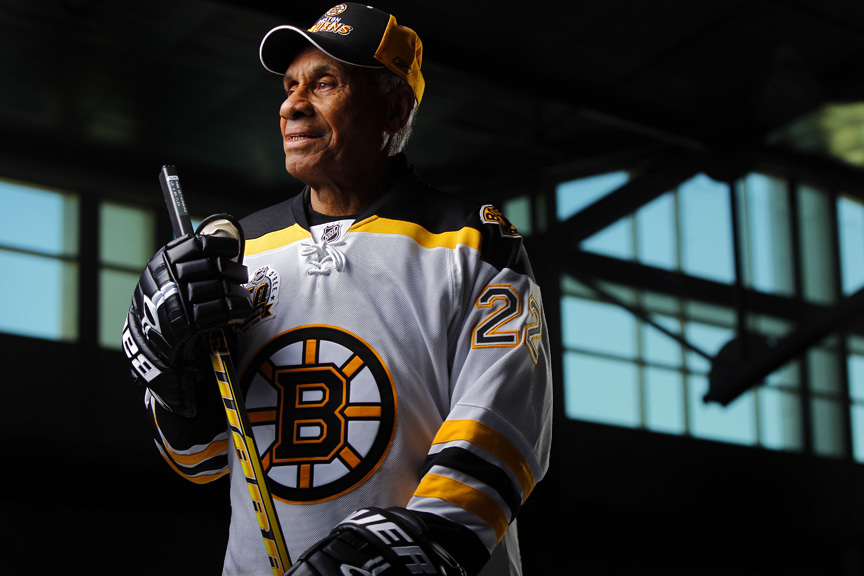
He made his debut, wearing Number 22, on January 18, 1958, against the Montreal Canadiens at the Montreal Forum. Despite the Habs being at almost the exact midpoint of their 5 straight Stanley Cups, the Bruins won the game, 3-0. O'Ree neither scored nor assisted, but simply by taking the ice, he changed hockey history.
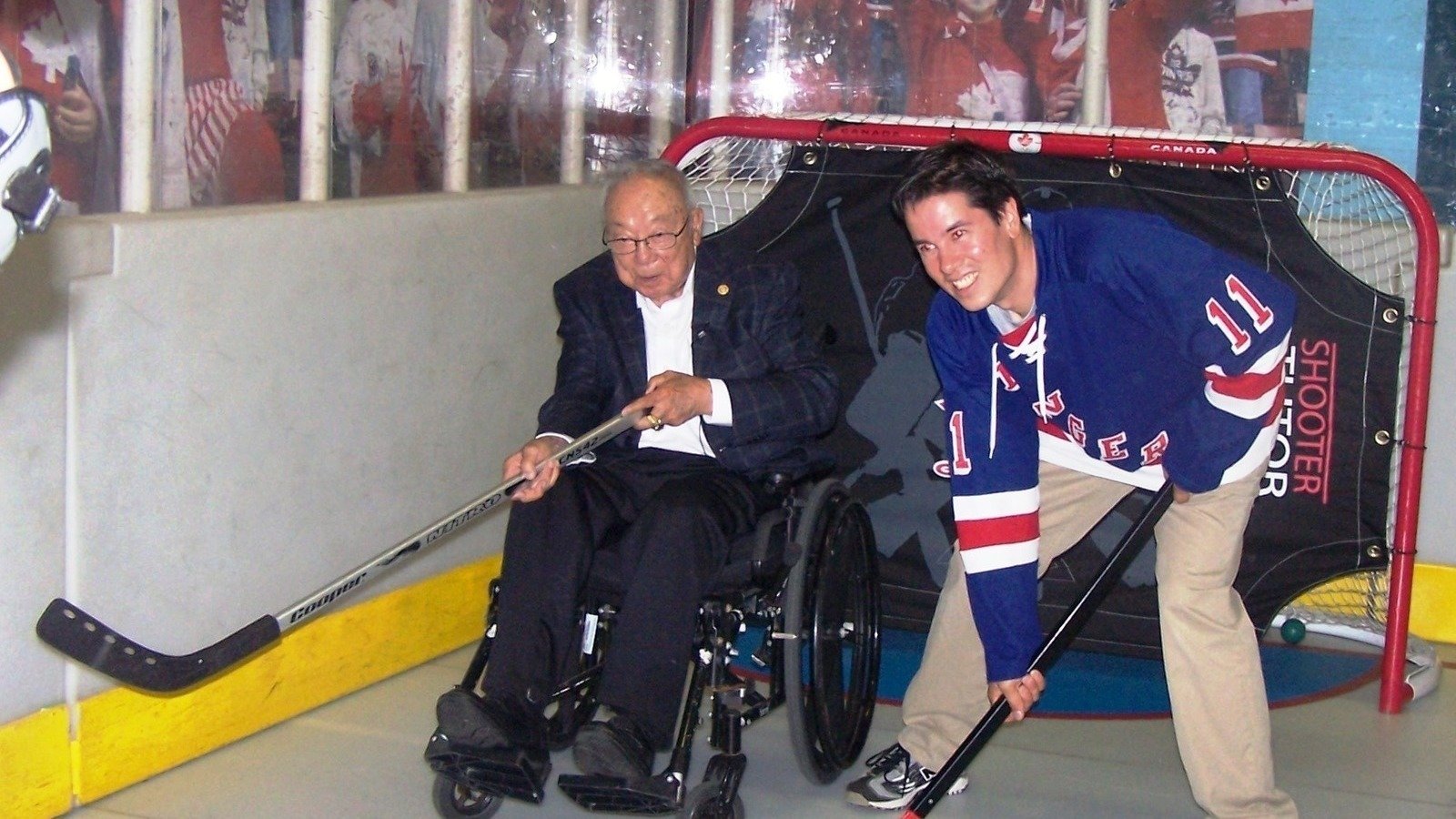
Actually, he wasn't the 1st nonwhite player in the NHL. A few players of Native American ancestry had played before him, and Larry Kwong, a Chinese-Canadian from British Columbia, played 1 NHL game, for the New York Rangers, on March 13, 1948. Like O'Ree, his debut was against the Canadiens at the Forum. The Canadiens won, 3-2. Kwong was on the ice for just 1 minute, and never returned.

In his 45 games, he scored 4 goals and had 10 assists. He also had 26 penalty minutes: "Race never started a fight. I never fought because I had to. I fought because I wanted to." Sounds like a Boston Bruin to me!
After he last played for the Bruins in 1961, not until the expansion season of 1974-75 would there be another black player in the NHL, Mike Marson of the hopeless 1st-year Washington Capitals. After these African-Canadians, the first African-American to play in the NHL was Val James, a left wing from Ocala, Florida, who played 7 games for the Buffalo Sabres in 1982 and 4 more for the Toronto Maple Leafs in 1988, but spent most of his career in the minors.
O'Ree would go on to play in the Western Hockey League, for the Los Angeles Blades and the San Diego Gulls, scoring 328 goals in that league. He first played professionally for the Fredericton Junior Capitals of the New Brunswick Junior Hockey League in 1951, at age 15; and last for the San Diego Hawks of the Pacific Hockey League in 1979, at age 43.
I have no doubt that playing in the 6-team, 120-player era held him back, although he was only on the verge of his 32nd birthday at the time of the NHL's 1967 expansion, and the World Hockey Association had no qualms about taking "old men" when they started in 1972, as he was turning 37. He should have played in either of the big leagues again.
His Number 24 was retired by the Gulls (now defunct, but the banner still hangs at the San Diego Sports Arena), and he has been elected to the San Diego Hall of Champions, the city's equivalent of a municipal sports hall of fame. His hometown of Fredericton named its new arena Willie O'Ree Place, and his country has named him an Officer of the Order of Canada for his youth hockey work. His home Province has awarded him the Order of New Brunswick. The NHL gave him the 2000 Lester Patrick Award, for service to hockey in the U.S.
Of these 25, 7 are Americans, including Ranger rookie Emerson Etem and Islander All-Star of Nigerian descent Kyle Okposo. There's former Devils Cup-winner Johnny Oduya, the son of a Kenyan father and a Swedish mother. While men of Caribbean descent but born in France are common in professional soccer, the only one currently in the NHL is Pierre-Édouard Bellemare of the Philadelphia Flyers, whose father is from Martinique.
The other 16 are Afro-Canadians (a term preferred there over "African-Canadians"). They include Bellemare's Flyer teammates Ray Emery and Wayne Simmonds, Chicago Blackhawks Cup-winner Trevor Daley, Canadiens All-Star Pernell "P.K." Subban and his brother Malcolm Subban of the Bruins, and Jarome Iginla of the Colorado Avalanche, who will probably be the 2nd black player in the Hockey Hall of Fame, after Grant Fuhr, the starting goalie on 4 Stanley Cup teams for the Edmonton Oilers and backup on a 5th.
"I never get tired," O'Ree has said. "It's the thing that I experienced. When I broke the color barrier in 1958, it seemed to stick with me. The media called me the Jackie Robinson of hockey, and I'm very happy to be in the same category of Mr. Robinson. I met Mr. Robinson on two occasions. I met him in 1949 in Brooklyn, and I met him again in 1962, when he was the keynote speaker at a luncheon in Los Angeles. He made a big impact with me. I'm just happy when they say there's Willie O'Ree, he's the Jackie Robinson of hockey."
October 15, 1582: Pope Gregory XIII orders that the Julian Calendar, which is scientifically off by 11 days, be replaced by a new calendar. The difference in the new Gregorian Calendar is that years ending in -00, while divisible by 4 and thus traditionally "leap years," adding a 29th day to the month of February, will now only be leap years if they are divisible by 400. For example, 1600 was a leap year, but 1700, 1800 and 1900 were not. 2000 was, 2100 will not be.
The new calendar was necessary because certain holy days, such as Ash Wednesday and Easter, were calculated astronomically, and did not fall on the same day every year. Gee, wouldn't it have been simpler to just make them fall on the same day every year? Say, Ash Wednesday is the 3rd Wednesday in February, while Easter is the 1st Sunday in April? Leave it to organized religion to complicate things.
The Catholic world, including Spain and Portugal and their colonies, adopted the Gregorian Calendar immediately. In other words, October 4, 1582 was immediately followed by October 15, 1582. That year, October 5 through October 14 simply never happened.
But not everyone adopted it at once. Protestant nations, such as Britain and the states that would make up modern Germany, didn't. Eastern Orthodox nations such as Greece and Russia didn't, either. Britain didn't adopt it, and January 1 as New Year's Day, until 1752. As a result, while George Washington's date of birth is now listed as February 22, 1732, as a man born in the British Empire under the Julian Calendar, he considered his birthdate to be February 11, 1731 -- as the Empire then celebrated the New Year on March 25. Such dates falling between October 4, 1582 and September 13, 1752 are now listed as "O.S." for Old Style.
Russia adopted the Gregorian Calendar after the Bolshevik Revolution in 1917. This is why the year's 2 revolutions are skewed, date-wise: The "February Revolution" that deposed the Czar is now listed as having happened on March 8, not February 23 (O.S.); while the Bolshevik Revolution is also known as the October Revolution, beginning October 25 (O.S.), but now listed as November 7 (N.S. or New Style). The next year, 1918, with the fall of the Ottoman Empire, Turkey becomes the last major nation to switch over.
*
October 15, 1875, 140 years ago: Charles Timothy O'Leary is born in Chicago. A weak-hitting shortstop, he played for the Detroit Tigers' Pennant-winners of 1907, '08 and '09. He coached under Miller Huggins with both the St. Louis Cardinals and the Yankees, and in 1920 made the mistake of getting in a car driven by Babe Ruth, who had an accident. O'Leary was thrown from the car, but survived.
On September 30, 1934, Charley O'Leary was called out of retirement by the St. Louis Browns, a couple weeks shy of his 59th birthday. In a pinch-hitting appearance, he O'Leary singled and scored, becoming the oldest Major League Baseball player to bat, the oldest to successfully collect a hit, and the oldest to score a run. Until surpassed Satchel Paige in 1965, he was oldest to ever play in the major leagues. He died in 1941, age 65.
October 15, 1881: Harmar Denny McKnight organizes a new Allegheny Baseball Club of Pittsburgh in anticipation of a proposed new league, which becomes the American Association. This is the birth of the club known today as the Pittsburgh Pirates, although they cite their 1887 entry into the National League as their “date of birth,” and wore centennial patches on their sleeves in the 1987 season.
October 15, 1892: Charles “Bumpus” Jones of the Cincinnati Reds‚ making his major league debut‚ pitches a no-hitter against the Pirates‚ winning 7-1 on the final day of the season. Jones‚ who won 16 games in a row in the minors‚ will have a tough time the following season when the pitching distance is increased from 50 feet to 60 feet, 6 inches. He will go 1-4 with a 10.93 ERA, and will never pitch in the majors again.
October 15, 1897: William Chase Temple, a coal, citrus and lumber magnate based in Pittsburgh‚ who also owns the Pirates and as such donated a trophy that has been contested for the last 4 baseball seasons by the 1st- and 2nd-place finishers in the National League‚ is dissatisfied with this year’s contest. He will attend the League meeting, and ask that the Temple Cup be returned to him. The League will investigate the charge that the players agreed beforehand to divide the receipts equally.
In 1894, despite finishing 2nd, the New York Giants had won the Temple Cup by sweeping the NL Champion Baltimore Orioles in 4 straight. In 1895, the 2nd-place Cleveland Spiders took the Champion Orioles in 5. In 1896, the Pennant-winning Orioles got half of their revenge, sweeping Cleveland in 4. In 1897, the 2nd-place Orioles defeated the Champion Boston Beaneaters (forerunners of the Braves) in 5.
These games are not, however, generally considered to be for the “world championship,” and after the 1899 season the Orioles were consolidated out of the NL, making possible the brief 2-year presence of a franchise of the same name in the AL, and then a minor-league team of that name from 1903 to 1953, before the St. Louis Browns moved and returned the City of Baltimore and the Orioles name to the major league level.
There was also a Dauvray Cup, donated by actress Helen Dauvray, wife of Giants star John Montgomery Ward. The Giants won it in 1888 and 1889, but the 3-league strife of 1890 led to its end. And there was the Chronicle-Telegraph Cup, only awarded once, in 1900, when the 2nd-place Pirates thought they were a better team than the Pennant-winning Brooklyn Superbas, and challenged them to a postseason series, with a trophy donated by a Pittsburgh newspaper. The Pirates were wrong, the Dodgers beat them 3 games to 1. Or maybe they were just premature: The Pirates won the next 3 Pennants. That trophy was never again contested.
Today, the Temple Cup and the Chronicle-Telegraph Cup can be seen in the museum section of the Baseball Hall of Fame, while the Dauvray Cup has long since been lost.
I’ve occasionally wondered if baseball history would have been any different if the game had a prominent trophy such as the Stanley Cup as a prize all those years. Would the White Sox have thrown the 1919 World Series if they knew it meant they would not win the Temple Cup, or the Dauvray Cup?
The current trophy, the Commissioner’s Trophy, with its ring of flags, was first awarded in 1967, but it still isn’t as identified with its sport as the Stanley Cup, or the Super Bowl trophy, also first awarded that calendar year and renamed the Vince Lombardi Trophy after Lombardi’s death in 1970.
The trophy has been won the following number of times: The Yankees 7 times, the Cardinals and A’s 4 each, the Reds and Red Sox * 3, 2 each to the Pirates, Orioles, Tigers, Mets, Twins, Blue Jays, Marlins, Phillies and Giants, and once each to the Royals, Braves, Diamondbacks, Angels and White Sox. The Cubs and Indians have each won 2 World Series, but they won them before the Commissioner’s Trophy was created, so they don't have one.
*
October 15, 1899: The Cincinnati Reds close out the season with 16-1 and 19-3 home victories over the hapless Cleveland Spiders. John “Bid” McPhee‚ usually considered the best 2nd baseman of the 19th Century‚ plays in both games‚ the last of his career, with all 18 being spent with the Reds.
Cleveland finishes deep in the cellar with 20 wins and 134 losses‚ 84 games out, a “winning” percentage of .149. They also conclude a 36-game road trip (1-35) after setting a mark earlier this year with a 50-game road trip. They lost 24 straight at one point (the worst ever, the worst since being the 1961 Phillies with 23), and 40 out of their last 41. These all remain records for professional baseball futility.
The reason for the Spiders’ futility is that they were bought by the owners of the St. Louis team that would soon be renamed the Cardinals. This system, known as “syndicate baseball,” was legal at the time. And, as St. Louis natives, the owners brought all of the good Cleveland players, including pitcher Cy Young – but not Louis Sockalexis, the once-powerful but now injured and alcoholic Penobscot tribesman who has been called “the original Cleveland Indian” – to St. Louis. The result is a Cleveland team that may not even have been, by today’s standards, Triple-A quality.
The Spiders, the Baltimore Orioles, the Louisville Colonels and the Washington Nationals will be consolidated out of the National League within weeks, though this makes the American League, and its franchises in Cleveland, Washington and, at least for two years, Baltimore, possible.
In their 13-season history, the Spiders were 827-938, a percentage of .4685. Minus that last season, they were 807-804, .5003. They deserved a better fate: They had on their roster, at one time or another, Hall-of-Famers Cy Young, John Clarkson, Buck Ewing, Bobby Wallace, George Davis and Jesse Burkett, plus Cupid Childs, Chief Zimmer, Patsy Tebeau, Lave Cross, Louis Sockalexis, Lou Criger, Kid Carsey and Jack O'Connor, any one of who would have been an All-Star had there been an All-Star Game in the 1880s or 1890s.
They never won a Pennant, but finished 2nd in the NL in 1892, 1895 and 1896, and were 81-68 (5th out of 12) in 1898 before the syndicate broke them up. They were not a failed franchise: They got sabotaged.
The last surviving 1899 Cleveland Spider was right fielder Lewis "Sport" McAllister, who lived until 1962. No date of death is known for pitcher Frank Bates, who went 3-19 that season, losing his last 14 decisions. The last record anyone has of him is from 1918. He would have been 85 years old when McAllister died, so it is possible he was the last survivor.
October 15, 1910: Stanley Ketchel, Middleweight Champion of the World since 1907, known as the Michigan Assassin, is murdered at the Conway, Missouri ranch where he was training. He was 34.
The murderer was a ranch hand named Walter Dipley. He and the ranch’s cook, Goldie Smith, were a couple (but not married) and set Ketchel up to be robbed.
Dipley was captured the next day. At the trial, Smith said she had no idea Dipley was going to rob Ketchel. They were both convicted of murder anyway, and sentenced to life in prison, but Smith’s conviction was overturned and she served just 17 months. Dipley served 23 years.
The writer John Lardner (son of Ring and brother of Ring Jr.) wrote, “Stanley Ketchel died yesterday, shot by the husband of the woman who was cooking his breakfast” – the implication being that Dipley was a jealous husband who had caught Ketchel having an affair with his wife. It was great writing, but it wasn’t true.
Ketchel’s manager, a con artist named Wilson Mizner, was told about Ketchel’s death, and said, “Tell ‘em to start counting ten over him, and he’ll get up.” (Mizner is also believed to be the source of the classic lines, “If you copy from one author, it’s plagiarism. If you copy from two, it’s research” and “Be kind to the people you meet on the way up, because you’re going to meet the same people on the way down.”)
October 15, 1911: In an exhibition game at the Polo Grounds in New York‚ Honus Wagner‚ Walter Johnson‚ Gabby Street and other white major leaguers take on the Lincoln Giants‚ a star-studded black team featuring John Henry “Pop” Lloyd‚ Dick McClelland‚ and Louis Santop. (Being named for Abraham Lincoln was a sign that it was an all-black team.) Johnson strikes out 14 to give the white all-stars a 5-3 win. Wagner, Johnson, Lloyd and Santop would all be elected to the Hall of Fame.
October 15, 1912: In Game 7 on a cold day in Boston‚ the Giants catch up with Joe Wood’s smoke‚ teeing off for 6 runs on 7 hits before the 32‚694 fans have settled down. Jeff Tesreau wobbles to an 11-4 win, and the Series is tied at 3-all. (Game 2 was called because of darkness while still tied.) The only Boston bright spot is Tris Speaker’s unassisted double play in the 9th‚ still the only one ever by an outfielder in Series play.
Before the game‚ Red Sox management foolishly releases the Royal Rooters’ block of tickets to the general public‚ and when the Rooters march on to the field shortly before game time‚ they find “their” seats taken. The Rooters refuse to leave the field, and the club resorts to using mounted policemen to herd them behind the left-field bleacher rail or out of the park.
When the Red Sox win the coin flip after today’s game to determine the site for the deciding match‚ the upset Royal Rooters boycott the finale‚ lowering the attendance. Imagine that, the Boston Red Sox management doing something to upset their loyal fans. Good thing that didn’t become a trend, right?
October 15, 1917: After the White Sox’ Urban “Red” Faber and the Giants’ Rube Benton match 3 scoreless innings in Game 6‚ the Sox’ Eddie Collins leads off the 4th and hits a grounder to Heinie Zimmerman at 3rd base. Collins takes 2nd when the throw gets past 1st baseman Walter Holke. Joe Jackson’s fly to right field is dropped by Dave Robertson‚ and Collins goes to 3rd.
When Oscar "Happy" Felsch hits one back to the pitcher‚ Collins breaks for home. Benton throws to 3rd to catch Collins‚ and catcher Bill Rariden comes up the line. But with Zimmerman in pursuit, Collins keeps running and slides home safely. Zimmerman will be blamed for chasing the runner‚ but he shouldn't be, because nobody was covering home plate, so he didn't have anybody to whom he could throw.
The Giants come back with 2 runs on Buck Herzog’s triple in the 4th‚ but Faber, a future Hall-of-Famer, wins his 3rd game of the Series 4-2, and the White Sox take the Series.
This turns out to be the last World Series won by a Chicago team for 88 years – partly due to the fault of at least 6 and possibly 7 White Sox “throwing” the Series 2 years later.
A letter signed by 24 members of the World Series Champion Chicago White Sox and manager Pants Rowland contains complaints concerning not receiving their full winners' share after beating the Giants. The written request, which will be discovered as a tattered document more than 40 years later in boxes stored at the Hall of Fame library, may explain the Black Sox' motivation for fixing the Fall Classic the 2 years later.
The last surviving member of the 1917 White Sox was right fielder Harry “Nemo” Leibold, who lived until 1977.
*
October 15, 1920: Mario Gianluigi Puzo is born in Manhattan. In his screenplay for The Godfather Part II, the character of Hyman Suchowsky, a young Jewish mobster played in that part of the film by John Megna, is asked by his new boss, young Vito Corleone, to pick a new name. He chooses Rothstein, in honor of the man behind the Black Sox Scandal, saying: “I’ve loved baseball ever since Arnold Rothstein fixed the World Series in 1919.” This name is later shortened to “Hyman Roth.”
The older Roth is played by Lee Strasberg, and the character was based on real-life mobster Meyer Lansky, who, unlike Roth, not only outlived the 1959 finale of that film, but was still alive when the film was released in 1974, and phoned Strasberg to compliment him on his performance.
October 15, 1923: The Yankees win Game 6 of the World Series, riding a 1st-inning homer by Babe Ruth and the pitching of “Sad” Sam Jones, to beat the Giants 6-4 at Polo Grounds, and clinch their 1st World Championship.
This was not, however, the 1st title for many of the Yankee players. Some of them, including Ruth and Jones, had won titles with the Boston Red Sox in the 1910s. In fact, of the 25 men on the Yankee roster when they won their 1st World Championship, 12, nearly half, had been Red Sox sold off by Boston owner Harry Frazee.
This was also the beginning of the end for Giant manager John McGraw and his style of baseball: Finally, the Yankees had put together a team that did not have to simply rely on Ruth’s home runs to beat McGraw’s style of “inside baseball” – what would, today, be called “small ball.”
The Giants would win another Pennant the next season, but that would be the last under McGraw’s leadership. In the 85 seasons after that, in New York and San Francisco combined, the Giants took 8 Pennants, still more than most teams have. Up until this moment, the Giants had won 11 Pennants and 3 World Championships, either through the World Series, pre-1900 postseason series, or the title of the only league then playing; the Dodgers, 6 and, by the means available to them to win a “world championship” at the time, 3, but none since 1900; the Yankees, 3 and none.
From the Yankees’ 3rd Pennant in September 1923 until the end of the Giants’ and Dodgers’ last season in New York, September 1957, forward, the count was: Yankees, 21 and 17; Giants, 7 and 2; and Dodgers, 7 and 1. (The Giants have since added 2 more Pennants, and won the World Series both times.
The last surviving member of the 1923 Yankees was center fielder Ladislaw Waldemar Wittkowski, a.k.a. Lawton Walter Witt, a.k.a. Whitey Witt, who lived until 1988.
*
October 15, 1925, 90 years ago: A steady downpour yesterday and today has left the field at Forbes Field in Pittsburgh a muddy mess, as Game 7 of the World Series is played in the rainiest conditions in Series history. The weather forecast suggested rain for the next 3 days for both cities involved, Pittsburgh and Washington, making the moving of Game 7 to Washington a bad idea, and Commissioner Kenesaw Mountain Landis was anxious to get it over with.
While I’ve never seen film of this game -- I don’t even know if any survives, although YouTube has footage from earlier in the Series -- it would have been just plain wrong to play if the rain were as bad as what Philadelphia and Tampa Bay faced when Game 5 of the 2008 Series was suspended. There was a 4-day delay due to rain in 1911, and there were 3-day delays in 1962 and 1975. It could have been done again.
It’s a short day for Pirate starter Vic Aldridge: 3 walks and 2 hits‚ and he’s out of there with just 1 out in the 1st. Walter Johnson takes a 4-0 lead to the mound. In what becomes known as “Johnson’s Last Stand,” the Bucs clobber the 38-year-old Big Train for 15 hits‚ good for 24 total bases. Max Carey’s 4-for-5 gives him a Series-high .458.
The Senators make the most of 7 hits‚ scoring 7 runs‚ including shortstop Roger Peckinpaugh’s home run‚ the 12th homer of the Series by both teams combined‚ then a Series record, despite Forbes Field and Washington’s Griffith Stadium both having some of the most distant fences in the game. Johnson would have fared better but for 2 more errors by Peckinpaugh‚ his 7th and 8th‚ still the Series record for any position. The Senators made only one other error in the 7 games.
Ray Kremer picks up his 2nd win with a 4-inning relief effort‚ as the Pirates win 9-7. This is the Pirates’ 1st World Championship in 16 years, and only one player remains from that 1909 title with Honus Wagner: Babe Adams, who had pitched and won 3 games in ’09, and was riding out the string in ’25. No Washington team has been as close to a World Series win since.
The last surviving member of the 1925 Pirates was shortstop Glenn Wright, who lived until 1984.
October 15, 1927: William Rodman Henry is born in Alice, Texas. A pitcher, he debuted with the 1952 Red Sox, was an All-Star with the 1960 Cincinnati Reds, and was on the Reds' 1961 Pennant-winner. He closed his career back in South Texas with the Houston Astros in 1969, with a record of 46-50, and died in 2014, at the age of 86.
October 15, 1928: After just one season away from the club for which he’d played his entire big-league career, Walter Johnson signs a 3-year contract to manage the Senators‚ owner Clark Griffith having secured his release from the 2nd year of his contract to manage the minor-league Newark Bears. Tris Speaker, newly retired as a player, will take over as Newark’s manager.
Despite being arguably the greatest pitcher and the greatest center fielder the game has yet seen, neither Johnson nor Speaker would lead the Bears to a Pennant. In fact, Johnson never won a Pennant as a manager, and Speaker never did except in 1920, when he had himself in his prime as a player.
*
October 15, 1933: The Philadelphia Eagles play their 1st game in the NFL. It doesn’t go so well: They lose to the New York Giants at the Polo Grounds, 56-0. The birth of the Eagles was made possible by Pennsylvania finally dropping its law banning sporting events on Sunday. Due to their proximity, Eagles vs. Giants will, eventually, become one of the NFL’s best rivalries.
October 15, 1935, 80 years ago: On the same day that Willie O'Ree was born, Bobby Joe Morrow is born in the Rio Grande town of Harlingen, Texas, and grows up in nearby San Benito. He won the 100 meters and 200 meters, and was part of the U.S. team in the 4x100-meter relay, winning 3 Gold Medals at the 1956 Olympics in Melbourne, Australia. He is still alive.
Also on this day, Barry McGuire (no middle name) is born in Oklahoma City, and grows up in California. The lead singer of the New Christy Minstrels, who had a hit with "Green, Green," in 1965 he took Phil Sloan's gloom & doom song "Eve of Destruction" to Number 1, despite most radio stations banning it.
He doesn't have much to do with sports, but there are times when I feel like sports is on the eve of destruction, and I don't mind to tell you, over and over and over again, my friend.
October 15, 1937: Rather than accept any trade offers‚ the Yankees release Tony Lazzeri, and allow him to make his own deal. That’s right: In the heart of the reserve clause era, a future Hall-of-Famer, not yet 34 years old, has been allowed to become a free agent. "Poosh-em-Up Tony" later signs as a player-coach with the Chicago Cubs, and retires as a player after the 1939 season.
October 15, 1939: New York Municipal Airport is dedicated in Astoria, Queens. It was built because Mayor Fiorella LaGuardia demanded it, having once flown TWA with a ticket that said, "New York," and instead landing at Newark Airport. In 1953, it would be renamed for the late Mayor.
LaGuardia is the source of the infamous planes that can be seen and heard at Mets home games and during the U.S. Open tennis tournament, just 2 miles across Flushing Bay. The takeoffs are much more of a problem than the landings, which are on a different flight path. Indeed, in my opinion, the plane noise is the one thing about Citi Field that is not an improvement over Shea Stadium: I think that's actually gotten worse.
Also on this day, Gordon Gund (no middle name) is born in Cleveland. He played hockey at Harvard University and served in the U.S. Navy, and, like his father George Gund II, went into big business. But he was stricken with retinitis pigmentosa, and gradually went blind. He founded a foundation to fight the disease.
In spite of his blindness, he helped his brother George Gund III move the California Golden Seals hockey team to become the Cleveland Barons in 1976. But the team was losing money badly due to a bad lease at the Richfield Coliseum. After a failed bid to buy the Coliseum, the Gunds were allowed to purchase the financially failing Minnesota North Stars, and merge the 2 teams, thus folding the Barons and keeping the Stars afloat.
But the Stars still didn't make money. The Gunds jwanted to move them, and try the Bay Area again, but the NHL wouldn't allow it. The League did allow them to sell the Stars and take an expansion team, which became the San Jose Sharks, a highly profitable team. Gordon sold his share in 1992, while George retains a small share.
By 1983, the brothers had finally bought the Coliseum, and also bought the Cleveland Cavaliers. In 1994, they built the Gund Arena, across the street from the Indians' new ballpark. In 2005, they sold the team and the arena to Dan Gilbert, who renamed the building after his company: Quicken Loans Arena.
Gordon Gund lives in Princeton, Mercer County, New Jersey. Despite his blindness and his age (he is now 76), he has received acclaim as a sculptor, carving animals in wood and having them recast in bronze.
*
October 15, 1945, 70 years ago: James Alvin Palmer is born in Manhattan, and grows up in Scottsdale, Arizona. Jim Palmer helped the Baltimore Orioles win the World Series in 1966, 1970 and 1983, and when I say “helped” I don’t just mean he pitched very well in the regular season: He is the only pitcher to win World Series games in 3 different decades. He is in the Hall of Fame, and the Orioles have retired his Number 22.
At Scottsdale High School, he was 2 years ahead of future Vice President Dan Quayle, who was a star on their golf team.
Also on this day, Jerald Eugene Burns II is born in Cambridge, Massachusetts. Known professionally as Jere Burns, he is best known as the womanizer Kirk Morris on Dear John, and played Wynn Duffy on Justified. He also appeared on the recent premiere of the new version of The Muppets.
October 15, 1946: It seems only fitting that the World Series with the most regular-season wins by the combatants – the Boston Red Sox with a city-record 106 wins, and the St. Louis Cardinals with 105, 1 win off their city record from ’42 – goes to a deciding Game 7 at Sportsman’s Park in St. Louis.
Red Sox fans are confident: After all, no Boston team has ever lost a World Series. The Braves won one in 1914; the Red Sox won them in 1903, 1912, 1915, 1916 and 1918.
But center fielder Dom DiMaggio gets hurt, and has to be replaced by Leon Culberson. In the bottom of the 7th, Enos Slaughter is on 1st for the Cards, and Harry Walker is up. Slaughter takes off for 2nd on the hit-and-run. “Harry the Hat” drives the ball to center. Slaughter sees Culberson bobble the ball, and thinks he can score.
I’ve seen the film of the play many times. Culberson gets the ball to Sox shortstop Johnny Pesky, and I simply cannot see that with which Pesky has been accused for the last 69 years: “Hesitating” or “holding the ball.” And I don’t think it would have mattered, as Slaughter scored by plenty.
It became known as “the Mad Dash” or “Slaughter’s Sprint,” and in the telling of the legend, Slaughter is usually said to have scored from 1st on a single. Not really: Walker did make it to 2nd and was credited with a double. But it is the go-ahead run, and the Cardinals win, 4-3.
For the Cardinals, led by Slaughter and the sensational Stan Musial, it is their 6th World Championship, their 3rd in 4 tries in the last 5 seasons. For the Red Sox, it is not only their 1st-ever World Series defeat, after not getting that far for 28 years, and the 1st-ever World Series loss for any Boston team, but it is the beginning of a stretch of 4 seasons in which they will end up bitterly disappointed 3 times.
Billed as the duel between the 2 best hitters in baseball‚ the Series sees Musial go 6-for-27 (.222) and Boston’s Ted Williams 5-for-25 (.200 -- combined, the Splendid Splinter and Stan the Man batted .212). This will be the only Series of Williams’ career, and the only one the Red Sox will play in a 49-year stretch from 1918 to 1967.
The Cardinals, at first, will fare little better, as they won’t play in another Series for 18 years: Whereas Musial, who spent the ’45 season in the Navy and that was the only season from ’42 to ’46 when the Cards didn’t win at least the Pennant, had won a Pennant in each of his first 4 full seasons, he will play another 17 seasons without winning one, despite close calls in ’47, ’48 and ’49 and 2nd-place finishes in ’56 and his final season of ’63.
Harry Brecheen wins 3 games for the Cardinals‚ the 1st lefthander ever to accomplish this. It is a feat that has been matched only by Mickey Lolich in 1968 and Randy Johnson in 2001. Brecheen won Games 6 and 7‚ a feat matched only by the Big Unit.
With Musial’s death in 2013, and that of Pesky the year before, there are now 2 surviving members of each of these teams: For the Cards, 2nd baseman Red Schoendienst (HOF as a player although he was also a pretty good manager), and catcher Joe Garagiola (HOF as a broadcaster); for the BoSox, HOF 2nd baseman Bobby Doerr and pitcher Dave “Boo” Ferriss.
Also on this day, Suzanne Marie Mahoney is born in San Bruno, California, in the Bay Area. We know her as Suzanne Somers. As far as I know, the actress best known for playing Chrissie Snow on Three's Company has nothing to do with sports, although her fitness videos could get you into shape.
*
October 15, 1955, 60 years ago: The Honeymooners airs the episode "The Golfer." Hello, ball!
October 15, 1959: Emeril John Lagasse is born in Fall River, Massachusetts. I hope the great TV chef, a big Red Sox fan but a man who loves New York City, doesn’t blow out the candles on his cake by shouting, “BAM!” I do hope, however, that he contacts Dan Le Batard, the Miami Herald columnist and sometime guest-host on ESPN’s Pardon the Interruption, about appropriating his “BAM!” on the air.
October 15, 1962: After being postponed by 3 days of rain -- and with helicopters hovering over the Candlestick Park field to help dry it out -- Game 6 of the World Series is finally played. Billy Pierce allows a Roger Maris home run, but otherwise outpitches Whitey Ford, and the San Francisco Giants beat the Yankees 5-2.
No team has won 2 straight games in this Series, the 1st time it has ever happened: The Yankees have won all the odd-numbered games, while the Giants have won all the even-numbered games. Game 7 is an odd-numbered game.
October 15, 1964: Game 7 of the World Series at Sportsman’s Park – or, as Cardinals owner and Anheuser-Busch beer baron August Anheuser Busch Jr., a.k.a. “Gussie” Busch, has renamed it, Busch Stadium. The Cardinals start Bob Gibson, loser of Game 2 but winner of Game 5, on 2 days’ rest. The Yankees start rookie Mel Stottlemyre, who had defeated Gibson in Game 2.
Lou Brock’s 5th-inning home run triggers a 3-run frame and a 6-0 lead for Gibson. Mickey Mantle‚ Clete Boyer‚ and Phil Linz homer for New York – for Mantle, the record 18th and final Series homer of his career – and the Yanks close to within 7-5 in the 9th. But it’s not enough, as an exhausted Gibson finds enough gas in his tank to finish the job, and the Cards are the World Champions.
Both Boyers‚ Ken for the Cards and Clete for the Yankees‚ homer in their last Series appearance. While they had homered in back-to-back games, Clete in Game 3 and Ken a grand slam in Game 4, this remains the only time in Series history that 2 brothers have both homered in the same game.
Although the Yankees (27) and Cardinals (11) have won more World Series than any other team, they have never met in another, despite both making the Playoffs in 1996, 2000, 2002, 2004, 2005, 2006, 2011 and 2012. (Both teams came close in 1974, the Cards just missed in 1981, and the Yanks just missed in 1985.)
For each manager, it is his last game at the helm. Johnny Keane had nearly been fired by Cardinal management in mid-season, and their come-from-behind run to top the Philadelphia Phillies had saved his job. But he had had enough, and he resigns.
Yogi Berra, after helping the Yankees to 14 World Series as a player and now 1 as their manager, also coming from behind, to top the Chicago White Sox, thinks he’s done a good job, and expects to be offered a new contract. Instead, he gets fired, and Yankee management hires… Johnny Keane.
This will turn out to be a massive mistake. While the Cardinals will hire their former star 2nd baseman Red Schoendienst, who will lead them to the 1967 World Championship and the 1968 Pennant, Keane, already in ill health, will be a terrible fit for the Yankees, getting fired early in 1966, and he dies in 1967.
Del Webb and Dan Topping, who had owned the Yankees since 1945, had just sold the Yankees to CBS – yes, the broadcast network – and had cared little for keeping the farm system stocked. As a result, there was very little talent left to call up to the majors when the Yanks’ current stars got hurt or old, and it seemed like they all got hurt or old at once.
In the 44 seasons from 1921 to 1964, the Yanks won 29 Pennants and 20 World Series, but fell to 6th place in 1965, 10th and last in ’66. Despite a 2nd-place finish in ’70, they were well behind the World Series-winning Orioles. They didn’t get into a race where they were still in it in August until ’72, to the last weekend still in the race until ’74 (by which time George Steinbrenner had bought the team from CBS), to the postseason until ’76 and the World Championship until ’77.
In 2008, Buster Olney published The Last Night of the Yankee Dynasty, about the one that began in 1996, and ended at what's now called Chase Field in Phoenix on November 4, 2001. But no baseball dynasty, indeed no sports dynasty, was as, well, dynastic as the 1949-64 Yankees. Peter Golenbock's Dynasty: The New York Yankees 1949-64 tells of how it was built, and how it began to fall apart; David Halberstam's October 1964 tells of how both the Yankees and the Cardinals got to this Game 7, and what happened thereafter; both books put the teams in the context of their times, at home and abroad.
There are 19 surviving players from the 1964 Cardinals, 51 years later: Gibson, Brock, catchers Tim McCarver and future Hall of Fame broadcaster Bob Uecker, shortstops Dick Groat and Dal Maxvill, 2nd baseman Julian Javier, 1st baseman (and future Yankee broadcaster and NL President) Bill White, infielder Jerry Buchek; outfielders Mike Shannon, Carl Warwick, Bob Skinner and Charlie James; and pitchers Roger Craig, Curt Simmons, Bob Humphreys, Gordie Richardson, Ray Washburn and Ron Taylor. Coach Schoendienst is also still alive. Pitchers Ray Sadecki and Barney Schultz both died within the last year.
Yogi died last month. There are 13 surviving players from the 1964 Yankees: Pitchers Stottlemyre, Whitey Ford, Ralph Terry, Rollie Sheldon, Jim Bouton, Al Downing and Pedro Ramos; shortstops Linz and Tony Kubek, 2nd basemen Bobby Richardson and Pedro Gonzalez, outfielder Hector Lopez and 1st baseman Joe Pepitone. (In each case, this only counts players who were on the World Series rosters.)
None of them had any inkling that this was anything other than the last day of a great season, that it was The Last Day of the Yankee Dynasty.
*
October 15, 1966: The Boston Celtics open the NBA season by defeating the San Francisco Warriors, 121-113 at the Boston Garden. Rick Barry scores 41 points for the Warriors, but, as usual, the Celtics have a more balanced team, led by 29 points from Sam Jones.
Bill Russell scores only 8 points, but he had other things on his mind. Namely, he was now a player-coach, the 1st black coach in NBA history, and, unless you count Fritz Polland of the 1st NFL Champions, the 1920 Akron Pros (and the NFL was hardly a major league at that point), the 1st black coach in the history of North American major league sports. That this happens on the birthday of Willie O'Ree, and in the building he also called home with the Bruins, is interesting, but not especially relevant.
The Celtics would fall to the Philadelphia 76ers in the Eastern Conference Finals this season, but Russell would lead them to the NBA title in 1968 and 1969 -- making him the most recent player-coach to lead a team to a World Championship. Alas, while Bill Russell is still one of the Top 10 players in NBA history, he didn't do so well as a coach when he didn't have Bill Russell as a player: With himself playing, his coaching record is 162-83, for a winning percentage of .661; otherwise, with the 1974-77 Seattle SuperSonics and the 1987-88 Sacramento Kings, he's 100-122, .450; overall, 341-290, for a winning percentage of .540.
Also on this day, the Chicago Bulls make their NBA debut. Guy Rodgers scores 36 points, and they beat the St. Louis Hawks, 104-97 at the Kiel Auditorium. For most of their history, the Bulls will be at least good, and, at times, historically good.
Also on this day, Jorge Francisco Campos Navarrete is born in Acapulco, Mexico. The soccer player started as a striker with Mexico City club UNAM, a.k.a. Pumas, winning his national league in 1991. But he switched to being a goalkeeper, and won the league with Mexico City club Cruz Azul (Blue Cross) in 1997.
In 1998, Jorge Campos moved to the Chicago Fire, and helped them win the American version of The Double: The MLS Cup and the U.S. Open Cup. He helped Mexico win the CONCACAF Gold Cup in 1993 and 1996, and the Confederations Cup in 1999. He played in the World Cup in 1994, 1998 and 2002, and closed his career with Puebla in 2004. He now owns a restaurant, and commentates for TV Azteca.
October 15, 1968: Didier Deschamps is born in Bayonne. That’s Bayonne, in the Basque Country of southwestern France; not Bayonne, New Jersey. The midfielder captained France to victory in the 1998 World Cup and Euro 2000.
As a player, he helped Olympique de Marseille win Ligue 1 in 1990 and '92, and the Champions League in 1993 -- the only French club ever to win the European Cup. With Juventus of Turin, Italy, he won Serie A in 1995, '97 and '98; the Coppa Italia in 1995 (making a Double), and the Champions League in 1996 (he is one of 20 players, thus far, to win the European Cup with 2 different clubs). With Chelsea, he won the 2000 FA Cup.
As manager, he led AS Monaco (which is not in France but is in the French football system) to the 2003 League Cup and the runner-up spot in Ligue 1 in 2003 and the Champions League in 2004; and Marseille to Ligue 1 in 2010 and 3 straight League Cups from 2010 to 2012. He is now the manager of the France national team.
October 15, 1969: Game 4 of the World Series at Shea Stadium, the Mets’ Tom Seaver against the Orioles’ Mike Cuellar, in a rematch of Game 1. It turns out to be a brilliant pitching duel between the Fresno stuff-mixer and the Cuban curve and screwball master.
The Mets were clinging to a 1-0 lead in the top of the 9th, but the O’s get Frank Robinson to 3rd and another runner on 1st with 1 out. Brooks Robinson hits a sinking liner to right field, which looks like a game-winning 2-run double. But Ron Swoboda dives and snares it. Frank still manages to tag up and score the tying run, sending the game to extra innings.
In the bottom of the 10th, tied at 1-1, Met manager Gil Hodges gambles on getting a run now or good work from his bullpen and a run at some later point, and sends J.C. Martin up to pinch-hit for Seaver. “Tom Terrific” is normally a good hitter by pitchers’ standards, but this is no time for that. Martin bunts, and Pete Richert, who has relieved Cuellar, tries to throw him out at 1st, but his throw hits Martin on the wrist. The ball gets away, and Rod Gaspar, who had been on 2nd, comes around to score the winning run.
The Mets are now 1 win away from completing their “Miracle.” The upset is nearly complete, and former Yankee and Met manager Casey Stengel no longer speaks sarcastically when he uses the word he used to describe the awful early Mets: When interviewed about it, he says, “The New York Mets are amazing, amazing, amazing, amazing… ”
*
October 15, 1970: The Orioles avenge their upset loss in last year’s World Series, and claim their 2nd title with a 9-3 win over the Cincinnati Reds in Game 5 at Memorial Stadium.
After winning the first 3 games and then dropping Game 4 – this remains the only time in Series history this has ever happened – the O’s overcome a 3-0 deficit for the 3rd time in the Series. Frank Robinson and Merv Rettenmund each homer and drive in 2 runs.
Brooks Robinson‚ who has not only fielded so spectacularly that he has been nicknamed the “Human Vacuum Cleaner‚” but has also gotten several key hits, and fields the final out, easily wins the Series MVP award.
There are 14 surviving members of the 1970 Orioles: Both Robinsons, Palmer (who won this Series on his 25th birthday), Rettenmund, Richert, John "Boog" Powell, Davey Johnson, Andy Etchebarren, Bobby Grich, Dick Hall, Tom Phoebus, Terry Crowley, Eddie Watt and Dave Leonhard.
Also on this day, the Buffalo Sabres play their 1st home game. It turns into their 3rd straight loss, as they fall to the Montreal Canadiens 3-0 at the Buffalo Memorial Auditorium.
October 15, 1971: Julius Erving plays his 1st professional basketball game. The University of Massachusetts star, already known as Doctor J, suits up for the Virginia Squires against the Carolina Cougars at the Greensboro Coliseum. He scores 21 points, but it's former North Carolina star Charlie Scott who leads all scorers with 36, leading the Squires to a 118-114 victory.
Also on this day, Andrew Alexander Cole is born in Nottingham. One of the 1st great black soccer players in England, the striker is the 2nd-leading goal scorer in Premier League history – that is, the 2nd-highest in English league play since the 1st division of “the Football League” became the Premier League in 1992. Too bad he did most of it for Manchester United. He scored 187 times in Premiership play, although this is well behind the record of 260 held by former Newcastle United star Alan Shearer.
With Man U, he won the League in 1996, '97, '99, 2000 and '01; the FA Cup in 1996 and '99, and the UEFA Champions League in 1999, completing England's only European Treble. With Blackburn Rovers, he won the 2002 League Cup. He was usually known as Andy when he played, but now prefers to be called Andrew.
October 15, 1972: In what turns out to be his last appearance at a major league ballpark, Jackie Robinson, speaking prior to Game 2 of the World Series at Riverfront Stadium in Cincinnati, urges baseball to hire a black manager. Jackie will die of a heart attack, brought on by years of weakening by diabetes, 9 days later.
The 1st African-American skipper will not be hired until 2 years later, just after the conclusion of the 1974 regular season, when the Cleveland Indians hire Frank Robinson to run the team.
The Oakland Athletics win Game 2, 2-1, as Joe Rudi clouts a homer and makes an amazing game-saving catch in the 9th to back up Catfish Hunter’s pitching. Despite being without their best player, the injured Reggie Jackson, the A’s take a 2-game advantage over the Big Red Machine as the Series moves to Oakland.
Also on this day, the Winnipeg Jets play their 1st home game. Despite winning their 1st 2 games on the road, over the hapless New York Raiders and the somewhat better Minnesota Fighting Saints, they lose this one, 5-2 to the Alberta Oilers at the Winnipeg Arena.
October 15, 1974: Game 3 of the World Series. The A's beat the Dodgers 3-2 at the Oakland Coliseum, despite Jim "Catfish" Hunter giving up a home run to Bill Buckner -- easily Buckner's greatest moment in baseball. No one knows it at the time, but this is Catfish Hunter’s last game for Oakland.
Also on this day, the Washington Capitals play their 1st home game, managing a 1-1 tie against the Los Angeles Kings at the Capital Centre in Landover, Maryland. It was one of the highlights of a season that saw them go 8-67-5.
Also on this day, the Washington Capitals play their 1st home game, managing a 1-1 tie against the Los Angeles Kings at the Capital Centre in Landover, Maryland. It was one of the highlights of a season that saw them go 8-67-5.
October 15, 1977: The Yankees beat the Dodgers in Game 4 at Dodger Stadium, 4-2, to take a 3-1 advantage in the World Series. Reggie Jackson doubles and homers‚ and rookie lefthander Ron Guidry pitches a 4-hitter‚ striking out 7.
From August 10, 1977 through April 22, 1979, including the postseason, Guidry went 42-5 with a 1.93 ERA, one of the greatest runs any pitcher will ever have.
Also on this day, David Sergio Trezeguet is born in Rouen, France. A striker, he won France's Ligue 1 with AS Monaco (which plays in that league despite not actually being in France) in 1997 and 2000, and Italy's Serie A with Turin club Juventus in 2002 and 2003. He was Serie A Top Goalscorer, Footballer of the Year and Foreign Footballer of the Year in 2002. But he missed a penalty in the 2003 UEFA Champions League Final, one of the misses that made the difference as Juve lost to AC Milan in the 1st-ever UCL Final to be played by 2 teams from the same country.
He played on the France team that shocked Brazil in the Final to win the 1998 World Cup on home soil, and his "Golden Goal" beat Italy in the Final of Euro 2000. Italy got their revenge when they beat his France side in the 2006 World Cup Final. In spite of this, upon retiring earlier this year, he went back to Italy to be a part of Juventus' management team.
October 15, 1978: The Yankees beat the Dodgers in Game 5 at Yankee Stadium, 12-2, to take a 3-2 advantage in the World Series. Jim Beattie, the Yanks’ 4th starter who had a 6-9 record in the regular season, pitches the 1st complete game of his career. Bucky Dent, Mickey Rivers and Brian Doyle, substituting at 2nd base for the injured Willie Randolph, each collect 3 hits.
After taking the 1st 2 games in L.A., the Dodgers have been shellshocked by Graig Nettles’ defensive display in Game 3 and Reggie Jackson’s “Sacrifice Thigh” in Game 4, and have not recovered. The Series heads back to California, and the Yankees need to win only 1 of the last 2.
Also on this day, the San Diego Clippers play their 1st home game. The lose 98-94 to the Denver Nuggets at the San Diego Sports Arena.
October 15, 1979: The Utah Jazz play their 1st home game. They have even less luck than the Clippers did a year earlier, getting pounded by the Milwaukee Bucks, 131-107, despite 29 points from Pistol Pete Maravich.
Also on this day, Paul William Robinson is born in Beverly, East Yorkshire, England. A goalkeeper, he was in the net for North London club Tottenham Hotspur's last trophy, the 2008 League Cup. But he was also the starting goalie when Leeds United had one of the worst seasons in Premier League history in 2004, receiving a relegation from which they have not yet recovered. After being cut by Blackburn Rovers after last season, he is currently without a club.
*
October 15, 1981: The Yankees beat the A’s, 4-0 at the Oakland Coliseum, and sweep the ALCS in 3 straight.
Once and future Yankee manager Billy Martin, a native of nearby West Berkeley, California, had previously played for the Oakland Oaks’ 1948 Pacific Coast League champion under Casey Stengel, and now, once again, he had revived the fortunes of his hometown team, saving the A’s from total incompetence and irrelevance, taking them from 108 losses the year before he arrived to 2nd place in his 1st season to the AL West title in his 2nd.
This was the 5th time Billy had managed a team into the postseason, and with the 4th different team: Minnesota in 1969, Detroit in ’72, the Yankees in ’76 and ’77, and he came close to making it 6 times with 5 different teams, with Texas in ’74.
When introduced before Game 1 of this series at Yankee Stadium, Billy got a huge ovation. That made him very happy. George Steinbrenner couldn’t be reached for comment. But in this series, the Yankees just had too much for the A’s, and took their 33rd Pennant -- the A’s, if you count their Philadelphia years, are 2nd among AL teams, with 12.
For reasons partly, but not entirely, his fault, Billy would never manage in the postseason again. And, for reasons partly, but not entirely, Billy’s fault, the Yankees’ 34th Pennant would not be soon in coming. Today, the total stands at Yankees 40, A’s 16. (Red Sox? 13. If you count the last 3*.)
During this Game 3 at the Oakland Coliseum, “professional cheerleader” Krazy George Henderson, a native of nearby San Jose, leads what is thought to be the first audience Wave. “And anybody who says I didn’t is a stinkin’ liar,” he would later say. Robb Weller, later to co-host Entertainment Tonight, would say he didn’t, claiming to have invented the Wave himself, at a University of Washington football game. But the game in question happened 2 weeks later, so I’m inclined to believe Krazy George.
Now 71 years old and still a “free agent” cheerleader, Krazy George once game to a Trenton Thunder game I was at, and we won. I told him, “George, stick around, we need the wins!” To be honest, though (and I didn’t tell him this), I’ve always hated the Wave. I find it juvenile.
October 15, 1984: The Green Bay Packers play on ABC's Monday Night Football. No surprise there. They play in a snowstorm. Okay, it's a little early in the year for snow, but such weather is hardly unusual for the Packers. What is unusual is that it's an away game for them.
The blizzard hits Mile High Stadium in Denver, and the Packers, uncharacteristically, can't handle it, fumbling away their 1st 2 possessions deep in their own territory, and the Denver Broncos take a quick 14-0. The Pack try to come back, but it's not quite enough: The Broncos hold on, 17-14.
October 15, 1986: Desperate to win Game 6 of the National League Championship Series at the Astrodome, the Mets do not want to face Houston pitcher Mike Scott – a Met-killer both as a Met and an Astro – in a Game 7, especially in the Astrodome, where Scott is far better than he is on the road.
The Mets use that sense of desperation to score 3 runs in the top of the 9th to force extra innings. In the 14th, the Mets make their first bid to win. After Gary Carter opens with a single, a walk to Darryl Strawberry puts 2 runners on with nobody out. After Knight forces Carter at 3rd, Wally Backman drives a single to right. When Kevin Bass’ throw to the plate sails high over Alan Ashby’s head to the screen, Strawberry scores.
But with 1 out in the bottom of the 14th and the Houston fans with their heads in their hands, Billy Hatcher shocks everyone with a line-drive home run off the left field foul pole. It was the 1st earned run allowed by the Mets bullpen in the entire series. Hatcher went 3-for-7 in the game, and his homer meant the Astros would be kept alive for at least one more inning. (This presages his heroics in the 1990 World Series.)
Both teams fail to score in the 15th, and the game goes to the 16th inning, the most innings in baseball’s postseason history at that time. The Mets appear to take control of the game once again, this time coming up with 3 runs in the top half of the inning. The rally begins with Strawberry receiving a gift double when Hatcher and Bill Doran misplay his towering fly ball with 1 out. When Knight follows with a single to right, a poor throw to the plate by Bass allows the tiebreaking run to score, just as it had in the 14th. Jeff Calhoun then relieves Aurelio Lopez and uncorks a walk, two wild pitches, and a single by Lenny Dykstra to bring in 2 more runs, putting the Mets up 7–4.
But as they had in the 14th, the Astros refuse to go down without a fight in the bottom of the 16th. Jesse Orosco strikes out Craig Reynolds to open the inning, but a walk and 2 singles later, Houston has a run in and the tying run on base. Orosco induces Denny Walling to hit into a force play at 2nd for the 2nd out, but Glenn Davis singles home another run, bringing the Astros within 7-6.
The tying run is on 2nd, the winning run on 1st – a run that Met fans do not want to allow to score. So damned smug all season long, Met fans are now are freaking out over the possibility of facing Scott in the Dome in Game 7, and their magnificent 108-win season, their “inevitable” World Championship, going down in flames.
But Orosco strikes out Bass, ending the game. He throws his glove in the air, foreshadowing the end of the World Series. As the pitcher of record when the Mets took the final lead, he is was awarded the victory, marking the 1st time in postseason history that a reliever won 3 games in a series.
Despite a .189 batting average, the lowest average ever recorded by a winning team in a postseason series, the Mets have their 3rd National League Pennant, and it remains the only one they’ve ever clinched on the road.
In fact, to this day, 11 of the Mets’ 16 clinchings have been at Shea Stadium: 1969 Division (beating the St. Louis Cardinals to eliminate the Chicago Cubs), 1969 Pennant (Atlanta Braves), 1969 World Championship (Baltimore Orioles), 1973 Pennant (Cincinnati Reds), 1986 Division (Chicago Cubs to eliminate Philadelphia Phillies), 1986 World Series (Boston Red Sox), 1988 Division (beating and eliminating Pittsburgh Pirates), 1999 Division Series (Arizona Diamondbacks), 2000 Wild Card (beating the Braves to eliminate the Los Angeles Dodgers), 2000 Division Series (San Francisco Giants), and 2006 Division (beating the Florida Marlins to eliminate the Phillies).
Their only road clinchings have been: 1973 Division (at Wrigley Field against the Cubs, eliminating the Cardinals), the aforementioned 1986 Pennant, 1999 Wild Card (at Riverfront Stadium in a play-in game against the Reds), 2006 Division Series (at Dodger Stadium against, well, the Dodgers), and 2006 Division (at Great American Ballpark against the Reds). They have the chance to clinch at Dodger Stadium tonight.
My Grandma watched Major League Baseball for about 75 years, first as a Dodger fan in Queens and Newark, then as a Met fan in the New Jersey towns of Belleville, Nutley and Brick. I asked her once what her favorite game of all time was. This is the one she chose, without hesitation. I can’t say that I blame her. It wasn’t a “heavyweight title fight,” with big punches going back and forth. It was more like a middleweight or welterweight fight, with lots of jabs, until finally one fighter finished off a “death of a thousand cuts” and the other fell. It was an epic.
The same day, after being down 3 games to 1 in the ALCS, the Red Sox complete one the greatest comebacks in Playoff history by defeating the California Angels 8-1 to win the American League Pennant.
The game caps yet another heartbreaking failure for Angels skipper Gene Mauch‚ who in Game 5 was 1 strike away from reaching his 1st World Series in 25 seasons as a major league manager. He had previously been a part of the Phillies’ collapse in 1964, a tough last-weekend Division loss for the Montreal Expos in 1980, and the Angels’ 2-games-to-none choke against the Milwaukee Brewers in 1982. No manager ever managed longer without winning a Pennant. After the game‚ 2nd baseman Bobby Grich retired after a fine career with the Orioles and Angels.
The Mets and Red Sox winning Pennants on the same day -- with the Sox having beaten the Yankees out for the Division en route to doing so. This was a bad day to be a Yankee Fan. Over the next 12 days, it would get worse.
*
October 15, 1988: In one of the most improbable finishes in World Series history‚ pinch hitter Kirk Gibson hits a 2-run home run off Dennis Eckersley with 2 out and 2 strikes in the bottom of the 9th inning, to give the Los Angeles Dodgers a 5-4 win over the Oakland Athletics in Game 1.
The injured Gibson was not expected to play in the Series, and will not play in it again. It is the first World Series game to end on a home run since Game 6 in 1975.
Vin Scully, normally the voice of the Dodgers but broadcasting this game for NBC, said, "In a year that has been so improbable, the impossible has happened." Jack Buck, normally the voice of the St. Louis Cardinals but broadcasting on radio for CBS, said, "I don’t believe what I just saw!"
Yankee Fans of my generation had heard tall tales of Mickey Mantle limping up to home plate, looking like he had no chance, then hitting a home run anyway, and limping around the bases to the rapturous cheers of the Bronx faithful. But since we weren’t old enough to have seen it, and the expense of videotape meant that so many of those old games were taped over by WPIX-Channel 11, we’ve hardly seen any footage of it. (Mickey’s 500th homer, on May 14, 1967, is an exception, thankfully preserved, showing both Mickey and the pre-renovation old Yankee Stadium in full color.) Gibson, one of many players who got the tag “the next Mickey Mantle” -- and he got a lot more of the Mantle injuries than the Mantle homers -- gave my generation a glimpse of what that must have been like.
After the game, Eckersley coined the phrase “walkoff home run.” The powerful A’s, winners of 103 games, were expected to make quick work of the comparatively weak-hitting Dodgers, who barely scraped by the Mets in the NLCS. Instead, Gibson’s homer set the tone for a very different Series.
It’s also worth noting that Gibson had a good enough year to be named NL Most Valuable Player that season, and had previously hit 2 home runs in Game 5 of the 1984 World Series, to give the Detroit Tigers the championship. So he’s one of the few players to be a World Series hero for 2 different teams -- in 2 different leagues, no less.
Last year, Gibson was fired as the manager of the Arizona Diamondbacks, having won the NL West title in 2011. He is not in the Baseball Hall of Fame, as some predicted he might be, because injuries limited him to 252 home runs. He, David Wells and Jake Peavy share ownership of a hunting ranch in Michigan. He was recently diagnosed with Parkinson's disease. He and his wife JoAnn have been married for almost 30 years, and they have 4 children. One, son Cam, has followed in his father’s footsteps, playing baseball at Michigan State University and being drafted by the Tigers.
Eckersley was not unduly affected by this home run: He just kept on becoming one of the best relief pitchers ever, after having been a pretty good starter. He won 197 games in his career, and saved 390 others. He is one of 2 pitchers to have a 20-win season and a 50-save season, the other being John Smoltz. He is in the Baseball Hall of Fame and the Boston Red Sox Hall of Fame, and the A’s have retired his Number 43. He’s now a studio analyst for both TBS and the Red Sox’ NESN.
Also on this day, Mesut Özil is born in Gelsenkirchen, Westphalia, Germany. A 3rd-generation Turkish-German, the midfielder has starred for the German national soccer team. He helped Werder Bremen win the 2009 DFB-Pokal (German national cup), and Spanish club Real Madrid win the 2011 Copa del Ray (King’s Cup) and 2012 League title.
He now plays for London club Arsenal, and, within a 2-month span in 2014, won the FA Cup with Arsenal and the World Cup with Germany. He won another FA Cup this year. Contrary to what those idiots who support Tottenham and Chelsea believe, he is one of the top 5 players in the world.
*
October 15, 1989: Wayne Gretzky scores a goal for the Los Angeles Kings for his 1,851st career point, surpassing Gordie Howe to become the NHL’s all-time leading points scorer. The goal comes with 53 seconds left in regulation, tying the game against his former team, the Edmonton Oilers, a game the Kings go on to win in overtime.
Also on this day, Blaine Williamson Gabbert is born in the St. Louis suburb of Ballwin, Missouri. He played 3 seasons as a quarterback for the Jacksonville Jaguars, and is now Colin Kapernick's backup on the San Francisco 49ers.
October 15, 1995, 20 years ago: Nine months after New York Jets owner Leon Hess hired Rich Kotite as head coach, saying, "I'm 80 years old, I want results now!" he gets a result. Not one he's looking for.
The Jets fall to 1-5, playing one of the worst games in team history -- including a Bubby Brister shovel-pass that gets turned into a "pick six" -- and the expansion Carolina Panthers get their 1st win ever, 26-15, at Frank Howard Field at Memorail Stadium in Clemson, South Carolina.
October 15, 1997: The Baltimore Orioles waste another magnificent effort by Mike Mussina, as the Cleveland Indians score the game’s only run on Tony Fernandez’s home run in the top of the 12th to win‚ 1-0. Mussina hurls 8 shutout innings and allows just 1 hit‚ while walking 2 and striking out 10. Charles Nagy does not give up a run in 7 1/3 innings for the Indians‚ while surrendering 9 hits‚ as the O’s leave 14 batters on base.
The pitcher who gave up the Pennant-winning homer to Fernandez? Armando Benitez. It is not the last time he will mess up a postseason game, but it is the last time he will do so for the Orioles. The O’s now had a 4-6 record in postseason games played at Camden Yards. Having finally gotten back to the postseason in 2012, but crashed out in the 2012 ALDS and the 2014 ALCS, that record now stands at 6-8, including 1-7 in ALCS games.
October 15, 1999: Despite his guidance of the team to 5 straight AL Central titles and 2 Pennants, the only postseason berths the team has had since 1954, the Cleveland Indians fire manager Mike Hargrove.
October 15, 2001: The Yankees defeat the A’s‚ 5-3‚ to move into the ALCS. In doing so‚ they become the 1st team ever to win a best-of-5 series after losing the first 2 games at home. Derek Jeter gets a pair of hits to break Pete Rose’s postseason record with 87. David Justice hits a pinch-hit homer for the Yanks.
They will face the Seattle Mariners, whose 116-win season nearly went down the drain against the Indians, but they came back from a 2-games-to-none deficit. Not the biggest choke in Indians’ history, but bad enough.
October 15, 2003: The Florida Marlins complete a stunning comeback by defeating the Chicago Cubs‚ 9-6 in Game 7 at Wrigley Field‚ to win their 3rd straight game and the NLCS.
The Cubs seemed, at first, not to be affected by their Game 6 disaster, as homers by pitcher (!) Kerry Wood and aggrieved left fielder Moises Alou give them a 5-3 lead. But Florida bounces back to take the lead on Luis Castillo’s RBI single in the 6th. Miguel Cabrera hits a 3-run homer for the Marlins.
Catcher Ivan Rodriguez, who wins his first Pennant after going 1-9 in postseason games with the Texas Rangers, is named the NLCS Most Valuable Player. (Cough-steroids-cough, cough-Bartman-cough-absolved-cough)
Meanwhile, Game 6 of the ALCS is played at Yankee Stadium, as the Hundred-Year War builds toward a crescendo. The Red Sox rally for 3 runs in the 7th inning to come from behind, and pull out a 9-6 victory over the Yankees to send it to a Game 7. Boston slugs 16 hits‚ including 4 by Nomar Garciaparra‚ and gets HRs from Jason Varitek and Trot Nixon.
October 15, 2005, 10 years ago: Jason Collier, center for the Atlanta Hawks dies at age 28, of an enlarged heart. He remains the last active NBA player to die.
October 15, 2006: Game 4 of the NLCS at Busch Stadium. There will come a day when Met fans will, perhaps unfairly, rue the names of Carlos Beltrán and Óliver Pérez. This is not that day. Pérez gives up home runs to Jim Edmonds, David Eckstein, and, with some foreshadowing, Yadier Molina. But he gets 2 homers from Beltrán, and 1 each from David Wright and Carlos Delgado, and the Mets beat the Cardinals, 12-5.
The series is tied, and, at the least, there will be a Game 6 at Shea Stadium. Met fans, in the only season between 1988 and 2015 in which they have gone further than the Yankees, have reason to have some confidence.
October 15, 2007: The Colorado Rockies beat the Arizona Diamondbacks, 6-4 at Coors Field in Denver, and complete a sweep of the NLCS for their 1st Pennant. Matt Holliday’s 3-run homer makes the difference.
No team had ever swept their way to the World Series since the Division Series began in 1995. The Rockies were also the 1st team to have a 7-0 start to a postseason since the 1976 Cincinnati Reds finished 7-0, sweeping both the LCS and World Series.
The Rockies now have a chance to match or beat the 1999 Yankees’ achievement of 11-1, the best postseason record since the LCS went to a best-4-out-of-7 in 1984. They have now won 21 of their last 22 games. But it will be their last win of the season, as they are, themselves, swept in the World Series by the Boston Red Sox * .
October 15, 2008: In Game 5 of the NLCS, the visiting Phillies beat the Dodgers, 5-1, to win their 1st Pennant in 15 years. Southpaw Cole Hamels, the series MVP, hurls his 3rd postseason win, and Jimmy Rollins starts Philadelphia attack with a leadoff home run to start the game.
October 15, 2011: With another home run in the Game 6 clincher, a 15-5 Texas Rangers rout of the Detroit Tigers, Nelson Cruz sets a new record for the most round-trippers in a postseason series with 6. The Texas right-fielder, who ended the regular season in a slump, is named the ALCS MVP.
It is the 2nd straight Pennant for the Rangers, as they'd never won a Pennant in the preceding 38 seasons (49 if you count their time as the "new Washington Senators"). They will try to top their finish of last season by winning the World Series, against the Cardinals.


