Showing posts with label bloomington. Show all posts

Sunday, December 28, 2025

December 28, 1975: The Cowboys' Hail Mary, Full of Disgrace

December 28, 1975, 50 years ago: The Minnesota Vikings host the Dallas Cowboys in an NFC Divisional Playoff game at Metropolitan Stadium, in the Minneapolis suburb of Bloomington, Minnesota. Each team had dominated, and would continue to dominate, its respective Division through the 1970s: The Vikings, the NFC Central; the Cowboys, the NFC East. The Cowboys had lost Super Bowl V and won Super Bowl VI; the Vikings had lost Super Bowls IV, VIII and IX, and were going for their 3rd straight NFC Championship.

The game's 1st half was relatively quiet, with only one score, a touchdown by the Vikings in the 2nd quarter that made it 7-0. The Cowboys tied it with a touchdown in the 3rd quarter. So the game was dominated by each team's defensive unit, the Cowboys' "Doomsday Defense" and the Vikings' "Purple People Eaters."

Early in the 4th quarter, Toni Fritsch, the Cowboys' Austrian-born placekicker, kicked a 24-yard field goal, and they led 10-7. But quarterback Fran Tarkenton, named the NFL's Most Valuable Player that season, led a touchdown drive that gave Minnesota a 14-10 lead with 5:24 left in regulation.

The Cowboys could not gain a 1st down on their next drive, so the Vikings got the ball with 3:12 left. With Tarkenton as a running quarterback, known as "Fran the Scrambler" -- as was the Cowboys' Roger Staubach, a.k.a. "Roger the Dodger" -- the Vikings kept the ball on the ground to run out the clock, forcing the Cowboys to use up all their timeouts.

But on a 3rd & 2 play, Charlie Waters sacked Tarkenton for a 3-yard loss, with the clock stopping for the 2-minute warning. Tarkenton later said, "That play cost us the game. It wasn't the Hail Mary pass. We had the game in control, but didn't make the play."

The Vikings punted, and the Cowboys got the ball back on their 15-yard line, with 1:51 left, and no timeouts, including the already-used 2-minute warning. Staubach got to the Cowboys' 31, then took a low snap and fumbled it, resulting in a 4th & 16 from the 23. He threw a pass to Drew Pearson, who was pushed out of bounds by Nate Wright before he caught it. Under the rule of the time, this counted as a reception. The rule was changed in 2008. The rule might not have been fair, but it was in place.

Staubach got the Cowboys to the 50-yard line with 32 seconds left. Staubach threw a long pass, usually called a "bomb" in those days. Being Catholic, he called it a "Hail Mary," putting that expression into the football lexicon.

The pass was intended for Pearson, who was again covered by Wright. Pearson pushed Wright, which should have resulted in a penalty for offensive pass interference. No penalty was called, and Pearson caught the pass, and took it in for a touchdown. The Cowboys led, 17-14.

To make matters worse for Tarkenton, he found out that his father -- named, with retroactive irony, the Reverend Dallas Tarkenton -- died while watching the game on television, back in their hometown of Athens, Georgia.

The Cowboys went on to beat the Los Angeles Rams for the NFC Championship, before losing Super Bowl X to the Pittsburgh Steelers. The Vikings rebounded to win the NFC Championship the next year, but lost Super Bowl XI to the Oakland Raiders. That made them 0-4 in Super Bowls, a total that would later be matched by the Denver Broncos and the Buffalo Bills. Through the 2021 season, the Vikings haven't even been to a Super Bowl since 1977. The Bills are still 0-4, but the Broncos have improved to 3-5.)

Viking fans have had to put up with a lot, but they still fume over the penalty that was not called on Staubach's pass. It wasn't a "Hail Mary, full of grace": It was full of disgrace. It remains the most infamous moment in the history of sports in the State of Minnesota.

The question needs to be asked, though: What if the penalty had been called? The Cowboys could still have won the game, anyway. Not for nothing was Staubach known as "Captain Comeback." And if the Vikings still won? They would have had to face the Rams in the NFC Championship Game, in Los Angeles. And if they'd won that, they would have had to face the Steel Curtain.

In this counterfactual scenario, I don't like their chances. They went to 4 Super Bowls between the seasons of 1969 and 1976, and they weren't the better team in any of them, and lost them all. So maybe their grievance over this game is bigger than it should be.

In hindsight, though, Pearson paid a price: It took until 2021 for him to be elected to the Pro Football Hall of Fame, his 33rd year of eligibility. For years, fans have speculated that there is a general bias against the Cowboys for the Hall: Mel Renfro had to wait 14 years; Rayfield Wright, 22 years; Bob Hayes, 30 years (and died before being elected); Cliff Harris, 36 years; Chuck Howley, 45 years.

Some are still waiting to get in: Don Meredith and Don Perkins have been eligible since 1974 (and both are dead), Lee Roy Jordan since 1981, Charlie Waters since 1987, Jay Novacek since 2001, and Darren Woodson since 2010. Howley was elected in 2023, his 45th year of eligibility. He was 86 years old, but at least he was still alive. Jordan died earlier this year.

In Pearson's case, it seemed as though the statistical case was there: 489 receptions, 7,822 yards, 48 touchdowns, all big numbers for a 1970s receiver. It was widely believed that one play was keeping him out: Nobody had ever punished the Cowboys for this unfair result, so the Hall voters punished Pearson as an individual. Regardless, he is in now. And, unlike Hayes -- and the still-not-in Meredith, Perkins and Jordan -- he lived long enough to see it.

Saturday, August 31, 2024

Major League Distances from Big Ten Cities

These schools are listed from East to West. Distances are listed in miles.

* Rutgers University, New Brunswick, New Jersey. Yankees, Giants, Nets, Devils, Red Bulls.
MLB, 46 to New York Yankees, 50 to New York Mets, 68 to Philadelphia Phillies.
NFL, 35 to New York Giants and New York Jets, 68 to Philadelphia Eagles.
NBA, 37 to Brooklyn Nets, 38 to New York Rangers, 68 to Philadelphia 76ers.
NHL, 28 to New Jersey Devils, 38 to New York Rangers, 57 to New York Islanders, 68 to Philadelphia Flyers.
MLS, 31 to New York Red Bulls, 46 to New York City FC, 84 to Philadelphia Union. 

* University of Maryland, College Park, Maryland. Nationals, Commanders, Wizards, Capitals, United.
MLB, 11 to Washington Nationals, 30 to Baltimore Orioles.
NFL, 10 to Washington Commanders, 29 to Baltimore Ravens.
NBA, 9 to Washington Wizards.
NHL, 9 to Washington Capitals.
MLS, 11 to D.C. United.

* Pennsylvania State University, a.k.a. Penn State, State College, Pennsylvania. Pirates, Steelers, 76ers, Penguins, Union.
MLB, 138 to Pittsburgh Pirates, 197 to Philadelphia Phillies.
NFL, 138 to Pittsburgh Steelers, 197 to Philadelphia Eagles.
NBA, 197 to Philadelphia 76ers, 239 to Cleveland Cavaliers, 297 to Toronto Raptors.
NHL, 137 to Pittsburgh Penguins, 197 to Philadelphia Flyers.
MLS, 186 to Philadelphia Union, 226 to New York Red Bulls, 239 to New York City FC, 295 to Toronto FC, 326 to Columbus Crew.

* Ohio State University, Columbus, Ohio. Reds, Bengals, Cavaliers, Blue Jackets, Crew.
MLB, 110 to Cincinnati Reds, 142 to Cleveland Indians.
NFL, 110 to Cincinnati Bengals, 145 to Cleveland Browns.
NBA, 142 to Cleveland Cavaliers, 177 to Indiana Pacers, 197 to Detroit Pistons.
NHL, 4 to Columbus Blue Jackets.
MLS, 4 to Columbus Crew.

* University of Michigan, Ann Arbor, Michigan. Tigers, Lions, Pistons, Red Wings, Crew.
MLB, 45 to Detroit Tigers.
NFL, 45 to Detroit Lions.
NBA, 44 to Detroit Pistons.
NHL, 44 to Detroit Red Wings.
MLS, 189 to Columbus Crew, 242 to Chicago Fire, 272 to Toronto FC.

* Michigan State University, East Lansing, Michigan. Tigers, Lions, Pistons, Red Wings, Fire.
MLB, 89 to Detroit Tigers, 217 to Chicago White Sox, 228 to Chicago Cubs.
NFL, 89 to Detroit Lions, 220 to Chicago Bears.
NBA, 86 to Detroit Pistons, 223 to Chicago Bulls.
NHL, 86 to Detroit Red Wings, 223 to Chicago Blackhawks.
MLS, 220 to Chicago Fire, 250 to Columbus Crew, 295 to Toronto FC.

* Indiana University, Bloomington, Indiana. Reds, Bengals, Bulls, Blackhawks, Fire.
MLB, 130 to Cincinnati Reds, 217 to Chicago White Sox, 224 to St. Louis Cardinals, 228 to Chicago Cubs.
NFL, 130 to Cincinnati Bengals, 220 to Chicago Bears.
NBA, 222 to Chicago Bulls.
NHL, 222 to Chicago Blackhawks, 224 to St. Louis Blues, 224 to Columbus Blue Jackets.
MLS, 220 to Chicago Fire, 223 to Columbus Crew, 225 to St. Louis City.

* Purdue University, West Lafayette, Indiana. White Sox, Colts, Pacers, Blackhawks, Fire.
MLB, 116 to Chicago White Sox, 127 to Chicago Cubs, 182 to Cincinnati Reds, 270 to St. Louis Cardinals.
NFL, 69 to Indianapolis Colts, 119 to Chicago Bears.
NBA, 71 to Indiana Pacers, 122 to Chicago Bulls.
NHL, 122 to Chicago Bulls, 270 to St. Louis Blues.
MLS, 119 to Chicago Fire, 271 to St. Louis City.

* University of Illinois, Champaign, Illinois. White Sox, Colts, Pacers, Blackhawks, Fire.
MLB, 132 to Chicago White Sox, 143 to Chicago Cubs, 174 to St. Louis Cardinals.
NFL, 125 to Indianapolis Colts, 135 to Chicago Bears.
NBA, 126 to Indiana Pacers, 138 to Chicago Bulls.
NHL, 138 to Chicago Blackhawks, 174 to St. Louis Blues.
MLS, 135 to Chicago Fire, 175 to St. Louis City.

* Northwestern University, Evanston, Illinois. Cubs, Bears, Bulls, Blackhawks, Fire.
MLB, Chicago Cubs 9, Chicago White Sox 19.
NFL, Chicago Bears 15.
NBA, Chicago Bulls 17.
NHL, Chicago Blackhawks 17.
MLS, Chicago Fire 15.

* University of Wisconsin, Madison, Wisconsin. Brewers, Packers, Bucks, Blackhawks, Fire.
MLB, Milwaukee Brewers 76, Chicago Cubs 143, Chicago White Sox 150, Minnesota Twins 271.
NFL, Green Bay Packers 142, Chicago Bears 151, Minnesota Vikings 269.
NBA, Milwaukee Bucks 80, Chicago Bulls 149, Minnesota Timberwolves 271.
NHL, Chicago Blackhawks 149, Minnesota Wild 262.
MLS, Chicago Fire 151, Minnesota United 264.

* University of Minnesota, Minneapolis, Minnesota. Twins, Vikings, Timberwolves, Wild, United.
MLB, Minnesota Twins 3.
NFL, Minnesota Vikings 2.
NBA, Minnesota Timberwolves 3.
NHL, Minnesota Wild 7.
MLS, Minnesota United 3.

* University of Iowa, Iowa City, Iowa. White Sox, Bears, Bulls, Blackhawks, Fire.
MLB, Chicago White Sox 227, Chicago Cubs 230, St. Louis Cardinals 260, Milwaukee Brewers 261, Minnesota Twins 281, Kansas City Royals 308.
NFL, Chicago Bears 228, Minnesota Vikings 279, Kansas City Chiefs 308, Green Bay Packers 317.
NBA, Chicago Bulls 222, Milwaukee Bucks 258, Minnesota Timberwolves 281.
NHL, Chicago Blackhawks 222, St. Louis Blues 260, Minnesota Wild 270.
MLS, Chicago Fire 228, St. Louis City 259, Minnesota United 274, Sporting Kansas City 320.

* University of Nebraska, Lincoln, Nebraska. Royals, Chiefs, Thunder, Blues, Sporting.
MLB, Kansas City Royals 203, St. Louis Cardinals 444.
NFL, Kansas City Chiefs 204.
NBA, Oklahoma City Thunder 436, Denver Nuggets 485.
NHL, St. Louis Blues 443.
MLS, Sporting Kansas City 192, St. Louis City 442.

* University of Southern California, a.k.a. USC, Los Angeles, California. Dodgers, Rams, Lakers, Kings, LAFC.
MLB, Los Angeles Dodgers 6, Los Angeles Angels 34.
NFL, Los Angeles Rams 7, Los Angeles Chargers, 7.
NBA, Los Angeles Lakers 2, Los Angeles Clippers, 2.
NHL, Los Angeles Kings 2, Anaheim Ducks 36.
MLS, Los Angeles FC 6, Los Angeles Galaxy 11.

* University of California at Los Angeles, a.k.a. UCLA, Los Angeles, California. Dodgers, Rams, Lakers, Kings, LAFC.
MLB, Los Angeles Dodgers 12, Los Angeles Angels 43.
NFL, Los Angeles Rams 12, Los Angeles Chargers 12.
NBA, Los Angeles Lakers 11, Los Angeles Clippers 11.
NHL, Los Angeles Kings 11, Anaheim Ducks 43.
MLS, Los Angeles FC 11, Los Angeles Galaxy 21.

* University of Oregon, Eugene, Oregon. Mariners, Seahawks, Trail Blazers, Kraken, Sounders.
MLB, Seattle Mariners 282.
NFL, Seattle Seahawks 282.
NBA, Portland Trail Blazers 111.
NHL, Seattle Kraken 284.
MLS, Portland Timbers 110.

* University of Washington, Seattle, Washington. Mariners, Seahawks, Trail Blazers, Kraken, Sounders.
MLB, Seattle Mariners 5.
NFL, Seattle Seahawks 5.
NBA, Portland Trail Blazers 175.
NHL, Seattle Kraken 4.
MLS, Seattle Sounders 5.

*

So:

* New York Yankees: Rutgers.
* Baltimore Orioles: Maryland.
* Pittsburgh Pirates: Penn State.
* Cincinnati Reds: Ohio State, Indiana.
* Detroit Tigers: Michigan, Michigan State.
* Chicago White Sox: Purdue, Illinois, Iowa.
* Chicago Cubs: Northwestern.
* Milwaukee Brewers: Wisconsin.
* Minnesota Twins: Minnesota.
* Kansas City Royals: Nebraska.
* Los Angeles Dodgers; USC, UCLA.
* Seattle Mariners: Oregon, Washington.

Sunday, November 12, 2017

How to Be a Rutgers Fan at Indiana

The football team at Rutgers University lost to Penn State yesterday, 35-6. Once upon a time, losing by 29 points away to Penn State would have been understandable. That was before Greg Schiano led Scarlet Knight fans to dream... and then walked away when the project was half-done.

RU plays away to Indiana University next Saturday.

Before You Go. Bloomington, Indiana is further south than Atlantic City. Despite being in the Midwest, it is not on a Great Lake, bringing strong winds and "lake effect snow." So the weather won't be substantially different from what we get in the Middle Atlantic States. The website of the Indianapolis Star is predicting high 40s for next Saturday afternoon, and low 30s for the evening. Bring a winter jacket.

Indiana used to be 1 of 2 States, Arizona being the other, where Daylight Savings Time was an issue; however, since 2006 -- 4 years after a West Wing episode lampooned this -- the State has used it throughout. There will be no need to adjust your timepieces.

Tickets. Indiana football is not Indiana basketball. They've sold out 2 of 5 home games this season. The last 2 seasons, only 1 of 13. You can probably get tickets for this game.

In both levels, front seats are $60, then they drop in price, until you get to the back, where they're $10.

Getting There. It's 761 miles from Times Square in Manhattan to downtown Bloomington, and 734 miles from Rutgers Stadium in Piscataway to Memorial Stadium. Knowing this, your first reaction is going to be to fly out there. This might be a problem, since Bloomington doesn't have a big airport. You'd have to fly to Indianapolis. Round-trip, non-stop, that could be had for under $600.
The State House, Indianapolis

If you take Amtrak, it will be simple to go out: You would board the Cardinal at Penn Station on Friday at 6:45 AM, and arrive at Union Station in Indianapolis on Saturday at 5:20 AM. Unfortunately, the Cardinal only runs 3 times a week, so you'll have a day and a half to kill in Indianapolis before the game. Going back, you'll leave Indy at 11:59 PM on Saturday, getting back to New York at 9:58 PM on Sunday. Round-trip fare would be $344. Union Station is at 350 S. Illinois Street, corner of South Street.

Getting to Indianapolis by plane or train, you'd still have to get to Bloomington, 52 miles away. You could rent a car. Or you could use Miller Transportation. Bloomington is a stop on their Indianapolis-to-Louisville bus run, so you might not have to rent a car at the Indianapolis airport. It's $36 round-trip. The bus leaves from Union Station, while Bloomington's bus terminal is at 301 S. Walnut Street.

Greyhound, however, does go to Bloomington, although you'd have to change buses in Indianapolis. The fare is $428, but it can drop to $394 with advanced purchase. The station is at 154 W. South Street, at Illinois Street, around the corner from Union Station. (That's right, "West South Street," but that's South Street, west of downtown.)

If you decide to drive, it's far enough that it will help to get someone to go with you and split the duties, and to trade off driving and sleeping. You'll need to get on the New Jersey Turnpike, and take Interstate 78 West across New Jersey, and at Harrisburg get on the Pennsylvania Turnpike, which at this point will be both I-70 and I-76.

When the two Interstates split outside Pittsburgh, stay on I-70 west. You'll cross the northern tip of West Virginia, and go all the way across Ohio (through Columbus), and halfway through Indiana. Exit 79B will take you to State Route 37 South, which will take a little under an hour to take you into Bloomington.

If you do it right, you should spend about an hour and 15 minutes in New Jersey, 5 hours in Pennsylvania, 15 minutes in West Virginia, 3 hours and 45 minutes in Ohio, and 2 hours in Indiana. That's going to be 12 hours and 15 minutes. Counting rest stops, preferably 6 of them, and accounting for traffic in both New York and Indianapolis, it should be about 15 hours.

Once In the City. Indiana was the 19th State admitted to the Union, on December 11, 1816. It is home to 6.6 million people. About half of them love the Indiana Hoosiers and hate the Purdue Boilermakers, and the other half are the other way around. Bloomington, founded in 1818, is home to about 85,000 permanent residents. The city is about 83 percent white, 8 percent Asian, 5 percent black and 4 percent Hispanic. Indiana University was founded there in 1820.
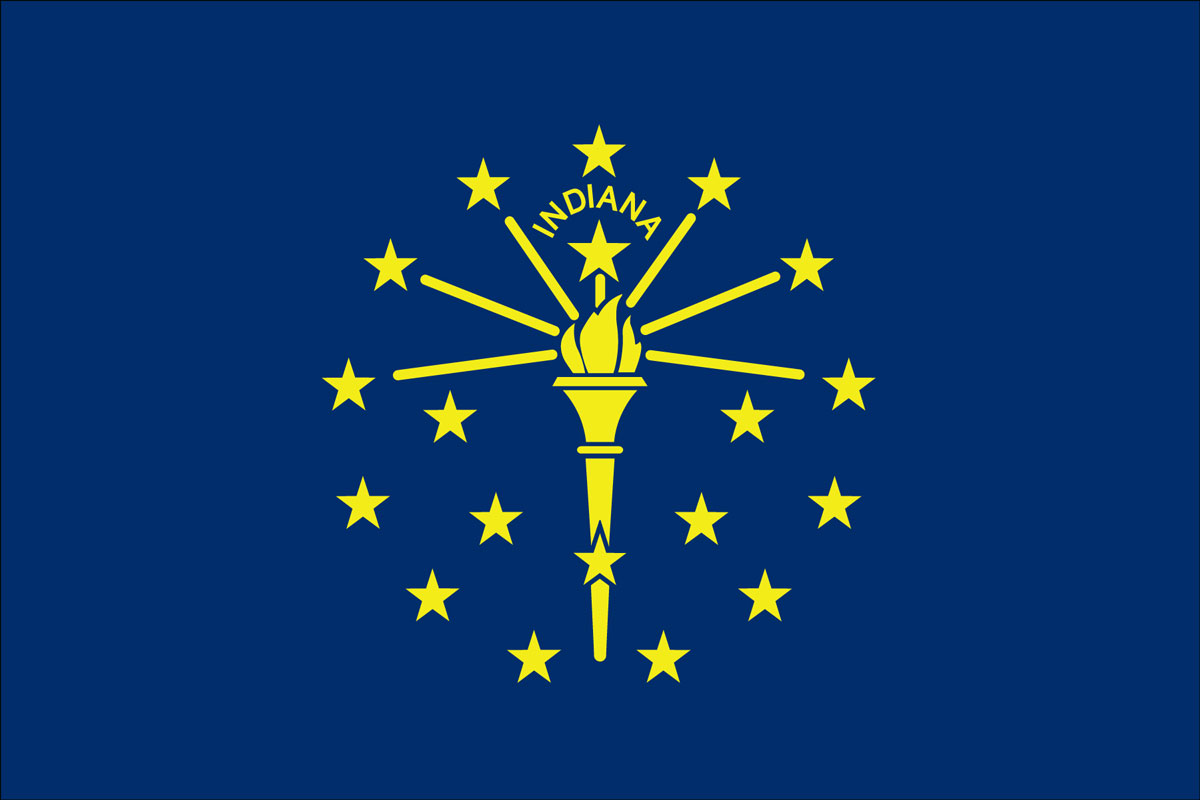
Note the 19 stars, as Indiana was the 19th State,
with 13 outer stars representing the original 13 States.

Kirkwood Avenue divides street addresses into North and South, and Walnut Street divides them into East and West. Bloomington has no freeway "beltway." The sales tax in the State of Indiana is 7 percent. ZIP Codes in Bloomington start with the digits 474, and the Area Code is 812, with 930 overlaid. There's no subway, but IndyGo offers a $4.00 all-day pass for its buses. The City of Bloomington Utilities runs the electricity.
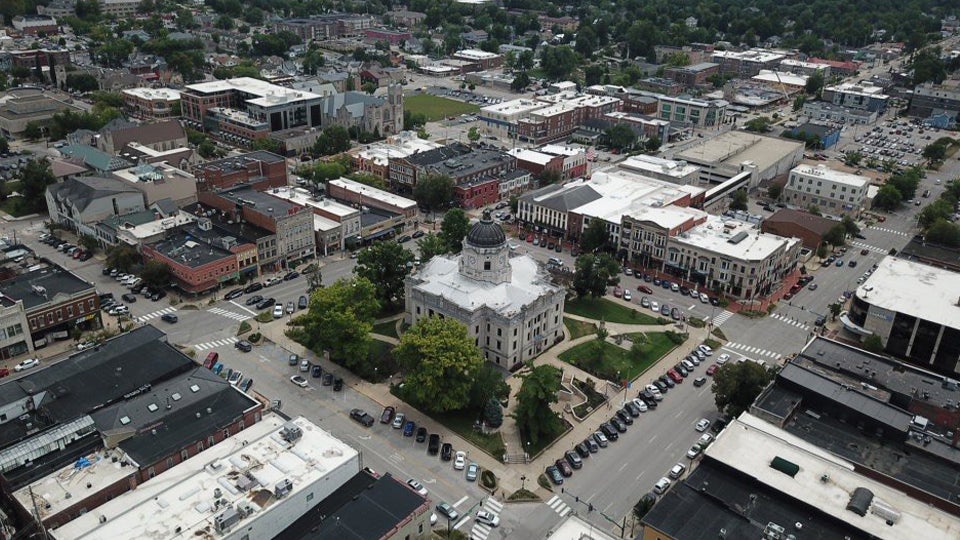
Downtown Bloomington

In addition to the Statewide Indianapolis Star, Bloomington has a local daily paper, The Herald-Times, and the student-operated Indiana Daily Student.

In addition to its flagship campus in Bloomington, IU has IU East in Richmond, IU Fort Wayne, IU Kokomo, IU Northwest in Gary, IU South Bend, IU Southeast in New Albany, and 2 co-ops with arch-rival Purdue: Indiana University - Purdue University Indianapolis (IUPUI), and another in Columbus, Indiana (IUPUC).

Notable non-sports IU alumni include: 


* Entertainment: Pianist-composer Hoagy Carmichael, singer Sylvia McNair, Star Trek writer Jeri Taylor.

* Literature: Hunger Games author Suzanne Collins.

* Business: Mark Cuban, also the owner of the Dallas Mavericks.

* Science: MythBusters co-host Jamie Hyneman.

* Journalism: Jane Pauley, Tavis Smiley.

* Politics: Vice President Mike Pence, also former Congressman and Governor of Indiana; and President Michael D. Higgins of Ireland.

* And Wikipedia co-founder Jimmy Wales.

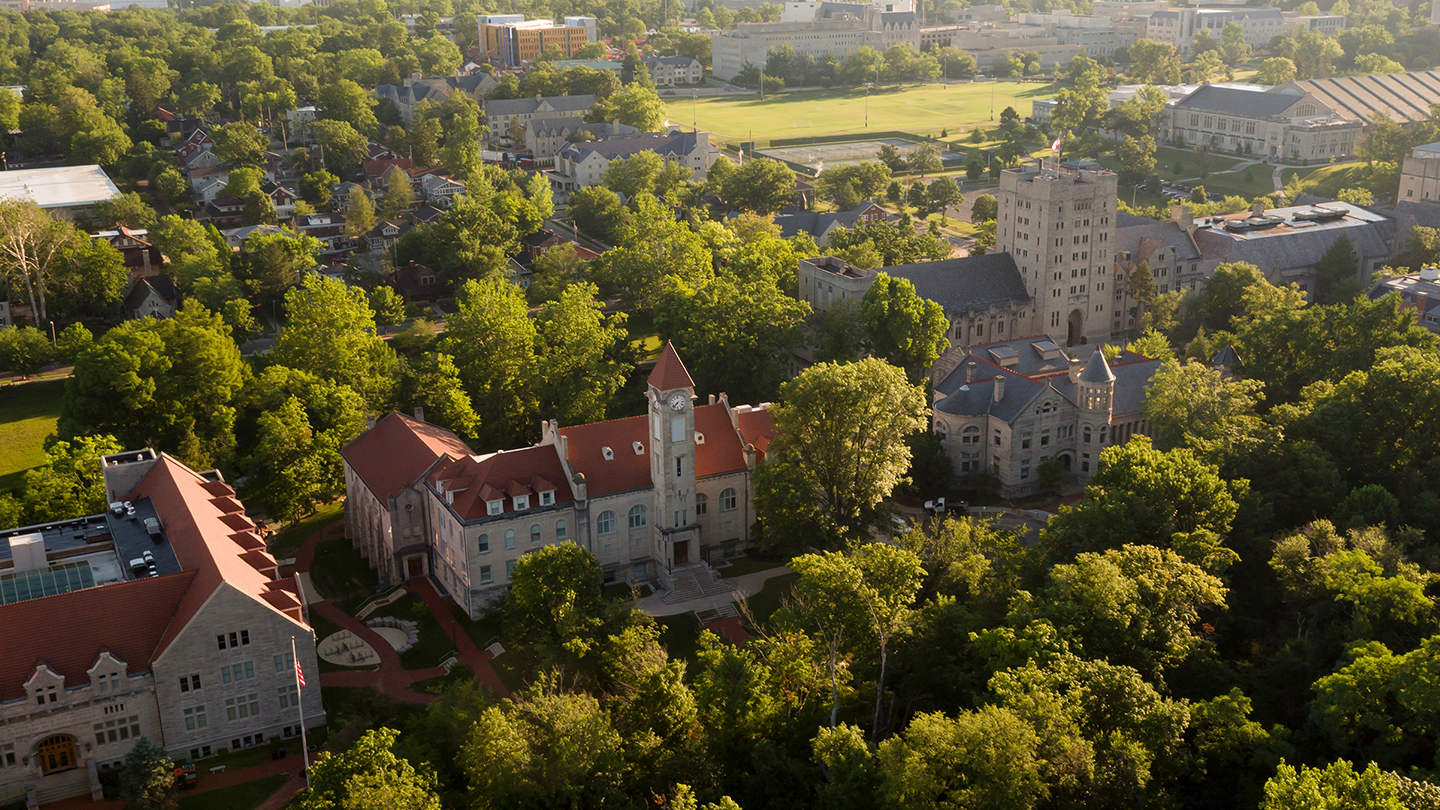
Going In. The official address of Memorial Stadium is 1001 E. 17th Street, at N. Dunn Street, about a mile north of downtown and the main campus. Assembly Hall, home of the legendary Indiana basketball program, is just to the east. Public buses don't get all that close, so you might need to use the A-Route on the campus bus system. If you drive in, parking is $20.

Since it opened in 1960, after World War II, it is a memorial to IU students and faculty who died in both World Wars, as opposed to most campus stadiums with the name, which were generally built in the 1920s, in the aftermath of World War I -- including the previous Memorial Stadium at Indiana, which I'll mention in "Sidelights."

Like the Prudential Center, home of the New Jersey Devils, it's known as "The Rock," and it's easy to see why. In Big Ten Country, his book about his visits to all the Big Ten campuses in the 1988 football season, Michigan State graduate Bob Wood wrote that it looked like a couple of dams surrounding a football field. But that was before the north end zone was filled in, with an entrance gate befitting a war memorial building. Nevertheless, it remains perhaps the least attractive Big Ten stadium.
Nice try, IU, but it still doesn't remind anybody of Ohio Stadium.

The Stadium is a horseshoe, with the field running north-to-south, open at the south end. It opened
with 48,344 seats, and was expanded to over 52,000 in 1969, and has had about that many since, currently 52,929. It switched to artificial turf in 1970, switched back to real grass in 1998, and returned to plastic in 2008.
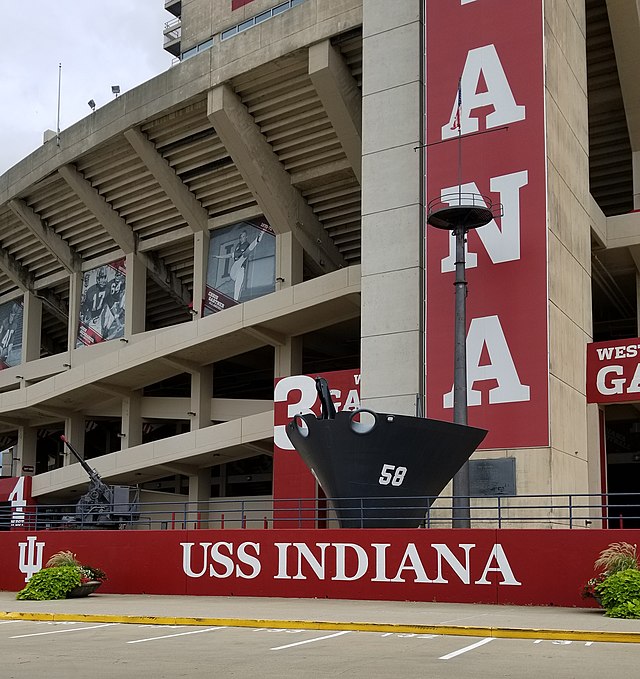
The prow, mainmast, and two guns of the battleship USS Indiana are erected at the western entrance of the stadium. The battleship saw extensive service in the Pacific Theater of World War II, including the Battle of Iwo Jima. It was retired after The War, not making it to Korea.
Food. Indiana is in the heart of the Midwest, right-smack-dab in the middle (or what used to be the middle, before Penn State, and then Nebraska, Rutgers and Maryland were admitted) of Big Ten Country, where tailgate parties are practically a sacrament. So you would expect there to be great food inside the Hoosiers' stadium. According to the school website:

Located throughout the stadium you will find Eisenberg hot dogs, half pound foot long steak dogs, Johnsonville Brats, nachos, popcorn, dippin dots, frozen lemonade and specialty pretzels.
To provide additional fun food options on the IU Athletics campus on gamedays, food trucks will be located in Hoosier Village prior to kickoff. 
 
Free beverage refills will be provided for all who buy the special souvenir cup at stadium concessions stands this season.


Complete your game day with State Faire mini donuts on the East Concourse. Watch as your donuts are baked in front of your eyes as you wait. Sure to be a hit with fans young and old, our mini donuts can't be beat.

Try Papa John's personal pan pizza sold at all traditional concessions stands. Chick Fil A is available on the West Concourse, East Concourse and in the balcony. Fresh popped Kettle Korn and Lemon Shake Ups are located on both the East and West Concourses as is Honey Baked Ham. Maui Wowi smoothies and Hawaiian Coffees are located on the West Concourse.

Credit and debit cards are accepted at all concession stands and select specialty carts.

Concession Stand Menu
  • Hoosier Dogs
  • Foot Long Steak Dogs
  • Johnsonville Brats
  • Sourdough Gourmet Pretzel
  • Nachos
  • Popcorn
  • Peanuts in the Shell
  • Candy
  • Cracker Jacks
  • Bottled Water
  • Fountain Coke Products

Specialty Carts (located throughout the stadium)
  • Gourmet Pretzels
  • Frozen Lemonade
  • Frozen Strawberry Lemonade
  • Lemon Shake Ups
  • Dippin Dots
  • Assorted bottled coke product
  • Bratwurst
  • Cheddar Dogs
  • State Faire Mini Donuts

Chick-Fil-A, Honey Baked Ham, Maui Wowi Smoothies and Kountry Kids Kettle Korn are located on both the East and West concourses.

Chick-fil-A? Papa John's? Oh, hell, no. But the rest should contain enough viable (taste-wise and humanity-wise) options for you.

Team History Displays. In terms of all-time record, Indiana is the least-successful football program in the Big Ten. Even oft-mocked Rutgers and Northwestern are better (with the "classic Big Ten" schools in bold):

1. Michigan: 942-336-36, .731
2. Ohio State: 894-324-53, .724
3. Nebraska: 893-378-40, .696
4. Penn State: 874-386-42, .687
5. Michigan State: 691-452-44, .601
6. Wisconsin: 695-489-53, .583
7. Minnesota: 670-500-42, .570
8. Iowa: 640-553-39, .535
9. Maryland: 634-575-43, .524
10. Purdue: 601-555-48, .519
11. Illinois: 587-561-51, .511
12. Rutgers: 641-622-42, .507
13. Northwestern: 503-642-44, .442
14. Indiana: 462-632-45, .425

Those 632 losses are the most of any school in the Football Bowl Subdivision (FBS, formerly known as Division I-A). The .425 percentage ranks 9th-worst.

They've won the Big Ten title outright only once, in 1945, at a time when World War II was over, but most of the men serving in it had yet to be discharged, and those who had and had been in college at the time were not yet able to resume their studies, much less their sports. They also shared the Big Ten title in 1967, a 3-way tie with arch-rival Purdue and Minnesota. Neither of those schools has won so much as a share of it since, either: 50 years.

Indiana has been to the Rose Bowl exactly once, on New Year's Day, 1968, in the wake of their Big Ten Tri-Championship. Their timing was bad, as they ran smack into Number 1-ranked USC and O.J. Simpson. No, they didn't "get killed," but they did lose 14-3.

They've been to 11 bowl games, and won only 3: The 1979 Holiday Bowl, the 1988 Liberty Bowl and the 1991 Copper Bowl. They did reach a bowl game last season, the Foster Farms Bowl, at the San Francisco 49ers' new stadium in Santa Clara, California, but lost to Utah. They played at Yankee Stadium in the 2015 Pinstripe Bowl, and lost an overtime thriller to Duke -- which sounds more like a great basketball game, although the score would have been a little low, 44-41.

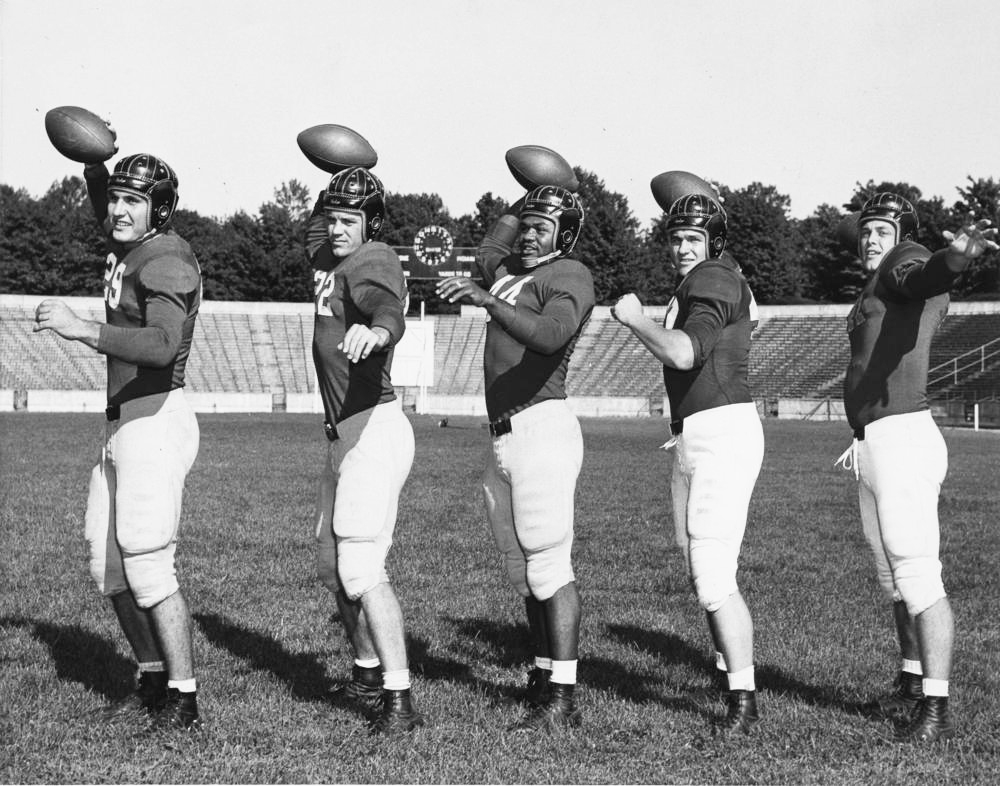
None of their achievements, as meager as they are, are displayed on the press box or on flagpoles. However, on the outside of the stadium, they do have some large portraits of former IU All-Americans.
There are 5 Indiana players in the College Football Hall of Fame. One, end Pete Pihos, played on the 1945 Big Ten Champions, and the 1948 and 1949 NFL Champion Philadelphia Eagles, and is also their lone Pro Football Hall-of-Famer.
Number 44, in the middle, is George Taliaferro.
Next to him on the right, Number 40, is Pete Pihos.

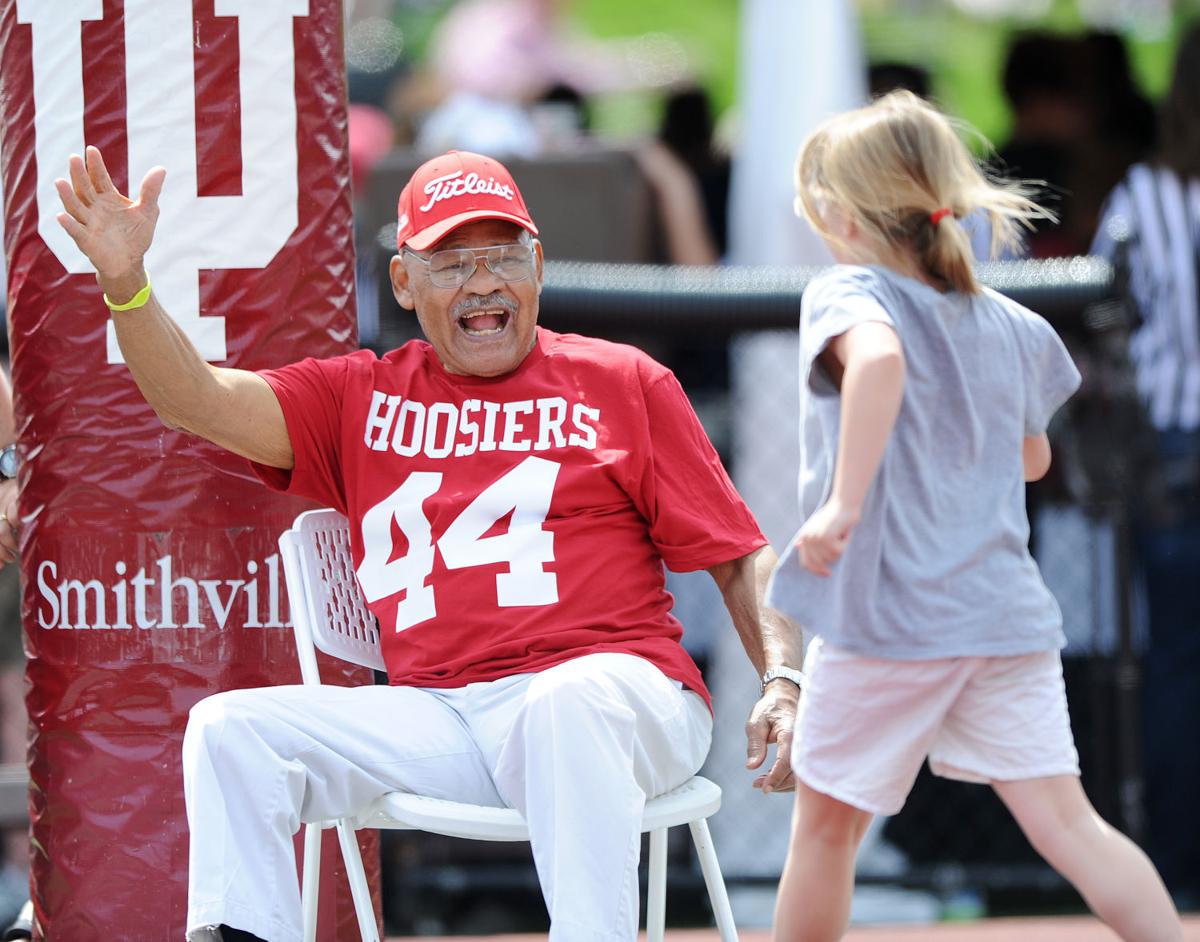
George Taliaferro, a running back on the 1945 Big Ten titlists, became the 1st black player drafted by an NFL team, the 1949 Chicago Bears. He went instead to the Los Angeles Dons of the All-America Football Conference, then played from 1950 to 1954 with the team that became the Baltimore Colts, closed his career as Pihos' teammate again with the 1955 Eagles. He is now 90 years old, and an uncle of Lorenzo Taliaferro of the Baltimore Ravens.
A recent photo of George Taliaferro, at the IU Spring Game

UPDATE: Taliaferro died on October 8, 2018.

Another, running back Anthony Thompson, was on their 1988 Liberty Bowl winners, and finished 2nd to Andre Ware of Houston for the 1989 Heisman Trophy. His Number 32 is the only number retired by the program, and he went on to play 3 years for the team then known as the Phoenix Cardinals and 2 years for the Los Angeles Rams.
Also honored are Zora Clevinger, a 2-way back at the dawn of the 20th Century, who went on to coach Nebraska Wesleyan, Tennessee and Kansas State in football, and all 3 of those schools plus Indiana in baseball and basketball as well; John Tavener, a center during World War II, but before the '45 titlists, and who never played pro ball; and Bill Ingram, who coached Indiana in 1923, '24 and '25, then went to the Naval Academy and coached them to an undefeated 1926 season and a retroactively-awarded National Championship.

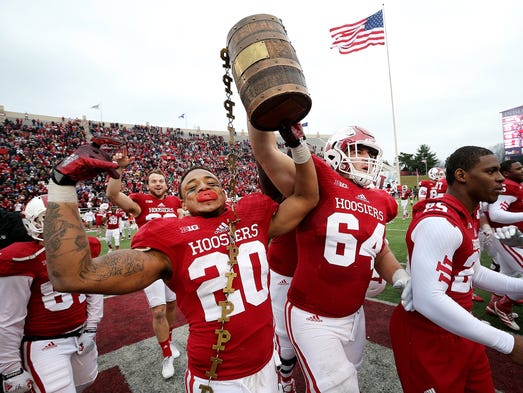
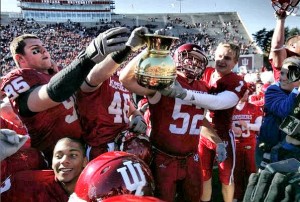
Indiana's biggest rivalry, in all sports, is with Purdue, from West Lafayette, Indiana, 100 miles to the north. The Hoosiers and the Boilermakers first met in 1891, and since 1925 have competed for one of college football's most familiar trophies (or, rather, one of the most familiar names among football trophies), the Old Oaken Bucket.

It has a chain, and after every game, a new brass I or P is added to it. Whichever team wins it puts it on display so that the chain seems to have a lot more of their letter on it. That's harder for the Hoosiers, as the Boilers lead in "Bucket Games," 56-31-3, and the rivalry overall, 72-41-6, although Indiana has won the last 4. They will play each other for the Bucket on Saturday, November 26, in West Lafayette. (UPDATE: Through the 2019 season, Purdue leads 74-42-6 overall, and 60-32-3 for the Bucket.)
Indiana also has a trophy game with Michigan State, for the Old Brass Spittoon. Michigan State won it this year, and has now won 8 of the last 9, and leads 46-16-2 overall.
Indiana vs. Kentucky is a bitter rivalry in basketball, but neither school has been very successful in football. They've only played each other 36 times, and not since 2005 due to conference commitments. It couldn't be much closer: Indiana leads 18-17-1. In 1987, they introduced a trophy, not especially old, called the Old Bourbon Barrel, but retired it in 1999 after a Kentucky player died from alcohol-related reasons.

Stuff. There's no big team store at Memorial Stadium, but there is a Varsity Shop in Assembly Hall, just to the east. The Indiana University Bookstore is at 900 E. 7th Street, downtown.

Don't look for books or videos about Indiana football. You're much more likely to find them about Indiana basketball. And since the shadow of Bobby Knight still looms large, 17 years after he left, some of those books will be complimentary, but some won't be.

During the Game. Because of their Midwestern/Heartland image, Hoosier fans like a "family atmosphere." They don't much like New York or New Jersey, but they won't bother Rutgers fans just for being Rutgers fans, or for wearing Scarlet Night gear in their stadium. As long as you don't say anything bad about Bobby Knight, you should be okay.

In 1979, when Rutgers went to Knoxville to play Tennessee, and the UT student paper had the headline, "What's a Rutgers?" Rutgers showed them, by winning. Well, Indiana fans are always getting asked, "What's a Hoosier?"

Suggestions have ranged from a 19th Century construction leader named Samuel Hoosier, who decided that men from Indiana were better workers than men from Kentucky, and the Indiana men became known as "Hoosier's men" and finally "Hoosiers" (but no such man has ever been found in any official records); to accented speech producing the words "Who's here?" or even, following a frontier fight that led to lost body parts, "Whose ear?"

So we really still don't know. And, since we don't know what a Hoosier is, other than "a person from Indiana," the school doesn't really have a mascot. Good fans, maybe; good cheerleaders, certainly; a good band, definitely; but no mascot.
The Indiana Marching Hundred

Not that they haven't tried. From 1959 to 1965, they had a live bulldog named Ox. After Ox died, instead of getting a new dog, they introduced a bison. But neither a bison nor a bulldog made any sense, nor would an actual ox have. They introduced a guy in a suit named Hoosier Pride in 1979, but the student body hated it, and it was dropped, and no attempt has been made since.

In 2005, head coach Terry Hoeppner found a limestone boulder -- the same kind of Indiana limestone that was quarried to build the exterior of the Empire State Building -- on the IU practice field, and he had it removed and put it into the north end of the stadium. He had the players touch the rock for luck as they came onto the field, a practice done with stadium rocks at other schools, most notably Clemson.

Did it work? Not for Hoeppner: He died of cancer 2 years later. But in his memory, the players still touch "Hep's Rock" as they come onto the field.

Fight songs include "Indiana, Our Indiana" and "Indiana Fight." The alma mater is "Hail to Old IU." There's also "Chimes of Indiana."

After the Game. Most of the area to the north and east of the stadium is additional property of the IU athletic department. Most of the area to the south is parking. Most of the area to the west is residential. While your safety will not be an issue, hunger might be, and your best chance of getting a postgame meal is to get back downtown.

In Big Ten Country, Michigan State graduate Bob Wood's book about his visits to all the Big Ten campuses in the 1988 football season, he decided that the best breakfast in Bloomington was at Runcible Spoon, at 412 E. 6th Street; the best bar was Nick's English Hut, at 423 E. Kirkwood Avenue, 2 blocks from Runcible Spoon, and both of them just to the west of the main IU campus; and the best burger was at Mustard's, at 300 S. College Mall Road, a spot now occupied by a Steak 'n Shake.

If your visit to Bloomington is during the European soccer season, as we are now in, your best bet to see your club is at the Uptown Cafe, 102 E. Kirkwood Avenue, downtown.

Sidelights. Indianapolis is often said to be boring: Its most common nickname is "India-no-place." But Bloomington is not Indianapolis.

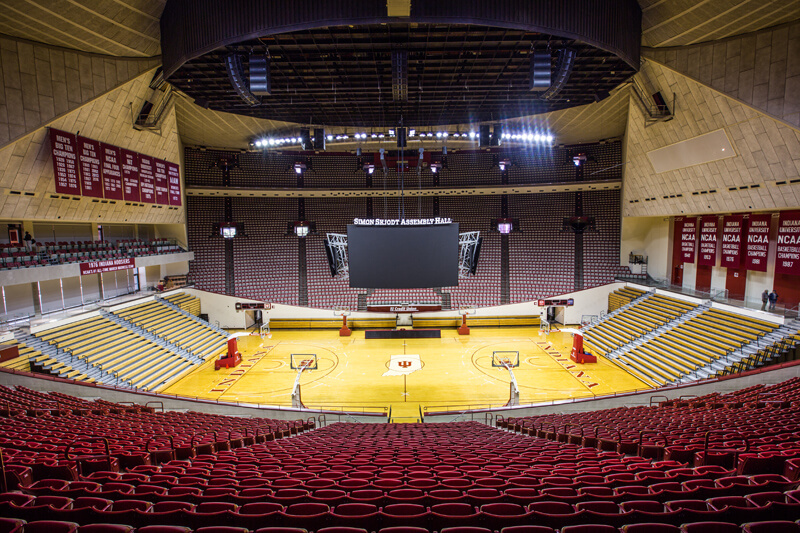
Just to the east of Memorial Stadium is the 17,222-seat Assembly Hall, opened in 1971, and sharing the stadium's address of 1001 East 17th Street. The playing surface is named Branch McCracken Court, after the coach of Indiana's 1940 and 1953 National Championship teams.
In 2016, the building was renamed Simon Skjodt Assembly Hall, after a $40 million donation for renovations by Cynthia Simon Skjodt, daughter of Indiana Pacers owner Mel Simon and wife of Paul Skjodt, who played for the Indianapolis Checkers and now owns the Indianapolis Ice hockey team.
Hoosier Heaven

(Mel's son, David Simon, runs the company that Mel and his brother Herb Simon founded, the Simon Property Group, which runs several malls, including New Jersey's Menlo Park, Quaker Bridge, Jersey Gardens, Newport Centre; and New York's Roosevelt Field and Woodbury Commons.)

In addition to being the closest thing to Hoosier Heaven, Elvis Presley sang at Assembly Hall on June 27, 1974 and May 27, 1976. 

From 1960 to 1971, Indiana played hoops at the 9,000-seat Gladstein Fieldhouse, which still stands, to the east of Assembly Hall. From 1928 to 1960, it played at the 8,000-seat Indiana Fieldhouse, now named the Wildermuth Intramural Center, at the main campus, at 1025 E. 7th Street.
Wildermuth Intramural Center

UPDATE: The facility was named for Ora Wildermuth, a former University trustee. In 2018, after a 9-year lobbying effort, his name was removed from it, due to his public opposition to racial integration on the campus in the 1940s.

The building is now named the William Leon Garrett Fieldhouse. Bill Garrett played basketball at Indiana from 1948 to 1951, and was the 1st black starting player on a team in what's now known as the Big Ten. He never played in the NBA, but played 3 seasons with the Harlem Globetrotters, and then coached high school ball in Indiana, winning a State Championship. He died of a heart attack in 1974, only 45 years old, just 3 years after the considerably older Wildermuth.
Along with Duke, North Carolina, Kentucky, Kansas and UCLA, Indiana is 1 of the top 6 most successful college basketball programs. They have won 5 National Championships: As I said, in 1940 and 1953 under Branch McCracken; and in 1976 (still the last undefeated season in college basketball, including beating previously undefeated Rutgers in the NCAA Semifinal in Philadelphia), 1981 and 1987. They've reached 8 Final Fours: The preceding, 1973, 1992 and 2002. They've never won the Big Ten Tournament, which bean in 1998; but they've won the regular season title 22 times, most recently in 2016.

Hoosier All-Americans include McCracken himself, 1930; Everett Dean, 1921, who coached Stanford to the 1942 National Championship; Vern Huffman, 1936, who later played for the Detroit Lions; his brother Marv Huffman, 1940; Bob "Slick" Leonard, 1954, who coached the Indiana Pacers to 3 ABA Championships; Walt Bellamy, 1961, later a star with the Knicks; the twins Dick and Tom Van Arsdale, 1965, later starring with the Cincinnati Royals and the Phoenix Suns; George McGinnis, 1971, one of Leonard's Pacers; Quinn Buckner, Scott May and Kent Benson of the undefeated 1976 team; Mike Woodson, 1980, later coach of the Knicks; Isiah Thomas, 1981, star of the Detroit Pistons but, regrettably, also involved with the Knicks; Steve Alford, 1987, later coach at Indiana, and now at UCLA; Calbert Cheaney, 1992; Eric Gordon, 2008, last season's NBA Sixth Man of the Year; and Yogi Ferrell, 2016, now of the Dallas Mavericks.

McCracken, Bellamy, McGinnis and Thomas are in the Basketball Hall of Fame as players; Dean, Leonard and Knight as coaches.

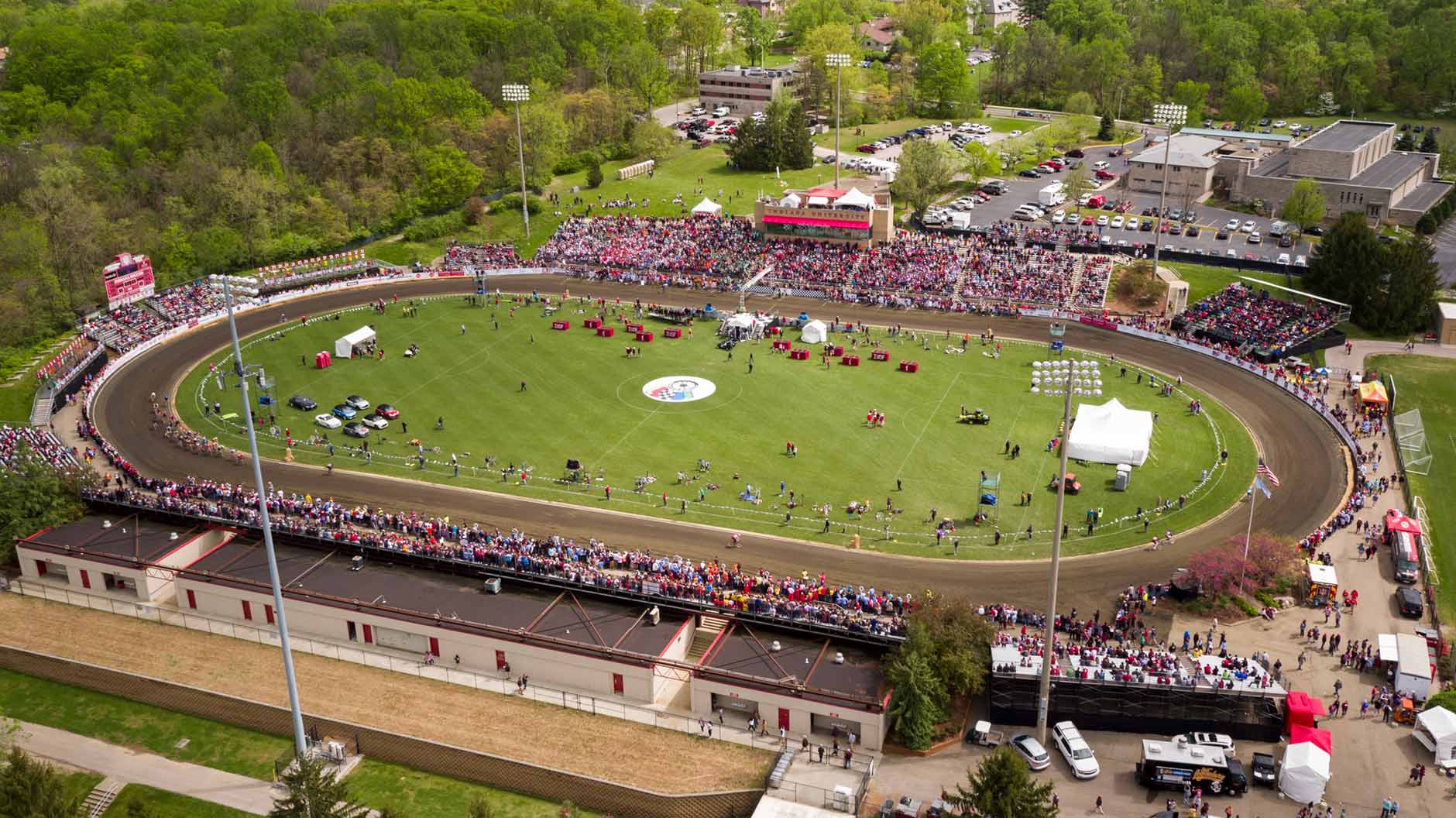
The original Memorial Stadium was a memorial to World War I, built in 1925, seating 20,000. Later known as Tenth Street Stadium, it hosted the Little 500 bicycle race, which was depicted in the 1979 cycling movie Breaking Away. It was demolished in 1982, and the Indiana University Arboretum is now on the site.
Tenth Street Stadium

Indiana's soccer program, founded in 1973, is one of the most successful college soccer programs in America. They've won 8 National Championships: In 1982, 1983, 1988, 1998, 1999, 2003, 2004 and 2012. They play at the 6,500-seat Bill Armstrong Stadium, named for the president of the Indiana University Foundation. It now hosts the Little 500 bicycle race, replacing Tenth Street Stadium. Armstrong appeared in Breaking Away as the race announcer. 1606 N. Fee Lane, to the east of Memorial Stadium and Assembly Hall.
IU is also known for its swimming program, long led by head coach James "Doc" Counsilman. A bomber pilot in World War II with a doctorate in physiology from the University of Iowa, he coached the Hoosier swim program from 1957 to 1990, including 6 straight National Championships from 1968 to 1973. Among those he coached was Mark Spitz, who went on to win 9 Olympic Gold Medals, setting the standard shattered by Michael Phelps.
Like Bob Knight, Counsilman competed at Ohio State before coaching at Indiana. Unfortunately, he was there during World War II, and he never got to compete in the Olympics, as they were canceled in 1940 and 1944. In 1979, at age 58, he set a record that still stands, as the oldest person to swim the English Channel. He lived until 2004, age 83.

The program is based at the Student Recreational Sports Center, at 1601 E. Law Lane, at the eastern edge of campus, between the main academic center and the athletic complex.
As you might guess, the most popular NFL team in Indiana is the Indianapolis Colts, except for the State's northwestern corner, aligned with the Chicago Bears; and its southeaster, aligned with the Cincinnati Bengals. The most popular NHL team is easily the Chicago Blackhawks, 233 miles to the northwest; neither the St. Louis Blues, 228 miles to the west, nor the Columbus Blue Jackets, 224 miles to the northeast, make much inroads.

Baseball is a little more complicated. An April 23, 2014 New York Times article -- written before the Chicago Cubs won the 2016 World Series, mind you -- showed that, among people in the Bloomington area who had a favorite baseball team, the Cubs were the favorite of 20 percent, the Cincinnati Reds 15, the Boston Red Sox 13, and the Yankees 12.

The Chicago White Sox and the St. Louis Cardinals, both of whom had won at least 1 World Series in the preceding 10 years and were considerably closer than the Yanks and Red Sox, didn't even register above 10 percent. (The Reds are 129 miles to the east, the Cardinals 227 miles to the west, the White Sox 228 miles to the northwest, the Cubs 239 miles to the northwest.)

The closest minor-league team to Bloomington is the Indianapolis Indians of the International League, winners of 10 Pennants, and playing at 12,230-seat Victory Field, at 501 W. Maryland Street at West Street in Indianapolis, 51 miles to the northeast.

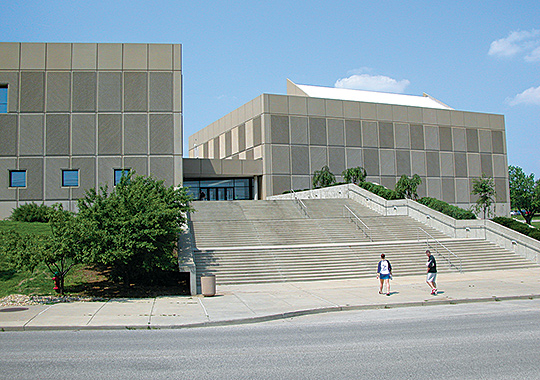
Bloomington is home to the Eskenazi Museum of Art, at 1133 E. 7th Street; the Mathers Museum of World Cultures, at 416 N. Indiana Avenue; the Farmer House Museum, at 529 N. College Avenue; and the WonderLab Science Museum, at 308 W. 4th Street.

The Beatles never played a concert in Indiana. In addition to Assembly Hall, Elvis sang in the State on December 4 through 7, 1955 at the Lyric Theater, at 121 N. Illinois Street, in Indianapolis (a parking deck is on the site now); at the Fort Wayne Memorial Coliseum on March 30, 1957, June 12, 1972, and October 25, 1976; at Roberts Memorial Stadium in Evansville on June 13, 1972 and October 24, 1976; at the Notre Dame Athletic Center (now the Joyce Center) on September 30 and October 1, 1974 and October 20, 1976; at the Hulman Civic Center in Terre Haute on July 9, 1975; and at the Market Square Arena in Indianapolis on June 26, 1977, which turned out to be his last concert.

The tallest building in the State of Indiana is the Salesforce Tower, formerly known as the Bank One Tower and the Chase Tower, with a roof 700 feet high and spires rising to 830 feet. 111 Monument Circle.

William Henry Harrison, 9th President of the United States and former Territorial Governor (died just 1 month after his 1841 Inauguration), and his grandson, Benjamin Harrison, 23rd President (1889-1893), both lived in Indiana (as did Abraham Lincoln as a boy). But Grouseland, the house of William Henry, is 130 miles away in Vincennes. The site of his big battle, Tippecanoe, is just northeast of the Purdue campus in West Lafayette. The Benjamin Harrison Presidential Site is just north of downtown, at 1230 N. Delaware Street. Number 19 bus.

Only 4 TV shows are known to have been set in Indiana, 3 in Indianapolis. Close to Home and the U.S. version of the British hit Men Behaving Badly are best forgotten. But the CBS sitcom One Day at a Time, which aired from 1975 to 1984, and starred Bonnie Franklin and launched Mackenzie Phillips and Valerie Bertinelli to stardom, was groundbreaking: It was not only the first TV show to show a divorced single mother (rather than a widowed one), but it actually made Indianapolis seem like a fun place to be.

The other was Breaking Away, based on the bicycle racing movie of the same name. It was set in Bloomington, seat of IU, but filmed in Athens, Georgia, seat of the University of Georgia.

Other shows set in Indiana, but in fictional locations, have been Parks and Recreation in Pawnee, and the current hit Stranger Things in Hawkins. The Fugitive established the hometown of Dr. Richard Kimble (Dave Janssen) as Stafford, not far from South Bend, and the final episode, at the time of its August 29, 1967 airing the most-watched program in U.S. TV history, took place there, although the amusement park where the climactic scene took place was filmed in Southern California.

Movies set in Indianapolis are also rare. Some early scenes of Close Encounters of the Third Kind
were set there, before moving out to the iconic Devil's Tower National Monument in Wyoming. The 2015 cult hit The Fault In Our Stars was set there, but filmed in Pittsburgh.

Of course, the most famous movie set in Indiana is Hoosiers, which was filmed in the State, and whose climactic game, a dramatization of the 1954 State Final, was filmed at the actual location, Butler University's Hinkle Fieldhouse. In reality, Milan High School did defeat the much larger school, Muncie Central. But they had also been to the Final 2 years earlier (losing it), with some of the same players, so while it was an upset, it wasn't like Milan was a total unknown. An underdog, yes; a tremendous longshot, no.

*

Indiana is the most basketball-crazy State of them all. Their love of football also extends to the IU Hoosiers, as well as to the Purdue Boilermakers, the Notre Dame Fighting Irish, and the Indianapolis Colts. A visit to the IU campus in Bloomington could be not only fun, but a good chance for Rutgers to get a rare Big Ten road victory.

Sunday, April 24, 2016

Top 5 Reasons You Can't Blame Norm Green for Moving the Minnesota North Stars to Dallas

The Dallas Stars have advanced to the NHL Western Conference Semifinals, defeating the Minnesota Wild.

This has not gone over well in Minnesota, and not just because they don't like to lose there. Nor just because they don't like losing to Dallas. (See the 1975 NFC Divisional Playoff, where the Cowboys cheated their way to a win over the Vikings.)

It's because, from 1967 to 1993, the Dallas Stars were the Minnesota North Stars. Under that name, in 26 seasons, they won 2 Division titles, reached the last 4 of the Stanley Cup Playoffs 5 times, and the Stanley Cup Finals twice, but never won the Cup.

Then came Norm Green, a mall developer and telecom investor from Calgary. He'd already had experience in moving a hockey team, as part of the Harley Hotchkiss-led group that bought the Atlanta Flames in 1979, and moved them to Calgary in 1980.

But that was different. Atlanta never really took to hockey, and the Thrashers, expanded into existence in 1999, would fail in 2011.

In 1990, at the NHL's request, Green sold his shares in the Flames, and the brothers George and Gordon Gund sold the North Stars to Green, because they preferred to own a team in the San Francisco Bay Area. This enabled the Gunds to found the San Jose Sharks.

In 1991, the North Stars reached the Finals, but lost to the Pittsburgh Penguins. In 1993, he moved the team.

He could have changed the name to the Dallas Lone Stars, which would have enabled him to keep the new Star logo, as opposed to the North Stars' N topped by a Star logo, he made them just the Dallas Stars.

That was the dumbest thing he did, but moving the team was worse than that. He cited attendance as the reason for the move. So you think you can't get enough hockey fans in cold Minnesota, but you can in hot Dallas?

Well, the team has done well in attendance in Dallas, regularly filling the Reunion Arena from 1993 to 2001, and the American Airlines Center from 2001 to 2010, before a downturn in performance led to one in attendance, but it picked up again in 2015 and remains up.

It was suggested at the time that he wanted to move to get away from the Minnesota media, which was writing unflattering things about him, in the wake of a sexual harassment lawsuit.

Green was vilified as "Norm Greed" in Minnesota, but he was a hero in Dallas. Since the move, in 23 years, the Stars have won 8 Division titles (including this year), reached the Western Conference Finals 4 times, reached the Stanley Cup Finals twice, and won the Stanley Cup in 1999.
Norm Green. This guy is a secret underground lair away
from being a villain in a James Bond movie.

Despite the founding of the Minnesota Wild and the opening of the Xcel Energy Center in St. Paul, both on the Autumn of 2000, Green has not been forgiven by Minnesotans. Should he be?

Top 5 Reasons You Can't Blame Norm Green for Moving the Minnesota North Stars to Dallas

First, a few reasons that didn't make the cut: The Best of the Rest.

The Early 1990s Recession. Contrary to what conservatives said in 1993, as new President Bill Clinton was enacting the economic plan that restored America to prosperity, the recession that hit in 1990 really was bad. That drove down attendance to the kind of level that made Green complain.

Burnout. From March 1991 to April 1992, just a shade over 1 year, the Twin Cities hosted the Frozen Four, the World Series, the Super Bowl and the Final Four. They were scheduled to host the NBA All-Star Game in 1994, hosted by the NBA team they'd just gotten. As a result, Minneapolis-St. Paul felt more "major league" than it ever had. Maybe losing the North Stars really didn't matter that much.

The Softenings of the Blow. Maybe Minnesotans thought that losing their NHL team was a tragedy. But was it, really? Losing baseball teams crushed New York in 1957 (especially the Borough of Brooklyn, which has never recovered emotionally), Milwaukee in 1965, Seattle in 1970, and Washington in 1971. Losing NFL teams was a blow to Oakland in 1982, Baltimore in 1984, St. Louis in 1987 (though not so much in 2016), Los Angeles and Cleveland in 1995, and Houston in 1996. Each of those cities felt a little less "major league."

But losing an NHL team? It didn't hurt the Bay Area and Kansas City much in 1976, or Cleveland in 1978, or Colorado in 1982. It did hurt Quebec City in 1995 and Winnipeg in 1996, because that hurt Canada's psyche as much as losing an MLB or NFL team would to an American city's. It hurt Hartford in 1997, but that was because the Whalers were all they had.

Minnesotans still had high school and college hockey, and teams in MLB, the NFL, the NBA, and college football and basketball. And they did get the announcement of the Wild in 1997, just 4 years later, to take the ice in 2000, just 7 years after the North Stars were taken away.

So was it really all that bad? It's better than Cleveland got with the new Browns, New York (at first) got with the Mets, and much less of a wait than Baltimore had until the Ravens, Winnipeg with the reborn Jets, Colorado with the Avalanche, or Quebec City, which still doesn't have a replacement team. The wait has now also been exceeded by that of Seattle for a replacement for the SuperSonics.

Okay, the '99 Cup being won by the same franchise in Dallas must've stung. But there's no guarantee they would have won it had they stayed in Minnesota.

Now for the Top 5:

5. The Attendance Really Was Bad. Green may have been a greedy jerk and a womanizer, but on this subject, he was not a liar. In 1982, in the wake of the previous season's trip to the Finals, Stars fans filled the Metropolitan Sports Center to capacity, averaging 15,220 fans per home game. But it declined: From 1985 to 1993, it never again topped 14,000.

By 1988, it was under 12,000. In the Finals year of 1990-91, it was a mere 7,838. That is not a typographical error: Seven thousand, eight hundred thirty-eight. The Chicago Blackhawks get nearly 3 times that now. Even in the final season, believing that increased attendance could change Green's mind and get him to keep the team in what's now known as "The State of Hockey," it was only 13,910 fans per game.

Much like the Brooklyn Dodgers and the Baltimore Colts before them, and the Cleveland Browns after them, North Stars fans didn't support their team in the kind of numbers that their enthusiasm then and their angst shortly thereafter would suggest.

Green could have been a decent man who wasn't getting sued for bad behavior toward women, and he still would have had a great reason to move the team. If Minnesotans who were already salaried adults in the George H.W. Bush years want to blame someone for their team moving, the 1st place they need to look is in the mirror.

4. The Golden Gophers. The University of Minnesota had the State's, and the Twin Cities', most popular hockey team. By 1993, they'd already reached what's now known as the NCAA Frozen Four 14 times (they've since raised that number to 21), and won National Championships in 1974, 1976 and 1979. They have added them in 2002 and 2003, for 5 titles. The women's team has won 7 titles.
Mariucci Arena, with banners

The Gophers could be counted on to win more often than not. The North Stars couldn't. So a local hockey fan was more apt to spend his hard-earned dollars on a winning team.

3. New Buildings. The NBA's expansion Minnesota Timberwolves got a new arena, the Target Center, in 1990, after playing their 1st season in the Metrodome. And the Twins and Vikings had gotten the Metrodome only a few years earlier, in 1982. The City of Minneapolis was willing to build new venues for them, but not for the North Stars. Nor was the City of Saint Paul. Nor was Hennepin County (where Minneapolis is). Nor was Ramsey County (where St. Paul is). Nor was the State of Minnesota. Why couldn't the North Stars get a new arena?

Why did the North Stars need a new arena? The Met Center was in suburban Bloomington, 9 miles south of downtown Minneapolis. Today, the Metro Blue Line light rail connects downtown with the Mall of America, built in stages on the sites of Metropolitan Stadium and the Met Center. But it didn't open until 2004, long after the Twins, Vikings, and North Stars left.
Some sports venues have their naming rights bought by a bank.
This one looked like it was a bank.

At the time, it wasn't so easy to get there from Minneapolis without a car. It was even harder from St. Paul, 12 miles away. In contrast, the Metrodome site, now nearly fully converted into U.S. Bank Stadium, the new home of the Vikings, and the Twins' new home of Target Field, and the Target Center are all adjacent to light rail stations downtown. The Xcel Energy Center in downtown St. Paul has public transit access as well.

So why didn't Green simply negotiate to move the North Stars into the Target Center? Because it was built with basketball specifically in mind. As Islander fans are now finding out at the Barclays Center in downtown Brooklyn, when you try to squeeze a hockey rink into a venue built for basketball, the sight lines don't work out very well.

This was also true of old NHL arenas like the 1925-68 version of Madison Square Garden, the Boston Garden, Chicago Stadium, the Olympia in Detroit, and the Buffalo Memorial Auditorium: Unlike the Montreal Forum and Maple Leaf Gardens in Toronto, these arenas weren't built for hockey, with its 200 feet by 85 feet rink, or even for basketball, with its 94 feet by 50 feet court; but for boxing, at the time a much bigger sport than either, with its ring being between 16 and 20 feet square. As Celtics boss Red Auerbach said of the Boston Garden, "The seating's all cockeyed."

So moving the North Stars into a basketball-specific arena would have created a problem that might well have outweighed all the problems it solved.

2. Dallas. It's a sports-crazy city with a lot of transplants from hockey areas, and lots and lots of money. Dallas was rolling in it in the early Nineties, from the energy, insurance and banking industries. Minneapolis may have been an agribusiness, pharmaceutical and technological giant once upon a time, but by the Daddy Bush years, its business glory days were long gone.
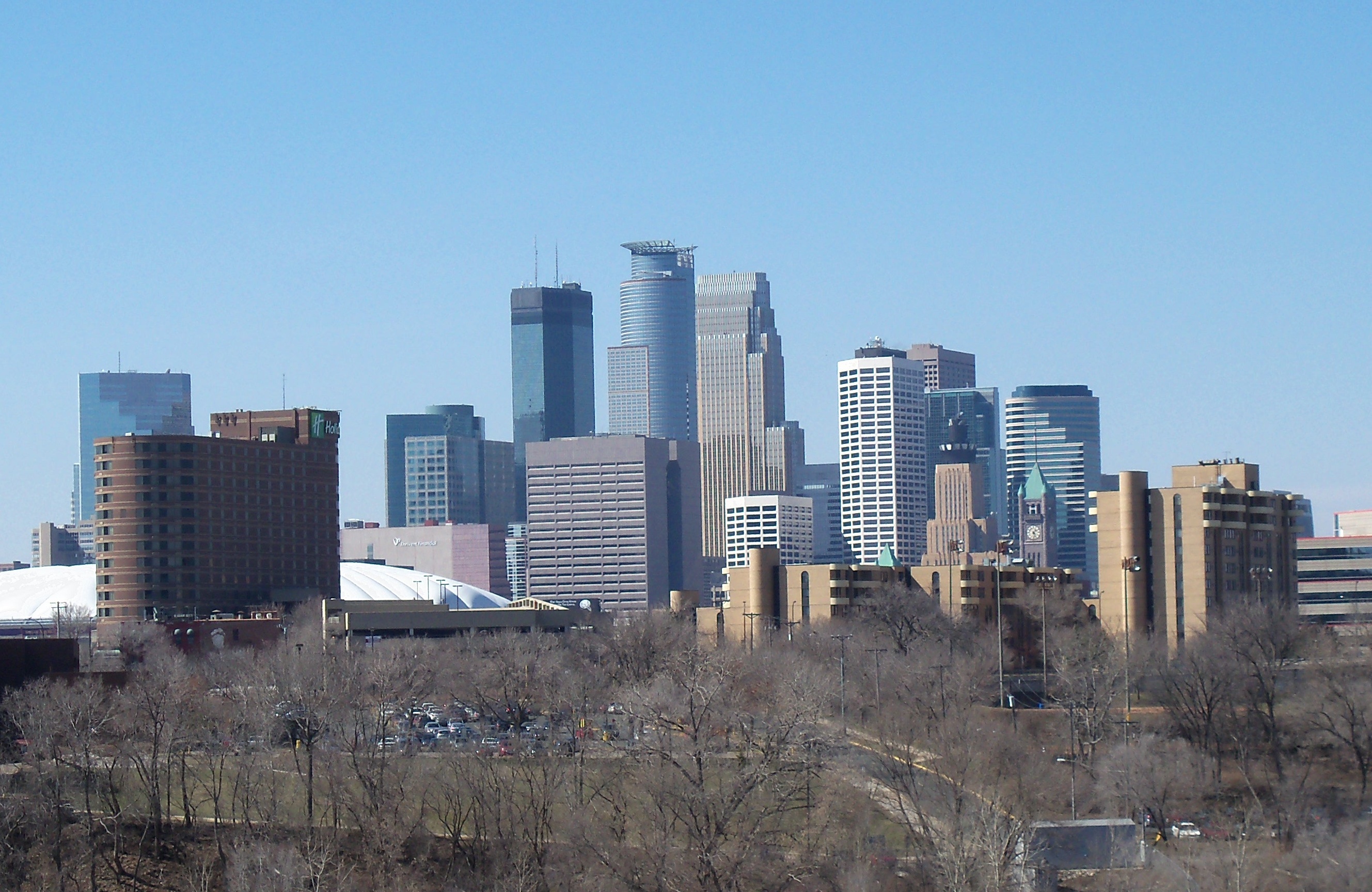
Downtown Minneapolis, as seen from
the University of Minnesota campus.
Photo taken in 2013. Note the Metrodome still standing.

And, as we've seen, the Stars have done well in Dallas, both on the ice and at the box office. Hockey in Texas may never feel quite right, but this "marriage" has stood the test of time thus far.
Downtown Dallas

1. Gary Bettman. Whatever the Commissioner of the National Hockey League wants, he gets. He wanted fewer teams in the Snow Belt, and more teams in the Sun Belt. The fact that he had to give Minnesota an expansion franchise shortly thereafter shows that he was wrong. But it is also a fact that, if he had wanted the North Stars to stay in Minnesota, they'd still be there, probably playing at the Xcel Center in St. Paul, while Dallas, rather than Minnesota, would have gotten an expansion franchise.

VERDICT: Not Guilty. Norm Green may have been Norm Greed, but he had legitimate reasons for moving the team, and for where.

Hopefully, with the NHL now long restored to the Twin Cities, and the Wild having been good more often than not, the statute of limitations has expired, and Minnesota hockey fans can focus on the future, not on the past.

Friday, June 27, 2014

How to Be a Yankee Fan In Minnesota -- 2014 Edition

After a short but intense 5-game homestand against The Scum and the Strays, the Yankees will head out onto the road for the remainder of the first half of the season, to play the Minnesota Twins in Minneapolis, the Cleveland Indians, and the Baltimore Orioles.

Then comes the All-Star Break, and the All-Star Game will also be in Minnesota this year. This will be the 3rd time the Twins have hosted, and in the 3rd different ballpark: 1965 at Metropolitan Stadium, 1985 at the Metrodome, and 2014 at Target Field.

In the photo above, you can see Target Field.  Behind that, the Target Center. (The Target store company is headquartered in Minneapolis.) Behind that, downtown Minneapolis. And, in the upper-left corner, the Metrodome.

By a weird twist, when my twin nieces were born, 7 summers ago, the Yankees were playing, you guessed it, the Twins. The Yankees won. Nevertheless, the girls have become Yankee Fans.

I’ll teach them the irony of it all, but, personally, I have nothing against the Minnesota ballclub. I used to, but then they got out of the (George Carlin word)ing Metrodome.

I know, I sometimes curse on this page, but these “How to Be a Yankee/New York Fan In…” pages are meant to be family-friendly.

Before You Go. It's a little soon to post the weather forecast, but, since the Twins do not play in the Metrodome anymore, you should consult the Minneapolis Star-Tribune and St. Paul Pioneer Press websites for their forecasts. Seeing as how this will be early July, including the 4th, the legend of cold Minnesota winters that last from October to early May will not apply in this series.

Minnesota is in the Central Time Zone, 1 hour behind New York. Adjust your timepieces accordingly.

Tickets. The Twins’ success of the last 2000s (but not, as yet, the 2010s) and the building of Target Field led to an average per-game attendance of 39,112 in 2011, pretty much a sellout every night, in spite of their not having a very good season (mainly due to injuries). But last season, the novelty of the new park had worn off, and they averaged 30,588, and they're averaging 27,042 so far this season. So getting tickets shouldn't be a big problem. Still, I advise getting them ahead of time.

The Twins use "demand-based pricing." For games against the Yankees, and for regional rivals like the Milwaukee Brewers and the Chicago White Sox, prices are higher because the demand is greater. Here are the listings for the Yankee games: Diamond Box, $68; Field Box, $56; Home Plate Terrace, $54; Skyline View, $29; Field View, $26; LF Bleachers (the U.S. Bank Home Run Porch), $30; RF Bleachers (Grandstand), $32. In other words, despite the Twins’ history of frugal (or even blatantly cheap) ownership, it’ll be expensive.

There's no mention of the Twins setting off fireworks on the 4th (Friday, probably because it's an afternoon game, a 2:10 PM Central time start). But, as it's the 75th Anniversary of Lou Gehrig Day, they're giving away Gehrig bobbleheads to the first 10,000 fans.

Getting There. It’s 1,199 road miles from Times Square in New York to Nicollet Mall in downtown Minneapolis (the spot where Mary Tyler Moore threw her hat in the air in the opening sequence of her 1970-77 CBS sitcom), and 1,204 miles from Yankee Stadium to Target Field. Knowing this, your first reaction is going to be to fly out there.

But it’s kind of an expensive flight. Even if you order early, chances are you’ll have to pay at least $950 round-trip for a flight from Newark to Minneapolis-St. Paul International Airport. And you'll have to change planes in Chicago – or even Dallas (which would piss off not just the New York Giants football fan that you might be, but also the Minnesota Vikings fans you may be flying to Minneapolis with). But when you do get there, the Number 55 light rail takes you from the airport to downtown in under an hour, so at least that is convenient.

Bus? Not a good idea. Greyhound runs 3 buses a day between Port Authority and Minneapolis, all with at least one transfer, in Chicago and possibly elsewhere as well. The total time, depending on the number of stops, is between 26 and 31 hours, and costs $507 round-trip, although it can be dropped to $449 with advanced purchase. The Greyhound terminal is at 950 Hawthorne Avenue, at 9th Street North, just 3 blocks from Nicollet Mall, 2 from the Target Center arena, and from there just across the 7th Street overpass over Interstate 394 from Target Field.

Train? An even worse idea. Amtrak will make you leave Penn Station on the Lake Shore Limited at 3:40 PM Eastern Time, arrive at Union Station in Chicago at 9:45 AM Central Time, and then the Empire Builder, their Chicago-to-Seattle run, will leave at 2:15 PM and arrive in St. Paul (not Minneapolis) at 10:31 PM. From there, 730 Transfer Road, you’d have to take the Number 16 or 50 bus to downtown Minneapolis. And it’s $692 round-trip.

If you decide to drive, it’s far enough that it will help to get someone to go with you and split the duties, and to trade off driving and sleeping. You'll need to get into New Jersey, and take Interstate 80 West. You'll be on I-80 for the vast majority of the trip, through New Jersey, Pennsylvania and Ohio. In Ohio, in the western suburbs of Cleveland, I-80 will merge with Interstate 90. From this point onward, you won’t need to think about I-80 until you head home; I-90 is now the key, through the rest of Ohio and Indiana.

Just outside Chicago, I-80 will split off from I-90, which you will keep, until it merges with Interstate 94. For the moment, though, you will ignore I-94. Stay on I-90 through Illinois, until reaching Madison, Wisconsin, where you will once again merge with I-94. Now, I-94 is what you want, taking it into Minnesota and the Twin Cities, with Exit 233A being your exit for downtown Minneapolis.

If you do it right, you should spend about an hour and a half in New Jersey, 5 hours and 15 minutes in Pennsylvania, 4 hours in Ohio, 2 and a half hours in Indiana, an hour and a half in Illinois, 2 and a half hours in Wisconsin, and half an hour in Minnesota. That’s 17 hours and 45 minutes. Counting rest stops, preferably halfway through Pennsylvania and just after you enter both Ohio and Indiana, outside Chicago and halfway across Wisconsin, and accounting for traffic in New York, the Chicago suburbs and the Twin Cities, it should be no more than 23 hours, which would save you time on both Greyhound and Amtrak, if not on flying.

Once In the City. The team's original ballpark was in the suburb of Bloomington, on the Minneapolis side of the Mississippi River, but roughly equidistant from the downtowns of both Minneapolis and St. Paul. (Not quite: Minneapolis' City Hall is 9.6 miles away, St. Paul's is 11.1 miles.) The team is called "Minnesota," because they didn't want to slight either city. It is called the "Twins" because Minneapolis and St. Paul are the "Twin Cities."

Well, these "twins" are not identical: They have different mindsets, and, manifesting in several ways that included both having Triple-A teams until the MLB team arrived, have been known to feud as much as San Francisco and Oakland, Dallas and Fort Worth, Baltimore and Washington, if not as much as Manhattan and Brooklyn. Minneapolis has about 390,000 people, St. Paul 285,000, and the combined metropolitan area about 3.4 million, ranking 16th in the U.S. -- roughly the combined population of Manhattan, The Bronx and Staten Island -- or that of Manhattan and Queens. Denver is the only metropolitan area with teams in all 4 sports that's smaller.

"Minneapolis" is a combination of the Dakota tribal word for water, and the Greek word for city. It was founded in 1867 with the name St. Anthony Falls, and, of course, St. Paul, founded in 1854, is also named for an early Christian saint. In Minneapolis, Hennepin Avenue separates the numbered Streets from North and South, and the Mississippi River is the "zero point" for the Avenues, many (but not all) of which also have numbers.

Each city once had 2 daily papers, now each is down to 1: Minneapolis had the Star and the Tribune, merged in 1982; St. Paul the Pioneer and the Dispatch, merged into the Pioneer Press and Dispatch in 1985, with the Dispatch name dropped in 1990. Today, they are nicknamed the Strib and the Pi Press.

The sales tax in the State of Minnesota is 6.875 percent. It's 7.775 in Minneapolis' Hennepin County, and 7.625 percent in St. Paul's Ramsey County. Bus and Light Rail service is $2.25 per ride during rush hours, $1.75 otherwise.

Going In. Target Field is at the northwest edge of downtown Minneapolis, in a neighborhood called the Warehouse District. The Metro Transit Hiawatha Line, Minneapolis’ light rail system, has a Target Field Station.

Target Field is bounded by 5th Street (left field), 3rd Avenue (right field), 7th Street (1st base) and the Hiawatha Line (3rd base). Parking lots are all over downtown, although if you’ve driven all this way, most likely you’ll be staying at a hotel and walking or taking public transit from there.  The official address is 1 Twins Way.

If you’re walking from downtown, you’ll most likely be arriving over the I-394 overpass and entering at the right field or home plate gates. If you’re arriving by light rail, the station is outside the left field gate. If you're driving, parking is between $10 and $15, depending on the event.

The gates are numbered in honor of the men whose numbers had already been retired when the ballpark opened: Center field, Gate 3, Harmon Killebrew; Left field, Gate 6, Tony Oliva; Home plate, Gate 14, Kent Hrbek; Right field corner, Gate 29, Rod Carew; and another in right field, Gate 34, Kirby Puckett. Gate 29 has Target Plaza, with statues of those players, and also of former owners Calvin Griffith, and Carl and Eloise Pohlad, parents of current owner Jim Pohlad.  The Twins' team Hall of Fame display is also there.

The ballpark faces northeast, and in stark contrast to the Metrodome, the place is open at right field, has no stupid roof with stupid lighting, and has, yes, real grass. If you are old enough to remember the Twins' original home, Metropolitan Stadium, the double-decked left field bleachers will be reminiscent of that stadium, but, from some angles, will also bear a resemblance to Jack Murphy/Qualcomm Stadium in San Diego and the old Mile High Stadium in Denver (if you remember the baseball configurations of those stadiums). Looking at the 1st base/right field stands, you may see a resemblance to Camden Yards in Baltimore. Target Field does seem to have a mixture of 1970s funkiness (which, aside from round entrance ramps, was rarely incorporated into the designs of the ballparks in use in that decade) and 1990s-to-the-present convenience.

Outfield distances are 339 to left, 377 to left-center, 411 to center, 365 to right center and 328 to right – favoring lefthanded hitters, although the ball doesn’t fly out of the yard the way it did at Metropolitan Stadium or the Metrodome. In its brief history, the longest home run hit at Target is a 491-footer by Jim Thome in 2011. Ben Oglivie of the Milwaukee Brewers hit the longest at the Metrodome, 481 feet, although I can't find a reference to a date. The longest at The Met, as you  might guess, was by Harmon Killebrew, 525 feet in 1967.

Above center field is a sign saying “TARGET FIELD,” with the words separated by the Target store logo. Above that is the original team logo, with two ballplayers against an outline of the state. One is wearing an M logo on his sleeve, another an StP logo on his, and they’re reaching across a river to shake hands. This symbolizes the old minor-league teams in the American Association, the Minneapolis Millers and the St. Paul Saints, who went out of business when the original Washington Senators moved to Minnesota to become the Twins in 1961.

Food. Considering that Minnesota is Big Ten Country, you would expect their ballpark to have lots of good food, in particular that Midwest staple, the sausage, including German, Italian, Polish and Kosher varieties. Fortunately, you would be right, as the influence of regional rivals Chicago and Milwaukee has taken hold. Something called Kramarczuk’s Food Network Creations is at Section 114 (lower level behind home plate), and Mexican and Asian specialties also dot the walkways.

At Section 133 (right-center-field bleachers), they have “State Fair Classics” -- the State Fair, held from late August to Labor Day, in the small town of Falcon Heights, between the Twin Cities, is a very big deal, known as "The Great Minnesota Get-Together." These "classics" include Pork Chops on a Stick, Roasted Corn on the Cob, Corn Dogs, and Walleye Fingers – think a fish version of "chicken fingers." It's not something I would eat, but walleyes, a native fish, are very popular in Minnesota. The start of walleye fishing season, usually around May 10, is so big there, the Twins always request to be on the road that weekend, so as not to hurt attendance.

Being Midwestern, the Twins believe in beer and lots of it. (In their early days, the Twins heavily identified with Hamm's Beer, which was headquartered in St. Paul. Hamm's has since been bought out, although the brand is still sold in the Upper Midwest.) Being American, the Twins believe in ice cream and lots of it.

Team History Displays. The Twins are now in their 2nd half-century of play, so they certainly have some history. They have banners representing their titles on the exterior promenade of the ballpark: The 1965 American League Pennant, the 1969 and 1970 AL Western Division Championships, the 1987 and 1991 World Championships, and the 2002, 2003, 2004, 2006, 2009 and 2010 AL Central Division Championships. The Twins have never reached the Playoffs via the Wild Card.

No mention is made of the titles won as "the old Washington Senators": The 1924 World Championship and the 1925 and 1933 AL Pennants. Nor is any mention made of the American Association Pennants won by the Millers (1896, 1910, ’11, ’12, ’15, ’32, ’35, ’55, ’58 and ’59) and the Saints (1924 and ’48).

The Twins’ retired numbers are shown in stanchions on the facing of the upper deck in left field: 3, Harmon Killebrew, 3rd base & 1st base, 1961-74; 6, Tony Oliva, right field, 1962-76 and serving the club in several capacities since; 10, Tom Kelly, 1st baseman 1975, manager 1986-2001; 14, Kent Hrbek, 1st base, 1981-94; 28, Bert Blyleven, pitcher, 1970-76 and 1985-88; 29, Rod Carew, 2nd base and 1st base, 1967-78; and 34, Kirby Puckett, center field, 1984-95 -- plus Jackie Robinson's universally-retired 42. Oddly, the numbers are listed in order of their retirement from right to left, as opposed to left to right (or numerically), so that, from left to right, they read: 42, 10, 28, 34, 14, 6, 29, 3. Killebrew (who died in 2011), Oliva, Carew, Hrbek, and Kirby Puckett Jr., standing in for his father, threw out the ceremonial first balls for the first game at the new park on April 12, 2010.

As stated, the Twins' team Hall of Fame is outside the park at Gate 29, with the statues. The members include:

From the 1965-70 teams: Killebrew, Oliva, Carew, catcher Earl Battey, shortstop Zoilo Versalles, left fielder Bob Allison, and pitchers Camilo Pascual, Jim Kaat and Jim Perry.

From the 1987 & ’91 teams: Kelly, Blyleven, Hrbek, Puckett, shortstop Greg Gagne, 3rd baseman Gary Gaetti, and pitchers Frank Viola and Rick Aguilera.

From the 2000s: Pitchers Brad Radke and Eddie Guardado.

And spanning the eras: Founding owner Calvin Griffith, original team executive George Brophy, Hall of Fame broadcaster Herb Carneal, owner Carl Pohlad, minor-league director Jim Rantz, media relations director Tom Mee, and public address announcer Bob Casey.

No mention is made of Millers legends Joe Cantillon, Joe Hauser, Ted Williams, Willie Mays, Monte Irvin, Ray Dandridge, Hoyt Wilhelm, Orlando Cepeda, Felipe Alou and Carl Yastrzemski. (The Millers were a Red Sox farm team, then the Giants, then the Red Sox again.) Or of Saints legends Duke Snider and Roy Campanella. (The Saints were a Dodger farm team.)

In 1999, Killebrew, Carew and Puckett were named to The Sporting News' 100 Greatest Baseball Players.

Stuff. The Twins have Team Stores throughout the ballpark. The usual items that can be found at a souvenir store can be found there.

Books about the Twins are not exactly well-known. The staff of the Star-Tribune put together Minnesota Twins: The Complete Illustrated History in 2010. Newly-published is Stew Thornley's Minnesota Twins Baseball: Hardball History on the Prairie. Cool of the Evening: The 1965 Minnesota Twins is Jim Thielman’s look at Minnesota’s 1st major league Pennant winner. Bill Gutman, Dave Weiner and Tony Seidl wrote From Worst to First! The Improbable 1991 Seasons of the Atlanta Braves and the Minnesota Twins.

There is, as yet, no Essential Games of the Minnesota Twins, or of either Metropolitan Stadium or the Metrodome. But the official 1987 and 1991 World Series highlight film packages are available.

During the Game. Because of their Midwest/Heartland image, Twins fans like a “family atmosphere.” Therefore, while they don’t especially like the Yankees, they will not directly antagonize you. You’ll probably be all right if you don’t say anything unkind about Killebrew or Puckett, especially now that they’re both dead. I would also advise against saying anything complimentary about the Green Bay Packers, the University of Wisconsin, the Dallas Stars (the hockey team that used to be the Minnesota North Stars) or Norm Green (the owner who moved them).

The Twins' mascot is TC Bear -- TC for Twin Cities, and it's probably a bear in honor of that once-familiar Minnesota mascot/TV pitchanimal, the Hamm's Bear. They don't have a song to use after “Take Me Out to the Ballgame” in the 7th Inning Stretch, or a postgame victory song, but they do have a theme song, "We're Gonna Win, Twins!"

They still sell the Homer Hankies made famous during their 1987 postseason run. They did not, however, originate the idea: In 1977, the Cleveland Indians, desperate for attendance, held “Hate the Yankees Hanky Night.”

The Twins have "The Race at Target Field." It's a takeoff on the Milwaukee Brewers' Sausage Race, with five Minnesota-inspired characters: Louie the Loon (a bird, not a crazy man), Wanda the Walleye (fish), Babe the Blue Ox (from the legend of Paul Bunyan), Skeeta the Mosquito (apparently they got him in a trade with the Houston Astros), and Bullseye the dog (mascot of Target, and apparently a descendant of former Bud Light pitchdog Spuds Mackenzie). No revival of the Hamm's Bear.

After the Game. An unfortunate part of the Twins’ legacy is the fact that, when Washington Senators owner Clark Griffith, who would never have moved the team, died in 1955, his son Calvin Griffith wanted out of the increasingly-black D.C. At a Lions Club dinner in 1978, he freely admitted that he moved the Twins to Minnesota because it was mostly white. So the Twins exist primarily because of racism – albeit that of just one man. Nevertheless, this racial homogeneity has kept Minneapolis comparatively safe – although the Twin Cities have since attracted more blacks, and had already produced some famous black people, including baseball legend Dave Winfield and music superstar Prince Rogers Nelson. (Along with the fictional character of Synclaire James, played by Kim Coles on the New York-based show Living Single.) At any rate, regardless of the races of the people you see on the streets, you should be safe.

If you want to be around other New Yorkers, I’m sorry to say that listings for where they tend to gather are slim. But I have one listing for a place that seems to cater to football Giants fans: O'Donovan's Irish Pub, at 700 1st Avenue North at 7th St.

Another restaurant that may be of interest to New York baseball fans is Charley's Grill, at 225 3rd Avenue South at 2nd Street.  It was popular among visiting players from other American Association cities when they came to play the Millers and the Saints. Legend has it that, when the Yankees gathered for spring training in 1961, they were trying to figure out which restaurants in the new American League cities were good, and someone who'd recently played for the Denver Bears mentioned Charley's. But Yogi Berra, who'd gone there when the Yanks' top farm team was the Kansas City Blues, said, "Nobody goes there anymore. It's too crowded." Well, someone must still be going there, because it's still open.  (That Yogi said the line is almost certainly true, but the restaurant in question was almost certainly Ruggiero's, a place in his native St. Louis at which he and his neighbor Joe Garagiola waited tables.)

Sidelights. Minnesota’s sports history is long, but very uneven. Teams have been born, moved in, moved around, and even moved out. But there are some local sites worth checking out.

* Site of the Hubert H. Humphrey Metrodome and the new Vikings stadium. Home of the Twins from 1982 to 2009, the University of Minnesota football team from 1982 to 2008, and the NFL’s Vikings from 1982 to 2013, that infamous blizzard and roof collapse in 2010 brought the desire to get out and build a new stadium for the Vikes to the front burner, and it has finally led to action.

The Twins won the 1987 and 1991 World Series here – going 8-0 in World Series games in the Dome, and 0-6 in Series games outside of it. The Vikings, on the other hand, are just 6-4 in home Playoff games since moving there – including an overtime defeat in the 1998 NFC Championship Game after going 14-2 in the regular season.

From October 1991 to April 1992, the Metrodome hosted 3 major events: The World Series (Twins over Atlanta Braves), Super Bowl XXVI (Washington Redskins over Buffalo Bills), and the NCAA Final Four (Duke beating Michigan in the Final). It also hosted the Final Four in 2001 (Duke won that one, too, over Arizona).

In May 2012, faced with the serious possibility of the Vikings moving without getting a suitable stadium (Los Angeles, Las Vegas and San Antonio had been rumored as locations, in descending order of likelihood), the Minnesota State legislature approved funding for a new stadium for the Vikings, to be built on the site of the Metrodome and on adjoining land.

The damn thing has now been fully demolished -- in a piece of poetic justice, just as it was built and completed ahead of schedule and under budget, so did the demolition take place. The people of Minnesota seemed to be proud of its having been built on the cheap and on time, but it served its purpose, to keep the Twins and Vikings from moving for a generation, and now replacement stadiums are achieving the same purpose. Billy Martin, who hated the place, had the best word on it, though the awkward wording of it may have been inspired in part by his pal Yogi Berra: "It's a shame a great guy like HHH had to be named after it." (Billy's first managing job was with the Twins, at the Met in 1969.)

The Vikings will play at TCF Bank Stadium in 2014 and '15, before the new stadium opens in 2016. The new stadium might also allow Minnesota United to get promoted to Major League Soccer. 900 South 5th Street at Centennial (Kirby Puckett) Place. Metrodome station on Light Rail.

* Mall of America and sites of Metropolitan Stadium and the Metropolitan Sports Center. In contrast to their performance at the Metrodome, the Vikings were far more successful at their first home, while the Twins were not (in each case, playing there from 1961 to 1981). The Vikings reached 4 Super Bowls while playing at The Met, while the Twins won Games 1, 2 and 6 of the 1965 World Series there, but lost Game 7 to the Los Angeles Dodgers on a shutout by Sandy Koufax. (So the Twins are 11-1 all-time in World Series home games, but 0-9 on the road.) The Vikings were far more formidable in their ice tray of a stadium, which had no protection from the sun and nothing to block an Arctic blast of wind.

In fact, the Met had one deck along the 3rd base stands and in the right field bleachers, two decks from 1st base to right field and in the left field bleachers, and three decks behind home plate. Somebody once said the stadium looked like an Erector set that a kid was putting together, before his mother called him away to dinner and he never finished it. At 45,919 seats, it had a capacity that was just fine for baseball; but at 48,446, it was too small for the NFL.

Prior to the 1961 arrivals of the Twins and Vikings, the Met hosted the Minneapolis Millers from 1956 to 1960, and 5 NFL games over the same stretch, including 4 “home games” for the Packers. (Viking fans may be sickened over that, but at least University of Minnesota fans can take heart in the University of Wisconsin never having played there.) The experiments worked: The Met, built equidistant from the downtowns of Minneapolis and St. Paul, in the southern suburb of Bloomington, was awarded the MLB and NFL teams, and Midway Stadium, built in 1957 as the new home of the St. Paul Saints (at 1000 N. Snelling Avenue in the city of St. Paul, also roughly equidistant from the two downtowns), struck out, and was used as a practice field by the Vikings before being demolished in 1981.

The NHL’s Minnesota North Stars played at the adjoining Metropolitan Sports Center (or Met Center) from 1967 to 1993, before they were moved to become the Dallas Stars by owner Norm Green, earning him the nickname Norm Greed. The Stars reached the Stanley Cup Finals in 1981 and 1991, but never won the Cup until 1999 when they were in Dallas.

The Beatles played at Metropolitan Stadium on August 21, 1965 -- making one of only 3 facilities to host an All-Star Game, a Finals and a Beatles concert in the same year. (The others were the Boston Garden and Maple Leaf Gardens in 1964.) Elvis Presley sang at the Met Center on November 5, 1971 and October 17, 1976.

8000 Cedar Avenue South, at 80th Street -- near the airport, although legends of planes being an issue, as with Shea Stadium and Citi Field, seem to be absent. A street named Killebrew Drive, and the original location of home plate, have been preserved. A 45-minute ride on the Number 55 light rail (MOA station).

* Site of Nicollet Park. Home of the Millers from 1912 to 1955, it was one of the most historic minor-league parks, home to Ted Williams and Willie Mays before they reached the majors. With the Met nearing completion, its last game was Game 7 of the 1955 Junior World Series, in which the Millers beat the International League Champion Rochester Red Wings. A few early NFL games were played there in the 1920s. A bank is now on the site. Nicollet and Blaisdell Avenues, 30th and 31st Streets. Number 465 bus.

* Site of Lexington Park. Home of the Saints from 1897 to 1956, it wasn’t nearly as well regarded, although it did close with a Saints win over the arch-rival Millers. The site is now occupied by retail outlets. Lexington Parkway, University Avenue, Fuller & Dunlap Streets.

* Xcel Energy Center and site of the St. Paul Civic Center. Home of the NHL’s Minnesota Wild since their debut in 2000, and site of the 2008 Republican Convention that nominated John McCain for President and Sarah Palin for Vice President. (The GOP met in Minneapolis in 1892, renominating President Benjamin Harrison at the Industrial Exposition Building at 101 Central Avenue SE. It was torn down in 1940, and condos are on the site now.)

The place is a veritable home and hall of fame for hockey in Minnesota, the most hockey-mad State in the Union, including the State high school championships that were previously held at the Civic Center.

That building was the home of the Minnesota Fighting Saints of the World Hockey Association from 1973 to 1977. The Fighting Saints had played their first few home games, in late 1972, at the St. Paul Auditorium. Elvis sang at the Civic Center on October 2 and 3, 1974, and April 30, 1977. The Civic Center is also where Bruce Springsteen and Courteney Cox filmed the video for Bruce’s song “Dancing In the Dark.” 199 Kellogg Blvd. West. at 7th Street.

* Target Center. Separated from Target Field by I-394 and 2nd Avenue, this arena has been home to the NBA’s Minnesota Timberwolves since the team debuted shortly after its 1989 opening. The T-Wolves have only made the Western Conference Finals once, and are probably best known as the team Kevin Garnett and GM (and Minnesota native) Kevin McHale couldn’t get over the hump, before Garnett went to McHale’s former team, the Boston Celtics. The WNBA’s Minnesota Lynx also play here. 600 N. 1st Avenue at 6th Street.

* Site of Minneapolis Auditorium. Built in 1927, from 1947 to 1960 this was the home of the Minneapolis Lakers – and, as Minnesota is “the Land of 10,000 Lakes” (11,842, to be exact), now you know why a team in Los Angeles is named the Lakers. (The old Utah Jazz coach Frank Layden said his team and the Lakers should switch names, due to L.A.'s "West Coast jazz" scene and the Great Salt Lake: "Los Angeles Jazz" and "Utah Lakers" would both make more sense.)

The Lakers won the National Basketball League Championship in 1948, then moved into the NBA and won the Championship in 1949, 1950, 1952, 1953 and 1954. In fact, until the Celtics overtook them in 1963, the Minneapolis Lakers were the most successful team in NBA history, and have still won more World Championships than all the other Minnesota major league teams combined: Lakers 5, Twins 2, the rest a total of 0.

They were led by their enormous (for the time, 6-foot-10, 270-pound) center, the bespectacled (that’s right, he wore glasses, not goggles, on the court) Number 99, George Mikan. The arrival of the 24-second shot clock for the 1954-55 season pretty much ended their run, although rookie Elgin Baylor did help them reach the Finals again in 1959. Ironically, the owner of the Lakers who moved them to Los Angeles was Bob Short – who later moved the “new” Washington Senators, the team established to replace the team that moved to become the Twins.

The Auditorium hosted the NCAA Final Four (although it wasn't yet called that) in 1951, won by Kentucky over Kansas State. Elvis sang there early in his career, on May 13, 1956. The Auditorium was demolished in 1989, and the Minneapolis Convention Center was built on the site. 1301 2nd Ave. South, at 12th Street. Within walking distance of Target Field, Target Center and the Metrodome.

* University of Minnesota. TCF Bank Stadium, the new home of the University of Minnesota football team, opened in 2009. It was designed to resemble a classic 1920s college football stadium, with a reddish-brown brick exterior and a horseshoe shape, much like the 56,000-seat Memorial Stadium, where the Golden Gophers played from 1924 to 1981, before the Metrodome was built.

Its capacity of 50,805 makes it the 2nd-smallest stadium in the Big Ten, ahead of only Northwestern’s Ryan Field/Dyche Stadium, but the Gophers’ lack of success over the last 40 years or so has been overcome: They have regularly filled it. The Vikings played a home game here in 2010 after the Metrodome roof collapse, but the capacity (much like that of the even smaller Metropolitan Stadium) makes it insufficient as a permanent new home for the Vikings. The Vikings played a home game at “Old Memorial” in 1969 due to the Twins making the Playoffs that season.

The new stadium is at 2009 University Avenue SE, at 420 SE 23rd Avenue. Stadium Village stop on the light rail Green Line.

"Old Memorial" was a block away from where the new stadium now stands, on Walnut Street between University Avenue and Beacon Street. The Vikings played a home game there in 1969 due to the Twins making the Playoffs that season and having dibs on Metropolitan Stadium. The McNamara Alumni Center now stands on the site, and the arched entrance to Memorial has been preserved and stands inside.

The Gophers play their basketball games at Williams Arena, a classic old barn built in 1928, across Oak Street from the open west end of TCF Bank Stadium. Across 4th Street from Williams is Mariucci Arena, home of the hockey team that has won National Championships in 1974, '76, '79, 2002 and '03. Named for John Mariucci, a member of the Chicago Blackhawks' 1938 Stanley Cup winners who coached the Gophers, the arena was built in 1993, after the team previously played hockey at Williams.

Legend has it that 4th Street is the "Positively 4th Street" used as the title of a song by former UM student Robert Zimmerman, a.k.a. Bob Dylan, although, as is often the case with Dylan songs, there is no mention of the title in the songs. Whether the "friend" who's "got a lot of nerve" was a fellow UM student, I don't know. It's also been suggested that the 4th Street in question is the one in New York's Greenwich Village.

* Museums. The Twin Cities are very artsy, and have their share of museums, including one of the five most-visited modern art museums in the country, the Walker Art Center, at 1750 Hennepin Avenue. Number 4, 6, 12 or 25 bus. The Minneapolis Institute of Arts is at 2400 3rd Avenue South. Number 17 bus, then walk 2 blocks east on 24th Street. The Science Museum of Minnesota is at 120 W. Kellogg Blvd. in St. Paul, across from the Xcel Center.

Fort Snelling, originally Fort Saint Anthony, was established by the U.S. Army in 1819, where the Mississippi and Minnesota rivers meet, to guard the Upper Midwest. It served as an Army post until World War II. It is now a museum, with historical demonstrations based on its entire history, from the post-War of 1812 period to the Civil War, from the Indian Wars to the World Wars. 101 Lakeview Avenue in St. Paul, across from the airport. An hour’s ride on the Blue light rail.

Minnesota is famous for Presidential candidates that don’t win. Governor Harold Stassen failed to get the Republican nomination in 1948, and then ran several more times, becoming, pardon the choice of words, a running joke. Senator Eugene McCarthy opposed Lyndon Johnson in the Democratic Primaries in 1968, but lost his momentum when Robert Kennedy got into the race and LBJ got out, then ran in 1976 as a 3rd-party candidate and got 1 percent of the popular vote. Vice President Walter Mondale was the Democratic nominee in 1984, losing every State but Minnesota in his loss to Ronald Reagan. In the 2012 election cycle, the moderate former Governor Tim Pawlenty and the completely batty Congresswoman Michele Bachmann ran, and neither got anywhere.

Most notable is Hubert Horatio Humphrey. Elected Mayor of Minneapolis in 1945 and 1947, he became known for fighting organized crime, which put a price on his head, a price it was unable to pay off. In 1948, while running for the U.S. Senate, he gave a speech at the Democratic Convention, supporting a civil rights plank in the party platform, a movement which culminated in his guiding the Civil Rights Act of 1964 through the Senate as Majority Whip. He ran for the Democratic nomination for President in 1960, but lost to John F. Kennedy, then was elected LBJ’s Vice President in 1964. He won the nomination in 1968, but lost to Richard Nixon by a hair. He returned to the Senate in 1970, and ran for President again in 1972, but lost the nomination to George McGovern. He might have run again in 1976 had his health not failed, as cancer killed him in 1978 at age 66. His wife Muriel briefly held his Senate seat.

Not having been President (he's come closer than any other Minnesotan ever has), he has no Presidential Library, but there is the Hubert H. Humphrey School of Public Affairs at the University of Minnesota, 301 19th Avenue South, only a short walk from the Dome that would be named for him. Hubert and Muriel are laid to rest in Lakewood Cemetery, 3600 Hennepin Avenue. Number 6 bus.

The tallest building in Minnesota is the IDS Center, at 80 South 8th Street at Marquette Avenue, rising 792 feet high. The tallest in the State outside Minneapolis is Wells Fargo Place, at 30 East 7th Street at Cedar Street in St. Paul, 472 feet.

Nicollet Mall is a pedestrians-only shopping center that stretches from 2nd to 13th Streets downtown. At 7th Street, in front of Macy's, in roughly the same location that Mary Tyler Moore as Mary Richards threw her hat in the air in the opening to The Mary Tyler Moore Show, is a statue of "Mare" doing that. It was the first in a series of statues commissioned by TV Land that now includes Jackie Gleason outside Port Authority, Henry Winkler in Milwaukee, Bob Newhart in Chicago, Andy Griffith and Ron Howard in Raleigh, Elizabeth Montgomery in Salem, Massachusetts and Elvis in Honolulu. However, the show had no location shots in Minneapolis.

The sitcom Coach, which aired on ABC from 1989 to 1996, was set at Minnesota State University. At the time, there was not a real college with that name. But in 1999, Mankato State University was renamed Minnesota State University, Mankato; and in 2000, Moorhead State University became Minnesota State University, Moorhead. The University of Minnesota was originally a model for the school on the show, but withdrew its support: Although some game action clearly shows the maroon and gold of the Golden Gophers, the uniforms shown in most scenes were light purple and gold. In one Season 1 episode, the Gophers are specifically mentioned as one of the Screaming Eagles' opponents, suggesting that Minnesota State might have been in the Big Ten. Show creator Barry Kemp is a graduate of the University of Iowa -- like Wisconsin, a major rival of the Gophers -- and most of the exterior shots you see of the campus were filmed there. In addition, the main character, Hayden Fox, was named after then-Iowa coach Hayden Fry. No scenes were actually shot in Minnesota, not even Hayden's oft-snowy lake house.

St. Paul is the capital of the State of Minnesota. The Capitol Building is at University Avenue and Capital Blvd. It's a half-hour ride from downtown on the Number 94 bus (named because most of its route is on I-94).

*

Bob Wood, a native of Kalamazoo, Michigan, and a graduate of Michigan State University, wrote a pair of sports travel guides: Dodger Dogs to Fenway Franks, about his 1985 trip to all 26 stadiums then in MLB; and Big Ten Country, about his 1988 trip to all the Big Ten campuses and stadiums. (Penn State, Nebraska, and soon-to-be members Rutgers and Maryland were not yet in the league).

The Metrodome was the only stadium that featured in both books, although if either were updated to reflect current reality, it would feature in neither. In Big Ten Country, Wood said, “Now, don't get me wrong. It's not that I don't like Minneapolis. How can you not like Minneapolis?... No, Minneapolis is lovely. It’s the Metrodome that sucks!”

Thankfully, the Twins now play at Target Field, and, from what I understand, Minneapolis and St. Paul are still terrific cities, including for sports. A Yankee Fan should definitely take in a Yankees-Twins game there.