Showing posts with label austria. Show all posts

Friday, May 1, 2026

May 1, 1926: Hakoah at the Polo Grounds

Béla Guttmann

May 1, 1926, 100 years ago: A crowd of 46,000 files into the Polo Grounds in New York to watch an all-star team from the American Soccer League beat Hakoah Wien, 3-0. It remains the largest crowd to watch a soccer game in America until Pelé and the New York Cosmos move into Giants Stadium, 51 years later.

The New York Yankees beat the Washington Senators, 4-1 at Yankee Stadium. This game was just across the Harlem River from the Hakoah match, and attracted 42,000 customers -- 4,000 fewer. Waite Hoyt outpitched Dutch Reuther. Babe Ruth went 1-for-3 with a walk. Lou Gehrig went 0-for-3.

Hakoah -- a Hebrew word meaning "strength" -- was an All-Jewish sports club based in Vienna, the capital of Austria. It was founded in 1909, countering the then-popular idea of "muscular Christianity" with "muscular Judaism." It sponsored teams in several sports, and in 1925, its soccer team won the national title. They went on a tour of the United States, including that game at the Polo Grounds.

Their best player was centerback Béla Guttmann. He was born on January 27, 1899 in Budapest, the capital of Hungary. He starred for the team now known as MTK Budapest. Escaping his homeland's anti-Semitism, in 1922 he moved to Vienna, and played for Hakoah Wien. In 1923, they went to London, and beat West Ham United, 5-1 at Upton Park in the East End. While the Hammers, who had reached the FA Cup Final that season, had played a largely reserve team against Hakoah, this still made Hakoah the 1st team from the European Continent to defeat an English team in England.

Their 1926 U.S. tour inspired some of the players to stay in America. Guttmann played for the Brooklyn Wanderers at Ebbets Field, and the soccer version of the New York Giants at the Polo Grounds; and founded New York Hakoah, who played at Dexter Park in Queens, and are still in existence today, albeit at a semipro level.

Losing everything in the stock market Crash of 1929, Guttmann returned to Europe, coaching in Austria, the Netherlands and Hungary. In 1944, he was captured by the Nazis, and sent to a concentration camp. Several members of his family were killed, as were 6 of his Hakoah teammates, but he escaped.

After World War II, he managed teams in Hungary, Romania, Italy, Argentina, Cyprus, Brazil, Portugal, Uruguay, Switzerland and Greece. He won League titles in Hungary with Újpest in 1939 and 1947; in Portugal with Porto in 1959, and Benfica in 1960 and 1961; and in Uruguay with Peñarol in 1962. With Benfica, he won the European Cup (now the UEFA Champions League) in 1961 and 1962. He was the Larry Brown of his sport, rarely staying at a club longer than two seasons, no matter how well he was doing, and was quoted as saying, "The third season is fatal."

After the 1962 title, he asked for a raise, didn't get it, and quit. Supposedly, he then said, "Not in a hundred years from now will Benfica ever be European Champions again." So far, 64 years later, he is still right: Between the Champions League and the UEFA Cup/Europa League, they have lost their last 8 finals in European competition. Nevertheless, a statue of him now stands outside Benfica's Estádio da Luz (Stadium of Light). He died on August 28, 1981, in Vienna.

Sportclub Hakoah Wien had been founded in 1909, but the Nazis dissolved it after the Anschluss with Austria in 1938. It was re-started in 1945, but it dropped soccer in 1949. It is still active in other sports.

Saturday, February 14, 2026

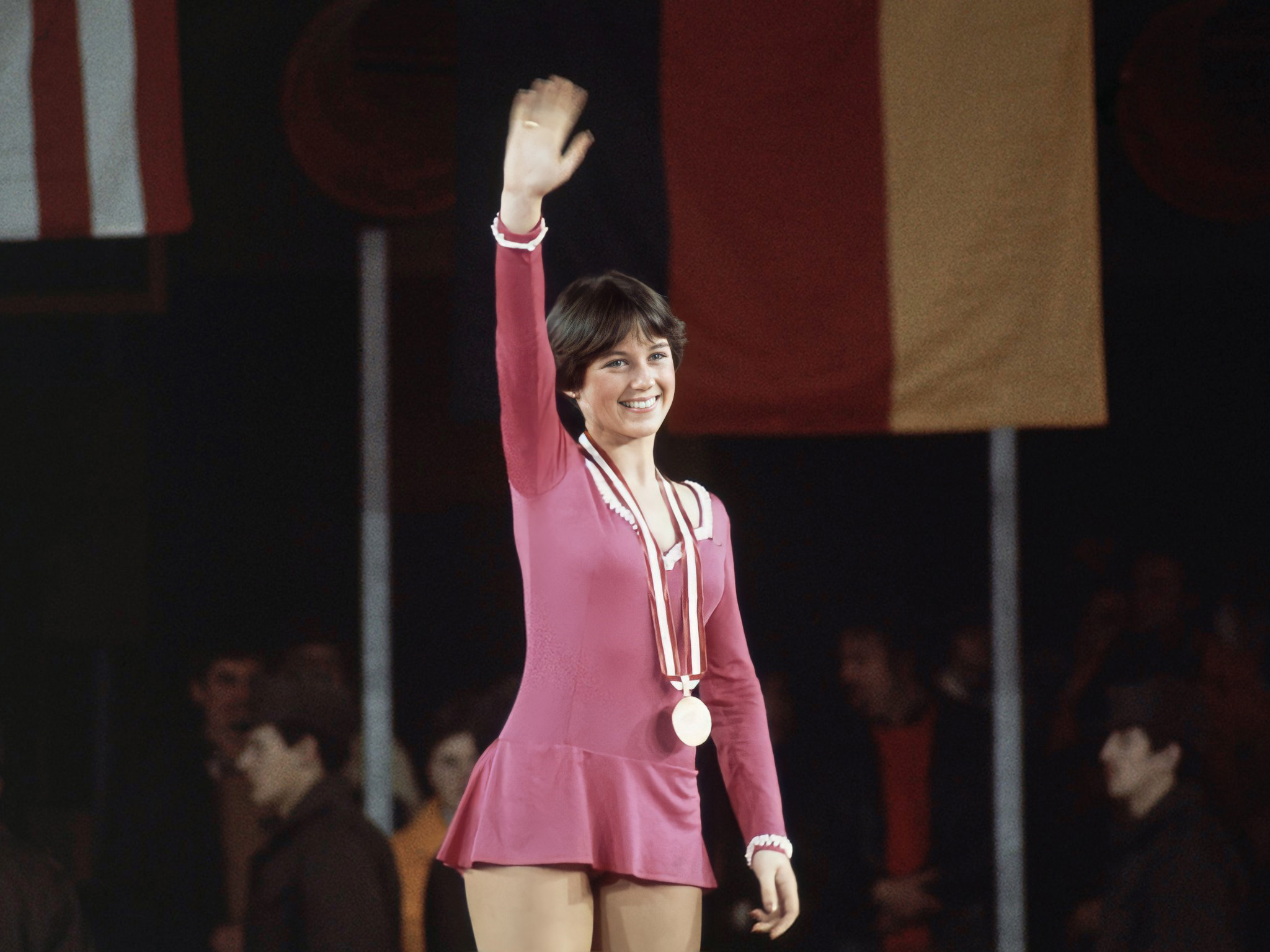
February 14, 1976: Dorothy Hamill Wins a Gold Medal

February 14, 1976, 50 years ago: Dorothy Hamill wins the Gold Medal in ladies' figure skating at the Winter Olympics at Innsbruck, in the Austrian Alps.

A 19-year-old native of the New York suburb of Greenwich, Connecticut, she had won the Silver Medal at the World Championships in 1974 and 1975, and the Gold Medal a few weeks earlier. Still, in spite of previous U.S. Gold Medalists Tenley Albright, Carol Heiss and Peggy Fleming, she was not considered the favorite in Innsbruck. But she won, and became "America's Sweetheart."

Hamill was credited with developing a new skating move, a "camel spin" that turned into a "sit spin," which became known as the "Hamill camel." The bobbed hairstyle that she wore during her Olympic performance was created by stylist Yusuke Suga, and started a fad, known as the "short and sassy" look, leading to a contract with Clairol hair products.

The following year, the film Star Wars premiered, starring Mark Hamill. He and Dorothy are not related, and it appears they have never even met. 

She starred in the Ice Capades, and as late as 1993, a poll showed her tied with Olympic gymnast Mary Lou Retton as the most popular athlete in America, ahead of Michael Jordan, Joe Montana and Wayne Gretzky.
She has married 3 times, including to singer Dean Paul Martin (son of singer-actor Dean Martin), and had a daughter with her 2nd husband. As of 2025, she still appears in skating shows.

Tuesday, May 7, 2024

May 7, 1824: Beethoven's 9th Symphony

May 7, 1824, 200 years ago: Perhaps the greatest of all musical compositions has its premiere: Symphony No. 9 in D minor, Opus 125, also known as the Choral Symphony, by Ludwig van Beethoven.

He is said to have been born on December 16, 1770 in Bonn, in what is now the state of North Rhine-Westphalia, Germany. That date is probably correct: While there is no official record of his birth, there is one of his baptism, the next day, and, in Germany at the time, the tradition was to baptize the baby within 24 hours of birth.

His family was from the Netherlands, hence the German version of Louis, "Ludwig," but also the Dutch-sounding surname. Bonn would serve as the capital of the Federal Republic of Germany from its 1949 founding until its 1990 consolidation with the Democratic Republic of Germany.

His father, Johann, was a musician and singer in the choir of the Archbishop of Cologne, and recognized his son's musical talent early. Later taught by Christian Gottlob Neefe, he had his 1st published composition at the age of 12, a set of keyboard variations. He studied under both Wolfgang Amadeus Mozart and Mozart's alleged rival, Antonio Salieri. (Aside from depicting his immature love of vulgarities, the play and film Amadeus are both to be regarded in terms that Mozart himself would have appreciated: Great art, but also pure bullshit.)

Mozart died in 1791. The following year, at the age of 21, Beethoven moved to Vienna, Austria, which Mozart had helped to make the capital of the world's music, even though Austria was then at war with France, which was going through its Revolution. (France has actually had many of them, but when people say, "The French Revolution," this is the one they mean, the one with the Reign of Terror and the guillotine.) He studied under Joseph Haydn, who, along with Mozart, made the symphony a standard form of composition.

Although the term has had many meanings from its origins in the ancient Greek era, by the late 18th Century, the word "symphony" had taken on the meaning common today: A work usually consisting of multiple distinct sections or "movements," often 4 of them, with the 1st movement in sonata form. A sonata is a musical structure generally consisting of 3 main sections: An exposition, a development, and a recapitulation.

Symphonies are almost always scored for an orchestra consisting of a string section (violin, viola, cello and double bass), brass, woodwind, and percussion instruments, which altogether number about 30 to 100 musicians. Symphonies are notated in a musical score, which contains all the instrument parts. Orchestral musicians play from parts which contain just the notated music for their own instrument. Some symphonies also contain vocal parts.

It's been suggested that, with Beethoven's symphonies, it’s the reverse of Star Trek movies: The odd-numbered ones are the great ones. His Symphony No. 1 in C major premiered on April 2, 1800, when he was 29 years old. This was followed the next year by a series of string quartets that gained some renown. In 1802, he dedicated his Piano Sonata No. 14, later known as his Moonlight Sonata, to his piano student, Giulietta Guicciardi. This was followed on April 5, 1803 by his Symphony No. 2 in D major.

Beethoven called his Symphony No. 3 in E♭ major (that's "E-flat major") the Eroica, or the Heroic Symphony. He knew politics, and the situation in Europe, and he dedicated this symphony to the man he thought was the greatest man in the world at the time: Napoleon Bonaparte, First Consul of France.
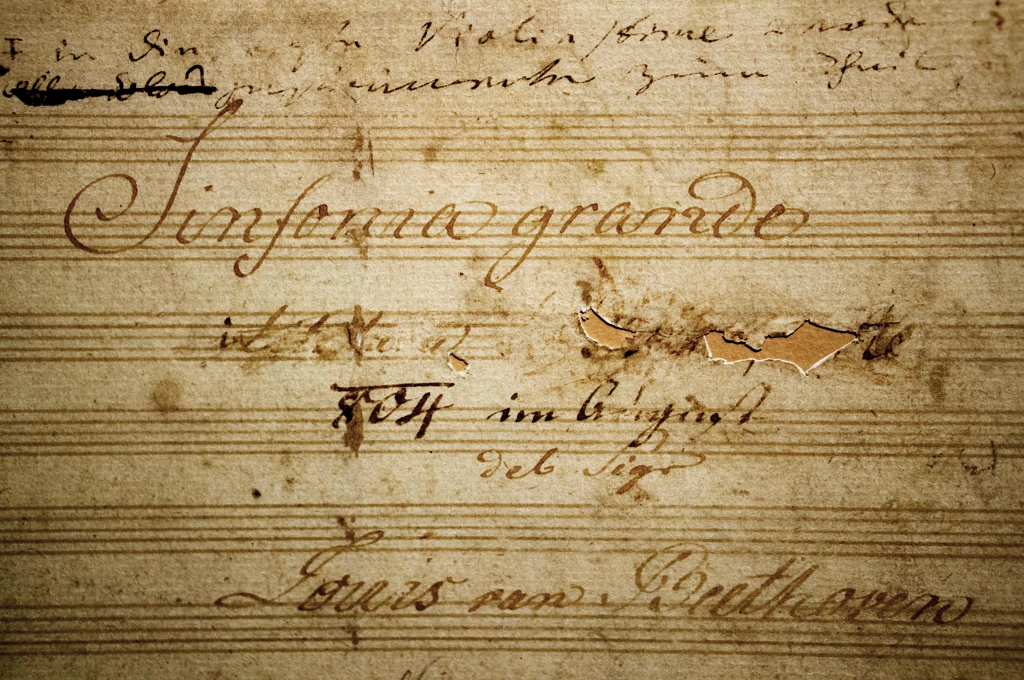
But on December 2, 1804, before this Symphony could be publicly played, Napoleon crowned himself Emperor of France. Apparently, ol' Louie van B had no problem with Napoleon being a dictator, but a monarch? He wouldn't hear of it: He scratched out the dedication with such ferocity that he tore the paper. The score has been preserved, and the hole in it can still be seen on display at the Society of Friends of Music in Vienna.
He rewrote the dedication: "To the memory of a great man." I suspect this meant that the man he thought Napoleon to have been was worth celebrating, but was now "dead." The Symphony premiered on April 7, 1805. On November 20 of that year, his only opera, Fidelio, premiered. The following year, with Napoleon on the march, the Holy Roman Empire, the First Reich, founded by Charlemagne, collapsed after 1,006 years.

He was 34, and had hit his stride: With Mozart dead, and Haydn forced into retirement by advancing age and illness (he died in 1809), Beethoven had become Europe's, and by definition the world's, most sought-after composer. But, in one of the great ironies in the history of artistic expression, he had begun to lose his hearing. He could still write the notes he wanted to hear on a scale, and he could produce them on a piano, but he could no longer hear them sufficiently. He could still conduct an orchestra playing his works in front of a live audience, but he couldn't hear them, or the applause that resulted.  
 
His Symphony No. 4 in 
B♭ major premiered on April 13, 1808. On December 22, 6 days after his presumed 38th birthday, there was a double premiere for his 5th and his 6th. Symphony No. 5 in C minor, which he titled Fate, might be the most famous piece of music ever written, with its "Dun dun dun duhhhh… " opening. It became known as "the Victory Symphony," and, when Morse Code was created, 3 dots and a dash, " . . . - " mimicking the opening, became the symbol for the letter V. Also, V is the Roman numeral for the number 5.

"Beethoven's 5th," long in the public domain, has been used in everything from children's cartoons to the film V for Vendetta. In 1976, Walter Murphy rearranged it as a disco song, "A Fifth of Beethoven," and hit Number 1 with it. And when the Royal Philharmonic Orchestra did the opening medley for their 1981 album Hooked On Classics, of course, the opening of Beethoven's 5th was included, as was the "Ode to Joy" section of his 9th.

Symphony No. 6 in F major, the Pastoral Symphony, by comparison, is far less known. Nevertheless, had he died after this dual premiere, before writing everything that came after it, he would still have been one of the giants of world music.

After his death, found among his papers was a composition dated 1810, Bagatelle No. 25 in A minor, a piano piece that he marked "Für Elise." The piece was published under that name in 1867, and has been known by it ever since. Elise has never been positively identified.  

Beethoven never married. Not that he didn't try: He is known to have had several failed romances. Like many a musical man before and after, women found him irresistible, and he was happy to oblige. His surviving letters show that he wanted to marry and have children, but his stormy personality likely doomed many of these relationships.

Found among his belongings after his death was a letter dated July 6, 1812, addressed to a woman he identified only as "Unsterbliche Geliebte," meaning "Immortal Beloved." The likeliest candidate for the recipient is Josephine Brunsvik, daughter of the Count of Brunswick. She and Ludwig had met in 1799, and they continued to meet and correspond despite her having married twice. Several letters from him, found in her possession after her death, use the term "beloved." It is also an interesting coincidence that Beethoven and Bonaparte each apparently found the love of his life in a woman named Josephine.
She was separated from her 2nd husband, an Estonian baron named Christoph von Stackelberg, in July 1812, and evidence suggests that she and Ludwig met again in Prague, in what is now Czechia. He was 41 years old, she was 33. Three days later, he wrote the letter, but never sent it. Nine months later, on April 8, 1813, Josephine gave birth to a daughter, Minona. Stackelberg believed the child was not his. Was she Beethoven's?

Also in 1812, having fallen ill and gone to the health spa town of Teplitz (now Teplice, Czechia), he met author Johann Wolfgang von Goethe, who, not yet having met him, had commissioned musical pieces based on his writing. Even this meeting of the minds -- Europe's greatest living composer and the German language's greatest living writer -- was fraught with conflict.
Goethe wrote of Beethoven, "His talent amazed me; unfortunately he is an utterly untamed personality, who is not altogether wrong in holding the world to be detestable, but surely does not make it any more enjoyable... by his attitude." But in 1822, Beethoven wrote to him, "The admiration, the love and esteem which already in my youth I cherished for the one and only immortal Goethe have persisted." (He seems to have liked the word "immortal." Alas, Goethe was not immortal, dying in 1832, at age 82. Famously, his last words were to call out for "Light! More light!")

Beethoven's Symphony No. 7 in A major premiered on December 8, 1813, on a double bill with his Opus 91, Wellington's Victory, also known as the Battle Symphony, even though it is not, itself, a symphony. It was in celebration of Arthur Wellesley, the Marquess of Wellington (who was made a Duke the following year), defeating Beethoven's former hero, Napoleon, at the Battle of Vitoria in northern Spain, deciding the long, bloody Peninsular War.

Beethoven's Symphony No. 8 in F major premiered on February 27, 1814. At the age of 43, he was now profoundly deaf, and it looked like that would be it: While others had done more symphonies, some many more – Mozart had 41, and Haydn a record 104 – Beethoven's 8 led him to be seen as the master of the format, and it seemed difficult to imagine that he could produce a 9th.

Indeed, the most memorable song written in 1814 would be a poem by Francis Scott Key, set to an English drinking song, "To Anacreon in Heaven." It would be titled "Defense of Fort McHenry," about the Battle of Fort McHenry in Baltimore, part of the War of 1812. It would later be retitled "The Star-Spangled Banner." The main reason the Americans were able to hang on against the British is that the British troops were divided, with their best men fighting Napoleon.

The final defeat of Napoleon, by Wellington at Waterloo, Belgium on June 18, 1815, should have been a moment of celebration for Beethoven, perhaps the inspiration for a 9th Symphony, or some other great work. But this was the beginning of a very rough period in his life, marked by what he called "an inflammatory fever" and legal issues with his family back in Bonn, including a custody battle with his sister-in-law over his nephew, following his brother's death from tuberculosis.

By 1819, his health had recovered, and he had resumed composing, but the last of his hearing was gone. He had to have someone with him at all times, both of them with notebooks, and that's how they would communicate. (Apparently, despite being the historical figure most known for deafness, he never learned sign language, which had existed in various forms for centuries, or to read lips.) The survival of those notebooks has aided biographers and music historians for over 200 years.

He saw Josephine Brunsvik again as late as 1816. She died in 1821. That year, Beethoven composed the last 2 of his 32 piano sonatas, and some music historians are convinced they are both requiems for her. By that point, he was ill again, with rheumatism and jaundice.

The Philharmonic Society of London commissioned a 9th Symphony from him in 1817, but he couldn't do it, due to his illness and his other issues. Finally, in Autumn 1822, he began, and finished it in February 1824.

On May 7, it premiered at the Theater am Kärntnertor (the Carinthian Gate Theater) in Vienna. George IV was on the throne of Britain. Louis XVIII of France was dying, and would be replaced by his much more conservative brother Charles X within 5 months. Simón Bolívar was leading the South American wars of liberation.

James Monroe was the President of the United States. John Adams and Thomas Jefferson were still alive; Abraham Lincoln was 15, and Ulysses S. Grant was 2. There were 24 States in the Union. The fastest method of communication was still a man on a horse: There was no telegraph, and no railroad. And baseball was still around 20 years away from being developed. 

William Blake was still alive, and Lord Byron had died 18 days before. Victor Hugo was 22 years old, and Alexandre Dumas pere soon would be. Ralph Waldo Emerson was 21 and at Harvard University. Edgar Allan Poe was 15, Alfred Tennyson was 14, Charles Dickens was 12, Henry David Thoreau was 6, and Walt Whitman was 5. Charlotte Brontë was 8, Emily was 6, and Anne was 4.

Gioachino Rossini was 32, and, with Beethoven's deafness in mind, was probably then the European composer most in demand. Johan Strauss I, eventually the composer of the Radetzky March, was 20. His son, Johan II, eventually the composer of The Blue Danube, was born the next year. Felix Mendelssohn was 15, Frédéric Chopin was 14, and Franz Liszt was 13. Johannes Brahms was born 9 years to the day later.

Composer Franz Schubert was in attendance. So was the Chancellor of the Austrian Empire, Klemens von Metternich, one of the architects of the post-Napoleon Congress of Vienna. Francis II, the last Holy Roman Emperor, and by this point the 1st Emperor of Austria, did not attend. Nor did King Frederick William III of Prussia, to whom the Symphony was dedicated.
Theater am Kärntnertor

To sing for this symphony, Beethoven had personally recruited 2 young women who had already begun to make names for themselves, even though he had never heard them sing: Henriette Sontag, an 18-year-old soprano from Koblenz; and Caroline Unger, a 20-year-old Viennese contralto.

The words he wrote for them suggested that someone told him, "Me: French is a language of love. So is Spanish. So is Italian. German could never be a language of love." And he said, "Halte mein Bier... "

Joseph Böhm, the Hungarian first violin that night, recalled:

Beethoven himself conducted, that is, he stood in front of a conductor's stand and threw himself back and forth like a madman. At one moment he stretched to his full height, at the next he crouched down to the floor, he flailed about with his hands and feet as though he wanted to play all the instruments and sing all the chorus parts. The actual direction was in [Louis] Duport's hands; we musicians followed his baton only.

The 4th and final movement includes a section titled "Freude, schöner Götterfunken." No, this does not mean that God Himself was getting funky upon the advice of Sigmund Freud, who, though he made his name in Vienna, would not be born until 1856 (and would become a committed atheist). It means "Joy, beautiful spark of the gods." It has become known as "The Ode to Joy," and is the most familiar part of the composition. It has been used for many things, from an Easter hymn to the theme for the 1990s NBC sitcom Suddenly Susan.

When the Symphony was over, Beethoven was several bars off and still conducting. Fraulein Unger walked over, and gently turned him around to accept the audience's cheers and applause.

One year to the day later, on May 7, 1825, Antonio Salieri, institutionalized due to dementia, died.

By late 1826, Beethoven fell ill again, and by March 1827 was bedridden. According to Austrian composer Anselm Hüttenbrenner, a friend who was there over the last few days, on March 24, he said to those present, in Latin, "Plaudite, amici, comoedia finita est," meaning, "Applaud, friends, the comedy is over." Later that day, a gift of a case of wine arrived. When told, he whispered, "Pity. Too late."

At 5:00 in the afternoon on March 26, there was a flash of lightning and a clap of thunder. At this, Hüttenbrenner said, "Beethoven opened his eyes, lifted his right hand and looked up for several seconds with his fist clenched... not another breath, not a heartbeat more." He was 56 years old, and left everything he had to his nephew, Karl.

When Mozart had died in Vienna, 36 years earlier, there was not much of a funeral procession, and he was buried in an unmarked grave. When Beethoven died, there was a torchlight funeral procession of 10,000 people, including Hüttenbrenner and Schubert. He was laid to rest in Vienna's Central Cemetery. Schubert had syphilis, and died only a year and a half later, at the age of 31.

Karl van Beethoven served in the Austrian army, then failed at business, but was able to live comfortably on royalties from his uncle's works. He died in 1858, of liver failure. He had 5 children, the last survivor of them living until 1919. The male Beethoven line has died out, but Karl's daughters have descendants who live today.

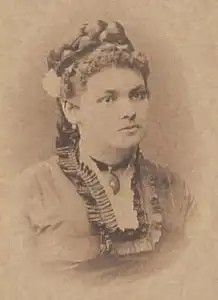
Minona von Stackelberg  became a "lady's companion" -- someone to keep an older woman of means company, not at all implying a lesbian relationship -- and lived until 1897, age 84.
Minona von Stackelberg. Was she Beethoven's daughter?

Louis Duport, the conductor for the 9th's premiere, died in 1853. Henriette Sontag, later the Countess Rossi, lived until 1854; Caroline Unger, until 1877.

Built in 1763, after a previous theater on the site burned down, the Theater am Kärntnertor in Vienna was replaced in 1869, across the street named Walfischgasse, with the Vienna State Opera House. The Hotel Sacher was built on the site of the premiere of Beethoven's 9th.
The Vienna State Opera House (left) and the Hotel Sacher

In Charles Schulz' comic strip Peanuts, the character of Schroeder was a pianist, and obsessed with Beethoven. In 1956, rock and roll pioneer Chuck Berry had a hit with a song titled "Roll Over Beethoven," using him as a stand-in for all the music that teenagers' parents liked, from classical to the more recent Hit Parade stuff.

Berry was a smart guy, but, in this case, he didn't know what he was talking about: Beethoven rocked harder than most classical composers, and while he didn't use drugs, he drank and womanized as much as any rocker of the latter half of the 20th Century.

UPDATE: No less a piano-based rocker than Billy Joel said, in a 2025 interview with Far Out magazine, "From early on, I felt Beethoven. I still think he is the greatest composer who ever lived. To me, he was the most human composer. With Beethoven, I hear the stops and the starts and the friction and the struggles that he had when he was writing. He had to struggle. The man was deaf when he wrote most of this stuff."

In 2011, the YouTube series Epic Rap Battles of History featured "Justin Bieber vs. Ludwig van Beethoven," the big star of the moment against an all-timer. Although ERB co-founder Nice Peter didn't give Beethoven a German accent (he later would give Mozart one in a battle against electronic songwriter Skrillex), he really roasted Bieber:

There's a crowd of millions waiting
to hear my symphonies!
You wanna be a little white Usher?
Here: Show then to their seats!

There's an even better joke about Beethoven's 9th:

The Boston Symphony recently performed Beethoven's Ninth symphony, which is a wonderful piece that has a part near the end in which the bass violins do nothing. So, the bassists snuck offstage, out the back door, and next door to the local pub for a drink.

After quickly gulping down a few stiff drinks, one of them checked his watch and said, "Oh no, we only have 30 seconds to get back!"

Another bassist said, "Don't worry, I tied the last page of the conductor's score down with string to give us a bit more time. We'll be fine."

So, they staggered and stumbled back into the concert hall and took their places just as the conductor was busily working on the knot in the string so he could finish the symphony.

Someone in the audience asked his companion, "What's going on? Is there a problem?"

His companion said, "This is a critical point: It's the bottom of the Ninth, the score's tied, and the bassists are loaded!"

In 1985, the European Union adopted the "Ode to Joy" section of Beethoven's 9th as the Anthem of Europe.

Tuesday, July 17, 2018

Rightful Monarchs

Franz, Duke of Bavaria.
Is he the rightful King of England?

July 17, 1918, 100 years ago: The household of the deposed Russian imperial family -- Czar (or Tsar) Nicholas II, his wife Czarina Alexandra, his heir Tsarevich Alexei, and his daughters the Grand Duchesses Olga, Tatiana, Maria and Anastasia, are executed by the Bolsheviks at Yekaterinburg.

The Czar was 50 years old; the Czarina, 46; the Grand Duchesses, 22, 21, 19 and 17, respectively; and the Tsarevich only 13.

The Czar had much to answer for. The rest did not deserve to die.

Four months later, World War I was over, and Kaiser Wilhelm II of Germany had abdicated, and was in exile. "Nicky" and "Willy" were first cousins, of each other, and also of King George V of Britain. All were grandsons of Britain's Queen Victoria.

These royal houses are listed in order of their overthrow

Britain: House of Stuart, 1688/1714
1685-1701 James II (VII of Scotland), followed by his son
1701-1766 James III (VIII of Scotland), followed by his son
1766-1788 Charles III, followed by his son
1788-1807 Henry IX, followed by his 2nd cousin, fellow great-great-grandson of Charles I
1807-1819 Charles IV, followed by his brother
1819-1824 Victor I, followed by his daughter
1824-1840 Mary II, followed by her son
1840-1875 Francis I, followed by his niece
1875-1919 Mary III, followed by her son
1919-1955 Robert I (IV of Scotland), followed by his son
1955-1996 Albert I, followed by his son
1996-present Francis II, Franz, Duke of Bavaria, age 86

France: House of Bourbon/Legitimist, 1848
1830-1848 Louis-Phillippe (Louis XIX), followed by his cousin
1848-1883 Henri V, followed by his cousin
1883-1887 Jean III, followed by his son
1887-1909 Charles XI, followed by his son
1909-1931 Jacques I, followed by his brother
1931-1936 Charles XII, followed by his nephew
1936-1941 Alphonse I (Alphonso XIII of Spain), followed by his son
1941-1975 Jacques II, followed by his cousin
1975-1989 Alphonse II, followed by his son
1989-present Louis XX, Louis Alphonse, Duke of Anjou, age 45
King Louis XX of France

France: House of Orleans, 1848
1830-1848 Louis-Phillippe (Louis XIX), followed by his son
1848-1894 Philippe VII, followed by his son
1894-1926 Philippe VIII, followed by his cousin
1926-1940 Jean III, followed by his son
1940-1999 Henri VI, followed by his son
1999-2019 Henri VII, followed by his son
2019-present Jean IV, Jean, Count of Paris, age 54
King Jean IV of France

France: House of Bonaparte, 1870
1848-1873 Napoleon III, Louis-Napoleon, followed by his son
1873-1879 Napoleon IV, Louis-Napoleon, followed by his cousin
1879-1926 Napoleon V, Victor, followed by his son
1926-1997 Napoleon VI, Louis, followed by his son
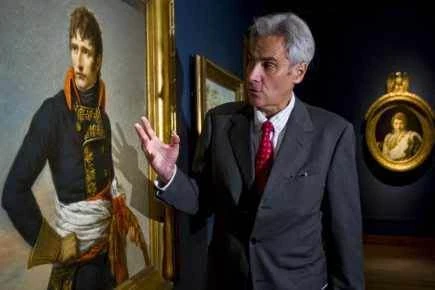
1997-present Napoleon VII, Charles, age 68
Emperor Napoleon VII of France,
with a painting of his ancestor's brother

Portugal: House of Braganza, 1910
1908-1932 Manuel II (Emmanuel), followed by his nephew
1932-1976 Duarte II (Edward), followed by his son
1976-present Duarte III, Duke of Braganza, age 74
King Duarte III of Portugal

Russia: House of Romanov, 1917
1894-1918 Nikolai II (Nicholas), followed by his uncle
1918-1929 Nikolai III, followed by his cousin
1929-1938 Kirill I (Cyril), followed by his son
1938-1992 Vladimir IV, followed by his daughter
1992-present Maria I, Grand Duchess Maria Vladimirovna, age 65, the only woman among these would-be monarchs
Maria I, Empress and Autocrat of All the Russias

Germany: House of Hohenzollern, 1918
1888-1941 Wilhelm II, followed by his son
1941-1951 Wilhelm III, followed by his son
1951-1994 Ludwig V, Louis Ferdinand, followed by his son
1994-present, Georg I, Georg Friedrich, Prince of Prussia, age 43
Kaiser Georg I of Germany, with a bust of his great-grandfather.
As you can see, there is a physical resemblance.
Hopefully, there isn't a temperamental resemblance.

Austria: House of Habsburg-Lorraine, 1922
1848-1916 Franz Josef I, followed by his grandnephew
1916-1922 Karl I (IV of Hungary), followed by his son
1922-2011 Otto I (lived to be 98 years old), followed by his son
2011-present Karl II (V of Hungary), Karl von Habsburg-Lothringen, age 58
Image result for Karl von Habsburg
Emperor Karl II of Austria.
Also King Károly V of Hungary.

Italy: House of Savoy, 1946
1900-1946 Vittorio Emanuele III (Victor Emmanuel), followed by his son
1946-1983 Umberto II (Humbert), followed by his son
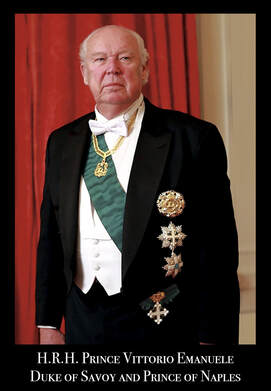
1983-present Vittorio Emanuele IV, Prince of Naples, age 82
King Vittorio Emanuele IV of Italy

I had considered doing this for Greece, but the last King of Greece, Constantine II, who reigned from 1964 until the abolition of the monarchy in 1973, is still alive, at age 78.
King Konstantinos II of Greece

Saturday, June 28, 2014

June 28, 1914: The Assassination of Archduke Ferdinand Sparks World War I

June 28, 1914, 100 years ago: Archduke Franz Ferdinand and his wife, Sophie, Duchess of Hohenberg, are assassinated in Sarajevo, then a part of the Austro-Hungarian Empire, to whose throne the Archduke was the immediate heir.

The Empire then stretched from the Alps to the Black Sea, but had so many different ethnicities under its domain that it was hard to keep it together. Franz Ferdinand, 50, was the heir presumptive to the throne, the nephew of the Emperor, Franz Josef, 83. Franz Ferdinand was no friend to the Serbs: At various times, he called them "pigs," "thieves," "murderers" and "scoundrels."

Sophie, 46, was a German princess, but not of dynastic rank, and so the Emperor refused to permit the marriage. A compromise was worked out: Franz Ferdinand could marry Sophie only if he renounced the right of succession to any of their descendants.

In 1913, Franz Ferdinand had been named inspector-general of the imperial military. He was visiting Sarajevo, with Sophie, to inspect Austrian troops there. Six members of the Black Hand, terrorists trying to establish an independent "Greater Serbia," prepared to assassinate him to make their point.

At 10:15 AM local time, Nedeljko Čabrinović threw a bomb that bounced off the Archduke's car, a 1911 Gräf & Stift 28/32 PS Double Phaeton. The car behind it ran over it as it exploded, wounding 20 people but killing none.

(A similar thing happened with the assassination of Czar Alexander II of Russia in 1881. That also required a 2nd attempt by the conspirators, which, in that case, came immediately after.)

The Archduke and Archduchess arrived at the Town Hall for a reception with the Mayor, Fehim Čurčić. In his speech at the reception, the Archduke thanked the people of Sarajevo "as I see in them an expression of their joy at the failure of the attempt at assassination."

Gavrilo Princip, a Bosnian Serb a few weeks short of his 20th birthday, learned that the 1st attempt had failed. He was determined to make a 2nd attempt. Knowing the route of the motorcade would be on the Appel Quay, along the Miljacka River, he stood in front of Moritz Schiller's delicatessen, adjacent to the Latin Bridge.
The site of the assassination in 2007. Schiller's Delicatessen
is now the Museum of Sarajevo 1878-1918.

The Archduke's driver, Leopold Lojka, made a right turn, and was told that he should have turned left. He stopped, and began to turn the car around -- right in front of Princip. At 11:00 AM -- the time throughout most of Europe, 10 AM in London, 5 AM on the U.S. East Coast -- the would-be assassin had his chance, lunged forward, and fired 2 shots. Franz Ferdinand was hit in the neck, Sophie in the abdomen.

Franz Ferdinand knew he was doomed, and called out to his wife, "Sophie, Sophie! Don't die! Live for our children!" But she was already dead. Asked about his own condition, he said, "It is nothing." It wasn't: He was pronounced dead at 11:30.

Princip was unrepentant. At his trial, he said, "I am a Yugoslav nationalist, aiming for the unification of all Yugoslavs, and I do not care what form of state, but it must be freed from Austria."
Princip's mug shot

On July 23, the imperial government issued the "July Ultimatum": If, within 48 hours, the semi-autonomous Serbian government did not crack down on the Black Hand, Austrian troops would come in and do so. The Serbian government did not crack down on the Black Hand, and on July 28, Austria declared war on Serbia. If that had been the end of it, Austria would have won what would have remained an internal uprising.

That was not the end of it. The Serbs appealed to their allies, the Russian Empire. On July 31, Czar Nicholas II ordered mobilization. Had that been the end of it, Russia likely would have won the war, the Austro-Hungarian Empire would have been broken up, a united Slavic nation would have been formed in the Balkans, and Russia would have emerged as perhaps the strongest nation on the European continent, on a level with France and Germany.

That was not the end of it. The German Empire came to the aid of their neighbor and linguistic brother Austria. On August 1, Kaiser Wilhelm II -- a cousin of Czar Nicholas -- declared war on Russia. If that had been the end of it, Germany vs. Russia would have been a brutal war, but Russia's superior numbers would not have saved them against Germany's more advanced military, and the German Empire would have taken big parts of the Russian one, including Poland, and emerged as perhaps the strongest nation in the world, at the very least on the same level as the British Empire and the United States of America.

That was not the end of it. Also on August 1, France mobilized in support of its ally, Russia. On August 3, Germany declared war on France. If that had been the end of it, it would have been a two-front war, but Germany would probably have beaten France, as it had in 1870, and as its predecessor nation, the Holy Roman Empire, had in 1815.

That was not the end of it. On August 4, in support of allies France and Russia, the British Empire declared war on Germany. Britain's King George V was a cousin of both the Kaiser and the Czar: All 3 were grandsons of Queen Victoria, whose 9 children had married into several royal families, to the point where her son, George's father, King Edward VII, was known as "The Uncle of Europe." (He was married to Princess Alexandra of Denmark, and her father, King Christian IX, was called "The Father-in-Law of Europe.")

Everyone thought "The Great War" would be over by Christmas. Instead, in September, because the British were there to support the French, a stalemate developed on the Western Front, and Germany couldn't redirect troops to assist those on the Eastern Front.

Emperor Franz Joseph died on November 21, 1916. He was succeeded by a grandnephew, who took the throne as Charles I, Emperor of Austria, and Karl IV, King of Hungary, in the "Dual Monarchy."

America entered the war on April 6, 1917, after Germany began attacking American ships aiding the Allies, and after it attempted to get Mexico into the war on its side. (This failed.) Russia collapsed, and there were 2 revolutions in 1917. The 1st, in March, overthrew the Czar, and attempted to establish a republic. The 2nd, in November, overthrew that, and the new government of Vladimir Lenin was Communist. It took the Czar and his family prisoner, and executed them all on July 17, 1918.

Lenin took Russia out of the war on March 3, 1918. With the Eastern Front rendered unnecessary, the Germans, themselves on the verge of collapse, could throw everything onto the Western Front, and were about to win, a great come-from-behind victory, when American troops were finally able to enter combat on June 1.

On November 11, 1918, 2 days after the Kaiser admitted the inevitable, and abdicated, fleeing to the Netherlands, the Germans surrendered. The Great War, the World War, "The War to End All Wars," was over. There were over 10 million military personnel killed, and at least that many civilians. New nations were created, including an independent Poland, and the combined Slavic nation the conspirators of June 1914 wanted, named Yugoslavia.

Most of them were not around to appreciate this. Most of the conspirators were under age 20, and considered minors, and not executed, but that didn't necessarily keep them alive long enough to see the war's end. Veljko Čubrilović, Danilo Ilić and Mihajlo "Miško" Jovanović were executed by hanging on February 3, 1915. Čabrinović died in prison of tuberculosis on January 20, 1916, age 20. Just 23 days later, Mayor Čurčić also died of tuberculosis, at 50. 

Trifun Grabež also died in prison of tuberculosis, on October 21, 1916. Princip would also die in prison of tuberculosis, on April 28, 1918. A prison psychiatrist who examined Princip wrote he believed the World War was bound to happen, independent of his actions, and that he "cannot feel himself responsible for the catastrophe."

Lojka died in 1926, at 39, but I can't find a cause of death. To the end of his life, he claimed to still hear the voices telling him he had made a wrong turn.

Vaso Čubrilović, Veljko's brother, at 17 the youngest of the conspirators, lived to see the end of World War I. and was then released. So was Cvjetko Popović. When Nazi Germany invaded Yugoslavia in 1941, Vaso was arrested, and sent to a concentration camp. He survived that, too. Popović lived until 1980. Vaso was the last survivor of the events, dying on June 11, 1990 -- not quite living to see the breakup of Yugoslavia and the awful multi-front civil war that followed.

Both the death car and Princip's pistol are now in the Museum of Military History in Vienna, the capital of the Republic of Austria. The museum on the site of Schiller's Delicatessen includes a replica of that pistol, and has placed brass footprints where Princip stood as he fired. They had to be replaced in 1945 after the Nazis broke them up, and again in 1995 after the Serbs bombed it.

In 2014, the BBC began its commemorations of the Centennial of World War I. Among its productions was something unimaginable in 1914: Actors playing the leading figures in the buildup to the war, engaging in a rap battle: Princip, Franz Joseph, Nicholas II, Wilhelm II and George V. A figure playing Field Marshal Joseph Joffre represented France, but, oddly, had no lines in the battle.

Except for the Czar, played by a much larger, scarier-looking man, the actors looked the part and had the right accents. But I'm still not sure if the actor playing Franz Joseph was an actual old man, or a younger guy in makeup. There was also nobody representing the other countries that got in: No Wilson for America, no Robert Borden for Canada, no Andrew Fisher for Australia, no King Victor Emmanuel III for Italy, and no Sultan Mehmed V or General Mustafa Kemal Atatürk for the Ottoman Empire.