Today, the Mets started a series away to the Washington Nationals.
Washington's 10 Greatest Athletes
Honorable Mention to Washington Senators in the Baseball Hall of Fame, who didn't otherwise make the Top 10: Sam Rice, Bucky Harris, Goose Goslin, Joe Cronin, Heinie Manush, Rick Ferrell, Early Wynn and Harmon Killebrew. (The Killer only played his 1st 5 seasons in Washington. If the "Old Senators" hadn't moved, or he'd gone to the "New Senators" at some point, he'd be on this list. He will definitely be on it when I do it for Minnesota.)
Honorable Mention to Homestead Grays in the Baseball Hall of Fame: Cumberland Posey, Jud Wilson, Cool Papa Bell, Ray Brown, Buck Leonard and Josh Gibson. There is a consensus that, at the very least, Bell, Leonard and especially Gibson would have been superstars had baseball been integrated. But we'll never know, and Negro League stats are woefully incomplete.
Honorable Mention to the 3 big stars of the Washington Nationals' 4 (so far) National League Eastern Division Championships in this decade: Ryan Zimmerman, Stephen Strasburg and Bryce Harper. Would any of them be in the Top 10 if the Nats had won so much as a Pennant? I'm not sure. Would any be in it if they'd won the District's 1st World Series title since 1924? As Harper would say, "That's a clown question, bro."
Honorable Mention to Washington Redskins in the Pro Football Hall of Fame, who didn't otherwise make the Top 10: Turk Edwards, Wayne Millner, Bill Dudley, Bobby Mitchell, Sam Huff, Paul Krause, Chris Hanburger, Ken Houston, Russ Grimm and Bruce Smith.
Mitchell started in Cleveland and went to Washington, and if he'd spent his entire career in either city, would be a solid candidate for either's Top 10. Huff would be in the Top 10 if he'd spent his entire career in Washington. If he'd spent his entire career in New York, he might be in their Top 10.
Krause spent most of his career in Minnesota, and will be in the Twin Cities' Top 10. Houston spent half his career in the city whose name is his own, and will be in the Houston Top 10. Bruce, who spent most of his career in Buffalo, will definitely be in the Top 10 when I do this for Western New York.
Very Honorable Mentions to Charley Taylor and Art Monk: Each of these Redskins, at one point, was the NFL's all-time leader in receptions. When
The Sporting News named their 100 Greatest Football Players in 1999, Houston was ranked 61st, Taylor 85th, Monk 91st. None of them was included in the NFL Network's 2010 list of the 100 Greatest Players.
Honorable Mention to Washington Bullets or Washington Wizards in the Basketball Hall of Fame, who didn't otherwise make the Top 10: Bernard King and Mitch Richmond.
Honorable Mention to Washington Mystics stars: Chamique Holdsclaw, Nikki McCray, Alana Beard and Crystal Langhorne.
Honorable Mention to Washington Capitals in the Hockey Hall of Fame, who didn't otherwise make the Top 10: Scott Stevens, Larry Murphy, Dino Ciccarelli and Adam Oates.
Honorable Mention to D.C. United players who were chosen for Major League Soccer's 10th Anniversary Best XI in 2005: Jeff Agoos, Eddie Pope, Marco Etcheverry and Jaime Moreno.
10. Rod Langway, defenseman, Washington Capitals, 1982-93. After starting his career with the Montreal Canadiens, and winning the Stanley Cup as a rookie in 1979, he never got close to the Cup again. But he became one of the top defensemen in the game in D.C. (Landover, actually), something he couldn't do with Larry Robinson running the show in Montreal.
He made 6 All-Star Games, 4 with the Caps. He won back-to-back Norris Trophies for best defenseman in 1983 and '84. He only scored 51 goals in his 14 NHL seasons, but had 278 assists. The Caps retired his Number 5, and was elected to the Hockey Hall of Fame.
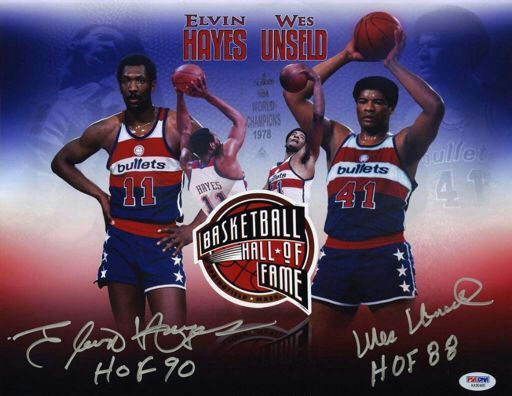
9. Wes Unseld, center, Washington Bullets, 1973-81. The big center spent his entire career with the Bullets, arriving in Baltimore in 1968 and making the move down the Baltimore-Washington Parkway in 1973. He was both Rookie of the Year and Most Valuable Player in the NBA in 1969, although both of those were in Baltimore. He was a 5-time All-Star, though only the last was in Washington.
He got the Bullets into the NBA Finals in 1971, 1975, 1978 and 1979, and finally led them to the title in 1978, winning the Finals MVP. The Bullets retired his Number 41 (before becoming the Wizards), and he was named to the Basketball Hall of Fame and the NBA's 50th Anniversary 50 Greatest Players.
8. Mike Gartner, right wing, Washington Capitals, 1979-89. He played another 9 seasons in the NHL, and never once appeared in the Stanley Cup Finals -- coming closest when the Rangers traded him in 1994, just before they could win it.
It's too bad, because he was fantastic, scoring 708 goals, and making 7 All-Star Games, 4 with the Caps. He was elected to the Hockey Hall of Fame, the Caps retired his Number 11, and he was named to the 100 Greatest Hockey Players by both The Hockey News in 1998 and the NHL on its 100th Anniversary in 2017.
7. John Riggins, running back, Washington Redskins, 1976-86. He wasn't pretty. He wasn't graceful. He wasn't tactful. He was just a great fullback. He helped the University of Kansas win the 1968 Big Eight Championship, then played 5 seasons for the Jets, and 4 for the Washington Redskins.
Then he held out for the entire 1980 season, and returned, saying, "I'm bored, I'm broke, and I'm back." Good thing he did, because, 2 years later, he was named Most Valuable Player of Super Bowl XVII, the Redskins' 1st NFL Championship in 40 years.
He only played in 1 Pro Bowl, in 1975, but in 1983, he set an NFL record with 24 rushing touchdowns, and won the Bert Bell Award as NFL MVP, helping the Redskins get into Super Bowl XVIII, although they lost. He rushed for 11,352 yards and 104 touchdowns. He was named to the Pro Football Hall of Fame, the Redskins Ring of Fame, and the NFL's 1980s All-Decade Team.
6. Sonny Jurgensen, quarterback, Washington Redskins, 1964-74. In 1964, the Philadelphia Eagles named Joe Kuharich as head coach. Kuharich was a massive prude, and the Eagle's All-Pro quarterback, Christian Adolph Jurgensen III, liked the nightlife. So Kuharich traded Sonny to the Washington Redskins for their starting quarterback of the time, Norm Snead.
This trade was
so dumb! How dumb
was it? Over the rest of the decade, the Eagles floundered, while the Redskins got better, eventually becoming the team (albeit quarterbacked by Billy Kilmer, with Sonny as an aging backup) that won the 1972 NFC Championship.
Sonny also threw more touchdown passes in the 1960s than any other quarterback. Guess which quarterback threw more interceptions in the 1960s than any other. Did I telegraph the punch enough? It was Norm Snead. And Joe Kuharich traded Sonny for Norm.
Sonny had the highest career "quarterback rating" of any player before the 1978 rule changes that opened up the passing game: 82.6. He led the NFL in passing yards 5 times and in touchdown passes twice -- at a time when the other contenders for the title of best quarterback in the NFL were Johnny Unitas, Y.A. Tittle and Bart Starr. Vince Lombardi, who coached Starr in Green Bay and the Redskins in the last season of his life, 1969, said, "If we would have had Sonny Jurgensen in Green Bay, we'd never have lost a game."
Sonny was named to the College and Pro Football Halls of Fame, the NFL's 1960s All-Decade Team, the Philadelphia Eagles Hall of Fame and the Washington Redskins Ring of Fame. He and Hall of Fame linebacker Sam Huff formed a beloved broadcasting team for the Redskins.
The Redskins don't officially retire numbers (Sammy Baugh's 33 is the lone exception), but Jurgensen's Number 9 has only been given out once since he retired after the 1974 season. That was in 2002, by new head coach Steve Spurrier, to one of his former University of Florida quarterbacks, Shane Matthews. He also gave Number 7, worn by Joe Theismann, to another of his Florida quarterbacks, Danny Wuerffel. Redskin fans were so angry that, before the regular season started, he switched Wuerffel to 17 (no outcry over getting Kilmer's number) and Matthews to 6. At 83, Sonny remains that beloved in the Potomac Valley.
5. Elvin Hayes, forward, Washington Bullets, 1972-81. The Big E reached the Bullets in their last season in Baltimore, and may still be the best player the franchise has ever had, making 12 NBA All-Star Teams (7 in Washington), and helping them reach the NBA Finals 3 times, winning the 1978 NBA Championship.
His Number 11 was retired by the Bullets (before becoming the Wizards). He was named to the Basketball Hall of Fame. and the NBA's 50th Anniversary 50 Greatest Players.
4. Darrell Green, cornerback, Washington Redskins, 1983-2002. Those dates alone should tell you something: He played 20 seasons in the NFL, and not as a placekicker or a punter. He played 295 games, the most of any defensive player in the League's 98-season history. He might be the best Washington football player of the last 70 years, and he might also be the fastest player in NFL history.
He arrived too late to be a member of their team that won Super Bowl XVII, but he got them into Super Bowl XVIII (lost), Super Bowl XXII (won), and Super Bowl XXVI (won). He made 7 Pro Bowls, his last at age 38.
He was the oldest man to play either of the defensive back positions, cornerback or safety, nearly 43. He was the oldest to have a gain of at least 35 yards, also nearly 43. He was the oldest with an interception, nearly 42. He was the oldest to return an interception for a game-winning touchdown in overtime, nearly 36; and the 2nd-oldest to return any interception for a touchdown, nearly 38.
He wasn't just a great player: He was a great guy, winning the Walter Payton NFL Man of the Year award in 1996. He was named to the College and Pro Football Halls of Fame, the NFL's 1990s All-Decade Team, and the Redskins' Ring of Fame.
In 1999,
The Sporting News ranked him 81st on its list of the 100 Greatest Football Players. In 2010, the NFL Network ranked him 75th on their list of the 100 Greatest Players. In other words, 11 years later, when other defensive backs had cemented their legacy, Green had actually grown in the estimation of many people.
3. Alex Ovechkin, left wing, Washington Capitals, 2005-present. He's only 32 years old, but already has 604 career goals (making him the all-time leader among Russian- or Soviet-born players), a record 20 of them in overtime. He scored 65 goals, a record for his position, in 2007-08.
When the Maurice Richard Trophy was established for the leading goalscorer in 1998-99, he became the the 1st player to win that, the Art Ross Trophy for leading scorer (goals and assists), the Lester B. Pearson Award (most outstanding player according to a players' vote) and the Hart Memorial Trophy (Most Valuable Player as judged by the sportswriters) in the same season, 2007-08.
A 9-time All-Star, he's won the Calder Memorial Trophy (Rookie of the Year) in 2006, the Hart in 2008, '09 and '13; the Ross in 2008; the Richard in 2008, '09 and '13; and Pearson in 2008, '09 and '10; and the Kharlamov Trophy (named for Valery Kharlamov, the great Soviet winger of the 1970s, and given to the best Russian-born player) in 2006, '07, '08, '09, '10, '14 and '15.
Team success has eluded him, as the Caps haven't reached the Conference Finals since he arrived. And he's never competed for Russia in the Olympics. But in 2017, he was named one of the NHL's 100th Anniversary 100 Greatest Players. Unless he does something on the level of Pete Rose or O.J. Simpson, he is sure to be elected to the Hockey Hall of Fame, and for the Capitals to retire his Number 8.
2. Walter Johnson, pitcher, Washington Senators, 1907-27. As Lawrence Ritter and Donald Honig put it in their 1981 book
The 100 Greatest Players In Baseball History, "He had only one pitch, a fastball -- but what a fastball!" He used it to build statistics that simply don't look real, and to build a reputation such that, in a 1916 game, Ray Chapman of the Cleveland Indians, doomed to become the only MLB player to die as a result of an on-field injury, walked away from an at-bat. The umpire told him he had 1 strike left, and he said, "Take it. I don't want it."
"The Big Train" debuted in 1907, and won 417 games, 2nd-most behind Cy Young, and the most in American League history. And he did this for the Washington Senators, who, even in his day, were known as "First in war, first in peace, and last in the American League." He had a 2.17 career ERA, a 147 ERA+ -- so his greatness wasn't just a result of the Dead Ball Era -- and a 1.061 WHIP.
He had 3,508 strikeouts. Not only did that stand as a record from 1921, when he surpassed the 2,803 of Cy Young, until 1983, when Nolan Ryan surpassed him, but, from July 22, 1923, when he surpassed the 3,000-strikeout barrier, until July 17, 1974, when Bob Gibson also did, he was the only member of the 3,000 Strikeouts Club. While his strikeout record has now been surpassed by 8 pitchers, his record of 110 shutouts has never been approached. (Grover Cleveland Alexander is next-best with 90.)
He led the AL in wins 6 times, ERA 5 times, and strikeouts 12 times. He led the League in all 3 -- the Pitching Triple Crown -- in 1913, 1918 and 1924. In 1913, he went 36-7, with a 1.14 ERA -- an ERA+ of 259, meaning he was 159 percent better at preventing earned runs than the average pitcher that season. He pitched a no-hitter in 1920. It took until 1924 for the Senators to win a Pennant, and, after losing 2 games in the Series, he came on in relief in Game 7 and was the winning pitcher. He won another Pennant with the Senators in 1925.
His last game was on September 30, 1927. It was the game in which Babe Ruth set a new record with his 60th home run of the season. Oddly, Johnson came on as a pinch-hitter. He was a decent hitter by pitchers' standards, batting .235 with 24 home runs and 255 RBIs in 21 seasons.
In 1936, he was 1 of the 1st 5 players elected to the Baseball Hall of Fame. Sadly, his wife Hazel died of heatstroke in 1930, and he died of a brain tumor in 1946, only 59 years old. A monument to him was erected outside the Senators' Griffith Stadium, and moved to Walter Johnson High School when it was established in 1956 in the suburb of Bethesda, Maryland, where Johnson lived. A statue of him stands outside Nationals Park in Washington.
In 1999,
The Sporting News ranked him 4th on their list of the 100 Greatest Players, 1st among pitchers, and trailing only Babe Ruth, Willie Mays and Ty Cobb among all players. That same year, 82 years after he threw his last professional pitch, he was still familiar enough to fans for them to vote him onto the Major League Baseball All-Century Team.
1. Sammy Baugh, quarterback, safety, punter, Washington Redskins, 1937-52. Maybe Slingin' Sammy wasn't quite "the first quarterback," but he was the 1st truly great passer in football. He was drafted by the Redskins in 1937, their 1st year in D.C., and, that year, he did something that no other human being had done before, and none has since: He led a team to the NFL Championship as a rookie quarterback. Johnny Unitas didn't do it. Nor did Joe Montana. Nor did Tom Brady. Otto Graham did it in the AAFC, and in his 1st season in the NFL, but not as a rookie
and an NFL quarterback.
A 6-time Pro Bowler, he and Sid Luckman of the Chicago Bears reinvented the quarterback position, just as Don Hutson of the Green Bay Packers was doing to the position of end, inventing the wide receiver. Baugh and Luckman played each other in 4 NFL Championship Games, with Baugh's Redskins winning in 1937 and 1942, and Luckman's Bears winning in 1940 and 1943.
In 1943, Baugh led the NFL in passer rating, punting yards, and interceptions -- made, not thrown. Think about that: In one year, he was Tom Brady (without cheating), Shane Lechler and Darius Slay at the same time.
He played until 1952, and remains one of the greatest quarterbacks ever, and still has the highest career punting yard average. In 1960 and 1961, he was the 1st head coach of the New York Jets (then the New York Titans.) In 1963, he was a charter inductee into the Pro Football Hall of Fame, and he turned out to be the last survivor of those, living until 2008.
TCU retired his Number 45, and his 33 is the only number officially retired by the Redskins. He was named to the Redskins Ring of Fame, the NFL 1940s All-Decade Team, and the NFL 75th Anniversary Team. In 1999,
The Sporting News ranked him 11th on its list of the 100 Greatest Football Players. In 2008, ESPN named ranked him 5th on their list of the Top 25 College Football Players of All Time. In 2010, the NFL Network ranked him 14th on their list of the 100 Greatest Players.
Interviewed for the NFL's 75th Anniversary TV special in 1994, he said, "I love the way they play today. I wish I was playing now." The football world isn't sure if they agree: They might want to watch him, but they wouldn't want to play against him.