Thursday, September 19, 2024

September 19, 1934: Hank Greenberg Does Not Play On Yom Kippur

September 19, 1934, 90 years ago: The Detroit Tigers take the field at their home ballpark of Navin Field. They do so against what is, aside from themselves, the best team in the American League, the New York Yankees. What's more, they do so without their best player, 1st baseman Hank Greenberg.

The Tigers went into the game 7 1/2 games ahead of the Yankees, 8 in the loss column, with 11 games left for them and 10 left for the Yankees. No one thought in terms of a "magic number" to clinch in those days, but the Tigers' was 4: Any number of Tiger wins and Yankee losses the rest of the way, adding up to 4, and the Tigers would win the AL Pennant.

But they hadn't wrapped it up yet. There hadn't yet been a team with a significant lead in September that ended up blowing it. This was before the 1951 Brooklyn Dodgers, the 1964 Philadelphia Phillies, the 1969 Chicago Cubs, the 1978 Boston Red Sox, the 1987 Toronto Blue Jays, the 1995 California Angels, and the 2007 New York Mets. (Indeed, the Jays, the Angels and the Mets didn't even exist yet.)

But the New York Giants, winners of the previous year's World Series, had led the National League by 7 games as late as September 6, and now led the St. Louis Cardinals by only 3 1/2 games, and did end up blowing it in the last 2 days of the regular season. So such a collapse was already considered possible.

And the idea that Greenberg might not play in this game worried Tiger fans. But, as a series of TV commercials for Hebrew National Kosher hot dogs would say, decades later, he answered to a higher authority.

Henry Benjamin Greenberg was born on January 1, 1911 in Manhattan. He grew up in The Bronx, attended James Monroe High School, and became the Tigers' starting 1st baseman in 1933. Henry Aaron was born on February 5, 1934, and would go on to become baseball's all-time home run leader. But his nickname, "Hammerin' Hank," was first given to Hank Greenberg.

On September 18, 1934, Greenberg hit a home run, his 25th of the season, off fellow future Hall-of-Famer Red Ruffing, and the Tigers beat the Yankees, 2-0, as Lynwood "Schoolboy" Rowe pitched a 6-hit shutout.

But, in 1934, from sunset on September 18 to sunset on September 19, was Yom Kippur, the Day of Atonement, the holiest day on the Jewish calendar, the conclusion of Judaism's "high holy days" that begins with the start of the Jewish New Year, Rosh Hashanah.

And Greenberg was Jewish. Rosh Hashanah fell on September 10 and 11 that year, and Greenberg did play on the afternoon of the 11th. (The Tigers' ballpark wouldn't get lights until 1948, making it the last in the AL to do so.) The Tigers lost that game to the Boston Red Sox, 4-3 in 11 innings, as Hall-of-Famer Lefty Grove pitched 3 innings of scoreless relief for the win, and Greenberg went 0-for-3, although he did walk twice and was driven in both times.

Some Jewish people suggested that the defeat, and Greenberg's hitless performance -- few people thought in terms of on-base percentage in those days -- was God's punishment for playing on the holy day. So, with Yom Kippur coming up, he was facing pressure from both sides: Tiger fans who wanted him to play on September 19, and Jews who didn't want him to play.

He announced that he would not play. On the morning of the 19th, he attended a service at a synagogue: Congregation Shaarey Zedek, whose name translates to "Gates of Righteousness." It was located at 2900 Chicago Avenue. Clinton Street Greater Bethlehem Temple Church occupies the site now. In 1962, Shaarey Zedek moved to their current location, is now in suburban Southfield, Michigan, at 27375 Bell Road.

And when the Tigers took the field against the Yankees, their 1st baseman was Frank Doljack. He did reach base twice, with a single and a walk. It was the Tigers' other stars who fell short that day. Between them, Greenberg, 2nd baseman Charlie Gehringer, and left fielder Leon "Goose" Goslin were known as the "G-Men," in this year that was the 1st of big publicity for the FBI, whose agents were also called that (the G standing for "Government men"). Goslin went 0-for-4. Gehringer went 0-for-3 with a walk. And Mickey Cochrane, both the Tigers' manager and their catcher, only appeared as a pinch-hitter, although he had an RBI on a sacrifice fly.

So they had 3 future Hall-of-Famers in their lineup, instead of the usual 4. That, along with their other regulars, should have been enough to help them win. Especially since the Yankees did not have Babe Ruth in this game. (It would be his last season with them.)

But the Yankees did have Lou Gehrig, on his way to becoming the 1st Yankee ever to win the Triple Crown. (In spite of this, Cochrane would be named the AL's Most Valuable Player.) Gehrig went 0-for-3. But they had another Hall-of-Famer, Tony Lazzeri, and his 2-run double in the 6th inning made the difference, and the Yankees won, 5-2.

All over America, Jews celebrated Greenberg for sacrificing an important game for the sake of his faith. Tiger fans? Their concerns faded, and a doubleheader sweep of the Chicago White Sox on September 26 gave the Tigers their 1st Pennant in 25 years. Greenberg became a hero to anyone who wasn't an anti-Semite.

The Tigers lost the World Series to the Cardinals. The next season, they won the Pennant again, with Greenberg being named AL MVP, and won the World Series against the Chicago Cubs, the 1st World Championship for a Detroit baseball team since the 1887 Wolverines, 48 years earlier.

Greenberg would have 184 RBIs in 1937, falling 1 short of Gehrig's AL record. In 1938, he hit 58 home runs, falling 2 short of Ruth's major league record. In 1940, he led the Tigers to another Pennant, having been moved from 1st base to left field, and becoming the 1st player ever to be named MVP at 2 different positions. But he got hurt in the World Series, and they lost to the Cincinnati Reds.

In 1941, he became the 1st major league player to enlist in the U.S. Army, as World War II threatened to drag America into it. He was discharged in 1945, between V-E Day and V-J Day, and returned to the Tigers to hit a grand slam on the last day of the season, to clinch their 4th Pennant with him, and beat the Cubs to win another World Series.

A bad back convinced Greenberg to retire after the 1946 season, but the Pittsburgh Pirates asked him to come back, so he could tutor their young slugger Ralph Kiner. They offered him baseball's 1st $100,000-a-year salary. (With inflation, it would be worth $1.33 million in 2022.) He took it on the condition that it be his last season. Kiner never forgot Greenberg's kindness.

Nor did Jackie Robinson, whose 1st season was Greenberg's last. Facing anti-Semitism on a greater scale than any player ever had, Greenberg was the one player who could, and did, truthfully say to modern baseball's 1st black player, "I know what you're going through."

On May 17, 1947, when the Pirates played the Brooklyn Dodgers, Robinson laid down a bunt, and, in his effort to reach 1st base, collided with Greenberg. Neither man was hurt. Later in the game, Greenberg walked, and, as Robinson was also playing 1st that season (moving to 2nd the next year), they had a chance to talk:

Greenberg, then: "Don't pay attention to these guys who are trying to make it hard for you. Stick in there... I hope you and I can get together for a talk. There are a few things I've learned down through the years that might help you and make it easier."

Robinson, to the press after the game: "Class tells. It sticks out all over Mr. Greenberg."

Despite being just short of 37 years old, due to his injury, Greenberg did indeed retire after the 1947 season. Lifetime batting average: .331. OPS+: 158. Hits: 1,628, including 379 doubles (including 63, 4 off the all-time record, in 1934) and 331 home runs (including the 58 in 1938). RBIs: 1,276 (including the 184 in 1937). All this in what amounted to just 10 full seasons. If he'd been exempt from military service and had been able to play until he was 40, he would have had about 600 home runs, might have collected 3,000 hits, and perhaps joined Ruth and Aaron, Alex Rodriguez and Albert Pujols as the only men with 2,000 RBIs.

In 1999, The Sporting News placed him at Number 37 on its list of the 100 Greatest Baseball Players, in spite of his abbreviated career. In his book Ted Williams' Hit List, Williams named his Top 20 Hitters, and he put Greenberg at Number 11. Whether he was ranked that high (ahead of Tris Speaker and Mickey Mantle) due to peak value or to their friendship, I don't know. But Ted always said Hank was a wonderful guy.

Bill Veeck, owner of the Cleveland Indians, offered him a front-office position, and together they helped make the Indians the 1948 World Champions. Greenberg tutored another young slugger, a Jewish one like himself, third baseman Al Rosen. When Veeck sold the team, the new owners kept Greenberg, promoting him to general manager, and another Pennant-winner was built in 1954. When Veeck bought the Chicago White Sox, he brought in Greenberg as a part-owner, and another Pennant-winner was built in 1959.

That was Greenberg's last job in organized baseball, although his son Steve later played in the minors, not making it to the majors due to injury. Steve later founded Classic Sports Network, bought by ESPN and turned into ESPN Classic, one of the great treasures of American broadcasting.

In one of the weirdest occurrences in baseball history, Hank Greenberg, Ralph Kiner and Al Rosen all retired sooner than they could have due to bad backs. It didn't keep Greenberg out of the Hall of Fame: He was elected in 1956. It almost kept Kiner out: He was elected in 1975, his 15th and last year of eligibility under the baseball writers' vote. It has, thus far, kept Rosen out, although he later went on to become, like Greenberg, one of baseball's finest executives, building postseason teams in New York (the 1978 World Champion Yankees), Houston (the 1986 National League Western Division Champion Astros) and San Francisco (the 1989 NL Champion Giants).
Greenberg never hesitated to speak of his admiration for his heroes, including Babe Ruth, Lou Gehrig, his teammate and manager in Detroit Mickey Cochrane, and, even though he was several years younger, Jackie Robinson. As Jackie said, class tells: Men such as Robinson, Williams, Kiner and Rosen spent the rest of their lives telling of Greenberg's hitting talent and his great decency. Greenberg died on September 4, 1986, at the age of 75.

Tigers principal owner Frank Navin died on November 19, 1935. This made Walter Briggs the team's sole owner. In the 1937-38 off-season, Briggs expanded the ballpark into what became its familiar configuration, and renamed it Briggs Stadium. He died in 1952, and his son Walter Jr., a.k.a. Spike Briggs, inherited the team. In 1956, Spike sold the Tigers to a group led by John Fetzer. In 1961, Fetzer renamed the ballpark Tiger Stadium. The Tigers remained there until the 1999 season, and then moved into their current home, Comerica Park.

In 1965, Sandy Koufax of the Los Angeles Dodgers, then the best pitcher in baseball, refused to start Game 1 of the World Series because it fell on Yom Kippur. The Dodgers lost to the Minnesota Twins, and when manager Walter Alston came to take their other Hall of Fame pitcher, Don Drysdale, out of the game, Drysdale said, "I bet you wish I was Jewish, too!"

To make matters worse, Koufax lost Game 2. But the Dodgers came back, and Koufax pitched shutouts in Games 5 and 7 to win the Series. The fact that Koufax took a bigger risk, and the fact that, unlike Greenberg, a star of radio and black & white newsreels, his sacrifice took place in the era of TV and color film, made Koufax an even bigger legend than Greenberg.

But Greenberg did it first. As with anything else, the first one to do something will always be special.

September 19, 1934 was a Wednesday. Yom Kippur does not prohibit the birth of Jewish babies, and, in Liverpool, England, Brian Epstein, the man who would go on to manage The Beatles, was born on this day.

Tuesday, September 17, 2024

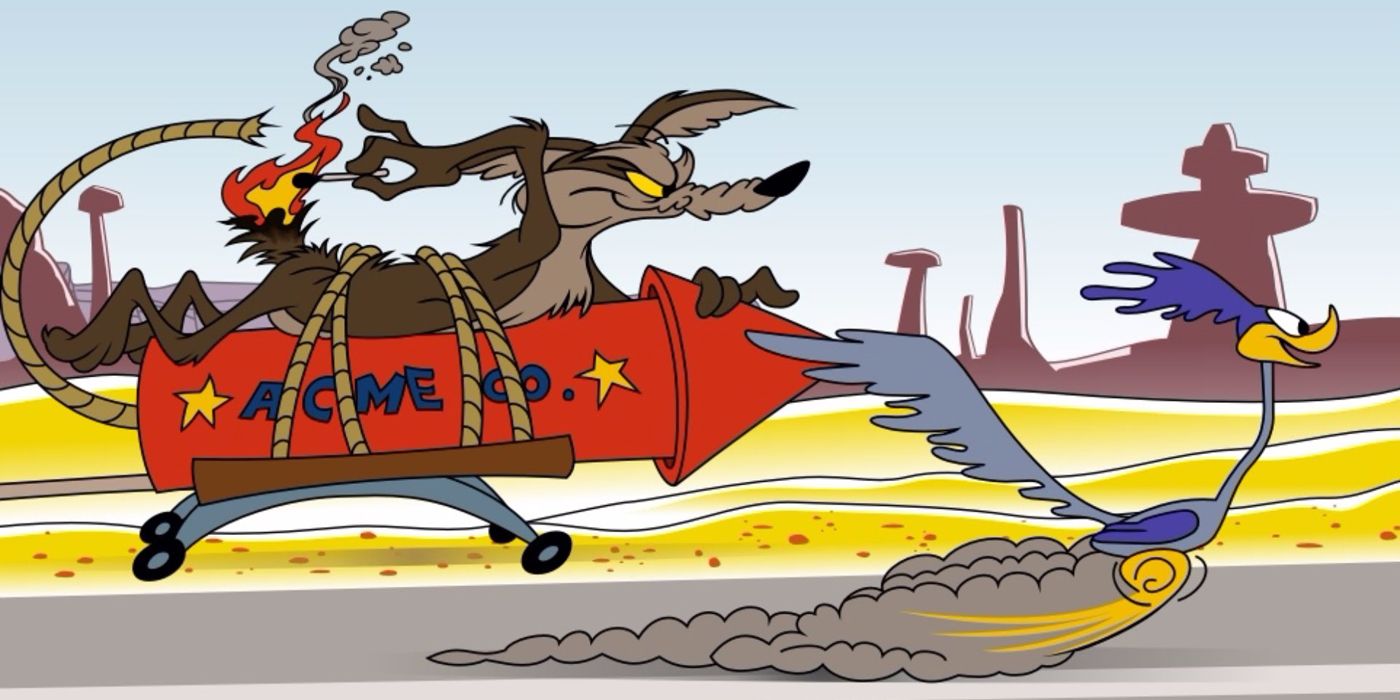
September 17, 1949: Wile E. Coyote & the Road Runner Debut

September 17, 1949, 75 years ago: Warner Brothers releases the cartoon Fast and Furry-ous, introducing the characters of Wile E. Coyote and the Road Runner.

In his book Chuck Amuck: The Life and Times of an Animated Cartoonist, Chuck Jones claimed that he and the artists behind the Road Runner and Wile E. Coyote cartoons adhered to some simple but strict rules:

  1. "The Road Runner cannot harm the Coyote except by going, 'Beep-Beep!'"
  2. "No outside force can harm the Coyote, only his own ineptitude or the failure of the Acme products."
  3. "The Coyote could stop anytime, if he were not a fanatic. (Repeat: 'A fanatic is one who redoubles his effort when he has forgotten his aim.' – George Santayana)."
  4. "No dialogue, ever, except 'Beep-Beep!'" (In cartoons not involving the Road Runner, the Coyote spoke. For example, telling Bugs Bunny that he was a genius. Which he was not.)
  5. "The Road Runner must stay on the road, otherwise, logically, he would not be called a Road Runner."
  6. "All action must be confined to the natural environment of the two characters, the Southwest American desert."
  7. "All materials tools, weapons, or mechanical conveniences must be obtained from the Acme Corporation."
  8. "Whenever possible, make gravity the Coyote's greatest enemy." (Sometimes, something would fall on top of the Coyote. My father called that “Coyote Sandwich.”
  1. "The Coyote is always more humiliated than harmed by his failures."
One running gag involves the coyote trying, in vain, to shield himself with a little parasol against a great falling boulder that is about to crush him. Another involves him falling from high cliffs, after momentarily being suspended in midair, as if the fall is delayed until he realizes that there is nothing below him. (This would later be used on The Flintstones.) The rest of the scene, shot from a bird’s-eye view, shows him falling into a canyon so deep that his figure is eventually lost to sight, with only a small puff of dust indicating his impact.
 
The Coyote is notably a brilliant artist, capable of quickly painting incredibly lifelike renderings of such things as tunnels and roadside scenes, in further (and equally futile) attempts to deceive the bird. However, the Road Runner would run into this fake tunnel, as if it were real. When the Coyote tried it himself, he would crash into it with a SPLAT!
 
From the "My Entire Childhood Was a Lie" Department: Coyotes are faster than roadrunners – and, in real life, "roadrunner" is always one word, not two like with the cartoon character. The top speed of a coyote is 43 miles per hour; of a road runner, 26.
 
From 1967 to 1974, the Western Hockey League had a team named the Phoenix Roadrunners. From 1974 to 1977, a team with that name played in the Western Hockey League. In 1997, the NHL gave Phoenix a team, which would eventually named the Arizona Coyotes. They moved to Salt Lake City this year. 

Monday, September 16, 2024

The Yankees May Have Begun Their Run

Maybe, just maybe, the Yankees have begun the run that will lead them not only into, but through, the postseason.

They began last week last Monday night, Labor Day, with a home series against the Kansas City Royals, who are probably going to the Playoffs themselves. Carlos Rodón did not have a good start, but the Yankees got home runs from Alex Verdugo and Austin Wells. Wells had 4 RBIs, and Gleyber Torres went 3-for-5 with an RBI, and has broken out of a poor season with the bat. The Yankees won, 10-4.

Marcus Stroman had a bad start on Tuesday night, but it wouldn't have mattered if he'd had a good one: Seth Lugo had a brilliant start for Kansas City, going 7 shutout innings, allowing 3 hits and no walks, striking out 10. Torres singled to lead off the 1st inning, and singled again in the 6th, and Wells singled in the 7th. That's all the baserunners the Yankees got. The Royals won, 5-0.

Wednesday night's contest felt like a must-win game. Luis Gil allowed only 1 run over the 1st 5 innings, but at 97 pitches, Aaron Boone (and Brian Cashman) didn't let him pitch any longer. Juan Soto homered in the 6th inning. But Clay Holmes, having earned his way out of the closer's role, was brought in to protect a 2-1 lead in the 7th, and couldn't. It was his 12th blown save of the season. I had to look up the record: It's 14, by Bruce Sutter, with the 1976 Chicago Cubs. And Sutter is a Hall-of-Famer. Holmes is not.

The game went to extra innings. With the stupid "ghost runner" rule, each team scored a run in the 10th. Jon Berti had been activated off the Injured List, and was the ghost runner to start the bottom of the 11th. Soto grounded out, which moved Berti over to 3rd. The next batter was Aaron Judge, and 1st base was open, and his run meant nothing. Naturally, the Royals chose to walk him intentionally.

That meant pitching to Jazz Chisholm. We'll never know if pitching to Judge would have been a mistake. Pitching to Chisholm was: He singled Berti home. Yankees 4, Royals 3. Luke Weaver was the winning pitcher, pitching to 5 batters, and getting them all out. He may now be the closer.

*

The Scum came in. For 4 games, starting on Thursday night, the Yankees would face the Boston Red Sox, proven cheaters, with their manager Alex Cora, a proven cheater with another team. Torres hit a leadoff home run in the 1st inning. That was all that Nestor Cortés needed, as he went 5 innings, allowing 1 run on 3 hits, 3 walks, 9 strikeouts.

But he threw 92 pitches, so he was removed. The bullpen held the Sox, but the Yankees couldn't get it done. After Torres' homer, for the rest of the regulation 9 innings, the Yankees got 5 singles, a double, 5 walks and a hit-by-pitch -- but no runs.

In the bottom of the 10th, with Berti again the ghost runner, Soto singled him home with the winning run. Yankees 2, Red Sox 1. Winning pitcher: Believe it or not, Holmes.

On Friday night, Clarke Schmidt pitched 5 shutout innings, but lost control in the 6th. Through the 1st 6 innings, the Yankees got 3 singles, a double, and 3 walks, but no runs, and trailed, 4-0.

Cliché Alert: Walks can kill you, especially the leadoff variety. Anthony Volpe led off the bottom of the 7th with a walk. Verdugo drew a walk. Torres singled Volpe home. And Soto drew a walk, to load the bases for Judge. Judge had gone 16 straight games without a home run. He put an end to that with a blast into the left field stands. Yankees 5, Red Sox 4. The much-maligned Mark Leiter Jr. was the winning pitcher, and Weaver got another save.

If had told me, after the 2003 World Series, blown in large part (but not in whole) by Jeff Weaver, that I would one day cheer a Yankee reliever named Weaver, I would have asked what drug you were on. Yet, here we are.

Saturday afternoon, 2 great wins over the Red Sox behind us, Gerrit Cole on the mound? I was confident. I shouldn't have been: The "ace" was great for 3 innings, then fell apart, allowing 7 runs before being removed in the 5th. Red Sox 7, Eagles 1, with Torres, again, coming through, in this case with the team's only RBI.

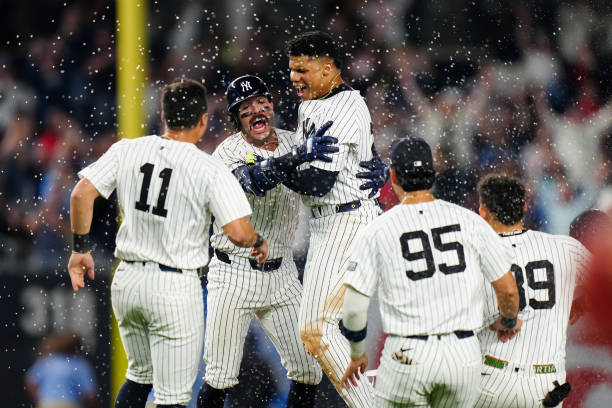
So the Sunday afternoon game also felt "must-win." Chisholm led off the bottom of the 2nd with a single, and Giancarlo Stanton doubled him home. Torres and Judge both homered in the 3rd, Torres with his 14th, Judge with his 53rd.

Rodón made the lead stand up, allowing 2 runs into the 6th inning. The bullpen took it from there, keeping the Sox off the board. Yankees 5, Red Sox 2, taking 3 out of 4 from The Scum.

*

For weeks, it looked like the Yankees didn't have what it takes to win the American League Eastern Division. They were reprieved by the Baltimore Orioles also being unable to take hold of the Division. Going into tonight's MLB games -- neither the Yanks nor the O's are scheduled -- the Yanks are 87-63, 3 games ahead of the O's. The Yanks' Magic Number to clinch a Playoff berth is 3; the Division, 10.

If the current standings hold to the end of the season, the Yankees would have the top seed all the way through the AL Playoffs. If they reach the World Series, the only National League teams that would have home-field advantage over them would be the Philadelphia Phillies (whom they swept in Philadelphia in July) and the Los Angeles Dodgers.

The remaining regular-season schedule, with all times Eastern Time and PM:

* Away to the Seattle Mariners: Tomorrow and Wednesday at 9:40, Thursday at 4:10.
* Away to the Oakland Athletics -- for the last time, unless a miracle saves them from moving in the off-season: Friday at 9:40, Saturday at 9:07, and Sunday at 4:07.
* Home to the Baltimore Orioles: Tuesday the 24th, Wednesday the 25th, and Thursday the 26th, all 7:05. This series will likely decide the Division title.
* Home to the Pittsburgh Pirates: Friday the 27, at 7:05; Saturday the 28th, at 1:05; and Sunday the 29th, at 3:05.

Has the big postseason run begun? We will find out.

Sunday, September 15, 2024

September 15, 1994: The Baseball Season Is Canceled

September 15, 1994, 30 years ago: A date which lives in infamy. There is no joy in Mudville, or anywhere else.
Milwaukee Brewers owner Bud Selig, a walking conflict-of-interest as the Acting Commissioner of Major League Baseball, cancels the remainder of the regular season, and the postseason, including the World Series, following a vote of the team owners. No Commissioner, in any of the "big four" North American sports, had ever done that before.

The vote is 26-2. Oddly, the 2 who voted to go on with the season and not betray the fans were 2 of the most hated team owners of the era: Peter Angelos of the Baltimore Orioles and Marge Schott of the Cincinnati Reds.

That strike, lasting from August 12, 1994 to April 25, 1995, was rough. Although President Clinton got the Crime Bill passed, his health care initiative failed, the Republican Party won control of both houses of Congress, and began passing bills slashing social services, which Clinton had to veto. A ferry carrying passengers from Estonia to Sweden sank, killing over 800 people. The Taliban was founded. A religious cult unleashed a sarin gas attack on the Tokyo subway, killing 13 and putting 5,000 in the hospital. Singer Selena (Quintanilla-Perez, not Gomez) was murdered. And, just before baseball started play again, a white "Christian" domestic terrorist blew up the federal government office building in Oklahoma City.

It wasn't all bad. A totalitarian government in Haiti fell. The Channel Tunnel opened, finally linking Britain with the European Continent by road. Sony released the first PlayStation. George Foreman regained the Heavyweight Championship of the World, 20 years after he lost it to Muhammad Ali, by knocking Michael Moorer out, making himself the oldest Heavyweight Champion ever, age 45.

Billy Wright, and Wilma Rudolph, and Howard Cosell died. Halsey, and Carlos Correa, and Giannis Antetokounmpo were born. 

Friday, September 13, 2024

September 13, 1994: President Bill Clinton Signs the Crime Bill

Clinton hugs Biden at the bill's signing.
Behind them, left to right: First Lady Hillary Clinton,
House Speaker Tom Foley of Washington,
Representative Patricia Schroeder of Colorado,
Senator Dianne Feinstein of California,
Senate Majority Leader George Mitchell of Maine,
Representative Chuck Schumer of New York,
and House Majority Leader Dick Gephardt of Missouri.

September 13, 1994, 30 years ago: The Violent Crime Control and Law Enforcement Act of 1994, a.k.a. simply "The Crime Bill," largely written by then-Senator Joe Biden of Delaware, was signed into law by President Bill Clinton. More than anything else, it was responsible for the reduction in crime in American cities at the end of the 20th Century.

It included a ban an "assault weapons," military-style rifles that were useless for hunting, since they caused so much damage that the animal was useless as either food or a trophy. Their only purpose was to kill other human beings in a war zone. That part of the bill had been written by 2 members of the House of Representatives who would both, by 1998, be elected to the Senate: Chuck Schumer of New York, now the Majority Leader; and Dick Durbin of Illinois, now the Majority Whip and the Chairman of the Judiciary Committee.

But, as a concession in the hopes that some Republicans might vote for it, the assault-weapon ban was listed to last only 10 years. When it ran out in 2004, the Republican Party controlled both houses of Congress, as well as the Presidency, and, despite its success in reducing firearm deaths, there was no chance of a renewal bill getting anywhere.

Still, even with mass shootings happening nearly every day, they tend to happen in the suburbs, where police departments are less-equipped to handle them than major cities. In those cities, crime is higher than it was in 2004, but still far below what it was in 1994, when huge swaths of the urban landscape were "no-go zones."

Films like Mean Streets, Taxi Driver, The Warriors and Fort Apache, The Bronx seemed like documentaries. (All were set in New York City, released in 1973, 1976, 1979 and 1981, respectively.) The fear that 1997 might look like the 1981 film Escape from New York, that 2019 might look like the 1982 film Blade Runner, and that "the near future" would end up looking like the 1987 film Robocop, seemed legitimate. Thanks to Schumer, Durbin, Biden and Clinton, that has never come to pass.

Thursday, September 12, 2024

September 12, 1994: The Great TV Realignment

KYW-TV logo, 1980s

September 12, 1994, 30 years ago: The great TV realignment. Because CBS (for a few years, anyway) lost their NFL contract, a lot of stations switched networks. This didn’t happen in New York, but in Philadelphia, on the other side of my Central Jersey base, it did: KYW-Channel 3 went from NBC to CBS, and WCAU-Channel 10 went from CBS to NBC.
KYW-TV logo, 1995

The buying into NFL broadcast rights helped turn Fox from a distant 4th among networks, behind NBC, CBS and ABC, into a legitimate 4th network. It launched Fox Sports, which has since included Major League Baseball, college football, the NHL, and professional soccer.

And since individual stations valued NFL money more than CBS money, while some of them switched affiliates with NBC, some picked up the former "independent stations" that Fox had picked up in the 1980s, losing a lot of viewers.

Monday, September 9, 2024

Ed Kranepool, 1944-2024

When my mother was a teenager, she had a crush on Ed Kranepool, because he was the 1st player from her generation to make it to Major League Baseball, and with a local team, no less.

Yes, the '62 Mets counted as "major league."

Edward Emil Kranepool was born on November 8, 1944 in Manhattan, and grew up in The Bronx. A baseball star at James Monroe High School, the school's biggest since Hank Greenberg, and no Major League Baseball Draft then being in place, Ed Kranepool was fair game. The Bronx-based New York Yankees decided they didn't need him, so the New York Mets snapped him up.

He made his major league debut, still 17 years old, on September 22, 1962, at the Polo Grounds. In the top of the 7th inning, wearing Number 21, he replaced Gil Hodges at 1st base, and grounded out to 2nd batting against Paul Toth in the bottom of the 8th. The Mets lost to the Chicago Cubs, 9-2.

He played mostly right field, and some 1st base, in 1963, but he'd been brought up too soon. He was sent down to Triple-A. He still couldn't hit, and was sent all the way back down to Class D (what we would now call the Rookie League.) A banner appeared at the Polo Grounds, mocking the not-yet-19-year-old: "IS KRANEPOOL OVER THE HILL?"

On May 30, 1964, he played all 18 innings of a doubleheader with the Buffalo Bisons, when the Mets called him back up. At brand-new Shea Stadium, they played a doubleheader against the San Francisco Giants, and the nightcap went 23 innings. Ed Kranepool played 50 innings in 2 days. But he was up for good: Having been given Number 7, he made the National League All-Star Team in 1965 (only 20 years old), and was a member of the Mets' 1969 "Miracle" World Championship, managed by Hodges, and their 1973 National League Pennant, managed by Yogi Berra.

Later in his career, he did commercials for Gillette Foamy shaving cream. One ad began with him repeatedly striking out on black-and-white film, and the announcer, possibly Met broadcaster Bob Murphy (the ad isn't on YouTube, and I'm working on memory here), said, "From 1962 to 1970, Ed Kranepool batted .227."

The ad then shows him lathering up with Foamy; then, with some symbolism, switches the film to color, and shows him slicing a line drive down the right field line for a double: "Since 1971, Ed's batted .283! What do you think of that, Ed?"

The ad plays on ballplayers' tendency toward superstition, and shows Ed, in the dugout, in full uniform but lathered up, holding a can of Foamy, saying, "I don't know, but now, I shave every other inning."

God only knows why he really started hitting better at age 26. But the stats were a bit off: From 1962 to 1970, his batting average was actually .246; from 1971 to 1978, .281. The closing narration was, "Foamy: More than thick and rich enough for New York's heavy hitters." He was never a heavy hitter: His peaks were 16 home runs in 1966, and 58 RBIs in 1971.

He played his last game on September 30, 1979, shortly before turning 35, with a .261 lifetime batting average, and 1,418 career hits, a club record until surpassed by David Wright. He was the last remaining '62 Met, and his 1,853 games and 16 seasons in a Met uniform remain team records. He was elected to the Mets Hall of Fame, became a stockbroker, making enough money to live in tony Old Westbury, Long Island.

But he developed diabetes, and had a toe amputated. In 2019, he received a kidney transplant. It bought him 5 years, and allowed him to attend the 50th Anniversary reunion of the 1969 World Champions. He had attended the other major anniversary reunions, as well as the 2008 closing of Shea Stadium, the 2009 opening of Citi Field, and the Mets' 50th Anniversary celebration in 2012.
On May 30, 2018, on The Michael Kay Show on ESPN radio, Kay's co-host, Don La Greca, a Met fan, ripped Mets management for letting their great players get away, from Tom Seaver and Darryl Strawberry to more recent players like Jacob deGrom; and lamented on players whose careers got sidetracked by injuries, such as David Wright. He went on an epic rant, saying, "Who is your forever player? Ed Kranepool?"

Ed Kranepool died of a heart attack yesterday, September 8, 2024, in Boca Raton, Florida. He was 2 months short of his 80th birthday.

With his death, there are 8 members of the original 1962 New York Mets: Craig Anderson, Galen Cisco, Cliff Cook, John DeMerit, Rick Herrscher, Jay Hook, Félix Mantilla and Jim Marshall. And there are 15 surviving players from the 1969 World Champion New York Mets: Nolan Ryan, Jerry Koosman, Gary Gentry, Wayne Garrett, Cleon Jones, Ron Swoboda, Art Shamsky, Al Weis, Ken Boswell, Ron Taylor, Bobby Pfeil, J.C. Martin, Duffy Dyer, Rod Gaspar and Jack DiLauro.