Showing posts with label yom kippur. Show all posts

Thursday, September 19, 2024

September 19, 1934: Hank Greenberg Does Not Play On Yom Kippur

September 19, 1934, 90 years ago: The Detroit Tigers take the field at their home ballpark of Navin Field. They do so against what is, aside from themselves, the best team in the American League, the New York Yankees. What's more, they do so without their best player, 1st baseman Hank Greenberg.

The Tigers went into the game 7 1/2 games ahead of the Yankees, 8 in the loss column, with 11 games left for them and 10 left for the Yankees. No one thought in terms of a "magic number" to clinch in those days, but the Tigers' was 4: Any number of Tiger wins and Yankee losses the rest of the way, adding up to 4, and the Tigers would win the AL Pennant.

But they hadn't wrapped it up yet. There hadn't yet been a team with a significant lead in September that ended up blowing it. This was before the 1951 Brooklyn Dodgers, the 1964 Philadelphia Phillies, the 1969 Chicago Cubs, the 1978 Boston Red Sox, the 1987 Toronto Blue Jays, the 1995 California Angels, and the 2007 New York Mets. (Indeed, the Jays, the Angels and the Mets didn't even exist yet.)

But the New York Giants, winners of the previous year's World Series, had led the National League by 7 games as late as September 6, and now led the St. Louis Cardinals by only 3 1/2 games, and did end up blowing it in the last 2 days of the regular season. So such a collapse was already considered possible.

And the idea that Greenberg might not play in this game worried Tiger fans. But, as a series of TV commercials for Hebrew National Kosher hot dogs would say, decades later, he answered to a higher authority.

Henry Benjamin Greenberg was born on January 1, 1911 in Manhattan. He grew up in The Bronx, attended James Monroe High School, and became the Tigers' starting 1st baseman in 1933. Henry Aaron was born on February 5, 1934, and would go on to become baseball's all-time home run leader. But his nickname, "Hammerin' Hank," was first given to Hank Greenberg.

On September 18, 1934, Greenberg hit a home run, his 25th of the season, off fellow future Hall-of-Famer Red Ruffing, and the Tigers beat the Yankees, 2-0, as Lynwood "Schoolboy" Rowe pitched a 6-hit shutout.

But, in 1934, from sunset on September 18 to sunset on September 19, was Yom Kippur, the Day of Atonement, the holiest day on the Jewish calendar, the conclusion of Judaism's "high holy days" that begins with the start of the Jewish New Year, Rosh Hashanah.

And Greenberg was Jewish. Rosh Hashanah fell on September 10 and 11 that year, and Greenberg did play on the afternoon of the 11th. (The Tigers' ballpark wouldn't get lights until 1948, making it the last in the AL to do so.) The Tigers lost that game to the Boston Red Sox, 4-3 in 11 innings, as Hall-of-Famer Lefty Grove pitched 3 innings of scoreless relief for the win, and Greenberg went 0-for-3, although he did walk twice and was driven in both times.

Some Jewish people suggested that the defeat, and Greenberg's hitless performance -- few people thought in terms of on-base percentage in those days -- was God's punishment for playing on the holy day. So, with Yom Kippur coming up, he was facing pressure from both sides: Tiger fans who wanted him to play on September 19, and Jews who didn't want him to play.

He announced that he would not play. On the morning of the 19th, he attended a service at a synagogue: Congregation Shaarey Zedek, whose name translates to "Gates of Righteousness." It was located at 2900 Chicago Avenue. Clinton Street Greater Bethlehem Temple Church occupies the site now. In 1962, Shaarey Zedek moved to their current location, is now in suburban Southfield, Michigan, at 27375 Bell Road.

And when the Tigers took the field against the Yankees, their 1st baseman was Frank Doljack. He did reach base twice, with a single and a walk. It was the Tigers' other stars who fell short that day. Between them, Greenberg, 2nd baseman Charlie Gehringer, and left fielder Leon "Goose" Goslin were known as the "G-Men," in this year that was the 1st of big publicity for the FBI, whose agents were also called that (the G standing for "Government men"). Goslin went 0-for-4. Gehringer went 0-for-3 with a walk. And Mickey Cochrane, both the Tigers' manager and their catcher, only appeared as a pinch-hitter, although he had an RBI on a sacrifice fly.

So they had 3 future Hall-of-Famers in their lineup, instead of the usual 4. That, along with their other regulars, should have been enough to help them win. Especially since the Yankees did not have Babe Ruth in this game. (It would be his last season with them.)

But the Yankees did have Lou Gehrig, on his way to becoming the 1st Yankee ever to win the Triple Crown. (In spite of this, Cochrane would be named the AL's Most Valuable Player.) Gehrig went 0-for-3. But they had another Hall-of-Famer, Tony Lazzeri, and his 2-run double in the 6th inning made the difference, and the Yankees won, 5-2.

All over America, Jews celebrated Greenberg for sacrificing an important game for the sake of his faith. Tiger fans? Their concerns faded, and a doubleheader sweep of the Chicago White Sox on September 26 gave the Tigers their 1st Pennant in 25 years. Greenberg became a hero to anyone who wasn't an anti-Semite.

The Tigers lost the World Series to the Cardinals. The next season, they won the Pennant again, with Greenberg being named AL MVP, and won the World Series against the Chicago Cubs, the 1st World Championship for a Detroit baseball team since the 1887 Wolverines, 48 years earlier.

Greenberg would have 184 RBIs in 1937, falling 1 short of Gehrig's AL record. In 1938, he hit 58 home runs, falling 2 short of Ruth's major league record. In 1940, he led the Tigers to another Pennant, having been moved from 1st base to left field, and becoming the 1st player ever to be named MVP at 2 different positions. But he got hurt in the World Series, and they lost to the Cincinnati Reds.

In 1941, he became the 1st major league player to enlist in the U.S. Army, as World War II threatened to drag America into it. He was discharged in 1945, between V-E Day and V-J Day, and returned to the Tigers to hit a grand slam on the last day of the season, to clinch their 4th Pennant with him, and beat the Cubs to win another World Series.

A bad back convinced Greenberg to retire after the 1946 season, but the Pittsburgh Pirates asked him to come back, so he could tutor their young slugger Ralph Kiner. They offered him baseball's 1st $100,000-a-year salary. (With inflation, it would be worth $1.33 million in 2022.) He took it on the condition that it be his last season. Kiner never forgot Greenberg's kindness.

Nor did Jackie Robinson, whose 1st season was Greenberg's last. Facing anti-Semitism on a greater scale than any player ever had, Greenberg was the one player who could, and did, truthfully say to modern baseball's 1st black player, "I know what you're going through."

On May 17, 1947, when the Pirates played the Brooklyn Dodgers, Robinson laid down a bunt, and, in his effort to reach 1st base, collided with Greenberg. Neither man was hurt. Later in the game, Greenberg walked, and, as Robinson was also playing 1st that season (moving to 2nd the next year), they had a chance to talk:

Greenberg, then: "Don't pay attention to these guys who are trying to make it hard for you. Stick in there... I hope you and I can get together for a talk. There are a few things I've learned down through the years that might help you and make it easier."

Robinson, to the press after the game: "Class tells. It sticks out all over Mr. Greenberg."

Despite being just short of 37 years old, due to his injury, Greenberg did indeed retire after the 1947 season. Lifetime batting average: .331. OPS+: 158. Hits: 1,628, including 379 doubles (including 63, 4 off the all-time record, in 1934) and 331 home runs (including the 58 in 1938). RBIs: 1,276 (including the 184 in 1937). All this in what amounted to just 10 full seasons. If he'd been exempt from military service and had been able to play until he was 40, he would have had about 600 home runs, might have collected 3,000 hits, and perhaps joined Ruth and Aaron, Alex Rodriguez and Albert Pujols as the only men with 2,000 RBIs.

In 1999, The Sporting News placed him at Number 37 on its list of the 100 Greatest Baseball Players, in spite of his abbreviated career. In his book Ted Williams' Hit List, Williams named his Top 20 Hitters, and he put Greenberg at Number 11. Whether he was ranked that high (ahead of Tris Speaker and Mickey Mantle) due to peak value or to their friendship, I don't know. But Ted always said Hank was a wonderful guy.

Bill Veeck, owner of the Cleveland Indians, offered him a front-office position, and together they helped make the Indians the 1948 World Champions. Greenberg tutored another young slugger, a Jewish one like himself, third baseman Al Rosen. When Veeck sold the team, the new owners kept Greenberg, promoting him to general manager, and another Pennant-winner was built in 1954. When Veeck bought the Chicago White Sox, he brought in Greenberg as a part-owner, and another Pennant-winner was built in 1959.

That was Greenberg's last job in organized baseball, although his son Steve later played in the minors, not making it to the majors due to injury. Steve later founded Classic Sports Network, bought by ESPN and turned into ESPN Classic, one of the great treasures of American broadcasting.

In one of the weirdest occurrences in baseball history, Hank Greenberg, Ralph Kiner and Al Rosen all retired sooner than they could have due to bad backs. It didn't keep Greenberg out of the Hall of Fame: He was elected in 1956. It almost kept Kiner out: He was elected in 1975, his 15th and last year of eligibility under the baseball writers' vote. It has, thus far, kept Rosen out, although he later went on to become, like Greenberg, one of baseball's finest executives, building postseason teams in New York (the 1978 World Champion Yankees), Houston (the 1986 National League Western Division Champion Astros) and San Francisco (the 1989 NL Champion Giants).
Greenberg never hesitated to speak of his admiration for his heroes, including Babe Ruth, Lou Gehrig, his teammate and manager in Detroit Mickey Cochrane, and, even though he was several years younger, Jackie Robinson. As Jackie said, class tells: Men such as Robinson, Williams, Kiner and Rosen spent the rest of their lives telling of Greenberg's hitting talent and his great decency. Greenberg died on September 4, 1986, at the age of 75.

Tigers principal owner Frank Navin died on November 19, 1935. This made Walter Briggs the team's sole owner. In the 1937-38 off-season, Briggs expanded the ballpark into what became its familiar configuration, and renamed it Briggs Stadium. He died in 1952, and his son Walter Jr., a.k.a. Spike Briggs, inherited the team. In 1956, Spike sold the Tigers to a group led by John Fetzer. In 1961, Fetzer renamed the ballpark Tiger Stadium. The Tigers remained there until the 1999 season, and then moved into their current home, Comerica Park.

In 1965, Sandy Koufax of the Los Angeles Dodgers, then the best pitcher in baseball, refused to start Game 1 of the World Series because it fell on Yom Kippur. The Dodgers lost to the Minnesota Twins, and when manager Walter Alston came to take their other Hall of Fame pitcher, Don Drysdale, out of the game, Drysdale said, "I bet you wish I was Jewish, too!"

To make matters worse, Koufax lost Game 2. But the Dodgers came back, and Koufax pitched shutouts in Games 5 and 7 to win the Series. The fact that Koufax took a bigger risk, and the fact that, unlike Greenberg, a star of radio and black & white newsreels, his sacrifice took place in the era of TV and color film, made Koufax an even bigger legend than Greenberg.

But Greenberg did it first. As with anything else, the first one to do something will always be special.

September 19, 1934 was a Wednesday. Yom Kippur does not prohibit the birth of Jewish babies, and, in Liverpool, England, Brian Epstein, the man who would go on to manage The Beatles, was born on this day.

Friday, September 17, 2010

Top 10 Sports Atonements

Sundown today marks the beginning of Yom Kippur, the Jewish Day of Atonement. Jews are not to do any work from sundown today to sundown tomorrow, nor are they to spend any of that time in the pursuit of happiness. Rather, they are to spend the day in prayer and reflection, and to seek forgiveness for whatever harm they have done in the past year, as all of us have done some harm.

Yankee broadcaster Suzyn Waldman, being Jewish, has not made the trip to Baltimore to broadcast this 3-game series with John Sterling. I was previously under the impression that Sterling was Jewish as well, and that "John Sterling" was a nom de broadcast, but this is not the case.

Baseball Hall-of-Famers Hank Greenberg and Sandy Koufax had to face the decision of whether to play on Yom Kippur, Greenberg during a tight Pennant race in 1934 and Koufax on the day of Game 1 of the 1965 World Series. Both chose not to play, and became bigger heroes than ever, to Jews and Gentiles alike. Here's a link to an ESPN story on the history of Jewish players and how they handled the issue.

That story mentions Al Rosen. But it doesn't mention this: In 1978, Rosen was the general manager of the Yankees, and flew to Boston to attend the Playoff for the American League Eastern Division title. It was played on Rosh Hashanah, the Jewish New Year. The Yankees, of course, won, 5-4, largely thanks to a home run by that mensch Bucky Dent.

The next day, back in New York, Rosen got a phone call from a woman saying that Rosen had disappointed her and many other Jews by being at the game.

"Ma'am," Rosen asked, "how did you know I was at the game?"

"I saw it on television," he said.

"Why were you watching television on Rosh Hashanah?"

How do you say, "Gotcha!" in Yiddish?

Top 10 Sports Atonements

Before I begin this list -- which, oddly enough, has no fully Jewish people on it -- let me say that one name that will not be on it is Kobe Bryant. I don't care what he's won since, or how he's kept his nose clean since: He should have gone to prison for taking advantage of that girl in Colorado, and he hasn't atoned for squat.

10. Alex Rodriguez. As the 2009 season began, he had much to atone for, both personally and professionally. While I am in no position to say that his personal life is settled, in baseball terms he answered every question, becoming a major force in the Yankees going through the regular season and eventually winning the World Series.

Granted, I'm a bit miffed at the way he ended the Yankees' last game on Wednesday night, but he's proven that he can atone for such things, and I wouldn't put it past him to, uh, repeat.

9. Earnest Byner. To be fair, his fumble late in the 1987 AFC Championship Game did not, by itself, cost the Cleveland Browns a trip to Super Bowl XXII. After all, they were losing, and a touchdown and extra point only have tied the game.

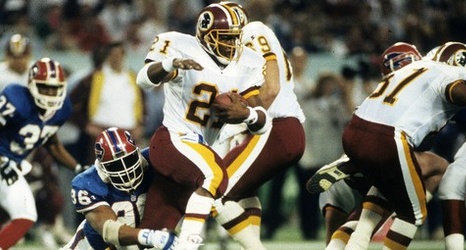
He did later star for the Washington Redskins in winning Super Bowl XXVI, including scoring a touchdown in the game. For all the good that does people in Northern Ohio: They still have to deal with memories of "The Fumble." Byner does not: He atoned.
8. Maurice Richard. "The Rocket" had led the Montreal Canadiens to Stanley Cup wins in 1944, 1946 and 1953. On March 13, 1955, he got into a fight, and when linesman Cliff Thompson (himself a former Bruins player) tried to break it up, Richard hit him, too.

NHL President Clarence Campbell suspended him for the rest of the season: One regular-season game, at the Montreal Forum against the Detroit Red Wings on March 17, that would determine the top seed for the Stanley Cup Playoffs, and the entirety of the Playoffs themselves.

Campbell made the mistake of going to that game, and was harassed for his apparent anti-French bias. Someone threw a smoke bomb onto the ice, the game was called off, and the Forum was cleared. Angry Canadiens fans rioted in the streets of Montreal.

 The next day, Richard went on radio and TV, and, in French and English, asked the fans to stop. He said they shouldn't be doing this on his account, that he would take his punishment, and that he hoped the Canadiens could win the Cup without him.
They didn't, as the Wings, having clinched home-ice advantage due to the March 17 forfeit, won in 7 games. But Richard came back the next season, and they won the next 5 straight Stanley Cups. Richard then retired as an 8-time World Champion.

 In 2000, the two most popular people in the history of the Province of Quebec died, Maurice Richard in May and former Prime Minister Pierre Trudeau in October. Richard had more people lining the streets for his funeral procession than the greatest political leader Canada has ever had.
7. Eddie Shore. What Richard did on March 13, 1955 was bad, and he was lucky there was no ESPN (TSN in Canada) in those days to show the clip over and over again. But what Shore did on December 12, 1933 was far worse.

The Boston Bruins defenseman, who had already helped them win the 1929 Stanley Cup, was hit from behind by Toronto Maple Leafs' defenseman Frank "King" Clancy and crashed into the boards.

A little woozy, he went after Clancy, but his still-blurry vision led him to the wrong man, left wing Irvine Wallace "Ace" Bailey. Shore high-sticked Bailey to the ground, and Bailey hit his head and was knocked out. He nearly died, and although he recovered, it became clear he would never play again, after being part of a team that re-established the Leafs as a hockey power, winning the 1932 Stanley Cup.

Bailey accepted Shore's apology, and Shore was suspended for 16 games -- at the time, 1/3rd of a regular season.

On February 14, 1934, a benefit game for the Bailey family was held at Maple Leaf Gardens. Although not officially counted as such, this is generally treated as the first NHL All-Star Game, with the Leafs taking on a team made up of players from every other team in the League at that time, including New York Rangers Bill Cook and Ivan "Ching" Johnson, and New York Americans Red Dutton and Normie Himes. (Rangers coach-general manager Lester Patrick was their head coach.)

Before the puck was dropped, Shore skated over to Bailey, who was dressed in a suit and sitting on the Leafs' bench. They smiled and shook hands, and a tremendous ovation went up. The Leafs beat the NHL All-Stars, 7-3.
Shore helped the Bruins win another Cup in 1939, before buying the nearby Springfield Indians and beginning a long career as a minor-league executive and coach, with the Bruins eventually retiring his Number 2. Bailey remained in the Leafs' organization until his death in 1992, and his Number 6 was the first number they retired.

Despite Shore's actions and the comparative brevity of Bailey's career, both men are in the Hall of Fame.

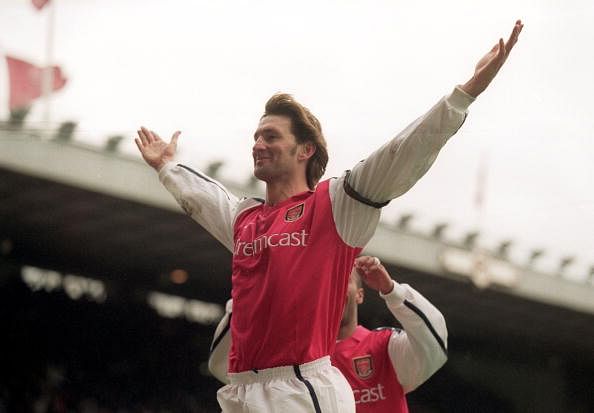
6. Tony Adams. The centreback was named Captain of London soccer club Arsenal when he was just 21 years old, and led them to the championship of England's Football League in 1989 at 22.

 On May 6, 1990, he crashed his car and pled guilty to drunken driving. Contrary to what I had previously believed, this wasn't why he was not included on the England roster for the 1990 World Cup. It might have, but he had already been excluded from selection by manager Bobby Robson, who had previously selected him for Euro 88.

Adams spent December 19, 1990 to February 15, 1991 in prison, and was released in time to lead Arsenal to another League title. It took until 1996 for him to finally quit drinking, and he published a harrowing memoir titled Addicted.

In 1997-98, his first full season completely sober, he led Arsenal to win the Premier League (successor to the Football League) and the FA Cup -- "winning The Double." Arsenal accomplished this again in 2002, his final season.
The man known as "Mr. Arsenal" went on to manage Wycombe Wanderers and Portsmouth, and now manages Gabala FC in Azerbaijan, and runs Sporting Chance Clincic, an alcohol and drug rehabilitation clinic in his native London.

5. Ralph Terry. In Game 7 of the 1960 World Series, Terry, pitching for the New York Yankees, gave up a game-winning, World Championship-winning, home run to Bill Mazeroski of the Pittsburgh Pirates. This remains the only home run ever to win a World Series Game 7.

Two years later, Terry pitched a 3-hit shutout in Game 7 of the 1962 World Series against the San Francisco Giants. He'd also started and won Game 5.

 No, he didn't pitch Game 7 on 2 days' rest, although this would later be done by Bob Gibson in 1964 (he won), the aforementioned Sandy Koufax in 1965 (he won), Jim Lonborg in 1967 (he lost) and Mickey Lolich in 1968 (he won). A rain delay allowed a rejiggering of the rotations and for Terry, who'd also pitched for the Yanks' in the 1961 World Series victory, to get full redemption.
4. Roberto Durán. He might have been the greatest lightweight boxing champion ever, and was a hero in Latin America, in particular treated nearly as a god in his native Panama. In 1980, in front of 60,000 people at the Olympic Stadium in Montreal, he defeated Sugar Ray Leonard to win the welterweight championship.

But a few months later, a rematch was held in front of 70,000 people in the Superdome in New Orleans. This time, Leonard fought better, and was taunting Durán. At the end of the 8th round, Durán, trailing on all cards, turned to the referee, also a Latin American, Octavio Meyran of Mexico, and said to him in Spanish, "I don't want to fight with this clown," and he went back to his corner and quit.

Broadcasting the fight for ABC, Howard Cosell said -- erroneously, as it turned out -- that what Durán had told the ref was, "No más" -- "No more." Leonard was declared the winner by technical knockout, and regained the title. To make matters worse, the official excuse for Durán quitting was "stomach cramps." If he had them before the fight, it should have been postponed.

The man known as Hands of Stone was viewed to have feet of clay. Back in Panama, both his house and his mother's were vandalized. Graffiti appeared in Panama City calling him a coward, a traitor, and even "maricón" -- roughly, the Caribbean Spanish word for the anti-gay slur "faggot." 

(This was the word Benny "the Kid" Paret had used at Emile Griffith during the weigh-in for their 1962 Welterweight Championship and trilogy-decider fight, that led Griffith to pound away at him so hard during the fight that Paret died.)

In 1983, Durán fought Super Welterweight Champion Davey Moore in front of a mostly-Latino crowd at Madison Square Garden, hoping to see the return of a former hero to heroic status. 

It was no contest: Durán crushed Moore, whose cornermen threw in the towel -- appropriately enough, in the 8th round, the same round that did Durán in 3 years earlier. Durán regained not only a title (if not the same one), but also his strong, masculine image, his pride, his reputation, and his fans.
Interesting that SI correctly put an accent mark on the A in "No más,"
but, incorrectly, not on the one in "Durán."

3. George Steinbrenner. From bullying his shipbuilding company's employees into helping him make illegal contributions to President Nixon's 1972 re-election campaign to hiring a compulsive gambler to dig up dirt on Dave Winfield, to all those firings and otherwise unfairly treating employees, "The Boss" became the most hated man in baseball since Walter O'Malley moved the Dodgers out of Brooklyn.

Forced in 1990 to step aside and let "my baseball people" run the show, they did, and rebuilt the Yankee Dynasty. And, from 1996 until his death earlier this year, at ballparks and ticker-tape parades, Yankee Fans chanted, "Thank you, George!" And, to his credit, he understood and appreciated how far he had come to receive that.
2. Muhammad Ali and George Foreman. I make this a dual entry because the two men are forever linked, and Ali's atonement made Foreman's necessary.

Ali was stripped of the heavyweight boxing title in 1967, when he refused to accept being drafted into the U.S. Army during the Vietnam War. In 1968, Foreman won an Olympic Gold Medal (as Ali, then still named Cassius Clay, had done in 1960 and their later opponent Joe Frazier had done in 1964). Foreman, saying he did it as a gesture of pride rather than to position himself as an "anti-Ali," celebrated by holding up a small American flag in the ring.

 Foreman became a hero to those who hated Ali, and not since Jack Johnson, the first black champion (1908 to 1915), had an American athlete been so widely hated.

In 1974, with Foreman now champion and as yet undefeated as a professional, he and Ali stepped into the ring in Kinshasa, Zaire (now the Democratic Republic of the Congo), and Ali pulled off a stunning victory.

In just 7 years -- 7 years that showed just how wrong both the Vietnam hawks and the Ali-haters, usually one and the same, were -- Ali went from being nearly universally reviled by whites and frequently so by many blacks, to being the biggest sports hero on the planet for his amazing comeback.

But Foreman was never the same fighter, and he struggled for 3 years until retiring. He became an ordained minister, and in 1987 returned to fighting after 10 years to raise money for his Houston church.

 In 1991, 42 years old, he fought then-champion Evander Holyfield to a near-standstill. Holyfield won by decision, but everyone seemed to think that Big George, who had turned himself from a near-monster to a big, cuddly man of God, had proven his point.

Everyone, that is, except George. He continued to fight, and in 1994, age 45, wearing the exact same trunks he wore against Ali 20 years earlier, knocked out then-champion Michael Moorer, to become the oldest man ever to hold the title. It lasted only a year (I won't get into that story here), but what a story.
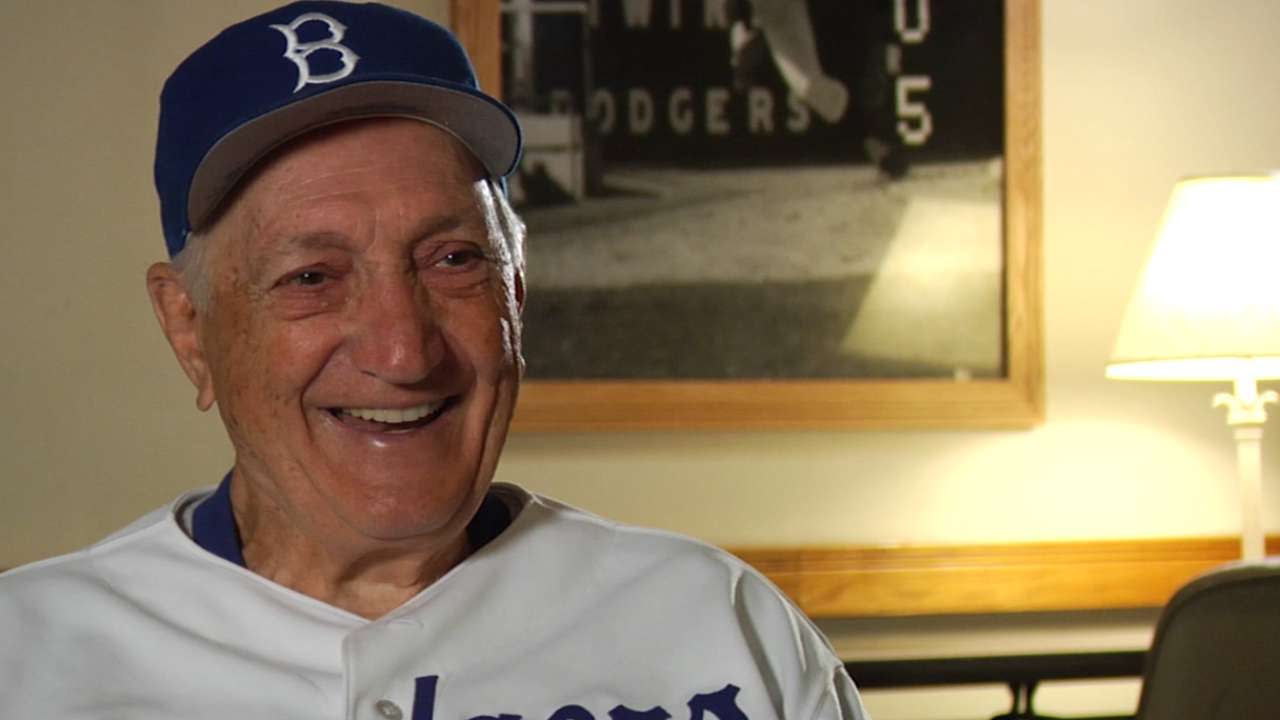
1. Ralph Branca. The one exception on this list: He is Italian and Catholic on his father's side, and is a practicing Catholic, but is Jewish on his mother's side.

Of course, we all know that Branca gave up the home run to the late Bobby Thomson that sent the 1951 National League Pennant from Branca's Brooklyn Dodgers to Thomson's New York Giants, the Dodgers' arch-rivals.

What some of you may not know is that Branca is one of the founders and directors of the Baseball Assistance Team (BAT). The assistance provided takes many forms. Health care, financial grants, rehabilitative counseling or whatever form is required to attain some type of comfort and dignity for former players and their families with demonstrated needs.
Gives a whole new meaning to the words "relief pitcher."