Wednesday, May 22, 2024

May 22, 1964: President Lyndon Johnson's "Great Society" Speech

May 22, 1964, 60 years ago: President Lyndon B. Johnson gives the commencement address at the graduation ceremony at the University of Michigan, in Ann Arbor. Although he had already used the phrase "a Great Society" 15 days earlier, on the campus of Ohio University in Athens, this address becomes known as "the Great Society Speech."

Johnson had been a young aide to Representative Richard Kleberg of Texas in 1933 when President Franklin D. Roosevelt launched his "New Deal" in response to the Great Depression. The New Deal contained emergency measures, but some of them, such as banking insurance and Social Security, worked so well that they were kept in operation.

Johnson was a Congressman himself in 1944 when, with American troops marching toward victory in World War II, FDR created the G.I. Bill of Rights, allowing for a postwar economic boom.

With the economy booming again in the early 1960s, in part due to the measures enacted over the previous 3 years by the recently assassinated President John F. Kennedy, Johnson thought now was the time for another New Deal -- not out of necessity, like in 1933; or out of gratitude, like in 1944; but out of opportunity. There had never been a better chance for the American federal government to help the people who had "fallen through the cracks." He told the commencement crowd:

For a century, we labored to settle and to subdue a continent. For half a century, we called upon unbounded invention and untiring industry to create an order of plenty for all of our people.
The challenge of the next half century is whether we have the wisdom to use that wealth to enrich and elevate our national life, and to advance the quality of our American civilization.
Your imagination, your initiative, and your indignation will determine whether we build a society where progress is the servant of our needs, or a society where old values and new visions are buried under unbridled growth. For in your time we have the opportunity to move not only toward the rich society and the powerful society, but upward to the Great Society.
The Great Society rests on abundance and liberty for all. It demands an end to poverty and racial injustice, to which we are totally committed in our time. But that is just the beginning.
The Great Society is a place where every child can find knowledge to enrich his mind and to enlarge his talents. It is a place where leisure is a welcome chance to build and reflect, not a feared cause of boredom and restlessness. It is a place where the city of man serves not only the needs of the body and the demands of commerce but the desire for beauty and the hunger for community.
It is a place where man can renew contact with nature. It is a place which honors creation for its own sake and for what it adds to the understanding of the race. It is a place where men are more concerned with the quality of their goals than the quantity of their goods.
But most of all, the Great Society is not a safe harbor, a resting place, a final objective, a finished work. It is a challenge constantly renewed, beckoning us toward a destiny where the meaning of our lives matches the marvelous products of our labor.
Johnson had already declared "War On Poverty" in his State of the Union Address on the preceding January 8. That war, with the founding of the Office of Economic Opportunity (OEO), became a subset of the Great Society. He noted in his speech that the University of Michigan was the birthplace of the Peace Corps, and he added VISTA, Volunteers In Service To America, as a kind of "domestic Peace Corps" for poor places on our own shores, both urban and rural.

Head Start created better preschools for millions of children. His Higher Education Act of 1965 expanded college access. The Social Security Act of 1965 created Medicaid for the poor and Medicare for people age 65 and up.

Most of all, despite being a white Southerner, LBJ attacked the problem of racism. He created the Equal Employment Opportunity Commission (EEOC) to alleviate discrimination in hiring based on race and gender. He saw JFK's civil rights bill through to passage as the Civil Rights Act of 1964. He demanded, and got, the Voting Rights Act of 1965. And the Civil Rights Act of 1968, the Fair Housing Act, made it easier for black people to move into houses wherever they wanted, and to repair the homes they already had.

LBJ gave the speech just as the 1964 Republican Presidential Primaries were nearing their conclusion. Senator Barry Goldwater of Arizona won the nomination, and ran against the Great Society -- what had already been passed, and what LBJ had hinted -- and, beyond that, what the conservative movement suspected was yet to come -- as "overreach." He believed such things were unconstitutional, powers not specifically granted to the federal government by the Constitution of the United States.

It is likely that Johnson would have defeated Goldwater solidly even if Goldwater hadn't voted against the Civil Rights Act of 1964, which he challenged on constitutional grounds. He may have forgotten that the Constitution, in its very Preamble, says it was ordained an established in part to perform the rather vaguely worded tasks to "promote the general welfare and secure the blessings of liberty to ourselves and our posterity."

But the full term that Johnson won would be stricken with a different challenge: The Vietnam War. In essence, he got one full term as President, 4 years: From JFK's assassination on November 22, 1963 until November 30, 1967, when Senator Eugene McCarthy of Oregon announced he would challenge him in the 1968 Democratic Primaries, LBJ pretty much had free rein to govern how he wanted.

This was true in large part because he was backed by large Congressional majorities. In the 1964 election, led by LBJ as JFK's "heir," the Democrats gained 37 seats in the U.S. House of Representatives, giving them 295 seats for the 1965-66 term, which remains their highest total since the 1937-38 session. And they gained 2 Senate seats, giving them 68, which remains their highest total since 1939-40.

But in the 1966 elections, while they only lost 4 Senate seats, they lost 47 seats in the House, proving that LBJ was not invincible. And the public turned on him. So did the media: On August 1, 1967, Herbert Block, the editorial cartoonist for The Washington Post, under the name "Herblock," drew Johnson arm-in-arm with a trash-looking woman, whose mink stole was labeled "VIETNAM WAR," while he pointed a finger at a thin woman in a raggedy dress labeled "U.S. URBAN NEEDS," and tells her, "There's money enough to support both of you - Now doesn't that make you feel better?"
(In addition, Barbara Garson, one of the University of California students who was arrested during the "Free Speech Movement" protest of late 1964, wrote a satirical play titled MacBird! in 1966, imagining LBJ as Macbeth, assassinating JFK, and talking about his plan for "The Smooth Society." Interviewed in 2006, she said it was just a satire, and that she never believed that LBJ had anything to do with the assassination, adding, "If he did, it's the least of his crimes.")

The intraparty challenge by McCarthy made LBJ nervous. But then, JFK's brother, Senator Robert F. Kennedy of New York, got into the race. Unlike McCarthy, with his obsession with Vietnam, RFK was not a one-issue candidate, and could out-promise LBJ on issues connected with the Great Society, because, as his brother's Attorney General, he had a record on such issues, one that LBJ had built on.

On March 31, 1968, LBJ announced he wouldn't run for a 2nd full term. In June, RFK knocked McCarthy out, then was assassinated. LBJ's Vice President, Hubert Humphrey, was nominated, then lost the general election to former Vice President Richard Nixon.

How Nixon handled it depends on who you talk to. Most liberals thought that Nixon "dismantled" the Great Society. He did end the OEO, and cut spending on many programs. But many conservatives, especially those affiliated with the later Presidency of Ronald Reagan, thought that Nixon had let them down on the issue, especially with his institution of what became known as "Food Stamps": After Nixon's death in 1994, Fred Barnes of The New Republic said that Nixon "let the Great Society flower."

After leaving office, Johnson told his aide Doris Kearns -- who would later marry Richard Goodwin, author of the Great Society Speech -- with his usual away-from-microphones earthiness:

I knew from the start that I was bound to be crucified, either way I moved. If I left the woman I really loved, the Great Society, in order to get involved in that bitch of a war on the other side of the world, then I would lose everything at home. All my programs, all my hopes, all my dreams.

But if I left that war and let the Communists take over South Vietnam, then I would be seen as a coward, and my nation would be seen as an appeaser, and we would both find it impossible to accomplish anything, for anybody, anywhere on the entire globe.

Johnson died in 1973. Running for President in 1980, Reagan said in his speeches, "We fought a war on poverty, and poverty won." He wasn't lying, but he was far from completely correct: Just as FDR's New Deal had cut poverty in America by 1/3rd in its 1st 30 years, 1933 to 1963, so too did LBJ's Great Society cut poverty in America by another 1/3rd in its 1st 30 years, 1964 to 1994.

Monday, May 20, 2024

Yankees Keep Going, and Going Well

The Yankees went out to Minneapolis, to play a 3-game series against the Minnesota Twins, a team they have dominated in recent years, regardless of how good they were. Carlos Rodón started the series opener, and went 6 strong innings. The Yankees got 2 hits each from Giancarlo Stanton (1 of his was a home run), Gleyber Torres, Anthony Volpe and Oswaldo Cabrera, and won, 5-1.

Marcus Stroman pitched his best game as a Yankee so far, going 6 innings, allowing 2 hits and 3 walks. Aaron Judge went 4-for-4 with a home run, a walk, and 2 RBIs. Stanton and Alex Verdugo each had 2 hits, and the Yankees won, 4-0.

Clarke Schmidt was even better in the Thursday matinee finale, going 8 innings, allowing only 3 hits, no walks, and striking out 8. Volpe hit a home run, and he, Judge and Torres each got 2 hits, and the Yankees won, 5-0.

*

Back home the Bronx Bombers came, to face the Chicago White Sox, who had gotten on a hot streak after getting off to one of the worst starts in Major League Baseball history. Nestor Cortés put a stop to that streak: "Nasty Nestor" went 7, allowing 1 run, unearned, on 5 hits and 1 walk, fanning 6. Judge and Stanton homered, the 270th and 413th of their careers, respectively. Stanton and Anthony Rizzo each had 2 hits, and the Yankees won, 4-2.

Luis Gil is the least experienced man in the current Yankee rotation, but on Saturday afternoon, he sure didn't pitch like the man who should be taken out when Gerrit Cole comes back: 6 innings, 1 run, 5 hits, 1 walk, and 14 strikeouts -- out of 18 outs that he was asked to get. This is a new record for a Yankee rookie, breaking the record set in 1998 by Orlando "El Duque" Hernandez, who was on hand to watch, and congratulated Gil after the game.

Juan Soto went 4-for-4 with 2 home runs, a walk and 3 RBIs. Stanton also got 2 hits. The Yankees won, 6-1.

Carlos Rodón started again yesterday, again going 6 innings, allowing 2 runs on 4 hits and 2 walks. This insistence by Yankee management that their starters only go 6 innings is frustrating, but, at the moment, we can't argue with the results. Judge and Jon Berti hit home runs. Berti, Torres and Rizzo each had 2 hits., and the Yankees won, 7-2.

*

So here we are: We have played 48 games, or just under 30 percent of the regular season. The Yankees are 33-15, including 7 straight wins, having previously had 2 5-game winning streaks and a 4-game winning streak. Our winning percentage is .688, so that's a pace to go 111-51.

Keeping in mind that the teams have not all played the same number of games: In the American League Eastern Division, we are 2 games ahead of the Baltimore Orioles, 8 ahead of the Tampa Bay Rays, 9 1/2 ahead of the Boston Red Sox, and 11 1/2 ahead of the Toronto Blue Jays; but, in the all-important loss column, are tied with the O's, 8 ahead of the Rays, 9 ahead of the Sox, and 10 ahead of the Jays. In all of MLB, the only team with a better record is the Philadelphia Phillies.

In the AL, the Yankees are 1st in runs scored, 1st in on-base percentage, 1st in total bases, 1st in walks (by a whopping 30 over the Texas Rangers), tied with the O's for 1st in home runs, 2nd to the Houston Astros in hits and batting average, 2nd to the O's in slugging percentage. Two concerning stats: We also lead the AL in grounding into the most double plays, and are tied with the Astros for most men left on base. All that has been done with DJ LeMahieu unavailable through injury all season.

As late as April 26, Judge was batting just .178. He is now up to .266. As late as May 1, Stanton was batting just .223. He is now up to .252. Three worrying spots: Torres is still batting only .225, Verdugo is at .244, and our catchers, Austin Wells and Jose Trevino, are, combined, also batting .244.

Pitching-wise: The Yankees are 1st in runs allowed/per game, 1st in earned-run average (ERA, by a big 0.22 over the O's), 1st in saves (despite concerns over Clay Holmes as the closer), 3rd in fewest hits allowed behind the O's and the Seattle Mariners, 3rd in strikeouts behind the Twins and the Cleveland Guardians.

The ERAs of the starters, all of who have started at least 9 games: Gil 2.39, Schmidt 2.49, Rodón 3.27, Stroman 3.33, Cortés 3.56. Here are their WHIPs: Cortés 1.055, Gil 1.082, Schmidt 1.125, Rodón 1.200, Stroman 1.418, although he has improved lately. Gerrit Cole has been out all season, but could be back in around 2 weeks. Who do you take out to make room for him?

A concerning stat: We have 5 balks, tied with the Astros and the Los Angeles Angels for the most in the AL. We are 3rd behind the Astros and the Kansas City Royals for most runners stranded on base, meaning we can let men get on, but we don't necessarily let them score.

Baseball-Reference.com ranks the Yanks 2nd in the AL, to the O's, in "Defensive Efficiency" -- whatever that means. We are tied for 4th in committing the most errors, but it doesn't seem to have hurt us much.

Tonight, the Yankees open a home series against the Mariners. Stroman starts against Logan Gilbert.

Sunday, May 19, 2024

Arsenal: So Close

The Premier League season has come to an end. Arsenal beat Everton, 2-1 at the Emirates Stadium in North London, but needed not only that, but for one of Manchester City's last 2 opponents to hold them to no more than a draw.

Arsenal's nearby arch-rivals, Tottenham Hotspur, played like garbage on Tuesday, and City beat them, 2-0. The "Spurs" fans cheered their own defeat, knowing it meant Arsenal wouldn't win the title, but also knowing it meant their own team would not qualify for the next season's UEFA Champions League.

At least West Ham United, the pride of London's East End, showed up at Man City's home, the Etihad Stadium, yesterday. They did their best, closed to within 2-1, and for a moment seemed to have closed to within 3-2. But it was not to be.

I guess it was too much to ask a team managed by David Moyes to match a team backed by billions of dollars from a corrupt slaveholding oil-based monarchy, already known to have committed 115 rule violations, and may yet end up having this league title stripped from them.

Certainly, it was too much to ask Tottenham, the biggest joke franchise in sports, any sport, any country, to show up. Their idiot fans call their team "The Pride of North London," but neither the team nor the fans showed any pride.

Arsenal have come so far from the brief dark period, from the sacrificing of manager Arsène Wenger on the altar of "It's the title or failure" erected by a few loud and stupid man-boys, to the firing of Unai Emery and his replacement by Mikel Arteta. We have won the 2020 FA Cup, once again qualified for the Champions League, gotten to its Quarterfinals, and now have back-to-back 2nd-place finishes behind "the best team in the world."

Arsenal won 28 League games this season, more than in any season except the 1971 "Double" team, which won 29 -- but that was in a 22-team Football League Division One, with 42 League games instead of the current 38. Even "The Invincibles" of 2004 won "only" 26. They finished with 89 points, 1 off the Invincibles' team record, and 2 more than the 2002 Double team.

(The 1998 Double team won the League with just 78 points. The 1971 Double came at a time when a win was still 2 points instead of 3, and they finished with 65; under the current system, they would have finished with 94.)

Several times since the founding of the Premier League in 1992, the title has still not been decided going into the final day. But the last time the team going into the final day in 2nd place finished 1st was in 1989, under the old Division One, when Arsenal famously had to not only beat Liverpool at Anfield, but do it by 2 goals, in order to tie them on points (76), at which point the tiebreaker favored them. And they did win, with Michael Thomas scoring the winner in the 92nd minute, what would have been, had he not scored it, the last minute of the season.

Under Mikel Arteta, Arsenal have restored their place in the PL's elite that they had before Chelsea (which can no longer afford to do so), and later Man City, began spending gobs of energy money on star players (and possibly bribes for referees), breaking the hammerlock that Arsenal and Manchester United had had on the title between them for a few years.

From 1989 to 2004, the League Champion was either Arsenal or Manchester United in 13 out of 16 seasons -- and, in 5 of those 13 seasons, the other finished 2nd. Chelsea began spending the big bucks in 2003, and, from 2005 to 2011, they and Man United were the only League winners. Man City began spending the big bucks in 2010, and they've won 8 of the last 13 League titles, including the last 4, something never done before. (Doing 3 in a row had been done a few times, including Arsenal in 1933-35, and Man United in 2007-09.)

Arsenal have paid off the debt from building the Emirates Stadium in 2006. They have reorganized, with Arteta managing in the method of his former manager, Wenger. Equally importantly, changes in ownership have led to United and Chelsea dropping off. And, with the departure of manager Jürgen Klopp leaving Liverpool with a big question mark, it appears that Arsenal and Man City are now prepared to duel for the League title for years to come.

Unless the Football Association, or UEFA, or FIFA decide to actually punish City for their rule violations. In which case, it will be Arsenal against the world.

As it always is: Many admire Arsenal, but refuse to admit it.

Well, let it be a lesson to all who do not support this team. It took one hundred and fifteen rule violations, and a couple of referees who refused to accept what VAR told them, to beat us, and we never cheered when our own team lost.

We are The Arsenal. We are Herbert Chapman's team, which won 5 League titles and 2 FA Cups in 9 seasons from 1930 to 1938, despite Chapman's death in the middle of it. We Tom Whittaker's team, winning the 1948 and 1953 League titles and the 1950 FA Cup.

We are Bertie Mee's and Don Howe's team, as Howe assisted Mee in building the team that won the Inter-Cities Fairs Cup (which is now the UEFA Europa League) in 1970 and the Football League and the FA Cup in 1971. We are Terry Neill's and Don Howe's team, as Howe returned after a few years away, and helped Neill manage the 1979 FA Cup winners.

We are George Graham's team, which, over 8 seasons from 1987 to 1994, won 2 League titles, an FA Cup, 2 League Cups and a European Cup Winners' Cup (a tournament now defunct). We are Arsène Wenger's team, which won 2 Doubles, 2 other FA Cups, became the only team to go through a Premier League season as unbeaten Champions, and reached a Champions League Final; then, after a few years of coming close to trophies, won 3 FA Cups in 4 years. And we are Mikel Arteta's team.
Talent and class are not the same thing, but we are the only team in the Premier League that truly embraces both. Unlike the Manchester teams and Chelsea -- and, let's face it, Liverpool and Leicester City would not have won their lone PL titles had it not been for the diving of Mohamed Salah and Jamie Vardy, respectively -- we don't want to win in the worst way, we want to win in the best way.

Arteta himself said, after yesterday's game, "Don’t be satisfied. We want much more than that, and we are gonna get it."

The bastards who smeared Wenger don't know what to make of this. Mikel is showing the "ambition" they demanded, but he's one of Wenger's men, playing Wenger's way, which they can't stand.

Go get it, Mikel.

May 19, 1984: The Islander Dynasty Ends, the Oiler Dynasty Begins

May 19, 1984, 40 years ago: The Edmonton Oilers win their 1st Stanley Cup. They beat the New York Islanders, 5-2 at the Northlands Coliseum in Edmonton, in Game 5 of the Stanley Cup Finals. Wayne Gretzky, the biggest star in the game at the time, already with several scoring records under his belt, scores 2 goals.

The Islanders, winners of the last 4 Stanley Cups, had swept the Oilers in 4 straight the season before. This time, in their "Drive for Five," an attempt to match the 1956-60 Montreal Canadiens for the most consecutive Cups, they won Game 2, 6-1. But the Oilers won the other games: 1-0, 7-2, 7-2 and 5-2.

It was the 1st Cup won by a team west of Chicago since the 1925 Victoria Cougars. Centers Gretzky and Mark Messier, right wings Jari Kurri and Glenn Anderson, defensemen Paul Coffey and Kevin Lowe, goaltender Grant Fuhr, and head coach and general manager Glen Sather would all be elected to the Hockey Hall of Fame.

Defenseman Lee Fogolin Jr., who was also with the Oilers to win the Cup the next year, was the son of Lee Fogolin Sr., a defenseman who was a member of the Detroit Red Wings when they won the Cup in 1950.

This began a string of 5 Cups in a span of 7 years for the Oilers. They won the Cup again in 1985, beating the Philadelphia Flyers; missed the Finals in 1986; and beat the Flyers in the Finals again in 1987. Coffey was traded, but they won again in 1988, beating the Boston Bruins in the Finals. Gretzky engineered his trade to the Los Angeles Kings, and Andy Moog replaced Fuhr as the starting goalie. They missed the Finals in 1989, and won the Cup again in 1990, again over the Bruins, with Sather still the general manager, but he had hired John Muckler to succeed him as head coach.

It was a great time for hockey in Alberta: In 1986 and 1989, the years in that stretch that the Oilers did not win the NHL Clarence Campbell Conference (forerunner of the Western Conference), the Conference was won by the Calgary Flames, their Provincial arch-rivals. The Flames lost the Finals to the Montreal Canadiens in 1986, then beat the Canadiens in 1989.

The Oilers would not reach the Finals again until 2006, losing to the Carolina Hurricanes. Through the 2021-22 season, they have not won the Cup since 1990. The Islanders have not reached the Finals since, though they have reached the Conference Finals twice.

May 19, 1974: The Flyers and the Howes

Bobby Clarke (left, face partially obscured) and Bernie Parent

May 19, 1974, 50 years ago: Both of North America's major hockey leagues decide their championships on this day. One is an old league with a new champion, led by a young captain and superstar. The other is a new league with a new champion, led by an old war-horse.

The Philadelphia Flyers were part of the NHL's "Great Expansion" of 1967, along with the Pittsburgh Penguins, the St. Louis Blues, the Minnesota North Stars, the Los Angeles Kings and the Oakland Seals. All of these teams, regardless of location, were placed in the newly-created Western Division, with the "Original Six" teams placed in the Eastern Division. The Flyers finished 1st in the West in 1968, but lost in the 1st round of the Playoffs. They struggled the next 4 seasons, missing the Playoffs in 2 and getting swept in the 1st round in the other 2.

There was 1 sign of hope. On December 11, 1969, the Flyers introduced what became one of the team's best-known traditions: Playing a recording of Kate Smith singing "God Bless America" instead of the National Anthem, "The Star-Spangled Banner" before games deemed to be important. The perception was that the team was more successful on these occasions, so the tradition grew. (Only the players, nearly every one of whom was still Canadian at that point, thought about that.)

The move was initially done by Flyers Promotion Director Lou Scheinfeld as a way to defray national tensions during the Vietnam War. Scheinfeld noticed that people regularly left their seats and walked around during the anthem, but showed more respect and often sang along to "God Bless America."

Noticing that his team was often physically outmatched, majority owner Ed Snider instructed general manager Bud Poile to acquire bigger, tougher players. While head coach Keith Allen soon after replaced Poile as general manager, this mandate eventually led to one of the most feared teams to ever take the ice in the NHL, with players like Ed Van Impe, Bob "Hound" Kelly, André "Moose" Dupont, and, the most feared of them all, Dave "the Hammer" Schultz.

The keystone of those teams was acquired when the Flyers took a chance on a 19-year-old diabetic from Flin Flon, Manitoba, Bobby Clarke, with their 2nd pick in the 1969 NHL Draft. Clarke certainly had the look of a 1970s NHL player: Big hair, missing teeth, tough, but talented, and never gave up. 

Rough-house teams had been a part of the NHL since the beginning. As the 1970s dawned, the toughest team was Boston's "Big Bad Bruins." But the Flyers gained a reputation as the nastiest team in the history of the sport. On December 29, 1972, they played away to the Vancouver Canucks. Don Saleski put a chokehold on the Canucks' Barry Wilkins. But he was close enough to the stands that a fan was able to pull Saleski's hair. Backup goaltender Bobby Taylor went into the stands to get the fan, and was followed by teammates to even the odds a little, as they were still heavily outnumbered.

On February 9, 1973, the Flyers made their next visit to Vancouver, and several players were summoned to court to answer assault charges. The case was postponed until Summer. That night, in only the 2nd minute of play, Dupont high-sticked Bobby Schmautz, and the fans pelted him with eggs. Dupont was given a 5-minute major penalty, but the Flyers scored twice, and won, 10-5.

After the game, Dupont told the Philadelphia media, "It was a good day for us: We didn't go to jail, we beat up their chicken forwards, we scored goals, and we won. Now, the Moose drinks beer." That's a Philadelphia athlete if I ever heard one.

In an article for the Philadelphia Bulletin on January 3, Jack Chevalier and Pete Cafone labeled the Flyers, whose arena, The Spectrum, was on South Broad Street, "the Broad Street Bullies." With their head coach now being Fred Shero, a.k.a. "Freddy the Fog," the team was also nicknamed "Freddy's Philistines." When the football-themed movie The Longest Yard premiered the next year, the Flyers were also given the name of Burt Reynolds' prison football team: The Mean Machine.

Clarke was awarded the Hart Memorial Trophy as the NHL's Most Valuable Player, the 1st player on any of the 1967 expansion teams to receive it. Rick MacLeish became the 1st Flyer to score 50 goals in a season. And the Flyers beat the Minnesota North Stars in the Stanley Cup Quarterfinals, thanks to an overtime goal by Gary Dornhoefer in Game 5, in which, like the Bruins' Bobby Orr with his clinching goal in the 1970 Finals, he was tripped up and seemed to be flying in celebration. This goal was commemorated in a statue that was placed outside The Spectrum. The Flyers had taken a big step, but they weren't quite there yet: They lost the Semifinals to the Montreal Canadiens. 

Just after the season ended, the Flyers regained goaltender Bernie Parent, who had left for the World Hockey Association. Over the next 3 seasons, Parent was as good as any goaltender has ever been, and is arguably the key figure in team history: With him, they won Stanley Cups; without him, they never have.

The Flyers won the West Division in 1974, the last season of the NHL's 2-division setup before another expansion and realignment. They swept the Atlanta Flames in the Quarterfinals, and outlasted the New York Rangers in 7 games to setup a Finals against Boston: It would be the 2 toughest teams of all time (or so modern fans have been led to believe), the Big Bad Bruins, Cup winners in 1970 and '72, vs. the Broad Street Bullies.

The Flyers had played in Boston 19 times, tying 2 and losing the others. And the Bruins would have home-ice advantage. So, in order to win the Cup, the Flyers would have to win at least 1 game at the Boston Garden. And they didn't want to leave that for Game 7. The Bruins won Game 1, 3-2. But with less than a minute to go in regulation in Game 2, Dupont tied the game, and Clarke won it in overtime. Now, the Flyers were going back home with a precious road win. In Philadelphia, the Flyers won Game 3, 4-1; and Game 4, 4-2. Back in Boston, the Bruins won Game 5, 5-1. But they still had to win in Philadelphia to force a Game 7 at home.

It was May 19, 1974. The game was televised nationally on NBC. The Flyers, not wanting to have to play a Game 7 at the Boston Garden, didn't take any chances. They announced that Kate Smith -- 67 years old, and 30 years past her peak of popularity, but enjoying her new connection with this hockey team, who was 36-3-1 when her record was played, for a winning percentage of .913 -- would sing "God Bless America" live. She did, and the ovation was huge.
To counteract this good-luck charm, the Bruins' 2 best players, Orr and Phil Esposito, skated over to her, and gave her a big bouquet of flowers. It was a nice gesture, but would it work?

At first, neither team's good-luck measures seemed to work. The game was scoreless 14 minutes in, with Parent and the Bruins' Gilles Gilbert -- Gerry Cheevers having temporarily left for the WHA -- fending off all attempts.

But at 13:58, Terry O'Reilly of the Bruins was sent to the penalty box for hooking. Then, at 14:22, Orr and Clarke, arguably the 2 best players in the game at this point, and not necessarily in that order, got into a shoving match. Both were sent to the sin-bin, giving the Flyers a 4-3 advantage on the ice. The Flyers won the ensuing faceoff, and, at 14:48 of the 1st period, Dupont fired a shot on goal. MacLeish tipped it with his stick, fooling Gilbert, and it went in. The Flyers led, 1-0.

That wouldn't be the last attempt, but it would be the only goal. Gilbert stopped 25 out of 26 shots, and Parent stopped 30 of 30. The Flyers became the 1st "Class of '67" team to win the Stanley Cup, and the 1st NHL team to win its 1st Stanley Cup since the 1936 Detroit Red Wings, 38 years earlier. Clarke received the Conn Smythe Trophy as MVP of the Playoffs. Fans had run onto the ice, making it impossible for Clarke and Parent to carry the Cup around it, so all they could do was carry it back to their dressing room.

Two days later, on May 21, the Flyers had a parade up Broad Street. Ed Gudonis, a Philadelphia-based comedian and radio show host using the stage name Big Daddy Graham, was 21 at the time, and recalled trying to drive back from Sea Isle City on the Jersey Shore, and the closer he got to Philadelphia, the worse the traffic got. By the time he got back in, the parade was over. When the Flyers won the Cup again the next season, beating the Buffalo Sabres in 6 games, he made sure he was in the city for the parade, and he went to his grave insisting that there were more fans at the 1975 parade.

Kate Smith made her final public performance on May 23, 1985, before Game 2 of the Stanley Cup Finals, when the Flyers lost to the Edmonton Oilers, and lost the series in 5 games. She died the next year. The year after that, the team erected a statue of her outside The Spectrum. On one side was a plaque telling her life story; on the other, a plaque with the lyrics of "God Bless America," written by Irving Berlin and famously recorded by Smith in 1938.

The Flyers were swept by the Canadiens in the 1976 Finals, but Parent was awarded the Conn Smythe Trophy anyway. In 1979, he sustained an eye injury that forced him to retire. Since then, the Flyers have reached the Stanley Cup Finals in 1980, 1985, 1987, 1997 and 2010, and have usually been at least a good team. But they have never again won the Stanley Cup since their back-to-back titles of 1974 and 1975.

When the Flyers and the NBA's 76ers moved from The Spectrum to what's now named the Wells Fargo Center in 1996, the Smith statue, the Dornhoefer goal statue, and a statue of 76ers legend Julius "Dr. J" Erving were moved to the new arena. A statue of Clarke and Parent holding the Cup is also now outside the new arena, as is one of earlier Philadelphia basketball legend Wilt Chamberlain.

The Smith statue was covered and then removed in April 2019, due to criticism of lyrics in some of Smith's earlier songs that were perceived as racist. This may have been unfair, as some of those songs had also been sung by black singers. Smith's recording of "God Bless America" has not been played before Flyers home games since. The Flyers' record in such games is 100 wins, 29 losses and 5 ties, for a winning percentage of .765.

*

The Championship of the aforementioned WHA was also decided on that day. And if the thuggish Flyers winning the Stanley Cup wasn't enough of an embarrassment for the established NHL, the team that won the WHA title would be another.

Gordie Howe had debuted with the Detroit Red Wings in 1946. Between 1948 and 1966, he had helped them reach the Stanley Cup Finals 11 times, winning 4: In 1950, 1952, 1954 and 1955. In 1963, he became the NHL's all-time leader in goals. When a wrist injury convinced him to finally retire in 1971, at the age of 43, he had 786 goals.

He was given a job in the Wings' front office. Essentially, he was just a schmoozer, shaking hands with corporate clients at their arena, the Olympia Stadium, and allowing the Wings to put his magic name on their corporate letterhead. He grumbled about not having any actual input in the running of the organization. He wasn't the head coach, or an assistant coach, or the general manager, or the director of scouting, or anything of substance. In his words, he was "vice president in charge of paper clips."

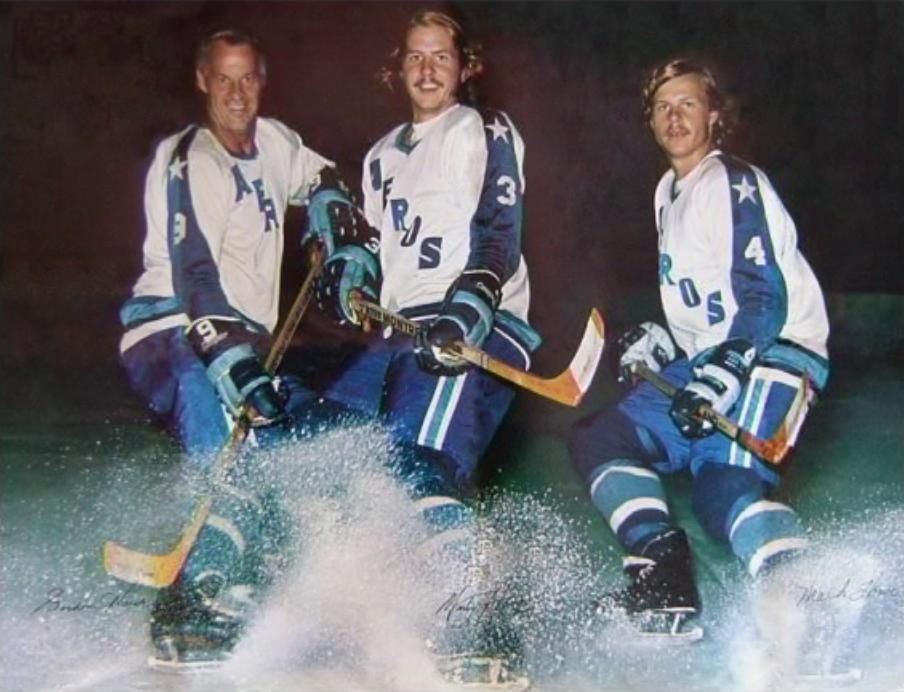
Bill Dineen, a teammate of Gordie's on the '54 and '55 Cup winners, was named head coach of the WHA's Houston Aeros. Another '55 (but not '54) teammate, Larry Hillman, was his assistant. In the 1973 WHA Draft, Dineen took Gordie's sons Mark and Marty. To help the WHA get better publicity, Dineen asked Gordie to come out of retirement. He was willing to get surgery on his troubled wrist, and give it a shot.

Wings owner Bruce Norris told the Howes that if Gordie quit the Wings' front office and went to "the rebel league," not only would he be blackballed from the NHL, never to work in it again in any capacity, but that Mark and Marty would also be blackballed -- and since they were players just starting out, this would affect them much more.

In other words, he gave Gordie, and his wife, Colleen, also the agent for her husband and their sons, an anti-incentive that would have hurt them much more than Gordie's own blackballing would have. It may not be the biggest dick move in the history of hockey, but it's the best-known dick move in NHL history.

Few decisions in the history of sports have backfired this much. Gordie and Mark -- or Gordie and Marty -- became the 1st father and son teammates in professional hockey history. They played on a line together. Mark and Marty got the traditional rookie hazings, and Gordie did not use his influence to stop it. On the other hand, the sons referred to their father as "Gordie," and even called him that to his face, in their teammates' presence, knowing that if they called him "Dad," they'd never hear the end of it.

Attendance went up all over the WHA, as people wanted to see the Howes. It probably kept the league going long enough for a merger with the NHL to be plausible. The Aeros won the WHA West Division in 1974, swept Bobby Hull and the Winnipeg Jets in the Quarterfinals, beat the Minnesota Fighting Saints in 6 games in the Semifinals, and, on May 19, completed a 4-game sweep of the Chicago Cougars, to win the AVCO World Trophy as WHA Champions in 1974.
Gordie, Marty, Mark

And Gordie, age 46, was awarded the Gary Davidson Trophy as the league's Most Valuable Player. Davidson, the league's founder, and also the founder of the American Basketball Association and the World Football League, saw good public relations in taking his own name off, and renamed the award the Gordie Howe Trophy.

Like the Flyers, the Aeros would win their league's 1975 title, and reach the Finals again in 1976. Unlike the Flyers, they were beset by money woes, which forced them to sell all 3 Howes to the New England Whalers. When the NHL took on 4 WHA teams in 1979, the renamed Hartford Whalers were one of them, and all 3 Howes were still there, as Gordie embarked on 1 last season, his 32nd in the major leagues and his 26th under the NHL banner. Norris tried to assert his contract rights over Gordie, but the NHL overruled him. Mark would later become a defenseman, and join Gordie in the Hockey Hall of Fame.

Meanwhile, from the time that Gordie signed with the Aeros in 1973 until 1983, the Wings made the Playoffs only once. From 1970 until 1987, they only won 1 Playoff series. From 1966, Gordie's last trip to the Finals, until 1986, 20 seasons -- ending the year Norris died, although he'd sold the team to Mike Ilitch in 1982 -- they played in only 17 Playoff games, winning 4 of them. They became known as "The Dead Things."

Saturday, May 18, 2024

May 18, 1964: Mods vs. Rockers In Brighton

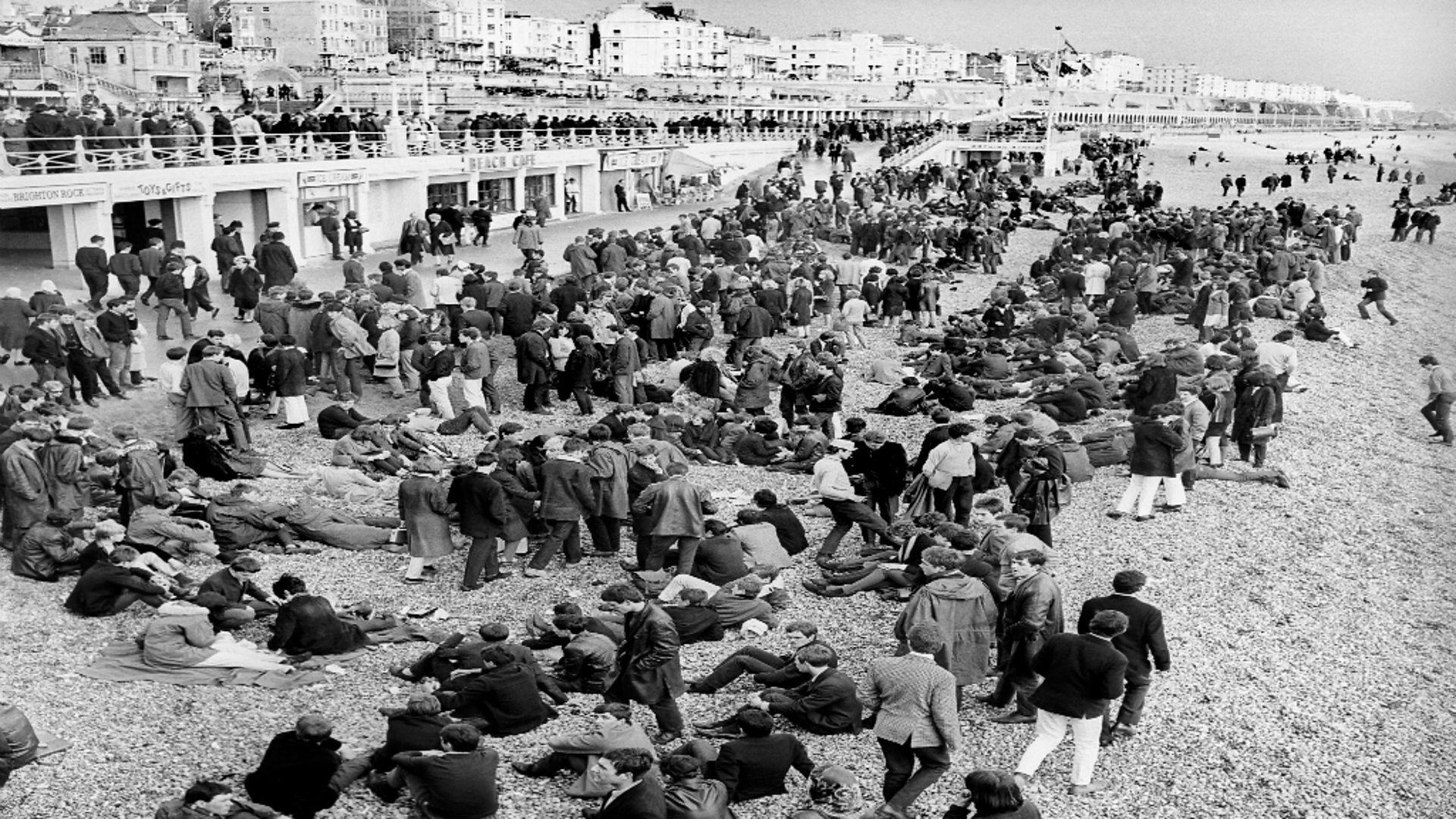
May 18, 1964, 60 years ago: Great Britain's 2 leading youth cultures square off, and it is a mess.

National Service for men aged 18 to 20 ended gradually from 1957. Britain has had an all-volunteer military ever since, just as America has had with the post-Vietnam ending of the draft in 1973. Both countries have found that having an armed forces staffed entirely by men and women who want to be there works far more effectively than having one with men who were forced to give up their lives to fight for a cause they didn't always understand.

But having so many more men ages 17 to 21 out on the streets, without an equivalent of America's G.I. Bill to send them to college, led to unintended consequences, including the creation of some subcultures that became nationally infamous, and then world-famous.

This was around the time that England's first rock and roll bands were being formed. It is no coincidence that 1957 was also the year that 17-year-old John Lennon met 15-year-old Paul McCartney in Liverpool; and that, early in 1958, they met 15-year-old George Harrison. By that point, 17-year-old Richard Starkey was already drumming in a band, and would begin calling himself "Ringo Starr" a year later.

After The War, young men in delinquent gangs who had adopted Edwardian-era fashion -- in the style of the years from 1901 to 1910, when the King was Edward VII, or "Good Old Teddy" -- were sometimes known as "Cosh Boys" or "Edwardians." On September 23, 1953, the national newspaper the Daily Express shortened "Edwardian Boy" to "Teddy Boy," and the name stuck.

By the early 1960s, that fad had ended the way most fads do: The originators grew out of it, and moved on. But 2 new subcultures took the Teddy Boys' place: The Mods and the Rockers. The Rockers were based on motorcycle culture, inspired by Marlon Brando in the 1953 film The Wild One. (Brando played a character named Johnny, which caught John Lennon's attention. And the film included a motorcycle gang named the Beetles. But The Beatles were named as a play on Buddy Holly's band, The Crickets.)
The Rockers wore leather jackets, leather pants or blue jeans, and leather boots, and generally made nuisances of themselves everywhere they went. Their choice of music was that of the early rockers who had toured Britain: Bill Haley, Chuck Berry, Little Richard, Buddy Holly, Eddie Cochran and Gene Vincent. (Cochran and Vincent had completed a tour of Britain in 1960, and were heading home to London's Heathrow Airport when their driver crashed, killing Cochran and badly injuring Vincent.)

The Rockers were leather-clad slobs. The Mods were different. They dressed up. The play The Odd Couple wasn't staged until 1965, and the movie and the TV show based on it came a few years after that; but if the Rockers were "Oscars," the Mods were "Felixes."

And instead of big motorcycles, like the kind produced in Britain and America, they preferred scooters, small and efficient enough for getting around streets in the countries that were producing them, Italy and France. If the scooters could work well in the streets of Rome and Paris, it was reasoned, they could work well in the streets of London. They would have multiple lights, or "lamps" in British parlance, on them. But, what was more, you could show up to work dressed like a Mod, and keep your job. It was "respectable."
Their musical tastes were different as well. They were originally called "mod" because they preferred "modern jazz," instead of "traditional jazz," whose fans became known as "trad." But they also embraced rock and roll, not the harder stuff of Elvis and Chuck Berry, but vocal groups with the black and Italian "doo-wop" sound. 

Pete Townshend, the lead songwriter and the lead guitarist for The Who, defined the Mods for Americans in an interview with Rolling Stone magazine for their September 28, 1968 issue:

It was a movement of young people, much bigger than the hippie thing, the underground and all these things. It was an army, a powerful, aggressive army of teenagers with transport. Man, with these scooters and with their own way of dressing.

It was acceptable, this was important; their way of dressing was hip, it was fashionable, it was clean and it was groovy. You could be a bank clerk, man, it was acceptable. You got them on your own ground. They thought, "Well, there's a smart young lad." And also you were hip, you didn't get people uptight. That was the good thing about it.

To be a mod, you had to have short hair, money enough to buy a real smart suit, good shoes, good shirts; you had to be able to dance like a madman. You had to be in possession of plenty of pills all the time and always be pilled up. You had to have a scooter covered in lamps. You had to have like an army anorak to wear on the scooter. And that was being a mod and that was the end of the story.

There was another difference in there, mentioned by Townshend: The pills, amphetamines, as opposed to the Rockers' drugs of choice, tobacco and alcohol. That's why Who lead singer Roger Daltrey purposely stuttered on their signature song, "My Generation": As Townshend explained, he's under the influence of the pills.

The Mods seemed like the perfect counterweight to the Rockers and their predecessors, the Teddy Boys. They launched the 1960s culture that became known as "Swinging London." But, soon enough, it would be fists that would be swinging, between the Mods and the Rockers.

On May 18, 1964, the 1st warm weekend of the calendar year, it came to a head in several seaside communities in England. The worst of the Mod vs. Rocker violence was in Brighton in Sussex, where, as all surviving sources agree, the Mods started it, not the Rockers with what was then the more aggressive reputation. The fighting moved along the coast, to Hastings, which led to the media calling it "the Second Battle of Hastings."

There were also beach and beach-town battles in Margate, Kent; and Clacton, Essex. Newspapers called the groups "vermin" and "louts." The Birmingham Post warned that Mods and Rockers were "internal enemies" who would "bring about disintegration of a nation's character." The members of The Who -- Daltrey, Townshend, bass guitarist John Entwistle and drummer Keith Moon -- were not directly involved in the fighting. But Townsend would write the rock opera Quadrophenia about the events, releasing it in 1973. It became a film in 1979.

The Beatles' film A Hard Day's Night was filmed in March and April 1964, a few weeks before the Brighton violence, but not released until after: July 6 in Britain, and August 11 in America. If Americans had heard about the violence in Brighton at all, they had quickly forgotten about it. In the film, a female reporter asked Ringo, "Are you a Mod or a Rocker?" And with the "cheeky humour" for which the group was then known, he answered, "I'm a Mocker!"

Every so often, as with other fads, the British youth subcultures come back. The Teddy Boys had a revival in the Glam Rock period of the 1970s. The subsequent rise of punk rock in 1976 brought the Rocker subculture back. The "Northern Soul" movement of the 1980s, centered around Manchester, revived interest in the Mods. And The Stray Cats, an American retro-rock band of the early 1980s, proved more popular in Britain, and, wittingly or not, was another revival of the Rockers.

Friday, May 17, 2024

May 17, 2014: Arsenal End the Trophy Drought

Aaron Ramsey, doing his best "Charlie George"

May 17, 2014, 10 years ago: The Football Association Cup Final is held at the new Wembley Stadium in London. For one team, Hull City Association Football Club of Hull, East Yorkshire, England, it starts out looking like "The Magic of the Cup." For the other team, Arsenal Football Club of North London, it starts out looking like the latest in a series of disasters in their attempt to win a trophy.

The Arsenal -- their fans like to call them that, Capital T, Capital A -- had won the FA Cup in 1930, 1936, 1950, 1971, 1979, 1993, 1998, 2002, 2003 and 2005. They had also lost in the Final in 1932, 1952, 1972, 1978, 1980 and 2001. They had won the old Football League Division One in 1931, 1933, 1934, 1935, 1938, 1948, 1953, 1971, 1989 and 1991. They had won its replacement, the Premier League, in 1998, 2002 and, with an unbeaten season within the League, 2004. They had won both the League and the Cup, for "The Double," in 1971, 1998 and 2002.

They had not won the main European trophy, the UEFA Champions League, formerly the European Cup; but had won secondary European trophies in 1970 and 1994. And they had won English soccer's secondary cup tournament, the Football League Cup, in 1987 and 1993. By winning both domestic cups in 1993, they were the 1st team ever to win a "Cup Double."

The trophies won from 1998 to 2005 were under Arsène Wenger. In 1998, the Frenchman became the 1st manager from outside the British Isles to win the League, and the 1st such manager to win the Cup. He would be followed by others. And he brought in players from all over the world: Europe, Africa, even Asia. By the date of this game, he'd even played, however briefly, 3 players from the United States.

Arsenal, known as the Gunners because of the cannon on their badge, and whose fans are known as the Gooners, were the first team that many English fans "loved to hate." From their beginning in 1886, they had a "foreign" presence, as some of the players on their original team were not English, but Scottish. For most of their history, they had relied on Scottish players, and the occasional Welsh player. Their 1979 FA Cup winners were known as "The Irish Connection," as several players were either from the Republic of Ireland or Northern Ireland, and even their manager, Terry Neill, was from Northern Ireland.

Their 1971 Double team was Captained by Frank McLintock, and also included among its key players George Graham. Both were Scots. Graham became the Arsenal manager in 1986, winning 6 trophies. That same year, another Scotsman, Alex Ferguson, became the manager of Manchester United. By this point, a Scottish manager was no big deal: United had previously had Matt Busby, while Liverpool had had Bill Shankly and now Kenny Dalglish. In 1999, West London team Chelsea fielded an entire starting XI with no players from the British Isles. Yet Arsenal were still "the foreign team" in the eyes of English fans and the English media.

But the 2005 FA Cup win was, coming into this game, their most recent trophy win. Since then, Arsenal reached the Champions League Final one, the Semifinals one other time, and the Quarterfinal one other time. They'd reached the FA Cup Semifinals once, and 2 League Cup Finals, but didn't win any of them. And, in that time, they did not finish higher than 3rd in the League.

The vast sums of money spent by Manchester United, Chelsea starting in 2003, and Manchester City starting in 2010 had not been matched by Wenger, and as the number of "years since Arsenal won a trophy" mounted, some fans demanded that Wenger "Spend some fucking money!" Or that the club fire him -- "Wenger Out" -- and hire a manager who would spend the money.

In January 2014, Arsenal were in 1st place. But, as seemed to happen every season since the 2006 CL run, an injury crisis struck, and knocked them out of the lead, and they ended up finishing 4th in the League again. Good enough to qualify for the next season's CL, but not good enough to satisfy the few thousand fans with the entitlement complex, the people who thought Wenger owed them a trophy.

Emblematic of this was the 3rd Round of the FA Cup, on January 4. Arsenal were paired with their nearby arch-rivals, Tottenham Hotspur. "Spurs" had last won a trophy in 2008. The last time before that, 1999. Both times, it was the League Cup. This is the difference between the teams and their fans: If Arsenal were to win the League Cup, it would be nice, we'd celebrate that day, then, the next day, we'd move on to seeking the next trophy; but when Spurs won, their fans never let us hear the end of it, treating it as if they'd won the League. They hadn't won the League since 1961; the FA Cup, since 1991, not even making the Finals since, including losing 3 Semifinals to Arsenal.

But, at this point, they had still won a trophy 3 years more recently than Arsenal. Still, nobody joked about how long their trophy drought was -- because it wasn't funny. When Manchester United went 26 years without a League title, 1967 to 1993, it was funny. Same as Liverpool going 30 years, 1990 to 2020. Same as Manchester City going 35 years without winning any trophy, 1976 to 2011. Because those are big clubs. Tottenham fans only think their team is a "big club."

Arsenal won this Cup tie, 2-0, with Theo Walcott scoring the 2nd goal. But, with Arsenal having made all 3 substitutions then allowed, Walcott was hacked down by Danny Rose (still "nicking a living" based on a goal he'd scored against Arsenal nearly 4 years earlier), wrecking his knee. Did Rose get a straight red card? No, not even a booking. Although going down to 10 men didn't hurt Arsenal in this game, losing Walcott for the 2nd half of the season cost them some League games.

Meanwhile, he was getting stretchered off, right in front of the visiting Tottenham fans. They threw things at him, including coins. That was how Tottenham responded to a problem that season: They threw money at it, and got little in return. What they got in return was Walcott holding up 2 fingers in his right hand, and making an O with his left, to signal the 2-0 score. Spurs fans were furious, and wanted him suspended and fined. He wasn't.
The chant was, "Theo! What's the score? Theo, Theo, what's the score?"

In the 4th Round, on January 24, Arsenal hosted Midlands team Coventry City at the Emirates Stadium. Coventry had famously upset Tottenham in the 1987 Final, but were now in League One, the 3rd Division of English soccer. Lukas Podolski scored 2 goals in the 1st half-hour, and Arsenal coasted to a 4-0 win.

Arsenal then knocked off both of the Liverpool teams. A week before taking on Liverpool FC at the Emirates in the 5th round, Liverpool had embarrassed Arsenal at Anfield, 4-1. This time, on February 16, Arsenal controlled the game from first whistle to last, and won, 2-1. On March 8, Arsenal hosted Everton in the Quarterfinal, and won, 4-1, thanks to a pair of late goals by Olivier Giroud.

The Semifinal, at Wembley, on April 12, would be tougher. Arsenal were a perennial at the old Wembley, having played their 1st game there in 1927 and their last not long before it closed in 2000. But since the new one opened in 2007, they were 0-3 there, having lost a 2009 FA Cup Semifinal, and the League Cup Final in 2007 and, in embarrassing fashion in the closing minutes, in 2011.

The opponent was Wigan Athletic, from the Manchester area, who had pulled off a miracle in the previous year's Final, defeating Manchester City in stoppage time. They were on the verge of relegation, and were looking to salvage something. And, for a while, it looked like they might achieve another major upset.

Arsenal blew a lot of chances in the 1st half. In the 2nd half, in the 63rd minute, Per Mertesacker -- the 6-foot-6 centreback affectionately known to Arsenal fans as "the Big Fucking German" -- made a critical mistake, tripping Wigan's Callum McManaman in the penalty area, and Wigan were rightly granted a penalty shot, which Jordi Gomez converted.

Wigan led 1-0, and on Twitter, the invective against Wenger by those who wanted him out was matched by the sadness of those who wanted him to stay, but figured now, with another trophyless year, he'd want to leave, so as not to have to put up with that kind of crap anymore.

The Wenger Outers acted as though some other manager brought the 2 Doubles, the "Invincibles" League title, the other trophies, and the new Emirates Stadium whose 60,000 seats allowed Arsenal to compete much better than beloved old Highbury with its 38,000 seats.

And they acted though, after the '06 Final, that aforementioned wonderful manager left, and then this cheap, stubborn old Frenchman came in and brought Arsenal to "mediocrity." Finishing no worse than 4th for 8 straight seasons, reaching a Champions League Semifinal and 2 other Quarterfinals, and reaching 2 League Cup Finals is hardly "mediocrity," or even "decline."

They also failed to take into account all the injuries, bad officiating decisions, and disloyalty shown to him by certain players, some of whom went on to win trophies with other teams. And they thought that spending truckloads of money was the answer. For Chelsea, Liverpool and the Manchester teams, it was. For Tottenham and Newcastle United, it wasn't. For Leeds United and Portsmouth, it meant financial disaster, relegation, and nearly going out of business. Clearly, simply spending a lot of money on hyped players is not the answer.

But in the 82nd minute, Alex Oxlade-Chamberlain fired a shot, and Wigan goalkeeper Scott Carson, who'd been playing very well, could only deflect it, and Mertesacker redeemed himself by heading in a tying goal. Suddenly, all the despairing Arsenal fans seemed to believe again. The Wenger Outers, however, remained unconvinced. 

Despite 5 minutes of 2nd-half stoppage time, such a late winner did not come for either side. And, through the pair of 15-minute halves of extra time, neither side seriously threatened to score. Both teams played with a lot of guts -- and when a team with more talent than guts doesn't get the job done, a team with more guts than talent, like Wigan, can surprise. So 120 minutes gone -- 128 minutes, if you count stoppage time -- and no winner could be found.

Penalty kicks. Every fan's least favorite way of settling a soccer game -- unless you're playing the national team of either England or the Netherlands, both notorious for missing penalties in knockout games. Packed to the gills at the Blind Pig in New York's Greenwich Village, then the main bar of the New York Gooners, I yelled, "Gentlemen, start your coronaries!"

Lukasz Fabianski, a much-maglined backup the last few years, first to Manuel Almunia, and now to fellow Pole Wojciech Szczesny, had started every FA Cup game for Arsenal the season. Arsenal's chances rested not just on the feet of up to 5 attackers, but in the hands of a keeper most Arsenal fans (including yours truly, also of Polish descent) would, not that long ago, not have trusted at all.

Wigan won the toss, and elected to kick first. Gary Caldwell fired, and Fabianski stopped it. Arsenal fans were elated, thinking that, now, they had a chance... if no Arsenal players missed. Spanish midfielder Mikel Arteta stepped up, and sent it home. It was "One-Nil to The Arsenal!" Jack Collison stepped up for Wigan... and Fabianski stopped him, too. Kim Kallstrom, the only signing Wenger made in the January transfer window (and that, a loan), who'd barely played since the transfer was made, partly due to injury, stepped up, and hit it.

Jean Beausejour was next for Wigan, and he converted. 2-1 Arsenal. Giroud made it 3-1 Arsenal. James McArthur scored to make it 3-2.  It was now all up to Spanish midfielder Santi Cazorla, who'd been so good the season before, his 1st for Arsenal, but not so good this season. He made it. 4-2 Arsenal, and the game. Arsenal were through to the Final on May 17 at Wembley.

For millions of Arsenal fans all over the world, jubilation. For many, myself included, more like relief. All the trauma of the last few weeks faded away. All those calling for Wenger to be fired, for Giroud to be sold, shut up for the rest of the day.

*

The Final would also be at Wembley. In other words, Arsenal did not have to leave London for the entire Cup run. One more thing about which the Arsenal-haters could whine.

Hull City, known as the Tigers for their black and yellow stripes, were managed by Steve Bruce, who had been a centerback on Manchester United's 1990s title-winners. His son, Alex Bruce, was a centerback for this team. One of their midfielders was familiar to Arsenal fans: Former Tottenham player Tom Huddlestone.

They had reached the Final by beating Middlesbrough of Yorkshire in the 3rd Round, Southend United of Essex in the 4th Round, Brighton & Hove Albion of Sussex in the 5th Round, Sunderland of the North-East in the Quarterfinal, and Sheffield United of South Yorkshire in the Semifinal. They had reached the Quarterfinal 5 times before, and the Semifinal in 1930; but this was their 1st trip to the Final.

From their founding in 1904 until that 2014 FA Cup Final, Hull had won... not much. They had won trophies for winning the Football League Division Three North in 1933, 1949 and 1966. They had been promoted from the 4th division to the 3rd in 1983 and 2004. They had been promoted from the 3rd to the 2nd, without a trophy, in 1959, 1985 and 2005. They had been promoted from the 2nd to the 1st, without a trophy, in 2008 and 2013. And in 1984, they had won the League Cup. In 110 years, that was their only trophy.

In other words, beating Arsenal would have been nearly as big a Final upset, a bit of "The Magic of the Cup," as Wigan beating Man City the year before; or Portsmouth and Cardiff City both advancing to the 2008 Final, with Portsmouth winning; or Wimbledon beating Liverpool in 1988; or Coventry beating Spurs in 1987.

It almost happened. James Chester scored in the 4th minute, and Hull Captain Curtis Davies in the 8th. Arsenal were already down 2-0, and it looked like it was over early. But Cazorla pulled one back in the 17th, to make it 2-1 Hull. As the old saying goes, "It's the hope that kills ya." But there was more hope in the 71st, thanks to a goal off a corner from Laurent Koscielny. The game went to extra time.

In the 1971 Final against Liverpool, Charlie George hit a screamer in the 111th minute, and celebrated by lying on the ground at the old Wembley. It became one of the iconic images of English football. This time, in the 109th minute, Giroud made a cheeky backheel pass to Aaron Ramsey, Arsenal's oft-injured Welsh midfielder who had come through so many times that season, and he put it in the net.

The goal wasn't much on style, but it was huge on significance. Ramsey ran around the corner where the Arsenal fans had been placed, to celebrate, and then slid on the grass, flat on his back, like George before him, before his teammates pounced on him.

But it wasn't over. Counting stoppage time, there were 12 minutes to go. And Fabianski nearly blew it in the 115th minute, rushing forward for an unsuccessful steal, with only left back Kieran Gibbs clearing the ball just in front of the net saving him from the most ignominious goalkeeping "howler" in FA Cup Final history. (In some minds, that title is held by an Arsenal man: Dan Lewis, against Cardiff City in 1927.)

When referee Lee Probert blew the final whistle, tremendous cheers went up -- inside Wembley, in North London, and wherever Arsenal fans gathered. I can vouch for East 14th Street in Manhattan, where there were 3 bars within a one-block stretch showing the game, known as Gooner Alley. Champagne flowed inside the Blind Pig.

Arteta, serving as Captain for this Final, and the injured Belgian centerback Thomas Vermaelen, the usual Captain, received the Cup from Prince William, head of the FA, on behalf of the royal family. The "years since Arsenal won a trophy" counter reverted to 0.
Wenger at the 2014 FA Cup celebration

Wenger led Arsenal to win the Cup again in 2015, beating Aston Villa in the Final; and 2017, beating Chelsea. A funny thing happened, though. Two funny things, really. Actually, neither of them were funny in the least.

First of all, the Wenger Outers, who kept saying that trophies matter, and "4th place is not a trophy," suddenly decided that the FA Cup didn't matter any more: It was winning the Premier League and the Champions League that mattered. To borrow a phrase from American football, they moved the goalposts.

And along the same lines, the English media, and fans of every other team, took the same tack, saying, "The FA Cup has been devalued." Except they didn't say that when it was won by Man United in 2016, Chelsea in 2018, Man City in 2019, Leicester City in 2021, or Liverpool in 2022. Certainly, they didn't say it the year before, when Wigan pulled off the major upset. Those times, it was "The Magic of the Cup."

In 2018, the small but loud minority finally convinced Arsenal team owner Stan Kroenke to give Wenger his "retirement." Unai Emery was hired, and his 1st season was worse than the "mediocrity" of the preceding years. He was fired early the next season, and replaced by Arteta, a "Wenger man," and he led Arsenal to win the FA Cup in 2020, another Final win over Chelsea.