Tuesday, August 24, 2010

Miami's All-Time Baseball Team

Tonight, the Mets start a 3-game series against the Florida Marlins at Citi Field.

Considering how much talent is in Florida from Tampa and St. Petersburg on north, it's a little surprising that South Florida isn't nearly as loaded. In fact, it's particularly weak in pitching, aside from an ace who is still the best lefthanded pitcher I've ever seen -- and another who could have been, if only.

Which reminds me of another really good lefty, Mike Cuellar, which reminds me that, no, if a player grew up in Cuba and then lived in or around Miami after Castro took over, you can’t count him for this team. Not Cuellar, not Luis Tiant, not Pedro Ramos. They have to have grown up, or at least played high-school ball, south of Lake Okeechobee.

Which would qualify Jose Canseco, born in Havana but grew up in Miami and attended the city's Coral Park High School. But for admitting his steroid use, frankly, I don't care what he achieved, he ain't gettin' on this list.

It would also qualify Rafael Palmeiro, born in Havana but grew up in Miami and attended the city's Andrew Jackson High School. Not that Palmeiro is going to make this team: For using steroids, and then so forcefully lying about it, he can take his 132 career OPS+, his 3,020 hits, his 569 home runs, and his 1,835 RBIs, and stick it where he stuck his needle.

I'll start this team with a 1st baseman who, unlike Palmeiro, was naturally big, and didn't need steroids to hit home runs for the Baltimore Orioles. Or the bandbox that is Oriole Park at Camden Yards, either.

Miami’s All-Time Baseball Team

1B John "Boog" Powell of Key West.
He may not be as easily associated with the southernmost point in the Lower 48 States as Ernest Hemingway and Jimmy Buffett, but his hitting was as intense as the former's writing, and his personal style is as relaxing as the latter's songs.

The 4-time All-Star was very nearly voted the Most Valuable Player of the American League in 1966 and '69 before winning it in '70. The Baltimore Orioles won Pennants all of those years, and in '71, and also had a near-miss in '64 and AL Eastern Division titles in '73 and '74. He hit 339 home runs and had 3 100-RBI seasons and a career OPS+ of 134. Despite his size, he held his own among the great fielders on that Baltimore squad.

Since the opening of Oriole Park at Camden Yards in 1992, he has run Boog's Barbecue on the Eutaw Street promenade between the right-field stands and the B&O Warehouse, starting a trend of ex-stars hosting barbecue stands at new ballparks that now includes Greg Luzinski, Gorman Thomas, Manny Sanguillen and Randy Jones (plus Luis Tiant at the not-at-all-new Fenway Park). If he could hit 303 home runs while playing his home games at Memorial Stadium (he hit 36 after leaving the O’s), what could he have done in that bandbox on the Inner Harbor?

2B Robby Thompson of West Palm Beach. He finished 2nd in the National League's 1986 Rookie of the Year balloting to Todd Worrell, was an All-Star twice and a Gold Glove winner once, and hit 238 doubles despite playing the equivalent of just 9 full seasons. He led the NL in triples in 1989, helping the San Francisco Giants win their 1st Pennant in 27 years.

SS Bucky Dent of Hialeah. Okay, he'll never be considered a heavy hitter. But he got hits when they mattered, particularly between October 2 and 17, 1978, when he saved the Yankees' bacon in the AL East Playoff with the Red Sox, and was the MVP of the World Series against the Dodgers. And he was a really good fielder, forming a fantastic double-play triad with Willie Randolph and Chris Chambliss. Whatever they call him in New England, the man born Russell Earl O'Dey will always be Bucky Blessed Dent to me.

3B Alex Rodriguez of Westminster Christian High School in Miami. The debate I had in my head (a rough place, I know) was both whether to put A-Rod on any list (because of steroids) and where. What city? Born in New York, but grew up (for want of a better choice of words) in Miami. What position? Since he is now more identified with the Yankees than with any other team, and will likely have played more games at 3rd than at shortstop by the time he's retired (currently 1,272 at short and 970 at 3rd), this is where he goes.

As of right now, at age 34, he has a .303 lifetime batting average, an OPS+ of 146, 2,644 hits, 472 doubles, 604 home runs, and 1,803 RBIs. He is 3 RBIs away from his 14th 100-RBI season, his 13th in a row. He has led the American League in home runs 5 times, RBIs twice, runs scored 5 times, and batting, hits and doubles once each.

He is a 13-time All-Star, and has won 3 MVP awards, finishing 2nd 2 other times. Believe it or not, his postseason batting average is .302, his postseason OPS .977, with 13 homers and 35 RBIs. He has reached the postseason 8 times (this season will almost certainly make it 9), including 3 times with the Seattle Mariners. He's only played on 1 Pennant winner, but the Yankees would not have won the 2009 World Series without his postseason contributions. He has answered all the questions.

Some people will never forgive him for using steroids for the 3 years that he's admitted, 2001-03, while he was with the Texas Rangers. Many of these same people are willing to overlook the proven steroid use of David Ortiz and Manny Ramirez, and the suspected steroid use of such Yankee nemeses as Curt Schilling, Luis Gonzalez, Ivan Rodriguez and Mike Piazza.

Because he came clean, unlike Barry Bonds and some others, A-Rod will almost certainly reach the Hall of Fame, and his Number 13 will be retired by the Yankees, and he will have a Plaque in Monument Park. You don’t have to like it. He'll never be one of my 100 favorite Yankees. But he has done what he came to New York to do: Win a championship.

LF Mike Greenwell of Fort Myers. Ted Williams, Carl Yastrzemski, Jim Rice, Mike Greenwell, Manny Ramirez... As they used to sing on Sesame Street, "One of these things just doesn't belong here." Yeah, and it's Manny, who couldn't field, looked ridiculous, and used steroids.

While Greeny may have been only the 5th-best left fielder in Red Sox history (if anyone is old enough to remember Duffy Lewis and wants to bump him ahead of Greenwell, be my guest), but he was a 2-time All-Star who came up as a late-season callup in the 1986 Pennant season, and helped them reach the postseason in 1988, '90 and '95. He batted .303 lifetime with a 120 OPS+, before injuries cut his career short at age 32.

In 1988, when the Red Sox won the American League East, he batted .325, hit 22 homers and had 119 RBIs, and finished 2nd in the AL Most Valuable Player voting to Canseco. When Canseco admitted his steroid use, Greenwell demanded that Canseco forfeit the MVP. So far, Canseco has refused. Greenwell is right, and for me to stick up for a Red Sock says a lot.

Honorable Mention to Warren Cromartie of Andrew Jackson High School in Miami. When he got good, starting in 1977 at age 23, the Montreal Expos got good. His hitting and fielding kept them in the NL East race every year through 1983, including the 1981 Division title, the only one the Expos/Nationals franchise has ever been officially awarded.

But, in a precursor to the economic conditions – or, perhaps, to the attitude toward them – that would led the Expos to leave Montreal, they didn't offer him a new contract, and at age 30 he went to Japan and signed with that country's most successful team, the Tokyo-based Yomiyuri Giants. In 1989, he was named MVP of Japan’s Central League. He had a brief U.S. comeback with the Kansas City Royals in 1991, batting .313 as a 37-year-old pinch-hitter. A lifetime .281 hitter in the North American major leagues, he deserved better.

CF John Milton "Mickey" Rivers of Miami. Roger Kahn, one of the most literary-minded of all sportswriters, once noted the name of the author of the 17th Century British epic Paradise Lost, and wrote that Mick the Quick "may be the only man named John Milton who has never heard of Paradise Lost."

But he stole 75 bases for the California Angels in 1975, and was obtained by the Yankees to be their new center fielder and leadoff hitter. In 3 full seasons in Pinstripes, he won 3 Pennants and 2 World Series. His .326 batting average led the 1977 World Champions, and he got all kinds of big hits for the Yankees, particularly against the Red Sox in the regular season and the Royals and Dodgers in the postseason. And that speed made him one of the finest defensive outfielders of his time.

Like Casey Stengel and Yogi Berra, he said a lot of things that suggested a fine line between genius and madness, but ain't no sense worryin' about that.

Somewhat Honorable Mention to Deion Sanders of Fort Myers. We'll never know what "Prime Time" could have done if he'd stuck with baseball, although he was certainly better off trying to play both that and football than Bo Jackson turned out to be. It's hard to believe, but he started out as a Yankee. (I wonder what George Steinbrenner thought of his off-the-field dress.)

He played for the Atlanta Braves in their 1991 and '92 Pennant-winning seasons and in the 1992 World Series, alternating with the Falcons, Atlanta's NFL team, which he also helped to reach the Playoffs. That 1992 season was his best in baseball, batting .304 with 8 homers, 28 RBIs and 26 steals, and leading the NL with 14 triples in only 97 games.

On January 29, 1995, he played for the San Francisco 49ers in Super Bowl XXIX, topping Jackie Jensen and Chuck Essegian (who had played in the World Series and the Rose Bowl) by became the 1st (and still only) man to play in both the World Series and the Super Bowl (but only winning the latter). But after 1995, he would play in only 2 more major-league seasons. He'll never be in the Baseball Hall of Fame, but he becomes eligible for the Pro Football version this winter.

RF Andre Dawson of Southwest High School in Miami. He finally got elected to the Hall of Fame on his 9th try, and that was at least 6 too many. It hurt him -- in more ways than one -- to play his 1st 10 full seasons in Montreal, a city where baseball is the 3rd sport behind hockey and Canadian-style football, with a flying saucer they call the Olympic Stadium, with its rock-hard astroturf that wrecked his knees. Then came 8 seasons in real ballparks in actual "baseball cities," 6 at Wrigley Field in Chicago and 2 at Fenway Park in Boston, where he burnished his legend (I know, that sounds dirty), before closing his career with 2 seasons with his hometown Marlins.

"The Hawk" was NL Rookie of the Year in 1977, and MVP in 1987, leading the League with 49 homers, most in the NL between 1977 and 1998 (remember, at Wrigley, the wind blows out half the time and in the other half), and 137 RBIs. He was an All-Star and a Gold Glove winner 8 times each, and finished his career with a 119 OPS+, 2,774 hits, 503 doubles, 438 homers, and 314 stolen bases. The only players with at least as many stolen bases as Dawson who had more homers than he did are Willie Mays and, uh, Barry Bonds.

How could anyone say this guy didn't belong in the Hall? If he'd spent his entire career in Chicago, or at least the time he spent with the Expos and Cubs combined all with the Cubs, he would've been in sooner. Unfortunately, while he played in 2 NLCS, in with the 1981 Expos and the 1989 Cubs, he never reached the World Series.

Honorable Mention to Dante Bichette of West Palm Beach. It's true that 201 of his 274 career home runs came while playing home games at altitude for the Colorado Rockies, but he also had seasons of at least 15 homers for the Angels, Brewers and Reds, none of whom played in hitters' parks. And he did have a .299 lifetime batting average, leading the NL in hits twice, 1995 and 1998.

Honorable Mention to Danny Tartabull of Carol City. Born in Puerto Rico as the son of Cuban-born right fielder Jose Tartabull (best known for a throw he made that sealed a win in the Red Sox' 1967 "Impossible Dream" season), he grew up in the Miami area, and had a 133 career OPS+ with 5 100-RBI seasons, and 262 homers despite playing the bulk of his career at Royals Stadium in Kansas City (now Kauffman Stadium and always a pitchers' park) and Yankee Stadium (great for lefty hitters but terrible for righthanders like Danny).

He was a member of the 1994 Yankees that had the best record in the AL when the strike hit, but was traded a year later for Ruben Sierra, who was traded a year after that for Cecil Fielder. Unlike his father, Danny never played in the postseason. However, he did appear on Seinfeld, as did fellow Yankees Derek Jeter, Bernie Williams, Paul O'Neill and manager Buck Showalter (and, in a scene that never made it to air, George Steinbrenner), and ex-Met Keith Hernandez.

UT Lenny Harris of Andrew Jackson High School in Miami. A classic utility player, only once was he a regular starter (at 3rd base with the 1991 Dodgers who nearly won the NL West). But over his 18-year career, he played every position except catcher: 485 games at 3B, 300 at 2B, 161 in RF, 157 in LF, 87 at 1B, 52 at SS, 3 in CF, and even pitched a scoreless inning for the Reds in 1993.

He reached the postseason with 4 different teams, the 1995 NL Central Champion Reds, the 1999 NL West Champion Diamondbacks, the 2000 NL Champion Mets and the 2003 World Champion Marlins (his only ring). Despite being a utility player (and despite being somewhat chunky), he stole 131 bases. He is the all-time leader in pinch hits with 212, and is now the roving minor-league hitting instructor for the Dodgers.

C Charles Johnson of Fort Pierce. Not a lot to choose from here, the next-best being former Yankee Mike Stanley of Fort Lauderdale. Johnson's here for his defense, winning 4 Gold Gloves. His best season with the bat was 2000, .304, 31 homers, 91 RBIs. He helped his hometown Marlins win the 1997 World Series, but was done at age 33. Injuries? Yes. Steroid-induced? Almost certainly not.

SP Steve Carlton of North Miami. In 1967, he helped the St. Louis Cardinals win the World Series. In 1968, he helped them win another Pennant. In 1971, he went 20-9. In 1972, Cards owner Gussie Busch offered him a contract for the season worth $50,000. Carlton wanted $60,000. Busch, a billionaire through his beer company, blew his stack over being asked to fork over an extra $10,000, and traded Carlton to the Philadelphia Phillies for Rick Wise.

Now, Wise was a good pitcher, but the Cards got rid of him too soon as well. That's why this was a bad trade: They didn't get what they could have out of the guy they got, and it was their fault, not his, and lost one of the greatest lefthanded pitchers ever, all over $10,000 -- even then, not an enormous amount.

In that 1972 season, Carlton went 27-10. The rest of the Phils' staff went just 32-87. Carlton also had a 1.97 ERA, and won the 1st of 4 Cy Young Awards (he was the first to win that many). When Carlton pitched, he told the Phils, "It's Win Day." He had 329 win days in his career, more than any lefthander ever except Warren Spahn, and an ERA+ of 115.

In 1983, he and Nolan Ryan vied to become the all-time strikeout leader. Ryan beat Carlton to Walter Johnson's longtime record of 3,508, but for a while, Carlton had the lead, until Ryan pulled away. Still, Carlton was the 2nd man to get to 4,000 strikeouts, finishing with 4,672. He reached the postseason 8 times, and helped the Phillies win the 1980 World Series (winning Game 2 and the clinching Game 6) and the 1983 Pennant.

He didn't like to talk to reporters. In 1981, a joke went around that the 2 best pitchers in baseball didn't speak English: Fernando Valenzuela and Steve Carlton. But his pitching spoke volumes. He is in the Hall of Fame, and the Phillies have retired his Number 32, elected him to the Philadelphia Baseball Wall of Fame, and erected a statue of him outside Citizens Bank Park.

SP Ken Johnson of West Palm Beach. Not an especially good pitcher, but South Florida hasn't produced very many good ones, and he was, in my opinion, the 5th-best starter. (Remember, I list the starting pitchers in chronological order.) He went 91-106 with a 102 ERA+ over a 13-year career, peaking in 1965 when he went 16-10 for the Houston Astros and Milwaukee Braves.

On April 23, 1964, pitching for the Astros (then still the Houston Colt .45's), he pitched a complete-game, 9-inning no-hitter... and lost. The game's only run scored, by Pete Rose, on 2 errors, the 1st one made by Johnson himself. He got into 1 postseason game, with the 1961 Cincinnati Reds, and seemed headed for more with the 1969 Chicago Cubs, but...

SP Fred Norman of Andrew Jackson High School in Miami. His career record was just 104-103, but he went 24-11 over the Cincinnati Reds' 1975 and 1976 World Championship seasons.

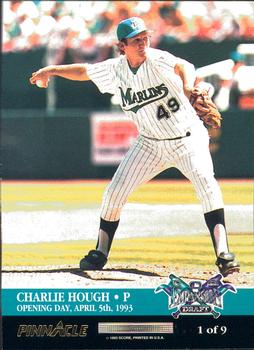
SP Charlie Hough of Hialeah. Actually born in Honolulu, Hawaii, and if I were doing an All-Hawaii team, I might have trouble filling it out – only 36 people born there have reached the majors – but it would have a heck of a good pitching staff, with Hough joined by 1986 Mets Ron Darling and Sid Fernandez (who did both grow up there), and also former Detroit Tiger starter Milt Wilcox (who grew up in Oklahoma).

Hialeah High School, alma mater to Hough and Bucky Dent, also produced Alan Wiggins, the ill-fated 2nd baseman for the Pennant-winning 1984 Padres, Pro Football Hall-of-Famer Ted Hendricks, CNN anchor Rick Sanchez, and singers Jon Secada and Harry Wayne Casey (leader of KC & the Sunshine Band).

Hough's career record is dead-even at 216-216, but he still won 216 games more than most people ever will. He helped the Dodgers win Pennants in 1974, '77 and '78, although he never won a ring, and in '77 he gave up Reggie Jackson's monstrous 3rd homer in Game 6 of the World Series. He spent a few years with good-but-not-great teams with the Texas Rangers and Chicago White Sox, and then came home to South Florida in the 1993 expansion draft.

Like a lot of knuckleballers, he wore Number 49 to honor Hoyt Wilhelm. Also like a lot of knuckleballers, he lasted a long time, throwing his final pitch at age 46. On April 5, 1993, at Joe Robbie Stadium, he pitched for the Marlins and beat his former team, the Los Angeles Dodgers, in the 1st major league game ever played in Florida.

SP Rick Rhoden of Delray Beach. A teammate of Hough's on the Pennant-winning Dodgers of 1974, '77 and '78, he did play for a World Champion -- sort of, being hurt most of the 1979 season and pitching just 1 game, 5 innings, for the eventual World Champion Pittsburgh Pirates.

In 1987, he went 16-10 for the Yankees, and on June 11, 1988, Billy Martin, in his 5th term and last month as Yankee manager, desperate to plug injury-caused holes, batted Rhoden -- a .238 lifetime hitter with 9 career home runs -- 7th as the designated hitter in a game I saw in person. The gamble paid off, as he hit a sacrifice fly to drive in a run, the last of his 75 career RBIs, and the Yankees beat the Baltimore Orioles, 8-6.

He is the only pitcher ever to appear in a game as a DH but not as a pitcher. (His former Pirate teammate John Candelaria started and won that game. Jay Buhner hit a grand slam, but was soon traded for Ken Phelps. But enough about that.) That sac fly was pretty much the last highlight for Rhoden, and the next year was his last in the majors. Still, his 151-125 record was better than Norman's and Hough's.

Honorable Mention to Herb Score of Lake Worth. Born in Queens but grew up in Palm Beach County, in 1955 he set a rookie record for strikeouts that still stands for the AL. In 1956, he was even better. Prior to the start of the 1957 season, he was 36-19 with 508 strikeouts for the Cleveland Indians, and had just turned 24 years old. The Boston Red Sox offered the Indians $1 million cash for him. They turned it down. His future seemed limitless.

On May 7, 1957, his future was limited, when he was hit in the face by a line drive from the Yankees' Gil McDougald. Several bones were broken, and his vision was permanently impaired. Although he insisted that it was a sore arm the following spring that doomed his playing career, we'll forever wonder. He was 19-27 the rest of the way. He won 55 games -- about 250 less than he should have. He could have been the AL's version of Sandy Koufax, a lefty strikeout machine. He went on to become an Indians broadcaster, staying until their Pennants of 1995 and 1997. He was Northern Ohio's version of Phil Rizzuto, Richie Ashburn, Ron Santo and Joe Nuxhall -- except he was probably better as a player than any of them, but had the least chance to prove it. He is in the Indians' team Hall of Fame.

RP Scot Shields of Fort Lauderdale. Basically a setup man for the Angels these last 10 seasons, but he's helped them reach the postseason in 2002 (World Champions), 2004, 2005, 2007 and 2009. He has a career ERA+ of 140 and a WHIP of 1.246.

In Game 3 of the 2005 ALDS, when Randy Johnson spit the very expensive bit for the Yankees, Shields was the winning pitcher in relief of Paul Byrd. He has been terrible this season, though (0-3 with a 5.62 ERA), and at 34 he could be nearing the end of the line.

MGR Dick Howser of West Palm Beach. An All-American shortstop at Florida State University, he became the prototypical good-field-no-hit infielder in the 1960s with the Kansas City Athletics and then the Yankees. An All-Star as a rookie in 1961, he batted .280 and stole 37 bases, but that was pretty much his peak as a player.

He became a Yankee coach, and got a pair of World Series rings that way. He managed the Yankees to the AL East title in 1980, but resigned in disgust when George Steinbrenner insisted he fire some coaches following an embarrassing ALCS loss to the Royals.

But when the Royals fired manager Jim Frey the next season, Howser went back to Kansas City, and got them into the postseason in 1981 (the 2nd-half AL West title in that split season), 1984 (AL West) and 1985 (the only major-league World Championship ever won by a Kansas City baseball team). He managed the AL to victory in the 1986 All-Star Game, but sadly that was his last game.

He resigned as Royals manager due to cancer, and died less than a year later. They made his Number 10 the 1st number they ever retired. Florida State named their baseball stadium for him, and both they and the Royals dedicated statues of him outside their ballparks. The baseball equivalent of the Heisman Trophy is the Dick Howser Trophy.

Honorable Mention to J. Stanley "Skip" Bertman of Miami Beach, who played at the University of Miami, and was an assistant coach there before becoming the head coach of 5 National Championship teams at Louisiana State University: 1991, 1993, 1996, 1997 and 2000.

Finally, an Honorable Mention to all those Cuban-born players who still can't go home, and have taken up residence in Miami, especially the following: Bert Campaneris, Jose Cardenal, Leo Cardenas, Paul Casanova, Tito Fuentes, Tony Gonzalez, the brothers Livan and Orlando "El Duque" Hernandez, Minnie Minoso, Tony Oliva, Camilo Pascual, Tony Perez, Pedro Ramos, Cookie Rojas, Diego Segui, Jose Tartabull, Tony Taylor, Luis Tiant. And to those who died before they could return: Sandy Amoros, Mike Cuellar and Zoilo Versalles.

Those Pesky Blue Jays

Well, the Pesky Blue Jays struck again. You can usually trust the Devils to beat the Maple Leafs, the Knicks and Nets are usually 50-50 to beat the Raptors, the Red Bulls have swept the home-and-home series with Toronto FC (breaking TFC's 14-month home winning streak last Saturday), and, of course, the Argonauts have never beaten either the Giants or the Jets. (Never played 'em, although in 1960 they did play a preseason exhibition against an NFL team, the Pittsburgh Steelers, and got clobbered.)

But the Pesky Blue Jays, who ruined the first live game I ever saw and have beaten the Yankees in 4 of the 6 games I've seen between them, including the 2 I've seen in Toronto, beat the Yanks again last night, 3-2.

Or, rather, Jose Baustista beat the Yankees, hitting his 39th and 40th home runs of the season to drive in all the Toronto runs, and also to lead the majors.

This is a guy who debuted in the majors at age 24, and in 4 full seasons has hit 16, 16, 15 and 13 home runs, respectively. Now, suddenly, at age 29 (he'll be 30 in October), he's hit 40 with 6 weeks to go.

His batting averages haven't gone up all that much: .235, .254, .238, .235... .254. No big deal there. But his OPS+'s: 94, 96, 91, 101... 162.

Test him! Nobody develops like that all of a sudden!

So much for the Yankees being undefeated this season when Alex Rodriguez doesn't start: They're now 13-1. Though it should be mentioned that Derek Jeter got the night off until a late pinch-hitting appearance. And also that the much-maligned bat of Ramiro Pena was not a liability, as he went 2-for-3, and didn't strand any runners.

Ivan Nova started for the Yankees, a 23-year-old Dominican making his 3rd and longest big-league appearance, and his 1st start. He pitched into the 6th, and gave up the 1st of Baustista's homers (ah-test-him-choo). He pitched 5 1/3rd innings, 6 hits, no walks. Not bad, definitely earned another chance. Boone Logan and Joba Chamberlain both pitched without allowing a run. It was David Robertson, who'd been great for a while, who gave up the 2nd of Baustista's homers (cough-test-him-cough), and was charged with the loss.

John Sterling did it again: Robinson Cano led off the 9th with a walk, and Jorge Posada came up, and here's what Sterling said:

"Theeee... pitch, it's swung on, AND THERE IT GOES! DEEP TO RIGHT-CENTER! But... "

It was caught.

In explaining it, Sterling said, "But it dropped... " And I shouted at the radio, "No shit, Sherlock!" (I love that expression.)

For a moment, Sterling allowed his listeners to believe that "Jorgie juiced one." Again, he broke Red Barber's Rule: Watch the outfielder, not the ball, so you'll know whether the outfielder thinks he can catch it.

Again: John Sterling, good guy, not a good broadcaster.

Tonight, Dustin Moseley goes for the Yanks, and Marc Rzepczynski (I think it's "Rep-CHIN-ski," with that first Z being silent) going for the Pesky Blue Jays.

*

The Mets open a 3-game series against their "pesky" team, the Florida Marlins, at Pity Field. Later today, or maybe tomorrow, I'll post the all-time team for the Miami region. I've got the players picked out, I just need to write the text.

The Red Sox claimed Johnny Damon off waivers from the Detroit Tigers. If they want to bring him back, that's fine. They probably did it to keep him away from the Yankees (who might already regret letting him go) and the Rays (and if they don't get him, great).

Albert Pujols hit his 399th career home run. That's how many home runs Al Kaline hit in his career. Pujols is 30.

According to Baseball-Reference.com, these are Pujols' 10 Most Statistically Similar Batters through age 30: Jimmie Foxx (Hall of Fame, 534 homers), Hank Aaron (Hall of Fame, All-Century Team, 755 homers), Lou Gehrig (Hall of Fame, All-Century Team, 493 homers, greatest first baseman ever), Ken Griffey Jr. (All-Century Team, eligible for the Hall of Fame in 2016, 630 homers), Frank Robinson (Hall of Fame, 586 homers), Mickey Mantle (Hall of Fame, All-Century Team, 536 homers), Juan Gonzalez (434 homers, eligible for the Hall next year but won't get in due to steroid suspicions), Mel Ott (Hall of Fame, 511 homers), Hank Greenberg (Hall of Fame, 331 homers in what amounted to just 10 full seasons), and Orlando Cepeda (Hall of Fame, 379 homers in what amounted to 14 full seasons).

Albert is going to put up some sicko numbers for his career. As long as he doesn't do what O.J. Simpson, Kobe Bryant, Pete Rose or Barry Bonds did. And, hell, people seem to have forgive Kobe, and a lot have forgive Pete.

*

Days until Rutgers plays football again: 9. A little over a week.

Days until East Brunswick High School plays football again: 18. Under 3 weeks.

Days until the first regular-season Giants game at the new Meadowlands Stadium: 19.

Days until the first regular-season Jets game at the new Meadowlands Stadium: 20.

Days until the next Yankees-Red Sox series begins: 31, Friday, September 24, at Yankee Stadium II. One month.

Days until the Devils play hockey again: 45, on Friday, October 8, at home at the Prudential Center in Newark, against the Dallas Stars. A little over 6 weeks.

Days until Rutgers and Army play the first college football game at the new Meadowlands Stadium: 53.

Days until the Devils play another local rival: 61, on Sunday, October 24, at Madison Square Garden against The Scum. Just 2 months. Then the Rags come to the Prudential on Friday, November 5. The first game of the season against the Islanders is on Friday, November 26, the day after Thanksgiving, at the Nassau Coliseum, followed the next day by the first game of the season against the defending Eastern Conference Champion Philadelphia Flyers, at The Rock.

Days until the next North London Derby: 89, Sunday, November 21, at New Highbury. Under 3 months.

Days until the next East Brunswick-Old Bridge Thanksgiving clash: 93.

Days until Derek Jeter collects his 3,000th career hit: 269 (estimated). 9 months.

Days until the Rutgers-Army football game at Yankee Stadium: 445.

Days until the last Nets game in New Jersey: 600 (estimated).

Days until the 2012 Olympics begin in London: 703. Now under 2 years.

Days until Alex Rodriguez collects his 3,000th career hit: 786 (estimated).

Days until Alex Rodriguez hits his 700th career home run: 1,056 (estimated, and moved back a little because of his injuries).

Days until Super Bowl XLVIII at the Meadowlands: 1,255. Now under 3 1/2 years.

Days until Alex Rodriguez hits his 756th career home run to surpass all-time leader Hank Aaron: 1,719 (estimated).

Days until Alex Rodriguez hits his 763rd career home run to become as close to a "real" all-time leader as we are likely to have: 1,743 (estimated). 58 months, so, less than 5 years.

Monday, August 23, 2010

Clemens: Indecent But Not (Yet) Proven Guilty

Roger Clemens... you can't defend him. Unless you're Rusty Hardin, his lawyer, in which case you can try to defend him.

The feds don't indict somebody unless they're damn sure the conviction is in the bag. But...

They'd better have a positive test, as Mark Fainaru-Wada and Lance Williams, the reporters for the San Francisco Chronicle who broke the case against Barry Bonds, say the feds do have on Bonds. If the feds have a positive test on Clemens, then either he cops a plea (hard to imagine the obstinate Rocket doing that), or he goes to prison, where somebody just might try to do to him what he did, and tried to do, or Met fans believe he tried to do, to Mike Piazza.

If the feds do not have a positive test, then their entire case boils down to the word of Brian McNamee. And McNamee is a known liar and snake who would say anything, and tarnish anyone, to keep his sorry ass out of jail.

And Roger Clemens would then be found Not Guilty. Because even with Andy Pettitte's testimony, which Tom Davis, the Republican Congressman from Virginia who chaired the committee in question, said was crucial to gaining the indictment, Hardin can still spout Clemens' line that Andy "misremembered" or "misheard," and there's your reasonable doubt.

No positive test, and Clemens walks.

He may then become a "Flying Dutchman." Not like Honus Wagner (that was his nickname), but like Shoeless Joe Jackson did, like Pete Rose has, like Barry Bonds probably will. Going from port to port, and no one will let him dock.

On the other hand, O.J. Simpson still had people who let him in... until he did the dumbest thing any ex-athlete ever did. Face it, if you were acquitted in one of the biggest trials ever, regardless of whether you actually did it or not, the last thing you would want to do is put yourself in a position to be hauled back into court.

Roger Clemens is now in a bubble. As well as on the bubble. Even if he is acquitted, or settles his case, who will trust him again? Anyone who does trust him, who will trust them again? Besides Clemens.

The Yankees did have steroid users. Jason Giambi and Gary Sheffield, most consequentially, aside from (possibly) Clemens.

But their opponents had many more, from Rafael Palmeiro and Brady Anderson on the 1996-97 Orioles, to Luis Gonzalez and Matt Williams on the 2001 Diamondbacks, to David Ortiz and Manny Ramirez (and possibly more) on the 2003-present Red Sox, to Ivan Rodriguez on 3 separate teams that faced the Yankees in the postseason: The 1996-99 Rangers, the 2003 Marlins and the 2006 Tigers.

You want to invalidate any of the Yankees' titles, you gotta invalidate those, too. And the Yankees are still way ahead.

But if Clemens wants to come to Yankee Stadium for Old-Timers' Day, he'd better buy a ticket. He ain't takin' the field wearing Number 22, that number ain't gettin' retired, and the only way he'll get into Monument Park is on foot with the tourists and regular fans.

Suddenly, Ed Whitson, Randy Johnson, and even Kyle Farnsworth don't sound so bad.

And, besides, we can always say that Clemens may be an asshole, but he started out with the Red Sox, so they probably made him that way. They've done it before, and they will again.

After all, they are The Scum.

Friday, August 20, 2010

Pittsburgh's All-Time Baseball Team

There's a lot to talk about, what with the Yankees taking 3 out of 4 from a Detroit Tiger team that's better than their current record suggests, the Mets continuing to hit poorly and only briefly get away with it, Roger Clemens being indicted, and the Brett Favre saga continuing (of course it does).

But I want to keep going with this regional all-time teams project. Tonight, the Mets begin a series in Pittsburgh against the Pirates.

Pittsburgh's All-Time Baseball Team

All of these players are from Pennsylvania, west of the Susquehanna River. Players from northern West Virginia were eligible, but I decided only one would make the team, and then only as an Honorable Mention -- although Bill Mazeroski, the legendary Pirates 2nd baseman, was born in Wheeling, but grew up in southeastern Ohio, and I put him on the Cleveland Indians' regional all-time team.

1B James "Ripper" Collins of Altoona. A rookie with the St. Louis Cardinals when they won the 1931 World Series, he led the National League in games, home runs, total bases and slugging in their 1934 World Championship "Gashouse Gang" season. He appeared in 3 All-Star Games and 3 World Series, also going to the 1938 edition with the Chicago Cubs. He only played 8 full seasons (debuting at 27 and only playing one after 34), but was a .296 lifetime hitter, OPS+ 126.

2B Jacob Nelson "Nellie" Fox of St. Thomas. After the 1949 season, when he'd played a grand total of 98 major league games, the Philadelphia Athletics traded him to the Chicago White Sox for Joe Tipton. (Who?) A backup catcher and a .236 lifetime hitter, that's who. We'll never know if Nellie could have helped the A's enough to keep them in Philly. (Given the Mack family's finances, almost certainly not.)

We do know he gave the South Siders 14 good seasons, 12 of them All-Star seasons, before wrapping it up with the Houston Astros. He led the American League in hits 4 times. He had 6 .300 seasons and just missed 2 others. He struck out just 216 times in 19 big-league seasons. He won 3 of the 1st 4 Gold Gloves awarded to 2nd basemen. With Chico Carrasquel, he formed a very good double-play combination; then, with Luis Aparicio, formed one of the best ever, now immortalized in a pair of statues at U.S. Cellular Field.

In 1959, he hit only 2 home runs, but batted .306, drove in 70, collected 191 hits including 34 doubles, and fielded brilliantly, helping "the Go-Go White Sox" win their only Pennant between 1919 and 2005, and winning the AL's Most Valuable Player award.

He died in 1975 of skin cancer when he was just short of his 48th birthday, and did not reach the Hall of Fame until well after his death, but is now there. The White Sox have retired his Number 2. Writer, radio host and humorist Jean Shepherd, best known for writing the book that became the film A Christmas Story, which he narrated, was a die-hard White Sox fan, and narrated the team's official history videotape in 1987, saying that Fox was his favorite ballplayer of all time.

SS Johannes Peter "Honus" Wagner of Carnegie. "The Flying Dutchman" (in this case, "Dutch" meaning "German") played from 1897 to 1917, and is still regarded as the greatest shortstop who ever lived. With Ty Cobb, Babe Ruth and Willie Mays, he's usually in the discussion for the title of "Greatest Baseball Player Who Ever Lived."

He helped his hometown Pirates win Pennants in 1901, 1902, 1903 and 1909, losing the 1st World Series to Cy Young's Boston Americans (Red Sox) in 1903, but winning the Series over Cobb's Detroit Tigers in 1909. He won more NL batting titles than anyone, 8; and led the NL in RBIs and stolen bases 5 times each. His lifetime batting average was .329, and he collected 3,430 hits. Remember the fuss made when Pete Rose broke Cobb's career record for hits? Well, somebody had to have the record before Cobb, and it was Wagner.

He later coached with the Pirates, wearing Number 33 in this role, and it was retired for him. With Cobb, Ruth, Christy Mathewson and Walter Johnson, he was 1 of the 1st 5 players elected to the Baseball Hall of Fame in 1936. In 1969, he was named to the Major League Baseball All-Time Team. In 1999, 82 years after his last game and 44 years after his death, fans voted him onto the MLB All-Century Team.

Honorable Mention to Bobby Wallace of Pittsburgh. He reached the majors in 1894 and played until 1918. How long ago was that? So long ago that he played for a Cleveland team in the National League (the Spiders) and a St. Louis team in the American League (the Browns). A great fielder by the standards of his time, he hit .300 and drove in 100 runs twice each. He collected 2,309 hits, including 391 doubles and 143 triples.

He wasn't a bad pitcher, either. In fact, of all players in the Hall of Fame who played at least half of their careers in the 20th Century, he made more mound appearances than anybody not usually thought of as a pitcher except Babe Ruth, 57. He went 12-14 for the 1895 Spiders (with Cy Young also in the rotation, and they beat the original Baltimore Orioles in a postseason series for the Temple Cup – more an equivalent to English soccer's FA Cup than any "world championship"”) and 10-7 for the 1896 edition (which played the Orioles in the Temple Cup again, but lost). He is in the Hall of Fame.

Honorable Mention to Dick Groat of Swissvale. Perhaps the 1st great basketball player at Duke University, he chose baseball instead, and was 4 times an All-Star for his hometown Pirates. In 1960, he led the NL in batting with a .325 average, won the MVP, and took the Pirates to the World Championship. Traded to the Cardinals in 1963, he nearly won another MVP, finishing 2nd to Sandy Koufax as he led the NL with 43 doubles, before helping them win the World Series in 1964 – both his rings coming against the Yankees.

He had 2,138 hits in just 14 seasons (missing some time due to Korean War service and retiring at 36). Had he not had to serve in the Army, he might have put up another good season or two, and we'd be thinking about him for the Hall of Fame.

3B Dick Allen of Wampum. Don't call him "Richie," although most references to the 1964 Phillies still list him as such. He was named the NL Rookie of the Year that season, leading the League in runs, triples and total bases, batting .318 with 29 homers and 91 RBIs.

A 7-time All-Star, he was as good a hitter as the game has ever seen from the time he was 22 until he was 32, 1964 to 1974. Chased out of Philadelphia in 1969, he got to the Chicago White Sox in 1972 (and playing mostly 1st base from then on), and that year won the AL MVP, leading in home runs with 37, RBI with 113, OBP with .420, slugging with .603 and OPS with 1.023, batting .308. Lots of people in Chicago, noting that the ChiSox had been struggling financially and had come closing to moving once already, say that the crowds coming to see Allen's drives (he also led the AL in homers in 1974) saved the franchise from being moved.

His lifetime batting average was .292, his on-base percentage .378, his slugging percentage a hefty .534, his OPS .912, his OPS+ 156. This guy should have gone to the Hall of Fame.

So what happened? The Phils went on a 10-game losing streak and just missed the Pennant in 1964, although Allen hit like hell that month, so you can't blame him. The next year, he got into a fight with teammate Frank Thomas (not to be confused with the later White Sox slugger), which was apparently racially motivated. Management took the side of the better-hitting Allen, and traded Thomas. But Philly's white fans didn't forgive him for that, and booed him terribly until he finally got his wish to be traded.

He began to be paranoid about racial matters, drank heavily, gambled a lot on horse racing, and frequently showed up late for games. He ended up quitting on the White Sox in 1974, and managed to get back with the Phillies, whose fans, no longer in the black neighborhood that Connie Mack Stadium was in, cheered him vociferously at Veterans Stadium. But despite reaching the postseason in '76, his demons remained, and a year later he was out of baseball.

He hit "only" 351 home runs, despite playing his entire career in pitchers' parks (Connie Mack Stadium, a year at Busch Stadium in St. Louis, a year at Dodger Stadium in Los Angeles, Comiskey Park, the Vet, and his last year at the Oakland Coliseum), and having his last productive season at age 34.

Allen took his passion for racehorses in a positive direction, training them, and returned to the Phillies in a front-office capacity, and remains with them today. Some people believe he should be in the Hall. Many have squelched the notion that he was underachieving and divisive, including Hall-of-Fame teammates Goose Gossage and Mike Schmidt, and former managers Red Schoendienst, Chuck Tanner and, shortly before his death, Gene Mauch. Both the Philadelphia Baseball Wall of Fame (at Citizens Bank Park) and the Chicagoland Sports Hall of Fame (at Hawthorne Race Course) have inducted him.

Honorable Mention to Eddie Miller of Pittsburgh. Hard to tell why this Boston Brave and Cincinnati Red appeared in 6 All-Star Games. Either he must have been a good fielder, or in the years between Pie Traynor and Eddie Matthews, the NL must've been hard-up for good 3rd basemen, so they took this guy with an 80 career OPS+ and a peak batting average of .276. Still, he led the NL with 38 doubles in 1947.

LF Stan Musial of Donora. Once, at a Hall of Fame induction weekend, Stan, the greatest National League hitter of his generation, was talking with his American League counterpart, Ted Williams. Afterwards, Ted's son, John Henry Williams, asked his father, known for wanting people to call him "the greatest hitter who ever lived," "Dad, do you think Musial was as good a hitter as you were?" Without hesitation, Ted said, "Yes, I do." And he wasn't just sticking up for an old friend: Stan was, indeed, The Man.

In his 1st 4 full seasons with the St. Louis Cardinals – minus 1941, when he had a late-season callup and the Cards just missed, and 1945 when he was in the Navy for World War II – they won the World Series in 1942, the Pennant in 1943, the World Series in 1944, and the World Series in 1946. They never won another Pennant with him, but that didn't stop him. He was the NL MVP in 1943, 1946 and 1948, and finished 2nd in the voting in '49, '50, '51 and '57 – winning Sports Illustrated's Sportsman of the Year award that year.

His lifetime batting average was .331, his OPS+ a whopping 159. He led the league in batting 6 times (topping out at .376 in 1948), hits 6 times, runs 5 times, doubles 8 times, triples 5 times, and RBIs twice with 10 100-RBI seasons. He hit 725 doubles (2nd all-time to Tris Speaker) 177 triples, and 475 home runs, not counting what we would now call a walkoff homer in the 1955 All-Star Game. 

Speaking of which, because of the 2 ASGs played per season from 1958 to 1962, he played in 24 All-Star Games, a record that would be tied by Willie Mays and Hank Aaron, but not broken. At the 1962 ASG in Washington, when he was 41, the 45-year-old President John F. Kennedy told him, "They said I was too young to be President, and you were too old to play baseball. I guess we showed them."

He was once the NL's all-time hits leader with 3,630 – 1,815 at home, 1,815 on the road. You cannot make this stuff up. He was once the all-time leader in both extra-base hits and total bases, until surpassed by Aaron. Hall of Fame. All-Century Team. Number 6 retired by the Cardinals, and a statue dedicated outside Busch Stadium, inscribed with a quote attributed to former Commissioner Ford Frick: "Here stands baseball's perfect warrior. Here stands baseball's perfect knight."

Honorable Mention to Jesse Burkett of Wheeling, West Virginia. Only 5-foot-8 and 155 pounds, he nonetheless had a lifetime batting average of .338, an OPS+ of 140, and 2,850 hits. He won 3 batting titles, in 1895 (.405) and 1896 (.410) with the NL's Cleveland Spiders, and in 1901 (.376) with the St. Louis Cardinals, before moving on to the St. Louis Browns of the AL. He's the only West Virginia product in the Hall of Fame. (As I mentioned, Bill Mazeroski was born there. So was George Brett. But both grew up elsewhere.)

Honorable Mention to Hank Sauer of Pittsburgh. In 1952 he won the NL's MVP despite playing for a Cub team that finished 5, as he led the League in homer swith37 and RBIs with 121. He was so popular with Cub fans that he became known as the Mayor of Wrigley Field, before Ernie Banks arrived and well before Harry Caray did. Career OPS+ of 123, and hit 288 home runs.

Honorable Mention to John Preston "Pete" Hill of Pittsburgh. Born in Culpeper county, Virginia, he grew up in the Steel City, and played for several all-black teams from 1899 to 1925, the longest with the Chicago American Giants, whose owner, manager and ace pitcher Rube Foster called him "my field general" and "my second manager."

He played against what could hardly be called entirely big-league caliber competition, and with records woefully incomplete, but Cumberland "Cum" Posey, owner of the Homestead Grays, said that Hill was "the most consistent hitter of his time." In 2006, when the Hall of Fame had a special committee consider Negro League players that they might have missed, Hill was one of those elected.

CF Lewis "Hack" Wilson of Ellwood City. He might be the most defensively lacking outfielder on any of these teams, but what can you do when Ken Griffey Jr. doesn't qualify as your team's center fielder? (Explanation below.) Besides, as his nickname might suggest, Hack might have been a more powerful hitter.

He was just 5-foot-6, and at 190 pounds it was suggested that he was "shaped like a beer barrel, and not unfamiliar with its contents." Despite playing all but his last season in the Prohibition era, few athletes were ever more identified with drunkenness. (Playing most of his career in the Chicago media market, ground zero for Prohibition due to the machinations of Al Capone, didn't help.)

And, due to his size, he wasn't the most mobile of outfielders. Legend has it that he was standing in the outfield at Baker Bowl in Philadelphia during batting practice before a Cubs-Phillies game, and he had his head down so he didn't have to aim his heavy, bloodshot eyes at the hot sun. But a teammate hit a ball off the park's close, tall right field wall. The sound of horsehide on tin shook him out of his stupor, and, thinking he was now in an actual game, he grabbed the ball and threw a perfect strike back to the infield, and got a standing ovation – shades of the Dick Stuart hot-dog wrapper story.

But, when sober, boy could he hit. In just 12 seasons, he hit 244 homers, with a batting average of .307 and an OPS+ of 144. He led the NL in homers 4 times, including 56 in 1930, a record that stood until 1998 (or 2006, if you think Ryan Howard is clean, as he so far appears to be). That same year, a year after driving in 159 runs, Hack had 191 RBIs, an all-time single-season record. (Before a recent re-check of the records, he was usually credited with 190.)

But the drinking took its toll, and he had just 1 season of more than 61 RBIs after that. He did help the New York Giants win the Pennant in 1924 and the Cubs do it in 1929. But, frustrated by his drinking, the Cubs traded him in 1932, and he did not play for that Pennant winner. Drinking killed him in 1948, age 48. A sad story. But he is in the Hall of Fame, and is honored in the Cubs' Walk of Fame outside Wrigley Field, although he did not wear a number that could be retired for him until after he left the Cubs (Number 4).

RF Ken Griffey of Donora. While his son, George Kenneth Griffey Jr., was also born in Donora, he grew up in Cincinnati while Ken Sr. was part of the Big Red Machine, and attended the prestigious Archbishop Moeller High School, as did MLB players Buddy Bell (son of former Reds star Gus Bell), his son David Bell, and Barry Larkin; and former Chicago Bear turned ESPN 1000 host Tom Waddle. Therefore, Junior qualifies for the Reds' regional team, not the Pirates'.

Ken Sr. was no slouch. In 19 seasons, he batted .296, with an OPS+ of 118, 2,143 hits including 364 doubles. He wasn't a big slugger, as he only topped 14 homers and 74 RBIs once each. But he was a 3-time All-Star, and helped the Reds win the 1975 and '76 World Series and the '79 NL West title, nearly helped get the Yankees to the 1985 AL East title, and finished his career in 1990 and '91 with his son on the Seattle Mariners.

UT John Montgomery Ward of Bellefonte. This pioneer of the game could play just about anywhere, including pitching. "Monte" had 3 .300 seasons, and while stolen-base records were not kept from his 1878 debut (at age 18!) until 1886, he is credited with 540 steals, including 111 in 1887. (The rules for what constituted a "stolen base," like a lot of rules, were a little different then.)

He won NL Pennants with the Providence Grays in 1879, and the New York Giants in 1888 and 1889. A practicing attorney in the off-season, he led the Players' League revolt of 1890, and almost freed the players' from the yoke of the owners' reserve clause. If he had just held out a little longer... But he did play long enough to get into the Hall of Fame, and "organized baseball" didn't hold his union activity against him.

C Harold Delano "Butch" Wynegar of York. I'm stretching it a bit, as York is closer to Philly, but it is west of the Susquehanna. A 2-time All-Star as a catcher with the Minnesota Twins, he was traded to the Yankees in 1982, and caught Dave Righetti's no-hitter the next season. A 9th-inning home run against Toronto on the 3rd-from-last game of the 1985 season kept the Yankees in the AL East race until the next day.

SP George "Rube" Waddell of Bradford. In 1904, he struck out 349 batters, a single-season record in the majors until 1965 (Sandy Koufax) and in the AL until 1973 (Nolan Ryan) – although it was miscounted as 343 for many years, and Bob Feller was thought to have broken it with 348 in 1946. In 1905, he went 27-10 with a 1.48 ERA. He helped the Philadelphia Athletics win Pennants in 1902 and 1905, and nearly another in 1907.

But... I don't know if he was retarded, or had the worst case of attention-deficit disorder in baseball history, but he could never focus on anything, a situation he didn't make any easier by becoming an alcoholic. A's manager Connie Mack finally had enough, and in 1908, he sold Waddell to the St. Louis Browns. By 1910, age 33, he was done. In 1914, age 37, he died of tuberculosis.

But he's in the Hall of Fame. His career record was 193-143, a 2.16 ERA, a 135 ERA+, and 2,316 strikeouts despite only 11 full seasons. If he'd played today, a team psychologist would probably have figured out what was wrong, and they might've known what to do. Instead, he pitched his last big-league game 100 years ago – to the month, August 1, 1910 – and nobody understood.

SP Eddie Plank of Gettysburg. Another stretch, although Gettysburg is further to the west than York. In fact, like York, it's closer to Baltimore and Washington than it is to Philadelphia – and now you know why Robert E. Lee wanted it so badly in 1863, and why the Union defended it fiercely enough to beat the Confederates back across the Mason-Dixon Line.

Plank was Waddell's teammate from 1902 to 1907, and, fortunately, Connie Mack had a much easier time with this great lefthander. He helped the A's win Pennants in 1902, 1905, 1910, 1911, 1912, 1913 and 1914, winning the World Series in 1910, 1911 and 1913.

His record was 326-194, winning 26 twice, 24 on 2 other occasions and 23 on 2 others. Career ERA 2.35, ERA+ of 122. His A's teammate Eddie Collins said, "Plank was not the fastest, not the trickiest, and not the possessor of the most stuff, but he was just the greatest." He is in the Hall of Fame.

SP Bob Purkey of Pittsburgh. The graduate of South Hills High School both began (1954-57) and ended (1966) his career with his hometown Pirates, but he's best-remembered with the Cincinnati Reds, helping them to win the Pennant in 1961 with a 16-12 record. He was even better in 1962, going 23-5. He Won 129 games in his career, and is a member of the Reds' Hall of Fame.

SP Gary Peters of Mercer. He pitched only 2 games as a rookie for the '59 Go-Go White Sox, and didn't stick in the majors until 1963, when he was already 26. But what a stick he made that season: 19-8, a League-leading 2.33 ERA, and the Rookie of the Year. In 1964, he was even better, 20-8, as the Sox finished just 1 game behind the Yankees.

He led the AL in ERA again in 1966 with 1.98, and in 1967 went 16-11 with 2.28 as the Sox came close again, finishing 3 games behind Boston. He probably would have won more had he pitched for, say, the White Sox of 1917-19, or the 1977 "South Side Hit Men," or the Frank Thomas teams of the 1990s, but he still won 124 major league games.

SP Sam McDowell of Pittsburgh. Probably the best left arm ever to come out of the city's Central Catholic High School – with Dan Marino having the best right arm. That school also produced Basketball Hall-of-Famer Jack Twyman, Costco founder James Sinegal, actor Zachary Quinto, and, although he didn't graduate, playwright August Wilson.

In 1965, "Sudden Sam" went 17-11 for a weak Cleveland Indians team, and led the AL in ERA with 2.18 and strikeouts with 325 – and he was only 22 years old. He led the AL in strikeouts 5 times, and went 20-12 for an even weaker Tribe in 1970.

But he was wild, on and off the field. He led the AL in walks 5 times and wild pitches 3, and his drinking got out of control. In 1972, the Indians traded him to the San Francisco Giants for Gaylord Perry. A rare great trade by the Indians, as Perry won the Cy Young Award, while, at 29, McDowell was basically through, going just 19-25 away from Cleveland after going 122-109 with them. Still, he did pitch in 6 All-Star Games, win 141 games, struck out a substantial 2,453 batters despite having only 10 full seasons, and his ERA+ was 112.

Having gone through treatment, he is now a substance abuse counselor and sports psychologist. In that latter role, he worked with the Toronto Blue Jays and was awarded a World Series ring in 1993. An urban legend has it that the Cheers character Sam Malone was based on McDowell, although "Mayday" was righthanded and actually assisted other people's drinking by running a bar. (The photo at the bar of a Red Sox pitcher wearing Number 16, intended to be Sam, was actually of Jim Lonborg.)

RP Albert "Sparky" Lyle of DuBois. He was a rookie on the Pennant-winning "Impossible Dream" Red Sox of 1967, but the team's management didn't understand him. He was the stereotypical flaky lefthander – or, if you prefer, the stereotypical flaky reliever. So, after the 1971 season, they traded him to the Yankees for Danny Cater and Mario Guerrero. Cater was the key: He always hit well in Fenway Park, so why not play him at Fenway 81 times a year? Big mistake: Cater and Guerrero did nothing for Boston. It turned out, the reason he hit so well at Fenway is that Boston had lousy pitching.

Sparky in The Bronx? He set an AL record (which lasted all of one year) with 35 saves in 1972. He was a major force in the Yanks' return to glory, winning the Pennant in 1976 and the World Series in 1977, a season in which he became the 1st AL reliever to win the Cy Young Award.

The Yanks had had good relievers before (see below), but Sparky kicked it up to a new level, which would one day be reached and surpassed by Dave Righetti and Mariano Rivera. Unfortunately for Sparky, that level would first be reached by Rich "Goose" Gossage, and, in just 1 year, according to teammate Graig Nettles, "Sparky went from Cy Young to Sayanora." His tell-all book, The Bronx Zoo, became a best-seller, and he ended up getting another ring with the 1980 Philadelphia Phillies. In fact, as far as I know, he's the only man ever to win Pennants with the Yankees, Phillies and Red Sox.

He saved 238 games in his career, 141 for the Yankees. His ERA+ is 128. He hasn't yet received a plaque in Yankee Stadium's Monument Park, and his Number 28 has been kept in circulation (currently worn by manager Joe Girardi, to signify the goal of a 28th World Championship). But he has been the subject of a YES Network Yankeeography.

Since 1998, Sparky has been the manager of the Bridgewater, New Jersey-based Somerset Patriots, whose 5 Pennants have made them the most successful team in Atlantic League history. Sparky's trademark bushy mustache led to the design of the Pats' mascot, a large schnauzer named Sparkee.

Honorable Mention to Joe Page of Cherry Valley. He really only had 2 effective seasons, but those were 1947 (14-8 with 17 saves) and 1949 (13-8 with 27 saves, a record at the time), and both times the Yankees won the World Series. In the latter year, when the Yanks and Red Sox went down to the wire, the key was that the Yankees had Page in their bullpen, and the Red Sox didn't.

He was the 1st reliever to be known as a "Fireman," because he "put out fires." He mopped up for Allie Reynolds so much that a joke circulated among New York baseball fans. Q: Who's pitching for the Yankees today? A: Reynolds and Page. And when Joe DiMaggio was asked about whether he was excited about his upcoming marriage to Marilyn Monroe, he supposedly said, "It's got to be better than rooming with Joe Page."

MGR Bill McKechnie of Wilkinsburg. The manager of the only New Jersey-based MLB team ever, the 1915 Newark Peppers of the Federal League (they finished 5th), "the Deacon" managed the Pirates to the 1925 World Championship, the Cardinals to the 1928 NL Pennant, and the Reds to the 1939 NL Pennant and the 1940 World Championship. He is in the Hall of Fame.

Thursday, August 19, 2010

San Francisco's All-Time Baseball Team

I already missed the Mets' last series against the Giants this season, but the Giants are playing the Phillies at nearby Citizens Bank Park. So this is the time to post their regional team.

San Francisco's All-Time Baseball Team

This could well be the best of the 30. They are absolutely loaded in the infield. They have devastating bats and fantastic gloves in the outfield. And the pitching is pretty good, too. Put it this way: Bobby Jones was an All-Star, and he doesn't make this team. Then again, he's not even the best Met pitcher from Fresno.

1B Frank Chance of Fresno. Despite his association with shortstop Joe Tinker and 2nd baseman Johnny Evers, both borderline Hall-of-Famers at best and likely in only because of the Franklin P. Adams poem commemorating them, he had a .296 lifetime batting average, a 135 OPS+, led the National League in stolen bases in 1903, led the NL in on-base percentage in 1905, and led it in steals and runs scored in 1906.

"The Peerless Leader" is also the manager of this team, having led the Cubs to the 1906, 1907, 1908 and 1910 NL Pennants and the 1907 and 1908 World Championships – the only World Series the Cubs have ever won.

Honorable Mention to George "High Pockets" Kelly of San Francisco. A real borderline HOFer, probably in only due to the efforts of his New York Giants teammate, Frankie Frisch, who spent a long time on the Hall's Veterans Committee and got a bunch of his teammates in, worthy and otherwise.

But Kelly was no slouch: .297 batting average, 7 times a .300 hitter, 337 doubles, 5 100-RBI seasons and just missed a 6th, and led the NL in homers with 23 in 1921. Helped the Giants win the 1921 and '22 World Series, and also the '23 and '24 Pennants. Helped start a Series-ending double play against the Yankees in 1921 – from 1st base.

Honorable Mention to Dolph Camilli of Atherton. Became a star with the Philadelphia Phillies, and in 1938 Larry MacPhail made him one of the guys who restored the Brooklyn Dodgers. Brooklynites called him the People's Choice – or, in their accent, Da Peepul's Cherce. Lifetime OPS+ 136. Hit 239 homers. In 1941, led the NL in homers with 34 and RBIs with 120, leading the Dodgers to their 1st Pennant in 21 years and earning himself the MVP. But never regained his batting stroke after returning from World War II.

Honorable Mention to Dick Stuart of Redwood City. He once hit 66 home runs in a minor-league season. That was probably the worst thing that could have happened to him, as people expected him to hit enormous amounts of home runs. In 1960, winning the World Series with the Pittsburgh Pirates, he hit 23 with 83 RBIs. The next season, he hit 35 with 117 RBIs. But he struck out way too much, and as for his defense, well, he was a liability. He got traded to the Boston Red Sox, where his righthanded swing was perfect for Fenway Park, and he hit 42 homers in 1963, leading the American League with 118 RBIs, and 33 in 1964.

But his defense was still so bad, they nicknamed him Stonefingers. Then, in '64, when the movie Dr. Strangelove came out, they started calling him Dr. Strangeglove. Supposedly, the Fenway wind blew a hot-dog wrapper onto the field, and he made a diving catch of it, and got a sarcastic standing ovation. He moved on to the Phillies in 1965, and hit 28 homers, but that was his last full season, at age 32. He never made it to the DH era.

His final total was 228 home runs, and he had an OPS+ of 117, but only a .264 batting average, and he struck out 957 times in the equivalent of 8 full seasons. A good guy, but too one-dimensional for the pre-1973 era.

Honorable Mention to Jim Gentile of San Francisco. A graduate of Sacred Heart Cathedral H.S., he edged Mickey Mantle and Roger Maris for the AL RBI title with 141 in 1961, and his 46 homers were the most in the majors that season by anyone other than the M&M Boys. It was his 2nd of 3 All-Star seasons for the Baltimore Orioles, but injuries left him unable to play in the majors beyond age 32. A 136 OPS+, but just 179 homers. He deserved better.

Honorable Mention to Keith Hernandez of San Bruno. Sorry, Mex, but until you're in the Hall of Fame, you're not ahead of High Pockets Kelly, let alone Frank Chance. He shared the 1979 NL Most Valuable Player award with Willie Stargell (the only tied vote either League's MVP has ever had), leading the NL in batting with .344, doubles with 48 and runs with 116. He led in runs and on-base percentage in 1980.

In 1982, he was part of a St. Louis Cardinal team that won the World Series. But manager-GM Whitey Herzog didn't like him, thought him arrogant and a cocaine user. Mex protested, but, as we now know, Whitey was right, and he's in the Hall now, and Mex isn't. In the short term, though, Herzog made a big mistake in trading him to the Mets on June 15, 1983, for pitchers Neil Allen and Rick Ownby.

It may be the best trade the Mets ever made, as in his 6 full seasons in Flushing, the Mets finished 1st or 2nd in the NL East every year, including the 1986 World Championship, for which Hernandez was Captain. Lifetime batting average .296, OPS+ 128, 2,182 hits including 426 doubles and 162 homers, 11 Gold Gloves, 5 All-Star berths. Much as center fielders Mickey Mantle and Willie Mays were compared, so too were New York 1st basemen Hernandez and Don Mattingly. Strangely, both men’s careers ended early due to bad backs, Hernandez not playing a full season after age 33.

According to Baseball-Reference.com, their HOF Monitor has him at 86 out of 100 (no), and their HOF Standards at 32 out of 50 (no), and their 10 Most Similar Players has none in the Hall. But that doesn't include defense, so maybe Hernandez, now a Met broadcaster, will make it. After all, who does this guy think he is? "I'm Keith Hernandez!"

Dishonorable Mention to Hal Chase of Los Gatos. Like Hernandez (and Gil Hodges, who qualifies for Cincinnati's regional team), "Prince Hal" was considered the best defensive 1st baseman of his time, and played in New York to much acclaim, with the Highlanders, forerunners of the Yankees. He was a good hitter, too, .291 lifetime with 2,158 hits.

But no player in the history of the game is more associated with "throwing" games. Teammates used to see him mess up plays at 1st, and think, "Well, he's the best there is, so it must have been my fault." No. Ultimately, despite having played on 2nd-place teams with the Highlanders in 1906 and 1910, and even being a player-manager for a short time, he was banished from the club, and bounced around until last playing at age 36 in 1919. After that, though nothing was ever proven, his reputation was so tainted that only "outlaw leagues" – today we would call them "independent leagues," such as the Atlantic League or the Can-Am League – would take him.

2B Tony Lazzeri of Galileo High School in San Francisco. In 1925 he hit 60 homers for the Salt Lake City Bees of the Pacific Coast League – the 1st player in "organized ball" ever to hit 60 in a season. The Yankees bought him for 1926, and he starred for them for the next 12 seasons.

His fellow Italian-Americans yelled, "Poosh 'em Up Tony" – meaning to push the runners up around the bases, and that became his nickname. He became the victim of the most famous strikeout of all time that season, getting fanned by an aging, exhausted, possibly hungover Grover Cleveland Alexander with the bases loaded in the 7th inning of Game 7 of the World Series.

But Lazzeri would be part of Yankee World Champions in 1927, '28, '32, '36 and '37. He was the AL's starting 2nd baseman in the 1st All-Star Game in 1933. He had a .292 lifetime batting average, 121 OPS+, and 7 100-RBI seasons – now that's pushing 'em up.

Unfortunately, he also suffered from epilepsy – as did Alexander, in a morbid coincidence – and in 1946, aged just 42, he had a seizure, fell down the stairs in his house, broke his neck and died. In 1991, he was finally elected to the Hall of Fame.

Honorable Mention to Jerry Coleman of Percival Lowell High School in San Francisco. The most famous Yankee to wear Number 42 before Mariano Rivera, his double drove home the runs that clinched the 1949 AL Pennant. He was an All-Star in 1950, and helped the Yankees win the World Series in 1949, '50 and '51.

But, having already served in the Marines in World War II, he was called back early in the 1952 season to serve in the Korean War, and became a pilot, a hero by anyone's definition but his own. Lieutenant Colonel Coleman returned with 2 Distinguished Flying Crosses, as the only MLB player to see combat in 2 wars (though not the only one to serve in 2), toward the end of the 1953 season, but he was never the same as a player, and Billy Martin was now blocking his path.

He became a broadcaster, first with the Yankees, reunited with former double-play partner Phil Rizzuto; then with the San Diego Padres, for whom he has been their "voice" for almost their entire history. His Hall of Fame broadcasting career includes such moments as Mickey Mantle's 500th home run and Steve Garvey's walkoff homer in Game 4 of the 1984 NLCS. His trademark phrase is, "You can hang a star on that baby!"

But he's also known for, well, I can't post them all here, but here's a link, and try these 3: "Rich Folkers is throwing up in the bullpen." "On the mound for the Padres is Randy Jones, the lefthander with the Karl Marx hairdo." (He meant Harpo Marx.) "There's a fly ball, deep to right, Winfield goes back to the wall, he hits his head on the wall! And it rolls off! It's rolling all the way back to second base. This is a terrible thing for the Padres!"

SS Joe Cronin of Sacred Heart Cathedral H.S. in San Francisco. He was the AL's starting shortstop in the 1st 3 All-Star Games, and 7 of the 1st 9. Starring for the Washington Senators, team owner Clark Griffith allowed him to become his son-in-law, and, at the tender age of 26, his manager. The result was a Pennant in 1933, and that remains the last Pennant any Washington baseball team has ever won.

But after the 1934 season, Boston Red Sox owner tom Yawkey offered Griffith Lyn Lary and $225,000, and so Griffith traded his manager, his shortstop and his son-in-law – which would have been a big deal even if that were 3 men instead of 1!

Yawkey was a fabulously wealthy man who was trying to buy a Pennant. He ended up buying 4, but never bought a World Series win. Those Pennants included the 1946 one managed by Cronin, who had probably held the Sox back by refusing to vacate the shortstop position, where his skills quickly deteriorated, resulting in the sale of Sox farmhand Harold "Pee Wee" Reese to the Dodgers.

Eventually, Cronin gave way to Johnny Pesky and the Sox were much better off. But the real reason the Sox finished 2nd in 1938, '39, '41 and '42 wasn't Cronin's managing, it was that the Yankees were the much better team. Yawkey kicked Cronin upstairs after he followed the '46 Pennant with a 3rd-place finish in '47, and Cronin remained Sox GM until 1959, when he became President of the American League.

Interestingly, it was only when Cronin left the organization that the Sox, the last all-white team in the majors, finally integrated. People have often blamed Pinky Higgins, who like Cronin was one of Yawkey's drinking buddies, rather than Cronin.

Cronin served as AL President until 1973, and was elected to the Hall of Fame. His Number 4 was retired by the Sox, and he is a member of both the Red Sox Hall of Fame and the Washington Wall of Stars at Nationals Park. I'’s not just for his managing: .301 lifetime batting average, 119 OPS+,. 2,285 hits including 515 doubles and 118 triples.

Honorable Mention to Frank Crosetti of Santa Clara. Nobody has more World Series rings. As a player, he was the Yankees' starting shortstop on their 1932, '36, '37, '38 and '39 World Champions. With the coming of Phil Rizzuto, the Crow was the backup in '41. With the Scooter away in World War II, Crosetti was the starter in '43. He was a reserve in '47, and then became the 3rd base coach for the Yankee champions of '49, '50, '51, '52, '53, '56, '58, '61 and '62. So that's 8 World Championships as a player, and counting his coaching, he had 17.

But was he a good player? In his 20s, he was, but by the time he turned 30, there was no doubt that Rizzuto was the best shortstop in the organization.

Honorable Mention to Eddie Joost of Mission High School in San Francisco. He was a 2-time All-Star for the Philadelphia Athletics. Ordinarily, this would not be odd, except that his All-Star seasons were in 1949 and 1952, well after Connie Mack broke up his last A's dynasty. In fact, when the A's were sold and moved out of Philadelphia in 1954, Joost was their last manager, playing out the string of a career that saw him win a Pennant in 1939 and a World Series with the Cincinnati Reds in 1940, before coming to the A’s. He hit 134 home runs, a surprising number for a late 1940s-early '50s shortstop, and twice had an OPS+ of at least 133.

Honorable Mention to Jim Fregosi of San Francisco. Attended Father Junipero Serra H.S., an elite Catholic school in San Mateo on the Peninsula, which would later produce Barry Bonds and Tom Brady – uh, maybe I shouldn't mention that, it might damage their reputation.

Anyway, put aside for a moment the fact that getting hurt shortly after coming to the Mets in 1972 made their trade of Nolan Ryan for him look incredibly stupid: Fregosi was a hell of a player before that, with the team known from 1961 to 1965 as the Los Angeles Angels and from 1966 until well after he left as the California Angels. He made 6 All-Star teams, won a Gold Glove, had a 113 OPS+ even with his injury-plagued 30s, got at least 140 hits, peaking at 171 (including at least 19 doubles, peaking at 33) every year from 1963 to 1970, and was the greatest player the Angels franchise had until the 1980s when guys like Reggie Jackson and Rod Carew arrived.

Number 11 retired by the Angels, whom he managed to their 1st postseason berth in 1979. Also managed the Phillies to the 1993 NL Pennant.

Honorable Mention to Jeff Blauser of Auburn, Placer County, California. A 2-time All-Star for the Atlanta Braves, he was part of their rise from pathetic to champions, winning 4 Pennants and the 1995 World Series with them. In 1998, he went to the Chicago Cubs, and helped them get into the Playoffs, too. However, an injury ended his career the next season, aged only 33.

Honorable Mention to Troy Tulowitzki of Sunnyvale. He's only 25, yet he's already been an All-Star once, got screwed out of the 2007 NL Rookie of the Year voting (Ryan Braun of Milwaukee had a great year offensively but can't carry Tulo's glove), got a "career" OPS+ of 111, collected 560 hits including 106 doubles and 77 homers, and reached the postseason twice (2007 World Series and 2009 NL West title) – twice as many postseason berths as the Colorado Rockies had ever reached before he got there.

3B Bob Elliott of San Francisco. Not to be confused with the comedian of the same name who starred with Ray Goulding (himself a Boston baseball fan, but for the Red Sox rather than Elliott's Braves) in a long-running radio comedy team, and became the father of comedian Chris Elliott and the grandfather of actress Abby Elliott. This Bob Elliott was a 6-time All-Star with the Pittsburgh Pirates and Braves. OPS+ of 124, 2,061 hits, 6 100-RBI seasons. 1947 NL MVP, and helped the Braves win their last Boston Pennant in 1948.

Honorable Mention to Gil McDougald of San Francisco. A graduate of the University of San Francisco, he spent 10 years with the Yankees, beating out teammate Mickey Mantle for the 1951 AL Rookie of the Year award. A 5-time All-Star, Gil had a 111 OPS+, led the AL in triples and sacrifice hits in 1957, and helped the Yankees win 8 Pennants and 5 World Series.

By his own admission, he was deeply disturbed by the line drive he hit back at pitcher Herb Score in 1957, and says he was never the same after that, either. He retired after the 1960 season, age 32, and later coached at Fordham University before retiring due to hearing loss. He has since become a paid spokesperson for the company that produced his cochlear implant.

Honorable Mention to Carney Lansford of Santa Clara. He helped the Angels win the 1979 AL West title, won the 1981 AL batting title at .336 with the Red Sox, then became probably the best 3rd baseman in Oakland A's history, helping them to 4 AL West titles, 3 Pennants and the 1989 World Championship in 5 years. Injuries cut his career short at age 35, but a batting average of .290, an OPS+ of 111, and 2,074 hits showed him to be a very productive player.

And then there's Matt Williams of Bishop. Grew up in Carson City, Nevada, and I never really decided which "region" should get Nevada's best. Nevertheless, the closest teams to Carson City, the Nevada State Capital on the California State Line near Lake Tahoe and Virginia City, are the Bay Area teams, the Giants and A's, and he played for the Giants, so that settles that.

He helped the Giants win the 1989 NL Pennant, the Cleveland Indians the 1997 AL Pennant, and the Arizona Diamondbacks the 2001 World Series, in the process becoming the only man (still) to hit home runs in World Series play for 3 different teams. A 5-time All-Star, he hit 378 homers, peaking at 43 in 1994 when the strike hit (he was on a pace to hit 61), and had 4 100-RBI seasons with a peak of 142 in 1999.

However, injuries began to take their toll when he was just 34, and at 37 he retired. And he went bald early. Steroids? He was mentioned in the Mitchell Report, and that’s why he's not the starter on this team.

One guy who did admit to steroid use was Ken Caminiti of Hanford and San Jose State University. He probably didn't need it. A 3-time All-Star and 3-time Gold Glove, he had been a really good player for the Houston Astros, before going to the San Diego Padres. In 1994, he hit 18 homers and had 75 RBIs; within 2 years, he went to 26 and 40 homers, and 94 and 130 RBIs. In 1996, he won the NL's MVP, helping the Padres win the NL West. In 1998, he helped the Padres win the Pennant. In 1999 he went back to the Astros and helped them win an NL Central title.

He finished with the Braves in 2001, winning an NL East title, with a career OPS+ of 116 and 239 homers. But the steroids took their toll, and, dying, he wrote an article that appeared in Sports Illustrated, admitting he had killed himself with them. He died in 2004, aged just 41. He could still have been playing then.

LF Francis “Lefty” O’Doul of Bay View High School in San Francisco. He started out as a pitcher with the Yankees, but never found the plate. After bouncing around the majors and the minors, he became an outfielder, and starred with the Salt Lake City Bees of the PCL (as a teammate of Lazzeri's), and learned how to hit like hell.

He returned to the majors with the 1928 Giants at age 31, and batted .319. In 1929, with the Phillies, he batted .398, an average that has only been topped twice since, and set an NL record that still stands with 254 hits. He won another batting title with the Dodgers in 1932, and went back to the Giants in 1933, appearing in the 1st All-Star Game and winning the World Series.

He left the Giants after 1934, going back to the PCL and his hometown San Francisco Seals, remaining as a player-manager until he was 43 (with 2 more one-shot appearances at 47 and 48, and one more in Vancouver at 59) and managing them until 1951. O'Doul managed several future big-league greats with the Seals, including Joe and Dom DiMaggio.

O'Doul is not in the Hall of Fame, probably because he didn't have enough good seasons in the majors, and his PCL successes are not considered – and they should, because the PCL thought of itself as a major league, and the AL and NL as "the eastern leagues." As you can see by this list, and by the lists for the A's, Dodgers, Angels and Mariners teams, and by the Padres team I'll eventually post, the Pacific Coast produced more value than any gold or silver mine in the region.

O'Doul has been honored by the Bay Area Sports Hall of Fame, and by the Japanese Baseball Hall of Fame for his efforts at promoting the game there. Supposedly, he named Tokyo's top baseball team, the Yomiuri Giants, after the New York Giants and suggested they use the same colors, orange and black. The move of the Giants to San Francisco helped his legend, as Lefty O'Doul's Restaurant & Lounge in downtown San Francisco benefited by fans stopping by. A bridge over McCovey Cove, near the Giants' new home of AT&T Park, is named the Lefty O'Doul Bridge.

Dishonorable Mention to Barry Bonds of San Mateo. Here's a guy who had it all: Great bloodlines (his father Bobby Bonds was a perennial All-Star), looks, immense talent. From 1986 to 1998, he had made the All-Star team and won the Gold Glove 8 times each, had won 3 MVP awards, and reached 5 postseasons (although had never won a Pennant). And, to that point, he had hit 411 home runs, and stolen 443 bases, making him the first to have 400 of each in a career. And at 1,917 hits, he looked like a sure bet for 3,000 hits, and for 600 home runs.

He was the best player in the game – maybe the 2nd-best behind Ken Griffey Jr. – and if he kept going, he could have been the best left fielder ever, and up there with guys like Babe Ruth and his own godfather, Willie Mays, for the title of greatest player ever.

The one thing he didn't have was the love of the fans. His own surly personality had prevented that. The key here is the date: 1998. He saw how Mark McGwire and Sammy Sosa had electrified fans with their home run race, both breaking the previous record of 61 in a season by Roger Maris, and he saw how they were not just respected, as he was, but loved. He also thought they took steroids. So he took steroids.

I won't discuss the numbers he put up after 1998, but the thing that upsets me the most about him is that he didn't need to take them. Without steroids, McGwire was broken-down at 29 and probably finished, and Sosa is a question mark. Without steroids, Bonds was already one of the greatest ever. And he cheated anyway. He wanted the love of the fans? Except maybe in San Francisco, he will never have it.

CF Joe DiMaggio of Galileo High School in San Francisco. How do you sum up the Yankee Clipper? I will be as brief as I can. 10 Pennants. 9 World Championships. An All-Star 13 times – every season he played in the majors. (He missed 3, aged 28, 29 and 30, due to World War II service, and retired due to injury right after turning 37.)

He won 3 MVPs, and just missed 3 others. .325 batting average, 155 OPS+. 2,214 hits in those 13 seasons, including 389 doubles, 131 triples, and 361 homers (all this despite playing in the pre-renovation Yankee Stadium with its vast left and center fields) with just 369 strikeouts. His .381 batting average in 1939 is the 2nd-highest in team history, behind Babe Ruth's .393 in 1924. 9 100-RBI seasons and just missed 2 others. A 56-game hitting streak in 1941, the longest ever – only 2 men before, and 1 since, have even gotten to 40.

There were no Gold Gloves in his day, but he was regarded as the best defensive outfielder ever until Willie Mays came along – and, to many, remained so. And, more so than the several singing stars and boxing champions that preceded him, he became the 1st Italian-American celebrity that non-Italians embraced.

Hall of Fame. Number 5 retired. Received a plaque that became part of Yankee Stadium's Monument Park, replaced by a monument after his death. In 1969, named to an all-time team, and named its "greatest living player," in honor of the 100th Anniversary of professional baseball. In 1999, shortly after his death, he was elected to the All-Century Team.

New York's West Side Highway was renamed the Joe DiMaggio Highway (even though most people still use its original name). My generation, who never saw him play, knows him through black-and-white highlight reels, the occasional trip to Yankee Stadium for Old-Timers' Day, and from his TV commercials for Mr. Coffee and the Bowery Savings Bank. (The Bowery is now a part of the Capital One system – and I'd sooner trust DiMag to ask me, "What's in your wallet?" than those… what are they, Vikings, Huns, Visigoths?)

When, in his song, "Mrs. Robinson," Paul Simon asked, "Where have you gone, Joe DiMaggio? A nation turns its lonely eyes to you," he was using Joe D as an example of a reliable symbol of a more innocent time – as if the Great Depression, World War II and the early Cold War really were "innocent." DiMaggio's reaction to that line? "What do you mean, 'Where have I gone?' I haven't gone anywhere." He's been dead for over a decade now, and hasn't played in nearly 60 years. But he still hasn't gone anywhere: Joe DiMaggio is still with us.

Honorable Mention to Dominic DiMaggio, also of Galileo H.S. in San Francisco. One of the earliest players to wear glasses on the field, he was called the Little Professor. It seems unfair to compare Dom to his brother when he was very nearly of Hall of Fame quality himself.

A 7-time All-Star (and it would have been more if he hadn't gone off to war), a fine defender, a .298 lifetime hitter, a 111 OPS+, 1,680 hits including 308 doubles in just 10 full seasons, but strangely retired early – I can't find a reason, no apparent injury or illness. He helped the Red Sox win the 1946 Pennant, and nearly 2 others, in 1948 and 1949. He led the AL in runs, triples and stolen bases in 1950, and in runs again in 1951. A member of the Red Sox Hall of Fame, but not the big one in Cooperstown. Maybe if he'd played longer…

In case you're wondering, older brother Vince DiMaggio was also a center fielder, and a 2-time All-Star with the Pirates. Unfortunately, while he did have 100 RBIs in 1941, he also led the NL in strikeouts 6 times, fanning 837 times in his career. Joe and Dom, combined, only struck out 940 times.

Honorable Mention to Willie McGee of Richmond. On October 21, 1981, the Yankees traded him to the St. Louis Cardinals for pitcher Bob Sykes. This was a stupid thing to do: Sykes was 26, but an injury meant he would never play again; while McGee, just 22, nearly became the next year's NL Rookie of the Year, and helped the Cards win the 1982 World Series, and the 1985 and 1987 NL Pennants. He also helped the A's win the 1990 AL Pennant, and then nearly helped the Giants win the 1993 NL West title (and they were leading the next year when the strike hit), and returned to the Cardinals and got them to within 1 win of the 1996 NL Pennant.

He won 2 Gold Gloves and the 1985 NL MVP, and batting titles in 1985 and 1990, and made a bunch of great catches. He finished with a .295 batting average, 2,254 hits, 350 doubles, and 352 stolen bases. The Cards have not officially retired his Number 51, but neither have they handed it back out.

Honorable Mention to Dave Henderson of Dos Palos. Considering how Red Sox fans now treat David Ortiz, Curt Schilling, and several other members of the 2004 and 2007 tainted champions, just imagine if they'd gotten that last out in 1986. Hendu, who hit the home run to put them ahead in the top of the 10th in Game 6 of the World Series, and also hit the home run that saved them from being eliminated in Game 4 of the ALCS, would be a god in New England today.

But the Sox didn't hang on to him. He was one of these guys that "get followed around by winning teams." He helped the Giants win the Division in 1987, then went across the Bay to Oakland, winning the AL West in 1988, '89, '90 and '92, the Pennant in '88, '89 and '90, and the '89 Series. A knee injury knocked him out at 35, but had several good seasons, and was oh… so… close… to being the biggest hero in New England baseball history.

RF Harry Heilmann of Sacred Heart Cathedral H.S. in San Francisco. He was a really good hitter in even-numbered years: .356 in 1922, .346 in 1924, and .367 in 1926. But he must've been signing 2-year contracts that ended in odd-numbered years, because check these batting averages out: .394 in 1921, .403 in 1923, .393 in 1925, and .398 in 1927, all winning AL batting titles.

Ty Cobb, his teammate on the Detroit Tigers from 1914 to 1926, must've had a good influence on him. His lifetime batting average was .342, his OPS+ 148, 2,660 hits including 542 doubles and 151 triples. He played before uniform numbers were worn, but he is in the Hall of Fame.

Honorable Mention to Harry Hooper of Santa Cruz. Along with Duffy Lewis and Tris Speaker, he formed one of the greatest outfields of all time. Helped the Red Sox win World Series in 1912, 1915, 1916 and 1918. Had a 114 career OPS+, 2,466 hits, 389 doubles, 160 triples, and 375 stolen bases. He was often considered the best defensive right fielder of his era. Hall of Fame.

C Gus Triandos of Mission High School in San Francisco. The Yankees had Yogi Berra and Elston Howard, so it was no big deal to them to let him go in the same post-1954 trade that sent away Gene Woodling but brought in Bob Turley and Don Larsen. But the trade worked out well for the Baltimore Orioles, who got a 3-time All-Star who hit 156 homers over the next 9 years, despite playing his home games at Memorial Stadium.

His expertise helped build the 1st good Oriole pitching staff, enabling them to win 89 games and finish 2nd to the Yankees in 1960, the closest any Baltimore baseball team had gotten to a major league Pennant in 62 years. He was not only out of Baltimore but out of baseball by the time the Orioles won their 1st Pennant and World Series in 1966, but they wouldn't have gotten that far without his earlier efforts.

SP Vernon "Lefty" Gomez of Richmond High School in San Francisco. "He was fast with a quip and a pitch," says his Plaque at Monument Park at Yankee Stadium. One such quip was, "I'd rather be lucky than good." He was both.

He only had 10 full seasons, and his last good one was at age 32, but he was 189-102 for his career, and 6-0 in World Series play. He won 20 games 4 times, including a 26-5 record in 1934 -- no Yankee has topped that since. (Two have reached 25: Whitey Ford 1961 and Ron Guidry in 1978. On the other New York teams, Don Newcombe won 27 in 1956, Carl Hubbell 26 in 1936 and Tom Seaver 25 in 1969.)

He was named to the 1st 7 All-Star Games, and started the 1st 2 (both against Hubbell). He was a member of 7 Pennant winners and 6 World Championships: 1932, '36, '37, '38, '39 and '41. Hall of Fame, and as I said, a Monument Park Plaque, although his Number 11 remains in circulation.

SP Ewell Blackwell of Bonita. Known as the Whip because of his pitching motion, he went 22-8 for the Cincinnati Reds in 1947. That included 16 straight wins. The 8th was a no-hitter, and in the 9th he almost tied teammate Johnny Vander Meer's record of back-to-back no-hitters, but with 2 outs to go, a ground ball through his legs, which he couldn't get to because of his height and thin frame, was scored a hit.

Due to injury, he only had 2 other big seasons, 17-15 in 1950 and 16-15 in 1951. He was then traded to the Yankees and helped them win the 1952 and 1953 World Series. And the Reds elected him to their team Hall of Fame. But he's only the 3rd-best former Cincinnati pitcher in this rotation.

SP Mike Garcia of Visalia. The Big Bear was twice a 20-game winner and twice an AL ERA champion for the Cleveland Indians. He only got into 1 game in their 1948 World Championship season, but in 1954 went 19-8 with a league-leading 2.48 ERA to help them win a League-record 111 games and the Pennant. He finished 142-97 with an ERA+ of 118.

SP Jim Maloney of Fresno. One of the fastest pitchers of all time. He was still finding his way when the Reds won the Pennant in 1961, but had 2 20-win seasons on his way to a career record of 131-84, with an ERA+ of 116 and 1,605 strikeouts. In 1965 he pitched a no-hitter for 10 innings, but lost it and the game in the 11th. So, later that season, he pitched another 10-inning no-hitter, and this time the Reds scored in the 10th and won it for him. He pitched a 3rd no-hitter (MLB doesn't give him credit for the 1st, even though he started and pitched 9 hitless innings) in 1969.

All that heat, and all those extra innings, must've taken their toll, because he was finished at 31, and was unable to pitch with the Big Red Machine of the 1970s, appearing in just 7 games for the Reds' 1970 Pennant winners before being traded.

Because his career ended early, and he didn't pitch in a major media market like Whitey Ford and Tom Seaver in New York, or Sandy Koufax and Don Drysdale in Los Angeles, or Juan Marichal in San Francisco, and he didn't appear in a bunch of World Series games like Ford and Seaver and Koufax and Drysdale and Bob Gibson, he gets forgotten. Still, the Reds have elected him to their team Hall of Fame, and he's the 2nd-best former Cincinnati pitcher in this rotation.

SP Tom Seaver of Fresno. Okay, we don't generally think of him for his 1977 to 1982 tenure with the Reds. For the Mets, he was The Franchise, the man who, more than any other person except manager Gil Hodges, made them respectable, let alone 1969 World Champions. That year, the man who 2 years earlier had won the NL Rookie of the Year went 25-7 with a 2.21 ERA, and helped the Mets win the World Series -- ironically, he lost Game 1 before winning Game 4 with a gutsy 10-inning, 1-run effort.

In 1970, he tied the record at the time by striking out 19 batters against the San Diego Padres, including a still-record 10 in succession. He won Cy Young Awards in 1969, 1971 and 1975. He had 5 20-win seasons, probably missed a 6th due to the 1981 strike (he was 14-2), and probably missed 2 others because the Mets had hitting troubles. He led the NL in ERA 3 times (including a miniscule 1.76 in 1971) and strikeouts 5 times (his 283 in 1970 and 289 in 1971 are the 2 best totals in Met history, ahead of Dwight Gooden's 276 in 1984). He never pitched a no-hitter for the Mets (no one has, in 49 seasons), but in 1978 he pitched one for the Reds.

He struck out 3,640 batters, his 3,000th victim another member of this team and a future Met legend, Keith Hernandez. He finished 311-205, his 300th victory coming in 1985 with the Chicago White Sox, against the Yankees at Yankee Stadium. I was there, and I still have the ticket to prove it. (I tried to donate it to the Hall of Fame. I wanted the honor of having something of mine in their displays. They graciously mailed it back, saying they had enough artifacts from that game and I should keep it for my collection.) He closed his career with the Red Sox in 1986, ironically facing the Mets in the World Series, although he was not on the active roster.

He was the 1st player generally associated with the Mets to be elected to the Hall of Fame, and the 1st Met player to have his number retired. (Although Hodges did finish his playing career with the Mets, his Number 14 is retired for what he did as a manager.) To this day, a generation of New York Tri-State Area natives can't see the Number 41, in any form, without thinking of "Tom Terrific."

Reggie Jackson, who opposed him in the 1973 World Series with the A's, and served as a generation's touchstone for the Yankees the way Seaver did for the Mets, paid him an unforgettable compliment: "Blind people come to the park just to listen to him pitch."

He's gone into broadcasting, written a few books about baseball, and returned to his native San Joaquin Valley to grow wine. When the Mets closed Shea Stadium in 2008 and opened Citi Field the next spring, he was the ideal person to throw the ceremonial pitches. You would have to go a long way to find a more class act than George Thomas Seaver, and probably no one in my lifetime has better handled the fame that has come from being a New York sports superstar.

Honorable Mention to Gary Nolan of Oroville. Only the 4th-best former Cincinnati pitcher on this team, and like so many others got his career cut short by injury, throwing his last big-league pitch at age 29 and finishing at 110-70 with an ERA+ of 117. But he had more luck with the Reds than Blackwell, Maloney or Seaver, pitching on their 1970 and 1972 Pennant winners and their 1975 and 1976 World Champions, beating the Yankees in the clinching Game 4 in '76.

Honorable Mention to Mike Norris of Balboa. He went 22-9 for the A's in 1980, finishing 2nd to a 25-win Steve Stone of Baltimore in the Cy Young Award voting, as Billy Martin and his exciting young team saved Major League Baseball in the East Bay for at least another generation. In the strike-shortened 1981 season, Norris went 12-9 as the A's won the AL West.

But "Billyball" meant pitchers burned out quickly, and that, coupled with a cocaine addiction, led to Norris flaming out, and he was out of baseball after the 1983 season, at age 28. He beat the coke, and tried 2 comebacks, and actually reached the A's again, making 14 relief appearances and going 1-0 for their 1990 Pennant winners.

Honorable Mention to Jon Garland of Granada Hills. As a 20-year-old rookie, he helped the Chicago White Sox win the 2000 AL Central title. As a 25-year-old ace, he went 18-10 to help the Pale Hose win the 2005 World Series. As a 28- and 29-year-old star, he helped the Los Angeles Dodgers win the 2008 and 2009 NL West titles. Now 30, he is currently 12-8 for the San Diego Padres as they fight for the NL West title. His career record is 129-110 with an ERA of 4.33 and an ERA+ of 105.

RP Dave Righetti of San Jose. He came to the Yankees from the Texas Rangers in the post-1978 trade for Sparky Lyle. He was the AL Rookie of the Year in 1981, leading the League with a 2.05 ERA as the Yankees won the Pennant. He went 14-8 in 1983, including a July 4 no-hitter against the Red Sox.

But in 1984, the Yanks needed to replace Goose Gossage as their closer, and sent Rags to the bullpen. It seemed to work, including 46 saves in 1986, a major league record that stood for 4 years, a lefties' record that stood for 7, and still an AL record for lefties. He was the 1st pitcher ever to both pitch a no-hitter and lead a league in saves, and only Dennis Eckersley has joined him since.

But the Yanks never reached the postseason with him again, and after the team crashed to last place in 1990, he signed as a free agent with his hometown Giants. At 31, he never had another good season. But he did save 252 games in his career, with an ERA+ of 114. Since 2000, he has been the Giants' pitching coach.

Honorable Mention to John Wetteland of Santa Rosa. If you're the general manager of the Los Angeles Dodgers, be glad the Montreal Expos no longer exist, because at almost the same time, they traded both Wetteland and Pedro Martinez to the Expos, and both were big mistakes. In 1994, the Expos had the best record in baseball when the strike hit, and he and Pedro were 2 big reasons why. In the offseason, deciding they couldn't afford to keep him, the Expos traded him to the Yankees for Fernando Seguignol and cash. Who? Never mind, the key part of the deal was the cash. Wetteland helped the Yanks back into the postseason in 1995, and in 1996 he saved 43 games, including 7 in the postseason -- including all 4 World Series wins, and he was named Series MVP.

But with Mariano Rivera ready to graduate from setup man to closer, the Yanks let him go via free agency. He signed with the Rangers, and gave them 4 strong seasons, including AL West titles in 1998 and '99, before retiring at age 33, despite not being injured. I guess he'd had enough. He saved 330 games, including more than any other pitcher in the 1990s and more than any other pitcher in Rangers history. He is a member of the Rangers' team Hall of Fame. He is now the bullpen coach for the Seattle Mariners.