Showing posts with label lefty gomez. Show all posts

Thursday, July 6, 2023

July 6, 1933: The 1st Major League Baseball All-Star Game

July 6, 1933, 90 years ago: The first All-Star Game in what would later be called Major League Baseball is held, at Comiskey Park in Chicago, home of the White Sox.

There had been baseball games with "all-star teams" before, usually as benefits for indigent former players, or for the families of players who fell victim to untimely deaths. The most notable of these was in Cleveland in 1911, for the family of the late Indians pitcher Addie Joss. But this was the first one sanctioned by official baseball.

The idea came from Arch Ward, the sports editor of the Chicago Tribune. Chicago had been incorporated as a city in 1833, 100 years before, and was hosting the Century of Progress World's Fair on the South Side. Mayor Edward J. Kelly had talked to Ward about the Tribune sponsoring a sporting event in connection with the Fair.

Since the Tribune Company owned a vast media network, including radio station WGN (named for what the Tribune liked to call itself, "The World's Greatest Newspaper") and, at the time, the New York Daily News, Ward saw to it that the 55 newspapers the Company owned printed ballots for fans to use to select the players for what he called "The Game of the Century."

The players were chosen. And so, on July 6, at Comiskey Park (larger than Wrigley Field on the North Side, home of the Chicago Cubs), the game was played.

The managers were Connie Mack of the Philadelphia Athletics, already the winningest manager of all time, for the American League team; and, for the National League team, John McGraw, who had retired as manager of the New York Giants the previous season, due to ill health. (He died the following Winter.) In 1937, after the establishment of the Baseball Hall of Fame, they would become the 1st 2 managers elected to it.

The American League All-Stars wore their regular team uniforms: 

* From the New York Yankees: Right fielder Babe Ruth, 1st baseman Lou Gehrig, left fielder Ben Chapman, pitcher Lefty Gomez, all starters; catcher Bill Dickey, 2nd baseman Tony Lazzeri.

* From the host Chicago White Sox: Starting center fielder Al Simmons, starting 3rd baseman Jimmy Dykes.

* From the Boston Red Sox: Starting catcher Rick Ferrell.

* From the Cleveland Indians: Pitchers Wes Ferrell (Rick's brother) and Oral Hildebrand, and outfielder Earl Averill.

* From the Detroit Tigers: Starting 2nd baseman Charlie Gehringer.

* From the Philadelphia Athletics: Pitcher Robert "Lefty" Grove and 1st baseman Jimmie Foxx.

* From the St. Louis Browns: Outfielder Sam West.

* From the Washington Senators: Starting shortstop Joe Cronin and pitcher Alvin "General" Crowder.

The National League All-Stars wore special uniforms for the game, saying, "NATIONAL LEAGUE," which they haven't done since:

* From the New York Giants: Starting 1st baseman Bill Terry (also their manager), pitchers Carl Hubbell and Hal Schumacher, and outfielder Francis "Lefty" O'Doul.

* From the Brooklyn Dodgers: 2nd baseman Tony Cuccinello.

* From the Boston Braves: Starting center fielder Wally Berger.

* From the Chicago Cubs: Catcher Charles "Gabby" Hartnett, pitcher Lon Warneke, shortstop Woody English.

* From the Cincinnati Reds: Starting left fielder Charles "Chick" Hafey.

* From the Philadelphia Phillies: Starting right fielder Chuck Klein, starting shortstop Dick Bartell.

* From the Pittsburgh Pirates: 3rd baseman Hal "Pie" Traynor and outfielder Paul Waner. (Paul's brother, Lloyd Waner, did not make the game.)

* From the St. Louis Cardinals, all starters: Pitcher Bill Hallahan, catcher Jimmie Wilson, 2nd baseman Frankie Frisch and 3rd baseman John "Pepper" Martin.
The AL had 11 players go to the Hall of Fame: Ruth, Gehrig, Gomez, Dickey, Lazzeri, Simmons, Rick Ferrell, Gehringer, Grove, Foxx and Cronin. The NL had 8: Terry, Hubbell, Hartnett, Hafey, Klein, Traynor, Waner and Frisch. Total, 19.

The AL contributed umpires Bill Dinneen behind home plate and Bill McGowan at 2nd base; the NL, Bill Klem at 1st base and Cy Rigler at 3rd base. McGowan and Klem would be elected to the Hall of Fame.

A crowd of 47,595 paid to see the game. Graham McNamee and Hal Totten broadcast it on radio for NBC, and Pat Flanagan and Johnny O'Hara did so for CBS.

Top of the 1st inning: Martin grounded out to short. Frisch did the same. Klein lined out to short, so a busy inning for Cronin.

Bottom of the 1st: Chapman grounded to 3rd. Gehringer walked. Gehringer stole 2nd. Ruth was called out on strikes. Gehrig grounded out, 1st to pitcher.

Top of the 2nd: Hafey grounded to 2nd, and Gehringer, normally so sure a fielder that he was known as "The Mechanical Man," couldn't get a throw off in time, and Hafey had the game's 1st hit. Terry singled to left. Berger grounded to 3rd, and Dykes stepped on 3rd for the 1st out. He threw to 2nd, and Terry was out. But the triple play could not be completed. Bartell struck out swinging. Game still scoreless.

Bottom of the 2nd: Simmons flied to left. Dykes drew a walk. Cronin did the same. Ferrell flied to right. Gomez singles to center, scoring Dykes. This was a amazing, as Gomez was a notoriously poor hitter even by pitchers' standards. Late in life, he joked that he never broke a bat until he was 73 years old, and that was from backing the car out of the garage. Chapman grounded to short, causing a force play that eliminated Gomez at 2nd. AL 1, NL 0.

Top of the 3rd: Wilson grounded to 3rd. Hallahan flied to center. Martin popped to short.

Bottom of the 3rd: Gehringer walked. Ruth hit a home run, and it was fitting that he hit the 1st home run in All-Star Game history. Gehrig walked. Hallahan was removed, replaced by Warneke. Simmons grounded to short, for a double play. Dykes singled to left. Cronin flied to center. AL 3, NL 0.

Top of the 4th: Gomez out as pitcher, Crowder in. Frisch lined to center. Klein grounded to 1st, unassisted. Hafey hit a foul pop to 3rd.

Bottom of the 4th: Ferrell flied to right. Crowder grounded to 2nd. Chapman grounded to 3rd. AL 3, NL 0.

Top of the 5th: Terry grounded to 2nd. Berger grounded to short. Bartell hit a foul pop behind 1st, but Gehrig dropped it. Bartell hit another such pop, and, this time, Gehrig caught it.

Bottom of the 5th: Up until this point, American League baseballs were being used in the game. The switch was made to National League baseballs. Gehringer flied to center. Ruth singled to center. Gehrig struck out. Simmons singled to left. Dykes grounded to 2nd, for a force play that eliminated Simmons. AL 3, NL 0.

Top of the 6th: O'Doul batted for Wilson, and grounded to 2nd. Warneke tripled to right. Martin grounded to 3rd, and Warneke scored on the play. Frisch hit a home run. Klein singled. Hafey grounded to 3rd. AL 3, NL 2.

Bottom of the 6th: Hartnett now catching. Cronin singled to center. Ferrell bunted Cronin over to 2nd, 1st to 2nd. Averill batted for Crowder, and singled to center, scoring Cronin. Chapman bunted to 3rd and beat it out. Gehringer flied to right. AL 4, NL 2.

Top of the 7. Grove pitching. Terry singled to left. Berger grounded to short, forcing out Terry. Traynor batted for Bartell, and doubled to center. Hartnett struck out. English batted for Warneke, and flied to center. AL 4, NL 2.

Bottom of the 7th. English playing at short. Hubbell pitching. Gehrig walked. Simmons grounded to 3rd, for a force play that eliminated Gehrig. Dykes singled to left. Cronin hit a foul popup to 1st. Ferrell grounded to 2nd. AL 4, NL 2.

Top of the 8th: Martin was called out on strikes. Frisch beat out a grounder to 1st. Klein flied to center. Hafey hit one deep to right, but Ruth reached over the top of the wall to catch it. Had there been ESPN at the time, we would have spent the next 80 years talking about how Ruth was a great fielder, as well as the greatest hitter who ever lived.

Bottom of the 8th: Waner moved to right field. Grove grounded to 1st, unassisted. Chapman struck out. Gehringer lined to center. AL 4, NL 2.

Top of the 9th. Ruth came out of the game. Chapman moved to right. Simmons moved to left. West went to center. Terry grounded to 2nd. Berger lined to right. Cuccinello batted for Hubbell, and struck out swinging.

Ballgame over. The American League wins, 4-2. For the AL: 4 runs, 9 hits, 1 error, and 10 men left on base. For the NL: 2 runs, 8 hits, they played errorless baseball, and left 5 on base.

The game was such a success that Commissioner Kenesaw Mountain Landis decided to make it an annual event. Since the Fair was scheduled for a 2nd year in 1934, Ward came up with another idea: The Chicago College All-Star Game, in which the best college football players of the previous season would face the defending NFL Champions at Soldier Field in Chicago. Since the defending Champions were the Chicago Bears, it was relatively easy. That tradition ended in 1976, but "the Midsummer Classic" continues.

Woody English was the last surviving player from this game, living until 1997, 64 years later.

There are 4 6-pointed stars on Chicago's city flag, and 1 represents the Century of Progress Fair that inspired this All-Star Game. The others represent the founding of Fort Dearborn in 1803, the Great Fire of 1871, and the World's Columbian Exposition of 1893.
The top blue bar represents Lake Michigan and the North Branch of the Chicago River, and the bottom blue bar represents the South Branch of the River and the Chicago Sanitary and Ship Canal. The 3 white background areas represent the North South and West Sides. 

Thursday, August 12, 2021

Lucky > Good

On Monday night, the Yankees began a roadtrip by blowing 4 saves against the Kansas City Royals, and still managed to win. Surely, such a defiance of luck would come back to haunt them in the next game.

It did. Nestor Cortes allowed 2 runs in the 1st inning. The Yankees scored a run in the 3rd, and 2 more on a home run by Kyle Higashioka to takes a 3-2 lead in the 4th. But Cortes and the bullpen couldn't hold it, and the game fell apart.

Royals 8, Yankees 4. WP: Josh Staumont (2-2). No save. LP: Cortes (0-1).

*

So the rubber match of the series was played yesterday afternoon. With their starting rotation depleted by injuries and COVID restrictions, and closer Aroldis Chapman also on the Injured List, Aaron Boone chose the bullpen-all-day route, with Lucas Luetge as the starter, and 99 percent of Yankee Fans were thinking....
But a funny thing happened on the way to falling behind 8-1 after 3 innings on the way to a 12-3 loss: We didn't. Cliché Alert: Walks can kill you, especially the leadoff variety. DJ LeMahieu led off the game with a walk. Brett Gardner struck out, but Aaron Judge singled, Joey Gallo added a walk, and this was followed by back-to-back RBI singles by Luke Voit and Rougned Odor. It was 3-0 Yankees before Luetge even took the mound.

He allowed a run in the 1st, and we were all, "Ah, shit... " But he settled doendown, and got to the end of the 2nd without further damage. Albert Abreu pitched the 3rd and the 4th, allowing another run. But the rest of the way, the bullpen was brilliant: Joely Rodriguez, Chad Green (who, somehow, got credit for the win), Jonathan Loáisiga and Zack Britton got through the last 5 innings, allowing no runs on 1 hit and 1 walk.

The Yankees didn't need any more runs, but they got them. Tyler Wade -- usually completely useless at the plate, so this is one for Ripley's Believe It Or Not! -- hit 2 doubles in the game, 1 of them leading off the 4th. After Rob Brantley (the emergency catcher with Gary Sanchez having had the weak J&J vaccine) flew out, there followed 3 straight singles, by LeMahieu, Gardner and Judge, driving home 2 runs.

Yankees 5, Royals 2. WP: Green (6-5). SV: Britton (1). LP: Brady Singer (3-8). The Yankees took 2 out of 3 in the series, and while they were lucky, they also got the job done when they needed to. As their Hall of Fame pitcher of the 1930s, Vernon "Lefty" Gomez, used to say, "I'd rather be lucky than good." He was both. Maybe, so is this Yankee team, which was hardly imaginable a month ago.

The Yankees closed the series 6 games behind the Tampa Bay Rays in the American League Eastern Division, and 2 games (only 1 in the loss column) behind the Boston Red Sox for the AL's 2nd Wild Card slot.

Tonight, they begin a series away to the Chicago White Sox -- but not in Chicago. It will be at the Field of Dreams complex in Dyersville, Iowa, a game that was planned for last season, but postponed due to the COVID shutdown. Assuming no further injuries or virus afflictions -- and, as that great fictional New Yorker Felix Unger taught us, you should never assume -- Andrew Heaney will start for the Yankees, against Lance Lynn for the Pale Hose.


Wednesday, March 16, 2016

Top 10 Yankee Pitchers

Prior to the 2011 season, I did the Top 10 Yankees by position. There's not a lot of update required as to stats, but I have tweaked these entries a little bit, expanding some entries and adding some honorable mentions.

Honorable Mentions

Jack Chesbro, 1903-09. The 1st ace of the team that was officially renamed the Yankees in 1913, he went 128-93 for the New York Highlanders, 198-132 overall. In 1904, he won 41 games, the most of any pitcher in any single season since the pitching distance was extended to 60 feet, 6 inches in 1893. He's in the Hall of Fame.

Russ Ford, 1909-13. No relation to Whitey, he didn't become a big-league regular until he was 27. But in 1910 and '11, he won 48 games. The Yankees lost him to the Federal League in 1914, and didn't take him back when the Feds collapsed 2 years later. His career record was 99-71, 73-56 as a Yankee.

Carl Mays, 1919-23. He already had a reputation as a nasty guy and a bad teammate before the afternoon of August 16, 1920, when he hit Cleveland Indians shortstop Ray Chapman in the head with a pitch, from which Chapman died, so people wanted to believe he hit Chapman on purpose. He spent the last 50 years of his life denying it, pointing out that the ball came off Chapman's head right back to him, leading him to think Chapman had actually hit it, so he threw to 1st base. Mays was a jerk, but he wasn't a headhunter. We're not talking about Pedro Martinez here.

He was one of many players that Red Sox owner Harry Frazee let go to the Yankees in the 1920s, including with Babe Ruth. In just 4 1/2 seasons with the Yankees, he went 80-39, including 26 wins in 1920 and 27 in 1921, for the Yankees' 1st Pennant. He was also on the staff of the 1922 Pennant and the 1st World Series win in 1923. Had there been a Cy Young Award then, he would probably have won it in 1920, definitely in 1921. But he wore out his welcome, and was sold to the Cincinnati Reds in 1924, and went 20-9 with them -- the Yankees could have used him that year, as they finished 2nd to the Washington Senators.

Overall, he went 207-126 for his career. He batted .268 lifetime -- a decent average, a great one for a pitcher, in any era. If not for his date with ill destiny, he might have been elected to the Hall of Fame. But it will likely forever be held against him, because the Hall's caretakers don't want to have fathers explain to sons that this Hall-of-Famer killed somebody, even accidentally. (Never mind the dirty play and/or bigotry of some already in the Hall.)

Wilcy Moore, 1927-29, returned 1932-33. Not baseball's 1st great relief pitcher -- Fred "Firpo" Marberry of the Washington Senators beat him to that title by a few years -- but the 1st great Yankee reliever. He didn't make his major league debut until just before turning 30. But as a 30-year-old rookie in 1927, he went 19-7, led the American League with a 2.28 ERA, and had 13 saves, then a major league record.

He wasn't nearly as sensational in 1928 and '29, and was traded away. He was reacquired in 1932, and helped the Yankees win the World Series for the 3rd time (with him, the 5th time overall), before playing out the string in 1933. His career total of 49 saves sounds like a single season for a great closer today, but things were different back then.

Spurgeon "Spud" Chandler, 1937-47. He didn't make his major league debut until he was nearly 30 years old, but he had a very good half a career. He didn't even make his professional debut until he was 24, but in 1932, between Classes B and A, went 12-1.

He became a mainstay for the Yankees' farm club, the original Newark Bears, before finally getting called up to the big club. He went 14-5 for the 1938 World Champions, then battled injuries, but from 1941 to '43 he went 46-13, including 20-4 with a major league-leading 1.64 ERA in 1943, winning the World Series and the AL Most Valuable Player award.

He went off to war for 2 years, then went 20-8 for a not-so-good Yankee team in '46, and in '47 had a 2.46 ERA which would have led the AL had he pitched enough innings to qualify. But age and injury caught up with him.

His career record was 109-43, for a sizzling winning percentage of .717, making him the all-time leader among pitchers with at least 100 major-league decisions. His Number 21 has not been retired, and if it ever is, it will be for Paul O'Neill.

Eddie Lopat, 1948-55. One of the "Big 3" of the late Forties and early Fifties, along with Allie Reynolds (see below) and...

Vic Raschi, 1946-53. Steady Eddie and the Springfield Rifle backed up the Superchief to form as good a 1-2-3 punch as any baseball team has ever had. They didn't have the longevity of the 1990s-2000s Atlanta Braves of Greg Maddux, Tom Glavine and John Smoltz, but they won more in that less time. And they far outclass the early 2000s Oakland Athletics "Big 3" of Barry Zito, Mark Mulder and Tim Hudson.

Between the 3 of them, they went 364-169 for the Yankees. The Yankees always managed to find the 4th starter necessary to fill out a Pennant-winning rotation: Tommy Byrne in 1949 and '50, Tom Morgan in '51, Cincinnati Reds veteran Ewell Blackwell in '52, and a returning from the Army Whitey Ford in '53.

Lopat wore Number 30, Raschi Number 17. Neither has been retired.

Mel Stottlemyre, 1964-74. Talk about bad luck: He was the right kind of pitcher, for the right team, but he arrived at the wrong time, at the end of the Mantle-Berra-Ford Dynasty; and, due to a rotator cuff injury that could probably have been properly repaired with today's medicine, left at the wrong time, just before the Jackson-Munson-Guidry Dynasty could begin.

But he's the best pitching coach of recent times (rest in peace, Johnny Sain, Mel's predecessor as such), having put together the staffs of both the 1980s Mets and the 1990s Yankees. For his pitching and his coaching, he was honored last year with a Plaque in Monument Park. Like Lopat, he wore Number 30 as a player. He wore Number 34 as a coach, because Willie Randolph was also on the staff and was already wearing 30 when Mel returned to The Bronx.

Albert "Sparky" Lyle, 1972-78. Along with Rollie Fingers, Bruce Sutter and -- to Sparky's dismay -- Goose Gossage, redefined the role of the relief pitcher in the Scintillating Seventies. In 1977, he became the 1st AL pitcher to win the Cy Young. He wore Number 28, which has not been retired.

Don't give him a cake on his birthday. Unlike late 1950s Yankee prospect turned early 1960s Met joke Marv Throneberry, the problem is not that he would drop it.

Jim "Catfish" Hunter, 1975-79. A Hall-of-Famer, and a Yankee for 5 years, but he was only really available for 2 and parts of 2 others: 1975, '76, the first half of '77 and the second half of '78. I love the guy, but, in all honesty, I couldn't put him on this list. He wore Number 29, which has never been retired.

Dave Righetti, 1981-90. "Rags" came to the Yankees in the 1978-79 offseason, in the trade that sent Sparky to the Texas Rangers. He was named AL Rookie of the Year in 1981, helping the Yankees win the Pennant. He pitched a no-hitter against the Boston Red Sox on the 4th of July 1983.

He was converted into a reliever, and set a record of 46 saves in 1986. (It's still a record for AL lefthanders.) He saved 252 games (a career record for lefties later broken by John Franco), 224 as a Yankee. He never became the great pitcher everyone hoped, though. He wore Number 19, which has never been retired. Bob Turley, the 1st Yankee to win the Cy, in 1958, also wore 19.

The San Jose native grew up as a San Francisco Giants fan, and has been their pitching coach since 2000. He has now helped them win 3 World Series, after neither he nor the Giants (in San Francisco, anyway) had ever won one before.

Jimmy Key, 1993-96. Here's another guy who's probably kept out of the Top 10 due to not being in Pinstripes long enough. But, along with Paul O'Neill and Wade Boggs, he was one of 3 big 1992-93 acquisitions that signaled that the rebuilding was not only underway, it was succeeding. He started and won Game 6 of the 1996 World Series that finished the job of bringing the Yankees back -- though it was his last game for the team.

He went 186-117 for his career, 48-23 for the Yankees. He's not in the Hall, but maybe he should be. He wore Number 22, which has not been retired.

David Cone, 1995-2000. He wouldn't make either the Mets' or the Yanks' all-time starting rotation, but put the two of them together and you have one of the great New York pitchers of all time. He went 81-51 for the Mets, 64-40 for the Yankees, 125-91 in New York, and 194-126 overall.

Every year he was with the Yankees, they made the Playoffs. He helped win the 1996, 1998, 1999 and, despite an awful season, 2000 World Series. After several close calls (including some before he was a Yankee), he finally pitched a no-hitter on July 18, 1999, and it was a perfect game.

He's now a Yankee broadcaster, and should be in the Hall of Fame. (He is now eligible.) At the very least, he should be in Monument Park. His Number 36 has not been retired.

David Wells, 1997-98 and 2002-03. His tenures were brief. His performances were memorable. He wasn't perfect (except on May 17, 1998), but he was a winner. He went 18-4 in 1998, and saved the Yankees' bacon in the AL Championship Series against Cleveland, and also won Game 1 of the World Series against his hometown San Diego Padres. He went 68-28 as a Yankee, 239-157 overall. He's also eligible for the Hall, but not in. He wore Number 33, which has not been retired for anyone.

Orlando Hernandez, 1998-2002 (with a brief comeback in 2004). El Duque wasn't with us long, but he'll be long remembered. Because he had to defect from Cuba -- the joke was that he worked for the 2 most demanding bosses in the Western Hemisphere, Fidel Castro and George Steinbrenner -- he didn't appear in a major league game until he was 32 (although he said he was 28).

He went 90-65 for his career, 61-40 as a Yankee, and was an integral part of the 1998, 1999 and 2000 title teams. His story (as unreliable as it sometimes was revealed to be), his windup, his fun-loving nature and his dependability (he won his 1st 8 postseason decisions) made him a very popular Yankee.

Mike Mussina, 2001-08. He helped the Yanks win 2 Pennants, made several other postseason appearances possible, and won 20 games at age 40. He went 123-72 for the Yankees, 270-153 overall.

A classy guy, but his dates of arriving and leaving do kind of make him the Don Mattingly of pitchers. Still, put his work for the Baltimore Orioles and the Yankees together, and he should be elected to the Hall of Fame. He is now eligible.

CC Sabathia, 2009-present. His 1st 4 years in Pinstripes were superb (74-29), but his last 3 showed the effects of overwork and his drinking (23-27). Hopefully, 2016 will be a bounce-back season for the Big Fella. Overall, he's 97-56 for the Yankees, 214-129 for his career.

I will not give an Honorable Mention to Roger Clemens (1999-2003, 2007), even though his statistical performance deserves it. The pitcher does; the man does not.

10. Herb Pennock, 1923-33. The Boston Red Sox had him before that, and after that. Too bad for them. He was another of the players that Frazee let go to the Yankees in the 1920s. He won 241 games, 162 for the Yankees, only 62 for the Sox. He helped the Yankees win their 1st 4 World Series (1923, '27, '28 and '32). Had there been a Cy Young Award in his time, he might have won it in 1923, '24, '26 and '27.

The Philadelphia-area native, known as "The Knight of Kennett Square," started his career with the Philadelphia Athletics, and ended his life as general manager of the Philadelphia Phillies. Sadly, in that role, he was a major and enthusiastic part of the Phillies' hideous attitude on race relations.

Nevertheless, his pitching made him a deserving member of the Hall of Fame. The Yankees have never put him in Monument Park, nor retired a number for him. He played in the era before numbers were worn, then, when it was a new phenomenon; and, like most players at the time, he didn't have a regular number, wearing 11, 12 and 16 at various times.

9. Rich "Goose" Gossage, 1978-83. His bulk, his fearsome stare (later augmented with a nasty "biker mustache"), his blinding speed and his willingness to pitch inside made him the 1st truly intimidating modern reliever.

The native of Colorado Springs honed his craft (I love that expression) with the Chicago White Sox, then spent 1 year with the Pittsburgh Pirates, giving Yankee Fans a taste of what was to come by pitching in that retina-burning Pirate black-and-gold uniform at the old Yankee Stadium in the 1977 All-Star Game.

In 1978, he got off to a rough start in Pinstripes, but straightened out to become the 1st pitcher ever to throw the final out of a Division Title clincher (the AL East Playoff against the Red Sox, a.k.a. the Boston Tie Party), a Pennant clincher (Game 4 of the ALCS against the Kansas City Royals) and a World Series clincher (Game 6 against the Los Angeles Dodgers).

Unfortunately, bad trades and injuries -- including the plane-crash death of Thurman Munson in 1979 -- made 1978 his only ring season, although he was sensational in helping the Yankees win the 1981 Pennant. He moved on to help the San Diego Padres win a Pennant in 1984. He's finally in the Hall of Fame and Monument Park, although the Yankees have not yet retired his Number 54.

8. Waite Hoyt, 1921-30. The Brooklyn native was the 1st native New Yorker to be a Hall-of-Fame quality Yankee -- unless you count another Brooklynite, Willie Keeler, who was already at that level before he became an original 1903 New York Highlander.

Hoyt was another player that Frazee sent to the Pinstripes, like the Babe. Hoyt knew how important the Babe was, particularly to ballplayers' salaries: "Every kid, when he goes to bed at night, should say, 'God bless Mommy, God bless Daddy, and God bless Babe Ruth.'"

He won 237 games, 157 as a Yankee. He was a member of the Yankees' 1st 6 Pennant winners (1921, '22, '23, '26, '27 and '28) and 1st 3 World Champions (1923, '27 and '28). Had there been a Cy Young Award in his time, he, rather than Pennock, almost certainly would have won it in 1927 and '28. He appeared in the 1931 World Series for the Athletics, and was still a pretty good pitcher for the Pittsburgh Pirates in the mid-1930s. He finished his career with his hometown Dodgers. He later became a beloved broadcaster for the Cincinnati Reds.

Hall of Fame. He is not in the Yankees' Monument Park, but the Reds elected him to their team Hall of Fame. He was another player who was with the Yankees at the time numbers were first used in 1929, and wore both 11 and 12, neither of which is retired for him.

7. Allie Reynolds, 1947-54. Known as the Superchief, for his Native American heritage and a fastball that reminded a sportswriter of the fast "Super Chief" train of the Santa Fe Railroad, it was his blessing to arrive in The Bronx just as the Yankees were embarking on a great new era.

But it was his curse to arrive 30 years too soon to become one of the great relief pitchers ever. He had the talent, and he had the mentality: He could have out-Goosed Rich Gossage. He was tough, and he was mean. He once went to 3 balls and no strikes on a batter, and hit him with the 4th pitch, telling the media after the game, "If I'm gonna put him on, I might as well hurt him."

But he was good enough to justify the faith of manager Casey Stengel, who wasn't afraid to pitch him every 4th day and often bring him in for relief duty in between. He went131-60 as a Yankee, 182-107 overall. He's not in the Hall of Fame, but if Joe Tinker, Johnny Evers and Frank Chance could be elected together, then the Yankees' "Big 3" of this period -- Reynolds, Eddie Lopat and Vic Raschi -- deserve consideration for the same.

In 8 seasons with the Yanks, he was a member of 6 Pennant winners, winning the World Series every time. In Game 1 of the '49 Series, he outdueled Don Newcombe and rode a Tommy Henrich walkoff homer to win, 1-0. In 1951, he pitched 2 no-hitters, the only Yankee to do so in a career, let alone in a single season. He could have won the Cy Young Award in 1949, and would have won it in 1952.

A back injury forced him to retire, and his energy investments in his native Oklahoma meant he didn't need the Yankees' money. He was the 1st great Sooner for the Yanks, before Mickey Mantle and Bobby Murcer. And while his Number 22 has not been retired, he does have a Plaque in Monument Park. (Lopat and Reynolds do not.)

6. Andy Pettitte, 1995-2013. (Well, 1995-2003, 2007-10 and 2012-13.) "Average Andy"? No way. The native of the Houston suburbs went 219-127 as a Yankee, 256-153 overall, for a career winning percentage of .626. Twice, he won 21 games in a season despite pitching in the Five-Man Rotation Era. He won more games as a Yankee lefty than any pitcher except for the one at Number 1 on this list.

He was an All-Star at age 24 and at age 38, which shows remarkable consistency. So does having an ERA+ of 156 at 25 and 148 at 40. He struck out more batters in a career than any Yankee pitcher: 2,020, 2,448 counting his time with his hometown Houston Astros. (Clemens and Phil Niekro notched their 3,000th with the Yankees, but not all with the Yankees.)

He won 7 games in Division Series play (6 for the Yankees), 7 in the League Championship Series, and 5 in the World Series, including the 1998 and 2009 World Series clinchers (at 26 and 37), for a total of 19 postseason wins, the all-time record (18 of those for the Yankees, 1 during his Astro sojourn).

He'll be eligible for the Hall of Fame in January 2019. His Number 46 has been retired, and his Plaque is in Monument Park.

5. Vernon "Lefty" Gomez, 1930-42. He came from the Yankees' unofficial "farm system" relationship with the Pacific Coast League's San Francisco Seals, and went 189-102, although his last solid season was at age 32.

In 1934, he went 26-5, and those 26 wins have not been matched by any Yankee pitcher since. (Don Newcombe's 27 in 1956 mark the only time any New York-based pitcher has matched or surpassed it since. Whitey Ford didn't do it, nor did Ron Guidry, nor did Tom Seaver, nor did Dwight Gooden.) He probably would have won the Cy Young Award in 1932, '34 and '37. He holds the record for most career World Series games won without losing any, 6-0.

Hall of Fame, Monument Park. He wore Number 11 for most of his Yankee career, although the number is not retired, not for him or for anyone else.

4. Ron Guidry, 1975-88. The Lafayette, Louisiana native preferred "Gator" as a nickname to "Louisiana Lightning" and "the Ragin' Cajun." (To be fair, the latter is the name of the teams at his alma mater, now named the University of Louisiana at Lafayette.) But the way he pitched, a better thing to call him would be "Sir."

He holds the Yankee record for most strikeouts in a season (248 in 1978) and a game (18 against the California Angels on June 17 of that season). He went 25-3 with a 1.74 ERA that season, including 3 2-hit shutouts in September, one of those being in the 3rd game of the 4-game Fenway Park sweep known as the Boston Massacre.

The 25th win was, of course, in the Playoff against the Sox. He also won Game 4 of the ALCS (the Pennant-clincher) and, though exhausted and far from his best (and with serious help from Graig Nettles putting on a fielding clinic at 3rd base), Game 3 of the World Series.

Naturally, he won the Cy Young Award; that Jim Rice of the 2nd-place Red Sox got the MVP that season is a travesty: If ever a pitcher was "the most valuable player in his league," it was Ron Guidry in 1978. Not since Lefty Grove went 31-4 for the 1931 Philadelphia Athletics has a pitcher had a more dominant season. (And the A's lost that World Series.) From August 10, 1977 through April 22, 1979, including the postseason, Guidry went 42-5 with a 1.93 ERA, one of the greatest runs any pitcher will ever have. And that was in the American League, where he couldn't catch a break by facing an opposing pitcher. 

Guidry had one flaw: He had the worst pickoff move I have ever seen. I remain convinced that he wrecked his arm with all those pickoff moves. He had his last good season at age 34 (22 wins in 1985, a total no New York pitcher -- Yankee or Met -- has reached since), and was done at 37.

But his career record is a sparkling 170-91, with a 119 ERA+ and a 1.184 WHIP. He was 5-2 with a 3.02 ERA in postseason play, including 3-1 with a sizzling 1.69 in the World Series, helping the Yankees win it all in '77 and '78 and the Pennant in '81. He will probably never make the Hall of Fame, not even through the Veterans' Committee, but the Yankees have retired his Number 49 and awarded him a Plaque in Monument Park.

3. Charles "Red" Ruffing, 1930-46. Red Sox fans can't blame Frazee for this one, since he sold the team in 1923 and died in 1929. It was subsequent Sox ownership that traded Ruffing to the Yankees in 1930, for Cedric Durst and, probably more important in that first full year of the Great Depression, $50,000 cash. It seemed like a good deal for the Sox at the time, as Ruffing went just 39-96 for some terrible teams... although his ERA+ was a not-particularly-bad 92.

As a Yankee, Ruffing went 231-124, with a 120 ERA+. He was a member of 8 Pennant winners (1932, '36, '37, '38, '39, '40, '41 and '42) and 7 World Championships (winning the World Series in all but the last of those). Had there been a Cy Young Award in his day, he could have won it in '38 and '39, and possibly also in '32 and '36.

He remains the winningest righthanded pitcher in Yankee history -- in fact, of all the righthanders in New York baseball history, only Christy Mathewson has won more. (373 -- Tom Seaver won 311, but "only" 198 as a Met.)

Hall of Fame. He mostly wore Number 15 for the Yankees, but that number has been retired for someone else. He was honored with a Plaque in Monument Park in 2004, well after his death.

2. Mariano Rivera, 1995-2013. I seriously considered putting Mo in at Number 1, especially since I've seen his entire career, whereas the other serious candidate for Number 1 is someone I only saw on old films. I just couldn't do it. Not even for the Panamanian Strongman. The Silent Assassin. The Sandman. The Hammer of God. The man who, like 1930s-40s Yankee outfielder Tommy Henrich, could have been nicknamed Ol' Reliable.

The all-time leader in ERA+, 205 -- meaning his career ERA, 2.21, is 105 percent better than that of the average pitcher between 1995 and 2013. WHIP 1.000 -- that's right, he averages exactly one hit and walk combined per inning, and that's the lowest for any reliever ever, the lowest for any pitcher in the post-1920 Lively Ball Era, and 2nd all-time behind only Addie Joss with 0.968.

The all-time leader in saves, with 652 -- to give you an idea, even after 2 generations of relief pitching being important, there are only 4 other pitchers who even have 400 (Billy Wanger 422, John Franco 424 is tops among lefties, former all-time leader Lee Smith 478, and former all-time leader and still National League leader Trevor Hoffman has 601). The closest active pitcher is Francisco Rodriguez, and he's got 386 at age 33. Mariano has 42 more saves in postseason play. No total of win-saves -- the number of saves a relief pitcher has of wins of a particular starting pitcher -- is higher than that of Pettitte and Rivera: Together, they total 77 in the regular season, and 11 more in the postseason.

Lowest ERA in postseason history, 0.70 -- this against the Edgar Martinez/Alex Rodriguez/Ichiro Suzuki Mariners, the Juan Gonzalez/Ivan Rodriguez Rangers, the Rafael Palmeiro Orioles, the Chipper & Andruw Jones Braves, the Manny Ramirez/Jim Thome Indians, the Tony Gwynn Padres, the Nomar Garciaparra Red Sox, the Jason Giambi A's, the Luis Gonzalez Diamondbacks (okay, that didn't work out so well), the Troy Glaus/Garrett Anderson Angels, the Joe Mauer/Justin Morneau Twins, the Manny/David Ortiz/whatever other steroid freaks they had Red Sox, the Ivan Rodriguez/Miguel Cabrera Marlins, the Cabrera/Magglio Ordonez Tigers, the Victor Martinez/Grady Sizemore Indians, the Vladimir Guerrero/Kendrys Morales Angels, and the Josh Hamilton/Michael Young Rangers. Against that, he averages an earned run every 13 innings.  That's counting Game 7 of the 2001 World Series, and Games 4 and 5 of the 2004 ALCS.

He is the most important player for the Yankees from 1995 onward -- even more than Derek Jeter. Without Mo, the Yankees might not have won any Pennants since 1981; with him, they have won 7 so far (1996, '98, '99, 2000, '01, '03 and '09) while winning 5 World Series (1996, '98, '99, 2000 and '09).

His Number 42 has been retired, although he hasn't yet been give his Monument Park Plaque. Like Pettitte, he will be eligible for the Hall of Fame in January 2019. And, on top of everything else, he's a Hall of Fame human being as well.

1. Edward "Whitey" Ford, 1950-67. They called him "The Chairman of the Board" and "The Money Pitcher," and a man would have to be those things to rank ahead of the great Mariano Rivera.

Born in Manhattan, raised in Queens, he has the best career ERA of any starting pitcher in the post-1920 Lively Ball Era, 2.75. (Best among active pitchers is Clayton Kershaw with 2.43, but with at least 10 seasons, it's Adam Wainwright with 2.98.) Whitey also has the best winning percentage of any pitcher with at least 300 decisions, 236-106 for .690. (Kershaw leads active pitchers with .671.)

Whitey's 236 wins also make him the winningest pitcher in Yankee history, in spite of Casey Stengel's tendency to not only throw him against the tough teams of the era, but also to hold him back a day, or move him up to throw him on short rest, against said teams. As good as the Yankees were, Whitey raised their winning percentage.

The Cy Young Award was not established until 1956, right after Cy Young died, and it did not get awarded in each league until 1967, Whitey's last season.  He won the both-leagues award in 1961 (25-4), and if it had been in place when Whitey started, he would have won it in the AL in 1955, '56 and '63.

He missed 2 seasons due to serving in the Korean War, but still won 11 Pennants (1950, '53, '55, '56, '57, '58, '60, '61, '62, '63 and '64) and 6 World Series (1950, '53, '56, '58, '61 and '62). He holds a slew of World Series records including 10 wins (against 8 losses, also a record). His 33 2/3 consecutive scoreless innings are still a World Series record, although no longer a postseason record.

Hall of Fame, Number 16 retired, Monument Park. But the greatest tribute Whitey could have received came from my Grandma. A Dodger-turned-Met fan, she hated the Yankees of the Forties and Fifties. Hated Joe DiMaggio. Hated Mickey Mantle. Hated Yogi Berra. Hated Billy Martin -- and hated him even more as a manager, because he was a "hothead." (Her word, and quite accurate.) Really, really hated Casey Stengel. But there were 2 Yankees she loved: Phil Rizzuto and Whitey Ford. She loved them because they were little guys but tough, and always seemed to come through when the spotlight was brightest. The fact that, like her, they came from Queens might have had something to do with it.

Friday, March 28, 2014

San Francisco's All-Time Baseball Team

Up until the 1920s, it was rare when a man from the Pacific Coast made it to the major leagues -- or, as Pacific Coast League fans called them until 1958, "the Eastern leagues." Frank Chance was a notable exception.

But in the 1920s, big league clubs followed the advice incorrectly ascribed to 19th Century newspaper baron Horace Greeley: "Go west, young man, and grow up with the country." The San Francisco Bay Area, the Los Angeles area, San Diego, Portland and Seattle all produced plenty of good ballplayers in the next few years, and some of the Bay Area boys are listed here.

14. San Francisco's All-Time Baseball Team

This could well be the best of the 30. They are absolutely loaded in the infield. They have devastating bats and fantastic gloves in the outfield. And the pitching is pretty good, too. Put it this way: Bobby Jones was an All-Star, and he doesn't make this team. Then again, he's not even the best righthanded Met pitcher from Fresno.

1B Frank Chance of Fresno. Despite his association with shortstop Joe Tinker and 2nd baseman Johnny Evers, both borderline Hall-of-Famers at best and likely in only because of the Franklin P. Adams poem commemorating them, he had a .296 lifetime batting average, a 135 OPS+, led the National League in stolen bases in 1903, led the NL in on-base percentage in 1905, and led it in steals and runs scored in 1906.

"The Peerless Leader" is also the manager of this team, having led the Cubs to the 1906, 1907, 1908 and 1910 NL Pennants and the 1907 and 1908 World Championships – the only World Series the Cubs have ever won.

Honorable Mention to George "High Pockets" Kelly of San Francisco. A real borderline HOFer, probably in only due to the efforts of his New York Giants teammate, Frankie Frisch, who spent a long time on the Hall's Veterans Committee and got a bunch of his teammates in, worthy and otherwise.

But Kelly was no slouch: He had a .297 lifetime batting average, was 7 times a .300 hitter, 337 doubles, 5 100-RBI seasons and just missed a 6th, and led the NL in homers with 23 in 1921. He helped the Giants win the 1921 and '22 World Series, and also the '23 and '24 Pennants. He helped start a Series-ending double play against the Yankees in 1921 – from 1st base.

Honorable Mention to Dolph Camilli of Atherton, in San Mateo County, on the Peninsula between San Francisco and San Jose. He became a star with the Philadelphia Phillies, and in 1938 Larry MacPhail made him one of the guys who restored the Brooklyn Dodgers. He had a lifetime OPS+ 136, and hit 239 homers. In 1941, he led the NL in homers with 34 and RBIs with 120, leading the Dodgers to their first Pennant in 21 years and earning himself the MVP. But he never regained his batting stroke after returning from World War II.

Honorable Mention to Dick Stuart of Redwood City, also in San Mateo County. He once hit 66 home runs in a minor-league season. That was probably the worst thing that could have happened to him, as, afterward, people expected him to hit enormous amounts of home runs. In 1960, winning the World Series with the Pittsburgh Pirates, he hit 23 with 83 RBIs. The next season, he hit 35 with 117 RBIs. But he struck out way too much, and as for his defense, well, he was a liability.

He got traded to the Boston Red Sox, where his righthanded swing was perfect for Fenway Park, and he hit 42 homers in 1963, leading the American League with 118 RBIs, and 33 in 1964. But his defense was still so bad, they nicknamed him Stonefingers. Then, in '64, when the movie Dr. Strangelove came out, they started calling him Dr. Strangeglove. Supposedly, the Fenway wind blew a hot-dog wrapper onto the field, and he made a diving catch of it, and got a sarcastic standing ovation.

He moved on to the Phillies in 1965, and hit 28 homers, but that was his last full season, at age 32. He never made it to the DH era. His final total was 228 home runs, and he had an OPS+ of 117, but only a .264 batting average, and he struck out 957 times in the equivalent of 8 full seasons. A good guy, but too one-dimensional for the pre-1973 era.

Honorable Mention to Jim Gentile of San Francisco. A graduate of Sacred Heart Cathedral H.S., he edged Mickey Mantle and Roger Maris for the AL RBI title with 141 in 1961, and his 46 homers were the most in the majors that season by anyone other than the M&M Boys. It was his 2nd of 3 All-Star seasons for the Baltimore Orioles, but injuries left him unable to play in the majors beyond age 32. A 136 OPS+, but just 179 homers. He deserved better.

Honorable Mention to Bill Buckner of Napa. He played in 4 different decades (starting in 1969 and ending in 1990), 7 times (almost 8) batted .300, collected 2,715 hits, and appeared in 2 World Series. One of these, of course, was in 1986, but he hit 18 home runs and drove in 102 runs that season. Yes, it was in Fenway Park, but he was a lefty, not hitting over the Green Monster. The Boston Red Sox would not have won the Pennant if not for him.

Honorable Mention to Keith Hernandez of San Bruno, San Mateo County. Sorry, Mex, but until you're in the Hall of Fame, you're not ahead of High Pockets Kelly, let alone Frank Chance.

He shared the 1979 NL Most Valuable Player award with Willie Stargell (the only tied vote either League's MVP has ever had), leading the NL in batting with .344, doubles with 48 and runs with 116. Led in runs and on-base percentage in 1980. In 1982, he was part of a St. Louis Cardinal team that won the World Series. But manager-GM Whitey Herzog didn't like him, thought him arrogant and a cocaine user. Mex protested, but, as we now know, Whitey was right, and he's in the Hall now, and Mex isn't.

In the short term, though, Herzog made a big mistake in trading him to the Mets on June 15, 1983, for pitchers Neil Allen and Rick Ownbey. It may be the best trade the Mets have ever made, as in his 6 full seasons in Flushing, they finished 1st or 2nd in the NL East every year, including the 1986 World Championship, for which Hernandez was Captain.

He had a lifetime batting average of .296, OPS+ 128, 2,182 hits including 426 doubles and 162 homers, 11 Gold Gloves, 5 All-Star berths. Much as center fielders Mickey Mantle and Willie Mays were compared, so too were New York 1st basemen Hernandez and Don Mattingly. Strangely, both men's careers ended early due to bad backs, Hernandez not playing a full season after age 33, and playing his last game shortly before turning 37.

According to Baseball-Reference.com, their HOF Monitor has him at 86 out of 100 (meaning, no, he shouldn't get in), and their HOF Standards at 32 out of 50 (meaning, no). Their 10 Most Similar Players, weighted toward the same position the player played (though not necessarily all of them did), are Wally Joyner, Mark Grace, Hal McRae, Joe Kuhel, Ken Griffey Sr., Chris Chambliss, Cecil Cooper, Jose Cruz Sr., Joe Judge and Bob Elliott. None of them are in the Hall, and aside from Grace a case can't really be made for any of them.

But the above figures don't include defense, so maybe Hernandez, now a Met broadcaster, will one day make it through the Veterans Committee. After all, who does this guy think he is? "I'm Keith Hernandez!"

Dishonorable Mention to Hal Chase of Los Gatos, Santa Clara County, outside San Jose. Like Hernandez, "Prince Hal" was considered the best defensive 1st baseman of his time, and played in New York to much acclaim, with the Highlanders, forerunners of the Yankees. He was a good hitter, too, .291 lifetime with 2,158 hits.

But no player in the history of the sport is more associated with "throwing" games. Teammates used to see him mess up plays at 1st, and think, well, he's the best there is, so that bad play must have been my fault. No.

Ultimately, despite having played on 2nd-place teams with the Highlanders in 1906 and 1910, and even being a player-manager for a short time, he was banished from the club, and bounced around until last playing at age 36 in 1919. After that, though nothing was ever proven, his reputation was so tainted that only "outlaw leagues" – today we would call them "independent leagues," such as the Atlantic League or the Can-Am League – would take him.

2B Tony Lazzeri of Galileo H.S. in San Francisco. In 1925, he hit 60 homers for the Salt Lake City Bees of the Pacific Coast League – the 1st player in "organized ball" ever to hit 60 in a season. That got the Yankees' attention, and they bought him for 1926, and he starred for them for the next 12 seasons. His fellow Italian-Americans yelled, "Poosh 'em Up Tony," meaning push the runners up around the bases, and that became his nickname.

He became the victim of the most famous strikeout of all time that season, getting fanned by an aging, exhausted, possibly hungover Grover Cleveland Alexander with the bases loaded in the 7th inning of Game 7 of the World Series.

But Lazzeri would be part of Yankee World Champions in 1927, '28, '32, '36 and ’73. He was the AL's starting 2nd baseman in the 1st All-Star Game in 1933. He had a .292 lifetime batting average, 121 OPS+, and 7 100-RBI seasons – now that's pushing 'em up. Unfortunately, he also suffered from epilepsy – as did Alexander, in a morbid coincidence – and in 1946, aged just 42, he had a seizure, fell down the stairs in his house, broke his neck and died. In 1991, he was finally elected to the Hall of Fame.

Honorable Mention to Jerry Coleman of Percival Lowell H.S. in San Francisco. The most famous Yankee to wear Number 42 before Mariano Rivera, his double drove home the runs that clinched the 1949 AL Pennant. He was an All-Star in 1950, and helped the Yankees win the World Series in 1949, '50 and '51.

But, having already served in the Marines in World War II, he was called back early in the 1952 season to serve in the Korean War, and became a pilot, a hero by anyone's definition but his own. Lieutenant Colonel Coleman returned with 2 Distinguished Flying Crosses, as the only MLB player to see combat in 2 wars (though not the only one to serve in 2), toward the end of the 1953 season, but he was never the same as a player, and Billy Martin was now blocking his path.

He became a broadcaster, first with the Yankees, reunited with former double-play partner Phil Rizzuto; then with the San Diego Padres, for whom he was been their "voice" for almost their entire history until his death a few weeks ago. His Hall of Fame broadcasting career includes such moments as Mickey Mantle’s 500th home run and Steve Garvey's walkoff homer in Game 4 of the 1984 NLCS. His trademark phrase is, "You can hang a star on that baby!"

But he's also known for, well, I can't post them all here, but here’s a link, and try these 3: "Rich Folkers is throwing up in the bullpen." "On the mound for the Padres is Randy Jones, the lefthander with the Karl Marx hairdo." (He meant Harpo Marx.) "There's a fly ball, deep to right, Winfield goes back to the wall, he hits his head on the wall! And it rolls off! It's rolling all the way back to second base. This is a terrible thing for the Padres."

SS Joe Cronin of San Francisco. A another Sacred Heart Cathedral grad, he was the AL's starting shortstop in the 1st 3 All-Star Games, and 7 of the 1st 9. Starring for the Washington Senators, team owner Clark Griffith allowed him to become his son-in-law, and, at the tender age of 26, his manager. The result was a Pennant in 1933, and that remains the last Pennant any Washington baseball team has ever won.

But after the 1934 season, Boston Red Sox owner Tom Yawkey offered Griffith Lyn Lary and $225,000, and so Griffith traded his manager, his shortstop and his son-in-law – which would have been a big deal even if that were 3 men instead of 1!

Yawkey was a fabulously wealthy man who was trying to buy a Pennant. He ended up buying 4, but never bought a World Series win. Those Pennants included the 1946 one managed by Cronin, who had probably held the Sox back by refusing to vacate the shortstop position, where his skills quickly deteriorated, resulting in the sale of Sox farmhand Harold “Pee Wee” Reese to the Dodgers.

Eventually, Cronin gave way to Johnny Pesky, and the Sox were much better off. But the real reason the Sox finished 2nd in 1938, '39, '41 and '42 wasn't Cronin's managing, it was that the Yankees were the much better team. Yawkey kicked Cronin upstairs after he followed the '46 Pennant with a 3rd-place finish in '47, and Cronin remained Sox GM until 1959, when he became President of the American League. Interestingly, it was only when Cronin left the organization that the Sox, the last all-white team in the majors, finally integrated. (People have often blamed Pinky Higgins, who like Cronin was one of Yawkey’s drinking buddies, rather than Cronin.)

Cronin served as AL President until 1973, and was elected to the Hall of Fame. His Number 4 was retired by the Sox, and he is a member of both the Red Sox Hall of Fame and the Washington Wall of Stars at Nationals Park. It’s not just for his managing: .301 lifetime batting average, 119 OPS+, 2,285 hits including 515 doubles and 118 triples. (Legend has it that he was the first manager ever to tell a pitcher, "Don't give him anything good to hit, but don't walk him.")

Honorable Mention to Frank Crosetti of Santa Clara. Nobody has more World Series rings. As a player, he was the Yankees’ starting shortstop on their 1932, '36, '37, '38 and '39 World Champions. With the coming of Phil Rizzuto, the Crow was the backup in '41.

With the Scooter away in World War II, Crosetti was the starter in '43. He was a reserve in '47, and then became the 3rd base coach for the Yankee champions of '49, '50, '51, '52, '53, '56, '58, '61 and '62. So that's 8 World Championships as a player, and counting his coaching, he had 17. But was he a good player? In his 20s, he was, but by the time he turned 30, there was no doubt that Rizzuto was the best shortstop in the organization.

Honorable Mention to Eddie Joost of Mission H.S. in San Francisco. He was a 2-time All-Star for the Philadelphia Athletics. Ordinarily, this would not be odd, except that his All-Star seasons were in 1949 and 1952, well after Connie Mack broke up his last A's dynasty. In fact, when the A's were sold and moved out of Philadelphia in 1954, Joost was their last manager, playing out the string of a career that saw him win a Pennant in 1939 and a World Series with the Cincinnati Reds in 1940, before coming to the A's. He hit 134 home runs, a surprising number for a late 1940s-early '50s shortstop, and twice had an OPS+ of at least 133.

Honorable Mention to Jim Fregosi of San Francisco. Attended Father Junipero Serra H.S., an elite Catholic school in San Mateo, which would later produce Barry Bonds and Tom Brady – uh, maybe I shouldn't mention that, it might damage their reputation. Anyway, put aside for a moment the fact that getting hurt shortly after coming to the Mets in 1972 made their trade of Nolan Ryan for him look incredibly stupid: Fregosi was a hell of a player before that, with the team known from 1961 to 1965 as the Los Angeles Angels and from 1966 until well after he left as the California Angels.

He made 6 All-Star teams, won a Gold Glove, had a 113 OPS+ even with his injury-plagued 30s, got at least 140 hits, peaking at 171 (including at least 19 doubles, peaking at 33) every year from 1963 to 1970, and was the greatest player the Angels franchise had until the 1980s when guys like Reggie Jackson and Rod Carew arrived. His Number 11 was retired by the Angels, whom he managed to their first postseason berth in 1979. He also managed the Phillies to the 1993 NL Pennant. Like Coleman, he died within the past few weeks.

Honorable Mention to Jeff Blauser of Auburn, Placer County. A 2-time All-Star for the Atlanta Braves, he was part of their rise from pathetic to champions, winning 4 Pennants and the 1995 World Series with them. In 1998, he went to the Chicago Cubs, and helped them get into the Playoffs, too; however, an injury ended his career the next season, aged only 33.

Honorable Mention to Troy Tulowitzki of Sunnyvale, Santa Clara County. He's only 29, but he's already a 3-time All-Star. He got screwed out of the 2007 NL Rookie of the Year voting (Ryan Braun of Milwaukee had a great year offensively but can't carry Tulo’s glove), has a career OPS+ of 120, has 3 seasons batting .300 or better, 5 seasons of 24 or more home runs, and has reached the postseason twice (2007 World Series and 2009 NL West title) – twice as many postseason berths as the Colorado Rockies had ever reached before he got there.

3B Carney Lansford of Santa Clara. He helped the Angels win the 1979 AL West title, won the 1981 AL batting title at .336 with the Red Sox, and then became probably the best 3rd baseman in Oakland A's history, helping them to 4 AL West titles, 3 Pennants and the 1989 World Championship in 5 years. Injuries cut his career short at age 35, but a batting average of .290, an OPS+ of 111, and 2,074 hits showed him to be a very productive player.

Honorable Mention to Gil McDougald of San Francisco. A graduate of the University of San Francisco, he spent 10 years with the Yankees, beating out teammate Mickey Mantle for the 1951 AL Rookie of the Year award. A 5-time All-Star, Gil had a 111 OPS+, led the AL in triples and sacrifice hits in 1957, and helped the Yankees win 8 Pennants and 5 World Series. By his own admission, he was deeply disturbed by the line drive he hit back at pitcher Herb Score in 1957, and says he was never the same after that, either.

He retired after the 1960 season, age 32, and later coached at Fordham University before retiring due to hearing loss. He later regained some hearing through a cochlear implant, and became a paid spokesperson for the company that produced it.

And then there's Matt Williams of Bishop, Inyo County, in the Sierra Nevada Mountains. He grew up in Carson City, Nevada, and I never really decided which "region" should get Nevada's best. Nevertheless, the closest teams to Carson City, the Nevada State Capital on the California State Line near Lake Tahoe and Virginia City, are the Bay Area teams, the Giants and A's, and he played for the Giants, so that settles that.

He helped the Giants win the 1989 NL Pennant, the Cleveland Indians the 1997 AL Pennant, and the Arizona Diamondbacks the 2001 World Series, in the process becoming the only man (still) to hit home runs in World Series play for 3 different teams. A 5-time All-Star, he hit 378 homers, peaking at 43 in 1994 when the strike hit (he was on a pace to hit 61), and had 4 100-RBI seasons with a peak of 142 in 1999.

However, injuries began to take their toll when he was just 34, and at 37 he retired. And he went bald early. Steroids? He was mentioned in the Mitchell Report, and that’s why he's not the starter on this team.

One guy who did admit to steroid use was Ken Caminiti of Hanford, Kings County in the San Joaquin Valley, and San Jose State University. He probably didn’t need the juice. A 3-time All-Star and 3-time Gold Glove, he had been a really good player for the Houston Astros, before going to the San Diego Padres.

In 1994, he hit 18 homers and had 75 RBIs; within 2 years, he went to 26 and 40 homers, and 94 and 130 RBIs. In 1996, he won the NL's MVP, helping the Padres win the NL West. In 1998, he helped the Padres win the Pennant. In 1999 he went back to the Astros and helped them win an NL Central title. He finished with the Braves in 2001, winning an NL East title, with a career OPS+ of 116 and 239 homers.

But the steroids took their toll, and, dying, he wrote an article that appeared in Sports Illustrated, admitting he was killing himself with them. He died in 2004, aged just 41. He could still have been playing.

LF Francis "Lefty" O'Doul of Bay View H.S. in San Francisco. He started out as a pitcher with the Yankees, but never found the plate. After bouncing around the majors and the minors, he became an outfielder, and starred with the Salt Lake City Bees of the PCL (as a teammate of Lazzeri's), and learned how to hit like hell.

He returned to the majors with the 1928 Giants at age 31, and batted .319. In 1929, with the Phillies, he batted .398, an average that has only been topped twice since, and set an NL record that still stands with 254 hits. He won another batting title with the Dodgers in 1932, and went back to the Giants in 1933, appearing in the first All-Star Game and winning the World Series.

He left the Giants after 1934, going back to the PCL and his hometown San Francisco Seals (presaging the move of the Giants themselves by 23 years), remaining as a player-manager until he was 43 (with 2 more one-shot appearances at ages 47 and 48, and one more in Vancouver at 59) and managing them until 1951. O’Doul managed several future big-league greats with the Seals, including Joe and Dom DiMaggio.

O'Doul is not in the Hall of Fame, probably because he didn't have enough good seasons in the majors, and his PCL successes are not considered – and they should, because the PCL thought of itself as a major league, and the AL and NL as "the eastern leagues." As you can see by this list, and by the lists for the other West Coast teams, the West Coast produced more value than any gold or silver mine in the region.

O'Doul has been honored by the Bay Area Sports Hall of Fame, and by the Japanese Baseball Hall of Fame for his efforts at promoting the game there. Supposedly, he named Tokyo's top baseball team, the Yomiuri Giants, after the New York Giants, and suggested they use the same colors, orange and black.

The move of the Giants to San Francisco helped his legend, as Lefty O'Doul's Restaurant & Lounge in downtown San Francisco benefited by fans stopping by. A bridge over McCovey Cove, near the Giants' new home of AT&T Park, is named the Lefty O'Doul Bridge.

Dishonorable Mention to Barry Bonds of San Mateo. Here's a guy who had it all: Great bloodlines (his father Bobby Bonds was a perennial All-Star), looks, immense talent. From 1986 to 1998, he had made the All-Star team and won the Gold Glove 8 times each, had won 3 MVP awards, and reached 5 postseasons (although had never won a Pennant). And he had hit 411 home runs, and stolen 443 bases, making him the first to have 400 of each in a career. And at 1,917 hits, he looked like a sure bet for 3,000 hits, and for 600 home runs.

He was the best player in the game – maybe the 2nd-best behind Ken Griffey Jr. – and if he kept going, he could have been the best left fielder ever, and up there with guys like Babe Ruth and his own godfather, Willie Mays, for the title of greatest player ever.

The one thing he didn't have was the love of the fans. His own surly personality had prevented that. The key here is the date: 1998. He saw how Mark McGwire and Sammy Sosa had electrified fans with their home run race, both breaking the previous record of 61 in a season by Roger Maris, and he saw how they were not just respected, as he was, but loved. He also thought they took steroids (and he was right). So he took steroids (and he was wrong).

I won't discuss the numbers he put up after 1998, but the thing that upsets me the most about him is that he didn't need to take performance-enhancing drugs. Without steroids, McGwire was broken-down at 29 and probably finished, and Sosa would've remained a question mark. Without steroids, Bonds was already one of the greatest ever. And he cheated anyway. He wanted the love of the fans? Except in San Francisco, he will never have it.

When The Sporting News announced its 100 Greatest Baseball Players in 1999, he came in at Number 34, then the highest-ranking active player. And that was, pretty much, based on what he did without juicing. But now, we'll never know.

CF Joe DiMaggio of Galileo H.S. in San Francisco. How do you sum up the Yankee Clipper? I will be as brief as I can. He won 10 Pennants and 9 World Championships. He was an All-Star 13 times – every season he played in the majors. (He missed 3 seasons, aged 28, 29 and 30, due to World War II service, and retired due to injury right after turning 37.)

He won 3 MVPs, and just missed 3 others. He had a .325 batting average, 155 OPS+. 2,214 hits in those 13 seasons, including 389 doubles, 131 triples, and 361 homers (all this despite playing in the pre-renovation Yankee Stadium with its vast left and center fields) with just 369 strikeouts. His .381 batting average in 1939 is the 2nd-highest in team history, behind Babe Ruth's .393 in 1924.

He had 9 100-RBI seasons and just missed 2 others. He had a 56-game hitting streak in 1941, the longest ever – only 2 men before, and 1 since, have even gotten to 40. There were no Gold Gloves in his day, but he was regarded as the best defensive outfielder until Willie Mays came along – and, to many, remained so. And, more so than the several singing stars and boxing champions that preceded him, became the first Italian-American celebrity that non-Italians embraced.

He was elected to the Hall of Fame. His Number 5 was retired by the Yankees. He received a plaque that became part of Yankee Stadium's Monument Park, replaced by a monument after his death. In 1969, he was named to an all-time team, and its "greatest living player," in honor of the 100th Anniversary of professional baseball. In 1999, shortly after his death, he was elected to the All-Century Team. That same year, when The Sporting News announced its 100 Greatest Baseball Players, he came in at Number 11.

New York's West Side Highway was renamed the Joe DiMaggio Highway (even though most people still use its original name).

My generation, who never saw him play, knows him through black-and-white highlight reels, the occasional trip to Yankee Stadium for Old-Timers' Day, and from his TV commercials for Mr. Coffee and the Bowery Savings Bank. (The Bowery is now a part of the Capital One system – and I'd sooner trust DiMag to ask me, "What's in your wallet?" than those… what are they, Vikings, Huns, Visigoths?)

When, in his song, "Mrs. Robinson," Paul Simon asked, "Where have you gone, Joe DiMaggio? A nation turns its lonely eyes to you," he was using Joe D as an example of a reliable symbol of a more innocent time – as if the Great Depression, World War II and the early Cold War really were "innocent." DiMaggio's reaction to that line? "What do you mean, 'Where have I gone?' I haven't gone anywhere." He's been dead for 15 years now, and hasn't played in over 60 years. But he still hasn't gone anywhere: Joe DiMaggio is still with us.

Honorable Mention to Dominic DiMaggio, also of Galileo H.S. in San Francisco. One of the first players to wear glasses on the field, he was called the Little Professor. It seems unfair to compare Dom to his brother when he was very nearly of Hall of Fame quality himself: A 7-time All-Star (and it would have been more if he hadn’t gone off to war), a fine defender, a .298 lifetime hitter, a 111 OPS+, 1,680 hits including 308 doubles in just 10 full seasons. Strangely, he retired early – I can't find a reason, no apparent injury or illness.

He helped the Red Sox win the 1946 Pennant, and nearly 2 others in 1948 and 1949. He led the AL in runs, triples and stolen bases in 1950, and runs again in 1951. He is member of the Bay Area Sports Hall of Fame and the Red Sox Hall of Fame, but not the big one in Cooperstown. Maybe if he’d played longer…

In case you’re wondering, older brother Vince DiMaggio was also a center fielder, and a 2-time All-Star with the Pirates. Unfortunately, while he did have 100 RBIs in 1941, he also led the NL in strikeouts 6 times, fanning 837 times in his career. Joe and Dom, combined, only struck out 940 times.

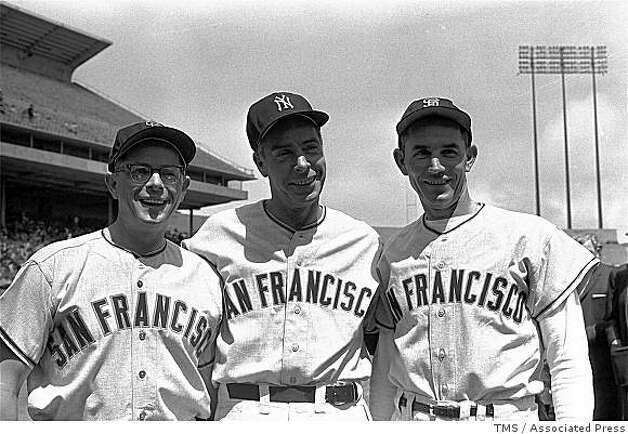
That photo at the top of this article shows the brothers at an old-timers' celebration at Candlestick Park in the 1960s -- all wearing Giants away uniforms so that they read "SAN FRANCISCO." That's Dom on the left, Joe in the center, Vince on the right. Joe is wearing a Yankee cap, the others Giants caps.

RF Harry Heilmann of Sacred Heart Cathedral H.S. in San Francisco. He was a really good hitter in even-numbered years: .356 in 1922, .346 in 1924, and .367 in 1926. But he must've been signing 2-year contracts that ended in odd-numbered years, because check these batting averages out: .394 in 1921, .403 in 1923, .393 in 1925, and .398 in 1927, all winning AL batting titles. Ty Cobb, his teammate on the Detroit Tigers from 1914 to 1926, must've had a good influence on him.

His lifetime batting average was .342, his OPS+ 148, 2,660 hits including 542 doubles and 151 triples. He played before uniform numbers were worn, but he is in the Hall of Fame. When The Sporting News announced its 100 Greatest Baseball Players in 1999, he came in at Number 54.

Honorable Mention to Harry Hooper of Santa Cruz, Santa Cruz County. Along with Duffy Lewis and Tris Speaker, he formed one of the greatest outfields of all time. He helped the Red Sox win World Series in 1912, 1915, 1916 and 1918. He had a 114 career OPS+, 2,466 hits, 389 doubles, 160 triples, and 375 stolen bases. He was often considered the best defensive right fielder of his era. Hall of Fame.

C Gus Triandos of Mission H.S. in San Francisco. The Yankees had Yogi Berra and Elston Howard, so it was no big deal to them to let him go in the same post-1954 trade that sent away Gene Woodling but brought in Bob Turley and Don Larsen.

But the trade worked out well for the Baltimore Orioles, who got a 3-time All-Star who hit 156 homers over the next 9 years, despite playing his home games at Memorial Stadium. His expertise helped build the first good Oriole pitching staff, enabling them to win 89 games and finish 2nd to the Yankees in 1960, the closest any Baltimore baseball team had gotten to a major league Pennant in 62 years. He was not only out of Baltimore but out of baseball by the time the Orioles won their first Pennant and World Series in 1966, but they wouldn't have gotten that far without his earlier efforts.

SP Vernon “Lefty” Gomez of Richmond H.S. in San Francisco. "He was fast with a quip and a pitch," says his Plaque at Monument Park at Yankee Stadium. One such quip was, "I'd rather be lucky than good." He was both.

He only had 10 full seasons, and his last good one was at age 32, but he was 189-102 for his career, and 6-0 in World Series play. He won 20 games 4 times, including a 26-5 record in 1934 -- no Yankee has matched, let alone topped, 26 wins since. (Two have reached 25: Whitey Ford 1961 and Ron Guidry in 1978. On the other New York teams, Don Newcombe won 27 in 1956, Carl Hubbell 26 in 1936 and Tom Seaver 25 in 1969.)

He was named to the 1st 7 All-Star Games and started the 1st 2 (both against Carl Hubbell). He was a member of 7 Pennant winners and 6 World Championships: 1932, '36, '37, '38, '39 and '41. Hall of Fame, and as I said, a Monument Park Plaque, although his Number 11 remains in circulation. When The Sporting News announced its 100 Greatest Baseball Players in 1999, he came in at Number 73.

SP Mike Garcia of Visalia, Tulare County, in the San Joaquin Valley. The Big Bear was twice a 20-game winner and twice an AL ERA champion for the Cleveland Indians. He only got into one game in their 1948 World Championship season, but in 1954 went 19-8 with a league-leading 2.48 ERA to help them win a League-record 111 games and the Pennant. He finished 142-97 with an ERA+ of 118.

SP Jim Maloney of Fresno. He was one of the fastest pitchers of all time. He was still finding his way when the Reds won the Pennant in 1961, but had 2 20-win seasons on his way to a career record of 131-84, with an ERA+ of 116 and 1,605 strikeouts. In 1965 he pitched a no-hitter for 10 innings, but lost it and the game in the 11th. So, later that season, he pitched another 10-inning no-hitter, and this time the Reds scored in the 10th and won it for him. He pitched a 3rd no-hitter (MLB doesn't give him credit for the first, even though he started and pitched 9 hitless innings) in 1969.

All that heat, and all those extra innings, must've taken their toll, because he was finished at 31, and was unable to pitch with the Big Red Machine of the 1970s, appearing in just 7 games for the Reds' 1970 Pennant winners before being traded.

Because his career ended early, and he didn't pitch in a major media market like Whitey Ford and Tom Seaver in New York, or Sandy Koufax and Don Drysdale in Los Angeles, or Juan Marichal in San Francisco, and he didn't appear in a bunch of World Series games like Ford and Seaver and Koufax and Drysdale and Bob Gibson, he gets forgotten. Still, the Reds have elected him to their team Hall of Fame, and he's the 2nd-best former Cincinnati pitcher in this rotation.

SP Tom Seaver of Fresno. Okay, we don't generally think of him for his 1977 to 1982 tenure with the Reds. For the Mets, he was The Franchise, the man who, more than any other except manager Gil Hodges, made them respectable, let alone 1969 World Champions. That year, the man who 2 years earlier had won the NL Rookie of the Year went 25-7 with a 2.21 ERA, and helped the Mets win the World Series -- ironically, he lost Game 1 before winning Game 4 with a gutsy 10-inning, 1-run effort.

In 1970, he tied what was then the record by striking out 19 batters against the San Diego Padres, including a still-record 10 in succession. He won Cy Young Awards in 1969, 1971 and 1975. He had 5 20-win seasons, probably missed a 6th due to the 1981 strike (he was 14-2), and probably missed 2 others because the Mets had hitting troubles. He led the NL in ERA 3 times (including a miniscule 1.76 in 1971) and strikeouts 5 times (his 283 in 1970 and 289 in 1971 are the 2 best totals in Met history, ahead of Dwight Gooden's 276 in 1984). He never pitched a no-hitter for the Mets (no one has, in 49 seasons), but in 1978 he pitched one for the Reds.

He struck out 3,640 batters, his 3,000th victim being another member of this team and a future Met legend, Keith Hernandez. He finished 311-205, his 300th victory coming in 1985 with the Chicago White Sox, against the Yankees at Yankee Stadium. I was there, and I still have the ticket to prove it. (I tried to donate it to the Hall of Fame. I wanted the honor of having something of mine in their displays. They graciously mailed it back, saying they had enough artifacts from that game and I should keep it for my collection.) He closed his career with the Red Sox in 1986, ironically facing the Mets in the World Series, although he was not on the active roster.

He was the 1st player generally associated with the Mets to be elected to the Hall of Fame, and the first Met player to have his number retired. (Although Hodges did finish his playing career with the Mets, his Number 14 is retired for what he did as a manager.) To this day, a generation of New York Tri-State Area natives can't see the Number 41, in any form, without thinking of "Tom Terrific." When The Sporting News announced its 100 Greatest Baseball Players in 1999, he came in at Number 32.

He's gone into broadcasting, written a few books about baseball, and returned to his native San Joaquin Valley to grow wine. When the Mets closed Shea Stadium in 2008 and opened Citi Field the next spring, he was the ideal person to throw the ceremonial pitches. You would have to go a long way to find a more class act than George Thomas Seaver, and probably no one in my lifetime has better handled the fame that has come from being a New York sports superstar.

Reggie Jackson, who opposed him in the 1973 World Series with the A's and served as a generation's touchstone for the Yankees the way Seaver did for the Mets, paid Seaver an unforgettable compliment: "Blind people come to the park just to listen to him pitch."
 
SP Mark Langston of Santa Clara. Three times he led the AL in strikeouts, but the Mariners didn't want to pay his salary, so they traded him -- to the Montreal Expos, for an as-yet-unknown Randy Johnson, among others. He went 12-9 as a rent-a-pitcher for the Expos, and then they let him get away to the Angels, whom he gave 8 seasons, becoming perhaps their 2nd-best starter ever after Nolan Ryan.

Although he grew up outside San Jose, and went to San Jose State University, he was born in San Diego, and helped his original-hometown Padres win the Pennant in 1998. He thought he had Tino Martinez struck out in Game 1, before giving up a tremendous grand slam. The Indians signed him afterward, thinking they were going to face the Yankees in the postseason again, and thinking, "The Yankees can't hit lefthanders, especially in the postseason." (This also didn't work the next few years with Chuck Finley.) Langston was 38 and done, but he did win 179 games and strike out 2,464 batters.

Honorable Mention to Gary Nolan of Oroville, Butte County. Only the 3rd-best former Cincinnati pitcher on this team, and like so many others, he got his career cut short by injury, throwing his last big-league pitch at age 29 and finishing at 110-70 with an ERA+ of 117. But he had more luck with the Reds than Maloney or Seaver, pitching on their 1970 and 1972 Pennant winners and their 1975 and 1976 World Champions, beating the Yankees in the clinching Game 4 in '76.

Honorable Mention to Mike Norris of Balboa H.S. in San Francisco. He went 22-9 for the A's in 1980, finishing 2nd to a 25-win Steve Stone of Baltimore in the Cy Young Award voting, as Billy Martin and his exciting young team saved Major League Baseball in the East Bay for at least another generation. In the strike-shortened 1981 season, Norris went 12-9 as the A's won the AL West.

But "Billyball" meant pitchers burned out quickly, and that, coupled with a cocaine addiction, led to Norris flaming out, and he was out of baseball after the 1983 season at age 28. He beat the coke, and tried 2 comebacks, and actually reached the A's again, making 14 relief appearances and going 1-0 for their 1990 Pennant winners.

RP Dave Righetti of San Jose. He came to the Yankees from the Texas Rangers in the post-1978 trade for Sparky Lyle. He was the AL Rookie of the Year in 1981, leading the League with a 2.05 ERA as the Yankees won the Pennant. He went 14-8 in 1983, including a July 4 no-hitter against the Red Sox.

But in 1984, the Yanks needed to replace Goose Gossage as their closer, and sent "Rags" to the bullpen. It seemed to work, including 46 saves in 1986, a major league record that stood for 4 years, a lefties' record that stood for 7, and still an AL record for lefties. He made 2 All-Star teams, and was the first pitcher ever to both pitch a no-hitter and lead a league in saves, and only Dennis Eckersley has joined him since.

But the Yanks never reached the postseason with him again, and after the team crashed to last place in 1990, he signed as a free agent with his "hometown" Giants. At 31, he never had another good season. But he did save 252 games in his career, and win 82 others, compiling an ERA+ of 114. Since 2000, he has been the Giants' pitching coach.

Honorable Mention to John Wetteland of Santa Rosa, Sonoma County. If you're the general manager of the Los Angeles Dodgers, be glad the Montreal Expos no longer exist, because at almost the same time, they traded both Wetteland and Pedro Martinez to the Expos, and both were big mistakes. In 1994, the Expos had the best record in baseball when the strike hit, and he and Pedro were 2 big reasons why.

In the offseason, deciding they couldn't afford to keep him, the Expos traded him to the Yankees for Fernando Seguignol and cash. Who? Never mind, the key part of the deal was the cash. Wetteland helped the Yanks back into the postseason in 1995, and in 1996 he saved 43 games, including 7 in the postseason -- including all 4 World Series wins, and he was named Series MVP.

But with Mariano Rivera ready to graduate from setup man to closer, the Yanks let him go via free agency. He signed with the Rangers, and gave them 4 strong seasons, including AL West titles in 1998 and '99, before retiring at age 33, despite not being injured. I guess he'd had enough. He saved 330 games, including more than any other pitcher in the 1990s and more than any other pitcher in Rangers history. He is a member of the Rangers' team Hall of Fame.

Tuesday, July 2, 2013

July 6, 1933: The 1st Major League Baseball All-Star Game

July 6, 1933, 80 years ago: The first All-Star Game in what would later be called Major League Baseball is held, at Comiskey Park in Chicago, home of the White Sox.

There had been baseball games with "all-star teams" before, usually as benefits for indigent former players, or for the families of players who fell victim to untimely deaths. The most notable of these was in Cleveland in 1911, for the family of the late Indians pitcher Addie Joss. But this was the first one sanctioned by official baseball.

The idea came from Arch Ward, the sports editor of the Chicago Tribune. Chicago had been incorporated as a city in 1833, 100 years before, and was hosting the Century of Progress World's Fair on the South Side. Mayor Edward J. Kelly had talked to Ward about the Tribune sponsoring a sporting event in connection with the Fair.

Since the Tribune Company owned a vast media network, including radio station WGN (named for what the Tribune liked to call itself, "The World's Greatest Newspaper") and, at the time, the New York Daily News, Ward saw to it that the 55 newspapers the Company owned printed ballots for fans to use to select the players for what he called "The Game of the Century."

The players were chosen. And so, on July 6, at Comiskey Park (larger than Wrigley Field on the North Side, home of the Chicago Cubs), the game was played.

The managers were Connie Mack of the Philadelphia Athletics, already the winningest manager of all time, for the American League team; and, for the National League team, John McGraw, who had retired as manager of the New York Giants the previous season, due to ill health. (He died the following Winter.) In 1937, after the establishment of the Baseball Hall of Fame, they would become the 1st 2 managers elected to it.

The American League All-Stars wore their regular team uniforms: 

* From the New York Yankees: Right fielder Babe Ruth, 1st baseman Lou Gehrig, left fielder Ben Chapman, pitcher Lefty Gomez, all starters; catcher Bill Dickey, 2nd baseman Tony Lazzeri.

* From the host Chicago White Sox: Starting center fielder Al Simmons, starting 3rd baseman Jimmy Dykes.

* From the Boston Red Sox: Starting catcher Rick Ferrell.

* From the Cleveland Indians: Pitchers Wes Ferrell (Rick's brother) and Oral Hildebrand, and outfielder Earl Averill.

* From the Detroit Tigers: Starting 2nd baseman Charlie Gehringer.

* From the Philadelphia Athletics: Pitcher Robert "Lefty" Grove and 1st baseman Jimmie Foxx.

* From the St. Louis Browns: Outfielder Sam West.

* From the Washington Senators: Starting shortstop Joe Cronin and pitcher Alvin "General" Crowder.

The National League All-Stars wore special uniforms for the game, saying, "NATIONAL LEAGUE," which they haven't done since:

* From the New York Giants: Starting 1st baseman Bill Terry, pitcher Carl Hubbell, pitcher Hal Schumacher, and outfielder Francis "Lefty" O'Doul.

* From the Brooklyn Dodgers: 2nd baseman Tony Cuccinello.

* From the Boston Braves: Starting center fielder Wally Berger.

* From the Chicago Cubs: Catcher Charles "Gabby" Hartnett, pitcher Lon Warneke, shortstop Woody English.

* From the Cincinnati Reds: Starting left fielder Charles "Chick" Hafey.

* From the Philadelphia Phillies: Starting right fielder Chuck Klein, starting shortstop Dick Bartell.

* From the Pittsburgh Pirates: 3rd baseman Hal "Pie" Traynor and outfielder Paul Waner.

* From the St. Louis Cardinals, all starters: Picher Bill Hallahan, catcher Jimmie Wilson, 2nd baseman Frankie Frisch and 3rd baseman John "Pepper" Martin.
The AL had 11 players go to the Hall of Fame: Ruth, Gehrig, Gomez, Dickey, Lazzeri, Simmons, Rick Ferrell, Gehringer, Grove, Foxx and Cronin. The NL had 8: Terry, Hubbell, Hartnett, Hafey, Klein, Traynor, Waner and Frisch. Total, 19.

The AL contributed umpires Bill Dinneen behind home plate and Bill McGowan at 2nd base; the NL, Bill Klem at 1st base and Cy Rigler at 3rd base. McGowan and Klem would be elected to the Hall of Fame.

A crowd of 47,595 paid to see the game. Graham McNamee and Hal Totten broadcast it on radio for NBC, and Pat Flanagan and Johnny O'Hara did so for CBS.

Top of the 1st inning: Martin grounded out to short. Frisch did the same. Klein lined out to short, so a busy inning for Cronin.

Bottom of the 1st: Chapman grounded to 3rd. Gehringer walked. Gehringer stole 2nd. Ruth was called out on strikes. Gehrig grounded out, 1st to pitcher.

Top of the 2nd: Hafey grounded to 2nd, and Gehringer, normally so sure a fielder that he was known as "The Mechanical Man," couldn't get a throw off in time, and Hafey had the game's 1st hit. Terry singled to left. Berger grounded to 3rd, and Dykes stepped on 3rd for the 1st out. He threw to 2nd, and Terry was out. But the triple play could not be completed. Bartell struck out swinging. Game still scoreless.

Bottom of the 2nd: Simmons flied to left. Dykes drew a walk. Cronin did the same. Ferrell flied to right. Gomez singles to center, scoring Dykes. This was a amazing, as Gomez was a notoriously poor hitter even by pitchers' standards. Late in life, he joked that he never broke a bat until he was 73 years old, and that was from backing the car out of the garage. Chapman grounded to short, causing a force play that eliminated Gomez at 2nd. AL 1, NL 0.

Top of the 3rd: Wilson grounded to 3rd. Hallahan flied to center. Martin popped to short.

Bottom of the 3rd: Gehringer walked. Ruth hit a home run, and it was fitting that he hit the 1st home run in All-Star Game history. Gehrig walked. Hallahan was removed, replaced by Warneke. Simmons grounded to short, for a double play. Dykes singled to left. Cronin flied to center. AL 3, NL 0.

Top of the 4th: Gomez out as pitcher, Crowder in. Frisch lined to center. Klein grounded to 1st, unassisted. Hafey hit a foul pop to 3rd.

Bottom of the 4th: Ferrell flied to right. Crowder grounded to 2nd. Chapman grounded to 3rd. AL 3, NL 0.

Top of the 5th: Terry grounded to 2nd. Berger grounded to short. Bartell hit a foul pop behind 1st, but Gehrig dropped it. Bartell hit another such pop, and, this time, Gehrig caught it.

Bottom of the 5th: Up until this point, American League baseballs were being used in the game. The switch was made to National League baseballs. Gehringer flied to center. Ruth singled to center. Gehrig struck out. Simmons singled to left. Dykes grounded to 2nd, for a force play that eliminated Simmons. AL 3, NL 0.

Top of the 6th: O'Doul batted for Wilson, and grounded to 2nd. Warneke tripled to right. Martin grounded to 3rd, and Warneke scored on the play. Frisch hit a home run. Klein singled. Hafey grounded to 3rd. AL 3, NL 2.

Bottom of the 6th: Hartnett now catching. Cronin singled to center. Ferrell bunted Cronin over to 2nd, 1st to 2nd. Averill batted for Crowder, and singled to center, scoring Cronin. Chapman bunted to 3rd and beat it out. Gehringer flied to right. AL 4, NL 2.

Top of the 7. Grove pitching. Terry singled to left. Berger grounded to short, forcing out Terry. Traynor batted for Bartell, and doubled to center. Hartnett struck out. English batted for Warneke, and flied to center. AL 4, NL 2.

Bottom of the 7th. English playing at short. Hubbell pitching. Gehrig walked. Simmons grounded to 3rd, for a force play that eliminated Gehrig. Dykes singled to left. Cronin hit a foul popup to 1st. Ferrell grounded to 2nd. AL 4, NL 2.

Top of the 8th: Martin was called out on strikes. Frisch beat out a grounder to 1st. Klein flied to center. Hafey hit one deep to right, but Ruth reached over the top of the wall to catch it. Had there been ESPN at the time, we would have spent the next 80 years talking about how Ruth was a great fielder, as well as the greatest hitter who ever lived.

Bottom of the 8th: Waner moved to right field. Grove grounded to 1st, unassisted. Chapman struck out. Gehringer lined to center. AL 4, NL 2.

Top of the 9th. Ruth came out of the game. Chapman moved to right. Simmons moved to left. West went to center. Terry grounded to 2nd. Berger lined to right. Cuccinello batted for Hubbell, and struck out swinging.

Ballgame over. The American League wins, 4-2. For the AL: 4 runs, 9 hits, 1 error, and 10 men left on base. For the NL: 2 runs, 8 hits, they played errorless baseball, and left 5 on base.

The game was such a success that Commissioner Kenesaw Mountain Landis decided to make it an annual event. Since the Fair was scheduled for a 2nd year in 1934, Ward came up with another idea: The Chicago College All-Star Game, in which the best college football players of the previous season would face the defending NFL Champions at Soldier Field in Chicago. Since the defending Champions were the Chicago Bears, it was relatively easy. That tradition ended in 1976, but "the Midsummer Classic" continues.

Woody English was the last surviving player from this game, living until 1997, 64 years later.