Showing posts with label university of oklahoma. Show all posts

Monday, November 5, 2018

How to Go to the Oklahoma-Oklahoma State "Bedlam" Game

This coming Saturday, a football game known as "Bedlam" will be played: Oklahoma vs. Oklahoma State. It will be held on the OU campus in Norman.

The name comes from a shortening of Bethlem Royal Hospital, in Southeast London, the most notorious psychiatric hospital of the Victorian Age. "Bedlam" became a term meaning "uproar" or "confusion."

Before You Go. Oklahoma is part of the Great Plains region. There aren't a lot of trees to shade you or to block the wind. As a result, it gets beastly hot in the summer, and brutally cold in the winter. This will be late November, so cold could have been expected.

However, the website for The Daily Oklahoman is predicting low 50s for Saturday afternoon, and mid-30s for Friday night. So you should bring a Winter jacket.

The entire State of Oklahoma, except for the westernmost Panhandle, which is on Mountain Time -- is in the Central Time Zone, 1 hour behind New York. Adjust your timepieces accordingly.

Tickets. The Sooners get at least 86,000 every home game. The Cowboys are less likely to sell out their 60,000 seats, with only 1 of their 6 home games so far topping 55,000. But this game will sell out.

For games at Oklahoma: All tickets are $55. Oklahoma State, not a longtime college football power like their rivals, charges a lot more: $87.

Getting There. It's 1,469 miles from Midtown Manhattan to Gaylord Family Oklahoma Memorial Stadium in Norman, and 1,415 miles to T. Boone Pickens Stadium in Stillwater. Knowing this, your first reaction is going to be to want to fly.

You won't get a nonstop flight. There are any number of cities in which you would have to change planes, depending on the airline: Charlotte, Chicago, Dallas, for example. And, this week, it's kind of an expensive flight: over $1,000 at the minimum. And you'd still have to get from there to Norman or Stillwater. Still, flying to Oklahoma City's Will Rogers World Airport and renting a car is still the best options here.

Especially since neither Amtrak nor Greyhound goes to Stillwater. On Amtrak, to get to Norman, you'd have to change trains in Chicago and again in Fort Worth, and you'd still have to get from OKC to Norman.

On Greyhound, the trip to Norman is much shorter, about 40 hours, but you have to transfer at Chicago, Kansas City and Oklahoma City. The fare is $512, but can drop to $343 with advanced purchase. 506 N. Porter Avenue, about a mile north of the campus.

If you decide to drive, it's far enough that it will help to get someone to go with you and split the duties, and to trade off driving and sleeping. You'll need to get on the New Jersey Turnpike, and take Interstate 78 West across New Jersey, and at Harrisburg get on the Pennsylvania Turnpike, which at this point will be both I-70 and I-76. When the two Interstates split outside Pittsburgh, stay on I-70 west. You'll cross the northern tip of West Virginia, and go all the way across Ohio (through Columbus), Indiana (through Indianapolis) and Illinois.

When you cross into Missouri, you'll be in St. Louis. Switch to Interstate 44 West, the Will Rogers Turnpike, and take that across southern Missouri and northeastern Oklahoma. Outside Edmond, you'll turn onto Interstate 35 South, passing Oklahoma City, then take Exit 108 A onto State Route 9. The campus is 3 miles ahead on your left.

If you do it right, you should spend about an hour and 15 minutes in New Jersey, 5 hours in Pennsylvania, 15 minutes in West Virginia, 3 hours and 45 minutes in Ohio, 2 hours and 30 minutes in Indiana, 2 hours and 30 minutes in Illinois, 5 hours in Missouri, and 4 hours in Oklahoma before arriving. That's going to be about 24 hours. Counting rest stops, preferably 6 of them, and accounting for traffic at both ends, it should be about 30 hours.

The trip to Stillwater is a little shorter. On I-44, you'll take Exit 34, onto I-244 West toward Tulsa. U.S. Route 412, the Cimarron Turnpike, will split off from I-244, and you'll take that west to the Cimarron Turnpike Spur, and that west to Exit 20A, U.S. Route 177 South. That will take you to the OSU campus. The trip should take an hour less than to Norman.

Once In the City. Oklahoma was not yet a State at the time of the American Civil War, and thus did not secede, although, could it have, it likely would have. It was admitted to the Union as the 46th State on November 16, 1907.

Oklahoma City, the capital of the State of Oklahoma, was founded in 1889 as a result of the Oklahoma land rush, after the former Indian Territory was legally (if not morally) opened up to white settlers. (As a result, their minor-league baseball team was long called the 89ers.) The name comes from the Choctaw tribe, meaning "red people."
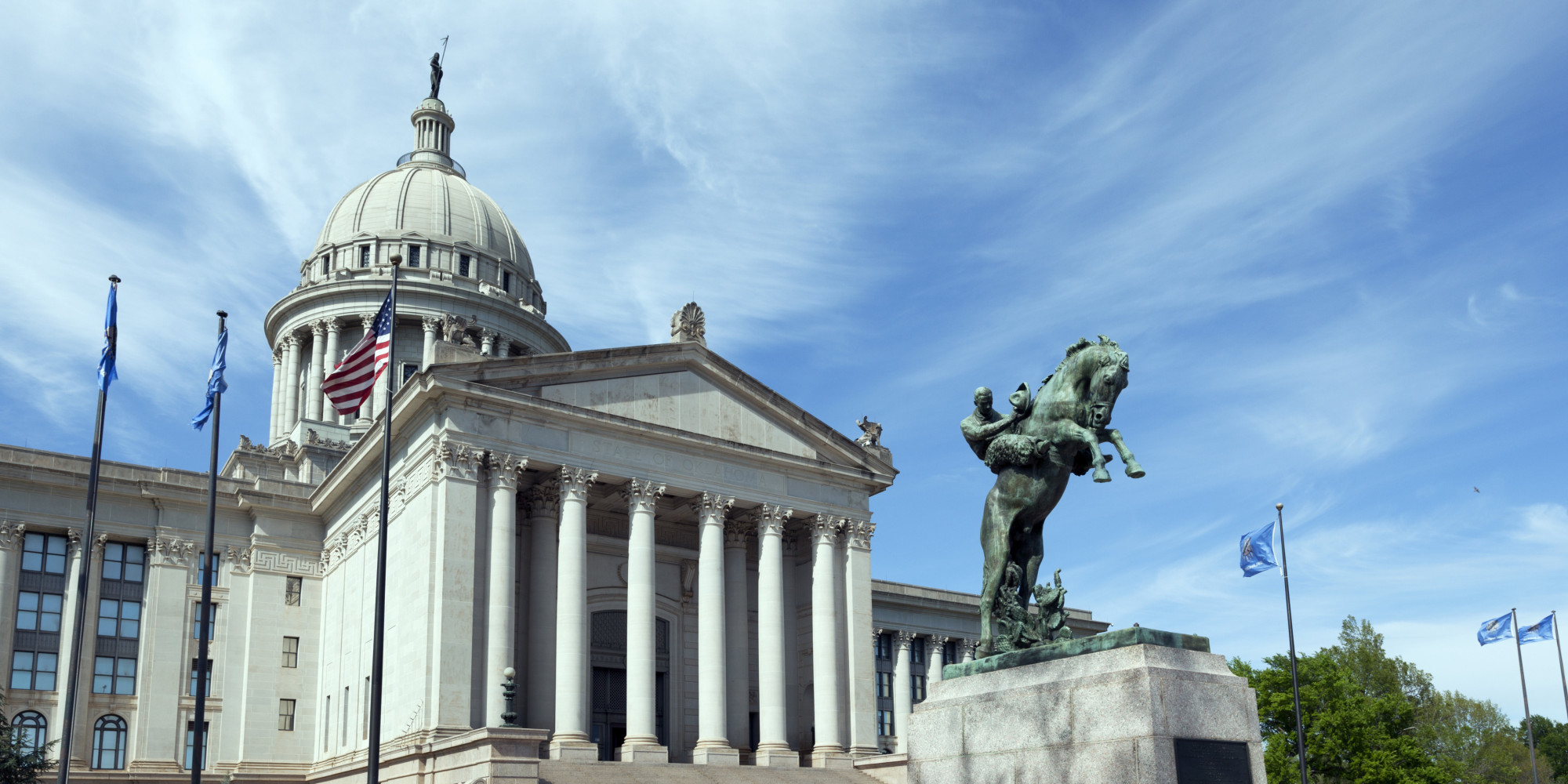
The State House. The statue is called Tribute to Range Riders,
and does not represent any particular person.

The sales tax in the State of Oklahoma is 4.5 percent. ZIP Codes for Oklahoma start with the digits 73 and 74. For Norman, it's 730; for Stillwater, 740. The Area Code for Oklahoma City, Norman and Stillwater is 405. Oklahoma Gas & Electric (OG&E) runs the electricity for the State.

ZIP Codes for Oklahoma start with the digits 73 and 74. For Oklahoma City, 731. For Norman, 730. The Area Codes are 405 for Oklahoma City and Norman. The sales tax is 4.5 percent.
Oklahoma City is a decent-sized city, with about 630,000 people, but the metropolitan area is small, just 1.3 million. Norman, included in that, was founded in 1891, named for the area's initial land surveyor, Abner Norman, and has about 125,000. It is served by The Daily Oklahoman and The Norman Transcript.
Cleveland Area Rapid Transit (Norman is in Cleveland County) runs Norman's buses. The fare is cheap: 75 cents. Jones Avenue divides addresses into East and West, Main Street into North and South.
Main Street, Downtown Norman

Stillwater was founded in 1884, and was named for a creek that the native tribes called "Still Water." About 50,000 people live there. The daily newspaper is the NewsPress -- not a very imaginative name, and the result of a merger of 2 papers. Main Street divides addresses into East and West, and Elm Avenue into North and South. OSU/Stillwater Community Transit System runs buses, also with a fare of 75 cents.
Main Street, a.k.a. The Strip, Downtown Stillwater

Norman is about 81 percent white, 6 percent Hispanic, 5 percent Native American, 4 percent black and 4 percent Asian. Stillwater is roughly the same: About 80 percent white, 6 percent Asian, 5 percent black, 5 percent Hispanic and 4 percent Native American. Neither Norman nor Stillwater has a "beltway."

Oklahoma's darkest hour came on May 31, 1921, when mobs of White residents, some of them deputized and given weapons by city officials, attacked Black residents and destroyed homes and businesses of the Greenwood District in Tulsa, Oklahoma. The attacks burned and destroyed more than 35 square blocks of the neighborhood – at the time one of the wealthiest Black communities in the United States, known as "Black Wall Street." As many as 300 people were killed.

The University of Oklahoma was founded in 1890, right after the Land Rush. Notable athletes, other than the football players to be mentioned later, include:

* Baseball: Joe Simpson, Mickey Hatcher, Bobby Witt and Russ Ortiz. Also broadcaster Russ Porter.

* Basketball: Terry Stotts, Clifford Ray, Wayman Tisdale, Mookie Blaylock, Stacey King and Blake Griffin. Also Oklahoma City Thunder owner Clay Bennett.

* Olympians: Gymnast Bart Conner (who married legendary gymnast Nadia Comaneci), gymnast Kelly Garrison-Funderburk, sprinter Jason Rouser, wrestlers Dave and Mark Schultz (but this Dave Schultz is not to be confused with the 1970s Philadelphia Flyers goon).

* Sports Journalism: Larry Merchant.

Notable OU graduates in other fields:

* Entertainment: Actors Van Heflin, Rance Howard (father of Ron and Clint, grandfather of Bryce Dallas), Dennis Weaver, James Garner, Alice Ghostley, Larry Drake, Ed Harris and Olivia Munn; music personalities David Gates of Bread and Tom Paxton, Science fiction author C.J. Cherryh, and Miss America 2006 Jennifer Berry.

* Politics, representing Oklahoma unless otherwise stated: Governors David Hall, David Boren, David Walters, Frank Keating, Brad Henry, and Susana Martinez of New Mexico; Senators Boren (his son Dan Boren served in the House) and Tom Coburn; Speaker of the House Carl Albert, House Majority Leader Dick Armey, Congressman and former OU quarterback J.C. Watts, and current Oklahoma City Mayor Mick Cornett. And, both as a student and a law professor at OU, Anita Hill.

* Astronauts: Fred Haise of Apollo 13, and record-setting (since broken) Shannon Lucid.

Oklahoma State University was also founded in 1890, on Christmas Day, no less. It was known as Oklahoma A&M until 1958. Auburn and Mississippi State also had the "A&M" name early in their histories, and, like OSU, their teams are sometimes still called the "Aggies" to this day, even though Texas A&M is the only major college football school that officially uses that name.

Aside from football players to be mentioned later, their notable athletes include:

* Baseball: Yankee Legend Allie Reynolds (for whom their baseball complex is named), Jerry Adair, Joe Horlen, former Yankee Gary Ward, Pete Incaviglia, Mickey Tettleton, former Met and then Yankee Robin Ventura, Jeromy Burnitz, Matt Holliday, former Boston Red Sox manager John Farrell, Josh Fields, Luke Scott.

* Basketball: Bob Kurland, Knicks star John Starks, Bryant "Big Country" Reeves, John Lucas III, Marcus Smart, and college basketball coaching legends Don Haskins, Eddie Sutton and Bill Self.

In basketball, OU has won the Conference 14 times, most recently in 2005; won the Conference Tournament 7 times, most recently in 2003; won both in the same season (which soccer fans would call "The Double") 3 times, most recently in 1988; reached the Final Four 5 times, in 1939, 1947, 1988, 2002 and 2016; and lost the Final in 1947 to Holy Cross and 1988 to Kansas. Their women's team reached the Final in 2002, and has also made the Final Four in 2009 and 2010. Their baseball team won the College World Series in 1951 and 1994.

OSU has the more successful basketball program, winning the National Championship under coach Henry Iba in 1945 and 1946, with Kurland, known as "Foothills" and "the first great big man in basketball." They also reached the Final in 1949, losing to Kentucky; and also reached the Final Four in 1951, 1995 and 2004, for a total of 6. They've won 19 Conference Championships, most recently in 2004; 4 Conference Tournaments, most recently in 2005; and won both in 2004. Their women's team has been less successful, although they did win the Conference in both the regular season and the tournament in 1991.

What Oklahoma State is really known for is its wrestling program, led by coach Edward C. Gallagher from 1916 until his death in 1940. He went 138-5-4. In his 24 seasons, 19 ended undefeated in dual meets, and 11 ended with National Championships. In spite of all of Iba's successes in his sport, OSU's indoor sports facility is named Gallagher-Iba Arena. That's right: Gallagher has top billing.

Oklahoma State has won wrestling's National Championship a record 34 times -- 7 times since Dan Gable began coaching at Iowa, which may actually be more impressive than the previous 27. Indeed, the National Wrestling Hall of Fame -- and the WWE doesn't have a dang thing to do with it -- is at 405 W. Hall of Fame Avenue, across from the northeast corner of Pickens Stadium and Gallagher-Iba Arena. Their last title was in 2006, but that capped a streak of 4 straight. Their current head coach is John Smith, who won 2 Olympic Gold Medals after wrestling at OSU.

Going In. Oklahoma's stadium opened in 1923, as Oklahoma Memorial Stadium. The coach was Bennie Owen, and the playing surface was named Owen Field. Since so many major colleges had named their facilities "Memorial Stadium" (since so many had been built in the 1920s, in the aftermath of World War I), "Owen Field" became the most familiar name for the Sooners' place. It is also nicknamed The Palace On the Prairie.
In 2002, it was renamed Gaylord Family Oklahoma Memorial Stadium, after the Gaylords, the owners and publishers of The Daily Oklahoman, collectively donated $50 million to the University.

The address is 180 E. Brooks Street, a mile south of downtown. Bus 24. If you drive in, parking is a whopping $46.
Formerly a horseshoe with the south end open, it has now been fully enclosed, including their a ginormous scoreboard, clearly designed to compare with the one at rival Texas. The field was artificial from 1970 to 1993, but has been real grass again since 1994.

The stadium seated 16,000 when it opened, and was expanded to 32,000 in 1929, 55,000 in 1949 following the initial success under Bud Wilkinson, 61,000 in 1957, 71,000 in 1975, 75,000 in 1984, 81,000 in 2003, and the current 86,112 in 2016. The Sooners allow their stadium to be used for other purposes, including concerts.
September 17, 2016. Ohio State visited.
That's their band in the process of doing "Script Ohio."

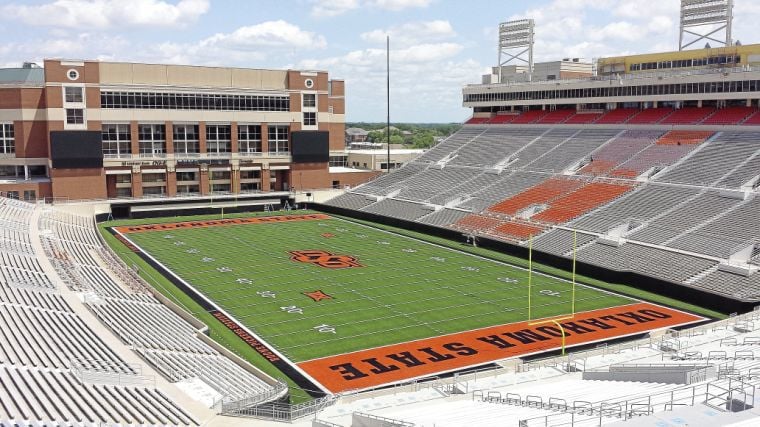
Oklahoma State's stadium stands at 700 West Hall of Fame Avenue, a half-mile southwest of downtown. If you drive in, parking is $13.
With Gallagher-Iba Arena in the open east end zone

It is the oldest stadium in the Big 12 Conference, having opened in 1920 as Lewis Field, after Dr. Laymon Lewis, a veterinarian who was also the school's popular dean of literature and science. In 2003, it was renamed T. Boone Pickens Stadium, or "The Boone," for the OSU grad and Texas oilman who donated $165 million to the school's athletic department, which provided for the building of the west end zone and, among other things, new facilities for soccer, tennis, track, and the new baseball stadium set to open in 2020 (which, I hope, will also be named for Allie Reynolds).

The stadium seated just 8,000 at the time, but grew to 13,000 in 1930, 30,000 in 1947, 39,000 in 1950, 50,000 in 1972, and 60,000 in 2008. The field has been artificial turf since 1972, and, oddly, runs east-to-west, usually a problem because of the path of the Sun.
Food. Oklahoma's Gaylord Stadium has Bavarian pretzels with cheese, Sooner Street Tacos, Mackdaddy's Onion Burgers, and Billy Sims Barbecue stands. The Heisman winner runs restaurants and markets his sauce to supermarkets.

Oklahoma State's Pickens Stadium includes such brands as Pizza Hut, Chick-fil-A, Thai Loco, and Zaxby's coffee. Given Boone Pickens' political prediletions, I'm not surprised there's Chick-fil-A, although, if there was going to be pizza, I would have expected it to be Papa John's.

Team History Displays. Oklahoma is one of the defining programs in college football. Oklahoma State is... not. Not even close. They aren't a terrible program, but comparing them to Oklahoma is like comparing a perennially underachieving baseball team to the old Yankee Dynasty.

The Sooners display their titles on the press box at Gaylord/Memorial/Owen. They've won National Championships in 1950, 1955, 1956, 1974, 1975, 1985 and 2000, as certified by either the AP, UPI, or the BCS. There are other titles, awarded by less authoritative agencies, that they do not claim.

They won the Southwest Conference title in 1915 and 1918; the league that would eventually be known as the Big 8 in 1920 (as the Missouri Valley), 1938, 1943, 1944, 1946, 1947 (these as the Big 6), 1948, 1949, 1950, 1951, 1952, 1953, 1954, 1955, 1956, 1957 (these as the Big 7), 1958, 1959, 1962, 1967, 1968, 1972, 1973, 1974, 1975, 1976, 1977, 1978, 1979, 1980, 1984, 1985, 1986 and 1987; and the Big 12 in 2000, 2002, 2004, 2006, 2007, 2008, 2010, 2012, 2015, 2016 and 2017. So that's 47 titles: 2 in the SWC, 34 in the Big 8, and 11 in the Big 12. In addition, they won the Big 12 South Division, but lost the Championship Game, in 2003.
Oklahoma is the only school to have 4 coaches with at least 100 wins at the school: Bennie Owen (1905-26), Charles Burnham "Bud" Wilkinson (1947-63), Barry Switzer (1973-88) and Bob Stoops (1999-2016). Included among Wilkinson's 145 wins was a 47-game unbeaten streak -- a tie, and then 46 straight wins. Led by running back Tommy McDonald and center-linebacker Jerry Tubbs, from 1953 to 1957 the Sooners avoided defeat in 47 straight games, and that's still a college football record. Both the last team and the next team to beat them was Notre Dame.

Owen and Wilkinson have statues outside the stadium. So do the school's 1st 5 Heisman Trophy winners: 1952 running back Billy Vessels (whose pro career was cut short by injury), 1969 running back Steve Owens (played 5 years with the Detroit Lions), 1978 running back Billy Sims (was headed for a Hall of Fame career with the Lions before a knee injury ended it in his 5th season), 2003 quarterback Jason White (the only Heisman winner ever willing to turn pro and still not be drafted, due to concerns over his knees, and he has since gotten rich in retail), and 2008 quarterback Sam Bradford (cut by the Arizona Cardinals over this past weekend). Presumably, a statue will be added for their 6th Heisman winner, 2017 honoree Baker Mayfield, now the quarterback of the Cleveland Browns.
Wilkinson's statue

Like USC, the Sooners have specialized in running backs. In addition to Vessels, Owens and Sims, they include Greg Pruitt (1970s Cleveland Browns), Joe Washington (1970s Baltimore Colts and 1980s Washington Redskins) and Adrian Peterson (2010s Minnesota Vikings, now with the Redskins).

Other Sooner football stars include Tommy McDonald (Hall of Fame receiver for the 1950s Philadelphia Eagles), Bob Kalsu (Buffalo Bills linebacker killed in action in Vietnam), Lee Roy Selmon (Hall of Fame defensive tackle for the Tampa Bay Buccaneers, who played on OU's defensive line with his brothers Dewey and Lucius), Brian Bosworth (controversial 1980s linebacker who went into action movies), and Tony Casillas (defensive tackle for the 1990s Dallas Cowboys). However, the Sooners do not retire uniform numbers, so even Sims' 20 is still available.

Darrell Royal, legendary coach of rival Texas, was a quarterback at Oklahoma under Wilkinson. Wilkinson also tried to recruit Mickey Mantle as a halfback and Bobby Murcer as a quarterback, but, knowing that baseball then paid more than football, both of them signed with the Yankees. Pat Bowlen, owner of the Denver Broncos since 1984, is also an Oklahoma graduate.

Oklahoma has won 29 bowl games, including the Orange Bowl (once with an automatic bid to the Big 8 Champions) in 1954, 1956, 1958, 1959, 1968, 1976, 1979, 1980, 1981, 1986, 1987 and 2001 (and denied for 1955 and 1957, due to a rule, soon changed, that prohibited back-to-back appearances); the Sugar Bowl in 1949, 1950, 1972, 1973, 2014 and 2017; the Fiesta Bowl in 1976 and 2011; the Cotton Bowl in 2002; and the Rose Bowl in 2003.

Oklahoma is 1 of 5 schools to have won all 5 major bowls, achieving it in 2011. The others: Notre Dame in 1989, Penn State in 1995, Ohio State in 1999 and Texas in 2004.

Oklahoma State claims the 1945 National Championship, and put a display of it on a wall at Pickens Stadium. Had this title been awarded by the Associated Press (AP, the sportswriters' poll) or United Press International (UPI, the coaches' poll), it would have made the school, then known as Oklahoma A&M, the 1st school to win National Championships in both baseball and football in the same calendar year (1945), and the 1st to do it in the same schoolyear (1945-46).

Neither poll recognized them as such, giving it to Army, and the achievements in question have only been done by 1 school, Florida, in 2006 and 2006-07, respectively.
It's not worth the Army's time to remove it.

But they have won 10 Conference Championships: In 1926, 1930, 1932, 1933, 1944, 1945, 1948, 1953, 1976 and 2011. They've won 18 out of 28 bowl games, including the 1944 and 2013 Cotton Bowls, the 1945 and 2015 Sugar Bowls, and the 1974 and 2011 Fiesta Bowls.

The greatest of all OSU football players is 1988 Heisman Trophy winner Barry Sanders. He and Thurman Thomas were teammates for a couple of years, and both are in the Pro Football Hall of Fame. However, OSU does not retire uniform numbers, not even Sanders' 21 (20 in the pros) or Thomas' 34.

Other Cowboy legends (OSU, not necessarily Dallas) include former Dallas receivers Walt Garrison and Dez Bryant, early New York Giant offensive lineman Bill Owen, Philadelphia Eagles center Sonny Keys, Jets Super Bowl kicker Jim Turner, Jets and Chicago Bears defensive coordinator Buddy Ryan, Cleveland Browns offensive tackle Jerry Sherk, Washington Redskins defensive tackle Dexter Manley, San Diego Chargers and Kansas City Chiefs defensive end Leslie O'Neal, Pittsburgh Steelers linebacker Jason Gildon, Indianapolis Colts guard Charlie Johnson, defensive tackles Jamal Williams of the Chargers and Kevin Williams of the Minnesota Vikings (not related), Denver Broncos defensive end Antonio Smith, Houston Texans quarterback Brandon Weeden, and 1980s quarterback, now head coach, Mike Gundy. He was a good quarterback. Now, he's a good coach! He's a man! He's 51!

The "Bedlam Series" between the Sooners and the Cowboys was first played on November 6, 1904, in Guthrie, Oklahoma. The Sooners won 75-0. No, that's not a misprint: Seventy-five to nothing. The game has been played every season since 1910, and is one of the most lopsided major college football rivalries: The Sooners lead it 87-18-7. Oklahoma A&M/State have won only in 1917, 1924, 1927, 1930, 1932, 1933, 1944, 1945, 1965, 1966, 1976, 1995, 1997, 1998, 2001, 2002, 2011 and 2014. (UPDATE: Through the 2019 season, make it 89-18-7.)

OU won 19 straight from 1946 to 1964, roughly the Bud Wilkinson era. They went 17-0-1 from 1977 to 1994, roughly the Barry Switzer era. How rough has it been for OSU? Since 2004, in 6 of these games, they've scored at least 35 points, and only won 1 of them. In 4 of them, they've scored at least 41 points, and won none. They scored 48 in 2012 and 52 last year, and lost both.

Ask a Sooner fan, and you'll hear that the Cowboys aren't their biggest rivals, the Texas Longhorns are. It's like Yankee Fans: Sooner fans pity the Cowboys like we do the Mets, but they hate Longhorns like we hate the Red Sox.

The Oklahoma-Texas game has several nicknames: The Red River Showdown (the Red River separates the States), the Red River Rivalry, the Red River Classic and the Red River Shootout. It's been played on neutral ground in Dallas every season since 1929. Texas leads the rivalry 61-45-5.

For many years, Oklahoma's biggest rivalry was with Nebraska, as the 2 schools dominated the Big 8 in the 1960s, '70s and '80s. Oklahoma leads, They first played in 1912, and played every year from 1928 to 1997. But changing conference lineups ended that. They played each other in the Big 12 Championship Game in 2006 and 2010 (Oklahoma won both times). But with Nebraska now in the Big 10, the game becomes even rarer. The schools recently signed a deal to play each other in 2021 and 2022 (home-and-home). The Sooners lead the Cornhuskers, 45-38-3.

Stuff. OU has a large team store under the north end of the stadium. The University of Oklahoma Bookstore is at 1185 Asp Avenue (yes, Asp like the snake), just outside Memorial Stadium's west stand. OSU has a Spirit Merchandise store at their stadium, and their University Store is at the Student Union, 3 blocks south of the stadium.

Ray Dozier wrote Legends of Oklahoma Sooners Football in 2014. Bud Wilkinson: An Intimate Portrait of an American Legend was published in 1994, shortly after he died, by his son Jay Wilkinson and businesswoman Gretchen Hirsch. Jim Dent, author of several books on college football, wrote The Undefeated: The Oklahoma Sooners and the Greatest Winning Streak in College Football in 2001. The DVD The History of Oklahoma Football came out in 2010.

Oklahoma State football books are far fewer. Pat Jones and Jimmie Tramel published Tales from Oklahoma State Football in 2007. The following year, the DVD The Legends of Oklahoma State was released.

During the Game. As with any college football game where you're a neutral, particularly in the South, stick with one team or the other, and leave the other team's fans alone, and you should be okay.

The Oklahoma Land Rush of 1889 inspired the title of the OU fight song, "Boomer Sooner." The music was swiped from Yale's "Boola Boola," and they also swiped an idea from North Carolina's "I'm a Tar Heel Born."

The Pride of Oklahoma Marching Band also plays the theme from the Rodgers & Hammerstein musical Oklahoma! (naturally), Gioachino Rossini's "William Tell Overture" (probably because it reminds people of the Lone Ranger, except he had been a Texas Ranger), Neil Diamond's "Sweet Caroline," Three Dog Night's "Never Been to Spain" (because the song's composer, Hoyt Axton, truthfully included a reference to being born in Oklahoma), Led Zeppelin's "Kashmir," the theme from Jaws, Ozzy Osbourne's "Crazy Train," the theme from the Mortal Kombat video game series, Zombie Nation's "Kernkraft 400," and the White Stripes' "Seven Nation Army."

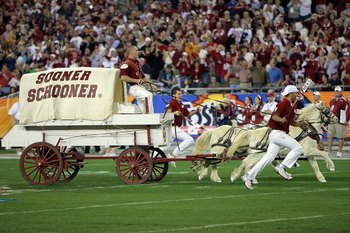
The Land Rush -- the participants were known as the 89ers -- also inspired Oklahoma's mascot, the Sooner Schooner, a prairie schooner pulled by 2 ponies, named, naturally, Boomer and Sooner. Debuting in 1964, it leads the team onto the field, and circles the stadium after after touchdown.
Oklahoma A&M's teams were originally called the Tigers, hence the colors orange and black. In 1923, they became the Cowboys. In 1958, the year the name was changed to Oklahoma State, the caricature of Pistol Pete debuted, and a guy-in-a-costume mascot debuted in 1984.

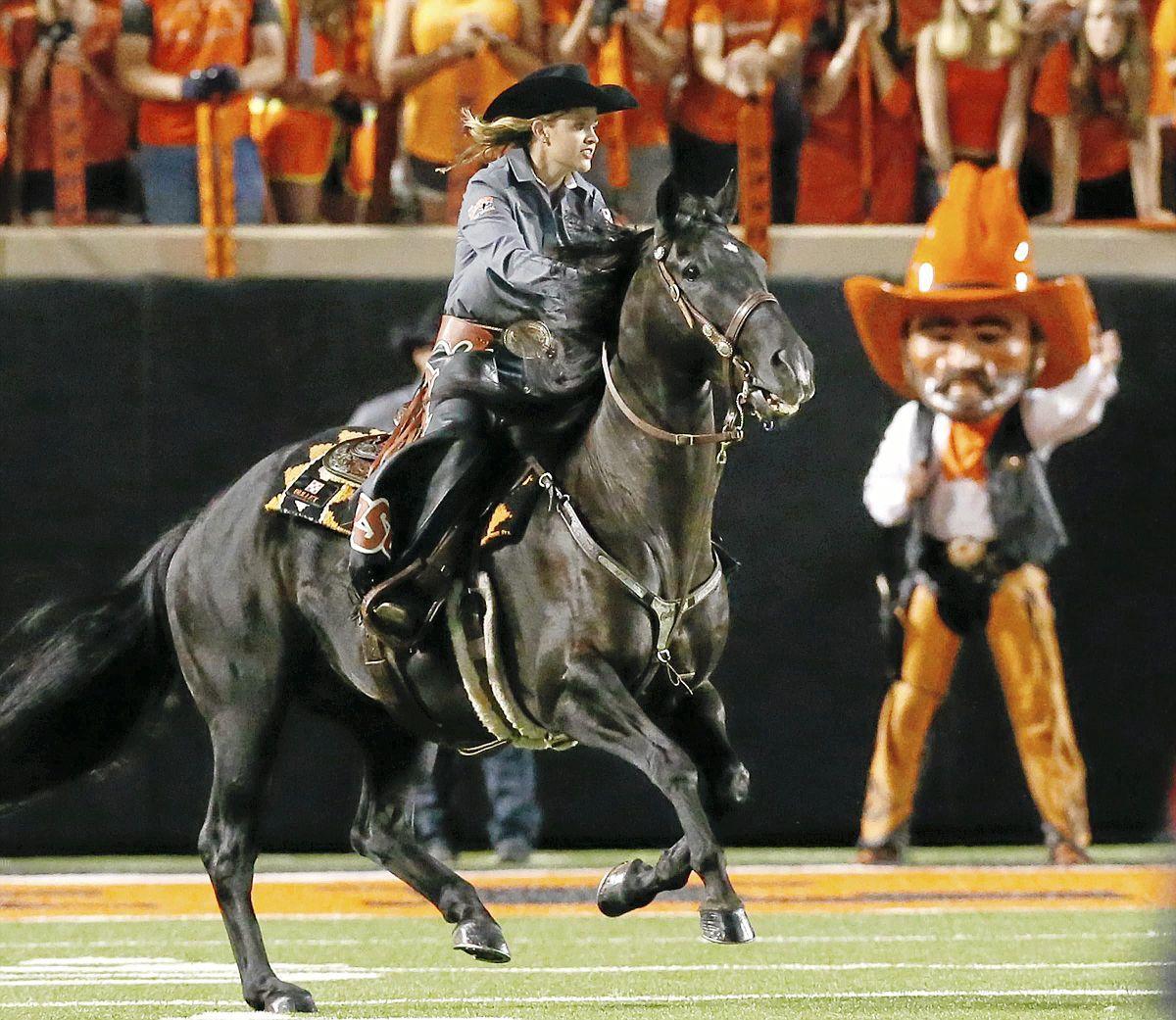
They have a secondary mascot, Bullet, a black horse ridden by the Spirit Rider -- who must also take care of the horse, including cleaning out his stall. They ride around the field as the team comes onto the field, and after every touchdown.
The Spirit Rider aboard Bullet, with Pistol Pete in the background

The Cowboy Marching Band plays "The Waving Song" during pregame introductions, after touchdowns, and after a win. Fans wave their right arms, similar to the "Waving Wheat" of Big 12 neighbors Kansas.

Then there's the Paddle People. According to a 2014 Tulsa World article:

Legend has it that a handful of diehard Cowboys showed up at a game one Saturday with orange paddles, resembling cricket bats.
They sat in the front row of the student section and furiously pounded against the low wall that surrounds the football field, making a teeth-rattling racket. They came back the next game. And the next.
Back then, of course, front-row seats weren't hard to find. OSU wasn't exactly a powerhouse. But as the football program grew, so did the number of Paddle People...
Eventually, they stretched single-file from the back of the end zone to near the 25-yard line, up to 80 paddles hammering in unison in Boone Pickens Stadium.
The deafening rhythm has become an OSU trademark, an indispensable part of the game-day experience, rallying the home team and distracting opponents. Those front-row seats, however, aren't so easy to get anymore.
On October 6, 2017, Thrillist compiled a list of their Best College Football Stadiums, the top 19 percent of college football, 25 out of 129. Pickens Stadium came in at Number 25, and the Paddle People were cited:

In another environment, hordes of crazed young people armed with big wooden paddles would seem like a deleted scene from The Warriors. But at Oklahoma State they're the Paddle People, a group of students who bang these paddles on stadium surfaces to create one of the loudest environments in college football. The nine-figure renovation that the dilapidated old Lewis Field underwent to become Boone Pickens helps too. The stands surround the field on three sides and shoot straight up, making the place especially intense during sold-out night games. 

After the Game. As long as you didn't antagonize anybody -- whether the game is in Norman or Stillwater -- the safety of you (and, if you drove in, your car) should not be an issue.

In Oklahoma City, the violent crime rate is one of the highest in the nation. However, if you stick to the downtown area, you should be safe.

With Memorial Stadium flanked by campus buildings on its north and west sides, and OU's track & field facility on the east, your best bet is to head back downtown: The Diner at 213 E. Main Street (renowned for breakfast), Bison Witches Bar & Deli at 211 E. Main, the Service Station at 502 S. Webster Avenue, and, most famously, The Mont at 1300 Classen Blvd., about a half-mile northeast of the stadium.

Stillwater was the site of the 1st Sonic Drive-In, and it's at 215 N. Main Street, 4 blocks from Pickens Stadium. To the east and south of the stadium, Knoblock Street has several notable eateries, including The Garage, Cafe 88, and the Stonewall Tavern -- definitely not to be confused with the Stonewall Inn, the Greenwich Village bar that became the launching point of the modern gay rights movement.

If your visit to Oklahoma is during the European soccer season, you're probably out of luck in either Norman or Stillwater. Your best bet for a place to watch your club is: Near Norman, Skinny Slim's, at 201 E. Main Street in downtown Oklahoma City; and, near Stillwater, George's Pub, 108 N. 1st Street in Jenks, near Tulsa.

Sidelights. Oklahoma's sports history includes Jim Thorpe, Johnny Bench, and Yankee Legends Mickey Mantle, Bobby Murcer and Allie Reynolds. And then there's all those college football legends, although not every OU and OSU legend was originally from Oklahoma.

The Oklahoma City Dodgers are the closest professional baseball team to Norman. They play at Chickasaw Bricktown Ballpark, which opened in 1998. Previously, they were known as the 89ers and the RedHawks. They haven't yet won a Pennant since moving into the Class AAA Pacific Coast League (and Oklahoma isn't exactly on any coast), but they have won Division titles in 1999, 2002, 2004, 2005, 2008, 2010, 2013 and 2015.
Every street bordering the ballpark is named for a local legend. The official address is 2 S. Mickey Mantle Drive, but outside the ballpark it's Walnut Avenue. It runs along the 3rd base side. Reno Avenue runs along the 1st base side, where it is named Johnny Bench Drive. The right field side is Russell M. Perry Avenue, except next to the ballpark where it is Joe Carter Avenue, after the Toronto Blue Jays legend. And a street that only exists for a few blocks along the left field side is named for the aforementioned local band, Flaming Lips Alley. Statues of Mantle and Bench are outside the park.

Prior to the new ballpark opening, the team was known as the Oklahoma City 89ers, and competed in the Class AAA American Association. They played at All Sports Stadium, and won Pennants in 1963, 1965, 1992 and 1996. It was located in State Fair Park at 333 Gordon Cooper Blvd. at Eighty-Nine Drive, about 5 miles west of downtown. Number 38 bus from downtown.

The Tulsa Drillers are the closest minor-league team to Stillwater. They play at ONEOK Field. (That's named for a natural gas utility, is supposed to mean "One OK," and is pronounced "WON-oak.") It's also home to the Tulsa Roughnecks, a minor-league soccer team named for a team in the old North American Soccer League. 201 N. Elgin Avenue.
Oklahoma City is home to the NBA's Oklahoma City Thunder. In Oklahoma, the most popular NFL team is easily the Dallas Cowboys, and the most popular NHL team is easily the Dallas Stars. For MLB and MLS, it depends on direction: Go south of OKC, toward Norman and Texas, and it'll be the Texas Rangers and FC Dallas; go north, especially northeast toward Tulsa, and it'll be the Kansas City Royals and Sporting Kansas City -- but you'd probably have to go past Tulsa to find a lot of Chiefs fans.

It's 84 miles between the 2 stadiums. From Norman, it's 21 miles to the Thunder's arena, 125 to Tulsa, 190 to Dallas, and 372 to Kansas City. From Stillwater, it's 67 to the Thunder, 69 to Tulsa, 258 to Dallas and 317 to Kansas City.

The 11,562-seat Lloyd Noble Center has been the home of Oklahoma basketball since 1975. It was named for Samuel Lloyd Noble, a Houston oilman who had donated to OU. Elvis Presley sang there And he did shows at the Lloyd Noble Center n March 25 and 26, 1977. 2900 Jenkins Avenue, about a mile south of the stadium. No bus service.
Langston University is now in the NAIA, effectively NCAA Division IV. They won National Championships for historically black colleges and universities (HBCUs) in football in 1939 and 1941, and in basketball in 1944 and 1946. 701 Sammy Davis Jr. Drive in Langston, 42 miles northeast of downtown Oklahoma City.

There has never been a President who was born or spent significant time in Oklahoma, and so there's no Presidential Library there. Herbert Hoover's Vice President was an Oklahoman, Charles Curtis, believed to be the 1st person of Native American descent to serve in the U.S. Congress, and he served in both houses. Typical for Vice Presidents, he tends to get forgotten. Then again, Hoover should have been so lucky.

Carl Albert, known as the Little Giant from Little Dixie (he was 5-foot-4), served a northeastern Oklahoma district in Congress from 1947 to 1977. From 1955 onward, he served in the Democratic Party's leadership in the House of Representatives, and was Speaker of the House from January 21, 1971 to January 3, 1977.

This meant that, from Spiro Agnew's resignation of the Vice Presidency on October 10, 1973 until Congress approved House Minority Leader Gerald Ford as Vice President on December 6, and again from Richard Nixon's resignation making Ford President on August 9, 1974 until Nelson Rockefeller's confirmation as Vice President on December 19, Albert was the next person in line for the Presidency.

If Nixon or Ford had died during those times -- or, a very real danger the 1st time around, if evidence was discovered that would have forced Nixon's earlier resignation -- the Presidency would have passed to Albert, and thus from a Republican to a Democrat, without an election. Knowing this, Albert never lifted a finger to make himself President. Quite the opposite: He made Ford's confirmation as Vice President as smooth as he could. In spite of their political differences, they were friendly.

The Devon Energy Center, opening in 2012 at 844 feet, is tallest building in Oklahoma -- indeed, it's the tallest building between Chicago and Dallas. 280 W. Sheridan Avenue at Robinson Street, in downtown Oklahoma City.

Aside from Thunderstruck, the most notable movies set in Oklahoma are the 1940 version of John Steinbeck's The Grapes of Wrath, The Outsiders, Far and Away, Twister (as you might guess for a State known as "Tornado Alley"), Elizabethtown and The Killer Inside Me.

Cimarron, made in 1931 off Edna Ferber's novel, and based on the 1889 land rush that created Oklahoma as we know it, was perhaps the 1st great Western of the sound film era. It was remade in color in 1960, shortly after NBC aired an unrelated Western series named Cimarron City. A few years later, CBS aired a Western series named Cimarron Strip. However, none of those movies was actually filmed in Oklahoma, instead using Southern California locations.

The TNT crime drama Saving Grace was set in Oklahoma City, hometown of its creator Nancy Miller. While it used some location shots, it was largely filmed in Los Angeles and Vancouver. The HBO series Carnivàle was also set in Oklahoma, but filmed in Southern California.

(UPDATE: In 2021, Hulu premiered the drama Reservation Dogs, set on a Native American reservation in Oklahoma. The show, whose title is a play on the Quentin Tarantino film Reservoir Dogs, is billed as the 1st TV series filmed completely in Oklahoma.)

Special Agent Eleanor "Ellie" Bishop on NCIS grew up on an Oklahoma farm and is an Oklahoma State graduate, and has an OSU pennant on the wall of her cubicle. She is played by Emily Wickersham, who actually grew up in Mamaroneck, New York and went to Muhlenberg College in Pennsylvania. The University of Oklahoma doesn't have a claim on a pop-culture figure even that big.

*

Oklahoma is a long way from New York, but it's one of the hotter football hotbeds. "Bedlam" may be an understatement.

Tuesday, October 10, 2017

How to Go to the Red River Rivalry: Texas vs. Oklahoma

Next Saturday, one of the great American sports traditions will be held: The University of Texas playing the University of Oklahoma in football, at the Cotton Bowl stadium in Dallas, as part of the Texas State Fair.

You would think that Texas' greatest rival would be Texas A&M, and that Oklahoma's greatest rival would be Oklahoma State. For TAMU and OSU, this is true. But for the Longhorns and the Sooners, it isn't. Their greatest rivals are each other.

UPDATE: On June 26, 2022, Both schools announced that, at the end of their current contract with the Big XII Conference on June 30, 2025, they will switch to the Southeastern Conference. Presumably, they will go back to playing each other on an annual basis.

Before You Go. It's not just The South, it's Texas. And you know what? Oklahoma is a lot like Texas, except without the added macho baloney about the Alamo. (You know, where a nation mighty in its time defended its land against illegal immigrants. Who were also slaveholders. Yes, at the Alamo, the good guys won.)

So if you go to Dallas for this game, it would be best to avoid political discussions -- even if, by comparison, UT-Austin is a comparatively liberal bastion in the Lone Star State.

Also within the realm of "It's not just The South, it's Texas," you should be prepared for hot weather. It's not just the heat that's so bad, it's the humidity. And the mosquitoes. You think it was only the heat that made the Houston Astros build the Astrodome? Sandy Koufax said, "Some of the bugs they've got down there are twin-engine jobs." At least, unlike in baseball, the Dallas-area football team has a dome. But you'll have to spend some time outside. It's hot, it's humid, it's muggy and it's buggy, and they have that shit all the time.

So, before you go, check the website of the Austin American-Statesman for the weather. Right now, they're talking about it being in the mid-80s during daylight (by our standards, hot for this time of year), and the high 60s at night.

Texas and Oklahoma are both in the Central Time Zone, 1 hour behind New York. (The exception for Texas is the southwestern corner, including El Paso, which borders New Mexico, so it's in the Mountain Time Zone.) Adjust your timepieces accordingly.

Despite Texas' foreignness -- and that's before you factor in the Mexican-American presence, which improves things -- and its former Confederate status, you do not need to bring your passport or change your money. The same is true of Oklahoma, which wasn't yet a State during the Civil War.

Tickets. The current capacity of the Cotton Bowl is 92,100 -- officially, even larger than AT&T Stadium, which nonetheless covers a lot more area. But getting tickets will still be hard. You'll have to go to StubHub or a similar site. Right now, even in the upper corners of the upper deck, tickets are going for around $200.

For games at Texas: In the lower level, midfield seats are $140, end seats are $110, and end zone seats are $95; in the upper level, midfield seats are $95, end seats are $70, and end zone seats are $55.

For games at Oklahoma: All tickets are $55.

Getting There. It is 1,745 miles from Midtown Manhattan to downtown Dallas. So unless you want to be cooped up for 24-30 hours, you... are... flying.

A round-trip nonstop flight on United Airlines from Newark, Kennedy or LaGuardia airports to Dallas/Fort Worth International Airport could set you back as little as $404 round-trip. DFW is a major airline hub: American Airlines has its corporate headquarters there. And yet, American offers fewer nonstops at considerably higher prices. There is Orange Line rail service from the airport to Dallas' Union Station, but it will take about an hour and a half.

Amtrak offers the Lake Shore Limited (a variation on the old New York Central Railroad's 20th Century Limited), leaving Penn Station at 3:40 PM Eastern Time and arriving at Chicago's Union Station at 9:45 AM Central Time. Then switch to the Texas Eagle at 1:45 PM, and arrive at Dallas' Union Station (400 S. Houston Street at Wood Street) the following morning at 11:30. (In other words, if you left New York on Thursday, you'd have 3 hours on Saturday to get to a hotel, and then make the kickoff.) It would be $482 round-trip.
Dallas' Union Station

As with American Airlines, Dallas is actually Greyhound's hometown, or at least the location of its corporate headquarters: 205 S. Lamar Street at Commerce Street, which is also the address of their Dallas station. If you look at Greyhound buses, you'll notice they all have Texas license plates. So, how bad can the bus be?

Well, it is cheaper: $364 round-trip, and advanced purchase can get it down to $351. But it won't be much shorter: It's a 38-hour trip, and you'll have to change buses at least twice, in Richmond, Virginia (and I don't like the Richmond station) and either Atlanta or Memphis.

Oh... kay. So what about driving? As I said, over 1,500 miles. I would definitely recommend bringing a friend and sharing the driving. The fastest way from New York to Dallas is to get into New Jersey, take Interstate 78 West across the State and into Pennsylvania, then turn to Interstate 81 South, across Pennsylvania, the "panhandles" of Maryland and West Virginia, and across the Shenandoah Valley of Virginia into Tennessee, where I-81 will flow into Interstate 40. Take I-40 into Arkansas, and switch to Interstate 30 in Little Rock, taking it into the Dallas-Fort Worth metropolitan area, a.k.a. "The Metroplex."

Once you get across the Hudson River into New Jersey, you should be in New Jersey for about an hour, Pennsylvania for 3 hours, Maryland for 15 minutes, West Virginia for half an hour, Virginia for 5 and a half hours (more than the entire trip will be before you get to Virginia), 8 hours and 15 minutes in Tennessee, 3 hours in Arkansas, and about 3 hours and 30 minutes in Texas.

Taking 45-minute rest stops in or around (my recommendations) Harrisburg, Pennsylvania; Charlottesville, Virginia; Bristol, on the Virginia/Tennessee State Line; Nashville and Memphis, Tennessee; Little Rock and Texarkana, Arkansas; and accounting for overruns there and for traffic at each end of the journey, and we're talking 31 hours.

But it would be better to leave on Friday afternoon, reach the area on Saturday night, and get a hotel. Fortunately, AT&T Stadium is in Arlington, midway between the downtowns of Dallas and Fort Worth. Well before either the Rangers or the Cowboys set up shop in Arlington, Six Flags Over Texas did so, as the original theme park in the Six Flags chain (opening in 1961), and so there are plenty of hotels available nearby. They’re also likely to be cheaper than the ones in downtown Dallas.

Austin. Nonstop flights to and from Austin-Bergstrom International Airport (named for Captain John Bergstrom, who died in the attack on Pearl Harbor) are available, but a lot harder to get. Most likely, you'll have to change planes in Dallas. But they could be had for just a little over $500.

On Amtrak, you'd have to start out a day earlier, on Wednesday, as the Texas Eagle wouldn't get to Austin until 6:21 PM. Round-trip fare is $464. The station is at 250 N. Lamar Blvd., downtown. On Greyhound, round-trip fare is $488, but can drop to $391. The station is at 916 E. Koenig Lane, 6 miles north of downtown, and 3 miles north of the campus. Bus 7.

Driving from New York to Austin, follow the directions from Dallas, then take I-35E and I-35 South for about 3 hours. Once you get across the Hudson River into New Jersey, you should be in New Jersey for about an hour, Pennsylvania for 3 hours, Maryland for 15 minutes, West Virginia for half an hour, Virginia for 5 and a half hours (more than the entire trip will be before you get to Virginia), 8 hours and 15 minutes in Tennessee, 3 hours in Arkansas, and about 6 hours and 30 minutes in Texas.

Taking 45-minute rest stops in or around (my recommendations) Harrisburg, Pennsylvania; Charlottesville, Virginia; Bristol, on the Virginia/Tennessee State Line; Nashville and Memphis, Tennessee; Little Rock and Texarkana, Arkansas, and Dallas itself; and accounting for overruns there and for traffic at each end of the journey, and we're talking 35 hours.

Norman. To get to an Oklahoma game, you'd have to fly to Oklahoma City's Will Rogers International Airport (named for the Oklahoma-born entertainer of the early 20th Century) and then take a bus to Norman. This would be more expensive, around $840, before the ride on the Number 24 bus, which takes about an hour.

Amtrak isn't all that convenient to OKC. You'd have to board the Lake Shore Limited at Penn Station at 3:40 PM Eastern Time, then arrive at Union Station in Chicago at 9:45 AM Central Time the next morning, then there's a 4-hour layover until the Texas Eagle leaves at 1:45 PM, and it arrives in Fort Worth the next day at 1:25 PM, and then you'd have to change trains again, with a 4-hour layover -- in Fort Worth, not the despised but much more modern city of Dallas -- before taking the Heartland Flyer at 5:25, finally arriving in Oklahoma City at 9:27 PM. That's 62 hours and 42 minutes. And it's $488 round-trip. That may not be worth the hassles. At any rate, the station is on Gaylord Blvd., between Reno and Sheridan Avenues, just 2 blocks from the arena -- sure, now, at the end, it's convenient.

On Greyhound, the trip is much shorter, about 39 hours, and you only have to transfer once, and, believe me, 4 hours in Chicago is good. (More hours in Chicago is better, but that's a story for another time.) It's also possible that your transfer may be in Kansas City. The round-trip fare is $278, and you don't save much with advanced purchase. The station is at 1948 E. Reno Avenue at Martin Luther King Avenue, on the same street as the arena, but 2 miles to the east, so what it makes up for in convenience during the trip, it blows up at the end -- the opposite of Amtrak. To Norman itself, it's $353 round-trip. 506 N. Porter Avenue, about a mile north of the campus.

If you decide to drive, it’s far enough that it will help to get someone to go with you and split the duties, and to trade off driving and sleeping. You'll need to get on the New Jersey Turnpike, and take Interstate 78 West across New Jersey, and at Harrisburg get on the Pennsylvania Turnpike, which at this point will be both I-70 and I-76. When the two Interstates split outside Pittsburgh, stay on I-70 west. You'll cross the northern tip of West Virginia, and go all the way across Ohio (through Columbus), Indiana (through Indianapolis) and Illinois. When you cross into Missouri, you'll be in St. Louis. Switch to Interstate 44 West, the Will Rogers Turnpike, and take that across southern Missouri and northeastern Oklahoma. Outside Edmond, you'll turn onto Interstate 35 South, passing Oklahoma City, then take Exit 108 A onto State Route 9. The campus is 3 miles ahead on your left.

If you do it right, you should spend about an hour and 15 minutes in New Jersey, 5 hours in Pennsylvania, 15 minutes in West Virginia, 3 hours and 45 minutes in Ohio, 2 hours and 30 minutes in Indiana, 2 hours and 30 minutes in Illinois, 5 hours in Missouri, and 4 hours in Oklahoma before arriving. That's going to be about 24 hours. Counting rest stops, preferably 6 of them, and accounting for traffic at both ends, it should be about 30 hours.

Once In the City. Texas declared its independence from Mexico on March 2, 1836; was admitted to the Union as the 28th State on December 29, 1845; became the 7th State to secede from the Union, on February 1, 1861; and the 10th former Confederate State to be readmitted, on March 30, 1870.

Oklahoma was not yet a State at the time of the American Civil War, and thus did not secede, although, could it have, it likely would have. It was admitted to the Union as the 46th State on November 16, 1907.

Dallas (population about 1.3 million, founded in 1856) was named after George Mifflin Dallas, a Mayor of Philadelphia and Senator from Pennsylvania who was James K. Polk's Vice President (1845-49). Fort Worth (about 850,000, founded in 1849) was named for William Jenkins Worth, a General in the War of 1812 and the Mexican-American War. And Arlington (400,000, founded in 1876) was named for the Virginia city across the Potomac River from Washington, D.C., as a tribute to Confederate General Robert E. Lee.

The population of the entire Metroplex is about 6.8 million and climbing, although when you throw in Oklahoma, southern Arkansas and northern Louisiana, the total population of the Cowboys' "market" is about 19 million -- a little less than the New York Tri-State Area, and soon it will surpass us.
Commerce Street divides Dallas street addresses into North and South. Beckley Avenue, across the Trinity River from downtown, appears to divide them into East and West. The sales tax in the State of Texas is 6.25 percent, in Dallas County 8.25 percent, and in Tarrant County (including Arlington and Fort Worth) 8 percent even. ZIP Codes for Dallas start with the digits 75 and 79. The Area Code for Dallas is 214.

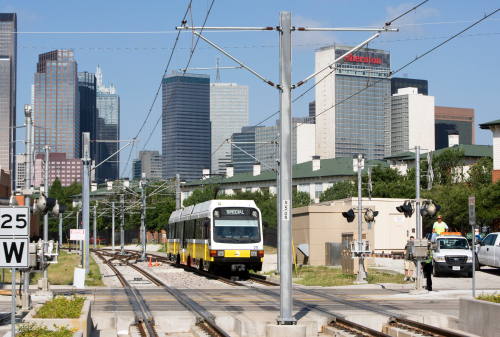
Dallas Area Rapid Transit (DART) runs buses and light rail trains. A 2-hour pass costs $2.50, and a day pass is $5.00 local and $10.00 regional (if you want to go beyond Dallas to Arlington or Fort Worth).
Green Line train just outside downtown

Dallas' beltway is named for 2 Presidents: Interstate 635, to the north, is the Lyndon B. Johnson Freeway; while Interstate 20, to the south, is the Ronald Reagan Memorial Highway. I-20, along with Interstate 820, the Jim Wright Freeway (named for the local Congressman who was an ally of LBJ's, an enemy of Reagan's, and Speaker of the House from 1987 to 1989), is Fort Worth's beltway. And, as I said, I-30, the Tom Landry Freeway, connects the 2 cities and goes through Arlington. Austin, Norman and Oklahoma City don't have beltways.

Dallas proper is about 42 percent Hispanic, 28 percent white, 24 percent black, and 3 percent Asian. South Dallas is mostly black, while North Dallas is mostly white. The northern suburbs are rich, and so conservative, they make New Jersey Republicans look like Socialists.

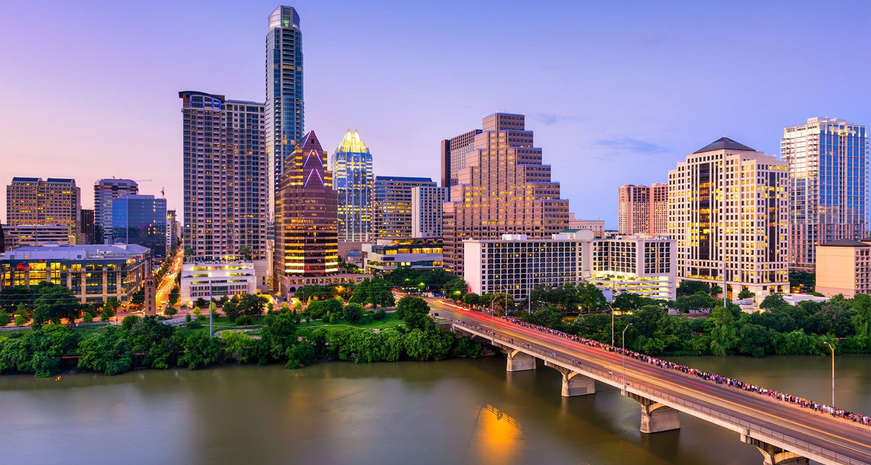
Named for Stephen F. Austin, "the Father of Texas" and the leader of the successful Texas Rebellion of 1836, and founded 3 years later, Austin has grown by leaps and bounds, and is now home to about 950,000 people, and would be well over 1 million counting students at the University of Texas and people working for the State government, both of whom have their permanent residences elsewhere. The metropolitan area has over 2 million.
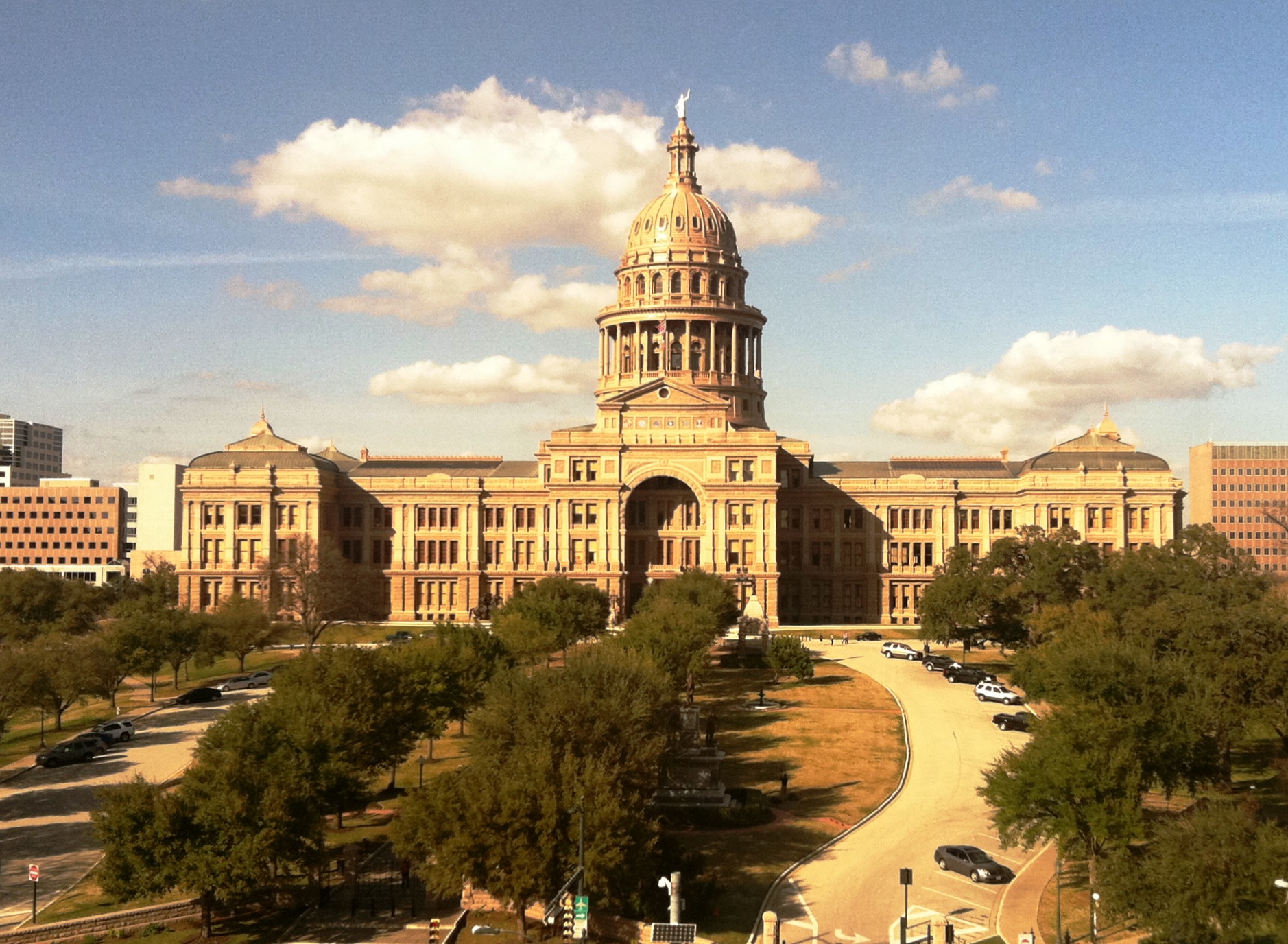
The State Capitol building is larger in area and floor space than the national one in Washington. Like Raleigh, North Carolina; Nashville, Tennessee; Atlanta, Georgia; Jackson, Mississippi; Lincoln, Nebraska; Laramie, Wyoming and Salt Lake City, Utah, Austin is a liberal capital in a conservative State.
The Texas State House in Austin

The leading newspaper is the Austin American-Statesman. ZIP Codes for Austin start with 786, 787 and 789. The Area Code is 512. Austin Energy runs the city's electricity.

Aside from the University and the State government, the city is known for its alternative music scene, including the South By Southwest Festival, a.k.a. SXSW. Congress Avenue divides addresses into East and West, and the Colorado River (not the same one that goes through Arizona and Nevada) into North and South.

Consistent with much of Texas other than Dallas and Houston, Austin has a population that is about 48 percent non-Hispanic white, 35 percent Hispanic, 8 percent black, and 6 percent Asian. A 2014 study by UT showed that it was the only rapidly-growing U.S. city to have a net loss of African-Americans between 2000 and 2010.

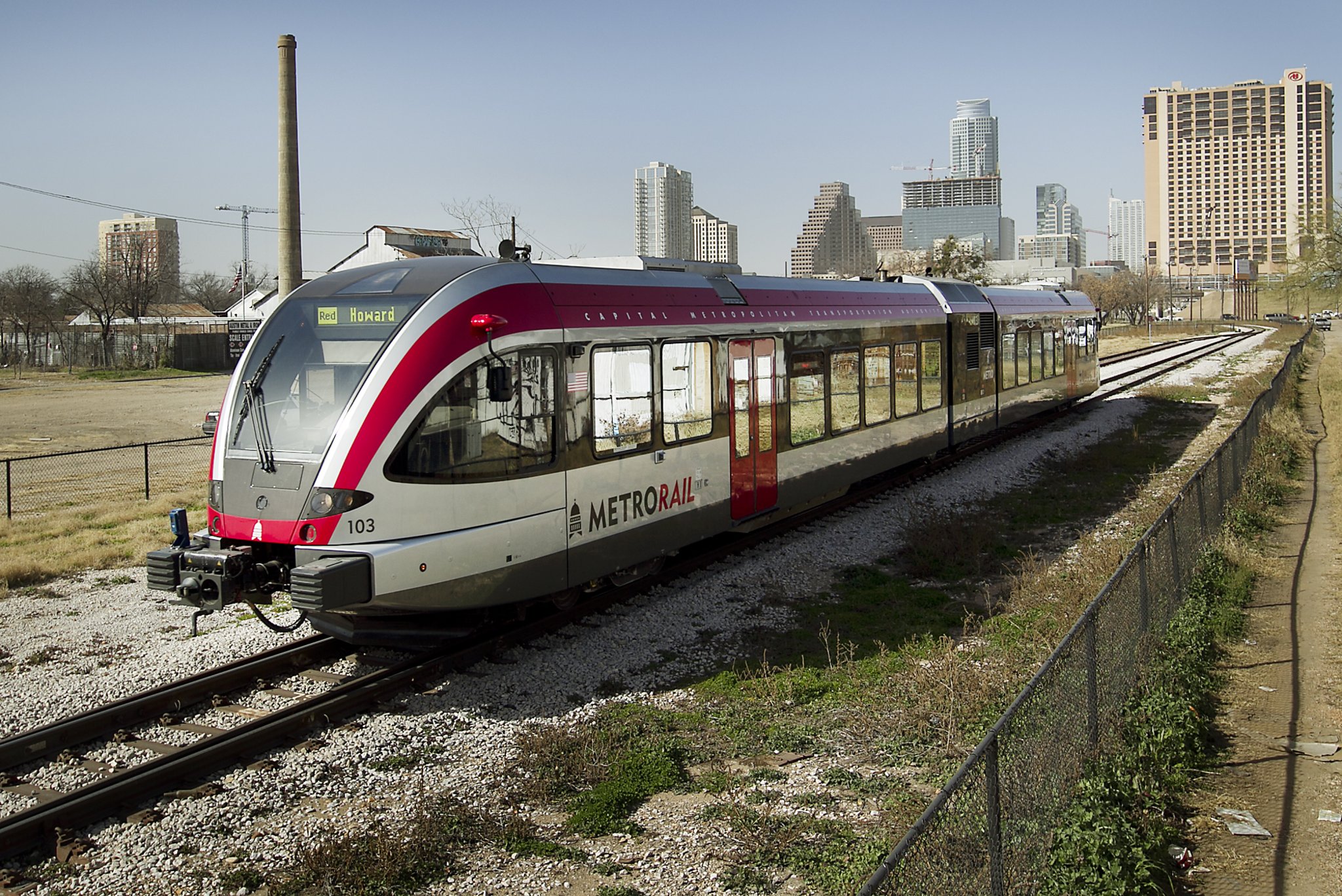
The Capital Metropolitan Transportation Authority, or Capital Metro for short, runs buses and a commuter rail, Capital MetroRail, in the city and the nearby suburbs. A single ride is just $1.25.
Capital Metro Rail

The University of Texas was founded in 1883. It became the 1st major Southern university to racially desegregate, in 1950. In 1967, the State legislature, in recognition of the vast growth of the University of Texas System, officially renamed the main campus "The University of Texas at Austin." Texans call it "UT-Austin." Or maybe "The Longhorns," or "The 'Horns" for short. Unless they're Texas A&M people, in which case they call 'em "tea-sippin' liberals," or "tea-sips" for short.

The University of Texas System also has campuses in Dallas, Arlington, San Antonio, El Paso, Rio Grande Valley (in Brownsville and Edinburg), Tyler, and the Permian Basin (in Odessa). Surprisingly, there is no campus in Houston, the State's largest city.

Texas-El Paso, or UTEP, competes in NCAA Division I FBS. It was known as Texas Western University until 1967. It is best known for its all-black starting five that upset Kentucky for the 1966 National Championship. UT-Arlington, UTSA, UTRGV also compete in NCAA Division I FBS. UT-Tyler and UTPB are in NCAA Division II. UT-Dallas is in NCAA Division III. 

Aside from athletes, notable UT-Austin graduates include: 

Entertainment: Actors Eli Wallach '36, Fess Parker '50, Barbara Barrie '52, Tommy Tune '62, Bruce McGill '73, Marcia Gay Harden '80, Owen Wilson '91, Renee Zellweger '92, Matthew McConaughey '93; directors Thomas Schlamme '82, Wes Anderson '90 and Robert Rodriguez '08 (based on his age, probably should have been '90); singers Kinky Friedman '66, Nancy Griffith '75 and Michelle Shocked '83; game show host Allen Ludden '40.

Literature: Novelist and journalist Willie Morris '56; fantasy writer and Percy Jackson creator Rick Riordan '86; and cartoonists Roy Crane '22, Ben Sargent '70 and Berkeley Breathed '79.

Politics, representing Texas unless otherwise stated: Senators Tom Connally 1898, Earle Mayfield 1900, Ralph Yarborough '27, Lloyd Bentsen '42 and Kay Bailey Hutchison '62; Governors Dan Moody 1910, John Connally '39, Dolph Briscoe '42, Ann Richards '55, Jeb Bush of Florida '74 (but not George W.: He was Yale '68) and Greg Abbott '81; Secretary of State Rex Tillerson '75, Secretaries of the Treasury Connally, Bentsen and Robert B. Anderson '32; Secretary of Commerce Donald Evans '69, Attorneys General Tom Clark '22 and his son Ramsey Clark '49. Tom was also a Justice of the Supreme Court, but resigned because President Johnson wanted to appoint Ramsey as AG, and it would have been a conflict of interest.

Also, First Ladies Claudia "Lady Bird" Johnson '33 and Laura Bush '73; and First Daughters Lynda Bird Johnson Robb '66 and Jenna Bush Hager '04. (But not their sisters: Luci Baines Johnson Turpin is Georgetown '69, and Barbara Bush Coyne is Yale '04.) Also, Clinton campaign adviser turned CNN correspondent Paul Begala '83.

Oklahoma may have a "more Texas" State House than Texas does. Because it's the only one with an oil well on the Capitol's grounds.
The Oklahoma State House in Oklahoma City

ZIP Codes for Oklahoma start with the digits 73 and 74. For Oklahoma City, 731. For Norman, 730. The Area Codes are 405 for Oklahoma City and Norman. The sales tax is 4.5 percent.
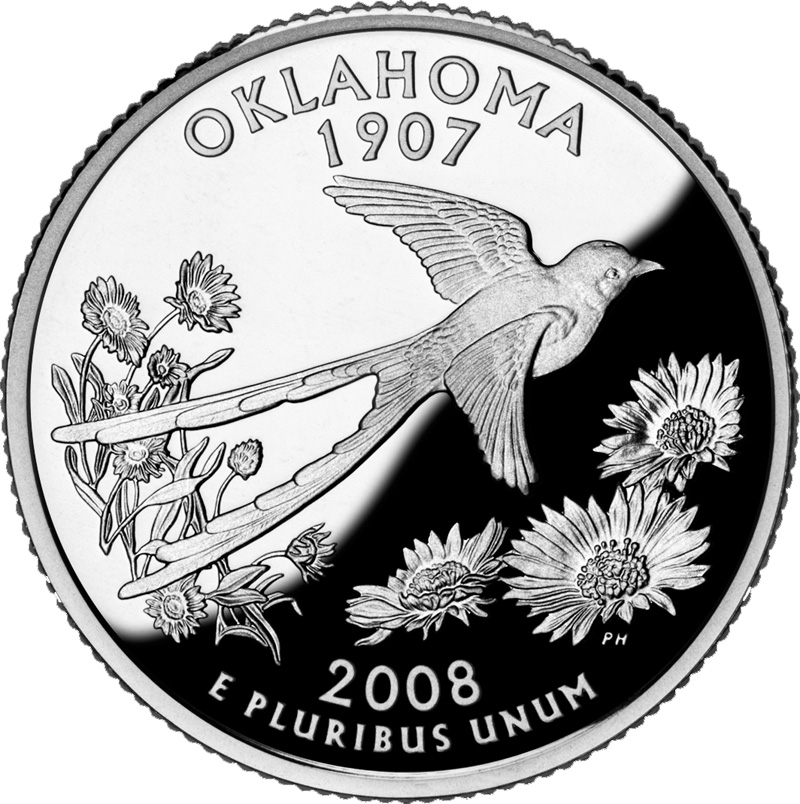
Oklahoma City is a decent-sized city, with about 630,000 people, but the metropolitan area is small, just 1.3 million. Norman, included in that, was founded in 1891 and has about 120,000. It is served by The Daily Oklahoman and The Norman Transcript. Norman is about 81 percent white, 6 percent Hispanic, 5 percent Native American, 4 percent black and 4 percent Asian. Oklahoma Gas & Electric (OG&E) runs the electricity for the State.
Oklahoma's darkest hour came on May 31, 1921, when mobs of White residents, some of them deputized and given weapons by city officials, attacked Black residents and destroyed homes and businesses of the Greenwood District in Tulsa, Oklahoma. The attacks burned and destroyed more than 35 square blocks of the neighborhood – at the time one of the wealthiest Black communities in the United States, known as "Black Wall Street." As many as 300 people were killed.

Cleveland Area Rapid Transit (Norman is in Cleveland County) runs Norman's buses. The fare is even cheaper than Austin's: 75 cents. Jones Avenue divides addresses into East and West, Main Street into North and South.

Aside from the main campus in Norman, OU's only satellite campus is in Tulsa. Notable OU graduates in fields other than sports:

* Entertainment: Actors Van Heflin, Rance Howard (father of Ron and Clint, grandfather of Bryce Dallas), Dennis Weaver, James Garner, Alice Ghostley, Larry Drake, Ed Harris and Olivia Munn; music personalities David Gates of Bread and Tom Paxton, Science fiction author C.J. Cherryh, and Miss America 2006 Jennifer Berry.

* Politics, representing Oklahoma unless otherwise stated: Governors David Hall, David Boren, David Walters, Frank Keating, Brad Henry, and Susana Martinez of New Mexico; Senators Boren (his son Dan Boren served in the House) and Tom Coburn; Speaker of the House Carl Albert, House Majority Leader Dick Armey, Congressman and former OU quarterback J.C. Watts, and current Oklahoma City Mayor Mick Cornett. And, both as a student and a law professor at OU, Anita Hill.

* Astronauts: Fred Haise of Apollo 13, and record-setting (since broken) Shannon Lucid.

Going In. This game is played at the Cotton Bowl, aside from the Alamo the most famous building in the State of Texas. The address is 3750 The Midway, as it is the centerpiece of the Texas State Fair. It is 3 miles east of downtown, in the Fair Park section of south Dallas. Bus 012 or 026, or Green Line light rail to Fair Park station. Be advised that this is generally considered to be a high-crime area of Dallas. If you drove in, parking can be had for as little as $5.50.
Known as Fair Park Stadium when it opened in 1930, the name was changed in 1937, when the Cotton Bowl Classic replaced the old Dixie Classic as Dallas' postseason college football game. It was the site of some (but not all) home games of Southern Methodist University (heretoafter called SMU) between 1932 and 2000. Because of the popularity of SMU running back Doak Walker, a second deck was put on each sideline, raising capacity to 75,504, earning it the nickname "The House That Doak Built."
The Cotton Bowl, in its best-remembered configuration,
before its recent renovation and expansion

It was the Dallas Cowboys' 1st home, from their 1960 launch until the middle of the 1971 season. It also hosted the original NFL version of the Dallas Texans in 1952; the AFL's Dallas Texans from 1960 to 1962, before they moved and became the Kansas City Chiefs; the Tornado in their 1967 and 1968 seasons' some games of soccer's 1994 World Cup, 7 U.S. soccer games, most recently a draw to Mexico in 2004; and an Elvis concert on October 11, 1956, the 20,000 fans being his biggest crowd until he resumed touring in 1970.

And it hosted the Cotton Bowl game from 1937 to 2009, after which it was moved to AT&T Stadium. On 5 occasions, the game decided the National Championship: 1959-60, Syracuse over Texas; 1963-64, Texas over Navy; 1964-65, Arkansas over Nebraska; 1969-70, Texas over Notre Dame; and 1977-78, Notre Dame over Texas.

Due to its age, the deterioration of the neighborhood, and the construction of AT&T Stadium, since 2009 it's hosted just 2 games per year: The annual "Red River Rivalry" game between the Universities of Texas and Oklahoma, and the "Heart of Dallas Bowl," a very minor game.

Nevertheless, the upper deck has been extended all the way around, and capacity is now 92,100. The field is laid out northwest-to-southeast, unusual due to the angle of the Sun, and was artificial turf from 1970 to 1993, when it was replaced with real grass for the World Cup, and kept. I still remember watching the 1985 Cotton Bowl, Doug Flutie's last college game, Boston College vs. the University of Houston, and it rained, so they had to squeegee the field. That's just wrong.
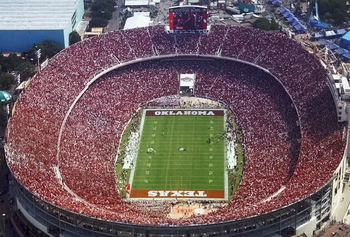
The Cotton Bowl, in all its maroon (Oklahoma) and burnt orange (Texas) glory.

Texas vs. Oklahoma is held at the Cotton Bowl every 2nd Saturday in October, because that's the weekend when the Texas State Fair is held, as the stadium is in Fair Park. (Just look for the statue of "Big Tex" -- you can't miss him.)
This guy.

While it doesn't seem fair that Oklahoma's visit to play Texas should be called a "neutral site" if it's in the State of Texas, the fact remains that each school gets half the tickets, and the stadium is split right down the middle at the 50-yard line, Texas Burnt Orange and Oklahoma Maroon. It's actually slightly closer to OU's campus in Norman, 191 miles, than it is from UT's in Austin, 197 miles. (While it should be "UO," it's always listed as "OU," and that's even the monogram on their helmets.)

The game has several nicknames: The Red River Showdown (the Red River separates the States), the Red River Rivalry, the Red River Classic and the Red River Shootout. It was 1st played in 1900, 7 years before Oklahoma gained Statehood. It was played in Austin from 1900, 1901, 1902, 1903, 1904, 1907, 1909, 1910, 1911 and 1923; Norman in 1901, 1903 (played twice in those seasons), 1908 and 1922; Oklahoma City in 1905 and 1906; Houston in 1913; and in Dallas every other time, including every season since 1929. A deal has been made to keep the game at the Cotton Bowl through at least 2025.

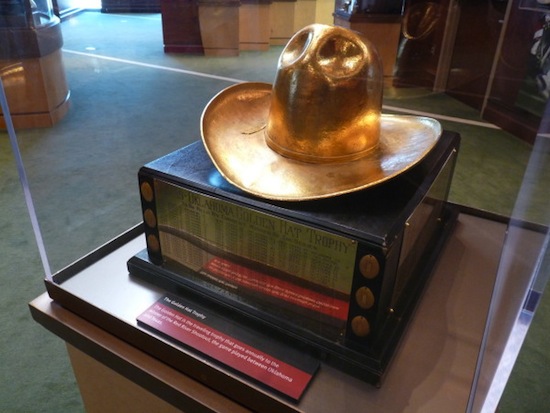
Texas leads the rivalry 61-45-5. The winner receives a trophy, the Golden Hat. In 1963, Texas came in ranked Number 1, and Oklahoma Number 2; Texas won. In 1984, Texas came in Number 1, Oklahoma Number 2, and in a driving rain and on a very slick carpet, Texas kicked a field goal on the last play to forge a 15-5 tie, which ended up sending both teams into mediocrity.
The Golden Hat

A running joke is that, unlike the Longhorns' rivalries with Texas A&M and Arkansas, and the Sooners' with Oklahoma State and Nebraska, this is a rivalry not for the people but the rich, and that millionaires have bet ranches and oil wells on the outcome, many regretting it.

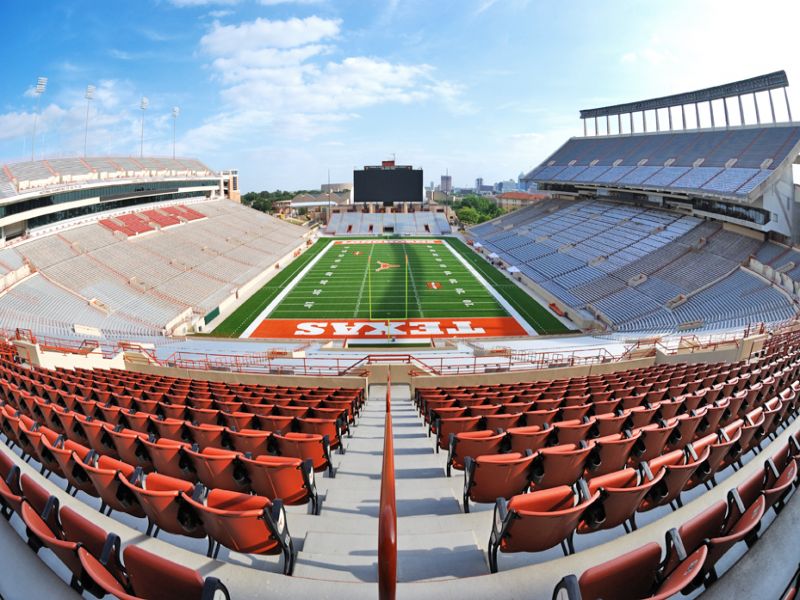
Texas' usual home field is Darrell K. Royal-Texas Memorial Stadium, about. Built in 1924, in 1996 it was named for the man who coached the Longhorns from 1957 to 1976. The official address is 405 E. 23rd Street, about 3 miles north of downtown. Bus 7. If you drive in, parking is $25. The playing surface is named Joe Jamail Field, a graduate of UT's Law School and a major benefactor.

It opened with 27,000 seats, increasing to 40,000 in 1926, 60,000 in 1948, 66,000 in 1968, 78,000 in 1971, 85,000 in 2006, and the current 100,119 in 2009. There is a plan to enclose the south end zone, the open end of the horseshoe, raising capacity to 115,000, topping even Michigan Stadium and Neyland Stadium in Tennessee.
You know the old saying, "Everything's big in Texas"? In 2006, a 7,370-square-foot scoreboard was added in the south end, nicknamed "Godzillatron," although it's got so many ads that it's also called "Adzillatron." The field runs north-to-south, and its original grass was replaced by artificial turf in 1969, went back to grass in 1996, and went to FieldTurf in 2009.
The board is almost as big as the bleacher it stands over.
A board as big as the crowd.

Oklahoma's stadium opened in 1923, as Oklahoma Memorial Stadium. The coach was Bennie Owen, and the playing surface was named Owen Field. Since so many major colleges had named their facilities "Memorial Stadium" (since so many had been built in the 1920s, in the aftermath of World War I), "Owen Field" became the most familiar name for the Sooners' place. It is also nicknamed The Palace On the Prairie.
In 2002, it was renamed Gaylord Family Oklahoma Memorial Stadium, after the Gaylords, the owners and publishers of The Daily Oklahoman, collectively donated $50 million to the University.

The address is 180 E. Brooks Street, a mile south of downtown. Bus 24. If you drive in, parking is a whopping $46.
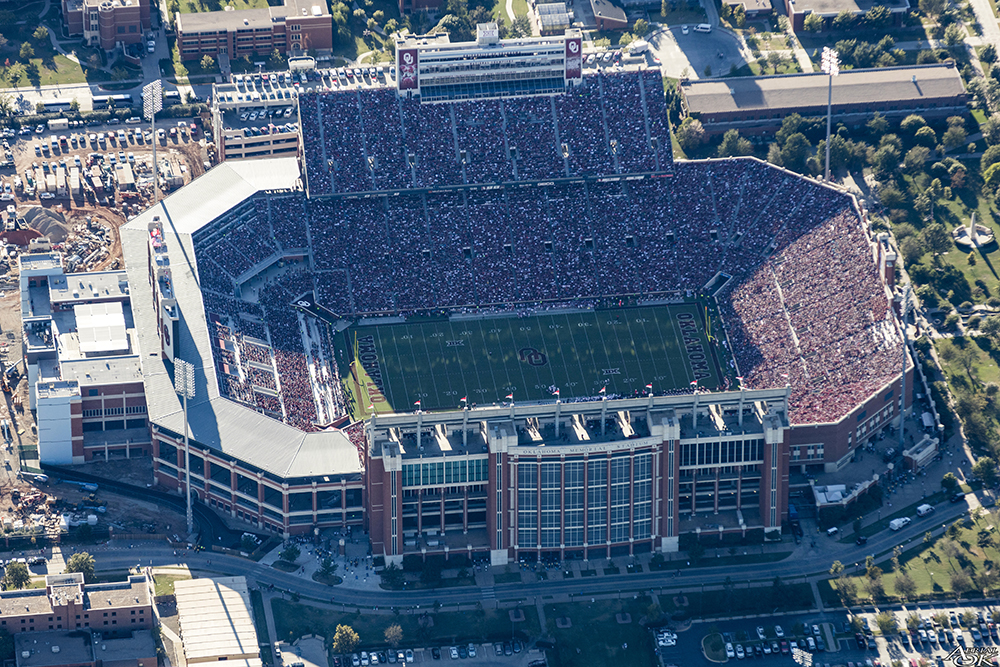
As with Texas' stadium, it was a horseshoe with the south end open, but has now been fully enclosed, including their own ginormous scoreboard. The field was artificial from 1970 to 1993, but has been real grass again since 1994. It seated 16,000 when it opened, and was expanded to 32,000 in 1929, 55,000 in 1949 following the initial success under Bud Wilkinson, 61,000 in 1957, 71,000 in 1975, 75,000 in 1984, 81,000 in 2003, and the current 86,112 in 2016. Unlike the Longhorns, the Sooners allow their stadium to be used for other purposes. This includes concerts.
September 17, 2016. Ohio State visited.
That's their band in the process of doing "Script Ohio."

UPDATE: Through the 2019 season, Texas leads Oklahoma 62-48-5, Texas A&M 76-37-5, Texas Tech 52-17, and Arkansas 56-22. Oklahoma leads Oklahoma State 89-18-7.

Food. According to the stadium's website, "During the Red River Showdown, Cotton Bowl Stadium has more than 75 concession areas with specialty items ranging from chicken fajitas to game-day staples of hot dogs and soft drinks. They are located just outside Gates 1 through 10. Additionally, on each ramp you will find express beverage service. All fans have access to these areas before and throughout the game."

The Red McCombs Red Zone Food Court -- named, as was UT's School of Business, for the car sales magnate who once owned the San Antonio Spurs, the Denver Nuggets and the Minnesota Vikings (not at the same time) -- is in the north end of Memorial Stadium, and is open on non-game days from 7:00 AM to 5:00 PM. It includes stands for Subway, Starbucks, Gatti's Pizza and Gigi's Cupcakes.

Oklahoma's Gaylord Stadium has Bavarian pretzels with cheese, Sooner Street Tacos, Mackdaddy's Onion Burgers, and Billy Sims Barbecue stands. The Heisman winner runs restaurants and markets his sauce to supermarkets.

Team History Displays. This game is so big because the teams and programs involved are so big. You can debate whether the greatest of all college football programs is Notre Dame, Alabama, USC, or anyone else; but any list of the Top 10 has got to include both Texas and Oklahoma. You don't have to like either one of them, or even respect them, but you should be impressed by their achievements. The Cotton Bowl isn't either team's home field, so, obviously, you won't see any display of those achievements there.

Texas was granted unofficial National Championships in 1914, 1941, 1968, 1977 and 1981. They officially claim National Championships, due to having won either the Associated Press (AP) writers' poll or the United Press International (UPI) coaches' poll in 1963 (both), 1969 (both) and 1970 (UPI); and in 2005, for having won the Bowl Championship Series. So that's 4 official, 9 counting the unofficial ones.

They won the Texas Intercollegiate Athletic Association title in 1913 and 1914; the Southwest Conference in 1916, 1918, 1920, 1928, 1930, 1942, 1943, 1945, 1950, 1952, 1953, 1959, 1961, 1962, 1963, 1968, 1969, 1970, 1971, 1972, 1973, 1975, 1977, 1983, 1990, 1994, and the last title of the league, 1995; and the Big 12 title in 1996 (the 1st season after the former Big 8 took in half of the SWC), 2005 and 2009. That's 32 league titles. They won the Big 12 South, but lost the Big 12 Championship Game, in 1999 and 2001.

Texas has appeared in the Cotton Bowl Classic 22 times, winning 11, both records, most recently in 2003. They've also won 2 Sugar Bowls, 2 Orange Bowls, 2 Fiesta Bowls, and 2 Rose Bowls, including the 2006 thriller with USC that won them their most recent National Championship. Overall, they have a 27-24-2 record in bowl games.

Texas has had 2 Heisman Trophy winners, both running backs: Earl Campbell in 1977 and Ricky Williams in 1998. Campbell's Number 20 (he wore 34 for the NFL's Houston Oilers) and Williams' Number 34 have been retired. So have the 22 of 1940s quarterback Bobby Layne, who starred for the Detroit Lions; the 60 of 1960s linebacker Tommy Nobis, the 1st draft pick and 1st star of the Atlanta Falcons; the 10 of 2000s quarterback Vince Young, whose pro career turned out every bit as star-crossed as Williams' and the 12 of Young's successor as quarterback, Colt McCoy, now with the Washington Redskins.

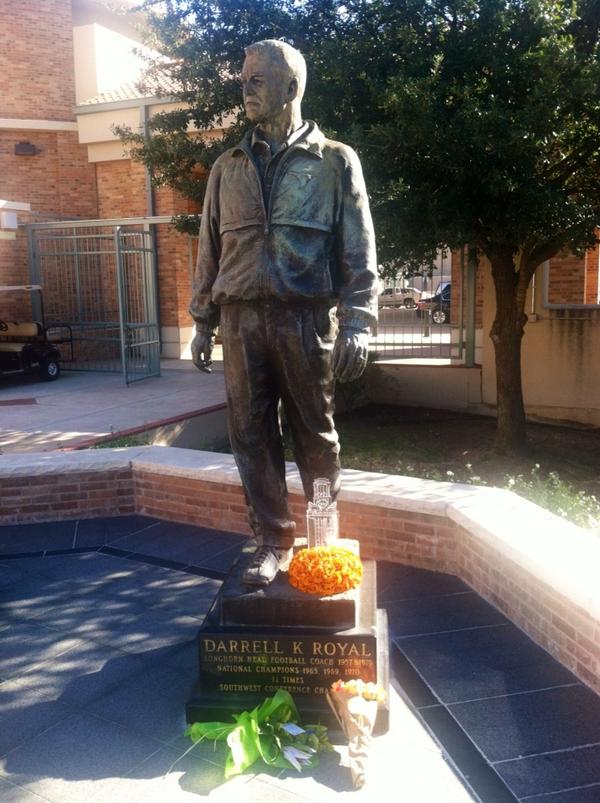
Campbell and Williams each have a statue outside Royal Memorial Stadium. So does Royal himself, who coached the 1963, 1969 and 1970 National Champions. Ironically, he was an Oklahoma native, and a University of Oklahoma quarterback under Bud Wilkinson.
Texas also has a trophy rivalry with Texas Tech of Lubbock, playing for the Chancellor's Spurs. The Longhorns lead the Red Raiders 50-15.
Texas' longstanding rivalries with Texas A&M and Arkansas have been interrupted due to conference realignments. The 1969 Texas-Arkansas game, in Fayetteville, was a Number 1 vs. Number 2 matchup, billed as one of those periodic "Game of the Century" matches, and was attended by President Richard Nixon. (Legend has it that Arkansas native and future President Bill Clinton attended, but he was at Oxford University at the time.)

Texas leads the rivalry 56-22, but the annual game stopped after Arkansas left the SWC for the Southeastern Conference in 1991 (rendering the SWC a Texas-only league, and probably leading to its doom 5 years later), they haven't played each other since Arkansas won the 2014 Texas Bowl, and they won't play each other again until 2021.

The game with Texas A&M was usually played on Thanksgiving Weekend, sometimes on Thanksgiving Day itself. They began playing in 1894, and is nasty as hell. Someone once said that in Texas, football is religion, and this is the holy war.

To a Texas Longhorn, A&M is a rural school, a "cow college," full of gung-ho rednecks. To a Texas Aggie, the Longhorns are effete intellectuals with more money than sense. There's a political aspect, too: The Longhorns are called "tea-sippin' liberals," too good for American and Texan values and good ole whiskey, and President Lyndon B. Johnson, the Democrat known for civil rights, health care and education (but also the Vietnam War), wisely put his Presidential Library literally across the street from Memorial Stadium.

In contrast, "A&M" stands for "Agricultural and Mechanical," but a common misconception is that it's "Agricultural and Military," and they have the Library of a Republican President, George H.W. Bush. (George W.'s is in Dallas, at his wife Laura's alma mater, SMU.)

A&M went from the SWC to the Big 12 with Texas in 1996, but left for the SEC in 2012. A last-second field goal gave the Longhorns a 27-25 win in what is currently the most recent meeting, on November 24, 2011. To keep the rivalry going, the schools agreed to establish the Lone Star Trophy, given to the school with the most wins against the other in other sports.
This is the kind of rivalry that made the great ABC college football announcer Keith Jackson say, "These two teams just... don't... like each other." How much do the Longhorns and Aggies hate each other? Each mentions the other in their fight song. The Aggies hate the Longhorns more: While the 'Horns merely sing, "And it's Goodbye to A&M" in "Texas Fight," the entire 2nd verse of "The Aggie War Hymn" is about hating the University of Texas. The Longhorns lead the rivalry 76-37-5.

Unlike the Longhorns, the Sooners display their titles, on the press box at Gaylord/Memorial/Owen. They've won National Championships in 1950, 1955, 1956, 1974, 1975, 1985 and 2000, as certified by either the AP, UPI, or the BCS. There are other titles, awarded by less authoritative agencies, that they do not claim.

They won the Southwest Conference title in 1915 and 1918; the league that would eventually be known as the Big 8 in 1920 (as the Missouri Valley), 1938, 1943, 1944, 1946, 1947 (these as the Big 6), 1948, 1949, 1950, 1951, 1952, 1953, 1954, 1955, 1956, 1957 (these as the Big 7), 1958, 1959, 1962, 1967, 1968, 1972, 1973, 1974, 1975, 1976, 1977, 1978, 1979, 1980, 1984, 1985, 1986 and 1987; and the Big 12 in 2000, 2002, 2004, 2006, 2007, 2008, 2010, 2012, 2015 and 2016. So that's 46 titles: 2 in the SWC, 34 in the Big 8, and 10 in the Big 12. In addition, they won the Big 12 South Division, but lost the Championship Game, in 2003.
Oklahoma is the only school to have 4 coaches with at least 100 wins at the school: Bennie Owen (1905-26), Charles Burnham "Bud" Wilkinson (1947-63), Barry Switzer (1973-88) and Bob Stoops (1999-2016). Included among Wilkinson's 145 wins was a 47-game unbeaten streak -- a tie, and then 46 straight wins. Led by running back Tommy McDonald and center-linebacker Jerry Tubbs, from 1953 to 1957 the Sooners avoided defeat in 47 straight games, and that's still a college football record. Both the last team and the next team to beat them was Notre Dame.

Owen and Wilkinson have statues outside the stadium. So do the school's 5 Heisman Trophy winners: 1952 running back Billy Vessels (whose pro career was cut short by injury), 1969 running back Steve Owens (played 5 years with the Lions), 1978 running back Billy Sims (was headed for a Hall of Fame career with the Lions before a knee injury ended it in his 5th season), 2003 quarterback Jason White (the only Heisman winner ever willing to turn pro and still not be drafted, due to concerns over his knees, and he has since gotten rich in retail), and 2008 quarterback Sam Bradford (now the starter for the Vikings).
Wilkinson's statue

Other Sooner football stars include Tommy McDonald (Hall of Fame receiver for the 1950s Philadelphia Eagles), Bob Kalsu (Buffalo Bills linebacker killed in action in Vietnam), Greg Pruitt (All-Pro running back for the 1970s Cleveland Browns), Joe Washington (All-Pro running back for the 1970s Baltimore Colts and the 1980s Washington Redskins), Lee Roy Selmon (Hall of Fame defensive tackle for the Tampa Bay Buccaneers, who played on OU's defensive line with his brothers Dewey and Lucius), Brian Bosworth (controversial 1980s linebacker who went into action movies) and Tony Casillas (defensive tackle for the 1990s Dallas Cowboys). However, the Sooners do not retire uniform numbers, so even Sims' 20 is still available.

Oklahoma has won 29 bowl games, including the Orange Bowl (once with an automatic bid to the Big 8 Champions) in 1954, 1956, 1958, 1959, 1968, 1976, 1979, 1980, 1981, 1986, 1987 and 2001 (and denied for 1955 and 1957, due to a rule, soon changed, that prohibited back-to-back appearances); the Sugar Bowl in 1949, 1950, 1972, 1973, 2014 and 2017; the Fiesta Bowl in 1976 and 2011; the Cotton Bowl in 2002; and the Rose Bowl in 2003.

Texas, in 2004, and Oklahoma, in 2010, are 2 of the 5 schools to have won all 5 major bowls. The others: Notre Dame in 1989, Penn State in 1995 and Ohio State in 1999.

Oklahoma's main in-State rival is Oklahoma State. It is called the Bedlam Series, and is one of the most lopsided rivalries in major college football. They first played each other in 1904, and have played every year since 1910. The Sooners lead the Cowboys 86-18-7. From 1946 to 1994, the Sooners led 45-3-1. It's been closer since 1995: The Sooners lead 15-7.

For many years, Oklahoma's biggest rivalry was with Nebraska, as the 2 schools dominated the Big 8 in the 1960s, '70s and '80s. Oklahoma leads, They first played in 1912, and played every year from 1928 to 1997. But changing conference lineups ended that. They played each other in the Big 12 Championship Game in 2006 and 2010 (Oklahoma won both times). But with Nebraska now in the Big 10, the game becomes even rarer. The schools recently signed a deal to play each other in 2021 and 2022 (home-and-home). The Sooners lead the Cornhuskers, 45-38-3.

The rivalry included the site of the 1971 "Game of the Century," when they played each other on Thanksgiving Day (the only major college football game scheduled for that day that year, thus the entire country could watch it), with the Sooners ranked Number 1 and the Cornhuskers ranked Number 2. Nebraska won, and went on to win the National Championship.

Stuff. There are souvenir stands at the Cotton Bowl, but no big team store, as no team officially calls it home any longer. Longhorns Limited is located in under the west stand at Royal Memorial Stadium. Texas' University Co-Op is at 2246 Guadelupe Street, about a 10-minute walk from the stadium. The University of Oklahoma Bookstore is at 1185 Asp Avenue (yes, Asp like the snake), just outside the stadium's west stand.

Dan Myers published The Story of the Cotton Bowl -- the game, not just the stadium -- in 2015. In 1997, John Eisenberg wrote Cotton Bowl Days: Growing up with Dallas and the Cowboys in the 1960s.

Mike Shropshire, author of a few books on Dallas sports, wrote Runnin' with the Big Dogs: The Long, Twisted History of the Texas-OU Rivalry in 2007. Bobby Hawthorne wrote Longhorn Football: An Illustrated History in 2007. Royal and Pat Culpepper published Coach Royal: Conversations with a Texas Football Legend in 2005, 7 years before the coach died. Terri Frei of the Denver Post wrote Horns, Hogs, and Nixon Coming: Texas vs. Arkansas in Dixie's Last Stand, about the 1969 Texas-Arkansas Game.

In 1991, John Maher and Kirk Bohls wrote Bleeding Orange: Trouble and Triumph Deep in the Heart of Texas Football. Not to be outdone, a Texas A&M fan named Frank W. Cox III soon cranked out a book titled I Bleed Maroon.

Ray Dozier wrote Legends of Oklahoma Sooners Football in 2014. Bud Wilkinson: An Intimate Portrait of an American Legend was published in 1994, shortly after he died, by his son Jay Wilkinson and businesswoman Gretchen Hirsch.

The DVD The History of Texas Longhorns Football immediately followed the 2006 Rose Bowl, to include the latest National Championship. The History of Oklahoma Football came out in 2010.

During the Game. During the Fair, your safety probably won't be a problem. Otherwise, South Dallas can be a bit dicey. As for the game: Whichever side you pick, stick with them, and don't approach the other side. If you can somehow make it clear that you're a neutral, you should be okay.

Each school gets the same number of tickets. The stadium will be split right down the middle, at the 50-yard-line: Longhorn Burnt Orange at the north and west, Sooner Crimson at the south and east.

The Oklahoma Land Rush of 1889 inspired the title of the OU fight song, "Boomer Sooner." The music was swiped from Yale's "Boola Boola," and they also swiped an idea from North Carolina's "I'm a Tar Heel Born." Through their Show Band of the Southwest, UT has 2 fight songs: "The Eyes of Texas" (to the tune of "I've Been Working On the Railroad"), and "Fight, Texas."
The Land Rush -- the participants were known as the 89ers -- also inspired Oklahoma's mascot, the Sooner Schooner, a prairie schooner pulled by 2 ponies, named, naturally, Boomer and Sooner. Debuting in 1964, it leads the team onto the field, and circles the stadium after after touchdown.
On Thanksgiving Day 1916, Texas beat Texas A&M 21-7. At that game, the 1st live longhorn steer mascot was introduced. Ben Dyer, editor of a campus magazine, named him BEVO, a play on "beeve," which Texans used as the plural of "beef."

On February 12, 1917, A&M students broke into the stockyard where the steer was kept, and branded the score of the previous year's game on him, which the Aggies won: "13 - 0." Aside from being cruel to the animal, these Aggies were idiots: It was easy to adjust the branding of the 13 to a B, consider the zero an O, and make it "BEVO." Most people believe that's where the name came from, but the name appeared in accounts of the Thanksgiving game 3 months earlier.

Bevo XIII was the longest-serving mascot, 16 years, including Ricky Williams' Heisman season and the most recent last Longhorn National Championship. The current mascot is Bevo XV. He is kept at the stadium's south end, and when a Longhorn player scores a touchdown at that end, he runs over to greet Bevo.

Given the animal's actual long horns, it is one of the meanest-looking live mascots. But a live bull would be too difficult to handle. So he's a steer. It has been suggested that Bevo be given "neuticles": Implants that look like testicles, so that he'll look more masculine. This idea has been rejected.

For similar reasons of needing to be able to handle the animal, the University of Colorado uses a female buffalo as their mascot Ralphie. Someone once joked about cross-breeding Ralphie and Bevo, but Ralphie's trainer had to remind the jokester about the difference between a bull and a steer.

Harley Clark, later a federal Judge, was head cheerleader in 1955, and told the crowd at a pep rally at Gregory Gym on November 11, 1955, before their game with Texas Christian (TCU) the next day, "This is the official hand sign of the University of Texas, to be used whenever and wherever Longhorns gather!" He held up his index finger and pinky, so that his hand resembled the Longhorn logo. The "Hook 'Em, Horns" gesture was born.

Clark was told by Arno Nowotny, the dean of student life, that he had unwittingly copied the malocchio, the Sicilian "Evil Eye" gesture. This can be even nastier: When shaken, it is also taken by Mediterranean-based cultures such as the Italians, Greeks, Spanish and Portuguese to mean you've been cuckolded. Clark responded, "Dean, you need to look on the bright side of things. Instead of our mascot being a longhorn, it could've been a unicorn!"

In spite of its resemblance to the malocchio, and to the later-invented heavy metal "devil horns" gesture, the Hook 'Em sign is familiar to college football fans from coast to coast, whether they are "Texas Exes" or otherwise.
Judge Clark flashing his invention in front of the Tower,
a few years before his death in 2014

The Austin campus' the Main Building, known as The Tower, is normally lit up in white lights at night. But, like the Empire State Building, different colors are chosen for special occasions. And when the Longhorns win a football game, the lights are burnt orange.

After the Game. Dallas has a bit of a bad reputation when it comes to crime, but you'll be pretty far from it. Not only is the stadium not in a bad neighborhood, it's one of those stadiums that's not really in any neighborhood. As long as you don't make any snide remarks about the Cowboys, or make any liberal political pronouncements, safety will not be an issue.

Buffalo Joe's, at 3636 Frankford Avenue, is the local Giants fan bar. But it's 22 miles due north of downtown Dallas. Even further, the Cape Buffalo Grille, at 17727 Addison Road in Addison, 28 miles northeast of AT&T Stadium, has been described by a Giant fan as "a lifesaver for people from New York and New Jersey." Humperdink's, at 6050 Greenville Avenue in north Dallas, 15 miles north of downtown, seems to be the local home of Jet fans.

If you visit Dallas during the European soccer season, as we are now in, the best-known "football pub" in town is Trinity Hall, at 5321 E. Mockingbird Lane, just off the SMU campus. Blue Line to Mockingbird Station.

The UT campus is seriously sprawled, and you may have to go downtown to find a good place to eat. About 5 blocks south of the stadium is the Scholz Garten, a German-themed burgers, brats and beer place at 1607 San Jacinto Blvd. Sports Illustrated once included it as a reason why they believe Austin was the best college town in America: "If you don't like Austin, you're a sad case."

Austin is a very good city for watching European soccer: At The Tavern (Arsenal, 922 W. 12th Street, at the western edge of downtown), Bull McCabe's (Liverpool, 714 Red River Street), Fado (Manchester United, 214 W. 4th Street), Haymaker (Manchester City, 2310 Manor Road, 3 miles northeast of downtown, Bus 20), and Quatro (Barcelona, 4407 Bee Cave Road, 5 miles west of downtown, Bus 30 only gets you within 2 miles).

But if you're in Norman, and you want to see your favorite club before watching a Sooner home game, you may have to head up to Oklahoma City, to Skinny Slim's, at 201 E. Main Street, downtown, and hope you can make it back to Norman for kickoff.

Sidelights.  My sidelights for Dallas can be found in my entries for them. The short version: The Mavericks and Stars play downtown at the American Airlines Center, while the Rangers and Cowboys play 18 miles west in suburban Arlington.

UPDATE: On November 30, 2018, Thrillist published a list of "America's 25 Most Fun Cities," and Austin came in 10th, while Dallas came in 14th. 

The 16,540-seat Frank C. Erwin Jr. Special Events Center has been the home of Texas basketball since 1977. Erwin was a member of UT's Board of Regents. 1701 Red River Street, about a 5-minute walk south of the stadium, about halfway between it and the State Capitol.
Austin's nearest professional baseball team is the Round Rock Express, owned by Nolan Ryan (the Hall of Fame pitcher from the Houston suburbs, a.k.a. The Ryan Express) and his family. Appropriately, they are a farm team of the Texas Rangers, in Class AAA, in the now-inaptly-named Pacific Coast League. They've made the Playoffs 3 times in their 1st 18 seasons, most recently in 2015.

They play at the 11,631-seat Dell Diamond. 3400 E. Palm Valley Blvd., 21 miles north of downtown Austin. No public transit.
Elvis Presley sang in Austin 5 times: On March 17, 1955 (the day of the Rocket Richard Riot in Montreal), at Dessau Dance Hall, 13422 Dessau Road, 14 miles northeast of downtown, no public transit (the original burned down in 1967, replaced with this one in 1969); on August 25, 1955, at the Sportcenter, now the Armadillo World Headquarters, 501 Barton Springs Road, just south of the river from downtown, Bus 10; on October 6, 1955, at the Skyline Club, 11306 N. Lamar Blvd., about 10 miles north of downtown, Bus 801; on January 18, 1956, at the City Coliseum, 701 W. Riverside Drive, across from the Sportcenter site; and on March 28, 1977, at the Municipal Auditorium, also at that location.

Austin is home to the Texas Memorial Museum, 2400 Trinity Street, just to the north of Memorial Stadium; the Lyndon Baines Johnson Presidential Library, 2313 Red River Street, just to the northeast of the stadium; the Bullock Texas State History Museum, 1800 Congress Avenue; and the Blanton Museum of Art, right across from the Bullock Museum at 200 E. Martin Luther King Jr. Blvd.

The tallest building in Austin is The Austonian, at 683 feet the tallest residential building west of the Mississippi River. 200 N. Congress Avenue. Of course, you can't talk about tall buildings in Texas without referring to the University's 307-foot Tower. Built in 1937, it is, as I said, lit up in certain colors for special occasions, white otherwise.
But it's best known for the 96-minute shooting spree on its 28th floor observation deck by Charles Whitman on August 1, 1966, resulting in the wounding of 34, 17 of whom died, before the police managed to get off a shot that killed him.

The 11,562-seat Lloyd Noble Center has been the home of Oklahoma basketball since 1975. It was named for Samuel Lloyd Noble, a Houston oilman who had donated to OU. Elvis Presley sang there And he did shows at the Lloyd Noble Center n March 25 and 26, 1977. 2900 Jenkins Avenue, about a mile south of the stadium. No bus service.
Oklahoma's basketball team reached the Final Four in 1947, 1988, 2002 and 2016, but has never won a National Championship in that sport. They also have highly-regarded baseball, wrestling and track programs.

Oklahoma City is home to Chesapeake Energy Arena, home court of the Oklahoma City Thunder, 100 W. Reno Avenue, downtown; and Chickasaw Bricktown Ballpark, home field of the Oklahoma City Dodgers, 2 S. Mickey Mantle Drive, Bus 38. (UPDATE: In 2021, this arena was renamed the Paycom Center.)

The Fred Jones Jr. Museum of Art, at 555 Elm Avenue, about a 10-minute walk northeast of Gaylord Family Stadium. The Sam Noble Oklahoma Museum of Natural History is at 2401 Chautauqua Avenue, about a mile southwest of the stadium.

The MTV sitcom Faking It was set in Austin. The TNT crime drama Saving Grace was set in Oklahoma City, hometown of its creator Nancy Miller. While it used some location shots, it was largely filmed in Los Angeles and Vancouver. The HBO series Carnivàle was also set in Oklahoma, but filmed in Southern California.

(UPDATE: In 2021, Hulu premiered the drama Reservation Dogs, set on a Native American reservation in Oklahoma. The show, whose title is a play on the Quentin Tarantino film Reservoir Dogs, is billed as the 1st TV series filmed completely in Oklahoma.)

Special Agent Eleanor "Ellie" Bishop on NCIS grew up on an Oklahoma farm and is an Oklahoma State graduate, and has an OSU pennant on the wall of her cubicle. She is played by Emily Wickersham, who actually grew up in Mamaroneck, New York and went to Muhlenberg College in Pennsylvania. The University of Oklahoma doesn't have a claim on a pop-culture figure even that big.

*

Texas is a weird place, and the Dallas-Fort Worth Metroplex is no exception. But it's a pretty good area for sports, and the Texas-Oklahoma game is its signature sporting event, even more than the Cotton Bowl or Cowboys football. Go in and say, "Howdy."