Showing posts with label tommy john. Show all posts

Sunday, August 16, 2026

Tommy John, 1943-2026

Before the surgery, for 31 years, there was the man. After the surgery debuted, for 52 years, there was the man. And, as rough as the condition that requires the surgery, and the return from it, can be, you'd much rather have the surgery named for Tommy John than the disease named for an earlier Yankee star, Lou Gehrig.

Thomas Edward John Jr. was born on May 22, 1943 in Terre Haute, Indiana. He starred in baseball and basketball at that city's Gerstmeyer High School, and was the valedictorian of its Class of 1961. But he had a stutter, so the school wouldn't let him give the valedictory speech.

In 1971, Gerstmeyer was consolidated with Garfield High School, which produced basketball stars Clyde Lovellette and Terry Dischinger. The combined school, Terre Haute North Vigo High School, has produced Major League Baseball players Brian Dorsett and Josh Phegley, and football stars Anthony Thompson and Steve Weatherford.

John was signed out of high school by the Cleveland Indians. He made his major league debut on September 6, 1963, wearing Number 37, pitching the 7th inning and allowing an unearned run on 2 hits, in a 7-2 loss to the Washington Senators at District of Columbia Stadium (later renamed Robert F. Kennedy Stadium) in Washington.

The Indians split him between starting and relieving the rest of 1963, and all of 1964. On January 20, 1965, the Indians made an epic mistake. It was the 2nd time they had done so with a trade involving slugging right fielder Rocky Colavito. They had traded Colavito, then 26 years old, to the Detroit Tigers for Harvey Kuenn, and it worked out considerably better for the Tigers. Now, Colavito was 31, and struggling with injuries, was not the same player, and ended up playing his last major league game at 35..

It was a 3-way trade. The Indians got Colavito and Cam Carreon, basically a throw-in. The Kansas City Athletics got Jim Landis, Mike Hershberger and Fred Talbot, none of whom did much for them. And the Chicago White Sox got Tommy John, Tommie Agee and John Romano.

Romano, a catcher, gave the White Sox 2 good seasons before injuries cut his career short. Agee became the American League Rookie of the Year in 1966, and also hit well in 1967, before the White Sox made the mistake of trading him to the Mets.

But this trade still worked out well for the White Sox, as they put John into the starting rotation. Switching to the Number 25 that he wore for the rest of his career, he won 14 games in both 1965 and '66. In '66, he led the AL with 5 shutouts. In 1967, he went 10-13, but had a 2.47 ERA, and again led the AL in shutouts, with 6. The White Sox were in the AL Pennant race until the final weekend.

After the 1971 season, they traded John and utility infielder Steve Huntz to the Los Angeles Dodgers for Dick Allen. This trade worked out very well for both teams. Allen led the AL in home runs in 1972, winning the AL Most Valuable Player award, and it's been suggested that the attendance he brought in saved the South Siders from being moved.

John went 11-5 for the Dodgers in 1972, 16-7 for a National League-leading .696 winning percentage in 1973, and was 13-3 for a League-leading .813 percentage in 1974, helping the Dodgers win the Pennant, before an injury cut his season short on July 17.

Would the Dodgers have won the 1974 World Series, against the Oakland Athletics, if John had been available? He likely would have started Game 3 instead of Al Downing, which the Dodgers lost, 3-2. (All 5 games, including Game 2, which the Dodgers won, ended with a 3-2 score.) Even if he had outpitched Catfish Hunter that day, he still would have had to start Game 6 and win again.

*

On September 25, 1974, John underwent surgery on his left elbow, his pitching elbow. The procedure was performed at Memorial Hospital in Los Angeles, by Dr. Frank Jobe. This procedure is one where the ulnar collateral ligament in the medial elbow is replaced with either a tendon from elsewhere in the patient's body, or with one from a deceased donor. It became known as "Tommy John Surgery" or "TJS."
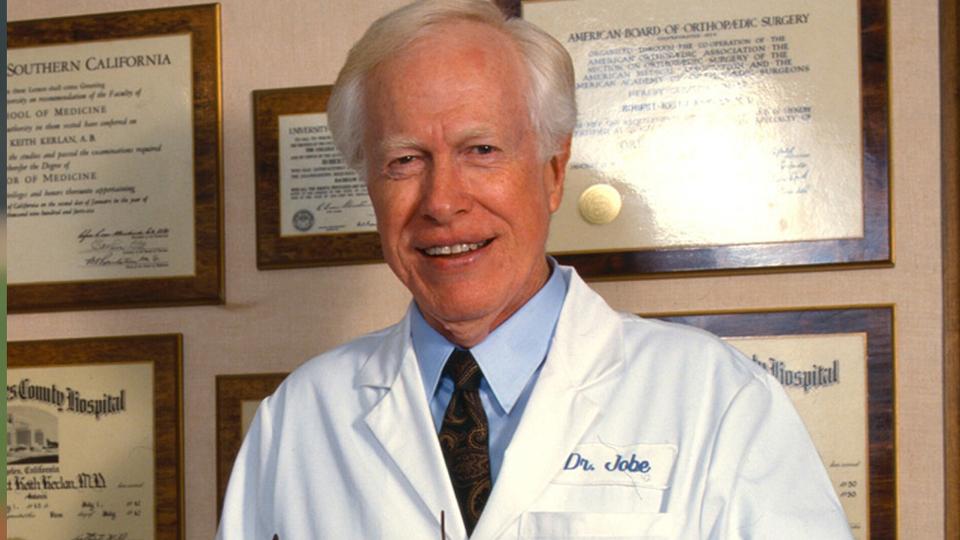
Dr. Frank Jobe

Jobe gave the operation 100-1 odds of being successful, but John had it anyway, as his other option was to start working at a friend's car dealership back in Terre Haute.

Traditionally, a pitcher misses an entire season in rehabilitation from the surgery. Some come back from it well, some don't. Some end up needing a 2nd TJS. The fact that John, the 1st pitcher to undergo the procedure, came back so well from it gave other pitchers hope.

A year and a half later, on April 16, 1976, John returned to the mound. He didn’t pitch well, losing to the Atlanta Braves, 3-1 at Atlanta-Fulton County Stadium. But he pitched without pain. Switching from his former blazing fastball and hard curveball to a sinker, in 22 games, all starts, he went 10-10 with a 3.09 ERA.

In 1977, he went 20-7, his 1st 20-win season, and had a 2.78 ERA. The Dodgers won the Pennant, and he started Game 3 of the World Series, but lost it to the Yankees and Mike Torrez. In 1978, he went 17-10 with a 3.30 ERA. The Dodgers won the Pennant again, and he started and won Game 1 of the World Series against the Yankees. He also started Game 4, and pitched well, but was not involved in the decision, as the Yankees won in 10 innings.

Yankee owner George Steinbrenner must have liked what he saw: His contract with the Dodgers having run out, on November 21, 1978, the Yankees signed John to a 3-year contract worth $1.4 million. He was never better than when he was a 36- and a 37-year-old Yankee: He went 21-9 with a 2.96 ERA in 1979, and 22-9, including winning his 1st 7 decisions, and a 3.43 ERA in 1980. That year, he finished 2nd int he AL Cy Young Award voting to Steve Stone, who won 25 games for the Baltimore Orioles.
In the strike-shortened 1981 season, he went 9-8, 2.63. The Yankees won the Pennant, and he pitched 7 innings of 3-hit shutout ball against the Dodgers to win Game 2 of the World Series. The Yankees were 2 wins away from getting him his World Series ring.

But the Dodgers won the next 3 games. After 4 innings of Game 6, and the score 1-1, Yankee manager Bob Lemon screwed up, sending Bobby Murcer, another man who was closer than ever to a ring than at any time in a long career, up to pinch-hit for John. He flew out. Lemon then sent George Frazier in to relieve for John, and he allowed 3 runs in the 5th. The Yankees lost, 9-2, and John had now been in 3 World Series, all of them Yankees vs. Dodgers, and on the losing side of all 3.

Steinbrenner began to break up the dynasty. This included a trade on August 31, 1982: He sent John to the California Angels for pitcher Dennis Rasmussen. He did well for the Yankees, but they got rid of him too soon, so this wasn't a bad trade for them.

Like Steinbrenner, Gene Autry, the legendary entertainer known as "The Singing Cowboy" and the owner of the Angels, was willing to spend big money if he thought it would get him big results. The 1982 Angels' pitching staff included such veteran stars as John, Luis Tiant, Stan Bahnsen (all former Yankees), Bruce Kison, Steve Renko, Andy Hassler, Ken Forsch, Dave Goltz and John Curtis. Their veteran hitters included former Yankee Reggie Jackson, perennial AL batting Champion Rod Carew, Fred Lynn, Don Baylor (all former AL MVPs), Bob Boone (Aaron' father), Rick Burleson, Doug DeCinces, Juan Beníquez and Brian Downing.

It almost worked: The Angels won the AL Western Division title, and led the AL Championship Series 2 games to none. But the Milwaukee Brewers won the next 3 games to take the Pennant.

John never came so close to a Pennant again. The Angels released him in midseason in 1985, and he signed with the Oakland Athletics. They released him after the season. He was 42 years old, and that year off was 10 years back. It looked like he was done.

But injuries to their starting pitchers led the Yankees to bring John back on May 2, 1986. He made 13 appearances, including 10 starts, and went 5-3 with a 2.93 ERA. In 1987, he made 33 starts, and went 13-6, although his ERA rose to 4.03. In 1988, he turned 45, and was the oldest player in baseball, though that elbow ligament was only 14 years old. He 35 appearances, including 32 starts, and went 9-8 with a 4.49 ERA.

In 1989, he made 10 appearances, all starts, and went 2-7 with a 5.80 ERA. On May 30, 5 days after his last appearance, and 8 days after his 46th birthday, the Yankees released Tommy John.

*

When he began his career, John F. Kennedy was President, and had just spoken at the two-year-old Berlin Wall. There were 20 teams in Major League Baseball, 9 of them playing in ballparks that opened in 1912 or earlier, and none of them playing on artificial turf or under a dome. Stan Musial was still playing, and Casey Stengel was still managing. Tom Seaver was in college, Reggie Jackson and Mike Schmidt were in high school, and Barry Bonds and Mark McGwire were about to be born.

When he ended his career, George H.W. Bush was President, and the Berlin Wall was 5 months away from coming down. There were 26 teams in Major League Baseball, 3 of them playing in ballparks that opened in 1912 or earlier, 10 of them playing on artificial turf, and 4 of them playing under a dome. Ken Griffey Jr., Sammy Sosa, Larry Walker and Jim Abbott were rookies. Derek Jeter was in high school, David Ortiz was in junior high; and Giancarlo Stanton, George Springer and Freddie Freeman were born.

Does Tommy John belong in the Baseball Hall of Fame? He won 288 games, and lost 231, for a winning percentage of .555. Indeed, he won more games after his surgery, 164, than he did before it, 124. Or, as John himself has put it, he won just 1 fewer game after his surgery than Sandy Koufax did in his entire injury-shortened career. (Given the nature of his condition, John's surgery, had it been available in Koufax's time, would have done him no good.) He also made more All-Star Games after, 3, than before, 1. His career ERA was 3.34, his ERA+ was 111, he pitched 46 shutouts, he had 2,245 strikeouts, and his WHIP was 1.283.

Here is a list of all the pitchers who match or surpass him in wins, winning percentage, shutouts and strikeouts, in chronological order: Cy Young, Christy Mathewson, Eddie Plank, Walter Johnson, Warren Spahn, Steve Carlton, Tom Seaver and Roger Clemens. That's it, that's the list: 8 guys. And only 4 of them pitched all or most of their careers in the post-1920 Lively Ball Era: Spahn, Carlton, Seaver and Clemens.

Baseball-Reference.com, a website that makes writing this blog far easier, has a Hall of Fame Monitor, on which a "Likely HOFer" is at 100, John is at 112, suggesting that he should be in. It also has a Hall of Fame Standards, on which the "Average HOFer" is at 50; John is at 44, suggesting that he falls short.

It also has Similarity Scores, usually comparing players of similar positions. John's Top 10 most statistically similar pitchers are Jim Kaat, Robin Roberts, Bert Blyleven, Fergie Jenkins, Early Wynn, Tom Glavine, Burleigh Grimes, Tony Mullane, Don Sutton and Eppa Rixey. Mullane is the only one of these who is not in the Hall of Fame.

While he was eligible for election by the Baseball Writers Assocation of America, which votes on recently retired players, from 1995 to 2009, T.J. never received as much as 32 percent of the vote. He has been eligible for the Veterans Committee's Modern Era Subcommittee in 2020, and its Classic Era Subcommittee in 2025, but fell short both times.

In my opinion, he should be in the Hall of Fame, not just for the historical significance of the surgery that bears his name and has saved many other careers after his, but on merit. Essentially, he had two good careers that added up to one great career.

*

In 2012, Lindsey Berra, Yogi's granddaughter, who works for ESPN, pointed out that 1 out of every 7 pitchers then in the major leagues had undergone Tommy John surgery at some point in their careers.

Like basketball star Bill Walton, John overcame his stutter and became a broadcaster in his sport, calling games for the Minnesota Twins from 1994 to 1996, the International League's Charlotte Knights in 1997, and the Yankees in 1998.

That year, he participated in the Yankees' Old-Timers Day festivities at Yankee Stadium. I was at that game, as they celebrated the 20th Anniversary of the 1977 and 1978 World Series, inviting several former Yankees and former Dodgers. In the Old-Timers Game between the former Yankees and the former Dodgers, John pitched for the Dodgers, and gave up a walkoff home run to Willie Randolph. At the age of 55, he still wasn't ending up on the winning side of Yankee-Dodger festivities.

He was hired as the pitching coach at Furman University in Greenville, South Carolina. In the 2002 and 2003 seasons, he coached in the Montreal Expos' organization. In 2004 and 2005, he returned to the Pinstripe organization, as the manager of the Class A Staten Island Yankees. He managed the Connecticut-based Bridgeport Bluefish of the independent Atlantic League from the start of the 2007 season to mid-2009, resigning to go into business, including advertising a joint cream. He had no connection to the Tommy John underwear company.
Tommy John and Mariano Rivera,
a few Old-Timers Days ago

John married twice, and had 4 children, all of them with names beginning with T, and 2 of them touched by tragedy. In 1981, his 2-year-old son Travis fell nearly 40 feet from a 3rd-story window of the family's rented house in New Jersey, and lapsed into a coma for nearly 3 weeks. He underwent successful treatment, and returned home to walk and play normally. Steinbrenner invited him to throw out the ceremonial first ball before Game 2 of the 1981 World Series.

Taylor John wasn't son lucky: He dealt with depression, and in 2010, he took his prescription drugs in the wrong combination, and died from an overdose. He was 28 years old. "He was the greatest kid in the world, but he would get into these panic spells and deep abysses," his father said. "He was wired different than the rest of us."

Daughter Tamara went to Duke University, where she met her husband, Patrick Mannelly, who went on to play for the Chicago Bears. Son Tommy John III pitched for his father at Furman, named All-Southern Conference. It shouldn't surprise anyone to know that one of Tommy John's children went into medicine: Tommy III became a chiropractor, and wrote Minimize Injury, Maximize Performance: A Sports Parent's Survival Guide, which discusses the injury risk associated with young athletes specializing in one specific sport and suggests ways to prevent youth from ever having to undergo major sports-related surgery, such as Tommy John surgery.

Tommy John and his 3rd wife, Cheryl Zeldin, settled in Bradenton, Florida, in the Tampa Bay area. He fell victim to bladder cancer, and died yesterday, on August 15, 2026, at the age of 83.

In 1987, in his 2nd tenure with the Bronx Bombers, he was one of the people interviewed for the documentary New York Yankees: The Movie. So were Yankee legends Mickey Mantle, Yogi Berra, Phil Rizzuto and Whitey Ford. Clips of interviews of Babe Ruth, Lou Gehrig, and the then-still-living Joe DiMaggio and the still-living-now Reggie Jackson were included.

With John's death, there are only 8 survivors among the interviewees: Bobby Richardson, and John's former teammates Roy White, Lou Piniella, Ron Guidry, Willie Randolph, Dave Righetti, Dave Winfield and Don Mattingly.

Thursday, April 3, 2014

St. Louis' All-Time Baseball Team

The St. Louis Cardinals' "territory" is spread over several States, although not as many as there used to be. In the pre-expansion era, powerful radio station KMOX broadcast the Cards' games over about 75 percent of the country. As both the Westernmost team in the majors until 1955, and the Southernmost until 1962, Cardinal fans are still all over the South despite the Atlanta Braves and the Florida and Texas teams, and all over the Midwest despite the arrival of teams in Kansas City, Minnesota and even Colorado.

Today, however, their region is pretty much "limited" to Eastern Missouri, Southeastern Iowa, Southern Illinois, Southwestern Indiana, the Western edges of Kentucky and Tennessee (Memphis' Elvis Presley was a big Cards fan), Northern Mississippi and Northeastern Arkansas.

I grew up in Central Illinois, about halfway between Chicago and St. Louis, and I made a historic blunder: All my friends became Cardinal fans and grew up happy and liberal, and I became a Cub fan and grew up embittered and conservative.
-- George Will, nationally-syndicated columnist for the Washington Post and author of two books about baseball.

He grew up in Champaign, as his father was a professor at the University of Illinois. The campus is 144 miles from Wrigley Field, 134 miles from U.S. Cellular Field, 173 miles from Busch Stadium, and 236 miles from Cincinnati's Great American Ballpark. So he had other choices he could have made.

However, traditionally, Cub fans have been rather liberal, while Cardinal fans have usually been conservative. This is not written in stone, though: Bill Clinton, a liberal who grew up in Hot Springs, Arkansas, 415 miles from St. Louis, and Rush Limbaugh, a right-wing fanatic who grew up in Cape Girardeau, Missouri, 119 miles away, are both big Cardinal fans. (No wonder Bill and Hillary "had problems in their marriage": Hillary grew up in Park Ridge, Illinois, just 12 miles from Wrigley, and was a Cub fan -- before she became a Yankee Fan!)

Anyway, here's...

2. St. Louis' All-Time Baseball Team

1B Gil Hodges of Princeton, Indiana. Putting aside for a moment the fact that he managed the New York Mets, for crying out loud, to a World Series win, he is one of the players not in the Hall of Fame who most deserves it. He had a career OPS+ of 120, the first 3 Gold Gloves given to National League first basemen (the first of which when he was already 33 years old), 7 straight 100-RBI seasons, and 370 home runs despite missing 3 seasons due to World War II.

At the time he played his last game, he was 11th on the all-time home run list, trailing only Jimmie Foxx and, just recently surpassed at that point, Willie Mays among righthanders (and Mickey Mantle if you count switch-hitters). He helped the Dodgers win 7 Pennants (6 in Brooklyn, 1 in Los Angeles) and 2 World Series (1 in each city). His Number 14 was retired by the Mets, but not by the Dodgers. There is no good reason to not have Hodges in the Hall.

St. Louis is loaded at 1st base for its history, having Honorable Mentions dishable out to St. Louis natives Roy Sievers and Ryan Howard (who may replace Hodges as the starter someday); 1890s hitting star and Hall-of-Famer Jake Beckley of Hannibal, Missouri; and Hodges' fellow Hoosier Don Mattingly of Evansville.

2B Red Schoendienst of Germantown, Illinois. A 10-time All-Star, he helped the Cardinals to win the World Series in 1946 and the Milwaukee Braves to do it in 1957, and another Pennant in '58. He suffered from tuberculosis and missed most of '59 and half of '60, or else the Braves might have won 4 straight Pennants. He led the NL in stolen bases as a rookie in 1945, doubles and sacrifice hits in 1950, and hits in 1957. His lifetime batting average was .289. He was never a home run hitter, but he collected 2,449 hits including 427 doubles in an illness-shortened playing career. 

He returned to the Cardinals as their manager, winning the 1967 World Series and the 1968 Pennant. He has occasionally returned as Cards' interim manager, such as during Ken Boyer's fatal illness. The Cards have retired his Number 2, and he is in the Hall of Fame.

SS Don Kessinger of Forrest City, Arkansas. A 6-time All-Star and a 3-time Gold Glove, the Chicago Cub shortstop was part of a few close-but-no-cigar finishes, and never appeared in the postseason. He was also, across town with the White Sox in 1979, the last player-manager in the American League.

Honorable Mention to John Richard Schofield and Richard Craig Schofield, both of Springfield, Illinois. Both major league players and both known as "Dick" and "Ducky," officially they are not "Senior" and "Junior." And neither can push Kessinger out of the starting lineup. However, with John Richard's grandson and Richard Craig's nephew, Jayson Werth, also reaching the majors, this is now a three-generation MLB family.

3B George Kell of Swifton, Arkansas. He's best known for just barely beating out Ted Williams for the AL batting title in 1949, thus denying him a record 3rd Triple Crown. In each of the next 2 seasons Kell led the AL in both hits and doubles. He was a 10-time All-Star, with a .306 lifetime batting average, and after his retirement returned to the Detroit Tigers to become one of many fine broadcasters for that franchise. In the Hall of Fame, although none of the numbers he wore has been retired (mainly wore 21 and 7).

The St. Louis region is also loaded at this position: Bill Madlock of Memphis, Tennessee; Gary Gaetti of Centralia, Illinois; Kevin Seitzer of Springfield, Illinois; and Scott Rolen of Evansville, Indiana, who might one day join Kell in the Hall of Fame, but the voters will have to take his fielding into account.

LF Walter "Hoot" Evers of Collinsville, Illinois. A Detroit teammate of Kell's and a 2-time All-Star, when Kell led the AL in hits and doubles in 1950, Evers led it in triples. It is a bit ironic that while the St. Louis region had Stan Musial, one of baseball's 20 greatest players ever, in left field (although he also played a lot of 1st base), Hoot is the best the region can do for a native left fielder. It's also unfortunate that both Kell and Evers arrived in Detroit after the 1934-45 period that saw the Tigers win 4 Pennants and 2 World Series: The closest they got was a 2nd-place finish in 1950.

CF Max Carey of Terre Haute, Indiana. A .285 lifetime batting average came from getting 2,665 hits, including 419 doubles and 159 triples. And once he got on base, that's when the fun started: He stole 738 bases, a total topped by only 4 guys before (Billy Hamilton, Arlie Latham, and his contemporaries Ty Cobb and Eddie Collins) and only 4 guys since (Lou Brock, Rickey Henderson, Tim Raines and Vince Coleman). He led the NL in steals 10 times, topping 60 twice and 50 6 times, peaking with 63 in 1916.

He was a little unlucky, reaching the Pittsburgh Pirates in 1910, right after they won their first World Series, but was still there in 1925 when they won their second, and he batted .458 with 2 RBIs in his only trip to the postseason. He retired before uniform numbers were worn, but he's in the Hall of Fame.

Honorable Mention to Edd Roush of Oakland City, Indiana. "I didn't know if I'd make it to the major leagues," he said in an interview late in life, "but I didn't care. I just had to get away from those damn cows." He made many baseballs get away from pitchers: Lifetime batting average .323, OPS+ of 127, 2,376 hits. He was said to have had the best outfield arm of his era.

He lived until 1988, and insisted until then that the Cincinnati Reds would have won the 1919 World Series even if the White Sox had played it on the level. He's in the Hall of Fame, and although he played before numbers were worn, he was probably the greatest player the Reds ever had until Johnny Bench came along.

Honorable Mention to Pete Reiser of St. Louis, Missouri. Branch Rickey, then running the Cardinals, started scouting Harold Patrick Reiser in 1931. The man nicknamed after a movie cowboy named Pistol Pete was no man yet: He was just 12 years old. Rickey finally signed him for the Cards in 1937, but in 1940 traded him to the Dodgers -- perhaps Rickey anticipated his own move to Brooklyn.

Leo Durocher was the Dodger manager, and while Leo often said Willie Mays (also a center fielder, of course) was the greatest player he ever saw, he also once said Mays "might have been better than Reiser."

How good was this guy? In 1941, his first full season in the majors, he led the NL in batting (.343), slugging, on-base percentage, total bases, runs, doubles and triples -- and the Dodgers won the Pennant. In 1942, he led it in stolen bases. Then World War II intervened. In his next year of play, 1946, again he led the NL in steals.

But his tendency to crash into hard concrete outfield walls to make catches -- say a prayer of thanks, Lenny Dykstra, for the padded walls of your era -- led to serious injuries, including a fractured skull and a separated shoulder. In 1947, another Dodger Pennant year, he batted .309, but broke his ankle late in the season. He was 28, having already lost the seasons of ages 24, 25 and 26 due to the war, and he never topped 258 plate appearances again.

He last played at age 33, and died at 62. He's one of the great what-if stories in baseball history. On the other hand, if Reiser hadn't continually gotten hurt, Duke Snider might never have become the Dodgers' center fielder.

Honorable Mention to Steve Finley of Paducah, Kentucky. Playing for several teams, he won 5 Gold Gloves, and while not a great hitter (only once topping 100 RBI in a hitting-happy era), he did collect 2,548 hits, including 449 doubles, 124 triples and 304 homers. He appeared in 2 World Series, both against the Yankees, losing with the San Diego Padres in 1998, and winning with the Arizona Diamondbacks in 2001. He's now eligible for the Hall of Fame, but I think he's a step short. Still, it might be nice for the D-backs to retire his Number 12.

RF Arnold "Bake" McBride of Fulton, Missouri. He kind of got lost in the shuffle with the 1976-83 Phillies near-dynasty having Greg "the Bull" Luzinski in left field and Garry "the Secretary of Defense" Maddox in center, but he was a very good outfielder. He won the NL Rookie of the Year in 1974 (with St. Louis, and the Cards were fools to get rid of him), batted .299 lifetime, and had his best year at just the right time, 1980, as the Phils won their first World Series.

Honorable Mention to Jayson Worth of Chatham, Illinois -- the starting right fielder on the other Phillies team to win the World Series, in 2008. (Funny, but Phils fans aren't especially grateful to him these days.) He'll be 35 next month, so his current career home run total of 170 won't rise enough to get him to the Hall of Fame, but he has a 122 OPS+. An All-Star in 2009, he led the NL in doubles in 2010. He may have been the only player to reach the postseason every season from 2007 to 2012 -- the first 5 with the Phils, the last with the Washington Nationals.

C Lawrence Peter "Yogi" Berra of St. Louis, Missouri -- the North Side, the then-mostly-Italian "The Hill." Actually, that's a shortened name, as it was known as "the Dago Hill" before "Dago" became an unacceptable slur. Yogi grew up across the street from Joe Garagiola, who was also a big-league catcher, although he's in the Hall of Fame as a broadcaster.

Yogi won World Championships with the Yankees in 1947, '49, '50, '51, '52, '53, '56, '58, '61 and '62, plus Pennants in '55, '57, '60 and '63. His 14 appearances, 10 championships, games, at-bats and hits are the most in World Series history.

He was elected to the Hall of Fame and the All-Century Team. His Number 8 was retired by the Yankees, who honored him in their Monument Park. His 358 home runs are the most ever by a player 5-foot-8 or shorter, although he's no longer the all-time leader in home runs by a catcher. And he's the only man ever to win Pennants as manager of both the Yankees and the Mets, in 1964 and '73, although both times his team lost Game 7.

By a weird coincidence, Yogi's backups on this team are his predecessor and his successor as Yankee catcher.

Honorable Mention to Bill Dickey of Searcy, Arkansas. Prior to Yogi and Johnny Bench, he was considered, along with Mickey Cochrane, as perhaps the greatest catcher ever. 8 Pennants and 7 World Championships with the Yankees from 1932 to 1943. Hall of Fame, Number 8 co-retired with Yogi, Monument Park.

When The Sporting News announced its 100 Greatest Baseball Players in 1999, Yogi came in at Number 40, Bill at Number 57.

Honorable Mention to Elston Howard of St. Louis, Missouri. He was the first black Yankee, and played on 9 Pennant-winners, plus 1 more with the Boston Red Sox in 1967, and 4 World Championships. In 1963, practically carrying the offense with Mickey Mantle and Roger Maris injured for much of the season, he became the first black player to win the AL MVP. (By that point, 8 black men had won 11 MVPs in the NL.) Number 32 retired, Monument Park.

Honorable Mention to Quincy Trouppe of St. Louis, Missouri. A star in the Negro Leagues, especially for the Homestead Grays and Kansas City Monarchs, he was player-manager for the Cleveland Buckeyes, taking them to Negro American League Pennants in 1945 and 1947. He spent 2 weeks with the Cleveland Indians, despite being 39 years old.

Along with his Monarch teammate Buck O'Neil, he is one of the black stars still deserving of the Baseball Hall of Fame who is not in. He added the extra P to his surname because it sounded cooler when he played winter ball in the Caribbean, turning "TROOP" into "Troo-PAY." His son, a renowned poet, restored the original name, and goes by Quincy Troupe.

SP Elwyn "Preacher" Roe of Viola, Arkansas. He didn't have a full season until he was 28 because of World War II, and he then struggled with the Pirates. But when he was traded to the Dodgers, he became the top lefty for the Boys of Summer. In 1951, he went 22-3. He finished 127-84, not counting a shutout of the Yankees in Game 2 of the 1949 World Series, but was gone by the time the Dodgers won it all in 1955.

SP Robin Roberts of Springfield, Illinois. He won 20 games. In 6 seasons. In a row. This included 20 in the Phillies' 1950 "Whiz Kids" Pennant season, and 28 in 1952, a total surpassed only once since (Denny McLain's 31 in 1968) and not otherwise matched since (Steve Carlton in 1972 and Bob Welch in 1990 reaching 27).

He won 286 games, despite pitching most of his career for a mediocre Phils team. He was named to 7 All-Star Games. He had a career ERA+ of 113, and WHIP of 1.170. Hall of Fame, and his Number 36 was the 1st ever retired by a Philadelphia sports team. A statue of him was dedicated outside the 1st base gate of Citizens Bank Park when it opened. When The Sporting News announced its 100 Greatest Baseball Players in 1999, he came in at Number 74.

SP Bob Turley of East St. Louis, Illinois. One of the fastest pitchers of the 1950s, came to the Yankees in the post-1954 deal that also brought in Don Larsen from the Baltimore Orioles. At the beginning of that season, he started and won the first home game in Oriole history, at Memorial Stadium. In 1991, at Memorial's last Opening Day, he was invited to throw out the ceremonial first pitch, along with the opposing starter from the first game, Virgil Trucks, then with the White Sox. (By a weird twist of fate, they died just 7 days apart last March.)

In 1958, after developing a sharp curveball to go with his blazing fastball, Bullet Bob, not Whitey Ford, became the first Yankee pitcher to win the Cy Young Award, going 21-7, plus winning Games 5 and 7 of the World Series, one of 4 titles he won. (And remember, until 1967, the Cy Young was awarded to the most valuable pitcher in both Leagues. Ford would win it, in 1961.)

He was 101-85 for his career, 82-52 for the Yankees. Due to injury, he last pitched in the majors in 1963, only 33 years old. He became a pitching coach, then moved to the Atlanta area made a fortune in insurance, then an even bigger one in real estate in Georgia and Florida -- much more money than a baseball player could make during his time, although not as much as a Cy Young Award winner could make now.

SP Tommy John of Terre Haute, Indiana. He used a blazing fastball to win 124 games for the Cleveland Indians, Chicago White Sox and Los Angeles Dodgers -- which would be a fine career for most pitchers. Then, at age 31, he wrecked his elbow. Then he had surgery, a pioneering procedure that now bears his name.

After sitting out a season, became a sinkerballer, and won 164 games for the Dodgers, Yankees, California Angels and Oakland Athletics -- winning more games after the surgery that could have ended his career (had it gone wrong) than he did before it.

Total wins: 288, the closest any pitcher comes to 300 major league wins -- long considered a benchmark for Cooperstown -- without making it. His .555 career winning percentage should also open some eyes. He never pitched on a Series winner, although he did pitch for 6 teams that reached the postseason ('74, '77 & '78 Dodgers; '80 and '81 Yanks, '82 Angels). He belongs in the Hall.

SP Steve Rogers of Jefferson City, Missouri. If only the Montreal Expos had been better at the start of his career, and if only injury hadn't made him just 33 when he pitched his last good season. He still managed to win 158 games, still a record for the Expos/Nationals franchise. His career ERA+ was 116 and his WHIP 1.232.

Sadly, he'll probably be best remembered for giving up a Pennant-losing home run to a guy who almost made this team, Rick Monday of the Dodgers (born in Batesville, Arkansas but grew up in Santa Monica, California and thus ineligible for this team), on "Blue Monday," October 19, 1981.

The Expos never played another postseason game (although they were sabotaged by Bud Selig in 1994 and by their own ownership after that, and took until 2012 to reach the postseason as the Washington Nationals). It's also a little odd that the greatest pitcher in the history of this Canadian team shared the real name of the comic book character Captain America.

Honorable Mention to Mark Buehrle of St. Charles, Missouri. He just turned 35, and has a career record of 186-142. Sounds good, except that those 142 losses are now tops among active pitchers. (Ryan Dempster is next, at 132-133). Buehrle has an ERA+ of 117, plus 2 no-hitters, 1 of them a perfect game, and went 2-0 with a 2.81 ERA in the Pale Hose's 2005 postseason, resulting in their first Pennant since the Ike Age and their first World Championship since World War I. He's made 4 All-Star teams and won 4 Gold Gloves.

Honorable Mention to Max Scherzer of Chesterfield, Missouri. On almost any team but the Tigers, he'd be the ace; but on that team, even his fantastic 21-3, 2.90 ERA, 0.970 WHIP, Cy Young Award 2013 season isn't enough to make him more highly regarded than former MVP Justin Verlander.  Scherzer turns 30 in July, but he's already 73-45 for his career, and has already been to the postseason the last 3 years, including starting Game 4 of the 2012 World Series. (The Giants finished off a sweep of the Tigers, but did it in 10 innings, so Scherzer, who pitched well, was not charged with the loss.)

RP Jason Isringhausen of Brighton, Illinois. He was supposed to be one of the "Generation K" pitchers that would lift the Mets out of their early 1990s stink. By the time they got back to the postseason, though, all of those pitchers were injured, and none looked like they'd be able to contribute much to any team.

But Izzy fooled them, accepting a conversion to the bullpen -- a move Met manager Bobby Valentine had, with his usual acumen, said would be "using an Indy car as a taxi" -- and pitching in the postseason for the A's and Cardinals, including the 2006 World Championship.

When he missed the 1998 season, at the end of which he turned 26, who would then have thought that he would still be pitching as late as 2012, age 40? He finished his career with an even 300 saves, including an NL-leading 47 in the Cards' 2004 Pennant season. And who did the Mets get from the A's in exchange for Isringhausen and Greg McMichael in 1999? Billy Taylor, who pitched 18 games for them, none of them noteworthy. Yet another bonehead Met trade.

MGR Earl Weaver of East St. Louis, Illinois. As the aforementioned political columnist George Will, a baseball nut and Orioles stockholder, said, "Earl Weaver looked like a baseball manager should look." He was short, chubby, had gray hair even in his early 40s that turned white before he was 50, seemed to always be angry, and constantly argued with umpires. I'm convinced Trey Wilson was cast as the manager in Bull Durham because, hair aside, he was Weaveresque.

I didn't always like him: I'm still peeved that he had the field at Memorial Stadium watered down to get a rainout during a 1978 Yanks-O's series, even though the Yanks won the World Series that year anyway. But he was a great manager. He managed the Orioles to 6 postseason berths, 4 Pennants and, strangely, only 1 World Championship, in 1970. (Hank Bauer managed them in 1966, and Joe Altobelli succeeded Earl in 1983 and won that year's Series.)

Thomas Boswell, covering the Orioles for The Washington Post in those years when they were the closest MLB team to the Nation's Capital, made the point that Jim Palmer won 268 games as a big-league pitcher, but wouldn't have won 50 if not for Earl, even though Weaver and Palmer drove each other crazy. Palmer even titled a memoir Together We Were Eleven-Foot-Nine. (Palmer was 6-foot-3. Officially, Weaver was 5-foot-7, but Palmer may have thought him shorter.)

The Earl of Baltimore was a hothead, and I'm convinced that this, contrasted with the calm demeanor of Gil Hodges, is the biggest reason that Hodges' Mets beat Weaver's O's in the 1969 World Series. But the experience helped Earl's O's triumph over rookie manager Sparky Anderson's Reds the next year. The next, hothead Earl lost to calm veteran Danny Murtaugh and the Pirates. In 1979, hothead Earl lost to calm veteran Chuck Tanner and the Pirates.

No matter. Earl is rightfully in the Hall of Fame, and the O's retired his Number 4. When Memorial Stadium was closed in 1991, the first player introduced was Brooks Robinson, the last player introduced was Cal Ripken Jr., but the last person introduced was Earl. He personified that team: "The Oriole Way is pitching, defense, and three-run homers." Not just home runs, but with men on base. He didn't put up with RISPfail. He didn't put up with anything except your best effort.

Maybe if he'd applied the same standard to himself, as did the physically similar but not quite as hotheaded football coach Vince Lombardi, Earl would have won 5 titles like Lombardi did. Certainly, he might not have lost 2 Series in Game 7s. But he did make the Orioles a model organization on the field for an entire generation.

Friday, January 11, 2013

Top 10 Should-Be Baseball Hall-of-Famers

In the wake of the Baseball Writers' Association of America electing no one to the Baseball Hall of Fame in Wednesday's vote, the question needs to be asked: Who is eligible for the Hall of Fame, and deserves it, but is not in?

Someone (I forget who) said that one good way to judge whether a player is deserving is if he's a "1 in 100" kind of player. That is, if you think he's in the top 1 percent of all baseball players, ever.

There are 297 people in the Hall. Of these, 236 were elected as players, rather than as managers, umpires, or executives of any kind (owners, general managers, league presidents, commissioners, or "pioneers").

Of those, 35 were elected due to the perception of their performance in the Negro Leagues -- for which statistics are, through no fault of the players involved, woefully incomplete, so we're essentially just guessing how good they were, based on the word of those who saw them play, either in contemporary newspaper accounts or from reminiscences.

That leaves 201 players whose statistical performances we can look at, and from which we can draw our own conclusions.

According to Baseball Reference, a website which is your friend whether you know it or not, there have been 17,943 men who have appeared in at least one regular-season Major League Baseball game.

Therefore, if we were adhering to the 1 percent guideline, there should be 179 players in the Hall of Fame that fit the description I gave. Not 201. Which means we may have more than we should.

Nevertheless, I'm going to list 10 players that I think should be in the Hall, but aren't.

I previously did such a list on May 14, 2010. Here were my Top 10 at that time:

10. Don Newcombe
9. Wes Ferrell
8. Allie Reynolds, Eddie Lopat and Vic Raschi
7. Alan Trammell and Lou Whitaker
6. Ted Simmons
5. Tommy John
4. Jim Kaat
3. Bert Blyleven
2. Ron Santo
1. Gil Hodges

Some explanation is needed. I reckoned that, if Joe Tinker, Johnny Evers and Frank Chance, the 1906-10 Chicago Cub double play combination, could be elected as a unit, why couldn't we do this for others?

Separately, Reynolds, Lopat and Raschi were not HOFers; together, they formed a HOF unit, every bit as much as did the later Atlanta Braves triad of Greg Maddux, Tom Glavine and John Smoltz. And "TramWhit" was much worthier of the Hall than Tinker-Evers-Chance, if you're judging them solely on their playing: Chance deserved election as a manager, but was a step below greatness as a player. Tinker was no better, and Evers, while better, is a close call.

In the nearly 3 years since, Blyleven and Santo have been elected -- although Santo died before it could happen.

The Hall does not combine records for playing and managing, which hurts Hodges, but shouldn't: He should be in as a player. The Hall also does not combine records for playing and broadcasting, which hurt Santo, and still hurts Kaat. In all 4 major North American sports, only one man has been honored by his sport's Hall of Fame for both playing and broadcasting, pro football's Frank Gifford.

UPDATE: Len Dawson has joined Gifford as having been elected to the Pro Football Hall of Fame as both a player and a broadcaster. But no baseball, basketball or hockey player has been so honored.

Here is Baseball Reference's top 10 nonpitchers eligible but not in, using "WAR," or "Wins Above Replacement," which is defined as how many games said player appears to have won for his team, above and beyond what a rookie just called up from the minors might do. It's subjective, and the part of it that is statistical includes a formula that I don't think I've ever seen, and don't care to. Keep in mind that Shoeless Joe Jackson and Pete Rose are not currently eligible:

1. Barry Bonds
2. Jeff Bagwell
3. Lou Whitaker
4. Bill Dahlen
5. Larry Walker
6. Bobby Grich
7. Alan Trammell
8. Tim Raines
9. Rafael Palmeiro
10. Kenny Lofton

UPDATE: Bagwell, Walker, Trammell and Raines are now in.

Incidentally, the difference between Bonds at 1 and Bagwell at 2 is, by the standards of this stat, enormous. Indeed, Bonds is 2nd all-time behind Babe Ruth.

You say Bonds and Palmeiro shouldn't be up there, because they used steroids? I agree. But this particular list isn't about who's worthy, which is based on opinion; it's about who's high-ranking and eligible, which is based on facts.

Here's the top 10 pitchers, based on Pitching WAR:

1. Roger Clemens (all-time, trails only Cy Young and Walter Johnson)
2. Curt Schilling
3. Jim McCormick
4. Bobby Mathews
5. Rick Reuschel
6. Kevin Brown
7. Luis Tiant
8. Tommy Bond
9. David Cone
10. Charlie Buffinton

UPDATE: Through the election of 2025, none of those have made it.

No, I'd never heard of McCormick, either, even though he lived most of his life in my native North Jersey. He played his last game in 1887, the 1st term of President Grover Cleveland, and anybody who played back then and isn't in the Hall of Fame is, almost certainly, going to be forgotten. And that's the difference between getting into the Hall, and not.

I had heard of Mathews, whose finale was also in 1887, but only because I read an article about the 300 Wins Club, and saw that, if you count what he did in the National Association of 1871-75 (some sources do, some don't), his career win total was 297, just short. If he'd gotten just 3 more, he'd have had 300, and he would be in. But he didn't, so he's not, and so I never heard of him until a few years ago, when I read the article online.

Bond was one of the best pitchers in the game as it moved from the first professional league, the NA, to the first totally major league, the National League, in 1876. It was a very different game then, especially as far as pitching is concerned: It was all underhanded, and batters could call for a high or a low pitch. As in baseball's British cousin, cricket, where the position is called the bowler, the pitcher was the least important defensive player, not the most important, as it would become once overhand pitching was legalized in 1884. (In the pitcher's favor, though, it then took 9 balls to walk a batter, not 4.)

And the pitching distance was extended from 50 feet to 60 feet, 6 inches in 1893, and a lot of pitchers who were good before that year either lost their effectiveness or retired. So it's hard to say that a pitcher whose best years were before 1893, and even harder if they were before 1884, would have excelled afterward. It's a bit easier to say a pitcher good between 1893 and the dawn of the Lively Ball Era in 1920, and easier still for one good between then and the dawn of the Integration Era in 1947, would have excelled afterward.

Buffinton was a pitcher for whom the 1884 legalization of overhand pitching was a godsend, but for whom the 1893 extension appears to have been the end of the line, as his last appearance was in 1892, when he was only 31. I had never heard of him until I read the book about Edward Achorn's book about the 1884 Pennant race between the Charlie "Old Hoss" Radbourn's Providence Grays and Buffinton's Boston Beaneaters, Fifty-Nine in '84: Old Hoss Radbourn, Barehanded Baseball, and the Greatest Season a Pitcher Ever Had. Again, it's the difference between being in the Hall of Fame (Radbourn, career record 309-194) and not (Buffinton, 233-152).

But let's get real: While Clemens is in the 300 Wins Club, he and Schilling are both in the 3,000 Strikeouts Club, and both Tiant and Cone have their advocates, I don't know why anyone would think Rick Reuschel or Kevin Brown was a Hall-of-Famer. And that would be my stance even if Brown hadn't broken his hand in September 2004 and then had that horrible start in Game 7 of the ALCS for the Yankees.

So who are the top 10 deserving men?

Well, if we were including the Negro Leaguers, for whom the stats just aren't available in full, we would have to include Buck O'Neil. And if Ichiro Suzuki and Hideki Matsui get considered, why not Sadaharu Oh? It's not his fault that he never played in the North American majors. But we're only looking at major leaguers.

And I won't cop out by suggesting the joint entries of ReynLopSchi and TramWhit. One TinkEvAnce in Cooperstown is enough.

But it is worth pointing out where they stand. Baseball Reference has a Hall of Fame Monitor, on which 100 is a "Likely HOFer." They also have a Hall of Fame Standards, on which 50 represents the "Average HOFer." And they have "Similarity Scores," which shows the 10 players whose statistics most closely resemble that player's, and is weighted toward players who also that player's position, so as to compare apples to apples and oranges to oranges.

HOF Monitor: Trammell 118, Reynolds 110, which means they should be in; Whitaker 92, which means he falls a little short; Raschi 82 and Lopat 64, which means they fall well short.

HOF Standards: Whitaker 43, Trammell 40, Reynolds 33, Lopat 27, Raschi 25, which means they all fall short.

10 Most Similar: Of the Yankee trio, only Reynolds has anyone in his Top 10 who are in, but those are his Top 2: Lefty Gomez and Bob Lemon. Trammell's 10 Most Similar include Whitaker, and also Barry Larkin, Ryne Sandberg and Pee Wee Reese, who are in; and Jimmy Rollins, who will probably make it. Whitaker's 10 Most Similar include Trammell (obviously); already-in players Sandberg, Larkin, Roberto Alomar and Joe Morgan; and Joe Torre, who will be in as a manager.

UPDATE: Rollins had a major dropoff that may have knocked him out of consideration. He will be eligible in 2022.

As for my Top 10, I am listing these in chronological order, not in ascending (or descending) order of how much they deserve it.

And since we're going chronologically, let me mention 3 players who are so far back that it's difficult to judge their careers, but for their pioneering roles, should be in.

Doc Adams. After all, if we're reflecting the history of the game, shouldn't we go back to the beginning of its history? Daniel Lucius Adams (1814-1899), a physician from Mount Vernon, New Hampshire, even more than the man usually credited, Alexander Cartwright, was the guiding force behind the Knickerbocker Base Ball Club and, more than any other person, comes close to being the man who shaped the rules of earlier forms of "base ball" (even into the early 20th Century, it was often printed as two words) into a game that we would recognized as "baseball," and thus comes closer than anyone else to being "the man who invented baseball."

He began with the New York Base Ball Club -- the team that beat the Knickerbockers 23-1 in what's long been considered "the first baseball game" in Hoboken, New Jersey on June 19, 1846. That club split over some dispute or other, and led to the formation of the Knickerbocker Club. So that New York Club was already in existence, and now you know why they clobbered the supposed inventors of the sport in "the first game." Adams played in that game.

According John Thorn, author of a slew of books about the sport and now the official historian of Major League Baseball, Adams essentially invented the position of shortstop, more as what we would now call a cutoff man than as a way to better stop grounders. Adams played every position available at the time except pitcher, and was a lefthanded hitter with, under the conditions of the time, power, hitting some balls from Hoboken's Elysian Fields into the Hudson River. Thorn has called him the best player of the 1840s, and he played until 1859.

More important that his performance were his innovations. In addition to inventing shortstop, he was the man who, at a New York convention to standardize rules in 1857, convinced the other men to settle on 9 innings for a game, 90 feet between bases (making official the rough estimate Cartwright made of "42 paces" between home plate and 2nd base, and between 1st and 3rd bases), and eliminating the rule of catching the ball on the first bounce still counting as an out.

Cartwright has been overcredited -- including by myself, on this blog, in years past. He is in the Hall of Fame, but probably shouldn't be, just as Abner Doubleday, whom we now know to have had nothing to do with baseball, is not. Adams should be in the Hall. And case can also be made for another Knickerbocker, William R. Wheaton (1814-1888).

Jim Creighton. Born in Brooklyn in 1841, James Creighton Jr. didn't last long, but his impact was tremendous. He was a superb batter, and as a pitcher, he used what may well be the first "trick pitch." Pitching was done underhand, but he managed to put in a snap of his wrist, and make the pitch much faster. Essentially, he invented the fastball.

A lot of people thought this was unfair. Most of them were probably in favor of big offense. Even during the American Civil War, people dug the long ball. But Creighton's delivery was described as being "as swift as it was shot out of cannon" and "fairly unhittable." Up to that point, high scores were common. If you think ERAs are high now, in the amateur era, there were scores that today's football purists would have found to be a bit high.

He played for several amateur clubs in Brooklyn, until 1898 a separate city from New York (then just Manhattan Island). He helped establish the Excelsior Club (named for the motto of New York State, meaning "Ever upward") as one of the dominant clubs. The Excelsior Club lured Creighton in 1860 but getting him a job that paid him $500 a year -- a big sum for a working man then.

Another player they lured was Asa Brainard, himself a great pitcher. They also lured his brother Henry Brainard. They were probably the first professional players, but, in American baseball as in English soccer, professionalism was then considered ungentlemanly.

On October 14, 1862, in a match against the Union Club of Morrisania (which was included in the City as part of the Borough of The Bronx when Consolidation happened in 1898), Creighton hit a home run, but suffered a hernia. With medicine being what it was then, he couldn't be helped, and spent 4 days in immense pain until he died. He was only 21.

William Arthur "Candy" Cummings is in the Hall of Fame, even though statistics suggest he wasn't such a great pitcher, because of his claim to inventing the curveball. That claim has been revealed to be highly questionable, as another pitcher seems to have thrown one in a game earlier. If Cummings is in the Hall for "inventing the curveball," why is Creighton not in the Hall for being a superb hitter and the almost-certain inventor of the fastball?

Lip Pike. While Creighton and the Brainards were the first professional players, Lipman Emanuel Pike (1845-1893) was the first player revealed to have been paid to play. The Manhattan native is also the first baseball player known to have been Jewish.

His willingness to let it be known that he was paid to play, by the first team to be known as the Philadelphia Athletics, in 1866, paved the way for the first openly all-professional team, the 1869 Cincinnati Red Stockings. That team included Asa Brainard, who had become the best pitcher in the baseball after Creighton's death, and whose name led to a star pitcher being called an "ace." (Brainard is also worthy of HOF consideration.)

The Red Stockings went through the entire 1869 season without losing a game, and were still undefeated on June 14, 1870 (their streak being anywhere from 81 to 130 games, depending on whose story you believe), before crossing the ferry to Brooklyn (the Brooklyn Bridge was in the first stages of construction and wouldn't open until 1883) to face the Atlantics at the Capitoline Grounds in what's now the Bedford-Stuyvesant section.

A crowd of at least 12,000 came out, and in a game that required 11 innings to be completed, the Atlantics -- with early stars Pike at 2nd base, Dickey Pearce at shortstop, Joe Start at 1st base, George Zettlein pitching, and the man with the wildest nickname in baseball history, the fine-fielding Bob "Death to Flying Things" Ferguson, catching -- won 8-7 to give the Cincy club their first defeat. It was the first great game in professional baseball history.

When the NA was founded in 1871, Pike was one of its first stars, leading it in home runs in each of its 1st 3 seasons. Ironically, he later played for and managed a new club called the Cincinnati Reds. He played his last game in 1887, at age 42. Unfortunately, he died of heart disease at 48, just as the 60-and-6 pitching distance ended forever the game he knew.

But, having been a nonpitcher, he is much more likely than Brainard or even Creighton to have been able to adapt to the modern game, had someone time-traveled back to the 1870s and offered him the chance to play in the 21st Century.

Now, the Top 10:

1. Wes Ferrell.  Born in Greensboro, North Carolina in 1908, Wesley Cheek Ferrell debuted in the majors with the 1927 Cleveland Indians. In his 1st 4 full seasons, he won 91 games -- all before his 25th birthday. He won 21 at 21, 25 at 22, 22 at 23 and 23 at 24. That was from 1929 to 1932, one of the biggest periods ever for hitters, rather than the Dead Ball Era of the 1900s and 1910s, or the 1960s. And it was for an Indians team that really didn't contend while he was there.

Acquired by Tom Yawkey in his bid to buy championships for the Boston Red Sox, he rode better support to add 2 more 20-win seasons, and finished with 193 wins and a .601 winning percentage.

And he was a really good hitter, too: In 1931, he won 22 games and hit 9 home runs. In 1935, he won 25 and hit 7. His lifetime batting average was .280, he had a .797 OPS, and OPS+ of exactly 100 (How many pitchers hit as well as the average hitter of their time?), and had 107 extra-base hits, including 38 home runs, more than any player whose primary position was pitcher. (This, of course, excludes former pitcher Babe Ruth.) He last appeared in the majors in 1941, and died in 1976.

So why is he not in the Hall? Well, an injury meant that his last productive season was at age 30, and he last pitched in the majors at at 33, and then came World War II. His career ERA was 4.04. Granted, that was, as I said, in the power-happy 1930s, and his career ERA+ was 117, meaning he was 17 percent better at preventing runs than the average pitcher of his time. But his career WHIP was also high, 1.481. And he also gave up a lot of home runs, including a league-leading 25 in 1937. His brother Rick Ferrell, a fine defensive catcher, is in the Hall. Wes deserves it more.

HOF Monitor: 75. HOF Standards: 22. Both mean he shouldn't be in. None of Ferrell's 10 most similar pitchers are in the Hall, and if you're under age 75, the 2 you're most likely to have seen are Rick Sutcliffe and Dave Stewart, and you don't see much agitation for either of those to be elected.

It doesn't matter: I think Ferrell should be in.

2. Gil Hodges. They don't combine playing and managing. If they did, Gilbert Raymond Hodges, born in 1924 in Indiana, would be, to mix my sports metaphors, a slam dunk. After all, he managed the New York Mets to a World Championship.

True, so did Davey Johnson, and no one recommends him for the Hall. Then again, Johnson was lucky: While he also managed L.A. and Baltimore to postseason play, he only won that one Pennant. We'll never know what else Gil could have done as a manager: He died right before the '72 season, and the Mets won the '73 Pennant.

But what a player: A 120 OPS+, 370 home runs, 10th all-time when he retired, and he did not play in a homer-happy era; and the best-fielding 1st baseman of his generation. 

HOF Monitor: 83. HOF Standards: 32. Both mean he falls a little short. Keep in mind, though, this measures only hitting, not fielding. 10 Most Similar: Norm Cash, George Foster, Tino Martinez, Jack Clark, Boog Powell, Rocky Colavito, Joe Adcock, Lee May, Willie Horton, Derrek Lee. Lee has not yet officially retired, but he isn't going to the Hall. But Colavito might belong, and Foster, Powell and Clark sure looked like they would end up in before tailing off. No matter: Gil Hodges belongs.

(UPDATE: In 2021, Hodges was finally elected.)

3. Don Newcombe. The fact that Donald Newcombe, born in 1926, is a lifelong resident of New Jersey (grew up in Madison Borough, Morris County, and has lived most of his adult life in Woodbridge) is nice, but has nothing to do with his qualifications.

Unlike a lot of the early black players, racism didn't keep him out long enough to cost him his prime, as he was 23 years old when he debuted. But injuries and alcoholism ended his career at 34, and the Korean War cost him the seasons in which he turned 26 and 27, and half of the season when he turned 28, ruining what could have been his 3 best seasons.

(Shocking: The Dodgers won the Pennant in 1952 and '53 without him -- imagine them facing the Yankees in those World Series with him. Though it's worth noting the Yanks were, themselves, without Whitey Ford due to the same war in '51 and '52, and won the Series in those seasons anyway.)

In the 3 seasons before that, his 1st 3, he won 56 games; in his 1st 2 after that, he won 47 -- he went 47-12! In 1955, he won 20 games and hit 7 home runs, a feat matched only by Wes Ferrell (twice), Bob Lemon, and Newk's eventual Dodger teammate Don Drysdale. Cy Young died the following off-season, and the Cy Young Award was established to honor the pitcher (first in all of the majors, then in 1967 in each League) judged to be most valuable to his team, a reflection of the idea that, not playing every day, pitchers didn't deserve the MVP. Newk ended up winning the 1st Cy Young, and the MVP anyway, with 27 wins, a total topped only once since and matched only 2 other times.

He had a lifetime batting average of .271, a .705 OPS (though only an 85 OPS+, still amazing for a pitcher), and had 51 extra-base hits, including 15 home runs. He won 149 games despite missing almost 3 prime seasons, with career stats of a .623 winning percentage and a 1.203 WHIP. In his 1st 6 seasons, the Dodgers finished 1st or 2nd every year; in each of his 1st 5 full seasons, the Dodgers either won the Pennant or lost it on the final day.

The knock on Newk was that he wasn't a big-game pitcher. In 1949, as a rookie, he started Game 1 of the World Series and held the Yankees scoreless for 8 innings, but Allie Reynolds held the Dodgers scoreless for 9 and Tommy Henrich homered off Newk in the bottom of the 9th to win it. On the final day in 1950, he held the Phillies off for 9 innings, before giving up Dick Sisler's Pennant-winning homer in the 10th. 

In the final game of the 1951 Playoff, he threw his 264th through 272nd innings of the season, complained that he was tired in the 270th, was told by teammate Jackie Robinson (who didn't want people to see a black man complain of fatigue), "You keep pitching until your fucking arm falls off," and was finally relieved in the 9th while still holding a 4-2 lead in the Polo Grounds. (Ralph Branca was brought in, and you know what happened: The Giants won the Pennant.) Newk gave his all in big games, and that his opponents were often the better team isn't his fault.

Finally, allowance should be made that, while he was just 23 when he reached the majors, he did pitch in the Negro Leagues, and quite well, helping the Newark Eagles win the 1946 Negro World Series.

HOF Monitor: 78. HOF Standards: 28. Both mean he should not be in. 10 Most Similar: Ray Kremer, Dizzy Dean, Schoolboy Rowe, Dennis Leonard, Chris Carpenter, Newk's Dodger teammate Elwin "Preacher" Roe, Roy Oswalt, Nig Cuppy, Rip Sewell, Mike Garcia. Dean is in. Kremer and Rowe fall a little short. Leonard, Roe, Sewell and Garcia are well short. So was George Cuppy, a righthander for the 1890s Cleveland Spiders, who was, in that politically incorrect time, called "Nig" because he was a white man with a dark complexion. Oswalt and Carpenter are still active, but neither will make it.

4. Jim Kaat. Born on the Lake Michigan coast of Michigan in 1938, he won 283 games and 16 Gold Gloves. He was the ace of the Minnesota Twins' 1st Pennant, and was a key member of a St. Louis Cardinals' World Championship -- 17 years later. As far as I know, that's the longest gap between World Series appearances of any player.

In between, he helped the Twins reach the LCS twice and the Philadelphia Phillies to 3 times. He won 18 games at age 23, and 20 at age 36. And he was a terrific broadcaster. And as both a player and a broadcaster, "Kitty" was a man of sterling character. Put him in.

HOF Monitor: 130, which means he should be in. HOF Standards: 44, which means he falls a little short. 10 Most Similar: Tommy John (No, but should be), Robin Roberts (Yes), Fergie Jenkins (Yes), Eppa Rixey (Yes), Jamie Moyer (officially still active but probably won't make it), Bert Blyleven (Yes), Early Wynn (Yes), Burleigh Grimes (Yes), Frank Tanana (No) and Red Ruffing (Yes).

(UPDATE: Kaat was elected in 2022.)

5. Tommy John. Born in 1943 in Terre Haute, Indiana, Thomas Edward John used a blazing fastball to win 124 games for the Cleveland Indians, Chicago White Sox and Los Angeles Dodgers -- which would be a fine career for most pitchers.

Then he wrecked his elbow. Then he had surgery, a pioneering procedure that now bears his name. Then, after sitting out a season, he became a sinkerballer, and won 164 games for the Dodgers, New York Yankees, California Angels and Oakland Athletics -- winning more games after the surgery that could have ended his career (had it gone wrong) than he did before it.

Think about this: Due to an injury, Dizzy Dean won "only" 150 games, and he's in the Hall of Fame. Due to an injury, Sandy Koufax won "only" 165 games, and he's in the Hall of Fame. Though, to be fair, from 1933 to 1937, Dean was one of the top 3 pitchers on the planet along with Carl Hubbell and Satchel Paige; and from 1961 to 1966, Koufax was one of the top 5 pitchers on the planet at the time and from 1963 to 1966 was one of the top 5 pitchers who has ever lived. TJ was only occasionally (1973-74, 1977-80) one of the top 5 or even one of the top 10 pitchers on the planet.

But he won more games after his potentially career-ending injury than Dean did in his entire career, and almost as many as Koufax won in his entire career. Total wins: 288, the closest any pitcher (aside from the aforementioned Bobby Mathews) comes to 300 major league wins -- long considered a benchmark for Cooperstown -- without making it. His .555 career winning percentage also opens eyes.

HOF Monitor: 112, which means he should be in. HOF Standards: 44, which means he falls a little short. 10 Most Similar: Kaat (No, but should be), Roberts (Yes), Blyleven (Yes), Jenkins (Yes), Wynn (Yes), Grimes (Yes), Tom Glavine (Not yet eligible, but will get in), Tony Mullane (No), Don Sutton (Yes), Rixey (Yes).

6. Ted Simmons. You have to judge the stats of catchers, who play the hardest defensive position, a little differently from those of outfielders and 1st basemen. Ted Lyle Simmons (not "Theodore"), born in 1949 in the Detroit suburbs, has a lifetime batting average of .285. His OPS is .785, his OPS+ 117, and he hit 248 home runs despite his position and playing most of his home games at Busch Memorial Stadium in St. Louis.

As the man who sponsors his Baseball-Reference.com page points out, compared to other HOF catchers of the last half-century, "The Mighty Simba" had more career RBIs than Johnny Bench, scored more runs than Gary Carter, and collected more hits than Yogi Berra or Carlton Fisk. He had 3 seasons of 100 or more RBIs and just missed 4 other times. He played in 8 All-Star Games.

He led the Milwaukee Brewers to their 1st 2 postseason appearances in 1981 and '82 -- until 2008 their only postseason appearances -- but, ironically, ran into his former Cardinal teammates in his only World Series appearance, and still almost won it for the Brew Crew, hitting 2 home runs in that 7-game thriller. (In another irony, the Series MVP was his replacement as Cardinal catcher, Darrell Porter.) He never won a Gold Glove, but that was because he played in the same league at the same time as Bench and Carter, and then switched leagues and got stuck behind Fisk.

From the ages of 22 to 33, he was one of the most productive catchers ever, was still a productive regular at 35, and still a productive pinch-hitter at 37 -- pretty good considering he caught 1,771 games in his career, more than all but 4 players before him.

HOF Monitor: 124, which means he should be in. HOF Standards: 44, which means he falls a little short. 10 Most Similar: Miguel Tejada (not yet eligible, and wouldn't get in even if you didn't know he was a juicer), Trammell (No, but should be), Joe Torre (No, falls a little short as far as his playing is concerned), Fisk (Yes), Carter (Yes), Whitaker (No, but should be), Larkin (Yes), Joe Cronin (Yes), Berra (Yes), Sandberg (Yes).

(UPDATE: Simmons was elected in 2019.)

7. Tim Raines. Quick: Tell me what these 4 men have in common: Rickey Henderson, Lou Brock, Billy Hamilton and Ty Cobb? Answer: They are the only 4 human beings, living or dead, male or female, black or white or whatever, American or foreign-born, who stole more bases in Major League Baseball games than the 808 stolen by Raines.

And he wasn't just about the steals. Born outside Orlando in 1959, Timothy Raines was the NL's answer to Henderson, the best leadoff hitter the league had ever seen. He batted .294 lifetime, topping .300 7 times and just missing one other, had an OPS+ of 123, and collected 2,605 hits. With the Montreal Expos, he led the NL in stolen bases in 1981, '82, '83 and '84; in runs scored in '83 and '87; in doubles in '84; and in batting average and on-base percentage (.334 and .413) in 1986.

He nearly won the NL Rookie of the Year in 1981, as the Expos came within 1 run of a Pennant. He didn't return to the postseason until 1993 with the Chicago White Sox, and in 1996 and 1998 won rings as the closest thing the Joe Torre Yankees had to a regular left fielder.

HOF Monitor: 90. HOF Standards: 47. In each case, he falls a little short. 10 Most Similar: Brock (Yes), Kenny Lofton (No), Max Carey (Yes), Johnny Damon (still active but I don't think he makes it), Willie Davis (No), Jimmy Ryan (No), Jose Cruz Sr. (No), Julio Franco (No), Fred Clarke (Yes) and Enos Slaughter (Yes).

(UPDATE: Raines was elected in 2017.)

8. Curt Schilling. Born in 1966 in Anchorage and grew up in Phoenix, I am judging Curtis Montague Schilling totally on performance, not on personality. 216-146 (including 3 seasons of 21 or more wins), for .597. ERA, 3.46; ERA+, 127. WHIP, 1.137. Strikeouts, 3,116, including 2 (nearly 3) seasons of 300 or more.

Big pitcher in big games, which certainly helps his cause. Pitched a shutout in Game 5 of the 1993 World Series to keep the Phillies alive. Went 4-0 with a 1.11 ERA for the Arizona Diamondbacks in the 2001 postseason. Gutted out wins on an injured ankle in 2004 in Game 6 of the ALCS and Game 2 of the World Series to help the Red Sox finally win the Series after 86 years. Went 3-0 in the 2007 postseason as the Sox did it again.

HOF Monitor: 171, meaning he's an easy choice. HOF Standards: 46, meaning he's a little short. 10 Most Similar: Kevin Brown, Bob Welch, Orel Hershiser, Freddie Fitzsimmons, Milt Pappas, John Smoltz, Don Drysdale, Dazzy Vance, Jim Perry, and his former Red Sox teammate Pedro Martinez. Only Drysdale and Vance are already in, and only Smoltz and Pedro are likely to get in.

9. Larry Walker. Born in 1966 in a suburb of Vancouver, Larry Kenneth Robert Walker got skunked for a 3rd year in a row this week. Part of it was the fact that he played 1st 1/3rd of his career with the Expos, making him the greatest player to both come from and play in Canada. Part of it was the fact that he played his most productive years for the Colorado Rockies in homer-happy Coors Field.

And part of it was a thin postseason resume: He helped the Rox reach the Playoffs in 1995, but didn't get back until 2004, when he was one of the few St. Louis Cardinals to hit well in the World Series (.357, 2 homers, 3 RBIs).

For a guy who played in a homer-happy park, his career home run total doesn't look so hot: 383. Although that's more than a few guys who are in, like Joe DiMaggio, Johnny Bench and Jim Rice. But he batted .313 at a time when few players had lifetime averages over .300. He batted .300 9 times and just missed a 10th; he batted at least .322 6 times, and 3 times in 4 years he won the NL batting title: .363 in 1998, .379 in '99, and .350 in 201. His career OPS+ is 141.

HOF Monitor: 148, an easy choice. HOF Standards: 58, also an easy choice. 10 Most Similar: Duke Snider (Yes), his former Rockies teammate Ellis Burks (No), Moises Alou (Not yet eligible and won't make it), Jim Edmonds (Not yet eligible and will be a tough call), DiMaggio (Yes), Johnny Mize (Yes), Vladimir Guerrero (Active and has an excellent shot if he's not proven to be a juicer), Carlos Beltran (Active and probably won't make it), Chuck Klein (Yes) and his former Rockies teammate Todd Helton (Active but has really declined the last 3 seasons, and now might not make it).

(UPDATE: Walker was elected in 2020.)

10. Craig Biggio. Like the Casey Stengel-era Yankee Big 3 and TramWhit, Biggio should have been elected in a package deal with Jeff Bagwell. But if you can only pick one, it should be Craig Alan Biggio, born in 1965 in Smithtown, Long Island, because he has the 3,000 hits. And when 668 of those are doubles -- only Tris Speaker, Pete Rose, Stan Musial and Ty Cobb had more, and of those only Rose debuted after World War II -- and there's no accusation of steroid use, you should have an easy case.

Not that you could go particularly wrong by selecting Jeffrey Robert Bagwell, born in 1968 in Boston and grew up in Killingworth, Connecticut. Lifetime batting average .297, with 6 .300+ seasons and 8 100+ RBI seasons. OPS+ 149 -- among players debuting in my lifetime, only Bonds, Albert Pujols, Mark McGwire, Frank Thomas, Joey Votto, Manny Ramirez and Miguel Cabrera are higher; only Pujols, Thomas and Votto have avoided serious juicing allegations.

Bags has been suspected, but unless something is being hidden, those suspicions are just guesses. His 449 home runs make him the Astros' all-time leader, and he added 448 doubles. Yes, they played the 2nd half of their careers' home games at hitter-friendly Minute Maid Park, but they also played the 1st half at the pitcher-friendly Astrodome.

HOF Monitor: Biggio 169, Bagwell 150. HOF Standards: Bagwell 59, Biggio 57. Easy choices.

Biggio's 10 Most Similar: Robin Yount (Yes), Derek Jeter (Active but an easy choice), Morgan (Yes), Paul Molitor (Yes), Alomar (Yes), Cal Ripken (Yes), Damon (Active but probably won't make it), Brooks Robinson (Yes), Whitaker (No but should be) and George Brett (Yes).


Bagwell's 10 Most Similar: Carlos Delgado (Not yet eligible, hard to think of him as a HOFer but he did hit 473 home runs with 9 100+ RBI seasons in mostly pitchers' parks), Thomas (Not yet eligible but should make it), Fred McGriff (Not yet in but should be), Guerrero (Active and has an excellent shot if he's not proven to be a juicer), Helton (Active but now a question mark), Jason Giambi (Not yet eligible and wouldn't make it even if you didn't know he juiced), Andres Galarraga (No, and is a borderline case at best), Willie Stargell (Yes), Pujols (Active but will almost certainly make it unless he's outed as a juicer) and Orlando Cepeda (Yes).

Of these, the most deserving? Biggio, which makes sense, as he is the one of these who has come the closest to election.

(UPDATE: Biggio was elected in 2015.)