Showing posts with label st. louis browns. Show all posts

Wednesday, August 19, 2026

August 19, 1951: The Eddie Gaedel Game

August 19, 1951, 75 years ago: Eddie Gaedel makes his major league debut. He reaches base in his 1st plate appearance. He never makes a 2nd.

Born on February 9, 1914 in Chicago, William Louis Veeck Jr. was the son of a Chicago Cubs executive, and, in 1937, was responsible for putting the ivy on the brick outfield wall at Wrigley Field, and supervised the building of the hand-operated scoreboard atop the bleachers. He later bought the minor-league version of the Milwaukee Brewers, who won 3 American Association Pennants. After serving in World War II, he bought the Cleveland Indians, and built the team that won the 1948 World Series.

He got divorced the next year, and, needing cash, he sold the Indians. In 1951, he bought the St. Louis Browns, the most embarrassing team in the American League. Although they owned Sportsman's Park, leasing it to the National League's St. Louis Cardinals, they were pathetic, and had hardly any attendance at all. Veeck thought he could save the Browns, and drive the Cardinals, despite their 4 Pennants and 2 other near-misses in the 1940s, out of town.

Veeck held all kinds of promotions, including races between players and track stars, cow-milking contests, things like that. He once said, "There is nothing in the world more beautiful than a baseball stadium full of people having fun." But, despite a seating capacity of just 30,804, Sportsman's Park wouldn't fill, even for these promotions, leading Veeck to say, "You can draw more people with a losing team plus bread and circuses than with a losing team and a long, still silence."
In 1951, the American League celebrated its 50th Anniversary. All 8 teams wore anniversary sleeve patches. Veeck decided to celebrate the anniversary on August 19, with a large cake, which had wheeled onto the field between games of a Sunday doubleheader, against the Detroit Tigers. The Tigers won the 1st game, 5-2.

Out of the cake popped Eddie Gaedel, a 3-foot-7-inch, 65-pound dwarf. The term "dwarf" comes from German folklore, and referred to supernatural beings with a human appearance. Scientifically speaking, a "dwarf," or a "person with dwarfism," is defined as an adult with a height of less than 4 feet, 10 inches. The average adult height among people with dwarfism is about 4 feet even.

The term "midget" comes from "midge," a tiny biting insect, and has historically been used for any person considered short; but, unlike "dwarf," it does not have a scientific definition. Various other small things have had the tag applied: Small cars are used in "midget racing," a kids' hockey team is sometimes called "midget hockey," and so on." But people with dwarfism consider "midget" to be a slur, and it is not used as often anymore. On TV nostalgia networks' rebroadcasts of old shows, when the word "midget" was originally used, it is sometimes bleeped out.

While Eddie Gaedel was, medically speaking, a dwarf, he has gone down in history as "the midget who played baseball." Born on June 8, 1925, and also a Chicagoan, he had worked as a riveter during World War II, as he was small enough to climb into spaces fully-grown men couldn't. After the war, he became a professional entertainer, and was the model for the "Mercury Man" logo of Mercury Records.

Gaedel popped out of the cake wearing a Browns uniform with the Number 1/8 (one-eighth) on it. The uniform belonged to Bill DeWitt Jr., the Browns' batboy, and the son of Bill DeWitt Sr., the Browns' general manager. The fans got a kick out of it.
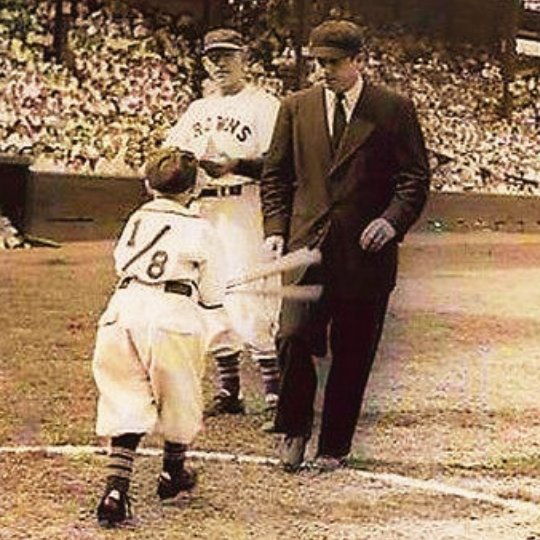
Bill DeWitt Jr. wearing the unusual number

But that wasn't the end of it. In the bottom of the 1st inning, Gaedel walked to the plate, to pinch-hit for the alleged leadoff hitter, right fielder Frank Saucier. He was announced by the public-address announcer. The fans went wild -- although there were just 18,369 of them, so the stunt didn't get a big crowd.

The home plate umpire, Ed Hurley, wasn't having it. He called time-out, and looked over to Browns manager Zack Taylor. But Taylor was ready: He walked out, and took a rolled-up piece of paper from his pocket. It was Gaedel's contract, signed not only by him and by Veeck, but by the President of the American League, Will Harridge. Clearly, Harridge signed it with no idea that the player involved was 3-foot-7. The subject of signing a midget to a contract had never come up before. So the contract was real and official. Hurley had no choice: He had to allow the at-bat.
Note the height of the ball in the mitt, compared to Gaedel's.
Note also Gaedel's crouching stance.

With his height, and a crouching batting stance, Gaedel had the smallest strike zone in baseball history, not much larger than the ball itself. The idea was that the pitcher, Bob Cain, wouldn't come close to a strike, and that Gaedel would walk on 4 straight pitches.

Veeck told Gaedel that there was a sniper on the roof of Sportsman's Park, ready to shoot him if he swung at any pitch. Veeck never said whether there actually was a sniper. If there really was one, he never came forward and admitted it. And whether Gaedel took this threat seriously, only he knew.

What everyone else knew is that catcher Bob Swift got onto his knees, and told Cain, "Keep it low." Cain threw 4 pitches. The 1st 2 were serious attempts at strikes, and did get over the plate, but were too high. Realizing it was hopeless, Cain threw the last 2 at half-speed, still getting them over the plate, but at about the level of Gaedel's head.

After ball 4, Hurley told Gaedel, "Take your base," and Gaedel trotted to 1st base. Jim Delsing then ran out to pinch-run for him. Like a real major-league ballplayer, which he now was, Gaedel slapped Delsing on the rear and, and trotted off the field -- to a standing ovation.

Delsing remained in the game, played center field as former Yankee Cliff Mapes moved from center to right, and went 1-for-3. It was no use: The Tigers got a fine pitching performance from Cain, a home run from Jerry Priddy, and 3 hits each from George Kell and Pat Mullin, and completed the sweep, 6-2.

The next day, AL President Harridge publicly said that Veeck was making a mockery of the game, and voided Gaedel's contract. In response, Veeck, who always hated the New York Yankees, told the Chicago press that he was going to request an official ruling on whether Phil Rizzuto, the Yankees' shortstop and the previous season's AL Most Valuable Player, was "a short ballplayer or a tall dwarf." 

Rizzuto was listed at 5-foot-6, and that may have been generous by an inch. Nevertheless, he was also the best shortstop in baseball at that point, and had batted .324 the season before, getting 200 hits. And, while his 92 walks that season were a career high, that was hardly an extraordinary total, probably was not much aided by his lack of height. Rizzuto's reaction to Veeck's request is unrecorded, but it would probably have been something like, "Veeck, you huckleberry. Holy cow."

Nevertheless, Gaedel got paid for his appearance: $100, his standard fee at the time. (In 2026 money, it works out to about $1,290.) Some time later, he was a guest on the radio show of Chicago-based talk show host Louis "Studs" Terkel. He complained that "Mr. Veeck" wouldn't let him swing the bat, and that he wanted to do that, just once. Terkel, then 39 years old and not looking much like a man who had ever been any kind of athlete, consoled him by saying, "You are exactly what I wish I was: An ex-big-league ballplayer!"

(Terkel would later play Chicago sportswriter Hugh Fullerton in Eight Men Out, the film about the 1919 Black Sox Scandal, and be interviewed by Ken Burns, including on the subject of Gaedel, for his miniseries Baseball.)

Veeck had hoped to run the financially troubled Cardinals out of St. Louis. But, early in 1953, they were bought by Anheuser-Busch chairman Gussie Busch. With Busch's beer fortune behind them, Veeck knew the Browns could not afford to compete for St. Louis' baseball fans.

He didn't particularly care about St. Louis: He just wanted to eliminate the competition and be Number 1 in whatever city he was in, as he had been in Milwaukee and Cleveland. With that option no longer available in St. Louis, he tried to get the Browns moved to Baltimore. The other AL owners, seeing a chance to get rid of him, voted to approve the move, on the condition that Veeck sell the team. He did. But in 1959, he bought the Chicago White Sox.

On May 26, 1959, as Harvey Haddix of the Pittsburgh Pirates was pitching his perfect-but-then-not game, 90 miles to the north in Milwaukee, Eddie Gaedel worked for Bill Veeck again. A helicopter carrying Gaedel and 3 other dwarves dressed in spacesuits landed on the infield at Comiskey Park. They came bearing gifts: Ray guns. They gave these to White Sox stars Luis Aparicio (who was 5-foot-9) and Nellie Fox (5-foot-10). In a parody of the alien visitors' trope, "Take me to your leader," Gaedel told them, "I don't want to be taken to your leader. I've already met him." The White Sox won the Pennant that season.

On June 18, 1961, Gaedel was found dead in his bed by his mother, with bruises all over his body. He was just 36 years old. His killer has never been identified.

By this point, Veeck had sold the White Sox, to pay for his medical expenses, as he had been told he was dying. This turned out to be a misdiagnosis, as he recovered, and he later owned the White Sox again, from 1975 to 1980. He lived until 1986.

But as a result of his 1961 illness, he was unable to attend Eddie Gaedel's funeral. Indeed, only one person with any connection with baseball did: Bob Cain, the pitcher who faced him. They had never even formally met.

Catcher Bob Swift died in 1966. Umpire Ed Hurley lived until 1969. Will Harridge served as AL President from 1931 to 1959, and died in 1971. Browns manager Zack Taylor lived until 1974. Bob Cain lived until 1997. Pinch-runner Jim Delsing lived until 2006. Frank Saucier, for whom Gaedel pinch-hit, was 1 of the last 3 surviving former St. Louis Browns, along with Ed Mickelson and Billy Hunter. All 3 of those men died in 2025, Hunter turning out to be the last survivor of them.

Bill DeWitt Jr. donated his uniform, Gaedel's uniform, to the Baseball Hall of Fame in Cooperstown, New York. He later became the principal owner of the St. Louis Cardinals, and got the uniform back, where it is on display at the St. Louis Cardinals Hall of Fame and Museum, across Clark Avenue from the current Busch Stadium, which also features artifacts from the Browns and St. Louis-area natives who played for other teams, such as Yogi Berra. 

Officially, the shortest players in MLB history have been Edmund "Stubby" Magner, who played 13 games for the New York Highlanders (forerunners of the Yankees) in 1911; and Pompeyo "Yo-Yo" Davalillo, who played 19 games for the Washington Senators in 1953. Both were listed at 5-foot-3.

In 1978, in his 2nd go-round as White Sox owner, Veeck promoted Harry Chappas to the majors, telling the media that he was, after Gaedel, the shortest player in MLB history, at 5-foot-3. This was a lie, but, fittingly, a small one: He was really 5-foot-5, the same height as the man then considered the shortest in the majors, Freddie Patek of the Kansas City Royals. Magner, Davalillo, Chappas and Patek were all, by a quirk of fate, shortstops.

Jon Rauch appeared in the major leagues from 2002 to 2013, including for the Montreal Expos when they moved to become the Washington Nationals in 2004-05, and for the Minnesota Twins in 2009 and 2010, enabling him to appear in postseason play. Sean Hjelle made his big-league debut with the San Francisco Giants in 2022. Both are 6-foot-11, and thus the tallest players in MLB history. Loek van Mil, a 7-foot-1 native of the Netherlands, appeared in professional baseball from 2006 to 2018, but only got as high, if you'll pardon the choice of words, as Class AAA. All 3 of these men are relief pitchers.

Friday, April 24, 2026

April 24, 25 and 26, 1901: The American League's 1st Games

April 24, 1901, 125 years ago: The American League plays its 1st games. The National League had been playing this season's regular-season games since April 18, but the AL was now making its debut.

The AL had offered the NL a deal: Accept us as a full major league, and we will respect your contracts, and not take any of your players. The NL refused to accept them, and so, the AL "declared war." On January 27, Hugh Duffy "jumped" from the Boston Beaneaters to the Milwaukee Brewers. On February 8, Napoleon "Nap" Lajoie, Charles "Chick" Fraser and Bill Bernhard jumped from the Philadelphia Phillies to the Philadelphia Athletics.

On March 2, Jimmy Collins jumped from the Beaneaters to the Boston Americans. Sometime before March 11, John McGraw signed to manage, and play 3rd base, for an AL team with the same name as his now-defunct former NL team, the Baltimore Orioles. On March 19, Cy Young jumped from the St. Louis Cardinals to the Americans.

(Baseball-Reference.com says McGraw signed with the AL Orioles "Before 1901 Season." Nor does Wikipedia provide a definitive date. The reason we know it was before March 11, 1901 is that it has been established that, on that date, he signed Charlie Grant, a black player, and attempted to pass him off as a Cherokee Indian named Charlie Tokohoma. But, that day, the Orioles played a Spring Training game against the Chicago White Sox, whose owner, Charlie Comiskey, the AL's co-founder with League President Ban Johnson, and a former star 1st baseman for the team that became the Cardinals, recognized Grant, and told McGraw that he'd blow the whistle on him if he didn't dump Grant. McGraw guessed that Comiskey wasn't bluffing, which was probably true, and released Grant.)

The 1st AL game was played at South Side Park, at 38th Street and Princeton Avenue, in Chicago, about 4 blocks south of where the home team from that game would play for most of the 20th Century, and about 3 blocks south of where it plays now. The Chicago White Sox defeated the Cleveland Blues, 8-2. Attendance was listed as 9,000, at a ballpark that seated about 15,000.

The White Sox were managed by Clark Griffith, who was still an active pitcher. He had been an ace for the previous team known as the Chicago White Stockings, in the NL.

According to the account written many years later, in the visiting team's hometown newspaper, The Plain Dealer: 

The date was April 24, in Chicago's White Sox park, when Ollie Pickering stepped to the plate for the Cleveland Blues. Pickering, an outfielder, hit the second pitch from Chicago White Sox right-hander Roy Patterson to center field. William Hoy, a deaf-mute who was cruelly nicknamed Dummy, caught the routine fly, and with that the American League was officially underway.

Hoy, whose batting, baserunning and fielding skills have led later observers to suggest that he should be elected to the Baseball Hall of Fame, was long erroneously credited with being the source for umpires using their left hands to call balls and their right hands to call strikes, because he couldn't hear their verbal calls. Pickering is correctly credited with coining the term "Texas leaguer," a looping hit that falls between the infielders and the outfielders.

The White Sox scored 2 runs in the 1st inning, and 5 in the 2nd, and coasted the rest of the way, and won the game on this Wednesday, 8-2.

The next day, the White Sox beat the Blues again, 7-3. Erve Beck of the Blues hit the AL's 1st home run. In 1902, the Blues acquired star 2nd baseman Napoleon Lajoie, and named him their manager. For the 1903 season, they changed their name to honor him: The Cleveland Naps.

He left after the 1914 season, when the World Series was won by the Boston Braves. They'd used the Native American nickname for only 3 seasons. So the Naps then changed their name to the Cleveland Indians, and used that name until 2021, then becoming the Cleveland Guardians. The stories that they'd been named the Indians after tribesmen living on the shore of Lake Erie, and that they'd been named after the 1st Native American player in the majors, former Cleveland Spiders star Louis Sockalexis, have been proven incorrect.

One other game was played on Thursday, April 25: The Detroit Tigers beat the Milwaukee Brewers, 14-13 at Bennett Park in Detroit. The Brewers led 7-0 after just 3 innings, and 13-4 going into the bottom of the 9th. But the Tigers scored 10 runs to win it. And they did it without the benefit of a home run. (This was the Dead Ball Era.)

In 1912, a new ballpark would open on the site of Bennett Park, named Navin Field. It would be expanded and renamed Briggs Stadium in 1938, and renamed Tiger Stadium in 1961.

The Brewers would move after just 1 season, becoming the St. Louis Browns in 1902, and later the new major league version of the Baltimore Orioles in 1954. A new minor-league team would take up the Brewers name, before making way for the Boston Braves to become the Milwaukee Braves in 1953. They moved to Atlanta in 1966, making possible a new AL Milwaukee Brewers in 1970.

On Friday, April 26:

* The Washington Senators beat the Philadelphia Athletics, 5-1 at Columbia Park in Philadelphia. The Senators became the Minnesota Twins in 1961. They were replaced by an expansion team with the Senators name that year, but that team also moved, becoming the Texas Rangers in 1972. The Athletics moved to Kansas City in 1955, to Oakland in 1968, and to Sacramento in 2025, and hope to move to Las Vegas in 2028.

* The Baltimore Orioles beat the Boston Americans, 10-6 at Oriole Park in Baltimore. The Americans would change their name to the Boston Red Sox in 1908. The Orioles would break up in 1902, and a new franchise was created in its place for the 1903 season: The New York Highlanders, who, in 1913, officially changed their name to what people had been calling them for a few years already: The New York Yankees. (Research by Yankee historian Marty Appel has proven that the New York franchise of 1903 onward is not the Baltimore franchise of 1901 and '02.) A new minor-league team would take up the Orioles name.

* The Tigers beat the Brewers, 6-5 at Bennett Park.

And there were 3 games played in the National League that day: The New York Giants beat the Brooklyn Superbas, 5-3 at the Polo Grounds in New York; the Boston Beaneaters beat the Philadelphia Phillies, 4-3 at Baker Bowl in Philadelphia; and the Cincinnati Reds beat the Chicago Orphans, 8-7 in 12 innings at West Side Park in Chicago.

The Superbas became the Dodgers in 1911, changed their name to the Robins in honor of new manager Wilbert Robinson in 1914, and became the Dodgers again in 1932 after he was fired. They moved to Los Angeles in 1958. At the same time, the Giants moved to San Francisco.

The Beaneaters became the Braves in 1912, and, as I said, moved to Milwaukee in 1953, and to Atlanta in 1966. The former Chicago White Stockings had long been led by Adrian Constantine Anson, known as "Cap" for "captain," and "Pop" as he got older, and after his 1897 retirement, were known as "the Orphans, because they missed their Pop." They became the Cubs in 1903.

Tuesday, September 30, 2025

September 30, 1945: Lieutenant Hank Greenberg Clinches the Pennant

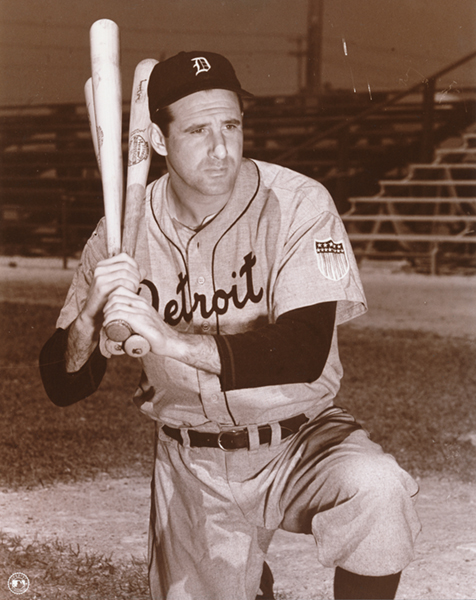
Swinging two bats in the on-deck circle
was a common sight before the Yankees' Elston Howard
invented the "bat donut" in the 1960s.
Hank Greenberg was one of the few players
who was strong enough to swing three bats.

September 30, 1945, 80 years ago: Hank Greenberg, recently discharged from the U.S. Army, hits a grand slam off Nelson Potter in the top of the 9th inning, and gives the Detroit Tigers a 6-3 win over the St. Louis Browns at Sportsman's Park, clinching the American League Pennant, which the Browns had won the previous season, for the only time in their history. The Tigers go on to win the World Series over the Chicago Cubs in 7 games.
The 1st player to go into the service was Philadelphia Phillies pitcher Hugh Mulcahy, drafted on March 8, 1941, and he served for the duration of The War. As my grandmother taught me, she and everyone else who lived through it, even if they never left "the home front," always called it "The War," Capital T, Capital W. 
Greenberg had been the 1st major baseball star to volunteer for the U.S. armed forces in preparation for World War II, inducted into the Army on May 7, 1941. So it was only natural that he was the 1st player to return, discharged on June 14, 1945, with Nazi Germany having surrendered, but not, as yet, Imperial Japan. He had scouted bombing targets for B-29 bombers in the China/India/Burma Theater of Operations, and was discharged with the rank of 1st Lieutenant.
Already known as Hammerin' Hank before Henry Aaron was even born, he had lost his seasons of age 31, 32 and 33, and the 1st half of his age 34 season. He finished his career with a lifetime batting average of .313 and 331 home runs. He should have had at least 150 more home runs. He never regretted it, saying, "My country comes first."
Nor did Chief Petty Officer Bob Feller, U.S. Navy, who lost his seasons of ages 23, 24, 25 and most of 26. He won 266 games and struck out 2,581 batters, all for the Cleveland Indians. Based on his 1941 and 1946 performances, he should have had at least another 90 wins and 1,000 strikeouts, which could have made him the all-time strikeout leader, and, with another 98 wins, the pitcher with the most in the post-1920 Lively Ball Era.
He knew The War was more important. He also knew that people like Ty Cobb and Ohio State football coach Woody Hayes, who compared sports to war, were blowhards, saying, "Anybody who says sports is war has never been in a war."
Warren Spahn had appeared in 4 games before going into the service, and was the winning pitcher in exactly none of them. By the time he rejoined the Boston Braves, 1st Lieutenant Warren Spahn, U.S. Army, had missed his age 22, 23 and 24 seasons, and had gotten frostbite in the Battle of the Bulge and been wounded at the Remagen Bridge.
But his wartime experience may have matured him. From age 25 to 44, he did become the Lively Ball Era's winningest pitcher, and the winningest lefthanded pitcher regardless of era, with 363. So maybe his stats didn't suffer.
The stats of Sergeant Joe DiMaggio, U.S. Army Air Force, did suffer, as he lost his age 28, 29 and 30 seasons. He finished with a .325 batting average, and 2,214 hits including 361 home runs. He should have had at least another 550 hits and another 75 home runs.
And then there was Ted Williams, who served as a flight instructor in World War II and a fighter pilot in the Korean War. By the time he left the service for the last time in 1953, Captain Theodore S. Williams, U.S. Marine Corps, had damaged hearing, and had lost his seasons of age 24, 25 and 26, and most of those of age 33 and 34.
He batted .344 for his career, with 2,654 hits and 521 home runs. It shouldn't surprise people who know a little about baseball history that Ted reached 500 homers, only the 4th to do so after Babe Ruth, Jimmie Foxx and Mel Ott. But it is surprising that the man often called "The Greatest Hitter Who Ever Lived" didn't even get close to 3,000 hits. (He also never got 200 hits in a season.) By missing 4 1/2 prime seasons, he may have missed out on as many as 600 hits and 200 home runs, which would have put him past the 714 of Ruth, the record before Aaron reached 755.
In contrast, Ruth only missed 1 month due to World War I, September 1918, and that was because everybody missed at least that much, since the season was cut short. And Aaron was never drafted. Mickey Mantle was classified 4-F, medically unfit for service.
Willie Mays did serve in the Korean War, missing most of his age 21 season and all of his 22, probably costing him around 350 hits on top of his 3,293, and at least 50 homers on top of his 660, meaning he might have gotten to 715 before Aaron did. Yankee pitcher Whitey Ford (1951 and '52) and Brooklyn Dodger pitcher Don Newcome (1952 and '53) also missed 2 seasons serving in Korea.)
Seaman 1st Class Stan Musial, U.S. Navy, the best hitter in the National League while Ted was the best in the American League, only missed 1945, his age 24 season, due to World War II. He had 3,630 hits and 475 home runs, so he may have missed 200 hits and maybe the 25 homers that would have put him over 500.
One man was a veteran of both D-Day and Major League Baseball. In his case, he was just 19 when he was in a U.S. Navy ship off the coast of Normandy, and his service probably didn't delay his entry into the major leagues by much. He may have been the calmest man in the battle, later saying that the exploding shells looked like fireworks. He was Seaman 2nd Class Lawrence Peter Berra. Yogi.
Yankee shortstop and Seaman 1st Class Phil Rizzuto missed his age 25, 26 and 27 seasons due to those huckleberries Hitler and Tojo. His Dodger counterpart, Chief Petty Officer Harold "Pee Wee" Reese, missed his age 24, 25 and 26 seasons. And Army 1st Lieutenant Jack Roosevelt Robinson missed his age 24, 25 and 26 seasons in the Army. Of course, at that point, he had no idea that he would ever play professional baseball in any capacity, much less the one that would make him the most important player of all time.

Bobby Shantz, who just turned 100, is the last remaining veteran of both World War II and Major League Baseball. 

Thursday, July 3, 2025

Billy Hunter, 1928-2025

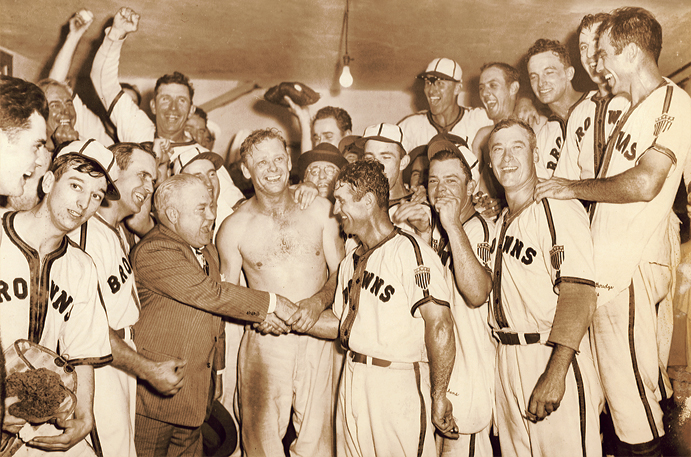
The St. Louis Browns were a failed franchise. They played in the American League for 52 seasons, from 1902 to 1953. They finished in 2nd place, 5 games out of 1st place, behind the Philadelphia Athletics, in 1902. They finished 2nd, 1 game behind the Yankees, in 1922. They won the Pennant in 1944, with most of the game's top stars off serving in World War II. They finished 3rd the next season, 6 games behind the Detroit Tigers.

And that was it. Other than those 4 seasons, they finished an average of 34 games out of 1st place.

They had their moments. And there were 15 members of the Baseball Hall of Fame who played for them, including Rogers Hornsby, Dizzy Dean and Satchel Paige. But only 3 of those played at least 4 full seasons for them: Bobby Wallace, George Sisler and Rick Ferrell -- and, if they ever had to start dropping guys from the Hall, Ferrell and possibly Wallace would be among them.

Now, the book can be closed on the Browns, because their last living former player has died.

Gordon William Hunter was born on June 4, 1928 in Punxsutawney, Pennsylvania, the town famous for introducing the tradition of Groundhog Day, about 80 miles northeast of Pittsburgh. He grew up in Indiana, Pennsylvania, and played shortstop and quarterback at Penn State.

In 1952, playing for the Fort Worth Cats, he was named the Most Valuable Player of the Texas League. But the Cats were a farm team of the Brooklyn Dodgers, and the Dodgers' shortstop was Pee Wee Reese. Here's a list of shortstops who got stuck behind Pee Wee who later became major league managers: Bobby Bragan, Gene Mauch, Dick Williams, Don Zimmer, Billy Hunter.

So the Dodgers traded him to the St. Louis Browns. He made his major league debut for them on April 14, 1953, and became their one and only representative to the All-Star Game. On September 27 of that year, was again their starting shortstop in the last game they ever played, a 2-1 11-inning loss to the Chicago White Sox. When they re-debuted on April 13, 1954 as the Baltimore Orioles, in a 3-0 loss to the Detroit Tigers, he was, again, their starting shortstop. In both cities, he wore uniform Number 6.

On November 17, 1954, he became part of the biggest trade, by number of players, in baseball history: 17. Among the other players the Yankees got were pitchers Don Larsen and Bob Turley. Among the players the Orioles got was Gene Woodling, who had played left field on the Yankees' 5 straight World Champions of 1949 to 1953.

Wearing Number 20, Hunter wasn't considered good enough to replace even an aging Phil Rizzuto. After Rizzuto was released in 1956, it was Tony Kubek who succeeded the Scooter, not Hunter. He was a member of the Yankees' World Series-winning team, but was not on the Series roster.
That should have been a sign that he was going to be part of "the Kansas City Shuttle," a pattern in which the Yankees and the Kansas City Athletics sent players back and forth. Oddly enough, in that February 19, 1957 trade, the Yankees traded, among others, the man who became the last living St. Louis Brown, Billy Hunter, for, among others, the man who became the last living Philadelphia Athletic, Bobby Shantz. The following year, Hunter made his last major league appearance, with the Cleveland Indians. In 630 major league games, he batted .219.

He spent the 1959 season with the San Diego Padres of the Pacific Coast League, then was hired as a scout by the Indians, then was welcomed back into the Oriole organization. He managed the West Virginia-based Bluefield Orioles to the Appalachian League Pennant in 1962 and 1963. He was then made the major-league Orioles' 3rd base coach, and remained so until 1977, including on 8 1st-place teams, winning 6 Pennants and the 1966 and 1970 World Series. Hunter, wearing Number 55 and waving runners home, became a familiar sight to baseball TV viewers.
In Game 4 of the 1969 World Series, manager Earl Weaver was thrown out of the game, and Hunter served as acting manager. He was offered the manager's job for the California Angels for the 1972 season, but turned it down. On June 27, 1977, he finally said yes to a managing job, with the Texas Rangers. He got them to 2nd place in the American League Western Division, and also finished 2nd in the voting for AL Manager of the Year -- behind his recent boss, Weaver, who nearly won the AL East.
Ranger 1st baseman Mike Hargrove, who later became a Pennant-winning manager with the Cleveland Indians, called Hunter "a perfect blend of knowing how to handle people, plus knowing the game." He guided the Rangers to another 2nd-place finish in 1978. In spite of that, he lost the locker room, feuding with some players, and later admitted that he was sorry he took the job.

His record over was 146–108, for a .575 winning percentage, but he never wore a major league uniform in an official capacity again. He returned to the Baltimore area, and served as head coach at Towson State University from 1979 to 1988, and as the school's athletic director from 1984 to 1995. The school and the Orioles each elected him to their Hall of Fame.

Billy Hunter died on July 3, 2025, at the age of 97, in Lutherville, Baltimore County, Maryland. He was the last living former St. Louis Brown, and the last living original Baltimore Oriole. He was also the earliest living former Yankee. That title is now held by Bobby Richardson. The oldest living former Yankee was already Bobby Shantz, who is also the last surviving player for the Philadelphia Athletics.

Thursday, April 17, 2025

April 17, 1945: Pete Gray Makes His Major League Debut

April 17, 1945, 80 years ago: Pete Gray makes his major league debut. This would be a big deal for any player. But it was an especially big deal for Gray, since he only had one arm.

Peter James Wyshner was born on March 6, 1915 in Nanticoke, in the coal country of northeastern Pennsylvania. His brother became a boxer under the name Whitey Gray. Pete would take the name Gray as well.

The story of how Pete lost his right arm has varied over the years, even his age, 7 or 8. Supposedly, it was in a wagon accident. But he still wanted to play baseball, and he learned to bat and field one-handed, catching the ball in his glove and then quickly removing his glove and transferring the ball to his hand in one motion.

By the age of 19, he was playing semi-pro baseball. In 1942, he signed with Three Rivers of the Canadian-American League. His play there caught the attention of the Memphis Chicks of the Southern Association. In 1944, he batted .333, and led the SA with 68 stolen bases. He was awarded the league's Most Valuable Player award.

That season, for the only time in their history, the St. Louis Browns won the American League Pennant. It was largely "credited" to the manpower drain of World War II taking away the other teams' best players. But even the Browns were losing players to the military draft, and they signed Pete Gray for $20,000.

He made his major league debut on April 17, 1945, at Sportsman's Park in St. Louis, the Browns' season opener, against the Detroit Tigers. He was put in left field on this day, wearing Number 14, and batting 2nd. The opposing pitcher was Hal Newhouser, the previous year's AL MVP. Gray grounded to shortstop in the 1st inning, struck out in the 3rd, flew out to center in the 5th, and beat out an infield single to 2nd in the 7th. The Browns won the game, 7-1, as Sig Jakucki outpitched Newhouser.

Gray said his dream was to play at Yankee Stadium. It came true on May 20, with a doubleheader that the Browns swept, 10-1 and 5-1. He got 5 hits and had 2 RBIs. But, as it turned out, he couldn't hit breaking pitches, and with only one hand, he couldn't check his swing. He appeared in 77 games, batting just .218.

He was not appreciated by his teammates, either. They thought he was only on the team to sell tickets due to his disability. They thought he was holding them back from repeating as Pennant winners. It wasn't true: Their winning percentage in games he played was .600, and in games he didn't, .425. They finished 3rd. He was released after the season, with the veterans coming back, and, without him, the Browns fell back to 7th. They didn't have another winning season until 1960 -- their 7th as the Baltimore Orioles.

Gray played in the minor leagues over the next 4 years, but never returned to the majors. He returned to semi-pro ball, and played into the early 1950s. He developed addictions to alcohol and gambling, and resisted interview requests. In 1986, Keith Carradine starred in the ABC movie A Winner Never Quits: The Pete Gray Story. It renewed interest in him, and he became more receptive to publicity. He died on June 30, 2002 in Nanticoke, at age 87.

Friday, March 21, 2025

Notable Last Survivors -- 2025 Baseball Edition

Bobby Shantz

I first did this series in 2021, and again in 2023. Significant updates need to be made.

Notable last survivors of baseball occurrences:

* June 10, 1904: Walter T. Avery, 90, the last participant in what was long purported to be the 1st baseball game, and was definitely the 1st one played under what became known as the Knickerbocker Rules, at the Elysian Fields in Hoboken, New Jersey on June 19, 1846. 58 years.

* March 27, 1927: Joe Start, 84, the last survivor of the Brooklyn Atlantics team that gave the Cincinnati Red Stockings, the 1st openly professional baseball team, their 1st loss, on June 14, 1870. 57 years.

* August 21, 1937: George Wright, 90, the last survivor of the 1869 Cincinnati Red Stockings. 68 years.

* July 7, 1939: James "Deacon" White, 91, the last surviving player from the 1st Major League Baseball game, on May 4, 1871. 68 years. Playing for the Cleveland Forest Citys, he was the game's 1st batter, against the 1st pitcher (and thus the 1st MLB player), Bobby Matthews.

White, elected to the Baseball Hall of Fame in 2013, 74 years after his death, was also the last surviving player from that 1st professional league, the National Association, 1871 to 1875. 64 years.

* July 3, 1948: Charles Witherow, 96, the last living MLB player from the 1870s. 69 years. He pitched 1 game for the 1875 version of the Washington Nationals.

* July 27, 1948: Joe Tinker, 68, the last survivor of the 1906-10 Chicago Cubs double play combination immortalized in Franklin Pierce Adams' poem "Baseball's Sad Lexicon," a.k.a. "Tinker to Evers to Chance.

He was one of the best shortstops of his time, but let's not kid ourselves: Without that poem, neither he nor 2nd baseman Johnny Evers, who died the year before at 65, would ever have gotten into the Baseball Hall of Fame. Maybe 1st baseman Frank Chance does, since he was also the manager who got the Cubs to 4 Pennants (including 2 World Series wins) in 5 years. He died in 1924, only 47, due to heart disease. The 3rd baseman in that infield, Harry Steinfeldt, was not only an ordinary player, but died even sooner, in 1914, only 38, from a cerebral hemorrhage.

* May 3, 1958: Al Maul, 92, the last surviving player from the Union Association, a quasi-major league that played only the 1884 season, playing for the Philadelphia Keystones. 74 years. He led the National League in earned run average in 1895, with the NL version of the Washington Senators, and last played in the major leagues with the 1901 New York Giants.

* July 17, 1961: Ty Cobb, 75, the last survivor of the original 5 honorees by the Baseball Hall of Fame, January 16, 1936. 25 years. He played center field, mostly for the Detroit Tigers, from 1905 to 1928. Christy Mathewson died in 1925, before the Hall was established; Walter Johnson in 1946, Babe Ruth in 1948, Honus Wagner in 1955.

* December 15, 1961: William Elsworth Hoy, 99, the last surviving player from the Players' League of 1890. 71 years. Known as Billy, and as Dummy because he was deaf (although not mute, as "dumb" then meant), he was long erroneously believed to be the inspiration for umpires' hand signals, as he couldn't hear them yell, "Ball!" or "Strike!"

He was also the last surviving player from the 1880s. 72 years. He played from 1888 to 1902, batted .288 lifetime, collected 2,044 hits, stole 607 bases, led the National League in stolen bases in 1888, and won the 1st American League Pennant with the 1901 Chicago White Sox.

He died 2 months after throwing out the first ball at a World Series game hosted by one of his former teams, the Cincinnati Reds, and 5 months before he would have become the 1st former MLB player to reach a 100th birthday.

* July 17, 1962: Lewis "Sport" McAllister, 87, the last surviving player from the worst single-season team in MLB history, the 1899 Cleveland Spiders who went 20-134. 63 years. An outfielder, he was also an original Detroit Tiger in 1901.

* June 28, 1963: Frank "Home Run" Baker, 77, the last survivor of the Philadelphia Athletics' "$100,000 Infield" of 1910-14. 59 years. He was the 3rd baseman. 2nd baseman Eddie Collins died in 1951, 1st baseman John "Stuffy" McInnis in 1960, and shortstop Jack Barry in 1961.

* January 16, 1965: Jimmy Williams, 88, the last survivor of the 1903 New York Highlanders, the 1st season of the team that became the New York Yankees. 62 years. He was a 2nd baseman.

* January 23, 1969: Al Bridwell, 85, the last survivor of the Fred Merkle Game that cost the New York Giants the National League Pennant, and gave it to the Chicago Cubs, September 23, 1908. 61 years. He was a shortstop, and hit the ball that drove in the apparent winning run, before Merkle ran off the field without touching 2nd base. He later admitted that he wished he'd never gotten that hit, for what Merkle had to endure.

* November 7, 1972: Freddy Parent, 96, the last surviving member of the winning team in the 1st World Series, the 1903 Boston Americans. 69 years. The team changed its name to the Red Sox in 1907. Parent was also the last surviving player in the Jack Chesbro Game of October 10, 1904.

* March 26, 1973: George Sisler, 80, the last survivor of the group of members of the Baseball Hall of Fame honored at the Hall's opening in Cooperstown, New York, June 12, 1939. 34 years. He played 1st base, mostly for the St. Louis Browns, from 1915 to 1930.

* March 1, 1974: Larry Doyle, 87, the last survivor from the Playoff game between the Giants and the Cubs that was forced by the Merkle Game, won by the Cubs, October 8, 1908. 66 years. He was a 2nd baseman, who once proclaimed, "It's great to be young and a Giant."

* October 2, 1975: Charlie Emig, 100, the last surviving player from the 19th Century. 76 years. He appeared in 1 game in 1896 for the Louisville Colonels. He is also believed to have been the 1st MLB player to have lived to see a 100th birthday.

* October 13, 1975: Charles "Swede" Risberg, 81, the last survivor of the "Eight Men Out," the Chicago White Sox players who threw the World Series, losing it to the Cincinnati Reds on October 9, 1919. 56 years.

* September 7, 1984: Joe Cronin, 77, the last survivor of the 5 straight American League players struck out by National League and New York Giants pitcher Carl Hubbell in the 1934 All-Star Game at the Polo Grounds in New York. 50 years. In order: Babe Ruth died in 1948, Lou Gehrig in 1941, Jimmie Foxx in 1967, Al Simmons in 1956, and Cronin in 1984. Bill Dickey, who lived until 1993, then got a hit. Lefty Gomez, who lived until 1989, then struck out -- but while that was a 6th strikeout, it wasn't a 6th consecutive strikeout. Hubbell lived until 1988.

* October 7, 1984: Artie Butler, 96, the last surviving teammate of Cy Young, with the 1911 Boston Rustlers (who became the Braves the next season). 73 years. He was an infielder.

* July 27, 1985: Smoky Joe Wood, 95, the last surviving player from the Addie Joss Benefit Game, held to support the family of the Cleveland Indians pitcher who died of meningitis at the start of the season, July 24, 1911. 75 years.

A pitcher, Wood was also the last survivor of the 1912 and the 1915 World Champion Boston Red Sox. 73 and 71 years. That also made him the last surviving player from the Fred Snodgrass Game in the 1912 World Series. He was also the last surviving player from the 1900-09 decade. 76 years.

* December 6, 1985: Burleigh Grimes, 92, the last survivor of the 17 pitchers who were still allowed to throw one of the altered pitches that fell under the category of "spitball" after they were outlawed in 1920. 65 years. The Hall-of-Famer, who pitched most of his career with the St. Louis Cardinals, including winning the 1931 World Series, and won 270 games, was also the last active pitcher allowed to do it, retiring after the 1934 season.

* July 28, 1986: Joe Oeschger, 94, the last survivor from the longest game in MLB history, 26 innings, finally called due to darkness, with Oeschger going the distance for the Boston Braves, and Leon Cadore going the distance for the Brooklyn Dodgers. 66 years. Both pitchers missed a start, but still had good seasons after that. Cadore lived until 1958.

Oeschger was also the last living player from the Philadelphia Phillies' 1915 National League Pennant winners, and was invited to throw out a ceremonial first ball at the World Series when the Phillies won the Pennant in 1983.

* August 17, 1986: Sammy Vick, 91, the last surviving player from the game in which Ray Chapman became the 1st player to sustain a fatal injury in an MLB game, August 16, 1920. 66 years. Vick played for the Yankees against Chapman's Cleveland Indians, who won 4-3. Carl Mays hit Chapman in the head with a pitch -- unintentionally, Mays always insisted -- and Chapman died the next day.

* March 14, 1988: Zeb Terry, 96, the last surviving teammate of Shoeless Joe Jackson, who was banned from baseball in 1920. 68 years. An infielder, Terry was a teammate of Jackson on the 1917 World Champion Chicago White Sox, but was with Pittsburgh when Jackson was (accused of) throwing the 1919 World Series.

* March 21, 1988: Edd Roush, 94, the last surviving player from the Federal League of 1914 and 1915, having played for the Pennant-winning Indianapolis Hoosiers in 1914, and moved with them to become the Newark Bears in 1915. 73 years.

He was also the last survivor of the 1919 World Champion Cincinnati Reds. 69 years. He insisted to the end of his life that they would have won the World Series even if the Chicago White Sox had played to win all the way. He was also the last surviving teammate of Christy Mathewson, who closed his career with the Reds in 1916. 72 years. Roush also threw out the first ball before the last game at Cincinnati's Crosley Field in 1970.

With a .323 lifetime batting average, and one of the best outfield arms anyone had ever seen at that point, he was generally considered to be the Reds' greatest player ever before the Big Red Machine of the 1970s, and was elected to the Baseball Hall of Fame.

* July 14, 1988: Lawton "Whitey" Witt, 92, the last surviving player from the 1923 New York Yankees, meaning he was the last survivor of the 1st game at the original Yankee Stadium on April 18, and of the 1st Yankee team to win the World Series, on October 15. 65 years.

* January 9, 1989: Bill Terry, 90, the last surviving player mentioned in Ogden Nash's 1949 poem "Line-Up for Yesterday." 40 years. The Hall of Fame 1st baseman for the New York Giants (Nash's favorite team) was also the last player to bat .400 for a full season in the National League, in 1930.

* May 17, 1989: George "Specs" Toporcer, 90, the last surviving baseball player interviewed by Lawrence S. Ritter for his book The Glory of Their Times, published on September 26, 1966. 23 years. An infielder for the St. Louis Cardinals, he was the 1st player known to have worn glasses on the field, hence his nickname.

He was also the last surviving player from their 1926 team that won the World Series, which included Grover Cleveland Alexander's strikeout of Tony Lazzeri with the bases loaded in the 7th inning of Game 7. 63 years.

* February 3, 1990: Erv Kantlehner, 97, the last surviving teammate of Honus Wagner, who retired in 1917. 73 years. A pitcher, Kantlehner was with the Flying Dutchman on the Pittsburgh Pirates in 1914, '15 and '16.

* April 22, 1993: Mark Koenig, 88, the last surviving player from the 1927 World Champion New York Yankees, a.k.a. Murderers' Row, often called the greatest baseball team ever. 66 years. He was also the last surviving player from Game 7 of the 1926 World Series, the St. Louis Cardinals' 1st World Series win, featuring baseball's most famous strikeout (other than the fictional one of "the Mighty Casey"), Grover Cleveland Alexander fanning Tony Lazzeri with the bases loaded in the 7th inning and the Cards up 3-2. And he was the last survivor of the Yankees' 1928 World Series win, too.

* November 12, 1993: Bill Dickey, 86, the last surviving player to have played for the Yankees under manager Miller Huggins, in 1928 and 1929. 64 years.

* June 27, 1997: Ray Benge, 95, the last surviving teammate of Grover Cleveland Alexander, who retired in 1930. 67 years. Benge and Alexander both pitched on the 1930 Philadelphia Phillies.

* September 26, 1997: Elwood "Woody" English, 91, the last surviving player from the 1st Major League Baseball All-Star Game, at Comiskey Park in Chicago, July 6, 1933. 64 years. He was a shortstop for the Chicago Cubs. He was also the last surviving player from Game 3 of the 1932 World Series, which featured Babe Ruth's "Called Shot."

* September 17, 1998: Chet "Red" Hoff, 107, the last surviving Yankee to have played under the New York Highlanders name, 1912. 86 years. He was also the last surviving player from the 1910s, and thus the last surviving player from the Dead Ball Era. 79 years.

Despite being teammates on the 1915 St. Louis Browns, in George Sisler's rookie season, Hoff turned out to be Sisler's last surviving teammate. He is also believed to be the longest-lived MLB player ever.

* March 8, 1999: Joe DiMaggio, 84, the last surviving inductee into Monument Park at Yankee Stadium prior to its closing for renovation, September 30, 1973. 26 years. Miller Huggins died in 1929, Jacob Ruppert in 1939, Lou Gehrig in 1941, Babe Ruth in 1948, Ed Barrow in 1953, Pope Paul VI in 1978, and Mickey Mantle in 1995.

He was also the last surviving player from the "Greatest Players Ever" list chosen for the 100th Anniversary of professional baseball in 1969. He was chosen as the "Greatest Living Player," and he insisted upon being introduced as such for the rest of his life.

* April 1, 2001: Joe "Jo-Jo" Moore, 92, the last surviving player who had played for the New York Giants under manager John McGraw, who retired in 1932. 69 years. He was an outfielder, made 6 All-Star Games, and helped McGraw's successor, Bill Terry, win the 1933 World Series.

* March 7, 2002: Mickey Haslin, 92, the last surviving player from MLB's 1st night game, at Crosley Field in Cincinnati, May 24, 1935. 67 years. An infielder, he drove in the Phillies' run in a 2-1 loss to the Reds.

* April 3, 2002: Karl Swanson, 101, the last surviving player who had played for the Chicago White Sox under founding owner and ballpark namesake Charlie Comiskey, who died in 1931. 71 years. Swanson was a 2nd baseman, who had played for the Pale House in 1928 and '29.

* July 5, 2002: Ted Williams, 83, the last man to bat .400 for a full season in 1941. 61 years.

* September 25, 2002: Ray Hayworth, 98, the last surviving teammate of Ty Cobb, who retired in 1928. 74 years. A catcher, he was a rookie on the Detroit Tigers in 1926, Cobb's last season with them, before closing his career with 2 seasons with the Philadelphia Athletics.

* January 2, 2004: Paul Hopkins, 99, the last pitcher who gave up one of Babe Ruth's 60 home runs in the 1927 season. 76 years. At the time, he pitched for the Washington Senators. This also made him the last surviving teammate of Walter Johnson. Tris Speaker was also on that '27 Senators team, before closing his career with Cobb on the '28 A's, so Hopkins was also Speaker's last living teammate.

* October 30, 2005: Al López, 97, the last surviving player from the 1920s. 75 years.

* July 22, 2007: Rollie Stiles, 100, the last surviving teammate of Rogers Hornsby, who last played in 1937. 70 years. He pitched for player-manager Hornsby on the 1933 St. Louis Browns.

* January 22, 2009: Bill Werber, 100, the last surviving teammate of Babe Ruth, playing for the Yankees in the 1930 and 1933 seasons. Ruth played his last game on May 30, 1935, so, 74 years. Werber also won the 1940 World Series with the Cincinnati Reds.

* December 1, 2009: Tommy Henrich, 96, the last surviving player from, and the beneficiary of, The Mickey Owen Game, Game 4 of the World Series, October 5, 1941. 68 years. He was also the last survivor of the Yankees' 1937, 1938, 1939 and 1941 World Champions. This also made him the last surviving Yankee who had played for team owner Jacob Ruppert. And the last surviving teammate of Lou Gehrig.

* August 9, 2010: Gene Hermanski, 90, the last surviving player from Jackie Robinson's debut game, April 15, 1947. 63 years.

* December 15, 2010: Bob Feller, 92, the last pitcher to have given up a hit to Joe DiMaggio during his 56-game hitting streak in 1941. 69 years. He was probably the best pitcher in baseball at the time. He also turned out to be the last player interviewed for Chicago Daily News sports editor John P. Carmichael's 1945 book My Greatest Day In Baseball.

* February 18, 2011: Buddy Lewis, 94, the last surviving player from Lou Gehrig's last game, on April 30, 1939. 72 years. A 3rd baseman for the Washington Senators, he also turned out to be the last player in the doubleheader played on Lou Gehrig Day on July 4, 1939.

* February 2, 2014: Ralph Kiner, 91, the last survivor from the New York Mets' original broadcasting trio that lasted from 1962 to 1979. 48 years. Lindsey Nelson died in 1995, Bob Murphy in 2004. Kiner was also a Hall of Fame slugging outfielder for the Pittsburgh Pirates.

* May 8, 2014: Charlie Mead, 93, the last surviving teammate of Mel Ott, who last played in 1947. 67 years. They played together on the New York Giants in 1943, '44 and '45.

* September 22, 2015: Yogi Berra, 90, the last surviving player from Game 3 of the 1947 World Series, the Bill Bevens Game. 68 years. He caught Bevens in that near-no-hitter. Bobby Brown, the last survivor of the Al Gionfriddo Game, did not play in the Bill Bevens Game. He was also the last survivor of the game where the Dodgers won their only World Series, Game 7, October 4, 1955, the Johnny Podres Game. 60 years.

* January 11, 2016: Monte Irvin, 96, the last living player who was a player in the Negro Leagues and elected to the Baseball Hall of Fame, prior to the desegregation of the game in 1947. 69 years.

* November 23, 2016: Ralph Branca, 90, the last surviving member of the 1st desegregated Major League Baseball team, the 1947 Brooklyn Dodgers. 69 years.

* April 28, 2017: Luis Olmo, 97, the last surviving MLB player who "jumped" to the Mexican League in 1946, a.k.a. "the Mexican Jumping Beans." 71 years. One of the earliest Puerto Ricans in MLB, he had been a star outfielder for the Brooklyn Dodgers.

* November 13, 2017: Bobby Doerr, 99, the last surviving MLB player from the 1930s. 78 years. With the 1941 Boston Red Sox, he became the last player on the team for which Ted Williams batted .406, and the last surviving teammate of Lefty Grove. 76 years. With the 1945 Red Sox, he became the last surviving teammate of Jimmie Foxx. 72 years.

With the 1949 Red Sox, he became the last surviving player from the 1949 Pennant-decider against the Yankees. 68 years. For the moment, he is also the longest-lived member of the Baseball Hall of Fame.

* October 18, 2018: Dick Cole, 92, the last survivor of the Chicago Cubs' ill-fated "College of Coaches" experiment of the 1961 and 1962 seasons. 56 years.

* January 1, 2020: Don Larsen, 90, the last surviving player from the perfect game that he pitched for the Yankees against the Brooklyn Dodgers in Game 5 of the World Series, still the only no-hitter in World Series history, October 8, 1956. 63 years.

Larsen was also the last surviving player in the trade with the Kansas City Athletics that brought Roger Maris to the Yankees, on December 11, 1959. 60 years. He and Hank Bauer were the most prominent players going to Kansas City.

* October 8, 2020: Edward "Whitey" Ford, 92, the last surviving player among the Yankees who were involved in what became known as "The Copacabana Incident" at the Copacabana nightclub in Midtown Manhattan, May 16, 1957. 63 years.

Billy Martin died in 1989, Mickey Mantle in 1995, Hank Bauer in 2007, Johnny Kucks in 2013 and Yogi Berra in 2015. The wives of all except Martin, then between marriages, were also there, and Ford outlived all of them as well.

* March 25, 2021: Bobby Brown, 96, the last surviving teammate of Bill Dickey, debuting with the Yankees in Dickey's last season, 1946. 75 years. He was also the last surviving player in Game 6 of the 1947 World Series, the Al Gionfriddo Game; and the last surviving player on the Yankees' World Series winners of 1947, 1949, 1950 and 1951.

* May 5, 2021: Del Crandall, 91, the last surviving player from the Boston Braves, who played their last home game on September 21, 1952, 69 years, and then moved to Milwaukee. He was the catcher on their team that won the 1957 World Series. (There are 30 surviving players from the Braves' Milwaukee tenure, 1952 to 1965.)

* October 4, 2021: Eddie Robinson, 100, the last surviving player from the last World Series winner from Cleveland, the 1948 Indians. 73 years.

* January 8, 2022: Eddie Basinski, 99, the last surviving player from the "tricornered game" in which the Yankees, Brooklyn Dodgers and New York Giants each played 6 innings at the Polo Grounds, to raise money for war bonds, June 26, 1944. 77 years.

A Dodger infielder, Basinski was also the last survivor of the 1930s and '40s players mentioned in Dave Frishberg's song "Van Lingle Mungo." Playing for the Pittsburgh Pirates in 1947, Basinski was also the last surviving teammate of Hank Greenberg.

* December 13, 2022: Curt Simmons, 93, the last surviving player from the Philadelphia Phillies' 1950 Pennant-winning "Whiz Kids." 72 years.

* April 16, 2024: Carl Erskine, 96, the last survivor of the Brooklyn Dodger players Roger Kahn profiled in his book The Boys of Summer, having covered the team for the New York Herald Tribune in 1952 and '53. 71 years.

* June 18, 2024: Willie Mays, 93, the last surviving player from the game 1951 National League Playoff game where Bobby Thomson hit a Pennant-winning home run; and the last surviving player from the 1954 World Series game where he made the catch that became the most famous defensive play in sports history.

* December 10, 2024: Rocky Colavito, 91, the last surviving player from the baseball-themed game show Home Run Derby, which aired in syndication from January 9 to July 2, 1960, 65 years.

* December 27, 2024: Charlie Maxwell, 97, the last surviving player from 3 notable Yankee games in 1951. 74 years. An outfielder for the Boston Red Sox, he played on April 17, making him the last survivor from the 1st MLB game for Mickey Mantle, and the Yankees' 1st game with Bob Sheppard as the public address announcer at Yankee Stadium.

And on September 28, he played in a doubleheader. The opener was Allie Reynolds' 2nd no-hitter of the season. The nightcap was the Pennant clincher.

* January 15, 2025: Tommy Brown, 97, the last surviving player from the Dick Sisler Game, where Sisler's 10th inning home run against the Dodgers gave the Phillies the 1950 Pennant. 74 years. With some irony, Brown had been the 2nd-youngest player in MLB history, debuting at age 16 with the 1944 Dodgers.

* March 5, 2025: Art Schallock, 100, the last surviving teammate of Joe DiMaggio, who last played in 1951. 74 years. A pitcher, Schallock was also the last survivor of the Yankees' 1953 World Series winners. 72 years. He was not on the Series roster in 1951 or '52.

*

Alive as of March 21, 2025:

* There are believed to be only 2 former Negro League players still alive. Bill Greason, 100, who pitched 8 games with the 1948 Birmingham Black Barons, and thus was a teammate of Willie Mays, and then 3 games with the 1954 St. Louis Cardinals. He is now the oldest living former MLB player. And Ron Teasley, 98, who played 2 games in the outfield for the 1948 New York Cubans. (For many years, "Cuban" was code for "too dark-skinned to pass for white.")

UPDATE: Teasley died on February 3, 2026, just after his 99th birthday. This probably means Greason, at 101, is the last one.

* Bobby Shantz, 99, is the last surviving man who played in MLB in the 1940s, thus making him the earliest surviving former MLB player. He is also the last surviving man who played for the Philadelphia Athletics, thus making him the last surviving man who played for Connie Mack on the A's.

Despite being just 5-foot-6 and 140 pounds, the lefthanded pitcher was the American League Most Valuable Player in 1952, helped the Yankees win the 1958 World Series, was an original Houston Colt .45 (Astro) in 1962, was part of the trade that sent Lou Brock from the Chicago Cubs to the St. Louis Cardinals, and returned to Philadelphia (as a native of Pottstown, Pennsylvania, almost his hometown) to close his career with the ill-fated 1964 Phillies.

* There are 2 surviving men who are veterans of both World War II and MLB: Shantz and Ed Mickelson, 98, a 1st baseman for both the St. Louis Cardinals and the departed St. Louis Browns.

UPDATE: Mickelson died on June 27, 2025, leaving Shantz as the last surviving veteran of both WWII and MLB.

* There are 2 remaining players from the St. Louis Browns, who played their last game on September 27, 1953, 71 years, then moved to become the Baltimore Orioles: The aforementioned Ed Mickelson, also 96; and infielder Billy Hunter, about to turn 97.

Hunter is also the last surviving player from the biggest trade in baseball history, 17 players between the Baltimore Orioles and the Yankees, December 18, 1954. 70 years. Among the players joining Hunter in going from Venable Park to the South Bronx was Don Larsen. Hunter would later become known as the 3rd base coach for the 1966-71 quasi-dynasty on the Orioles, and briefly as the manager of the Texas Rangers.

UPDATE: As I said, Ed Mickelson died on June 27, 2025, leaving Billy Hunter as the last living former St. Louis Brown. He died just 7 days later, on July 3, 2025.

* Sandy Koufax, 89, the last surviving member of the 1955 Brooklyn Dodgers, is the earliest surviving World Series winner. He did not, however, appear in that World Series. Bobby Richardson is the last surviving member of the 1956 New York Yankees, but he did not appear in that World Series. He did appear in the 1957 World Series, as did John DeMerit of the Milwaukee Braves, who beat the Yankees in that Series, making DeMerit the earliest surviving player to play on a winning World Series team. Taylor Phillips, the other surviving member of the '57 Braves, did not play in the Series.

* Stan Pawloski, 93, is the last living former teammate of Bob Feller, who pitched his last game for the Cleveland Indians on September 30, 1956, 68 years. Pawloski was a 2nd baseman, who played 2 games at the close of the 1955 season.

* There are 4 surviving players from the Brooklyn Dodgers, who played their last game on September 24, 1957, 66 years, and were then moved to Los Angeles: Jim Gentile, Fred Kipp, Bob Aspromonte and Sandy Koufax.

Aspromonte, who lasted in the majors until 1970, and thus was the last active former Brooklyn Dodger, and Koufax are the last 2 surviving teammates of Jackie Robinson.

* There are 6 surviving players from the New York Giants, who played their last game on September 29, 1957, 67 years, and were then moved to San Francisco: Joey Amalfitano, Ray Crone, Jackie Brandt, Al Worthington, Joe Margoneri and Bill White. (UPDATE: Crone died on January 15, 2026, and Worthington died on June 16, 2026. That left 4 living New York Giants: Amalfitano, Brandt, Margoneri and White.)

* There are 4 surviving players from the American League Pennant-winning Chicago "Go-Go" White Sox of 1959: Luis Aparicio, Ken McBride, J.C. Martin and Claude Raymond.

* There are 5 surviving teammates of Ted Williams, who played his last game for the Boston Red Sox on September 26, 1960, 63 years: Marty Keough, Ted Bowsfield, Jerry Mallett, Jim Mahoney and Ted Wills.

* There are 6 surviving players from the "Old" Washington Senators, who played their last game on October 2, 1960, 64 years, and were then moved to become the Minnesota Twins: Bob Ross, Bob Oldis, Camilo Pascual, Pedro Ramos, Ken Aspromonte and Jim Kaat. (From the "New Senators," who played from 1961 to 1971, and were then moved to become the Texas Rangers, there are 83 living players, so, too many to list.)

* From the Bill Mazeroski Game, October 13, 1960, 64 years ago, there are 7 survivors. The Pittsburgh Pirates have 5: Mazeroski himself, Bob Skinner, Vernon Law and Roy Face. The Yankees have 3: Bobby Richardson, Tony Kubek and Bobby Shantz.

* There are 9 surviving players who played for Casey Stengel on the Yankees: Bobby Richardson, Billy Hunter, Bobby Shantz, Tony Kubek, Zach Monroe, Gary Blaylock, Fred Kipp, Hal Stowe and Johnny James. (UPDATE: Hunter's death leaves 8.)

* From the game where Roger Maris hit his 61st home run of the season, October 1, 1961, 63 years ago, there are 3 survivors: Yankees Bobby Richardson and Tony Kubek; and Red Sock Carl Yastrzemski.

* There are 4 surviving players from the New York Mets' 1st game, an 11-4 loss to the Cardinals at Sportsman's Park in St. Louis, April 11, 1962. 63 years. Both are from the Cardinals: Julián Javier and Bill White. Félix Mantilla was the last surviving Met from that game, dying on January 10, 2025.

* There are 7 surviving players from the original New York Mets of 1962: Craig Anderson, Galen Cisco, Cliff Cook, John DeMerit, Rick Herrscher, Jay Hook and Jim Marshall.

* There are 24 surviving Milwaukee Braves; 76 from the Kansas City Athletics; 20 from the Red Sox' 1967 "Impossible Dream" Pennant winners; and 29 from the ill-fated 1969 Seattle Pilots -- in each case, too many to list here.

* Denny McLain, about to turn 81, is the last surviving pitcher to have won 30 games in a season, going 31-6 to help the Detroit Tigers win the 1968 World Series. 55 years.

* The earliest living Met manager is Joe Torre, from 1977.

* The earliest living Yankee manager is Lou Piniella, from 1986.

* The earliest living manager of a World Series winner, or even a Pennant winner, is Davey Johnson, 82, of the 1986 Mets.

Tuesday, October 1, 2024

October 1, 1944: The St. Louis Browns Win Their Only Pennant

October 1, 1944, 80 years ago: The St. Louis Browns beat the New York Yankees, 5-2 at Sportsman's Park in St. Louis. This, combined with the Detroit Tigers' 4-1 loss to the Washington Senators at Briggs Stadium in Detroit, enables the Browns to clinch the American League Pennant. It is their first. They are the last of Major League Baseball's "Original 16" teams (a term not used back then) to do so.

Had the Tigers won, or had both they and the Browns lost, a 1-game Playoff for the Pennant would have been held between them. Sportsman's Park was renamed Busch Stadium in 1953, and Briggs Stadium was renamed Tiger Stadium in 1961.

This was only the 2nd time a team had beaten the Yankees to clinch a Pennant. It had previously happened in 1904, when the team that would become known as the Boston Red Sox did it. It would not happen again until the Kansas City Royals did it in the 1980 AL Championship Series. (It has since been done by the Red Sox in 2004, the Texas Rangers in 2010, the Detroit Tigers in 2012, and the Houston Astros in 2017 and 2019.)

Sigmund "Sig" Jakucki outpitches Mel Queen, despite falling behind 2-0 in the 3rd inning. Mike Kreevich led off the bottom of the 4th with a single, followed by a game-tying home run from Chet Laabs. In the 5th, same combination: Single by Kreevich, homer by Laabs. Vern Stephens added a homer in the 8th.

Managed by Luke Sewell, brother of Cleveland Indians Hall-of-Famer Joe Sewell, the Browns finished the season 89-65, finishing 1 game ahead of the Detroit Tigers and 6 ahead of the defending World Champion Yankees. They had previously come the closest to a Pennant in 1922, when, with what was almost certainly a better team, they went 93-61 but finished a game behind the Yankees.

For most of their history, they were terrible, losing 107 games in back-to-back seasons, 1910 and 1911; 108 in 1937; and 111 in 1939. Noting that St. Louis was the center of America's leather industry and the home of several breweries, someone countered the insult of the Washington Senators -- "Washington: First in war, first in peace, and last in the American League" -- with "St. Louis: First in shoes, first in booze, and last in the American League."

In contrast, the St. Louis Cardinals had won National League Pennants in 1926, '28, '30, '31, '34, '42 and '43, and did so again in '44. The Browns were the landlords at Sportsman's Park, the Cards the tenants, but the tenants were more successful.

And it just so happened that the Cards stood in the Browns' way in their 1st World Series. The Browns won Games 1 and 3, bringing them 2 wins from a World Championship. But this would be the high-water mark of the team, as the Cards took the next 3 games for the title.

When World War II ended, and everybody's players came back from the service, the Browns fell back into a condition where mediocrity would have been an improvement. After the 1953 season, they were moved to become the Baltimore Orioles. They did not win another until Pennant, and did not win the franchise's 1st World Championship, until 1966.

The Browns/Orioles franchise and the Cardinals have never played each other in another World Series. Both teams made the Playoffs in the seasons of 1996, 2012 and 2014, but neither team won its respective Pennant in the years in question.

After 1944, there would not be another team winning their 1st Pennant until September 23, 1957, when the Milwaukee Braves do it -- or, if you don't count moved teams, until October 6, 1969, when the Mets pull off their "Miracle."

The last survivor of the 1944 Browns was 2nd baseman Don Gutteridge -- who, ironically, started his career with the St. Louis Cardinals. He lived until 2008, age 96.

Saturday, May 4, 2024

May 4, 1944: The St. Louis Browns Desegregate Sportsman's Park

May 4, 1944, 80 years ago: The St. Louis Browns baseball team has its finest hour. And it has nothing to do with their winning their only Pennant that season.

The St. Louis Browns, playing in a racially segregated city, announce that they are dropping their policy restricting black fans to the bleachers at Sportsman's Park, which they own. The St. Louis Cardinals, tenants despite their great success since 1926 and the Browns' long failure, have no choice but to comply.

In their game that day, the Browns beat the Detroit Tigers, 2-0. Nelson "Nels" Potter pitched a 5-hit shutout. George McQuinn drove in a run with a looper in the 3rd inning, and another with a double in the 5th.

This season, the Browns go on to win their 1st Pennant. It is poetic justice. But the Browns do not desegregate their playing roster. And the Cardinals, who also don't, defeat them in the only All-St. Louis World Series ever. Only partial poetic justice.

On July 17, 1947, 3 months after Jackie Robinson of the Brooklyn Dodgers broke the color barrier, and 12 days after Larry Doby of the Cleveland Indians did so in the American League, the Browns became the 3rd team to add a black player, Kansas City Monarchs 3rd baseman Hank Thompson. Two days later, they added Monarchs outfielder Willard Brown. On July 8, 1949, Thompson and Monte Irvin each made their debut with the New York Giants, becoming that team's 1st black players.
Hank Thompson (left) and Willard Brown

The Cardinals did not field a black player until April 13, 1954, 1st baseman Tom Alston. By that point, the Browns had moved, becoming the Baltimore Orioles. The Cardinals now owned Sportsman's Park. Their refusal to integrate their roster allowed the Dodgers, and then other National League teams, to surpass them in talent, and in the NL standings.
Tom Alston

By 1964, they had integrated, with black players like Bob Gibson, Lou Brock, Curt Flood and Bill White, and won their 1st Pennant, and their 1st World Series, since 1946. Except for 1950, with the Philadelphia Phillies, every National League Pennant winner in between had been integrated.

Saturday, May 6, 2023

Notable Last Survivors -- 2023 Baseball Edition

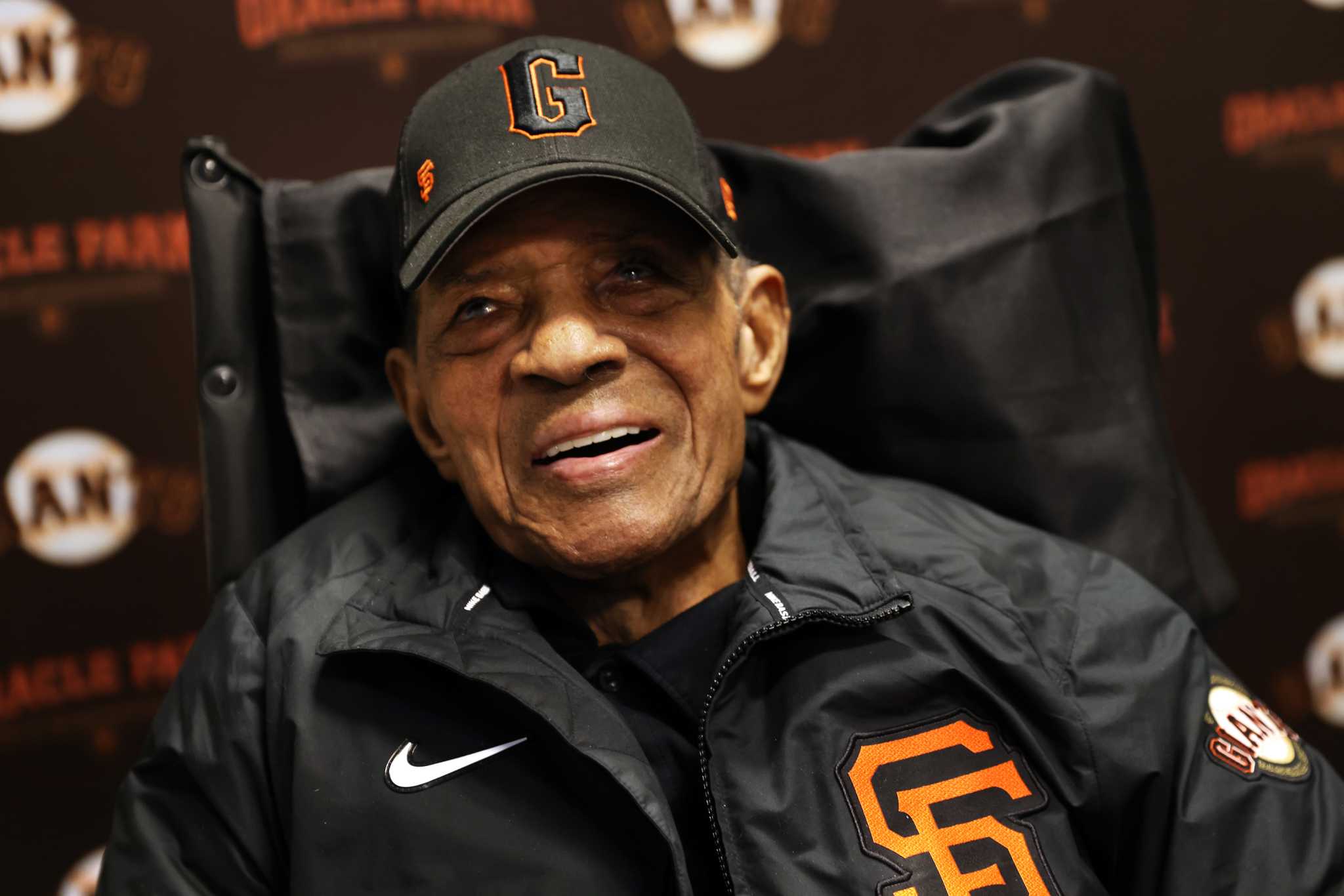
Willie is blind, and rarely appears in public anymore.
In most recent public appearances, he wore a cap
with a Giants' "G" on it, because he knows he is still
beloved in both New York and San Francisco.

May 6, 1931, 92 years ago: Willie Howard Mays Jr. is born in Westfield, Alabama, outside Birmingham. The former Giants star is the last survivor of the triad of great New York center fielders of the 1950s, broken up in 1957, when the New York Giants were moved to San Francisco and the Brooklyn Dodgers were moved to Los Angeles. 64 years. Mickey Mantle of the Yankees died in 1995, and Duke Snider of the Brooklyn Dodgers died in 2011.

This also makes him the last surviving player mentioned in the 1950s section of Terry Cashman's 1981 song "Talkin' Baseball (Willie, Mickey & the Duke)." Among the players mentioned in the 1980s section, there are 7 still alive: George Brett, Pete Rose, Reggie Jackson, Rod Carew, Steve Garvey, Mike Schmidt and Vida Blue. (UPDATE: Mere hours after I posted this, Vida Blue died, lowering the number to 6.)

He is also  is the last surviving player from the Bobby Thomson Game, October 3, 1951. Nearly 72 years. He is also the last surviving player from Game 6 of that year's World Series, which was Joe DiMaggio's last game.

He is also the last surviving player from the game where he made "The Catch," Game 1 of the World Series, September 29, 1954. 69 years. And he is the last survivor from the team of "Greatest Living Players" selected for the 100th Anniversary of professional baseball in 1969.

Notable last survivors of baseball occurrences:

* June 10, 1904: Walter T. Avery, 90, the last participant in what was long purported to be the 1st baseball game, and was definitely the 1st one played under what became known as the Knickerbocker Rules, at the Elysian Fields in Hoboken, New Jersey on June 19, 1846. 58 years.

* March 27, 1927: Joe Start, 84, the last survivor of the Brooklyn Atlantics team that gave the Cincinnati Red Stockings, the 1st openly professional baseball team, their 1st loss, on June 14, 1870. 57 years.

* August 21, 1937: George Wright, 90, the last survivor of the 1869 Cincinnati Red Stockings. 68 years.

* July 7, 1939: James "Deacon" White, 91, the last surviving player from the 1st Major League Baseball game, on May 4, 1871. 68 years. Playing for the Cleveland Forest Citys, he was the game's 1st batter, against the 1st pitcher (and thus the 1st MLB player), Bobby Matthews.

White, elected to the Baseball Hall of Fame in 2013, 74 years after his death, was also the last surviving player from that 1st professional league, the National Association, 1871 to 1875. 64 years.

* July 3, 1948: Charles Witherow, 96, the last living MLB player from the 1870s. 69 years. He pitched 1 game for the 1875 version of the Washington Nationals.

* May 3, 1958: Al Maul, 92, the last surviving player from the Union Association, a quasi-major league that played only the 1884 season, playing for the Philadelphia Keystones. 74 years. He led the National League in earned run average in 1895, with the NL version of the Washington Senators, and last played in the major leagues with the 1901 New York Giants.

* July 17, 1961: Ty Cobb, 75, the last survivor of the original 5 honorees by the Baseball Hall of Fame, January 16, 1936. 25 years. He played center field, mostly for the Detroit Tigers, from 1905 to 1928. Christy Mathewson died in 1925, before the Hall was established; Walter Johnson in 1946, Babe Ruth in 1948, Honus Wagner in 1955.

* December 15, 1961: William Elsworth Hoy, 99, the last surviving player from the Players' League of 1890. 71 years. Known as Billy, and as Dummy because he was deaf (although not mute, as "dumb" then meant), he was long erroneously believed to be the inspiration for umpires' hand signals, as he couldn't hear them yell, "Ball!" or "Strike!"

He was also the last surviving player from the 1880s. 72 years. He played from 1888 to 1902, batted .288 lifetime, collected 2,044 hits, stole 607 bases, led the National League in stolen bases in 1888, and won the 1st American League Pennant with the 1901 Chicago White Sox.

He died 2 months after throwing out the first ball at a World Series game hosted by one of his former teams, the Cincinnati Reds, and 5 months before he would have become the 1st former MLB player to reach a 100th birthday.

* July 17, 1962: Lewis "Sport" McAllister, 87, the last surviving player from the worst single-season team in MLB history, the 1899 Cleveland Spiders who went 20-134. 63 years. An outfielder, he was also an original Detroit Tiger in 1901.

* June 28, 1963: Frank "Home Run" Baker, 77, the last survivor of the Philadelphia Athletics' "$100,000 Infield" of 1910-14. 59 years. He was the 3rd baseman. 2nd baseman Eddie Collins died in 1951, 1st baseman John "Stuffy" McInnis in 1960, and shortstop Jack Barry in 1961.

* January 16, 1965: Jimmy Williams, 88, the last survivor of the 1903 New York Highlanders, the 1st season of the team that became the New York Yankees. 62 years. He was a 2nd baseman.

* January 23, 1969: Al Bridwell, 85, the last survivor of the Fred Merkle Game that cost the New York Giants the National League Pennant, and gave it to the Chicago Cubs, September 23, 1908. 61 years. He was a shortstop, and hit the ball that drove in the apparent winning run, before Merkle ran off the field without touching 2nd base. He later admitted that he wished he'd never gotten that hit, for what Merkle had to endure.

* November 7, 1972: Freddy Parent, 96, the last surviving member of the winning team in the 1st World Series, the 1903 Boston Americans. 69 years. The team changed its name to the Red Sox in 1907. Parent was also the last surviving player in the Jack Chesbro Game of October 10, 1904.

* March 26, 1973: George Sisler, 80, the last survivor of the group of members of the Baseball Hall of Fame honored at the Hall's opening in Cooperstown, New York, June 12, 1939. 34 years. He played 1st base, mostly for the St. Louis Browns, from 1915 to 1930.

* March 1, 1974: Larry Doyle, 87, the last survivor from the Playoff game between the Giants and the Cubs that was forced by the Merkle Game, won by the Cubs, October 8, 1908. 66 years. He was a 2nd baseman, who once proclaimed, "It's great to be young and a Giant."

* October 2, 1975: Charlie Emig, 100, the last surviving player from the 19th Century. 76 years. He appeared in 1 game in 1896 for the Louisville Colonels. He is also believed to have been the 1st MLB player to have lived to see a 100th birthday.

* October 13, 1975: Charles "Swede" Risberg, 81, the last survivor of the "Eight Men Out," the Chicago White Sox players who threw the World Series, losing it to the Cincinnati Reds on October 9, 1919. 56 years.

* September 7, 1984: Joe Cronin, 77, the last survivor of the 5 straight American League players struck out by National League and New York Giants pitcher Carl Hubbell in the 1934 All-Star Game at the Polo Grounds in New York. 50 years. In order: Babe Ruth died in 1948, Lou Gehrig in 1941, Jimmie Foxx in 1967, Al Simmons in 1956, and Cronin in 1984. Bill Dickey, who lived until 1993, then got a hit. Lefty Gomez, who lived until 1989, then struck out -- but while that was a 6th strikeout, it wasn't a 6th consecutive strikeout. Hubbell lived until 1988.

* October 7, 1984: Artie Butler, 96, the last surviving teammate of Cy Young, with the 1911 Boston Rustlers (who became the Braves the next season). 73 years. He was an infielder.

* July 27, 1985: Smoky Joe Wood, 95, the last surviving player from the Addie Joss Benefit Game, held to support the family of the Cleveland Indians pitcher who died of meningitis at the start of the season, July 24, 1911. 75 years.

A pitcher, Wood was also the last survivor of the 1912 and the 1915 World Champion Boston Red Sox. 73 and 71 years. That also made him the last surviving player from the Fred Snodgrass Game in the 1912 World Series. He was also the last surviving player from the 1900-09 decade. 76 years.

* December 6, 1985: Burleigh Grimes, 92, the last survivor of the 17 pitchers who were still allowed to throw one of the altered pitches that fell under the category of "spitball" after they were outlawed in 1920. 65 years. The Hall-of-Famer, who pitched most of his career with the St. Louis Cardinals, including winning the 1931 World Series, and won 270 games, was also the last active pitcher allowed to do it, retiring after the 1934 season.

* July 28, 1986: Joe Oeschger, 94, the last survivor from the longest game in MLB history, 26 innings, finally called due to darkness, with Oeschger going the distance for the Boston Braves, and Leon Cadore going the distance for the Brooklyn Dodgers. 66 years. Both pitchers missed a start, but still had good seasons after that. Cadore lived until 1958.

Oeschger was also the last living player from the Philadelphia Phillies' 1915 National League Pennant winners, and was invited to throw out a ceremonial first ball at the World Series when the Phillies won the Pennant in 1983.

* August 17, 1986: Sammy Vick, 91, the last surviving player from the game in which Ray Chapman became the 1st player to sustain a fatal injury in an MLB game, August 16, 1920. 66 years. Vick played for the Yankees against Chapman's Cleveland Indians, who won 4-3. Carl Mays hit Chapman in the head with a pitch -- unintentionally, Mays always insisted -- and Chapman died the next day.

* March 14, 1988: Zeb Terry, 96, the last surviving teammate of Shoeless Joe Jackson, who was banned from baseball in 1920. 68 years. An infielder, Terry was a teammate of Jackson on the 1917 World Champion Chicago White Sox, but was with Pittsburgh when Jackson was (accused of) throwing the 1919 World Series.

* March 21, 1988: Edd Roush, 94, the last surviving player from the Federal League of 1914 and 1915, having played for the Pennant-winning Indianapolis Hoosiers in 1914, and moved with them to become the Newark Bears in 1915. 73 years.

He was also the last survivor of the 1919 World Champion Cincinnati Reds. 69 years. He insisted to the end of his life that they would have won the World Series even if the Chicago White Sox had played to win all the way. He was also the last surviving teammate of Christy Mathewson, who closed his career with the Reds in 1916. 72 years. Roush also threw out the first ball before the last game at Cincinnati's Crosley Field in 1970.

With a .323 lifetime batting average, and one of the best outfield arms anyone had ever seen at that point, he was generally considered to be the Reds' greatest player ever before the Big Red Machine of the 1970s, and was elected to the Baseball Hall of Fame.

* July 14, 1988: Lawton "Whitey" Witt, 92, the last surviving player from the 1923 New York Yankees, meaning he was the last survivor of the 1st game at the original Yankee Stadium on April 18, and of the 1st Yankee team to win the World Series, on October 15. 65 years.

* January 9, 1989: Bill Terry, 90, the last surviving player mentioned in Ogden Nash's 1949 poem "Line-Up for Yesterday." 40 years. The Hall of Fame 1st baseman for the New York Giants (Nash's favorite team) was also the last player to bat .400 for a full season in the National League, in 1930.

* May 17, 1989: George "Specs" Toporcer, 90, the last surviving baseball player interviewed by Lawrence S. Ritter for his book The Glory of Their Times, published on September 26, 1966. 23 years. An infielder for the St. Louis Cardinals, he was the 1st player known to have worn glasses on the field, hence his nickname.

He was also the last surviving player from their 1926 team that won the World Series, which included Grover Cleveland Alexander's strikeout of Tony Lazzeri with the bases loaded in the 7th inning of Game 7. 63 years.

* February 3, 1990: Erv Kantlehner, 97, the last surviving teammate of Honus Wagner, who retired in 1917. 73 years. A pitcher, Kantlehner was with the Flying Dutchman on the Pittsburgh Pirates in 1914, '15 and '16.

* April 22, 1993: Mark Koenig, 88, the last surviving player from the 1927 World Champion New York Yankees, a.k.a. Murderers' Row, often called the greatest baseball team ever. 66 years. He was also the last surviving player from Game 7 of the 1926 World Series, the St. Louis Cardinals' 1st World Series win, featuring baseball's most famous strikeout (other than the fictional one of "the Mighty Casey"), Grover Cleveland Alexander fanning Tony Lazzeri with the bases loaded in the 7th inning and the Cards up 3-2. And he was the last survivor of the Yankees' 1928 World Series win, too.

* November 12, 1993: Bill Dickey, 86, the last surviving player to have played for the Yankees under manager Miller Huggins, in 1928 and 1929. 64 years.

* June 27, 1997: Ray Benge, 95, the last surviving teammate of Grover Cleveland Alexander, who retired in 1930. 67 years. Benge and Alexander both pitched on the 1930 Philadelphia Phillies.

* September 26, 1997: Elwood "Woody" English, 91, the last surviving player from the 1st Major League Baseball All-Star Game, at Comiskey Park in Chicago, July 6, 1933. 64 years. He was a shortstop for the Chicago Cubs. He was also the last surviving player from Game 3 of the 1932 World Series, which featured Babe Ruth's "Called Shot."

* September 17, 1998: Chet "Red" Hoff, 107, the last surviving Yankee to have played under the New York Highlanders name, 1912. 86 years. He was also the last surviving player from the 1910s, and thus the last surviving player from the Dead Ball Era. 79 years.

Despite being teammates on the 1915 St. Louis Browns, in George Sisler's rookie season, Hoff turned out to be Sisler's last surviving teammate. He is also believed to be the longest-lived MLB player ever.

* March 8, 1999: Joe DiMaggio, 84, the last surviving inductee into Monument Park at Yankee Stadium prior to its closing for renovation, September 30, 1973. 26 years. Miller Huggins died in 1929, Jacob Ruppert in 1939, Lou Gehrig in 1941, Babe Ruth in 1948, Ed Barrow in 1953, Pope Paul VI in 1978, and Mickey Mantle in 1995.

He was also the last surviving player from the "Greatest Players Ever" list chosen for the 100th Anniversary of professional baseball in 1969. He was chosen as the "Greatest Living Player," and he insisted upon being introduced as such for the rest of his life.

* April 1, 2001: Joe "Jo-Jo" Moore, 92, the last surviving player who had played for the New York Giants under manager John McGraw, who retired in 1932. 69 years. He was an outfielder, made 6 All-Star Games, and helped McGraw's successor, Bill Terry, win the 1933 World Series.

* March 7, 2002: Mickey Haslin, 92, the last surviving player from MLB's 1st night game, at Crosley Field in Cincinnati, May 24, 1935. 67 years. An infielder, he drove in the Phillies' run in a 2-1 loss to the Reds.

* April 3, 2002: Karl Swanson, 101, the last surviving player who had played for the Chicago White Sox under founding owner and ballpark namesake Charlie Comiskey, who died in 1931. 71 years. Swanson was a 2nd baseman, who had played for the Pale House in 1928 and '29.

* July 5, 2002: Ted Williams, 83, the last man to bat .400 for a full season in 1941. 61 years.

* September 25, 2002: Ray Hayworth, 98, the last surviving teammate of Ty Cobb, who retired in 1928. 74 years. A catcher, he was a rookie on the Detroit Tigers in 1926, Cobb's last season with them, before closing his career with 2 seasons with the Philadelphia Athletics.

* January 2, 2004: Paul Hopkins, 99, the last pitcher who gave up one of Babe Ruth's 60 home runs in the 1927 season. 76 years. At the time, he pitched for the Washington Senators. This also made him the last surviving teammate of Walter Johnson. Tris Speaker was also on that '27 Senators team, before closing his career with Cobb on the '28 A's, so Hopkins was also Speaker's last living teammate.

* October 30, 2005: Al López, 97, the last surviving player from the 1920s. 75 years.

* July 22, 2007: Rollie Stiles, 100, the last surviving teammate of Rogers Hornsby, who last played in 1937. 70 years. He pitched for player-manager Hornsby on the 1933 St. Louis Browns.

* January 22, 2009: Bill Werber, 100, the last surviving teammate of Babe Ruth, playing for the Yankees in the 1930 and 1933 seasons. Ruth played his last game on May 30, 1935, so, 74 years. Werber also won the 1940 World Series with the Cincinnati Reds.

* December 1, 2009: Tommy Henrich, 96, the last surviving player from, and the beneficiary of, The Mickey Owen Game, Game 4 of the World Series, October 5, 1941. 68 years. He was also the last survivor of the Yankees' 1937, 1938, 1939 and 1941 World Champions. This also made him the last surviving Yankee who had played for team owner Jacob Ruppert. And the last surviving teammate of Lou Gehrig.

* August 9, 2010: Gene Hermanski, 90, the last surviving player from Jackie Robinson's debut game, April 15, 1947. 63 years.

* December 15, 2010: Bob Feller, 92, the last pitcher to have given up a hit to Joe DiMaggio during his 56-game hitting streak in 1941. 69 years. He was probably the best pitcher in baseball at the time. He also turned out to be the last player interviewed for Chicago Daily News sports editor John P. Carmichael's 1945 book My Greatest Day In Baseball.

* February 18, 2011: Buddy Lewis, 94, the last surviving player from Lou Gehrig's last game, on April 30, 1939. 72 years. A 3rd baseman for the Washington Senators, he also turned out to be the last player in the doubleheader played on Lou Gehrig Day on July 4, 1939.

* February 2, 2014: Ralph Kiner, 91, the last survivor from the New York Mets' original broadcasting trio that lasted from 1962 to 1979. 48 years. Lindsey Nelson died in 1995, Bob Murphy in 2004. Kiner was also a Hall of Fame slugging outfielder for the Pittsburgh Pirates.

* May 8, 2014: Charlie Mead, 93, the last surviving teammate of Mel Ott, who last played in 1947. 67 years. They played together on the New York Giants in 1943, '44 and '45.

* September 22, 2015: Yogi Berra, 90, the last surviving player from Game 3 of the 1947 World Series, the Bill Bevens Game. 68 years. He caught Bevens in that near-no-hitter. Bobby Brown, the last survivor of the Al Gionfriddo Game, did not play in the Bill Bevens Game. He was also the last survivor of the game where the Dodgers won their only World Series, Game 7, October 4, 1955, the Johnny Podres Game. 60 years.

* January 11, 2016: Monte Irvin, 96, the last living player who was a player in the Negro Leagues and elected to the Baseball Hall of Fame, prior to the desegregation of the game in 1947. 69 years.

* November 23, 2016: Ralph Branca, 90, the last surviving member of the 1st desegregated Major League Baseball team, the 1947 Brooklyn Dodgers. 69 years.

* April 28, 2017: Luis Olmo, 97, the last surviving MLB player who "jumped" to the Mexican League in 1946, a.k.a. "the Mexican Jumping Beans." 71 years. One of the earliest Puerto Ricans in MLB, he had been a star outfielder for the Brooklyn Dodgers.

* November 13, 2017: Bobby Doerr, 99, the last surviving MLB player from the 1930s. 78 years. With the 1941 Boston Red Sox, he became the last player on the team for which Ted Williams batted .406, and the last surviving teammate of Lefty Grove. 76 years. With the 1945 Red Sox, he became the last surviving teammate of Jimmie Foxx. 72 years.

With the 1949 Red Sox, he became the last surviving player from the 1949 Pennant-decider against the Yankees. 68 years. For the moment, he is also the longest-lived member of the Baseball Hall of Fame.

* October 18, 2018: Dick Cole, 92, the last survivor of the Chicago Cubs' ill-fated "College of Coaches" experiment of the 1961 and 1962 seasons. 56 years.

* January 1, 2020: Don Larsen, 90, the last surviving player from the perfect game that he pitched for the Yankees against the Brooklyn Dodgers in Game 5 of the World Series, still the only no-hitter in World Series history, October 8, 1956. 63 years.

Larsen was also the last surviving player in the trade with the Kansas City Athletics that brought Roger Maris to the Yankees, on December 11, 1959. 60 years. He and Hank Bauer were the most prominent players going to Kansas City.

* October 8, 2020: Edward "Whitey" Ford, 92, the last surviving player among the Yankees who were involved in what became known as "The Copacabana Incident" at the Copacabana nightclub in Midtown Manhattan, May 16, 1957. 63 years.

Billy Martin died in 1989, Mickey Mantle in 1995, Hank Bauer in 2007, Johnny Kucks in 2013 and Yogi Berra in 2015. The wives of all except Martin, then between marriages, were also there, and Ford outlived all of them as well.

* March 25, 2021: Bobby Brown, 96, the last surviving teammate of Bill Dickey, debuting with the Yankees in Dickey's last season, 1946. 75 years. He was also the last surviving player in Game 6 of the 1947 World Series, the Al Gionfriddo Game; and the last surviving player on the Yankees' World Series winners of 1947, 1949, 1950 and 1951.

* May 5, 2021: Del Crandall, 91, the last surviving player from the Boston Braves, who played their last home game on September 21, 1952, 69 years, and then moved to Milwaukee. He was the catcher on their team that won the 1957 World Series. (There are 30 surviving players from the Braves' Milwaukee tenure, 1952 to 1965.)

* October 4, 2021: Eddie Robinson, 100, the last surviving player from the last World Series winner from Cleveland, the 1948 Indians. 73 years.

* January 8, 2022: Eddie Basinski, 99, the last surviving player from the "tricornered game" in which the Yankees, Brooklyn Dodgers and New York Giants each played 6 innings at the Polo Grounds, to raise money for war bonds, June 26, 1944. 77 years.

A Dodger infielder, Basinski was also the last survivor of the 1930s and '40s players mentioned in Dave Frishberg's song "Van Lingle Mungo." Playing for the Pittsburgh Pirates in 1947, Basinski was also the last surviving teammate of Hank Greenberg.

* December 13, 2022: Curt Simmons, 93, the last surviving player from the Philadelphia Phillies' 1950 Pennant-winning "Whiz Kids." 72 years.

*

Alive as of May 6, 2023:

* There are only 3 former Negro League players still alive. And 2 of them also played in the white major leagues: Mays; and Bill Greason, who pitched 8 games with the 1948 Birmingham Black Barons, and thus was a teammate of Mays, and then 3 games with the 1954 St. Louis Cardinals. The other is Ron Teasley, 96, who played 2 games in the outfield for the 1948 New York Cubans. (For many years, "Cuban" was code for "too dark-skinned to pass for white.") (UPDATE: Mays died on June 18, 2024. That left only Greason and Teasley.)

* There are 4 surviving men who played in MLB in the 1940s: Tommy Brown, Carl Erskine, Larry Miggins, Bobby Shantz. Having debuted on August 3, 1944, and remaining the 2nd-youngest player in major league history, but lasting in the majors until 1953, Tommy "Buckshot" Brown, 95, is the earliest remaining former MLB player, and the last living man who played in MLB during World War II. (UPDATE: Miggins died on December 12, 2023. And Erskine died on April 16, 1924, lowering the number to 2: Brown and Shantz.)

* There are 5 surviving men who are veterans of both World War II and MLB: Erskine, Miggins, Shantz, Ed Mickelson and Frank Saucier. (UPDATE: Frank Saucier died March 3, 2025. His death, and those of Miggins and Erskine, lowers the number to 2: Shantz and Mickelson.)

* Bobby Shantz, 97, the last surviving player from the Philadelphia Athletics, who played their last home game on September 19, 1954. 69 years. He was also the last player to have played for owner-manager Connie Mack on the Athletics, October 1, 1950. 73 years. Pitching for Mack's replacement, Jimmy Dykes, Shantz won the 1952 American League MVP, and later helped the Yankees win the 1956 and '58 World Series.

* Tommy Brown, 95, the last surviving player from the Dick Sisler Game, where Sisler's 10th inning home run against the Dodgers gave the Phillies the 1950 Pennant. 70 years. With some irony, Brown had been the 2nd-youngest player in MLB history, debuting at age 16 with the 1944 Dodgers.

* Charlie Maxwell, 96, the last surviving player from 3 notable Yankee games in 1951. 72 years. An outfielder for the Boston Red Sox, he played on April 17, making him the last survivor from the 1st MLB game for Mickey Mantle, and the Yankees' 1st game with Bob Sheppard as the public address announcer at Yankee Stadium.

And on September 28, he played in a doubleheader. The opener was Allie Reynolds' 2nd no-hitter of the season. The nightcap was the Pennant clincher. 

* Art Schallock, 99, the last surviving teammate of Joe DiMaggio, who last played in 1951. 72 years. A pitcher, Schallock is also the last survivor of the Yankees' 1953 World Series winners. 70 years. He was not on the Series roster in 1951 or '52. He is also the oldest living former MLB player, and the earliest surviving World Series winner.

* Carl Erskine, 96, the last survivor of the Brooklyn Dodger players Roger Kahn profiled in his book The Boys of Summer, having covered the team for the New York Herald Tribune in 1952 and '53. 71 years. (UPDATE: Erskine died on April 16, 2024.)

* There are 3 remaining players from the St. Louis Browns, who played their last game on September 27, 1953, 70 years, then moved to become the Baltimore Orioles: Outfielder Frank Saucier, 96; 1st baseman Ed Mickelson, also 96; and infielder Billy Hunter, about to turn 95.

Hunter is also the last surviving player from the biggest trade in baseball history, 17 players between the Baltimore Orioles and the Yankees, December 18, 1954. 69 years. Among the players joining Hunter in going from Venable Park to the South Bronx was Don Larsen. Hunter would later become known as the 3rd base coach for the 1966-71 quasi-dynasty on the Orioles, and briefly as the manager of the Texas Rangers.

(UPDATE: Saucier died on March 3, 2025, leaving Mickelson and Hunter as the last 2.)

* There are 4 living former teammates of Bob Feller, who pitched his last game for the Cleveland Indians on September 30, 1956, 67 years: Hank Foiles, Dick Tomanek, Stan Pawloski and Rocky Colavito. (UPDATE: Tomanek died on August 11, 2023. Foiles died on May 21, 2024. Colavito died on December 10, 2024. That left Pawloski as Feller's last surviving teammate.)

* There are 8 surviving players from the Brooklyn Dodgers, who played their last game on September 24, 1957, 66 years, and were then moved to Los Angeles: Tommy Brown, Bobby Morgan, Jim Gentile, Carl Erskine, Fred Kipp, Bob Aspromonte, Roger Craig and Sandy Koufax.

Brown, Morgan, Erskine, Aspromonte, Craig and Koufax are the last 6 surviving teammates of Jackie Robinson.

(UPDATE: Morgan died on June 1, 2023, Craig 3 days later, and Erskine on April 16, 2024. That leaves 5 surviving Dodgers, and 3 who played with Robinson: Brown, Aspromonte and Koufax, who played with him; and Gentile and Kipp, who played for the Dodgers in 1957, after Robinson retired.)

* There are 10 surviving players from the New York Giants, who played their last game on September 29, 1957, 66 years, and were then moved to San Francisco: Billy Gardner, Joey Amalfitano, Ozzie Virgil Sr., Ray Crone, Jackie Brandt, Al Worthington, Eddie Bressoud, Joe Margoneri, Bill White and Willie Mays. (UPDATE: Bressoud died on July 13, 2023. Gardner died on January 3, 2024. And Mays died on June 18, 2024, leaving 7.)

* There are 6 surviving players from the American League Pennant-winning Chicago "Go-Go" White Sox of 1959: Luis Aparicio, Lou Skizas, Joe Hicks, Ken McBride, J.C. Martin and Claude Raymond.

(UPDATE: Skizas died on November 17, 2023. Joe Hicks died on December 2, 2023. That leaves 4: Aparicio, McBride, Martin and Raymond.)

* There are 2 surviving players from the baseball-themed game show Home Run Derby, which aired in syndication from January 9 to July 2, 1960, 63 years: Willie Mays and Rocky Colavito. (UPDATE: Mays died on June 18, 2024, leaving Colavito as the last survivor. Colavito, as I said, died on December 10, 2024.)

* There are 7 surviving teammates of Ted Williams, who played his last game for the Boston Red Sox on September 26, 1960, 63 years: Charlie Maxwell, Pete Daley, Marty Keough, Ted Bowsfield, Jerry Mallett, Jim Mahoney and Ted Wills.

* There are 10 surviving players from the "Old" Washington Senators, who played their last game on October 2, 1960, 63 years, and were then moved to become the Minnesota Twins: Bob Ross, Bob Oldis, Camilo Pascual, Pedro Ramos, Whitey Herzog, Ken Aspromonte, Bobby Malkmus, Dan Dobbek, Jim Kaat and Billy Gardner. (From the "New Senators," who played from 1961 to 1971, and were then moved to become the Texas Rangers, there are 94 living players, so, too many to list.)

(UPDATE: Dobbek died on November 28, 2023. Gardner died on January 3, 2024. Herzog died on April 15, 2024, leaving 7 players.)

* From the Bill Mazeroski Game, October 13, 1960, 63 years ago, there are 8 survivors. The Pittsburgh Pirates have 5: Mazeroski himself, Bob Skinner, Joe Christopher, Vernon Law and Roy Face. The Yankees have 3: Bobby Richardson, Tony Kubek and Bobby Shantz.

(UPDATE: Christopher died on October 3, 2023, leaving 7: Mazeroski, Skinner, Law, Face, Richardson, Kubek and Shantz.)

* There are 11 surviving players who played for Casey Stengel on the Yankees: Art Schallock, Bobby Richardson, Billy Hunter, Lou Skizas, Bobby Shantz, Tony Kubek, Zach Monroe, Gary Blaylock, Fred Kipp, Hal Stowe and Johnny James.

(UPDATE: Skizas died on November 17, 2023, leaving 10.)

* From the game where Roger Maris hit his 61st home run of the season, October 1, 1961, 62 years ago, there are 3 survivors: Yankees Bobby Richardson and Tony Kubek; and Red Sock Carl Yastrzemski.

* There are 4 surviving players from the New York Mets' 1st game, an 11-4 loss to the Cardinals at Sportsman's Park in St. Louis, April 11, 1962. 61 years. For the Mets: Roger Craig and Félix Mantilla. For the Cardinals: Julián Javier and Bill White.

* There are 12 surviving players from the original New York Mets of 1962: Craig Anderson, Joe Christopher, Galen Cisco, Cliff Cook, Roger Craig, John DeMerit, Rick Herrscher, Jay Hook, Ed Kranepool, Ken MacKenzie, Félix Mantilla and Jim Marshall.

(UPDATE: Craig died on June 4, 2023. Christopher died on October 3, 2023. Ken MacKenzie died on December 14, 2023. That leaves 9.)

* Denny McLain, 79, is the last surviving pitcher to have won 30 games in a season, going 31-6 to help the Detroit Tigers win the 1968 World Series. 55 years.

* The earliest living Met manager is Joe Torre, from 1977. The earliest living Yankee manager is Lou Piniella, from 1986.

* The earliest living manager of a World Series winner, or even a Pennant winner, is Whitey Herzog, 91, of the 1982 St. Louis Cardinals, 41 years. (UPDATE: Herzog died on April 15, 2024, making the earliest living manager of a World Series or Pennant winner Davey Johnson of the 1986 Mets.)