How many people have been involved with both the Yankees and the Mets, and Have Been Loved by both fan bases? Very few. And we just lost one.
Melvin Leon Stottlemyre was born on November 13, 1941 in Hazelton, a defunct town in southern Missouri, in the middle of a triangle formed between Kansas City, St. Louis, and Little Rock, Arkansas. The manpower drain of World War II essentially wiped the town out, and the Stottlemyre family moved to Mabton, Washington, in the southern part of the State about halfway between Yakima and Walla Walla, and that's where Mel grew up in that 1940s and 1950s.
These were the days when the nearest major league baseball team was in St. Louis, while the Pacific Coast League was considered the best of the minor leagues, and its fans referred to the American League and the National League as "the Eastern leagues," considering their own league to be their equal.
The nearest PCL team was the Seattle Rainiers, 180 miles to the northwest. So Mel's exposure to the Major Leagues was the newspapers, magazines, movie theaters newsreels, and radio. Television came later. But it still made the Yankees the team he saw the most of, and this made starry-eyed prospects, at the time, easy pickings for Yankee scouts.
A Yankee scout saw him pitching for a junior college team, and signed him in 1961. By the Summer of 1964, he was leading the International League with a 1.42 ERA with the Richmond Virginians, using a sinker, when he got the call.
He made his major league debut on August 12, 1964 at the original Yankee Stadium. Wearing Number 30, the only number he would wear in his major league career, he went the distance, allowing 3 runs (2 earned) on 7 hits and 1 wall, with 1 strikeout, in a 9-3 Yankee win over the Chicago White Sox.
He went 9-3 with a 2.06 ERA down the stretch, and the Yankees won the Pennant by 1 game over the White Sox, making his debut pivotal. He lost the AL Rookie of the Year award to the batting champion, Tony Oliva of the Minnesota Twins, and it's unlikely that he would have gotten it had even called up sooner.
He started 3 games of the World Series, beating the St Louis Cardinals in Game 2, having a no decision in Game 5, but starting Game 7 on just 2 days' rest, and losing to Bob Gibson.
He made the 1st of 5 All-Star Games in 1965, going 20-9, but the Yankee Dynasty crumbled, and the team finished 5th. On July 20 of that season, he was the winning pitcher in a 6-3 Yankee win over the Boston Red Sox, and hit an inside-the-park grand slam off Bill Monbouquette. (For his career, he batted .160, but, despite being a pitcher, and a righthanded hitter in the pre-renovation old Yankee Stadium, he had 120 hits, including 14 doubles, 6 triples and 7 home runs, and 51 RBIs.
In 1966, in the Yankees 1st last-place season since 1912, he went 12-20, but still made the All-Star Team. He was 21-12 in 1968, and 20-14 in 1969, one of the few bright spots in the Yankees' Dark Age. An interviewee, not identified, on the 1987 home video
New York Yankees: The Movie said, "Mel's probably the unluckiest pitcher in Yankee history."
Never was this more apparent than on Jun 11, 1974. Mel was pitching against Frank Robinson, then with the California Angels, at Shea Stadium (this was during the old Stadium's renovation), and tore his rotator cuff. With what was known about shoulder injuries at the time, he was told to simply stop throwing, and he'd be re-evaluated in Spring Training.
But the Yankees' new owner, George Steinbrenner, had been suspended by Commissioner Bowie Kuhn, and, essentially, general manager Gabe Paul was running the team on his own. And he acted as though he had forgotten that he now had Steinbrenner's money to play with, and acting as if he was, as he once was with each, the GM of either the Cincinnati Reds or the Cleveland Indians, a pair of organizations always struggling for cash.
Paul learned that the Yankees would have to pay him $30,000 in severance pay if they kept him on the roster after March 31, 1975. So, 2 days before that, he released Mel. In that same off-season, Paul had also broken a promise to never trade the other big star of the Yankees' lean years, Bobby Murcer. Both Bobby and Mel said they would never forgive the Yankees. Both accepted Steinbrenner's apology and offer to return -- after Paul left to go back to Cleveland following the 1977 title.
Ah, yes, titles. The thing the Yankees are known for. Suppose Mel hadn't gotten hurt. At that point, he was 6-7 with a 3.58 ERA. but had averaged 15 wins over the preceding 4 seasons. The Yankees finished 2 games behind the Baltimore Orioles in the American League Eastern Division. A healthy Mel Stottlemyre could have made the difference. Whether they would have beaten the defending World Champions, the Oakland Athletics, in the AL Championship Series is another matter. But the Yankees would have ended their postseason drought 2 years sooner.
Could Mel have made more of a difference? In 1976, the Yankees won the Pennant, but were swept in the World Series by the Reds. The Yankees' 4 games were started by, in this order, Doyle Alexander, Catfish Hunter, Dock Ellis and Ed Figueroa. (Ron Guidry was not yet a regular.)
In mid-season, the Yankees traded Rudy May, Scott McGregor, Rick Dempsey and Dave Pagan for Ken Holtzman, Grant Jackson, Elrod Hendricks and Jimmy Freeman. Had Mel been available and pitching as well as he did from 1964 to 1973, this trade wouldn't have been necessary, and not only could Mel have started Game 1 of the Series, and possibly made it competitive, but May and McGregor would have been available for the Yankee rotation thereafter; Martinez would have been available for the bullpen; and Dempsey would have been there to first spell Thurman Munson when he was injured, and then succeed him after his plane crash.
This doesn't mean that, with a healthy Mel, the Yankees could have made up the 12-game difference between them and the Red Sox in the AL East race in 1975, or beaten the Reds in the '76 Series. But the 1977 and 1978 titles would have been less stressful -- certainly, there would have been no Playoff with the Red Sox -- and the 1979 season might not have been lost.
The 1980 ALCS with the Kansas City Royals might have been different, and, approaching his 40th birthday, Mel could have made a difference in the 1981 World Series -- certainly, McGregor, Martinez and Dempsey could have, as did May, who had been reacquired.
Alas, Mel was hurt in 1974, throwing his last professional pitch at age 32. He finished his career, all with the Yankees, with 164 wins against 139 losses, a 2.97 ERA, a 112 ERA+, a 1.219 WHIP, and 1,257 strikeouts. He deserved better.
*
Better began to come. In 1976, the AL expanded to include a new team in his home State, the Seattle Mariners. He was hired as their roving pitching instructor. When the Mets hired Davey Johnson as their manager for the 1984 season, they hired Mel as their pitching coach. He was only 42, and could still have been pitching himself.
He helped build a starting rotation that included Dwight Gooden, Ron Darling, Sid Fernandez and Bob Ojeda, and later David Cone and Frank Viola; and a bullpen that included Jesse Orosco, Rick Aguilera, Doug Sisk and Randy Meyers.
The 1980s Met pitching staff did not, however, include Sidd Finch, the teacher turned Buddhist monk turned apparent super-prospect, who was the subject of an April Fool's Day article written for
Sports Illustrated by George Plimpton in 1985.
Mel was one of several people in the Mets' organization who went along with the gag. He held a radar gun to time Finch's fastball, and Ronn Reynolds, then the backup catcher to Gary Carter (they didn't dare risk the Camera Kid with such a flamethrower), said, "Don't tell me, Mel, I don't want to know." Mel's radar gun timed Finch at 168 miles per hour. Current Yankee closer Aroldis Chapman holds the accepted record of 105.
The following week,
SI wrote that Finch had lost his control due to the media pressure, and was quitting baseball so he didn't hurt anyone. The week after that, the hoax was confessed.
From 1984 to 1990, 7 straight seasons, the Mets finished no worse than 2nd place. In 1986, they won the World Series, getting Mel his 1st Pennant, and his 1st World Series ring. In 1988, they won the NL East again. In 1994 and 1995, he was the pitching coach of the Houston Astros.
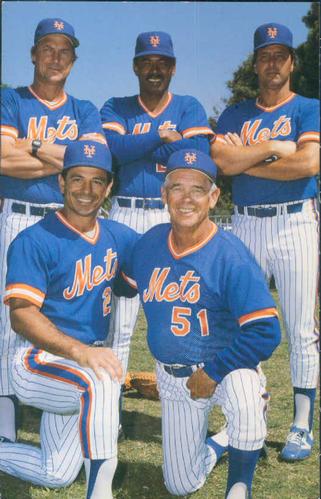
Met manager Davey Johnson, flanked by coaches Mel Stottlemyre
and Greg Pavlik. Front: Bobby Valentine and Vern Hoscheit.
For 1996, George Steinbrenner hired Joe Torre as Yankee manager, and Joe asked for Mel as his pitching coach. Mel and George made up, and the Yankee pitchers performed legendary feats. Gooden and Cone became Yankees, and each pitched a no-hitter at Yankee Stadium. Cone's was a perfect game, and David Wells also pitched a perfect game at Yankee Stadium.
The rotation in Mel's return to The Bronx also included such luminaries as Jimmy Key, Andy Pettitte, Orlando "El Duque" Hernandez, Roger Clemens and Mike Mussina. The bullpen had Mariano Rivera, John Wetteland, Jeff Nelson, Graeme Lloyd, Mike Stanton and Ramiro Mendoza. If "pitching wins championships," the 1996-2003 Yankees proved that a lot more than did the 1964 Yankees, or the 1984-90 Mets for that matter.
The brain trust of baseball's last dynasty:
Don Zimmer, Joe Torre and Mel Stottlemyre
But the older, supposedly mellower Steinbrenner still occasionally meddled with the team, and after the 2005 season, Mel had had enough, and resigned after that season's Playoff defeat. He had one more season in a major league uniform, as pitching coach with the Mariners in 2008.
*
Mel lived his adult life in the Seattle suburb of Issaquah, Washington, with his wife Jean. They had 3 sons. Todd Stottlemyre went 138-121 in the major leagues, winning the World Series with the 1992 and 1993 Toronto Blue Jays, and also reaching the postseason with the 1996 St. Louis Cardinals, the 1998 Texas Rangers, and the 1999 and 2002 Arizona Diamondbacks -- but followed his father's pattern by being injured for the entire 2001 season, and missing the D-backs' World Series win over the Yankees. He has since become a very successful stock trader.
Mel Stottlemyre Jr. wasn't so lucky in baseball: He made just 13 major league appearances, all with the Kansas City Royals in 1990, going 0-1 with a 4.88 ERA. But, like his father, he became a successful pitching coach, serving with the Diamondbacks at the major league level in 2009 and 2010, then as a roving instructor through 2013, and back at the top in 2014 and 2015. He was hired by the Mariners in 2016, and will be the pitching coach for the Miami Marlins this season.
But another son, Jason, developed leukemia, and died at age 11. Later, Mel developed a similar ailment, multiple myeloma, and missed much of the 2000 season recovering. In 2011, it returned.
On June 20, 2015, the Yankees held Old-Timers' Day. A Number 30 was marked in white on each foul line, presumably to honor former 2nd baseman and coach Willie Randolph with a Plaque in Monument Park. As a surprise, it was to honor 2 Number 30s: Mel was also honored with a Plaque.
Note that is lists him as "MELVIN LEON STOTTLEMYRE, SR.,"
in recognition of his family's contribution's to baseball, not just his.
Weakened by his illness and his treatment, Mel used a cane, and I got the impression that they were doing this while they still had time. But they did not do this for the aforementioned Bobby Murcer when it became clear, during his cancer treatment in 2007 and '08, that he could die, and then did. They still haven't given Bobby a Plaque, and he was at least as important to the Yankees from 1969 to 1974 as Mel was -- and, like Mel won just 1 Pennant with the team, albeit near the end, 1981, instead of at the beginning, in Mel's case in 1964.
"A 'thrill' isn't a word to use," he said. "It's beyond that."
He also said that, given the nature of his illness and his residence all the way across the country -- he had to clear this trip with his doctor -- it might be his last Old-Timers' Day visit. He said, "I will start another baseball club, coaching up there, whenever they need me."
They needed him on Sunday, January 13, 2019, at the age of 77.
With Mel's death, there are 12 surviving players from the 1964 Yankees: Pitchers Whitey Ford, Ralph Terry, Rollie Sheldon, Jim Bouton, Al Downing and Pedro Ramos; shortstops Tony Kubek and Phil Linz, 2nd basemen Bobby Richardson and Pedro Gonzalez, outfielder Hector Lopez and 1st baseman Joe Pepitone.
And it leaves 14 living honorees in Monument Park at the new Yankee Stadium: Ford, Reggie Jackson, Ron Guidry, Willie Randolph, Goose Gossage, Don Mattingly, Joe Torre, Bernie Williams, Paul O'Neill, Mariano Rivera, Derek Jeter, Andy Pettitte, Tino Martinez and Jorge Posada.
UPDATE; Mel was buried at Sunset Hills Memorial Park in the Seattle suburb of Bellevue, Washington.