(Before I begin: I'm not going to do updates for all of Rutgers' 2021 away Big Ten opponents. Just Rutgers itself, and the only away opponent for whom I have not yet done a Trip Guide: Northwestern University.)
It's hard to believe, but we are just one week away from college football. On Thursday night, September 2, at 6:30 PM, Rutgers University will kick off, at home at Rutgers Stadium -- or SHI Stadium, if you must use the official, corporate name -- in Piscataway, Middlesex County, New Jersey, against Temple University.
So here's my how-to guide for Rutgers, the closest Football Bowl Subdivision (FBS, formerly known as Division I-A) team to New York City. The next-closest team, the U.S. Military Academy at West Point, New York, a.k.a. "Army," is 52 miles from Times Square. Next-closest is the University of Connecticut, based in Storrs but playing in East Hartford, 114 miles away. Syracuse? It may be in the State of New York, but Times Square and the Carrier Dome are 252 miles apart -- Penn State and the University of Maryland are actually closer.
Columbia in Manhattan, Fordham in The Bronx, Wagner on Staten Island; Hofstra (which no longer plays football) and Stony Brook on Long Island; Princeton and Monmouth in New Jersey; and Sacred Heart in Connecticut are all fairly close, but all are Football Championship Subdivision (FCS, formerly named Division I-AA) schools.
College football hasn't been as big in New Jersey as the NFL since the Giants got good in the 1950s, and when Joe Namath made the Jets matter in 1968, that was pretty much it for Rutgers and Princeton, then both "small college." In the 1970s, Rutgers made a commitment to play what they called "big-time football," and Princeton wanted to stay in the Ivy League. Rutgers went big and, for the most part, has spectacularly failed; Princeton stayed at their level, and has, more often than not, done very well.
According to
a map based on Facebook "Likes," showing each County in the country, the New York Giants are the leading NFL team in the New Jersey Counties of Sussex, Passaic, Bergen, Warren, Morris, Essex, Hudson, Hunterdon, Somerset, Union, Middlesex, Monmouth and Ocean -- all of North Jersey, and all of Central Jersey except Mercer. The Philadelphia Eagles were tops in the Counties of Mercer, Burlington, Camden, Gloucester, Salem, Cumberland, Atlantic and Cape May -- all of South Jersey except for Ocean, plus Mercer.
In fact, until 2013, the New York Jets had just one County in the entire New York Tri-State Area where they had more fans than the Giants: Nassau County, Long Island, long the home of their team offices and training camp, Weeb Ewbank Hall on the campus of Hofstra University, across from the Nassau Coliseum. Now, even Nassau is listed as majority Giants territory. I guess
Sports Illustrated had it right in 1986, when the Giants were on their way to their 1st Super Bowl win and the Jets were also Playoff-bound:
"In the Big Apple, the Jets are always second banana."However, that same map puts the lie to coach Greg Schiano's claims about "the State of Rutgers" including New York City, Long Island, Philadelphia, Delaware, and even some of Florida. Big chunks of Bergen, Passaic and Sussex Counties prefer Penn State to Rutgers. Some parts of Bergen even have Notre Dame ahead. And the Southern half of the State, the part that tilts toward Philadelphia, and even towns near the Delaware River in the Counties of Warren, Hunterdon and Mercer, 200 miles from Beaver Stadium, prefer Penn State. The bastards.
Before You Go. SHI Stadium is 40 miles from Midtown Manhattan, so the weather will be just about the same. It can be hot in September, and then, starting midway through October, it can be cold.
Tickets. Since Rutgers got good in 2005, tickets have been hard to come by, even with recent events such as the expansion of the stadium and the team's nosedive back into mediocrity. As of this writing, none of the 7 home games are completely sold out. In Big Ten play, Rutgers doesn't play Nebraska this year, and goes away to Michigan and Penn State. But Ohio State comes in, so don't expect to get great seats, even if you order now. That said, there isn't really a bad seat in the stadium.
Ticket prices remain the same as last year. Lower level (sections starting with 100) sideline seats go for $70 and $60, corner and end zone sections for $40. Upper level (sections starting with 200) middle seats go for $65 and $45, while on the ends (the upper deck only goes along the sidelines) are $25.
Getting There. As I said, Rutgers Stadium is almost exactly 40 miles from Times Square. However, do not take that for granted. Traffic getting out of New York City may be favorable to you on a Saturday morning, especially after Labor Day, but the last couple of miles before you reach the stadium will be bad.
It would be best to go early, trying to reach the stadium at least an hour before kickoff. If you enjoy tailgating, make it at least 2 hours before kickoff, to give yourself enough time to set up, cook, eat, and disassemble again. If you don't enjoy tailgating, your best bet is probably to forget the car and take public transportation.
It's important to note that "Rutgers, the State University of New Jersey" is vast, including campuses (campii?) in Newark and Camden. The main campus straddles the Raritan River in Middlesex County. The College Avenue Campus (the original part of the school), the Cook Campus (the agricultural and environmental studies section) and the Douglass Campus (originally the New Jersey College for Women) are in New Brunswick. The Livingston Campus (including the arena) and the Busch Campus (including the stadium) are across the river in Piscataway.
New Jersey Transit runs rail service from Penn Station in Midtown Manhattan to New Brunswick, once an hour on Saturday mornings. The 9:14 Northeast Corridor train arrives in New Brunswick at 10:11, and the next one (10:14 to 11:11) will also get you there before kickoff. Round-trip fare is $28.
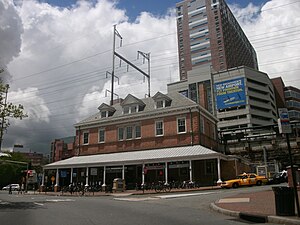
New Brunswick Station, with The Vue behind it
Coach USA (formerly Suburban Transit) runs buses from Port Authority Bus Terminal in Midtown to New Brunswick every hour on the hour, and it takes 50 minutes, dropping you off in front of the New Brunswick train station. A round-trip fare is $22.50. On the way back, cross Albany Street, and stand in front of that big empty space where the Ferren Mall used to stand before its demolition late last year. (The new parking deck is a block to the west.)
NOTE: For the moment, due to COVID restrictions, Coach USA is still not running buses between New Brunswick and Port Authority except during morning and evening weekday rush hours, so this will not be an option this season. If you don't have a car, you'll have to take the train.
From the New Brunswick train station, there will be special Campus Buses to shuttle you to the stadium. These will be free. Although it's only 3 miles, depending on the traffic, this could take anywhere from 5 to 45 minutes. You have been warned.
At least, if you're wearing opposing-team colors, the RU fans will not harass you. They may be Giant, Jet, or (yikes) Eagle fans on Sunday, but on Saturday, it's a whole other animal. They will leave you alone, or even try to be polite to you. (Unless you're wearing Penn State gear. In which case, stay away entirely.)
If you're driving from New York City, get onto the New Jersey Turnpike. Whether that means the Lincoln Tunnel, the Holland Tunnel, or the Belt Parkway followed by the Verrazano-Narrows Bridge followed by the Staten Island Expressway followed by the Goethals Bridge, all roads to Rutgers lead to the Turnpike.
Take the Turnpike to Exit 9, and take Route 18 North toward New Brunswick. The signs will lead you over the John Lynch Memorial Bridge. (John Lynch Jr., a corrupt former Mayor of New Brunswick, had it built and named after his father who had also been Mayor.) Once you're over the bridge, take the exit saying Campus Road/Rutgers Stadium/Busch Campus. (The sign was not changed when the stadium's name was.)
Then turn left on Sutphen Road. The stadium will be on your left; to your right will be an indoor practice facility known as The Bubble (for a reason that will be obvious when you see it). At which point, follow the instructions of the Campus Police. If you do it right, you should hit a wall of traffic within 45 minutes of leaving The City.
Once In the City. New Jersey is named for Jersey, one of the United Kingdom's Channel Islands, birthplace of Sir George Carteret, who in 1664 was granted the part of the former New Netherland across the Hudson River from what became New York. He gave the Colony of New Jersey freedom of religion. (The Borough of Carteret is named for him, the City of Elizabeth for his wife.)
While the name was written as "Caesarea" in Latin, it is apparently not named for Julius Caesar: "Jers" comes from a word meaning "earl," and the -ey suffix denotes an Island, as with the other of the large Channel Islands, Guernsey.
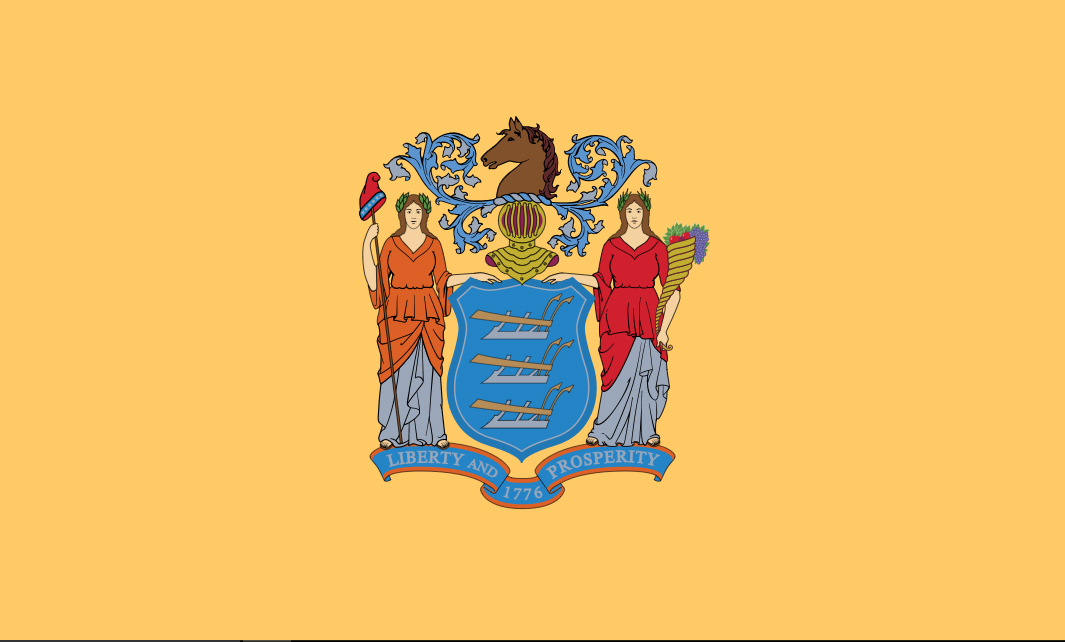
The State Flag. Officially, this yellowish color
is called "buff."
One of the Original 13 Colonies, New Jersey was the 3rd State to ratify the Constitution, on December 18, 1787 -- meaning that my home State technically has the same birthday that I do -- and was the 1st State to ratify the Constitution's 1st 10 Amendments, the Bill of Rights, on November 20, 1789.
The State House, Trenton
New Jersey has had its issues with race and ethnicity. There was an anti-German riot in Hoboken in 1951, and the 1967 Newark riot spilled over into Plainfield, just 11 miles from downtown New Brunswick. While New Brunswick's city government has embraced corruption, including the police confirmed as having ticket quotas, incidents of police brutality have been noticeably reduced.
New Brunswick is named for an English town, whose name was taken from the German city of Braunschweig in Lower Saxony, taken from "Bruno's wik." A wik was a marketplace and a rest stop for travelers in medieval Germany. Bruno, Brun, or Braun -- the English name Brown and the German name von Braun come from him -- was Duke of Saxony, and is a Catholic saint. He is said to have founded Braunschweig in AD 861.
The New Jersey city is considerably newer, although old by American standards: Formerly Prigmore's Swamp and Inian's Ferry, the first European settlement there was in 1681. The name was changed a little over 300 years ago, in 1714, in honor of the German-born new King of England, George I, who was also Elector of Hanover and Duke of Brunswick-Luneburg. His brother, Prince Ernest Augustus, was the Duke of York and Albany, and the main intersection of the city is George & Albany Streets, named for the King and his brother -- not for George Washington and the New York State capital.
The Albany Street Bridge, built in 1887,
with the 1903 Pennsylvania Railroad Bridge behind it
The corner of George & Albany Streets is not, however, a "centerpoint": For east-west streets, addresses start at the Raritan River and increase westward; for north-south streets, they start on the south side of town and increase northward, so that the main intersection includes not 1 North George Street and 1 West Albany Street, but 410 George Street and 120 Albany Street.
A "King's Highway" was built in colonial times, and this was the forerunner of today's New Jersey Route 27, including part of Somerset Street, all of French Street, all of Albany Street, and the Albany Street Bridge over the river into neighboring Highland Park.
The city was occupied by the British during the War of the American Revolution. While there is no Washington Street in town, and George Street is named for an earlier King (not George III), there is a Hamilton Street, named for Alexander Hamilton. The University's administration building, a.k.a. Old Queens, was built on a hill on that street, overlooking the river, where Hamilton observed British troop movements, and ordered cannon fire that kept them occupied until the Continentals could fully evacuate.
The seat of Middlesex County (population, about 825,000), New Brunswick is home to about 55,000 people. Long a haven for immigrants from Ireland and Eastern Europe (especially Hungary), the growth of the American middle class made possible the development of nearby towns like Franklin (named for Ben, not, as long believed, his colonial governor son William who accepted the charter for what became Rutgers), Piscataway, Edison, North Brunswick (which is actually south of New Brunswick), East Brunswick (ditto) and South Brunswick (and again, ditto, although in that case it made sense).
But that white flight from New Brunswick left poor blacks moving in, and the Hub City (so named because it was a major transportation center) became stricken with ghettos. Many children of those black citizens overcame this, and moved into the neighboring towns. Their places were taken by Mexican immigrants, their community settled, ironically, on French Street. (The street was almost certainly named for steamboat pioneer Daniel French, rather than the nationality of the original settlers on it.) The city is about 50 percent Hispanic, 27 percent white, 16 percent black, 7 percent Asian.
Today, New Brunswick's 4 main communities -- academic, legal (as I said, it's a County Seat), health care (2 major hospitals and being world headquarters for Johnson & Johnson gave it the nickname "The Healthcare City") and immigrant -- combine to make it a very vibrant city.
There's always construction going on, including downtown. The Barnes & Noble that forms the new campus bookstore is on the ground floor of the 2012-constructed tallest building in Central Jersey, the 24-story, 299-foot The Vue. It is connected by a walkway to the outbound platform (for trains running from New York and Newark toward Trenton and Philadelphia) of the train station.
The station is the hub for both New Jersey Transit buses to neighboring towns (fares: 1 zone, $1.60; 2 zones, $2.55; 3 zones, $3.15) and Campus Buses (free). The main newspaper is the
Home News Tribune, created in 1995 as a result of a merger between the New Brunswick-based
Home News and the Woodbridge-based
News-Tribune.
Sales tax in the State of New Jersey is 7 percent, and it does not rise in the County of Middlesex; quite the opposite: The entire City of New Brunswick is an Urban Enterprise Zone, cutting the sales tax in half to 3 1/2 percent. Public Service Electric & Gas (PSE&G) runs the electricity.
ZIP Codes in North Jersey tend to begin with the digits 07, including 071 for Newark and environs, 072 for Elizabeth, 073 for Jersey City, and 075 for Paterson. Central and South Jersey got ZIP Codes starting with the digits 08, including 084 for Atlantic City, 085 and 086 for Trenton, and 089 for New Brunswick and environs: Rutgers has 08903, the rest of New Brunswick 08901, North Brunswick 08902 and Highland Park 08904, the highest ZIP Code in New Jersey. (The other neighboring towns all have ZIPs starting with 088.)

New Jersey's original Area Code was 201. 609 was split off in 1958, 908 in 1991, 732 in 1997, and 856 in 1999. Now, they serve as follows: 201, with 551 overlaid in 2001, serves only Bergen and Hudson Counties (including the Meadowlands, and thus MetLife Stadium, and Harrison, and thus Red Bull Arena); 609 serves Mercer County (including the capital of Trenton and Princeton University) and the Southern Shore region (including Atlantic City); 732, with 848 overlaid, much of Central Jersey (including Rutgers University) and the Northern Shore region; 856, the Delaware River region that serves as suburbs of Philadelphia; 908, the Counties of Union, northern Somerset, Morris and Warren; and 973, with 862 overlaid, the Counties of Essex (including Newark, and thus the Prudential Center) and Passaic.
Once On Campus. The school was originally named Queens College, and George III gave the school its royal charter in 1766, the 8th of 9 American colleges founded before independence. The other "Colonial Colleges" are:
* New College, now Harvard, in Cambridge, Massachusetts, 1636.
* William & Mary in Williamsburg, Virginia, 1693.
* Collegiate School, now Yale University, in New Haven, Connecticut, 1701.
* The College of New Jersey, now Princeton University, 1746. (The current school named The College of New Jersey, or TCNJ, was founded in 1855, in Trenton, as the New Jersey State Normal School. In 1929, it moved to the adjoining suburb of Ewing. and was renamed New Jersey State Teachers College. In 1958, it was renamed Trenton State College, and was renamed The College of New Jersey in 1996.)
* King's College, now Columbia University, in New York City, 1754.
* The College of Philadelphia, now the University of Pennsylvania, or "Penn" for short, in Philadelphia, 1755,
* The College of Rhode Island, now Brown University, in Providence, 1764.
* And Dartmouth College, in Hanover, New Hampshire, 1769.
Harvard, Yale, Princeton, Columbia, Penn, Brown and Dartmouth all became "Ivy League" schools, along with Cornell University in Ithaca, New York, founded a bit later, in 1865. In spite of Penn's name, they are all private schools. Rutgers is a State school, and is one of a few that are nicknamed "Public Ives."
Queens College was chartered by the Dutch Reformed Church. For this reason, the college green, Voorhees Mall, has a 15-foot statue of William I, Count of Nassau and Prince of Orange (1533-1584), a.k.a. William the Silent, ancestor of the current Dutch royal family and the hero of Dutch independence. The statue also includes his dog, Pompey.
Although he was able to aid the establishment of the Dutch Republic in 1581, Spain, being a Catholic country that despised Protestants such as the people of the Netherlands had become, refused to recognize this, and had William assassinated in Delft on July 10, 1584. The assassin, a Frenchman named Balthasar Gérard, ran, but was quickly caught, horribly tortured for 4 days, and then executed. Spanish recognition of Dutch independence did not happen until 1648, when the Peace of Westphalia ended both the Thirty Years War and the Eighty Years War.Supposedly, if a senior still a virgin walks past his statue, "Willie the Silent" (a.k.a. "Still Bill") will be silent no more, and whistle. Since its installation in 1928, 93 years ago, no one has ever reported having heard this whistle.
In 1825, the year Old Queens was completed, the school had run out of money and had to close. At the time, they thought it might be permanent. Enter Colonel Henry Rutgers, a high-ranking member of the Dutch Reformed Church in Manhattan. A graduate of Kings College (Columbia), Rutgers was a lifelong bachelor with no children, legitimate or otherwise (it has been retroactively suggested by activist groups that he was gay), and, having no family to whom he could leave his money, made considerable donations in his time.
Knowing of New Brunswick's role in slowing the British down, making the Continental Army's retreat, its regrouping in Pennsylvania, and its subsequent victories at Trenton and Princeton possible, he donated $5,000 (about $117,000 in today's money), and a bell for the cupola at Old Queens.
In gratitude, and in hopes that the Colonel would leave them something more in his will, the regents renamed the school Rutgers College. The Colonel left them nothing more, but the name stuck, and the school's marching band still plays a song titled "The Colonel Rutgers March."
In New Brunswick, when people say, "The Colonel,"
they don't mean Harland Sanders, Sherman T. Potter
or Steve Cropper. They mean Henry Rutgers.
As for the name itself: Rutgers is a Dutch surname, from the Christian name Rutger, a variant of the English name Roger, both from the Germanic combination of
hrōd, χrōþi ("fame", "renown", "honour") and gār, gēr ("spear", "lance").
Rutgers became New Jersey's only land-grant college under the Morrill Act of 1862 (which created land-grant colleges), and, following the consolidation with Cook and Douglass, the State University in 1956.
The University of Newark was incorporated into the RU system in 1945, and the College of South Jersey was added in 1950. These schools are now known as Rutgers University-Newark and Rutgers University-Camden, respectively.
Rutgers-Newark and Rutgers-Camden have separate athletic programs, operating in NCAA Division III, and playing in the New Jersey Athletic Conference (NJAC), along with the aforementioned TCNJ, Kean University in Union (formerly Newark State College), Montclair State, the New Jersey City University (formerly Jersey City State), Ramapo College in Mahwah, Rowan University (formerly Glassboro State College), Stockton University in Pomona, outside Atlantic City, and William Paterson University in Wayne.
Douglass College, founded in 1918 as the New Jersey College for Women, was added in 1955. Cook College has always been a part of the Queens/Rutgers system. The main part of the campus, along College Avenue in New Brunswick, is still officially "Rutgers College." The Livingston and Busch campuses were added in 1969. (By a macabre coincidence Douglass founder Mabel Smith Douglass and Henry Rutgers are buried in the same cemetery, Green-Wood in Brooklyn.)
While the Queens name has never been restored, the administration building is still known as Old Queens, and some university flags still bear the script form of the letter Q. Some bear a script R. Both are flanked by the numbers 17 and 66, for the school's founding year.
No one has ever seriously suggested changing the name to "the University of New Jersey" or "New Jersey State University" or even "Jersey State." It might have been better if they had: What's a better chant? "UNJ! UNJ! UNJ!" or "R... U... R... U... "
Aside from being the host of "the first college football game," RU is known for its scientific and medical breakthroughs, including the isolation of Streptomycin by Selman Waksman in 1943.
Notable RU graduates from outside of the world of sports include:
* Politics, representing New Jersey unless otherwise stated: Vice President Garret Hobart, Class of 1863 (served in William McKinley's 1st term, died in office 1899); Governors Charles C. Stratton 1814, George C. Ludlow 1850, Foster Voorhees 1876, A. Harry Moore 1903, Richard J. Hughes '31, William T. Cahill '37 and Jim Florio '67; Senators James Schureman 1775, Frederick Frelinghuysen 1836, Clifford Case '25, Bob Torricelli '74, Elizabeth Warren '76 of Massachusetts, and Bob Menendez '79; Cabinet officials Frelinghuysen (Secretary of State) and Hazel O'Leary '66 (Secretary of Energy); Supreme Court Justice Joseph P. Bradley 1836; FBI Director Louis Freeh '71. Also, Eheneden Erediaua '81, who has been crowned Emperor Ewuare II of the African nation of Benin.
* Business: Economist Milton Friedman '32, Home Depot founder Bernard Marcus '51.
* Science and Medicine: Robert A. Cooke 1902 (antihistamine pioneer), Selman Waksman 1915, Louis Gluck '30 (called the Father of Neonatology), Peter C. Schultz '64 (co-inventor of fiberoptics), Michael Gottlieb '69 (AIDS study pioneer).
* Literature: James Blish '42, Michael Shaara '51, Judith Viorst '52, Robert Pinsky '62, Janet Evanovich '65, Junot Diaz '91.
* Journalism: Martin Agronsky '36, Milton Viorst '51 (Judith's husband), Gene Lyons '52, Bernard Goldberg '67, Mike Taibbi '71, Natalie Morales '94. You should count sportswriters, so add erry Izenberg '52, Michael Farber '73, Steven Goldman '94.
* Art: Sculptor George Segal '63.
* Enertainment: Actors Avery Brooks '73, Sheryl Lee Ralph '75, James Gandolfini '83, Kristin Davis '87,
Ally McBeal co-stars Calista Flockhart and Jane Krakowski '88, Sebastian Stan '05; screenwriter Kurt Sutter '86; bandleader Ozzie Nelson '27; rapper Lisa "Sister Souljah" Williamson '86; comedians Judy Gold '84 and Bill Bellamy '89; MTV host Matt Pinfield '88; chef Mario Batali '82 (a close friend of Gandolfini's).
Going In. As I said, free Campus Buses will take you from the train station to the stadium, a 2-mile trip. The official address of the stadium is 1 Scarlet Knight Way. If you're driving,
parking is $20, and information is available here at ScarletKnights.com.
A statue depicting an early football player, honoring Rutgers as "The Birthplace of College Football," is at the stadium's north gate. There are also west, east and south gates.
The original Rutgers Stadium opened in 1938, built by President Franklin D. Roosevelt's Works Project Administration, at a low cost since it was built into a natural bowl, thus not requiring as much digging as one built on level ground would have. It had a West Stand, an East Stand, and a North Stand, all single-decked, all concrete with wooden benches, no actual seats. Having seen a few games there, I can tell you that making fans comfortable was not a high priority. Seating capacity was 23,000.
On each side of the North Stand, between the other stands, were grass areas -- I don't want to use the term "grassy knoll," but they did get called that. When these areas got filled in, capacity rose to over 30,000. In 1969, a Centennial Game was played against Princeton, and ABC offered to televise it. So, for the 1st TV game in Rutgers football history, a few spare bleacher seats were added, and 31,219 was the paid attendance, the highest in the stadium's history.
1938-1992 configuration, late in its history,
after the Hale Center was built on the East Stand
According to a
Home News article published in 1988, on its 50th Anniversary, the stadium was designed to last 50 years. Right on schedule, by this point, it was beginning to fall apart. Plus, at just 23,000 "seats," it was too small for what Rutgers, in the 1970s, began calling "big-time football."
So when Giants Stadium opened in 1976, Rutgers began dividing their home schedule: 3 games "On the Banks of the Old Raritan," 3 games at the Meadowlands. On October 3, 1992, Rutgers lost 38-24 to Penn State there, in front of the largest home attendance Rutgers has ever had, 72,203. (Despite the opening of MetLife Stadium at the Meadowlands in 2010, Rutgers has only played 1 game there, and got only 41,292 fans.)
So negotiations were undertaken with the State government, and in 1992, after a Halloween thriller with Virginia Tech, when a touchdown on the final play gave Rutgers a 50-49 win, and a 13-9 win over West Virginia, the old stadium was closed and demolished.
Playing their home games at Giants Stadium in 1993, Rutgers opened the new Rutgers Stadium on September 3, 1994, beating Kent State, 28-6. It had a horseshoe shape, open at the south end, maintaining a nice view of the riverfront and downtown New Brunswick. The lower deck was rounded at the corners, but otherwise perfectly straight, and upper decks were added along the sidelines. Also, for the first time, Rutgers Stadium had permanent lights. Capacity was now 41,500 -- still the smallest in the recently-formed Big East Football Conference.
The Hale Center, with team offices, training facilities, a huge new locker room, and press facilities (the old press box was a dinky little thing on the West Stand, not much bigger than a high school stadium's press box), had opened on the East Stand a few years earlier. (Here's a shot of that configuration, complete with the trees at the South end.)
1994-2008 configuration
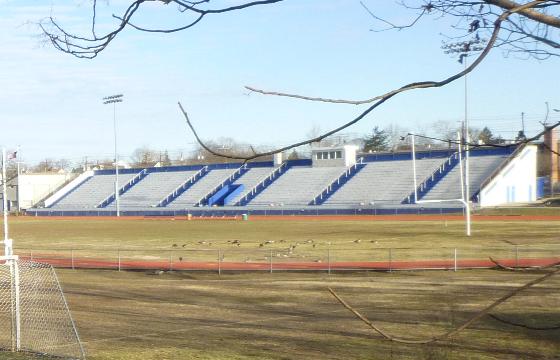
Finally, in 2009, a new south end was built, as the new student section, and it gets as rowdy as the ends at English soccer grounds. This cut off the nice view (and forced the cutting down of a lot of trees), but it also turned the horseshoe into a fully-enclosed bowl, and increased capacity to 52,454 -- now that Rutgers is in the Big Ten, only Northwestern has a smaller stadium. (Indiana's is larger by a few hundred.) It's unlikely that there will be further expansion, unless they want to tear off that little red roof on the North Stand and put on a second deck.
2009-present configuration, with the big scoreboard
towering over the new South Stand
The largest on-campus crowd thus far is 53,774, which saw RU lose to Penn State 13-10 on September 13, 2014. The biggest away crowd for Rutgers thus far is 111,213, in a 35-14 loss to Michigan on October 28, 2017.
In 2011, the facility was renamed High Point Solutions Stadium. High Point Solutions was based in Sparta, in the northernmost part of the State, in Sussex County. In 2018, with the change in the company's name, the stadium's name was changed to HighPoint.com Stadium. According to their company website, "HighPoint is unlike any other consulting firm. We're focused, with more consultants dedicated to the life sciences and healthcare industries than the large consulting firms."
On July 19, 2019, Rutgers signed a new naming rights agreement, with information technology firm SHI International Corporation. The initials stand for Software House International. Their headquarters is in the Somerset Park section of Franklin Township, Somerset County, 5 miles from the stadium. Their operational center is in Piscataway, about 4 miles away.
From here until the end of this post, I will call the facility by its original name, Rutgers Stadium. I won't use its corporate name again, because selling naming rights to a stadium is never a high point, and it offers no solutions. And, let's face it, naming a stadium "SHI" provides the same kind of issues that naming the Mets' new ballpark "Citi Field" did.
The playing surface has been FieldTurf since 2004, after having been natural grass since the original stadium's opening in 1938.
Four matches of the U.S. soccer team have been played on the site, 3 before the 1994 reconstruction, 1 after it, a 1995 draw with Colombia. Rutgers plays lacrosse on the site, and it has hosted that sport's version of the NCAA Final Four in 1998, 2001 and 2002. Its predecessor did so in 1974, 1978, 1983, 1987 and 1990, so that's 7 times.
It hosts State high school Playoff games, and band competitions. Commencement exercises are held there every may, including in 2016 when President Barack Obama gave the Commencement Address, in honor of the University's 250th Anniversary. In 2005, a lecture by the Dalai Lama sold the stadium out.
Food. Don't expect anything fancy. It's pretty much the standard stadium fare, although the hot dogs are good. (Not great, just good.) The concession stands are plentiful, and are manned by local high school booster clubs' officials, eager to continue their partnership with The State University, so they're going to be friendly.
One interesting item is available on the West Stand, near the entry gate. For $5.00, you can get a fried turkey leg, as if you're Charles Laughton playing the old Tudor monarch in the 1933 film classic
The Private Life of Henry VIII. Adjacent to this cart are stands for Premio Italian sausages.
Team History Displays. I mentioned that Rutgers has played at 1 game at MetLife Stadium. This was on October 19, 2010, a 23-20 victory over Army. It was also the game which defensive tackle Eric LeGrand broke his neck while making a hit on a kickoff return. While he still can't walk, he has recovered to the point where he led the team onto the field in his motorized wheelchair in a snow-strewn game the next season, he got his degree, and became an analyst on RU broadcasts and a motivational speaker.
This is one man who's not afraid of The Dreaded SI Cover Jinx.
What's it going to do to him that's worse than what he's already endured?
In 2013, he became the 1st Rutgers football player to get his number retired, Number 52. That number is now shown on the video gantry on the upper deck of the East Stand. When his coach, Greg Schiano, left RU to take the head job with the Tampa Bay Buccaneers in 2012, he signed LeGrand to a contract, to make him an official NFL player, though, obviously, he never got into a game. In a corresponding display of equal class, LeGrand subsequently "retired" to open a roster spot for a deserving player.
Note his initials, EL, are a different color, so they stand out.
Also on the North Stand are displays of the official logos from Rutgers' bowl appearances: The 1978 Garden State Bowl at the Meadowlands (a loss to Arizona State), the 2005 Insight Bowl in Phoenix (also a loss to Arizona State), the 2006 Texas Bowl in Houston (beating Kansas State), the 2007-08 International Bowl in Toronto (beating Ball State), the 2008 PapaJohns.com Bowl in Birmingham (beating North Carolina State), the 2009 St. Petersburg Bowl (beating Central Florida), the 2012 Russell Athletic Bowl in Orlando (losing to Virginia Tech), the Pinstripe Bowl in New York in 2011 (beating Iowa State) and 2013 (losing to Notre Dame), and the 2014 Quick Lane Bowl in Detroit (beating North Carolina).
The Garden State Bowl was, essentially, made up by Rutgers, and was played at Giants Stadium. It was a running joke that schools that had entered Division I-A recently had gone to "a real bowl game," and Rutgers, "The Birthplace of College Football," hadn't. (Or had had to make a bowl game up, at home, and still lost it.)
They didn't go to a real one until 2005, in Phoenix -- and, oddly, again lost to Arizona State, although, this time, Arizona State was playing just a few miles from their Tempe campus). As you might guess, the Pinstripe Bowl is played at the new Yankee Stadium, and is practically a home game for Rutgers.
However, Rutgers has never played in any of the traditional New Year's Day bowl games: No Rose, no Orange, no Cotton, no Sugar, no Fiesta. Nor have they played in any of the 2nd-tier bowls that sometimes get played on or around January 1, such as the Sun, the Gator, or the Peach.
They had near-misses in 2006, when they lost to West Virginia University on a late play, denying them the Big East Conference Championship and a berth in a Bowl Championship Series game; and in 2012 when they lost back-to-back Big East games, resulting in a 4-way tie for the title, but the University of Louisville (the 2nd of the 2 losses, and an absolutely disgraceful choke) got the Big East BCS berth. Still, a title is a title, and a notation is on the North Stand, near the bowl mentions.
There's also no mention of the 2014 Lambert Trophy, which Rutgers was awarded as "the best college football team in the East." It was the 1st time RU had won this trophy, 1st awarded in 1936. Even Princeton won it twice, in 1950 and '51. But every other time RU had a great team, somebody seemed to have a better one, including in the undefeated seasons of 1961 (it went to Penn State, which, at least that time, was ridiculous) and 1976 (to the undefeated University of Pittsburgh, a considerably more justified awarding).
Even when Rutgers beat Louisville in 2006, Louisville got the Lambert Trophy. So why would Rutgers get it over Louisville in 2014, when Louisville beat them?
The Lambert Trophy
In the middle of the lower deck on the East Stand, there are a number of displays relating to Rutgers' football history, including the original dedication plaque from the old stadium, and tributes to famous Rutgers wins, coaches and officials. There's also a plaque with the inductees into a hall of fame for high school football coaches and officials in New Jersey.
As I mentioned, a statue is outside the North Gate, on a strip of sidewalk called Scarlet Walk, honoring "the first college football game," in 1869. (More about that in "Sidelights.") Rutgers still has "The Birthplace of College Football" displayed behind the North Stand end zone, and on top of the big scoreboard at the South Stand.
There is no mention at the stadium for the 4 games the U.S. national soccer team played at the site, the highest attendance having been 12,063, only half-filling the 1938-1992 version of the stadium. That shows you just how far the U.S. team has come in 20 years: Now, it can come close to selling out the 82,000-seat Meadowlands.
There is no opponent, currently regular or otherwise, that Rutgers plays for a trophy, such as a bucket, a barrel, an axe, or an avatar of some animal or other. Even when they played Princeton, with all the talk of cannons, there was no cannon trophy.
Rutgers won The First Game in 1869, and then didn't beat Princeton again until the dedication game for the original Rutgers Stadium in 1938 -- 33 straight losses over 68 years. As Rutgers made its move toward "big-time football" (or, as some put it, "bigger-time football"), they turned the rivalry around a bit, going 9-3-1 from 1968 onward, including winning the Centennial Game in 1969, and taking the last 5 games from 1976 to 1980: 17-0 at Palmer Stadium, 10-6 at Palmer Stadium, 24-0 at Giants Stadium, 38-14 at Palmer Stadium, and finally 44-13 at Rutgers Stadium. Princeton didn't want to play a Division I-A team anymore, and stopped the rivalry. But even with these games, Princeton still "won," 53-17-1.
Rutgers' other real rivalry is with Penn State. They won the 1st game against them, in 1918, and beat them again in 1988 -- and that's it. Penn State leads the rivalry 29-2.
Stuff. There's no official Team Store, but souvenir stands are all over the place. There's no funny hats, such as a big foam Knight helmet. They do, however, have the gimmick of a foam red sword. Season highlight DVDs are available at a stand on the East Stand.
The campus bookstore, the aforementioned Barnes & Noble, is at 100 Somerset Street, at the foot of College Avenue next to the train station. It sells all kinds of RU gear, from T-shirts and sweatshirts to caps. (And, yes, textbooks. Very, very expensive textbooks.) Across the street, at 109 Somerset, Scarlet Fever sells RU gear as well.
The stadium concession stands don't sell any books about the team, or the school. In 2007, Michael Pellowski published
Rutgers Football: A Tradition In Scarlet, running from the debut in 1869 up to the team's recent revival and Big East near-miss. LeGrand wrote
Believe: My Faith and the Tackle That Changed My Life. (When selling merchandise saying "BELIEVE" to raise money for LeGrand's chosen charities, the EL, his initials, are black, while the other letters are red.)
William C. Dowling, a professor of English at RU, lamenting the increased emphasis on sports (especially football), has publicly ripped the school (that provides him with a job), having written letters to the
Home News Tribune and the State's largest newspaper, the Newark-based
Star-Ledger, and a book detailing "the other side of the story":
Confessions of a Spoilsport: My Life and Hard Times Fighting Sports Corruption at an Old Eastern University.During the Game. Safety will not be an issue. Regardless of what professional sports teams they root for -- and RU takes fans from New York-aligned North and Central Jersey and from Philly-oriented South Jersey -- the school is strict on making fans abide by a family-friendly code of behavior.
Alcohol is not served in the stadium, and that's a good thing, given how students (most of them under age 21) get at football games. However, if you are staying overnight (unlikely if you're coming from New York City), or even if you want to stay late before taking a bus or train back into Manhattan, I would exercise caution on Easton Avenue, New Brunswick's main bar drag.
The team website has a "Gameday Timeline":
Hours to Kickoff
- 5:00 - Parking Lots Open
- 3:00 - Block R Party Begins
- 2:15 - The Scarlet Walk
- 1:30 - Stadium Gates Open
Minutes to Kickoff
- 20:00 - Band Show Begins
- 10:00 - Horse Entrance
- 7:00 - Scarlet Knights Take the Field
- 5:00 - National Anthem
Despite having a large and good (but not great) marching band, RU usually has a live singer perform the National Anthem. The Anthem is followed by the Rutgers Glee Club singing
the Alma Mater:
On the banks of the old Raritan, my friendswhere old Rutgers evermore shall standFor has she not stoodsince the time of the Floodon the banks of the old Raritan.Which leads to the oddity of the name of the recently-fired RU coach, Kyle Flood. It could be worse. While it seemed right at the time to hire Ohio State's offensive coordinator, his name didn't exactly inspire confidence: Chris Ash. And this wasn't Ash Williams from the
Evil Dead movies, although the cannon (more about which in a moment) is one hell of a "boomstick."
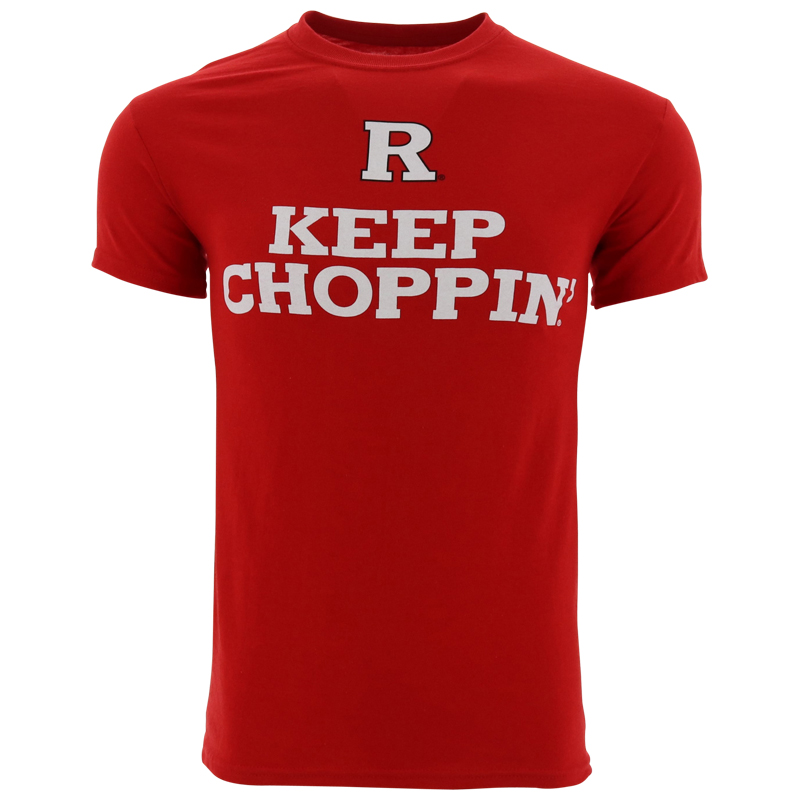
Flood's predecessor, and now Ash's successor, Greg Schiano, liked to say of his team, "We just keep choppin' away." Someone got the idea to have a player (a different senior every game) lead the team onto the field while holding an ax, run from their entrance at the southeast corner, and over to the northeast corner (the home bench is on the east side of the stadium), where a big tree stump is located, and swing the ax into it. "Keep Choppin'" T-shirts are sold, and foam axes are sold, to go along with the foam swords.
Since 2000, before every game, every player touches the shoe on the 1869 statue. This is known as "Scarlet Walk."
When public address announcer Joe Nolan -- also the traffic reporter on WABC-Channel 7's
Eyewitness News -- says, "And
that is another Rutgers...
first down!" the band plays a fanfare, and the fans chant, "First down, touchdown, go RU!" And each score -- touchdown, field goal, even a safety -- is followed by the fight song, "
The Bells Must Ring," which is followed by the official
school cheer:
Upstream, red team!Red team, upstream!Rah, rah, Rutgers, rah!I didn't say the cheer was intellectually stimulating. Then again, Rutgers has pretensions to being a "public Ivy," and some of the actual Ivy League schools have even sillier cheers. (Seriously, Yale? "Boola boola"?)
The south end student section. That empty space
behind the goalposts is where the band sits.
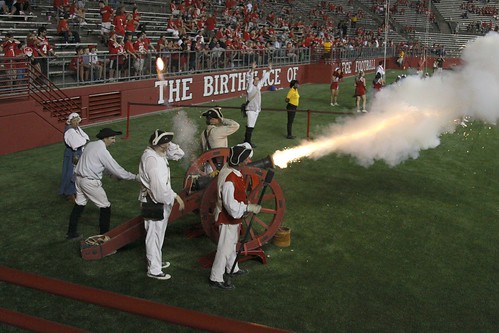
Each score, including extra points, is followed by men in Revolutionary War garb (all wool, so it must be really uncomfortable in those September afternoon home games) standing behind the west corner of the north end zone, loading and firing a cannon that is contemporary to that period. Don't worry, there's no actual cannonball or other such projectile in there. It's loud and smoky, but as long as you're not standing right in front of it, you're safe.
There are 2 Scarlet Knight mascots. One is a guy in a traditional cloth suit with a big foam head, his large-chinned face resembling Pittsburgh Steeler mascot Steely McBeam, himself an obvious parody of former Steeler coach Bill Cowher.
The other is a man in an actual suit of scarlet-painted armor, complete with a sword, riding a horse around the field. It is best to stay away, for this is a very dangerous creature, one that may knock you over, or step on you, or bite you, or kick you, or piss on you, or crap on you. The horse is a bit better-trained. (Old joke.) The horse is always white or gray, never dark.
After the Game. Win or lose, the band comes onto the field after the game and, once more, plays "
On the Banks of the Old Raritan." It usually plays a few more songs before filing out. It's best to stick around for this: Not only are they usually very good musicians, but it gives you a chance to not get stuck in the immediate post-game exodus, making it easier for you to find your car (or your shuttle bus back to the train station) and leave the premises.
And you will have to leave the premises and their vicinity to get a postgame meal, or just a pint. Unless you want to go to the Busch Student Center, you're going to have a bit of a trek. Back across the Lynch Bridge, Easton Avenue, extending northward from Albany Street and the train station, is the place to be.
Featuring such New Brunswick institutions as the Corner Tavern (not to be confused with the Court Tavern, New Brunswick's famed rock music venue), the Golden Rail and the Olde Queens Tavern, this is where the Rutgers community (assuming they're at least 21 years old -- or think they can fool someone with a fake ID) goes to drink.
A particular favorite of mine, and many others', is Stuff Yer Face, at 49 Easton at Condict Street, purveyors of strombolis. (Or is the plural form "stromboli," like the plural of that Italian pastry has no S, "cannoli"?) Their slogan is, "Enjoy a boli and a beer!" And boy, do they have a variety of beers. Indeed, they call it "the Beer Library."
Stuff Yer Face and the Stuff Staff, 2013
It's one of those places that likes to brag, "We were here before you were born." It opened on October 22, 1977, shortly after the Yankees won the World Series with Reggie Jackson hitting those home runs, so it's not true for me, but it
is true for any Rutgers student who graduated after the 20th Century. Celebrity chef Mario Batali worked there while attending Rutgers.
If you're a fan of European soccer, and you ask nicely, they may change the channel of one of the TVs to a game. However, if the game starts at 10 AM or earlier (due to the time difference with Europe), you won't see at least the 1st half: SYF opens at 11:00 every morning, including weekends. No breakfast bolis -- yet. Frankly, I don't see why they couldn't put a fried egg, hash browns and bacon bits in one. Or have a "pancake" or "French toast" boli. At any rate, it's still your best chance at seeing "your club" play "the beautiful game" at a New Brunswick bar.
Just 3 doors up, at 55 Easton, is Thomas Sweet, creator of "blended ice cream" and an equal New Brunswick institution. They also have an outlet in Princeton, catering to that other Central Jersey academic center. They've even opened one in Washington, D.C. -- catering to Jersey Boys and Jersey Girls working for the federal government, or studying there, maybe?
Sidelights. One of the great things about being in New Brunswick (I lived there for 2 years and have lived nearby most of my life) is that you're less than an hour from New York and less than 2 hours from Philadelphia, making each city's attractions easy to reach. This includes the sports teams, who play their home games the following number of miles from the Rutgers Student Center:
* 28 miles to the Prudential Center in Newark, home of the New Jersey Devils
* 31 miles to Red Bull Arena in Harrison, home of the New York Red Bulls
* 35 miles to MetLife Stadium in East Rutherford, home of the New York Giants and the New York Jets
* 37 miles to the Barclays Center in Brooklyn, home of the Brooklyn Nets and the New York Liberty
* 38 miles to Madison Square Garden in Midtown Manhattan, home of the New York Knicks and the New York Rangers
* 46 miles to Yankee Stadium in The Bronx, home of the New York Yankees and New York City FC
* 50 miles to Citi Field in Queens, home of the New York Mets
* 57 miles to the UBS Arena in Elmont, about to become the home of the New York Islanders
* 68 miles to the Philadelphia Sports Complex
* 84 miles to Talen Energy Stadium in Chester, home of the Philadelphia Union
Reaching New York City is easy: Just take the New Jersey Transit Northeast Corridor to Penn Station. (Newark's station is also called Penn Station.) Reaching Philadelphia is a little harder: Take NJT to the Trention Transit Center, and then transfer to the SEPTA (SouthEastern Pennsylvania Transportation Authority) Trenton Line train to Center City's 30th Street, Suburban or Jefferson Station.
There are some nearby places, some sports-related, that might interest you.
* College Avenue Gym and site of First College Football Game. Next-door to the Rutgers Student Center, and across from Brower Commons, is the classic home of Rutgers Athletics. Built in 1931 after the previous gym burned down, "The Barn" seats only 3,200 people, and proved to be totally inadequate during the greatest season in the history of Rutgers basketball: 1975-76, when the Scarlet Knights won their 1st 31 games en route to the NCAA Final Four, finally losing to Indiana and then the 3rd place game to UCLA at the Spectrum in Philadelphia.
A friend of mine who was a senior that year confirms that the noise inside the Barn was so intense, it made paint chips fall from the ceiling. This necessitated the building of a new structure for RU basketball. The Barn is, however, still used for sports like wrestling and volleyball. It also hosted New Jersey's last Constitutional Convention in 1947, at which the current State Constitution was written.
Cramped quarters inside the Barn, seats on only 3 sides.
Behind it is Parking Lot 30, which was built on the site of one of the most important locations in the history of North American sports. For it was here, at what was then called College Field, that what is generally recognized as the first American football game was played, between Rutgers College and the College of New Jersey (which became Princeton University), on November 6, 1869. Attendance is believed to have been about 100. This year is the 150th Anniversary.
This game was, essentially, a soccer game played by teams of 25 men each. The Rutgers men, determined to distinguish themselves from their opponents, and thus make it easier for them to play, took some scarlet cloth -- a cheap color to obtain at the time -- and wrapped it around their heads like turbans, thus inventing school colors and, sort of, the football helmet.
Under the scoring system of the time, Rutgers won, 6-4. That's 6 goals to 4, with RU scoring both the 1st 2 goals of the game, and the last 2. Under today's scoring system, it would be roughly 42-28. A rematch was played a week later at Princeton, and the men of Old Nassau got their revenge on the men of Old Queens, 8-0. (56-0.)
Arnold Friberg's 1968 oil painting, The First Game.
It remains the best-known depiction of the game.
Apparently, no one thought to take a photograph
during the game, which was possible at the time.
Oddly enough, Rutgers continued to play Princeton, the schools just 18 miles apart, but never beat them again until the dedication game for the 1st Rutgers Stadium in 1938. There was one surviving Rutgers player left, 69 years later, and the last surviving Princeton player died that very morning.
Rutgers continued to play at College Field until 1891, before moving across the street. 130 College Avenue at Senior Street.
* Alexander Library and site of Neilson Field. The main campus library is typical of the banal American architecture of the 1950s. Not so typical is a brick wall behind it on George Street, where a plaque can still be made out, saying, "NEILSON FIELD." The library was built on the site of the facility Rutgers used for their home football games from 1892 to 1938, moving into the stadium across the river in midseason.
Neilson Field. Note the baseball diamond.
It also hosted high school games, especially the Thanksgiving game between New Brunswick and South River, which was moved to the stadium and played there until it was moved off Thanksgiving in the late 1970s (but is still a big rivalry).
Neilson Field continued to be used as a practice facility until the Archibald S. Alexander Library, named for a Board of Trustees member and former State Treasurer (and, ironically, a Princeton graduate), was built, opening in 1953. Think about that: Rutgers is the only school I know of that tore down a football stadium and built a library on the site! 169 College Avenue at Richardson Street.
Alexander Library
* Louis Brown Athletic Center. Built on the Livingston Campus in 1977, this is not a building befitting a great university. Originally known as the Rutgers Athletic Center (and still nicknamed The RAC, pronounced "the rack"), it was renamed in 1986 for, as was the University itself long before, a major donor.
What can I say, but, "It was the 1970s." Begging the question,
"What idiot suggested that drugs can expand your mind?"
It's a tacky chunk of concrete in the middle of nowhere. And that's on the outside. On the inside, it was designed to hold 9,000 people (hardly a big-time capacity), but the sight lines up top are
so bad (How bad
are they?), they don't even sell those seats anymore. Hence, an official capacity of 8,000.
The building is held up by big thick concrete columns at the corners, which obstruct a lot of views. And the concession stand -- that's singular, not plural -- doesn't sell much. And, unlike Seton Hall with their 3,200-seat Walsh Gym in South Orange, they don't have the option to play home games at the Prudential Center in Newark, with a basketball seating capacity of 18,711.
And this was considered an improvement on The Old Barn.
Like a lot of sports stadiums and arenas built in the 1960s and 1970s, it is functional – barely – and not worth its initial hype. Unlike many of those buildings, it still stands, not yet replaced by a far better one. Plans were once floated for a downtown New Brunswick arena seating 12,000, and now they're talking about expanding the RAC, perhaps to 12,500.
For now, home is the building they've got, at 83 Rockafeller Road at Avenue E. (The road is named for Harry Rockafeller, a Rutgers coach, not a member of the Rockefeller family. Note the difference in spelling.)
* Yurcak Field. A 5-minute walk from the stadium, this 5,000-seat aluminum-bench facility, resembling a high school football stadium, is home to the RU soccer and lacrosse programs, and to Sky Blue FC of the National Women's Soccer League. In 2009, they won the title in the predecessor league, Women's Professional Soccer (WPS). Ronald N. Yurcak, an All-American lacrosse player in 1965, donated the money for it. 83 Fitch Road at Scarlet Knight Way.
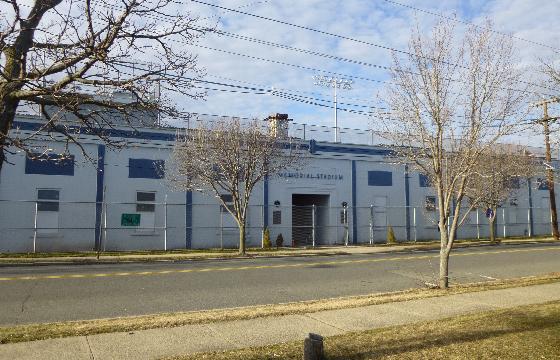
* Memorial Stadium. Built in 1950 as the home of New Brunswick High School athletics, this facility, with its oddly off-centered press box, was also used by the now-defunct St. Peter's High School. The building across the street was NBHS from 1967 until 2013, and is now New Brunswick Middle School.
In 1978, the New Jersey Americans used Memorial Stadium as a home field, and, at the time, they had one of the greatest soccer players who ever lived, by then playing out the string, the Portuguese legend
Eusébio.
The complex also includes a field for boys' baseball, another for girls' softball, and tennis courts, and each has been a former host for their respective Middlesex County, later Greater Middlesex Conference, championship tournament finals. The stadium has also hosted the County soccer finals. Joyce Kilmer Avenue between 9th and 12th Streets. (Formerly Codwise Avenue: The poet Joyce Kilmer was born on that street, and was killed in World War I.)
New Brunswick isn't a big museum city -- then again, it isn't a big city. Easily the most notable museum in town is the Jane Voorhees Zimmerli Art Museum, at 71 Hamilton Street, across from Old Queens. Adjacent, Scott Hall, at 77 College Avenue, hosts notable lectures and film festivals. Like all museums on Big Ten campuses, admission is free, although they do accept donations.
Speaking of films, there haven't been many movies filmed in or around New Brunswick.
The Adventures of Buckaroo Banzai Across the 8th Dimension was supposedly set there, but was filmed in Southern California. The 1984-90 CBS sitcom
Charles In Charge was set in New Brunswick, with the Rutgers name dropped in favor of the fictional Copeland College, but was taped entirely in Hollywood.
And, of course, while the beach season and the football season might share only 1 weekend a year (the beach's unofficial last, Labor Day weekend, is usually the football season's 1st), New Jersey is famous for its beaches. Here are some of the better-known, with their distance, in miles, from the Rutgers Student Center:
* Sandy Hook, 32
* Long Branch, 36
* Asbury Park, 36
* Belmar, 38
* Point Pleasant, 39
* Seaside Heights, 50
* Long Beach Island, 68
* Atlantic City, 95
* Ocean City, 99
* Wildwood, 124
* Cape May, 128
*
Going to a Rutgers game is as close as you can come to a big-time college football experience in the New York Tri-State Area, especially since the Pinstripe Bowl is played at Yankee Stadium rather than on a college campus.
Rutgers haven't won much -- indeed, the Scarlet Knights make the Mets look as successful as the Yankees by comparison -- and, when they lose, it tends to be either a blowout or a calamity on a Red Sox or Cubs scale. But that's made what they have won all the sweeter.







/cdn.vox-cdn.com/uploads/chorus_image/image/38116398/DSC02149.0.JPG)