September 30, 1973: The New York Yankees lost to the Detroit Tigers, 8-5. It was the last game at the pre-renovation Yankee Stadium.
October 1973 would be a busy month. For those of us old enough to remember -- and I am not quite old enough to remember, as I wasn't quite 4 years old -- it must have felt like an entire year compressed into 31 days.
*
October 1, 1973: Only 1,913 fans come out to Wrigley Field, under threat of rain, with the Chicago Cubs far out of the race, to see a doubleheader that had to be made up due to an earlier rainout. The New York Mets beat the Cubs in the opener, 6-4, and win the National League East, their 2nd 1st-place finish.
The Division Title that no one seemed to want to win has been won with an 82-79 record, which is still the worst 1st place finish ever in a season of at least 115 games. When the rain comes after the opener, the umpires call off the now completely meaningless 2nd game. The Mets were 52-63 on August 14, but won 30 out of 44 down the stretch, including 18 of their last 22.
For Willie Mays, who played 20 seasons with the Giants, including their 1957-58 move from New York to San Francisco, before being traded to the Mets the previous year, he is going out a winner: He had announced his retirement on September 25, and his last games will be in his 5th postseason, after 1951, '54, '62 and '71 with the Giants.
That night, on ABC Monday Night Football, the Detroit Lions beat the Atlanta Falcons, 31-6 at Tiger Stadium.
October 2, 1973: Paavo Nurmi dies of heart trouble in Helsinki, Finland. "The Flying Finn" was 76. He had won 9 Olympic Gold Medals in track, at Antwerp, Belgium in 1920, in Paris in 1924, and in Amsterdam in 1928.
He was active in Finland's resistance to the Soviet Union in the Winter War of 1939-40, and lit the cauldron with the Olympic Torch when the 1952 Olympics were held in Helsinki. He is still the most famous person ever to come from his country.
He was active in Finland's resistance to the Soviet Union in the Winter War of 1939-40, and lit the cauldron with the Olympic Torch when the 1952 Olympics were held in Helsinki. He is still the most famous person ever to come from his country.
DeShaun Holton, the rapper known as Proof, was born in Detroit. The leader of the rap group D12 and a childhood friend of rapper Eminem, he died in 2006, shot by his cousin in an argument at a pool hall.
October 3, 1973: Neve Campbell is born in Guelph, Ontario, Canada. The actress first gained notoriety in the Fox drama Party of Five, before starring in the Scream films.
October 6, 1973: Game 1 of the National League Championship Series was played at Riverfront Stadium in Cincinnati. Both the Mets and the Cincinnati Reds had something to prove: The Mets, that their 1969 "Miracle" wasn't a fluke; and the Reds, that they could win the big one, after losing the World Series in 1970 and '72.
Tom Seaver went the distance for the Mets. Perhaps manager Yogi Berra left him in for too long: Johnny Bench took him deep for a walkoff home run, and the Reds won 2-1. The big hits of this series had begun -- and they won't all be with the bats.
The American League Championship Series also got underway. Jim Palmer pitched a 5-hit shutout, to outpitch Vida Blue, and the Baltimore Orioles beat the Oakland Athletics, 6-0 at Memorial Stadium in Baltimore.
Also on this day, Ray Kennedy scored to give Arsenal a 1-0 win over Birmingham City against Highbury. This game marked the debut of William "Liam" Brady, a 17-year-old winger from Dublin, who came on as a substitute. "Chippy," so nicknamed for his love of what we would call French fries, a lad who apparently had a direct connection between his brain and his left foot, went on to become one of the most stylish and beloved players in Arsenal history.
But despite helping them reach 4 cup finals in a 3-season span, 1978 to 1980, he only wins 1 trophy with them, the 1979 FA Cup, and is lured away by the lira of Turin-based Juventus in 1980, not yet 24 years old. Strangely, Arsenal finished 2nd in the year before he came up, 1972-73, and 3rd in the 1st season after him, 1980-81, and didn't have a League finish so good with him.
Had Arsenal lost that 1979 FA Cup Final to Manchester United, Liam Brady would be to The Arsenal what Don Mattingly is to the Yankees: The defining figure of the team for a generation of supporters, but winning nothing.
Also on this day, Rebecca Rose Lobo was born in Hartford, Connecticut, and grew up in nearby Southwick, Massachusetts. In 1995, she led the women's basketball team at the University of Connecticut to a 35-0 record and the National Championship. She then won a Gold Medal with the U.S. team at the 1996 Olympics.
The WNBA then started, and she starred for the New York Liberty, but never won a title. She is now an announcer for ESPN. She married Sports Illustrated writer Steve Rushin at the Basketball Hall of Fame, of which she is (unfairly) not yet a member. They have 4 children.
And Ioan Gruffudd (pronounced like "Ian Griffith") is born in Aberdare, Glamorgan, Wales. The actor has played Captain Horatio Hornblower, British Prime Minister Tony Blair, and, in 2 Fantastic Four films, the Marvel Comics super hero Reed Richards, a.k.a. Mister Fantastic.
October 7, 1973: Game 2 of the NLCS is played. Jon Matlack pitches a 2-hit shutout, Rusty Staub hits a home run, and the Mets beat the Reds, 5-0, to tie the series.
Game 2 of the ALCS was also played. Jim "Catfish" Hunter outpitched Dave McNally, and was backed by 2 home runs by Sal Bando, and the A's beat the O's, 6-3, tying up that series.
Forced out of Yankee Stadium by its renovation, and refused the use of City-owned Shea Stadium by Mayor John Lindsay because of their announced move to New Jersey, the New York Giants played their 1st "home game" at the Yale Bowl in New Haven, Connecticut, 76 miles northeast of Times Square. (For comparison's sake, Yankee Stadium is 8 miles north, Shea Stadium is 8 miles east, and the Meadowlands is 8 miles west.) They lost 16-14 to the Green Bay Packers.
The 1973 season was their worst ever, as they go 2-11-1, although 4 of the losses were by 4 points or less. 1974 was even worse, 2-12. Overall, the Giants went 1-11 at the Yale Bowl. In 1975, with their deal at the Yale Bowl over, new Mayor Abe Beame lifted the grudge, and let them play at Shea. In 1976, Giants Stadium opened.
Also on this day, Priest Anthony Holmes was born in Fort Smith, Arkansas, and grew up in San Antonio. Yes, "Priest" is the name he was born with. A 3-time Pro Bowler, he won Super Bowl XXXV with the Baltimore Ravens, led the NFL in rushing with the Kansas City Chiefs in 2001, and rushed for 8,172 yards in his career. The Chiefs have elected him to their team Hall of Fame. He now runs a children-themed charitable foundation, and is eligible for the Pro Football Hall of Fame, but not in.
Also, Nélson de Jesus da Silva is born in Irará, Bahia, Brazil. Like Edvaldo Alves de Santa Rosa, who starred as a forward for Rio de Janeiro club Flamengo and helped Brazil win the 1958 World Cup, he is known by the nickname Dida. This one, however, is a goalkeeper.
He helped Belo Horizonte club Cruzeiro win the Copa do Brazil in 1996 and the Copa Libertadores, South America's version of the UEFA Champions League, in 1997. He moved on to São Paulo club Corinthians, and helped them win the Brazilian league in 1999 and the Copa do Brasil in 2002. Also in 2002, he was the starting goalie for his country as it won the World Cup. He also helped them win the Confederations Cup in 1997 and 2005, and the Copa América in 1999.
He moved on to one of the titans of Europe, A.C. Milan, winning the UEFA Champions League and the Coppa Italia in 2003, Serie A in 2004. and another Champions League in 2007. He is 1 of 9 players to have won both the Champions League and the Copa Libertadores, and was only the 2nd to accomplish the feat. The others are Juan Pablo Sorín, Roque Júnior, Cafu, Walter Samuel, Ronaldinho, Neymar, Danilo, and another player with an October 7 birthday, as you'll soon see.
More importantly, he ended the prejudice against black goalkeepers in Brazilian football, which dated back to the 1950 World Cup Final, when Moacir Barbosa of Rio club Vasco da Gama was blamed for the defeat to Uruguay.
He last played in 2015, back in Brazil, for Internacional in Porto Alegre, winning the Campeonato Gaúcho (state championship) in 2014 and 2015. He is now Milan's goalkeeping coach.
He is not the only soccer legend born in this day. Sami Tuomas Hyypiä was born in Porvoo, Finland. He is easily the greatest player his country has ever produced, helping the now-defunct club MyPa to win the Finnish Cup in 1992 and 1995, before being signed by Dutch club Willem II Tilburg and then England's Liverpool.
With the Merseyside club, he won a unique Cup Treble: The FA Cup, the League Cup and the UEFA Cup (now known as the Europa League) in 2001. He helped them win another League Cup in 2003, another FA Cup in 2006 (their last major trophy to date), and, as Liverpool fans will never stop reminding us, the Champions League in 2005, beating Dida's A.C. Milan. (Milan got their revenge on Liverpool in the 2007 Final, though.)
*
October 8, 1973: It rained in Oakland, so Game 3 of the ALCS was postponed. In the NLCS, the weather was fine. But the atmosphere would end up bad: A year to the day after the Lerrin LaGrow-Bert Campaneris incident in the previous year's ALCS between the A's and the Detroit Tigers, there's another Playoff brawl.
Game 3 at Shea Stadium should have been remembered for Rusty Staub hitting home runs in the 1st and 2nd innings, and a fine complete-game performance by Jerry Koosman. Instead, it is remembered for an incident in the top of the 5th inning.
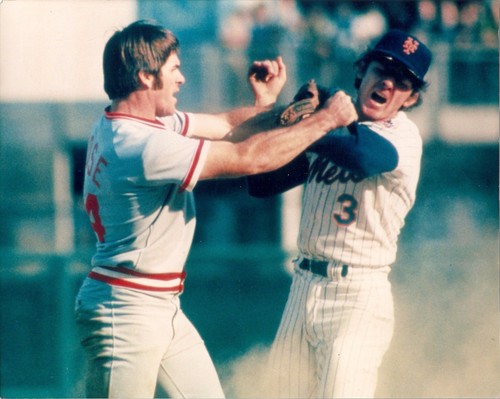
With 1 out, Pete Rose singled to center. Joe Morgan grounded to 1st base. John Milner went for the lead runner, and threw to shortstop Bud Harrelson, who stepped on 2nd base to eliminate Rose. Harrelson managed to get off a throw back to Milner to complete the double play. But not before the 5-foot-11, 200-pound Rose tried to break up the double play by crashing into the 5-foot-11, 140-pound Harrelson, and then starting a fight with the much thinner man. Both benches emptied. It took about 30 seconds to separate them. Somehow, Harrelson held his own.
Then things got weird: A 2nd fight broke out, between relievers Lee "Buzz" Capra of the Mets and Pedro Borbón of the Reds. Borbón got his cap knocked off. When that fight was broken up, Borbón reached for what he thought was his cap, but it was Capra's. He was so mad he couldn't tell a red one from a blue one. Capra showed him, and started laughing. Borbón took off the Mets cap, and started chewing on the brim, tearing the hat apart.
Seaver later said that, between the 2 fights, he was the only one who suffered any kind of injury: He was drinking a cup of coffee when it happened, and he spilled it on his leg, giving himself a minor burn.
With the fight broken up, Rose returned to his position in left field for the bottom of the 5th, where Met fans (understandably angry, but they were hardly justified in their actions) started throwing things at him, including glass bottles. Reds manager Sparky Anderson took his team off the field, fearing for their safety. But the fans kept throwing things.
The umpires got a message to Loren Matthews, the Shea public address announcer, who announced that if the throwing didn't stop, the game would be forfeited. Remember, the series is tied 1-1 and the Mets, barring a total (or even, dare I say it, a Metlike) collapse, have this game won, and would need only 1 more win for the Pennant. Lose it, even by forfeit, and it will be the Reds who are just 1 game from the Pennant.
Desperate, Met manager Yogi Berra took Seaver and Mays out there, and the 3 of them pleaded for peace. Listening to the 3 New York baseball legends, the fans stopped, and the Mets finished off the 9-2 win.
That night, what had become one of the nastiest rivalries in the NFL was broadcast on Monday Night Football: In a rematch of the previous season's NFC Championship game, in which the Washington Redskins defeated the Dallas Cowboys 24-3 at Robert F. Kennedy Memorial Stadium in Washington, the 'Skins won again, 14-7 at RFK. But even this game was overshadowed by what boxing promoter Don King, then early in his career, might have promoted as The Affray at Shea.
*
October 9, 1973: With a banner hanging from Shea's upper deck reading, "A ROSE BY ANY OTHER NAME STILL STINKS" -- I guess they weren't willing to say "Sucks" in public in 1973 -- Rose made his point by winning the game and tying up the series with a home run in the top of the 12th. The Reds won, 2-1, setting up a deciding Game 5.
Game 3 of the ALCS also went to extra innings, and was also decided by a home run by a player not known for his power. Mike Cuellar of the Orioles had a 1-hit shutout through 7 innings, but made a mental error to ignore the lead runner in the bottom of the 8th, leading to the A's tying the game. In the bottom of the 11th, Bert Campaneris homered off Cuellar, and the A's won, 2-1.
Sister Rosetta Tharpe, a pioneer in both recorded gospel music and electric guitar playing, considered one of the building blocks of rock and roll, died from the effects of strokes and diabetes in Philadelphia. She was only 58 years old. Bill Pulsipher was born, later to form "Generation K" with Jason Isringhausen and Paul Wilson, meant to be the basis of the Mets' turn of the 21st Century starting rotation, but injuries prevented it.
*
October 10, 1973: Spiro T. Agnew resigns as the Vice President of the United States, after pleading no contest to a felony charge of tax evasion.
Other charges against him, dating to his time as Governor of Maryland and, even earlier, as Chief Executive of Baltimore County, were dropped. He was fined $10,000 -- about $68,800 in 2023 money -- and placed on 3 years' probation. He never spent a minute in jail.
Two days later, President Richard Nixon, himself in deep trouble over Watergate, named Representative Gerald R. Ford of Michigan, the House Minority Leader, to be the new Vice President, under Section 2 of the 25th Amendment to the Constitution. It was the 1st time that any part of the Amendment, ratified in 1967, was used. Ford was popular with Republicans and respected by Democrats, and so he was confirmed by both houses of Congress, and sworn in on December 6.
Nixon may have had the most interesting Presidency in the nation's history, for reasons both beneficial and harmful. But, to me, the most interesting thing about his time in office is that his 1st Vice President had to resign, and the reason had absolutely nothing to do with the crimes that fell under the umbrella term "Watergate." Nixon used Agnew as a tool to help get himself elected in 1968 and re-elected in 1972, and to bad-mouth the supposedly liberal media in between.
Nixon had purposely kept Agnew out of the loop on pretty much everything, from national security matters such as the Vietnam War to the machinations of Watergate. After all, in case something did go wrong, the next President of the United States needed to have plausible deniability. Still, after Nixon's re-election, it seemed likely that, at the very least, Agnew would be nominated for President by the Republican Party in 1976.
But an investigation into corruption in Maryland politics, not even considering Agnew as a subject at first, found him as one. On September 25, 1973, he made a public statement refusing to go, and even repeated it for emphasis: "I will not resign if indicted! I will not resign if indicted!"
But now, both the President and the Vice President -- both of them, themselves, lawyers -- were under criminal investigation, and for entirely unrelated things. Agnew realized his position was untenable, and gave up the office in exchange for staying out of prison.
Agnew was also disbarred, and couldn't go back to the private practice of law. He wrote a memoir and a very thinly disguised novel, both justifying his actions as Vice President, and became a lobbyist for Arab nations wanting to work with the American federal government. Once shady, always shady. He rarely made public appearances, but made an exception to attend Nixon's funeral in 1994.
He died in 1996, at the age of 77. He was buried in Dulaney Valley Memorial Gardens, in the Baltimore suburb of Timonium. Baltimore Colts legends Johnny Unitas and Art Donovan would also be buried there after their deaths, in 2002 and 2013, respectively.
Among the sporting events taking place on that day was the deciding Game 5 of the NLCS. This was early in the annual term of the Supreme Court of the United States, which always begins on the 1st Monday in October, in this case October 1. Associate Justice Potter Stewart, who grew up in Cincinnati and was a Reds fan, was being handed slips of paper with updates on the game while he heard oral arguments. One read, "Kranepool flies to right. Agnew resigns."
The New York Mets beat the Cincinnati Reds, 7-2 at Shea Stadium, to win their 2nd Pennant in the last 5 years. Ed Kranepool singled home 2 runs, boosting Seaver to victory. Seaver had helped his own cause with a 6th inning double, and was singled home by Cleon Jones. As they had for all 3 1969 clinchers, the Met fans stormed and tore up the Shea field. (As stated, they had clinched the 1973 Division title on the road.)
Game 4 was played in the ALCS, at the Oakland Coliseum. The A's knocked Jim Palmer out of the box in the 2nd inning, but the Orioles came back, thanks to home runs by Andy Etchebarren and Bobby Grich, and beat the A's 5-4.
Also on this day, Denis Potvin played his 1st NHL game. He did not score or assist on a goal, and was assessed a 2-minute penalty for holding. The New York Islanders played the Atlanta Flames to a 1-1 at The Omni in Atlanta. Potvin and the Islanders would get better. Much better.
The San Antonio Spurs made their debut, having played the previous 6 seasons in the American Basketball Association as the Dallas Chaparrals. They lost to the San Diego Conquistadors, 121-106 at the HemisFair Arena in San Antonio.
This was the coaching debut of Wilt Chamberlain: For legal reasons, he was allowed to coach "the Q's," but not play for them this season. He got them into the 1st round of the ABA Playoffs, and then, rather than play for them in 1974-75, quit as head coach and retired as a player. He never coached again.
The Conquistadors, having changed their name to the San Diego Sails, folded early in the 1975-76 season. They would not be among the ABA teams accepted into the NBA for 1976-77. The Spurs were, and have usually made the Playoffs since. They've won 5 NBA Championships.
John Mobley was born outside Philadelphia in Chester, Pennsylvania. A linebacker, he was with the Denver Broncos when they won Super Bowls XXXII and XXXIII. He was an All-Pro in 1997. But an injury cost him most of the 1999 season, and another ended his career in 2003.
Zach Thornton was born in the Baltimore suburb of Edgewood, Maryland. He was an original New York/New Jersey MetroStar (forerunners of the New York Red Bulls) in 1996, as backup goalkeeper to Tony Meola. He was also an original member of the Chicago Fire, winning the MLS Cup with them in 1998; the U.S. Open Cup in 1998 (a Double), 2000, 2003 and 2006; and the Supporters' Shield in 2003.
He was named MLS Goalkeeper of the Year in 1998 and 2009. But since the U.S. national team has usually been loaded with good goalies (that is no longer the case), he only got 8 caps, and was never named in the squad for a major tournament. He is now an assistant coach at Elizabethtown College in Pennsylvania.
Actor Mario Lopez was also born. And conservative economist Ludwig von Mises died.
October 11, 1973: The A's have always had attendance problems in Oakland, and only 24,265 came to the Coliseum for the Pennant decider. They saw something nobody ever expected to see: Oriole 3rd baseman Brooks Robinson making an error, which led to the 1st A's run. Hunter pitched a 5-hit shutout, and the A's won, 3-0, and had their 2nd straight Pennant.
And future baseball All-Star Dmitri Young was born.
*
October 13, 1973: Game 1 of the World Series was played at the Oakland Coliseum. Ken Holtzman not only outpitched Jon Matlack, he doubled and scored in the 3rd inning, as the A's beat the Mets, 2-1.
Through the 2022 season, the Mets have been in 5 World Series, and have lost Game 1 every time, 0-5. They are 2-3 in Game 2, 5-0 in Game 3, 2-3 in Game 4, 2-3 in Game 5, 1-1 in Game 6 and 1-1 in Game 7.
Also, the Houston Aeros beat the Los Angeles Sharks, 4-3 at the Los Angeles Sports Memorial Arena. This WHA game is notable for the debut of the main forward line for the Aeros, consisting of Mark Howe at left wing, Marty Howe at center, and their father Gordie Howe on right wing.
The Detroit Red Wings legend, 45 years old, had come out of retirement to play with his sons, because the Red Wings weren't listening to his personnel and strategy suggestions, and, thinking they just wanted his historic name on their letterhead, he said, "I was tired of being vice president in charge of paper clips."
When the Aeros win the 1974 WHA Championship, Gordie will be awarded the Gary Davidson Trophy as league Most Valuable Player -- and the trophy, named for the league's founder (Davidson was also a founder of the ABA and the WFL), will be renamed for him.
The Aeros would win the 1975 WHA title and reach the Finals again in 1976, but money woes forced them to sell all 3 Howes to the New England Whalers. When the NHL took on 4 WHA teams in 1979, the renamed Hartford Whalers were one of them, and all 3 Howes were still there, as Gordie embarked on 1 last season, his 32nd in the major leagues and his 26th under the NHL banner. Mark would later become a defenseman, and join Gordie in the Hockey Hall of Fame.
Also, Brian Dawkins was born in Jacksonville, Florida. A devastating safety, he made 9 Pro Bowls, and the Philadelphia Eagles have retired his Number 20. He was elected to the Pro Football Hall of Fame.
When the Aeros win the 1974 WHA Championship, Gordie will be awarded the Gary Davidson Trophy as league Most Valuable Player -- and the trophy, named for the league's founder (Davidson was also a founder of the ABA and the WFL), will be renamed for him.
The Aeros would win the 1975 WHA title and reach the Finals again in 1976, but money woes forced them to sell all 3 Howes to the New England Whalers. When the NHL took on 4 WHA teams in 1979, the renamed Hartford Whalers were one of them, and all 3 Howes were still there, as Gordie embarked on 1 last season, his 32nd in the major leagues and his 26th under the NHL banner. Mark would later become a defenseman, and join Gordie in the Hockey Hall of Fame.
Also, Brian Dawkins was born in Jacksonville, Florida. A devastating safety, he made 9 Pro Bowls, and the Philadelphia Eagles have retired his Number 20. He was elected to the Pro Football Hall of Fame.
October 14, 1973: Game 2 of the World Series was played at the Coliseum. Curt Gowdy, as usual the lead broadcaster for NBC, called this contest "one of the longest and weirdest games in World Series history." Indeed, at 4 hours and 13 minutes, it was the longest game by time in Series history, a record long since broken.
Neither starting pitcher got the job done: The A's scored 3 runs off Jerry Koosman in the 1st 2 innings, while Vida Blue gave up home runs to Cleon Jones and Wayne Garrett, and was knocked out of the box in the 6th inning, as the Mets scored 4 runs, including 2 thanks to a throwing error by Blue's replacement, Darold Knowles.
Knowles is known for 2 things. In this Series, he became the 1st pitcher to appear in all 7 games of a World Series. And he said of Reggie Jackson, his team's best player, "There isn't enough mustard in the world to cover that hot dog." After missing the previous year's World Series with an injury sustained while scoring the winning run in the deciding game of the American League Championship Series, Reggie went 4-for-6 with 2 RBIs in this game, including the 1st of back-to-back RBI singles with Gene Tenace in the bottom of the 9th, sending this game to extra innings; and ended up as the Series' Most Valuable Player.
Willie Mays, now 42 and looking even older on the field, entered the game as a pinch-runner in the top of the 9th inning, and was left in to play center field for the 2,852nd and last time. He led off the top of the 11th inning by popping up to Tenace at 1st base.
He led off the 11th because he was left on deck when the top of the 10th ended. The Mets thought they had the lead when Félix Millán singled, and Bud Harrelson came home, but was thrown out at the plate. Mays was on his knees, motioning for Harrelson to slide, but catcher Ray Fosse tagged him out. Willie was left on his knees, pleading his case to home plate umpire Augie Donatelli, one of the few men who'd been in the National League longer than he had. (Donatelli's rookie year was 1950; Mays', 1951.)
It was still 6-6 when Harrelson led off the top of the 12th by doubling off Oakland relief ace Rollie Fingers. Yogi Berra, who'd seen it all in a big-league career going back to 1946, had no more pinch-hitters available, and had to let his own closer, Frank "Tug" McGraw, bat for himself. He tried to bunt Harrelson over to 3rd, and shortstop Bert Campaneris was unable to throw him out.
Fingers got Garrett to strike out and Millán to pop up. But Mays, no longer a Kid, had 1 more "Say Hey" moment, 1 more major league hit, left in him: He singled to center -- and stumbled getting out of the batter's box, but still made it to 1st base in time -- to drive Harrelson home. It was 7-6 New York. Cleon Jones singled to load the bases. A's manager Dick Williams brought in Paul Lindblad to pitch.
Here's where the game went from "classic" to "bizarre." John Milner hit the ball to 2nd baseman Mike Andrews, who had entered the game as a pinch-hitter in the 8th inning. He mishandled the ball, letting it go through his legs, much like Bill Buckner would do against the Mets, 13 years later. McGraw and Mays scored. 9-6 Mets.
That would have been bad enough. But the next batter, Jerry Grote, also hit a ground ball to Andrews. This time, he fielded the ball cleanly, but made a bad throw, and Jones scored. 10-6 Mets.
But the A's did not go down without a fight. Reggie led off the bottom of the 12th with a triple. Tenace drew a walk. Yogi took Tug out, and replaced him with George Stone. He allowed a single to Jesús Alou, scoring Reggie. But Stone settled down, getting Fosse to ground into a forceout, walking Andrews, getting pinch-hitter Vic Davalillo to pop up, and getting Bert Campaneris to ground out. Mets 10, A's 7.
Also on October 14: George Floyd, whose 2020 arrest and murder by Minneapolis police sparked anti-racist demonstrations, was born in Fayetteville, North Carolina.
October 15, 1973: Andrews, who'd previously played for the Boston Red Sox in their 1967 "Impossible Dream" Pennant season, was put on the "disabled list" by an enraged A's owner Charlie Finley, triggering the baseball equivalent of a constitutional crisis, just as the one started by the Watergate scandal is reaching a new peak.
Finley ordered Andrews to sign an affidavit saying he was injured, which would make him ineligible to play in the rest of the Series, and allow Finley to replace him on the roster. Andrews refused. Finley told him his baseball career would be over if he didn't sign it. Such coercions were all too common before the fall of the reserve clause 2 years later. Andrews signed it.
Williams was enraged at Finley's meddling, which he'd endured many times before. He spoke to the media, saying that Andrews was not injured. Bowie Kuhn, whose one saving grace as Commissioner of Baseball was his recognition of Finley's abuses, ordered that Andrews be reinstated, and there was nothing that Finley could do.
On ABC Monday Night Football, the Miami Dolphins beat the Cleveland Browns, 17-9 at Cleveland Municipal Stadium.
October 16, 1973: As satirical singer Tom Lehrer put it, "Satire died the day they gave Henry Kissinger the Nobel Peace Prize." This was the day: The main negotiators of the peace deal that ended the U.S. role in the Vietnam War, Kissinger and Le Duc Tho, were awarded it. Tho refused the prize, and informed the Nobel Committee that "When guns are silenced, and peace is really restored in South Vietnam, I will reconsider the acceptance of this prize." Kissinger, of course, accepted.
Reporting on it for ABC News, Peter Jennings, on the air, mispronounced "duck tow" as "fuck dough." He was not disciplined by the network, nor fined by the Federal Communications Commission.
Maynard Jackson was elected Mayor of Atlanta, making him the 1st black Mayor of a major city in the Deep South. And Gene Krupa, one of the greatest jazz drummers of all time, died at age 64.
And the World Series moved on to Shea Stadium, where Williams and his players wrote Andrews' uniform number, 17, on masking tape and put it on their sleeves, as if a tribute to a dead teammate. A pair of future Hall-of-Fame pitchers started. However, neither Seaver nor Hunter was involved in the decision. Wayne Garrett hit a home run to give the Mets a 2-0 lead in the 1st inning. But the A's scored in the 6th and the 8th, and the game went to extra innings.
In the bottom of the 10th, Berra sent Mays up to pinch-hit for McGraw, but he grounded to short. It was his last at-bat. With 1 out in the top of the 11th, Harry Parker walked Ted Kubiak, who advanced to 2nd on a passed ball by Grote. Campaneris singled Kubiak home. Paul Lindblad stood to be the winning pitchers, but needed help in the bottom of the 11th. Williams sent Fingers in to close it out, and the A's won, 3-2.
Also on this day, Brian Cornelius Schottenheimer is born in Denver. At the time, his father, Marty Schottenheimer, was in his 1st coaching job, as linebackers coach with the Portland Storm of the World Football League.
Brian would grow up in the suburbs of Cleveland and Kansas City, while his father was head coach of the Browns and later the Chiefs. He got his 1st coaching job in 1997, assisting Dick Vermeil on the St. Louis Rams. Marty would put Brian on his staff in Kansas City in 1998, Washington in 2001, and San Diego from 2002 to 2005. He has also coached at Syracuse University, USC, the Jets, with the Rams again, the University of Georgia, and Indianapolis, but has yet to receive his 1st head coaching job. He is now the offensive coordinator for the Seattle Seahawks.
Also on this day, David Gerald Unsworth is born in Chorley, Lancashire, England. A centreback, he played for Liverpool-based Everton, and helped them win the 1995 FA Cup. He was twice caretaker manager of Lancashire club Preston North End and once (so far) of Everton, and now manages Everton's reserves.
Also on this day, Donald Trump is mentioned in The New York Times for the 1st time. The story is of a lawsuit filed against the 27-year-old Trump, his father Fred, and their real estate company, by the U.S. Department of Justice, then (at least, for another 4 days) reporting to Attorney General Elliot Richardson, who reported to President Richard Nixon, for housing discrimination in their Queens apartment complexes.
In his 1987 autobiography Trump: The Art of the Deal -- which was actually written by Tony Schwartz, then writing for GQ, and who now correctly calls Trump a "sociopath" -- Trump said, "The idea of settling drove me crazy... I'd rather fight than fold, because as soon as you fold once, you get the reputation of being a folder."
Nevertheless, on June 10, 1975, Fred (who had previously been arrested for attending a Ku Klux Klan demonstration in Queens in 1927) and Donald signed an agreement prohibiting them from "discriminating against any person in the terms, conditions, or privileges of sale or rental of a dwelling." The decree made it clear that the Trumps did not view the agreement as a surrender, saying the settlement was "in no way an admission" of a violation.
Nevertheless, Trump officially became famous by being exposed as a bigot. And when you're officially too bigoted for Richard Nixon, you've got a problem.
October 17, 1973: Eleven Arab nations in OPEC, the Oil and Petroleum Exporting Countries, imposed an oil embargo against countries they thought had helped Israel in the Yom Kippur War. They said they would cut their oil production by 5 percent, and an additional 5 percent every month thereafter -- implying no exports at all by October 1, 1974 -- unless Israel agreed to withdraw completely from its occupied territories.
This would have a very damaging effect on the U.S. economy, which was already sliding into recession. And since Nixon was focusing on keeping himself in office and, secondarily, supporting Israel, he did little to stop the recession.
In Game 4 of the World Series, Williams put Andrews in the game in the 8th inning, as a pinch-hitter for pitcher Horacio Piña. Met fans, always with an affinity for the underdog, gave him a standing ovation. Andrews grounded out, and the Mets won, 6-1, thanks to a home run by Staub.
Finley ordered Williams to bench Andrews for the rest of the Series. Williams told his players that he was resigning after the Series, no matter what. The Mets won Game 5, to get within 1 win of the title. But the A's won Games 6 and 7 in Oakland to repeat.
On November 1, Finley released Andrews, and Andrews never played in the major leagues again, done at age 30. He returned to Boston to help run the Red Sox' official charity, the Jimmy Fund. Finley replaced Williams with Alvin Dark, and won another World Series in 1974. Williams would later manage the California Angels, the Montreal Expos, the San Diego Padres (winning that team's 1st Pennant in 1984, making him the 1st man to manage 3 different teams into the World Series) and the Seattle Mariners.
October 18, 1973: Walt Kelly, the cartoonist who created the strip Pogo, died. Rachel Nichols, reporter for ESPN, was born. Blue pitched well for the A's, but Koosman pitched better for the Mets, who won, 2-0. Now, the Mets only needed to take either Game 6 or Game 7 in Oakland.
October 19, 1973: Nixon offers Archibald Cox, the Special Counsel investigating Watergate, a compromise: He would allow John Stennis of Mississippi, one of the most respected members of the U.S. Senate, to review the tapes, and present Cox with summaries.
Cox wouldn't take it. He knew that Stennis was not only a conservative from Mississippi and a supporter of Nixon's -- conservative Southern Democrat, a.k.a. a "Dixiecrat," and no friend of mainstream Democrats -- but also 72 years old and hard of hearing. If those tapes revealed that Nixon committed an impeachable offense, Stennis might not hear it properly. And even if he did, he might refuse to admit it to Cox, and claim his poor hearing caused him to miss it. Cox announced the next day that he rejected "The Stennis Plan."
*
October 20, 1973: Everything happened on this day.
The Sydney Opera House, Australia's most famous structure, opened. In essence, the structure, designed by Danish architect Jørn Utzon to look like multiple sails, is the country's "Lincoln Center," with multiple performance spaces, centered on the 2,679-seat Concert Hall.
The Rolling Stones hit Number 1 on the U.S. singles charts with "Angie," a song apparently about Mary Angela Barnett, an American model and actress, who was married to David Bowie from 1970 to 1980.
Angelo "Gyp" DeCarlo, a caporegime in the Genovese crime family, and the most powerful organized crime figure in New Jersey in the 1960s, died of cancer at the age of 71. He was a friend of Frank Sinatra, who had asked Agnew to ask Nixon to commute his prison sentence, due to his health. As far as is known, this is the biggest favor Sinatra ever did for a Mob figure, and the biggest favor he ever asked a President for.
The Six Million Dollar Man premiered on ABC, starring Lee Majors as astronaut-turned-bionic-federal-agent Steve Austin. (Definitely not to be confused with the Stone Cold "professional wrestler" using the same name.)
The show ran for 5 seasons, and spawned 2 spinoffs: The Bionic Woman and the Saturday-morning kids' show Bigfoot and Wildboy.
How quaint the figure now sounds: With inflation, $6 million in 1973 equals about $41.6 million today.
The Capital Bullets played their 1st home game after 10 years in Baltimore, at the Cole Field House on the campus of the University of Maryland, in College Park, just inside the Capital Beltway. At this point, the Bullets were one of the better teams in the NBA, and they proved it, beating the Boston Celtics 96-87. Phil Chenier led all scorers with 26 points.
It took until December 2 for their new arena, the Capital Centre in Landover, on the other side of the Beltway, to be ready for the Bullets to play there. The following season, the Bullets changed their name to the Washington Bullets; and the Cap Centre also became home to an NHL expansion team, the Washington Capitals. In 1997, both teams moved into a new arena in the District of Columbia, now known as the Capital One Arena, and the Bullets changed their name to the Washington Wizards.
In college football, Number 1 Ohio State beat Indiana, 37-7 at Memorial Stadium in Bloomington, Indiana. In their traditional 3rd Saturday in October meeting, Number 2 Alabama beat Number 10 Tennessee, 42-21 at Legion Field in Birmingham. And Number 3 Oklahoma also beat a ranked opponent, Number 16 Colorado, 34-7 at Owen Field in Norman, Oklahoma.
Game 6 of the World Series was played on Oakland. Like his mentor, Casey Stengel, had done so many times, Berra played a hunch, and decided that, with 1 game left to win, starting Seaver on 3 days' rest was better than starting anyone else on 4 or more days' rest.
It didn't work, as Jackson drive in runs in the 1st and 3rd inning, in support of Hunter, and the A's tied the Series, 3-1. Now, the Mets had to go into Game 7, on the road, with Seaver unavailable. Many Met fans never forgave Yogi for this unsuccessful hunch.
Across the country, in Washington, Nixon decided that, in order to survive as President, he had to fire Cox -- whom he had never fully trusted, as Cox had been Solicitor General under President John F. Kennedy and an old friend of JFK's, and thus a partisan Democrat.
So he instructed his Attorney General, Elliot Richardson, the man who had hired Cox and had the power to fire him, to fire him. Richardson refused, because he thought it would spark a Constitutional crisis. Nixon said do it or you're fired. Richardson did the honorable thing, and resigned his post.
So Nixon went to the next man in line, Richardson's Deputy Attorney General, William Ruckelshaus. He told Ruckelshaus to fire Cox. He refused. Nixon said do it or you're fired. Ruckelshaus still refused, but did not resign. Nixon fired him.
So with the top 2 men in the U.S. Department of Justice now gone, Nixon went to the Number 3 man, the Solicitor General, the job Cox himself once held, and told him to fire Cox. He did, because he valued Nixon more than he values the Constitution.
Word quickly got out, and the Washington press corps quickly dubbed these events "The Saturday Night Massacre."
October 21, 1973: People woke up this morning to bold headlines in their Sunday papers. The Sunday morning news shows, NBC's Meet the Press, CBS' Face the Nation, and ABC's Issues and Answers (the predecessor program to This Week), could talk about nothing else.
The pressure on Congress to begin impeachment proceedings against Nixon vastly increased. And, with the Vice Presidency vacant, as Ford has not yet been confirmed by either house of Congress as the new VP, the next man in line was the Speaker of the House of Representatives, Carl Albert -- a Democrat, and, while from a Southern State, Oklahoma, considerably more liberal than Stennis.
If Nixon had died, were impeached by the House and removed by the Senate, or were pressured into resigning, or had the 25th Amendment had been invoked by his Cabinet and he were removed that way, and Albert were still next in line at the time, it would have been a political earthquake, much bigger than the end of Nixon's Presidency actually turned out to be.
Within days, Nixon realized what a blunder he had committed, and told the Acting Attorney General to appoint a new Special Prosecutor. That man would be Leon Jaworski. By December 6, Ford would be confirmed by both houses and sworn in as Vice President, and the danger of Nixon being constitutionally removed, and replaced by a President of the other party, was gone, and things calmed down in Watergate -- for a while.
There would be ramifications, of course -- some lasting much longer than the Nixon Administration itself. In 1987, President Ronald Reagan appointed that same former Acting Attorney General to the U.S. Supreme Court, as his judicial views fit the archconservative vision that Reagan had for the country. But his role in the Saturday Night Massacre was held against him -- although it's possible that he might have been rejected by the Senate anyway. His name was Robert Bork.
Also on October 21, Fred Dryer of the Los Angeles Rams became the 1st player in NFL history to score two safeties in the same game. The 24-7 win for the Rams over the Green Bay Packers at the Los Angeles Coliseum came on consecutive safeties in the 4th quarter, from sacks in the end zone by Dryer of Green Bay quarterbacks Scott Hunter and Jim Del Gaizo.
Finally, what might have been baseball's strangest season came to an end in Game 7 of the World Series at the Oakland Coliseum. Bert Campaneris and Reggie Jackson hit home runs off Met starter Jon Matlack, and the A's won, 5-2, for their 2nd straight World Championship.
Reggie was named the Series MVP. After having missed the previous year's Series with an injury sustained while scoring the winning run in the NLCS, he had begun to build his reputation as a big-time postseason performer. In 1977, a teammate would nickname him "Mr. October." But that teammate would be a New York Yankee, Thurman Munson.
A's reliever Darold Knowles -- who once said of Reggie, "There isn't enough mustard in the world to cover that hot dog" -- became the 1st pitcher, and through 2022 remains the only one, to appear in all 7 games of a Series.
The Mets had a 3-games-to-2 lead, but considering what that A's team was capable of, and that the A's had the home-field advantage for Games 6 and 7, it’s hard to say that the Mets "choked." They just got beat by a better team.
The Mets had a 3-games-to-2 lead, but considering what that A's team was capable of, and that the A's had the home-field advantage for Games 6 and 7, it’s hard to say that the Mets "choked." They just got beat by a better team.
*
October 22, 1973: Pablo Casals, the most renowned cello player in world history, died. Ichiro Suzuki, who became the greatest Japanese player in the North American major leagues, was born. On ABC Monday Night Football, the Denver Broncos played the Oakland Raiders to a 23-23 tie at Mile High Stadium in Denver. This is often cited among their fans as the beginning of "Broncomania."
October 24, 1973: Scottish soccer star Jackie McNamara was born. And Nixon vetoed the War Powers Act, designed to limit a President's ability to wage war without Congressional approval, in the wake of the Vietnam War. Nixon thought it was too limiting. On November 7, both houses of Congress had two-thirds majorities that overrode his veto, and the Act became law.
Usually, Presidents have since abided by it. One notable exception was Ronald Reagan, in what became known as the Iran-Contra scandal.
October 25, 1973: Hearing from his national security team that the Soviet Union was "planning to send a very substantial force" to intervene militarily against Israel in support of its Middle East allies, Nixon calls Premier Leonid Brezhnev, and tells him to back off. The peace negotiations continue, with the agreement that neither the U.S. nor the U.S.S.R. would send peacekeeping troops.
In Ethiopia, Abebe Bikila, the 1st 2-time Gold Medalist in the Olympic marathon, dies from complications of a paralyzing car accident 4 years earlier. He was only 41 years old. American actress Cleo Moore also died that day.
October 26, 1973: The West African nation Guinea-Bissau gained its independence from France. The former federal prison on Alcatraz Island in San Francisco Bay was opened to the public by the U.S. Park Service. And comedian Seth MacFarlane, creator of the animated comedy Family Guy and the live-action science-fiction tribute show The Orville, was born.
October 27, 1973: Following rounds "shuttle diplomacy" by Kissinger, between Cairo and Jerusalem, the governments of Egypt and Israel announced a ceasefire in the Yom Kippur War. The United Nations Security Council voted 14-0, with China abstaining, to approve a peacekeeping force to patrol the Sinai Peninsula for 6 months.
Israel got what it wanted: Survival. Egypt didn't get what it wanted, the return of the Sinai, but it did manage to recover some of the prestige it had lost in the 1967 Six-Day War. And the rest of the world got what it wanted: Peace, and the calming down of what had been a Cold War flashpoint.
Over the next 5 years, Egypt and Israel built a genuine peace, which has lasted ever since.
Also on this day, One Police Plaza (a.k.a. 1PP) opens in Lower Manhattan, on Park Row across from Manhattan Borough Hall, as a new headquarters for the New York Police Department. The "brutalist architecture" building replaces the old Police Building, built in the "Beaux-Arts" style in 1909 at 240 Centre Street. That building was converted into apartments, and still stands.
*
October 29, 1973: Match Game 73 aired this exchange on CBS:
Gene Rayburn, host, reading a card with a clue: "Bertha was so fat!"
Bert Convy, host of other game shows, and one of the panelists, interrupts: "How fat was she, Gene?"
Gene: "I'll tell you how fat Bertha was: They had to use (blank) to get her through the revolving door. That's how fat Bertha was."
Richard Voelsing, contestant: "Grease."
Bert: "I'm in the family. I said, 'Lard.'" Ironically, given how fat she apparently was. The show's judges counted it as a match.
Brett Somers, actress and Match Game regular: "I didn't say, 'Lard," I didn't say, 'Grease,' I said, 'Pushers!'"
Jack Carter, comedian: "You should see what pushers are selling nowadays! Well, I know Bertha's sister. She's so fat, she needs a bookmark to find her chins! She used, 'Suction!'"
Fannie Flagg, actress and writer, previously known for her work on Candid Camera, making her 1st appearance on the show before becoming a regular panelist: "This man and I are thinking alike: I said, 'Axle grease.'" It was counted as a match. Only, due to her dyslexia, she unleashed the 1st of her many Match Game misspellings: "Axil grease." Spelling didn't count on that show, much to the relief of Fannie and, later on, Hungarian-born actress Eva Gabor, who said on a 1977 installment, "Darling, I speak 4 languages, but I can't spell in any of them!"
Richard Dawson, actor, and later host of the game show Family Feud: "'Grease!'"
Ann Elder, comedy-show writer, who had been on Laugh-In with Dawson a couple of years earlier: "Well, I wrote a word that was near and dear to my heart as I tried to think of an answer. I wrote, 'Pressure.'" So, 3 matches.
A little later, Gene read, rolling his eyes, "The Vanderwinkles' guest bathtub is soooo huge... " And Convy took the hint and went along with it, asking, "How huge is it, Gene?" And Gene said, "They put up a sign saying, 'No (blank)ing!'" The answer was, "No swimming."
Johnny Carson released a record album, Here's Johnny.... Magic Moments From The Tonight Show, in 1974, and there's a "How hot was it?" line on it. I can find no reference to when that show was broadcast. It could have been before October 29, 1973, but I can't prove it. So this Match Game
episode is the earliest example I have yet found of the old "How (adjective) is/was (pronoun)?" bit on TV.
Gene: "I'll tell you how fat Bertha was: They had to use (blank) to get her through the revolving door. That's how fat Bertha was."
Richard Voelsing, contestant: "Grease."
Bert: "I'm in the family. I said, 'Lard.'" Ironically, given how fat she apparently was. The show's judges counted it as a match.
Brett Somers, actress and Match Game regular: "I didn't say, 'Lard," I didn't say, 'Grease,' I said, 'Pushers!'"
Jack Carter, comedian: "You should see what pushers are selling nowadays! Well, I know Bertha's sister. She's so fat, she needs a bookmark to find her chins! She used, 'Suction!'"
Fannie Flagg, actress and writer, previously known for her work on Candid Camera, making her 1st appearance on the show before becoming a regular panelist: "This man and I are thinking alike: I said, 'Axle grease.'" It was counted as a match. Only, due to her dyslexia, she unleashed the 1st of her many Match Game misspellings: "Axil grease." Spelling didn't count on that show, much to the relief of Fannie and, later on, Hungarian-born actress Eva Gabor, who said on a 1977 installment, "Darling, I speak 4 languages, but I can't spell in any of them!"
Richard Dawson, actor, and later host of the game show Family Feud: "'Grease!'"
Ann Elder, comedy-show writer, who had been on Laugh-In with Dawson a couple of years earlier: "Well, I wrote a word that was near and dear to my heart as I tried to think of an answer. I wrote, 'Pressure.'" So, 3 matches.
A little later, Gene read, rolling his eyes, "The Vanderwinkles' guest bathtub is soooo huge... " And Convy took the hint and went along with it, asking, "How huge is it, Gene?" And Gene said, "They put up a sign saying, 'No (blank)ing!'" The answer was, "No swimming."
Johnny Carson released a record album, Here's Johnny.... Magic Moments From The Tonight Show, in 1974, and there's a "How hot was it?" line on it. I can find no reference to when that show was broadcast. It could have been before October 29, 1973, but I can't prove it. So this Match Game
episode is the earliest example I have yet found of the old "How (adjective) is/was (pronoun)?" bit on TV.
That night, on ABC Monday Night Football, the Buffalo Bills beat the Kansas City Chiefs. 23-14 at Rich Stadium in suburban Orchard Park, New York. O.J. Simpson ran for 157 yards. The Bills' superstar was headed for a new single-season record of 2,003 yards. Of course, today, he's best known for something that happened long after his football career ended.
And soccer star Robert Pires is born. He was a member of the Arsenal team in North London that won the Premier League title and the FA Cup, "The Double," in 2002; scored the only goal in their win in the 2003 FA Cup Final; helped them go through the League season unbeaten in 2004; helped them win another FA Cup in 2005; and got them to the UEFA Champions League Final in 2006. He also helped France reach 2 World Cup Finals, winning in 1998 and losing in 2006, and winning UEFA Euro 2000.
October 30, 1973: The Bosphorus Bridge in Istanbul, Turkey was completed, connecting the continents of Europe and Asia over the Bosphorus for the 2nd time, and for the 1st time since a pontoon bridge had been created by the Emperor Darius of Persia in 512 BC. The opening of the 3,222 feet (982 m) long suspension bridge coincided with the 50th Anniversary of the proclamation of the Republic of Turkey.
And journalist Maggie Haberman was born. The New York Times columnist has written extensively about how bad a President, and how bad a person, Donald Trump is. During the 2016 Presidential campaign, she pretty much left Trump alone, and wrote columns lying about Hillary Clinton. If she had told the truth about Hillary, and about Trump, she never would have had a Trump residency to write about.
October 31, 1973: I was 3 years old, soon to turn 4, and was a cowboy for Halloween. And Dr. Paul Dudley White, the heart surgeon who treated President Dwight D. Eisenhower after his 1955 heart attack, died at the age of 87.
*
On November 17, President Nixon gave a press conference at the hotel where he was staying on vacation, the Walt Disney World Contemporary Resort, outside the famous theme park, near Orlando, Florida. He was trying to get away from the troubles of the Watergate scandal, and it wasn't working.
And Watergate wasn't Nixon's only scandal. As with Agnew, there were questions about his income taxes. And there was a scandal involving campaign contributions from Robert Vesco, who got them to the President through his nephew, Donald Nixon. Then there was Nixon's apparent intervention in the Department of Justice's approval of the merger between ITT Corporation and Hartford Insurance.
Nixon seemed to be angrier at accusations about his personal integrity than those about his conduct of the Presidency. He said:
Let me just say this, and I want to say this to the television audience: I made my mistakes, but in all of my years of public life, I have never profited, never profited from public service. I have earned every cent. And in all of my years of public life, I have never obstructed justice.
And I think, too, that I could say that in my years of public life, that I welcome this kind of examination! Because people have got to know whether or not their President is a crook! Well, I am not a crook. I've earned everything I've got!
On the video, it sounds like he's saying, "I'm not a crook!" But "I am not a crook" is how the line becomes remembered.
And, technically speaking, he wasn't a "crook." There was never enough evidence to charge him with anything in either the ITT scandal or Vesco's misdeeds. Nixon's crimes ended up being, as stated in the Articles of Impeachment that the House of Representatives drew up on July 27, 1974, "Obstruction of Justice," "Abuse of Power" and "Contempt of Congress."
No, Nixon was not a "crook," in the traditional sense of that word. He was an arch-criminal. Agnew, forced out over charges of bribery and tax evasion? He met the definition of a crook.
Nixon resigned the Presidency on August 9, 1974, because he'd been told by the Republican leaders of Congress that he could not avoid impeachment by the House and removal by the Senate. Vice President Ford became President, and pardoned Nixon for any crimes he may have committed while President.


