Showing posts with label rangers ballpark. Show all posts

Friday, July 26, 2013

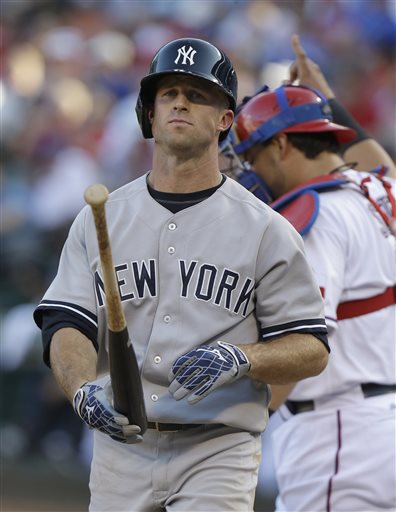
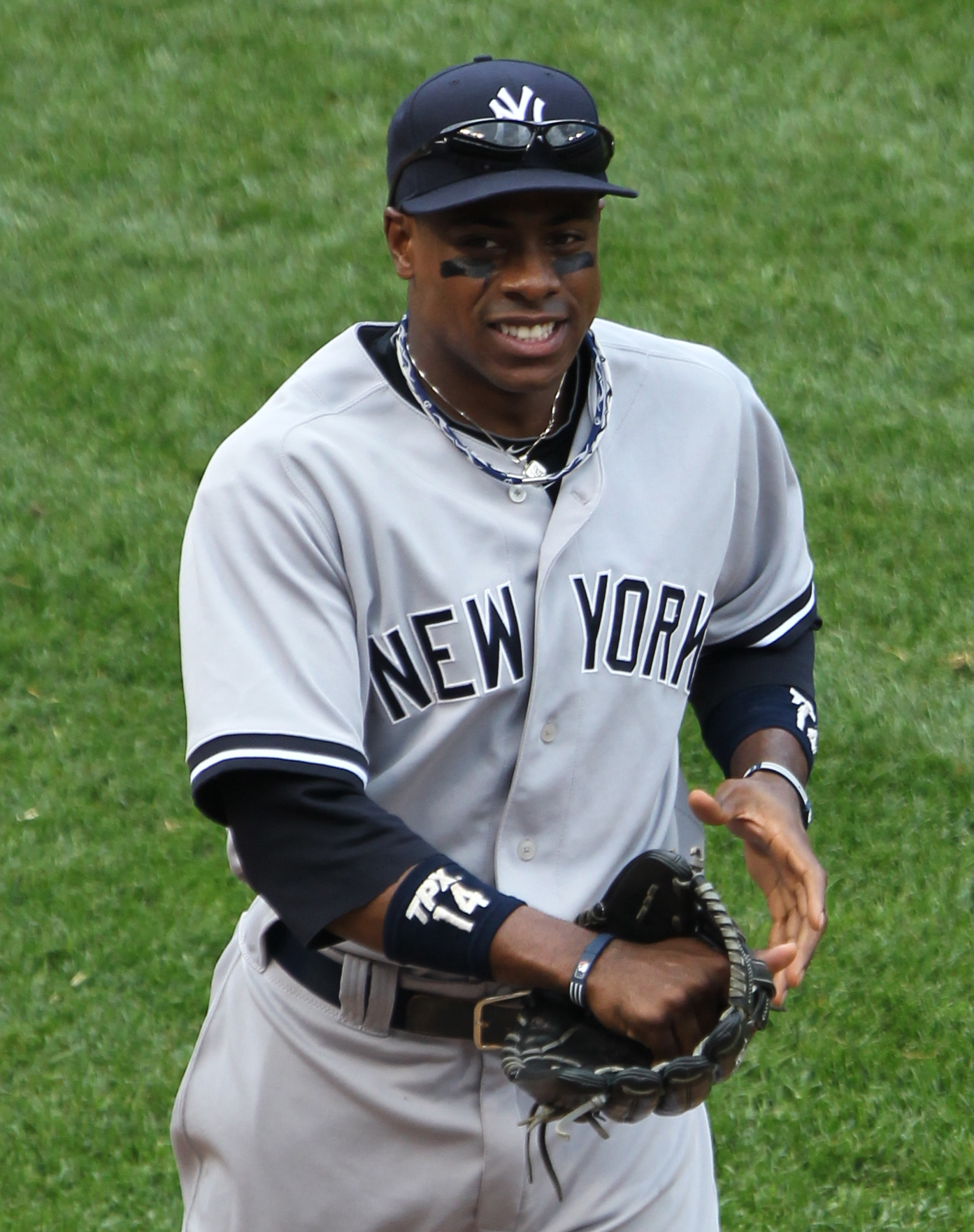
Strikeout Soriano Returns, Putting Damper On Fine Kuroda Performance

Once upon a time, the Yankees had a player named Alfonso Soriano. He looked like the next great star. He could hit for average. He could hit for power. He could run. He was exciting. He was going to be a part of the next Yankee Dynasty. And he was only 28.

There were 2 problems: He struck out too much, and he couldn't field any position.

You think I'm kidding about the strikeouts? Okay, look at this:

Player A: 126, 125, 120, 113, 112
Player B: 171*, 161*, 156*, 142*, 141*
Player C: 160*, 157, 153*, 130, 130*

All 3 are players who played for the Yankees and were said to "strike out too much." These are their 5 highest single-season strikeout totals.  However, in seasons in which these totals were with teams other than the Yankees, I have put an asterisk.  If you including only their Yankee seasons, then...

Player A: 126, 125, 120, 113, 112
Player B: 133, 129, 122, 107, 82
Player C: 157, 130, 125, 15, 3

Suddenly, Player B looks a lot better -- although it should be noted that the 82-K season was strike-shortened 1981, so he was on pace for around 120. You can also guess that player C was only a Yankee for 5 seasons, including 2 in which he spent most of the season in the minor leagues.

Player A is Mickey Mantle. By today's standards, Mickey didn't strike out all that much.

Player B is Reggie Jackson.

Player C is Alfonso Soriano.

On February 16, 2004, the Yankees traded Soriano and a player to be named later to the Texas Rangers for Alex Rodriguez and a rejiggering of A-Rod's contract.

The PTBNL turned out to be Joaquin Arias, then a 19-year-old infielder in A-ball.  He was an infielder who wouldn't reach the major leagues until 2006, and had played only 41 big-league games by the end of the 2009 season. No great loss, right?

Actually, he is now the backup 3rd baseman for the San Francisco Giants, and in 60 games is batting .282. Maybe the Ynkees could use him now after all.

As of right now, Soriano has 389 career home runs -- as many as Johnny Bench, 1 less than Graig Nettles, and more than such legendary slugers as Frank Howard, Jim Rice, Ralph Kiner, Johnny Mize, Yogi Berra and Joe DiMaggio. He also has 458 doubles, more than Paul O'Neill, Bernie Williams and Don Mattingly ended up with.

But this season, Soriano is batting .254, with an OPS+ of 102. That means that he's been 2 percent better than the average hitter. Two percent.

He has 17 home runs and 51 RBIs -- on pace for around 25 and 75. This was done while playing his home games at Wrigley Field, usually a hitter's park.

And he's 37 years old. And he's already struck out 89 times -- on pace for around 135. And he still can't play any position well enough to not DH him.

According to Mark Feinsand in today's Daily News, the Yankees will only give up a mid-level prospect for Soriano.

If this doesn't work, Brian Cashman should be unemployed by Halloween.

And in order for it to work, Soriano will have to put up a performance that will erase our last memory of him: The 2003 World Series, when he batted .227 and struck out -- how many times, Mr. Rooney? "Nine times!" After batting .133 and striking out 11 times against the Red Sox in the ALCS that ended with a home run by Aaron Boone, who was playing 3rd base, mainly because Soriano couldn't.

If this is the Yankees' only noticeable move before the trading deadline (this coming Wednesday), it could come back to haunt us.

(UPDATE: It did not work, and Cashman was still employed as of Halloween 2018.)

*

Oh, there was a game yesterday. And in it, again, the Yankees didn't hit much.

But this time, it didn't matter, because Hiroki Kuroda pitched like the ace of a contending team. He went 7 innings (okay, maybe not an ace by the standards of my youth), 6 hits, 1 walk, and no runs (okay, that is an ace by anyone's standards). David Robertson pitched a scoreless 8th, and Mariano Rivera pitched a scoreless 9th. In other words, what you would hope would be "the usual."

Austin Romine had the 1st 3-hit game of his career, including a double to lead off the 6th inning. Ichiro Suzuki sacrificed him to 2nd, and Brent Lillibridge doubled him home. With 1 out in the 8th, Robinson Cano doubled, Vernon Wells singled him over to 3rd, and Eduardo Nunez grounded into a forceout to get Cano home.

That was it. But, this time, it was enough. Yankees 2, Rangers 0. WP: Kuroda (10-6). SV: Rivera (33). LP: Derek Holland (8-6, and if I didn't hate Dallas I'd say he deserved a better fate). The 4-game series was split.

*

So with the Yankees 6 1/2 games behind the Boston Red Sox (6 in the loss column), the surging Tampa Bay Rays half a game back (even in the loss column), and the Baltimore Orioles 4 back, the Yankees come home to face the Rays, while the Sox visit the O's.

The Rays have won 8 o their last 10, but are only 26-23 on the road. Granted, we're only 28-23 at home, but we should have the advantage.

Projected pitching matchups:

Tonight, 7:05: CC Sabathia vs. Jeremy Hellickson. We need the Big Fella to be an ace again.

Tomorrow, 1:05: Ivan Nova vs. Chris Archer. Nova has pitched pretty well lately, let's hope he can do it again.

Sunday, 1:05: Phil Hughes vs. Matt Moore. Moore is 14-3, and a pretty good candidate for the Cy Young Award. But Hughes has also snapped out of it recently and pitched well.

So all 3 of these games look winnable.

The Rays' website has the slogan "WELCOME HOME." As if they are desperate for fans to come to their games. All that winning they've done since 2008, and they still can't draw flies to that stupid dome.

Well, they're on the road this weekend, so they can't do anything about it now.

*

Six and a half games back. There are 9 weeks (plus this weekend) left in the regular season. And there are 10 games remaining against the Sox.

It's not that hard. We've come back to finish 1st before. Especially against the Sox.

But is Soriano the answer? If so, Brian Cashman may not have heard the question correctly.

Tuesday, July 23, 2013

Desperate Times Call For Desperate Measures -- Are These Desperate Times?

My thanks to Delia Enriquez, whose Tweets broke up Yu Darvish's no-hitter in the 5th inning last night:
Unfortunately, nothing seems to wake the Yankee bats up for long.  Here's the extent of the Yankee baserunners in last night's series opener against the Texas Rangers in Arlington:

1st inning: Brett Gardner leads off the game by getting hit with a pitch. After a delay to see if he was okay, the game continued, and he remained in the game, but Ichiro Suzuki popped up, and Robinson Cano grounded into a double play.

5th inning: Lyle Overbay singles. Vernon Wells flies out. Travis Hafner walks. At this point, it's only 1-0 Rangers, and we have 1st & 2nd with 1 out. Unfortunately, the next 2 batters don't belong in the major leagues. Eduardo Nunez struck out, and Chris Stewart popped up.

7th inning: With 1 out, and the Strangers now up 2-0, Overbay singled again. So the Yankees had 2 hits in 7 innings, and Overbay had both of them. Vernon Wells drew a walk. Ranger manager Ron Washington replaced Darvish with Robbie Ross. And Hafner grounded into a double play. Nelson Cruz homered in the bottom of the inning to make it 3-0 Rangers, and that was the final.

9th inning: With 1 out, Ichiro singled to right. But Cano struck out, and Overbay flew out.

I want to note that Ivan Nova deserved a better fate. He went 7 innings, allowing 3 runs on 7 hits and 3 walks. We should have scored enough runs to at least avoid sticking him with the loss. Joba Chamberlain pitched a scorless 8th, not that I remain hopeful about his future with the Yankees, but it's still good to see.

WP: Darvish (9-4). SV: Joe Nathan (31). LP: Nova (4-3), who deserved a better fate.

I hate the Rangers. I hate all teams called Rangers, whatever the sport, whatever the country, especially if they wear blue shirts.

I used to say that the only Ranger in a blue shirt who doesn't suck is the Lone Ranger. But in the new movie The Lone Ranger, Armie Hammer wears a black shirt. (A "third jersey"? Look ridiculous on you, kemosabe.) No wonder the movie tanked.

Johnny Depp can survive this bomb, because he's Johnny Freakin' Depp: Men want to be him, and women just want him. But Hammer's career may take as big a hit as Seth Rogen's did when he tried to bring back the Green Hornet. (These characters were created by the same guy, and as a relative of the Lone Ranger. No, I'm not making that up: Britt Reid was the grandson of John Reid, the murdered brother of Lone Ranger Dan Reid.)

*

They say, "Desperate times call for desperate measures." Well, are times desperate for the Yankees? There are 10 weeks left in the season, 63 games, and we're 7 games behind the Red Sox (6 in the loss column). All we have to do is make up 1 game out of every 9. Considering how many times the Red Sox have choked away a Division lead (1948, 1949, 1972, 1974, 1977, 1978, 1991, 2006, 2009, 2011), it is time to be concerned, but not scared.

Yet the rumor is going around that the Yankees are trying to put together a trade with the Chicago Cubs, to bring back Alfonso Soriano. You remember the 2001 World Series, when he was 3 outs away from being a tremendous hero? No? Well, you remember the 2003 World Series, when he became known as Strikeout Soriano? Thought so.

I don't want him back. He would be no better than what we have now. In 2002, he led the AL in plate appearances, at-bats, hits, runs and stole bases. He batted .300, hit 39 home runs, had 102 RBIs. He had another great year in the Yanks' 2003 Pennant season. And then batted .133 in the ALCS against The Scum and .227 in the World Series against the Florida Marlins.  e's since been to only 2 postseasons, with the Cubs in 2007 and '08, and reached base 4 times in 29 appearances (an on-base percentage of .138).

He hasn't batted higher than .262 in 6 years. He had 32 homers and 108 RBIs last season, but it was his highest home run total in 6 years and his highest RBI total ever -- it was an outlier. He stole 41 bases as recently as 2006, but the Washington Nationals wouldn't keep him, and he signed as a free agent with the Cubs, and has 70 steals in the 6 1/2 seasons since. He's already struck out 87 times this season, and fanned 153 times last season.

And with the suspension yesterday of Ryan Braun, for the rest of the season, the thought that MLB bigwigs would hold off on suspending anyone in this Biogenesis thing until after the season is out the window. So even if Alex Rodriguez can come back from injury this season, he may be unavailable. And that brings us back to Soriano, the guy we traded to the Rangers to get A-Rod on February 16, 2004, a date which lives in fiduciary.

No, these are not desperate times. The Yankees do need a big bat or two, and the trading deadline is 8 days away. If Derek Jeter and Curtis Granderson could come back this season, it would be like 2 new signings.

Yikes, with the trading deadline acting as baseball's "transfer window," I'm starting to sound like an Arsenal fan.

But then, I am an Arsenal fan. But I don't want to be that kind of Arsenal fan, demanding that Brian Cashman "Spend some fucking money!" That's the problem: Cashman proves Arsene Wenger's point, that it's not how much money you spend, but on whom.

Saturday, July 20, 2013

How To Be a Yankee Fan In Dallas -- 2013 Edition

"I'm in hell!" – Morgan Freeman
"Worse: You're in Texas!" – Chris Rock
-- Nurse Betty

The Yankees will fly out of Boston late Sunday night and head to the Dallas area, to take on the Texas Rangers in what Texas native Molly Ivins – frequently sarcastically – called The Great State. An example of her writing: "In the Great State, you can get 5 years for murder, and 99 for pot possession." (I once sent the late, great newspaper columnist an e-mail asking if it could be knocked down to 98 years if you didn’t inhale. Sadly, she never responded.)

Before You Go. It's not just The South, it's Texas.  This is the State that elected George W. Bush, Rick Perry, Dick Armey, Tom DeLay, Ron Paul, Louie Gohmert and Ted Cruz, and thinks the rest of the country isn't conservative enough.  This is the State where, in political terms, somebody like Long Island's conservative Congressman Peter King is considered a sissy.  This is a State that thinks that poor nonwhites don't matter at all, and that poor whites only matter if you can convince them that, no matter how bad their life is, they're still better than the (slur on blacks) and the (slur on Hispanics).  So it would be best to avoid political discussions.  And, for crying out loud, don't mention that, 50 years ago this fall, a liberal Democratic President was killed in Dallas.  They might say JFK had it comin' 'cause he was a (N-word)-lovin' Communist.

No.  I'm not kidding.  Like I said, I've never been to Texas, but I've seen enough Texans elsewhere, in actual meetings and on TV, to know that there are some of them who think like this -- and, among their own people, they will be less likely to hold back.  So don't ask them what they think.  About anything.

At any rate, before we go any further, enjoy Lewis Black's R-rated smackdown of Rick Perry and the State of Texas as a whole.  Perry is so stupid and myopic, he makes Dubya look like Pat Moynihan.

Also within the realm of "It's not just The South, it's Texas," you should be prepared for hot weather.  You know this heat wave that we got now? They have this shit all the time.  Remember to keep yourself hydrated.

The website of the Dallas Morning News is suggesting day temperatures around 93 and nights around 75, with a thunderstorm possible on Monday night. The Fort Worth Star-Telegram is not predicting rain during the series, but thinks it will be even hotter.

Getting There. It is 1,551 miles from Midtown Manhattan to downtown Dallas, and 1,576 miles from Yankee Stadium to Rangers Ballpark. So unless you want to be cooped up for 24-30 hours, you... are... flying.

Nonstop flights from Newark, Kennedy or LaGuardia airports to Dallas-Fort Worth International Airport will set you back over $2,500 (round-trip), but single-stop flights, usually stopping (possibly also changing) at Chicago’s O’Hare Airport, could cut it to about $1,800. If that’s too much, and you want to wait until the next Yankee series – and thus order tickets after your next payday, in the hopes that your flight will be cheaper – you’re out of luck, as this is the only series the Yankees will play in Texas this season. Yet another thing that Interleague play has futzed up.

So, if it’s a choice between being cooped up or spending that much dough, what is being cooped up going to be like? Amtrak offers the Lake Shore Limited (a variation on the old New York Central Railroad’s 20th Century Limited), leaving Penn Station at 3:40 PM and arriving at Chicago’s Union Station at 9:45 the next morning (set your watch back 1 hour, Central Time). Then switch to the Texas Eagle at 1:45 PM, and arrive at Dallas’ Union Station (400 S. Houston Street at Wood Street) the following morning at 11:30. It would be $395 each way, and that’s with sleeping in a coach seat, before buying a room with a bed on each train.

Dallas is actually Greyhound’s hometown, or at least the location of its corporate headquarters: 205 S. Lamar Street.  (It is also the corporate HQ of American Airlines.) If you look at Greyhound buses, you’ll notice they all have Texas license plates. So how bad can the bus be?

Well, it’ll be a lot cheaper: $418 round-trip. But it won’t be much shorter. You’d have to leave Port Authority at 3:45 – but that’s not PM, like on the train, that’s AM, and after boarding that bus in the middle of the night, Saturday-into-Sunday, you’d go down I-95 and have to change buses at Richmond, Virginia on Sunday afternoon (and I don't like the Richmond station), before going through Nashville, Memphis and Little Rock, before arriving in Dallas at 5:15 PM Monday, by which time the gates would already be opening for the first game of the series.  The station is at 250 Lamar Street at Commerce Street.

Oh... kay. So what about driving? As I said, over 1,500 miles. I would definitely recommend bringing a friend and sharing the driving. The fastest way from New York to Dallas is to get into New Jersey, take Interstate 78 West across the State and into Pennsylvania, then turn to Interstate 81 South, across Pennsylvania, the “panhandles” of Maryland and West Virginia, and across the Shenandoah Valley of Virginia into Tennessee, where I-81 will flow into Interstate 40. Take I-40 into Arkansas, and switch to Interstate 30 in Little Rock, taking it into the Dallas-Fort Worth metropolitan area, a.k.a. “The Metroplex.” In Texas, I-30 is named the Tom Landry Freeway, after the legendary Dallas Cowboys coach.

Once you get across the Hudson River into New Jersey, you should be in New Jersey for about an hour, Pennsylvania for 3 hours, Maryland for 15 minutes, West Virginia for half an hour, Virginia for 5 and a half hours (more than the entire trip will be before you get to Virginia), 8 hours and 15 minutes in Tennessee, 3 hours in Arkansas, and about 3 hours and 45 minutes in Texas.

Taking 45-minute rest stops in or around (my recommendations) Harrisburg, Pennsylvania; Charlottesville, Virginia; Bristol, on the Virginia/Tennessee State Line; Nashville and Memphis, Tennessee; Little Rock and Texarkana, Arkansas; and accounting for overruns there and for traffic at each end of the journey, and we’re talking 31 hours. So, leaving New York at around 10:00 on Sunday morning (thus avoiding rush-hour traffic), you should be able to reach the Metroplex at around 4:00 on Monday afternoon (again, avoiding rush-hour traffic and giving you time to get to your hotel).

And you will be getting a hotel. Fortunately, Rangers Ballpark is in Arlington, midway between the downtowns of Dallas and Fort Worth. Well before either the Rangers or Cowboys set up shop in Arlington, Six Flags Over Texas did so, as the original theme park in the Six Flags chain (opening in 1961) and so there are plenty of hotels available nearby. They’re also likely to be cheaper than in downtown Dallas.

Officially, Rangers Ballpark (formerly known as The Ballpark In Arlington and AmeriQuest Field) is at 1000 Ballpark Way, off Exit 29 on the Landry Freeway. It sits right between Six Flags and the new Cowboys Stadium. Across Legends Way from the ballpark is a parking lot where the original home of the Rangers, Arlington Stadium, stood from 1965 to 1993. (It was a minor-league park called Turnpike Stadium before the announcement of the move of the team led to its expansion for the 1972 season.)

Here’s another reason why you may prefer to drive: Public transportation is not available to the ballpark. Dallas has built a subway and light rail system, and it has a bus service (get a Day Pass for $5.00), but neither of these goes anywhere near the ballpark. I read somewhere that, at 375,000 people, Arlington is the largest city in the country with no public transportation at all. If you went to the Metroplex by any way other than driving yourself, you’ll have to rent a car.

There is one way around it, but it only applies if you have a hotel near the various Arlington attractions: The Arlington Entertainment District Trolley, which goes to the area hotels and to the stadiums and theme parks. Of course, you've got to the hotels first...

Tickets. The Rangers averaged 42,719 fans last season, not surprising since they made the Playoffs for the 3rd straight season -- after making the Playoffs only 3 times in their preceding 38 seasons.  Official seating capacity is 48,114, boostable to over 52,000 with standing room. This season, they're averaging 39,669, which means over 8,000 tickets should be available, so getting them should not be a problem.

The Rangers have a peak price (at least, the highest available on the Ticketmaster website) of $112. (Normally these prices I’m quoting would be a little lower, but the Yankees make “Premium Pricing” kick in.  I’m presuming the Red Sox and fellow Texans the Houston Astros do as well.) Some seats on the lower level can be had for $88. Foul line boxes are $79. Outfield seats on the lower level (bleachers, they could be called) are $40, although the upper deck in right field is an “All You Can Eat Porch,” presumably with food taken care of, for $58. Upper Boxes are $27, and Upper Reserved are $26.  The uppermost right field upper deck, Grandstand Reserved, are just $13.

Be warned: A lot of these seats are listed as “Obstructed View.” This ballpark opened in 1994, and the plans for Camden Yards, if not the finished product, had to have been available. There is no excuse for a ballpark built after 1992 to have obstructed-view seats. Trying to look like one of the pre-World War II (or even WWI) ballparks can, after all, be taken too far.

Going In. Dallas (population about 1,250,000, founded 1856) was named after George Mifflin Dallas, a Mayor of Philadelphia and Senator from Pennsylvania who was James K. Polk's Vice President (1845-49).  Fort Worth (about 780,000, 1849) was named for William Jenkins Worth, a General in the War of 1812 and the Mexican-American War. And Arlington (375,000, 1876) was named for the Virginia city across the Potomac River from Washington, D.C., as a tribute to Confederate General Robert E. Lee.  The population of the entire Metroplex is about 6.6 million and climbing, although when you throw in Oklahoma, southern Arkansas and northern Louisiana, the total population of the Rangers' "market" is about 19 million -- a little less than the New York Tri-State Area, and soon it will surpass us.

Rangers Ballpark is 17 miles west of downtown in Dallas, and 18 miles east of downtown Fort Worth, although Arlington is in Fort Worth's Tarrant County, not Dallas County.  As I said, there's no public transit: You're driving, or spending a truckload on a taxi.  Each way.

Most likely, you’ll enter at the northwest corner of the stadium, which is the home plate entrance. The ballpark faces southeast, although the structure prevents you from seeing out. It’s just as well: Although Dallas has some interesting architecture, downtown is too far away to see it from there anyway.

Various old parks were incorporated into the design.  Most obvious is the old Yankee Stadium, with the frieze (that thing we Yankee Fans tend to incorrectly call a "facade") on the roof, and Tiger Stadium with that overhanging, support-poled upper deck in right field.  The use of green as the park’s main color may be a tribute to the oldest remaining ballparks, Fenway Park in Boston and Wrigley Field in Chicago (although Fenway’s seats are red, green is the main color for the rest of the park).

The field is not symmetrical.  It's 332 feet to left field, 390 to left-center, 404 to "deep left center," 400 to straightaway center, 407 to the deepest part of the park in "deep right center," 377 to right center, and 325 down the right field line.  The longest home run at this stadium, as you might guess, was hit by Josh Hamilton, a 485-footer in 2010.

The Center Field Sports Park is a fan interactive area located in Vandergriff Plaza. The interactive area includes a Wiffle Ball Park, Tee-Ball Cages, a Speed Pitch, a Pitching Cage, and picnic tables. Token machines are located in the park, and age restrictions apply to some activities. The Center Field Sports Park opens 2 hours prior to game time and remains open through the middle of the 7th inning during April, May, and September weekday games; and through the top of the 9th inning during June, July, and August games. The Center Field Sports Park will also close early on nights when postgame fireworks shows are scheduled.

Food. Along with the usual ballpark fare, the Rangers, going back to their early days at Arlington Stadium, were known for their nachos, as one might expect in Texas. As one also might expect in Texas, they have barbecue stands, and lots and lots of beer, including the hometown brand, Lone Star Beer.

In Texas, you can expect Tex-Mex, and Casa De Fuego is behind Section 125.  They have a "Coney Island" stand, but the closest this Section 40 stand comes to being the Brooklyn seaside institution is selling chili dogs.  There's a Dublin Up Irish Pub at 211, several Hot'n Chedder Sausage stands (their spelling, not mine), and at Section 24 (should be 34), Nolan Ryan's Beef Steak Sandwich.  At Section 16, "Sausage Sundae." I don't wanna know.

Team History Displays. The Rangers, having now been around for over 40 years, have a bit of history. And while they never won a Pennant until 2010, or even qualified for postseason play until 1996, rarely have they been flat-out terrible. For the most part, they’ve been just sort of there, just another stop on a team’s schedule, and nothing to get excited about. But they have had their moments, ranging from the sublime (the no-hitters and strikeout milestones of Nolan Ryan) to the ridiculous (sending 18-year-old Houston area native David Clyde to pitch in 1973, when he clearly wasn’t ready, and wrecking the arm of the top pick in the draft, just so they could bring in fans wanting to see a native Texan -- from the other side of the State -- pitch for the Rangers).

The Rangers have a team Hall of Fame, which is open to ticketed fans during home games, and during ballpark tours. There are currently 16 members: Pitchers Ryan, Charlie Hough, Ferguson Jenkins, and former Yankees John Wetteland and (ugh) Kenny Rogers; catchers Jim Sundberg and Ivan Rodriguez (Pudge, briefly a Yankee, was just inducted); infielders Toby Harrah (the last active Washington Senator, and a former Yankee) and Buddy Bell; outfielders Tom Grieve, Rusty Greer and former Yankee Ruben Sierra; manager Johnny Oates (another former Yankee), broadcasters Mark Holtz and Eric Nadel, and Tom Vandergriff, longtime Mayor of Arlington (1951-77) and “the Father of the Texas Rangers.”

At the start of the 2012 season, the Rangers dedicated statues of Shannon and Cooper Stone, the father and son involved in a tragic incident the year before. All-Star Ranger left fielder Josh Hamilton saw the Stones in the stands, and tossed a ball up to them. But Shannon, a 39-year-old firefighter, bobbled it, and fell over the railing to his death. His son Cooper was just 6, and the poor kid saw the whole thing. He was wearing a HAMILTON 32 jersey. The Rangers invited Cooper and his mother Jenny to throw out the ceremonial first pitches at a Playoff game in 2011, and dedicated the statues on Opening Day, as a symbol of the bond between fathers, sons and baseball.

A highway near the ballpark is the Nolan Ryan Freeway. Keep in mind, though, that Ryan only pitched for the Rangers for 5 seasons, and while he is regarded as a Texas icon, he was from the Houston area, not the Dallas area. Oates (Number 26) and Ryan (Number 34) have had their numbers retired. Those numbers are on the outfield wall. The center-field “batter’s eye” is known as Holtz Hill, and a statue of Vandergriff stands behind Holtz Hill on a part of the Ballpark’s concourse called Vandergriff Plaza.  A statue of Ryan is outside the park.

Prior to 1965, the Metroplex was home to 2 teams in the Class AA Texas League: The Dallas team had several names, including the Spurs in the 1920s and ‘30s, the Rebels in the ‘40s, and (this will shock people from the Philadelphia area) the Eagles in the ‘50s, before becoming the Dallas Rangers in 1958; while the Fort Worth team was called the Panthers in the 1900s, ‘10s and ‘20s and the Cats from 1932 onward. In 1959, the Class AAA American Association admitted both the Dallas Rangers and the Fort Worth Cats.

In 1965, Mayor Vandergriff had a 10,000-seat stadium built in his city, and it became home to a single team, the Dallas-Fort Worth Spurs, with the idea that 2 teams, both having attendance problems, would not help the region get an expansion or moved team at the major league level; but one team, drawing from the entire area, would. It worked, and as Bob Short announced he would move the “new” Washington Senators to the area for the 1972 season, Turnpike Stadium was expanded to 20,000 seats, then 35,000 in time for the Rangers’ arrival, and finally to 43,000 seats in 1978.

The City Council offered to name the expanded stadium for Vandergriff, but he said it should be named for the city, and he threw out the first ball for their first game and broadcast for them for 3 years. He later served a term in Congress (elected as a Democrat, defeated by noted right-wing nut Dick Armey) and as a County Judge (elected as a Republican), and died at age 84, living just long enough to see his team play in its first World Series.

Note that the original Texas Rangers, the lawmen for whom the team (and the legendary Lone Ranger) were named, have their own Hall of Fame and Museum, in Waco. It’s 100 miles south of the Dallas area, so if you want to see that, you’ll need a car.

Stuff. The Rangers have team shops throughout the Ballpark, and also in downtown Dallas and downtown Fort Worth. The usual array of caps, jerseys, T-shirts, jackets, and baseball equipment are available. There are DVD retrospectives of their 2010 and '11 Pennant seasons.  And The Essential Games of the Texas Rangers is newly released, with 4 games: Ryan's 7th no-hitter on May 1, 1991; the team's first postseason game, Game 1 of the 1996 AL Division Series (which remained their only postseason game won until 2010), and the ALCS Game 6s in both 2010 and '11, their 2 Pennant clinchers.

There aren't very many books about the Rangers -- indeed, if you do a search, and don't specify the baseball team, you'll probably end up with lots of books about the lawmen.  Probably the best known book about the team doesn't exactly put them in a positive light: Seasons in Hell: With Billy Martin, Whitey Herzog and "The Worst Baseball Team in History" -- The 1973-1975 Texas Rangers.  Mike Shropshire, who covered the Rangers first for the Star-Telegram and then the Morning News, published it in 1996, at a time when the Rangers had yet to appear in a postseason game -- although 1974, when Billy (having taken over from Herzog the year before) took them to 2nd place, should have been a fun season to cover.  But when you have to go to a stadium without sun protection in Texas, the long season could be pretty rough even in the best of times.

Broadcaster Nadel published The Texas Rangers: The Authorized History after the '96 AL West title, and the Morning News staff published Believe It! Texas Rangers: 2010 American League Champions, after they finally won a Pennant.

During the Game. If you were going to a Dallas Cowboys game, I would advise you against wearing New York Giants, Philadelphia Eagles, and especially Washington Redskins gear. Under those circumstances, the stereotypical aggression of Texans may come into to play. However, wearing Yankee gear in Rangers Ballpark will almost certainly get you no more than a little verbal. And, this being a stadium, you're gonna get searched, and so is everyone else, so Texas' infamously lenient gun laws will be rendered useless. You're not going to get shot.  Even J.R. wouldn't have gotten shot.

Like its predecessor, Arlington Stadium, Rangers Ballpark offers no protection from the searing Texas heat. As a result, most home games are played at night (until the ESPN Sunday Night Baseball era began, the Rangers were one of the few teams that ever played Sunday home games at night), and, like Arlington Stadium, it is a hitters’ park. This is particularly true to right field, where the pole is just 325 feet away, and the upper deck appears to overhang the lower one (there’s that Detroit similarity).  They call their fans "Rangers Republic," as opposed to "Red Sox Nation" (or "Yankees Universe").

The Rangers’ mascot is “Rangers Captain,” a horse dressed like a cowboy. On his page on the team website, Captain’s Corral, he is listed as follows: “Bats: Both. Throws: Smoke.” He has also been known to “throw down” with opposing mascots, including T.C. the Minnesota Twins’ bear, the Mariner Moose, and Junction Jack, the jackrabbit from the cross-State Houston Astros.

You know how the Yankees have "The Great City Subway Race"? And the Mets have the plane race? The Orioles have a Hot Dog race? The Nationals have the Presidents' Race? The Pirates have the Pierogi Race? The Brewers have the Sausage Race? The Rangers have the Dot Race.

The... wha-at? The Dot Race. It appears to have predated all of the preceding, although there seems to be some dispute as to who did it first, the Rangers or the A's. Originally, at Arlington Stadium, three dots -- red, green and blue -- would race around the scoreboard in the middle of the 6th inning. Now, they have live-action racing dots. Each fan is given a coupon that has one of the three colors. A coupon with the winning color can be taken to a Texas store to purchase... a new car! No, just kidding, not a new car. Okay, how about a steak dinner? Nope. Okay, how about a free hot dog at a ballpark concession stand? Nope. You win... a bottle of the race's sponsor, Ozarka bottled water. Oh. Joy. All that money in Texas, and that's the best they can do?

It is with great regret, and some queasiness, that I report that the Rangers’ regular song to play in the 7th inning stretch after "Take Me Out to the Ball Game" is the nauseating “Cotton Eye Joe.” And in an apparent effort to make the Whatever They’re Calling Themselves This Season Angels of Anaheim’s “Rally Monkey” look mature, the Rangers have adopted the “Claw and Antlers” gesture. Utility infielder Esteban German saw a home run, and held his hands in a claw-like position. (That sounds like something to do with dexterity rather than strength.) A stolen base led German to hold his hands to his head, his fingers attempting to look like the antlers of a deer or a moose. (Now that sounds like it could represent strength, at least if it’s a moose, though a deer can be speedy.) A foam “antlers” hat soon followed, and became a big seller. ‘Scuse me while I roll my eyes.

After the Game. Dallas has a bit of a bad reputation when it comes to crime, but you’ll be pretty far from it.  Not only is the Ballpark not in a bad neighborhood, it’s one of those ballparks that’s not in any neighborhood. As long as you don’t make any snide remarks about the Cowboys, safety will not be an issue.

The only bars I could find that have been mentioned as catering to New Yorkers are the Cape Buffalo Grille, at 17727 Addison Road in Addison, north of Dallas, 28 miles northeast of Rangers Ballpark; and Humperdinks, at 6050 Greenville Avenue in north Dallas. That’s far from your base, even if your hotel is in downtown Dallas, but the former is an established home for fans of the football Giants, described by one as “a lifesaver for people from New York and New Jersey”; the latter seems to be the local home of Jet fans.

Sidelights. Despite their new rapid-rail system, Dallas is almost entirely a car-friendly, everything-else-unfriendly city. Actually, it’s not that friendly. It’s a city for oil companies, for banks, for insurance companies, things normal Americans tend to hate. As one Houston native once put it, “Dallas is not in Texas.” In fact, most Texans, especially people from Fort Worth (and, to a slightly lesser extent, those from Houston) seem to think of Dallas the way the rest of America thinks of New York: They hate it, and think it represents all that is bad about their homeland. Until, that is, they need a win. Or money.

As I said, Cowboys Stadium is close to Rangers Ballpark; in fact, it’s 7/10ths of a mile. You could walk between them. If you don’t mind losing 5 pounds of water weight in the Texas heat. The official address is 925 N. Collins Street, and the Cowboys offer tours of this Texas-sized facility, which will make the new Yankee Stadium seem sensible by comparison.  It will host the NCAA Final Four next year.

Don’t bother looking for the former home of the Cowboys, Texas Stadium, because "the Hole Bowl" was demolished in 2010. If you must, the address was 2401 E. Airport Freeway, in Irving.

The Cowboys’ first home, from 1960 to 1970, was the Cotton Bowl, which also hosted the Cotton Bowl game from 1937 to 2009, after which it was moved to Cowboys Stadium. It also hosted some (but not all) home games of Southern Methodist University between 1932 and 2000, and some games of soccer’s 1994 World Cup.

But it’s old, opening in 1930, and the only thing that’s still held there is the annual “Red River Rivalry” game between the Universities of Texas and Oklahoma, every first Saturday in October, and that’s only because that’s the weekend when the Texas State Fair is held, as the stadium is in Fair Park. While it doesn’t seem fair that Oklahoma’s visit to play Texas should be called a “neutral site” if it’s in the State of Texas, the fact remains that each school gets half the tickets, and it’s actually slightly closer to OU’s campus, 191 miles, than it is from UT’s, 197 miles.

Next-door is the African-American Museum of Dallas. 1300 Robert B. Cullum Blvd., in the Fair Park section of south Dallas. Bus 012 or 026, or Green Line light rail. Be advised that this is generally considered to be a high-crime area of Dallas.

The NBA’s Dallas Mavericks and the NHL’s Dallas Stars play at the American Airlines Center, or AAC. Not to be confused with the American Airlines Arena in Miami (which was really confusing when the Mavs played the Heat in the 2006 and 2011 NBA Finals), it looks like a cross between a rodeo barn and an airplane hangar. 2500 Victory Avenue in the Victory Park neighborhood, north of downtown. Bus 052 or Green Line to Victory station.

Before the AAC opened in 2001, both teams played at the Reunion Arena. This building hosted the 1984 Republican Convention. To New York Tri-State Area fans, it is probably best remembered as the place where Jason Arnott’s double-overtime goal won Game 6 and gave the New Jersey Devils the 2000 Stanley Cup over the defending Champion Stars.  The 1986 NCAA Final Four, won by Louisville over Duke, was held there.  It was demolished in November 2009, 5 months before Texas Stadium was imploded. The arena didn’t even get to celebrate a 30th Anniversary. 777 Sports Street at Houston Viaduct, downtown, a 10-minute walk from Union Station.

The Major League Soccer club FC Dallas (formerly the Dallas Burn) play at FC Dallas Stadium, at 9200 World Cup Way in the suburb of Frisco. It’s 28 miles up the Dallas North Tollway from downtown, so forget about any way of getting there except driving.

Before there was the Texas Rangers, and before the Dallas-Fort Worth Spurs minor league team that opened Turnpike/Arlington Stadium in 1965, there were the Dallas team alternately called the Steers, the Rebels, the Eagles and the Rangers; and the Fort Worth Cats.  Dallas won Texas League (Double-A) Pennants in 1926, 1929, 1941, 1946 and 1953.  They played at Burnett Field, which opened in 1924, and was abandoned after the Dallas Rangers and the Fort Worth Cats merged to become the Spurs in 1965.  1500 E. Jefferson Blvd. at Colorado Blvd.  Bus 011.

The Cats won TL Pennants in 1895, 1905, 1906, 1920, 1921, 1922, 1923, 1924, 1925, 1930, 1937, 1939 and 1948.  Those 6 straight Pennants in the Twenties became a pipeline of stars for the St. Louis Cardinals, and the 1930 Pennant featured Dizzy Dean and a few other future members of the Cards' 1930s "Gashouse Gang."

The Cats played at LaGrave Field, the first version of which opened in 1900, and was replaced in 1926, again after a fire in 1949, and one more time in 2002, as a new Fort Worth Cats team began play in an independent league.  301 NE 6th Street.  Trinity Railway Express to Fort Worth Intermodal Transit Center, then Number 1 bus.

If there’s two non-sports things the average American knows about Dallas, it’s that the city is where U.S. President John F. Kennedy was assassinated on November 22, 1963, and where Ewing Oil President J.R. Ewing was shot on March 21, 1980. Elm, Main and Commerce Streets merge to go over railroad tracks near Union Station, and then go under Interstate 35E, the Stemmons Freeway – that’s the “triple underpass” so often mentioned in accounts of the JFK assassination.

The former Texas School Book Depository, now named The Sixth Floor Museum at Dealey Plaza, is at the northwest corner of Elm & Houston Streets, while the “grassy knoll” is to the north of Elm, and the west of the Depository. Like Ford’s Theater, where Abraham Lincoln was assassinated in 1865, and the area surrounding it in Washington, the area around Dealey Plaza is, structurally speaking, all but unchanged from the time the President in question was gunned down, an oddity in Dallas, where newer construction always seems to be happening.

John Fitzgerald Kennedy was shot in Dallas and died, while John Ross Ewing Jr. was shot in Dallas and lived. Where’s the justice in that? J.R. was shot in his office at Ewing Oil’s headquarters, which, in the memorable opening sequence of Dallas, was in the real-life Renaissance Tower, at 1201 Elm Street, Dallas’ tallest building from 1974 to 1985, and in real life is the HQ for Neiman Marcus and Blockbuster Video. Bank of America plaza, on Elm at Griffith Street, is now the tallest building in Dallas, at 921 feet, although not the tallest in Texas (there’s 2 in Houston that are taller).

The real Southfork Ranch is at 3700 Hogge Drive (that’s pronounced “Hoag”) in Parker, 28 miles northeast of the city. (Again, you’ll need a car.) It’s not nearly as old as the Ewing family’s fictional history would suggest, built in 1970. It’s now a conference center, and like the replica of the Ponderosa Ranch that Lorne Greene had built to look like his TV home on Bonanza, it is designed to resemble the Ewing family home. It is open to tours for an admission fee of $9.50.

The Dallas area is also home to 2 major football-playing colleges: Southern Methodist University (SMU) in north Dallas, which, as alma mater of Laura Bush, was chosen as the site of the George W. Bush Presidential Library (scheduled to open in 2013, on, naturally, September 11); and Texas Christian University (TCU) in Fort Worth.

SMU has produced players like Doak Walker, Forrest Gregg, Dandy Don Meredith, and the “Pony Express” backfield of Eric Dickerson and Craig James (both now TV-network studio analysts), while TCU has produced Slingin’ Sammy Baugh, Jim Swink and Bob Lilly. Both schools have had their highs and their lows, and following their 1987 “death penalty” (for committing recruiting violations while already on probation), and their return to play in 1989 under Gregg as coach, SMU are now what college basketball fans would call a “mid-major” school. Ironically, TCU, normally the less lucky of the schools, seriously challenged for the 2009 and 2010 National Championships, but their own “mid-major” schedule doomed them in that regard.

*

Texas is a weird place, and the Dallas-Fort Worth Metroplex is no exception. But it’s a pretty good area for sports, and it even seems to have finally embraced baseball as something more than something to do between football seasons. If you can afford it, go, and help your fellow Yankee Fans make the Rangers feel like they’re in Yankee Stadium. After all, as I’ve said before, RANGERS SUCK! Especially when they wear blue shirts. Whatever the sport, whatever the country, the only Ranger in a blue shirt who doesn’t suck is the Lone Ranger! (And with the new movie, even he doesn't even want to wear a blue shirt.  But then, the movie tanked, just like the last Lone Ranger movie did, in 1981.)

But remember to avoid using the oft-heard phrase “Dallas sucks.” In this case, keep the truth to yourself!

Thursday, April 26, 2012

You Can Never Have Too Much Pitching

"Pitching is 75 percent of baseball." -- Connie Mack

"Connie Mack lied." -- Billy Martin

No. He didn't. He may have exaggerated -- it's not three-quarters, but it's more than half -- but he was right.

*

In the 1st game of their series against the Texas Rangers in Arlington, CC Sabathia (2-0) pitched 8 innings, allowing 7 hits and just 1 walk, allowing 4 runs (which didn't matter because the Yankee bats worked), and Mariano Rivera pitched a perfect 9th (4th save). In other words, a good 1978-style pitching job by the Yankees (even if Sparky Lyle and Goose Gossage frequently went more than 1 full inning of relief).

The Yankee bats did work: Derek Jeter went 4-for-5 with an RBI, Robinson Cano went 2-for-5, Curtis Granderson drove in 2 runs with a hit, and Alex Rodriguez hit his 3rd home run of the season, a 3-run job, off Derek Holland (2-1). Yankees 7, Rangers 4.

The 2nd game, things were different. Hiroki Kuroda (1-3) had good stuff, getting into the 7th having allowed just 2 runs. But the Yankees got none off the Rangers' own Japanese pitcher, the much-heralded Yu Darvish (3-0). Jeter and Cano each got 2 hits, but the rest of the Yankees combined got just 3 (Nick Swisher, Russell Martin and Eric Chavez). Rangers 2, Yankees 0.

And then yesterday, it was a bad day for the Yankees all around.

1st reason: It was revealed that Michael Pineda, who was the key to sending the much-hailed Jesus Montero to the Seattle Mariners (where, so far, he's batting .281 but with a 94 OPS+, 2 homers and 11 RBIs), has a torn labrum and will be out for a year. In other words, not only will he not pitch this season, but he won't even be ready for Opening Day next season. The start of May 2013 is more likely.

2nd reason: The guy we might have been counting on to replace him, Andy Pettitte, did not pitch well for the Trenton Thunder last night, going only 5 innings, allowing 7 hits (but only 1 walk) and 4 runs (3 of them earned), in a game the Thunder went on to lose 10-4 to the Erie Seawolves. (Consolations: Left fielder Ronnier Mustelier and DH Cody Johnson are hitting the tar out of the ball down there.)

3rd reason: Phil Hughes started for the Yankees, and looked even more like he should be relegated to the bullpen. He didn't get out of the 3rd inning, and this time we can't blame the hideous fielding of Eduardo Nunez, who didn't even play.

Aside from a home run (his 3rd) and a double from Raul Ibanez, last night's game was a total waste. David Phelps, the young righthander that a lot of fans want to replace Hughes (or Pineda) in the rotation, also got hit hard, and didn't look like the answer to any question.

There was one more item of interest: Jeter got 2 more hits. He's now batting .420. This is what happens with Batman if his parents live long enough to help him grow up.

But hardly enough to help. Rangers 7, Yankees 3. WP: Robbie Ross (4-0). LP: Hughes (1-3).

A saying becomes a cliche by containing some truth. So do not roll your eyes when I say, "You can never have too much pitching."

*

So the Yankees have a travel day today, and begin a weekend series at The Stadium Mark II against the Detroit Tigers, the team that knocked us out of the Playoffs last season.

Friday night, 7:00: A big pitching matchup, Ivan Nova (our most consistent starting pitcher since last year's All-Star Break) vs. Justin Verlander (last season's American League Most Valuable Player).

Saturday afternoon, 4:00 (on Fox): Freddy Garcia vs. Drew Smyly. Oh, wonderful: A Fox game, a pitcher the Yankees have never seen (the 22-year-old lefty from Arkansas has pitched 3 major league games, with an ERA of 1.13), and Garcia hasn't pitched well so far. This looks like an L.

Sunday afternoon, 1:00: CC vs. Max Scherzer. Probably our best chance for a win in the series.

*

As of the conclusion of last night's games, the Baltimore Orioles and the Tampa Bay Rays are tied for first place in the AL Eastern Division. The Yankees and Toronto Blue Jays are each 1 game back. The Boston Red Sox are 3 1/2 back, 3 in the loss column.

A-Rod Tracker: 2,790 hits, 210 for 3,000; 632 home runs, 68 for 700 and 131 for the record 763.

* Last night, the Mets beat the Miami Marlins 5-1 at Citi Field, having taken 2 out of the first 3 in a series that concludes this afternoon. Jose Reyes, who left, went 1-for-8 in the series. David Wright, who stayed, hit a home run to give him 753, making him the all-time franchise leader, surpassing Darryl Strawberry.

Where would those 753 RBIs place the Mets' all-time leader on the Yankees' list?

1. Lou Gehrig 1,995
2. Babe Ruth 1,971
3. Joe DiMaggio 1,537
4. Mickey Mantle 1,509
5. Yogi Berra 1,430
6. Bernie Williams 1,257
7. Derek Jeter 1,209 and counting
8. Bill Dickey 1,209
9. Tony Lazzeri 1,154
10. Don Mattingly 1,099
11. Jorge Posada 1,065
12. Bob Meusel 1,005
13. Alex Rodriguez 910 and counting
14. Paul O'Neill 858
15. Graig Nettles 834
16. Wally Pipp 826 (he really was a great player)
17. Dave Winfield 818
18. Tommy Henrich 795
19. Roy White 758

Think about that: David Wright is the greatest player the Mets have had at his position (3rd base), and the best player the Mets have had over the last 10 years (at the start of which, Mike Piazza was already in decline)... and he hasn't even had more RBIs than Roy White.

Even if you only count those players whose career stats have been solely from the birth of the Mets in 1962 onward, it doesn't help a lot:

1. Bernie Williams 1,257
2. Derek Jeter 1,209 and counting
3. Don Mattingly 1,099
4. Jorge Posada 1,065
5. Alex Rodriguez 910 and counting
6. Paul O'Neill 858
7. Graig Nettles 834
8. Dave Winfield 818
9. Roy White 758

So, even then, Wright would only make the top 10.

The Mets.

Friday, April 20, 2012

How to Be a Yankee Fan In Texas - 2012 Edition

"I'm in hell!" – Morgan Freeman
"Worse: You're in Texas!" – Chris Rock
-- Nurse Betty

The Yankees will fly out of Boston late Sunday night and head to the Dallas area, to take on the Texas Rangers in what Texas native Molly Ivins – frequently sarcastically – called The Great State. Example: "In the Great State, you can get 5 years for murder, and 99 for pot possession." (I once sent the late, great newspaper columnist an e-mail asking if it could be knocked down to 98 years if you didn’t inhale. Sadly, she never responded.)

The Yanks-Strangers series starts Monday night, 7:05 PM Eastern Time (6:05 Central Time). The Tuesday and Wednesday games are 8:05/7:05 starts. I'm doing this now so, in case you want to go, you might get a lower airfare.

Before You Go. It's not just The South, it's Texas. You should be prepared for hot weather, and keep yourself hydrated.

That said, the website of the Dallas Morning News is suggesting day temperatures around 80 and nights around 60, but with thunderstorms possible for Tuesday night. The Fort Worth Star-Telegram is not predicting rain during the series, but agrees with its regional rival paper on the temperatures.

Getting There. It is 1,551 miles from Midtown Manhattan to downtown Dallas, and 1,576 miles from Yankee Stadium to Rangers Ballpark. So unless you want to be cooped up for 24-30 hours, you... are... flying.

Nonstop flights from Newark, Kennedy or LaGuardia airports to Dallas-Fort Worth International Airport will set you back over $2,000 (round-trip), but single-stop flights, usually stopping (possibly also changing) at Chicago’s O’Hare Airport, could cut it to under $1,400. If that’s too much, and you want to wait until the next Yankee series – and thus order tickets after your next payday, in the hopes that your flight will be cheaper – you’re out of luck, as this is the only series the Yankees will play in Texas this season. Yet another thing that Interleague play has futzed up.

So, if it’s a choice between being cooped up or spending that much dough, what is being cooped up going to be like? Amtrak offers the Lake Shore Limited (a variation on the old New York Central Railroad’s 20th Century Limited), leaving Penn Station at 3:45 PM and arriving at Chicago’s Union Station at 9:45 the next morning (set your watch back 1 hour, Central Time). Then switch to the Texas Eagle at 1:45 PM, and arrive at Dallas’ Union Station (400 S. Houston Street) the following morning at 11:30. It would be $330 each way, and that’s with sleeping in a coach seat, before buying a room with a bed on each train.

Dallas is actually Greyhound’s hometown, or at least the location of its corporate headquarters: 205 S. Lamar Street. If you look at Greyhound buses, you’ll notice they all have Texas license plates. So how bad can the bus be?

Well, it’ll be cheaper: $366 round-trip. But it won’t be much shorter. You’d have to leave Port Authority at 3:45 – but that’s not PM, like on the train, that’s AM, and after boarding that bus in the middle of the night, Saturday-into-Sunday, you’d go down I-95 and have to change buses at Richmond, Virginia on Sunday afternoon, before going through Nashville, Memphis and Little Rock, before arriving in Dallas at 5:15 PM Monday, by which time the gates would already be opening for the first game of the series.

Oh... kay. So what about driving? As I said, over 1,500 miles. I would definitely recommend bringing a friend and sharing the driving. The fastest way from New York to Dallas is to get into New Jersey, take Interstate 78 West across the State and into Pennsylvania, then turn to Interstate 81 South, across Pennsylvania, the “panhandles” of Maryland and West Virginia, and across the Shenandoah Valley of Virginia into Tennessee, where I-81 will flow into Interstate 40. Take I-40 into Arkansas, and switch to Interstate 30 in Little Rock, taking it into the Dallas-Fort Worth metropolitan area, a.k.a. “The Metroplex.” In Texas, I-30 is named the Tom Landry Freeway, after the legendary Dallas Cowboys coach.

Once you get across the Hudson River into New Jersey, you should be in New Jersey for about an hour, Pennsylvania for 3 hours, Maryland for 15 minutes, West Virginia for half an hour, Virginia for 5 and a half hours (more than the entire trip will be before you get to Virginia), 8 hours and 15 minutes in Tennessee, 3 hours in Arkansas, and about 3 hours and 45 minutes in Texas.

Taking 45-minute rest stops in or around (my recommendations) Harrisburg, Pennsylvania; Charlottesville, Virginia; Bristol, on the Virginia/Tennessee State Line; Nashville and Memphis, Tennessee; Little Rock and Texarkana, Arkansas; and accounting for overruns there and for traffic at each end of the journey, and we’re talking 31 hours. So, leaving New York at around 10:00 on Sunday morning (thus avoiding rush-hour traffic), you should be able to reach the Metroplex at around 4:00 on Monday afternoon (again, avoiding rush-hour traffic and giving you time to get to your hotel).

And you will be getting a hotel. Fortunately, Rangers Ballpark is in Arlington, midway between the downtowns of Dallas and Fort Worth. Well before either the Rangers or Cowboys set up shop in Arlington, Six Flags Over Texas did so, as the original theme park in the Six Flags chain (celebrating their 50th Anniversary last year) and so there are plenty of hotels available nearby. They’re also likely to be cheaper than in downtown Dallas.

Officially, Rangers Ballpark (formerly known as The Ballpark In Arlington and AmeriQuest Field) is at 1000 Ballpark Way, off Exit 29 on the Landry Freeway. It sits right between Six Flags and the new Cowboys Stadium. Across Legends Way from the ballpark is a parking lot where the original home of the Rangers, Arlington Stadium, stood from 1965 to 1993. (It was a minor-league park called Turnpike Stadium before the announcement of the move of the team led to its expansion for the 1972 season.)

Here’s another reason why you may prefer to drive: Public transportation is not available to the ballpark. Dallas has built a subway and light rail system, and it has a bus service, but neither of these goes anywhere near the ballpark. I read somewhere that, at 365,000 people, Arlington is the largest city in the country with no public transportation at all. If you went to the Metroplex by any way other than driving yourself, you’ll have to rent a car.

Tickets. The Rangers averaged 36,382 fans last season, not surprising since they were on their way to their 2nd straight Pennant (the only Pennants they’ve ever won). Official seating capacity is 48,194, boostable to over 52,000 with standing room. That means over 12,000 tickets should be available, so getting them should not be a problem.

The Rangers have a peak price (at least, the highest available on the Ticketmaster website) of $100. (Normally these prices I’m quoting would be a little lower, but the Yankees make “Premium Pricing” kick in. I’m presuming the Red Sox and fellow Texans the Houston Astros do as well.) Some seats on the lower level can be had for $74. Foul line boxes are $59. Outfield seats on the lower level (bleachers, they could be called) are $38, although the upper deck in right field is an “All You Can Eat Porch,” presumably with food taken care of, for $53. Upper Boxes are $23, and Upper Reserved are just $18.

Be warned: A lot of these seats are listed as “Obstructed View.” This ballpark opened in 1994, and the plans for Camden Yards, if not the finished product, had to have been available. There is no excuse for a ballpark built after 1992 to have obstructed-view seats. Trying to look like one of the pre-World War II (or even WWI) ballparks can, after all, be taken too far.

Going In. Most likely, you’ll enter at the northwest corner of the stadium, which is the home plate entrance. The ballpark faces southeast, although the structure prevents you from seeing out. It’s just as well: Although Dallas has some interesting architecture, downtown is 17 miles from the ballpark, and you couldn’t see it from there anyway.

The Center Field Sports Park is a fan interactive area located in Vandergriff Plaza. The interactive area includes a Wiffle Ball Park, Tee-Ball Cages, a Speed Pitch, a Pitching Cage, and picnic tables. Token machines are located in the park, and age restrictions apply to some activities. The Center Field Sports Park opens 2 hours prior to game time and remains open through the middle of the 7th inning during April, May, and September weekday games and through the top of the 9th inning during June, July, and August games. The Center Field Sports Park will also close early for post-game fireworks shows.

Food. Along with the usual ballpark fare, the Rangers, going back to their early days at Arlington Stadium, were known for their nachos, as one might expect in Texas. As one also might expect in Texas, they have barbecue stands, and lots and lots of beer, including the hometown brand, Lone Star Beer.

Team History Displays. The Rangers, having now been around for nearly 40 years, have a bit of history. And while they never won a Pennant until 2010, or even qualified for postseason play until 1996, rarely have they been terrible. For the most part, they’ve been just sort of there, just another stop on a team’s schedule, and nothing to get excited about. But they have had their moments, ranging from the sublime (the no-hitters and strikeout milestones of Nolan Ryan) to the ridiculous (sending 18-year-old Houston area native David Clyde to pitch in 1973, when he clearly wasn’t ready, and wrecking the arm of the top pick in the draft).

The Rangers have a team Hall of Fame, which is open to ticketed fans during home games, and during ballpark tours. There are currently 14 members: Pitchers Ryan, Charlie Hough, Ferguson Jenkins, and former Yankees John Wetteland and (ugh) Kenny Rogers; catcher Jim Sundberg; infielders Toby Harrah (the last active Washington Senator) and Buddy Bell; outfielders Tom Grieve, Rusty Greer and former Yankee Ruben Sierra; manager Johnny Oates (another former Yankee), broadcaster Mark Holtz, and Tom Vandergriff, longtime Mayor of Arlington (1951-77) and “the Father of the Texas Rangers.”

At the start of this season, the Rangers dedicated statues of Shannon and Cooper Stone, the father and son involved in a tragic incident last season. All-Star Ranger left fielder Josh Hamilton saw the Stones in the stands, and tossed a ball up to them. But Shannon, a 39-year-old firefighter, bobbled it, and fell over the railing to his death. His son Cooper was just 6, and saw the whole thing. He was wearing a HAMILTON 32 jersey. The Rangers invited Cooper and his mother Jenny to throw out the ceremonial first pitches at a Playoff game last season, and dedicated the statues on Opening Day, as a symbol of the bond between fathers, sons and baseball.

A highway near the ballpark is the Nolan Ryan Freeway. Keep in mind, though, that Ryan only pitched for the Rangers for 5 seasons, and while he is regarded as a Texas icon, he was from the Houston area, not the Dallas area. Oates (Number 26) and Ryan (Number 34) have had their numbers retired. Those numbers are on the outfield wall. The center-field “batter’s eye” is known as Holtz Hill, and a statue of Vandergriff stands behind Holtz Hill on a part of the Ballpark’s concourse called Vandergriff Plaza.

Prior to 1965, the Metroplex was home to 2 teams in the Class AA Texas League: The Dallas team had several names, including the Spurs in the 1920s and ‘30s, the Rebels in the ‘40s, and (this will shock people from the Philadelphia area) the Eagles in the ‘50s, before becoming the Dallas Rangers in 1958; while the Fort Worth team was called the Panthers in the 1900s, ‘10s and ‘20s and the Cats from 1932 onward. In 1959, the Class AAA American Association admitted both the Dallas Rangers and the Fort Worth Cats. In 1965, Mayor Vandergriff had a 10,000-seat stadium built in his city, and it became home to a single team, the Dallas-Fort Worth Spurs, with the idea that 2 teams, both having attendance problems, would not help the region get an expansion or moved team at the major league level; but one team, drawing from the entire area, would. It worked, and as Bob Short announced he would move the “new” Washington Senators to the area for the 1972 season, Turnpike Stadium was expanded to 20,000 seats, then 35,000 in time for the Rangers’ arrival, and finally to 43,000 seats in 1978.

The city offered to name the expanded stadium for Vandergriff, but he said it should be named for the city, and he threw out the first ball for their first game and broadcast for them for 3 years. He later served a term in Congress (elected as a Democrat, defeated by noted right-wing nut Dick Armey) and as a County Judge (elected as a Republican), and died at age 84, living just long enough to see his team play in its first World Series.

Note that the original Texas Rangers, the lawmen for whom the team (and the legendary Lone Ranger) were named, have their own Hall of Fame and Museum, in Waco. It’s 100 miles south of the Dallas area, so if you want to see that, you’ll need a car.

Stuff. The Rangers have team shops throughout the Ballpark, and also in downtown Dallas and downtown Fort Worth. The usual array of caps, jerseys, T-shirts, jackets, and baseball equipment are available. However, aside from a retrospective of their 2010 Pennant season titled “It’s Time!” there are no team DVDs for sale.

During the Game. If you were going to a Dallas Cowboys game, I would advise you against wearing New York Giants, Philadelphia Eagles, and especially Washington Redskins gear. Under those circumstances, the stereotypical aggression of Texans may come into to play. However, wearing Yankee gear in Rangers Ballpark will almost certainly get you no more than a little verbal. And, this being a stadium, you're gonna get searched, and so is everyone else, so Texas' infamously lenient gun laws will be rendered useless. You're not going to get shot.

Rangers Ballpark opened in 1994 with the idea of reflecting old-time parks. They have a whattayacallit on their roof that’s supposed to resemble the one from the old Yankee Stadium (officially a frieze but we’ve always called it a “façade”). The general shape of the stadium is also supposed to evoke the original Yankee Stadium, although the field distances aren’t exaggerated. That upper deck in right field, complete with support poles, was intended as a tribute to Tiger Stadium in Detroit. The use of green as the park’s main color may be a tribute to the oldest remaining ballparks, Fenway Park in Boston and Wrigley Field in Chicago (although Fenway’s seats are red, green is the main color for the rest of the park).

Like its predecessor, Arlington Stadium, Rangers Ballpark offers no protection from the searing Texas heat. As a result, most home games are played at night (until the ESPN Sunday Night Baseball era began, the Rangers were one of the few teams that ever played Sunday home games at night), and, like Arlington Stadium, it is a hitters’ park. This is particularly true to right field, where the pole is just 325 feet away, and the upper deck appears to overhang the lower one (there’s that Detroit similarity).

The Rangers’ mascot is “Rangers Captain,” a horse dressed like a cowboy. On his page on the team website, Captain’s Corral, he is listed as follows: “Bats: Both. Throws: Smoke.” He has also been known to “throw down” with opposing mascots, including T.C. the Minnesota Twins’ bear, the Mariner Moose, and Junction Jack, the jackrabbit from the cross-State Houston Astros.

You know how the Yankees have "The Great City Subway Race"? And the Mets have the plane race? The Orioles have a Hot Dog race? The Nationals have the Presidents' Race? The Pirates have the Pierogi Race? The Brewers have the Sausage Race? The Rangers have the Dot Race.

The... wha-at? The Dot Race. It appears to have predated all of the preceding, although there seems to be some dispute as to who did it first, the Rangers or the A's. Originally, at Arlington Stadium, three dots -- red, green and blue -- would race around the scoreboard in the middle of the 6th inning. Now, they have live-action racing dots. Each fan is given a coupon that has one of the three colors. A coupon with the winning color can be taken to a Texas store to purchase... a new car! No, just kidding, not a new car. Okay, how about a steak dinner? Nope. Okay, how about a free hot dog at a ballpark concession stand? Nope. You win... a bottle of the race's sponsor, Ozarka bottled water. Oh. Joy. All that money in Texas, and that's the best they can do?

It is with great regret, and some queasiness, that I report that the Rangers’ regular song to play in the 7th inning stretch after "Take Me Out to the Ball Game" is the nauseating “Cotton Eye Joe.” And in an apparent effort to make the Whatever They’re Calling Themselves This Season Angels of Anaheim’s “Rally Monkey” look mature, the Rangers have adopted the “Claw and Antlers” gesture. Utility infielder Esteban German saw a home run, and held his hands in a claw-like position. (That sounds like something to do with dexterity rather than strength.) A stolen base led German to hold his hands to his head, his fingers attempting to look like the antlers of a deer or a moose. (Now that sounds like it could represent strength, at least if it’s a moose, though a deer can be speedy.) A foam “antlers” hat soon followed, and became a big seller. ‘Scuse me while I roll my eyes.

After the Game. Dallas has a bit of a bad reputation when it comes to crime, but you’ll be pretty far from it. Not only is the Ballpark not in a bad neighborhood, it’s one of those ballparks that’s not in any neighborhood. As long as you don’t make any snide remarks about the Cowboys, safety will not be an issue.

The only bars I could find that have been mentioned as catering to New Yorkers are the Cape Buffalo Grille, at 17727 Addison Road in Addison, north of Dallas, 28 miles northeast of Rangers Ballpark; and Humperdinks, at 6050 Greenville Avenue in north Dallas. That’s far from your base, even if your hotel is in downtown Dallas, but the former is an established home for fans of the football Giants, described by one as “a lifesaver for people from New York and New Jersey”; the latter seems to be the local home of Jet fans.

Sidelights. Despite their new rapid-rail system, Dallas is almost entirely a car-friendly, everything-else-unfriendly city. Actually, it’s not that friendly. It’s a city for oil companies, for banks, for insurance companies, things normal Americans tend to hate. As one Houston native once put it, “Dallas is not in Texas.” In fact, most Texans, especially people from Fort Worth (and, to a slightly lesser extent, those from Houston) seem to think of Dallas the way the rest of America thinks of New York: They hate it, and think it represents all that is bad about their homeland. Until, that is, they need a win. Or money.

As I said, Cowboys Stadium is close to Rangers Ballpark; in fact, it’s 7/10ths of a mile. You could walk between them. If you don’t mind losing 5 pounds of water weight in the Texas heat. The official address is 925 N. Collins Street, and the Cowboys offer tours of this Texas-sized facility, which will make the new Yankee Stadium seem sensible by comparison. Don’t bother looking for the former home of the Cowboys, Texas Stadium, because it was demolished in 2010. If you must, the address was 2401 E. Airport Freeway, in Irving.

The Cowboys’ first home, from 1960 to 1970, was the Cotton Bowl, which also hosted the Cotton Bowl game from 1937 to 2009, after which it was moved to Cowboys Stadium. It also hosted some (but not all) home games of Southern Methodist University between 1932 and 2000, and some games of soccer’s 1994 World Cup. But it’s old, opening in 1930, and the only thing that’s still held there is the annual “Red River Rivalry” game between the Universities of Texas and Oklahoma, every first Saturday in October, and that’s only because that’s the weekend when the Texas State Fair is held, as the stadium is in Fair Park. While it doesn’t seem fair that Oklahoma’s visit to play Texas should be called a “neutral site” if it’s in the State of Texas, the fact remains that each school gets half the tickets, and it’s actually slightly closer to OU’s campus, 191 miles, than it is from UT’s, 197 miles. Next-door is the African-American Museum of Dallas. 1300 Robert B. Cullum Blvd., in the Fair Park section of south Dallas. Bus 012 or 026, or Green Line light rail. Be advised that this is generally considered to be a high-crime area of Dallas.

The NBA’s Dallas Mavericks and the NHL’s Dallas Stars play at the American Airlines Center, or AAC. Not to be confused with the American Airlines Arena in Miami (which was really confusing when the Mavs played the Heat in the 2006 and 2011 NBA Finals), it looks like a cross between a rodeo barn and an airplane hangar. (Like Greyhound, American Airlines is HQ’ed in Dallas.) 2500 Victory Avenue in the Victory Park neighborhood, north of downtown. Bus 052 or Green Line to Victory station.

Before the AAC opened in 2001, both teams played at the Reunion Arena. This building hosted the 1984 Republican Convention. To New York Tri-State Area fans, it is probably best remembered as the place where Jason Arnott’s double-overtime goal won Game 6 and gave the New Jersey Devils the 2000 Stanley Cup over the defending Champion Stars. It was demolished in November 2009, 5 months before Texas Stadium was imploded. The arena didn’t even get to celebrate a 30th Anniversary. 777 Sports Street at Houston Viaduct, downtown, a 10-minute walk from Union Station.

The Major League Soccer club FC Dallas (formerly the Dallas Burn) play at FC Dallas Stadium, at 9200 World Cup Way in the suburb of Frisco. It’s 28 miles up the Dallas North Tollway from downtown, so forget about any way of getting there except driving.

If there’s two non-sports things an American knows about Dallas, it’s that the city is where U.S. President John F. Kennedy was assassinated on November 22, 1963, and where Ewing Oil President J.R. Ewing was shot on March 21, 1980. Elm, Main and Commerce Streets merge to go over railroad tracks near Union Station, and then go under Interstate 35E, the Stemmons Freeway – that’s the “triple underpass” so often mentioned in accounts of the JFK assassination. The former Texas School Book Depository, now named The Sixth Floor Museum at Dealey Plaza, is at the northwest corner of Elm & Houston Streets, while the “grassy knoll” is to the north of Elm, and the west of the Depository. Like Ford’s Theater, where Abraham Lincoln was assassinated in 1865, and the area surrounding it in Washington, the area around Dealey Plaza is, structurally speaking, all but unchanged from the time the President in question was gunned down, an oddity in Dallas, where newer construction always seems to be happening.

John Fitzgerald Kennedy was shot in Dallas and died, while John Ross Ewing Jr. was shot in Dallas and lived. Where’s the justice in that? J.R. was shot in his office at Ewing Oil’s headquarters, which, in the memorable opening sequence of Dallas, was in the real-life Renaissance Tower, at 1201 Elm Street, Dallas’ tallest building from 1974 to 1985, and in real life is the HQ for Neiman Marcus and Blockbuster Video. Bank of America plaza is now the tallest building in Dallas, at 921 feet, although not the tallest in Texas (there’s 2 in Houston that are taller).

The real Southfork Ranch is at 3700 Hogge Drive (that’s pronounced “Hoag”) in Parker, 28 miles northeast of the city. (Again, you’ll need a car.) It’s not nearly as old as the Ewing family’s fictional history would suggest, built in 1970. It’s now a conference center, and like the replica of the Ponderosa Ranch that Lorne Greene had built to look like his TV home on Bonanza, it is designed to resemble the Ewing family home. It is open to tours for an admission fee of $9.50.

The Dallas area is also home to 2 major football-playing colleges: Southern Methodist University (SMU) in north Dallas, which, as alma mater of Laura Bush, was chosen as the site of the George W. Bush Presidential Library (scheduled to open in 2013, on, naturally, September 11); and Texas Christian University (TCU) in Fort Worth.

SMU has produced players like Doak Walker, Forrest Gregg, Dandy Don Meredith, and the “Pony Express” backfield of Eric Dickerson and Craig James (both now TV-network studio analysts), while TCU has produced Slingin’ Sammy Baugh, Jim Swink and Bob Lilly. Both schools have had their highs and their lows, and following their 1987 “death penalty” (for committing recruiting violations while already on probation), and their return to play in 1989 under Gregg as coach, SMU are now what college basketball fans would call a “mid-major” school. Ironically, TCU, normally the less lucky of the schools, seriously challenged for the 2009 and 2010 National Championships, but their own “mid-major” schedule doomed them.

*

Texas is a weird place, and the Dallas-Fort Worth Metroplex is no exception. But it’s a pretty good area for sports, and it even seems to have finally embraced baseball as something more than something to do between football seasons. If you can afford it, go, and help your fellow Yankee Fans make the Rangers feel like they’re in Yankee Stadium. After all, as I’ve said before, RANGERS SUCK! Especially when they wear blue shirts. Whatever the sport, whatever the country, the only Ranger in a blue shirt who doesn’t suck is the Lone Ranger!

But remember to avoid using the oft-heard phrase “Dallas sucks.” In this case, keep the truth to yourself!

Sunday, May 8, 2011

Our Long Jeterian Nightmare Is Over

Now, will all the people saying that Derek Jeter is washed up put a sock, a stirrup, a cleat, and any other available footwear in it?

The Captain went 4-for-6 with his first 2 home runs of the season, 10 total bases, 3 RBIs. He is now batting .276 with 2 homers and 9 RBIs. And, you know, that's not bad for a shortstop at this point in the season.

As Suzyn Waldman pointed out on today's radio broadcast, Hanley Ramirez, the 27-year-old Florida Marlins shortstop that many are holding up as a comparison for the soon-to-be 37-year-old Jeter, is currently batting .195, with 1 homer and 13 RBIs.

On the Other Team, Jose Reyes is batting .331, but has only 1 home run, and his 12 RBIs aren't that far ahead of Jeter. And, no, he's still never been a better fielder, just as that previous incredibly overrated Met shortstop, Rey Ordonez, was.

As for the rest of the Yankees, CC Sabathia (3-2) allowed the Texas Rangers to score 3 runs in the bottom of the 1st and 1 in the 2nd. But after that, it was nearly all Yankees, as the Bronx Bombers came back with 2 in the 3rd and another 2 in the 5th, another 2 in the 7th, and 6 in the 8th. (Alex Rodriguez, of course, missed the extra point. Kidding: A-Rod went 1-for-4 with an RBI.)

Curtis Granderson went 3-for-4, including his AL-leading 11th homer (Alfonso Soriano is the only NLer with 11), and 2 RBIs. Mark Teixeira hit his 9th, and Francisco Cervelli his 1st.

Ranger starter Dave Bush only went 4 innings, and the losing pitcher ended up being yesterday's winning pitcher, longtime Yankee punching bag Arthur Rhodes (1-2).

CC settled down a little, and then Joba Chamberlain, Rafael Soriano and Lance Pendleton each pitched a scoreless inning of relief. Yankees 12, Rangers 5.

The Yanks took only 3 games of the 7-game roadtrip, but that's a little deceiving. Yes, they lost the last 3 in Detroit after winning the 1st, but took 2 out of 3 in Texas in front of sellout crowds of over 48,000 each day. (In contrast, only the last of the 4 Detroit games was over 23,000, and that made it to 30,000. How come they got so much more in the only day game in that series?)

The Yanks have looked a bit shaky, but are in 1st place, technically tied with the Tampa Bay Rays but a game ahead of them in the All-Important Loss Column.

And the Captain is hitting, and driving in runs, and getting ever closer to Club Clemente, pop. 27... for the moment.

I still think he'll get it on or before his birthday, June 26.

Jeter 2960 40
Rivera 571 30
A-Rod 618 145
Magic Number 129 (to eliminate Rays, 125 for Scum & O's, 124 for Jays)

Bartolo Returns to Being a Semi-Colon

Bad last 24 hours. First the Yankees lose to the Rangers -- who, like all Rangers, suck.

Then, the Red Bulls take a 4th-minute goal from Thierry Henry, and then park the bus and let the Los Angeles Galaxy tie it up at the end of the 1st half, and spend the 2nd half playing for a tie, and get it, 1-1. A draw on the road against the 1st-place team in the other conference is not sufficient when you can get the win. And, as Herman Edwards taught us, "You play to win the game!"

Now Arsenal lose to Stoke, which is like losing to The Situation on Jeopardy!

Oy vey.

*

Neither starter did well. The Rangers scored 5 runs in the 1st 2 innings off Bartolo, who went back to being a Semi-Colon. But the Yankees struck back with 4 runs in the 3rd, knocking out Texas starter Matt Holland, and then tied it in the 6th, on a home run by Nick Swisher, his 2nd of the season. Things were looking up -- and not just the Swishalicious home run.

But Boone Logan (1-2) couldn't hold the tie, and the Rangers scored 2 off him in the bottom of the 6th to forge the final score of 7-5.

This time, even the pitching of Arthur Rhodes couldn't help the Yankees. When you start losing games in which Arthur Rhodes is the winning pitcher (1-1, Neftali Feliz getting his 6th save), that's a sign that all is not well in Yankeeland.

This is 4 losses in the last 5 games, and now the Yankees are tied for 1st place in the AL East with the Tampa Bay Rays -- although still one game ahead of the Strays in the All-Important Loss Column.

CC Sabathia starts the series finale this afternoon, 2:05 Eastern Time, against Dave Bush -- no relation to the idiot who not only once owned the Rangers, but let Osama bin Laden get away and then decided, "I truly am not that concerned about him."

*

Justin Verlander of the Detroit Tigers pitched his second career no-hitter yesterday, against the Toronto Blue Jays. Good for him. Personally, I'm not in good enough of a mood to be happy for him.

*

Jeter 2955 45
Rivera 571 30
A-Rod 618 145
Magic Number 130 (to eliminate Rays, 126 for Scum, 125 for O's and Jays)

Saturday, May 7, 2011

Curtis Granderson: You Like This

Last night, I did something I've never done before. I "Facebook Liked" a Yankee who has not yet helped the team win a World Series, or even a Pennant.

I'll give you all a minute to get the smelling salts for Subway Squawker Lisa. Hee hee.

Anyway, the player in question is Curtis Granderson. He homered in the 1st inning last night, to give the Yankees a 2-0 lead over the Texas Strangers at Rangers Ballpark in Arlington, before the Rangers could even come to bat.

That's what I like to see. As the man who built the 1st Yankee Dynasty, Colonel Jacob Ruppert would say, my idea of a perfect game is as follows: "It's when the Yankees score 8 runs in the 1st inning, and then slowly pull away."

(Obviously, that's not the same definition that Don Larsen, David Wells and David Cone have for a "perfect game," but I'm sure they'd welcome the offensive support.)

Anyway, I haven't been on Facebook all that long (and I'm there under my real name, which I've debated whether or not to mention here, rather than as "Uncle Mike"), so I never had the chance to "Like," and then regret "Liking," such former Yankees as Gary Sheffield, Jason Giambi, Randy Johnson and Aaron Boone.

Okay, I wouldn't regret "Liking" Aaron Boone, even if he did only get 2 important hits (and the 2nd one was in a World Series we ended up losing anyway).

The Yankees scored again in the 3rd, and then in the 7th, Granderson hit another one. That makes 10 on the season, to lead the American League and to share the major league lead with Ryan Braun of the Milwaukee Brewers and 2 former Yankees, Alfonso Soriano of the Chicago Cubs and Lance Berkman of the St. Louis Cardinals. The Grandy Man has 10 (and almost got an 11th in the 8th, but it was just foul, close enough to get John Sterling worked into a "And there it goes! But it goes foul!"), and it was only May 6.

(Which, by the way, was the 80th birthday of Willie Mays. Happy Birthday to the Say Hey Kid. A big man in baseball, but still gets called a kid for the boyish enthusiasm he brought to the game, and for the way he still makes us all feel like kids, even those of us not old enough to remember him as an active player.)

Ivan Nova (3-2) pitched his best major league game yet, taking a shutout into the bottom of the 8th, before Texas tallied. Rafael Soriano got out of the 8th, and then Mariano Rivera did the Mariano Rivera job in the bottom of the 9th, for his 12th save (571st of his career). Yankees 4, Rangers 1. (Matt Harrison was the losing pitcher, 3-4.)

Derek Jeter went 1-for-4, putting him at 2,954 career hits. Alex Rodriguez also went 1-for-4, keeping him at 618 home runs, but his career hit total is now 2,697, which ain't exactly chopped liver. Even Baltimore chopped liver.

Game 2 of the series is tonight, 8:05 Eastern Time. Bartolo Colon goes for the Pinstripes, Matt Harrison for the Strangers.

*

I saw a map the other day, showing the various parts of the U.S. divided into 30 areas in which each team holds sway. The Mets' region included North Jersey. I'm a bit offended by that.

If New England is "Red Sox Nation," does that make the St. Louis Cardinals' sphere of influence "Musialstan"?

I don't like golf, but let me say a kind word for Severiano Ballesteros Sota, better known as Seve Ballesteros. The native of Cantabria in northern Spain won the British Open 3 times and the Master twice between 1979 and 1988, and won the Ryder Cup with the European team 4 times as a player and once as non-playing Captain. He suffered from complications of a brain tumor for 3 years, and died today at age 4.

Today is St. Totteringham's Day, the day when it is assured that Arsenal will finish ahead of its North London rival, Tottenham Hotspur, in Premier League play. Spurs (not to be confused with the San Antonio basketball team -- they deserve respect and their fans are not dirty bastards) could only manage a draw against Blackpool today, meaning the most points they can finish with in Premiership play is 65. Arsenal already have 67.

Now, coming off their 1st appearance in the Champions League since 1962 (when it was still called the European Cup), they may not qualify for European play at all for next season.

Arsenal visit Stoke City tomorrow, their 1st visit since Stoke's Ryan Shawcross broke the leg of Arsenal's Aaron Ramsey, putting him out of action for a year. Stoke's next game will be next Saturday, in the FA Cup Final at the new Wembley Stadium, against Manchester City. I hope they get shredded in both games.

Elsewhere in soccer, tonight, the New York Red Bulls visit the Los Angeles Galaxy. I hope Thierry Henry and company smash David Beckham, Landon Donovan and all the rest.

Actually, Beckham nearly smashed himself yesterday. He was trying to avoid a stalled car on Interstate 405, the San Diego Freeway, outside of Los Angeles, but couldn't quite do it, and clipped the car. His son, Brooklyn, was in the car with him. His wife, formerly known as Victoria Adams and Posh Spice, was not in the car. No one was hurt.

I'm glad he's okay, but I hope he gets his feelings hurt by the Red Bulls tonight. Game time is 11:00, Eastern Time.

Animal Kingdom, ridden by John Velazquez, just won the Kentucky Derby. Great run in "The Run For the Roses," a.k.a. "The Most Exciting Two Minutes In Sports."

Churchill Downs is almost ruined with those skyboxes, nearly blocking out those iconic twin spires. Nevertheless, the venerable old track in Louisville hosted its biggest crowd ever today, 164,858.

*

Jeter 2954 46
Rivera 571 30
A-Rod 618 145
Magic Number 130 (to eliminate Rays, 126 for Scum, O's and Jays)

Wednesday, May 4, 2011

How to Be a Yankee Fan In Texas


"I'm in hell!" – Morgan Freeman
"Worse: You're in Texas!" – Chris Rock
-- Nurse Betty

The Yankees will fly out of Detroit tomorrow afternoon, to take on the Texas Rangers in what Texas native Molly Ivins – frequently sarcastically – called The Great State. Example: "In the Great State, you can get 5 years for murder, and 99 for pot possession." (I once sent the late, great newspaper columnist an e-mail asking if it could be knocked down to 98 years if you didn’t inhale. Sadly, she never responded.)

I considered doing these pieces for the Mets as well, but decided to limit it to only their most common opponents, the teams in the National League Eastern Division. Therefore, there will be no "How to Be a Met Fan In Houston" entry.

The Yanks-Strangers series, a rematch of last season's American League Championship Series (not really, it's only a real rematch if it takes place in the postseason), starts Friday night, 8:05 PM Eastern Time (7:05 Central Time). The Saturday game is also an 8:05/7:05 start, and the Sunday game is a 2:05/1:05 afternoon start.

Before You Go. The Dallas Morning News is predicting that the weekend will have afternoons in the 80s, approaching 90, with evenings in the high 60s, low 70s, with a 10 percent chance of rain on Saturday and Sunday, which makes it unlikely that rain will fall, or cool things off. The Fort Worth Star-Telegram is predicting roughly the same weather. This is not unusual for Texas, at any time of the year. It's not just The South, it's Texas. Dress for hot weather, and keep yourself hydrated, especially if you’re going to the Sunday game and will thus be outdoors for the vast majority of a 4-hour stretch.

Getting There. It is 1,551 miles from Midtown Manhattan to downtown Dallas, and 1,576 miles from Yankee Stadium to Rangers Ballpark. So unless you want to be cooped up for 24-30 hours, you... are... flying.

Nonstop flights from Newark, Kennedy or LaGuardia airports to Dallas-Fort Worth International Airport will set you back over $2,000 (round-trip), but single-stop flights, usually stopping (possibly also changing) at Chicago's O'Hare Airport, could cut it to under $1,500. If that's too much, and you want to wait until the next Yankee series – and thus order tickets after your next payday, in the hopes that your flight will be cheaper – you're out of luck, as this is the only series the Yankees will play in Texas this season. Yet another thing that Interleague play has futzed up.

So, if it’s a choice between being cooped up or spending that much dough, what is being cooped up going to be like? Amtrak offers the Lake Shore Limited (a variation on the old New York Central Railroad's 20th Century Limited), leaving Penn Station at 3:45 PM and arriving at Chicago's Union Station at 9:45 the next morning. Then switch to the Texas Eagle at 1:45 PM, and arrive at Dallas' Union Station (400 S. Houston Street) the following morning at 11:30. In other words, you’d have to be at Penn Station at 3:45 this afternoon to make it to Dallas by 11:30 the morning of the Friday night game. It would be $286 each way, and that’s with sleeping in a coach seat, before buying a room with a bed on each train.

Dallas is actually Greyhound's hometown, or at least the location of its corporate headquarters: 205 S. Lamar Street. If you look at Greyhound buses, you'll notice they all have Texas license plates. So how bad can the bus be?

Well, it'll be cheaper: $366 round-trip. But it won't be much shorter. You'd have to leave Port Authority at 3:45 – but that's not PM, like on the train, that's AM, and after boarding that bus in the middle of the night, Wednesday-into-Thursday, you'd go down I-95 and have to change buses at Richmond, Virginia on Thursday afternoon, before going through Nashville, Memphis and Little Rock, before arriving in Dallas at 5:25 PM Friday, by which time the gates would already be opening for the first game of the series.

Oh... kay. So what about driving? As I said, over 1,500 miles. I would definitely recommend bringing a friend and sharing the driving. The fastest way from New York to Dallas is to get into New Jersey, take Interstate 78 West across the State and into Pennsylvania, then turn to Interstate 81 South, across Pennsylvania, the “panhandles” of Maryland and West Virginia, and across the Shenandoah Valley of Virginia into Tennessee, where I-81 will flow into Interstate 40. Take I-40 into Arkansas, and switch to Interstate 30 in Little Rock, taking it into the Dallas-Fort Worth metropolitan area, a.k.a. “The Metroplex.” In Texas, I-30 is named the Tom Landry Freeway, after the legendary Dallas Cowboys coach.

Once you get across the Hudson River into New Jersey, you should be in New Jersey for about an hour, Pennsylvania for 3 hours, Maryland for 15 minutes, West Virginia for half an hour, Virginia for 5 and a half hours (more than the entire trip will be before you get to Virginia), 8 hours and 15 minutes in Tennessee, 3 hours in Arkansas, and about 3 hours and 45 minutes in Texas.

Taking 45-minute rest stops in or around (my recommendations) Harrisburg, Pennsylvania; Charlottesville, Virginia; Bristol, on the Virginia/Tennessee State Line; Nashville and Memphis, Tennessee; Little Rock and Texarkana, Arkansas; and accounting for overruns there and for traffic at each end of the journey, and we’re talking 31 hours. So, leaving New York at around 10:00 on Thursday morning (thus avoiding rush-hour traffic), you should be able to reach the Metroplex at around 4:00 on Friday afternoon (again, avoiding rush-hour traffic and giving you time to get to your hotel).

And you will be getting a hotel. Fortunately, Rangers Ballpark is in Arlington, midway between the downtowns of Dallas and Fort Worth. Well before either the Rangers or Cowboys set up shop in Arlington, Six Flags Over Texas did so, as the original theme park in the Six Flags chain (celebrating their 50th Anniversary this coming August 1) and so there are plenty of hotels available nearby. They’re also likely to be cheaper than in downtown Dallas.

Officially, Rangers Ballpark (formerly known as The Ballpark In Arlington and AmeriQuest Field), is at 1000 Ballpark Way, off Exit 29 on the Landry Freeway. It sits right between Six Flags and the new Cowboys Stadium. Across Legends Way from the ballpark is a parking lot where the original home of the Rangers, Arlington Stadium, stood from 1965 to 1993. (It was a minor-league park called Turnpike Stadium before the announcement of the move of the team led to its expansion for the 1972 season.)

Here’s another reason why you may prefer to drive: Public transportation is not available to the ballpark. Dallas has built a subway and light rail system, and it has a bus service, but neither of these goes anywhere near the ballpark. I read somewhere that, at 365,000 people, Arlington is the largest city in the country with no public transportation. If you went to the Metroplex by any way other than driving yourself, you’ll have to rent a car.

Tickets. The Rangers averaged 30,928 fans last season, and are averaging 33,833 fans this season, in the wake of their first-ever Pennant. Official seating capacity is 49,170, boostable to over 52,000 with standing room. That means over 15,000 tickets should be available, so getting them should not be a problem.

The Rangers have a peak price (at least, the highest available on the Ticketmaster website) of $81. Some seats on the lower level can be had for $69. Foul line boxes are $48. Outfield seats on the lower level (bleachers, they could be called) are $36, although the upper deck in right field is an "All You Can Eat Porch, presumably with food taken care of, for $45. Upper Boxes are $22, and Upper Reserved are just $17.

Be warned: A lot of these seats are listed as "Obstructed View." This ballpark opened in 1994, and the plans for Camden Yards, if not the finished product, had to have been available. There is no excuse for a ballpark built after 1992 to have obstructed-view seats. Trying to look like one of the pre-World War II (or even WWI) ballparks can, after all, be taken too far.

Going In. Most likely, you'll enter at the northwest corner of the stadium, which is the home plate entrance. The ballpark faces southeast, although the structure prevents you from seeing out. It’s just as well: Although Dallas has some interesting architecture, downtown Dallas is 17 miles from the ballpark, and you couldn’t see it from there anyway.

The Center Field Sports Park is a fan interactive area located in Vandergriff Plaza. The interactive area includes a Wiffle Ball Park, Tee-Ball Cages, a Speed Pitch, a Pitching Cage, and picnic tables. Token machines are located in the park, and age restrictions apply to some activities. The Center Field Sports Park opens 2 hours prior to game time and remains open through the middle of the 7th inning during April, May, and September weekday games and through the top of the 9th inning during June, July, and August games. The Center Field Sports Park will also close early for post-game fireworks shows.

Food. Along with the usual ballpark fare, the Rangers, going back to their early days at Arlington Stadium, were known for their nachos, as one might expect in Texas. As one also might expect in Texas, they have barbecue stands, and lots and lots of beer, including the hometown brand, Lone Star Beer.

Team History Displays. The Rangers, having now been around for nearly 40 years, have a bit of history. And while they never won a Pennant until last year, or even qualified for postseason play until 1996, rarely have they been terrible. For the most part, they’ve been just sort of there, just another stop on a team’s schedule, and nothing to get excited about. But they have had their moments, ranging from the sublime (the no-hitters and strikeout milestones of Nolan Ryan) to the ridiculous (sending 18-year-old Houston area native David Clyde to pitch in 1973, when he clearly wasn’t ready, and wrecking the arm of the top pick in the draft).

The Rangers have a team Hall of Fame, which is open to ticketed fans during home games, and during ballpark tours. There are currently 13 members: Pitchers Ryan, Charlie Hough, Ferguson Jenkins, and former Yankee John Wetteland; catcher Jim Sundberg; infielders Toby Harrah (the last active Washington Senator) and Buddy Bell; outfielders Tom Grieve, Rusty Greer and former Yankee Ruben Sierra; manager Johnny Oates (another former Yankee), broadcaster Mark Holtz, and Tom Vandergriff, longtime Mayor of Arlington (1951-77) and “the Father of the Texas Rangers.”

A highway near the ballpark is the Nolan Ryan Freeway. Keep in mind, though, that Ryan only pitched for the Rangers for 5 seasons, and while he is regarded as a Texas icon, he was from the Houston area, not the Dallas area. Oates (Number 26) and Ryan (Number 34) have had their numbers retired. Those numbers are on the outfield wall. The center-field “batter’s eye” is known as Holtz Hill, and a statue of Vandergriff stands behind Holtz Hill on a part of the Ballpark’s concourse called Vandergriff Plaza.

Prior to 1965, the Metroplex was home to 2 teams in the Class AA Texas League: The Dallas team had several names, including the Spurs in the 1920s and ‘30s, the Rebels in the ‘40s, and (this will shock people from the Philadelphia area) the Eagles in the ‘50s, before becoming the Dallas Rangers in 1958; while the Fort Worth team was called the Panthers in the 1900s, ‘10s and ‘20s and the Cats from 1932 onward. In 1959, the Class AAA American Association admitted both the Dallas Rangers and the Fort Worth Cats. In 1965, Mayor Vandergriff had a 10,000-seat stadium built in his city, and it became home to a single team, the Dallas-Fort Worth Spurs, with the idea that 2 teams, both having attendance problems, would not help the region get an MLB expansion or moved team, but one team, drawing from the entire area, would. It worked, and as Bob Short announced he would move the “new” Washington Senators to the area for the 1972 season, Turnpike Stadium was expanded to 20,000 seats, then 35,000 in time for the Rangers’ arrival, and finally to 43,000 seats in 1978.

The city offered to name the expanded stadium for Vandergriff, but he said it should be named for the city, and he threw out the first ball for their first game and broadcast for them for 3 years. He later served a term in Congress (elected as a Democrat, defeated by noted right-wing nut Dick Armey) and as a County Judge (elected as a Republican), and died late last year at age 84.

Note that the original Texas Rangers, the lawmen for whom the team (and the legendary Lone Ranger) were named, have their own Hall of Fame and Museum, in Waco.

Stuff. The Rangers have team shops throughout the Ballpark, and also in downtown Dallas and downtown Fort Worth. The usual array of caps, jerseys, T-shirts, jackets, and baseball equipment are available. However, aside from a retrospective of their 2010 Pennant season titled “It’s Time!” there are no team DVDs for sale.

During the Game. If you were going to a Dallas Cowboys game, I would advise you against wearing New York Giants, Philadelphia Eagles, and especially Washington Redskins gear. Under those circumstances, the stereotypical aggression of Texans may come into to play. However, wearing Yankee gear in Rangers Ballpark will almost certainly get you no more than a little verbal. And, this being a stadium, you're gonna get searched, and so is everyone else, so Texas' infamously lenient gun laws will be rendered useless. You're not going to get shot.

Rangers Ballpark opened in 1994 with the idea of reflecting old-time parks. They have a whattayacallit on their roof that’s supposed to resemble Yankee Stadium (officially a frieze but we’ve always called it a “façade”). The general shape of the stadium is also supposed to evoke the original Yankee Stadium, although the new one is actually closer to it in terms of shape and seat angles. That upper deck in right field, complete with support poles, is supposed to be a tribute to Tiger Stadium in Detroit. The use of green as the park’s main color may be a tribute to the oldest remaining ballparks, Fenway Park in Boston and Wrigley Field in Chicago.

Like its predecessor, Arlington Stadium, Rangers Ballpark offers no protection from the searing Texas heat. As a result, most home games are played at night (until the ESPN Sunday Night Baseball era began, the Rangers were one of the few teams that ever played Sunday home games at night), and, like Arlington Stadium, it is a hitters’ park. This is particularly true to right field, where the pole is just 325 feet away, and the upper deck appears to overhang the lower one (there’s that Detroit similarity).

The Rangers’ mascot is “Rangers Captain,” a horse dressed like a cowboy. On his page on the team website, Captain’s Corral, he is listed as follows: “Bats: Both. Throws: Smoke.” He has also been known to “throw down” with opposing mascots, including T.C. the Minnesota Twins’ bear, the Mariner Moose, and, in Interleague play, Junction Jack, the jackrabbit from the cross-State Houston Astros.

You know how the Yankees have "The Great City Subway Race"? And the Mets have the plane race? The Orioles have a Hot Dog race? The Nationals have the Presidents' Race? The Pirates have the Pierogi Race? The Brewers have the Sausage Race? The Rangers have the Dot Race.

The... wha-at? The Dot Race. It appears to have predated all of the preceding, although there seems to be some dispute as to who did it first, the Rangers or the A's. Originally, at Arlington Stadium, three dots -- red, green and blue -- would race around the scoreboard in the middle of the 6th inning. Now, they have live-action racing dots. Each fan is given a coupon that has one of the three colors. A coupon with the winning color can be taken to a Texas store to purchase... a new car! No, not a new car. Okay, how about a steak dinner? Nope. Okay, how about a free hot dog at a ballpark concession stand? Nope. You win... a bottle of the race's sponsor, Ozarka bottled water. Oh. Joy. All that money in Texas, and that's the best they can do?

It is with great regret, and some queasiness, that I report that the Rangers’ regular song to play in the 7th inning stretch after "Take Me Out to the Ball Game" is the nauseating “Cotton Eye Joe.” And in an apparent effort to make the Whatever They’re Calling Themselves This Season Angels of Anaheim’s “Rally Monkey” look mature, the Rangers have adopted the “Claw and Antlers” gesture. Utility infielder Esteban German saw a home run, and held his hands in a claw-like position. (That sounds like something to do with dexterity rather than strength.) A stolen base led German to hold his hands to his head, his fingers attempting to look like the antlers of a deer or a moose. (Now that sounds like it could represent strength, at least if it’s a moose, though a deer can be speedy.) A foam “antlers” hat soon followed, and became a big seller. ‘Scuse me while I roll my eyes.

After the Game. Dallas has a bit of a bad reputation when it comes to crime, but you’ll be pretty far from it. Not only is the Ballpark not in a bad neighborhood, it’s one of those ballparks that’s not in any neighborhood. As long as you don’t make any snide remarks about the Cowboys, safety will not be an issue.

The only bars I could find that have been mentioned as catering to New Yorkers are the Cape Buffalo Grille, at 17727 Addison Road in Addison, north of Dallas, 28 miles northeast of Rangers Ballpark; and Humperdinks, at 6050 Greenville Avenue in north Dallas. That’s far from your base, even if your hotel is in downtown Dallas, but the former is an established home for fans of the football Giants, described by one as “a lifesaver for people from New York and New Jersey”; the latter seems to be the local home of Jet fans.

Sidelights. Despite their new rapid-rail system, Dallas is almost entirely a car-friendly, everything-else-unfriendly city. Actually, it’s not that friendly. It’s a city for oil companies, for banks, for insurance companies, things normal Americans tend to hate. As one Houston native once put it, “Dallas is not in Texas.” In fact, most Texans, especially people from Fort Worth (and, to a slightly lesser extent, those from Houston) seem to think of Dallas the way the rest of America thinks of New York: They hate it, and think it represents all that is bad about their homeland. Until, that is, they need a win. Or money.

As I said, Cowboys Stadium is close to Rangers Ballpark; in fact, it’s 7/10ths of a mile. You could walk between them. If you don’t mind losing 5 pounds of water weight in the Texas heat. The official address is 925 N. Collins Street, and the Cowboys offer tours of this Texas-sized facility, which will make the new Yankee Stadium seem sensible by comparison. Don’t bother looking for the former home of the Cowboys, Texas Stadium, because it was demolished about a year ago. If you must, the address was 2401 E. Airport Freeway, in Irving.

The Cowboys’ first home, from 1960 to 1970, was the Cotton Bowl, which also hosted the Cotton Bowl game from 1937 to 2009, after which it was moved to Cowboys Stadium. It also hosted some (but not all) home games of Southern Methodist University between 1932 and 2000, and some games of the 1994 World Cup. But it’s old, opening in 1930, and the only thing that’s still held there is the annual “Red River Rivalry” game between the Universities of Texas and Oklahoma, every first Saturday in October, and that’s only because that’s the weekend when the Texas State Fair is held, as the stadium is in Fair Park. While it doesn’t seem fair that Oklahoma’s visit to play Texas should be called a “neutral site” if it’s in the State of Texas, the fact remains that each school gets half the tickets, and it’s actually slightly closer to OU’s campus, 191 miles, than it is from UT’s, 197 miles. 1300 Robert B. Cullum Blvd., in the Fair Park section of south Dallas. Be advised that this is generally considered to be a high-crime area of Dallas.

The NBA’s Dallas Mavericks and the NHL’s Dallas Stars play at the American Airlines Center, or AAC, at 2500 Victory Avenue in the Victory Park neighborhood. Not to be confused with the American Airlines Arena in Miami (which was really confusing when the Mavs played the Heat in the 2006 NBA Finals), it looks like a cross between a rodeo barn and an airplane hangar. (Like Greyhound, American Airlines is HQ’ed in Dallas.) Before it opened in 2001, both teams played at the Reunion Arena, which was at 777 Sports Street, downtown, and, to New York Tri-State Area fans, is probably best remembered as the place where Jason Arnott’s double-overtime goal won Game 6 and gave the New Jersey Devils the 2000 Stanley Cup. Unfortunately, it was demolished in November 2009, 5 months before Texas Stadium was imploded. The arena didn’t even get to celebrate a 30th Anniversary.

If there’s two non-sports things an American knows about Dallas, it’s that the city is where President John F. Kennedy was assassinated on November 22, 1963, and where J.R. Ewing was shot on March 21, 1980. Elm, Main and Commerce Streets merge to go over railroad tracks near Dallas’ Union Station, and then go under Interstate 35E, the Stemmons Freeway – that’s the “triple underpass” so often mentioned in accounts of the JFK assassination. The former Texas School Book Depository, now named The Sixth Floor Museum at Dealey Plaza, is at the northwest corner of Elm & Houston Streets, while the “grassy knoll” is to the north of Elm, and the west of the Depository. Like Ford’s Theater, where Abraham Lincoln was assassinated in 1865, and the area surrounding it in Washington, the area around Dealey Plaza is, structurally speaking, all but unchanged from the time the President in question was gunned down, an oddity in Dallas, where newer construction always seems to be happening.

John Fitzgerald Kennedy was shot in Dallas and died, while John Ross Ewing Jr. was shot in Dallas and lived. Where’s the justice in that? J.R. was shot in his office at Ewing Oil’s headquarters, which, in the memorable opening sequence of Dallas, was in the real-life Renaissance Tower, at 1201 Elm Street, Dallas’ tallest building from 1974 to 1985, and in real life is the HQ for Neiman Marcus and Blockbuster Video. The real Southfork Ranch is at 3700 Hogge Drive (that’s pronounced “Hoag”) in Plano, north of the city. It’s not all that old, built in 1970, is now a conference center, and is open to tours for an admission fee of $9.50.

The Dallas area is also home to 2 major football-playing colleges: Southern Methodist University (SMU) in north Dallas, which, as alma mater of Laura Bush, was chosen as the site of the George W. Bush Presidential Library (scheduled to open in 2013, on, naturally, September 11); and Texas Christian University (TCU) in Fort Worth. SMU has produced players like Doak Walker, Forrest Gregg, Don Meredith, and the “Pony Express” backfield of Eric Dickerson and Craig James (both now TV-network studio analysts), while TCU has produced Slingin’ Sammy Baugh, Jim Swink and Bob Lilly. Both schools have had their highs and their lows, and following their 1987 “death penalty” (for committing recruiting violations while already on probation), and their return to play in 1989 under Gregg as coach, SMU are now what college basketball fans would call a “mid-major” school. Ironically, TCU, normally the less lucky of the schools, seriously challenged for the 2009 and 2010 National Championships, but their own “mid-major” schedule doomed them.

*

Texas is a weird place, and the Dallas-Fort Worth Metroplex is no exception. But it’s a pretty good area for sports, and it even seems to have finally embraced baseball as something more than something to do between football seasons. If you can afford it, go, and help your fellow Yankee Fans make the Rangers feel like they’re in Yankee Stadium. After all, as I’ve said before, RANGERS SUCK! Especially when they wear blue shirts. Whatever the sport, whatever the country, the only Ranger in a blue shirt who doesn’t suck is the Lone Ranger!

But remember to avoid using the oft-heard phrase “Dallas sucks.” In this case, keep the truth to yourself!