Every year, I start the Major League Baseball teams' Trip Guides with the Yankees. Then I go to The Other Team: The New York Mets. They open the season on the road, on Thursday, April 7, away to the Washington Nationals. First pitch is scheduled for 4:05 PM. Their home opener will be on Friday, April 15, against the Arizona Diamondbacks, with first pitch set for 1:10 PM.
I'm going to put aside (most of) my usual trash-talking, and try to be as objective as possible.
This is the 14th season that Citi Field has been in operation, so, if you live anywhere in the Northeastern United States and love baseball, you should have gone at least once by now -- as a neutral observer, if not in a Citi Series game.
Yes, "Citi Series." It's only a "Subway Series" if it's a World Series. Nobody called it a "Subway Series" when the New York Giants played the Brooklyn Dodgers in a regular-season game up until 1957. Nor did they call it a "Subway Series" when they played each other in the 1951 National League Playoff.
I wouldn't recommend going there for a Citi Series game: Then, the natives get restless, and you could be in trouble. I saw 2 such games there at Shea, and I wouldn't go back to one, even if their hatred of the Yankees is slightly diffused by their hatred of their own ownership, which put them in a down era that began with the new ballpark's opening and the Bernie Madoff-caused collapse in 2008-09, and (seemingly) ended with the 2015 NL Pennant.
For those of you wanting to go to one of those Citi Series games, or any other Citi Field game, here are my guidelines. Follow them, and you shouldn't have a problem.
Before You Go: If you read this blog regularly, there is a 99 percent chance that you live in the New York Tri-State Area. So you've seen a weather forecast.
Tickets. The Mets had an official per-game attendance figure of 31,237 in 2019, the last pre-COVID season. That's out of an official capacity of 41,922, so that's about 72 percent of capacity. And if you believe that, you might be willing to buy the Queensboro Bridge. Most Met home games actually had maybe half that.
Here are the Mets' usual ticket prices, which are much cheaper than the Yankees', but go up for opponents like the Yankees, Phillies, Nationals, Braves, Cardinals, Dodgers and Giants: Infield seats: $69. Baseline: $23. Outfield Reserve: $12. Bud Light Landing (left field) and Coca-Cola Corner (right field, formerly Pepsi Porch): $12. Excelsior Box: $33. Promenade Box: $21. Promenade Reserved: $13. Promenade Outfield: $8.00, among the cheapest in the game.
Do not order tickets in Section 140, 141 or 142, in the center field bleachers ($39). That's the home of "The 7 Line Army," a Met fans' group that patterns themselves after European soccer "ultras." Never mind the fact that you'd be surrounded by the Mets' pale (or, at least, orange) imitation of our own Bleacher Creatures: Those seats might be the first to sell out on game day.
If your preference is for a promotional game, the Mets will have bobblehead giveaways for Francisco Lindor on April 30, Pete Alonso on May 14, Keith Hernandez on July 9 (will will also be the day of the retirement of his Number 17 jersey), Ron Darling on August 13, and Gary Cohen on September 17. They will have a replica of the new Tom Seaver statue on April 16. And they will have Fireworks Nights on May 28, July 1 and September 2.
Getting There. Since most people reading this will be local, posting the plane, bus and (except for the Subway) train information does not apply. If you are local, then you know how to do this: Take the Number 7 train, known as the International Express (even when it's a Local) for all the different ethnicities in the neighborhoods that it goes through.
If you haven't been to a Mets home game since they were still at Shea Stadium, there is one change: The station used to be named "Willets Point-Shea Stadium." Now, it's named "Mets-Willets Point."
Alternatively, if you're coming from Port Authority Bus Terminal, you can take the E train to Jackson Heights-Roosevelt Avenue, then go upstairs and transfer to the 7, where the station will be known as 74th Street-Broadway. Either way, it should take about 35 minutes. If you're coming from Grand Central Terminal, or any Subway or Metro-North line going into Grand Center, again, take the 7, and it should take about 32 minutes.
If you're coming from Penn Station, you may be better off following the Port Authority alternate route, or (if you don't mind paying a little extra) taking the Long Island Rail Road (LIRR) to its Mets-Willets Point station. The fare will be $8.25 outbound on weeknights (remember, rush hour), and $6.00 outbound on weekends and back inbound. So, round-trip, either $12.00 or $14.25.
If you want to drive, you'll have better parking options than at Yankee Stadium (old or new). Citi Field is at 126th Street & Roosevelt Avenue. It is bounded by Roosevelt on the south, 126th and the Van Wyck Expressway on the east, Northern Boulevard on the north and the Grand Central Parkway on the west.
If you're coming from Manhattan, don't fool around with the streets: Take the Subway. If you're coming from points north (The Bronx, Connecticut, or Westchester on up), take any road leading to Interstate 87 (the New York State Thruway north of the City, the Major Deegan Expressway inside), to the Triborough/Robert F. Kennedy Bridge, to the Grand Central, and take Exit 9E and follow the signs.
If you're coming from Long Island, take the LIRR. The Port Washington Line will take you directly to a station across Roosevelt Avenue from the ballpark, adjacent to the elevated 7 line. From the other LIRR lines, take any westbound train to Jamaica, and transfer to any Penn Station-bound train that will take you to Woodside. From there, switch to the 7 Train. If you'd rather drive in from The Island, take any westbound highway to the Van Wyck.
If you're coming from Brooklyn, it depends on whether you're coming from the west or east side of it. From the west side, get to the Brooklyn-Queens Expressway (BQE), stay on it until it becomes the Grand Central, and then follow the directions from points north. From the east side, take either the Shore Parkway or the Jackie Robinson Parkway to the Van Wyck, and follow the signs. If you're coming from Staten Island, get to the Verrazano-Narrows Bridge, and follow the directions from Brooklyn (and take your pick).
If you're coming from New Jersey, it's probably best to take a bus into The City and then take the 7 Train from Port Authority; or to take a train in and then take the LIRR from Penn Station. But if you'd rather drive, then, from North Jersey, get to the George Washington Bridge, and then follow the directions from points north. From Central Jersey, get to the New Jersey Turnpike, and take Exit 13 for the Goethals Bridge, and, from there, follow the directions from Staten Island.
If you want to plug in an address for your GPS, it's 41 Seaver Way. Formerly 123-01 Roosevelt Avenue, it's 8 miles by foot (10 by road) east of Midtown Manhattan. Speaking of Queens addresses:
Once In the City. There are about 23.9 million people in the New York Tri-State Area, 8.6 million in The City, and 2.3 million of them in Queens, the Mets' home Borough. Queens is a little different from the rest of The City, particularly in regard to street addresses. They come in this form: xx-xx (or xxx-xx) Streetname Street/Road/Avenue/Drive. Example: The Starting Gate, a bar I like in Queens, is 59-10 Woodside Avenue. (Or, rather, it used to be: It's since closed.)
Also unlike the other Boroughs, Queens doesn't have a single "city name," breaking it up. ZIP Codes for the Floral Park area begin with the digits 110, Long Island City 111, Flushing 113, Jamaica 114, and the Rockaways 116. (115 is for Nassau County.) So the official address of Citi Field, as was that of Shea Stadium before it, is 123-01 Roosevelt Avenue, Flushing, NY 11368. So think of it as 123 blocks from the East River. It's 11 miles east of Port Authority.
Other than that, you're already there, so this usual category is pointless. Let's move on.
Going In. One of the main features of Shea when it opened is that, unlike previous New York ballparks, it had lots of parking, enough spaces for 12,000 cars. Now that the Shea site has been cleared, Citi Field, which replaced it in 2009, has about that many parking spaces again. Parking costs $22.
Citibank bought the naming rights, even though the Mets are much more associated with Manufacturer's Hanover, a bank that advertised with both New York teams in the 1970s and '80s, bought out by Chemical Bank, which was bought out by Chase. The name became a problem because the ballpark was under construction when the Crash of 2008 happened, and lots of people didn't want it associated with a bank. Also, the name could be rhymed as "Shitty Field" (which could also have recycled Shea's unpleasant nickname, "The Flushing Toilet") or "Pity Field."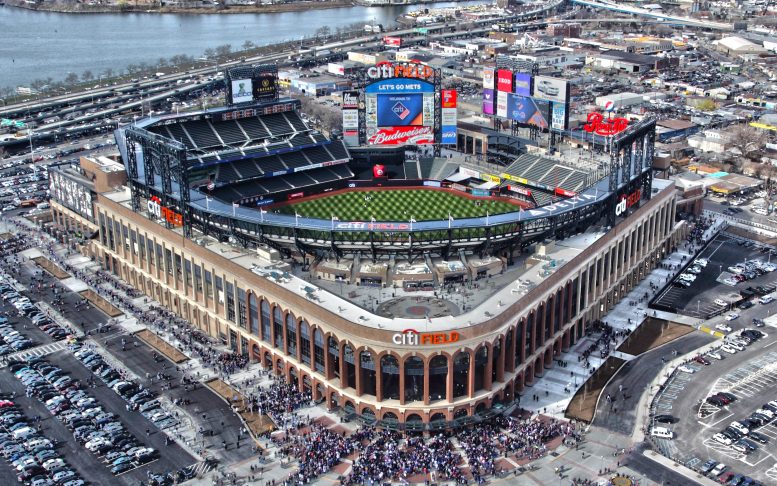
On the way in, especially if you're coming out of the Subway or LIRR station, you'll pass the original Home Run Apple from Shea, which has been restored, and serves as Citi Field's "meet me at this spot" spot, their equivalent to the old Yankee Stadium's smokestack, The Big Bat.
You'll pass a brick walkway where fans could "buy a piece of the ballpark" to commemorate a great moment in their fan experience, or memorialize a loved one who didn't live to see the new park. I had considered doing this for my grandmother, a Dodger-turned-Met fan from Queens, but I decided against it.
I figured, she left New York in 1955, so everyone she knew there was already either dead or in a retirement community elsewhere, and thus wouldn't see the commemorative brick; and, considering how much my parents hate going into New York, and how my sister has also taken to the Yankees (but also to the NFL's Jets, who played at Shea but not at Citi Field), the only person there who would know who she was would be me -- and I go there only once (maybe twice) a year.
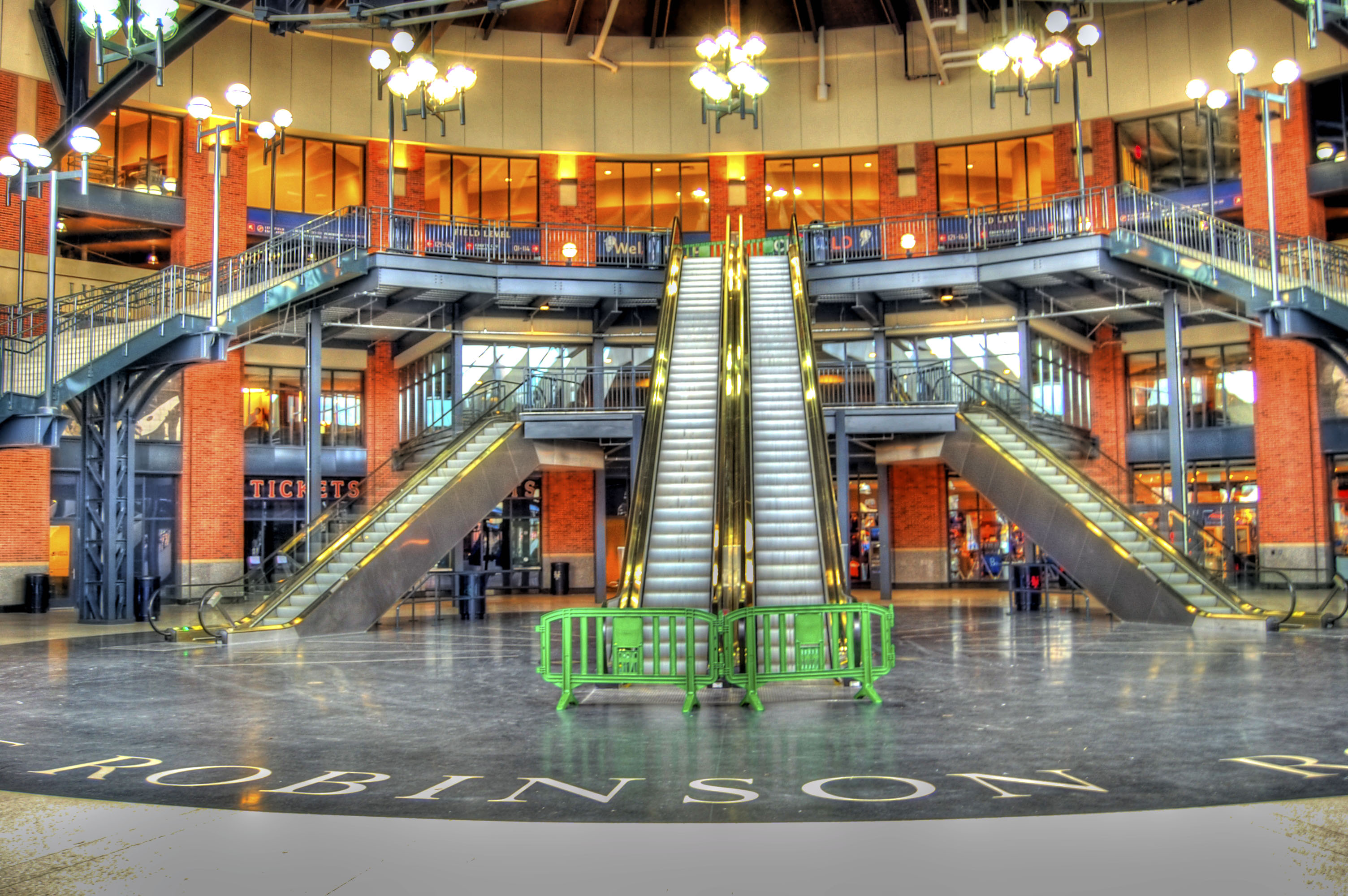
Inside the rotunda, before you go up the escalators, behind them will be a ticket office. Off to your left will be a team store. Off to your right will be the Mets Hall of Fame. (More about that later.)
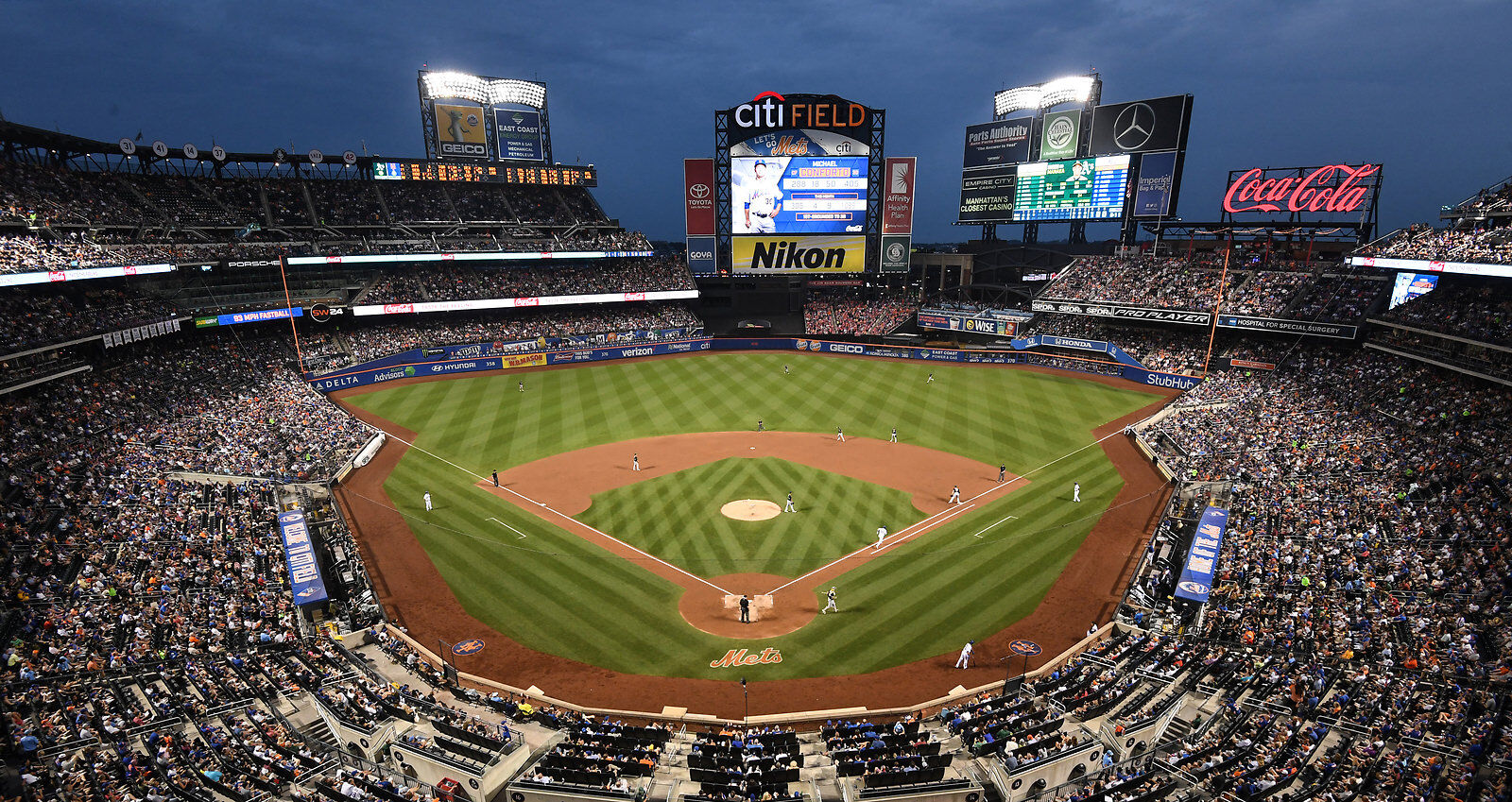
While Shea pointed due east, Citi Field points northeast. The field is real grass. Structurally, it may resemble Ebbets Field on the outside, but on this inside, it's closer to Baltimore's Camden Yards, with green seats in three wraparound decks going from left-center, around the left-field pole, around the plate, and down the right-field line, with bleachers in right field.
Unlike Shea, Citi is not symmetrical. The left field pole is 335 feet from home plate (Shea was 341 until the Jets moved out in 1984, eliminating the need for the movable baseline stands, thus shortening it to 338), left-center is 358 (same as at Shea), deep left-center is 379 (371 at Shea), straightaway center is 408 (410), deep right-center is 375 (371), right-center curves back out to 383 (358), and the right-field pole is 330 (341/338).
Home plate is the same one from Shea Stadium, but it's not clear that it's the same one that's been used since 1964. After all, the Mets clinched the Division and the World Series there in 1969, the Pennant in 1973, and the Division in 1986, before Mayor Ed Koch decided to get tough and put the mounted police on the field after the World Series was clinched, making the 1986 NL East title the last time fans ran onto a New York field for any clincher. Anyway, the current plate has been in use since at least the day after the 1986 Division clincher.
Citi is definitely a pitcher's park, as Shea was, although this has been slightly reduced due to the outfield fence having been brought in a bit and lowered a bit, as the Mets have had a lot of trouble hitting there. Funny, but the Yankees never seem to have trouble hitting there on their visits.
The longest home run in the brief history of Citi Field just happened last season: Michael Conforto hit a 469-foot home run on September 29, 2021. This surpassed now-Yankee Giancarlo Stanton of the Miami Marlins, 468 feet, on May 30, 2015; and Yoenis Cespedes, 466 feet, for the longest homer there by a Met, on June 30, 2016.
The longest home run at Shea Stadium, and the longest home run ever accurately measured by a New York-based baseball player at home, appears to have been a 515-foot blast by Dave Kingman on August 14, 1981. Darryl Strawberry's 1988 home run in Montreal is said to have gone 535 feet, which would make it the longest in Met history. A lot of Babe Ruth's and Mickey Mantle's long home runs at the old Yankee Stadium simply weren't measured.
Shea didn't have much of its grandstand in fair territory, so it was very hard to hit a fair ball into the upper deck. The only player who ever did that was Met center fielder Tommie Agee on April 10, 1969. The spot where the Agee homer landed, about 480 feet from home plate, was painted with the date, his name, and his uniform Number 20. Instead of the Mets putting it in the team Hall of Fame at Citi Field, it was bought and preserved by a private collector, and put in his backyard.
It's not clear who hit the longest home run at the Polo Grounds. On a few occasions, Babe Ruth hit one over the right-field roof, and Shoeless Joe Jackson supposedly also did it. Hitting one over the left field roof has been credited to Honus Wagner, Willie Mays, and Josh Gibson in a Negro League game.
The center field bleachers were a minimum of 460 feet away. Luke Easter hit one there in a Negro League game. In regular-season major-league games, 3 players did it: Joe Adcock, Hank Aaron and Lou Brock -- the last 2 on back-to-back days in 1962, against the Mets.
Adcock pulled off the feat in 1953. In 1954, he hit 4 home runs in a game at Ebbets Field. In 1956, he hit one onto the left-field roof there, and it bounced out of the stadium. That might have been its longest home run.
No football games have yet been played at Citi, but it has hosted futbol. Six soccer games have been played there. There have been 3 international games: Ecuador 1-1 Greece in 2011, Ecuador 3-0 Chile in 2012, and Israel 2-0 Honduras in 2013; And 2 club matches, the 1st being Italy's Juventus 1-0 Mexico's Club America in 2011.
Ecuador vs. Greece, 2011. Still the only soccer game
to come close to selling out Citi Field: 39,656.
Oddly, despite its smaller (and thus easier-to-reach) capacity, its better shape for the sport, and its good car and public transit access, New York City FC spurned Citi Field as a home ground for the new Yankee Stadium. It would have made much more sense, for those reasons, and for the reason that, like the Mets, NYCFC are doomed, at least for the time being, to be the Number 2 team in their sport in the New York Tri-State Area.
Alas, for October 22, 2017, a Yankee Playoff game bumped NYCFC to play a home game at Citi Field. It was a 2-2 draw with the Columbus Crew. Attendance: 20,119. Half-full, and wouldn't have sold out Red Bull Arena, let alone what NYCFC say is "capacity" at Yankee Stadium (but actually is far from it). A Yankee Playoff run bumped NYCFC to Citi Field again on October 23, 2019, a 2-1 loss to Toronto FC in front of 19,829.
On January 1, 2018, the NHL Winter Classic was held at Citi Field. The Rangers beat the Buffalo Sabres, 3-2 on an overtime goal by J.T. Miller.
Just as the Beatles played the 1st concert at Shea in 1965, former Beatle Paul McCartney played the 1st concert at Citi Field in 2009. Billy Joel played the last concert at Shea in 2008, and, as one of the biggest Beatles fans alive, invited Paul onstage with him. At the 1st Citi Field concert, Sir Cute One returned the favor, and brought the Piano Man on.
Other concerts at Citi Field include the Dave Matthews Band in 2010, Demi Lovato and Foo Fighters (separately) in 2015, Beyoncé in 2016, and, in spite of her scandalous appearance at Citi Field in 2010, Lady Gaga in 2017. On back-to-back days in 2017, the ballpark booked a bunch of acts that peaked in the Mets' dark age of the late 1970s: On July 29, the Eagles (minus the late Glenn Frey), the Doobie Brothers and Steely Dan; on July 30, Fleetwood Mac, Earth, Wind & Fire, and Journey.Beyoncé at Citi Field, June 7, 2016, inadvertently reminding everyone
that it had been 30 years since the Mets put a ring on it.
Despite not being as glamorous as Yankee Stadium (old or new), Citi Field has been shown in a 2009 episode of
CSI: NY, the 2014 disaster film
Sharknado 2 (They're gonna need a bigger ballpark), and the 2013 zombie film
Warm Bodies. You know what the difference is between Met fans and zombies? Zombies are aware that they need to look for brains.
So much for trying to stay objective. Let's move on.
Food. One area where the Mets always had the edge over the Yankees was in food. But that is no longer the case. Not because of taste (far from it) or price (Met food isn't much cheaper than Yankee food), but because of accessibility. They had years to get this right, and, instead, they have ended up with massive lines.
On my first visit to Citi Field, I was on line at Shake Shack for the entire 5th inning, and missed a home run that turned out to be the only run that was scored in regulation. (The Mets won in extra innings.) I stood on that line, deep behind the center field fence, looked back, and saw a stadium with maybe 10,000 people in it. Were the remaining 20,000 the average says the place has all on line at Shake Shack? Actually, if you've ever been on that line, you'll find that concept very believable.Shake Shack is in center field, behind Section 139. A Blue Smoke barbecue stand is nearby at Section 140, and also upstairs at Section 414. On top of the building that houses both Shake Shake and the adjacent McFadden's is the stylized New York skyline that was on top of the old main scoreboard at Shea. A McFadden's restaurant is at the 126th Street entrance.
Keith's Grill, named after Hernandez, is at Sections 132 and 415. Unlike the Phillies with Greg Luzinski, the Orioles with Boog Powell, and a few others with barbecue stands named for players, Hernandez doesn't actually watch over it and control it. (As Elaine Benes, played by Julia-Louis Dreyfus on Seinfeld, would say, "Who does this guy think he is?" As Keith responded then, "I'm Keith Hernandez!") It's not his fault, really, since he's a Met broadcaster, and he has to work during the games. They really should have had a barbecue stand named after Rusty Staub, who was both a better hitter than Keith, and equally famous as a cook.The Mets go around the world with Daruma of Tokyo at Section 105, El Verano Taqueria at 139, Two Boots (for the shapes of Italy and Louisiana) at 141, 317 and 512; and Kosher Grill at 114, 130, 401 and 528. They go around the block with Little Astoria and Mama's of Corona at 105, and across the City with Brooklyn Burger at 7 different stands. New York's legendary Nathan's hot dogs are all over Citi Field. And while Subway sandwich shops, in spite of their name, didn't start in New York (not that far away, though, in Bridgeport, Connecticut), there are 2 stands for it, at 125 and 413.
The Mets have a gluten-free stand and a Candy Cart at 105. They have Carvel ice cream stands all around, and Ittibitz (a variation on Dippin Dots) at 104, 118 and 424. Like the Yankees, they have lots of Premio Italian Sausage stands. And they do something for me that the Red Sox also do, but my beloved Yankees won't: They put a Dunkin Donuts in their ballpark, in Citi Field's case at Section 125. So I got that goin' for me when I visit, which is nice. And a Coolatta is still cheaper than a Black & White at Shake Shack.
A recent Thrillist article on the best food at each MLB park says the best food at Citi Field is a chicken sandwich at Fuku, outside Section 102. Or, as the article says:
New York's NL squad lacks for quality food like it lacks for young flamethrowers who look like they're into Thor cosplay. That's a baseball-nerdy way of saying they have a smorgasbord of sexy food choices in the concessions at Citi Field... and a litter of blonde, long-haired starters.
With all apologies to the honorable Shake Shack and legendary Pat LaFrieda Meat Purveyors, the crown goes to David Chang (duh) and his transcendent spicy chicken sandwich from Fuku. It's the best thing to happen to the Mets since Keith Hernandez and his mustache came to town.The best thing to happen to the Mets since Keith Hernandez came is a sandwich. I've tried to avoid trash-talking, and telling you that the Mets are a joke franchise. But, sometimes, there's no way of getting around it.
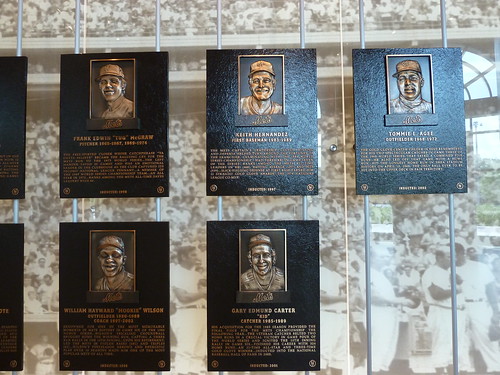
Team History Displays. As I mentioned, the old Home Run Apple is outside, and the Mets Hall of Fame and Museum is on one side of the rotunda. It includes their 2 World Championship trophies, seats from the Polo Grounds and Shea, the original Mr. Met costume, and tributes to legendary Met broadcasters Lindsey Nelson, Bob Murphy and Ralph Kiner.The Mets Hall of Fame includes plaques for the following inductees:
* From the early days, 1962 to 1968: Owner Joan Payson; executives Bill Shea, George Weiss and Johnny Murphy; manager Casey Stengel, and 1st baseman/outfielder Ed Kranepool. Gil Hodges was a 1st baseman in the early days, but was hurt so often he couldn't make much of a contribution; he's in the MHOF as a manager.
* From the 1969 World Championship: Mrs. Payson, Weiss and Murphy (Shea was no longer officially involved); manager Hodges; pitchers Tom Seaver, Jerry Koosman and Frank "Tug" McGraw; shortstop Darrell "Bud" Harrelson; outfielders Tommie Agee and Cleon Jones; catcher Jerry Grote; and Kranepool.
What Stengel had called them sarcastically in 1962, he called them enthusiastically when interviewed for the official World Series highlight film: "Amazing" -- historically, shortened to "Amazin'." Also calling them "Amazing" on that film: Yankee Legend Joe DiMaggio, Cubs star and Met victim Ernie Banks, and entertainment legend Pearl Bailey, who sang the National Anthem before Game 5 -- and would again for the Yankees before Game 1 in 1977. Jacqueline Kennedy took Caroline and John Jr. to the Series games, and can be seen on the highlight film, but did not grant an interview.Although Nolan Ryan was on this team, and is in the Baseball Hall of Fame in Cooperstown, he is not in the MHOF, probably because the Mets don't want to remind everyone that they let him get away 295 wins, 5,221 strikeouts and 7 no-hitters too soon. In fact, since being traded away, he has been back to a Met game only once, in 2009, for the 40th Anniversary celebration of this team. Not honored from this team, but should be, is outfielder Ron Swoboda -- ironically, a native of Baltimore, whose Orioles the Mets beat in the World Series.
* From the 1973 Pennant: Mrs. Payson (Weiss and Murphy had died by then), Seaver, Koosman, McGraw (who gave the Mets their ever-since slogan, "Ya Gotta Believe!"), Kranepool, Harrelson, Jones, Grote, outfielder Daniel "Rusty" Staub, and pitcher Jon Matlack. Although Yogi Berra managed this team, is in the Cooperstown Hall, and accepted an invitation to the Shea closing ceremony in 2008 (and even wore a Number 8 Met jersey), he has not yet been elected to the MHOF. Nor has Willie Mays, also on this team and invited to the Shea closing, but he was a Met for less than 2 full seasons.
* From the 1974-83 interregnum: Nobody outside of the preceding and the following.
* From the 1984-90 glory days, including the 1986 World Championship and the 1988 NL East title: General manager Frank Cashen, manager Davey Johnson, pitchers Dwight Gooden and Ron Darling, 1st baseman Keith Hernandez, catcher Gary Carter, and outfielders Darryl Strawberry and William "Mookie" Wilson.
Although Koosman has been back to Citi Field since doing 6 months in prison for tax evasion, I don't think we'll be seeing Lenny Dykstra honored by election to the team Hall of Fame by the Mets (or the Phillies) anytime soon. But 3rd baseman Howard Johnson, and pitchers Sid Fernandez, Bob Ojeda and Jesse Orosco are possibilities for future election.
* From the 1999 Wild Card berth and the 2000 Pennant: "Catcher" Mike Piazza, 2nd baseman Edgardo Alfonzo, and pitcher John Franco. Pitcher Al Leiter is a possibility as well.
* From the 2006 NL East title and the 2007 & '08
close-but-no-cigar Mets: So far, nobody, although the only ones retired and worthy of much consideration are 3rd baseman David Wright, 1st baseman Carlos Delgado, and, maybe, shortstop Jose Reyes are still active. They could, I suppose, elect Baseball Hall-of-Famers Pedro Martinez and Tom Glavine, but do they really want to open those cans of worms?
* From the 2015 Pennant and the 2016 Wild Card berth: Nobody yet.
* Crossing the eras: Broadcasters Nelson, Murphy and Kiner. Staub, Hernandez and Darling have also been Met broadcasters.Aside from Casey (who, of course, won 10 of them as Yankee manager, 3 as a New York Giant player and 1 as a Brooklyn Dodger), all of these honorees was involved with at least 1 Met Pennant.As the 3rd base coach in 1986, Harrelson is the only Met who has been on the field for 3 Pennants, while he and Davey are the only people who were in uniform for both of the Mets' World Series clinchers, albeit in Davey's case he was in uniform for the opposition in 1969, making the last out for the Orioles, a fly ball caught by Jones. As the 1st base coach in 2000, Mookie is the only Met since 1973 to have been in uniform for at least 2 Pennants.Bob and Johnny Murphy were not related, although Bob's brother Jack Murphy was a sportswriter who heavily lobbied for major league sports to come to his adopted hometown of San Diego, and the stadium used by the Chargers and formerly by the Padres was named in his honor until Qualcomm bought the naming rights. Johnny Murphy was a Yankee reliever in the 1930s and Weiss was a Hall of Fame GM for the Yankees, but neither is honored in Yankee Stadium's Monument Park. Only Stengel is honored with plaques in both ballparks.That's 30 people for 60 seasons of service, or 1 for every 2 seasons. In contrast, Yankee Stadium's Monument Park honors 38 people for 119 years, or about 1 for every 3. (That doesn't count Jackie Robinson's Number 42, the 9/11 tribute, and the Plaques honoring the 3 Papal Masses and the speech by Nelson Mandela delivered at the old Stadium.) If the Mets honored people at the same rate the Yankees did, they'd have 19; if the Yankees did so at the same rate as the Mets, they'd have 60. (And if the Mets honor Kranepool, how low would the Yankees have to set the bar? Possibly to Bucky Dent or Jim Leyritz.)
So while the Mets' Hall of Fame plaques were not on public display for a long time, it can no longer be argued that the Mets have failed to properly honor their history -- and, after more than half a century, they have some history to honor. Some of it is even honorable.
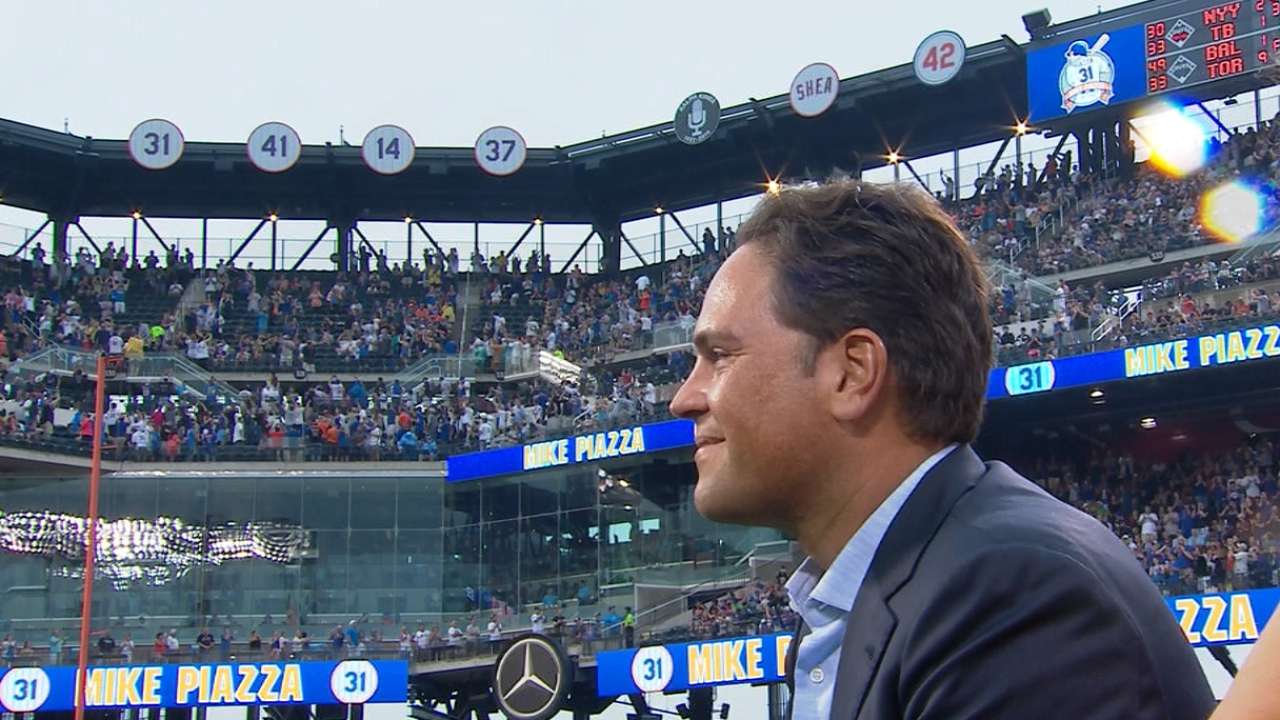
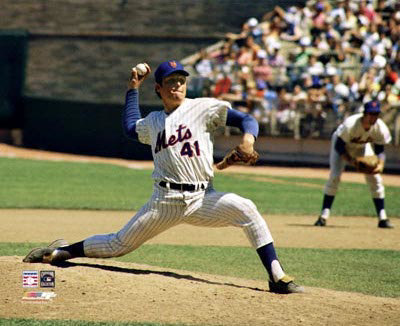
The Mets have retired 5 numbers: Stengel's 37, Hodges' 14, Seaver's 41, Koosman's 36, and Piazza's 31. This season, they will add Hernandez' 17. Of course, Jackie Robinson's Number 42 was universally retired in a 1997 ceremony at Shea Stadium (I was there, having taken my Grandma there to honor her favorite athlete of all time). When Shea entered its last season in 2008 they gave Bill Shea, the esteemed lawyer whose work got the Mets established in the early 1960s and got the stadium named after him, a stanchion with his name on it that stood in for a "retired number." They have now done the same with a microphone for Ralph Kiner.
Those stanchions are now above the left-field roof, instead of on the left-field wall as they previously were, as they were at Shea Stadium. Piazza looks better without the mustache. He's the anti-Rollie Fingers.
Not officially retired, but rarely given out, are: 8, Gary Carter, catcher 1984-90; and 24, Willie Mays, center field 1972-73. (UPDATE: They finally retired 24 for Mays on August 27, 2022.)
The Mets reached the 10th, the 20th and the 25th anniversaries of the 1986 title, and didn't give Carter the honor. They knew he was dying, and could have given it to him before he was bedridden, and they still didn't give it to him. But they gave it to Piazza.
I don't ever want to hear another Met fan lecture the Yankees or their fans on "class." The Mets had the chance to show class. Instead, they're showing how little they truly have.
Seaver was the only player with a serious Met connection named to The Sporting News' 100 Greatest Players in 1999. He was also chosen by Met fans as their representative in the 2006 DHL Hometown Heroes poll. He was also chosen to throw out the last pitch at Shea and the first pitch at Citi Field, in each case to Piazza. In 2022, ESPN
named its 100 Greatest Baseball Players. Among players who played
significant time for the Mets, Tom Seaver was ranked 22nd, and Mike Piazza 81st.
On the facing of the upper deck down the right field line are the "pennants" honoring the Mets' 9 postseason berths: The 1969 and 1986 World Championships; the 1973, 2000 and 2015 National League Pennants; the 1988 and 2006 N.L. Eastern Division titles; the 1999 Wild Card & N.L. Championship Series berth; and the 2016 Wild Card berth.Photo taken prior to the 2015 Pennant.
Met fans like to mention that it took them just 8 years to win their 1st World Series, the Yankees 21; 12 years to win their 2nd Pennant, the Yankees 20; and 25 years to win their 2nd World Series, exactly as long as the Yankees. Well, it took the Yankees 26 years to win their 3 World Series, while the Mets are entering Year 61 and still looking for their 3rd. And it took the Yankees 36 years to make it 10 postseason appearances, and they didn't have the benefit of Divisions and Wild Cards; the Mets are still looking for their 10th.
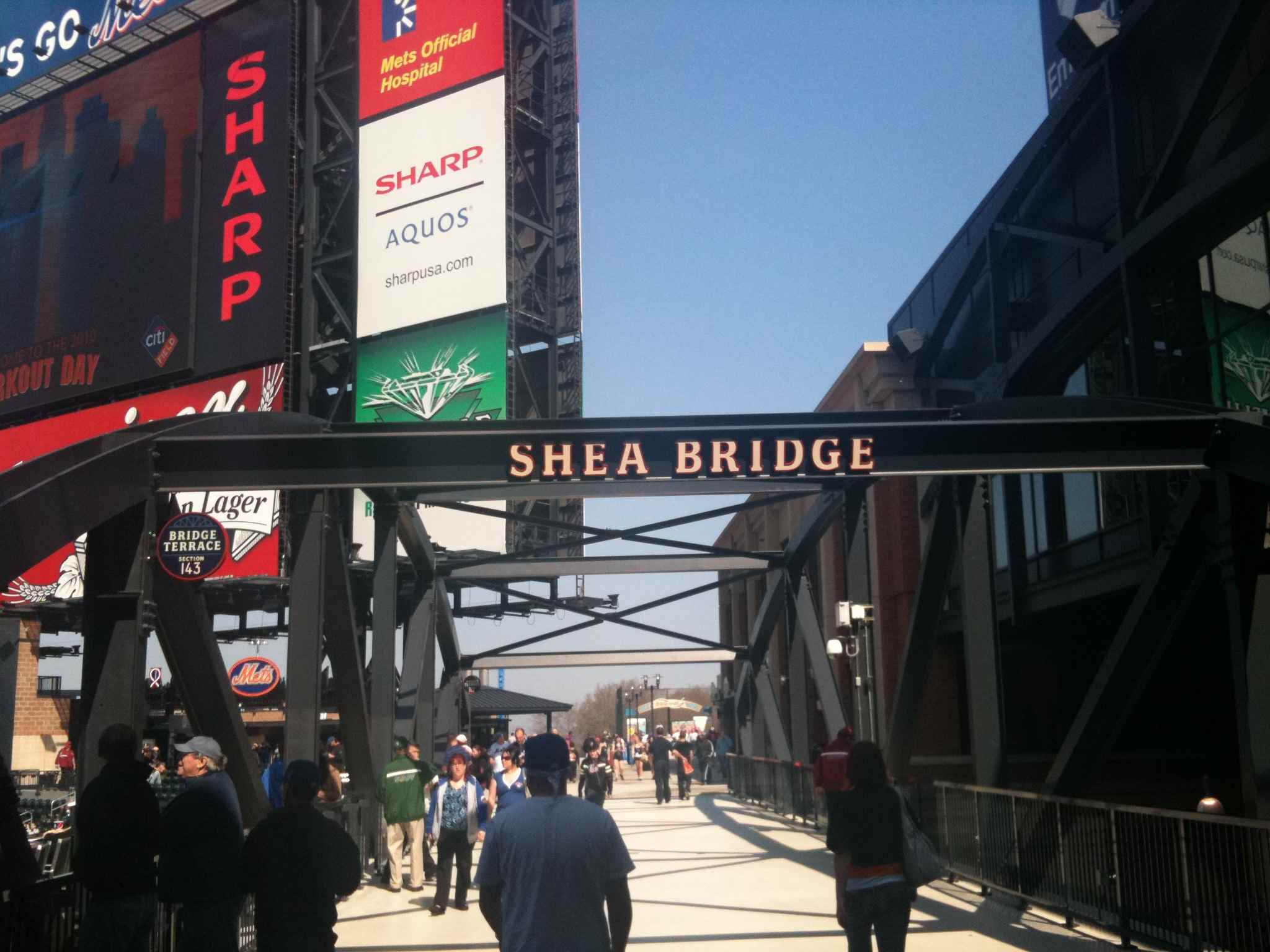
A walkway from the right-field stands to the center-field food court is named Shea Bridge. And at the back of that area is the "skyline" that once crowned the Shea Stadium scoreboard, including the red-white-and-blue "ribbon" that covers the representation of the World Trade Center (as seen in my opening photo, above).On April 15, 2022, the Mets will dedicate the statue of Seaver that they had originally wanted to put up in time for the 50th Anniversary of the Miracle in 2019. But his cognitive decline, and subsequent death on August 31, 2020, delayed it.There is no trophy for the winner of the season series between the Mets and the Yankees. The Yankees have won it 11 times, the Mets 4 (2004, '06, '13 and '21), and there have been 11 splits. Overall, counting the 2000 World Series, the Yankees lead in games, 80-59.
Prior to the institution of Interleague Play in 1997, there was a Mayor's Trophy Game between the teams, an annual in-season exhibition, from 1963 to 1983. The Yankees led that series 10-8-1 before it was stopped.The Mets won the Mayor's Trophy in 1982. Left to right:
Manager George Bamberger, co-owner Nelson Doubleday,
Mayor Ed Koch and co-owner Fred Wilpon.
Mets vs. Braves wasn't really a rivalry for very long, basically just from 1998 to 2001. The Braves lead it 467-389. Geographically, at least until Major League Baseball does away with Leagues entirely (and I suspect that few people other than Met fans will care), finally putting them in the same division as the Yankees, the Mets' real rivals are the Philadelphia Phillies, The Phils lead that rivalry 531-495.
Stuff. The Mets sell lots of team stuff, including the variations on the Mets caps and jerseys caused by their unfortunate experiments with using black, and orange, as base colors. You can always tell a real Mets fan (but you can't tell him much): He's got a blue cap with an orange NY, and/or, weather permitting, a blue jacket with an orange NY, not one of the later blue/black/orange combos. Mr. Met gets the souvenir highlight treatment, nearly as much as the Phillie Phanatic gets at Citizens Bank Park.
Books about the Mets abound, especially now that they've passed their 50th Anniversary. Greg Prince, co-author of the blog
Faith and Fear in Flushing, wrote a book with that title, and until someone writes a book that includes details of the 2015 Pennant, and perhaps well beyond that point, this will likely remain the definitive book about what it is like to be a Met fan.
As Prince says, "Mostly, I love the Mets because I love the Mets." It doesn't make sense, but then, since when has baseball made sense? To paraphrase Bart Giamatti, baseball boggles your mind, it is designed to boggle your mind. And the Mets, even in their good times, boggle the mind more than most sports teams.
Prince has also written The Happiest Recap: First Base (1962-1973): 50 Years of the New York Mets As Told in 500 Amazin' Wins (Volume 1). Presumably, he's working on the other "bases."
In 2002, on the occasion of the team's 40th Anniversary, Peter Golenbock published Amazin': The Miraculous History of New York's Most Beloved Baseball Team. (If that was ever true, it was no longer so by the stretch run of the Yankees' 1996 title season.) Books about the team's early days include Jimmy Breslin's Can't Anybody Here Play This Game? (based on Stengel's comment -- Breslin's book The Gang That Couldn't Shoot Straight was not about the early Mets) and Once Upon the Polo Grounds by Leonard Shecter.There were, as you can imagine, lots of books about the 1969 Miracle. Some have tried to combine that World Series win with the Jets' massive upset win in the Super Bowl earlier in the year, and even with the Knicks' 1st NBA title the following Spring.
Stanley Cohen focused on the ballclub with
A Magic Summer: The Amazin' Story of the 1969 New York Mets. Shortstop Bud Harrelson collaborated with Steven Travers on
The 1969 Miracle Mets: The Improbable Story of the World's Greatest Underdog Team. Bill Gutman wrote
Miracle Year 1969: Amazing Mets and Super Jets. Art Shamsky, who platooned in right field with Ron Swoboda, collaborated with Barry Zeman on
The Magnificent Seasons: How the Jets, Mets, and Knicks Made Sports History and Uplifted a City and the Country. And Bert Flieger, then a kid on Long Island, gave the '69 Mets the '77 Yankees "Bronx Is Burning" treatment with
The Wonder Year, also including the wild Mayoral race, the Moon landing and Woodstock.
Books about the 1973 Pennant are far fewer. Probably the best book about the 1973 baseball season, so far, is John Rosengren's
Hammerin' Hank, George Almighty and the Say Hey Kid, whose cover includes Willie Mays in a Met uniform -- but also Reggie Jackson at Yankee Stadium, except it's the pre-renovation Yankee Stadium and Reggie in an Oakland A's uniform.
Pitcher Jerry Koosman collaborated with Jacob Kanarek on
From First to Worst: The New York Mets, 1973-1977, discussing how team president M. Donald Grant broke up a team that had won 2 Pennants in 5 seasons, to save money (which wasn't even his), culminating in the "Midnight Massacre" trades of Tom Seaver and Dave Kingman, which sent attendance down so much that Shea Stadium became known as "Grant's Tomb."
The 1986 title produced a lot of books, including memoirs by Keith Hernandez, Gary Carter, Darryl Strawberry, Dwight Gooden, Mookie Wilson, and even 3rd-string catcher Ed Hearn. But the best book about it isn't one of the rush-jobs that came out in late 1986 and early 1987.
It's The Bad Guys Won! by Jeff Pearlman, which pulls no punches about the team's misbehavior, presaging the 1993 "Macho Row" Phillies and the 2004 Red Sox "Idiots," who followed the '86 Mets as slovenly, naughty champions.
But Matthew Silverman showed why they couldn't follow it up, getting only 1 more Division title in 1988, with
One-Year Dynasty: Inside the Rise and Fall of the 1986 Mets, Baseball's Impossible One-and-Done Champions. As I've said before, maybe the wrong Met title team is called a "miracle."
Their descent back into high-priced mediocrity led to
The Worst Team Money Could Buy, by Bob Klapisch, then of the
Daily News. When it was published in early 1993, not only did 3rd baseman Bobby Bonilla get caught on camera threatening him over it, but things got worse: On top of being overpaid underachievers, now, they also had juvenile delinquents.
There is, as yet, no particularly good book about the 2000 Pennant season, unless you want to count the anthology
The Subway Series Reader: Mets-Yankees 2000, edited by Pete Hamill of the
Daily News. Now, I know that M comes before Y in alphabetical order, but why is the team that lost listed first?
Kevin Kernan of the
New York Post wrote
Amazing!: Celebrating the Mets' Miracle 2006 Season. (Miracle? They didn't even win the Pennant.) And the aforementioned Greg Prince and WFAN's Howie Rose wrote
Amazin' Again: How the 2015 New York Mets Brought the Magic Back to Queens. Briefly. Good thing they didn't include "
Took Back New York" in the title, because that would have been a lie.
The best books about individual Mets include The Last Icon: Tom Seaver and His Times, by the aforementioned Steven Travers (who's also written several books about football at USC, his and Seaver's joint alma mater); Tug McGraw's memoir Ya Gotta Believe!: My Roller-Coaster Life as a Screwball Pitcher, and Part-Time Father, and My Hope-Filled Fight Against Brain Cancer; Still a Kid at Heart: My Life in Baseball and Beyond, Gary Carter's memoir with Phil Pepe of the Daily News; and William Julius Wilson's Mookie: Life, Baseball, and the '86 Mets.
I would avoid the various memoirs of Strawberry and Gooden, as even their ex-teammates say they're full of crap. And I'm Keith Hernandez: A Memoir, is as self-serving as the man has been on the mike.A DVD with the highlight films of the 1969 and 1986 World Series is available, as is a collection honoring the 1986 World Series (all 7 games, plus the clinching NLCS Game 6 in Houston), the stadium tribute
Shea Goodbye, and
The Essential Games of Shea Stadium.
This last DVD's "essential games" are: 1969 WS Game 4 (Swoboda's catch), 1986 NLCS Game 3 (Dykstra's walkoff), 1986 WS Game 6 (Bill Buckner), 1999 NLCS Game 5 (Robin Ventura's walkoff), September 21, 2001 (the 1st game back after 9/11, won by Piazza's home run), and May 19, 2006 (a walkoff hit by Wright beats the Yankees, for all the good
that did).
The set also includes these highlights: The last inning of the '69 WS, Carter's Opening Day walkoff in '85, the last inning of the '86 NL East clincher, highlights of '86 WS Game 7, Matt Franco's steroid-aided walkoff against Mariano Rivera in 1999, Todd Pratt's homer to clinch the '99 NL Division Series, the last inning of the 2000 Pennant clincher, 2006 highlights including the NL East clincher, the Endy Chavez catch from '06 NLCS Game 7 (for all the good
that did), and an interview with Bill Shea.
During the Game. A recent Thrillist article, ranking all 30 MLB teams' fans on "intolerability," listed Met fans 8th -- 4 places behind (i.e., not as bad as) the Yankees and 3 behind the Phillies.
"They get to stake out the claim as the hardscrabble, die-hard outsider fans," the article says, "just wallowing in the nether regions of Nassau County while the Yankees soak up all the attention. Mets fans would have you believe they have suffered in ways few fans can possibly understand."
Well, they got the geography right: Long Island (Lawn Giland), counting their home Borough of Queens, is pretty much the only place where Met fans outnumber Yankee Fans, even after a new Pennant. And their team has, much more often than not, made them suffer. If I'm being objective, then I should leave it to you do decide whether they deserve it. (Hint: A majority of Yankee Fans would say, "Hell, yeah, they do." So would a majority of fans of the other 14 teams in the National League.)For the most part, Met fans do not abuse fans wearing opposing teams' gear. But I wouldn't wear an Atlanta Braves cap or shirt to Citi Field. I definitely wouldn't wear Philadelphia Phillies stuff.
As for Yankee gear... The simple act of wearing Pinstripes or the Yankee cap inside the Mets' ballpark is enough for their fans to consider it a provocative act. Like being a Red Sox fan, being a Met fan means you have to hate the Yankees nearly as much as you love your own team.As shown by the friendship between Mr. Met
and Wally the Green Monster.
It's in their blood: From the arrival of Babe Ruth in 1920 onward, Giant fans and Dodger fans hated the Yankees as much as they hated each other. With the 1959-62 creation of the Mets serving as the burying of the hatchet between the Hatfields and McCoys of baseball, they were united in the twin causes of loving the Mets and hating the Yankees.
I seriously doubt that they will start a fight with you, simply because you show up in your team's colors. Still, if even one Met fan out of a thousand is willing to start a fight, that means, somewhere in the joint, there are between 10 and 42 fans who will want to. So be aware of the possibility.
And if they do give you some verbal, do your best to ignore them. Don't respond with anything harsher than, "We'll see what happens in this game."
Do not bring up the 27 World Championships to 2, or the 36-year Met drought: They'll just say the Yankees "cheated" or "bought their titles." As if the '86 Mets didn't have the biggest payroll in the NL at the time, and the failed Mets of 1987 until the 2009 fire-sale era didn't have one of the top 3 payrolls in the NL all those years, and Mike Piazza wasn't also an apparent steroid user.
This season, the Mets will once again be reminding people of their awful beginnings in 1962, by wearing a 60th Anniversary sleeve patch.
The Mets hold auditions for National Anthem singers, instead of having a regular, although actress Glenn Close has sung it a few times, starting with the 1986 World Series. S
ince the franchise's birth, they have had a theme song, "Meet the Mets." I have to admit, it's a better song than "Here Come the Yankees," even if "the butcher and the baker" and others (the milkman?) have been mostly replaced by supermarkets.Glenn Close. She is not going to be ignored.
A new "disco" version was done for Channel 9 broadcasts in 1975, and yet another, more family-friendly version, in 1984. That was replaced by the "Teamwork to make the dream work" fight song for 1986.
As I said in the "Tickets" section, the Mets have "The 7 Line Army," a group of fans that think they're better than our Bleacher Creatures, but, being Met fans, are delusional. They sit in the center field bleachers, in Sections 140, 141 and 142, and, if you're a visiting fan, it's best to avoid them.
Mr. Met, a guy in a Met uniform (Number 00) with a big baseball head, appears to have been the original man-in-a-suit mascot at big-league baseball games. Don't worry, he's designed to be harmless, unlike the Phillie Phanatic, whose "tongue," however inadvertently, has hurt a few people.
Mr. Met is the only guy who can smile all the way through 81 Met home games, and he's the only Met who's allowed to have a big head. In his case, he literally has a big head. Unquestionably, he's the New York Tri-State Area's best major league sports mascot. Who else is there? N.J. Devil?Mr. Met, Mrs. Met, and all the Little Mets.
Mr. Met has occasionally dressed in other costumes, including a superhero (Hero Met), The Fonz, Vegas Period Elvis, and others. Sometimes, he shows up with his wife, Mrs. Met, a.k.a. Lady Met. Sometimes, the Little Mets show up, too. But not on a school night.Although I do not remember Mrs. Met having that huge ponytail.
Or having that fine booty. Mr. Met got it done!
In 1979, the Mets phased out Mr. Met, and brought in a new mascot: Mettle the Mule. This was a major public relations blunder. First of all, Mr. Met is revered by Met fans. Second of all, a mule had already been used by the Kansas City/Oakland A's.
And 3rd of all, Mettle (meaning "strength" or "courage," and having "Met" in the name) was introduced to the fans by pulling a wagon around the field. And seated in the wagon was the owner at the time, Lorinda de Roulet, daughter of Mrs. Payson, who died in 1975.
Mrs. Payson was beloved, as the woman who brought the Mets to the NL-deprived fans. Mrs. de Roulet was despised, as the woman who let M. Donald Grant do whatever he wanted. Like Dandy, the weird mascot the Yankees introduced the next season, Mettle the Mule was quickly scrapped, and has not been missed. Mr. Met returned. He has been elected to the Mascot Hall of Fame.Pretty soon, even Mrs. de Roulet couldn't stand the thing anymore.
Nearly everything about Citi Field is an improvement over Shea Stadium. One thing that is not is the planes taking off from neighboring LaGuardia International Airport: I think moving the field a few hundred yards to the east actually made the plane problem worse. However, the truly loud ones are only those taking off. The ones landing go on a different runway, further away, and are usually not disruptive. The old "plane race" on the video board (which inspired the Yankees to do "The Great City Subway Race") has been retired.When a Met hits a home run, the Home Run Apple is activated. Originally placed in Shea's center field after Nelson Doubleday and Fred Wilpon bought the team from Mrs. Payson's estate in 1980, it was supposed to be a play not just on the New York nickname "the Big Apple," but also on the slogan of the time: "The New Mets: The Magic Is Back." It was a magician's black top hat, inverted, with the white letters "HOME RUN" on the front, and a big red apple with a Met logo on it would rise out, and the logo would light up.In 1998, when an accident forced a brief closure of the old Yankee Stadium and the moving of a Yankee home game to Shea, Strawberry, who hit more homers at Shea than anyone, hit one for the Yankees, and the apple was rigged to rise to only half its height, so only the top half of the Met logo could be seen, showing the stylized New York skyline but not the word "Mets." I thought it was a good touch.Knowing that Shea would be demolished, an Internet campaign went up to "Save the Apple." It worked: The old apple, which really was in bad shape, was restored and put outside Citi Field, and a new, larger apple was put in the center field hitter's background inside the new park.The main Met fans' chant is, of course, the rhyming, "Let's go, Mets!" For many years, in the 1990s and 2000s (but I haven't seen them do it at Citi Field), they would, during some late rallies, cue up the scene from the movie Network, when Peter Finch's news anchor Howard Beale demands that people yell out their windows, "I'm as mad as hell, and I'm not going to take this anymore!" so that it's rigged to say, "I want you to get up now. I want all of you to get up out of your chairs. I want you to get up right now and go to the window. Open it, and stick your head out, and yell... LET'S GO METS!"
In the 7th Inning Stretch, after Mr. Met leads fans in "Take Me Out to the Ballgame," the stadium speakers will play Newark native Lou Monte's half-Italian, half-English song "Lazy Mary." Why? Probably due to New York's huge Italian community and the song's inclusion in the New York-based film The Godfather. (Never mind that the recording was released in 1958, or 13 years after the film's opening wedding scene, which includes the song.)
After the game, if the Mets win, they play "New York Groove" by Ace Frehley of Kiss -- ironically, a Bronx native. Eventually, win or lose, even though Billy Joel is a Yankee Fan, the Mets play his song "New York State of Mind."
After the Game. Like Shea before it, Citi Field is an island in a sea of parking. Fortunately, the Mets do keep McFadden's open for a while after the game, and they list a lot of restaurant and bar ads in their game program. Sadly, Rusty's, Staub's once-wildly popular Midtown East Side restaurant which he based on the cuisine of his native New Orleans, is long gone.
A bar associated with the 1980s Mets, because some of their players liked to get tanked there, is Finn MacCool's, still open at 205 Main Street in Port Washington, 6 blocks west of the Port Washington station on the LIRR. If you want to go, go to the LIRR station across Roosevelt Avenue, and get on an eastbound train instead of a westbound one.
If you're a fan of a visiting National League team, there are bars that have been known to cater to fans from the cities/metro areas in question. Some of these have changed since I last listed them in 2019, mainly due to COVID permanently putting them out of business. All of them are in Manhattan, unless otherwise stated:
* Arizona Diamondbacks: Standings, 43 E. 7th Street. 6 Train to Astor Place. (NOTE: The previous place, Foley's at 18 W. 33rd Street, closed due to COVID. The owner is looking for a new space to host Foley's when restrictions fully end.)
* Atlanta Braves: The Watering Hole, 106 E. 19th Street. 4, 5, 6, L, N or R Train to Union Square.
* Chicago Cubs: Kelly's, 12 Avenue A. F Train to 2nd Avenue.
* Cincinnati Reds: Phebe's, 359 Bowery. 6 Train to Bleecker Street.
* Colorado Rockies: Stout, 133 W. 33rd Street. 1, 2 or 3 Train to 34th Street-Penn Station.
* Los Angeles Dodgers: Taqueria St. Mark's Place, 79 St. Mark's Place. 6 Train to Astor Place.
* Miami Marlins: Slattery's Midtown Pub, 8 E. 36th Street. B, D, F, N or R Train to Herald Square.
* Milwaukee Brewers: The Kettle of Fish, 59 Christopher Street. 1 Train to Christopher Street-Sheridan Square. In the 1950s, this bar was based on Macdougal Street, a few blocks away, and was a notoriously rough bar. It should be safe now, unless you're wearing a Chicago Bears jersey.
* Philadelphia Phillies: Shorty's, 219 E. 23rd Street. 4, 5 or 6 Train to 23rd Street.
* Pittsburgh Pirates: Hibernia Bar, 401 W. 50th Street. C or E Train to 50th Street.
* St. Louis Cardinals: Saluggi's East, 399 Grand Street. F, J, M or Z Train to Delancey Street.
* San Diego Padres: Scallywag's, 508 9th Avenue. A, C or E Train to 42nd Street.
* San Francisco Giants: Kent Ale House, 51 Kent Avenue, in the Williamsburg section of Brooklyn. G Train to Nassau Avenue.
* Washington Nationals: Dorrian's Red Hand, 1616 2nd Avenue. Q Train to 86th Street.
If you're visiting New York during the European soccer season, as we are now in, there are many places where you can watch your favorite team. The best "football pub" in The City, and, indeed, in the country, is The Football Factory, downstairs at Legends NYC, at 6 West 33rd Street, across from the Empire State Building, and 2 blocks east from The Garden. B, D, F, N, Q or R train to 34th Street-Herald Square. It fills up quickly, so get there early.
Sidelights. This could get long, so I'll limit it to Met-centric sites.Shea Stadium during the Payson family era, 1964-1979
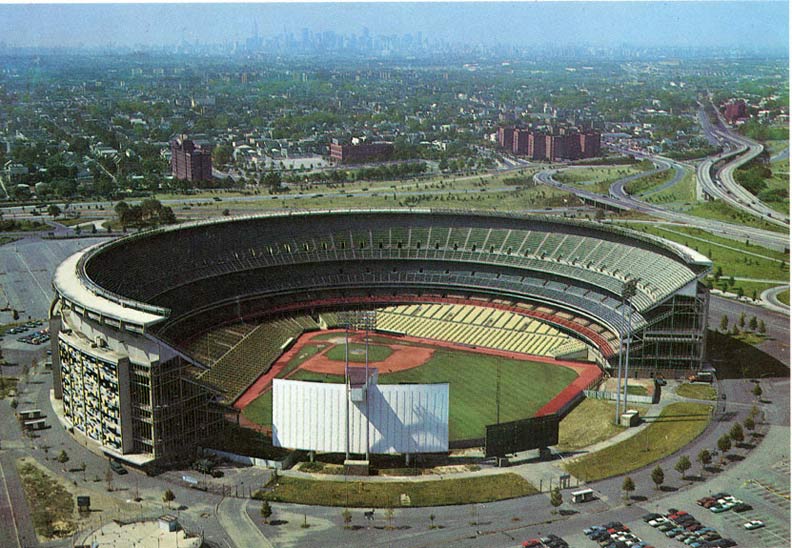
The Flushing Meadow site has been the Mets' home since 1964, with the site of Shea Stadium just to the west of where Citi Field now stands. Shea was also home to the AFL/NFL Jets from 1964 to 1983, the Yankees during the renovation of the old Yankee Stadium in 1974 and 1975, and the Giants in 1975 -- making 1975 the only time a single venue in North America hosted 4 different major league sports teams.
Shea Stadium during the Doubleday-Wilpon era, 1980-2008
Across Roosevelt Avenue and the LIRR tracks is Flushing Meadow-Corona Park, site of the 1939-40 New York World's Fair (the Queens Museum is pretty much all that's left of it) and the 1964-65 New York World's Fair (a few more structures survive, including the Unisphere globe).
Not destroyed by the Men In Black. That was just a movie.
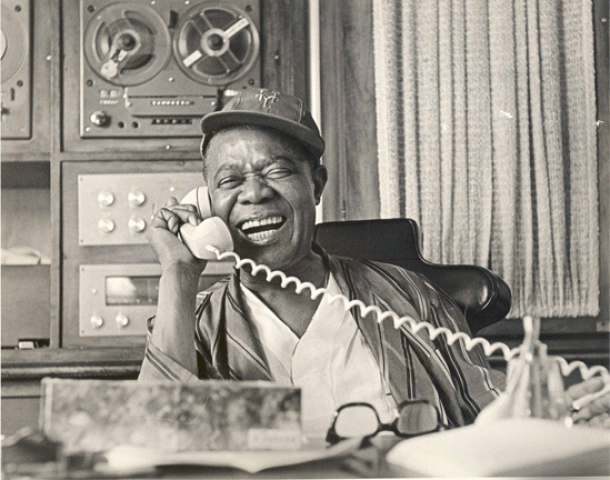
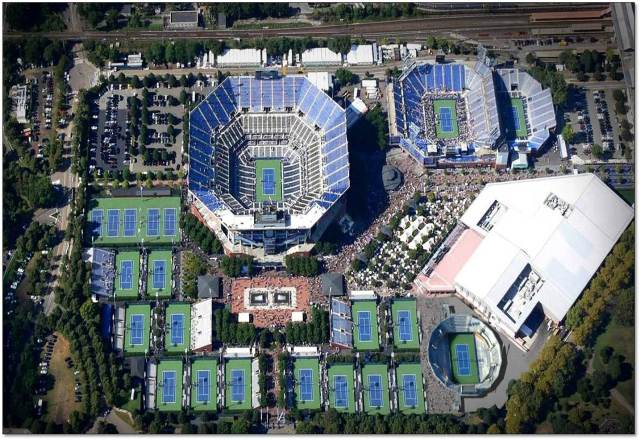
It includes the Billie Jean King National Tennis Center, home of the U.S. Open, including the main stadium, named for tennis legend Arthur Ashe, and a smaller one that used to be the main stadium, named for music legend Louis Armstrong, who lived nearby in Corona, loved baseball, had season tickets for the Yankees until Shea opened, then became a Met fan, and, for some reason, loved tennis, going to the Open when it was still being held at the Forest Hills Stadium.
You might be cool, but you'll never be Satchmo talking on the phone
while wearing a Mets cap and pajamas in his home recording studio cool.
Funny, but when Jack Klugman wore pretty much the same outfit
as Oscar Madison on The Odd Couple, he wasn't nearly so cool.
Louis Armstrong Stadium was originally the Singer Bowl, built for the '64 World's Fair. It was converted into 2 venues, attached to each other, for the U.S. Open, and reopened in 1978, seating 18,000. When Arthur Ashe Stadium opened in 1997, Armstrong Stadium had its top deck removed, and capacity was reduced to 10,000. It was demolished last year, and will be replaced with a 15,000-seat stadium, also named for Armstrong, in time for the 2018 Open.
The BJK NTC at FMCP, 2015.
Ashe Stadium in the center, Armstrong Stadium to the right.
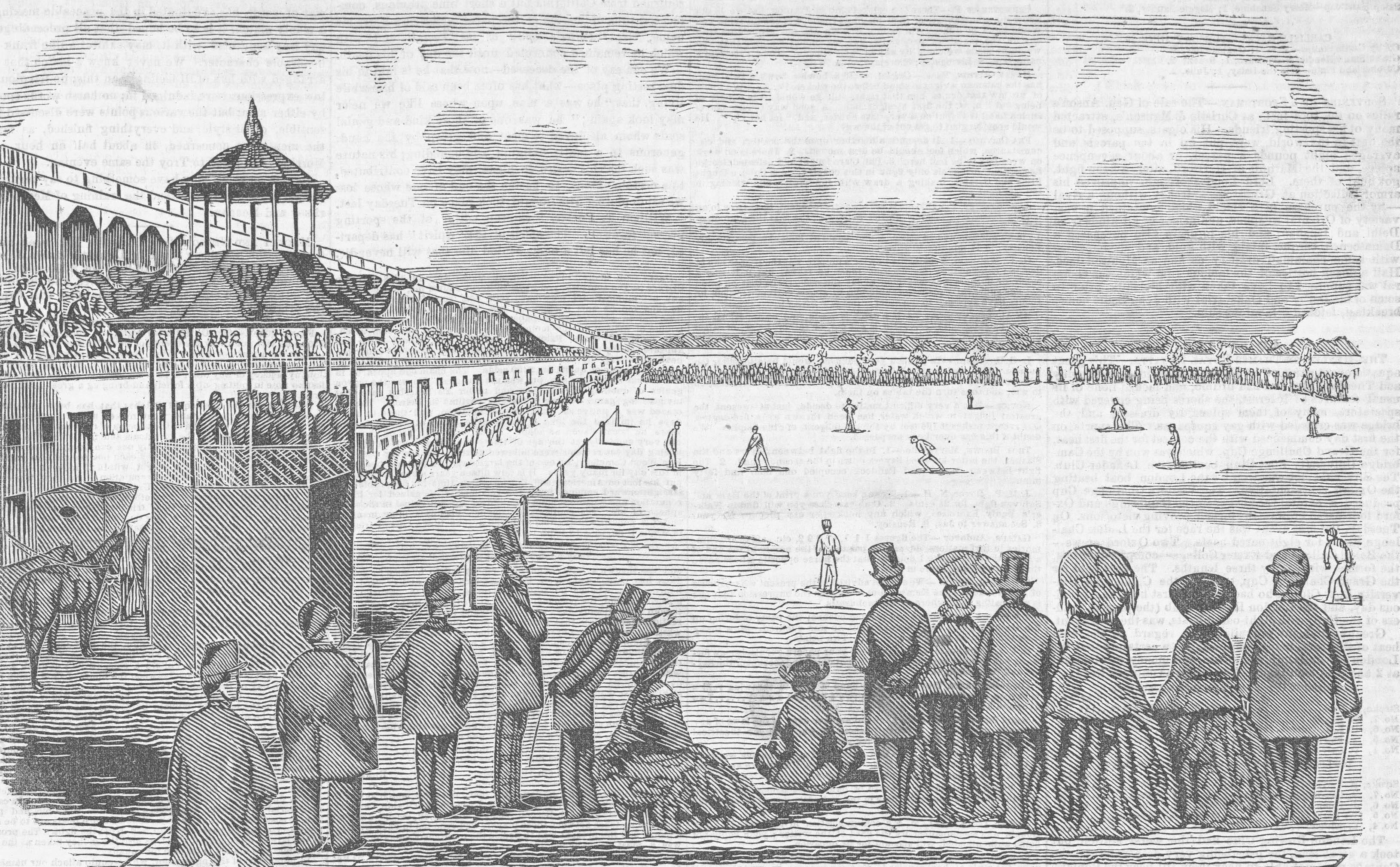
There is one more baseball site in Queens that you need to know about. From 1853 to 1869, the Fashion Race Course hosted horse racing, named for a horse named Fashion that won a match race in 1842 that was, then, still widely remembered.
In 1858, the Course hosted a series of games between teams of players from the then-separate cities of New York (at the time, just Manhattan) and Brooklyn. On July 20, the New York team, including future Cincinnati Red Stocking star Harry Wright, won the 1st game, 22-18. On August 17, led by Dickey Pearce, star of the Atlantic Base Ball Club (the sport was then usually written as two words, "base ball"), Brooklyn won the 2nd game, 29-8. On September 10, New York won, 29-18.
These games were essential to the development of baseball for several reasons. These are probable firsts in baseball: Games where fans were charged for admission, games played in an enclosed ground, and games to bring the best available players together to play against each other, hence inventing the all-star game.
These are definite firsts: Holding a baseball game for charity, as once expenses were paid, the remaining gate receipts were divided between each city's widows-and-orphans fund for its fire departments; taking advantage of the New York vs. Brooklyn rivalry that would last for almost the next 100 years, until the Giants and Dodgers moved after the 1857 season; and enforcement of the 3 called strikes for an out rule by the umpire, in this case one of the men who had helped establish the rules that governed "the New York Game" as a member of the Knickerbocker Club in 1845, Daniel "Doc" Adams.
But more than this: The publicization of this game in newspapers stamped the New York Game as the preferred version of baseball, over that of "the Massachusetts Game" that was still favored in New England.
We have credited Abner Doubleday with the invention of baseball in Cooperstown, New York in 1839 (with no accuracy); and we have credited Adams, Alexander Cartwright and the rest of the Knickerbockers at Madison Square Park in Manhattan in 1845, with their subsequent game with the New York Base Ball Club at the Elysian Fields in Hoboken, New Jersey the following year (with some accuracy). These 1858 games at the Fashion Race Course did not "invent baseball," but they did establish baseball as a big-time sport in America -- if not yet, yet, as something that was coined as a phrase that very year: "The national pastime."
The Fashion Race course's main gate was at 103rd Street and 37th Avenue in Corona, about a mile as the crow flies, or a mile-and-a-half drive, west of Citi Field. 7 Train to 103rd Street-Corona, then 2 blocks north.
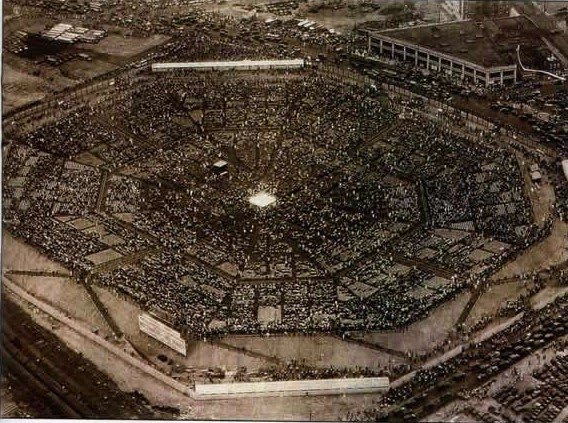
Unwilling to put Summer prizefights inside Madison Square Garden (due to the heat in those pre-air-conditioning days, as much as to the limited seating capacity), and also unwilling to pay the big rents charged by the Yankees for their Stadium or the baseball Giants for the Polo Grounds, in 1932, the Madison Square Garden Corporation built the Madison Square Garden Bowl, a 72,000-seat open-air facility in Long Island City, Queens. It wasn't much: just a lot of aluminum benches in an octagon around a boxing ring. Nothing else could be held there.
It hosted 4 fights for the Heavyweight Championship of the World. On June 21, 1932, Max Schmeling was defeated by Jack Sharkey. On June 29, 1933, barely over a year later, Sharkey was stunned by Primo Carnera, the 6-foot-7 Italian known as the Ambling Alp. On June 14, 1934, Carnera was in turn knocked out by Max Baer. Soon, somebody (who it was depends on who's telling the story) yelled, "The joint is jinxed!"
The Bowl's reputation as "The Jinx Bowl" was certified exactly one year later, on June 13, 1935, when Baer was defeated by Jim Braddock, the Cinderella Man. After that, no one wanted to fight in the Jinx Bowl. Braddock waited 2 years before defending his crown, and went to Chicago where Joe Louis knocked him out at Comiskey Park.
The Garden Corporation gave up, and started paying rent on Yankee Stadium for big fights. The Bowl was demolished during World War II, to make way for a U.S. Army mail depot. Today, there's retail on the site, including the well-known auto dealership Major World. 34-60 48th Street, or 43-40 Northern Blvd. if you prefer. E Train to Steinway Street, then 8 blocks east on 34th Avenue.
In their 1st 2 seasons, 1962 and 1963, the Mets played at the Polo Grounds. It was home to the baseball Giants from 1911 to 1957 (and a previous stadium on the site, which burned down, hosted them from 1891 to 1911), the Yankees from 1913 to 1922, and the football Giants from 1925 to 1955. It hosted a few Army-Notre Dame games, including the one in 1924 where Notre Dame's backfield ran all over the place and was nicknamed The Four Horsemen by legendary sportswriter Grantland Rice.
I recognize this photo as one I first saw in black and white.
Clearly, it has been colorized.
Fordham's football team also played some home games there, including a famous scoreless tie with Pittsburgh in 1937, when ended the season ranked Number 1 and Fordham, with a line known as the Seven Blocks of Granite and including Brooklyn native Vince Lombardi and South River, New Jersey's Alex Wojchiechowicz (both in the Pro Football Hall of Fame), finished at Number 3.
There were 6 fights for the Heavyweight Championship of the World at the Polo Grounds. Jack Dempsey knocked out Luis Firpo there on September 14, 1923, retaining the heavyweight title despite Firpo knocking him all the way out of the ring at one point. Joe Louis came from behind to knock out Billy Conn there, retaining the title on June 18, 1941. Louis knocked Lou Nova out their on September 29, 1941.
Rocky Marciano knocked Roland La Starza out there on September 24, 1953. Floyd Patterson knocked Tommy "Hurricane" Jackson out there on July 29, 1957; then became the 1st fighter ever to regain the heavyweight title, knocking out Ingemar Johansson there on June 20, 1960, after Ingo had knocked him out at Yankee Stadium the year before.
Demolition of the Polo Grounds began on April 11, 1964, by the same company and using the same wrecking ball, painted to look like a baseball, that had demolished Ebbets Field. This was right before Shea opened -- in other words, if Shea hadn't been ready on April 17 (and it nearly wasn't), the Mets would have been screwed, because the Yankees weren't going to let them in.
Polo Grounds Towers opened on the site in 1966. At the entrance to one of those towers, roughly where home plate was, is a plaque honoring the old stadium. Just to the north is a playground (not an actual field) named Willie Mays Field. Across 155th Street is Rucker Park, home to a renowned summer basketball tournament. 2955 Frederick Douglass Blvd. (what 8th Avenue is called above Central Park). B or D train to 155th Street. Definitely a place for a sports fan to visit during the day. Definitely
not a place for anyone not from Harlem or Washington Heights to visit at night.
Speaking of Ebbets Field, the home of the Brooklyn Dodgers from 1913 to 1957 stood at 1700 Bedford Avenue, at the corner of Sullivan Place. B or Q train to Prospect Park. Again: Visit during the day, not at night.
A rare overhead color photo of Ebbets Field.
It was demolished in 1960, and in 1962, Ebbets Field Apartments opened on the site. Across McKeever Place was Jackie Robinson Intermediate School. It is now named Ebbets Field Middle School.
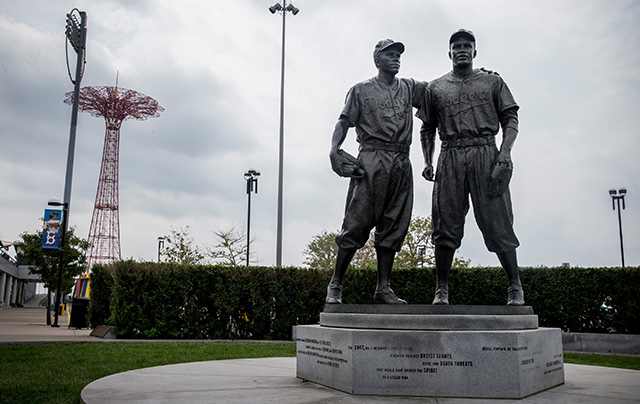
There are plenty of memorials to Jackie, including the Rotunda at Citi Field, and a statue of him and Dodger Captain Harold "Pee Wee" Reese outside the current home of Brooklyn baseball, Maimonides Park (named for the healthcare company, formerly named for the energy company that had been Brooklyn Union Gas and KeySpan, MCU Park).
That's the Coney Island Parachute Jump in the background,
over the stadium's right field corner. It's restored so it won't collapse,
but it's no longer a working ride.
The ballpark opened in 2001, and the Brooklyn Cyclones, named for the nearby roller coaster, won the New York-Penn League Pennant that year, and won another in 2019. They still sell the place out nearly every game. Their season starts in mid-June.
1904 Surf Avenue. D, F, N or Q train to Stillwell Avenue-Coney Island. It's a relatively safe neighborhood these days, but it takes an hour to get there on the Subway from Midtown Manhattan.
The 1968 film version of
The Odd Couple includes a scene at Shea Stadium. It was filmed before a game between the Mets and the Pittsburgh Pirates on June 27, 1967. The script called for a Pirate to hit into a
triple play, which sportswriter Oscar Madison (played on this occasion by Walter Matthau) would miss because his roommate Felix Ungar (Jack Lemmon -- it became "Unger" for the 1970-75 TV show) called him in the press box. Roberto Clemente was asked to be the triple play victim, but refused. They asked Bill Mazeroski next, and he accepted.
The film Frequency is, sort-of, a time-travel story, in which a cop living in 1999 (played by Jim Caviezel) uses his father's old ham radio (in some ways, the Internet of its time) to talk to his fireman father in 1969 (Dennis Quaid), stop him from dying in a fire, and then solve a mystery. The 1969 World Series becomes part of the solution.
The father in 1969 and the son in 1999 live in the same house, at 343 42nd Avenue in Bayside, Queens. This address does not exist in real life: Although there is a 42nd Avenue in Queens, there's no 343, or 3-43, or 343-01. If there was a 34-03 42nd Avenue in Queens, it would be pretty much in the middle of the railroad tracks in Long Island City. (The film was released in 2000, so the number was not chosen to honor the 343 firefighters killed on 9/11.)
The most familiar TV shows set in Queens have been sitcoms: All In the Family, Taxi and The King of Queens. As I said earlier, comic book hero Spider-Man is said to live in Queens, and both the comics and the 1970s kids TV show The Electric Company have established that Spidey, a.k.a. Peter Parker, is a Met fan.
*
As long as the Mets aren't playing the Yankees, with a deep hatred that goes back well before the Mets were even an idea, Citi Field is well worth a visit. You might be impressed -- by the ballpark, if not by the home team.
And if you're not, hey, it could be worse: You could have been at Shea Stadium, the old Flushing Toilet!
There I go again, dropping my objectivity.