Showing posts with label oriole park at camden yards. Show all posts

Saturday, September 6, 2025

September 6, 1995: Cal Ripken Becomes Baseball's All-Time "Iron Man"

September 6, 1995, 30 years ago: The Baltimore Orioles beat the California Angels, 4-2 at Oriole Park at Camden Yards. Cal Ripken Jr. batted 5th and played shortstop. As the game's 5th inning concluded, making the game official, the game was interrupted for a ceremony honoring Ripken, because it was his 2,131st consecutive game with the Orioles.

This broke the record of 2,130, set by Lou Gehrig with the New York Yankees, from June 1, 1925 to April 30, 1939.

Ripken's streak began on May 30, 1982, at the Orioles' previous home park, Memorial Stadium. Then 20 years old, and the son of Oriole 3rd base coach Cal Ripken Sr., he played shortstop, and batted 8th, going 0-for-2, but did draw a walk. The Toronto Blue Jays beat the Orioles, 6-0, getting a 1-hit shutout from Jim Gott (6 innings) and Roy Lee Jackson (3). The only Oriole hit was a single by Rick Dempsey in the 5th inning.

Although he had been featured on the Orioles' "Future Stars" card in the 1982 Topps baseball card set -- along with shortstop Bob Bonner and pitcher Jeff Schneider -- he had, to this point, appeared in a grand total of 65 major league games. And the Orioles' most recent one hadn't been one of them.

He must have impressed manager Earl Weaver, because Earl put Cal in the next game as well. And the next. And so on. In 1982, he was named the American League's Rookie of the Year. In 1983, defying the "sophomore jinx" that had hit many Rookies of the Year, he became the only one, in either League, to win his League's Most Valuable Player award the following season. The Orioles won the World Series, beating the Philadelphia Phillies in 5 games, with Ripken catching a line drive from Garry Maddox for the last out.

Ripken became a perennial All-Star, and in 1991 was named AL MVP again, and also the MVP of the All-Star Game. He surpassed the various men ahead of him on the list of most consecutive games played: Stan Musial with 895, Billy Williams with 1,117, Steve Garvey with the National League record of 1,207, and Everett Scott with the pre-Gehrig record of 1,307.

When the Strike of '94 hit on August 12, 1994, with Ripken having played in 2,009 straight games, there was some question as to whether the next Orioles game, should he play in it, would count as part of the streak. Major League Baseball ruled that it would.

The Strike was ended, and Ripken and the Orioles resumed. On September 5, the Orioles beat the Angels, 8-0, having hit 7 home runs, 2 by Brady Anderson, 1 by Ripken as he tied Gehrig's record at 2,130.

On Gehrig's Monument in Monument Park at Yankee Stadium, the inscription includes the words, "A man, a gentleman and a great ball player whose amazing record of 2130 consecutive games should stand for all time." Whether it should have stood for all time was a separate debate. But it took 56 years after Gehrig's retirement, forced by a fatal illness, to fall.

With the Washington Senators having moved to the Dallas area after the 1971 season, becoming the Texas Rangers, the Orioles became the closest MLB team to the nation's capital, and many Washington insiders made the 45-mile trip up the Baltimore-Washington Parkway, took up the Orioles as their second team, and entertained prominent guests, first at Memorial Stadium, then, starting in 1992, at Camden Yards.

And because Ripken was the biggest star on the capital, he became a national figure, celebrated not for being spectacular, but for simply showing up and doing his job every day -- even though he had just come off the longest work stoppage in his industry's history. (Of course, the players were right and the team owners were wrong. But it does make the celebration of Ripken showing up every day a bit hypocritical.)

So when it was calculated, after the Strike's end, that September 6 would (barring a postponement) be Game Number 2,131, everybody who was anybody wanted to be there. This included President Bill Clinton and First Lady Hillary Clinton, who watched the game with MLB Acting Commissioner Bud Selig. ESPN broadcast the game nationally.

The teams traded home runs in the 1st inning: Tim Salmon for the Angels, and Rafael Palmeiro for the Orioles. Bobby Bonilla led off the bottom of the 4th with a home run. Up next was Ripken, who was a few days past his 35th birthday, and he made it back-to-back home runs, causing Oriole broadcaster Jon Miller to shout, "Oh my goodness, he's done it again!" That made it 3-1 Orioles.

After the 5th inning, as the game began official, people turned to the warehouse beyond the right field wall, where 4 banners hung, reading 2, 1, 3 and 0. A 1 banner was unfurled over the 0 banner, making it 2,131. A standing ovation began, and would not stop. For the moment, he was not just a national treasure, a man widely seen as having restored baseball's popularity after the Strike: He was one of their own, a native of Aberdeen, Maryland, 34 miles to the northeast.

He took what English soccer fans would call a "lap of honour," shaking hands around the field. The ovation lasted 22 minutes, and ESPN did not break for commercial.

Palmeiro hit a home run in the 7th, and the Orioles won, 4-2. Future Hall-of-Famer Mike Mussina was the winning pitcher.

Ripken had once been an excellent defensive shortstop, but, in 1996, was moved to 3rd base, where he remained for the rest of his career. In 1996 and '97, he helped the Orioles reach the Playoffs, but their 1983 remained his only Pennant win. It had been suggested that he was hurting the team by not taking the occasional day off, but he kept going until September 20, 1998, at home against the Yankees, Gehrig's team. His streak ended at 2,632 in a row. He had surpassed Gehrig's record by 23 percent.

In taking the occasional day off, he 1999, he batted .340, the highest average of his career -- but also equal to Gehrig's career batting average. After the season, he was voted by fans onto the MLB All-Century Team. Early the next season, he collected his 3,000th career hit. He retired after the 2001 season, the Orioles retired his Number 8, and he was elected to the Baseball Hall of Fame in 2007.

Given what's now called "load management," the possibility of seriously approaching the streaks of Musial, Williams, Garvey, Scott and Gehrig, never mind Ripken's, is incredibly remote.

Friday, May 20, 2022

When Supporting Jordan Montgomery Is Not Enough

All good things must come to an end. And it's good that the Baltimore Orioles showed a little pride in the finale of the Yankees' 4-game visit.

Jordan Montgomery started the game for the Yankees. For once, he got what should have been enough run support. He went 5 innings, allowing 3 runs on 7 hits -- but no walks. He left with the Yankees leading 5-3, on a Giancarlo Stanton single that brought home 2 runs in the 1st inning, a leadoff home run from Stanton in the 4th, and a 2-run single by Isiah Kiner-Falefa in the 6th.

All season long, the Yankees' biggest strength has been the bullpen. Not yesterday afternoon, it wasn't. Miguel Castro faced 3 batters, and couldn't get an out. Chad Green added to that, and blew the lead.

The Yankees took the lead back in the top of the 9th, on a leadoff walk and a stolen base by IKF, and a single by DJ LeMahieu. But in the bottom of the 9th, instead of Aroldis Chapman, manager Aaron Boone trusted Lucas Luetge to close it out. Josh Donaldson began the inning with an error at 3rd base, and then Luetge got a strikeout, allowed a single, and gave up a walkoff home run to Anthony Santander, his 3rd homer against the Yankees in the last 2 weeks.

Orioles 9, Yankees 6. WP: Felix Bautista (1-1). No save. LP: Luetge (1-1). This time, giving Montgomery the run support he needed wasn't enough.

Tonight, the Yankees come home, to begin a series against the Chicago White Sox. They still have the best record in baseball, and remain in 1st place in the American League Eastern Division, 5 games ahead of the Tampa Bay Rays. The Magic Number to clinch the AL East is 120.

Saturday, April 16, 2022

Move Worthy of Earl Weaver Gives Orioles Win Over Yankees

When Charlie Finley bought the Kansas City Athletics in 1960, he decided that the Yankees were winning Pennants because their right-field foul pole was only 296 feet from home plate. So he built a little bleacher section in the right-field corner at Kansas City Municipal Stadium, and called it the KC Pennant Porch. American League President Will Harridge made him get rid of it.

Since Oriole Park at Camden Yards opened in 1992, the Yankees have usually handled the Baltimore Orioles pretty well there. Oriole management has decided that the reason they keep losing there, to the Yankees and other teams, is that the left-field fence was too short: Both too low in height, and too close to home plate. So they moved the fence back, and raised it in height, sacrificing about 1,000 seats and the revenue thereof for wins -- at least in theory.

This was a move worthy of 1968-82 manager Earl Weaver, who was known to pull all kinds of tricks, winning a 1978 game against the Yankees by being slow to get the tarp onto the field when a rain delay was called.

Last night, the Yankees began a 3-game series against the Orioles at Camden Yards. Home plate umpire Tom Hallion spent the entire game giving low strikes to both teams, but it seemed to hurt the Yankees more: 13 Yankee batters struck out, and if even half of those, 7 out of 13, were based on 3 actual strikes, I would be surprised.

But the Yankees couldn't hit, aside from an RBI single in the 3rd inning by Giancarlo Stanton. Jordan Montgomery pitched 5 shutout innings to start the game, and that nice performance was wasted. Wandy Peralta had nothing in the 6th, and the Orioles tied the game.

Stanton went 3-for-5. The rest of the team went 4-for-32: .125. They loaded the bases in the 6th, but a double play ended the threat. That was the start of 14 straight outs, from innings 6 through 10. Clarke Schmidt inherited the ghost runner in the bottom of the 11th, and walked the bases loaded. Aaron Boone brought in Aroldis Chapman, and he walked home the winning run, although the pitch that was called ball 4 sure looked like a strike to me.

Orioles 2, Yankees 1. WP: Joey Krebhiel (1-0). No save. LP: Schmidt (0-2). One run in 11 innings. Can't really blame the umpire when you do that.

The Yankees are now 4-4. They will send Jameson Taillon to the mound tonight, against Tyler Wells.

Thursday, June 1, 2017

Concerns for Tanaka, Yanks Still In 1st as May Ends

The Yankees have now lost their last 4 series to the Baltimore Orioles at Camden Yards. Last night, in the rubber game of this series, for the 3rd time in his last 4 starts, Masahiro Tanaka got hit hard. He allowed 7 runs in the 3rd and 4th innings, and didn't get out of the 6th, allowing 9 hits and 2 walks.

#YankeesTwitter is already whispering that he may be injured, and we just don't know it yet. If that's true -- or even if it isn't, and he's just lost his command -- the Yankees have a big problem.

The Yankees offense got a run in the 4th and 2 more in the 5th off Oriole starter Kevin Gausman, and 1 more off the Baltimore bullpen, but bad relief pitching by Giovanny Gallegos insured that it wasn't nearly enough. Orioles 10, Yankees 4. WP: Gausman (3-4). No save. LP: Tanaka (5-5).

*

So here we are, on June 1. Where do we stand?

* The Yankees are 30-20, playing .600 baseball. That translates to 97 wins over the course of the season. As I've learned, 92 is the average number of wins, going back to the start of Divisional Play in 1969, by the 2nd place team in the American League Eastern Division. Therefore, 93 wins is, on the average, enough to win the AL East. The Yankees are on such a pace, and then some.

* The Yankees lead the Boston Red Sox by 2 games, the Orioles by 3 1/2, the Tampa Bay Rays by 4, and the Toronto Blue Jays by 5 1/2. In the all-important loss column, they lead the Sox by 3, the O's by 4, and the Rays and Jays by 7 each.

* I said a few days ago that it didn't make sense to post "Magic Numbers" (or "Elimination Numbers") in May. Well, we are now in June, and here we go: The Yankees' number to eliminate the Rays from winning the AL East title is 103, the Jays 105, and the O's and Sox both 109. Therefore, any combination of Yankee wins and Boston losses -- or any combination of Yankee wins and Baltimore losses -- adding up to 109 the rest of the way, and the Yankees win the Division.

* The Yankees trail the Houston Astros by 4 games for the best record in the AL.

* The Mets? 23-29, 10 games behind the Washington Nationals in the National League East, 9 in the loss column. They are 8 games out of the 2nd NL Wild Card slot. Their fans complain that they've had a lot of injuries. This is true. Well, Boo-hoo, poor you: The Yankees didn't have Gary Sanchez and Didi Gregorius for most of April, and have Aroldis Chapman out for a month. Man up and win some ballgames.

* Oh yeah: Mr. Met flipped the bird at a fan last night. The actor playing him was fired and replaced. And the Twittereaction was fantastic.

* If the current MLB standings hold to the end of the season: The Minnesota Twins would travel to Boston to play the Red Sox in the AL Wild Card Game, with the winner playing the Astros in the AL Division Series; while the Yankees would have home-field advantage over the Cleveland Indians in their ALDS. The Arizona Diamondbacks would go to Denver to play the Colorado Rockies in the NL Wild Card Game, with the winner playing the Washington Nationals in the NLDS; while the Milwaukee Brewers would play the Los Angeles Dodgers in the other NLDS.

*

Tonight, the Yankees begin a 4-game series in Toronto, against those pesky Blue Jays. Here are the projected pitching matchups:

* Tonight, 7:07 PM: CC Sabathia vs. Marco Estrada.

* Tomorrow, 7:07 PM: Michael Pineda vs. Francisco Liriano.

* Saturday, 1:07 PM: Jordan Montgomery vs. Joe Biagini.

* Sunday, 1:07 PM: Luis Severino vs. Marcus Stroman.

Then a travel day, and, on Tuesday, home to The Scum. Come on you Bombers!

Wednesday, May 31, 2017

Yankees Have Orioles' Number: 21230

It often seems like, when the Yankees score a lot of runs in a game, their next game turns very quiet, and we start to think, "You know, a couple of those runs from last night would feel pretty good right about now."

In this series against the Baltimore Orioles at Camden Yards, it has been the other way around. The Yankees lost 3-2 on Monday, but, last night, they broke out.

21230. That was the Yankees' linescore from the 1st 5 innings. That also happens to be a ZIP Code from Baltimore, to the west and south of Camden Yards, including M&T Bank Stadium, home of the NFL's Ravens. Camden Yards's ZIP Code is 21201.

Brett Gardner hit a home run in the 1st inning. So did Matt Holliday. Holliday hit another in the 3rd, chasing Chris Tillman, who usually pitches well against the Yankees. Gardner hit another in the 4th. Both men now have 11 home runs on the season, and we're still, for 1 more day, in May. And these weren't el cheapo homers, either: They averaged 404 feet.

When Aaron Judge doubled in the 4th, to make it 8-0, it felt like a little bit of a letdown, as we now come to expect a home run from Da Judge.

Luis Severino pitched shutout ball into the 6th, and was removed by Joe Girardi with 6 1/3rd innings pitched, having allowed 1 run on 7 hits, 1 walk, and 8 strikeouts. But, you know Joe and his binder: 100 pitches is 100 pitches. Tommy Layne and Adam Warren each got an out in the 7th.

Bryan Mitchell got into trouble in the 8th, and Tyler Clippard was brought on to get the last 4 outs. Sometimes, this kind of situation turns nasty, and what was an 8-0 lead could seriously threaten to become a 9-8 loss. Not this time: Clippard didn't allow a baserunner.

Yankees 8, Orioles 3. WP: Severino (4-2). No save. LP: Tillman (1-2).

The Yankees now lead the American League Eastern Division by 3 games over the Boston Red Sox, 4 1/2 over the Orioles, 5 over the Tampa Bay Rays, and 6 1/2 over the Toronto Blue Jays, who have gone from horrible in April to respectable in May. In the all-important loss column, the Yanks lead the Sox by 4, the O's by 5, and both the Rays and the Jays by 8. (The Yankees have a game in hand on the O's, 2 on the Sox, 3 on the Jays and 4 on the Rays.)

The series concludes tonight. Masahiro Tanaka starts against Kevin Gausman. Then, the Yankees head up to Canada to take on those pesky Blue Jays.

Monday, September 5, 2016

Yanks Salvage Finale In Baltimore

The Yankees needed to take at least 2 out of 3 in their weekend series against the Orioles in Baltimore to stay in the American League Eastern Division race, and to strengthen their place in the Wild Card race.

It didn't happen.

The Friday night game was an outright disaster. Chad Green started, but was hurt, had nothing, and had to leave the game in the 2nd inning, having already allowed 4 runs. Nick Goody allowed 2 more before the inning was over, and Kirby Yates allowed 2 more.

But our starter could have been fine, and pitched very well, but it wouldn't have mattered. Here's what Oriole starter Dylan Bundy allowed in 5 2/3rds innings: A single (and a pickoff) and a walk by Brett Gardner, a single by Jacoby Ellsbury, a walk by Mark Teixeira, a walk by Chase Headley, and a walk by Gary Sanchez. Here's what relievers Donnie Hart, Vance Worley and Tommy Hunter allowed in the remaining 3 1/3rd innings: No baserunners at all. Not one Yankee batter even reached 2nd base.

Orioles 8, Yankees 0. WP: Bundy (8-5). No save. LP: Green (2-4). Worst game of the season, and at a very inopportune time.

Green went on the Disabled List. We probably won't see him again until Spring Training.

*

The Saturday night showed what happened when you get good pitching, but not good hitting. CC Sabathia started, and went 6 innings, allowing 2 runs (1 earned) on 6 hits and 2 walks. That should have been enough. But the home run he gave up to Adam Jones turned out to be all the O's needed.

Because Kevin Gausman can now be put into the category of "Pitchers Who Drive the Yankees and Their Fans Nuts." He went 6 innings and allowed 2 hits. Between him, Mycal Givens, Brad Brach and Zach Britton -- again, 4 pitchers, but 4 completely different pitchers than the ones who shut the Yankees out the night before -- they allowed only the following: Singles by Sanchez, Headley, Starling Castro and Brian McCann; walks by Ellsbury and Aaron Judge; and Didi Gregorius was hit by a pitch.

The Yankees loaded the bases as a result of the Didi HBP, but Gausman worked out of the jam. That was the only time in the 1st 2 games the Yankees got a man to 2nd base, let alone to 3rd.

Orioles 2, Yankees 0. WP: Gausman (7-10). SV: Britton (40). LP: Sabathia (8-12).

*

So as you prepared to watch the Sunday afternoon game, you could have been forgiven for thinking that, with Michael Pineda starting, the Orioles would complete the sweep.

But the Yankees scored 3 runs in the top of the 1st inning, on an RBI single by Headley and a 2-RBI single by Austin Romine. Headley beat out an infield single in the 3rd, allowing a run to score. And a Gardner sacrifice fly in the 9th brought an insurance run.

Joe Girardi really juggled the pitching staff. Pineda didn't pitch badly over 4 innings -- 2 runs on 5 hits and 2 walks -- but Girardi took him out, seeing he'd already thrown 87 pitches. (That damn binder again.) He let Luis Severino pitch the 5th and 6th innings, and he allowed 2 walks, but no hits, and no runs. Tommy Layne, Adam Warren, Tyler Clippard and Dellin Betances got the remaining outs. Aside from a single given up by Clippard, they were perfect.

Yankees 5, Orioles 2. WP: Severino (2-8), because the rule says that a starting pitcher must pitch 5 innings to qualify for the win. If he doesn't, then the win is granted to another pitcher at the discretion of the official scorer. SV: Betances (8). LP: Wade Miley (8-12).

*

So here's where we stand. There are 4 weeks left in the regular season, with 27 remaining scheduled games -- in other words, only 1 day off.

The Yankees are 70-65, 6 1/2 games behind the Toronto Blue Jays in the AL East, 6 in the loss column. The Boston Red Sox trail the Jays by 1 game, the Orioles by 3. The O's and the Detroit Tigers are currently tied for the 2nd AL Wild Card slot, and the Yankees trail by 3 1/2, 3 in the loss column.

Today, the Yankees begin their most important series of the season, home to those pesky Blue Jays. Here are the projected starting pitchers:

* Today, first pitch scheduled for 1:05 PM (a Labor Day matinee): Masahiro Tanaka vs. R.A. Dickey.

* Tomorrow, 7:05 PM: Luis Cessa vs. Aaron Sanche.

* Wednesday, 7:05 PM: Severino vs. Marcus Strohman. Although, with Sevy having pitched 2 innings yesterday, I don't think he's going to end up starting on 2 days' rest. Unless Girardi wants to play musical chairs with the bullpen again. (With September roster callups, it might be possible, but that doesn't necessarily make it recommended.)

If the Yankees want to make the Playoffs, or even win the Division, they must take 2 out of 3 from the Jays.

This is the season, right here.

Monday, June 6, 2016

Weekend Series In Baltimore a Wet Blanket

The Yankees played a 3-game series against the Orioles in Baltimore this weekend, and a good time was not had by all.

On Friday night, the Yankees hit 3 home runs: Carlos Beltran (his 13th of the season), Alex Rodriguez (his 7th) and Austin Romine (his 2nd).

It wasn't enough: Nathan Eovaldi did not pitch well, Kirby Yates didn't, either, and Dellin Betances finished the bad pitching job in the 7th.

Orioles 6, Yankees 5. WP: Mychal Givens (5-0). SV: Zach Britton (16). LP: Betances (2-3).

*

On Saturday night, they still didn't get good pitching, but, at first, it looked like they would get enough hitting to cover it. There were no home runs in the Baltimore Bandox (not by the Yankees, anyway), but A-Rod and Starlin Castro each got 3 hits, while Jacoby Ellsbury and Brett Gardner each got 2. A 4-run 5th inning was the key to victory, or so it seemed. It was 7-0 Yankees going into the bottom of the 7th.

For once, though, Joe Girardi made the opposite of his usual mistake: He left the starting pitcher in too long. Ivan Nova began to fall apart in the 7th, and Nick Goody, brought in to face one batter, didn't get him out. When is Girardi going to realize that this tactic is stupid?

Andrew Miller got all 3 outs in the 7th (since Girardi didn't want to use Betances again), and all 3 in the 8th. Aroldis Chapman finished the win off.

Yankees 8, Orioles 6. WP: Nova (4-3). SV: Chapman (now a perfect 9-for-9 in save opportunities). LP: Tyler Wilson (2-5).

*

Sunday afternoon featured a tense pitching duel between CC Sabathia and Kevin Gausman. With 1 out in the top of the 3rd, Ellsbury singled, advanced to 2nd on a wild pitch, and was singled home by A-Rod.

CC kept that 1-0 lead through the 5th. Goody, surprisingly, pitched a perfect 6th. In the top of the 7th, the Yankees had men on 1st & 2nd with 1 out, 2nd & 3rd with 2 out, but didn't score. That would prove to be big.

Girardi brought Betances on to pitch the bottom of the 7th. Why he didn't let CC pitch the 6th, I'll never know, but he blew this one, too. Betances ran into trouble, but got out of it. Still 1-0 Yankees, a most unlikely score at Camden Yards.

Then, in the bottom of the 8th, Girardi left Betances in. Why not bring in Miller? Because he'd pitched Miller for 2 innings 19 hours before. Betances gave up a walk to Mark Trumbo, then a single to Chris Davis. He struck out Nolan Reimold...

And then the rains came. The tarp was put on the field. Those of us old enough to remember 1978 remember Earl Weaver,then managing the Orioles, leaving a waterlogged tarp on long enough to ruin the field and give the Orioles a win over the Yankees.

The delay lasted over an hour and a half. That was no tarp: It was a wet blanket. There was no way Girardi was going to let Betances back out there. But he wasn't going to let Miller take the mound, either. So he sent out his closer, Chapman, to get a 5-out save.

Chapman struck out Jonathan Schoop. But he gave up a single to Francisco Pena, loading the bases. And then Matt Wieters singled to center. And Ellsbury bobbled it. All the runners scored.

Of course, the Yankees went out meekly in the 9th. Orioles 3, Yankees 1. WP: T.J. McFarland (1-1). SV: Britton (17). LP: Betances (2-4), although this is yet another one on Girardi.

*

You can complain all you want about hitters, runners, fielders, starters or relievers not getting the job done. But if Joe Girardi had a clue about handling pitchers (which, as an ex-catcher, he should have), the Yankees would be right up there with the American League leaders.

Instead, 9 weeks into a 26-week MLB season -- more than 1/3rd of the way through -- the Yankees are 26-30, 6 1/2 games behind the 1st-place Orioles, 7 in the loss column.

The Yankees have come home, and begin a series with the Whatever They're Calling Themselves This Season Angels of Anaheim. Here are the projected starting pitching matchups:

* Tonight: Masahiro Tanaka vs. Matt Shoemaker.

* Tomorrow: Michael Pineda vs. former Yankee lefthander David Huff.

* Wednesday: Eovaldi vs. Jered Weaver.

All games are listed as 7:05 PM starts.

Come on you Pinstripes! Snap out of it! And, while you're at it...

GIRARDI OUT!

Wednesday, July 9, 2014

How to Be a Yankee Fan In Baltimore -- 2014 Edition

After leaving Cleveland, the Yankees wrap up the official (if not the numerical) 1st half of the season with a 3-game stopover in Baltimore to face the Orioles.

I started my "How to Be a Yankee Fan In... " series with the Orioles, because they are actually the Yankees' closest opponents, if you don't count Interleague trips to Flushing and South Philly. They are closer to New York than the Boston Red Sox. It's an easy trip, or, as Yankee broadcaster Michael Kay once said, seeing a LOT of Yankee paraphernalia in the stands, "This is really the South Bronx. About 190 miles south." (Actually, it's 201 miles from The Stadium to The Yards.)

I saw 3 Oriole games at the old Memorial Stadium, and I've seen 4 games at Camden Yards, the last 2 involving the Yankees. I won't be going this weekend, and probably not this season, due to my finances having been banjaxed.

Nevertheless, I highly recommend this trip -- if not now, certainly in the future. Baltimore is a good city and a very good sports town.

Before You Go. Baltimore can get quite hot in the summer, but we're in May, so heat shouldn't be a problem. Check the Baltimore Sun website for the weather before you go. And it's going to be hot: Upper 80s in daylight this weekend, upper 60s at night. A thunderstorm is predicted for Sunday. Fortunately, it's close enough that, if there's a rainout, your raincheck will be fairly easy to use.

Baltimore is, of course, in the Eastern Time Zone, so there's no need to fiddle with your timepieces.

Tickets. It used to be that getting tickets to any Orioles home game, not just Yankee games, was hard, because they were selling Camden Yards out 44, 45, 46,000 per night. (Officially, seating capacity is 45,971, with the difference long being made up by standing room.)

Just as the 1954 arrival of the Orioles in Baltimore, 40 or so miles away, probably doomed the Washington Senators (twice, as it turned out, the originals-turned-Minnesota Twins in 1961 and the "New Senators"-turned-Texas Rangers in 1971), so, too, did the specter of a new team coming to Washington hang over the Orioles.  Edward Bennett Williams, the "superlawyer" who also owned the NFL's Washington Redskins for many years, wanted out of Memorial Stadium, which was a fine place to watch a baseball game and a great one to watch a football game. It had two major problems, however: You couldn't get in, and you couldn't get out. Driving there was bad, and public transport was every bit as bad, with the Number 3 bus constantly getting stuck in traffic on North Charles Street and then on 33rd Street.

Williams wanted a ballpark close to downtown, with easy access to Camden Station and Interstate 95 -- and thus with easier road and rail access from his Washington hometown. For years, Baltimoreans were terrified that, if he didn't get what he wanted, he would outright move the team to Washington to share Robert F. Kennedy Stadium with the 'Skins. This fear expanded after Robert Irsay moved the Colts to Indianapolis in 1984. But, just before Williams' death in 1988, a funding plan for the new ballpark got through the Maryland legislature.

New team owner Peter Angelos, once one of the biggest-spending owners in the game, was desperate to keep MLB expansion from including the Nation's Capital and established teams from moving there. He was sure that one-quarter of the Orioles' fans were from the D.C. area, and he didn't want to lose those fans. Which explains why he got plenty of freebies to D.C. power brokers, including members of Congress, White House staff, and pundits, including George Will, who became a minority owner of the franchise despite his lifelong fandom for the Chicago Cubs.

The Orioles reached the American League Championship Series in 1996, but lost to the Yankees; and again in 1997, but lost to the Cleveland Indians. In fact, the O's have played 6 ALCS games at Camden Yards since it opened in 1992, and have won only 5. (This includes 0-3 against the '96 Yanks, so since they couldn't protect their house, their fans can shut the hell up about Jeffrey Maier.)

A beanball war at Yankee Stadium in 1998, in the midst of a Yankee sweep, marked the end of the O's would-be dynasty. But people still came to Camden Yards in droves, even as the team deterioriated. In 1997, attendance peaked at 45,816 per game. As late as 2000, it was 40,704. In 2001, still 38,686.

And then, in 2002, per-game attendance dropped to 33,122. Just like that. So what happened in 2002? Or in the 2001-02 offseason? Easy: The statue of Cal Ripken was removed from third base.

You've probably gotten the joke: That wasn't a statue. That was Ripken himself, who probably played 3 years too long. But after Cal left, and took his overrated legend with him, there was no reason to watch the Orioles anymore: They stunk, and had no drawing cards.

In 2004, the last season before the Montreal Expos moved to become the Washington Nationals, O's per-game attendance was 34,300. In 2005, the Nats' first season down the Baltimore-Washington Parkway, attendance fell to 32,404. The Nats weren't good, and RFK Stadium was inadequate for modern baseball, but the novelty of baseball being back in the Nation's Capital wasn't enough to make the one-quarter difference that Angelos long feared. In fact, instead of a 25 percent drop, it was a 6 percent drop. But it was a 19 percent drop from the last Cal season.

In 2010, O's per-game attendance bottomed out at 21,662, which was their their lowest since 1988, the year they lost their first 21 games en route to losing 107 for the season. That's little more than half the total from the last Cal season, but that's got little to do with the Nats simply existing an hour's drive away (at least, it's an hour's drive in theory; BaltWash Corridor traffic can be horrendous), and lots to do with the O's being pathetic. And with Stephen Strasburg having arrived, now it will be the Nats who have the iconic player (as if Ryan Zimmerman isn't already a damn good player).

So the O's were really up the creek, right? Nope, they found a way to bounce back: Winning.  In 2012, they drove the Yankees crazy all season long, taking the American League Eastern Division race down to the wire, and even facing the Yankees in the AL Division Series, before the Yankees finally emerged victorious. Per-game attendance rose to 26,610. So far this season, with the O's challenging for the Playoffs again, it's 29,017.

So what does this mean? It means getting tickets for O's games will still be relatively easy, although it may no longer be possible to just walk up to the ticket booth and give your request, and basically get pretty much any seat(s) you're willing to pay for. Field Box seats are $79, Terrace Boxes are $55, Upper Boxes are $35, and Upper Reserves are $23.

Getting There. Getting to Baltimore is fairly easy. However, if you have a car, I recommend using it, and using the parking deck at a hotel near the ballpark. There are several.

It’s 193 miles by road from Times Square to Camden Yards, and 201 miles from Yankee Stadium to the Birds’ Nest. If you’re not “doing the city,” but just going to the game, take the New Jersey Turnpike all the way down to the Delaware Memorial Bridge (a.k.a. the Twin Span), across the Delaware River into the State of, well, Delaware. This should take about 2 hours, not counting a rest stop.

Speaking of which, the temptation to take an alternate route (such as Exit 7A to I-195 to I-295 to the Ben Franklin Bridge) or a side trip (Exit 4, eventually leading to the Ben Franklin Bridge) to get into Pennsylvania and stop off at Pat’s Steaks in South Philly can be strong, but if you want to get from New York to Baltimore with making only one rest stop, you’re better off using the Walt Whitman Service Area in Cherry Hill, between Exits 4 and 3. It’s almost exactly the halfway point between New York and Baltimore.

Once you get over the Twin Span – the New Jersey-bound span opened in 1951, the Delaware-bound one was added in 1968 – follow the signs carefully, as you’ll be faced with multiple ramps signs for Interstates 95, 295 and 495, as well as for U.S. Routes 13 and 40 and State Route 9 (not the U.S. Route 9 with which you may be familiar, although that does terminate in Delaware, but considerably to the south of where you'll be). You want I-95 South, and its signs will say “Delaware Turnpike” and “Baltimore.” You’ll pay tolls at both its eastern and western ends, and unless there’s a traffic jam, you should only be in Delaware for a maximum of 15 minutes before hitting the Maryland State Line.

At said State Line, I-95 changes from the Delaware Turnpike to the John F. Kennedy Memorial Highway, and you’ll be on it for about an hour (unless you want to make another rest stop, at either the Chesapeake House or Maryland House rest area) before reaching the Baltimore Harbor Tunnel and Exit 53, for I-395 which empties onto Martin Luther King Jr. Boulevard, and the ballpark will be right there. (The official address is 333 W. Camden Street.)

If all goes well (getting out of New York City and into downtown Baltimore okay, reasonable traffic, just the one rest stop, no trouble with your car), the whole trip should take about 4 hours.

Baltimore, whose airport is named for native son Thurgood Marshall, the 1st black Justice of the U.S. Supreme Court, is too close to fly, just as flying from New York (from JFK, LaGuardia or Newark) to Boston, Philadelphia and Washington, once you factor in fooling around with everything you gotta do at each airport, don’t really save you much time compared to driving, the bus or the train.

The train is a good option, but not a great one. Baltimore's Penn Station is at 1515 N. Charles Street, bounded on the other side by St. Paul Street, which runs southbound. Get on Charles, and you'll be going northbound, away from downtown, and you'll end up near the Museum of Art, Druid Hill Park ("Droodle Park" in Baltimorese), and the site of Memorial Stadium (now senior-citizens' housing). It's not a good neighborhood (although there are worse ones in Baltimore), and it will be out of your way. In addition, Amtrak is expensive. They figure, "You hate to fly, you don't want to deal with airports, and Greyhound sucks, so we can charge whatever we want."

Still, if you have the money – it’ll probably be $258 round-trip – Amtrak is a good option. An Acela Express (they don’t call ‘em Metroliners anymore) will be much more expensive, $394, but it will take about 2 hours and 15 minutes; a regular Northeast Regional about 2 hours and 45 minutes.

Bus? The old Greyhound terminal was right downtown, but it was an absolute hole. It looked like a homeless shelter. The new one is a huge improvement in terms of cleanliness. The problem is that it's at 2110 Haines Street, south of downtown. On paper, it's not unreasonable to walk from there to the NFL Ravens' stadium (currently, M&T Bank has the naming rights) and then past that to ballpark. But you'll be walking under the elevated Interstate 395, and you won't like it.

From Greyhound, the Number 27 bus will take you right to the ballpark. If you want to see the Inner Harbor attractions, change by the ballpark to the Number 7 bus.

Unfortunately, New York to Baltimore -- or, more accurately, the return trip -- by Greyhound is a bad option on a weeknight. The last bus of the night leaves the "downtown" terminal at 7:30 PM. Anyway, the trip is around 4 hours.

Greyhound also has "Baltimore Travel Plaza." It's at 5625 O'Donnell Street, 3 miles east of downtown, just off Interstate 95, designed to cater to Baltimore and Washington travelers at the same time, while those going to the Haines Street terminal are pretty much only those going to Baltimore. To get from Travel Plaza to downtown (Harborplace or Camden Yards), take the Number 20 bus. A bus from there will leave at 11:00 PM, but it won't get back to Port Authority until 3:45 AM. And do you really want to be at Port Authority at 4 in the morning? If you're willing to risk that, a round-trip New York-Baltimore ticket will cost $70, although an advanced-purchase can drop it to as little as $48.

Once In the City. Named for Cecilius Calvert, 2nd Lord Baltimore, founding proprietor of the Maryland Colony, and founded in 1729, Baltimore -- from the Gaelic "Baile an Tí Mhóir," meaning "town of the big house" -- is one of those cities whose interior population shrank due to "white flight," causing its suburbs to boom. A city of 800,000 in 1970, it has fallen to 621,000, but the metropolitan area has about 2.7 million -- roughly as many as Brooklyn. Counting their entire market -- roughly northern and eastern Maryland, plus Sussex County, southernmost Delaware, including Rehoboth Beach -- and it's about 3.3 million.

Keep in mind that Baltimore City and Baltimore County are separate entities. (This is also true of St. Louis -- but not Philadelphia, San Francisco or Denver, where the City and the County have the same borders. And the Counties of Los Angeles, San Diego, Dallas and Milwaukee include the cities with those names, as well as other municipalities.) So if someone tells you that such-and-such location is in Baltimore County, you'll know it's not anywhere near downtown.

The city's centerpoint is Charles & Baltimore Streets: Charles separates east & west, Baltimore separates north & south.

Baltimore is way behind the curve when it comes to public transportation. They didn't have a subway (they call it the Metro) until 1983, and it didn't go anywhere near Memorial Stadium; as it is, the Lexington Market and Charles Center stops are each 8 blocks from Camden Yards.

The Light Rail system opened in April 1992, the same month as the new ballpark, and separate stops serve both the ballpark (and Camden Station, enabling MARC commuter-rail access from Washington and the suburbs between the two cities) and the football stadium. The Light Rail does serve Penn Station, although the closest stop to the Greyhound station on Haines Street is Hamburg Street, which is the stop for the Ravens' stadium.  The regular fare for a bus, subway or light rail ride is $1.60.

As a result of not having a subway or a light rail until a generation ago, old habits die hard, and people overrely on the city's buses, jamming them, sometimes not even during rush hour.

I'll say it again: If you can drive, or if you can get someone to drive you, do it, and park in a downtown hotel's deck. You'll be better off walking around to the various downtown locations.

If you're coming into the city by Amtrak, when you get to Baltimore’s Penn Station, pick up copies of the Baltimore Sun and the Washington Post. The Post is a great paper with a very good sports section, and as a holdover from the 1972-2004 era when D.C. had no MLB team of its own, it still covers the Orioles well. The Sun is only an okay paper, but its sports section is nearly as good as the Post's, and their coverage of their town's hometown baseball team rivals that of any paper in the country -- including the great coverage that The New York Times and Daily News give to the Yankees.

Once you have your newspapers, walk out to St. Paul Street, and catch either the Number 3 or the Number 64 bus, which will take you to downtown, to the Inner Harbor and Camden Yards areas.

Sales tax for the State of Maryland is 6 percent. That does not rise when you enter Baltimore City, or Baltimore County for that matter.

Going In. There are 5,000 parking spaces available at the ballpark (costing $6.00), but over 20,000 within a short walk of it. The official address is 333 W. Camden Street. However you got there, you're most likely to walk in at the Eutaw Street gate, between the edge of the left field stands and the Baltimore & Ohio Warehouse. This area has several statues: Oriole legends Brooks and Frank Robinson, Jim Palmer, Eddie Murray, Cal Ripken and Earl Weaver, plus Baltimore native Babe Ruth.

But if you can, try to enter by the right field gate. You'll see some of the letters from the front gate of Memorial Stadium, which stood as a memorial to Baltimore City and Baltimore County losses in World Wars I and II. The bottom line of the inscription on the gate was saved: "TIME WILL NOT DIM THE GLORY OF THEIR DEEDS."

Entering by the right field gate will also enable you to get a good look at M&T Bank Stadium, home of the defending Super Bowl Champion Ravens, and its statue of Colts legend Johnny Unitas, and to get to what appears to be the only escalator bank at Camden Yards.

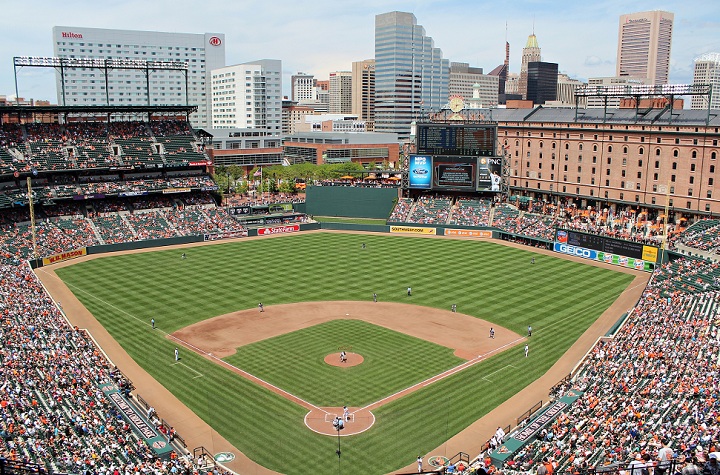
The field is natural grass. The park is not symmetrical. The left-field pole is 333 feet from home plate, left-center a nice, close 364, the deepest point in left-center 410, straightaway center 400, right-center 373, and the right-field pole 318. Unlike its predecessor, pitcher-friendly Memorial Stadium, Camden Yards is very much a hitters' park.

Darryl Strawberry, while with the Yankees in 1998, hit Camden Yards' longest home run to date, a 465-footer. The longest homer inside the old Memorial Stadium was a shot to center field by Frank Howard, 470 feet. However, Frank Robinson hit the only home run out of Memorial Stadium, down the left field line, hitting the parking lot 460 feet from home plate, before bouncing another 80 feet. A flag reading "HERE," with black letters on an orange background, was put up on a pole where the ball left the confines of the stadium.

Food. Eat. You'll be glad you did. Baltimore is a really good food city, and the concession stands reflect this.  There are plenty of stands, and the lines are usually of reasonable length. The Esskay hot dogs are good, and the beers are varied.

Boog Powell's barbecue stand, on the Eutaw Street walkway, sells good stuff, although his meats are a little too spicy for my taste. And sometimes, you can even see the big fella himself, the 1961-74 1st baseman monitoring the cooking, seeing to it that his recipes are well-cared-for.

Team History Displays. As I said, there is a nod to Oriole history at the Eutaw Street gate.  The statues are the men officially honored with retired numbers: 4, 1968-86 manager Earl Weaver; 5, 1955-77 3rd baseman (and later broadcaster) Brooks Robinson; 8, 1981-2001 shortstop (and later 3rd baseman) Cal Ripken Jr.; 20, 1966-71 right fielder (and later manager) Frank Robinson; 22, 1965-84 pitcher (and later broadcaster) Jim Palmer; and 33, 1977-96 1st baseman Eddie Murray.

Number 7, worn by longtime coach and briefly manager Cal Ripken Sr.; Number 44, worn by former catcher and longtime coach Elrod Hendricks; and Number 46, worn by former pitcher and general manager Mike Flanagan have not been officially retired, and they don't have statues, but neither has been given out since these men died.

The 6 Pennants that the American League version of the Orioles have won -- 1966, 1969, 1970, 1971, 1979 and 1983 -- used to be shown as painted onto the outfield fence. Now, they are restricted to flags on the big THE SUN scoreboard -- note the BALTIMORE SUN letters taking the place of the numbers on the clock, and the Oriole weathervanes.

The old, National League version of the Orioles won Pennants in 1894, 1895 and 1896. The Triple-A version of the Orioles won the International League Pennant in 1908, 7 straight from 1919 to 1925, and again in 1944 and 1950. And the 1901-02 American League version went on to win 40 Pennants (and counting) -- but that's as the New York Yankees.

There's a brick wall on the Eutaw Street walkway that features an Orioles Hall of Fame, with several inductees:

* From the pre-title period, 1954-65: Owner Jerry Hoffberger, manager/general manager Paul Richards, executive Jack Dunn III, GM Lee MacPhail, 1st baseman Jim Gentile, outfielder Gene Woodling (the Yankees sent him there in the 18-player deal that included getting Don Larsen), catcher Gus Triandos, and pitchers Hoyt Wilhelm, Milt Pappas (famously traded for Frank Robinson),

* From the 1966-74 glory years: Hoffberger, managers Hank Bauer and Earl Weaver (the ex-Yankee right fielder preceded Weaver); 3rd base coach Billy Hunter, pitching coach George Bamberger; executives Frank Cashen and Harry Dalton; 1st baseman John "Boog" Powell; 2nd basemen Davey Johnson (yes, the later Met manager) and Bobby Grich; shortstops Luis Aparicio (better known for playing for the Chicago White Sox) and Rick Belanger; 3rd baseman Brooks Robinson; outfielders Frank Robinson, Paul Blair and Don Buford; catcher Elrod "Ellie" Hendricks; and pitchers Mike Cuellar, Dave McNally, Jim Palmer, Stu Miller, Steve Barber, Dick Hall and Eddie Watt.

* From the 1977-84 contention: Hoffberger; GM Hank Peters; Weaver, coaches Hunter, Hendricks, 3rd base coach Cal Ripken Sr. and pitching coach Ray Miller; 1st basemen Lee May and Eddie Murray; 2nd baseman Rich Dauer; shorstops Belanger and Cal Ripken Jr.; 3rd baseman Doug DeCinces; outfielders Al Bumbry, Ken Singleton (now a Yankee broadcaster); catcher Rick Dempsey; and pitchers Palmer, Flanagan, Dennis Martinez, Tippy Martinez, Scott McGregor and Mike Boddicker,

* From the 1985-95 period that closed Memorial and opened Camden Yards: Both Ripkens, Manager Johnny Oates, coach Hendricks; catcher Chris Hoiles, and pitchers Gregg Olson and Mike Mussina (later with the Yankees).

* From the 1996-97 Playoff berths: Davey Johnson (back as manager), Ripken, Hoiles, Mussina, coach Hendricks, 2nd baseman Roberto Alomar, shortstop Mike Bordick, and outfielders Brady Anderson, B.J. Surhoff and Harold Baines.

* Crossing the eras: Broadcasters Chuck Thompson and Bill O'Donnell; public-address announcer Rex Barney (formerly a pitcher for the Brooklyn Dodgers); trainers Eddie Weidner, Ralph Salvon and Richie Bancells; public relations director Bob Brown; minor league director Lenny Johnston; scouts Don Pries and Walter Youse; traveling secretary Phil Itzoe; director of community relations Julie Wagner; clubhouse attendant Ernie Tyler; and Baltimore cabdriver turned superfan Wild Bill Hagy.

In 1999, Brooks and Cal were named to the Major League Baseball All-Century Team. That same year, they, Frank, Palmer, Murray, and 1890s Oriole Willie Keeler were named to The Sporting News' 100 Greatest Players. Wee Willie, just 5-foot-4 and maybe 140 pounds, was the earliest, and smallest, player so honored.

Stuff. The Warehouse includes a team store, but if you're looking for nostalgia items, your luck will be limited. They do see B. Robinson 5, Ripken 8, F. Robinson 20, Palmer 22 and Murray 33 jerseys, but that's about it. If you're looking for Oriole history DVDs, forget it, although it probably shouldn't be too hard, somewhere nearby, to find the official World Series highlight films, sold in an Orioles package of 1966, 1970 and 1983.

Souvenir stands dot the Camden Yards concourses every few yards, and when I was there in June 2010, some of them sold Yankee T-shirts as well as Oriole gear. I don't know if they do this for other teams -- I haven't been there for a game with an Oriole opponent other than the Yankees since 1999 -- but while I appreciate the effort to pander to visiting fans, I also find it troubling: It suggests that they think that their own stuff might not be good enough.

During the Game. You do not need to fear wearing your Yankee gear to Camden Yards. Although Baltimore is an old, tough, gritty Northeastern city, home to two tough, gritty, much-honored TV crime dramas (Homicide: Life On the Street and The Wire), their fans will not fight you or provoke you into a fight. O's fans are generally classy. And they know the game, and they don't want to ruin their experience by mixing it up with outsiders.

They will, however, boo you and your fellow Yankee Fans when you chant, "Let's Go Yankees!" They don't like it when you (and Red Sox fans, and, with Interleague play coming in, fans of the Mets, Phillies and Nats) take over their ballpark, but they know fighting isn't the answer. This is something some Red Sox fans have yet to learn.

But there is one thing that might bother you at the start of the game. "The Star-Spangled Banner," played at baseball games since at least 1918 and our official National Anthem since 1931, was written in Baltimore, by city resident Francis Scott Key, following the Battle of Fort McHenry on September 14, 1814. The city's connection with the song remains strong, and since the late 1970s, it has been a tradition at Orioles games for fans to yell out the "Oh" in the line, "Oh, say does that Star-Spangled Banner yet wave." In this case, "O" is short for "Oriole."

In theory, this is cute. In actual practice, I find it grossly offensive. It trivializes the event the song commemorates. My first visit for a Yanks-O's game was on September 11, 2004. As Baltimore was still (for 3 more weeks, anyway) the closest MLB team to D.C., they had Pentagon rescue workers throw out the ceremonial first ball to some Yankees, representing New York and the World Trade Center. But when they sang the "O!" I said, "Not today, people!" They still do it.

To make matters worse, this is done at other sporting events. I heard it in September 2009 when Rutgers went down to the University of Maryland to play football. I understand: While the College Park campus is inside the Capital Beltway, UM wouldn't be the athletic powerhouse it's become without kids from Baltimore City and Baltimore County. I heard it in the summer of 2006 when the Yankees played the Washington Nationals in an Interleague game at Robert F. Kennedy Stadium, and I heard it again that fall when I went to see the New Jersey Devils play the Washington Capitals at the Verizon Center.

Baltimore doesn't have an NHL team, and never has, although they briefly had the Baltimore Claws in the World Hockey Association. And a lot of Nats fans grew up with the O's as their MLB team, and old habits die hard. But the D.C.-area natives booed the hell out of the "O!" shouters at both the Nats game and the Caps game. (At the former, the Nats trailed the Yankees 8-2 but came back to win, 9-8, oy; at the latter, the Devils embarrassed the Caps, 4-1.)

I've never been to a basketball game in the D.C. area -- Washington Bullets/Wizards, University of Maryland, Georgetown University or George Mason University -- but I have it on good authority that the "O!" is done at games of the Ravens, the minor-league Aberdeen Ironbirds (owned by the Ripken brothers, adjacent to their Havre de Grace hometown), and the minor-league Norfolk Tides, even before it became the Orioles' top farm club in 2007. From 1969 to 2006, the team, previously known as the Tidewater Tides, was a Met farm club. That's 240 miles from Camden Yards, but apparently they still do the "O!" I don't know if they do it on at Delmarva Shorebirds games in Salisbury on the Eastern Shore. (They're in the Lakewood BlueClaws' league, and not far from Ocean City, Maryland. Maybe I'll check them out someday.)

At the 7th inning stretch, after they sing "Take Me Out to the Ballgame," they go into "Thank God I'm a Country Boy" by John Denver. It was suggested by shortstop Mark Belanger in 1975, as Oriole management was looking for "new songs" to appeal to young fans. During the 1979 World Series, Denver himself came to Memorial Stadium and sang it from the top of the Oriole dugout, along with the Oriole Bird mascot.

I hate that song. Come on, Baltimore, you're a Northeastern city of over 600,000 people. You're supposed to be tough and urban. Stop with this "country boy" nonsense!

Well, you got you a wife, she's a cousin you diddle...

After the Game. Don't worry about Oriole fans talking trash to you if they manage to beat you. A few might, but most won't. This isn't Boston. It isn't even Toronto, where the Blue Jays fans take a lot more liberties than their team has earned (since 1993, anyway).

If you want to get a drink before or after the game, there are plenty of choices near the ballpark, including Slider's, Pickles, the Wharf Rat, and the Goddess. (I realize that the last one's name makes it sound like a strip club, or maybe a lesbian bar, but it's neither.) Going to Harborplace for a late meal/snack/drink only works for day games, as they close at 9:00 at night.

If you came to Baltimore by Amtrak, and you're not spending the night, be advised that the last train of the night leaves Penn Station at 10:46 PM (and arrives at New York's Penn Station at 1:50 AM), and since Yanks-O's games tend to last over 3 hours, you could be in trouble. Make sure you get on the Light Rail train marked "PENN STATION," not one of those marked "MT. WASHINGTON" or "HUNT VALLEY," or you'll end up in the suburbs of Baltimore County.

Better to come down early on a Saturday, get a hotel, enjoy downtown on Saturday afternoon, see the game on Saturday night, and then on Sunday, choose between going to a second game and seeing something away from downtown such as the Museum of Art. You'll be glad you did.

Sidelights. The Ravens’ M&T Bank Stadium is just to the south of Oriole Park. It has hosted 2 Super Bowl winners, several games by touring international soccer clubs, and a July 21, 2013 U.S. soccer team win over El Salvador. It hosted the Army-Navy Game in 2000 and 2007, and will do so again this coming December and in 2016.

Three blocks from the ballpark, to the west, at 216 Emory Street, is the Babe Ruth Birthplace and Baltimore Orioles Museum, featuring exhibits on the Babe and the history of baseball in the City of Baltimore and the State of Maryland.

Also 3 blocks away, to the north, bounded by Baltimore, Howard and Lombard Streets and Hopkins Place, is the 1st Mariner Arena, formerly known as the Baltimore Civic Center. This arena, built in 1961, hosted the NBA’s Baltimore Bullets (now the Washington Wizards) from 1963 to 1973; the Beatles on September 13, 1964; Elvis Presley on November 9, 1971 and May 29, 1977; and Martin Luther King’s “Race and the Church” speech in 1966. Also home to minor-league hockey and indoor soccer, they’re talking about replacing it with a new arena on the site, but for now this arena remains in use.

The Baltimore area appears not to have forgiven the Bullets/Wizards for heading down the Baltimore-Washington Parkway over 40 years ago: According to recent polls, NBA fandom in Baltimore seems to be divided between the Los Angeles Lakers, the Boston Celtics and the Miami Heat. Indeed, even in D.C. itself, the Wizards only have plurality support, as most of the people working for the federal government and living in the D.C. metro area have kept their hometown fandom, often rooting against the Wizards at the Verizon Center. (This is also a problem for the Nationals and Capitals, and used to be one for the Washington Senators. Not so much for the Redskins: They own the town, far more than any politician ever has.)

Nevertheless, the Wizards, playing 37 miles from the Inner Harbor, remain the closest NBA team. Baltimore does, however, give good support to the Washington Capitals, the closest NHL team. To my dismay, Caps fans from the Baltimore side of Maryland even do the "O!" shout during the National Anthem.

If Baltimore ever did get a new NBA team, the metro area would rank 20th in population among NBA markets. It would also rank 20th among NHL teams. It does not appear that the Washington teams would claim territorial rights and block such a team being placed in Charm City.

The site of Memorial Stadium (1954-2002), and its predecessor Municipal Stadium (1922-1953), is at 1000 E. 33rd Street, at Ellerslie Avenue. It hosted the minor-league Orioles from 1944 to 1953, the major-league Orioles from 1954 to 1991, the Colts from 1947 to 1950 and again from 1953 to 1983, the Canadian Football League’s Baltimore Stallions in 1994 and 1995, and the NFL’s Ravens in 1996 and 1997.

The Army-Navy Game was played on the site as Municipal Stadium in 1924 and 1944. Memorial Stadium didn't host the Army-Navy Game, but it did host a few University of Maryland football games. (Despite having the Baltimore name, the USFL's Stars, in their last season of 1985, actually played at UMd's Byrd Stadium, closer to Washington.) It hosted 2 U.S. soccer games, a 1972 draw with Canada and, in one of its last events, a 1997 loss to Ecuador.

Senior citizen housing has gone up on the site. The Number 3 bus goes up Charles Street and turns right onto 33rd.

And no visit to Baltimore is complete without a trip to the Inner Harbor, home to the Harborplace mall. James Rouse, who revitalized New York’s South Street Seaport and Boston’s Faneuil Hall/Quincy Market, and designed Philadelphia’s Gallery at Market East Station, was from Baltimore, and he wanted to give his hometown the best one of all. He may have succeeded. Aside from the Orioles team store, the highlight may be The Fudgery, where the people making and serving the fudge sing all day. Harborplace is at the intersection of Light & Pratt Streets, and there’s a Light Street Pavilion and a Pratt Street Pavilion.

To the east of Harborplace is the USS Constellation museum, a pentagonal skyscraper named the World Trade Center (Boston, Montreal and San Francisco also have buildings with that name we so often associated with New York from 1973 onward), the National Aquarium, a Hard Rock Café, the Pier Six concert Pavilion, and the Star-Spangled Banner Flag House at 844 E. Pratt Street. That’s where the 15-star, 15-stripe Fort McHenry flag that “was still there” was sewn, not where it is now (it's at the Smithsonian Institution in Washington), and it’s also a museum dedicated to the War of 1812 and Baltimore’s pivotal role in that conflict, for which 200th Anniversary commemorations have begun. Beyond that is Fell’s Point, which is Baltimore’s Little Italy, which is loaded with kitschy stores and bars.

To the south of Harborplace is the Maryland Science Center, the American Visionary Art Museum (not to be confused with the Baltimore Museum of Art), and Federal Hill, a neighborhood which is the closest thing Baltimore has to a Greenwich Village, a neat (as in both "tidy" and "cool") place to walk around when you've got an hour or two with nothing to do until it's time to go to the game, a decent walk away.

Federal Hill includes the South Street Seaport-ish Cross Street Market, and my favorite Baltimore watering hole, the Abbey Burger Bistro. Officially, it’s at 1041 Marshall Street, but don’t let that fool you: It’s actually in a short alley off Cross Street between Light and Patapsco Streets, giving it the allure of an English-style pub. This is one of the reasons it’s the home of the Charm City Gooners, the local supporters club of my favorite English soccer team, London’s Arsenal FC. Like such new-to-New York chains as The Counter and Five Napkin Burger, you can build your own burger, and it caters to fans of the Orioles and Ravens; but they will put up with Yankee Fans if they're also Arsenal fans. And (assuming you have time either before or after the game), it's a reasonable walk from both the ballpark and the Greyhound terminal on Haines Street.

Baltimore doesn't have a lot of tall buildings.  The tallest is theTransamerica Tower, built in 1973 as the USF&G Building and later the Legg Mason Building, at 100 Light Street at Lombard Street, 528 feet high.  It succeeded the old Baltimore Trust Company Building, now the Bank of America Building, built in 1924 at 509 feet, at 10 Light Street at Baltimore Street.

Maryland has never produced a President, so there's no Presidential Birthplace or Presidential Library. The closest they've come is Spiro Agnew, Chief Executive of Baltimore County, Governor 1966-69, and Vice President 1969-73. But he conducted the office in disgrace, and that's how he resigned. There is no historical site honoring him, and his grave in Timonium, in Baltimore County, doesn't get a lot of visitors.

Don't look for TV locations from Baltimore. The best-known series set there are Homicide: Life on the Street and The Wire, and they were mainly set in bad neighborhoods. In particular, stay away from the west side, and the neighborhoods to the north, east and south of the Memorial Stadium site. (This includes between downtown and the old Stadium site.)

*

Baltimore's Sunday games are usually 1:35 starts, barring switches due to ESPN Sunday Night Baseball; while all other home games, including Saturday games, are 7:05 starts. This time, however, the Saturday game is a Fox Saturday Baseball game of the week, starting at 4:05; and the Sunday game is on ESPN, at 8:05. Good luck, and have fun!

Wednesday, May 15, 2013

How to Be a Yankee Fan In Baltimore -- 2013 Edition

The Yankees' current homestand is 3 games against Seattle and 3 against Toronto, before going down I-95 to face the Baltimore Orioles.

I started my "How to Be a Yankee Fan In... " series with the Orioles, because they are actually the Yankees' closest opponents, if you don't count Interleague trips to Flushing and South Philly. They are closer to New York than the Boston Red Sox. It's an easy trip, or, as Yankee broadcaster Michael Kay once said, seeing a LOT of Yankee paraphernalia in the stands, "This is really the South Bronx. About 190 miles south." (Actually, it's 201 miles from The Stadium to The Yards.)

I saw 3 Oriole games at the old Memorial Stadium, and I've seen 4 games at Camden Yards, the last 2 involving the Yankees. I won't be going next week, though, due to work commitments. There will be additional Yankee roadtrips there June 28-30 (a weekend) and September 9-12 (midweek). Hopefully, I will be able to go on the late June trip.

I highly recommend this trip -- if not now, certainly in the future. Baltimore is a good city and a very good sports town.

Before You Go. Baltimore can get quite hot in the summer, but we're in May, so heat shouldn't be a problem. Check the Baltimore Sun website for the weather before you go. Fortunately, it's close enough that, if there's a rainout, your raincheck will be fairly easy to use.

Getting There. Getting to Baltimore is fairly easy. However, if you have a car, I recommend using it, and using the parking deck at a hotel near the ballpark. There are several.

It's 193 miles by road from Times Square to Camden Yards, and 201 miles from Yankee Stadium to the Birds' Nest. If you’re not "doing the city," but just going to the game, take the New Jersey Turnpike all the way down to the Delaware Memorial Bridge (a.k.a. the Twin Span), across the Delaware River into the State of, well, Delaware. This should take about 2 hours, not counting a rest stop.

Speaking of which, the temptation to take an alternate route (such as Exit 7A to I-195 to I-295 to the Ben Franklin Bridge) or a side trip (Exit 4, eventually leading to the Ben Franklin Bridge) to get into Pennsylvania and stop off at Pat's Steaks in South Philly can be strong, but if you want to get from New York to Baltimore with making only one rest stop, you're better off using the Walt Whitman Service Area in Cherry Hill, between Exits 4 and 3. It's almost exactly the halfway point between New York and Baltimore.

Once you get over the Twin Span – the New Jersey-bound span opened in 1951, the Delaware-bound one was added in 1968 – follow the signs carefully, as you’ll be faced with multiple ramps signs for Interstates 95, 295 and 495, as well as for U.S. Routes 13 and 40 and State Route 9 (not the U.S. Route 9 with which you may be familiar, although that does terminate in Delaware, but considerably to the south of where you'll be). You want I-95 South, and its signs will say “Delaware Turnpike” and “Baltimore.” You’ll pay tolls at both its eastern and western ends, and unless there’s a traffic jam, you should only be in Delaware for a maximum of 15 minutes before hitting the Maryland State Line.

At said State Line, I-95 changes from the Delaware Turnpike to the John F. Kennedy Memorial Highway, and you’ll be on it for about an hour (unless you want to make another rest stop, at either the Chesapeake House or Maryland House rest area) before reaching the Baltimore Harbor Tunnel and Exit 53, for I-395 which empties onto Martin Luther King Jr. Boulevard, and the ballpark will be right there. (The official address is 333 W. Camden Street.)

If all goes well (getting out of New York City and into downtown Baltimore okay, reasonable traffic, just the one rest stop, no trouble with your car), the whole trip should take about 4 hours.

Baltimore is too close to fly, just as flying from New York (from JFK, LaGuardia or Newark) to Boston, Philadelphia and Washington, once you factor in fooling around with everything you gotta do at each airport, don’t really save you much time compared to driving, the bus or the train.

The train is a good option, but not a great one. Baltimore's Penn Station is at 1515 N. Charles Street, bounded on the other side by St. Paul Street, which runs southbound. Get on Charles, and you'll be going northbound, away from downtown, and you'll end up near the Museum of Art, Druid Hill Park ("Droodle Park" in Baltimorese), and the site of Memorial Stadium (now senior-citizens' housing). It's not a good neighborhood (although there are worse ones in Baltimore), and it will be out of your way. In addition, Amtrak is expensive. They figure, "You hate to fly, you don't want to deal with airports, and Greyhound sucks, so we can charge whatever we want."

Still, if you have the money – it’ll probably be $177 round-trip – Amtrak is a good option. An Acela Express (they don’t call ‘em Metroliners anymore) will be much more expensive, but it will take about 2 hours and 15 minutes; a regular Northeast Regional about 2 hours and 45 minutes.

When you get to Baltimore’s Penn Station, pick up copies of the Baltimore Sun and the Washington Post. The Post is a great paper with a very good sports section, and as a holdover from the 1972-2004 era when D.C. had no MLB team of its own, it still covers the Orioles well. The Sun is only an okay paper, but its sports section is nearly as good as the Post's, and their coverage of their town's hometown baseball team rivals that of any paper in the country -- including the great coverage that The New York Times and Daily News give to the Yankees.

Once you have your newspapers, walk out to St. Paul Street, and catch either the Number 3 or the Number 64 bus, which will take you to downtown, to the Inner Harbor and Camden Yards areas.

Bus? The old Greyhound terminal was right downtown, but it was an absolute hole. It looked like a homeless shelter. The new one is a huge improvement in terms of cleanliness. The problem is that it's at 2110 Haines Street, south of downtown. On paper, it's not unreasonable to walk from there to the NFL Ravens' stadium (currently, M&T Bank has the naming rights) and then past that to ballpark. But you'll be walking under the elevated Interstate 395, and you won't like it.

From Greyhound, the Number 27 bus will take you right to the ballpark. If you want to see the Inner Harbor attractions, change by the ballpark to the Number 7 bus.

Unfortunately, New York to Baltimore -- or, more accurately, the return trip -- by Greyhound is a bad option on a weeknight. The last bus of the night leaves the "downtown" terminal at 7:30 PM.  Anyway, the trip is around 4 hours.

Greyhound also has "Baltimore Travel Plaza." It's at 5625 O'Donnell Street, 3 miles east of downtown, just off Interstate 95, designed to cater to Baltimore and Washington travelers at the same time, while those going to the Haines Street terminal are pretty much only those going to Baltimore. To get from Travel Plaza to downtown (Harborplace or Camden Yards), take the Number 20 bus. A bus from there will leave at 11:00 PM, but it won't get back to Port Authority until 3:45 AM. And do you really want to be at Port Authority at 4 in the morning? If you're willing to risk that, a round-trip New York-Baltimore ticket will cost $66.

Tickets. It used to be that getting tickets to any Orioles home game, not just Yankee games, was hard, because they were selling Camden Yards out 44, 45, 46,000 per night. (Officially, seating capacity is 45,971, with the difference long being made up by standing room.)

Just as the 1954 arrival of the Orioles in Baltimore, 40 or so miles away, probably doomed the Washington Senators (twice, as it turned out, the originals-turned-Minnesota Twins in 1961 and the "New Senators"-turned-Texas Rangers in 1971), so, too, did the specter of a new team coming to Washington hang over the Orioles.  Edward Bennett Williams, the "superlawyer" who also owned the NFL's Washington Redskins for many years, wanted out of Memorial Stadium, which was a fine place to watch a baseball game and a great one to watch a football game. It had two major problems, however: You couldn't get in, and you couldn't get out. Driving there was bad, and public transport was every bit as bad, with the Number 3 bus constantly getting stuck in traffic on North Charles Street and then on 33rd Street.

Williams wanted a ballpark close to downtown, with easy access to Camden Station and Interstate 95 -- and thus with easier road and rail access from his Washington hometown. For years, Baltimoreans were terrified that, if he didn't get what he wanted, he would outright move the team to Washington to share Robert F. Kennedy Stadium with the 'Skins. This fear expanded after Robert Irsay moved the Colts to Indianapolis in 1984. But, just before Williams' death in 1988, a funding plan for the new ballpark got through the Maryland legislature.

New team owner Peter Angelos, once one of the biggest-spending owners in the game, was desperate to keep MLB expansion from including the Nation's Capital and established teams from moving there. He was sure that one-quarter of the Orioles' fans were from the D.C. area, and he didn't want to lose those fans. Which explains why he got plenty of freebies to D.C. power brokers, including members of Congress, White House staff, and pundits, including George Will, who became a minority owner of the franchise despite his lifelong fandom for the Chicago Cubs.

The Orioles reached the American League Championship Series in 1996, but lost to the Yankees; and again in 1997, but lost to the Cleveland Indians. In fact, the O's have played 6 ALCS games at Camden Yards since it opened in 1992, and have won only 5. (This includes 0-3 against the '96 Yanks, so since they couldn't protect their house, their fans can shut the hell up about Jeffrey Maier.)

A beanball war at Yankee Stadium in 1998, in the midst of a Yankee sweep, marked the end of the O's would-be dynasty. But people still came to Camden Yards in droves, even as the team deterioriated. In 1997, attendance peaked at 45,816 per game. As late as 2000, it was 40,704. In 2001, still 38,686.

And then, in 2002, per-game attendance dropped to 33,122. Just like that. So what happened in 2002? Or in the 2001-02 offseason? Easy: The statue of Cal Ripken was removed from third base.

You've probably gotten the joke: That wasn't a statue. That was Ripken himself, who probably played 3 years too long. But after Cal left, and took his overrated legend with him, there was no reason to watch the Orioles anymore: They stunk, and had no drawing cards.

In 2004, the last season before the Montreal Expos moved to become the Washington Nationals, O's per-game attendance was 34,300. In 2005, the Nats' first season down the Baltimore-Washington Parkway, attendance fell to 32,404. The Nats weren't good, and RFK Stadium was inadequate for modern baseball, but the novelty of baseball being back in the Nation's Capital wasn't enough to make the one-quarter difference that Angelos long feared. In fact, instead of a 25 percent drop, it was a 6 percent drop. But it was a 19 percent drop from the last Cal season.

In 2010, O's per-game attendance bottomed out at 21,662, which was their their lowest since 1988, the year they lost their first 21 games en route to losing 107 for the season. That's little more than half the total from the last Cal season, but that's got little to do with the Nats simply existing an hour's drive away (at least, it's an hour's drive in theory; BaltWash Corridor traffic can be horrendous), and lots to do with the O's being pathetic. And with Stephen Strasburg having arrived, now it will be the Nats who have the iconic player (as if Ryan Zimmerman isn't already a damn good player).

So the O's were really up the creek, right? Nope, they found a way to bounce back: Winning.  Last year, they drove the Yankees crazy all season long, taking the American League Eastern Division race down to the wire, and even facing the Yankees in the AL Division Series, before the Yankees finally emerged victorious.  Per-game attendance rose to 26,610.

So what does this mean? It means getting tickets for O's games will still be relatively easy, although it may no longer be possible to just walk up to the ticket booth and give your request, and basically get pretty much any seat(s) you're willing to pay for. Field Box seats are $95, Terrace Boxes are $65, Upper Boxes are $35, and Upper Reserves are $24.

Going In.  Named for Cecilius Calvert, 2nd Lord Baltimore, founding proprietor of the Maryland Colony, and founded in 1729, Baltimore -- from the Gaelic "Baile an Tí Mhóir," meaning "town of the big house" -- is one of those cities whose interior population shrank due to "white flight," but its suburbs boomed.  A city of 800,000 in 1970, it has fallen to 620,000, but the metropolitan area (roughly northern and eastern Maryland, plus Sussex County, southernmost Delaware, including Rehoboth Beach) has about 2.7 million -- roughly as many as Brooklyn.

Keep in mind that Baltimore City and Baltimore County are separate entries.  (This is also true of St. Louis -- but not Philadelphia, San Francisco or Denver, where the City and the County have the same borders.  And the Counties of Los Angeles, San Diego, Dallas and Milwaukee include the cities with those names as well as and other municipalities.) So if someone tells you that such-and-such location is in Baltimore County, you'll know it's not anywere near downtown.

The city's centerpoint is Charles & Baltimore Streets: Charles separates east & west, Baltimore separates north & south.

Baltimore is way behind the curve when it comes to public transportation. They didn't have a subway (they call it the Metro) until 1983, and it didn't go anywhere near Memorial Stadium; as it is, the Lexington Market and Charles Center stops are each 8 blocks from Camden Yards.

The Light Rail system opened in April 1992, the same month as the new ballpark, and separate stops serve both the ballpark (and Camden Station, enabling MARC commuter-rail access from Washington and the suburbs between the two cities) and the football stadium. The Light Rail does serve Penn Station, although the closest stop to the Greyhound station on Haines Street is Hamburg Street, which is the stop for the Ravens' stadium.  The regular fare for a bus, subway or light rail ride is $1.60.

As a result of not having a subway or a light rail until a generation ago, old habits die hard, and people overrely on the city's buses, jamming them, sometimes not even during rush hour.

I'll say it again: If you can drive, or if you can get someone to drive you, do it, and park in a downtown hotel's deck. You'll be better off walking around to the various downtown locations.

You're likely to walk in at the Eutaw Street gate, between the edge of the left field stands and the Baltimore & Ohio Warehouse. This area has several statues: Oriole legends Brooks and Frank Robinson, Jim Palmer, Eddie Murray, Cal Ripken and Earl Weaver, plus Baltimore native Babe Ruth.

But if you can, try to enter by the right field gate. You'll see some of the letters from the front gate of Memorial Stadium, which stood as a memorial to Baltimore City and Baltimore County losses in World Wars I and II. The bottom line of the inscription on the gate was saved: "TIME WILL NOT DIM THE GLORY OF THEIR DEEDS."

Entering by the right field gate will also enable you to get a good look at M&T Bank Stadium, home of the defending Super Bowl Champion Ravens, and its statue of Colts legend Johnny Unitas, and to get to what appears to be the only escalator bank at Camden Yards.

The park is not symmetrical.  The left-field pole is 333 feet from home plate, left-center a nice, close 364, the deepest point in left-center 410, straightaway center 400, right-center 373, and the right-field pole 318.  Unlike its predecessor, pitcher-friendly Memorial Stadium, Camden Yards is very much a hitters' park.

Darryl Strawberry, while with the Yankees in 1998, hit Camden Yards' longest home run to date, a 465-footer.  The longest homer inside the old Memorial Stadium was a shot to center field by Frank Howard, 470 feet.  However, Frank Robinson hit the only home run out of Memorial Stadium, down the left field line, hitting the parking lot 460 feet from home plate, before bouncing another 80 feet.  A flag reading "HERE," with black letters on an orange background, was put up on a pole where the ball left the confines of the stadium.

Food. Eat. You'll be glad you did. Baltimore is a really good food city, and the concession stands reflect this.  There are plenty of stands, and the lines are usually of reasonable length. The Esskay hot dogs are good, and the beers are varied.

Boog Powell's barbecue stand, on the Eutaw Street walkway, sells good stuff, although his meats are a little too spicy for my taste. And sometimes, you can even see the big fella himself, the 1961-74 1st baseman monitoring the cooking, seeing to it that his recipes are well-cared-for.

Team History Displays. As I said, there is a nod to Oriole history at the Eutaw Street gate.  The statues are the men officially honored with retired numbers: 4, 1968-86 manager Earl Weaver; 5, 1955-77 3rd baseman (and later broadcaster) Brooks Robinson; 8, 1981-2001 shortstop (and later 3rd baseman) Cal Ripken Jr.; 20, 1966-71 right fielder (and later manager) Frank Robinson; 22, 1965-84 pitcher (and later broadcaster) Jim Palmer; and 33, 1977-96 1st baseman Eddie Murray.

Number 7, worn by longtime coach and briefly manager Cal Ripken Sr., and Number 44, worn by former catcher and longtime coach Elrod Hendricks, have not been officially retired, and they don't have statues, but neither has been given out since these men died.

The 6 Pennants the American League version of the Orioles have won -- 1966, 1969, 1970, 1971, 1979 and 1983 -- used to be shown as painted onto the outfield fence. Now, they are restricted to flags on the big THE SUN scoreboard -- note the BALTIMORE SUN letters taking the place of the numbers on the clock, and the Oriole weathervanes.

The old, National League version of the Orioles won Pennants in 1894, 1895 and 1896. The Triple-A version of the Orioles won the International League Pennant in 1908, 7 straight from 1919 to 1925, and again in 1944 and 1950. And the 1901-02 American League version went on to win 40 Pennants (and counting) -- but that's as the New York Yankees.

There's a brick wall on the Eutaw Street walkway that features an Orioles Hall of Fame, with several inductees:

* From the pre-title period, 1954-65: Owner Jerry Hoffberger, manager/general manager Paul Richards, executive Jack Dunn III, GM Lee MacPhail, 1st baseman Jim Gentile, outfielder Gene Woodling (the Yankees sent him there in the 18-player deal that included getting Don Larsen), catcher Gus Triandos, pitchers Hoyt Wilhelm, Milt Pappas (famously traded for Frank Robinson),

* From the 1966-74 glory years: Hoffberger, managers Hank Bauer and Earl Weaver (the ex-Yankee right fielder preceded Weaver); 3rd base coach Billy Hunter, pitching coach George Bamberger; executives Frank Cashen and Harry Dalton; 1st baseman John "Boog" Powell; 2nd basemen Davey Johnson (yes, the later Met manager) and Bobby Grich; shortstops Luis Aparicio (better known for playing for the Chicago White Sox) and Rick Belanger; 3rd baseman Brooks Robinson; outfielders Frank Robinson, Paul Blair and Don Buford; catcher Elrod "Ellie" Hendricks; pitchers Mike Cuellar, Dave McNally, Jim Palmer, Stu Miller, Steve Barber, Dick Hall and Eddie Watt.

* From the 1977-84 contention: Hoffberger; GM Hank Peters; Weaver, coaches Hunter, Hendricks, 3rd base coach Cal Ripken Sr. and pitching coach Ray Miller; 1st basemen Lee May and Eddie Murray; 2nd baseman Rich Dauer; shorstops Belanger and Cal Ripken Jr.; 3rd baseman Doug DeCinces; outfielders Al Bumbry, Ken Singleton (now a Yankee broadcaster); catcher Rick Dempsey; pitchers Palmer, Dennis Martinez, Tippy Martinez, Mike Flanagan, Scott McGregor, Mike Boddicker,

* From the 1989-93 period that closed Memorial and opened Camden Yards: Both Ripkens, Manager Johnny Oates, coach Hendricks; catcher Chris Hoiles, pitchers Gregg Olson and Mike Mussina (later with the Yankees).

* From the 1996-97 Playoff berths: Davey Johnson (back as manager), Ripken, Hoiles, Mussina, coach Hendricks, 2nd baseman Roberto Alomar, shortstop Mike Bordick, outfielders Brady Anderson, B.J. Surhoff and Harold Baines.

* Crossing the eras: Broadcasters Chuck Thompson and Bill O'Donnell; public-address announcer Rex Barney (formerly a pitcher for the Brooklyn Dodgers); trainers Eddie Weidner, Ralph Salvon and Richie Bancells; public relations director Bob Brown; minor league director Lenny Johnston; scouts Don Pries and Walter Youse; traveling secretary Phil Itzoe; director of community relations Julie Wagner; clubhouse attendant Ernie Tyler; and Baltimore cabdriver turned superfan Wild Bill Hagy.

Stuff. The Warehouse includes a team store, but if you're looking for nostalgia items, your luck will be limited. They do see B. Robinson 5, Ripken 8, F. Robinson 20, Palmer 22 and Murray 33 jerseys, but that's about it. If you're looking for Oriole history DVDs, forget it, although it probably shouldn't be too hard, somewhere nearby, to find the official World Series highlight films, sold in an Orioles package of 1966, 1970 and 1983.

Souvenir stands dot the Camden Yards concourses every few yards, and when I was there in June 2010, some of them sold Yankee T-shirts as well as Oriole gear. I don't know if they do this for other teams -- I haven't been there for a game with an Oriole opponent other than the Yankees since 1999 -- but while I appreciate the effort to pander to visiting fans, I also find it troubling: It suggests that they think that their own stuff might not be good enough.

During the Game. You do not need to fear wearing your Yankee gear to Camden Yards. Although Baltimore is an old, tough, gritty Northeastern city, home to two tough, gritty, much-honored TV crime dramas (Homicide: Life On the Street and The Wire), their fans will not fight you or provoke you into a fight. O's fans are generally classy. And they know the game, and they don't want to ruin their experience by mixing it up with outsiders.

They will, however, boo you and your fellow Yankee Fans when you chant, "Let's Go Yankees!" They don't like it when you (and Red Sox fans, and, with Interleague play coming in, fans of the Mets, Phillies and Nats) take over their ballpark, but they know fighting isn't the answer. This is something some Red Sox fans have yet to learn.

But there is one thing that might bother you at the start of the game. "The Star-Spangled Banner," played at baseball games since at least 1918 and our official National Anthem since 1931, was written in Baltimore, by city resident Francis Scott Key, following the Battle of Fort McHenry on September 14, 1814. The city's connection with the song remains strong, and since the late 1970s, it has been a tradition at Orioles games for fans to yell out the "Oh" in the line, "Oh, say does that Star-Spangled Banner yet wave." In this case, "O" is short for "Oriole."

In theory, this is cute. In actual practice, I find it grossly offensive. It trivializes the event the song commemorates. My first visit for a Yanks-O's game was on September 11, 2004. As Baltimore was still (for 3 more weeks, anyway) the closest MLB team to D.C., they had Pentagon rescue workers throw out the ceremonial first ball to some Yankees, representing New York and the World Trade Center. But when they sang the "O!" I said, "Not today, people!" They still do it.

To make matters worse, this is done at other sporting events. I heard it in September 2009 when Rutgers went down to the University of Maryland to play football. I understand: While the College Park campus is inside the Capital Beltway, UM wouldn't be the athletic powerhouse it's become without kids from Baltimore City and Baltimore County. I heard it in the summer of 2006 when the Yankees played the Washington Nationals in an Interleague game at Robert F. Kennedy Stadium, and I heard it again that fall when I went to see the New Jersey Devils play the Washington Capitals at the Verizon Center.

Baltimore doesn't have an NHL team, and never has, although they briefly had the Baltimore Claws in the World Hockey Association. And a lot of Nats fans grew up with the O's as their MLB team, and old habits die hard. But the D.C.-area natives booed the hell out of the "O!" shouters at both the Nats game and the Caps game. (At the former, the Nats trailed the Yankees 8-2 but came back to win, 9-8, oy; at the latter, the Devils embarrassed the Caps, 4-1.)

I've never been to a basketball game in the D.C. area -- Washington Bullets/Wizards, University of Maryland, Georgetown University or George Mason University -- but I have it on good authority that the "O!" is done at games of the Ravens, the minor-league Aberdeen Ironbirds (owned by the Ripken brothers, adjacent to their Havre de Grace hometown), and the minor-league Norfolk Tides, even before it became the Orioles' top farm club in 2007. From 1969 to 2006, the team, previously known as the Tidewater Tides, was a Met farm club. That's 240 miles from Camden Yards, but apparently they still do the "O!" I don't know if they do it on at Delmarva Shorebirds games in Salisbury on the Eastern Shore. (They're in the Lakewood BlueClaws' league, and not far from Ocean City, Maryland. Maybe I'll check them out someday.)

At the 7th inning stretch, after they sing "Take Me Out to the Ballgame," they go into "Thank God I'm a Country Boy" by John Denver. It was suggested by shortstop Mark Belanger in 1975, as Oriole management was looking for "new songs" to appeal to young fans. During the 1979 World Series, Denver himself came to Memorial Stadium and sang it from the top of the Oriole dugout, along with the Oriole Bird mascot.

I hate that song. Come on, Baltimore, you're a Northeastern city of 620,000 people. You're supposed to be tough and urban. Stop with this "country boy" nonsense!

Well, you got you a wife, she's a cousin you diddle...

This season, the Orioles are be wearing sleeve patches in memory of Earl Weaver, who died this past January 19 at age 82.
After the Game. Don't worry about Oriole fans talking trash to you if they manage to beat you. A few might, but most won't. This isn't Boston. It isn't even Toronto, where the Blue Jays fans take a lot more liberties than their team has earned (since 1993, anyway).

If you want to get a drink before or after the game, there are plenty of choices near the ballpark, including Slider's, Pickles, the Wharf Rat, and the Goddess. (I realize that the last one's name makes it sound like a strip club, or maybe a lesbian bar, but it's neither.) Going to Harborplace for a late meal/snack/drink only works for day games, as they close at 9:00 at night.

If you came to Baltimore by Amtrak, and you're not spending the night, be advised that the last train of the night leaves Penn Station at 10:46 PM (and arrives at New York's Penn Station at 1:50 AM), and since Yanks-O's games tend to last over 3 hours, you could be in trouble. Make sure you get on the Light Rail train marked "PENN STATION," not one of those marked "MT. WASHINGTON" or "HUNT VALLEY," or you'll end up in the suburbs of Baltimore County.

Better to come down early on a Saturday, get a hotel, enjoy downtown on Saturday afternoon, see the game on Saturday night, and then on Sunday, choose between going to a second game and seeing something away from downtown such as the Museum of Art. You'll be glad you did.

Sidelights. The Ravens’ M&T Bank Stadium is just to the south of Oriole Park. Three blocks from the ballpark, to the west, at 216 Emory Street, is the Babe Ruth Birthplace and Baltimore Orioles Museum, featuring exhibits on the Babe and the history of baseball in the City of Baltimore and the State of Maryland.

Also 3 blocks away, to the north, bounded by Baltimore, Howard and Lombard Streets and Hopkins Place, is the 1st Mariner Arena, formerly known as the Baltimore Civic Center. This arena, built in 1961, hosted the NBA’s Baltimore Bullets (now the Washington Wizards) from 1963 to 1973; the Beatles on September 13, 1964; Elvis Presley on November 9, 1971 and May 29, 1977; and Martin Luther King’s “Race and the Church” speech in 1966. Also home to minor-league hockey and indoor soccer, they’re talking about replacing it with a new arena on the site, but for now this arena remains in use.

The site of Memorial Stadium (1954-2002), and its predecessor Municipal Stadium (1922-1953), is at 1000 E. 33rd Street, at Ellerslie Avenue. It hosted the minor-league Orioles from 1944 to 1953, the major-league Orioles from 1954 to 1991, the Colts from 1947 to 1950 and again from 1953 to 1983, the Canadian Football League’s Baltimore Stallions in 1994 and 1995, and the NFL’s Ravens in 1996 and 1997. The Number 3 bus goes up Charles Street and turns right onto 33rd.

And no visit to Baltimore is complete without a trip to the Inner Harbor, home to the Harborplace mall. James Rouse, who revitalized New York’s South Street Seaport and Boston’s Faneuil Hall/Quincy Market, and designed Philadelphia’s Gallery at Market East Station, was from Baltimore, and he wanted to give his hometown the best one of all. He may have succeeded. Aside from the Orioles team store, the highlight may be The Fudgery, where the people making and serving the fudge sing all day. Harborplace is at the intersection of Light & Pratt Streets, and there’s a Light Street Pavilion and a Pratt Street Pavilion.

To the east of Harborplace is the USS Constellation museum, a pentagonal skyscraper named the World Trade Center (Boston, Montreal and San Francisco also have buildings with that name we so often associated with New York from 1973 onward), the National Aquarium, a Hard Rock Café, the Pier Six concert Pavilion, and the Star-Spangled Banner Flag House at 844 E. Pratt Street. That’s where the 15-star, 15-stripe Fort McHenry flag that “was still there” was sewn, not where it is now (it's at the Smithsonian Institution in Washington), and it’s also a museum dedicated to the War of 1812 and Baltimore’s pivotal role in that conflict, for which 200th Anniversary commemorations have begun. Beyond that is Fell’s Point, which is Baltimore’s Little Italy, which is loaded with kitschy stores and bars.

To the south of Harborplace is the Maryland Science Center, the American Visionary Art Museum (not to be confused with the Baltimore Museum of Art), and Federal Hill, a neighborhood which is the closest thing Baltimore has to a Greenwich Village, a neat (as in both "tidy" and "cool") place to walk around when you've got an hour or two with nothing to do until it's time to go to the game, a decent walk away.

Federal Hill includes the South Street Seaport-ish Cross Street Market, and my favorite Baltimore watering hole, the Abbey Burger Bistro. Officially, it’s at 1041 Marshall Street, but don’t let that fool you: It’s actually in a short alley off Cross Street between Light and Patapsco Streets, giving it the allure of an English-style pub. This is one of the reasons it’s the home of the Charm City Gooners, the local supporters club of my favorite English soccer team, London’s Arsenal FC. Like such new-to-New York chains as The Counter and Five Napkin Burger, you can build your own burger, and it caters to fans of the Orioles and Ravens; but they will put up with Yankee Fans if they're also Arsenal fans. And (assuming you have time either before or after the game), it's a reasonable walk from both the ballpark and the Greyhound terminal on Haines Street.

Baltimore doesn't have a lot of tall buildings.  The tallest is theTransamerica Tower, built in 1973 as the USF&G Building and later the Legg Mason Building, at 100 Light Street at Lombard Street, 528 feet high.  It succeeded the old Baltimore Trust Company Building, now the Bank of America Building, built in 1924 at 509 feet, at 10 Light Street at Baltimore Street.

Don't look for TV locations from Baltimore.  The best-known series set there are Homicide: Life on the Street and The Wire, and they were mainly set in bad neighborhoods.  In particular, stay away from the west side, and the neighborhoods to the north, east and south of the Memorial Stadium site.  (This includes between downtown and the old Stadium site.)

*

Baltimore's Sunday games are always 1:35 starts, barring switches due to ESPN Sunday Night Baseball (which, this being the Yankees, could happen). All other home games, including Saturday games, are 7:05 starts. Good luck, and have fun!