October 26, 1996, 20 years ago: Has it really been 20 years? Yes. Yankees 3, Braves 2, clinching the Yankees' 23rd World Championship, their 1st in 18 years, at the original Yankee Stadium. The Yanks scored all 3 runs in the bottom of the 3rd, including a triple off Greg Maddux by catcher Joe Girardi.
Now that Girardi is the Yankee manager, it's easy to forget what kind of a player he was. He was a good defensive catcher, but hitting a triple off Maddux in a World Series game was really unexpected. It wasn't quite the U.S. college kids beating the "amateur" hockey players in their 30s put up by the Soviet Union in the 1980 Olympics, nor was it quite Buster Douglas knocking out Mike Tyson in 1990. But it was a shock. A beautiful shock.
When Mariano Rivera, then the "bridge" reliever, was on the mound in the 8th, Fox announcer Tim McCarver said, "There's not a lot of secret as to what you're gonna get from Mariano Rivera: A lot of high gas." It would be the next year, when Mo succeeded John Wetteland as the closer, that he developed the cut fastball that made him the greatest relief pitcher of all time.
When Mo got a strikeout to end the 8th, McCarver and Joe Buck wisely didn't say a word, and let the roar of the crowd be what took them to commercial. Those cheers seemed to contain not a word, but they spoke volumes. Some who were there said that the old Yankee Stadium actually shook at that moment.
An inning later, Wetteland, who became the 1st reliever ever to save all 4 of his team's wins in a World Series (and remains the only one) and was named MVP, got Mark Lemke to pop up to 3rd base, and Charlie Hayes caught it. As John Sterling said on WABC (the Yankees' radio station at the time), "Hayes... makes the catch! Yankees win! Theeeeeeee Yankees win!" He didn't start adding "Ballgame over!" until the next year, and didn't start adding "(name of series) over!" until the next.
Never mind how I felt about the Braves, though like many fans I was already sick of them. This was about the Yankees winning the World Series for the first time since 1978 – and since my parents made me go to bed early in 1977 and '78, this was the first time I had ever seen the Yankees win a World Series as it happened. And when you live in a town full of Met fans, and see Met fans every day on the local news, and hear all the time about 1969 and 1986, then 18 years really does feel as long as 86 years ended up feeling to Red Sox fans.
Add the fact that a lot of Met fans switched sides, either temporarily (like Joan Hodges, Gil's wife, and son Gil Jr.) or permanently (like Spike Lee), and the fact that the Yankees' ticker-tape parade attracted 4 million people, more than attended either of the Mets' parades, and more than attended the Rangers’ parade in 1994 (have I ever mentioned that the Rangers suck?), and this was the most satisfying sports championship I had ever experienced. Even more than the Devils' 1st Stanley Cup the year before. More than the various sports titles won by East Brunswick High. Even the football State Championship won, at long last, by E.B. in 2004 cannot top this. The '98 and '99 Yanks? Great victories, but '96 would always be the sweetest sports win of my life.
Or so I thought. More on that later.
The relief was tremendous. And I don't just mean the Yankee bullpen. No longer had the Yankees not won a World Series since 1978. And no longer were the Mets the most recent team from New York to win a World Series. As they used to say in the Alka-Seltzer commercials, "Oh, what a relief it is!"
A week earlier, when they finished off the Baltimore Orioles to win the Pennant, Hall-of-Famer Reggie Jackson was in the locker room, and he acknowledged what the team had done, but, knowing whereof he spoke, he told Scott Clark of WABC-Channel 7's Eyewitness News, "They got another round to go. They got another lap to make. Not done yet."
After Game 6 of the World Series, Reggie was in the locker room again, wearing an up-to-date team jacket, smoking a victory cigar. This man who has always loved to talk didn't say a word. He didn't have to: His smile said all that needed to be said.
Sterling was interviewed on Eyewitness News the next day. He was not yet known as the hyper-partisan, victory-yammering "Pa Pinstripe" that he later became. We did not yet think of him as "the Voice of the Yankees" like we did Phil Rizzuto, and generations before thought of Mel Allen.
And he knew that this team had won just 92 games in the regular season, faced a tough challenge from the Orioles to win the AL East, lost Game 1 of the ALDS to the Texas Rangers and were losing in Game 2 before they came back to win that, Game 3 and Game 4; and then had the Jeffrey Maier incident in Game 1 of the ALCS and lost Game 2 before sweeping 3 in Baltimore, and finally coming back from 2 games to 0 to take the next 4 of the World Series against the Braves.
This Yankee team's greatness was not in their numbers or in their star power – remember, Derek Jeter was a rookie, so was Jorge Posada (and he wasn't even the starting catcher yet), and Rivera and Andy Pettitte were both in Year 2 – but in their performance, their courage and their resilience. As George Steinbrenner said afterwards, "They're battlers, and New York is a city of battlers. You battle for everything in this town: For cabs, for a seat in a restaurant, everything."
And Sterling summed the '96 Yankees up: "They're not a great team, but they're a team that plays great together."
Beautiful. Then in 1998, the Yankees became the greatest single-season team of all time.
*
October 26, 1824: Andrew Jackson finishes 1st in the
Presidential election, both in the popular vote and in the Electoral Vote. But
he doesn't get a majority of either: The Electoral Vote goes 99 for Jackson,
America's greatest living military hero and a servant of Tennessee in both
houses of Congress; 84 for John Quincy Adams, the Secretary of State to
outgoing President James Monroe and the son of President John Adams; 41 for
William H. Crawford, then Secretary of War; and 37 for Henry Clay, then the
Speaker of the House of Representatives.
According to the
Constitution of the United States, this throws the election into said House.
Crawford dropped out due to ill health. Clay threw his support to Adams, and
Adams won 87-74, making him the 6th President of the United States. Adams then
appointed Clay to be his Secretary of State -- at the time, tantamount to being
chosen as successor. (Adams had so served Monroe, Monroe had so served Madison,
Madison had so served Thomas Jefferson, and Jefferson had so served George Washington,
though was not his immediate successor.)
Jackson and his
supporters cried foul: The term "corrupt bargain" entered the
American lexicon. But despite his anger, Jackson did the right thing: He went
home, and said little, and let his supporters paint him as the wronged man.
Adams' Presidency was a disaster, Jackson rode a wave of popular frenzy and won
the rematch, and defeated Clay in 1832. Clay would run again in 1844, losing
for a 3rd time.
October 26, 1825: The Erie Canal opens, connecting Buffalo on the Niagara River with Albany on the Hudson River, and thus connecting the Great Lakes to New York City. This goes on to make New York the biggest and richest city in the country, but it also enriches Great Lakes cities like Buffalo, Cleveland, Detroit and Chicago. It also makes the sports teams eventually founded there commercially viable.
October 26, 1859: Frank Gibson Selee is born in Amherst, New Hampshire. He never played professional baseball, but managed the Boston Beaneaters (forerunners of the Atlanta Braves) to National League Pennants in 1891, 1892, 1893, 1897 and 1898. He moved on to the Chicago Cubs, but was overcome with tuberculosis in 1905, and replaced by 1st baseman Frank Chance, who then won the next 3 Pennants. He died in 1909, and was elected to the Baseball Hall of Fame in 1999.
October 26, 1863: The Football Association is formed in London. Although there were football clubs (soccer teams) in England already (and a few of these are still in operation, though most on an amateur level), the rules of the game across the country were not uniform. So the founding of the FA is considered the "birthday" of English football.
October 26, 1868: A crowd of 10‚000 is at the Union Grounds in Brooklyn to see the Mutual Club of New York capture the national amateur baseball championship of the year by defeating the Atlantics of Brooklyn for the 2nd time‚ 28-17.
This is the 1st time that a New York City club has won a postseason series designed to crown the national champions of baseball – or, if you prefer, the “World Champions.” However, when the Cincinnati Red Stockings declare themselves openly professional next year, it makes this the last "world championship" won by an amateur baseball team.
October 26, 1870: In a rematch of the game that finally ended their unbeaten streak at the Capitoline Grounds in Brooklyn the previous June, the Cincinnati Red Stockings take on the Atlantics of Brooklyn‚ on neutral ground in Philadelphia. The Atlantics score 5 in the last of the 9th to beat the mighty Reds‚ 11-7.
This was, effectively, the end of the 1st era of organized baseball, the all-amateur era. The next season, the National Association, the 1st professional league, began play. The Boston Red Stockings were formed, taking about half of the Cincinnati players, and they continued to dominate baseball in the 1870s. The National League came along in 1876. The Boston club won NA Pennants in 1872, '73, '74 and '75, and NL Pennants in 1877 and '78, before poachings from other teams finally forced them off their perch. They won just 1 Pennant between 1878 and 1891, before starting a new dynasty.
The Atlantics weren't so lucky, as they refused to join the NA, and lost most of their good players to that league. They continued to play an independent schedule until folding in 1882, baseball's first great team going out not with a bang, but with a whimper.
It would be the late 1880s before Brooklyn had another championship-quality team, the one that would eventually become the Dodgers. While Brooklyn outpaced Manhattan in the 1860s and the early 1870s, it would be the other way around until the late 1890s. The Dodgers (then the Superbas) won Pennants in 1899 and 1900.
But in 1902, John McGraw became Giants manager, and Manhattan ruled the City (with the brief exception of the 1916 and 1920 Brooklyn Pennants) until the original Yankee Stadium opened in The Bronx in 1923, and the northernmost Borough ruled until the 1969 Met Miracle. So Queens ruled NYC baseball in the first half of the 1970s and the latter half of the 1980s. Other than that, it's been all Bronx since the end of the Harding Administration. The Mets' 2015 Pennant and 2016 Wild Card berth hasn't changed that.
October 26, 1877: What we would later call "Major League Baseball" suffers its 1st scandal. Charles Chase, vice president of the club known as the Louisville Eclipse, confronts George Hall‚ the National League home run leader in 1876 with 5‚ and pitcher Jim Devlin with charges that they threw road games in August and September of this past season.
Both admit to throwing non-league games -- an exhibition game in Lowell‚ Massachusetts on August 30 and another in Pittsburgh on September 3 -- and implicate teammates Al Nichols and Bill Craver. Hall implicates Devlin, saying that the 2 helped in losses to the NL’s Cincinnati Reds (no connection to the current team of that name) on September 6, and to the minor league Indianapolis Blues on September 24‚ but he argues that since the Reds were about to be suspended and the games nullified‚ it amounted to an exhibition game. The accused players will end up being permanently banned from baseball.
*
October 26, 1881: The Gunfight at the O.K. Corral is fought in Tombstone, Arizona Territory -- actually on Fremont Street, a couple of blocks from where the Corral was. While the Earp brothers and John Holliday were no angels -- by the standards of the time, the Earps were a lot like a Mob family (just as Henry McCarty, a.k.a. William H. Bonney, a.k.a. Billy the Kid, killed in the New Mexico Territory earlier that year, was essentially a hitman) -- the Clanton Gang was worse. So if there were any "good guys" in this fight, it was the Earps, and they won.
For the record: Wyatt Earp was not hit, Morgan Earp was hit in the shoulder but recovered quickly, Virgil Earp was shot through the calf and also recovered quickly, and Doc Holliday (a dentist) was saved when a bullet hit his holster, allowing him to escape with only a bruise; "Cowboys" gang leader Ike Clanton and Billy Claiborne were both unarmed, and ran without being hit, while the other 3 -- Tom's brother Billy Clanton and the brothers Frank and Tom McLaury -- were killed. (Frank was 33, Tom was 28, Billy Clanton just 19.)
As was the case in the major cities of the East in those days, there was a partisan divide reflected in competing newspapers. The Tombstone Nugget took the Cowboys' side, saying, "Blood flowed as water, and human life was held as a shuttle cock." The Tombstone Epitaph (one of the best newspaper names ever) took the Earps' side, saying, "The feeling among the best class of our citizens is that the Marshal was entirely justified in his efforts to disarm these men, and that being fired upon they had to defend themselves which they did most bravely."
Since the Epitaph had gotten the sanction of the Associated Press, that's the version that the public outside Arizona would come to accept as the truth. The coroner's report backed it up, essentially proving that Billy Clanton did not have his hands raised, thus making Ike Clanton a liar when he said Billy was trying to surrender, thus vindicating the Earps from the charge that it was murder instead of self-defense.
It didn't help the Cowboys' case that none of them lived past 1887 (Ike was shot resisting arrest for stealing a horse, age 40; Billy Claiborne was killed by Frank Leslie a year after the Corral shootout, just 22), while both Wyatt and Virgil Earp lived into the 20th Century, with Wyatt spreading tall tales about his deeds all the way up to his death in 1929, 48 years after the shootout. (He was 80. Virgil died in 1905, age 62.)
And while there would be setbacks -- in the next year, Morgan would be killed (30) and Virgil badly wounded -- today, the Clantons would be forgotten if things had been settled peacefully. Then again, so might the Earps and Doc Holliday. (The Doc was already suffering from tuberculosis, and died in 1887, age 36. His last words were a comment on the fact that he was dying in bed, with bare feet, rather than in a gunfight with his boots on: "This is funny.")
The incident inspired the films
My Darling Clementine in 1946,
Gunfight at the O.K. Corral in 1957, and both
Wyatt Earp and
Tombstone in 1994. It also inspired, ironically, science fiction, first with an episode of
Doctor Who in 1966.
DeForest Kelley played Ike Clanton in a TV version of
Gunfight at the O.K. Corral on a 1955 episode of
You Are There, played Morgan Earp in the 1957 film adaptation, and in the
Star Trek
episode "Spectre of the Gun," his Dr. Leonard "Bones" McCoy was forced by an alien to stand in for Tom McLaury. That episode nearly aired on the anniversary: October 25, 1968. Captain James T. Kirk (William Shatner) was forced to stand in for Ike Clanton, Chief Engineer Montgomery Scott (James Doohan) as the considerably younger Billy Clanton, Science Office Spock (Leonard Nimoy) as Frank McLaury, and Ensign Pavel Chekov (Walter Koenig) as Billy Claiborne.
Tombstone, founded in 1879, was a frontier boomtown, due to nearby silver mines, with a population of about 14,000 by the time of the gunfight -- a huge amount for a town in the West in that era. An 1886 fire ended the boomtown status, but its status as a County Seat saved it from being completely abandoned by the time Arizona gained Statehood in 1912. Today, its population is 1,338 -- and they may get that population doubled in tourists. It is 184 miles southeast of Phoenix, 70 miles southeast of Tucson, and 35 miles north of the Mexican border.
October 26, 1898: Harold Oliver (no middle name) is born in Selkirk, Manitoba. A right wing, Harry "Pee-Wee" Oliver helped the Calgary Tigers win the West Coast Hockey League title in 1924, although they lost the Stanley Cup Finals to the NHL Champion Montreal Canadiens.
He helped the Boston Bruins win the Stanley Cup in 1929, dethroning the defending champion New York Rangers. He retired in 1937, after 19 seasons, was elected to the Hockey Hall of Fame in 1967, and died in 1985.
October 26, 1899: William Julius Johnson is born in Snow Hill, on Maryland's Eastern Shore, and grows up in Wilmington, Delaware. Without question, "Judy" Johnson is the greatest baseball player ever to come from the State of Delaware.
So why are some of you saying, "I've never heard of him"? Because he played long ago, and in the Negro Leagues. Even those of you who have heard of him may be asking, "Why was he called Judy?" Because he resembled an earlier Negro League player, Judy Gans of the Chicago American Giants. I don't know why he was called "Judy." I thought perhaps his real name was Jude, but it was Robert.
Judy Johnson starred in the 1920s for the closest Negro League team to Wilmington, the Philadelphia Hilldales. He was considered the best-fielding 3rd baseman in Negro League history, and 4 times hit .390 or higher, once hitting .401. Connie Mack, owner and manager of the Philadelphia Athletics, once told Johnson, "If you were a white boy, you could name your own price."
In 1930, as a player-coach for the Homestead Grays, Johnson discovered the legendary slugging catcher Josh Gibson. Johnson and Gibson, as well as Satchel Paige and Cool Papa Bell, played for the powerful Pittsburgh Crawfords of the mid-1930s. Johnson's play, and his proximity to the Pittsburgh Pirates, led to easy comparisons to their .300-hitting, slick-fielding hot-corner man, then considered the best one in the majors: Just as Gibson was called "the Black Babe Ruth," and 1st baseman Buck Leonard was called "the Black Lou Gehrig," Judy Johnson was called "the black Pie Traynor."
Once the color barrier was broken in the majors by Branch Rickey and Jackie Robinson, Mack signed Johnson as the 1st black person in the front office of any major league team. Mack didn't promote a black player to the majors until 1949, but that's 8 years sooner than the Phillies did, playing in the same ballpark, let alone city.
Johnson moved to Kansas City with the A's, but the Phillies, much slower to integrate than the A's, allowed him to "come home" as one of their scouts, and for them he discovered the man then known as Richie Allen. Dick Allen may have been as talented as Johnson's other great find, Josh Gibson, but he was also a parallel for Gibson in the personal difficulties department, thankfully managing to overcome these as Gibson did not, and live, thus far, to the age of 74.
Johnson was elected to the Baseball Hall of Fame, and was the 1st person elected to the Delaware Sports Hall of Fame, whose display is located at the home field of the State's only professional sports team, the Wilmington Blue Rocks of the Class A Carolina League. The ballpark is named Judy Johnson Field at Daniel S. Frawley Stadium. (Frawley was the Mayor who brought the team in and got the ballpark built.)
Johnson did not live to see this honor, dying in 1989 at the age of 89. His daughter married Billy Bruton, an All-Star outfielder for the Milwaukee Braves, and another player that Johnson discovered.
*
October 26, 1902: Joseph Paul Zukauskas is born in Binghamton, New York, and moved to Boston after serving in the U.S. Navy, having tried to enlist to fight in World War I but being turned down due to his age, finally being let in after the war. It was in the Navy that he learned how to box.
Although a Lithuanian-American, he tapped into his adopted hometown's Irish fan base by changing his name to the more Hibernian-sounding Jack Sharkey. He was the last major fighter beaten by Jack Dempsey, in the 1st heavyweight fight at Yankee Stadium, in 1927, in between Dempsey’s 2 title fight defeats to Gene Tunney.
In 1930, Sharkey came back to Yankee Stadium to fight Max Schmeling, the winner to receive the title vacated by Tunney’s retirement. But in the 4th round, Sharkey hit Schmeling with a low blow, and was disqualified; for the 1st and only time, a major boxing title changed hands as the result of a disqualification.
In 1932, Schmeling and Sharkey fought again, this time at the Madison Square Garden Bowl in Long Island City, Queens, and Sharkey won a controversial split decision to take the title. And he never successfully defended the title, as just one year later, he fought for the first time as sitting champion, and lost (see the 1906 entry).
Like many of boxing's former champions, he later opened a restaurant in his hometown. He also became a boxing and wrestling referee and an accomplished fly fisherman, and occasionally fished with another Boston sports legend, Ted Williams. When asked if he liked fishing better than boxing, he said, "It doesn't pay as much, but then, the fish don't hit back." He died in 1994, age 91.
October 26, 1906: Primo Carnera is born in Sequals, Udine, Italy. The only citizen of Italy ever to win the heavyweight title, he won it by knocking Sharkey out at the MSG Bowl in 1933. Had Don King promoted the fight, he wouldn't have held it on June 29, he'd have held it on October 26 and called it "The Birthday Bash."
Carnera remains the tallest and heaviest man ever to win an undisputed boxing world championship, although there have recently been bigger men, Russians and Ukrainians, who have won the divided, quite disputed heavyweight title.
But he, too, defended the title only once, also at MSG Bowl, and was knocked out by Max Baer in 1934, leading someone to say about the Bowl, "The place is jinxed!" Baer, too, would wait almost exactly one year to defend his title, and do it at the Bowl, and lost in one of boxing's great upsets to Jim Braddock. "Cinderella Man" Braddock was smarter: He waited a whole 2 years, and then defended his title in Chicago's Comiskey Park instead of Long Island City, but it didn't work, as he got clobbered by Joe Louis.
Carnera got to the top by a lot of boxers "taking dives," encouraged to do so by the Mob, who wanted an Italian heavyweight champ, as Carnera was not very bright and easily manipulated. The 1st time there was an Italian-American heavyweight champ, Rocky Marciano, he didn't need no help from the wiseguys. In fact, they idolized him, because he was what they wanted to be: The toughest guy in the world.
Carnera moved to Los Angeles, and became yet another boxer to open a restaurant, but ended up dying young, age 60, not because the Mob became unhappy with him, but because of diabetes and drinking.
*
October 26, 1910: The Washington Post headlines a rumored trade that, had it gone through, would have been the biggest in baseball history in terms of the one-for-one names involved, with Walter Johnson of the Washington Senators going to the Detroit Tigers for Ty Cobb.
Tigers president Frank Navin scoffs at the story‚ saying he would never trade Cobb‚ but praising Johnson "as the best pitcher in the country." Cobb was about to turn 24 and had just finished his 5th full season of baseball; Johnson was 23 and had just finished his 4th season. This would have been like trading Mike Trout for Clayton Kershaw today.
October 26, 1911: The Philadelphia Athletics win their 2nd straight World Series. Chippewa pitcher Albert "Chief" Bender cruises to his second victory‚ a 4-hit 13-2 breeze. The A's cap the win with a 7-run 7th‚ battering three tired Giant hurlers‚ Red Ames‚ Hooks Wiltse‚ and Rube Marquard.
Overall‚ the Giants manage just 13 runs and a .175 batting average off Bender‚ Jack Coombs and Eddie Plank, gaining revenge for the Christy Mathewson-dominated Series of 1905 when the Giants embarrassed the A's.
Because of the NL's extended playing season‚ and a record 6-day rain delay, this is the latest ending ever for a World Series‚ and would remain so until the strike-delayed 1981 Series.
The last survivor of the 1911 A's was center fielder Amos Strunk, who lived until 1979.
Also on this day, Sidney Gillman (no middle name) is born in Minneapolis. With the Los Angeles Rams, Sid Gillman used the passing game of Norm Van Brocklin to Elroy "Crazy Legs" Hirsch and Tom Fears to win an NFL Championship as an assistant coach in 1951 and a Western Division title as head coach in 1955.
He became the 1st head coach of the San Diego Chargers in 1960 (they played their 1st season in Los Angeles before moving down the Coast), coaching quarterbacks like Jack Kemp, Tobin Rote and John Hadl, and receiver Lance Alworth, and reached 5 of the 1st 6 AFL Championship Games, in 1960, '61, '63, '64 and '65, winning in 1963 – still the only time in major league sports that a San Diego team has gone as far as their league allowed them to go. (They did not play the NFL Champion Chicago Bears, and if they had, it might have been the AFL's best chance to make a statement until Joe Namath and the Jets beat the Colts 5 years later.)
It was Gillman's wide-open passing game that helped to give the AFL its first positive reviews and its reputation as a League where anything could happen at any time, contrasting with the NFL, then comparatively very conservative despite having such quarterbacks as Johnny Unitas, Sonny Jurgensen and Bart Starr.
Gillman later served as an assistant with the Philadelphia Eagles, helping head coach Dick Vermeil develop Ron Jaworski, and with the Los Angeles Express of the USFL, where he helped to develop Steve Young.
NFL coaches who played or coached under him include Vermeil, George Allen, Al Davis, Chuck Noll and Chuck Knox. Coaches who played or coached under those men include: With Davis' Oakland Raiders, John Madden, Tom Flores, Art Shell, Bill Walsh and Jon Gruden; with Allen’s Redskins, Jack Pardee, Richie Petitbon and Joe Bugel; with Noll's Steelers, Bud Carson and Tony Dungy; with Vermeil's Eagles, Herman Edwards. Walsh's "coaching children," and thus Gillman's "grandchildren," include Mike Holmgren, Jim Fassel, Sam Wyche, George Seifert and Dennis Green; through them, Gillman's "great-grandchildren" include Andy Reid, John Fox, Mike Shanahan, Jeff Fisher, Brian Billick, Lovie Smith and Mike Tomlin.
Gillman was elected to the Pro Football Hall of Fame, one of the 1st primarily-AFL figures to be so honored.
Also on this day, Mahalia Jackson (no middle name) is born in New Orleans. She is often regarded as the greatest singer of gospel music ever, of any race, of any gender, of any era. As far as I know, she had nothing to do with sports, but I want to mention her anyway.
She sang at the March On Washington in 1963, and, supposedly, saw Dr. Martin Luther King Jr. was wrapping up his speech, and she remembered a previous speech of his, and said to him, "Martin, tell them about the dream." He did so, and a strong call for social justice became something larger than even all the people on that stage, which also included A. Philip Randolph, Bayard Rustin, John Lewis, Charlton Heston, Marlon Brando, Bob Dylan and Joan Baez.
If that story is true, then Mahalia performed a greater service to the human race than most people ever do to the God who created it, and to whom she sang so superbly.
October 26, 1917: Miller Huggins‚ a former "good-field, no-hit" 2nd baseman for the Cincinnati Reds, who managed the St. Louis Cardinals to a 3rd-place finish this season‚ is signed to manage the Yankees by owner Jacob Ruppert.
Co-owner Til Huston‚ who favored Brooklyn Dodger boss Wilbert Robinson for the job‚ has a falling out with partner Ruppert, and will sell his half interest to Ruppert in 1923. Huston had tried throughout the 3 men's common tenure to get rid of Huggins, to the point that, when Ruppert finally bought Huston out and announced it to the press, the next words out of his mouth were "Miller Huggins is my manager." And Huggins remained Yankee manager until his death in 1929, along the way leading the club to its 1st 6 Pennants and its 1st 3 World Championships.
*
October 26, 1921: Joseph Franklin Fulks is born in Birmingham, Kentucky. Jumpin' Joe starred at Murray State University in his home State, and they retired his Number 26. He served in the U.S. Marine Corps in World War II.
When the NBA was founded as the Basketball Association of America in 1946, he played for the Philadelphia Warriors, and averaged 23.2 points per game to become the league's 1st scoring champion. He led the Warriors to the 1st Championship of the league, beating the Chicago Stags 4 games to 2 in the Finals, clinching on April 22, 1947, at home at the Philadelphia Arena, at 4530 Market Street in West Philly.
From the dawn of the league until Elgin Baylor's 64 points in a 1959 game, Fulks held the NBA single-game point-scoring record, topping out at 63 on February 10, 1949, against the Indianapolis Jets. He played in the 1st 2 NBA All-Star Games, in 1951 and 1952, and retired after the 1954 season.
He worked as the recreation director of the Kentucky State Penitentiary until March 21, 1976. Ironically, it was a crime outside the prison walls that killed him: His girlfriend, Roberta Bannister, had a son named Gregg, and they argued over a gun, and Gregg shot Joe with it. Joe was only 54 years old.
On a 1996 ESPN Classic broadcast, sports columnist and basketball historian Bob Ryan tried to put the pre-24-second-shot-clock era into perspective, and said, "I'm not gonna kid you: I don't think Jumpin' Joe Fulks makes it in today's NBA, except maybe as a 12th man."
Nevertheless, he was named to the NBA's 25th Anniversary Team in 1971, and was posthumously elected to the Hall of Fame in 1978. Nevertheless, the Warriors have not retired the Number 10 he wore for them. (They moved to the Bay Area in 1962, and the Syracuse Nationals became the Philadelphia 76ers the next season. The Sixers have retired 10, but for Maurice Cheeks, and they don't acknowledge the Dubs' achievements in their city.)
October 26, 1930: Fair Park Stadium opens in Fair Park on the east side of Dallas. In 1937, with the establishment of the city's New Year's Day "bowl game," it will be renamed the Cotton Bowl.
Seating 92,000, it hosted the Cotton Bowl Classic from 1937 to 2009. It was home to Southern Methodist University football from 1932 to 1978, and SMU used it for home games again from 1995 to 1999. Two short-lived teams called the Dallas Texans used it, the NFL team of 1952 that became the Baltimore Colts the next year, and the AFL team of 1960 to 1962 that became the Kansas City Chiefs. Those Texans won the 1962 AFL Championship there.
It was the 1st home of the Dallas Cowboys, from 1960 to 1971, when Texas Stadium opened. The North American Soccer League's Dallas tornado used it in 1967 and 1968, and the Major League Soccer team formerly known as the Dallas Burn, now just "FC Dallas," used it from 1996 to 2005.
Today, with both the Cowboys and the Cotton Bowl Classic playing at AT&T Stadium in Arlington, the Cotton Bowl is mainly the host of 2 games: The annual Red River Rivalry between the Universities of Texas and Oklahoma every 2nd Saturday in October, during the Texas State Fair; and the Heart of Dallas Bowl.
Also on this day, Harry Payne Whitney dies at age 58. His fortune is estimated at $62.8 million -- about $900 million in today's money. He was a member of one of America's richest families, and had married into another, the Vanderbilts. He was a champion polo player and yacht racer, but his biggest contribution to sports was in horse racing.
His stable bred 12 winners of Triple Crown races, including 2 Horse of the Year honorees: Burgomaster in 1906, and Regret, the 1st filly to win the Kentucky Derby, in 1915. He was also the great uncle of the Mets' 1st owner, Joan Whitney Payson, who also bred champion horses.
Also on this day, Leslie Alan Richter is born in Fresno, California. A linebacker, he made 8 Pro Bowls, and helped the Los Angeles Rams reach the 1955 NFL Championship Game. He later ran Riverside International Raceway in the suburbs of Los Angeles, and served as a NASCAR executive. He died in 2010, reminding people of how great a football player he was, and was then posthumously elected to the Pro Football Hall of Fame.
October 26, 1931: Charles Comiskey dies of heart disease at age 72. One of the great players of the 1880s with the St. Louis Browns (forerunners of the Cardinals), he practically invented the way 1st base was played, and he was a major figure in the Players' League revolt of 1890.
But when offered the chance to start, own and run a team in the new American League in 1901, which became the Chicago White Sox, he betrayed the players who followed him by pinching pennies, much as later hockey greats Art Ross, Conn Smythe, Wayne Gretzky and Mario Lemieux would do.
Known as "the Old Roman" despite being of Irish descent, he built the ballpark that would bear his name, Comiskey Park, and built a franchise that would win 4 Pennants and 2 World Series in his lifetime. But he also indirectly caused, and made much worse, the greatest scandal in sports history, the Black Sox Scandal of 1919-21. His reputation as a great player and a smart, canny executive has been wiped out, replaced by one as a cheap, nasty old bastard.
On this same day, the Frankford Yellow Jackets defeat the Chicago Bears, 13–12 at Wrigley Field. Due to the Great Depression, this turned out to be the last game the Jackets ever played. The next day, the team's owner, the Frankford Athletic Association of Northeast Philadelphia, returned the franchise to the NFL, and the Frankford Yellow Jackets were out of business.
On July 9, 1933, former University of Pennsylvania football teammates Bert Bell and James Ludlow "Lud" Wray bought the territorial rights to a Philadelphia team from the NFL. And their new team, named the Eagles after the Blue Eagle symbol of President Franklin D. Roosevelt's New Deal, at first wore the Jackets' colors, powder blue and gold.
But they did not purchase the team itself, only the local rights to one. As a result, the NFL does not consider the Eagles to be a continuation of the Jackets, and the Eagles do not claim the Jackets' 1926 NFL Championship as one of their titles, along with those they won in 1948, 1949 and 1960.
This 1931 game also marked the last time a Philadelphia-based NFL team would win an away game over the Bears until October 17, 1999, when the Eagles defeated the Bears 20–16 at Soldier Field.
October 26, 1934: Washington Senators owner Clark Griffith sells his shortstop and manager, Joe Cronin, to the Boston Red Sox for $225‚000 (about $4 million in today's money) and Lyn Lary. Recently married to Mildred Robertson‚ Griffith's niece and adopted daughter‚ Cronin is signed to a 5-year contract, a real rarity in those days.
This trade not only helps return the Red Sox to contention for the first time since Harry Frazee sold off several stars to the Yankees from 1919 to 1923, but it also helps wreck the Senators franchise, which had won the Pennant just 1 year earlier: For 77 years, from 1934 to 2011, only once, in 1945, had a Washington baseball team been in a major league Pennant race; only twice had they finished as high as 2nd, only 3 times as high as 3rd, and only 5 times had they had winning seasons.
This includes the "old Senators" from 1935 to 1960 (when they moved to become the Minnesota Twins), the "new Senators" from 1961 to 1971 (when they moved to become the Texas Rangers), the Washington Nationals who had been terrible with flashes of fun since arriving in 2005, and the 1972-2004 interregnum when D.C.-area fans either had to go up to Baltimore, go to only the occasional exhibition game at RFK stadium, check out minor-league teams (the Maryland cities of Salisbury, Frederick and Hagerstown, or Virginia teams like nearby Prince William), or stick to TV and go without live major league ball.
And, since the Nats blew it in 2012 by shelving Stephen Strasburg, and choked in the 2014 Playoffs as well, threw away a sure Division title in 2015, and blew another Division Series this year, D.C. still hasn't had a Pennant since 1933.
Also on this day, Rodney Clark Hundley is born in Charleston, West Virginia. "Hot Rod" was a star guard at West Virginia University, preceding his future pro teammate Jerry West there. The Cincinnati Royals made him the 1st pick in the 1957 NBA Draft, but immediately traded his rights to the Minneapolis Lakers.
He moved with them to Los Angeles in 1960, made the NBA All-Star Game in 1960 and 1961, and retired in 1963, having reached the NBA Finals with them in 1959, 1962 and 1963 -- but not winning a title. He wore Number 33 on the Lakers long before Kareem Abdul-Jabbar did.
On November 15, 1960, his Laker teammate Elgin Baylor scored 71 points, a league record, albeit one that didn't stand for long, as Wilt Chamberlain raised it to 100 in 1962. Rod was fond of saying, "The highlight of my career was when Elgin Baylor and I combined for 73 points."
He went into broadcasting, and was the 1st voice of the expansion New Orleans Jazz in 1974. He moved with them to Utah in 1979, and until retiring in 2009, he became as identified with the Jazz as Frank Layden, Karl Malone or John Stockton. He died this past March 17 in Phoenix, from the effects of Alzheimer's disease. He was 80.
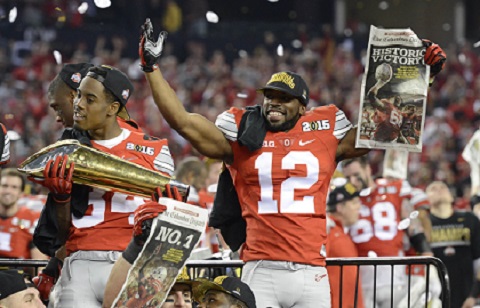
October 26, 1936, 80 years ago: The Ohio State University Marching Band first performs their
Script Ohio formation. It is based on the sign at the Loew's Ohio Theatre in downtown Columbus, although the capital O now resembles the block O in Ohio State's logos.
At the conclusion of the formation, the drum major leads a sousaphone player to the top of the lower case i in "Ohio," and he "dots the i." This is considered the highest honor at Ohio State. Honorary i-dotters have included former Ohio State football coach Woody Hayes, and such prominent Ohio natives as Bob Hope, golfer Jack Nicklaus, Heavyweight Champion James "Buster" Douglas, and astronauts and Senator John Glenn.
October 26, 1938: For the 1st time, an ice hockey match is televised. Oddly, this does not occur in Canada, or in America, or in any of the European nations that we now associate with the game, such as Russia or Sweden. It is in England, on the BBC, between Harringay Racers of North London and Streatham Redskins of South London. The broadcaster, at least, was a Canadian: Winnipeg-born Stuart MacPherson.
I don't have a record of the result, although Harringay won the English National League the preceding season, 1937-38, and Streatham had won it in 1934-35. Harringay folded in 1957, and have since been replaced by a new team using the name. Streatham are still in business.
In 1940, New York station W2XBS (forerunner of WNBC-Channel 4) would become the 1st TV station to broadcast an NHL game, a 6-2 New York Rangers win over the Montreal Canadiens at the old Madison Square Garden. Just 3 days after that, they would broadcast the 1st televised basketball game, also at the old Garden. That station had already broadcast the 1st baseball, college football and NFL games on television, all in New York in 1939: At Ebbets Field, Columbia University's Baker Field, and the Polo Grounds, respectively.
In 1952, CBC would bring
Hockey Night In Canada from radio to TV, and it quickly became, and remains, Canada's favourite (that's how it's "spelt" up there) TV show. But the U.S. -- ABC/ESPN, NBC and Fox have all tried -- has never really gotten hockey broadcasts right. "Glow puck," anyone?
October 26, 1939: William Stevenson (no middle name) is born in Leith, Scotland. A left back, Willie Stevenson was part of Liverpool FC's Scottish connection in the 1960s, which also included manager Bill Shankly. With him, they won the League in 1964 and 1966 and the FA Cup in 1965.
In 1974, he played for the original Vancouver Whitecaps of the old North American Soccer League. He closed his career with Macclesfield Town, and still lives in Macclesfield, retired from running a contract cleaning company.
*
October 26, 1940: Detroit Tigers outfielder Hank Greenberg is named the Most Valuable Player of the American League. Greenberg won the MVP honors in 1935 as a 1st baseman, but this season has played mostly left field, as another big slugger, Rudy York, is being tried at 1st, and there is no designated hitter at which to put either one.
Greenberg will soon become the 1st big-name player to enlist in the U.S. armed forces in anticipation of World War II, and when he returns in 1945, York has gone to Boston, and Greenberg plays the rest of his career at his former position of 1st base. Nevertheless, he is the 1st player to win MVP awards while playing at 2 different positions. He has since been joined only by Robin Yount (shortstop and center field) and Alex Rodriguez (shortstop and 3rd base). No National League player has yet accomplished the feat.
October 26, 1946, 70 years ago: Columnist Westbrook Pegler, writing for the Hearst Corporation's papers including the New York Journal American, writes a critical piece about the off-field relationship between Dodger manager Leo Durocher‚ actor George Raft and well-known gamblers. This is the first of a number of articles that will lead up to the suspension of Durocher for the 1947 season.
Pegler was an alcoholic and a lunatic, who had already called for the assassination of President Franklin D. Roosevelt, and one of his last public acts would be to do the same for Robert Kennedy, which happened. Eventually, he couldn't be hired by anyone except the John Birch Society -- the Tea Party/Trump fans of their day -- and, finally, even they fired him for being too extreme. But, in the case of Durocher, and in a few others, Pegler turned out to be right.
The recent movie 42, about Jackie Robinson and his introduction to the white major leagues, suggested that Durocher was actually suspended by Commissioner A.B. "Happy" Chandler because the local Catholic Youth Organization (CYO) was threatening to boycott the Dodgers due to Durocher's affair with actress Laraine Day (whom he married as soon as his divorce from his current wife became final).
Another factor is that, while Durocher was associating with known gamblers (big mistake), and didn't think it should be considered a big deal (bigger mistake, at least as far as his baseball career was concerned), he suggested that Yankee co-owner Larry MacPhail was doing the same, and accused Chandler of a double standard: Durocher was being targeted for it, while MacPhail was getting away with it.
Whatever the truth about MacPhail may have been (certainly, with co-owner Del Webb's Mob ties, it's possible), Durocher was suspended for what Chandler called "conduct detrimental to the game."
He would return for the 1948 season, then, when Mel Ott was fired as manager of the Dodgers' arch-rivals, the New York Giants, they offered Durocher the job, and he jumped ship -- making him the most-hated figure in the history of Dodger fandom, a traitor, a turncoat. Sort of like Sol Campbell going from Tottenham captain to Arsenal star -- if, that is, the Dodgers had been pushing Durocher out, which they hadn't. So it's more like Roger Clemens going from the Red Sox to the Yankees -- if Clemens hadn't spent 2 years in Toronto in between.
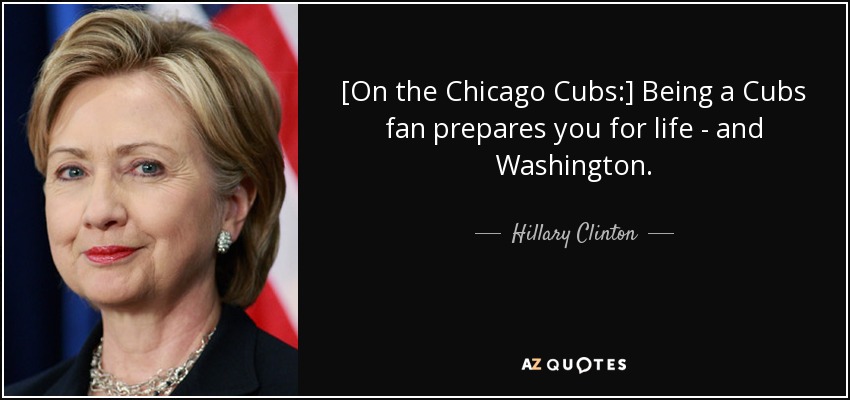
October 26, 1947: Hillary Diane Rodham is born in Chicago, and grows up in the nearby suburb of Park Ridge. And, yes, growing up, she was a Cub fan. In 1994, then First Lady, Hillary Clinton was invited to throw out the ceremonial first ball on Opening Day at Wrigley Field.
I knew she was never really a Yankee Fan. But then, Michael Bloomberg was honest about having been a Red Sox fan, and I'd sooner trust Hillary to be Mayor of New York, let alone President. Of course, we still have White Sox fan Barack Obama for another 3 months.
Donald Trump claims to be a Yankee Fan. Can't we trade him?
October 26, 1948: Colbert Dale Harrah is born in Sissonville, West Virginia. An All-Star 3rd baseman for the Texas Rangers and the Cleveland Indians, Toby Harrah was the last active player who had been a member of the Washington Senators, the team that moved to become the Rangers in 1972.
Next-to-last was his former Ranger teammate Jeff Burroughs, and together, with players like Mike Hargrove and Ferguson Jenkins, managed by Billy Martin, they finished 2nd in 1974, the best finish the Senators/Rangers franchise had yet had in 14 years of existence. They wouldn't win the AL West until 1994 – ironically, after Harrah's brief tenure as Rangers manager had ended.
In 1976, despite playing both games at shortstop, he went through an entire doubleheader without a single fielding chance. Despite this, he was generally regarded as a good defensive player, who also managed to hit 195 home runs despite being a middle infielder and playing his entire career in pitchers' parks: Arlington Stadium, Cleveland Municipal Stadium (the Rangers had traded him to the Indians for 3rd baseman Buddy Bell, a trade which worked out well for both teams, though neither is known for making good trades) and, for 1 season, in the old Yankee Stadium with its "Death Valley" in left and center making it hard on a righthanded hitter.
October 26, 1949: Stephen Douglas Rogers is born in Jefferson City, Missouri. No, not Captain America. This Steve Rogers plied his trade in Canada, as an All-Star pitcher for the Montreal Expos, and remains the all-time leader in several pitching categories for the franchise now known as the Washington Nationals.
Unfortunately, the furthest that franchise has ever gotten was a tie game in the 9th inning of the 5th and deciding Game of the 1981 NLCS, when Rogers, who had won Game 3 but was now pitching in relief on just 2 days rest, gave up a Pennant-winning home run to the Dodgers’ Rick Monday.
He deserves to be remembered for more than that, as he, not Randy Johnson or Pedro Martinez (neither of whom stayed in Montreal for very long) was the greatest pitcher in that franchise's history, and even if Stephen Strasburg does more for them than Rogers did in an Expo uniform, Rogers will still be the greatest pitcher the city of Montreal has ever had. (Former Dodgers manager and Montreal Royals lefty Tommy Lasorda may dispute that, but the Royals were the minors, the Expos – no matter how inept they sometimes were on the field and in the front office – were the majors.)
He was a 5-time All-Star, won 158 games in the major leagues, had a 3.17 ERA, and now lives not far from me, in West Windsor, New Jersey, employed by the players' union, the Major League Baseball Players Association.
*
October 26, 1950: Branch Rickey resigns as president of the Brooklyn Dodgers, and Walter O'Malley succeeds him. Rickey sells his 25 percent interest in the club for a reported $1.05 million. O'Malley had tried to push Rickey out, and got his chance when another partner died and his heirs wanted to sell his shares. O'Malley, in this as in everything else a money-grubbing bastard who didn’t care who he hurt in the process, tried to lowball Rickey, offering him only his original investment in the club, the $350,000 he had paid in 1942.
But Rickey and O'Malley, despite some stark differences, were more alike than either cared to admit. One way in which they were alike is that both were lawyers who knew all the tricks. Rickey knew that an agreement in the Dodger partnership said that if any of the partners got an offer for their shares, and another partner wanted to buy, that other partner had to match the offer. Rickey found someone willing to pony up a million, and so O'Malley had to pay through the nose: The $350,000 of '42 was worth $548,000 in inflation-adjusted dollars, while the $350,000 of '50 was worth just $223,000, so O'Malley was really offering Rickey a 57 percent loss. Instead, O'Malley had to pay Rickey a 92 percent profit.
Today, Rickey's original '42 investment is worth $5.2 million, O’Malley's '50 offer $3.5 million, and Rickey's $1.05 million becomes $10.5 million. In 1969, O'Malley admitted his holdings in the Dodgers were worth $24 million, which is $158 million in 2016 dollars.
At his death in 1979, at which point son Peter became owner, they were said to be worth $50 million, or today's $166 million. When Peter sold the Dodgers in 1997, it was for $311 million, or today's $468 million. When Magic Johnson bought the Dodger franchise, including Dodger Stadium, in 2012, the price was rumored to be about $2 billion.
Also on this day, Marcus Wayne Garland is born in Nashville. Dropping his first name, and not entering his hometown's leading industry -- although Mark Garland would have been a good name for a country singer -- Wayne Garland went 20-7 for the Baltimore Orioles in 1976, and looked like he would be one of the top pitchers in baseball over the next few years.
That Autumn, in the 1st free agent market, the Cleveland Indians offered him a 10-year contract for $230,000 a year -- a big one for the time. But in Spring Training the next year, he tore his rotator cuff, and, wanting to live up to the contract, he tried to pitch through it. He was released after just 5 years, having gone 28-48 for the Indians, for a career record of 55-66. He later served as a minor-league manager, but remains, at age 66, the patron saint of big-contract pitchers who, for whatever reason (their own fault or, in his case, otherwise), don't pan out.
October 26, 1951: Desperate for money to pay a mounting tax bill, Joe Louis, who stood as Heavyweight Champion of the World longer than anyone (12 years, 1937-49) and defended the title more than anyone (25 times), climbs into the ring at the old Madison Square Garden for a purse of $300,000 – about $2.8 million in today's money. He fights Rocky Marciano, then a rising contender who idolized Louis. Rocky had told the press, "This is the last guy I want to fight." It had nothing to do with his own ability.
It is a mismatch: Marciano is 28, is in superb shape, and has a sledgehammer for a right hand; Louis is 37, struggles with his weight, and his arms and legs, once the fastest in the fight game despite his being a heavyweight, have terribly slowed. Marciano actually knocks Louis out of the ring in the 8th round.
Marciano goes back to his dressing room and cries over what he has done to his greatest hero, and even goes over to see him and says, "I'm sorry, Joe." Sugar Ray Robinson, then Middleweight Champion, was in Louis' dressing room to console him, and was also crying.
Eleven months later, Marciano will knock Jersey Joe Walcott out to become champion. Louis, still needing money, will humiliate himself as a professional wrestler, and not a very good one. Both men's lives will end badly: Marciano's in a plane crash in 1969, Louis' in a wheelchair, unable to pay his medical bills, with Frank Sinatra hosting a benefit concert for him in Las Vegas in 1978, which keeps Louis afloat until he finally passes away in 1981.
As a Sergeant in the U.S. Army in World War II, he is laid to rest at Arlington National Cemetery, on the order of President Ronald Reagan, and with Sinatra delivering the eulogy.
October 26, 1952: The Philadelphia Eagles beat the New York Giants 14-10. According to newspaper accounts, Norm Willey, a 24-year-old defensive end from West Virginia, tackled Giants quarterback Charlie Conerly behind the line of scrimmage 17 times. The term "sack" hadn't yet been used to describe such a play. It would be years before Los Angeles Rams defensive end Deacon Jones came up with the term.
There appears to be no surviving film of this game, but Hugh Brown of the Philadelphia newspaper
The Evening Bulletin wrote, "Willey awed inhabitants of the Polo Grounds by dumping New York Giants quarterback Charlie Conerly 17 times as he attempted to pass."
Since passing ahead of the line of scrimmage is illegal, those 17 attempts could only have happened behind it -- therefore, they were sacks. So unless Brown got it really wrong, "Wild Man" Willey sacked Conerly 17 times. In one game. To paraphrase a later Philly sports legend, "Not a season, not a season, not a season: We talkin' 'bout a
game."
Willey wasn't huge, not even by the standards of his time: He was 6-foot-2 and 224 pounds. He must have been fast, though. He played from 1950 to 1957, a time when seasons were 12 games long, and he appears to have gotten 20 to 30 sacks a season.
Officially, the single-game record is 7, by Derrick Thomas of the Kansas City Chiefs in 1990; and the single-season record is 22 1/2, by Michael Strahan of the Giants in 2001. If Brown was even half-off with his account, Thomas' record goes by the wayside, and Strahan's record may be wrong as well.
Willey played for the Eagles from 1950 to 1957. He remained in the Philadelphia area, coaching at Pennsville Memorial High School in Salem County, on the New Jersey end of the Delaware Memorial Bridge. He died in 2011, outliving Thomas, a victim of a car crash.
October 26, 1957: The Cincinnati Royals play their 1st regular-season
game after moving from Rochester. They beat the Syracuse Nationals 110-100 at the Cincinnati Gardens.
Despite having future Hall-of-Famers in Oscar Robertson, Jerry Lucas and Jack Twyman, they never won a title, only getting as far as the 1963 and 1964 NBA Eastern Conference Finals.
In 1972, they moved again, to Kansas City. Since that city already had a baseball team named the Royals, they didn't want to make the same mistake that the NFL's Chicago Cardinals made when they moved to St. Louis, so they changed the name but kept the royalty theme, and became the Kansas City Kings. In 1985, they moved again, and became the Sacramento Kings.
Being small markets, neither Rochester, nor Cincinnati, nor Kansas City has ever regained an NBA team.
Also on this day, Robert Perry Golic is born in Cleveland. An Ohio State Champion wrestler at Cleveland's St. Joseph’s High School, Bob Golic played defensive tackle for his hometown Browns, and was a member of the team that lost back-to-back AFC Championship Games to the Denver Broncos in the 1986 and '87 seasons.
He and his brother Mike Golic, also a former NFL player, are both hosts of sports-talk shows on radio (although not together), and while Mike does NurtiSystem commercials that show him losing 50 pounds, Bob, using a different diet, lost 140, and is back to his high-school weight of 245 pounds.
*
October 26, 1963: Natalie Anne Merchant is born in Jamestown, New York. She was the lead singer of 10,000 Maniacs -- not to be confused with a capoultra, who leads "Ultra" groups in European soccer.
October 26, 1966, 50 years ago: Jeanne Zelasko is born in Cincinnati. She was the host of Fox’s baseball pregame shows from 2001 until its cancellation in 2008, twice taking time off to have children. She now works for MLB Network. She is also a survivor of thyroid cancer.
A lot of baseball fans don't like her, but I do. She knows the game and is a very good interviewer. But at the 2005 All-Star Game in Detroit, she wore an orange dress, to match the host Tigers' colors. She was pregnant at the time, and orange is not a good color for a maternity dress. But she still did her job well that night, and it certainly wasn't as poor a choice as the night Hannah Storm, working the 1997 NBA Finals for NBC, did an interview with Dennis Rodman, exposing her unborn child to his weirdness. (As far as I know, both of the children in question are okay.)
October 26, 1967: Keith Lionel Urban is born in Whangerei, New Zealand. At age 6, he moved with his family to Australia, and is an Australian citizen. Eventually, he moved to America and became a country singer. He is married to fellow Australian-American Nicole Kidman, which makes him not just a member but an officer of the Lucky Bastards Club.
A lot of people were very upset at country singer Garth Brooks for his "side project," The Legend of Chris Gaines, in which Brooks "played" Gaines, including doing concerts and TV appearances in character. I liked the idea -- but then, I wasn't find of Brooks' regular persona. I am now convinced that the Gaines character is based on Urban: Gaines, too, was born in 1967 (making him 5 years younger than his portrayer), was born in Australia but grew up in Los Angeles, and dealt with substance abuse at the height of his fame.
October 26, 1968: At the Arsenal Stadium, a.k.a. Highbury, in North London, host Arsenal and visiting East London club West Ham United play to a 0-0 tie. Despite the presence of such great players as Arsenal's Bob Wilson, Frank McLintock, George Armstrong, George Graham and John Radford; and West Ham's Bobby Moore, Geoff Hurst and Martin Peters, there isn't much action on the field.
There is, however, action in the stands. West Ham hooligans entered the North Bank, home of Arsenal's most vociferous fans, and "take" it, fighting hard enough that they had to be forced to stay. Despite the claims of other "firms" -- North London arch-rivals Tottenham Hotspur and their unforgivably-named Yid Army, West London's Chelsea and their Headhunters, Manchester United and their London-based Cockney Reds -- it is the only time any opposing firm took the North Bank.
*
October 26, 1970: Muhammad Ali returns to the ring, 3 1/2 years after his boxing license was suspended and his Heavyweight Championship stripped upon his refusal to be inducted into the U.S. Army.
Ironically, the 1st State willing to license Ali was the State that, historically, has been the de facto capital of the South, Georgia. Ali extended challenges to all of the top 10 contenders for the title, including the man who now held the belt, Joe Frazier. The only one who said yes was Jerry Quarry, an Irish Southern Californian who had beaten Floyd Patterson but lost to Frazier.
The fight was held at the City Auditorium in Atlanta, and Ali was definitely rusty. Quarry fought well in the 1st 2 rounds, but in the 3rd, Ali cut him over his eye. The referee was too concerned to let the fight continue.
Two years later, they fought again in Las Vegas. This time, Light Heavyweight Champion Bob Foster knocked Quarry's brother Mike out on the undercard, and then, again, Quarry fought hard before getting cut over the eye, this time in the 6th round, and the referee stopped the fight and awarded Ali a TKO. Both times, Quarry told the media that he could have gone on.
Quarry was one of many athletes who had more courage than sense, and one of many boxers who lost their money, and as a result kept fighting far too long. He suffered from dementia pugilistica, and died in 1999, only 53 years old.
October 26, 1973: On the day the Yom Kippur War ends, bringing a cease-fire between Israel and its Arab neighbors, the Boston Red Sox trade pitcher Ken Tatum and outfielder Reggie Smith to the Cardinals for pitcher Rick Wise and outfielder Bernie Carbo.
This could have been one of those rare trades that worked out for both teams: Wise was the leading winner on the Sox rotation that won the 1975 AL Pennant, and Carbo hit a key home run in that year's World Series; while Smith hit 314 career home runs – 2nd all-time among switch-hitters behind Mickey Mantle at the time of his retirement – and helped his team win 3 Pennants and a World Series.
The problem was that, just as the Cards gave up on Steve Carlton too soon, trading him to the Phillies for Wise, and gave up on Jerry Reuss too soon, sending him to the Dodgers, and now give up on Wise too soon, they will later give up on Smith too soon, trading him to the Dodgers, where he and Reuss will team up on the team that dominates the NL West from 1977 to 1988.
Also on this day, Austin Sean Healey is born in Wallasey, Cheshire, England. He has no connection to the British car brand Austin-Healey. The rugby player starred for the Leicester Tigers, and played for England in the 1999 Rugby World Cup. He was an outspoken player, known as the Leicester Lip, and has been a commentator on the sport for the BBC since before his retirement.
October 26, 1974: The Richfield Coliseum opens in Richfield, Ohio. The location was chosen because it was about halfway between the downtowns of Cleveland and Akron. This was a very stupid thing to do.
It was home to the NBA's Cavaliers from 1974 to 1994, the World Hockey Association's Crusdaders from 1974 to 1976, the NHL's Barons from 1976 to 1978, the Major Indoor Soccer League's Cleveland Force from 1978 to 1988, their successors the Cleveland Crunch from 1989 to 1992, and the International Hockey League's Cleveland Lumberjacks from 1992 to 1994.
In 1975, Muhammad Ali had his 1st defense of his regained Heavyweight Championship of the World there, surprisingly getting knocked down by Chuck Wepner before flooring the otherwise overmatched "Bayonne Bleeder" in the 15th and final round. This fight inspired Sylvester Stallone to write
Rocky.
The location was terrible, and the Cavs could never fill its 20,000 seats, so the Gateway (now Quicken Loans) Arena was built downtown. The Coliseum was demolished in 1999, and the site is now part of a National Forest.
October 26, 1975: Baltimore's last major league (or so-to-speak) basketball team folds, before it can ever play a regular-season game.
ABA Commissioner Dave DeBusschere, just a year removed from a Hall of Fame playing career, got word that one of the Baltimore Claws' banks had yanked its line of credit. Double D responded with an ultimatum: Deposit $500,000 with the league as a "performance bond" within 4 days to cover expenses, or be shut down. The Claws got together half of the money, but could not raise the rest. Reportedly, the remaining money, plus an additional $70,000, was being held in escrow by the city, to be released only if team president David Cohan resigned.
The ABA disbanded the Claws less than a week before the regular season began. It issued a statement noting that it had been prepared to enter the 1975-76 season with 9 solid teams and had given the Baltimore group extra time to get its affairs in order, but that the Claws had failed to do so. The Claws' office at the Baltimore Civic Center was locked up by arena management due to unpaid bills.
The Claws threatened to seek an injunction delaying the start of the season until the Claws were reinstated, citing a provision in the rules requiring 10 days notice before any team could be shuttered. However, after the league and the city threatened to file their own legal actions, the Claws gave up the ghost and folded.
Built in 1962, the Civic Center still stands, as the Royal Farms Arena. Baltimore would like to try to get back into the NBA, but that won't happen unless they can get a new arena, and condemn the downtown auditorium that hosted the NBA's Bullets, several minor-league hockey teams, Elvis and the Beatles to oblivion.
October 26, 1976, 40 years ago: Miikka Sakari Kiprusoff is born in Turku, Finland. He was the goaltender for the Calgary Flames, nearly helping them win the 2004 Stanley Cup with some amazing saves in the Playoffs. He is now a spokesman for the Rainbow Society, a Canadian version of the Make-a-Wish Foundation. His brother Marko also played in the NHL.
October 26, 1980: Christian Eugen Chivu is born in Reșița, Romania. A left back, he won league titles with Ajax Amsterdam in 2002, and with Internazionale Milano in 2008, 2009 and 2010; national cups with Ajax in 2002 (a Double), AS Roma in 2007, and Inter in 2010 (a Double) and 2011; and the UEFA Champions League in 2010 (Italy's only "European Treble" to date -- for all their achievements, neither AC Milan nor Juventus have done it).
He played for Romania in Euro 2000 and Euro 2008, but never in the World Cup. He retired after the 2014 season.
October 26, 1983: Francisco Liriano is born in San Cristobal, Dominican Republic. The Minnesota Twins' lefthander reached the All-Star team in 2006 aged just 22, but an elbow injury has hampered his career ever since. He pitched a no-hitter in 2011. He now pitches for the Toronto Blue Jays.
His career record is 96-92, and he has reached the Playoffs with the Twins in 2009 and '10; the Pittsburgh Pirates in 2013, '14 and '15; and the Blue Jays this season -- 4 straight seasons, and 6 of the last 8.
October 26, 1984: Michael Jordan makes his NBA debut. He scores 16 points and has 11 assists, and is outscored by 3 Chicago Bulls teammates: Orlando Woolridge with 28, Quintin Dailey with 25 and Steve Johnson with 18. The Bulls beat the Washington Bullets, 109-93 at Chicago Stadium.
Also on this day, Alexandra Pauline Cohen is born in Los Angeles. Of Russian-Jewish descent, "Sasha" Cohen won a Silver Medal in figure skating at the 2006 Winter Olympics, and has since become an actress.
She is definitely not to be confused with the also-Jewish British actor Sacha Baron Cohen, a.k.a. Ali G, Borat, Bruno, and Admiral General Hafez Aladeen. Unlike Sacha Baron Cohen, Sasha Cohen has class.
Also on this day, Adriano Correia Claro is born in Curitiba, Paraná, Brazil. Known simply as Adriano, the midfielder led hometown club Coritiba to the Paraná state championship in 2003 and 2004. He went to Spain, and won the Copa del Rey (King's Cup) with Sevilla in 2007 and '10, and with Barcelona in 2012, '15 and '16. He won the UEFA Cup with Sevilla in 2006 and '07. With Barcelona, he won La Liga in 2011, '13, '15 and '16, and the UEFA Champions League in 2011 and '15.
Despite helping Brazil win the 2004 Copa América, he has never represented his country in the World Cup. He now plays in Istanbul, Turkey, for Beşiktaş.
Also on this day, Jefferson Agustín Farfán Guadalupe is born in Lima, Peru. Known professionally as Jefferson Farfán, the forward led hometown club Alianza Lima to the Peruvian League title in 2001 and '03; PSV Eindhoven to the Dutch league (Eredivisie) title in 2005, '07, '07 and '08; PSV to the Dutch Cup (KNVB Beker) in 2005; and Schalke to the German Cup (DFB-Pokal) in 2011.
He is currently a free agent, and has never appeared in a World Cup for Peru.
Also on this day, Gus Mancuso dies in Houston of emphysema. He was 78. A catcher, he was a 2-time All-Star who won National League Pennants with the 1930 and 1931 St. Louis Cardinals, and with the 1933, 1936 and 1937 New York Giants, winning the World Series in 1931 and 1933. He is a member of the Texas and National Italian American Sports Halls of Fame.
*
October 26, 1985: Time travel is first demonstrated at the Twin Pines Mall (or is that the Lone Pine Mall?) in Hill Valley, California -- or, rather, is dramatized in the film Back to the Future.
The demonstration by Dr. Emmett Brown (Christopher Lloyd) and Marty McFly (Michael J. Fox) was actually filmed at the Puente Hills Mall in City of Industry, California, about 20 miles east of downtown Los Angeles. Most of the trilogy's scenes were filmed in Los Angeles County, although the Courthouse Square area was a movie set that, for whatever reason, has frequently been struck, not by lightning, but by fire.
Just before the terrorist attack that forces Marty to get in the DeLorean and accidentally get sent back to 1955, Doc Brown tells Marty that he's going 25 years into the future: "I'll get to see who wins the next 25 World Series! Wouldn't that be a nice gift to have for my old age!"
For the record, due to the Strike of '94, he would have gotten to see only 24, won by the following teams: The Kansas City Royals, the New York Mets, the Minnesota Twins, the Los Angeles Dodgers, the Oakland Athletics, the Cincinnati Reds, the Twins again, the Toronto Blue Jays, the Jays again, the Atlanta Braves, the New York Yankees, the Florida Marlins, the Yankees again, the Yankees again, the Yankees again, the Arizona Diamondbacks, the Anaheim Angels, the Marlins again, the Boston Red Sox, the Chicago White Sox, the St. Louis Cardinals, the Red Sox again, the Philadelphia Phillies, and the Yankees again.
But in the 2nd film, partially set 30 years in the future -- on October 21, 2015, now 5 days in our past -- Marty sees that the Chicago Cubs have won the World Series, beating a Miami-based team whose logo is an alligator. (This turned out to be impossible, not just because the Cubs didn't show up against the Mets in the 2015 National League Championship Series, but because MLB put the Cubs and the Miami team, which was instead named the Marlins, in the same League.)
This inspires him to buy a sports almanac that he can take back to 1985, so he can know the results beforehand and bet on them: "I can't lose!" Doc warns Marty about how dangerous that can be, and convinces Marty to throw the almanac out.
But the film's antagonist, Biff Tannen (Thomas F. Wilson), picks up the thrown-out almanac, takes it with him, steals the DeLorean, and demonstrates that the Doc was right: Placing bets using the almanac, Young Biff, with Old Biff's assistance, unwittingly creates an alternate reality where Hill Valley is a mini-Las Vegas, and Middle-Aged Biff is a cross between Fat Elvis and Tony Soprano, with a hairstyle that brings to mind Donald Trump -- except, unlike Trump, Biff actually makes money running a casino.
And, apparently having gotten connections to Richard Nixon, Biff has even gotten the 22nd Amendment repealed, so that Nixon is running for a 5th term as President.A tip of the hat to Watchmen, perhaps? No: In that story, whose "present" is September 1985, Nixon used Dr. Manhattan to win the Vietnam War in 1970; in this one, a newspaper headline reads "Vows to end Vietnam War by 1985." This situation is remedied at the end of the 2nd film: The newspaper changes to read, "Reagan to seek 2nd term, Vows to balance budget by 1985." (That didn't happen in real life.)
And yet, maybe the movie was only off by a year: The Cubs reached the NLCS in 2015, and reached the World Series in 2016!
Perhaps Marty should have warned the Cardinals about what was going to happen in Game 6 of the 1985 World Series, starting at Royals Stadium (now Kauffman Stadium) in Kansas City, about 19 hours after his trip back into time.
The Cards lead the cross-State Royals 1-0, and need just 3 more outs to win the World Series. Jorge Orta hits a ground ball to 1st baseman Jack Clark. Clark flips to reliever Todd Worrell, who is covering the base. Orta is unquestionably out. The instant replay cameras and the photograph above confirm this. Except 1st base umpire Don Denkinger blows the call, and calls Orta safe.
The next batter, Steve Balboni, pops up, and Clark can’t handle it, and Balboni singles on his next swing. A passed ball by Darrell Porter, a Royal postseason hero from 1980 but now the Cardinal catcher (having been their postseason hero in 1982), makes it men on 2nd and 3rd, and Hal McRae is intentionally walked. Dane Iorg steps up, and singles home Orta and Balboni, and the Royals have a 2-1 walkoff win to force a Game 7 at home.
The Cardinals are furious. So are their fans. Understandably so. They all think Denkinger stole the World Series from them. They still think so, 31 years later.
There's just one problem with this theory: There was still 1 game to go. If the Cardinals had won Game 7, Denkinger's blown call would have been just a footnote.
So Cardinal manager Whitey Herzog should have taken his team into the clubhouse and said, "Men, we got screwed tonight, but there's nothing we can do about it now. So let's win this thing tomorrow, and what happened tonight won't matter." Instead, the White Rat whined about the call to the media, and let it get into his head, and into his team's heads.
The shock isn't that the Cards lost Game 7 by a whopping 11-0. The shock is that the Royals won it by only 11 runs. It is the biggest blowout in Game 7 history, previously reached only by, oddly enough, the Cardinals, when they beat the Detroit Tigers in 1934 (the Joe Medwick Game).
In 2015, someone did a "Win Expectation" study of that game. Before the swing, the Cardinals had an 81 percent chance of winning the game -- meaning a 1 in 5 chance of losing. That's hardly ridiculous. If the right call had been made, giving the Cardinals an out, they would have had an 89 percent chance -- a 1 in 11 chance of losing, still not outrageous for the Royals to have come from behind to win. Even with the call blown, the Cards had a 67 percent chance -- a 2/3rds chance. They still should have won it.
Don Denkinger was still respected enough by the baseball establishment to be put behind the plate for the 1987 All-Star Game, and named crew chief for the 1988 American League Championship Series, the 1991 World Series, and the 1992 ALCS, before retiring in 1998 after 30 season in the majors, 22 as a crew chief. He is now 80 years old, and still lives in his hometown of Cedar Falls, Iowa.
The Cardinals have since won 3 World Series. For those among their fans who have not yet done so, it's time to move on.
On the same day of the real-life World Series umpiring miscue and the fictional time-travel experiment, the Montreal Canadiens pay tribute to one of their 1950s heroes, retiring the Number 2 of Hall of Fame defenseman Doug Harvey. They beat the Hartford Whalers, 5-3 at the Montreal Forum.
Also on this day, Monta Ellis (no middle name, and that's pronounced Mon-TAY) is born in Jackson, Mississippi. A guard for the Golden State Warriors, "the Mississippi Missile" was named the NBA’s Most Improved Player in 2007. He now plays for the Indiana Pacers.
Also on this day, Andrea Bargnani is born in Rome. A center, he starred in his native Italy before coming to America and playing for the Toronto Raptors, the Knicks and the Nets. He now plays in Spain.
Also on this day, Kieran Read is born in Papakura, New Zealand. This past April, he was appointed the Captain of their national rugby team, the world-famous All Blacks. He was part of their 2011 and 2015 Rugby World Cup winners, and plays his club rugby for Crusaders, based in the national capital of Christchurch.
October 26, 1986, 30 years ago: Jackson Scholz dies in Delray Beach, Florida at age 89. In 1920, he was part of an American relay team that won a Gold Medal at the Olympics in Antwerp, Belgium. In 1924, he won another Gold Medal in Paris, in the 200 meters.
But he's best remembered for a race he lost, the 100 meters in 1924, defeated by British runner Harold Abrahams. This was depicted in the 1981 film
Chariots of Fire, which won the Academy Award for Best Picture. Scholz was played by Brad Davis, Abrahams by Ben Cross. As part of American Express' promotions for the 1984 Olympics in Los Angeles, Scholz and Cross did one of AmEx's "Do you know me?" commercials.
Also on this day, Jakub Rzeźniczak is born in Łódź (pronounced "wootz"), Poland. A centreback, he is the Captain of Poland's leading sports team, Legia Warsaw, the former Polish Army soccer club, which celebrated its Centennial this year.
Rzeźniczak has won the Polish League, the Ekstraklasa, with "The Legion" in 2006, 2013, 2014 and 2016; and the Polish Cup (Puchar Polski w piłce nożnej) in 2008, 2011, 2012, 2013 (a Double), 2015 and 2016 (another Double). Oddly, he has never represented Poland in a major tournament, not even in 2012 when it shared hosting duties for Euro 2012 with Ukraine.
*
October 26, 1991, 25 years ago: Game 6 of the World Series. The Minnesota Twins even the Series at 3 games each with a 4-3 win over the Atlanta Braves, thanks to Kirby Puckett's great catch and his dramatic home run in the bottom half of the 11th inning. What has been shaping up as one of the best World Series ever will go to a Game 7 that will be worthy of it.
October 26, 1993: Shaquille O'Neal releases his 1st recording, the rap album Shaq Diesel. The album sells over a million copies, and the single "(I Know I Got) Skillz" reaches Number 35 on the Billboard magazine Hot 100.
Shaq later went into acting. However, he was wise to not quit his "day job."
October 26, 1995: The KeyArena opens at the Seattle Center complex, taking the place of the Seattle Center Coliseum. The Seattle SuperSonics make the NBA Finals in their 1st season there, but are moved to Oklahoma City in 2008. It is still home to the WNBA's Seattle Storm and the basketball teams of Seattle University. But it will have to be replaced -- or, be a stopgap facility while a new arena is constructed -- for a new NBA team or an NHL team coming to Seattle.
October 26, 1997: Game 7 of the World Series at whatever the combined Marlins-Dolphins stadium in the Miami suburbs was called at the time. The Cleveland Indians jump out to a 2-0 lead over Florida‚ and are just 2 outs away from winning their 1st World Series in 49 years.
But Jose Mesa, not for the first time nor for the last, blows the save, and the Marlins claw their way back and tie the score in the bottom of the 9th on a sacrifice fly by Craig Counsell. In the last half of the 11th‚ Edgar Renteria gets his 3rd hit of the game‚ driving home Counsell with the winning run‚ as Florida wins Game 7 by a score of 3-2.
This was, after 1962, only the 2nd World Series where neither team won back-to-back games: The Marlins won Games 1, 3, 5 and 7; the Indians won Games 2, 4 and 6. This was also the Series with the greatest extremes of weather: The 4 games in South Florida were the 4 warmest on record for Series games, while the 3 in Cleveland were 3 of the 4 coldest (the previous coldest, in New York in 1976, remains 3rd), and Game 4 is the only Series game to be played in a snowfall except for one in Chicago in 1906.
The Marlins, in just their 4th season of existence (as opposed to the Indians, in their 97th), thus become the fastest team in baseball history to win a World Series title‚ 3 years quicker than the 1969 Mets. Livan Hernandez, the pitcher who fled Cuba (and would soon be followed by his brother Orlando "El Duque" Hernandez) is named Most Valuable Player of the Series.
This Series is sweet vindication for manager Jim Leyland, who lost 3 straight NLCS while managing the Pittsburgh Pirates; for Bobby Bonilla, who played for Leyland on those Pirates, bad-attituded his way out of his native New York with the Mets, and flopped the year before with the Baltimore Orioles; for Alex Fernandez, who pitched for the talented Chicago White Sox team that fell just short in 1990, lost the ALCS in ’93 and was screwed over by the strike in ’94, and was injured and unable to pitch in the postseason, so his teammates put his Number 32 on their caps; and for Gary Sheffield, who was already gaining a reputation as a bad apple that nobody wanted to keep around for very long, despite his obvious talent for power hitting, and this remained his only World Series win.
For the Indians, who hadn't won a Series since 1948, went from 1954 to 1995 without winning a Pennant, went from 1959 to 1994 without even being in a Pennant race, stood to be the AL's Wild Card if the standings at the time of the Strike of '94 had held to the end of the season, lost the ’95 Series despite winning 100 of 144 games in the regular season, lost the '96 ALDS to an inferior Oriole team, and won just 86 games in this regular season but had defeated the favored Yankees and the Seattle Mariners before this crushing defeat, it is not just a crushing defeat, where they came closer to winning the World Series without doing so than any team ever had except the ’86 Red Sox (and now the 2011 Texas Rangers).
No, this loss meant that, like the Red Sox, the Indians now have a reputation of being a choking team. They have never shaken it, despite return trips to the postseason in 1998, '99, 2001 and '07 – blowing a 2-1 lead in the '98 ALCS and a 3-1 lead in the '07 ALCS.
Tonight, the Indians are hosting Game 2 of the World Series, having won Game 1 6-0 over the Chicago Cubs. We shall see.
Also on this day, D.C. United wins its 2nd MLS Cup, in the league's 2nd season, beating the Denver-based Colorado Rapids, 2-1 on home soil at Robert F. Kennedy Stadium in Washington. Jaime Moreno and Tony Sanneh score the goals.
October 26, 1999: Game 3 of the World Series. Andy Pettitte did not have his good stuff, but Tino Martinez, Chad Curtis and Chuck Knoblauch helped the Yankees come from 5-1 down to send the game to extra innings. Curtis led off the bottom of the 10th, and knocked one out for a 6-5 win.
The Yanks wrapped up the sweep, the 25th World Championship, the title of Team of the Decade (it ain't about Division Titles, Braves fans), and the title, as NBC's Bob Costas said that next night, of "Most Successful Franchise of the Century."
*
October 26, 2000: Game 5 of the World Series at Shea Stadium. Jeter and Bernie Williams homered off Al Leiter. Pettitte and Leiter gave it their all. The game was tied 2-2 in the top of the 9th. Two outs. Posada on 2nd, Scott Brosius on 1st. Not great speed on the basepaths. Luis Sojo, playing 2nd base because Knoblauch's fielding difficulties limited him to DH status, was coming up to bat. Leiter had thrown 141 pitches. A number that would not have caused Catfish Hunter and Tom Seaver to flinch, but by the standards of the 1990s and 2000s, a lot.
Met Manager Bobby Valentine's choices were not good: A, stick with an exhausted Leiter, who would be pitching on brains, courage and fumes, and pray that he gets the out that sends it to the bottom of the 9th still tied; B, put in Armando Benitez, who led the National League in saves that year and saved Game 3, but also blew Game 1 for Leiter and also blew a Division Series game against the Giants (which the Mets ended up winning anyway), and had previously messed up 2 ALCS games against the Yankees for the Orioles (including the Jeffrey Maier Game); or C, put in John Franco, who was the winning pitcher in Game 3 and also pitched well in Game 4, but would be pitching for the 3rd day in a row, and was 39, and there was a reason Valentine had taken the closer's job from Franco and given it to Benitez.
Valentine decided a tired Leiter was better than an aging, potentially tired Franco and an inconsistent, unreliable Benitez. Although I frequently accused Valentine of overmanaging, and sometimes outright stupidity, I can't fault him for this choice. If he had put in the very popular New York native Franco and lost anyway, he might have gotten away with it; but if he had put in the already suspicious Benitez and he blew yet another, Valentine would have been run out of Flushing on the Long Island Railroad.
Leiter threw his 142nd pitch to Sojo. He knocked it up the middle. A Met fan once told me that Rey Ordonez would have stopped this grounder. This Met fan was a fool: Ordonez would not have gotten it. Mike Bordick was the shortstop that night, and he couldn't quite get it.
Base hit for Sojo. Posada came around 3rd. Center fielder Jay Payton's throw... never made it to Mike Piazza at the plate, instead hitting Posada in the back and getting away, toward the backstop. This enabled not only Posada to score the tiebreaking run by Brosius to score an insurance run as well. It was Yankees 4, Mets 2.
Bottom of the 9th. Two out. The Mets get a man on. Piazza comes up to the plate. If you're a Met fan, this is the man you want up: The best offensive player the Mets have ever had (cough-steroids-cough), one of the best fastball hitters of his time, power hitter against power pitcher, Mariano Rivera.
But if you're a Yankee Fan, there’s no one you'd rather have on the mound, and there's no one you’d rather get as the final out. It was similar to the final matchup of the 1978 Boston Tie Party, with Carl Yastrzemski, one of the greatest fastball hitters ever, and the most beloved player in his franchise's history (remember, Sox fans didn't always love Ted Williams), coming up to try to save his club against one of the fastest and most fearsome pitchers ever, Rich "Goose" Gossage.
Yaz popped up to end that game in victory for the Yankees; 22 years later, Piazza got considerably better wood on his pitch, and hit one deep to straightaway center field. For a moment, many of us, myself included, thought, "Uh-oh, no!" Translation: "Tie game, Mets will go on to win it, and take the next 2 in The Bronx, and the Yanks will have choked it away."
Because we had grown up with the Mets as the team that won and the Yanks as the team that fell short. We had the arrogance of Yankee Fans of old, but deep down, in places we don't like to talk about at parties, we had the fears that came so easily to fans of the Cubs, the Indians, the pre-2004 Red Sox, the pre-2007 Phillies -- and the post-2006 Mets.
But Piazza had juuuust gotten under it. The ball had too much height and not enough distance. Bernie stood on the warning track, it was an easy catch, and it was over.
Jeter became the first player ever to be named Most Valuable Player of the All-Star Game and the World Series in the same season. Still, he has never been named MVP of a regular season.
For the first time, the Mets had the chance -- their first, their best, maybe their last -- to beat the Yankees in a Subway Series, and to irrevocably "take over New York." And while they had their chances and fought hard, in the end, the better team won.
The Yankees have beaten the Mets in a World Series – the other way around has never happened. And it never will. Never, never, never. Or, in the words of Flushing’s own Fran Drescher, "It begins with an N and ends with an A: Nev-a." As a Yankee Fan said then, "The Yankees have scoreboard over the Mets for all time."
This was the 26th World Championship. And for those of us who grew up as Yankee Fans during the Mets' "glory" years of 1984 to 1990, the Dynasty That Never Was, and had to deal with the unearned arrogance of the Flushing Heathen, the filthy bastards, delusional that their 2 titles outweighed our 22 (until 1996; now 27), damn fools to believe that the 1986 Mets could have beaten the Yankees of 1927, 1938, 1941, 1953, 1961 and 1978, and eventually even the 1998 juggernaut... for us, this was the greatest, sweetest moment of them all.
We beat the Mets. And it wasn't close. All 5 games were close, but winning in 5 games is domination. And we clinched at their place, on their field, at the William A. Shea International Airport, at the Flushing Toilet.
This was the 13th World Series game played at Shea. An unlucky 13th. It was also the last, which no one (not even a wiseass Yankee Fan like me) could have predicted at the time.
There were 25,000 people at Shea chanting "Let's Go Yankees!" and "We're Number 1!" Eventually, the owner came out to talk to the press, and he and the announcers couldn't talk, because the Yankee Fans were so loud, chanting "Thank you, George!" Imagine that, thousands of people saluting George Steinbrenner at Shea Stadium.
I loved it. October 26, 2000 – actually, the final out came just before midnight, so it was really October 27 that we celebrated – remains my favorite moment as a sports fan.
To the Flushing Heathen: I'd tell you to go to hell, but you're already Met fans. So, instead, you and your 2 long-ago rings can kiss my Pinstriped ass. Or you can kiss my 27 rings, 7 of which came since your '69 title and 5 of which came after you got lucky in '86. Yes, you got lucky that the Red Sox had their choke of chokes against you in Game 6.
Sure, the Yankees have had luck. But they have earned all their victories. That's why every Yankee Fan can, on occasion, say the words of Yankee legend Lou Gehrig: "Today, I consider myself the luckiest man on the face of the Earth."
After all, we could have had worse luck, and it would have been all our own fault.
We could have chosen to be Met fans. We chose Yankees. We chose greatness.
*
October 26, 2002: Game 6 of the World Series, at what was then known as Edison International Field of Anaheim – the former "Big A" briefly nicknamed "the Big Ed." The San Francisco Giants lead the Series 3 games to 2, and lead 5-0 after 6½ innings, thanks to home runs by Shawon Dunston and Barry Bonds.
The Anaheim Angels score 3 runs in the 7th to make it 5-3, but the Giants are still just 9 outs away from their 1st World Championship since moving to San Francisco 45 years earlier, their 1st in any city since they were in New York 48 years earlier.
But they choke. The Angels, having already scored the 3 runs in the 7th, score 3 more in the 8th on a home run by Scott Spiezio, and win, 6-5. The Series will go to a Game 7 in Anaheim tomorrow night.
October 26, 2004: The Red Sox win Game 3 of the World Series with a 4-1 win over the St. Louis Cardinals at Busch Memorial Stadium. Finally making his first World Series start, Pedro Martinez hurls 7 shutout innings to put the Sox up 3-games-to-0. Manny Ramirez homers and drives in a pair of runs for the Sox‚ while Larry Walker hits one out for the Cards. The Sox can achieve their 86-year-old dream tomorrow night.
Also on this day, Bobby Ávila dies at age 79. A three-time All-Star, the 2nd baseman was not the first major league player born in Mexico – that was Red Sox outfielder Mel Almada in 1933, an outfielder who batted .284 over 7 seasons in the bigs – but he may have been the best, at least until Fernando Valenzuela came along, and the best hitter until Vinny Castilla arrived.
In 1954, despite a broken thumb, he won the AL batting title with a .341 average, and helped the Indians win the Pennant. But it was the NL's batting champion, Willie Mays, who was the star of the World Series as the Giants swept the heavily-favored Tribe.
October 26, 2005: The Chicago White Sox shut out the Astros‚ 1-0 at Minute Maid Park in Houston‚ to sweep the World Series and win their 1st World Championship since 1917, the 1st for either Chicago team in that time. Freddy Garcia gets credit for the win‚ as Jermaine Dye drives home the game's only run. Dye is named the Series MVP.
Ozzie Guillen, a native of Venezuela, becomes the 1st foreign-born manager to win a World Series. The Astros, in the Series for the 1st time in their 44-season history, are still, through 2016, winless in World Series games. Their all-time record in postseason games is 24-38.
Also on this day, George Swindin dies in Kettering, Northamptonshire, England, from the effects of Alzheimer's disease. He was 90. A PT boat instructor for the British Army during World War II, he resumed his soccer career thereafter.
He was the starting goaltender for North London club Arsenal, winning the League title in 1948 and 1953 and the FA Cup in 1950. He later managed the club from 1958 to 1962, but not well. He also managed Peterborough United, Norwich City, Kettering Town, Cardiff City and Corby Town.
October 26, 2006, 10 years ago: Game 4 of the World Series, postponed a day by rain. Sean Casey hits a home run for the Detroit Tigers, but in the bottom of the 8th inning, David Eckstein, one of the Angels' Series heroes of 2002, doubles off Craig Monroe's glove, driving in Aaron Miles with the winning run. The St. Louis Cardinals win, 5-4, and can wrap up the Series tomorrow night.
October 26, 2008: In a 10-2 rout of the Tampa Bay Rays in Game 4 of the World Series at Citizens Bank Park, Philadelphia Phillies right-hander Joe Blanton hits a home run, the 1st pitcher to do so in a Series game in 34 years. Ken Holtzman of the A's was the last hurler to accomplish the feat when he went deep off Andy Messersmith of the Dodgers in 1974.
*
October 26, 2010: Paul the Octopus dies, just 3 months after his predictions -- based on national flags dropped into his tank -- for the World Cup in South Africa made him the most famous cephalopod who ever lived.
Living at the Sea Life Centre in Oberhausen, Ruhr, Germany (but hatched in Weymouth, Dorset, England), he correctly chose the winning team in several matches in Euro 2008, and in all 7 of Germany's matches in the 2010 World Cup. He also correctly predicted Spain's win over the Netherlands in the Final. Overall, his record was 12-2.
He was 2 1/2 years old, which is actually a rather normal lifespan for an octopus. Nevertheless, he was observed the day before, and appeared to be in good health.
October 26, 2013: Game 3 of the World Series is played at Busch Stadium in St. Louis, and it has the weirdest ending of any Series game ever.
In the bottom of the 9th inning, with the score tied 4-4, Red Sox pitcher Brandon Workman gives up a 1-out single to Yadier Molina. Boston closer Koji Uehara is brought in to face pinch-hitter Allen Craig, who doubles on the 1st pitch. Jon Jay hits a grounder to 2nd baseman Dustin Pedroia, who makes a sensational diving stab, and throws home to catcher Jarrod Saltalamacchia, who tags out the sliding Molina for the 2nd out.
But then Saltalamacchia throws to 3rd, trying to get Craig, who was running on the play and decided to slide towards Will Middlebrooks knocking him down. However, the ball glanced off Middlebrooks' glove and Craig's body, caroming into foul territory down the left field line. When Craig starts toward home, he runs over Middlebrooks, who winds up slowing Craig down as he tries to take off for home.
The 3rd base umpire, Jim Joyce, calls obstruction on the play. Home plate umpire Dana DeMuth determines that Craig would have scored without the obstruction, and awards the Cardinals the run, giving them a 5-4 win, and a 2–1 lead in the World Series.
This was 28 years to the day after an umpire's incorrect call set in motion a series of events that cost the Cardinals a World Championship. Had the Cardinals gone on to win the Series, it would have become an epic moment, and Red Sox fans would fume about getting screwed for the rest of their lives -- even though, unlike the Denkinger call in 1985, this call was correct. We know this, because Sox fans are still fuming about the alleged "interference" of Ed Armbrister of Cincinnati in the 10th inning of another Game 3, in 1975.
But, of course, the Sox won the Series (by cheating), so this play is a footnote. A bizarre footnote, but a footnote nonetheless.
October 26, 2014: The San Francisco Giants win Game 5 of the World Series, 5-0 over the Royals at Kauffman Stadium, 29 years to the day after the Royals' most stunning victory, in the same stadium, although not on the same field: Their old artificial turf has been replaced with real grass.
Madison Bumgarner becomes the 1st pitcher to throw a complete game shutout in Series play in 11 years. The Giants now lead 3 games to 2, and need to win just 1 of the possible 2 games in Kansas City to take the title.
Also on this day, Oscar Taveras is killed in a car crash in his native Puerto Plata, Domincan Republic. He was 22, and had been drinking. His girlfriend, Edilia Arvelo, was a passenger, and was also killed.
A right fielder, he had made his major league debut, for the Cardinals, only 5 months earlier, and had hit a home run against the San Francisco Giants in Game 2 of the NLCS. The Cardinals wore black patches with a white "OT" on them during the 2015 season.
Also on this day, Gordy Soltau dies in the San Francisco suburb of Santa Clara, California. He was 89, and was a 3-time Pro Bowl receiver for the San Francisco 49ers. He later broadcast for them.
Also on this day, Senzo Meyiwa is shot and killed in a robbery in the Vosloorus, South Africa home of his girlfriend and the mother of his child, Kelly Khumalo, one of South Africa's leading singers. He was believed to be 27, but a check of official records after his death revealed he was actually 30.
He was the goalkeeper and Captain of one of the country's greatest soccer clubs, Orlando Pirates, winning the League with them in 2011 and '12. Their next game was the country's greatest rivalry, the Soweto Derby, against Kaizer Chiefs. It was postponed in his memory. The killers remain at large.