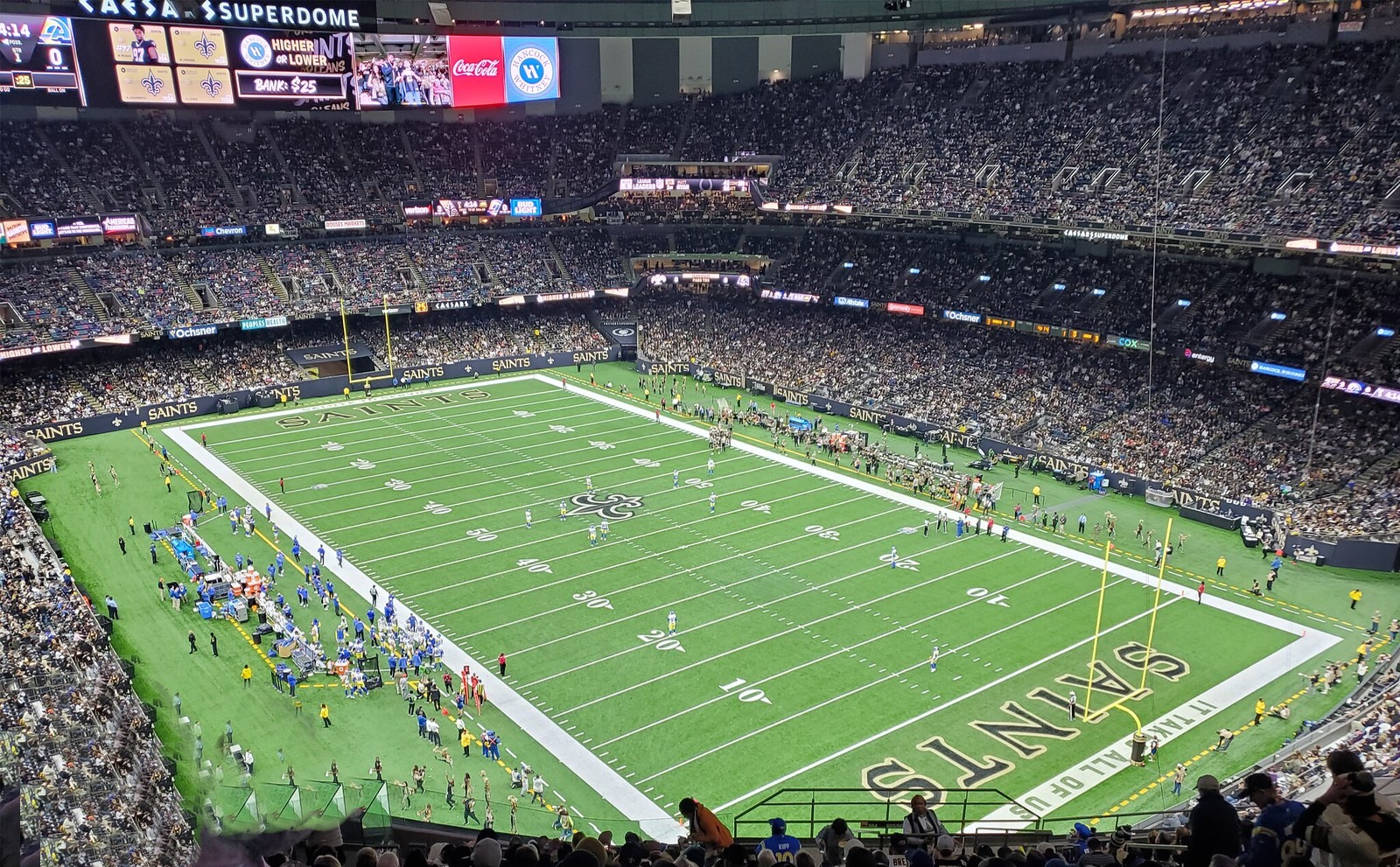
This coming Sunday, the New York Giants will be in what has been called "America's only foreign city," to play the New Orleans Saints at the Caesars Superdome, in a 1:00 PM Eastern Time start -- 12 noon local time.
The game will be played indoors, but that doesn't mean the weather won't be a factor before or after the game. New Orleans is a semi-tropical city. Fortunately, this game is being played in early Autumn, so heat and humidity won't be as much of factor. Check
, before you leave.
Indeed, the current weather forecast for New Orleans for next Sunday suggests, by our standards, unseasonable warmth for mid-December: Low 80s for daylight, low 70s for night. But they're not predicting rain, and Louisiana hardly ever gets snow. Besides, the game, if not the entire trip, will be indoors.
New Orleans is in the Central Time Zone, so set your timepieces back an hour. However, in spite of that "foreign city" stuff, and the Confederate chapter of its past, you won't need a passport. You might
you'll need it, especially while there, but you won't. You won't need to change your money, either. But the ability to speak fluent French, while hardly required, might help.
The Saints averaged 73,082 fans per home game in the 2019 season, the last pre-COVID season -- a sellout. They are easily the most popular sports team in Louisiana, ahead of the NBA's Pelicans, LSU football, or anybody else. So getting tickets might be an issue. And, with New Orleans' reputation as a city of, among other things, con men, I wouldn't trust a scalper any further than I could throw him. (I know, I know: "Well, with your bad knee, Mike, you shouldn't be throwing anybody.")
Bunker level (100 sections) seats go for $298 on the sidelines and $160 in the end zones. The 200, 300 and 400 level seats are Club seats, and will be even more expensive. Upper level (500 sections) seats go for $223 and $150. And Terrace level (600 sections) seats go for $74 and $53.
It's 1,340 miles from Times Square in New York to downtown New Orleans, and 1,336 miles from MetLife Stadium to the Superdome. Unless you really, really like driving, you're probably going to fly.
Google Maps says the fastest way from New York to New Orleans by road is to take the Holland Tunnel to Interstate 78 to Harrisburg, then I-81 through the Appalachian Mountains, and then it gets complicated from there.
No, the best way to go, if you must drive, is to take the New Jersey Turnpike/I-95 all the way from New Jersey to Petersburg, Virginia. Exit 51 will put you on I-85 South, and that will take you right through Charlotte and Atlanta, to Montgomery, Alabama. There, you'll switch to I-65 South, and take that into Mobile, where you'll switch to I-10 West, which, under the name of the Pontchartrain Expressway, will take you into New Orleans.
You'll be in New Jersey for about an hour and a half, Delaware for 20 minutes, Maryland for 2 hours, inside the Capital Beltway (Maryland, District of Columbia and Virginia) for half an hour if you're lucky (and don't make a rest stop anywhere near D.C.), Virginia for 3 hours, North Carolina for 4 hours, South Carolina for about an hour and 45 minutes, Georgia for 3 hours, Alabama for 4 hours and 45 minutes, Mississippi for an hour and 15 minutes, and Louisiana for 45 minutes before reaching downtown New Orleans. Use Exit 235B for downtown and the Superdome.
So we're talking about 23 hours. Throw in traffic in and around New York at one end, Washington and Atlanta in the middle, and New Orleans at the other end, plus rest stops, preferably in Delaware, and then one each State in Virginia, North Carolina, South Carolina, Georgia and Alabama, and it'll be closer to 28 hours. Still wanna drive? Didn't think so.
Flying? You could get a round-trip nonstop fare from Newark to Louis Armstrong International Airport for $863. But you'd have to fly down on Saturday and return on Monday. Otherwise, the schedule just doesn't work. The airport is west of downtown, in Kenner, and the E-2 bus will get you to downtown in 45 minutes for $2.00.
The bus doesn't sound much better. You'd have to leave Port Authority at 11:00 PM on Friday to make it to New Orleans by 5:35 AM on Sunday (that's 31 1/2 hours, counting the time change), changing buses in Atlanta, in order to make it by kickoff. Greyhound charges $750 round-trip, almost as much flying, but it drops to $515 with advanced purchase.
The train may be the best option. Certainly, it's the least complicated and the least annoying. Amtrak's
leaves Penn Station at 2:15 PM every afternoon, and arrives at Union Station in New Orleans the following evening at 9:02 PM (31 hours and 47 minutes). So you could leave on Friday, arrive on Saturday, and have a Saturday night in Party Town U.S.A. before the game on Sunday.
But you'd have to spend a 2nd night in New Orleans, and then get up really early (never an easy thing to do there -- "Big Easy," yeah, surrrre!) to catch the
back at 9:15 AM on Monday, arriving back in New York at 6:00 PM on Tuesday. Round-trip fare is $348, and this is one of the exceptions to the rule that Greyhound is cheaper than Amtrak. It's considerably faster, too, and might even be faster than driving.
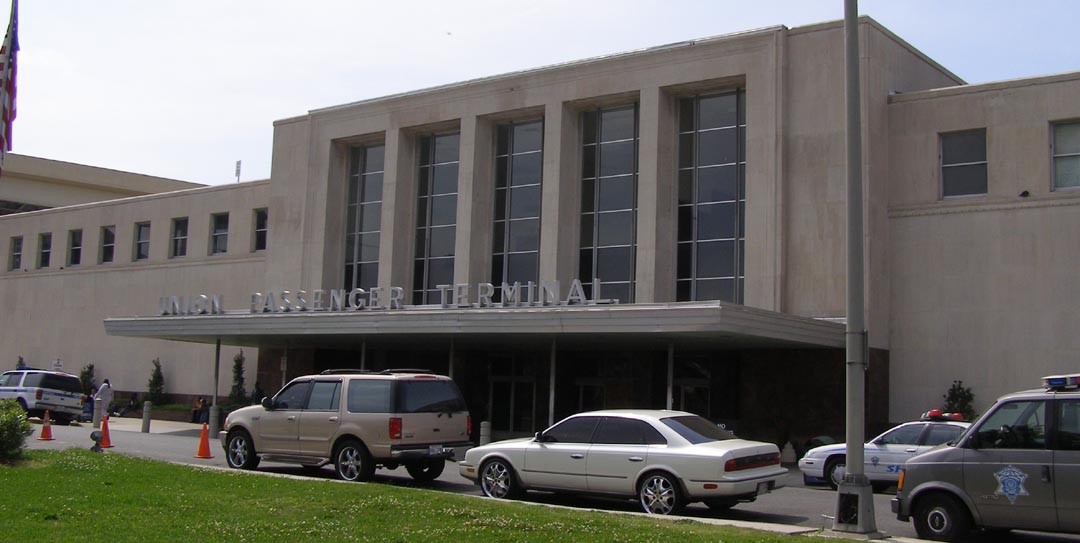
Union Station, now the New Orleans Union Passenger Terminal, handles both bus and train traffic. It is at 1001 Loyola Avenue, at Howard Avenue, a 5-minute walk from the Superdome.
The Terminal is not especially old, only going back to 1954. It may just be the least interesting major building in the city, even if, in the pre-Amtrak days, it was the southern terminus for the Illinois Central Railroad's morning-launching train to and from Chicago, made famous in Steve Goodman's 1970 folk song "The
, made famous in Jimmy Forrest's 1951 rhythm & blues instrumental "Night Train." (The former is best known by Arlo Guthrie; the latter, James Brown, and it gave legendary football defensive back Dick Lane his nickname.) The
ran from 1947 to 1972. Amtrak kept the night-launching
.
nephew of King Louis XIV and Regent for the child King Louis XV, governing with considerably more liberality than his uncle until the King's majority, at which point the King named the Duke Prime Minister, but he died shortly thereafter.
Known as the Crescent City for its shape, in a bend of the Mississippi River, New Orleans would be governed by the French from 1718 until the settlement of the French and Indian War in 1763, Spain from 1763 to 1802, France again from 1802 to 1803, the U.S. from the Louisiana Purchase of 1803 to 1861, the brief Republic of Louisiana after secession in 1861, the Confederate States of America in 1861 and 1862, and the U.S. again from 1862 onward.
The city's port status has long made it, though no longer the largest, easily the most important city in the American South. But it was also, if you think about it, one of America's earliest "Wild West" cities. As a result, it was a major battle area of both the War of 1812, elevating Andrew Jackson to hero status, and the American Civil War, which ended its status as the largest slave market in North America. But it also had more free black and mixed-race people than any other American city to that point -- indeed, there were some light-skinned black people wealthy enough to own other, darker-skinned, black people as slaves.
By 1820, the French had become a minority in the city. As late as the dawn of the 20th Century, 3/4ers of the population could speak French, and 1/4er spoke it first or even exclusively. Today, the main legacy of the French is in not just the many street names, but in the Creole patois of black New Orleanians.
New Orleans' status as the birthplace of jazz led to the naming of its 1st 2 major league sports teams: The NFL's Saints in 1967, after the unofficial anthem of New Orleans, "When the Saints Go Marching In"; and the NBA's Jazz in 1974, although they moved to Utah in 1979. The ABA's New Orleans Buccaneers were named for Jean Laffite, a privateer who aided Jackson during the 1814-15 Battle of New Orleans.
As late as 1950, New Orleans' population was 660,000, putting it in America's top 20 cities. White flight led to a drop to about 484,000 people within the city limits in the 2000 Census. After Hurricane Katrina, it dropped to 230,000, losing over half its people in one fell swoop. According to a recent estimate, it's back up to about 391,000, making it larger than such NFL cities as Tampa, St. Louis, Pittsburgh, Cincinnati and Buffalo (and, of course, Green Bay).
But the metropolitan area has just 1.45 million people, making it the smallest metro area in the NFL, ahead of only Buffalo (if Green Bay is included with Milwaukee and Niagara Falls is included with Buffalo). And the poverty issue, so pervasive before the hurricane, is worse. And crime is definitely an issue.
In 1940, the city was 70 percent white. As late as 1970, 51 percent white. By 1990, it was 62 percent black, and the proportions are roughly the same today: 61 percent black, 31 percent white, 5 percent Hispanic and 3 percent Asian. The further east you go, the greater the black percentage; the further west, the more white.
Most of the racial disturbances in the city, and in Louisiana, happened in the years immediately after the American Civil War: The New Orleans Massacre in 1866, the St. Bernard Parish Massacre and the Opelousas Massacre of 1868, the Colfax Massacre of 1873, the Battle of Liberty Place and the Coshatta Massacre of 1874, and the Robert Charles Riot in 1900.
About 36 percent of the people are Catholic, a holdover from both French and Spanish times, which led to the tradition of Mardi Gras, "Fat Tuesday": Several days of carnival ending precisely at midnight, because it becomes Ash Wednesday, the beginning of Lent, 40 days of penitence until Easter. As if New Orleans is ever truly penitent.
The sales tax in the State of Louisiana is 4 percent. Orleans Parish (Louisiana calls its Counties "Parishes") adds a 5 percent sales tax, so the total sales tax is 9 percent, even higher than New York City's rate of 8.875 percent.
Because the Mississippi River bends so much, the city doesn't have a North Side, East Side, South Side or West Side. Canal Street traditionally divides Uptown from Downtown. It, and the river, are essentially the "zero points" for street addresses. The city doesn't have a freeway "beltway," but Interstate 12 acts as a "bypass" for Interstate 10, which does go through the city.
ZIP Codes for the New Orleans area start with the digits 700, 701, 703 and 704. The Area Codes are 504 and 985. Entergy New Orleans runs the electricity. The New Orleans Regional Transit Authority (RTA) runs buses and historic (or at least historic-style) streetcars. The fare is just $1.25.
The streetcars once included the Desire Line, running to Desire Street in the Bywater District, in use from 1920 to 1948. In 1947, Tennessee Williams' play A Streetcar Named Desire was first staged, and filmed in 1951, after the real-life line stopped. Both the original play's cast and the film featured Marlon Brando, and launched him to stardom.
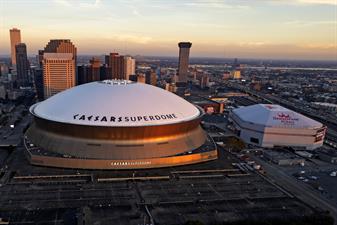
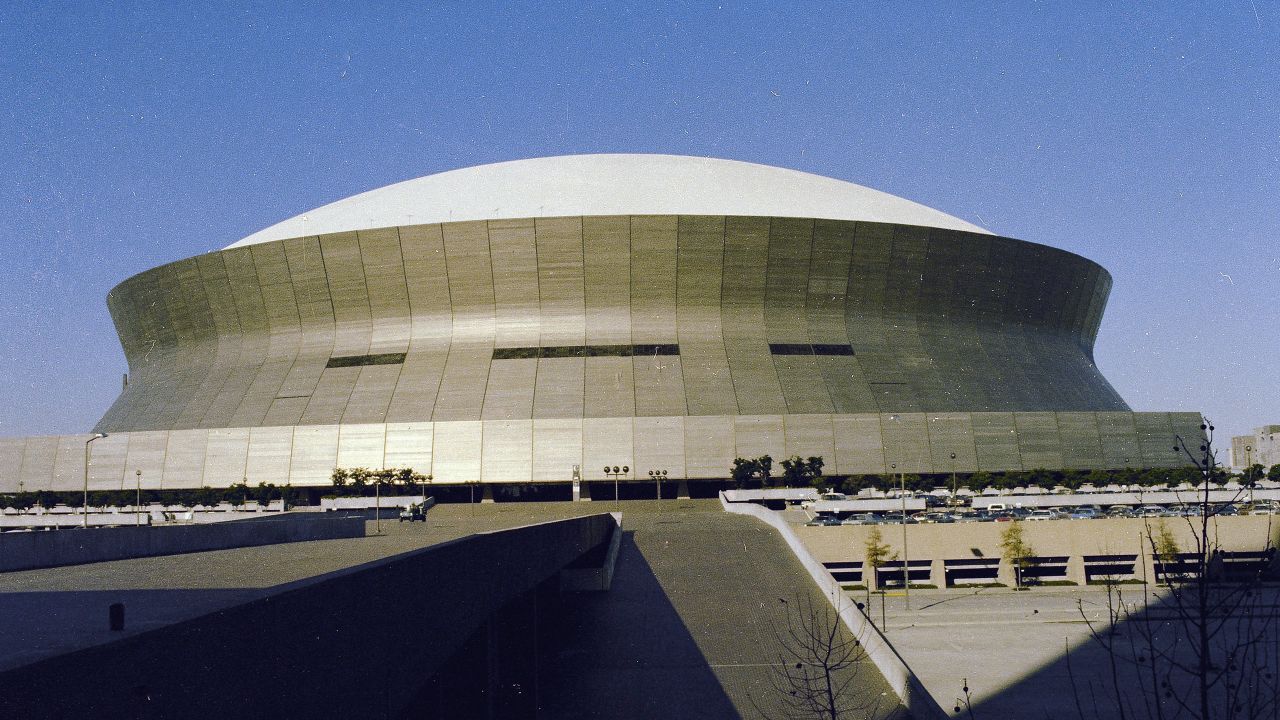
Going In. The address for the Louisiana Superdome is at 1500 Sugar Bowl Drive, bounded by Poydras Street, LaSalle Street, Howard Avenue and Claiborne Avenue, in the Central Business District.
Shortly after its 1975 opening
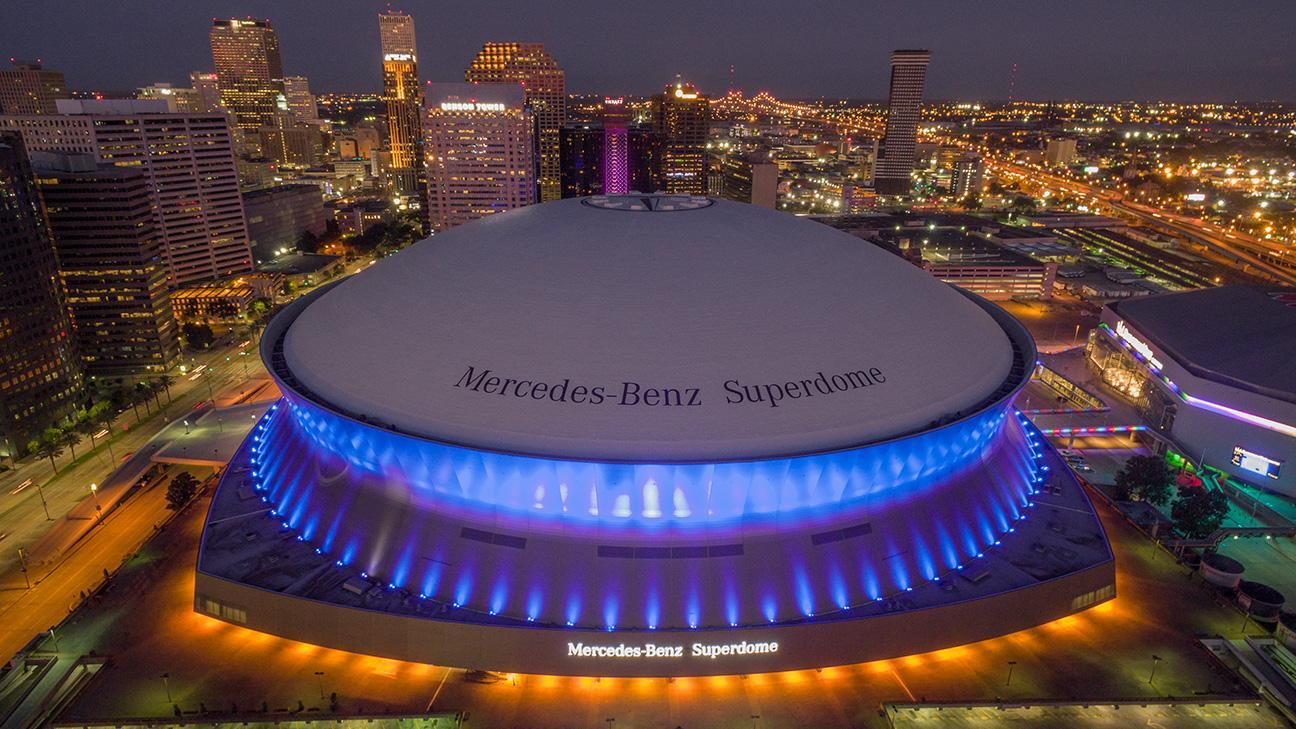
It opened in 1975. In 2011, it was rebranded as the Mercedes-Benz Superdome, after the German automaker bought the naming rights. Once they also bought the naming rights to the new home of the Saints' arch-rivals, the Atlanta Falcons, this became problematic. In 2021, the naming rights were sold to Caesars Entertainment, so it's now the Caesars Superdome. Everybody still calls it just the Superdome, or the Dome.
The Smoothie King Center arena, home of the NBA's New Orleans Pelicans, is adjacent. Founded as the original Charlotte Hornets, the new Hornets (formerly the Bobcats) have been assigned this franchise's 1988-2002 records, so the NBA counts them as starting in 2002, as the New Orleans Hornets. Having to play their 2005-06 season in Oklahoma City led the NBA to decide to let a team move there (the Seattle SuperSonics, as it turned out). The old Hornets became the Pelicans in 2013, taking the name of the city's former minor-league baseball team, itself taken from the State bird.
Some people have suggested that the Saints are cursed because the Superdome was built on top of a graveyard. But it's also been pointed out that the Saints played 8 seasons at Tulane Stadium before moving into the Superdome, and were awful then, so any curse on "The Big Mushroom on Poydras Street" doesn't explain that.
Both the dome and the arena were nearly ruined by Hurricane Katrina. Whatever had gone wrong on the inside of the Superdome, more noticeable was the outside, as the hurricane's winds had stripped the top of the dome, making it look like it had been sandblasted.
Repairing the stadium ended up costing, even with inflation factored in, much more than the initial construction did. It was worth it, though: The most famous building in Louisiana, maybe the most famous building in the entire Southeastern U.S., and its accompanying arena, are better than ever, even if they did sell naming rights to Mercedes-Benz.
One of several forms the Superdome's light show takes.
Like the now-demolished Riverfront Stadium in Cincinnati, the Superdome was built with a parking deck underneath. Parking costs $11. But if you don't get a space in the deck, you're screwed, because, otherwise, parking in downtown New Orleans is insanely expensive. Parking at the deck will make tailgating next to impossible.
But if you're willing to spend the dough, you can tailgate in a nearby outside lot. Said tailgating takes on a "N'Awlins" flavor: Lots of seafood, including shrimp, crawfish (a.k.a. crayfish, freshwater lobsters or mudbugs), oysters, all kinds of fish. Also, lots of rice & beans. And gumbo. And, of course, the usual tailgate party staples: Hot dogs and other sausages, burgers, chicken, ribs.
Having celebrated its 40th Anniversary in 2015, the Superdome has hosted a little bit of everything. The Saints from September 1975 onward. The Sugar Bowl since New Year's Day 1976. Tulane University football from 1975 to 2013. The Bayou Classic (nearly) every Thanksgiving Saturday between the traditionally black schools Grambling State (in Grambling in Northern Louisiana) and Southern University (in Baton Rouge in Southern Louisiana). The Louisiana high school football Playoffs.
It's hosted Sugar Bowls that were
de facto National Championship games: For the 1976-77 season, the University of Pittsburgh over Georgia; 1978-79, Alabama over Penn State; 1979-80, Alabama over Arkansas; 1980-81, Georgia over Notre Dame; 1982-83, Penn State over Georgia; 1989-90, Miami over Alabama; 1992-93, Alabama over Miami; and 1996-97, Florida over Florida State in the "God Wants a Rematch" game.
It's hosted actual National Championship games: 1999-2000, Florida State over Virginia Tech; 2007-08, Louisiana State over Ohio State; 2011-12, Alabama over LSU; and 2019-20, LSU over Clemson.
Seven Super Bowls, more than any other stadium. Sun Life Stadium outside Miami is next-best among existing stadiums with 5. The Rose Bowl has also hosted 5, but won't be considered for another due to the lack of skyboxes.
It's hosted Super Bowl XII, the 1st indoor Super Bowl, Dallas over Denver; XV, Oakland over Philadelphia; XX, Chicago over New England; XXIV, San Francisco over Denver; XXXI, Green Bay over New England; XXXVI, New England over St. Louis; and XLVII, Baltimore over San Francisco. It is currently scheduled to host Super Bowl LIX on February 9, 2025. (It was supposed to host Super Bowl LVIII, but that would have conflicted with Mardi Gras, and led to a tourist overload that a city that size simply can't handle.)
And that's just football. There's also been boxing, such as Muhammad Ali's successful September 15, 1978 rematch against Leon Spinks, and Sugar Ray Leonard's 1980 rematch against Roberto Duran. Exhibition baseball, including a couple of Yankees-Red Sox preseason games in 1994.
Prior to its post-hurricane renovation, baseball was possible at the Superdome,
but not really recommended, due to the dome and the turf.
Five NCAA Final Fours, including both of Dean Smith's National Championships, leading North Carolina over Georgetown in 1982 and Michigan in 1993. The others were Bob Knight's 3rd and last title for Indiana, over Syracuse in 1987; 2003, Syracuse over Kansas; and 2012, Kentucky over Kansas. It will host the Final Four again in 2022.
Concerts, including the largest indoor concert ever, with 87,500 watching the Rolling Stones on their "last tour" in 1981. A Papal Mass by Pope John Paul II in 1987. The 1988 Republican Convention, where George H.W. Bush told the delegates, "Read my lips: No new taxes!"
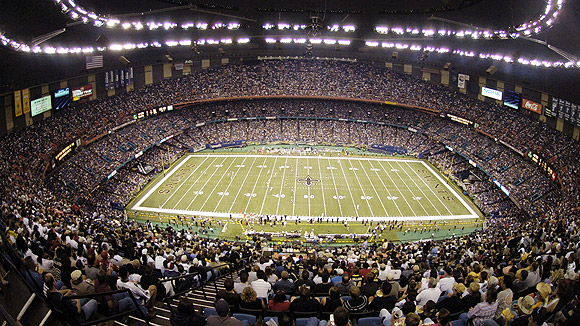
Even though the dome makes the sun a nonfactor, the field is still laid out the way most football fields are: More or less, north to south. The field, of course, is artificial. Aside from the 4 games they were forced to play at LSU due to Katrina having damaged the Dome, the Saints haven't played a home game on real grass since 1970, after which Tulane Stadium switched to artificial turf. The Saints have the west sideline, the visitors the east sideline.
Though the stadium has undergone several renovations and upgraded some facilities -- especially after Katrina -- the concourses are still small, the restrooms cramped, and the upper-level seats a painful distance from the field. It’s big and modern enough and for an indoor venue, still a great place to watch a game. But nothing here is all that memorable other than the drumline, the halftime marching bands, and the perpetual echoes of “Who Dat.”
Food. There are many great food cities in America. New Orleans considers itself special in this regard. If you like spicy food, you will enjoy yourself. If not, you might still enjoy yourself.
Parish Grill, at Sections 111, 117, 139 and 145, has PoBoys (a contraction of "poor boy," what the South calls submarine sandwiches) in roast beef, shrimp, and "Black & Gold" (Saints colors, made from "home made roast beef debris topped with fried shrimp"). They also have Dome Dogs, chicken tenders, shrimp baskets and fries with chili and/or cheese.
Other Parish Grill stands, at Sections 113, 116, 140 and 144, have roast beef poboys, burgers, hot dogs, fries and nachos. Poboys are also available at Poydras Street Poboy at 124. Royal Feast at 104 and Kings Table at 132 specialize in smoked sausage and nachos. Saint Jack's Barbecue at 152 includes a Pigskin Poboy (pork), barbecue nachos, and barbecue-style baked potatoes. Nola Slice at 153 has pizza. And the Pantheon Dome Cafe is in the southeastern corner of the stadium.
Each sideline on the 600 level has a Royal Feast stand and a Kings Table stand. You would think that, if any NFL team was going to have a team alumnus barbecue stand, a la Boog Powell with the Baltimore Orioles or Greg Luzinski with the Philadelphia Phillies, it would be the Saints. But this is not the case.
Team History Displays. The Saints played their 1st 20 seasons without having so much as a winning season, going 8-8 in 1979 and 1983, before they finally made the Playoffs in 1987, and making it 3 straight years starting in 1990, including their 1st Division title, in the NFC West, in 1991. But they never won a Playoff game until 2000, their 34th season, when, as NFC West Champions, they beat the defending World Champion St. Louis Rams.
They have banners honoring their 1991 and 2000 NFC West titles; their 2006, 2009, 2011, 2017, 2018, 2019 and 2020 NFC South titles; their 2009 NFC title; and their win in Super Bowl XLIV. When you have so few titles, of any kind, it's okay to double-up, or in this case even triple-up. The Giants don't hang such banners, and wouldn't do it this way. The Jets don't, but could.
There are 12 men in the Pro Football Hall of Fame who have been employed by the Saints. But 1980s linebacker Rickey Jackson, 1980s and '90s kicker Morten Andersen, and 1990s offensive tackle Willie Roaf are the only ones thus far elected based on what they did as Saints players.
Jim Finks, who was a front-office man for several teams, was inducted in part based on his 1986-93 tenure with the Saints. Otherwise, coaches Tom Fears, Hank Stram, Dick Stanfel and Mike Ditka; quarterback Ken Stabler; running backs Jim Taylor and Earl Campbell; and defensive end Doug Atkins were elected for what they did elsewhere.
The Saints have retired 3 numbers. Taylor's 31 and Atkins' 81 are from their founding days, even though their numbers haven't been retired by their main teams (the Green Bay Packers for Taylor, the Chicago Bears for Atkins). They've also retired the 8 of 1970s quarterback Archie Manning (Peyton and Eli's father).
The Saints have a Ring of Honor, around the rim of the upper deck, and a Saints Hall of Fame, in the northeastern corner of the stadium, on the lower level. Only established in 2013, the Ring of Honor includes Manning, Jackson, Andersen (Number 7), Roaf (77), defensive end Will Smith (91), and longtime owner Tom Benson.
The Saints Hall of Fame includes:
* Management: Owner Benson, GM Finks, head coach Jim Mora Sr. and assistant coach Steve Sidwell.
* Offense: Quarterbacks Manning, Billy Kilmer, Bobby Hebert and Aaron Brooks; running backs Tony Galbreath, George Rogers, Dalton Hilliard, Rueben Mayes, Deuce McAllister, Pierre Thomas and Reggie Bush; receivers Danny Abramowicz (1 of the 1st 2 inducted, in 1988, along with Manning), Eric Martin, Joe Horn, Michael Lewis, Lance Moore and Marcus Colston; tight ends Henry Childs and Hoby Brenner; centers John Hill and Joel Hilgenberg, guards Jake Kupp, Jim Dombrowski, Carl Nicks and Jahri Evans, offensive tackles Roaf and Stan Brock.
* Defense: Tackles Derland Moore and La'Roi Glover, ends Atkins, Bob Pollard, Jim Wilkes, Frank Warren, Wayne Martin, Joe Johnson and Will Smith (not the rapper-actor); linebackers Jackson, Joe Federspiel, Sam Mills, Vaughan Johnson, Pat Swilling and Jonathan Vilma (who had previously played for the Jets); cornerbacks Dave Whitsell, Dave Waymer and Tyrone Hughes; safeties Tommy Myers, Sammy Knight and Roman Harper.
* Special Teams: Kickers Andersen, Tom Dempsey and John Carney, plus Hughes was also a kick return specialist.
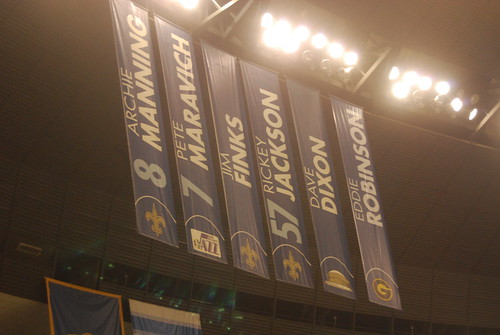
The retired numbers are not shown on banners, but there are banners for a Superdome Hall of Fame, including Manning, Jackson, Finks, LSU basketball and New Orleans Jazz star Pete Maravich, Grambling State coach Eddie Robinson (for his Bayou Classic appearances), and Dave Dixon, a businessman, Tulane graduate, and lobbyist for New Orleans football who was, essentially, the father of both the Saints and the Superdome. He tried to buy the Oakland Raiders and move them to New Orleans in 1962, but failed. He was also a backer of the USFL in the early 1980s.
No Saints were named to the NFL's 75th Anniversary Team in 1994,
The Sporting News' 100 Greatest Football Players in 1999, or the NFL Network's 100 Greatest Players in 2010.
On the east side of the Superdome, on the former site of the hurricane-ruined New Orleans Centre mall, is Champions Square. It is used as a site for pregame rallies, and if the Saints win another Super Bowl, that's where they'll hold the official celebration.
The Square includes a statue of Tom Benson, the auto-dealership and banking mogul who owned them from 1985 until his death in 2018, and the Pelicans from 2012 to 2018. Both teams are now owned by his widow, Gayle Benson. (This is one of the exceptions the NFL has made to its rule against cross-ownership in other sports.)
The statue shows him holding up the Vince Lombardi Trophy from Super Bowl XLIV, and stands in front of a mural, depiciting him, his controversial 3rd wife Gayle, the Vince Lombardi and George Halas (NFC title) Trophies, Saints fans, and the Saints and Pelicans logos.
The Square also includes Rebirth, a statue depicting one of the most famous plays in Saints history: Steve Gleason's block of a Michael Koenen punt that the Saints recovered for a touchdown early in the 1st quarter of the team's first post-Katrina home game in the Superdome, a 23-3 win over the Atlanta Falcons on Monday Night Football on September 25, 2006. The ravaged season before, the Saints had played 3 "home" games at LSU's Tiger Stadium in Baton Rouge, 4 at the Alamodome in San Antonio (where Benson has some business interests), and 1 at the Meadowlands. The Saints have had 6 Heisman Trophy winners in just over half a century of play. Danny Wuerffel (1996 Florida, with the Saints from 1997 to 1999) was a quarterback. The rest were running backs: George Rogers (1980 South Carolina, 1981-84), Earl Campbell (1977 Texas, 1984-85), Ricky Williams (1998 Texas, 1999-2001), Reggie Bush (2005 Southern California, 2006-10), and Mark Ingram (2009 Alabama, drafted by the Saints in 2011 and still with them). (UPDATE: In 2020, the Saints obtained quarterback Jameis Winston, 2013 Florida State, as a successor to Drew Brees.)
The Saints' biggest rivals are the Atlanta Falcons. They entered the NFL a season apart (Falcons in 1966, Saints in 1967), and have both struggled for most of their histories. The Falcons have been to more Super Bowls, 2; but the Saints have won 1, the Falcons none. The Falcons lead the all-time rivalry 53-51, including the only Playoff game between them, in 1991.
Stuff. The Saints Team Store and the Saints Women's & Kids' Team Shop are in the northeastern corner of the stadium, on the lower level. Whether these stores sell Saint "halos," I don't know.
The Saints haven't had a lot of success, but, from an awful start to Tom Dempsey's 63-yard field goal, from 1-15 seasons to Super Bowl glory, from being homeless to being one of the most beloved home teams in the NFL, they certainly have stories to tell.
In 2007, Alan Donnes and Chris Myers published Patron Saints: How the Saints Gave New Orleans a Reason to Believe. In 2010, just after their greatest triumph, Dan Fathow published the more comprehensive history The New Orleans Saints Story: The 43-Year Road to the Super Bowl XLIV Championship.
The NFL released official highlight videos for both the Saints' 2009 title season and Super Bowl XLIV itself. In 2013, they released a Saints version of NFL's Greatest Moments.
During the Game. A recent
Thrillist article on "
The Most Obnoxious Fans in the NFL" ranked the Saints 16th, right in the middle. That sounds about right. Saints fans are Louisianans -- and a few Mississippians, and even a few residents of the Alabama and Florida Panhandles. But, due to the multiracial and multiethnic nature of New Orleans, they have to get along, and, with the Saints' help, they do.
The fans themselves may not be saintly, but they have no interest in starting violence.
Their motto is the city's unofficial motto: "Laissez les bons temps rouler." That's French for, "Let the good times roll." Respect them as home fans, and they'll respect you as visiting fans.
The
Thrillist article said:
Obviously, after Hurricane Katrina, everybody in America fell in love with the Saints. You couldn't say a bad thing about 'em, even in Atlanta! But as a result, you now have two groups of fans: pre- and post-Katrina. One spent almost 30 years suffering with a team that rarely broke .500 (the “Aints!”) and was helmed by the likes of Aaron Brooks and Billy Joe Tolliver, while the other only knows the Super Bowl success of the Sean Payton era. You're both "all in" when it comes fandom -- which is great for jersey and ticket sales -- but it’s clear which group can handle a 1-4 start and which one keeps annoying everybody at the bar by yelling “Who Dat?” every two minutes. Throw in the massive “Bounty Gate” chip on your collective shoulder and a 16 ranking feels about right. Either way, you’re pretty much one Drew Brees retirement away from a return to fan normalcy and a drop waaaay back down this list.
Brees has now retired. We shall see.
From September 1 to 7, 2017, during the NFL National Anthem protest controversy,FiveThirtyEight.com polled fans of the 32 NFL teams, to see where they leaned politically. As you might expect from a minority-heavy, multicultural fan base, Saints fans were in the top quarter of most liberal NFL fan bases, 12.2 percent more liberal than conservative. The Saints do not have a regular National Anthem singer, instead holding auditions. They have had cheerleaders since their 1967 inception, but only since 1987 have they had an official name: The Saintsations. They had 2 mascots: A huge-chinned guy named Sir Saint and a dog named Gumbo.
And they both look like they've spent a little too much time
partying in the French Quarter.
The Saints' theme song is, naturally, the song for which they were named, the "National Anthem of Jazz": "When the Saints Go Marching In." They also have songs incorporating the phrase "Who dat?" (meaning, "Who is that?") Quite a few of them, in fact.
The phrase dates back to 19th Century minstrel shows, and in the late 1960s, fans at Southern University started to chant, "Who dat? Who dat? Who dat talkin' 'bout beatin' dem Jags?" Saints fans picked it up in the 1970s: "Who dat? Who dat? Who dat say dey gonna beat dem Saints?"
In 1981, on the way to their 1st Super Bowl, Cincinnati Bengals fans started chanting, "Who dey? Who dey? Who dey think gonna beat dem Bengals?" Bengal fans say that they inspired the Saints to make their "Who dat?" chant an official part of their organization, which happened in 1983. But there's no question that Saints fans did it before any other NFL team's fans, and it's far better known for them than for the Bengals. An individual Saints fan is often called a Who Dat, and they call their fan base Who Dat Nation.
One of the weird things about the Superdome is the reflection of the roof's ring of lights on a football helmet, making the players look like they have halos, as if they were, if not actual saints, then certainly angels.
As seen here on Drew Brees.
After the Game. New Orleans has had a crime problem for almost 300 years. Jean Laffite wasn't the only pirate there, and, at times, the city has seemed ungovernable -- especially since it's also got white-collar crime, both in business and in municipal government.
This is rampant throughout Louisiana, where Edwin Edwards ran to get back to the Governorship against former Ku Klux Klan leader David Duke with the slogan, "Vote for the crook. It's important." Edwards won. He also publicly bragged, "The only way they're going to get rid of me is to catch me with a dead girl or a live boy." He served from 1972 to 1980, 1984 to 1988, and 1992 to 1996. He was finally nailed on racketeering charges in 2001, and served 9 years in prison. He's now out, 88 years old, just a few days younger than Tom Benson.
But the Superdome is probably the best-policed place in the entire South. The only crime you're likely to get besieged by is drunk and disorderly conduct, nothing violent. As long as you don't start anything, neither will anyone else.
Nola.com posted a list of 7 New Orleans restaurants to try before or after a Saints game. These include Emeril Lagasse's home base of Emeril's, at 800 Tchoupitoulas Street at Julia Street. (Temporarily closed due to COVID.) Mike Serio's Po-Boys & Deli, at 133 St. Charles Avenue at Tulane Avenue, is festooned (love that word) with Saints and LSU memorabilia, and as the owner's name suggests, they are serious about New Orleans-style sandwiches. (Opens at 11:00 AM.) Walk-On's Bistreaux & Bar, a Baton Rouge and LSU institution, recently opened a Superdome affiliate at 1009 Poydras Street at Rampart Street. (Also temporarily closed.) All of these are within a mile of the Superdome.
Cooter Brown's Tavern & Oyster Bar has been hailed as the best sports bar in the State of Louisiana. 509 S. Carrollton Avenue, off Leake Avenue, near the Tulane and University of New Orleans campuses. (Campii?) St. Charles Streetcar to S. Carrollton. (Opens at 11:00 AM.)
Perhaps the most famous of all New Orleans drinking establishments is Pat O'Brien's Bar, in its current location since 1942. The name was in place well before the actor Pat O'Brien, famed for playing the title football coach in the film
Knute Rockne, All-American, became famous. Due to wartime difficulties in importing scotch, they experimented with easier-to-obtain rum, coming up with a recipe that they poured in a glass shaped like a hurricane lamp, and the hurricane cocktail was born.
718 St. Peter Street off Royal Street, in the heart of the French Quarter, just 2 blocks from iconic St. Louis Cathedral and Jackson Square, home to the statue of Andrew Jackson, a copy of the one in Lafayette Square across from the White House in Washington.
There doesn't appear to be a New Orleans bar that caters to New York sports fans. I looked up "New York Giants fan bar in New Orleans," then plugged in the Jets, the Yankees and the Mets, but got nothing concrete, other than to read postings that some of the bars around Tulane University show games, due to a contingent of students from our Tri-State Area. There has been an official New Orleans Jets Fans club since 2011, but they don't yet have a regular gameday meeting place.
If your visit to New Orleans is during the European soccer season, which we are now in, there is only one place in town that is sure to show your game: Finn McCool's Irish Pub, at 3701 Banks Street, in the Mid-City neighborhood, about 3 miles northwest of downtown. Streetcar 47 or 48 to Canal and Telemachus.
Sidelights. History? Atmosphere? Sports? Music? Debauchery? N'Awlins has got it all. To paraphrase John Dos Passos talking about New York, If you can get bored in New Orleans, you're a sad case.
On the one hand, it feels trite to laud the nonstop party vibe here, on the other hand, any city that so thoroughly champions legally imbibing outdoors without restrictions and flouts the notion of "last call" deserves as much praise as possible. Without minimizing the seriousness of the havoc Mother Nature has wreaked on it, New Orleans is so much bigger than the obstacles that've fallen in its path. Quite simply, if you haven't been there, you haven't had a complete American experience, and few cities can say that. If people from New Orleans say that to you, it'll be hard to understand, but at least their tone will be real friendly-like.
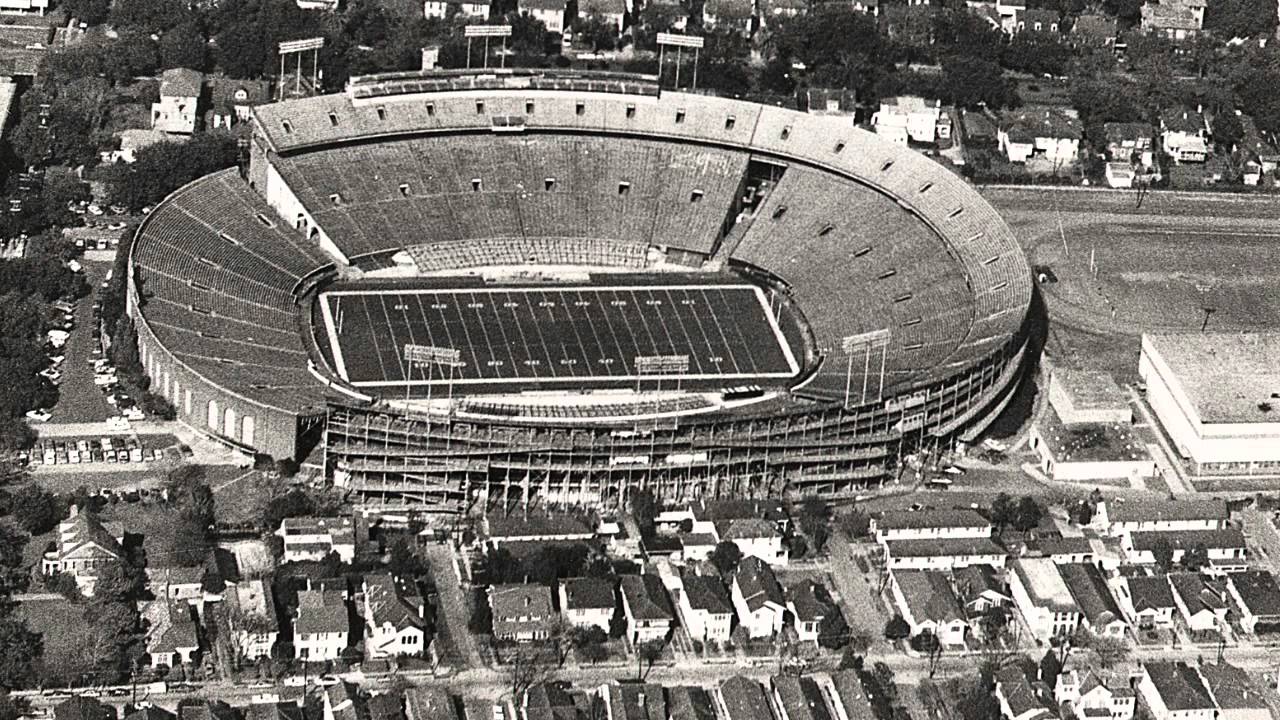
* Yulman Stadium and site of Tulane Stadium. Tulane University's football team, the Green Wave, played at the 81,000-seat Tulane Stadium, "the Queen of Southern Stadiums," from 1926 to 1974. The stadium was built on the site of a sugar plantation, hence the name of the game, and the stadium itself was nicknamed the Sugar Bowl.
The Saints played there from their 1967 founding to 1974, and it was the site of Tom Dempsey's record-setting 63-yard field goal in 1970. The Sugar Bowl was played there on (or close to) every New Year's Day from January 1, 1935 to December 31, 1974. In 1975, the Sugar Bowl, the Green Wave and the Saints all moved to the Superdome.
Sugar Bowls played there that were de facto National Championship games were in the seasons of 1938-39, Texas Christian (TCU) over Carnegie Tech (of Pittsburgh, now Carnegie-Mellon); 1939-40, Texas A&M over Tulane; 1952-53, Georgia Tech over Mississippi; 1958-59, Louisiana State (LSU) over Clemson; 1961-62, Alabama over Arkansas; and 1973-74, Notre Dame over Alabama.
Tulane Stadium hosted Super Bowl IV in 1970 (Kansas City over Minnesota), Super Bowl VI in 1972 (Dallas over Miami), and Super Bowl IX in 1975 (Pittsburgh over Minnesota), which was its last major event. It continued to host high school football before being demolished in 1979. Willow Street and Ben Weiner Drive.
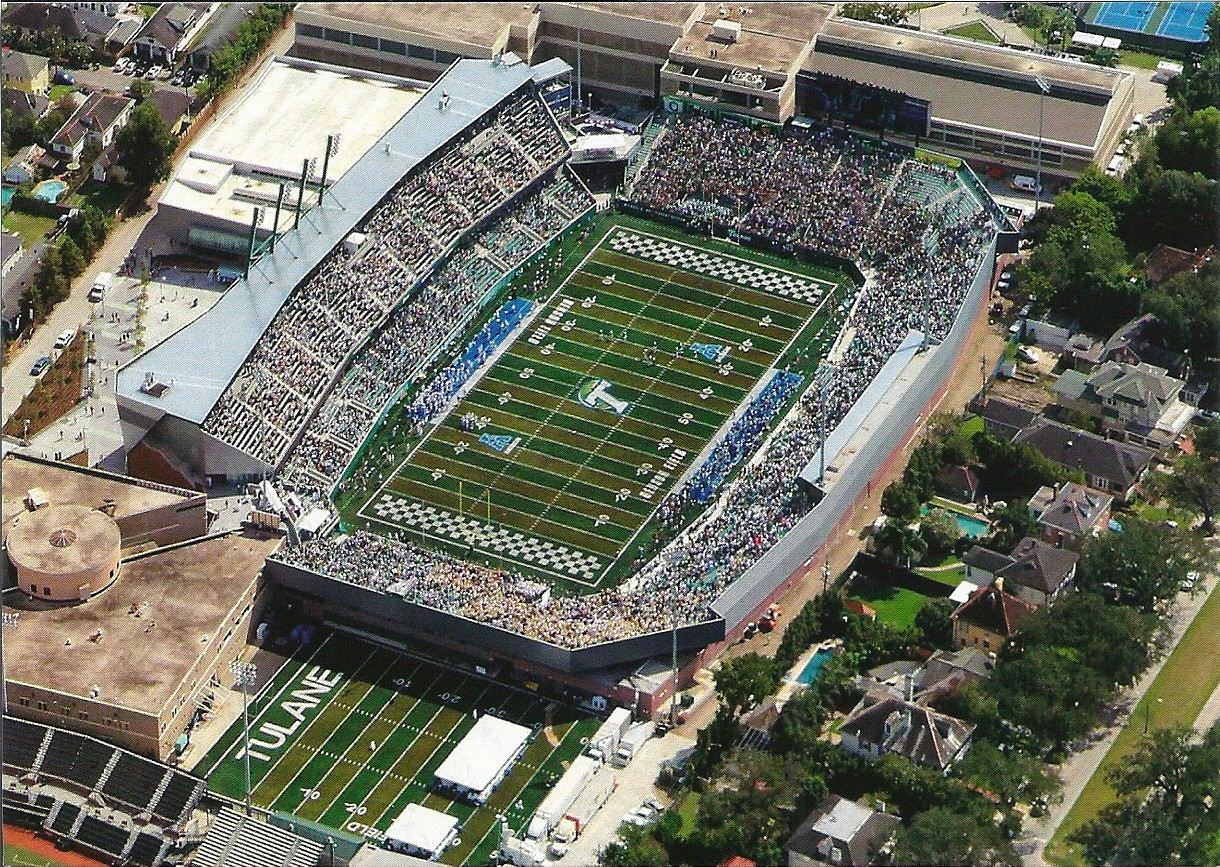
In 2014, the Green Wave moved into Benson Field at Yulman Stadium. The field was named after the Saints' owner, and the stadium for Richard Yulman, the former chairman of bed manufacturers Serta. Both are major donors to the University, and Richard and his wife Janet (for whom a nearby on-campus street is named) donated $15 million toward the stadium's construction.
The opener, a loss to Georgia Tech, had a listed attendance of 30,000 (roughly capacity), making it the best-attended Tulane sporting event since they abandoned the old stadium for the Superdome. A block up Ben Weiner Drive from the old stadium site, at Barrett Street. Turchin Stadium, Tulane's baseball facility, is just to the north. Number 16 bus, or Number 12 St. Charles streetcar.
* Municipal Auditorium. Built in 1930, this old music hall was home to the New Orleans Buccaneers of the ABA, before they moved to Memphis in 1970. The NBA's New Orleans Jazz played their 1st season here, 1974-75, before moving to the Superdome, and then to Utah in 1979.
Elvis Presley sang at the Municipal Auditorium on May 1, 1955 and August 12, 1956. It w
as seriously damaged by the hurricane, and its future is still in doubt. 1201 St. Peter Street at Essence Way, in what is now Louis Armstrong Park, just off the French Quarter.
Elvis sang in Louisiana many times in his early days, particularly as part of tours with established country singers like Hank Snow (who had Colonel Tom Parker as manager before Elvis did). He also sang in New Orleans at Jesuit High School (4133 Banks Street) on February 4, 1955; and on Ponchartrain Beach on September 1, 1955. In his return to the stage, 1969 to 1977, Elvis would sing at Louisiana venues, but never again in New Orleans.
He sang in Shreveport at the Municipal Auditorium as part of the Louisiana Hayride radio show in 1954 on October 16 and 23; November 6, 13 and 20; and December 4, 11 and 18; and in 1955 on January 8, 15, 22 and 29; February 5 and 19; March 5, 12 and 26; April 9; May 21 and 28; June 4, 11 and 25; July 2, 16 and 23; August 13, 20 and 27; September 10 and 24; October 1 and 29; November 5, 12 and 26; and December 10, 17 and 31; and in 1956 on January 7 and 21; February 25; and March 3, 10 and 31. Because his fame exploded in 1956, the show had to be moved to the larger (9,000-seat) Fair Grounds Youth Center for his show on December 15.
He also sang in Louisiana at the Lake Cliff Club in Lake Cliff on November 19, 1954; at West Monroe High School on February 18, 1955; at South Side Elementary School in Bastrop on February 24, 1955; at the Jimmie Thompson Arena in Alexandria on March 11, 1955; at Baton Rouge High School on May 2, 1955; and at the Plaquemine Casino Club in Baton Rouge on July 1, 1955.
And at the Monroe Civic Center on March 4, 7 and 8, 1974; and May 3, 1975; at the Lake Charles Civic Center on May 4, 1975; at the Hirsch Coliseum in Shreveport on June 7, 1975 and July 1, 1976; at the Rapidas Parish Coliseum in Alexandria on March 29 and 30, 1977; and at the Louisiana State University Assembly Center, now named for Pete Maravich, on June 17 and 18, 1974; July 2, 1976; and May 31, 1977.
The Doors played what turned out to be their last concert in New Orleans, at The Warehouse on December 12, 1970. It was generally agreed, even by his bandmates, that Jim Morrison's sloppy performance had made it a disaster. Seven months later, Morrison was dead.
The place had opened the preceding January 30, with The Flock and a pre-Stevie Nicks Fleetwood Mac opening for The Grateful Dead. That night, the Dead's hotel room got busted, which they referenced in the song "Truckin'." On February 1, the Dead and Fleetwood Mac returned to The Warehouse for a "Bread for the Dead" concert, raising money for legal fees.
The last concert there was by Talking Heads on September 10, 1982, and it was demolished in 1989. 1820 Tchoupitoulas Street, on the River, about 2 miles south of downtown. Bus 10 to Religious & Celeste, then a 5-minute walk -- which better be done in daylight, if at all.
* Baseball. The baseball version of the New Orleans Pelicans played from 1887 to 1959. After that, there was no professional baseball team in New Orleans, at any level, except for a brief revival of the Pelicans at the Superdome for the 1977 season, until the Colorado Rockies were expanded into existence, forcing the Denver Zephyrs to move for the 1993 season.
For most of their existence, the Pelicans played in the Southern Association, and on the same site, in a series of ballparks culminating in Heinemann Stadium, a.k.a. Pelican Park, built in 1915. They won 12 Pennants: 1887, 1889, 1896, 1905, 1910, 1911, 1915, 1918, 1923, 1926, 1927 and 1934. Their star players included Shoeless Joe Jackson, Joe Sewell, Dazzy Vance and Bob Lemon.
Pelican Park's alignment gave it Polo Grounds-like dimensions: Short foul poles and a distant center field. It was demolished in 1957, and a Burger King now stands on the site of its infield. 4068 Tulane Avenue at S. Carrollton Avenue. Number 39 bus.
The Zephyrs played at Privateer Park, on the campus of the University of New Orleans, on Lake Pontchartrain, from 1993 to 1996. It is now known as Maestri Field at NBC Park.But, at 2,900 seats, it was too small for Triple-A ball. 6801 Franklin Avenue. Number 55 bus.
In 1997, the Zephyrs moved to 10,000-seat Zephyr Field. They won Pennants there in 1998 and 2001. The ballpark was used to film some scenes in the baseball-themed film
Mr. 3000.
But the names have been changed. The New Orleans Zephyrs, formerly the Denver Zephyrs and the Denver Bears, play in the Class AAA Pacific Coast League (geography is no longer the league's strong point), and in 2017, they changed their name to... I swear, I am not making this up, I wouldn't make this up... the New Orleans Baby Cakes. Both their regular logo and their cap logo show the King Cake Baby wearing a crown. And the ballpark's name now reflects its address: The Shrine On Airline. 6000 Airline Drive, in suburban Metairie. E-2 bus, the same bus that goes between downtown and the airport. The ride to the ballpark takes about an hour.

They were a Mets farm team in 2007 and '08. But after the post-COVID reorganization of the minor leagues, 2019, as a Miami Marlins farm team, was their last season. So the franchise that began as the Denver Grizzlies in the Western League in 1901 is dead. And there appears to be no movement to re-establish professional baseball in New Orleans.
Also in Metairie is the grave of New York Giants Hall-of-Famer Mel Ott, a native of Gretna, near New Orleans. Metairie Cemetery, 5100 Ponchartrain Blvd. Canal-Cemeteries Streetcar to Canal Blvd. at City Park Avenue.
According to
an April 2014 article in The New York Times, the Yankees are the most popular baseball team in New Orleans, with about 23 percent of locals calling them their favorite team. The Red Sox are 2nd, with around 14 percent. The Chicago Cubs and Atlanta Braves are 3rd and 4th, each getting around 10 percent. This is despite the closest MLB team to New Orleans being the Houston Astros, 347 miles away.
The closest MLS team is Atlanta United, 469 miles away, but the Saints-Falcons rivalry makes rooting for them difficult. The highest-ranking professional soccer team in town is the New Orleans Jesters, in the National Premier Soccer League, America's 4th division. They play at the 5,000-seat Pan American Stadium, in City Park, about 4 miles northwest of downtown. 194 Zachary Taylor Drive. Bus 51.

The closest NHL team is the Dallas Stars, 508 miles away. And since the city's population would still rank its metro area dead last among MLB markets, you can forget about the Crescent City getting a team anytime soon.
* Maestri Field at NBC Park. On the campus of the University of New Orleans, on Lake Pontchartrain, the Zephyrs played here from 1993 to 1996, when it was known as Privateer Park. But, at 2,900 seats, it was too small for Triple-A ball. 6801 Franklin Avenue. Number 55 bus.
* Tad Gormley Stadium. Originally City Park Stadium, this 26,500-seat stadium was built by the Works Project Administration in 1937, and is New Orleans' premier high school football venue. It hosted the old baseball Pelicans in their last 2 seasons, 1958 and 1959. It's also a major concert venue, having started by hosting the Beatles on September 16, 1964. Other bands playing there include Journey, Pearl Jam and Rage Against the Machine.
5400 Stadium Drive, in New Orleans City Park, across from the New Orleans Museum of Art and the aforementioned Pan American Stadium. Number 48 Streetcar.
* Olympic Club site. On September 7, 1892, the 1st fight for the Heavyweight Championship of the World under the gloves-mandating, properly-timed-rounds-mandating Marquis of Queensbury Rules took place at the Olympic Club in the Bywater section of New Orleans. John L. Sullivan, last of the bare-knuckle champions but a proponent of gloves, defended his title against Jim Corbett. Gentleman Jim, a college-educated bank clerk from San Francisco, knocked out the lowbrow Boston Strong Boy in the 21st round, to become the 1st gloved Heavyweight Champion.
The Olympic Club, seating 3,500 but expanded for the occasion to 10,000, was located on Royal Street in a block bordered by Clouet, Chartres and Montegut streets, about a mile and a half east of the French Quarter. Number 5 Bus.
Harrah's Casino and Hotel was built on the site of the other Heavyweight Championship fight to be held in New Orleans. On January 15, 1972, Joe Frazier successfully defended the title by beating Terry Daniels at the Rivergate Auditorium. The Rivergate didn't last long, from 1968 to 1995. Harrah's has a restaurant named Manning's, named for the quarterbacking family. 228 Poydras Street at Peters Street. Streetcar 2.
* Museums. I've already mentioned the New Orleans Museum of Art, the city's version of our Metropolitan Museum of Art. Their answer to the Museum of Natural History is the Tulane Museum of Natural History, not on the Tulane campus but at 3705 Main Street in Belle Chase, 12 miles south of downtown. Not easily reachable by car.
Confederate Memorial Hall bills itself as Louisiana's Civil War Museum. 929 Camp Street at Andrew Higgins Street. It's next-door to the Ogden Museum of Southern Art, at 925 Camp.
A better museum, because it's to a war was fought by a united America, is the National World War II Museum. It's in New Orleans because the city built a lot of the landing craft used on D-Day, June 6, 1944, which, as you might guess, is one of the central exhibits of the museum.
Admission is $29.50, plus $5 additional for each for the films
Beyond All Boundaries, narrated by
Saving Private Ryan star Tom Hanks; and
Final Mission: The USS Tang Experience, about the most successful submarine of the war. 945 Magazine Street at Andrew Higgins Street.
The WWII Museum, Confederate Memorial Hall and the Ogden Museum are all a mile away from the Superdome, a 20-or-so-minute walk. From the French Quarter, Number 10 or 11 bus, or the Number 12 St. Charles Streetcar.
The French Quarter is centered on the corner of Orleans and Bourbon Streets. The French Quarter Visitor Center is on the riverfront, at 419 Decatur Street at St. Peter Street, 3 blocks from Pat O'Brien's. Preservation Hall, at 726 St. Peter Street off Bourbon Street, doesn't look like much from the outside, but it serves as the unofficial capital of jazz. The Cabildo was the seat of New Orleans' government, and the Louisiana Purchase was signed there. It is now the Louisiana State Museum. 701 Chartres Street off Jackson Square.
The Audubon Zoo, names for naturalist John James Audubon, who lived in New Orleans for much of his life, is at 6500 Magazine Street in Audubon Park. Number 11 bus. The Audubon Aquarium of the Americas is closer to downtown, on the riverfront at 1 Canal Street. Number 2 Riverfront Streetcar.
Louisiana has never produced a President. As a young man, Zachary Taylor lived in St. Francisville, 32 miles north of Baton Rouge and 112 miles northwest of New Orleans. But he's much more identified with Virginia, where he was born; and Kentucky, where he lived the last few years of his life and is buried.
*
Plessy v. Ferguson. Homer Plessy, a shoemaker who was 7/8ths white, bought a railroad ticket on June 7, 1892, and sat in the whites-only car. He was arrested at the Press Street Railroad Yards for not sitting in the "colored only" car. Judge John H. Ferguson ruled against him. Plessy was fined, and only spent the night of his arrest in jail.
Plessy sued Ferguson, arguing that the segregation law violated his rights under the 14th Amendment to the Constitution. The case was taken all the way to the U.S. Supreme Court, where, on May 18, 1896, Plessy's claim was rejected, as the segregated cars were "separate but equal."
Ferguson lived until 1915, Plessy until 1925. On May 17, 1954, in Brown v. Board of Education of Topeka, the Court "changed its mind" -- going from 8-1 for one side to 9-0 for the other in a span of 58 years -- and ruled that separate accommodations based on race was inherently unequal, striking down all such laws, anywhere in America, as unconstitutional.
On February 12, 2009 -- the 200th Anniversary of the birth of Abraham Lincoln -- a historical marker was erected at the site of the Press Street Yards, unveiled by Keith Plessy and Phoebe Ferguson,descendants of the named participants
. They have continued to work together on matters of reconciliation. The marker is at 2899 Royal Street at Press Street, about 3 miles northeast of downtown, and 2 blocks west of the Olympic Club site. Streetcar 2.
* Baton Rouge. The State capitol is 80 miles northwest of New Orleans, and can be reached by Greyhound, but not by Amtrak. It's home to Louisiana State University, home of the LSU Tigers, and the historically-black Southern University, home of the Jaguars.
The tallest building in the State of Louisiana isn't much to look at, typical of 1960s and '70s urban architecture. One Shell Square, opened in 1972 at 701 Poydras Street, 8 blocks from the Superdome, is 697 feet tall.
Films set and/or filmed at least partly in New Orleans include the Jean Lafitte biopic
The Buccaneer (made twice, in 1938 with Frederic March and Hugh Southern as Andrew Jackson, and 1958 with Yul Brynner and Charlton Heston in those roles),
The Flame of New Orleans, the Elvis movie
King Creole, The Cincinnati Kid, Easy Rider, the football-themed film
Number One (starring Heston as an aging quarterback),
Live and Let Die (Roger Moore's 1973 debut as James Bond)
, Pretty Baby, Cat People, Tightrope (in which Clint Eastwood played a different kind of cop, admitting, "Dirty Harry might not even like this guy"),
The Big Easy, Blaze, JFK, New Orleans native Anne Rice's
Interview with the Vampire,
Double Jeopardy, RED; the John Grisham-based legal thrillers
The Pelican Brief, The Client and
Runaway Jury; and, as previously mentioned, and perhaps most iconically,
A Streetcar Named Desire.
TV shows that have been set in New Orleans include
Bourbon Street Beat, Longstreet, Frank's Place, Treme, and, currently,
NCIS: New Orleans and the
Vampire Diaries spinoff
The Originals. While
True Blood was set in Louisiana, it was set in a fictional town in the north of the State, Bon Temps.
*
New Orleans is a city that celebrates the spiritual and the surreal. Certainly, the New Orleans Saints have seen a bit of both. A visit to the Giants-Saints game at the Superdome next Sunday could be fun, and you won't meet up with any ghosts, goblins, vampires, werewolves, or any other supernatural creatures.
Probably.