Showing posts with label monaco. Show all posts

Saturday, April 18, 2026

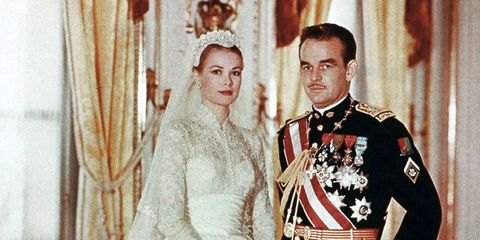
April 18, 1956: Grace Kelly Marries Prince Rainier III of Monaco

April 18, 1956, 70 years ago: Actress Grace Kelly marries Prince Rainier III, the monarch and dictator of the tiny nation of Monaco.

Grace Patricia Kelly was born on November 12, 1929 in Philadelphia. Her father, John B. Kelly Sr., won 2 Gold Medals in rowing at the 1920 Olympics in Antwerp, Belgium; and another in 1924 in Paris. Her brother, John B. Kelly Jr., a.k.a. Jack Kelly, never won more than a Bronze Medal -- in 1956, in Melbourne, Australia, a few months after his sister's royal wedding -- but later served as President of the U.S. Olympic Committee.

Grace began acting in a school play at age 12. By 1950, she was a star on Broadway. In 1952, she played the female lead opposite Gary Cooper in the classic Western High Noon.

If you remember the film Die Hard, Hans Gruber, played by Alan Rickman, tells John McClane, played by Bruce Willis, that he considers him "just another American cowboy." At the end, when it looks like Gruber has won, he tells McClane, prematurely as it turns out, "This time, John Wayne does not walk off into the sunset with Grace Kelly." And McClane tells him, "It was Gary Cooper, asshole!"

She starred opposite Clark Gable in John Ford's film Mogambo, Ray Milland in Alfred Hitchcock's Dial M for Murder, Jimmy Stewart in Hitchcock's Rear Window, and Cary Grant in Hitchcock's To Catch a Thief. She was heavily in demand: By directors, by would-be male leads, by the public, and by men in general.

She wasn't a "blonde bombshell" like Marilyn Monroe. Rather, the wealth and sophistication to which she was born gave her an onscreen persona that made her seem, well, graceful, and unattainable, but still very much desirable. In 2006, writing The Great Book of Philadelphia Sports Lists, with some lists having nothing to do with sports, the authors, radio talk-show hosts Big Daddy Graham and Glen Macnow, put her on top of their list of the most beautiful women ever to come from Philadelphia and environs.

(The remainder of their Top 10, in descending order: Dancer Lola Falana, model Gia Carangi, actress Maria Bello, actress-talk show host Kelly Ripa, actress Holly Robinson Peete, rapper Eve, actress Kim Delaney, and singers Lauren Hart and Pink.)

Oh, she was desired. And some of those desires came true. She had an affair with Cooper while filming, even though he was 28 years older. She had an affair with Gable while filming, even though he was also 28 years older. She had an affair with Milland while filming, even though he was 22 years older. She had an affair with Aly Khan, a notorious Pakistani prince who later married another of the era's leading actresses, Rita Hayworth; he was a mere 18 years older than Grace. (He was 7 years older than Rita.)

In 1954, she filmed The Country Girl, playing the wife of a character played by Bing Crosby -- and the mistress of a character played by William Holden. Holden, 11 years older, couldn't resist her, and rumors flew that he was going to leave his wife for her.

But she dumped him for Crosby, 26 years older. He was a strict Catholic with his family. With himself, not so much, although it should be pointed out that, at the time, he was widowed, not married. Grace and Der Bingle had an affair, and it was still ongoing on March 30, 1955, the night of the Academy Awards.

Many people thought the Oscar for Best Actress should go to Judy Garland, for her turn in the remake of A Star Is Born, because they were longtime fans of hers, and knew she had gone through a lot to get to that point. Others thought it should go to Dorothy Dandridge, for starring in Carmen Jones, which would have made her the 1st black actor of either gender to win an Oscar for a leading role.

Instead, it went to Kelly for The Country Girl. It was hardly her best work, and she was not better in it than Garland or Dandridge were in their nominated roles. Sidney Poitier won Best Actor in 1964, for Lilies of the Field. It would take until 2002 for a black woman to win Best Actress: Halle Berry, for playing the title role in Introducing Dorothy Dandridge. (Both Dandridge and Berry were natives of Cleveland.)

People began to ask questions like, "Who did Grace Kelly have to sleep with to get that Oscar?" It wasn't Bing Crosby: That night, he expected to, um, celebrate with her. But when he walked into her hotel room, she was, um, celebrating with the night's winner for Best Actor, for On the Waterfront: Marlon Brando. (He was only 5 years older.) In a weird twist of events, Kelly had been offered the female lead in that film, but turned it down. It went to Eva Marie Saint: It was her first film, and she won Best Supporting Actress for it.

Crosby dumped Kelly, but the affairs with him and Holden -- two co-stars in one film -- became the worst-kept secret in Hollywood: Nobody would report on it, but everybody seemed to know about it. She was branded a "homewrecker." 

Kelly had an affair with fashion designer Oleg Cassini, 16 years older. He proposed to her, and she accepted. But her parents said no, because he had been previously divorced. A rumor got out that she had gotten pregnant with Cassini's child, and had an abortion. Was it true? If so, did her parents know? Did these uber-Catholic Kellys arrange the abortion? We will never know: Some secrets were taken to the grave.

And John B. Kelly Sr. was a friend of another fabulously wealthy Irish-American, Joseph P. Kennedy. Maybe Joe's son, Senator John F. Kennedy, and Grace could have kept each other satisfied. But JFK married Jacqueline Bouvier in 1953. While hospitalized for back surgery the following year, Grace allegedly visited Jack, and... I'll let your imagination run wild, but the rumor of JFK and Grace is more likely to be true than the rumor of JFK and Marilyn Monroe.

Finally, the Kellys had had enough. It seemed like the only way to keep Grace out of Hollywood's bedrooms was to keep her out of Hollywood, and marry her off to someone far away -- and farther than Washington, D.C. They found someone: Rainier Louis Henri Maxence Bertrand Grimaldi, the Hereditary Prince of Monaco.

On April 18, 1956, 3 months before the release of her last film, High Society -- about rich Philadelphians like herself, and based on an earlier film titled The Philadelphia Story -- Grace and Rainier married in Monte Carlo, the capital of Monaco. She became Her Serene Highness, Princess Gracia Patricia.

Monaco is 2nd only to Vatican City as the world's smallest country by area: 2 1/2 miles long by 1 mile wide, surrounded on 3 sides by France and 1 by the Mediterranean Sea, and 8 miles from France's southeastern border with Italy. Then as now, it was home to less than 40,000 people, and is known for beaches, lax tax laws that allow rich people to keep much of what they have, and one of the world's foremost gambling casinos. It is ownership of Casino Monte Carlo that makes the House of Grimaldi, the royal family of Monaco, one of the richest families in the world.

The marriage meant the end of her film career, but it was hardly the end of her celebrity. She surpassed Eleanor Roosevelt as the most famous woman in the world. She became perhaps the world's leading charity fundraiser. And she gave the Prince 3 children: Caroline, Albert (now the monarch, Prince Albert II), and Stéphanie.

All 3 children have had complicated love-lives, with the media watching them much more than they watched Grace while she was acting. Albert is believed to have had at least 1 child out of wedlock, who is not in the line of succession. But Stéphanie was the real "wild child," having her mother's libido, but not nearly having her mother's sense of discretion.
Princess Grace, 1982

On September 13, 1982, with Stéphanie in the car, Princess Grace had a stroke while driving back to Monte Carlo from the Grimaldis' country home in Mont Agel, France. Stéphanie suffered a neck injury, but recovered. Grace did not, and died the next day. The following day, USA Today published its 1st edition, and its 1st headline was of an event from outside the U.S.A.: The death of Princess Grace, America's sweetheart and Monaco's. She was only 52 years old.

In his eulogy, Jimmy Stewart -- one of the few co-stars with whom Grace didn't have an affair -- said, "You know, I just love Grace Kelly. Not because she was a Princess, not because she was an actress, not because she was my friend, but because she was just about the nicest lady I ever met. Grace brought into my life, as she brought into yours, a soft, warm light, every time I saw her, and every time I saw her was a holiday of its own."

Prince Rainier never remarried, and lived until 2005.

Friday, March 21, 2014

One Arsène Wenger, 1,000 Games -- Part I

September 30, 1996: Arsène Wenger is named manager of North London's Arsenal Football Club. Not only was he first manager for the club not from the British Isles, he was one of the first Continental managers of any club in England's 1st division.

The 1996-97 season was already a few weeks underway, but Wenger was under contract to Nagoya Grampus Eight until September 30, so the appointment couldn't be announced until then.

This was not the obvious selection, and many questioned it. Newspaper printed "Arsène Who?" headlines. Tony Adams, Arsenal's Captain and one of the best centrebacks of his generation, was quoted as saying aloud, "What does this Frenchman know about English football?" Right back Lee Dixon thought Wenger looked like a geography teacher. Indeed, because of his academic nature, he was nicknamed Le Professeur.

"Big history, big tradition, big club, and big support," Wenger said a few years later, explaining why he accepted the job. "I thought that the marriage could work."

But a lot of observers predicted a quick divorce.

That was 17 1/2 years, and 999 matches ago. Tomorrow, Arsène Wenger will manage his 1,000th game for Arsenal Football Club.

*

Who was the man, before he came to the club? Arsène Wenger (no middle name) was born on October 22, 1949, in Strasbourg, a city of about 750,000 people in Alsace, a region that France and Germany spent decades fighting over before World War II permanently put it back within France's borders. Other famous Strasbourgers include wax museum creator Marie Tussaud, nuclear scientist Hans Bethe and mime king Marcel Marceau.

The son of a German father and a French mother, Wenger grew up in nearby Duttlenheim, and spoke only German until he was 7. The number of languages he speaks now isn't clear, but he speaks Japanese well enough to have managed in Japan, and his English is completely understandable, although it retains enough French and German influence that his grammar has a little bit the unusual word order.

His father ran La Croix d'Or (The Cross of Gold), a bistro in Duttlenheim -- or, as Arsène remembers it, a "pub":

There is no better psychological education than growing up in a pub, because, when you are five or six years old, you meet all different people, and hear how cruel they can be to each other. From an early age, you get a practical, psychological education to get into the minds of people. It is not often that a boy of five or six is always living with adults in a little village. I learned about tactics and selection from the people talking about football in the pub, who plays on the left wing, and who should be in the team.

In spite of living near French top-flight clubs FC (Football Club) Nancy and FC Metz; Swiss clubs FC Basel, BSC (Berner Sports Club) Young Boys, FC Zurich and Grasshopper Club Zurich; and German clubs like SC (Sport-Club) Freiburg and Eintracht Frankfurt, Wenger became a fan of Borussia Monchengladbach, a club over 250 miles away. (Though, to be fair, this still put them closer than his country's capital of Paris, over 300 miles away.)

"Gladbach" became a powerhouse, winning 4 Bundesliga (German league) titles in the 1970s, adding a DFB-Pokal (national Cup) and 2 UEFA Cups (2nd-tier European tournament), and reaching the Final of the 1977 European Cup (the top European tournament), losing to Liverpool. But even before they notched these achievements, the teenaged Wenger noticed that Gladbach was playing French teams in European tournaments and friendlies (exhibition games), and usually winning.

"I was attracted to a game of movement, of counterattack, based on speed and dynamism," he said in an interview with English football writer Myles Palmer (who, it should be noted, is not popular among Arsenal fans). "That was what mattered to me." This should surprise no one who, rather than "follow your local team," became impressed by the 1950s and '60s Manchester United, the Brazil team that spectacularly won the 1970 World Cup and then thrilled but ultimately failed in the 1982 edition, the 1970s Ajax Amsterdam, the Barcelona of modern times, or, yes, Wenger's Arsenal.

After playing as a midfielder for FC Duttlenheim, at age 18 he went to Mutzig, a club in France's 3rd division, said to play the best amateur football in Alsace. He moved to FC Mulhouse, and completed an economics degree at the University of Strasbourg -- perhaps the perfect combination for a young man who wants to go on to manage a soccer team.

He learned English in a three-week course at England's Cambridge University, played for ASPV (Association Sportive Pierrots Vauban) Strasbourg, and in time for the 1978-79 season, was signed by RC (Racing Club) Strasbourg. They won France's Division 1 (now called Ligue 1) that season.

But like many great managers/head coaches, Wenger was not a particularly notable player. He was tried as a midfielder and a sweeper, usually wearing Number 6 -- perhaps a foreshadowing of Adams being his Captain at Arsenal, and Laurent Koscielny being one of his better finds for the club. In 1981, he qualified as a manager, and was handed the reins of Strasbourg's youth team.

He became manager of AS Cannes in 1983 and Nancy in 1984. In 1986, Nancy were relegated to Ligue 2, and the club chairman defended him by saying he didn't have any money to spend. A little bit the foreshadowing there.

In spite of its worldwide fame as a seaside resort, a gambling center, and a tax haven, Monaco is one of the world's smallest countries. Its population of 36,000 could have fit into the former Arsenal Stadium, nicknamed Highbury for its neighborhood, with about 2,000 seats left over. Yet its soccer team, AS Monaco, competes in France's football system, and had already won Ligue 1 and the Coupe de France 4 times each before Wenger ever got there, so they were already a big club.


They snapped Wenger up in 1986, and he guided them to the 1988 Ligue 1 title, the 1991 Coupe de France, the Final of the 1992 UEFA Cup Winners' Cup (a tournament for the winners of the preceding season's national cups, folded into the UEFA Cup/Europa League in 1999), and the Semifinal of the 1994 UEFA Champions League.

German giants Bayern Munich wanted him as manager. Monaco wouldn't let him go. But a bad start to the 1994-95 season led them to fire him. Nagoya Grampus Eight brought him to Japan, and in his 1st season there, he led them to 2nd place in the J-League and their version of the FA Cup, the Emperor's Cup.

David Dein, former Vice Chairman of Arsenal, met Wenger in the executive box at Highbury on January 2, 1989, as Wenger wanted to attend the North London Derby between Arsenal and arch-rivals Tottenham Hotspur. Under former star player George Graham, Arsenal won, 2-0, and went top of the old Football League Division One that night, so the club weren't inclined to search for a new manager. But Dein was very impressed by Wenger, and thought that, whenever Graham moved on, Wenger should be the next Arsenal manager.

It didn't quite work out that way: When Graham left under a cloud in February 1995, Wenger was between Monaco and Nagoya, but Dein couldn't talk the board of directors into hiring him. After a 5th place finish in 1995-96, they finally listened to Dein, but had to wait until Wenger's contract ran out on September 30.

*

What was the club, before it hired the man? Founded as Royal Arsenal Football Club, as their members were working at the Royal Arsenal in Woolwich, in December 1886, and playing as Woolwich Arsenal on the south side of the River Thames in what was then within the County of Kent but is now part of Southeast London, "The Woolwich Reds" moved across the river to the Highbury area of North London in 1913, and dropped the locality from their name a year later, playing ever since as Arsenal Football Club, sometimes referred to (to this day) as "The Arsenal," Capital T, Capital A.

The club won nothing until Herbert Chapman became their manager in 1925. In 1930, he put them on the path to winning 5 League titles and 2 FA Cups in a 9-year stretch. By 1953, the club had won the League 7 times and the Cup 3 times. After a 17-year drought, it won the Inter-Cities Fairs Cup (forerunner of the UEFA Cup and the Europa League) in 1970, and then the League and FA Cup "Double" in 1971.

They won another Cup in 1979, and then came another down period, in which their style of play was criticized. Formerly sung at by opposition fans as "Lucky, Lucky Arsenal," they were now derided as "Boring, Boring Arsenal." Even when Graham took over, and led them to the 1987 and 1993 League Cups, the 1989 and 1991 League titles, the 1993 FA Cup and the 1994 Cup Winners' Cup, they were still called boring. As Graham put it, "We were like a machine, and I think people didn't want to see a machine win the title. But I thought, as machines go, we were a Rolls-Royce."

Although Graham's defense-first philosophy worked well at first, producing a lot of "One-nil to The Arsenal" results, it also led to some 0-0 draws, 1-1 draws, and 1-0 and 2-1 defeats. After winning 2 League titles in 3 seasons, the club finished 4th in 1992 (which was hardly a failure, but a bit of a disappointment), 10th in 1993 (midtable mediocrity offset a bit by becoming the 1st English club ever to win both domestic cups in the same season), 4th in 1994 (but with a European trophy), and 12th in 1995, the last season Graham started.


Also, in both 1993 and 1995, Arsenal finished behind Tottenham in the league table (standings). That was shameful. In 1996, Arsenal finished 5th under manager Bruce Rioch, who was let go before he could manage a 2nd season.

*

So, before Arsène Wenger was hired by Arsenal, he was a manager who had enjoyed some success, but hadn't been seriously tested in one of Europe's better leagues; and the club was one that was truly historic, but was in a bit of a down period, in need of a boost. Much like, say, Everton is today.

The man and the club needed each other.

What they have achieved together over the course of nearly 1,000 games is amazing, as you'll see in Part II.