Showing posts with label milt pappas. Show all posts

Thursday, February 26, 2026

Bruce Froemming, Worst Umpire Who Ever Lived, 1939-2026

The worst umpire in baseball history has died.

And if you're thinking Joe West or Ángel Hernández, I can tell you, not only are those two schmucks still alive, but there was one who was even worse.

Bruce Neal Froemming was born on September 28, 1939 in Milwaukee. The Braves moving to Atlanta in 1965 was the worst thing that has ever happened to baseball in Milwaukee, but Froemming being born in Milwaukee was the worst thing there that ever happened to baseball.

After a brief semi-pro playing career, Froemming became the youngest umpire in professional baseball in 1958 at age 18, working his way up through the minor leagues to the Pacific Coast League, before joining the National League staff in April 1971.

On September 2, 1972, Milt Pappas of the Chicago Cubs pitched a no-hitter against the San Diego Padres, winning, 8-0. It should have been a perfect game. He had a 3-and-2 count on the last batter, pinch-hitter Larry Stahl. Then he threw what should have been called strike 3 on the outside corner. But Froemming, in his 2nd season, called ball 4, and ruined it.

Pappas freaked out, and yelled at Froemming, including a few Greek profanities. He got the next batter, 
Garry Jestadt, to keep the no-hitter, but it could have been so much more. After the game, he tried to be rational, approaching Froemming and saying, "Do you know how few umpires have called a perfect game? You could have been one of them."

Froemming said, "Milt, if I had called that last pitch a strike, I never would've been able to live with myself." Pappas lost it again, and said, "How the hell do you live with yourself with all the other lousy calls you make?" So, already, Froemming had a reputation of not being a good umpire.

The next day, at Wrigley Field, Froemming says he was "besieged" by the media. Years later, he justified his call, saying, "I'm an umpire, not a fan. I called what I saw."

Froemming never called a perfect game, but he was the 1st base umpire for Dennis Martínez's perfect game for the Montreal Expos against the Los Angeles Dodgers on July 28, 1991; and he did call more no-hitters than any umpire in MLB history: 11.

On October 7, 1977, Game 3 of the National League Championship Series was played at Veterans Stadium in Philadelphia. The Philadelphia Phillies led the Dodgers, 5-3 in the top of the 9th inning. They were 1 more out from winning, and needed just 1 more win for their 1st Pennant in 27 years, since the 1950 Whiz Kids.

The Dodgers benefited from what Philadelphia fans would consider a sickening turn of events. Pinch hitter Vic Davalillo, a 41-year-old Venezuelan outfielder who has already retired from baseball once, showed enough guts to lay down a drag bunt, at his age, with 2 strikes, and he beat it out. Another pinch-hitter, 39-year-old Dominican Manny Mota, hit a long drive to left field.

Ordinarily, Phils manager Danny Ozark would have sent Jerry Martin out to left for defensive purposes, in place of the powerful but defensively suspect Greg Luzinski. This time, he didn't, and the Bull could only trap the ball against the fence. (In fairness, I’ve seen the play several times, and I don’t think Martin would have caught it, either, especially since he was a bit shorter than the Bull.) Luzinski threw back to the infield, but Phils 2nd baseman Ted Sizemore mishandled it, Mota went to 3rd, and Davalillo scored. It was 5-4 Phils, with 2 out.

Then came one of the most brutal umpiring screwups ever. Remember, the Dodgers were still down to their last out. Davey Lopes' grounder hit a seam in the artificial turf, and caromed off Mike Schmidt's knee to Larry Bowa‚ and Froemming incorrectly ruled the shortstop's throw late. Instead of the game being over in Philly's favor, Mota scored the tying run. The Dodgers went on to win, 6-5, and won the Pennant the next day.

In Philadelphia, the game is known as Black Friday. Froemming's name is still mud there.

Froemming worked in the All-Star Games of 1975, 1986 and 2007, behind home plate for the last 2; behind home plate for the NL Wild-Card play-in games of 1998 and 1999; a record 9 Division Series; 10 League Championship Series, formerly a record; and 5 World Series: 1976, 1984, 1988, 1990 and 1995.

In Game 4 in 1976, he ejected Yankee manager Billy Martin, who was miked-up for the official World Series highlight film, and was caught repeatedly saying, "Don't you be intimidating me!" On July 24, 2004, Froemming was the home plate umpire who let Red Sox pitcher Bronson Arroyo get away with hitting Yankee Alex Rodriguez on purpose, and then, when A-Rod dared to curse Arroyo out, Sox catcher Jason Varitek get away with smashing his mitt into A-Rod's face. Froemming threw Varitek and A-Rod out, but let Arroyo continue, when he should have thrown both Sox players out and let A-Rod continue.

In 1986, he appeared in a commercial for McDonald's new burger, the McDLT. The burger flopped, not because of Froemming's endorsement, but because the environmental movement forced McDonald's to stop using styrofoam containers, and there was no other way to "keep the hot side hot, and the cool side cool."

Froemming was named as 1 of the NL's 6 crew chiefs in 1988, and remained a crew chief when the Leagues' umpiring crews were combined in 2000. In 2001, when Miller Park (now American Family Field) opened in his hometown of Milwaukee, he was the home plate umpire. He umpired in 5,163 regular-season games, 2nd all-time at the time he retired after the 2007 season; and a record 111 postseason games.

Unfortunately, his last series was the 2007 American League Division Series between the Yankees and the Cleveland Indians, for which he was the crew chief. This included Game 2, when a swarm of midges came in from Lake Erie, rendering conditions unplayable, but he ordered that play continue, costing the Yankees the lead and the game. He should have stopped the game, as if it was raining, or (as has happened in Cleveland) there was snow, or fog. But he couldn't resist screwing one more team over.

Bruce Froemming married Rosemarie Loch in 1957, and they had two sons, Steven and Kevin. He had 2 grandchildren.

He died this past Wednesday, February 25, 2026, at the age of 86, at a hospital in Milwaukee. He had fallen in his home in suburban Mequon, Wisconsin the previous day, and doctors determined that he had a brain bleed that they were unable to stop, because he was taking blood thinners.

In the end, he died due to his thin blood. But his thin skin made him a terrible umpire.

Tuesday, December 9, 2025

December 9, 1965: Branch Rickey, Frank Robinson & Charlie Brown

December 9, 1965, 60 years ago: Branch Rickey, baseball's greatest executive ever, dies at age 84. A mediocre catcher in the major leagues from 1905 to 1914, he wasn't much of a field manager, either, from 1913 to 1925. But he served as general manager of the St. Louis Browns from 1913 to 1919, then of the St. Louis Cardinals until 1942, then of the Brooklyn Dodgers until 1950, and finally of the Pittsburgh Pirates until 1955.

As those teams' GMs, he did the following:

* He  practically (if not completely) invented the farm system, revolutionizing baseball.

* He brought Grover Cleveland Alexander to the Cardinals, setting up the most dramatic moment of the 1926 World Series.

* He traded Rogers Hornsby for Frankie Frisch, one future Hall-of-Famer for another.

* He built the team known as "The Gashouse Gang," the 1934 World Champion St. Louis Cardinals.

* He built the team led by Stan Musial that would dominate the National League in the World War II years.

* He built on the success of his Brooklyn predecessor Larry MacPhail, and built the team that became known as "The Boys of Summer."

* He revolutionized baseball a 2nd time, by racially integrating the Dodgers by signing Jackie Robinson.

* And he rebuilt the Pirates by signing Roberto Clemente and Bill Mazeroski, though he was no longer there by the time they won a World Series.

The teams he built won 16 Pennants and 8 World Series, the 1st in 1926 and the last in 1960.

He was what country singer Kris Kristofferson would have called "a walking contradiction, partly truth and partly fiction." He was a devout Methodist who would not work on Sundays, and thus would not even go to the ballpark on Sundays, letting a coach manage for him while he was the manager. Yet he would still accept the gate receipts from Sunday, the most lucrative day of the week.

It was said that he had money and he had players, and he didn't like to see them mix. He would be forced out of the Dodgers by Walter O'Malley. The two men had these things in common: They were cheap, they loved cigars, and they were Republicans. That was it: On important matters -- human dignity, racial sensitivity, and the Borough of Brooklyn -- they were incredibly different men.

On November 13, 1965, he was making his acceptance speech for his induction into the Missouri Sports Hall of Fame in Columbia, when he suffered a stroke. He never regained consciousness, and died on December 9, at the age of 84.

He was posthumously elected to the Baseball Hall of Fame in 1967, 5 years after Robinson was elected. Oddly, while Rickey's plaque at the Hall in Cooperstown, New York mentions his signing of Robinson, Robinson's original plaque made no mention of the fact that he was the 1st black player in modern baseball. A new plaque, cast in 2008, mentions it.

*

Frank Robinson, no relation to Jackie, was rising through the Cincinnati Reds' minor-league system during Rickey's final days as GM of the Pirates. Rickey was so desperate to improve the team, he offered the Reds $1 million -- about $10.3 million in today's money -- for a man who had yet to reach the majors. Gabe Paul was the GM of the Reds, in his 1st major league job, and told Rickey, "I wouldn't give you Frank Robinson for your entire team."

Paul was fired after the 1960 season, and his replacement, Bill DeWitt Sr., father of the man who now owns the Cardinals, was hired, and got the credit for the Reds' 1961 National League Pennant, a year in which Robinson was named the NL's Most Valuable Player. Robinson continued to be one of the best players in baseball over the next 4 seasons.

But on December 9, 1965, DeWitt traded Robinson to the Baltimore Orioles for Milt Pappas, Jack Baldschun and Dick Simpson. Baldschun and Simpson were throw-ins, designed to make the trade a 3-for-1, so it didn't look like the Reds were trading Robinson even-up for a single pitcher.
This looked like a bad trade rather quickly, as, in the very next season, 1966, Robinson led the Orioles to their 1st American League Pennant and their 1st World Championship, winning the Triple Crown and the Most Valuable Player award for himself, thus becoming the 1st man to win the MVP in both Leagues. (He remained the only one until Shohei Ohtani in 2024. Six pitchers have won the Cy Young Award in both Leagues: Gaylord Perry, Pedro Martinez, Randy Johnson, Roger Clemens, Roy Halladay and Max Scherzer.)

As for the Reds, they wouldn't win another Pennant until 1970, and another World Series until 1975. To make matters worse, when the Reds did win the Pennant in 1970, who beat them in the World Series? Robinson and the Orioles, although Brooks Robinson (no relation, of course) was a bigger reason than Frank on that occasion.

So why did they trade Robinson? Because he was "an old 30." Or maybe it was "not a young 30." The wording varies, depending on who tells the story.

Pappas was making $32,500, Baldschun $24,000, and Simpson $8,000; total, $64,500. Robinson, all by himself? $57,000. Robinson wanted $64,000 for 1966, and DeWitt decided he couldn't throw that kind of money around for just 1 player.

Orioles owner Jerry Hoffberger gave Frank his $64,000. He made it $100,000 after the Triple Crown/MVP/World Series season. The most he ever made? $160,000 in 1973 and '74. He actually took a pay cut in '75, to $105,000, even though he was both playing and managing. (He was the 1st black manager in Major League Baseball. By 1971, that was predictable; in 1965, it wasn't.)

The Reds needed pitching, and Pappas was a very good pitcher. He was then 26 years old, and had already won 110 games in the major leagues, against just 74 losses. In 1965, for an Oriole team that finished a distant 2nd to the Minnesota Twins, he went 13-9, with a 2.60 ERA -- an ERA+ of 133, so he wasn't just taking advantage of a pitching-friendly period in baseball history. His WHIP was a nifty 1.102.

He had made the All-Star Team for the 2nd time in 4 seasons. He'd won 16 games in '63 and did it again in '64, and had just won 13 in '65. That's 45 wins over the preceding 3 seasons. Not great, but very good. And he was reliable: He'd never had a significant injury.
His career record turned out to be 209-164 -- by 1 win in the National League, he missed winning at least 100 games in each League. Ten pitchers have done that: Cy Young, Al Orth, Jim Bunning, Ferguson Jenkins, Gaylord Perry, Nolan Ryan, Dennis Martinez, Kevin Brown, Randy Johnson and Pedro Martinez. (As of the end of the 2025 season, Max Scherzer is 7 AL wins away from turning the trick.)

Does this sound like a failed pitcher to you? Hardly. The problem wasn't that the Reds acquired him, it was that they let him go too soon. He had a down year in 1966, just 12-11, 4.29. But, even then, he won just 1 fewer game than he did the season before. In 1967, he went 16-13, 3.35. Much better. And then, in 1968, they traded him to the Atlanta Braves, in a 3-for-3 deal.

The names that mattered in that trade turned out to be Pappas and Clay Carroll. Carroll did turn out to be a key cog in the Big Red Machine bullpen of the 1970s. Then again, you wouldn't trade Frank Robinson and Milt Pappas for Clay Carroll, would you?

In 1970, between the Braves and the Chicago Cubs, Pappas went 12-10, 3.34. If he'd been available for the Reds against the Orioles during the 1970 World Series, it might have been a very different story.

*

December 9, 1965 was a Thursday. This was also the day that A Charlie Brown Christmas premiered. Charles Schulz had been drawing the comic strip Peanuts since 1950, and CBS was ready to take a gamble on a holiday TV special about Charlie Brown, his dog Snoopy, and the other kids in the strip. (It was around this time that such a program began to be called a "special." Previously, it would have been a "spectacular.")
I have a theory, and, as far as I can tell, there is nothing in the images or the script of the special that disproves it. Charlie Brown is depressed during the Christmas season, and everyone else has thrown themselves into the superficial and commercial sides of it, for the same reason: The special takes place in December 1963, after the assassination of President John F. Kennedy, and they want to forget.

Charlie Brown (voiced here by Peter Robbins) wasn't the 1st fictional character to wonder what Christmas was all about, nor the last. Nor was he the first, nor the last, to get his Christmas hopes laughed at.

But, as his best friend Linus Van Pelt (voiced by Chris Shea) points out (after quoting The Gospel According to Luke, Chapter 2, Verses 8 through 14, to remind us of "what Christmas is all about"), like the scrawny little tree that he'd found, ol' Chuck just needed a little love.

The special was a great success, and it remains the most popular Peanuts TV special, maybe the most popular Christmas TV special. And, today, when someone describes a Christmas tree as "a Charlie Brown tree," we still know exactly what that means. It's not about the quality of the tree, it's about the hearts of the people decorating it.

Wednesday, April 20, 2016

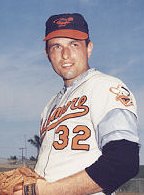
Milt Pappas, 1939-2016

Life can be good, or cruel, or just plain weird. It was all 3 to Milt Pappas.

Miltiades Stergios Papastergios was born on May 11, 1939 in Detroit. A son of Greek immigrants, his name would later be anglicized to Milton Stephen Pappas. He went to Cooley High School on Motown's West Side, and pitched them to Metropolitan League Championships in 1956 and 1957.

Other Cooley graduates of note include big league ballplayers Bill Roman and Joe Ginsberg; Detroit Tigers and Red Wings owner Mike Ilitch; basketball players Roy Tarpley and Willie Green; NFL players Terrence Mann, Chris Floyd and Lional Dalton; actresses Barbara Tarbuck and S. Epatha Merkerson; Anita Garian, the soprano voice backing up The Tokens on "The Lions Sleeps Tonight"; and James P. Hoffa, who, like his father James R., rose to become President of the International Brotherhood of Teamsters.

Black screenwriter Eric Monte based his film Cooley High on his alma mater in Chicago, which was named for a different man, and should not be confused with the legendary Detroit school, which was closed in 2010 due to declining enrollment. For the same reason, Chicago's Cooley Vocational High School was closed in 1979.

Milt was scouted by former Detroit Tigers pitcher Hal Newhouser, who was scouting for the Baltimore Orioles. The O's signed him, and he made his major league debut on August 10, 1957, just a few weeks after graduating from Detroit Cooley and less than 3 months after his 18th birthday. He pitched 2 innings of scoreless relief against the Yankees, allowing just 2 hits, singles to Mickey Mantle and Jerry Lumpe. Mantle and Enos Slaughter had already hit home runs, and the Yankees won, 6-3 at Memorial Stadium.

*

In 1958, Pappas became a regular in the rotation of a rising Oriole team. In 1959 and 1960, he won 15 games each season; in 1963 and 1964, 16 each. In 1962, and 1965, he was named to the American League All-Star Team; in '65, as starting pitcher in the All-Star Game in Minnesota.

On September 20, 1961, Pappas pitched for the Orioles at Memorial Stadium, hoping to stop the Yankees from clinching the Pennant. It was the 154th game of the season, and Roger Maris came into it with 58 home runs; if he hit his 60th to tie Babe Ruth's single-season record, or even if he hit his 61st to break it (it would have required 3), Commissioner Ford Frick would count it as official; if not, and the 60th (and the 61st) came later, it would count as a separate record. (There was never an asterisk.) Pappas didn't like that, and told the press he would pitch to Maris, and let the chips fall where they may. He did give up the 59th homer, and the Yankees did win to clinch the Pennant; but the 60th didn't come for another few days, also against the Orioles. The 61st came in the last game of the season.

It looked for a while as if Pappas would be remembered for that 59th homer and for being a good pitcher for the Orioles. But the Orioles thought they needed something to get them over the top, from contenders to champions. The Cincinnati Reds needed pitching. So on December 9, 1965, the Reds traded superstar Frank Robinson to the Orioles for Pappas, Jack Baldschun and Dick Simpson.

The trade soon became known as one of the most lopsided in baseball history. In the very next season, Robinson won the Triple Crown and the Most Valuable Player award, and led the Orioles to their 1st Pennant and World Championship. Meanwhile, Pappas won 12 for the Reds in '66 and 16 in '67, but they were in a transition period between their team that won the 1961 Pennant and nearly did so again in 1964, and the 1970s "Big Red Machine" that would win 4 Pennants in the decade.

In 1968, the Reds traded Pappas to the Atlanta Braves. Had he still been on the Reds' roster in 1970, they might have had a better chance in the World Series. Instead, they lost it, to Robinson and the Orioles, who also reached the Series in 1969 and 1971, although they lost both.

In 1969, the 1st year of Divisional play, the Braves won the National League Western Division, and Pappas made his only postseason appearance, pitching 3 innings of relief in an NL Championship Series that the Braves lost to the Mets. In 1970, the Braves traded Pappas to the Chicago Cubs. In 1971 and 1972, he won 17 games each season.
On September 2, 1972, Pappas pitched a no-hitter against the San Diego Padres, as the Cubs won, 8-0. It should have been a perfect game. He had a 3-and-2 count on the last batter, pinch-hitter Larry Stahl. Then he threw what should have been called strike 3 on the outside corner. But Bruce Froemming, in the 2nd season of a 37-year career that marks him as, in my opinion, the worst umpire ever, called ball 4, and ruined it.

Pappas freaked out, and yelled at Froemming, including a few Greek profanities. He got the next batter, Garry Jestadt, to keep the no-hitter, but it could have been so much more. After the game, he tried to be rational, approaching Froemming and saying, "Do you know how few umpires have called a perfect game? You could have been one of them."

Froemming said, "Milt, if I had called that last pitch a strike, I never would've been able to live with myself." Pappas lost it again, and said, "How the hell do you live with yourself with all the other lousy calls you make?"

Pappas had a poor season in 1973, and was released by the Cubs in spring training 1974. His career record was 209-164, with a 3.40 ERA, a 110 ERA+, and a 1.225 WHIP. He was the 1st pitcher to win 200 games in a career without ever having won at least 20 in a season -- or even 18.

He won 110 games in the American League, and 99 games in the National League. There are only 9 pitchers who've won at least 100 games in each League. In the reserve clause era, when it was harder for players to change teams, let alone Leagues, only 3 pitchers had done it: Cy Young, Al Orth and Jim Bunning. Milt Pappas nearly made it 4. Since the end of the reserve clause made it easier, the list has added Gaylord Perry, Nolan Ryan, Ferguson Jenkins, Dennis Martinez, Kevin Brown and Randy Johnson.

He was also a decent hitter for a pitcher, hitting 20 home runs during his career.

*

He stayed in Baltimore after retiring, and opened a restaurant, Milt Pappas' Scotch & Sirloin. After it failed, he moved to Wheaton, Illinois, hometown of football pioneer Red Grange, and not far from Chicago where he was still known. He worked for a liquor distributor, and sold building supplies.

He and his wife Carole had 2 children, Michelle and Steve. On September 11, 1982, Carole drove away from the house on an errand, and was never seen alive again. For 5 years, no one knew what happened to her. In 1987, workers draining a pond 4 blocks away found her 1980 Buick, with her still inside. The coroner guessed she had taken a wrong turn, and her death was ruled an accident.

In 1990, Pappas married Judi Bloome, a teacher, and moved to her nearby hometown of Beecher. They had a daughter, Alexandria Arlis. He lived to see 5 grandchildren.
In 2012, he was honored at Wrigley Field on the 40th Anniversary of his no-hitter. But the next year, he had his own car crash, and was hospitalized for several days. It's possible that he never recovered. Another blow was the death of his daughter Michelle last year.

Milt Pappas died yesterday at his home in Beecher, apparently from natural causes, He was 76.

He was a decent man and a very good pitcher, who deserves to be remembered for more than just being on the other end of a trade for a Hall-of-Famer, getting robbed of a perfect game, and living through the nightmare of a domestic mystery.

UPDATE: Pappas was cremated, so there is no gravesite.

Wednesday, December 9, 2015

Top 5 Reasons You Can't Blame the Cincinnati Reds for Trading Frank Robinson for Milt Pappas

December 9, 1965, 50 years ago today: On the day that Branch Rickey, baseball's greatest executive ever, dies at age 84, the Cincinnati Reds trade Frank Robinson to the Baltimore Orioles for Milt Pappas, Jack Baldschun and Dick Simpson.

Baldschun and Simpson were throw-ins, designed to make the trade a 3-for-1, so it didn't look like the Reds were trading Robinson even-up for a single pitcher.

"Bad trades are a part of baseball. I mean, who can forget Frank Robinson for Milt Pappas, for God's sake?"
-- Annie Savoy (Susan Sarandon), Bull Durham

This looked like a bad trade rather quickly, as, in the very next season, 1966, Robinson led the Orioles to their 1st American League Pennant and their 1st World Championship, winning the Triple Crown and the Most Valuable Player award for himself, thus becoming the 1st man to win the MVP in both Leagues. (He's still the only one.)

As for the Reds, they wouldn't win another National League Pennant until 1970, and another World Series until 1975. To make matters worse, when the Reds did win the Pennant in 1970, who beat them in the World Series? Robinson and the Orioles, although Brooks Robinson (no relation, of course) was a bigger reason than Frank on that occasion.

So why did they trade Robinson? Because he was "an old 30." Or maybe it was "not a young 30." The wording varies, depending on who tells the story.

An old 30? This guy carried the Reds on his back to win the Pennant (and the MVP for himself) just 4 years earlier. He was one of the best hitters in baseball. He would go on to hit 586 career home runs -- and Crosley Field, the Reds' home field until mid-1970, had a short left-field fence. He collected almost 3,000 career hits.

He was a good fielder, too. Perhaps he didn't cover as much ground in right field as his contemporaries Hank Aaron, Al Kaline, Roger Maris or Roberto Clemente; or have as good an arm as Clemente or Rocky Colavito. But he was really good.

What a bonehead trade.

Surely, there must be some justification for having made the trade...

Top 5 Reasons You Can't Blame the Cincinnati Reds for Trading Frank Robinson for Milt Pappas

5. Frank Robinson. Okay, he wasn't exactly in decline, but view him from the perspective of after the 1965 season. Here's his batting average, his on-base percentage, his slugging percentage, his OPS+, his doubles, his home runs, his RBIs and his stolen bases from 1962 (in which he actually had a better year than his MVP season of 1961) through 1965:

1962: .342, .421, .624, 172, 51, 39, 136, 18
1963: .259, .379, .442, 133, 19, 21, 91, 26
1964: .306, .396, .548, 160, 38, 29, 96, 23
1965: .296, .386, .540, 151, 33, 33, 113, 13

No, that's not a "decline." And his 1963 numbers were artificially held down by missing time due to injury.

But it did look like he'd dropped a bit from his peak. Reds owner Bill DeWitt (father of the man of the same name who now owns the St. Louis Cardinals) might have been concerned that the '63 injury hadn't fully healed. And 30, being a round number, is a harsher (if not an entirely fair) indicator than 32, or even 35.

The fairest thing you can say is that Frank went from being one of the 3 best players in the game (along with Mickey Mantle and Willie Mays) to being one of the 20 best. Where trading him had once been unthinkable -- Gabe Paul, the Reds' general manager from 1951 to 1960, supposedly told Branch Rickey, then running the Pittsburgh Pirates, "I wouldn't give you Frank Robinson for your whole team," but was running the Cleveland Indians by 1965 -- it was now thinkable.

Check out Frank's numbers from 1966, though -- and Baltimore's Memorial Stadium, especially in those days, was a pitcher's park:

1966: .316, .410, .637, 198, 34, 49, 122, 8
True, his stolen base total (which actually went up, reaching a career high for him, in the injury-shortened 1963 season) continued to go down. But, as the saying goes, If you hit it far enough, you don't have to run. And that's why this is only Reason Number 5: Trading him was plausible, but still not very smart.

4. Money. Pappas was making $32,500, Baldschun $24,000, and Simpson $8,000; total, $64,500. Robinson, all by himself? $57,000. Robinson wanted $64,000 for 1966, and owner DeWitt couldn't throw that kind of money around for just 1 player.

Orioles owner Jerry Hoffberger gave Frank his $64,000. He made it $100,000 after the Triple Crown/MVP/World Series season. The most he ever made? $160,000 in 1973 and '74. He actually took a pay cut in '75, to $105,000, even though he was both playing and managing. (He was the 1st black manager in Major League Baseball. By 1971, that was predictable; in 1965, it wasn't.)

3. The Reds needed pitching. Their 1965 starting rotation consisted of Jim Maloney, Joey Jay, and 2 out of these 4: Jim O'Toole, Joe Nuxhall, Sammy Ellis and John Tsitouris. Nuxhall then retired. O'Toole had a horrible season: 3-10, 5.92 ERA. Tsitouris wasn't much better: 6-9, 4.95. Jay, the only Reds pitcher to win a World Series game between 1940 and 1970, was 9-8, but his ERA was 4.22. Clearly, the Reds needed at least 2 more starting pitchers -- or 1, and hoped that someone out of Jay, O'Toole, Ellis and Tsitouris bounced back.

Nuxhall appeared in 32 games that season, divided evenly between 16 starts and 16 relief appearances. The Reds also had Roger Craig, once a very good starter, but, by this point, was being used exclusively in relief, and was pretty much done.

2. Milt Pappas. He was a very good pitcher. He was then 26 years old, and had already won 110 games in the major leagues, against just 74 losses. In 1965, for an Oriole team that finished a distant 2nd to the Minnesota Twins, he went 13-9, with a 2.60 ERA -- an ERA+ of 133, so he wasn't just taking advantage of a pitching-friendly period in baseball history. His WHIP was a nifty 1.102.

He had made the All-Star Team for the 2nd time in 4 seasons. He'd won 16 games in '63 and did it again in '64, and had just won 13 in '65. That's 45 wins over the preceding 3 seasons. Not great, but very good. And he was reliable: He'd never had a significant injury.
His career record turned out to be 209-164 -- by 1 win in the National League, he missed becoming one of the few pitchers ever to win at least 100 games in each League.

Does this sound like a failed pitcher to you? Hardly. The problem wasn't that the Reds acquired him. It was that they let him go too soon. He had a down year in 1966, just 12-11, 4.29. But, even then, he won just 1 fewer game than he did the season before. In 1967, he went 16-13, 3.35. Much better. And then, in 1968, they traded him to the Atlanta Braves, in a 3-for-3 deal.

The names that mattered in that trade turned out to be Pappas and Clay Carroll. Carroll did turn out to be a key cog in the Big Red Machine bullpen of the 1970s. Then again, you wouldn't trade Frank Robinson and Milt Pappas for Clay Carroll, would you?

In 1970, between the Braves and the Chicago Cubs, Pappas went 12-10, 3.34. If he'd been available for the Reds against the Orioles during the 1970 World Series, it might have been a very different story.

1. Unexpected declines. It wasn't Robinson that ended up declining. But the aforementioned Joey Jay did. So did center fielder Vada Pinson, costing him a genuine shot at the Hall of Fame. So did 1st baseman Gordy Coleman. So did shortstop Leo Cardenas. And, despite the addition of Pappas, the Reds' pitching didn't get much better.

Pretty much the only '65 Reds who were still around by the time they won the '70 Pennant were Pete Rose (24 years old in '65) and Tony Perez (23). Just about everybody else had to be replaced. If they'd lasted a little longer, maybe the Reds could have challenged the Los Angeles Dodgers for the '66 Pennant, the Cardinals for the '67 and '68 Pennants, and the Braves for the '69 NL Western Division title. By '70, they were ready to begin a decade that, in 10 years, saw them win 6 NL West titles, 4 Pennants and 2 World Series. But they did need to rebuild.

There may have been other reasons. There were stories that Robinson and Pinson didn't get along -- odd, since they were both graduates of McClymonds High School in Oakland, as were Curt Flood of the Cardinals and basketball superstar Bill Russell.

There were also stories of cops in Southern Ohio and Kentucky giving Robinson, one of the biggest names among black baseball players, a hard time for minor issues. Certainly, Baltimore had its racial issues in the 1960s, and, being an hour's drive (with good traffic flow, not always a given) from Virginia, is almost on the South's doorstep, as Cincy is.

But the trade of Robinson for Pappas didn't have to be so bad. If the Reds had just hung onto Pappas through 1970, and Jay, Pinson, Coleman and Cardenas had lasted a little longer, it might have been a very different story.

Today, Frank Robinson is 80 years old, a special assistant to Commissioner Rob Manfred, and the honorary President of the American League.
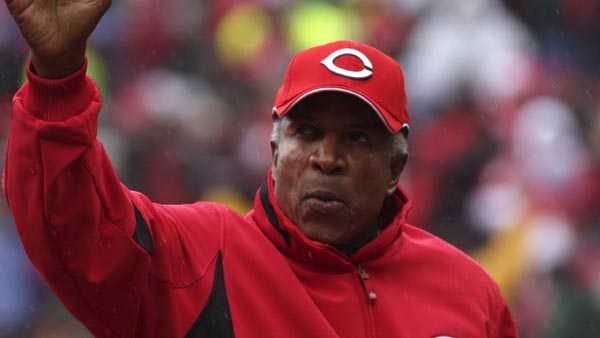
Robinson back in Cincinnati, at the 2015 All-Star Game

Milt Pappas is 76, living in the Chicago suburbs (where he stayed after pitching for the Cubs, including a 1972 no-hitter that was a controversial walk away from a perfect game), and retired from the building trade.
Pappas in 2012, on the 40th Anniversary of his no-hitter

Jack Baldschun is 79, retired from the lumber business, and living in Green Bay, Wisconsin. And Dick Simpson is 72, although I can find no recent information on him, other than that he lives outside Los Angeles in Venice, California.

UPDATE: Pappas died on April 19, 2016, just 4 months after I posted this. Robinson died on February 7, 2019, at the age of 83. At that point, Baldschun and Simpson were still alive.