I've decided to do Trip Guides for the Canadian Football League, whose season both starts and ends earlier than the NFL's, due to weather conditions. First up, the Montreal Alouettes, who open next Thursday, home to the Saskatchewan Roughriders.
From here on out, except when the city's name is part of a name, such as "Montreal Alouettes," I'll be listing the city's name with the proper accent mark: "Montréal." And I'll be listing the Province's name with the accent mark as well: "Québec."
Before You Go. This is Canada, the Great White North, but it will also be Summer, so you don't have to worry about the cold. According to the Montreal Gazette website, they're predicting mid-70s for Thursday afternoon, and low 60s for the evening. So you won't have to face the kind of cold that would make you say, "Sainte merde!" (That's French for "Holy shit!")
June 24, 2 days after this game, will be Saint-Jean-Baptiste Day, a.k.a. La Fête Nationale, Québec's "national holiday," a day of Provincial pride in which Québec nationalists act like the referendum of 1995 (or that of 1980) succeeded and they became a separate country. Think St. Patrick's Day, but French, louder, and with accordions instead of bagpipes. And it falls on a Saturday this year, but having been in Montréal on that day, I know they start celebrating the night before. So if you're staying for the weekend, you should be aware of it.
Being in a foreign country has its particular challenges -- and, yes, for all its similarities to America, Canada is still a foreign country. The French influence makes Québec cities like Montréal and Québec City seem more foreign even than Toronto, the only city and metropolitan area in Canada with more people than Montréal.
Make sure you call your bank and tell them you're going. After all, Canada may be an English-speaking country (at least co-officially, with French, although Québec is French-first), and a democracy (if a parliamentary one), and a country with teams in America's major leagues, but it is still a foreign country. If your bank gets a record of your ATM card making a withdrawal from any country other than the U.S., it may freeze the card, and any other accounts you may have with them. So be sure to let them know that you will, in fact, be in Canada for a little while.
As of June 1, 2009, you have to have a valid, up-to-date passport to cross the U.S.-Canadian border. You should also bring your driver's license (or other State-issued photo ID). If you don't have a valid passport, you will need a valid photo ID and a copy of your birth certificate. This is not something you want to mess with. Canadian Customs officials do not fuck around: They care about their national security, too.
Do yourself another big favor: Change your money before you go. There are plenty of currency exchanges in New York City, including one on 42nd Street between 7th and 8th Avenue. There are also a few in New Jersey: Travelex has exchange centers at Newark Liberty International Airport, and at 4 malls: Garden Sate Plaza in Paramus, Jersey Gardens in Elizabeth, Menlo Park Mall in Edison and Bridgewater Commons.
Leave yourself $50 in U.S. cash, especially if you’'e going other than by plane, so you'll have cash on your side of the border. I was actually in Montréal on the day when it most favored the U.S.: January 18, 2002, $1.60 to $1.00 in our favor. As of Thursday morning, June 15, US$1.00 = C$1.33, and C$1.00 = US 75 cents.
The multi-colored bills were confusing on my first visit, although we have those now, too:
* The $5 is blue, and features Wilfrid Laurier, Prime Minister, 1896-1911.
* The $10 is purple, and features John A. Macdonald, the 1st Prime Minister, 1867-1873 and again 1878-1891. The nation just celebrated the Bicentennial of his birth (1815). Essentially he's their George Washington, without having fought a war for independence.
* The $20 is green, and features the nation's head of state, Britain's Queen Elizabeth II.
* The $50 is red, and features William Lyon Mackenzie King, the longest-serving Prime Minister, 1921-1926, 1926-1930, 1935-1948, including World War II.
* And the $100 is yellow, and features Robert Borden, Prime Minister 1911-1920, including World War I.
The tricky part is going to be the coins – and you'll thank me for telling you this, but keep your U.S. coins and your Canadian coins separate, for the simple reason that their penny, nickel, dime and quarter are all the same colors and just about the same size as our respective coins. (To make matters more confusing, as we recently did with our States, they had a Provincial quarter series.)
All the coins have Queen Elizabeth's portrait on the front, as the monarch of Great Britain remains the monarch of all British Commonwealth nations, including Canada. But she's been Queen since 1952, and depending on how old the coin is, you might get a young woman, or her current 90-year-old self, or anything in between. You might even get a penny or a nickel old enough to feature her father, King George VI. Such a coin is still legal tender, however.
On the backs, the penny has maple leaves, the nickel a beaver, the dime a sailboat, and the quarter an elk. They have a $1 coin, copper-colored, bigger than a quarter, and 11-sided, with a bird on the back. This bird is a loon – not to be confused with the people lunatic enough to buy Maple Leafs season tickets. The coin is thus called the "loonie," although they don't say "ten loonies": They use "buck" for "dollar" the way we would. In fact, the term is connected to Canada: Their first English settlers were the Hudson's Bay Company, and they set the value of a dollar to the price of the pelt of a male beaver, the male of the species being called, as are those of a deer and a rabbit, a buck. (And the female, a doe.) The nation's French-speakers (Francophones) use the French word for loon, and call it a "huard."
Then there's the $2 coin, or "toonie." It's not just two dollars, it's two-toned, and even two-piece. It's got a copper center, with the Queen on the front and a polar bear on the back, and a nickel ring around it. This coin is about the size of the Eisenhower silver dollars we used to have. This is the coin that drives me bonkers when I'm up there.
My suggestion is that, when you first get your money changed before you begin your trip, ask for $1 coins but no $2 coins. It's just simpler. I like Canada a lot, but their money, yikes, eh?
Montréal is in the Eastern Time Zone, so you won't have to fiddle with your timepieces. And while a working knowledge of French will help considerably, it is not necessary: Just about everybody in Montréal understands and speaks English.
And most signs shouldn't be too hard to read, as they'll look like the signs in the U.S. (EXIT signs read SORTIE but look like EXIT signs, STOP signs are still eight-sided and red, etc.) However, from experience, I can tell you this: As Québec is Francophone, if you check your phone messages, your signal may get beamed to a Canadian satellite, and you may hear your message in French. And, if you don't understand spoken French, that could be a problem.
And this is very important: If you need to go to the bathroom, don't ask anyone where the "bathroom" is. In English, the word you're looking for is "washroom." In French, it's "toilette."
Tickets. Molson Stadium seats 23,420. Last season, the Alouettes averaged 20,378 per home game, about 86 percent of capacity. Getting tickets could be difficult.
They're also expensive. Lower Level Midfield seats are $133, Lower Level Ends $94. End Zone and Upper Deck seats are just $29. Those prices are in Canadian dollars.
Getting There. It's 367 miles from Times Square to downtown Montréal. It's the same distance from the Prudential Center to the Bell Centre. That's in that difficult range where it's a little too close to fly, but too far to get there any other way.
Air Canada runs flights out of Newark Liberty, John F. Kennedy and LaGuardia International Airport, and the flight to Montréal-Pierre Elliott Trudeau International Airport takes about an hour and a half. The airport was named for the city native who was Prime Minister almost continuously from 1968 to 1984, and whose son Justin was just elected to the job. It used to be named Montréal-Dorval International Airport, because it's located in suburban Dorval.
Book on Air Canada today, and a round-trip nonstop flight will cost US$1,120. That's nuts. From the airport, at the western edge of the city, a bus (appropriately, Number 747) will take about half an hour to get downtown.
Greyhound runs 5 buses a day from Port Authority Bus Terminal to Autobus Greyhound, at 1717 Rue Berri at Boulevard de Maisonneuve. (Countries in the British Commonwealth, including Canada, call a local bus a bus and an inter-city bus a "coach.") The ride averages about 8 hours, and is $123 round-trip -- although an advance purchase can drop it to $122.
In fact, if you don't want to spring for a hotel room, you can leave Port Authority at 12:01 AM, arrive in Montréal at 7:55 AM, leave again at 11:45 PM, and arrive back home at 7:15 AM.
The terminal is big and clean, and you shouldn't have any difficulties with it. If you made the mistake of not changing your money yet, there is an exchange window there. It's got a stairway leading to the Berri-UQAM (University of Québec at Montréal) Metro station. 1717 Rue Berri at Blvd. de Maisonneuve.
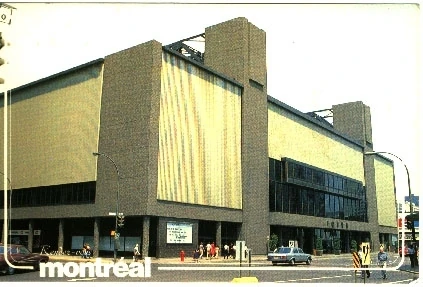
Montreal's bus station, with its towering parking decks
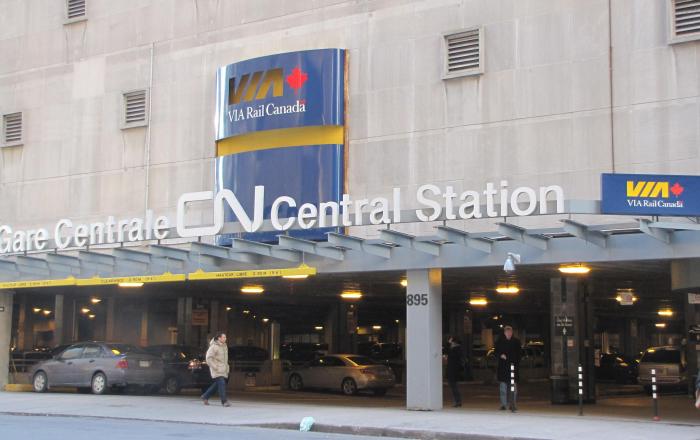
Amtrak, however, runs just 1 train, the Adirondack, in each direction each day between New York and Montréal, in cooperation with Canada's equivalent, VIA Rail. This train leaves Pennsylvania Station at 8:15 AM and arrives at Gare Centrale (Central Station) at 7:11 PM, a trip of almost 11 hours.
The return trip leaves Montréal at 10:20 AM and gets back to Penn Station at 8:50 PM. And since Thursday night's game starts at 7:00, you'd have to take the trip on Wednesday to get there on time, and spend not 1 but 2 nights in a hotel.

So, while Gare Centrale, bounded by Rue de la Gauchetiere, Rue University, Rue Belmont and Rue Mansfield, is in the heart of the city, taking Amtrak/VIA to Montréal is not particularly convenient. Especially since the Adirondack, with its views of the Hudson River and Lake Champlain, is one of Amtrak’s most popular routes, and it could sell out. If you still want to try it, it's US$146 round-trip.
If you're driving, if you live close to the Garden State Parkway, take it across the State Line to the New York State Thruway, Interstate 87. If you live near New Jersey Route 17, take that up to the Thruway. Same with Interstate 287. Once you get to the Thruway/I-87, remain on it through Albany, after which it becomes the Adirondack Northway, all the way up to the border.
When you get to the border, you'll be asked your citizenship, and you'll have to show your passport and your photo ID. You'll be asked why you're visiting Canada. Seeing a Devils vs. Canadiens game probably won't (but might) get you a smart-aleck remark about how the Habs are going to win, but they won't keep you out of their country based on that alone.
If you're bringing a computer with you (counting a laptop, but probably not counting a smartphone), you don't have to mention it, but you probably should. Chances are, you won't be carrying a large amount of food or plants; if you were, depending on how much, you might have to declare them.
Chances are, you won't be bringing alcohol into the country, but you can bring in one of the following items duty-free, and anything above or in addition to this must have duty paid on it: 1.5 litres (53 ounces) of wine, or 8.5 litres (300 ounces or 9.375 quarts) of beer or ale, or 1.14 litres (40 ounces) of hard liquor. If you have the slightest suspicion that I'm getting any of these numbers wrong, check the Canada Customs website. Better yet, don't bring booze in. Or out.
As for tobacco, well, you shouldn't use it. But, either way over the border, you can bring up to 200 cigarettes, 50 cigars, and 200 grams (7 ounces) of manufactured tobacco. And, on October 14, 2016, President Obama finally ended the ban on bringing Cuban cigars into America. This also applies to rum, for which Cuba is also renowned. It is still considerably easier to buy these items in Canada than in America, but, now, you can bring them back over the border.
If you've got anything in your car (or, if going by bus or train, in your luggage) that could be considered a weapon, even if it's a disposable razor or nail clippers, tell them. And while Canada does have laws that allow you to bring in firearms if you're a licensed hunter (you'd have to apply for a license to the Province where you plan to hunt), the country has the proper attitude concerning guns: They hate them. They go absolutely batshit insane if you try to bring a firearm into their country. Which, if you're sane, is actually the sane way to treat the issue.
You think I'm being ridiculous? How about this: Of the 44 U.S. Presidents -- 9 counting the Roosevelts, Theodore after he was President and Franklin right before -- 7 have faced assassins with guns, 6 got hit and 4 died; but none of the 22 people (including 1 woman) to serve as Prime Minister of Canada has ever faced an assassination attempt. John Lennon recorded "Give Peace a Chance" in Montréal and gave his first "solo concert" in Toronto, but he got shot and killed in New York. In fact, the next time I visit, I half-expect to see a bumper sticker that says, "GUNS DON'T KILL PEOPLE, AMERICANS WITH GUNS KILL PEOPLE."
(Another note about weapons: I’m a fan of the TV show NCIS, which airs in Canada on Global Network TV. If you are also a fan of this show, and you usually observe Gibbs Rule Number 9, "Never go anywhere without a knife," this time, forget it, and leave it at home. If you really think you're going to need it -- as a tool -- mention the knife to the border guard, and show it to him, and tell him you have it to use as a tool in case of emergency, and that you do not plan to use it as a weapon. Do not mention the words "Rule Number 9" or quote said rule, or else he'll observe his Rule Number 1: Do not let this jackass into your country, eh?)
And if you can speak French, don't try to impress the Customs officials with it. The locals might appreciate that you're trying to speak to them in their primary language, but they won't be especially impressed by any ability to speak it, and any such ability won't make it any easier for you to get through Customs.
When crossing back into the U.S., in addition to what you would have to declare on the way in (if you still have any of it), you would have to declare items you purchased and are carrying with you upon return, items you bought in duty-free shops or (if you flew) on the plane, and items you intend to sell or use in your business, including business merchandise that you took out of the United States on your trip. There are other things, but, since you're just going for hockey, they probably won't apply to you. Just in case, check the Canadian Customs website I linked to above.
After going through Customs, I-87 will become Autoroute 15, which will take you right into the Montréal area. If you're going to a downtown hotel, take Exit 53 to Pont Champlain (the Champlain Bridge), which will take you to Autoroute 10, the Bonaventre Expressway, across the St. Lawrence River and right into downtown -- or, as they say, Centre-ville.
If you make 2 rest stops – I would recommend at or near Albany, and count Customs, where they will have a restroom and vending machines – and if you don’t do anything stupid at Customs, such as fail to produce your passport, or flash a weapon, or say you watch South Park (a show with a vendetta against Canada for some reason), or say anything unkind about the late Maurice "Rocket" Richard or the late Jean Béliveau, the trip should take about 8 hours. Though that could become 9, because Montréal traffic is pretty bad, though not as bad as Toronto, which is every bit as bad as traffic in New York, Boston and Washington.
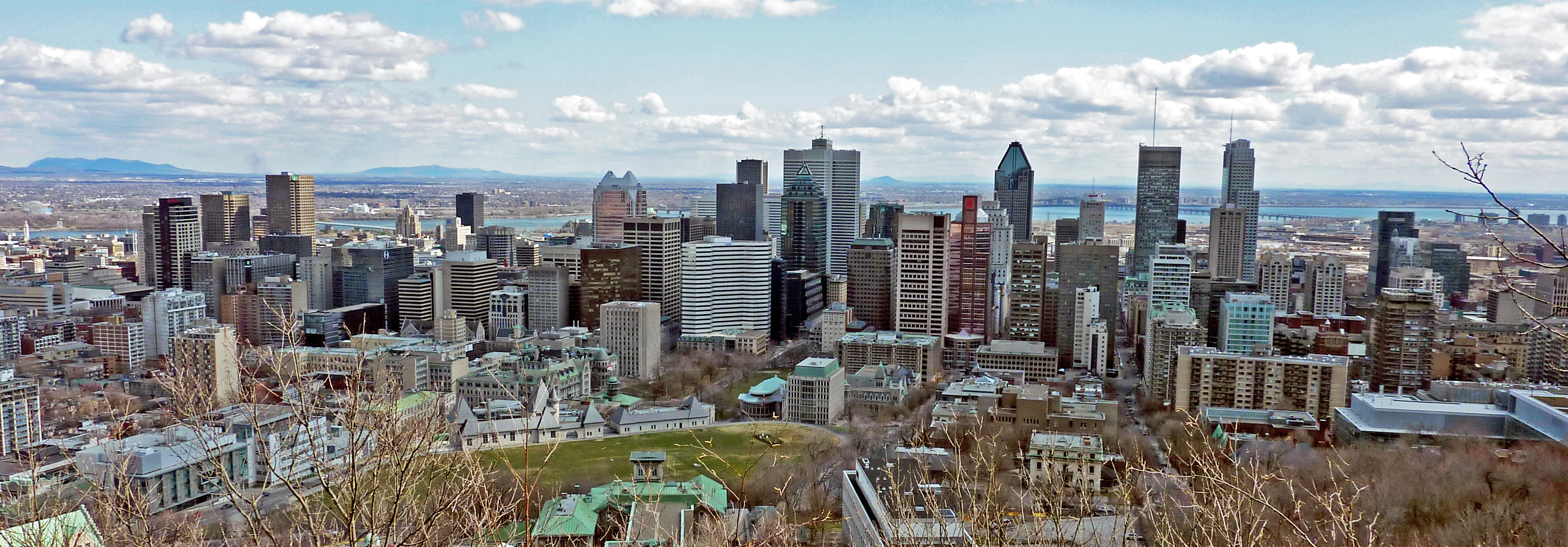
Once In the City. Montréal is one of the oldest cities in North America, founded by France in 1642. Seeing a big hill in the middle of the island will tell you where the name came from: "Mont Real," "Royal Mountain." In some instances, things in the city are spelled as "Mont Royal."
With 1.7 million people, Montréal has more people than any American city except New York, Los Angeles, Chicago and Houston. There are 4.1 million people in the metro area.
"I remember"
Since Canada is in the British Commonwealth, there are certain subtle differences. Dates are written not as Month/Day/Year, as we do it, but as Day/Month/Year as in Britain and in Europe. So while we would write the date of the game as "June 16, 2017," they would write it as "16 June 2017." Not 6/1617, but 16/6/17. They also follow the British custom in writing time: A game starting at 7:00 PM would be listed as 1900. (Those of you who have served in the military, you will recognize this as, in the words of M*A*S*H's Lt. Col. Henry Blake, "all that hundred-hours stuff.")
And every word we would end with -or, they will end with -our; and some (but not all) words that we would end with -er, they end with -re, as in "Bell Centre." Every measurement will be in the metric system: Temperatures will be in Celsius, not Fahrenheit; distances will be in "kilometres" (including speed limits), and gas prices will be per "litre," not per gallon.
Speaking of which: Gas prices will be not just in Canadian dollars, but will be per "litre." So if you see "100.9," which is the current average price I'm seeing online for Montréal, that's not US$1.00 & 9/10ths per gallon, that's C$1.01 per liter. Which works out to about US$2.87 per gallon. So, if you're driving, get your gas here in New Jersey, where it's currently running about $1.75.
When you arrive, I would recommend buying The Gazette and The Globe and Mail. The former newspaper is the city's predominant English-language paper, the latter is national, and both are liberal enough to suit my sensibilities (or, should I say, sensible enough to suit my liberalism). And The Gazette has a very good sports section, and does a superb job covering the Canadiens, and nearby minor-league, collegiate and “junior” hockey teams no matter what time of year it is.

I would advise against buying French-language papers like La Presse, Le Journal de Montreal and Le Devoir -- The Press, The Journal, and The Duty -- unless you really know French cold. Especially since Le Devoir is the local paper of Québec nationalism and even separatism. If The Gazette and The Globe and Mail are too liberal for you, The National Post may be more to your liking. Either the bus or the train terminal will have out-of-town papers, including The New York Times, and possibly also the Daily News or the New York Post.
Like New York, Montréal is a city of islands, with a a main island in the center -- except, unlike Manhattan, you can't cross a State Line (or, in this case, a Province Line) by going over a bridge or into a tunnel. Like New York, Montréal is international and multiethnic: In spite of French being the largest ethnic group, there are significant Irish, Italian and Jewish communities, and, for linguistic reasons, a large and growing community of immigrants from France's former African colonies.
Montréal doesn't really have a centerpoint. (Centrepoint? pointe du centre?) To make matters even more confusing, while they have East and West (Est et Ouest) on street names, like Manhattan, the main island is not perfectly north-south. Indeed, it's actually more than a 45-degree angle, so what's east is more north, and what's west is more south. Boulevard St-Laurent, known as The Main in English and Le Main (pronounced "leh man" in French), is the official east-west divider, where the address numbers on each side start at 1, while the river is the starting point for north-south-running streets. The city has no freeway "beltway."
The further west you go in the city, the more likely you are to hear English; the further east, the more likely you will be to hear only French. In fact, in Montréal's East End, you might see several buildings flying only the Provincial flag, the Fleurdelyse, the blue flag with the white cross and the white lilies in the cantons. These people who fly only the Provincial flag, not the red-white-red tricolor with the red Maple Leaf in the center, are separatists, who consider Québec a separate nation and want Anglophone Canada to "Let my people go." The separatist tide has faded since the nearly successful referendum of October 30, 1995, but there is still strong separatist sentiment in the East End, and this increases the closer you get to the Provincial capital, Québec City.
Roger Doucet, an opera singer who sang the National Anthem at Expos and Canadiens games in the 1970s before his death from cancer in 1981, would acknowledge this divide: He would begin the anthem in French, and face the east side of of Parc Jarry, Stade Olympique or the Forum; then, in mid-song, turn and face the west side of the structure, and conclude in English.
The city is about 67 percent white, 9 percent black, 7 percent East Asian, 7 percent Middle Eastern, 4.2 percent Hispanic, 3.3 percent South Asian, 2.5 percent Aboriginal (Canada calls its "Native Americans" the First Nations). About 66 percent of the city say their first language is French, 13 percent English, but nearly everybody speaks both to some degree, because they have to in order to get by in this city.
Société de Transport de Montréal runs a subway, opened in 1966 and known as “Le Metro,” just like that of Paris. When I first visited, they didn't use tokens or farecards. They used actual tickets. Very small tickets, an inch by an inch and a half. Thankfully, they now use a farecard, called an Opus Card. They charge $3.25 for 1 trip, $6.00 for 2, $26.50 for 10, $10.00 for a one-day card, and $13.00 for an "Unlimited Week-end" running from 6 PM Friday to 5 AM Monday. With the exchange rate, the prices are (especially when you factor in the new-MetroCard fee) roughly comparable to the New York Subway.
Reading the Metro map shouldn't be too much trouble, even if you don't know French. Until last year, the trains, regardless of the color of the line, were all blue. But, like their contemporaries, New York's "Redbirds," they've been replaced by silver cars.
Just as Minneapolis tried to beat the cold by building a skywalk system downtown, Montréal went in the other direction, creating "Underground Montreal." (In French, La Ville Souterraine.) Every day, about half a million people use this system that has over 20 miles of tunnels spread over 4.6 square miles. They connect things like shopping malls, hotels, banks, office buildings, museums, universities, apartment buildings, the bus terminal, Gare Central and Gare Windsor, 7 Metro stations, and, yes, the Bell Centre.
Postal Codes in Montréal and its suburbs begin with the letter H. The Area Codes are 514 for the main island and 450 for the suburbs, with 438 as an overlay. Hydro-Québec runs the Province's electricity.
The Provincial sales tax for Québec is 9.975 percent. The legal drinking age in Québec is 18. And if you're staying overnight, and wake up with a craving, and you can't find a Tim Hortons, you can look for a dépanneur. The word means "to help out of difficulty," is sometimes shortened to "dep," and is what we would call a convenience store. Like 7-Eleven or Wawa or Quik Chek. (There's now an eatery named Dépanneur in Brooklyn.)
Going In. I seriously recommend not driving to the stadium. If you did drive to Montréal, leave your car at the hotel's parking deck. Besides, tailgate parties really aren't a thing in Canada: Due to the British influence, it's more of a "Go to the pub before and after the match" culture.
Essentially, McGill University is Canada's answer to Harvard, right down to the Crimson color. Indeed, in 1874, the year before it played the 1st indoor hockey game, it had played Harvard in a game that was vital to the development of football in North America. Their teams were called the Redmen, but when they had to add women's teams, they chose Martlets as a nickname, instead of Redwomen.
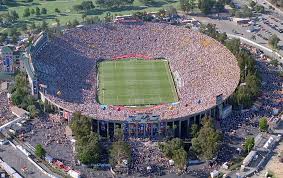
Built in 1915, Percival Molson Memorial Stadium has been the home field for McGill University athletic teams. It is tucked away into Mount Royal, at 475 Avenue des Pins (Pine Avenue) at Rue University, about a mile northwest of downtown. That tucking is on the west side, meaning you're most likely to enter from one of the other 3 sides, especially the east.
Yes, the sign is missing an O.
In addition to McGill, it was used by the Alouettes from 1954 to 1967, and again since 1998, although with only 25,012 seats, they still need to move into the Olympic Stadium for their Playoff games. It also hosted the field hockey matches of the 1976 Olympics, and the 2014 edition of Canada's National Championship for college football, the Vanier Cup, with the Université de Montréal defeating McMaster University of Hamilton, Ontario.
The original name was McGill Graduates' Stadium. In 1919, the stadium was named for Captain Percival Molson, a former McGill sports star and member of the Molson brewing family (which, for a time, owned the Canadiens), who was killed in action in World War I on July 5, 1917, 100 years ago.
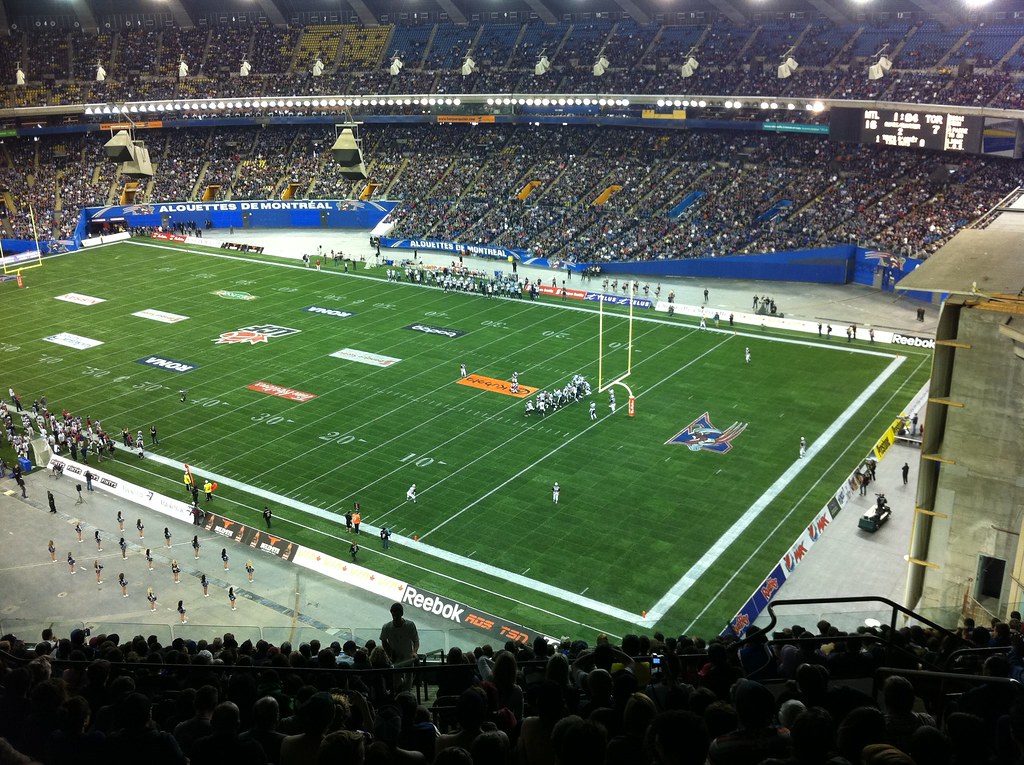
Despite Montreal's east-west (or Est-Ouest) street-naming system, which would suggest that the field runs east-to-west, it actually runs north-to-south. And, unfortunately, since 1976, the field has been artificial, although the Astroturf was replaced with FieldTurf in 2004.
An oddity is that both teams' benches are on the same side of the field, the east side. Another oddity is that the Montreal Neurological Institute and Hospital appears to be built into the south end, much as the University of Pennsylvania administration building looks like it's built into the west end of Franklin Field in Philadelphia, although much fancier-looking buildings than the hospital are around the stadium.

On August 5, 1961, the Alouettes played an exhibition game against the Chicago Bears at Molson Stadium, losing 34-16. This remains the last game played between teams in the 2 leagues, as the earlier start to the CFL season (designed to avoid snowouts in November and December) means that the NFL's preseason (in August) falls during the CFL's regular season.
In 1898, a McGill professor, Dr. Henry Yates, donated a trophy for Canadian college football, the Yates Cup. McGill won it 10 times from 1902 to 1969, until a 1971 realignment made them, ironically, ineligible. Canada's current college football national championship is called the Vanier Cup, and McGill won it in 1987, losing 3 other Finals.
McGill played the 1st indoor hockey game anywhere in 1875, and kept that original team going, so that it is now probably the oldest continuously-operating hockey team in the world. It's won Canada's national championship 22 times, despite not winning it at all from 1946 to 2006 -- 60 years. But in 2006, they began a streak of 6 titles in 7 years, ending with the 22nd title in 2012. The women's team has won 7 national championships, most recently in 2010.
Their home ice, McConnell Winter Arena, opened in 1956, thanks to a gift from John Wilson McConnell, a sugar magnate and publisher of the Montreal Star, an English-language newspaper which folded in 1979. Despite the school's prestige, it seats only, 1,600 people. 3883 Rue University, behind Molson Stadium. Both can be reached via the McGill or the Place-des-Arts station on the Metro.
Food. Montréal is a great food city, but there are two things of which you should beware. One is Montréal-style hot dogs. This is a problem since hot dogs are a staple of sporting events. They call their hot dogs steamé, stimé or Steamies, and top them with mustard, chopped onion or sauerkraut. Sounds like New York style, right?
But they also put this weird green relish on it, and that ruins it. Do yourself a favor, and order your Steamie without relish. (Incidentally, in spite of my suggestions of similarities between Montréal and New York, don't expect to see hot dog carts on the streets: The city banned street food carts in 1947.)
The other food you will want to avoid is poutine. It's French fries topped with brown gravy. Sounds great, right? Not so fast: They also top it with curd cheese. As they would say in the city's Jewish neighborhood, "Feh!" Poutine, along with French fries (they call them patates frites, "fried potatoes," as they know that the item originated in Belgium, not France), is available at McDonald's, but stay away from it. Trust me.
If you're a fan of the film Pulp Fiction, you should be aware that, regardless of what it's called in Paris, in Montréal, a Quarter Pounder with Cheese is called "un quarte de livre avec fromage." Literally, "a quarter of a pound with cheese." Not "a royale with cheese."
Neverthless, Molson Stadium has standard stadium food, and although none of it is great, most of it upsets Canadian stomachs far less than does NHL Commissioner Gary Bettman. One staple of Montréal food that is definitely worth it is viande fumée -- smoked meat sandwiches. Think New York's Carnegie Deli, only cheaper and better. Yum, yum. They can be found at Sections W1 and Y1 in the lower level, and F2, J2 and U2 in the upper deck.
Team History Displays. The Grey Cup, the championship trophy for Canadian football, has been won by Montreal teams 9 times. How many times, Ed Rooney? "Nine times!" The Montreal Foot Ball Club, sponsored by the Montreal Amateur Athletic Association (a.k.a. the Montreal AAA, the club that won the 1st Stanley Cup in 1893), won it in 1931.
And, as happened in both the U.S. and Canada during World War I, during World War II, Canadian football teams were temporarily replaced by service teams. St. Hyacinthe-Donnacona, named for a port town near Montreal and a Royal Navy ship, won the Cup in 1944.
Founded in 1946, the Als have won it 7 times: 1949, 1970, 1974, 1977, 2002, 2009 and 2010; and lost in the Final in 1954, 1955, 1956, 1975, 1978, 1979, 2000, 2003, 2005, 2006 and 2008. The banners are hung in the south end.
You may have noticed a significant gap in there: No '80s, no '90s. It wasn't because they were losing. It was because they weren't even there. The name was changed to the Montreal Concordes in 1982, and they folded in 1985.
In 1994, the CFL tried a short-lived experiment in America, going to cities that didn't have NFL teams at the time. One of these was the Baltimore Stallions, and it was blatant attempt to ride the nostalgia for the Colts: Horse name, blue and white uniforms, playing in Memorial Stadium. They reached the Grey Cup Final in 1994, and won it in 1995, the only time the trophy has been won by a team outside Canada. The experiment lost money, but the CFL allowed the Stallions to move to Montreal, and in 1996 the Alouettes were reborn.
George Dixon, 1960s Als great. Note that the bird theme led to
winged helmets, like the Philadelphia Eagles.
What's an "Alouette"? The team is named after "Alouette," a work song about plucking the feathers from a skylark, which had become a symbol of the people of
Québec. Thus, the team is also nicknamed the Larks, or the Als (short for Alouettes).
Junior Ah You, Samoan star Alouette of the 1970s
The team has worn red from the beginning, but blue has been their dominant color since the 1970s, and the silver helmets are (intentionally or otherwise) a reminder of the line from the Broadway song "You'll Never Walk Alone," so popular in British soccer: "At the end of the storm, there's a golden sky, and the sweet silver song of a lark."
1990s star Mike Pringle
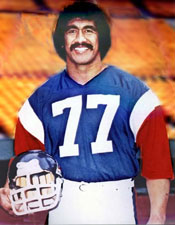
The Als have retired 11 uniform numbers: 13, 2000s quarterback Anthony Calvillo; 27, 1990s running back Mike Pringle; 28, 1960s running back George Dixon; 56, 1950s 2-way lineman Herb Trawick; 63, 1960s guard Pierre Desjardins; 74, 1970s tight end Peter Dalla Riva; 75, 1950s receiver and defensive back Hal Patterson; 77, 1970s defensive end Junior Ah You; 78, 1950s running back Virgil Wagner; 86, 2000s slotback (a receiving position that doesn't exist in U.S. football) Ben Cahoon; and 92, 1950s quarterback and 1970s head coach Sam Etcheverry. These numbers are displayed on the east stand.
There are 29 Alouettes in the Canadian Football Hall of Fame:
* From the 1949 Grey Cup winners: Trawick, Wagner, quarterback Bruce Coulter, and head coach and general manager Lew Hayman.
* From the losing Cup Finalists of 1954, '55 and '56: Trawick, Wagner, Coulter, Patterson, Etcheverry, and 2-way end Red O'Quinn.
* From the 1960s: Dixon. Although his number is retired, Desjardins is not in the CFHOF.
* From the 1970 Grey Cup winners: Etcheverry, Dalla Riva, receiver Terry Evanshen, tackle Ed George, defensive back Gene Gaines, and owner Sam Berger.
* From the 1974 Grey Cup winners: Dalla Riva, George, Gaines, Berger, Ah You, offensive tackle Dan Yochum, defensive tackle Glen Weir, linebacker Wally Buono, and defensive backs Dickie Harris (a native of Point Pleasant Beach on the Jersey Shore) and Marv Luster.
* From the 1977 Grey Cup winners: Dalla Riva, Berger, Ah You, Yochum, Weir, Buono and Harris.
* From the 1980s Concordes: Offensive lineman Miles Gorrell.
* From the 1990s rebirth, but not the Grey Cups of the 2000s: Quarterback Tracy Ham, guard Pierre Vercheval and defensive end Elfrid Payton.
* From the 2002 Grey Cup winners: Calvillo, Pringle, Cahoon, tackle Uzooma Okeke, head coach Don Matthews (who died this past Wednesday) and owner Bob Wetenhall (who still owns the team).
* From the 2009 and 2010 Grey Cup winners: Calvillo, Cahoon and Wetenhall.
In 2006, TSN (The Sports Network, Canada's version of ESPN) named the Top 50 CFL Players of All Time. From the Alouettes, they selected Pringle (Number 4), Patterson (13), Etcheverry (26), Harris (33) and Luster (35). Ah You, Cahoon, Calvillo, Dalla Riva, Dixon, Evanshen, George, Ham, Okeke, Trawick, Vercheval, and Yochum were among 134 other players named to an "Honour Roll," effectively finalists.
Two Heisman Trophy winners have played for the Alouettes: Johnny Rodgers (1972 Nebraska receiver, 1973-76) and Troy Smith (2006 Ohio State quarterback, 2013-14). (UPDATE: The 2012 winner, quarterback Johnny Manziel of Texas A&M, played for the Als in 2018.)
The Alouettes' main rivals, as you might guess from the Canadiens-Maple Leafs rivalry, are the Toronto Argonauts. They also play the annual Labour Day Classic (same as our Labor Day, the 1st Monday in September), against the team in the national capital, Ottawa: Formerly the Rough Riders, then the Renegades, now the Redblacks. Combined, all Ottawa teams lead the series 12-10. (UPDATE: Through the 2018 season, it's 14-11. Unfortunately, I can't find an all-time record of Als-Argos games. I can tell you that the Als are 6-5 vs. the Argos in Playoff games.)
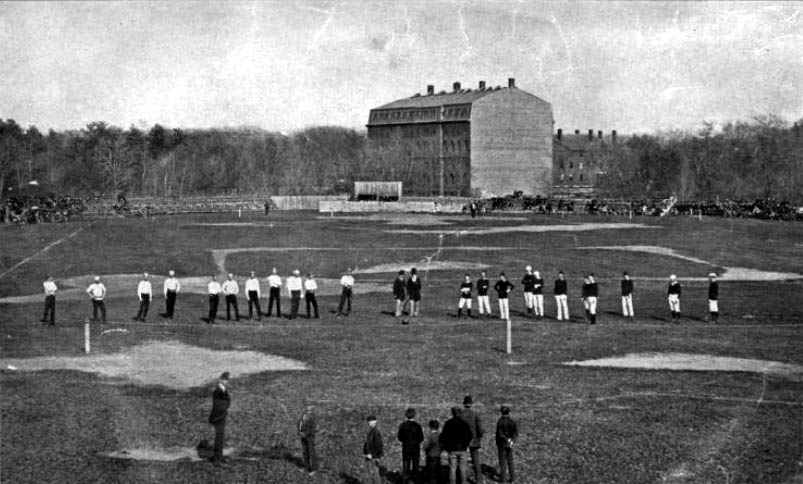
Of course, Molson Stadium's original, and still main, tenant is the Redmen of McGill University. They occupy a very special place in the history of North American football. On May 14, 1874, at Jarvis Field, Harvard University hosted McGill in the 1st-ever "football" games between American and Canadian teams. They played 2: A game under Harvard's "Boston game" rules, which Harvard won 3-0; and a game under the "code" of "rugby union," the code most familiar to Canada at the time (indeed, the predecessor to the CFL was the CRU, the Canadian Rugby Union), which ended 0-0.
The Harvard men liked the rugby version, including the "try." When they returned to the U.S., their officials met with officials from other schools, and the rules were combined with those of the soccer generally considered "football" in America, and carrying the ball became allowed, and the "try" became the "touchdown." So if you want to know why America plays the gridiron game instead of "football," blame Harvard and McGill. (And the fact that the gridiron game is "American," while soccer is "foreign," and we have tended to hate foreign things.)
Canadian college football is governed by U Sports, which currently awards the Yates Cup to the champions of Ontario University Athletics. Despite it having been originally donated by one of their professors, McGill has not been eligible for this trophy since 1971, McGill won it 10 times: 1902, 1906, 1912, 1913, 1919, 1928, 1938, 1960, 1962 and 1969.
They've won the Mitchell Bowl, one of the national semifinals, in 1958, 1960 and 1973. They've never been in the other semifinal, the Uteck Bowl, but they won its predecessor, the Atlantic Bowl, in 1969 and 1987. They've won the National Championship, the Vanier Cup, once, in 1987. And they've won the Dunsmore Cup, the Provincial Championship, in 1987, 2001 and 2002.
1987 Vanier Cup
Also located in Montreal, founded as a result of the 1974 merger of Loyola University and Sir George Williams University, Concordia University has won the Dunsmore Cup in 1982, 1993 and 1998. They won the Atlantic Bowl in 1998, but lost the subsequent Vanier Cup. The Université de Montréal won the Dunsmore Cup, the Uteck Bowl and the Vanier Cup in 2014; and the Dunsmore Cup and the Mitchell Bowl in 2015.
Also in Québec: Université Laval, near Québec City, is the Province's most successful football program. They've won 13 Dunsmore Cups since 1999, including last year's. They've won the Mitchell Bowl in 2003 and 2011; the Uteck Bowl in 2004, 2006, 2008, 2010, 2012, 2013 and 2016; and the Vanier Cup 9 times, in 1999, 2003, 2004, 2006, 2008, 2010, 2012, 2013 and 2016. So, going into this season, they are the holders of the Vanier, the Uteck and the Dunsmore. Bishop's University, of Sherbrooke, have won the Dunsmore Cup in 1986, 1988, 1990 and 1994. Sherbrooke University has won no titles, losing the Dunsmore Cup Final in 2010 and 2012.
Stuff. Since they don't own either facility, the Alouettes don't have an official team store at either Molson Stadium or the Olympic Stadium. If you're interested in a souvenir, you can go to a smaller stand, or to a store downtown.
The CFL has released DVDs titled CFL Traditions for each of its 8 old teams, including the Alouettes. But books about the Als aren't available on Amazon.com.
During the Game. You're not a Toronto fan or an Ottawa fan, so your safety won't be an issue. It wouldn't be an issue even if you were a fan of those teams, because this is Canada, and not hockey.
Since you're watching a CFL game, there will be one National Anthem sung. and it will be "O Canada," and it will be sung by the home fans with considerable gusto, most likely with the 1st half in French and the 2nd half in English. The Als hold auditions, rather than having a regular singer. Announcements are made in English and French. The mascot is a lark named Touché.
The rules are a bit different. The field is longer: 110 yards, as opposed to 100, and with end zones 25 yards deep, as opposed to 10, therefore the passing game is more important; and it's wider, 65 yards, as opposed to our 53 1/3rd. Teams get 3 downs to advance the ball instead of 4. And there's 12 men on each side, as opposed to 11, creating positions that we don't see in the NFL, the NCAA or our high school games, such as the slotback.
After the Game. Montréal is an international city, every bit as much as New York is, and some of these people may be immigrants who cut their teeth as sports fans in European soccer. But we're not talking about hooligans here. You'll be safe.
If you want to go out for a postgame meal, or even just a pint, the area around McGill is mostly residential. However, if you walk 9 blocks east on Avenue des Pins, and then 3 blocks north on Blvd. Saint-Laurent, to 3895, you will come to the famous Schwartz's Deli. It's worth the 15-minute walk. (Plus, that'll work off the calories from this glorious meal.) It's open until 1:30 AM on Fridays, 2:30 AM on Saturdays, and 12:30 AM every other day of the week.
If deli sandwiches aren't your bag, your best bet is probably to get back on the Metro, and head downtown. The Rue Crescent neighborhood, centered around that west-of-downtown street and roughly bordered by Rue Sherbrooke, Rue Peel, Boulevard René-Lévesque and Rue Guy (that's "gee" with a hard G, not "guy" rhyming with "high"), is, more or less, Montréal's "Greenwich Village." You should be able to find a place that will serve you even if you order in English. Be advised, though, that you must remove your hat when you walk into a Montréal pub. They insist.
Madisons New York Grill & Bar is at 5222 Rue Sherbrooke Ouest, a 5-minute walk from the Olympic Park that includes the Olympic and Saputo stadiums, and is renowned for its chicken tenders. However, there is no evidence that this is a particular place that New Yorkers visiting, or ex-New Yorkers living in, Montréal tend to go to. Plus, I've been told it's more of a "restaurant" than a "bar," and that it's "kind of like a nicer TGI Friday's." If that's true, expect mediocre food at too-high prices and lousy service. Metro to Pie-IX.
If all you need is a snack and coffee, your best bet may be Tim Hortons. (Note that there is no apostrophe: It's "Hortons," not "Horton's," because Bill 101, Québec's ridiculous protect-the-French-language law, prohibits apostrophes and the company wanted to keep the same national identity.) They have a 62 percent share of the Canadian coffee market (Starbucks has just 7 percent) and 76 percent of the Canadian baked goods market. They also sell sandwiches, soup, chili, and even (some of you will perk up faster than if you'd drunk their coffee) New York-style cheesecake. It's fast food, but good food. I rate them behind Dunkin Donuts, but ahead of Starbucks.
"Timmy's" (in the diminutive, people do use the apostrophe) has Montréal outlets even though namesake Tim Horton, a hockey defenceman (that’s how it's "spelt" up there), played most of his career for the hated Maple Leafs. He and businessman Ron Joyce started the doughnut/coffee shop chain in 1964, while in the middle of the Maple Leafs' 1960s dynasty. He played a couple of years for the Rangers, then went to the Buffalo Sabres and opened a few outlets in the Buffalo area. He was still playing at age 44, and the only thing that stopped him was death. Specifically, a 100-MPH, not-wearing-a-seat-belt crash on the Queen Elizabeth Way over Twelve Mile Creek in St. Catharines, Ontario.
And if Canada's answer to Dunkin Donuts isn't your cup of tea (or coffee), there's always the dépanneurs. And if you really, really want Dunkin Donuts, there is one in the Place Ville-Marie mall, at Rue Mansfield and Blvd. René-Lévesque, 4 blocks from the Bell Centre, although it may not be open after the game.
If your visit is during the European soccer season, of which we are now in the off-season (it starts again in mid-August), the best place to watch your club is at The Burgundy Lion, 2496 Notre-Dame Ouest & Charlevoix. Red Line to Lionel-Groulx.
Sidelights. Montréal is much cleaner than most American cities, mainly because Canada believes in using government for, you know, essential services, including proper sanitation, rather than in giving kickbacks to corporations that claim to create jobs but don't. But the city does have some bad neighborhoods. Still, you should be okay if you stay out of the East End -- or, if you really must go there, are willing to speak French there and give lip service to the separatist cause. In the meantime, check out these locations:
* Victoria Rink. Opened on Christmas Eve, December 24, 1862, and named for Queen Victoria, it was described at the dawn of the 20th Century as "one of the finest covered rinks in the world." On March 3, 1875, it hosted what is believed to be the very first indoor hockey game, anywhere in the world, complete with 9 men on a side, goaltenders (not a first but still unusual at that point), a referee, a puck rather than any kind of stone (as could be found in curling, then as now a popular sport in Canada), and both rules and time predetermined -- 60 minutes, as with today's hockey, although no separation into periods. The Victoria Skating Club played a team made up of students of nearby McGill University, and the Victorias won, 2-1.

The Montreal Hockey Club (or the Montreal Amateur Athletic Association, or "Montreal AAA") was awarded the 1st Stanley Cup in 1893, and it hosted the 1st Cup playoff games in 1894. The Victoria Hockey Club won the Cup while playing there in 1895, 1897, 1898 and 1899. The Montreal Shamrocks defeated them for the Cup in 1899 (more than one "challenge series" could be held per year in those days), and won it again in 1900. The rink also hosted some of North America's first figure skating competitions.
It was torn down in 1925, and a parking garage was built on the site. Rue Drummond & Blvd. René-Lévesque Ouest, adjacent to a Sheraton hotel. Metro: Lucien-L'Allier.
* Jubilee Arena. This building didn't last too long, built in 1909 and burning down in 1919, a year after the fire that destroyed Westmount Arena, forcing the Canadiens, who started here, move to Mount Royal Arena. This arena's construction led to the founding of both the Canadiens and the National Hockey Association, the precursor to the National Hockey League. 3100 Rue St-Catherine Est at Rue Moreau. Bus 34.
* Mount Royal Arena. Home to the Canadiens from 1920 to 1926, the Habs won the 1924 Stanley Cup while playing there. It only seated 6,000, so when they were offered the chance to move into the larger Forum, they jumped at it. Mount Royal Arena was converted into a concert hall and then a commercial building, before burning down in 2000. A supermarket is now on the site. 50 Avenue du Mont-Royal Ouest & Rue Saint-Urbain. Bus 55.
* Montreal Forum and Westmount Arena. The Yankee Stadium of hockey, the Forum opened on November 29, 1924, and the Canadiens played there from 1926 until 1996, winning 22 of their 24 Stanley Cups in that span. (They won 2 before moving in, in 1916 and 1924.) The Montreal Maroons also played there, winning the Stanley Cup in 1926 and 1935.
The Canadiens clinched on home ice in 1930, 1931, 1944, 1946, 1953, 1956, 1957, 1959, 1965, 1968, 1979 and 1993; and on the road in 1958, 1960, 1966, 1969, 1971, 1973, 1976, 1977, 1978 and 1986. Famously, the Canadiens never had an opponent clinch the Cup on Forum ice until 1989, when the Calgary Flames did it, the reverse of 1986 when the Habs clinched in Calgary. The Rangers clinched the 1928 Cup on Forum ice against the Maroons, who hung on through the Great Depression for as long as they could, but finally went out of business in 1938.
The Forum's original front entrance,
prior to the 1968 renovation
In 1937, the Forum hosted the funeral of Howie Morenz. the Canadiens star known as "The Babe Ruth of Hockey," and later that year hosted the Howie Morenz Memorial Game as a benefit for his family, between a combined Canadiens-Maroons team and players from the other 6 teams then in the NHL, including New York's Rangers and Americans. The NHL All-Stars beat the combined Montreal team 6-5.
In 1972, the Forum hosted Game 1 of the "Summit Series" between Canada and the Soviet Union, and the Soviets' shocking 7-3 win turned the hockey world upside-down before Canada won Games 6, 7 and 8 in Moscow to take the series.
On New Year's Eve, December 31, 1975, CSKA Moscow, a.k.a. the Central Red Army team, with many of the players from the Summit Series, began a North American tour at the Forum, and what were then the 2 best club hockey teams on the planet played to a stirring 3-3 tie. That game effectively launched the Habs on a streak of 4 straight Cups, 1976-79, which stand alongside their 5 straight of 1956-60 -- not as many consecutive Cups, but 16 consecutive series won as opposed to 10.
After the renovation
Elvis Presley never performed in Montréal -- or anywhere in Canada except shows in Toronto, Ottawa and Vancouver early in his career, in 1957 -- but The Beatles played at the Forum on September 8, 1964. In 1976, it hosted the Olympic gymnastic events, and it was there that Nadia Comaneci performed the 1st perfect 10 routine in Olympic history, having already gotten the 1st perfect 10 anywhere earlier in the year at what was still being called "the new Madison Square Garden."
The original seating capacity was 9,300 -- which was considered huge for an indoor stadium in the 1920s, before the building boom that the Forum helped start, leading to that era's incarnations of Madison Square Garden and the Boston Garden, Maple Leaf Gardens in Toronto, Chicago Stadium and the Olympia in Detroit. Capacity became 13,551 in 1949, and a 1968 renovation expanded it to a capacity of 16,259, pushed to 17,959 with 1,700 standees, with the tradition of the standees being let in first and rushing for position.
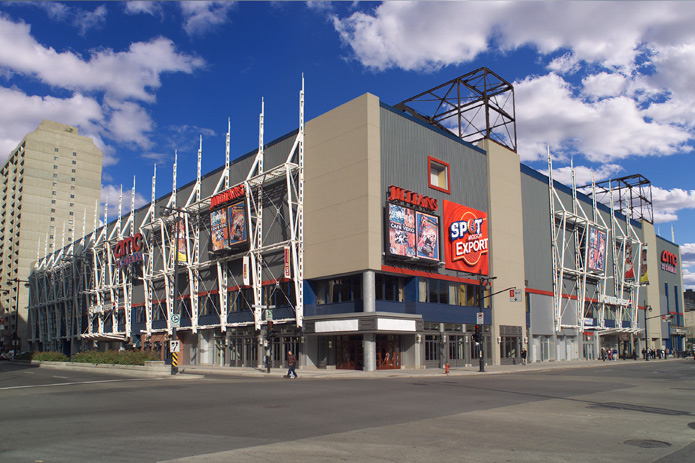
After an emotional closing ceremony on March 11, 1996, the Forum was converted into a mall, complete with restaurants, a bowling alley and a movie theater. Roughly where the rink was, hockey markings have been painted onto the floor of the main walkway, and there's a small bleacher with sculptures of fans and a bench with a statue of Maurice Richard, waiting to take the ice one more time.
The Forum building after its conversion
So, unlike the original Yankee Stadium and the original Boston Garden, the Montreal Forum still stands and is still being used, although not for its original purpose. 2313 Rue St-Catherine Ouest, at Avenue Atwater.
Atwater used to be the city line between Montréal and Westmount, before mostly-Anglophone Westmount was incorporated into the "megacity" of Montréal in 2002. The Westmount Arena, right across from the Forum but in a separate city, was sometimes known as the Montreal Arena for prestige purposes, and was designed specifically for hockey, a rarity at the time, and was perhaps the first ice rink in the world to have the rounded corners we have come to expect from hockey. It opened on New Year's Eve, December 31, 1898, and was the home of several teams.
The Montreal AAA team won the Stanley Cup there in 1902 and 1903, making it 4 Cups, and by 1906 it was an amateur team that lasted until 1961. The Montreal Wanderers played there, winning the Stanley Cup in 1906, 1907, 1908 and 1910. The Canadiens started playing there in 1911, and won the Cup there in 1916.
On January 2, 1918, 19 years to the week after it opened, a fire started in, ironically, the arena's ice-making plant, and burned it to the ground. No one died, but the Canadiens had to move back to Jubilee Arena, and the Wanderers went out of business. A shopping center, Place Alexis-Nihon, is now on the site. Both that shopping center and the Forum can be accessed by Atwater station on the Metro.
* Windsor Hotel. Often called Canada's first grand hotel and billing itself as "the best in all the Dominion," it stood from 1875 to 1981. The National Hockey League was founded here on November 26, 1917, with 5 teams: The Montreal Canadiens and Wanderers, the Toronto Arenas (forerunners of the Maple Leafs), the Ottawa Senators (not the team that uses the name today), and the Quebec Bulldogs. By 1934, all but the Habs and the Leafs would be out of business.
Following a fire in 1957, the hotel went into decline, and the North Annex is all that remains, now an office building and banquet complex called Le Windsor. 1170 Rue Peel at Rue Cypress. Metro: Peel or Bonaventure.
* Parc Olympique. The legacy of the 1976 Olympics was one of debt, not fully paid off until 2008. This got "The Big O" the additional nickname "The Big Owe." But much of it is still open.
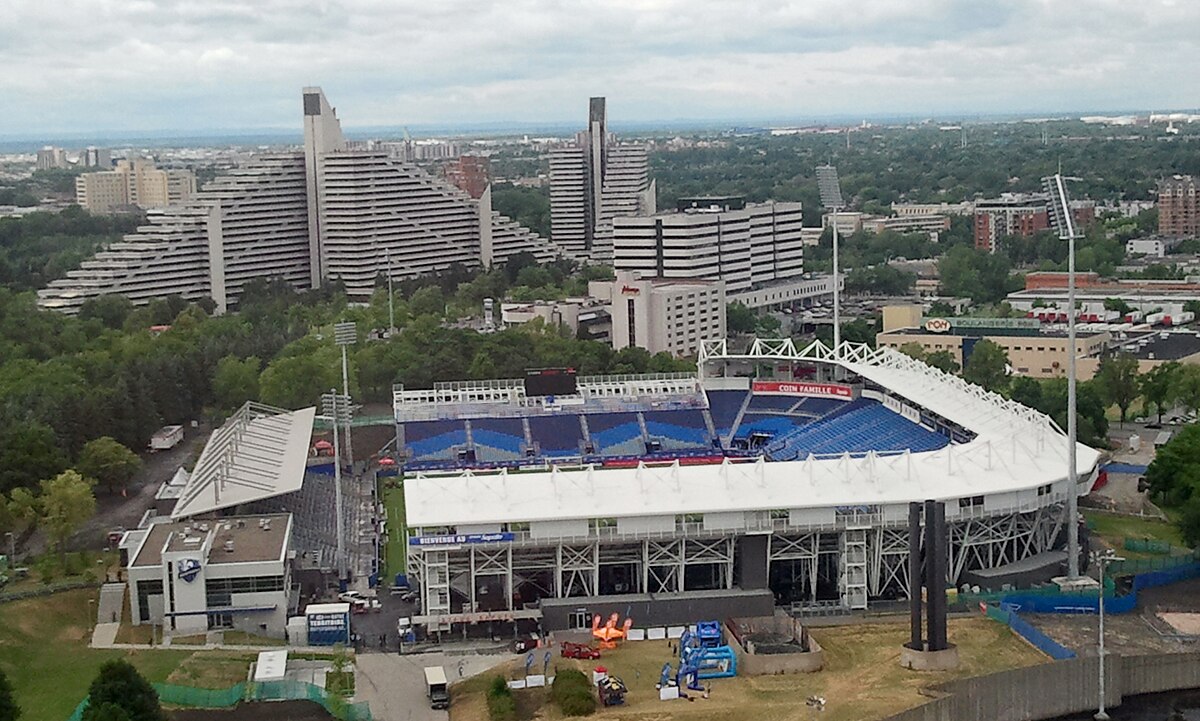
It includes Stade Olympique (Olympic Stadium), which the Alouettes used from 1976 to 1985, is still used by them for Playoff games, and games that MLS' Impact thinks will attract more than 20,000. The Expos played there from 1977 to 2004, and it hosted games of this year's Women's World Cup.
It also includes Stade Saputo, the home of L'Impact; an arena named for Canadiens great Maurice Richard, with a statue of him outside; the Velodrome cycling center, now a nature museum called the Biodome; the Montreal Botanical Garden and the Montreal Insectarium. But you don't want to see a museum devoted to bugs. Metro: Pie-IX (pronounced "Pee-nuff," named for 19th Century Pope Pius IX).
The Canadian Premier League, an attempt at a top-flight soccer league for the country, was founded in mid-2017, with the hopes of beginning play in Spring 2018. The Impact's reserve team might be moved into it.
UPDATE: North America won a joint bid to host the 2026 World Cup. The Olympic Stadium was chosen as 1 of Canada's 3 sites, the others being BMO Field in Toronto and Commonwealth Stadium in Edmonton.
* Bell Centre. Home of the Canadiens since 1996, the official address of the Bell Centre ("Centre Bell," pronounced SAHN-truh BELL in French) is 1909 Avenue des Canadiens-de-Montréal -- awarded to it in 2009 on the team's 100th Anniversary. The old address was 1100 Rue de la Gauchetière Ouest. Avenue des Canadiens-de-Montréal, the part of Rue de la Gauchetière that borders the arena, will soon be converted to a pedestrian-only street.
Getting to the Bell Centre by public transportation is easy. Line 2 goes to Station Bonaventure, and from there it's a 2-block walk west. Because of Montréal's cold weather, this can be done through the Underground City system.
Originally known as the Molson Centre, for the brewing family that has also long been part-owners of the Canadiens, the arena was renamed for Canada's national telephone company in 202. It hosted games of the 1996 and 2004 World Cups of Hockey. In 2009, in connection with the Habs' Centennial, it hosted the NHL's All-Star Game and Draft. It's hosted preseason NBA games, usually involving Canada's last remaining NBA team, the Toronto Raptors. However, Montréal has never had an NBA team, and likely never will. It hosts concerts and UFC events, including some featuring city native Georges St-Pierre.
According to an article in the May 12, 2014 New York Times, Montreal basketball fans divide their fandom between the Celtics, the Los Angeles Lakers, and the Miami Heat. How LeBron James' return to the Cleveland Cavaliers affected that, I don't know.
* Parc Jarry. Jarry Park Stadium was the original home of the Expos, from April 14, 1969 to September 26, 1976. It was meant as a temporary facility, seated only 28,456, and had a pool beyond right field that was the resting place for a few long home runs. Expos pitcher Bill Stoneman pitched the 2nd of his no-hitters there, and in the park's last MLB game, the Phillies clinched their first 1st-place finish in 26 years.
Now known as Stade Uniprix, in 1995 it was converted into a tennis stadium, with one end still recognizable as the home-plate seating area from Jarry Park. 285 Rue Faillon Ouest at Rue Gary-Carter. (Carter played his 1st 2 seasons there.) Metro: Parc. (Not to be confused with the Metropark train station on the Woodbridge-Edison border back in New Jersey.)
With the Expos gone, the closest MLB team to Montreal is, surprise, not the other Canadian team, the Toronto Blue Jays, 343 miles away; but the Boston Red Sox, 309 miles away. Likewise, the Boston Celtics are the closest NBA team, 307 miles away. If Montreal did get a new team, the metro area would rank 20th in MLB population, and 17th in the NBA.
* Site of Delorimier Stadium. Home of the Montreal Royals from 1928 to 1960, and the Alouettes from 1946 to 1953, this 20,000-seat stadium was one of the best facilities in the minor leagues, and was Jackie Robinson's 1st home field in "organized ball." It was demolished in 1971 and replaced by a school, with a plaque honoring Robinson and the Royals. 2101 Rue Ontario Est & Avenue de Lorimier. Bus 125.
* Concordia University. Formed in 1974 due to a merger of Sir George Williams University and Loyola University, Concordia, the city's other major Anglophone school also has a connection to McConnell, whose contributions got his name put on their library.
The current Concordia Stadium was built in 2003, and seats 4,000. Their recently-renovated rink, the 1,000-seat Ed Meagher Arena, is adjacent, and celebrated its 50th Anniversary this year. 7200 Rue Sherbrooke Ouest. Metro to Vendôme, then bus 105 to Sherbrooke/Campus Loyola.
* Université de Montréal. "UdeM" is the city's premier Francophone university, and their teams are called the Carabins -- the Gunmen. Their athletic complex opened in 1976, and hosted some Olympic events. Oddly, they have a women's hockey team, but not a men's hockey team. Stade du CEPSUM seats 5,100, and Aréna du CEPSUM seats 2,460. 2100 Boulevard Edouard-Montpetit.
* UQAM. The Université du Québec à Montréal's initials are pronounced "OO-kam" in French and "YOO-kwam" in English. Yeah, this one is definitely better in French. Their teams are called the Citadins, but they only compete provincially, not nationally. Think of them as the Canadian equivalent of NCAA Division I-AA. UQAM Centre Sportif is at 1212 Rue Sanguinet. Metro to Berri-UQAM.
* Autostade site. The Autostade was built as part of Expo '67, the World's Fair that announced the city's entry into the modern world (and gave the baseball team its name). It opened in 1966, and the Alouettes played there from 1968 to 1976.
But it was not a popular venue, due less to its weird look (the Sixties were a great decade for many things, but architecture was not one of them) than to its location, on an island in the St. Lawrence River, making it cold even in the summer. The Als moved to the Olympic Stadium for the 1977 season, and the Autostade was demolished shortly thereafter. Rue de Irlandais and Chemin de Moulins, southeast corner. Bus 168.
* Queen Elizabeth Hotel. Opened in 1958, its namesake -- and her namesake, the widow of King George VI that our generation knew as the Queen Mother -- stayed here, as have other monarchs, Presidents, Prime Ministers and legendary entertainers. From May 26 to June 2, 1969, John Lennon and Yoko Ono staged their "Bed-In For Peace" at Room 1742, and recorded "Give Peace a Chance" there. 900 Blvd. René-Lévesque Ouest at Rue University. Metro: Bonaventure.
(René Lévesque was Premier of Québec from 1976 to 1985, leading the Parti Québecois, attempting to get the Province to become independent from Anglophone Canada. His 1980 referendum fell well short, he lost power in 1985, and he died in 1987 without getting another chance. For the better part of a decade, he and Prime Minister Pierre Trudeau waged an epic battle for the hearts and minds of Québec for the better part of a decade. The street now named for Lévesque was previously named Dorchester Street.)
* Historic sites. Canada's Prime Ministers don't have the kind of building equivalent to a Presidential Library. Of Canada's 15 deceased Prime Ministers, 2 are buried in or near Montréal. John Abbott was PM for only a year and a half in 1891 and 1892, and is buried at Mount Royal Cemetery.
In contrast, Pierre Trudeau was PM for all but 9 months between April 1968 and June 1984, and is, depending on your stance on the role of government and the status of Québec, either the most-loved or the most-hated head of government in Canada's history. He is buried at Saint-Rémi-de-Napierville in Saint-Rémi. 840 Rue Notre-Dame, about 20 miles southwest of Montréal. Not reachable by public transportation.
George-Etienne Cartier was Premier of "Canada East" prior to Confederation (their first step toward independence) in 1867, and along with the Anglophone Sir John A. Macdonald of "Canada West" was essentially the Francophone "Founding Father" of Canada. (They call their Founding Fathers "the Fathers of Confederation.") Essentially, the Fathers were afraid that, with America's Civil War over, their country would be next -- an understandable belief, since attempts to take Canada from Britain by force had been made during the American Revolution and the War of 1812, and had also been threatened in the 1840s. Cartier's home is a National Historic Site, at 458 Rue Notre-Dame Est at Rue Berri. Metro: Champ-de-Mars.
Also accessible by Champ-de-Mars station is Place Jacques-Cartier, where the French explorer of that name -- no relation to George-Etienne -- discovered the islands that became the city. It is the gateway to Old Montreal (Vieux-Montréal), and unlike New York, which is actually older (founded 1624 as opposed to 1642), a lot of 17th and 18th Century Montréal buildings remain.
* Museums. The city's version of the Museum of Natural History, Pointe-à-Callière Museum, is at 350 Place Royale at Rue de la Commune Ouest. Metro: Place-d'Armes. Their equivalent to the Metropolitan Museum of Art, the Montreal Museum of Fine Arts, is at 1380 Rue Sherbrooke Ouest at Rue Crescent, just off the Concordia University campus. Metro: Peel or Guy-Concordia. The McCord Museum of Canadian History is at 690 Rue Sherbrooke Ouest at Rue University. Metro: McGill, although its relative proximity to the Museum of Fine Arts allows you to do one right after the other.
* Delis. That wonderful smoked meat, Montréal's take on the classic bagel, and other delicatessen delicacies, can be picked up in lots of places, but 2 stand out: The aforementioned Schwartz's, 3895 Blvd. Saint-Laurent at Rue Milton, Metro: Sherbrooke; and Wilensky's Light Lunch, immortalized in Mordecai Richler's novel The Apprenticeship of Duddy Kravitz, and with scenes from the Alan Arkin movie based on it filmed there, 34 Avenue Fairmount Ouest at Rue Clark, Metro: Laurier and then a 10-minute walk. I've been to both, and recommend them highly.
Sadly, the legendary Bens, the oldest deli in the city, with its Art Deco entrance at 990 Blvd. de Maisonneuve Ouest at Rue Metcalfe (Metro: McGill or Peel), closed in 2006 and was demolished in 2008. Some of its memorabilia is now at the McCord Museum. An effort was made to preserve it as a historic site, but it failed.)
The tallest building in Montréal is 1000 de la Gauchetière, a.k.a. "Le Mille," at the corner of Rue de la Cathédrale. At 673 feet and 51 floors, it reaches the maximum height approved by the city, the elevation of Mount Royal. A popular feature of this building is its atrium which holds a large ice skating rink. 1250 Blvd. René-Lévesque, also known as the IBM-Marathon Tower, 3 blocks away, has a roof 653 feet high, but its spire rises to 741 feet. There are currently 7 buildings of at least 400 feet under construction in the city, but none will rise higher than "Le Mille" or "Douze Cinquante."
Most TV shows filmed or set in Montreal have only been shown in Canada, and thus wouldn't be familiar to most Americans. Movies filmed and/or set there include the original 1958 version of The Fly, Agnes of God, Eddie and the Cruisers II, Jesus of Montreal, The Whole Nine Yards, the Angelina Jolie crime thriller Taking Lives, the figure-skating parody Blades of Glory, 90 percent of the shooting for The Day After Tomorrow, and the films made from the novels of Mordecai Richler, including The Apprenticeship of Duddy Kravitz and Barney's Version.
The Olympic Stadium was used as a stand-in for the Baltimore Ravens' stadium as the site of the Super Bowl destroyed by a terrorist bomb in The Sum of All Fears. And Casino de Montréal served as the exterior shot for the arena for both Blades of Glory and the 2002 remake of Rollerball.
*
Montréal is a great North American and world city. So if you feel like taking in hockey at its most passionate, make sure your passport is in order, see if you can scrounge up a ticket, and head on up. Vive la différence!