Showing posts with label larry doby. Show all posts

Wednesday, October 11, 2023

October 11, 1948: The Cleveland Indians Win the World Series

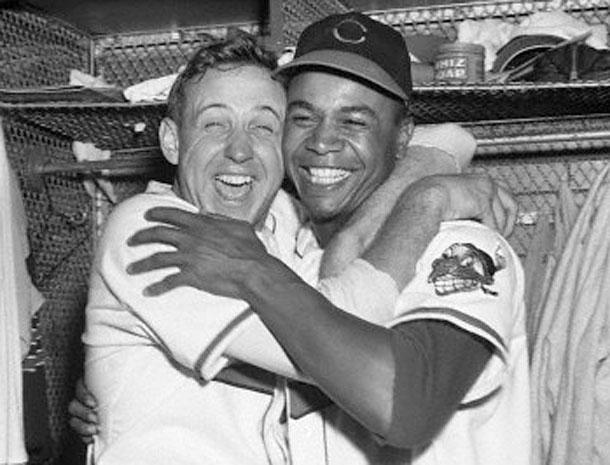
Steve Gromek (left) and Larry Doby

October 11, 1948, 75 years ago: The Cleveland Indians defeat the Boston Braves behind "rookie" 30-year-old knuckleballer Gene Bearden, 4-3 at Braves Field, and take Game 6 and win the World Series. It is their 2nd title, the 1st coming in 1920.

Team owner Bill Veeck had built this team. Larry Doby and Satchel Paige thus become the 1st black players to play on a World Series winner. Doby became the 1st black player to hit a home run in a World Series game. And Lou Boudreau, age 31, both shortstop and manager, becomes the last player-manager to win a World Series, or even a Pennant. Bob Feller would join Veeck, Doby, Paige and Boudreau in the Baseball Hall of Fame, although he ended up as the losing pitcher in both games the Indians lost in the Series: Game 1, to Johnny Sain; and Game 5, to another Hall-of-Famer, Warren Spahn.

A photograph of Doby being hugged by a white teammate, pitcher Steve Gromek, circulated, and was considered another step forward in black and white players working together.

The team has never won another World Series. They have had some close calls, some of them truly agonizing. And they're not even called the Indians anymore: In 2021, after years of complaints about their Native American name and its racist implications, they announced that, for the following season and thereafter, they would be named the Cleveland Guardians.

But at least they're still in Cleveland, despite a number of fears of having to move in the 1960s, '70s and '80s. In contrast, despite all their success in the 19th Century and winning Pennants in 1914 and 1948, that 1948 World Series Game 6 was the last late-season meaningful game the Boston franchise of the National League would ever play. The Braves would be in Milwaukee by the next time they reached the Series, in 1957.

The Indians' Eddie Robinson was the last surviving player from the 1948 World Series, living until 2021, age 100, 73 years later. Clint Conatser was the last survivor of the '48 Braves, living until 2019, at 98.

Thursday, October 11, 2018

How Long It’s Been: The Cleveland Indians Won a World Series

October 11, 1948, 70 years ago: The Cleveland Indians defeat the Boston Braves behind "rookie" 30-year-old knuckleballer Gene Bearden, 4-3 at Braves Field, and take Game 6 and win the World Series. It is their 2nd title, the 1st coming in 1920.

The Indians have never won another World Series. They have had some close calls, some of them truly agonizing:

* Losing the World Series in 1954 (getting swept by the New York Giants despite winning 111 games, then an AL record), 1995 (in 6 games to the Atlanta version of the Braves), 1997 (blowing a 2-0 lead in the 9th inning of Game 7 and losing to the Florida Marlins in the 11th) and 2016 (nearly coming from behind to beat the Chicago Cubs in the 10th inning in Game 7, but falling just short).

* Losing the American League Championship Series in 1998 (blowing a 2-games-to-1 lead against the Yankees) and 2007 (blowing a 3-games-to-1 lead against the Boston Red Sox).

* Losing the AL Division Series in 1996 (to the Baltimore Orioles), 1999 (to the Red Sox), 2001 (blowing a 2-games-to-none lead against the Seattle Mariners), 2017 (blowing a 2-games-to-none lead against the Seattle Mariners) and 2018 (getting swept by the Houston Astros).

* Finishing 2nd in the single-division American League in 1951 (to the Yankees), 1952 (to the Yankees again, this time by just 2 games), 1953 (to the Yankees again), 1955 (to the Yankees again, but just 3 games), 1956 (to the Yankees again), and 1959 (to the Chicago White Sox).

* Being just a game out of 1st place in the AL Central Division when the Strike of '94 hit.

* And nearly 2 generations of never even being in a Pennant race from 1960 to 1993.

The Indians haven't won the World Series since October 11, 1948. That's exactly 70 years. How long has that been?

*

The Indians have changed ballparks since then, moving from Cleveland Municipal Stadium to Jacobs Field in 1994. The name was changed to Progressive Field in 2008. The team they beat was the Boston Braves. They've not only changed ballparks 4 times since then, they've changed cities twice since then, moving to Milwaukee in 1953 and Atlanta in 1966.

The Indians won the World Series in 6 games. The Braves won Games 1 and 5. Only 1 player from each roster is still alive: Eddie Robinson of the Indians (also the oldest living ex-Yankee) and Clint Conatser of the Braves. Each of them is 97 years old.

Larry Doby and Satchel Paige, who had both been stars in the Negro Leagues, became the 1st black men to play for an American League team in the World Series, and the 1st black men to play on a World Series winner. Doby became the 1st black man to hit a home run in a World Series game. Lou Boudreau, age 31, both shortstop and manager, becomes the last player-manager to win a World Series, or even a Pennant.

Boudreau, Doby, Paige, Bob Feller, Braves manager Billy Southworth and pitcher Warren Spahn were involved in this Series, and went on to the Baseball Hall of Fame.

Fenway Park in Boston and Wrigley Field in Chicago are the only major league ballparks in use then that are still in use now. There was a National League team in Boston, and there were American League teams in Philadelphia, Washington and St. Louis. St. Louis was the Western outpost of the major leagues; it, Cincinnati and Washington were as far south as MLB went.

Milwaukee, Baltimore, Kansas City, San Francisco, Los Angeles, Minneapolis, Houston, Atlanta, Oakland, Seattle, San Diego, Montreal, Dallas, Toronto, Denver, Miami, Phoenix and Tampa Bay all had minor league teams then. All would get major league teams; except for Montreal, they all still have them.

Briggs Stadium in Detroit -- it became Tiger Stadium in 1961 -- had just become the last ballpark in the AL with lights. Wrigley wouldn't get them for another 40 years. No ballparks had electronic, or even electric, scoreboards. None had artificial turf, or a dome, retractable or otherwise. There were only a few black players; the few Hispanic players were all clearly white; and as for Asian players, well, this was a shade over 3 years past V-J Day, so forget it.

Connie Mack was still managing the Philadelphia Athletics. Hugh Duffy, Cy Young, Honus Wagner, Ty Cobb, Nap Lajoie, Tris Speaker and Fred Merkle were still alive. Babe Ruth had just died, less than 2 months earlier. Walter Johnson, Joe Tinker, Johnny Evers, and Mordecai "Three-Finger" Brown had all died within the last 2 years.

The defining players of my childhood? Carl Yastrzemski was 9 years old, Willie Stargell 8, Pete Rose 7; Tom Seaver, Steve Carlton and Rod Carew were 3; Reggie Jackson was 2, Nolan Ryan was 1, Johnny Bench and Carlton Fisk were 10 months, and Mike Schmidt and George Brett hadn't been born yet. Of the managers and head coaches of the 9 New York Tri-State Area sports teams, none had yet been born. Terry Collins of the Mets would be born the following May.

The Indians had interrupted the Yankees' run of World Championships. The defending NFL Champions were the Chicago Cardinals -- now in Arizona, and they haven't won the title since. The defending NBA Champions were the Baltimore Bullets, who would go out of business in 1954, and have no connection to the 1963 version of that team, now known as the Washington Wizards. The holders of the Stanley Cup were the Toronto Maple Leafs. The Heavyweight Champion of the World was Joe Louis.

The Olympics had just been held in Britain, and have been again. They have also since been held in America 5 times; 3 times each in Canada, Italy and Japan; twice each in Norway, Australia, Austria, France, Russia and Korea; and once each in Finland, Mexico, Germany, Bosnia, Spain, Greece, China and Brazil.

Due to World War II, the World Cup had not been held since 1938. It has since been held twice each in Brazil, Germany and Mexico; and once each in America, England, Switzerland, Sweden, Chile, Argentina, Spain, Italy, France, Japan, Korea, South Africa and Russia.

There were 48 States in the Union, and 21 Amendments to the Constitution of the United States. There had not been a Civil Rights Act since 1875. Racial segregation was legal in much of the nation, and interracial marriage was illegal in some States. Children in public schools could be forced to recite a Christian (usually Protestant) prayer. There was no Medicare, no Medicaid, no Environmental Protection Agency. Feminism and gay rights? Be serious. Two-thirds of the Justices now on the U.S. Supreme Court, 6 of the 9, had not yet been born.

The President of the United States was Harry Truman, about to win a full term of his own, what amounted to a 2nd term. Former President Herbert Hoover and Grace Coolidge, the widow of Calvin Coolidge, were still alive. Edith Roosevelt, widow of Theodore, had died 11 days earlier.

Dwight D. Eisenhower had just become President -- of Columbia University. John F. Kennedy and Richard Nixon were about to be elected to their 2nd terms in the U.S. House of Representatives; Gerald Ford, to his 1st. Lyndon Johnson had just just been promoted from the House to the Senate in a very sketchy special election. Jimmy Carter was serving aboard a submarine in the U.S. Navy. Ronald Reagan was acting, and was being divorced by his 1st wife, actress Jane Wyman. George H.W. Bush was getting started in the oil industry. Bill Clinton, George W. Bush and Donald Trump were all 2 years old -- and Trump hasn't gotten any more mature. Barack Obama wasn't born yet.

The Governor of Ohio, the Indians' home State, was Thomas J. Herbert, although he was about to be defeated for re-election by Frank Lausche. The Mayor of Cleveland was Thomas A. Burke. Current Governor John Kasich had not yet been born, and current Mayor Frank G. Jackson was 2 years old.

The Mayor of the City of New York was William O'Dwyer. The Governor of the State of New York, and the Republican Party's nominee for President was Thomas E. Dewey, about to be stunned by Truman. The Governor of New Jersey was Alfred E. Driscoll, and he was working on getting the New Jersey Turnpike approved. Aside from the Pennsylvania Turnpike, there weren't really superhighways in America.

There were still living veterans of the American Civil War (on both sides), the Indian Wars, the Franco-Prussian War, the Zulu War and the Northwest Rebellion. The American and British governing bodies of the Society of Friends (a.k.a. the Quakers) were the holders of the Nobel Peace Prize. No Prize would be awarded in 1948, as the Norwegian Nobel Committee released an official statement saying, "There was no suitable living candidate," and the Prize cannot be awarded posthumously. This was widely taken to be a tribute to Mohandas Gandhi, who had been assassinated the preceding January 30. So why didn't they give it to Gandhi while he was alive?

The Pope was Pius XII. The current Pope, Francis, then Jorge Mario Bergoglio, was 11 years old. The Prime Minister of Canada was William Lyon Mackenzie King, although he was about to retire and hand the government over to Louis St. Laurent; and of Britain, Clement Attlee. The monarch of both nations was King George VI, but his battle with lung cancer meant that he had already begun to turn some duties over to his 22-year-old daughter and heir apparent, Princess Elizabeth. There have since been 13 Presidents, 2 British monarchs, and 7 Popes.

Arsenal were the holders of England's Football League title, and Manchester United of its FA Cup. In the season that was now underway, Portsmouth would win the League, and Wolverhampton Wanderers the Cup. There was, as yet, no European Cup, nor even the Latin Cup, and the other tournament considered a predecessor to the European Cup (now the UEFA Champions League), the Mitropa Cup, had not yet been reestablished in the postwar era.

Publishing their 1st novels in 1948 were Truman Capote with Other Voices, Other Rooms, and Norman Mailer with The Naked and the Dead. Gore Vidal published The City and the Pillar, one of the earliest American novels to treat a gay protagonist without condemnation, although he is hardly a sympathetic character.

Agatha Christie published The Witness for the Prosecution and Other Stories, Georgette Heyer The Foundling, Alan Paton Cry, the Beloved Country, Irwin Shaw The Young Lions, Evelyn Waugh The Loved One. In non-fiction, Dumas Malone published Jefferson and His Time, Richard Hofstadter The American Political Tradition, and Thomas Merton The Seven Storey Mountain.

J.R.R. Tolkien had published The Hobbit, but not yet any of the Lord of the Rings Trilogy. C.S. Lewis had published books, but none of the Chronicles of Narnia books were yet among them. Jack Kerouac and Allen Ginsberg had yet to be published. George R.R. Martin had just been born, and Stephen King was a year old.

Major films of the Autumn of 1948 included the Laurence Olivier version of Hamlet, the Orson Welles version of Macbeth, the Ingrid Bergman version of Joan of Arc, the Gene Kelly and Lana Turner version of The Three Musketeers, the John Wayne Western Red River, the Robert Mitchum Western Blood On the Moon, the musical Isn't It Romantic, the musical Road House (definitely not the Patrick Swayze film, and Ida Lupino sings "One for My Baby"), the murder mystery Rope (Alfred Hitchock's 1st color film), the murder mystery Sorry, Wrong Number, Johnny Belinda, June Bride, The Night Has a Thousand Eyes, The Red Shoes, and the James Cagney adaptation of William Saroyan's play The Time of Your Life.

Gene Roddenberry had just resigned as a pilot for Pan Am, so he could write full-time for the new medium of television. It wasn't working out, so he soon joined the Los Angeles Police Department, which would give him several good ideas -- but not the one for which he would become known. George Lucas was 4 years old, Stephen Spielberg 2.

Kirk Alyn of Wharton, Morris County, New Jersey had just become the 1st live-action Superman, in a film serial earlier in the year. Robert Lowery was filming the serial Batman and Robin. Ian Fleming was working for The Sunday Times, and had not yet published any books, let alone those about James Bond.

It was the dawn of network television. CBS became a national TV network, and New York's Channel 11, WPIX, and Chicago's Channel 9, WGN, debuted that year. So did Milton Berle's Texaco Star Theater, Candid Camera, and Toast of the Town, the CBS variety show that everyone quickly began calling by the name of its host. In 1955, CBS would give in to this, and officially rename it The Ed Sullivan Show. Robert Kardashian Sr. was 4 years old, and neither Bruce Jenner nor Kris Jenner had yet been born.

The Number 1 song in America was "A Tree in the Meadow" by Margaret Whiting. Al Jolson, who'd been a star for over 30 years, was voted Most Popular Male Vocalist in Variety -- and you thought the Grammys were behind the times. Columbia Records introduced the long-playing (LP) record, which revolved at 33 1/3rd revolutions per minute. This would be used for albums. Also developed that year was the 45 RPM single. Both would supplant the standard 78 RPM over the next 10 years. Patti Page became the 1st singer to use multi-track overdubbing. Perry Como prepared his 1st televised Christmas special.

Frank Sinatra was one of the biggest stars in both music and film, still in his initial run of success. But Elvis Presley was 13 years old, John Lennon and Ringo Starr 8, Bob Dylan 7, Paul McCartney 6, George Harrison 5, David Bowie and Elton John 1, and Billy Joel, Bruce Springsteen, Michael Jackson, Prince, Madonna and Bono had not yet been born.


Inflation was such that what $1.00 bought then, $10.33 would buy now. A U.S. postage stamp cost 3 cents, and the fare on the New York Subway had just gone up from 5 to 10 cents. Boston's had already been 10 cents, but an "exit fare" was added, leading to a song whose best-known version would be done in 1959 by the Kingston Trio: "M.T.A." In 1953, New York would solve the problem of how to collect both a nickel and a dime without building turnstiles to accommodate both, by inventing the subway token.

The average price of a gallon of gas was 22 cents, a cup of coffee 27 cents, a fast food meal (cheeseburger, fries and shake) 55 cents, a movie ticket 34 cents, a new car $1,250, and a new house $7,700. The Dow Jones Industrial Average closed that day at 182.41.

The tallest building in the world was the Empire State Building. The majority of American homes now had telephones, but hardly any had television sets. Commercial photocopying was not yet possible. Computers were in their infancy. Alan Turing was still alive, but Steve Jobs, Bill Gates and Tim Berners-Lee weren't born yet. There were no credit cards or automatic teller machines. A majority of American homes did not yet have air conditioning. Most of the places that did were either bars or movie theaters.


Telephone numbers were still based on "exchanges," based on the letters on a rotary dial. So a number that, today, would be (718) 293-6000 (this is the number for the Yankees' ticket office, so I’m not hurting anyone's privacy), would have been CYpress 3-6000. There were no ZIP Codes, either. They ended up being based on the old system: The old New York Daily News Building, at 220 East 42nd Street, was "New York 17, NY"; it became "New York, NY 10017."

An artificial kidney was possible, but not an artificial heart. Transplantation of organs was not possible. The distribution of antibiotics were still new. There was no polio vaccine. There was no birth control pill, but there was no Viagra, either.

Space travel? That was the stuff of movies. Fruit flies were, for the moment, the only living things flown past the boundary of "space." No one had yet put any object into orbit.

In the Autumn of 1948, the Berlin Airlift was flying in supplies past a Soviet blockade, turning the Cold War from a winning issue for the Republicans into a winning issue for the Democrats. The Democratic People's Republic of Korea, a.k.a. North Korea, was proclaimed. Israel, India and Pakistan were also new nations. An earthquake killed over 100,000 people in Soviet Turkmenistan and Iran.

Brandeis University was founded in the suburbs of Boston, and the University of the Andes was founded in Bogota, Colombia. In neighboring Venezuela, a military coup overthrew President Romulo Gallegos. Whittaker Chambers accused Alger Hiss of spying for the Soviet Union. Hiss denied it under oath, and sued Chambers for slander. Chambers produced evidence, and, with the statute of limitation for espionage past, Hiss was indicted for perjury. Chambers produced "The Pumpkin Papers" 15 days after the Presidential election. Had he done so before, it would have swung the election from Truman to Dewey.

Edvard Benes, and Baseball Hall-of-Famer Hack Wilson, and 1900s pitcher Al "The Curveless Wonder" Orth died. Gerry Adams, Avery Brooks, and Mickey Rivers were born.

October 11, 1948. The Cleveland Indians won the World Series. They had a good team and should have been contenders for a long time to come. And they were: After a down year in 1949, they averaged 93 wins a year over the next few years, winning the Pennant in 1954, and coming close to it in 1950, '51, '52, '55 and '59.

Then they didn't so much as get into a Pennant race again until 1994, didn't win another Pennant until 1995, and they have never won another World Series. They came within 2 games in 1995, and within 1 run in 1997 and 2016.

Can they do it in 2019? To do it, they would have to go through the Yankees, the Boston Red Sox, and the Houston Astros, and maybe other teams. It doesn't look good.

    Monday, December 18, 2017

    Top 10 Athletes From New Jersey

    December 18, 1787: New Jersey becomes the 3rd State to ratify the Constitution of the United States.

    This is, therefore, New Jersey's official day of Statehood, and, effectively, the State's "birthday," even though its current land had been occupied by Native Americans since time immemorial, had been sighted by Europeans as early as 1609, and often cites as its "beginning" the 1664 takeover of New Netherland by the English.

    December 18, 1969: I am born in Livingston, Essex County, New Jersey. It pleases me that I share my birthday with my home State.

    Top 10 Athletes From New Jersey

    Remember: What matters is not where the athlete was born, but where he grew up and was trained to play his sport. Example: Dennis Rodman was born in Trenton, but grew up in Dallas, so he would count for Texas, not New Jersey. Where he played or coached, in college or the pros, doesn't matter. For all they did in New Jersey, Lawrence Taylor came from Virginia, and Martin Brodeur from Quebec, so that's where they would count (if, that is, I were doing this for Canada's Provinces).

    Sometimes, this is tricky. Orel Hershiser was born in Buffalo, then lived in Detroit, Toronto, and finally Cherry Hill, Camden County, before turning pro in baseball. He only lived in Detroit for 6 years, but that was where he first played any kind of organized ball, so, in spite of having played high school ball for Cherry Hill East, he qualifies for Michigan, not New Jersey.

    Honorable Mention to Amos Alonzo Stagg of West Orange, Essex County, New Jersey. Before Martin Brodeur and other local athletes lived in what's become a well-off town, before the Richard J. Codey Arena (formerly the South Mountain Arena) became the Devils' practice home and center for local high school and youth hockey, even before Thomas Edison built his post-Menlo Park laboratory there, West Orange was an area for poor Irish immigrants and their kids, and Stagg was one.

    He overcame this to become one of the best all-around athletes of the 1880s. At Yale, he was a pitcher, and invented the batting cage. In football, he played end, and was named to the 1st All-America team, in 1889. In basketball, he became an instructor at the YMCA Training School in Springfield, Massachusetts, and played in the 1st public basketball game in 1892, a few weeks after his fellow instructor, Dr. James Naismith, invented the sport there. The students beat the faculty 5-1, with a basket counting for only 1 point. Stagg scored the faculty's only basket.

    If I was counting coaching achievements, he would be a lot higher than an honorable mention. He coached his 1st college football team in 1892, at the University of Chicago. He coached his last in 1958, at what's now San Joaquin Delta College, at age 96. (He lived to be 102.)

    Essentially, he and the man who coached him at Yale, Walter Camp, invented American football as we've come to know it. He invented the center snap, the T formation, the linebacker, the unbalanced line, the quarterback keeper, the man in motion, the lateral, the reverse, the end-around, the onside kick, the quick kick, and what became known as the Statue of Liberty play. And that's just plays. He also invented the huddle, the tackling dummy, hip pads, padded goalposts, varsity letters (Chicago's "C"), and was the 1st coach in any sport to assign uniform numbers to his players. He also wrote the 1st book that included diagrams of football plays, in 1893.

    At Chicago, he coached football from 1892 to 1932, baseball from 1893 to 1913, track & field from 1896 to 1928, and basketball in 1920-21. He served as athletic director from 1892 to 1933. And he wasn't just innovative, as a coach, he was good. He won Conference Championships in 1905, 1907, 1908, 1913, 1922, 1924, 1936, 1938, 1940, 1941 and 1942 -- his last at age 80. His 1905 and 1913 Chicago teams, both unbeaten and untied, were retroactively awarded National Championships.

    The football stadiums at both Chicago and the University of the Pacific, in Stockton, California, were named for him. He is in both the College Football and the Basketball Halls of Fame. The NCAA named its Division III championship game the Amos Alonzo Stagg Bowl, held annually in Salem, Virginia (outside Roanoke).

    Honorable Mention to Alex Wojciechowicz of South River, Middlesex County. A member of Fordham University's legendary 1930s offensive line the Seven Blocks of Granite, he was a 2-time All-Pro center and linebacker for the Detroit Lions, and helped the Philadelphia Eagles win the 1948 and 1949 NFL Championships. He is a member of the College Football, Pro Football, and Philadelphia Eagles Halls of Fame, and was named to the NFL's 1940s All-Decade Team.

    Honorable Mention to Lou Creekmur of Woodbridge, Middlesex County. An 8-time Pro Bowler, the offensive tackle won the NFL Championship with the Detroit Lions in 1952, 1953 and 1957. He was elected to the Pro Football Hall of Fame.

    Honorable Mention to Jim Ringo of Phillipsburg, Warren County. A 10-time Pro Bowler, he was the center on the 1961 and 1962 NFL Champion Green Bay Packers, before being traded to the Philadelphia Eagles. He is a member of the Pro Football, Green Bay Packers and Philadelphia Eagles Halls of Fame, and was named to the NFL's 1960s All-Decade Team.

    Honorable Mention to Rosey Grier of Roselle, Union County. His real name is Roosevelt, so he wasn't nicknamed for his hometown. A 2-time Pro Bowler, the defensive tackle played in 5 NFL Championship Games for the Giants, winning in 1956, before becoming a member of the Los Angeles Rams' line known as the Fearsome Foursome. He later became an actor and a community activist, and was the 1st former professional athlete to be a panelist on Match Game, preceding Alex Karras and Don Sutton.

    Honorable Mention to Mike Rozier of Woodrow Wilson High School in Camden, Camden County, winner of the 1983 Heisman Trophy at Nebraska. He became a 2-time All-Pro running back for the Houston Oilers.

    Honorable Mention to Ron Dayne of Overbrook High School in Pine Hill, Camden County. Funny how New Jersey's only 2 Heisman winners come from the same County, only 15 miles apart. Dayne won the Trophy in 1999 with Wisconsin, and remains the NCAA's all-time leader in rushing yardage with 7,125 yards. He played 8 seasons in the NFL, the 1st 5 with the Giants, reaching Super Bowl XXXV. He and Rozier are both in the College Football Hall of Fame.

    Honorable Mention to Joe Theismann of South River, Middlesex County. He was the 1st New Jersey-trained quarterback to lead his team to an NFL Championship, with the 1982 Washington Redskins, winning Super Bowl XVII.

    Honorable Mention to Joe Flacco of Audubon, Camden County. He was the 2nd New Jersey-trained quarterback to lead his team to an NFL Championship, with the 2012 Baltimore Ravens, winning Super Bowl XLVII.

    Honorable Mention to David Tyree of Montclair, Essex County. The receiver reached the Pro Bowl with the Giants in 2005, and kept their drive to win Super Bowl XLII alive with his legendary "Helmet Catch." He is now the Giants' Director of Player Developent (kind of an assistant general manager).

    Honorable Mention to Charlie Sweasy and Andy Leonard, both of Newark, Essex County. Sweasy was the 2nd baseman on baseball's 1st opening professional team, the 1869-70 Cincinnati Red Stockings. Leonard was its left fielder, and continued to excel with some of his former teammates on the Boston Red Stockings, who dominated the 1st professional league, the National Association, in the early 1870s.

    Honorable Mention to Billy Hamilton of Newark, Essex County. No, not the center fielder for the Cincinnati Reds -- he's from Mississippi. This one, "Sliding Billy," was a star center fielder in the 1890s, for the Philadelphia Phillies and for the Boston Beaneaters, forerunners of the Atlanta Braves.

    There were no All-Star Games or postseason awards in his time, but he had a .344 lifetime batting average, led the National League in batting in 1891 and 1893, had a 141 career OPS+, and was the best stealer of his era. His 914 stolen bases -- sometimes recorded as 937 -- were an all-time record until surpassed by Lou Brock. (Because 1900 was frequently used as a cutoff point, Ty Cobb was said to be the all-time leader with 892. Regardless, Brock and later Rick Henderson surpassed both o them.)

    He helped the Beaneaters win the Pennant in 1897 and 1898. He was elected to the Baseball Hall of Fame and the Philadelphia Baseball Wall of Fame.

    Honorable Mention to Leon "Goose" Goslin of Salem, Salem County. A left fielder, he batted .316 lifetime, with 2,735 hits, including 248 home runs. He was the only player to win all 3 of the Washington Senators' Pennants: 1924 (winning the District's only World Series), 1925 and 1933. He helped the Detroit Tigers win the Pennant in 1934 and 1935 (the team's 1st World Championship). He led the American League in RBIs in 1924 and batting average in 1928. He was an All-Star in 1936.

    He is (for now) the only South Jersey native in the Baseball Hall of Fame, and was named to The Sporting News' 100 Greatest Baseball Players in 1999.

    Honorable Mention to Don Newcombe of Elizabeth, Union County. And...

    Honorable Mention to Joe Black of Plainfield, Union County. The 1st black man to be the starting, and the 1st black man to be the winning, pitcher in a World Series game, respectively.

    Roger Kahn immortalized several of the 1950s Brooklyn Dodgers in his book The Boys of Summer, including Black. But not Newcombe: Kahn, focused on the Dodgers of 1952 and 1953, when he covered the team for the New York Herald-Tribune, the youngest baseball beat writer in New York newspaper history, and, at the time, Newk was serving in the U.S. Army in the Korean War. Unfortunately, by the time the Dodgers finally won the World Series in 1955, Black had been traded. But that year, Newk won 20 games and hit 7 home runs, a feat only achieved in the major leagues by 1 other pitcher, Wes Ferrell -- and he didn't win the Pennant when he did it.

    Honorable Mention to Mike Trout of Millville. The center fielder for the Los Angeles Angels of Anaheim was named American League Rookie of the Year in 2012, and the MVP in 2014 and 2016, finishing 2nd 3 other times. He helped the Angels win the AL Western Division in 2014. He is a 6-time All-Star. His lifetime batting average is .306, and his career OPS+ is a shocking 172. Oh yeah: He's only 26 years old. If I do this list again in 5 years, he will most likely be in the Top 10.

    Honorable Mention to John Roosma of Passaic, Passic County. A member of the Passaic High School "Wonder Five" of 1919-21, he was personally recruited for the U.S. Military Academy by General Douglas MacArthur -- himself a former Army athlet. He became the 1st college player to score over 1,000 points in a career, and Army's basketball most valuable player award is named for him.

    He was stationed in Hawaii when Pearl Harbor was attacked. He rose to the rank of Colonel, and commanded the 334th Combat Infantry Regiment, driving into Germany and helping bring about V-E Day. He lived until 1983.

    Honorable Mention to Bennie Borgman of Haledon, Bergen County. One of the earliest pro basketball stars, he played for the New York team known as the Original Celtics (no connection to the Boston NBA team), winning league championships in 1922, 1926 and 1928. He later served as the 1st head coach of the Syracuse Nationals (now the Philadelphia 76ers), and played minor-league baseball for 15 seasons, without reaching the majors. He was elected to the Basketball Hall of Fame.

    Honorable Mention to Tom Barlow of Trenton, the State Capital, in Mercer County. Another of the earliest stars of professional basketball, he played for the Philadelphia Warriors in the American Basketball League from 1926 to 1932, well before the founding of the NBA, or their move to the San Francisco Bay Area (now known as the Golden State Warriors). He is in the Basketball Hall of Fame.

    Honorable Mention to Rory Sparrow of Paterson, Passaic County. The Eastside High School graduate played for several teams, including both the Nets and the Knicks. His Rory F. Sparrow Foundation, benefiting underprivileged kids in the New York Tri-State Area, earned him the NBA's 1986 J. Walter Kennedy Citizenship Award, and a place as 1 of 8 "Athletes Who Care" to receive
    Sports Illustrated's Sportspeople of the Year award for 1987.

    Honorable Mention to Nikos Galis of Union City, Hudson County. A graduate of Union Hill High School in his hometown, he stayed in New Jersey and starred at Seton Hall University. And he is in the Basketball Hall of Fame, newly elected this year. But he never made so much as a dribble in the NBA.

    So why is he in? Because he went to his parents' homeland, Greece, and became the greatest basketball player the country has ever seen, leading Thessaloniki-based Aris to 8 titles in their league, which he led in scoring 11 times and whose MVP he won 5 times. He led Greece to the 1987 Eurobasket title (continental tournament for national teams).

    Honorable Mention to Carol Blazejowski of Cranford, Union County. "The Blaze" is on the short list for the title of greatest female basketball player ever. In 1978, playing for Montclair State College, she set a Madison Square Garden (old or new) record for points in a college game, by a person of either gender, with 52 against Queens College. That season, she was awarded the 1st Wade Trophy for women's player of the year.

    She was too young to play on the 1976 U.S. Olympic team, and the boycott kept her out of the 1980 Olympics. When the Women's Pro Basketball League was formed in 1980, she was signed by the New Jersey Gems, and was, at $50,000, the league's highest-paid player. It lasted just the 1 season, and she never played again.

    She then worked in the NBA's front office, was elected to the Basketball Hall of Fame in 1994, and when the NBA created the WNBA in 1997, she was named general manager of the New York Liberty. She now works for her alma mater, since renamed Montclair State University.

    Honorable Mention to Anne Donovan of Ridgewood, Bergen County. A graduate of Paramus Catholic High School, she won the AIAW Championship (that era's national championship for women's basketball) at Virginia's Old Dominion University as a freshman (freshwoman?) in 1980, and was named national Player of the Year as a senior in 1983. She is in the Basketball Hall of Fame as a player.

    She went into coaching, and has coached at East Carolina and Seton Hall, and for 5 different WNBA teams, including the Seattle Storm, whom she took to the 2004 WNBA Championship, and the New York Liberty. She won Olympic Gold Medals with the U.S. as a player in 1984 in Los Angeles and 1988 in Seoul, and as head coach in 2008 in Beijing.

    Honorable Mention to Milt Campbell of Plainfield, Union County. He won the Gold Medal in the decathlon at the 1956 Olympics in Melbourne, Australia.

    Honorable Mention to Renaldo Nehemiah of Scotch Plains, Union County. For all the great soccer players produced by Scotch Plains-Fanwood High School their best athlete ever didn't play that sport. (They also produced slugging outfielder Jeffrey Hammonds, Rutgers football All-American Bill Austin, and Joe Scarpati, who held Tom Dempsey's 63-yard field goal. And also recent Governor Donald DiFrancesco.)

    The top sprint hurdler in the world in the late 1970s, Nehemiah was denied an Olympic Gold Medal by the 1980 U.S. boycott. But, despite having stuck to track instead of football at the University of Maryland, he played 3 seasons with the San Francisco 49ers, and won Super Bowl XIX with them. He was then cut -- after the Niners drafted Jerry Rice, who only became the greatest receiver who ever lived.

    Honorable Mention to Saskia Webber of Princeton, Mercer County. A member of the U.S. soccer team that won the 1999 Women's World Cup, she and her teammates were honored by Sports Illustrated as their Sportspeople of the Year. She also played on the team that won the Gold Medal at the 1996 Olympics in Atlanta.

    Honorable Mention to Carli Lloyd of Delran, Burlington County. Only 2 human beings have scored a hat trick, 3 goals, in a World Cup Final: Geoff Hurst of England in the 1966 men's Final against West Germany, and Carli Lloyd of America in the 2015 women's Final against Japan. She also won Olympic Gold Medals with the U.S. in 2008 in Beijing, in 2012 in London, and in 2016 in Rio de Janeiro. She plays her club soccer for the Houston Dash.

    Honorable Mention to Tobin Heath of Basking Ridge, Somerset County. Another member of the U.S. team that won the Women's World Cup, and won Olympic Gold Medals in 2008 and 2012. She plays for the Portland Thorns, winning the National Women's Soccer League title in 2013 and 2017.

    Honorable Mention to Heather O'Reilly of East Brunswick, Middlesex County -- the town where I've lived most of my life. We don't know each other, though I was there for the ceremony when East Brunswick High School, our shared alma mater, retired her Number 9. She won the 2015 Women's World Cup; Olympic Gold Medals in 2004, 2008 and 2012; and the NWSL Championship with FC Kansas City in 2015. She now plays for Arsenal Ladies -- as if I needed another reason to cheer her.

    Honorable Mention to Josh Miller of East Brunswick, Middlesex County. At the same ceremony, Josh, the only EB grad to reach the NFL, had his Number 6 retired. I was a year ahead of him, and we did know each other.

    A graduate of the University of Arizona, he was the punter on the 1995 Baltimore Stallions team that became the only team outside Canada to win the Grey Cup. He reached the 2000 Pro Bowl with the Pittsburgh Steelers, and in 2005 was a member of the New England Patriots team that won Super Bowl XXXIX. He also played for the Tennessee Titans, and now hosts a sports-talk show on a Pittsburgh radio station.

    Honorable Mention to Dave Wohl of East Brunswick, Middlesex County. At the same ceremony, Wohl, the only EB grad to reach the NBA, had his Number 12 retired. (Oddly, while they both grew up in EB, both Dave and Josh were born in Queens.) He went to the University of Pennsylvania, and played for 5 NBA teams, closing his career with his home-State Nets in 1977.

    He went into coaching, and won an NBA Championship as Pat Riley's assistant on the 1985 Los Angeles Lakers. He then spent 3 years as Nets head coach, served as an assistant for several other teams, and recently served as general manager of the Los Angeles Clippers.

    Honorable Mention to Eric LeGrand of Woodbridge, Middlesex County. A star defensive tackle at Colonia High School in Woodbridge, he was paralyzed while making a tackle for Rutgers against Army at MetLife Stadium in 2010. His recovery to graduate and begin a sports media career in spite of his injury became one of sports' most inspirational stories, and his Number 52 became the 1st number retired in Rutgers football.

    Honorable Mention to Jeff Torborg of Westfield, Union County. Although Westfield High School has produced a lot of good football players, including former Giants Butch Woolfolk and Dave Brown -- and also Charles Addams, cartoonist and creator of The Addams Family -- its most successful athlete was a baseball player. Torborg's .537 batting average now only got him onto the 1963 All-America team, but remains a Rutgers University baseball record.

    He wasn't much of a hitter, but he was a good defensive catcher, helping the Los Angeles Dodgers win the 1965 World Series. Sandy Koufax pitched 4 no-hitters, and Nolan Ryan pitched 7, and Torborg caught 1 from each of them.

    He later coached for the Yankees, and managed several teams, nearly reaching the postseason with the 1990 Chicago White Sox, earning him American League Manager of the Year. Unfortunately, his most notable managing tenure was with the 1992 and 1993 Mets, with their underachieving and their disciplinary issues.

    Honorable Mention to Dick Button of Englewood, Bergen County. The Gold Medalist in men's figure skating in the Winter Olympics of 1948 in St. Moritz, Switzerland and 1952 in Oslo, Norway, he received the 1949 James E. Sullivan Award as the nation's outstanding amateur athlete.

    He is now best remembered as the voice of Olympic figure skating, first on ABC, then on CBS, now on NBC. Sadly for Scott Hamilton and Brian Boitano, he was also a pioneer in going bald after winning gold.

    Honorable Mention to Bruce Baumgartner of Haledon, Bergen County. Winner of the 1995 Sullivan Award, he won Olympic Gold Medals in wrestling in 1984 in Los Angeles and 1992 in Barcelona.

    Very Honorable Mention to Paul Robeson of Somerville, Somerset County. You may know of him as an actor, a singer -- having sung it in Show Boat on Broadway in 1927 and the film version in 1936, his version of "Old Man River" is considered the definitive one -- an antipoverty activist, and as a victim of the anti-Communist blacklist of the 1940s and '50s. But he was a great athlete, too.

    Born in Princeton, and a graduate of Somerville High School, he was only the 3rd black student ever to enroll at what was then called Rutgers College, and the 1st ever to play football there. He was named valedictorian of the Class of 1919.

    At 6-foot-3 and 219 pounds, which made him very big for the time, he played end, both ways, and Walter Camp, who created the concept of the All-American team, named him to it in 1917 and 1918. When Camp named his all-time All-American team in 1920, he called Robeson the greatest defensive end he had ever seen.
    Due to his other commitments, he only played 2 seasons of pro ball, with the 1921 Akron Pros and the 1922 Milwaukee Badgers. The blacklist meant that, from 1950 onward, he was written out of American society. By the time he died in 1976, he was virtually forgotten. He has been rediscovered, with Rutgers properly honoring him, and the U.S. Postal Service put him on a stamp.

    Honorable Mention to Jim Dowd of Brick, Ocean County. A graduate of Brick Township High School, he set a national high school career scoring record with 375 points: 189 goals and 186 assists.

    He is the only native of New Jersey ever to play for the State's only true major league sports team (the Giants and Jets having never adopted the New Jersey name, and the Nets having left). He is also the only native of New Jersey to get his name on the Stanley Cup. Fortunately, he did both at the same time. His late goal won Game 2 of the 1995 Stanley Cup Finals, and the Devils beat the Detroit Red Wings in 4 straight games.
    He played 17 seasons in the NHL, and has gone in to coaching.

    Honorable Mention to Edward "Mickey" Walker of Elizabeth, Union County. "The Toy Bulldog" was Welterweight Champion of the World from 1922 until 1926, and then Middleweight Champion of the World until 1929. He later ran a popular restaurant in Manhattan, and became an accomplished painter.

    Honorable Mention to Gus Lesnevich of Cliffside Park, Bergen County. The Light Heavyweight Champion of the World form 1941 to 1948, The Ring magazine named him Fighter of the Year for 1947.

    Honorable Mention to Ike Williams of Trenton, Mercer County. The Lightweight Champion of the World from 1945 to 1951 -- from April 18, 1945 to July 26, 1948, 2 of the 8 weight classes were held by New Jerseyans -- The Ring named him Fighter of the Year for 1948.

    Think about that: At a time when boxing had Joe Louis, Jersey Joe Walcott, Ezzard Charles, Archie Moore, Sugar Ray Robinson, Jake La Motta, Rocky Graziano, Tony Zale, Beau Jack, Willie Pep and Sandy Saddler, New Jersey-trained boxers were named Fighter of the Year in back-to-back years.

    I'll get to Walcott a little later. He, Walker and Williams are in the International Boxing Hall of Fame, but Lesnevich has not yet been so honored.

    Honorable Mention to Regret of Middletown, Monmouth County. In 1915, she became the 1st filly to win the Kentucky Derby. Only 2 others have followed: Genuine Risk in 1980 and Winning Colors in 1988.

    Now, the Top 10:

    10. Tommy Heinsohn of Jersey City, Hudson County. A graduate of St. Michael's High School (now defunct) in Union City (also Hudson County), he, like Manhattan's Bob Cousy, went from the New York Tri-State Area to the College of the Holy Cross in Worcester, Massachusetts, and became their all-time leading scorer.

    A 6-time NBA All-Star with a deadly hook shot, he was the 1957 Rookie of the Year, and was a member of the 1st 8 NBA Championships won by the Boston Celtics: 1957, 1959, 1960, 1961, 1962, 1963, 1964 and 1965. He coached the Celtics from 1969 to 1978, winning Coach of the Year in 1973 and the NBA Championship in 1974 and 1976. He then became a broadcaster, and called their 1981, 1984, 1986 and 2008 titles -- making him, now that Red Auerbach is dead, the only Celtic employee to have been a part of all 17 titles and all 21 NBA Finals appearances.
    He is in the Basketball Hall of Fame, and he has had Number 24 retired by Holy Cross and Number 15 retired by the Celtics.

    9. Monte Irvin of Orange, Essex County. Born in Alabama, he moved to Orange as a child, and starred in 4 sports at Orange High School, setting a State record in the javelin throw. A left fielder, he played for his "hometown" Newark Eagles, and was a 5-time Negro League All-Star, helping them win the 1946 Negro World Series.

    Some observers thought he might become the 1st black player in modern baseball. That didn't happen, but in 1949, he and Hank Thompson (in the same game) became the 1st black players for the New York Giants. He led the National League in RBIs in 1951, helping them win the Pennant. He was named to the 1952 All-Star Game, and helped them win the World Series in 1954.
    He was the last living member of the Hall of Fame who had been elected in part due to his Negro League performance. Having long since moved to San Francisco, a city in which he had never played a home game, the Giants retired his Number 20.

    8. Joe Medwick of Carteret, Middlesex County. He was called Ducky, because of the way he walked; and Muscles, because no one dared to call him Ducky to his face. A 3-sport terror at Carteret High School, and a Catholic son of Hungarian immigrants, Knute Rockne, himself an immigrant, wanted him to play football for Notre Dame.

    He chose baseball instead, and made the right choice. He was a member of the St. Louis Cardinals' "Gashouse Gang" that won the 1934 World Series, although his actions in Game 7 led to one of the biggest controversies in baseball history. In 1937, he was named National League Most Valuable Player, having won the Triple Crown, and he remains the last NL player to do that.
    In 1940, he was traded to the Brooklyn Dodgers. He seemed to be on course for one of the greatest careers in baseball history. But just after the trade, he was hit in the head with a pitch, and was never the same. He still made 10 All-Star teams, had a .324 lifetime batting average, a 134 OPS+, and 2,471 hits including 540 doubles, 113 triples and 205 home runs. He added another Pennant with the Dodgers in 1941.

    He is the only Central Jersey native in the Baseball Hall of Fame, and the Cardinals have elected him to their team Hall of Fame, but have not retired his Number 7.

    7. Larry Doby of Paterson, Passaic County. Born in South Carolina, he was a 4-sport athlete at Paterson's Eastside High School. He played for the Newark Eagles of the Negro Leagues, where he was a teammate with Irvin on the team that won the 1946 Negro World Series. In 1947, Bill Veeck, owner of the Cleveland Indians, made him the 1st black player in the American League.

    He had never played center field before, but became a 7-time All-Star, and in 1948, not only became the 1st black player to play on a World Series winner, but the 1st one to hit a home run in a World Series game. He led the AL in home runs in 1952, and in 1954 led it in both home runs and RBIs, helping the Indians win another Pennant.
    The Indians retired his Number 14 and elected him to their team Hall of Fame. He lived long enough to be elected to the Baseball Hall of Fame. Just as he was the majors' 2nd black player, he was also its 2nd black manager, with the 1978 Chicago White Sox -- then owned by his former patron, Bill Veeck.

    6. Jersey Joe Walcott of Pennsauken, Camden County. He struggled for a long time to get his shot at the Heavyweight Championship of the World, finally getting it in 1947 against Joe Louis, but lost a very controversial decision. Louis knocked him out in the rematch.

    He then fought Ezzard Charles, Louis' successor, 3 times before finally winning it in 1951, making him, at 37, the oldest man ever to win the title. (He held that record until George Foreman broke it in 1994.) It also made him the only New Jerseyan ever to win it. (Although living in North Bergen, Hudson County, and known as "The Pride of New Jersey," 1935-37 champ James J. Braddock was born and raised in Manhattan.)
    He fought Charles a 4th time, and won again. But in 1952, fighting in his almost-hometown of Philadelphia, he knocked Rocky Marciano down in the 1st round, but Marciano got up, and gained the upper hand, and knocked Walcott out in the 13th. In a rematch the following year, Marciano knocked Walcott out in the 1st round, and Walcott retired.

    He became a referee, and was assigned to the 2nd fight between Muhammad Ali and Sonny Liston in 1965, but infamously lost control of the fight. In 1971, he was elected Sheriff of Camden County, the 1st black Sheriff in New Jersey. From 1975 to 1984, he was the Chairman of the New Jersey State Athletic Commission, which, among other things, oversees boxing in the State.

    5. Rick Barry of Roselle Park, Union County. At the University of Miami, he led the nation in scoring in 1965. He then led the NBA in scoring and was named All-Star Game MVP in 1967, having been named Rookie of the Year the season before. He helped the team then known as the San Francisco Warriors win the 1967 NBA Western Division title, but lost the Finals. He became the 1st NBA star to bolt for the ABA, crossing the Bay and winning the 1969 ABA Championship with the Oakland Oaks, and the 1972 Eastern Division title with the New York Nets.

    He then returned to his former team, now in Oakland and calling themselves the Golden State Warriors. He was a 12-time All-Star, 8 times in the NBA and 4 in the ABA. In 1975, he led the NBA in steals, and helped the Warriors win their 1st title since moving from Philadelphia in 1962, and won the Finals MVP.
    He closed his career in 1980 with the Houston Rockets. The year before, he set an NBA record with a .947 free throw percentage. One of the last players to make free throws underhanded, he retired with a career percentage of .900, then the all-time leader. (Both records have since been broken. Steve Nash is now the all-time leader at .904, with Mark Price and the still-active Stephen Curry between him and Barry.)

    The Warriors retired his Number 24. He was elected to the Basketball Hall of Fame, and named to the ABA All-Time Team and the NBA's 50th Anniversary 50 Greatest Players, 1 of 5 players so honored. His sons Brent and Jon also played in the NBA.

    4. Christie Pearce of Point Pleasant, Ocean County. A graduate of Monmouth University in West Long Branch, Monmouth County, she played for the U.S. women's soccer team from 1997 to 2015. This included the 1999 Women's World Cup, where she was named with her teammates Sports Illustrated's Sportspeople of the Year; and the 2015 Women's World Cup, for which she was Captain, under her married name, Christie Rampone. (Now divorced, she again uses "Pearce.")

    She was the only player on both teams. At 40, she was the oldest player to appear in a Women's World Cup Final. She also won Olympic Gold Medals with the U.S. in 2004 in Athens, in 2008 in Beijing, and in 2012 in London. She still plays club soccer, right here in Middlesex County, for Sky Blue FC, who play at Yurcak Field on the Busch Campus of Rutgers University in Piscataway.

    3. Franco Harris of Mount Holly, Burlington County. One of several New Jersey football players picked off by Penn State coach Joe Paterno, Franco, a graduate of Rancocas Valley High School, was NFL Offensive Rookie of the Year for the Pittsburgh Steelers in 1972.

    That year, the owners of a local Italian restaurant, noting that he was half-black and half-Italian, came to Three Rivers Stadium in fatigues and battle helmets, calling themselves "Franco's Italian Army." He was on the receiving end of a freak play that resulted in the Steelers scoring the winning touchdown in their 1st-ever Playoff game, known as the Immaculate Reception.

    When the Steelers won Super Bowl IX to be crowned 1974 NFL Champions, their 1st title, he was named the game's MVP, setting a Super Bowl rushing record (which didn't last very long). A 9-time Pro Bowler, he was an integral part of all 4 Steeler Super Bowl wins in the 1970s. He rushed for 12,120 yards and 91 touchdowns. He also caught 307 passes for 2,287 yards and 9 more touchdowns -- an even 100.
    He was elected to the Pro Football Hall of Fame and the NFL's 1970s All-Decade Team. The Steelers don't retire uniform numbers, but have not given his Number 32 out again, and elected him to their 75th Anniversary Team and, earlier this year, their new Hall of Honor. After retiring, he stayed in the Pittsburgh area, and built a business fortune.

      2. Shaquille O'Neal of Newark, Essex County. You can look it up, and see that he went to high school in San Antonio, Texas, but he started playing basketball at the Boys and Girls Club of America in Brick City. The Boys and Girls Club does terrific things with inner-city youth. (Then again, O.J. Simpson and Alex Rodriguez also got their starts with them. You win some, and... )

      A 2-time Southeastern Conference Player of the Year at Louisiana State, he became a 15-time NBA All-Star, being named MVP of the All-Star Game 3 times. With the Orlando Magic, he was 1993 Rookie of the Year, and led them to the 1995 NBA Eastern Conference title, winning the NBA's scoring title. Orlando proved too small for him, and he signed with the Los Angeles Lakers as a free agent for the 1996-97 season.

      At the 1997 All-Star Game in Cleveland, he was honored as one of the league's 50th Anniversary 50 Greatest Players. He was injured, and didn't show up. When his name was announced, he was booed. (Patrick Ewing was also selected, and injured. He showed up, was announced, and was cheered.) And in his 1st 3 seasons in L.A., which were also Kobe Bryant's 1st 3, Shaq couldn't get them into the NBA Finals. His legacy was at stake.

      Whether you think the Lakers benefited from officials' calls or not, the results are there to read. In 2000, he led the league in scoring again, was named regular season MVP, and took the Lakers to the NBA Championship. He took them to 3 straight, 2000-02, and was given the Bill Russell Award as Finals MVP all 3 times. Eventually, after the Lakers lost the 2004 Finals, it became clear that he and Kobe could no longer work together, and Shaq got his wish and got out.

      He won another title in 2006 with Dwyane Wade, Alonzo Mourning, Gary Payton and the Miami Heat. The rest of his career was less dramatic, making single-season stops in Phoenix, Cleveland and Boston, before retiring in 2011, as the last active member of the 50 Greatest Players. He was elected to the Basketball Hall of Fame, and has the rare distinction of 3 different numbers retired: 33 by LSU, 34 by the Lakers, and 32 by the Heat. (Oddly, the Magic haven't yet retired his 32.)

      He tried his enormous hand at acting and rapping. Well, let's just say it's a good thing he kept his "day job."
      There is one guy who can get past Shaq. Not jump over him. Unless Shaq lies down. He was a long jumper, not a high jumper:

      1. Carl Lewis of Willingboro, Burlington County. The Boro is also the hometown of baseball players Kristopher Negron and Mark Zagunis; NFL players Anthony Griggs, Kareem McKenzie, Wali Lundy and Dezman Moses; basketball players Patrick McFarland, Malik Allen and Crystal Langhorne; and NHL defenseman T.J. Brennan. And, from outside sports, CSI actor Gary Dourdan.

      Although born in Birmingham, Alabama, attending the University of Houston (at the same time as Hakeem Olajuwon, Clyde Drexler, and the rest of the "Phi Slamma Jamma" basketball team), and competing (as did his sister, Carole Lewis) for the Santa Monica Track Club, Frederick Carlton Lewis grew up in Willingboro, and graduated from Willingboro High School. (There was also a John F. Kennedy High School, as there is in Woodbridge and Paterson, but they were reconsolidated in 1990, with JFKHS becoming a middle school.)

      In the 1980s, when American track & field may have been the best it's ever been, Carl was the standout performer. Although he never did break Bob Beamon's record in the long jump (Mike Powell did), no long jumper has as many truly long jumps as he had, including 71 of 28 feet or more, and winning 65 straight events. He received the 1981 Sullivan Award.

      In the 1984 Olympics in Los Angeles, he matched Jesse Owens' feat of 1936 in Berlin by winning 4 Gold Medals, taking the same events: The long jump, the 100 meters, the 200 meters, and anchoring the 4 x 100 meter relay.

      In 1988, in Seoul, he repeated in the long jump, something no other Olympic performer has done, and finished 2nd in the 100 and the 200 -- but was awarded the Gold in the 100 when Ben Johnson of Canada failed a steroid test, and his shocking world record of 9.79 seconds was voided. In 1992, in Barcelona, Carl again won the long jump, and, as in 1984 but not 1988, anchored the 4 x 100 relay. In 1996, in Atlanta. he won the long lump for the 4th straight time, matching a record for any Olympic track event. All told: 9 Gold, 1 Silver. He won Olympic Gold at age 23, and at age 35 -- a stunning age for a track & field performer.
      In 1999, the International Olympic Committee voted him Sportsman of the Century. The International Association of Athletics Federations (IAAF, the governing body for world track & field), named him World Athlete of the Century. And Sports Illustrated named him Olympian of the Century and the greatest athlete from New Jersey. Despite all of Shaq's achievements, Carl is still on top.

      Thursday, March 27, 2014

      The New York Mets' All-Time Regional Team

      Here's how I decided whether a player who came from the New York Tri-State Area belonged on the Yankees' or Mets' regional team:

      Rule 1. Did the player have a connection – either playing, coaching, managing or front office – to the Yankees? If so, he's theirs. Did he have a connection to the Mets, the old New York Giants, or the old Brooklyn Dodgers? If so, he goes on the Mets' team. This qualification supersedes all the others. If he had a connection to neither, move on to...

      Rule 2. Did the player ever publicly state that he rooted for a particular team while growing up in the New York sphere of influence? If so, and it was the Yankees, he's theirs; if it was any of the NL teams, then he goes to the Mets' team.

      Example: Al Leiter's career both began and ended with the Yankees, but he grew up on the Jersey Shore as a Met fan, and pitched his best years with the Mets, so he qualifies for the Mets' team.  In contrast, Willie Randolph grew up in Brooklyn as a Met fan, and did play for the Mets near the end of his career, and even managed the Mets to a Division Title; but, because he played so long for the Yankees, he qualifies for the Yankees' team. Only Rule 1 can supersede this rule.

      If the player's childhood preference is not publicly known, move on to...

      Rule 3. Is the player nonwhite? If so, then we get into a tricky area. Spike Lee wrote in his book Best Seat In the House – admittedly, more of a basketball memoir – that he was a Met fan until 1977, when Reggie Jackson became New York's 1st black baseball superstar since Willie Mays. Then he, and (he says) a lot of black guys, who previously considered the Yankees a racist organization, switched sides.

      (That the Mets had been in the process of getting their 1969-73 Pennant winners broken up by greedy general manager M. Donald Grant, had just dumped Tom Seaver, and had crashed to last place may also have had something to do with it.)

      So, figure up until 1977, any black or Hispanic kid in the Tri-State Area who liked baseball would have been much more likely to root for the Mets (and, before that, either the Dodgers or the Giants) than the Yankees.

      Since 1977 – 18 = 1959, any nonwhite player not already qualifying under Rule 1 or Rule 2, that's the demarcation line. If he was born in 1959 or earlier, he goes to the Mets' team. If he was born in 1960 or later, he remains up for grabs.

      Now we get into geography. Remember, it's not necessarily where a player was born, it's where he was trained to play ball – i.e., if he played in City youth leagues or for a City high school, he qualifies for the Yank' or Mets' team even if he was born in, say, the Panama Canal Zone, like Rod Carew. And, of course, for any of these parts of the area, the preceding rules, if applicable, overrule geography. Let's start with the City:

      Bronx: Yankees. Home Borough.

      Queens: Mets. Home Borough.

      Brooklyn: Dodgers' home Borough, and now home to a Met farm team, so, Mets.

      Staten Island: Home to a Yankee farm team, so Yankees. So far, simple enough. Now, it gets a little more complicated.

      Manhattan: Giants' home Borough, but, in this case, it doesn't make much of a difference. That'’s a neutral zone, so, up for grabs.

      Long Island, both Nassau and Suffolk Counties: Since that's where a lot of the Dodger fans went in the Fifties and Sixties, and their kids were likely to grow up as Met fans, and the newspaper Newsday treats the Mets as Long Island's home team, Mets.

      Parts of New York State along Interstate 87, from Westchester County all the way up to the Canadian border: Yankees. Westchester, Putnam and Dutchess Counties all have Metro-North access to Yankee Stadium, and the Yankees once had a farm team in Albany.

      Central New York: Syracuse used to be a Yankee farm team, so, Yankees.

      Southern Tier: Binghamton used to have a Yankee farm team, but for many years now has had a Met farm team, so, Mets.

      Western New York, including Buffalo: The Buffalo Bisons, as they were in the Mets' 1st era, were recently the Mets' Triple-A farm team, although they are now that of the Toronto Blue Jays. So despite Buffalo being closer to Pittsburgh, Cleveland, Philadelphia, and even Toronto, this region, including Rochester, goes to the Mets.

      Connecticut: Fairfield, Litchfield and New Haven Counties have Metro-North access to Yankee Stadium, so, Yankees. Since Bobby Valentine of Stamford is covered under Rule 1, there no need to make an exception for him here. Of course, some parts of New Haven County are given over to the Red Sox' regional team.

      New Jersey: Here's where it gets tricky. It's not exactly definitive:

      In the old days, the stereotypical Yankee Fan was either a rich guy from Westchester or a boorish, drunken Italian guy from New Jersey's Bergen County who came over the George Washington Bridge. The old Newark Bears were a Yankee farm club, and the new Bears were once owned by former Yankee Rick Cerone. But there are a lot of Met fans in the State as well.

      The Trenton Thunder are a Yankee farm club now, but Trenton is closer to Philadelphia than to New York, making the Princeton-Trenton corridor a sort of neutral zone. So is much of the Shore region, particularly from the Manasquan River (dividing Monmouth and Ocean Counties) on south. So, let’s leave New Jersey up for grabs, unless a player qualifies under Rule 1, 2 or 3.

      So, essentially, if the ZIP Code starts with...

      * 064 to 069 in Connecticut; 070 to 076, 078, 079, 085, 088 and 089 in New Jersey; 103 to 109, 120 to 139 in New York: Yankees.

      * 110 to 119, 140 to 149 in New York: Mets.

      * 077 and 087 in New Jersey (Shore region); 100 to 102 in New York: Could be either one.

      * 080 to 084 and 086 in New Jersey, 170 to 196 in Pennsylvania, and 197, 198 and 199 in Delaware: Phillies.

      *

      Let me also, now, do a best players by Borough or County:

      Manhattan: Lou Gehrig of the High School of Commerce. George Wright of the 1869 Cincinnati Red Stockings also grew up in Manhattan (his brother Harry Wright was a bit older and grew up in England). Whitey Ford, Hank Greenberg and Jim Palmer were also born in Manhattan, but none of them are generally associated with the Borough. Aside from Gehrig, the only Hall-of-Famer who played high school ball in Manhattan was Rod Carew of George Washington H.S. in Washington Heights. Manny Ramirez would have joined him as a G.W. grad in the Hall -- if he hadn't ruined his reputation by getting caught as a steroid cheat, that is.

      Bronx: Hank Greenberg of James Monroe H.S. Frankie Frisch of Fordham Prep and Fordham University -- hence "the Fordham Flash" -- is also a Hall-of-Famer.

      Brooklyn: Sandy Koufax of Lafayette H.S. Mickey Welch, and Waite Hoyt of Erasmus Hall H.S. were also Brooklyn ballplayers in the Hall of Fame. Phil Rizzuto was born in Brooklyn but grew up in Queens. Joe Torre of St. Francis Prep is now in the Hall, but wasn't a better player than Koufax.

      Queens: No Hall-of-Famer has ever been born there, but Phil Rizzuto grew up there and went to Richmond Hill H.S. Whitey Ford grew up in Long Island City and Astoria, although, like Gehrig, he attended a vo-tech high school in Manhattan, in his case Manhattan School of Aviation. Whitey is a better choice for "Best Baseball Player From Queens" than Rizzuto.

      Staten Island: No Hall-of-Famers. Born in Scotland, but living in Richmond County since the age of 3, the best ballplayer to grow up there has been Bobby Thomson of Curtis H.S.

      Long Island, Nassau County: No HOFers, so their best is Frank Viola of East Meadow.

      Long Island, Suffolk County: Carl Yastrzemski of Bridgehampton is their only HOFer.

      Westchester County: No HOFers, so their best is... Ralph Branca of Mount Vernon. So the 1951 Pennant was decided by Westchester's best ever against Staten Island's best ever. Thomson swings for Curtis... The Warriors win the Pennant! The Warriors... Yeah, right. But I don't think Branca's Mount Vernon Knights, which also produced Denzel Washington and a slew of great basketball players like Gus Williams and Ben Gordon, would have taunted them with: "Warriors! Come out and play-ay!"

      New Jersey, Bergen County: Johnny Vander Meer of Midland Park, although he was born in Prospect Park in Passaic County. Eric Karros was born in Hackensack, but before he could reach high school the family moved to San Diego.

      Essex County: Monte Irvin of East Orange, a Hall-of-Famer.

      Hudson County: Johnny Kucks of Dickinson H.S. in Jersey City.

      Hunterdon County: Jack Cust of Flemington, although he attended Immaculata H.S. in Somerset County's Somerville.

      Mercer County: Al Downing of Trenton Central. This would ordinarily have put him in the Phillies' region, but he did pitch 9 years for the Yankees, and was their first black pitcher. Of course, years later, he gave up Hank Aaron's 715th career home run. It doesn't bother him: He wanted Hank to break the record, and it had to happen against somebody, and it did insure that Al would be remembered.

      Middlesex County: Joe Medwick of Carteret. A County Park stretching across Carteret and the neighboring Avenel section of Woodbridge is named for the Hall-of-Famer.

      Monmouth County: John Montefusco of Long Branch.

      Morris County: Don Newcombe of Madison Borough, and Jefferson H.S. in Jefferson Township. Although the school is in Morris County, it competes in the Sussex County Interscholastic League, so that it plays schools better matched to its enrollment.

      Ocean County: Al Leiter of Berkeley Township (postal address: Bayville) and the town's Central Regional H.S.

      Passaic County: Larry Doby of Paterson and Eastside H.S. Their arch-rivals are John F. Kennedy H.S., and in case you've ever wondered, up until 1963, they were known as Central H.S.

      Somerset County: Joe Lis of Somerville and Somerville H.S. Easily the best player the County has ever produced, he wasn't a star in the majors, but he was a success as a youth and American Legion coach.

      Sussex County: Russ Van Atta of Augusta.

      Union County: Jeffrey Hammonds of Scotch Plains and Scotch Plains-Fanwood H.S.

      Warren County: Charlie Berry of Phillipsburg. Hardly as accomplished in his sport as P-burg native and Pro Football Hall-of-Famer Jim Ringo was in his, Berry had the misfortune to arrive at first the Boston Red Sox in 1925, and then the Philadelphia Athletics in 1934, shortly after both teams stopped winning Pennants. But he went on to become an esteemed umpire.

      *

      So here we go. The Mets get this ranking due to having won 2 World Series, 2 other Pennants, and reached the postseason 3 other times. Hard to believe they're in the top half of MLB, but, that's by my own measure. I made the rule, I have to stick to it.

      15. New York Mets' All-Time Regional Team

      This is a much stronger team than an actual Mets all-time team, with a Hall-of-Famer at every position... except the man I've chosen for right field, and he's no weak link. Of course, if a certain goofball who played left and right in his career hadn't gotten caught... but it's too late for him now.

      1B Rod Carew of Manhattan. He was born in the Panama Canal Zone, but grew up in Washington Heights and went to George Washington High School.  He was the best contact hitter of the 1970s.
      Hall of Fame. 3,000 Hit Club. Number 29 retired by both the Minnesota Twins and, as they were known while he played for them, the California Angels. When The Sporting News announced its 100 Greatest Baseball Players in 1999, he came in at Number 61.

      Honorable Mention to:

      * Roger Connor of Waterbury, New Haven County, Connecticut, a Hall-of-Famer for the 1880s New York Giants and one of baseball's earliest true sluggers. Somebody had to have the record for most career home runs before Babe Ruth broke it, and it was Connor, with 137. Yes, 137. He is also credited with the first grand slam, the first home run hit with the bases loaded in major league play, in 1881.

      * Dan Brouthers of Troy, Renssalaer County, New York, the city across the Hudson River from Albany where the Giants started, a Hall-of-Famer who hit .342 lifetime and helped the Detroit Wolverines win the 1887 NL Pennant. Brouthers had the career home run record before Connor surpassed it, with 106.

      * Frank McCormick of Manhattan, NL Most Valuable Player and a World Champion with the 1940 Cincinnati Reds.

      Dishonorable Mention to Mo Vaughn of Pawling, Dutchess County, New York. Steroids.

      2B Frankie Frisch of The Bronx. The Fordham Flash. Hall of Fame. When The Sporting News announced its 100 Greatest Baseball Players in 1999, he came in at Number 88. He was once baseball's all-time hit leader among switch-hitters, since surpassed by Pete Rose and Eddie Murray. He won the 1921 and '22 World Series with the Giants, and was player-manager of the 1934 World Champion St. Louis Cardinals. Number 3 has not been retired by either team. Fordham Prep's Frisch Field is named for him.

      After his managing days were over, Frisch became a broadcaster for the Giants, known for his mournful expression, "Oh, those bases on balls!" A heart attack in 1956 led to him missing the rest of the season, enabling a recently released Yankee to get his first broadcasting experience. That's right, Frankie Frisch is the "huckleberry" responsible for the transformation of Phil Rizzuto from slick-fielding, slap-hitting shortstop to "Holy Cow"-ing, storytelling broadcaster.

      If you don't consider that a downside to Frisch's legacy, you may be aware of this one: As a member of the Hall of Fame's Committee on Veterans, he pushed for the election several former Giant and Cardinal teammates of dubious worthiness

      These included Giants Rube Marquard, George "High Pockets" Kelly, Dave Bancroft and Ross Young; and Cardinals Jesse Haines and Chick Hafey. Personally, I don't have a big problem with any of them being in the Hall, although Marquard and Kelly are marginal, Youngs' stats aren't especially amazing due to his early death, and Hafey's due to an illness that cut short his career though not his life.

      Often, 5 of these 6 men (though not everyone agrees on which should not be included) are derided by baseball history experts as "the Frisch Five." But there is no doubt that they were at least worthy of consideration, and that Frisch himself belonged.

      Honorable Mention to:

      * Charlie Sweasy of Newark, of the 1869-70 Cincinnati Red Stockings.

      * John Alexander "Bid" McPhee of Massena, St. Lawrence County, New York, a Hall-of-Famer with the 1880s and '90s Reds.

      * Tim Teufel of Greenwich, Fairfield County, Connecticut and the 1986 World Champion Mets.

      * Craig Biggio of Kings Park, Suffolk County, a member of the 3,000 Hit Club and a certain future Hall-of-Famer with the Houston Astros.

      SS George Davis of Cohoes, Albany County, New York. A Hall-of-Famer with the 1890s Giants and 1900s Chicago White Sox, he was a member of their 1906 World Champions. He batted .295 lifetime, 121 OPS+, 2,665 hits, and 10 seasons of at least 80 RBIs, 3 of 100, an astounding number for a shortstop in the pre-1920 Dead Ball Era.

      Not a whole lot of honorable mentions worth, well, mentioning. Probably the best one would be Bobby Valentine of Stamford, Fairfield County, Connecticut. No, he won't be the manager of this team, and he actually played several positions, but shortstop more than anything else. It was as a Dodger outfielder that a broken leg curtailed his career, but he's probably still the greatest player produced by Fairfield County in the last 100 years.

      In Spring Training 1979, he was cut by Met manager Joe Torre; 21 years later, he would have a shot at revenge in the 2000 World Series. He wouldn't get it, but get this: The man Torre put on the roster in place of Bobby V was Mike Jorgensen -- who ended up replacing Torre as Cardinal manager in 1995!

      3B Jimmy Collins of Buffalo. He won NL Pennants with the Boston Beaneaters (Braves) in 1897 and '98, then jumped leagues and was both 3rd baseman and manager for the Pilgrims (Red Sox) when they won the first-ever World Series in 1903 and the AL Pennant in 1904. Until Brooks Robinson started thrilling fans in the 1960s, Collins was usually considered the greatest 3rd baseman in American League history.

      Honorable Mentions to:

      * Fred Waterman of Manhattan, of the 1869-70 Cincinnati Red Stockings. He bore a striking resemblance to author Edgar Allan Poe, who died in 1849, before baseball could take off -- but did live for a time in The Bronx.

      * John McGraw, his rival for best 3rd baseman in the NL in the 1890s. More on McGraw later.

      LF Carl Yastrzemski of Bridgehampton, Suffolk County. He is not just the best player ever to come from The Hamptons, but the best player ever to come from Long Island, maybe even including Brooklyn and Queens.

      He was elected to the Hall of Fame. His Number 8 was retired by the Red Sox. He is in the 3,000 Hit Club. In fact, he was the 1st player to collect at least 3,000 hits and hit at least 400 home runs in AL play. His 3,419 hits are the most of any player whose career began after 1954 except for Pete Rose. 1967 AL MVP and Pennant, and until Miguel Cabrerra did it in 2012 he was the last man to win the Triple Crown in either League. When The Sporting News announced its 100 Greatest Baseball Players in 1999, he came in at Number 72.

      Strangely, the last NLer to win the Triple Crown is also a left fielder for this squad, but I'll make him the DH, in spite of the fact that the NL still doesn't use the DH, and in spite of a fine catch he made in the 1941 World Series.

      In fact, as thin as this team is at shortstop, it is absolutely loaded at left field. Which is ironic, considering that the Brooklyn Dodgers, it was joked, had great players everywhere but left field. Check out these other Honorable Mentions:

      * Andy Leonard of Newark, and the 1869-70 Cincinnati Red Stockings.

      * Jim "Orator" O'Rourke of Bridgeport, Fairfield County, Connecticut, who won Pennants with the Boston Red Stockings of the National Association in 1873, '74 and '75; the same team in the NL in 1877 and '78; the Providence Grays in 1879; and the Giants in 1888 and '89. He batted .360 at age 39, and .304 at 41.

      He came back to play one game, the Pennant-clinching game, for the Giants in 1904. He was 53, and was still playing regularly for the Bridgeport team in the Connecticut League, an independent league he founded and ran. He still played in that league until he was 60. Hall of Fame.

      * Monte Irvin of East Orange, Essex County, New Jersey, although born in Alabama. A lot of people thought he should have been the first black player in modern baseball. He led the Newark Eagles to the 1946 Negro World Series title. He and Hank Thompson, called up on the same day in 1949, were the first black players on the Giants.

      He helped them win the NL Pennant in 1951 and the World Series in 1954. Like Jackie Robinson, he stole home on the Yankees in the World Series, in '51; unlike Jackie, the film conclusively shows that he was safe. In 1951, he was in left, Willie Mays in center, and Thompson in right, becoming the 1st all-black outfield in the majors.

      He is the only player elected to the Hall of Fame based at least in part on Negro League activity who is still alive. He is 91. Though he never played a major league game in San Francisco, the Giants retired his Number 20 in 2010, and invited him to throw out the first ball before Game 1 of the World Series.

      * Tommy Davis of Brooklyn. He starred at Boys High School, and later said he'd signed with the Dodgers so he could stay in Brooklyn -- and then they moved. In 1962, he led the NL in batting, hits and RBIs as the Dodgers lost a Pennant Playoff with the Giants. He, not record-setting base-stealing teammate Maury Wills, should have been the NL MVP that year. In 1963, he won the batting title and the World Series with the Dodgers.

      A broken ankle in '65 ruined his career, although the Dodgers won the Series that year anyway. He became a player who kept getting picked up by teams, but also kept getting traded away by them. He also played in the postseason for the Oakland Athletics in 1971 and the Baltimore Orioles in 1973 and '74. In spite of his injury, he still batted .294 lifetime with 2,121 hits.

      * Willie Wilson of Summit, Union County, New Jersey. The Kansas City Royals have never reached the postseason without him; with him, they made it 7 times. He led the AL in triples 5 times, in stolen bases with an amazing 83 in 1979, in hits and runs in 1980 (setting a then-MLB record with 705 at-bats), and batting in .332. He helped the Royals win their 1st Pennant in 1980, but struck out 12 times in the World Series against the Phillies. Both his regular-season at-bats record and his WS strikeout record would be broken by current Phillies: The former by Jimmy Rollins in 2007, the latter by Ryan Howard in 2009.

      He hit 13 inside-the-park home runs, the most of any Major League player playing after 1950. Unfortunately, he and then-Royal teammates Vida Blue, Jerry Martin and Willie Aikens became the first active ballplayers to serve time, pleading guilty to cocaine charges in exchange for lighter sentences; Wilson and Aikens returned in time to help the Royals win the 1985 World Series. A member of the Royals' Hall of Fame, he has since become a minor league manager.

      Dishonorable Mention to Manny Ramirez of Manhattan. It's not just the steroid use. It's pushing an old man -- and, unlike Pedro Martinez, he pushed one that was working for his own team. It was acting like the rules didn't apply to him. I don't care how good a hitter he was, and how many home runs he hit -- and he was, perhaps, the best righthanded hitter of my lifetime. He blew it.

      CF Larry Doby of Paterson, Passaic County, New Jersey -- although he was born in South Carolina. A sensational all-around athlete at Paterson's Eastside H.S. He was Irvin's teammate on those powerful 1946 Newark Eagles, and the first black player in the American League. With the 1948 Cleveland Indians, he became the 1st black man to homer in, and the 1st one to win, a World Series.

      A 7-time All-Star, including in 1949, when, along with Dodgers Jackie Robinson, Roy Campanella and Don Newcombe (more about him momentarily), he became one of the 1st 4 black All-Stars in the major leagues -- in the game played, appropriately enough, at Ebbets Field. Hall of Fame. Number 14 retired by the Indians.

      Honorable Mentions to:

      * Lipman Emanuel Pike of Manhattan. "Lip" was the 1st Jewish player of any renown, and for a long time was regarded as "the first professional baseball player" -- at least, the first man known to have been paid to play baseball, in 1866 for the first team to bear the name of the Philadelphia Athletics. (Whether he actually was the first is now in dispute.)

      He bounced around in those freewheeling days before the institution of the reserve clause, but he played locally for the Brooklyn Atlantics, the Irvington Baseball Club (Essex, NJ; not Westchester, NY), the New York Mutuals and, toward the end of his career, the original New York Metropolitans of the American Association (and, yes, they were sometimes called the "Mets" for short).

      He was probably the best player of the 1860s and '70s, but he has never been elected to the Hall of Fame. Dying of heart disease in 1893, aged just 48, probably didn't help his legacy, as by the time the Hall opened in 1939, not only could he not speak up for his own cause, but hardly anybody who saw him play was alive to tell about him.

      * Billy Hamilton of Newark. "Sliding Billy" was the Rickey Henderson of his day -- without the overweening ego. He had a lifetime batting average .344, OPS+ 141, led his league in runs scored 4 times, walks 5, steals 5 and hits once. His 914 stolen bases, from 1888 to 1901 (I've seen him credited with 937, but Baseball-Reference.com says 914 so I'll go with that) were an all-time record until surpassed by Lou Brock in 1977, and only Henderson has also surpassed it.

      He starred with the Phillies, batting .403 as part of an all-.400-hitting outfield with Ed Delahanty and Sam Thompson in 1894 (but they finished 4th, 18 games out), and is in their Hall of Fame at Citizens Bank Park. He won NL Pennants with the Beaneaters/Braves in 1897 and '98. He died in 1940, age 74, and in 1945 became the first New Jerseyan elected to the Hall of Fame.

      * Tommy Holmes of Brooklyn, and that Borough's Brooklyn Technical H.S. (a.k.a. "Brooklyn Tech"). He starred for the Boston Braves in the 1940s, and his 37-game hitting streak in 1945 was the longest in NL play between 1897 and 1978. That season, he led the NL in hits, doubles, home runs, total bases and slugging percentage. He helped the Braves win the Pennant in 1948, their last in Boston.

      He was a player-manager for the Braves before closing his career with his hometown Dodgers in the 1952 World Series. He batted .302 lifetime, OPS+ 122. He later served for over 30 years as a Met scout. Not to be confused with the man of the same name who wrote sports for the Brooklyn Eagle and the New York Herald Tribune. Red Smith, his colleague at the Trib, called that Tommy Holmes "the best baseball writer of his time, possibly of all time."

      RF Ken Singleton of Mount Vernon, Westchester County. You may now know him as a Yankee broadcaster, but he grew up as a Met fan, and the Mets were his 1st team in the major leagues, in 1970. Just before the 1972 season, the Mets included him in a trade package to the Montreal Expos for Rusty Staub -- a rare good trade for the Mets, but a good one for the Expos, too. But the Expos made a big mistake after the 1974 season, trading him and Mike Torrez to the Orioles, the best player going north of the border being a broken-down Dave McNally.

      Kenny made 3 All-Star teams, had a 132 career OPS+, hit 317 doubles and 246 home runs, and had 3 100-RBI seasons, despite playing his entire career in pitcher's parks. In 1973, his performance put the Expos in their first-ever Pennant race. He finished 3rd in the AL MVP voting in 1977 and 2nd to Don Baylor in 1979, a year in which the O's came within 1 win of a World Championship. He hung on long enough to play for their 1983 World Champions, and in both Pennant seasons he led the AL in intentional walks.

      Honorable Mentions:

      * Al Reach of Brooklyn. He helped the original Philadelphia Athletics win the first professional Pennant, in the National Association in 1871. Along with Albert G. Spalding, he became one of the first great suppliers of sporting goods (eventually selling A.J. Reach & Company to Spalding). He was one of the founders of the Phillies franchise in 1883, although that was over 120 years before they really became a Met rival, so forgive him for that if you're a Met fan.

      * Jeffrey Hammonds of Scotch Plains, Union County, New Jersey. He reached the postseason with the Orioles in 1996 and '97, the Reds (sort of) in '99, and the Giants in 2003.

      Dishonorable Mention to Bobby Bonilla of The Bronx. It may be hard to ignore his "Make yo' move" rant of 1993, and he is certainly a steroid suspect, having that "roid rage"-like incident and having played for the much-juiced 1996 Baltimore Orioles. He helped the Pittsburgh Pirates win the NL East in 1990, '91 and '92, and the Florida Marlins win the 1997 World Series. Don't count on him reaching the Hall, though, and not because of any steroids he may have used: A .279 batting average, 287 homers, 2,010 hits... these are not Cooperstown numbers.

      DH Joe Medwick of Carteret, Middlesex County, New Jersey. In 1937, with the Cardinals, he became the last player to win the Triple Crown in the NL, and was also NL MVP that season. Somebody once said that he was called "Ducky" because of the way he walked, and "Muscles" because no one dared to call him "Ducky" to his face.

      (Of course, like another former Cardinal and Dodger, Harrison-born Joe Stripp, and the Camden-born boxer born Arnold Raymond Cream but known professionally as Joe Walcott, he was known as Jersey Joe.)

      Traded to the Dodgers in 1940, he was on a pace for over 3,000 hits and 500 home runs, but he got beaned that year, and was never the same again. This inspired Dodger president Branch Rickey to give all his players batting helmets, leading to all of baseball adopting them. He still hit 205 home runs and got 2,471 hits. He helped the Dodgers win the 1941 Pennant that established them, pretty much until October 2010, as a better team than the Giants.

      He was elected to the Hall of Fame. His Number 7 has not been retired by the Cardinals, for whose 1934 World Champions he played (and infamously got thrown out of Game 7 -- for his own protection!), but it should be. When The Sporting News announced its 100 Greatest Baseball Players in 1999, he came in at Number 79.

      Although Irvin and Doby grew up in the Garden State, the only men in the Hall of Fame who were born in New Jersey are Hamilton, Medwick and Salem's Leon "Goose" Goslin -- one from North Jersey, one from Central Jersey, one from South Jersey.

      Met fans won't like me including a designated hitter on their team, what with their fixation on the National League as somehow being holy, or at least more "pure" than the American League, in part because of no DH. But it's my list; if you don't like it, make your own.

      I considered Edgar Martinez for the DH slot, as he was born in Manhattan and was as much a "Yankee Killer" as any hitter in the modern era. However, his parents split up when he was a toddler, and he grew up in Puerto Rico, making him geographically ineligible for this team.

      C Mike "King" Kelly of Troy, Renssalaer County. Geographically, he would go on the Yankees' team, but he closed his checkered career with the Giants in 1893, so he goes on the Mets team. He might have been the best player of the 1880s, and probably the most colorful player of the 19th Century.

      He won Pennants with the Chicago White Stockings (forerunners of the Cubs) in 1880, '81, '82, '85 and '86. At which point, coming off a .388 season, was purchased by the Beaneaters (Braves) for $10,000, a record price for the time. At least for a while, he was worth it, but his drinking, his weight and his health (in those pre-antibiotics days) caught up with him.

      According to legend, he is the source for baseball's substitution rule: He saw a foul pop from the dugout, and yelled, "Kelly now catching for Chicago!" and caught it. With no rule against it at the time, the umpire called the batter out, and the rule was then changed so that a player couldn't enter the game in mid-play.

      He played every position at least once, including 11 games as a pitcher. He had a lifetime batting average .308, OPS+ 138. Stolen bases were not an official stat until 1886, but in 7 full seasons thereafter, he stole 368, so he probably had twice as many as that: Over 700.

      Just 35 when he played his last game, he was dead a year later. Still, he's in the Hall of Fame, and his former Chicago teammate and manager Cap Anson lamented that he threw away a chance to be remembered as the greatest player of all time.

      If you want a 20th or 21st Century catcher, I'm afraid you're out of luck, unless you want to go with Brad Ausmus of Cheshire, Connecticut, who is, at the least, the greatest catcher the Houston Astros have ever had.

      Starting Rotation

      Michael Francis Welch of Brooklyn. "Smiling Mickey" won 307 games for the Troy Haymakers/New York Gothams/New York Giants in the 1880s and '90s. He was also an outfielder, and is credited as the first pinch-hitter, in an 1889 game.

      He died in 1941, and was elected to the Hall of Fame in 1973. At the induction ceremony, his widow and Roberto Clemente's sat next to each other, holding their husbands' copies of their plaques. I'm not sure how old Mrs. Welch was, but she looked about 90 years old (which would have made her young enough to be Mickey's daughter, so she was probably not his first wife); Vera Clemente, if she was the same age as her husband, would have been almost 40, but sitting next to Mrs. Welch she looked about half that.

      Warren Spahn of Buffalo. He is the winningest lefthanded pitcher of all time with 363, and the winningest pitcher of either hand in the post-1920 Lively Ball Era. He won the 1948 NL Pennant with the Boston Braves (with Johnny Sain formed the not-quite-fairly-named rotation of "Spahn and Sain and two days of rain"), and the 1957 World Championship and 1958 Pennant with the Milwaukee Braves.

      He was the all-time strikeout leader among lefthanders until surpassed by Mickey Lolich in 1975. Hall of Fame. Number 21 retired by the Braves. He lived long enough to be elected to the All-Century Team in 1999. "He should be," said fellow electee, fellow southpaw and fellow Empire Stater Sandy Koufax, "because he pitched for most of the century." That same year, when The Sporting News announced its 100 Greatest Baseball Players, he came in at Number 21 -- the same as his uniform number.

      Don Newcombe of Jefferson, Morris County, New Jersey. A teammate of Irvin's and Doby's on the 1946 Newark Eagles, he was the 1st black pitcher to be a regular starter in the majors and the first to start a World Series game.  He was a World Champion with the Dodgers in 1955, going 20-5 and hitting 7 home runs. He was the first-ever Cy Young Award winner and NL MVP in 1956, going 27-7 -- only 2 pitchers since have matched those 27 wins (Denny McLain's 31 in 1968, Steve Carlton's 27 in 1972).

      Missing nearly 3 years due to the Korean War, and heavy drinking, cost him his chance at the Hall of Fame -- he had his last good season at age 33 and was out of the majors a year later -- but he did win 149 games against just 90 losses for a fine .623 winning percentage. He had a career ERA of 3.56, but an ERA+ of 114, and a career WHIP of a nice 1.203. He later quit drinking and became a substance-abuse counselor.

      Now 87 years old and living in the Colonia section of Woodbridge, Middlesex County, he, along with Carl Erskine, is still one of the men to turn to for doing interviews about the Brooklyn "Boys of Summer." His son Donald Jr. briefly played in the Dodger organization in 1984.

      Johnny Podres of Witherbee, Essex County, New York -- that's way Upstate, not far from the Canadian border, not the Newark-based Essex County in New Jersey. He did what no other Brooklyn Dodger ever did: Pitch and win the clinching game of a World Series, on October 4, 1955, 2-0 over the Yankees at Yankee Stadium. He was named the Series MVP (the first time the award was officially given) and Sports Illustrated's Sportsman of the Year.

      He missed the 1956 season due to military service, and actually did better for the Dodgers in Los Angeles than in Brooklyn. He led the NL in ERA and WHIP in 1957 and in winning percentage in 1961. He pitched for World Series winners in 1955, '59, '63 and '65 -- in fact, the Dodger franchise was not the last man standing without him on its roster between 1900 and 1981.

      Arm trouble meant that he'd never win more than 7 games in a season after age 30. He finished his playing career in 1969 with the expansion San Diego... Padres. (Yes, pronounced the same way.) He went 148-116 for his career, and became one of baseball's best pitching coaches, helping the 1987 and 1991 Minnesota Twins and the 1993 Philadelphia Phillies win Pennants.

      Sandy Koufax of Brooklyn. He didn't learn how to control his fastball and curve until 1961, when he was 25. But when he did, he gave baseball 6 of the best years any pitcher ever had. He pitched 4 no-hitters, including a perfect game in 1965. Pitched on World Series winners with the Dodgers in 1955, '59, '63 and '65.

      He struck out 15 Yankees in Game 1 in '63, then a Series record for any pitcher, and still one for lefties. He pitched shutouts in Games 5 and 7 in '65, after losing Game 2 and missing Game 1 because it fell on Yom Kippur, the holiest day in the Jewish calendar. He won the NL MVP in 1963, Cy Young Award in '63, '65, '66 -- remember, one Cy was given for both leagues at the time.

      He retired after the 1966 season, shortly before his 31st birthday, due to a circulatory problem in his arm. 165-87 for his career, ERA 2.76 (0.95 in World Series play, only Mariano Rivera has beaten that), ERA+ 131, WHIP 1.106, 2,396 strikeouts in only about half a career. He was the youngest-ever inductee into the Hall of Fame (36), Number 32 retired, All-Century Team. When The Sporting News announced its 100 Greatest Baseball Players in 1999, he came in at Number 26.

      Because of his fabulous numbers, his ethnicity, his early departure, and his DiMaggio-esque pursuit of privacy, he is one of the few living baseball greats to truly have a mystique. Now 78 years old and apparently well, there will be quite the outpouring of sorrow when he dies.

      Yes, that photo above is a recent one of Sandy Koufax, helping out Jon Niese of the Mets during spring training. Koufax went to Lafayette High School in Brooklyn, where he was a classmate of Met owner Fred Wilpon.

      Honorable Mentions to:

      * Jim Creighton of Brooklyn. Arguably the 1st famous baseball player, a snap of his wrist in an 1859 game produced the invention of the fastball. He also invented a pitch he called the "dew-drop" -- the first changeup. In 1862, playing for the Excelsior Club of Brooklyn, he was the game's best hitter and its best pitcher. He was on his way to being the Babe Ruth of the Civil War era. He was 21 years old. He should have still been playing into the 1880s.

      But he died on October 18, 1862, just days after beginning to feel severe abdominal pain shortly after playing a game. It's not clear what the cause of death was; reports have ranged from a ruptured bladder or spleen to an infected hernia to appendicitis. He was buried under a stupendous monument in Brooklyn's Green-Wood Cemetery. Buried nearby would be his former Excelsior teammate...

      * Asahel "Asa" Brainard of Albany. The pitcher for the 1869-70 Cincinnati Red Stockings, his success led to teams calling their best pitcher "our Asa." And so a great pitcher became known as an "ace." He also played 2nd base and the outfield. He pitched on until 1874, and died of tuberculosis in 1888, age 47. (Did I mention that medicine in those days left a lot to be desired?)

      * William Arthur "Candy" Cummings of Brooklyn. Another Excelsior, he claimed to have invented the curveball in 1867. He may not have been the first to throw it in an organized game, but that claim alone got him into the Hall of Fame.

      Despite this dubious distinction and his equally dubious election, he was a pretty good pitcher in the National Association of the 1870s, but didn't last long in the NL. Unlike Creighton, Brainard, and Charles Ebbets of Dodger ownership and ballpark-building fame, he is not buried in Green-Wood. But he did live on until 1924, long outliving Creighton and Brainard, and nearly Ebbets.

      * Charles Gardner "Old Hoss" Radbourn of Rochester. The man who sponsors his Baseball-Reference page does so under Radbourn's own name, claiming, "Gaze below at the statistical flibberdigab that supposedly represent the greatness that was my career. But these numbers are useless: there are no columns for pints consumed, harlots bedded, or blades brandished."

      Edward Achorn recently published a book about Hoss' most amazing season, titled Fifty-Nine in '84. There is some dispute as to who should have been credited as the winning pitcher in one of Hoss' games in the Providence Grays' 1884 Pennant-winning season, so some sources credit Hoss with 59 wins, some with 60.

      His career record (if you presume the total of 59 for 1884 is correct) was 309-194, for a .614 percentage, a 120 ERA+ and a 1.149 WHIP. Drinking finished his career at age 36 and his life at age 42 in 1897, but his exploits were remembered enough that, when the time came in 1939 for the Hall of Fame voters to first consider 19th Century players, he was elected.

      It's not clear whether he would have been just as great after 1893, with the pitching distance extended from 50 feet to 60 feet, 6 inches, or in throwing all overhand. So I can't make him one of the starters on this team. What he would think of that, I don't care. What's he gonna do, plunk me from beyond the grave? (Said grave is in Bloomington, Illinois, a few steps from 1950s Presidential candidate Adlai Stevenson.)

      I'll tell you who would plunk someone for disrespecting him like that...

      * Sal Maglie of Niagara Falls. Called "Sal the Barber" because his headhunting resulted in some "close shaves," ironically he preceded Roger Clemens in another regard, being one of those pitchers who tended not to shave on the day he started, thus looking more menacing. He was known for having a nasty curveball.

      His Hall of Fame chances were ruined by his 1946 defection (over money) to the Mexican League. When his suspension was lifted in 1950, he was already 33, but he led the NL in ERA, and over the next 3 seasons, including the Giants' 1951 Pennant season (23-6), he went 59-18. He helped the Giants win the World Series in 1954, but tailed off the next year and was traded to their Series opponents, the Cleveland Indians.

      He had enough left in 1956, at age 39, to go 13-5 for the Indians and then, after a trade, to the Brooklyn Dodgers, whose fans probably hated him (for his headhunting) more than any Giant except their manager, Dodger turncoat Leo Durocher. In another irony, this symbol of Dodger fans' hatred for the Jints pitched the last Brooklyn Dodger no-hitter that season -- and had a perfect game going himself in Game 5 of the World Series, until Mickey Mantle homered in the 4th. Maglie went the distance and lost to Don Larsen, who kept his perfect game.

      The next year, he completed his tour, pitching for the Yankees in '57 and '58 before going to St. Louis and retiring with a record of 119-62 -- which probably should have been more like 180-90 had he not gone to Mexico.

      Later, he became one of baseball's top pitching coaches, though immortalized in Ball Four by author Jim Bouton, who grew up a Giant fan and idolizing Maglie, as a very nasty man who didn't consider the knuckleball a real pitch. The minor-league stadium in his native Niagara Falls is now named for him.

      * Al Leiter of Berkeley Township, Ocean County, New Jersey. Along with his brother Mark, who also pitched in the majors, he grew up as a hardcore Met fan, yet he made his big-league debut with the Yankees. In 1989, the Yankees traded him to the Blue Jays for Jesse Barfield.

      Jesse was a good guy who had some power left, but this trade was a big mistake: Al won 7 major league games before the trade, 155 after it. Injuries kept him off the Jays' 1992 World Series roster, but he was a big reason why they won it in 1993. For the Marlins, he pitched a no-hitter and helped them win the 1997 World Series. He was the ace of the Met staff when they won their last Pennant in 2000, but was famously left in too long in Game 5 of the Series, losing the game on his 142nd pitch, to Luis Sojo.

      His 95 wins are 6th all-time among Mets. He returned to the Yankees to close his career, and while it didn't make a difference in the series, his last game was a fine relief effort in the 2005 ALDS. He now works for both the YES Network and the MLB Network. He is eligible for the Baseball Hall of Fame, but with a career record of 162-132, and an ERA+ of 113, I don't think he's going to make it.

      Bullpen

      Joe Black of Plainfield, Union County, New Jersey. Actually, his greatest distinction is that he was the 1st black man to be the winning pitcher in a World Series game, starting and winning Game 1 of the 1952 Series for the Dodgers against the Yankees, before starting and losing both Game 4 and Game 7. After the season, he was named NL Rookie of the Year. Prior to arriving in Brooklyn, he helped the Baltimore Elite Giants (with future Dodger teammate Roy Campanella) win 2 Negro League Pennants.

      After his retirement, spurred on by Jackie Robinson, he successfully worked to ensure that retired Negro League players were included in baseball's pension system; then he helped another teammate, Ralph Branca, ensure that said players would be helped by Branca's charity, the Baseball Assistance Team (BAT).

      John Franco of Brooklyn. Like Koufax, Met owner Fred Wilpon, and talk-show host Larry King, he graduated from Lafayette High School. Sadly, while no high school has produced more big-leaguers (21), the City's Board of Education has targeted it for closing (though this has been so for years, and it remains open for the moment).

      Franco's luck hasn't always been good: He was traded from the Cincinnati Reds to his boyhood team, the Mets, after the 1989 season, for, among others, another lefty reliever, Randy Myers. In 1990, after seasons in 1985 through '88 that would have won the NL Central title (but put them 2nd in the NL West of the time), the Reds won the World Series; the Mets finished 2nd in the NL East, the 7th straight year they'd finished at least that high, but began to collapse the next season.

      Still, when they returned to contention in 1998, Franco was a big reason why. The Mets won the Wild Card in 1999 and the Pennant in 2000, and in Game 3 of the Subway Series against the Yankees, Franco was the winning pitcher -- the only Met to win a World Series game since Roger McDowell won Game 7 in 1986.

      He started out wearing Number 31, but when Mike Piazza arrived in 1998, Franco him have the number and switched to 45, the number of his hero, another famed Met lefty reliever, Tug McGraw. He almost pitched until his age matched his number (as did another Met lefty reliever, Number 47, Jesse Orosco), and in his last season, 2005, he helped the Houston Astros win their 1st Pennant (although he was not on the postseason roster).

      His career record is 90-87, his ERA is 2.89, and his 424 saves are an all-time record for lefthanders, and he held the record for all NL pitchers until surpassed by Trevor Hoffman.

      Jim Johnson of Endicott, Broome County, New York (outside Binghamton). The closer for the Orioles, he's led the AL in saves each of the last 2 years, totaling 101. Above all other players, he is the reason the Orioles have hope of breaking the New York-Boston-Tampa Bay stranglehold on the AL East the next few years.

      Honorable Mention to Buffalo natives who appeared in The Natural when it was filmed in their hometown: Sibby Sisti, an infielder for the Boston Braves in the 1940s who played on their 1948 Pennant winners and played the Pittsburgh manager in the film's final-scene Playoff game; and Phil Mankowski, an infielder for the Detroit Tigers and the Mets, who played a New York Knights player in the film -- as did 1980 AL Rookie of the Year "Super Joe" Charboneau of the Cleveland Indians, a native of Belvidere, Illinois.

      MGR John McGraw of Truxton, Cortland County, New York. As a 3rd baseman for the old NL version of the Baltimore Orioles, he won Pennants in 1894, '95 and '96, batted .334 lifetime, led the NL in walks and runs scored twice each, and was basically a manager on the field who invented the "inside baseball" that would dominate the next 30 years of play. He collected 1,309 hits in what amounted to just 10 full seasons in the majors, cut short by injury.

      As a manager, he led the New York Giants to 10 NL Pennants, in 1904, '05, '11, '12, '13, '17, '21, '22, '23 and '24, and World Series wins in 1905, '21 and '22. Just 5-foot-7 and 155 pounds, he didn't care for the nickname "The Little Napoleon," and really hated the nickname "Muggsy."

      In 1933, McGraw and Connie Mack were named the opposing managers in the first All-Star Game; in 1937, they were the first men elected to the Hall of Fame as managers. His players and teammates who, themselves, became Pennant-winning managers include Hugh Jennings, Wilbert Robinson, Frankie Frisch, Bill Terry and Casey Stengel; their proteges include Leo Durocher, Yogi Berra, Dick Williams, Walter Alston and Billy Martin; theirs can be extended to recent managers Lou Piniella, Willie Randolph and Joe Torre. McGraw's influence has been diluted with the passing of the decades, but his imprint is still on the game.

      A plaque in his memory was placed on the center field wall at the Polo Grounds after his death in 1934, and the San Francisco edition of the Giants places an "NY" notation for him (and for his favorite player, Christy Mathewson) with their retired numbers.