Showing posts with label kevin brown. Show all posts

Sunday, June 19, 2022

The Most Damaging Player In Each New York Team's History

Note: I'm only going to include the "Big Four" leagues: MLB, the NFL, the NBA and the NHL. No Liberty, no Cosmos, no Red Bulls, no NYCFC, no whatever Sky Blue FC are calling themselves now.

I'll lead off with not (yet) the most damaging, but the most recent:

New York/New Jersey/Brooklyn Nets: Kyrie Irving. All he had to do was get vaccinated, and he would have been playing all along, home and away. There wouldn't have been a poisonous atmosphere at the Barclays Center. Chances are, they would have beaten the Boston Celtics in the 1st Round, and possibly dethroned the Milwaukee Bucks, and at least reached the Eastern Conference Finals against the Miami Heat. There could have been a Championship in the future. If not this year, then a serious run at it this year, and building on that for next year.

Instead, Kyrie had to be... Let's put it this way: With some people, the worst advice you can give them is, "Be yourself."

The worst thing about what Kyrie has done to the Nets is that it could well still be a work in progress. In other words, it's unlikely that team management will buy him out, so he could still hurt them again. True, he could also lead them to that elusive title.

But who's kidding who? As Mike Lupica put it in the Daily News when they were eliminated:

The only way Kyrie Irving could make himself an easier mark is if he were trying to guard you. On Twitter the other day he said that “My name is worth billions to these media corporations.” Name one.

But the problem with the Brooklyn Nets, the greatest dynasty that never was and never will be, is much bigger than Irving, a self-indulgent and self-absorbed player whose vaccination status was the single biggest contributing factor to what became not just a lost season, but one of the biggest flops in New York City basketball history. Irving: Who somehow seems himself as the hoops version of Nelson Mandela.

The larger problem with the Nets is that the people in charge, owner Joe Tsai and general manager Sean Marks, look like patsies here for the way they have allowed Kyrie and Kevin — K in this case stands for strikeout in basketball, too — to walk all over them from the time the two stars came to Brooklyn to win all those championships they were going to win.

You know what the Nets are? They are the East Coast version of the Lakers, another dynasty that never was and never will be, who also allowed their stars to run their franchise. They were going to be a Super Team for the ages and ended up winning one title, and winning it when the NBA turned into BubbleBall during COVID.

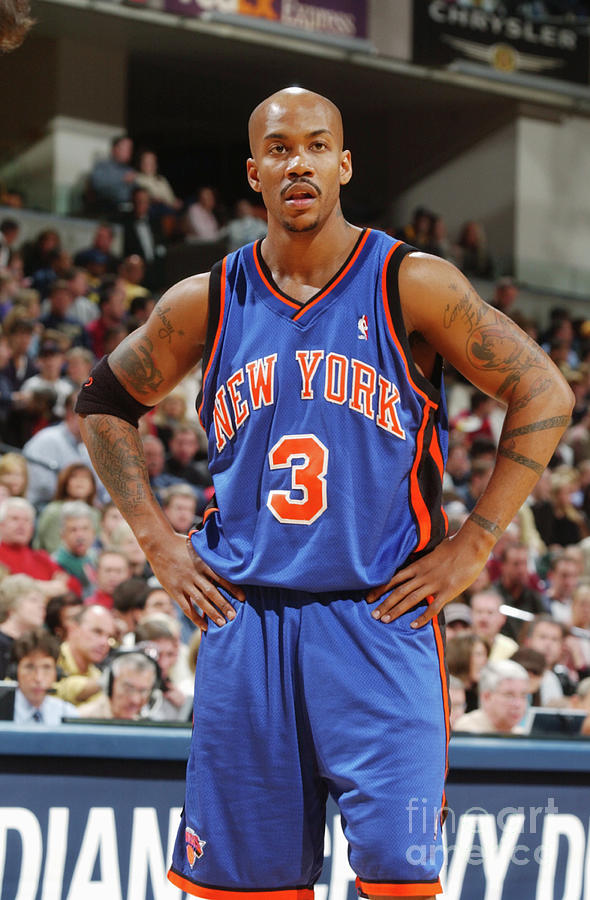
New York Knicks: Stephon Marbury. The last of 5 brothers to play at Abraham Lincoln High School in Brooklyn's Coney Island, "Starbury" (a nickname he made up) was supposed to be the next great New York City point guard. He went one-and-done at Georgia Tech, then signed with the Minnesota Timberwolves. He might be the biggest reason why Kevin Garnett had to go to Boston to win a title.

In 1999, he was traded to the Nets, and they were 2 of the worst seasons in the history of a franchise with a rotten history, although he was named to the 2001 All-Star Game. He was traded to the Phoenix Suns, even-up for Jason Kidd, a "my headache for your headache" trade. He helped the Suns set after several good years, despite another All-Star appearance in 2003; while Kidd immediately turned the Nets into back-to-back NBA Finalists.

In 2004, the Knicks traded for him. Marbury was only 27, and a 2-time All-Star. And, because he was one of New York City's own, Knick fans believed he would be the man to return the Knickerbockers to glory. That it did not happen was not all his fault -- after all, he came with Anfernee "Penny" Hardaway, a once-great player now saddled with injuries, who did his best but couldn't overcome them, and James Dolan was running the franchise -- but he led the way.
He didn't get along with head coach Don Chaney. Or with the next, fellow Brooklynite Lenny Wilkens, one of the NBA's 50th Anniversary 50 Greatest Players, and once the winningest head coach in NBA history, coach of the 1979 NBA Champion Seattle SuperSonics. And he didn't get along with the next one, Larry Brown.

Brown was a success wherever he went in the NBA. As his longtime friend and fellow Long Islander, Tony Kornheiser of ESPN, put it, "He took the Clippers to the Playoffs! Nobody takes the Clippers to the Playoffs!" And he had taken the Nets to the Playoffs. In fact, he had pulled both of those feats off twice. At the time, this was considered a huge deal, because both teams were "little brothers" to the bigger teams in the area. Both teams were, and -- despite what they've done since -- still are joke franchises. And he had won an NBA Championship with the Detroit Pistons, and gotten the Philadelphia 76ers to the Finals, eventually getting Allen Iverson to see the value in not just a game, but in practice.

The one team with whom he couldn't make the Playoffs was the Knicks: Unlike Iverson, Marbury could not be convinced that Brown knew what he was doing. They feuded like crazy, and, as Frank Isola and Michael O'Keefe wrote in the Daily News, Marbury had become "the most reviled athlete in New York."

Brown left in 2006, while Marbury continued to poison the atmosphere at Madison Square Garden until 2009, when the Boston Celtics finally took him off the Knicks' hands, reuniting him with Garnett -- and taking them down from their title perch of the season before. So that's 5 different NBA teams Marbury messed up, 2 of them in the New York Tri-State Area. He is a serious contender for the overall Number 1 on this list.

China was starting up a pro basketball league, and Marbury played in it from 2010 to 2018, and is now the head coach of the Beijing Royal Fighters.

New Jersey Devils: Ilya Kovalchuk. After 9 years as a sniper for the Atlanta Thrashers, the Devils traded for him. In 4 seasons with the team, he twice scored at least 30 goals, and was a key figure in the team that reached the 2012 Stanley Cup Finals. (It's worth noting that, of the 9 teams in the "big four" leagues, only 2 have reached their sport's finals since: The 2014 Rangers and the 2015 Mets. So this is a big deal.)
But in 2013, he "retired" from the NHL, with $77 million and 12 years remaining on his contract. He was only 30, and his move left the Devils in the lurch: They've only made the Playoffs once since, in 2018.

But he only retired from the NHL. He went back to Russia, and signed with his former team, SKA St. Petersburg. It was all about the money: Not just a higher salary, but considerably lower taxes. Then the ruble crashed in December 2014, and he was making less money. Serves him right. In 2018, he applied to return to the NHL, but the Devils weren't interested. Good thing: At 35, was a shadow of his former self, playing just 2 more seasons, for 3 different teams, and scoring 26 more goals, raising his career total to 328.

New York Islanders: Alexei Yashin. From 1993 to 2001, he scored 218 goals and had 273 assists for the Ottawa Senators. As the 2001-02 season dawned, he was about to turn 28, was coming off back-to-back 40-goal seasons, and hadn't missed a game due to injury in 4 years. There was nothing wrong with wanting a healthy Alexei Yashin on your team.

The question was, What was a team willing to trade to get him? The Islanders traded Bill Muckalt, Zdeno Chara, and their 1st-round draft pick, who the Senators turned into Jason Spezza. Muckalt was a thrown-in, and played his last NHL game in 2003. In 2022, Chara and Spezza are still playing in the NHL, and both could end up in the Hall of Fame.

And Yashin? General manager Mike Milbury signed him to a contract extension worth $87.5 million over 10 years. He scored 32 goals in 2001-02, but that would be his peak. His production dropped, and because of his contract, he was "untradeable." He played his last NHL game at age 34, although he hung on in the Russian league for 5 more years.
Unlike some of these guys, Yashin didn't make a nuisance of himself, to his teammates, to the organization, or to the fans. He just didn't deliver. And it's not like he paid himself: Milbury was more to blame than Yashin was.

New York Rangers: Ken Hodge. BlueLine Station, a Ranger fan website, calls the 1976 trade that sent Hodge to Madison Square Garden and Rick Middleton to the Boston Garden the worst trade in Ranger history. Hodge was supposed to pair up with Phil Esposito to score a lot of goals, as he had with the Bruins. Instead, he played 96 games for the Rangers, with 23 goals and 45 assists.
Yes, they actually wore these uniforms.
In regular-season games.

That's not terrible: The Rangers got off luckier than most of these teams. But look what they gave up for Hodge: In Boston, Middleton played 12 seasons, with 402 goals and 496 assists. The Bruins retired his Number 16, and he should be in the Hockey Hall of Fame. Think that might have helped in the 1979 Stanley Cup Finals against the Montreal Canadiens? Or in those Playoff series against the Islanders? Or in the 1986 Conference Finals against the Canadiens?

New York Giants: Kerry Collins. First season, 1999: 7-9. Second season, 2000: 12-4, but became the 1st quarterback ever to lead an offense that failed to score in a Super Bowl, the Giants' only score coming on a kickoff return. Third season, 2001: 7-9. Fourth season, 2002: 10-6, with 4 losses by 7 points or less, costing them a Division title, and allowing them to fall into that humiliating road Playoff loss to the San Francisco 49ers. Fifth season, 2003: 4-12. Collins was not only the worst starting quarterback in Giants history, he was the worst starting quarterback ever to play in a Super Bowl.
New York Jets: Mo Lewis. Now, this doesn't seem fair. Mo was a very good linebacker. He played 13 seasons for the Jets, including 3 Pro Bowl appearances, 4 Playoff berths, and a trip to an AFC Championship Game. But his tackle injured Drew Bledsoe and led to the rise of Tom Brady. What could be more damaging -- not just to the Jets, but to the entire NFL -- than that?
At such seemingly benign moments is history changed.

New York Yankees: Kevin Brown. I know, I know, I've ripped several Yankee pitchers over the 15 years I've written this blog. I even made a list of all the games one of them, Boone Logan, blew for the Yankees, which I suspect is a team record: Logan's Litany of Losing.

But Kevin Brown. Oy, gevalt, Kevin Brown! After pitching well against the Yankees for the Texas Rangers and the Baltimore Orioles from 1992 to 1995, he went to the National League, and helped the team then known as the Florida Marlins win the 1997 World Series. That team was immediately broken up, and he was traded to the San Diego Padres. They won the 1998 NL Pennant, and started Brown in Games 1 and 4 of the World Series, because of his success against the Yankees. Instead, the Yankees swept the Padres.

The Padres didn't keep him, either, and he signed the 1st $100 million-plus contract in baseball history, with the Los Angeles Dodgers. After the 2003 season, angry at Jeff Weaver's incompetence in the World Series, the Yankees traded Weaver and 2 pitchers who never amounted to anything to the Dodgers, for Brown, and also got Javier Vázquez, knowing they would need to replace the departed Roger Clemens and Andy Pettitte.

Some replacements. Brown went 10-6, and after a bad loss in September, punched the dugout wall with his right hand. His throwing hand. He broke it, but was ready to pitch again come the postseason. Despite making the All-Star Game, Vázquez only went 14-10. And, due to injuries, in the all-important Game 7 of the American League Championship Series against the arch-rival Boston Red Sox, manager Joe Torre started Brown, and he didn't make it out of the 2nd inning. Torre replaced him with Vázquez, who didn't get out of the 4th.
Before Kevin Brown became a Yankee, the Yankees were, beyond any question, the team in baseball, and the Red Sox were their bitches. We'll never know if he would have pitched better in October if he hadn't broken his hand in September, but since that game in October, the Yankees have fallen behind not just the Red Sox, but the Tampa Bay Rays and the Houston Astros, and that's just in the American League. Brown pitched 1 more year, through injuries, and retired with a record of 211-144, 216-149 if you count the postseason -- 15-14 as a Yankee.

I had considered long-ago 1st baseman Hal Chase, a great fielder and a good hitter, whose hiring as player-manager late in the 1910 season, and his known throwing of games for gamblers, turned a 2nd (but not close 2nd)-place team into a 102-loss last-place team in just 2 years. But, at the time, they were the New York Highlanders. They weren't officially the Yankees yet, let alone the Yankees.

New York Mets: Bobby Bonilla. There aren't too many athletes who messed a team up, left, returned, and messed them up again. Although born and raised in The Bronx, Yankee territory, Bonilla was a Met fan growing up, and became a star on the Pittsburgh Pirates' early 1990s near-dynasty.

The Mets threw money at him, and he joined for the 1992 season. It was a disaster, as his hitting stats went way down, and the team had its 1st non-contending season in 9 years. The Mets had an even worse season in 1993, full of acts of carelessness that got people hurt, and, in 2 separate incidents, Bonilla threatened local reporters. They finally traded him in 1995.

And yet, they brought him back for 1999. At 36, he was washed-up, and was released. But they still owed him $5.9 million. His agent offered the Mets a deal: He would defer payment for 10 years, and the Mets would pay him $1.19 million every year from 2011 to 2035 (or his heirs if he died before 2035). The Mets took the deal.
Now, every year, July 1, the date of the payment, is known as Bobby Bonilla Day: There are still players the Mets are paying less to play than they're paying Bonilla to not play. Only 13 more years to go.

Sunday, July 31, 2016

Top 10 Worst New York Baseball Trades

This week, the Yankees went from having the best bullpen in baseball, a bulwark against totally falling out of the Playoff race, to not even having that.

They have traded Aroldis Chapman and Andrew Miller for the already-failed-as-a-Yankee Adam Warren and seven guys who, at best, are 3 years away from making contributions at the major league level.

Not since the Philadelphia 76ers traded away Moses Malone and the top pick in the draft on June 15, 1986 has a sports team traded so much for so little so soon.

This is unacceptable. The Yankees had a chance at the Playoffs. It might not have been a good chance, but it was a chance. Now, they may not make the Playoffs again for years.

(UPDATE: Chapman helped the Chicago Cubs win the National League Pennant. Miller helped the Cleveland Indians win the American League Pennant. The Cubs won the World Series. The Yankees got Chapman back, and kept him through the 2022 season. They made the Playoffs in 2017, '18, '19, '20, '21 and '22.)

*

So, with tomorrow being the trading deadline, I wondered: What are the worst trades in New York baseball history?

The trading deadline was instituted in 1923, and was set at June 15 until 1986, when it was moved to July 31, except for years when that date falls on a Sunday, as it does this year, in which case it's moved to August 1.

Note: These are player-for-player deals, not free agent signings (so no Moises Alou by the Mets), refusals to sign a free agent (no Alex Rodriguez by the Mets), refusals to re-sign a free agent (no Reggie Jackson by the Yankees), purchases or sales.

And before I list the Top 10, let me remind you (or introduce you, if you're a relatively new reader of this blog) that I debunked the myth of perhaps the worst Yankee trade of recent memory: The 1988 trade of Jay Buhner for Ken Phelps was not a particularly damaging trade. Think of it as more of trading Jay Buhner for Paul O'Neill, and it becomes one of the best Yankee trades.

I'm also not going to include the most infamous transaction in the history of New York sports: June 15, 1977, the Mets trading Tom Seaver to the Cincinnati Reds for Steve Henderson, Doug Flynn, Pat Zachry and Dan Norman.

The Mets were horrible from 1977 to 1982, Seaver's time in Cincinnati, and having him would have made no difference at all. In contrast, Henderson was a good all-around player, Flynn a good-fielding 2nd baseman, and Zachry a decent pitcher. In the minds of Met fans (hold your jokes), it was devastating; in actual practice, it wasn't that big a deal, because the damage had already been done by previous trades.

I'm also not going to include the awful 1982 trade of Fred McGriff, Dave Collins and Mike Morgan from the Yankees to the Toronto Blue Jays for Dale Murray and Tom Dodd. Murray was awful in his 3 Yankee seasons, Collins rebounded away from The Bronx, Morgan was still pitching in the majors as late as 2002 -- including in the 2001 World Series for the Arizona Diamondbacks, against the Yankees -- and McGriff hit 493 home runs, as many as Lou Gehrig.

Why not include this trade? Because McGriff was 19. He wouldn't debut in the majors until 1986. He was a 1st baseman. The Yankees had Don Mattingly, and lots of guys who could DH. They didn't really have a place for McGriff. What, were they going to move him to the outfield? He played 19 seasons in the majors, and never played in the outfield, not even once. So while this was a bad trade, it was not one of the 10 worst in New York baseball history.

Nor will I include the deadline trade of June 15, 1976 with the Baltimore Orioles. It is true that the O's having Scott McGregor, Rudy May, Tippy Martinez and Rick Dempsey helped them a lot from 1977 to 1983. It is also true that the Yankees could have used them all, especially Dempsey, who could have succeeded Thurman Munson as the Yankees' catcher, from 1979 onward. But the Yankees got Ken Holtzman, Doyle Alexander, Grant Jackson and Elrod Hendricks, all of whom were crucial in winning the 1976 Pennant. Holtzman would also be key in the 1977 World Series triumph.

I couldn't find a trade that the Brooklyn Dodgers made that was bad enough to make the Top 10. I did find one for the New York Giants, though.

UPDATE: On March 5, 2024, on his radio show, Yankee broadcaster Michael Kay said the worst trade that Brian Cashman made as general manager was on March 13, 2022, sending Gary Sánchez and Gio Urshela to the Minnesota Twins for Josh Donaldson, Isiah Kiner-Falefa and Ben Rortvedt.

With the Toronto Blue Jays, Donaldson had been the American League's Most Valuable Player in 2015, and had a decent season for the Twins the year before. It was a classic Cashman move, trading for a player who could have helped the Yankees win the Pennant 8 years earlier, but not now: In a season and a half in The Bronx, Donaldson batted just .207, and didn't field well. "IKF" was a utility infielder, nothing more. A backup catcher, Rortvedt missed all of the 2022 season, and appeared only 32 times in 2023. Given enough time to consider it, this one could crack the Top 10.

Top 10 Worst New York Baseball Trades

Dishonorable Mention. December 8, 1966: The Yankees trade Roger Maris to the St. Louis Cardinals for Charley Smith.

The Yankee brass had treated Maris badly. Now, they traded him for a nothing infielder who had already failed with 5 teams, including the Mets. In terms of decency, this one is right down there with the '77 Seaver trade for the worst in New York baseball history.

Free of Yankee management and the New York media, and happy to play for a team and a fan base that made him feel welcome, Maris helped the Cards win the 1967 World Series and the 1968 Pennant, then accepted Cardinal and Anheuser-Busch owner Gussie Busch's retirement gift of a beer distributorship in sunny Gainesville, Florida -- quite a prize for someone who grew up in Hibbing, Minnesota and Fargo, North Dakota.

As for Smith? In 2 seasons in The Bronx, he batted .224 with 10 homers and 45 RBIs. At age 30, the Yankees traded him, and after another year he had played his last big-league game.

I can't rank this trade any higher, because, while Maris won in St. Louis, keeping him in New York wouldn't have done him or the team much good.

Dishonorable Mention. August 27, 1992: The Mets trade David Cone to the Toronto Blue Jays for Jeff Kent and a player to be named later, who, 5 days later, turned out to be Ryan Thompson.

Cone was going to be a free agent after the season, and the Mets probably didn't think they could re-sign him, so they wanted to get something for him, and figured Kent and Thompson were good compensation.

It's easy to forget now that Cone wasn't yet a Met when they won the 1986 World Series. They got him from the Kansas City Royals during the following Spring Training. Well, with the Mets, he won the 1988 NL Eastern Division title... and that's it. Afterward, he reached the postseason 6 times, winning the World Series 5 times: With the Jays in 1992, and with the Yankees in 1996, 1998, 1999 and 2000 -- against the Mets. Indeed, he was so successful with the Yankees, it's almost easy to forget he ever was a Met. He was 81-51 with them, 113-75 with everybody else.

Thompson didn't do much as a Met. Kent had some power, but provided little in the way of either wins or excitement. So the Mets let him go when he was 28, just moving into his prime. More about that later.

Dishonorable Mention. December 20, 1926: The New York Giants trade their 2nd baseman and Captain, Frankie Frisch, and Jimmy Ring to the St. Louis Cardinals for Rogers Hornsby.

At first, this blockbuster deal looked great for the Giants. Frisch had quit the team after Giant manager John McGraw berated him in front of his teammates for missing a sign. Giants management refused to step in and straighten things out between the manager and his best player. And Ring was a mediocre pitcher nearing the end of the line. In exchange, the Giants got Hornsby, also a 2nd baseman, and the best hitter in the National League.

The trade was great -- for the Cardinals. Hornsby's attitude was considerably worse than Frisch's, and McGraw had enough of him that 1st season, trading him afterward. The Giants didn't win another Pennant until 1933, after McGraw retired. Helped tremendously by a change of scenery, teammates and bosses, Frisch helped the Cardinals win Pennants in 1928, '30, '31 and, as player-manager of a team that became known as the Gashouse Gang, '34. This, on top of the Pennants he'd won as a Giant in '21, '22, '23 and '24. And Hornsby won a Pennant with the Cubs in 1929.

Dishonable Mention. December 3, 1969: The Mets trade Amos Otis and Bob Johnson to the Kansas City Royals for Joe Foy.

Otis was a center fielder. The Mets had Tommie Agee in center. They didn't need another center fielder. What they did need, perennially, was a 3rd baseman. (This subject will come up again.) So they traded Otis, 22 and with 168 major league plate appearances under his belt, and Johnson (who you don't need to consider) for Foy, a 26-year-old New York native with power and speed, who'd helped the Boston Red Sox win the 1967 American League Pennant.

In Kansas City, Otis became a 5-time All-Star, a 3-time Gold Glove winner, a 2-time .300 hitter, an AL leader in doubles twice and in stolen bases once, and a 4-time postseason performer. In New York, Foy decreased his hitting and increased a drug problem that the Mets didn't know about before the trade. After the 1970 season, they left him unprotected in the Rule 5 draft. He was taken by the Washington Senators, played 1971 with them, and never played in the major leagues again.

If the Red Sox had finished the job in the 1986 World Series, as they very nearly did, we would now be talking about a 47-year title drought for the Mets, and The Curse of Amos Otis.

Now, the Top 10. Or the Bottom 10, if you prefer.

10. January 22, 1918: The Yankees trade Urban Shocker, Fritz Maisel, Les Nunamaker, Nick Cullop, Joe Gedeon and $15,000 to the St. Louis Browns for Eddie Plank and Del Pratt.

Today, a man with a name like "Urban Shocker" would be welcomed with open arms in New York sports. (He was of French-Canadian descent, born Urbain Jacques Shockcor in Cleveland.) After the 1917 season, Shocker, a righthander, was 12-8, and didn't look like anything special.

Well, from 1918 to 1924, he went 126-80 for the Browns -- an average of 18-11. He won 27 games in 1921 and 24 in 1922. The Browns nearly beat the Yankees out for the Pennant in 1922, having probably the franchise's best team until they became the Baltimore Orioles and won their 1st World Series in 1966.

Shocker's absence nearly cost the Yankees the Pennant in '22, may have cost them the Pennant in '20 (20-10) and '24 (16-13), and may have been a reason why they lost the World Series in '21 and '22. Never mind the other players the Yankees gave up: Getting rid of Shocker was a mistake.

What about what they got in return? Plank was a genuine Hall-of-Fame pitcher, with a career record of 326-194 before the trade. But he was 42 and never threw another professional pitch, retiring because the stress of the game had given him stomach problems. (The stress must have gotten worse: He died of a stroke in 1926, just 8 years after the trade.)

Pratt was a good 2nd baseman, and led the AL in RBIs in 1916. In 1920, he attained career highs for the Yankees in batting .314 with 108 RBIs. But the Yankees traded him, anyway -- to the Red Sox for pitcher Waite Hoyt and catcher Wally Schang. That was a great trade.

In his 1979 book This Date In New York Yankees History, Nathan Salant called trading Shocker away the worst trade in Yankee history to that point. But there are 2 reasons it isn't that bad: The fact that it was, essentially, Shocker for Hoyt (a Hall-of-Famer) and Schang (an All-Star-caliber player, had there been an All-Star Game back then); and the fact that the Yankees did get Shocker back from the Browns, sending them another star pitcher, Bullet Joe Bush, and 2 other guys.

Shocker helped them win the 1926 Pennant and the 1927 World Series, but had a bad heart, and died in 1928. He was only 38.

9. December 12, 1975: The Mets trade Rusty Staub and Bill Laxton to the Detroit Tigers for Mickey Lolich and Billy Baldwin.

Laxton and Baldwin (no relation to the Long Island acting family that includes a Billy Baldwin) are footnotes. The Mets needed pitching, and thought Lolich, a hero of 2 postseason runs for the Tigers, but already 35 years old, had something left, so they were willing to give up Le Grand Orange in his prime.

Lolich didn't have anything left. Maybe Rusty wouldn't have hit as well in Shea's dimensions and wind as he did toward Tiger Stadium's short right field porch. But the Mets missed his bat: He averaged 19 home runs and 106 RBIs over the next 3 seasons. This was one of the trades that made the Seaver trade a confirmation of the already-present collapse, not the start of one.

Lolich, considered fat by the baseball standards of the time, has been called "the original hefty lefty" and "the original portly portsider." By the time the Mets got Staub back, he was fatter than Lolich, and slow, and little more than an occasionally-good pinch hitter.

8. December 11, 1986: The Mets trade one left fielder for another, Kevin Mitchell to the San Diego Padres for Kevin McReynolds.

McReynolds got booed because the Mets weren't winning anymore, and, as someone who was not a member of their 1986 World Champions, he was a convenient target. His career stats and Mitchell's were very close, and he certainly didn't deserve the poor treatment he got. There were far worse players that the Mets could have acquired. (McReynolds did get a nice hand when he was among the former players introduced after the last game at Shea Stadium in 2008, so Met fans did learn something.)

But the Mets shouldn't have gotten rid of Mitchell. The Padres soon traded him to the San Francisco Giants, and he became an All-Star, helping them reach the Playoffs in 1987 and the World Series in his MVP year of 1989. He batted .326 as a regular with the 1994 Cincinnati Reds, and was still productive as late as 1996. The Mets could have used him in their close-call seasons of 1987, '88, '89 and '90.

I have called the Mets' failure to win another World Series for almost 30 years now "The Curse of Kevin Mitchell." The trade isn't the biggest reason they didn't win another Pennant until 2000. (There were injuries, and there was substance abuse, and some guys just dropped off without a rational explanation.) But, like McReynolds, it is a convenient symbol.

7. December 27, 2001: The Mets trade pitcher Kevin Appier to the Anaheim Angels (as the team was then known) for 1st baseman Mo Vaughn.

With the Red Sox, Vaughn had been a good slugger and, despite his weight, a good fielder. But with the Angels, he was plagued with injuries, including missing the entire 2001 season. When the trade was made, the Angels' closer, Troy Percival, took an unnecessary shot at him: "We may miss Mo's bat, but we won't miss his leadership. Darin Erstad is our leader." Mo lost his cool, and launched a foul-mouthed fusillade against the Angels: "They ain't done shit in this game... They ain't got no flags hanging at friggin' Edison Field, so the hell with them."

Mo always hit well against the Yankees, and you'd think his game-winning home run against them in an Interleague game on June 16, 2002 would have endeared him to the Flushing Faithful. But his rising weight and his injuries kept him from being productive, and Met fans booed him. 2002 turned out to be the Mets' 1st losing season since 1996, and their never-finished Mike Piazza Era renaissance was over.

Vaughn last played for them, or for anybody else, on May 2, 2003. He was also later outed as a steroid user. However, he has done good work since retiring, rehabilitating urban housing in New York and Boston.

Appier? In his 1st season with the Angels, he helped them win the World Series. Now, there is a friggin' flag at Edison Field, or Angel Stadium of Anaheim as it's now known.

Just 16 days before this trade, the Mets made one with the Cleveland Indians to get Roberto Alomar. He got old in a hurry, and was terribly booed at Shea in 2002 and 2003. But the Mets weren't going anywhere anyway, and they didn't give much up to get him, so I can't put this trade on the list, even as a Dishonorable Mention.

6. December 2, 1971: The Yankees trade pitcher Stan Bahnsen to the Chicago White Sox for 3rd baseman Rich McKinney.

Bahnsen was the 1968 AL Rookie of the Year, and had won 14 games in 1970 and 1971. The Yankees sure could have used the 21 he won for the White Sox in 1972, as they finished just 6 1/2 games out of 1st place in the American League Eastern Division. Bahnsen also won 18 games in 1973, although the ChiSox fell apart and he also lost 21; the Yankees finished 17 back that season.

In contrast, McKinney, the man the Yankees hoped would be better at playing 3rd base and hitting than incumbent Jerry Kenney, proved even more inept: He batted .215 and made 8 errors in 33 games before manager Ralph Houk had enough and sent him down to the minors at the end of May. They dumped him off to the World Champion Oakland Athletics after the season, for an aging Matty Alou.


In Oakland, McKinney probably felt out of place among Reggie Jackson, Sal Bando, Joe Rudi, Bert Campaneris, Catfish Hunter, Rollie Fingers and Vida Blue. He only played another 147 games in the majors, last appeared at age 30, and had a lifetime OPS+ of 48 -- meaning he was 52 percent beneath the average hitter of that time.

If the Yankees hadn't made the trade, and kept Bahnsen and continued to trust Kenney as their 3rd baseman, and won the AL East, they probably would have lost the AL Championship Series to the A's. But at least their postseason drought wouldn't have seemed so long by the time Chris Chambliss hit that Pennant-winning home run in 1976, and team president Mike Burke, about to talk CBS into selling the team to George Steinbrenner's group, would have salvaged his baseball reputation before George came in and wrote the myth that he saved the team.

In the aforementioned book This Date in New York Yankees History, Salant rated this trade as the 2nd-worst transaction in Yankee history up to its publication in 1979.


However, still needing a 3rd baseman, on November 27, 1972, 6 weeks before George & Co. bought the team -- and with Indians president Gabe Paul probably making this trade knowing that he'd be Yankee president under Steinbrenner -- the Yankees sent Kenney, John Ellis, Charlie Spikes and Rusty Torres to the Cleveland Indians for Jerry Moses and Graig Nettles.

Trading Bahnsen for McKinney was stupid. But trading Kenney, Ellis, Spikes and Torres -- and, effectively, Bahnsen -- for Nettles was good. So maybe it all worked out for the best.


Is this the worst trade in Yankee history? Such is the Mets' history that it wasn't even the worst trade by a New York baseball team that month.

5A. July 5, 2002: A 3-team deal. The Yankees trade Ted Lilly, John-Ford Griffin and Jason Arnold (a minor-leaguer who never made it) to the Oakland Athletics. The A's send Jeremy Bonderman, Carlos Pena and Franklyn German to the Detroit Tigers. The Tigers send the A's cash. And the Tigers send the Yankees Jeff Weaver. From the Yankee perspective, this was essentially a trade of pitchers: Lilly for Weaver.

Lilly was considered a great prospect. He did well after leaving the Yankees, and lots of people said the Yankees never should have gotten rid of him. Wrong: He was never going to handle the pressure of pitching in New York.

Weaver sure as hell didn't. As a Yankee, he was 12-12 with a 5.35 ERA and a WHIP of 1.492. A whopping WHIP. He should never have been on the 2003 World Series roster: He almost prevented the Yankees from making the Playoffs that season. But Joe Torre trusted him in extra innings in Game 4. With one pitch to Alex Gonzalez of the Florida Marlins, Weaver turned a good shot at being up 3 games to 1 to losing the Series 4 games to 2.

Weaver's middle name is Charles. Since the 2003 World Series, however, in the tradition of what Red Sox fans call Bucky Dent, I have continually referred to him as "Jeff Fucking Weaver." The Yankees wasted little time in getting rid of him.

When the Dodgers made their 1st trip to New York to play the Mets in 2004, I bought a ticket -- just to yell at Weaver. The Met fans, who apparently never watch the World Series unless their team is in it (in other words, hardly ever), were clueless. I mean, more so than usual.

Then again, maybe getting rid of him was an even worse idea:

5B. December 13, 2003: The Yankees trade Jeff Weaver, Yhency Brazoban and Brandon Weeden to the Los Angeles Dodgers for Kevin Brown.

Brown had won the World Series with the 1997 Marlins and the Pennant with the 1998 San Diego Padres. Before that, he had pitched well for the Texas Rangers, especially against the Yankees. (Having him to start in Games 1 and 4, and maybe 7 if it got that far, was a big reason Padre fans and Yankee Haters thought the Padres would win the 1998 World Series. Instead, the Yankees swept.) The Dodgers signed him to baseball's 1st $100+ million contract for 1999, and he wasn't terrible: He won 18 games that year, and led the NL in ERA the next.

Although he would be 39 on Opening Day 2004, he was good the season before, and, having lost Roger Clemens and Andy Pettitte to free agency, the Yankees thought he was worth a shot. But he only went 10-6. Late in the season, after a beating, he punched the dugout wall and broke his hand. Hi

He wasn't out for the season. The Yankees might have been better off if he was: Torre looked at his exhausted staff, and decided that Brown was the best choice to start Game 7 of the 2004 AL Championship Series. My 78-year-old grandmother might have been a better choice: It was the single most embarrassing game in Yankee history.

He went 4-7 for the Yankees the next year, was not re-signed, and retired. He was 211-144 with a 127 ERA+ and a 1.222 WHIP, but his very decent career had a terribly indecent last year and change.

Meanwhile, Weaver helped the Dodgers win the NL Western Division in 2004 and 2009. In between, he was with the St. Louis Cardinals, and helped them win the 2006 World Series. Think about that for a moment: Ty Cobb, Ted Williams, Ernie Banks, Carl Yastrzemski and Don Mattingly don't have a single World Series ring between them, but Jeff Weaver does. Jeff Weaver has as many World Series rings as Willie Mays, as many as Hank Aaron, as many as Tom Seaver, as many as Nolan Ryan, as many as Jackie Robinson.

The hell?

4. Joint Entry: The Javier Vázquez Chronicles. The Yankees made 3 trades involving the righthanded pitcher from Ponce, Puerto Rico -- and they got progressively worse.

On December 16, 2003, the Yankees traded Nick Johnson, Randy Choate and Juan Rivera to the Montreal Expos for Javier Vázquez. At first, this didn't look like a bad deal. Rivera was a nothing player. Choate was so bad out of the bullpen, I called him "Randy Choke." And Johnson was constantly injured and unable to live up to his promise. Vázquez went 14-10 for the Yankees in 2004, and made the All-Star Team.

But he gave up home runs. Some people thought he should have started Game 7 of the 2004 ALCS instead of Kevin Brown. Torre brought him in to relieve Brown when down 3-0. Instead, Vázquez gave up a grand slam to Johnny Damon that essentially ended the chance at a comeback, the game, the season, and the Curse of the Bambino. After that, he was nicknamed "Home Run Javy."

Before he could appear for the Yankees again, on January 11, 2005 he was traded to the Arizona Diamondbacks with Dioner Navarro, Brad Halsey and cash for Randy Johnson. Johnson gave the Yankees the 2 most useless 17-win seasons any pitcher has ever had, choking in Game 3 of the AL Division Series in both 2005 and 2006, and then leaving. Navarro and Halsey never amounted to much, but Vázquez settled down a bit, bouncing around, at one point being traded for former Yankee Orlando "El Duque" Hernandez.

On December 22, 2009, the Yankees traded Melky Cabrera, Mike Dunn, Arodys Vizcaino and cash to the Atlanta Braves for Vázquez and Boone Logan. You don't need to consider Dunn or Vizcaino. Just note that Melky, for all his difficulties (including getting caught using PEDs), would have been a big help to the Yankees the last few years, while Logan might have been the worst reliever in Yankee history, and Vázquez went 10-10 with a 5.32 ERA in 2010.

His contract having run out at the end of the season, the Yankees didn't lift a finger to re-sign him, and he pitched 1 more season with the Marlins, and retired. He was 165-160 for his career. He had 4 good seasons, and only 1 really bad one, his rookie year with the Expos, 1998. His other 9 seasons, including his 2 with the Yankees, 2004 and 2010, were mediocre.

But that last trade, giving up the Melkman for Home Run Javy and Logan's Litany of Losing, oy vey.

3. October 21, 1981: The Yankees trade center fielder Willie McGee to the St. Louis Cardinals for pitcher Bob Sykes.

When the Yankees made this trade, Jerry Mumphrey, a decent player, was their center fielder, and McGee was about to turn 23, and had yet to make his major league debut. He was a prospect, but he was not being considered as the breakout star of 1982. Meanwhile, Sykes, a native of Neptune, New Jersey, was about to turn 27, but his career record was only 23-26. The Yankees thought he could be a good lefthanded complement to Goose Gossage in the bullpen.

Sykes was injured, got shelled in Triple-A ball in 1982, and never pitched again. In 1982, McGee helped the Cardinals win the World Series (including making a great catch therein), and finished 3rd in the NL Rookie of the Year voting. He would go on to win the 1985 NL batting title and MVP, win another batting title in 1990 (despite being traded to the AL at the deadline), bat .300 as late as 1997 (age 38), bat .295 lifetime, collect 2,254 hits (more than Joe DiMaggio), steal 352 bases, win 3 Gold Gloves, and appear in 6 postseasons including 4 World Series (though he only won the 1, in 1982).

The Cardinals have unofficially retired his Number 51, and there are people who think he belongs in the Hall of Fame. Certainly, the Yankees could have used him as their center fielder until Bernie Williams was ready, especially in the close-call years of 1985 to 1988. Awful trade by the Yankees.

2. December 10, 1971: The Mets trade Nolan Ryan, Leroy Stanton, Frank Estrada and Don Rose to the California Angels for Jim Fregosi.

Ryan showed a lot of promise, and pitched well for the Mets in the 1969 World Series, but had never found his control in Flushing Meadow. And they still needed a 3rd baseman: Ed Charles had retired, and Wayne Garrett was a placeholder at best. Fregosi was one of the best shortstops in the game, but the Mets already had Bud Harrelson, who couldn't hit to save his life, but was a very good fielder. So they figured they'd move Fregosi over to 3rd.

There was nothing wrong with wanting a healthy Jim Fregosi on your team at that point: He was a very good all-around player. The problem was, by 1971, he was already dealing with the injuries that would curtail his career. He wasn't the answer for the Mets.

Estrada and Rose are footnotes. But Stanton became a good hitter in Anaheim. And Ryan? With the Mets, he was 29-38 with 493 strikeouts. After the trade, he was 295-254 with 5,221 strikeouts and 7 no-hitters. (It should be noted, though, that he made the postseason 4 times afterward and never won a Pennant, while he did win a ring with the Mets.)

Did not having Ryan make a difference? Met fans still complain that Yogi Berra, their manager in 1973, started Seaver on 3 days' rest in Game 6 of the World Series, instead of holding him back for a potential Game 7, and had to throw Jon Matlack in Game 7. Well, Joan Payson, the team's founding owner, told Yogi that she insisted on Seaver starting Game 6, and he had no problem agreeing. 

Presuming Ryan wouldn't have blown it for the Mets in the regular season or the NL Championship Series (that was the year he pitched 2 no-hitters and set a major league single-season record that still stands with 383 strikeouts), he would have been available for either Game 6 or Game 7. Maybe adding no Pennants and just 1 World Championship doesn't sound like much, but think of what having 3 World Championships, instead of 2, would have meant to Met fans. Unlike the trade of Seaver in '77, this one did hurt them.

But that's not the worst trade in Met, or New York baseball, history. The worst is one that tends to get forgotten. And we just passed the 20th Anniversary of it:

1. July 29, 1996: The Mets trade Jeff Kent and Jose Vizcaino to the Cleveland Indians for Carlos Baerga and Alvaro Espinoza.

At the time, this looked like a great trade for the Amazin's: Baerga was considered, along with Roberto Alomar, 1 of the 2 best 2nd basemen in baseball; Kent, the most disappointing player at that position. Espinoza, a Yankee from 1988 to 1991, was a good backup shortstop who could also play 2nd base and 3rd base. And Vizcaino was an old-style good-field-no-hit middle infielder. It seemed like a no-brainer.

It was, but not in the way the Mets or their fans expected: Baerga was a flop in Flushing, while Espinoza was near the end of the line. Now, the Indians didn't benefit much from the trade, either: After the season, they traded Kent and Vizcaino to the San Francisco Giants for Matt Williams. (Each team also included another player that didn't matter much.) Williams helped the Tribe win a Pennant, while Kent helped the Jints win one, reached the postseason 8 times in his career, won the NL MVP in 2000, and finished with 377 home runs, 351 while playing 2nd base, still a record. (His personality wasn't much, but he could hit.)

The Mets needed to win 1 of their last 5 games in 1998 to get the NL's Wild Card berth. They won exactly none. They lost the 1999 NLCS to the hated Atlanta Braves. They lost the 2000 World Series to the even more hated Yankees. Kent could have made a big difference.

Oh yeah, about that 2000 World Series: It was essentially decided in the 12th inning of Game 1, on a game-winning single for the Yankees by... Jose Vizcaino.

So this might be an even more damaging trade than Ryan for Fregosi, because it may have made a difference at a time when the Mets were very good, keeping them from reaching true glory. Certainly, it was more damaging than the trade that brought Kent to the Mets.

Sunday, April 13, 2014

Yankees vs. Red Sox: The Defining Moments, Part IV: 2002-2014

The image above really should include North and Central Jersey.  But it gets the Bristol Line (as I call it, cutting through the Connecticut hometown of ESPN, and also Yale base New Haven) pretty much right.  It also gives an interesting indication: While, road-wise, the eastern tip of Long Island, Montauk Point, is closer to Midtown Manhattan and Yankee Stadium, in terms of as-the-crow-flies distance, which includes radio and TV signals, it's actually closer to Boston's Downtown Crossing and Fenway Park.

December 26, 2002, Fenway Park. The Yankees sign Cuban pitcher Jose Contreras, and new Sox president Larry Lucchino, in a fit of petulance, calls the Yankees "the Evil Empire."

Oh, really? Putting aside the question of which team is actually more evil... The term "Evil Empire" had been used by President Ronald Reagan -- who knew more about baseball than he did about economics or foreign affairs -- to describe the Soviet Union. Excuse me, Larry, but how do you square the image of the heavily capitalist Yankees with Communism and its prohibition of private property?

Some Yankee Fans, however, connect the word "Empire" with the villains of the Star Wars film franchise, including one fan who made a T-shirt with Darth Vader's helmet, saying, "May the Curse be with you."

October 11, 2003, Fenway Park. Game 3 of the ALCS, and another Roger vs. Pedro matchup. Pedro hits Karim Garcia in the head, on purpose. Not the first time he's hit a Yankee on purpose, nor will it be the last, but it is easily the most notorious.

Yelling back and forth. Jorge Posada, himself a former Pedro victim, yells in Spanish so that Pedro has no problem understanding. Pedro points at his head, then at Jorge. Message: "I'm going to hit you in the head." Making such a threat is a crime.

Later in the game, Clemens pitches to Manny Ramirez, and the pitch is head-high... but over the plate, and clearly not intended to hit Manny.  (As we've seen, if Roger Clemens wanted to hit a batter, that batter got hit.) Manny points at Clemens and walks toward him, still holding the bat. The benches clear again, and Yankee coach Don Zimmer -- manager of the Sox in 1978, but also a former player who nearly died from a beaning in Triple-A ball in 1953 -- runs toward Pedro.

Pedro Martinez, age 32, grabs Don Zimmer, age 72, by the head, and throws him to the ground. Attempted murder, if the jurisdiction is New York. In Boston, Zimmer ends up forced to apologize, with Pedro getting a $50,000 fine -- pocket change, with what the Sox are paying him. Refresh my memory: Did we have to apologize to Japan for putting Pearl Harbor in the way of our Pacific Coast?

When things finally settle down, Clemens finishes his strikeout of Manny. Yankees 4, Red Sox 3. The next day, Game 4 is rained out, giving everyone a 24-hour cooling-off period, which was really for the best.

English soccer fans like to refer to their rivals as "The Scum," and their rivals' fans as "Scummers." As far as I'm concerned, this was the day the Red Sox stopped being mere arch-rivals, and truly became The Scum. They can take their "Evil Empire" talk and shove it up their own evil asses.

October 16, 2003, Yankee Stadium. It comes down to a Game 7. David Ortiz hits 2 home runs (cough-steroids-cough), and the Sox lead 5-2 in the bottom of the 8th. By this point, Ortiz, a.k.a. "Big Papi," has been hitting the Yanks like crazy all year. His success against the Yankees will eventually beg the question, "How many times does a guy have to get big hits off you before you plunk him?"

Ah, but there's a double standard at work: A Sox pitcher can hit a Yankee batter, and get away with it every... single... time; a Yankee pitcher can hit a Sox batter, and he gets thrown out of the game, fined and suspended. Anyway, the Sox need 5 more outs.

Derek Jeter doubles. Bernie Williams singles, Jeter scores. 5-3. Sox manager Grady Little comes out, and he has to know that Pedro has thrown too many pitches, and that the next 2 batters are Hideki Matsui, lefty, and Posada, a switch-hitter but much better from the left side than from the right; so the right thing to do is to bring in a lefthanded pitcher, probably Alan Embree (who usually pitched well against the Yankees), to pitch Matsui lefty-on-lefty and turn Posada to his weaker right side. The decision seems obvious to everyone: Sox fans, Yankee Fans, the Fox broadcast team, neutral TV viewers.

Obvious to everyone, that is, except for the man whose decision it was: Little. He leaves Pedro in. Matsui hits a ground-rule double, moving Bernie to 3rd base. 2nd & 3rd, only 1 out, and the dangerous (especially from the left side) Posada coming up. Now Little has got to take Pedro out, and bring in Embree.

But he stays in the dugout. Pedro remains on the mound, and Jorge dumps a looper into short center, scoring Bernie and Hideki. 5-5. Yet another legendary Sox choke, and The Stadium shakes with fans cheering and jumping.  (And, considering Game 3, I find it very fitting that Posada got the hit that ended Pedro's night.)

Bottom of the 11th, and Tim Wakefield, who had beaten the Yanks in Games 1 and 4 of the series, and had pitched a scoreless 10th, opens the inning by throwing a 69 MPH knuckleball to Aaron Boone. Boom. Yankees 6, Red Sox 5. Boone takes his place alongside Bucky Dent and Bill Buckner.

November 28, 2003, Fenway Park. Having failed to trade Nomar to the Texas Rangers for Alex Rodriguez, the Red Sox instead pull off a "reverse Tom Seaver": They trade 4 nobodies to the Arizona Diamondbacks for one of the top pitchers in the game, Curt Schilling, who had previously driven the Yankees nuts in the 2001 World Series.

As a Philadelphia Phillie, Schilling had been described by general manager Lee Thomas as follows: "One day out of five, he's a horse; the other four, he's a horse's ass." Schilling lives up to that reputation at his introductory press conference in Boston, by saying, "I guess I hate the Yankees now."

February 16, 2004, Yankee Stadium. With the Sox having failed to trade for A-Rod, making a very public mess of the negotiations with the Texas Rangers, the Yankees succeed, sending Alfonso Soriano to Texas for the biggest name (if not the best player) in baseball. With Jeter still at shortstop, A-Rod moves over to 3rd base.

July 1, 2004, Yankee Stadium. As wild a regular-season game as you'll ever see. The Yankees end up using everyone on their roster. The Sox use everyone on theirs except for two. One is backup catcher Doug Mirabelli. The other is Nomar, apparently injured but not on the Disabled List -- and the fact that Nomar is not sent into what is very much a key game, calendar be damned, is telling.

Once, Nomar, Jeter and A-Rod were the subjects of a debate as to who was the best shortstop in baseball. Now, Jeter is making a diving play that saves the game, A-Rod is playing 3rd base and moving to shortstop after Jeter got hurt on that play, and Nomar is sitting on the bench, leading to his being traded by the Sox within a few days.

Manny homers in the top of the 13th, but Miguel Cairo and John Flaherty double in the bottom of the 13th to win it. Yankees 6, Red Sox 5. A stunning game whose re-airing on the YES Network the next morning gets relabeled from "Yankees Recap" to "Yankees Classic." (It also allowed "Flash" Flaherty to turn his one big hit in the major leagues into a broadcasting career on YES.  Then again, one big hit is more than Fran Healy, a backup catcher for the Yankees who broadcast for both New York teams, ever got.)

July 24, 2004, Fenway Park. Sox pitcher Bronson Arroyo -- white people should not wear cornrows, except for Bo Derek -- purposely hits A-Rod in the back. A-Rod curses Captain Cornrows out. Sox catcher and Captain Jason Varitek leaves on his mask, like the coward that he is, and pushes his catcher's mitt into A-Rod's pretty face, instigating a full-scale brawl. Refresh my memory: Which of these teams is evil? After the 1976 brawl, Bill Lee said, "The Yankees looked like a bunch of hookers swinging their purses." Well, at least they didn't hide behind protective masks.

Bill Mueller takes Mariano Rivera deep in the bottom of the 9th. Red Sox 9, Yankees 8. Mueller has often been suspected of steroid use, but has thus far been protected from such revelations.

September 19, 2004, Yankee Stadium. Yankees 11, Red Sox 1. The Yankees, the one team that seems to give Pedro trouble, beat him yet again, pounding him.  In a postgame press conference, he says, "I just tip my cap, and call the Yankees my daddy."

"Who's Your Daddy?" chants will dog Pedro for the rest of his career. One fan made up a T-shirt showing Darth Vader wearing a Yankee jersey, and saying, as if to Luke Skywalker, "Pedro, I am your father!" The chant even returned when Pedro pitched for the Mets in an Interleague game in 2006, and for the Philadelphia Phillies in Games 2 and 6 of the 2009 World Series at the new Yankee Stadium.

October 20, 2004, Yankee Stadium. After a Game 4 comeback led by proven steroid user David Ortiz, and a Game 5 win also led by proven steroid user Ortiz, and a Game 6 win that featured A-Rod's slap play on admitted steroid user Arroyo in relief of suspected steroid user Curt Schilling (who had said before the series, "I'm not sure I can think of any scenario more enjoyable than making 55,000 Yankee Fans shut up"), Game 7 is a disaster from the outset, as proven steroid user Ortiz homers again. Red Sox 10, Yankees 3.

The Red Sox become the first Major League Baseball team to come back from a 3-games-to-0 postseason deficit, and win the Pennant, clinching at Yankee Stadium, a house of pain for them for so long. They go on to beat the St. Louis Cardinals in the World Series, killing the Curse of the Bambino after 86 years.

Or so they thought. Now we know the truth.

April 5, 2005, Yankee Stadium. After he hit the home run that won Game 4 of the 2001 World Series, Jeter said he'd never hit a walkoff homer before, not even in Little League. He does it again in this game, off Keith Foulke. Yankees 4, Red Sox 3. The Yankees could have used one of these 6 months earlier.

April 14, 2005, Fenway Park. Yankee right fielder Gary Sheffield's cap is knocked off by a Red Sox fan while trying to pick up a fair ball in right field. In response, Sheffield pushes the fan. The conflict is quickly stopped by security guards. The fan was ejected from the game for interfering with play and is eventually stripped of his season tickets. Red Sox 8, Yankees 5. Still, the Sox fans once again prove that they, not the Yankees or their fans, are the evil ones.

August 18, 19, 20 & 21, 2006, Fenway Park. The Yankees complete a 5-game sweep at the little green pinball machine off Kenmore Square. The scores are 12-4, 14-11, 13-5, 8-5 and 2-1. The Yankees have moved from 1 1/2 games ahead of the Sox to 6 1/2 games ahead, effectively killing the Division race with 6 weeks to go.

I was in Boston on the 20th, for the 4th game, although my chances of getting into Fenway were slim and none, and I had to watch from elsewhere in Scum Town. Then again, I'd rather have watched from outside Fenway and won than watched from inside and lost. You should have heard Sox fans, not to mention the WEEI radio hosts, talk: They were in a daze, acting as though what happened in October 2004 had never happened. (And, based on what we now know, it really didn't.)

April 22, 2007, Fenway Park. Manny, J.D. Drew, Mike Lowell and Varitek hit 4 consecutive home runs off Yankee pitcher Chase Wright, powering a comeback from a three-run deficit and completing a three game sweep of the Yankees at Fenway Park for the first time since 1990. Red Sox 7, Yankees 6.

While the Yankees do get the Wild Card in this season, they never recover enough from this beating to take the Division title. The Sox win the World Series again, although this can also been deemed illegitimate. Manny is later proven a steroid user, and the other 3 have also been suspected.

Joe Torre is lowballed on a new contract offer, and leaves the Yankees. Former catcher Joe Girardi is named manager.

February 29, 2008, Legends Field, Tampa, Florida. At the spring-training complex soon to be renamed for his father, Yankee senior vice president Hank Steinbrenner responds to the popularity of the Sox in The New York Times newspaper's Play magazine:

'Red Sox Nation?' What a bunch of bullshit that is. That was a creation of the Red Sox and ESPN, which is filled with Red Sox fans. Go anywhere in America, and you won't see Red Sox hats and jackets, you'll see Yankee hats and jackets. This is a Yankee country. We're going to put the Yankees back on top and restore the universe to order.

Not "restore order to the universe." "Restore the universe to order." It will take 2 more seasons.

July 30, 2009, Fenway Park. Exactly 10 years to the day after the 13-3 demolition I saw at Fenway, it is revealed that both David Ortiz and Manny Ramirez failed steroid tests in the 2003 season. With Papi and Manny the 2 biggest reasons the Sox won the 2004 and 2007 World Series, those titles are now revealed to be completely illegitimate. The Curse of the Bambino still lives. 1918 * Forever.

August 7, 2009, Yankee Stadium II, Bronx. A-Rod ends a 0-0 standstill after 15 innings with a two-run home run off Junichi Tazawa. Two days later, former Sox hero Johnny Damon and Mark Teixeira hit back-to-back homers to give the Yanks a come-from-behind 3-2 win and a sweep.

September 27, 2009, Yankee Stadium II. Yankees 4, Red Sox 2. The Yankees complete a three-game sweep of the Red Sox with a 4-2 victory, clinching their first AL East title since 2006. The Yankees came back to tie the season series against the Red Sox 9-9, after starting with an 0-8 record against them, and go on to win their 27th World Championship -- slaying their own dragons (real, imagined, or steroid-induced), and in Hank's words, restoring the universe to order.

May 17, 2010, Yankee Stadium II. Marcus Thames breaks a bottom of the 9th slugfest deadlock with a walkoff homer off Jonathan Papelbon. Yankees 11, Red Sox 9.

As of April 11, 2014, the Yankees have hit 215 walkoff home runs in their history, counting the postseason. 28 of these, including the postseason walkoffs by Bernie Williams in 1999 and Aaron Boone in 2003, have been against the Red Sox.

September 28, 2011, Oriole Park at Camden Yards, Baltimore, Maryland. As late as September 1, a date on which they completed a 2-out-of-3 series win over the Yankees, the Sox were in first place in the AL East. But the Sox go into a tailspin, the Yankees take advantage, and on this date, the Sox lose to the Baltimore Orioles, 4-3, while the Yankees lose to the Rays. As a result, with the Yankees having already clinched the AL East, the Sox blow the Wild Card to the Rays.

Manager Terry Francona and general manager Theo Epstein will soon be fired. Once again, it is the Yankees who are regarded as champions, and the Red Sox who are regarded as chokers. As God intended it.

April 20, 2012, Fenway Park. The Sox celebrate the ballpark's 100th Anniversary -- the first Major League Baseball stadium to reach a centennial -- by playing on the exact anniversary and playing the exact same opponent. But they don't get the same result, as the Yankees hit 5 home runs: 2 by Nick Swisher, and 1 each by Nick Swisher, Russell Martin, and 1 by Alex Rodriguez, as Sox fans chant, "Steroids!" -- while cheering known steroid cheat David Ortiz. Yankees 6, Red Sox 2.

April 21, 2012, Fenway Park. The Yankees come from 9-0 down to beat the Sox 15-9, including 7 runs in the 7th inning and 7 more in the 8th. Swisher homers again, and Mark Teixeira hits home runs from each side of the plate. The next day, the series finale was rained out, and postponed until July, but the Yankees ended up winning it then anyway.

July 7, 2012, Fenway Park. The Sox lead 5-3. Boone Logan comes in to relieve Phil Hughes with 1 out in the 6th, man on 2nd.  Flyout, back-to-back walks, strikeout. End of that threat. But Girardi should have realized that, having already walked 2 batters, Logan shouldn't be kept in the game.

He leaves Logan in to start the 7th, and he allows a double. Girardi brings in Cory Wade, who turns that leadoff double (totally Logan's fault) into 4 runs (all of them partly Logan's fault). The Sox lead 9-4 instead of 5-4. The Yanks manage to make it 9-5, meaning if Logan doesn't allow that double, it's no worse than 5-5.
 And this is against The Scum. Granted, the Sox were awful in 2012, but you still want to beat them, and the Yanks were still in a Division title race. This was Game 21 in Logan's Litany of Losing.

However, having Bobby Valentine as manager turns out to be a disaster for the Sox, as they go 69-93, their worst season since 1965. The Yankees win the Division, but the postseason turns out to be a disaster.

April 1, 2013, Yankee Stadium II. The Yankees open the season at home, but lose 8-2 to the Sox. CC Sabathia has nothing, and gives up 4 runs in the 2nd inning.

May 31, 2013, Yankee Stadium II. The teams play each other for the first time since the bombing at the Boston Marathon on April 15. "Boston Strong" signs are everywhere, and, for once, the fans of the two legendary rivals are united. Behind the pitching of Sabathia and an RBI double by Vernon Wells, the Yankees win, 4-1.

August 5, 2013, Commissioner's Office, Rockefeller Center, New York. Alex Rodriguez is suspended for the rest of the 2013 season, and all of the 2014 season, for steroid use.

David Ortiz is permitted to continue playing.

September 6, 2013, Yankee Stadium II. The Yankees host the Sox, and lead 8-3. Andy Pettitte has pitched 6 strong innings. But Girardi brings the struggling Phil Hughes in to pitch the 7th. He gets 1 out, but allows 3 singles and a walk, making it 8-4. Girardi brings Logan in to face Ortiz with the bases loaded and 1 out. Cringe time... Logan strikes Ortiz out! All right, now get him out of there!

No, Girardi leaves him in to face Mike Napoli with the bases loaded and 1 out. Logan feeds the gopher, and Napoli hits a game-tying grand slam. Girardi still leaves him in, to face Daniel Nava.  Nava singles, and, finally, Girardi takes him out, and Preston Claiborne gets Stephen Drew out to end the inning. Claiborne and Joba Chamberlain finish the disaster in the 8th, and the Sox win, 12-8.

By this point, even Girardi had learned that Logan could not be trusted with pitching in the major leagues. Only once more did he put Logan in a game, and that was on September 24, in a game that an exhausted Hiroki Kuroda had already let get away. It was in a 7-0 loss to the Rays, and Logan faced 1 batter, Sam Fuld, and struck him out. It was the 34th game that Logan blew, or helped to blow, in his 4 seasons in Pinstripes. Exit permanently, stage lefty.

The Yankees went 85-77, a decent season by most teams' standards, but missing the Playoffs, finishing tied for 3rd in the AL East, 12 games behind the Division-winning Red Sox, and 7 games behind the 2nd Wild Card team, the Rays. The Sox went on to win another World Series, beating the St. Louis Cardinals in 6 games. David Ortiz, who shouldn't even be allowed to play professional baseball after being outed as a steroid cheat and a liar, and still lying about it, was named Series MVP.

April 13, 2014, Yankee Stadium II. The Hundred-Year War continues, as the Yankees try to make it 3 out of 4 against the Red Sox to start the season's series.

Play ball, and...

BEAT THE SCUM!

Thursday, October 20, 2011

Top 5 Reasons You Can't Blame the Yankees for 2004

The biggest thing to happen in baseball history on an October 20, aside from the birth of Mickey Mantle, was in 2004.

In 2007, shortly before the Red Sox won another title, ESPN did, as part of a regular series, The Top 5 Reasons You Can't Blame... "The Yankees for Losing a 3-0 Lead in 2004 ALCS."

Their reasons:

5. "Do you believe in miracles? Yes!" Red Sox manager Terry Francona had shown his team the film Miracle, about the 1980 U.S. Olympic hockey team. In a previous post, I showed why that win was no miracle. A big upset, yes; a miracle, no.

4. "Grady Little." Since he screwed up the 2003 ALCS, he was fired and thus wasn't there to screw up the 2004 ALCS. Is this the lamest reason? No, the next one is:

3. "The Splendid Splinter." Because the Red Sox moved the right field fence in for Ted Williams in 1940, a Tony Clark shot bounced into the stands for a ground-rule double, preventing a runner on 1st from getting past 3rd in Game 5.

Never mind that Ted had been dead for 2 years, and retired for 44 years. Or that he never asked the Sox management to do that. And even if he had, how could he know that, 64 years later, after his own death, it would help the Red Sox win a Pennant and the subsequent World Series?

2. "Frankenstein's Monster." The test run for the procedure on Curt Schilling's ankle, which was done on a cadaver. If there's one thing Red Sox fans know about, it's dead men. They've been watching enough of them play for the Red Sox.

1. "Big Papi." The hitting of David Ortiz.

*

What were the real top 5 reasons?

5. Yogi's Advice. Yogi Berra had said, "We've been playing these guys for 80 years. They can't beat us." But he also once said, "It ain't over 'til it's over." Maybe the Sox listened to him more than the Yankees did.

4. Hunger. Unlike in 1978, when the Sox slunk back into their dugout feeling totally defeated, 25 years later Trot Nixon walked off the field after Aaron Boone's homer, and slapped the Gatorade cooler off the dugout bench. He was sending a message: "This is unacceptable." And the Sox did seem, in 2004, to have a now-or-never approach. With Pedro Martinez's contract running out at the end of '04, it probably was then or never.

Whereas the Yankees, perhaps, had taken winning for granted. This was after the TV series NCIS had premiered, but before the revelation of Gibbs Rule Number 8: "Never take anything for granted."

3. The Schilling Surgery. It probably shouldn't have worked. It did. Whether Yankee manager Joe Torre was wrong to not tell his players to bunt on the bastard is debatable, but there should have been at least a 50-50 chance the guy didn't belong out there anyway. And I want the blood on that sock tested for steroids!

2. The Houston Boys. The Yankees' starters for those 7 games were as follows: Mike Mussina, Jon Lieber, Javier Vazquez, an aging Orlando "El Duque" Hernandez, Mussina, Lieber and Kevin Brown. Now, Lieber has been all but forgotten, but he was pretty solid for the Yanks that season. The problems were Vazquez and "Brown-out."

If Roger Clemens and Andy Pettitte -- or even either of them -- hadn't shuffled off to Houston in the 2003-04 off-season, then one of them might have started Game 4, instead of the nearly-washed-up Duque, and the Yanks might have led 4-2 going into the bottom of the 9th. The walk to Kevin Millar, the stolen base by pinch-runner Dave Roberts, and the RBI single by Bill Mueller would only make it 4-3 instead of 4-4.

Or if the Yankees had Clemens or Pettitte ready to go in Game 7 instead of Vazquez, would they have let the Sox jump out to a 6-0 lead after 2 innings? Well, Clemens, maybe, he fell behind 4-0 in Game 7 the season before. But not Pettitte, a lefty who would have put Ortiz, Nixon, Johnny Damon, and the switch-hitting but better from the left side Mueller, Jason Varitek and Mark Bellhorn at a bit of a disadvantage. But he followed Clemens "home," leaving the Yankees without a lefty in the rotation.

1. The Red Sox Cheated. And they got caught. And they lied about it for years. And they got exposed. And they still lied about it.

Face it, even if you don't count the exposed Manny Ramirez, the confessed Bronson Arroyo, and the other suspects (Schilling, Millar, Mueller, Bellhorn, Varitek, Nixon, and possibly others, including the not-yet-there Kevin Youkilis), it all comes down to ESPN's Reason Number 1.

Ortiz had played 4 seasons of at least 324 plate appearances with the Minnesota Twins, prior to coming to the Red Sox -- at which point he was 27 years old and should already have been in his prime. Keep in mind that the Twins then played at the Metrodome, one of the best hitters' parks ever. These are the 1998, 2000, 2001 and 2002 seasons. (He had just 25 plate appearances in 1999.) Then, in 2003, he began the 1st of what is now 9 seasons in Boston.

In the columns you'll see, the first number is the year, the second his home runs, the third his RBIs, the fourth his batting average, the fifth his on-base percentage, the sixth his slugging percentage, the seventh his OPS, and the eighth his OPS+.

Year HR RBI BA OBP SLG OPS OPS+
1997 1 6 0.327 0.353 0.449 0.802 107
1998 9 46 0.277 0.371 0.446 0.817 111
2000 10 63 0.282 0.364 0.446 0.810 101
2001 18 48 0.234 0.324 0.475 0.799 106
2002 20 75 0.272 0.339 0.500 0.839 120

Got that so far? He was 7, 11, 1, 6 and 20 percent better than the average hitter in the major leagues up to that point.

Now, if we presume that he was naturally coming into his own at age 27, going on 28, when he arrived in Boston, he should show an increase from '02 to '03 similar to that which he showed from '01 to '02. However, Fenway Park is a bad park for a lefthanded hitter: Although it features baseball's shortest home run distance, 302 feet, to its right-field pole, the fence curves out so that it's 380 feet to straightaway right. So, without pharmaceutical help, he could have gotten better, but he shouldn't have gotten that much better in '03 than in '02. But look:

2003 31 101 0.288 0.369 0.592 0.961 144
2004 41 139 0.301 0.380 0.603 0.983 145
2005 47 148 0.300 0.397 0.604 1.001 158
2006 54 137 0.287 0.413 0.636 1.049 161
2007 35 117 0.332 0.445 0.621 1.066 171
2008 23 89 0.264 0.369 0.507 0.877 123
2009 28 99 0.238 0.332 0.462 0.794 101
2010 32 102 0.270 0.370 0.529 0.899 137
2011 29 96 0.309 0.398 0.554 0.953 154

So he went from an up-til-then-peak of 20 percent better, and only that once was he over 11 percent better, to: 44, 45, 58, 61, 71, 23, 1, 37 and 54 percent better. The 1 being in the year he was exposed as a big fat lying cheating bastard.

So why the 37 and 54 in the last 2 seasons? Maybe he's got a masking agent now. Or maybe the supplementation has been done.

But if Ortiz had been in Boston what he was in Minneapolis...

* 2003: Chances are, the Seattle Mariners win the AL Wild Card, and if Aaron Boone still hits a walkoff homer to win the Pennant, it's great, but not nearly as great as it would have been against The Scum.

* 2004: The Oakland Athletics might have won the Wild Card.

* 2005: The Cleveland Indians would have won the Wild Card.

* 2006: The Red Sox still wouldn't have made the Playoffs in 2006.

* 2007: The Red Sox are probably only the Wild Card, rather than the Division Champions, and maybe they have to deal with the Lake Erie Midge. Can't you just imagine Jonathan Papelbon with those things crawling all over him? Or would that be professional courtesy? And the Indians probably end the Curse of Rocky Colavito.

* 2008: The Red Sox might not beat the Yankees out for the Wild Card.

* 2009: The Red Sox probably still get the Wild Card, so that doesn't change.

* 2010: The Red Sox still don't make the Playoffs.

* 2011: They don't get close enough for a massive choke.

You say the Yankees were also using steroids in 2004? Yes, there was Jason Giambi (confessed), Alex Rodriguez (confessed, and although he didn't confess to using them as a Yankee, the effects would still have been there from the season before), and Gary Sheffield (still denies he knowingly took them, but who's kidding who).

All that would mean is that the Yankees were equally undeserving that season. Actually, no, it wouldn't, because we have confessions, while the Red Sox still lie about it. (Except for Arroyo.) It means the Yanks didn't deserve the 2004 World Championship, but the Sox still deserve it less.

The right thing to do is not to award the 2004 American League Pennant to the Yankees, but to simply declare it vacant, and let the St. Louis Cardinals, the team the Sox beat in the World Series, decide whether to accept the 2004 World Championship.

*

What else happened in baseball history on October 20?

October 20, 1803: The U.S. Senate ratifies the Louisiana Purchase, making possible the major-league cities of St. Louis, Kansas City, Minneapolis and Denver. If you count cities that have major-league teams in other sports but not baseball, add to the list New Orleans and Oklahoma City.

October 20, 1910: The Philadelphia Athletics dispose of Chicago Cub starter Ed Reulbach in 2 innings‚ then pin the loss on reliever Harry McIntire‚ who lasts a third of a inning. Coombs coasts on one day's rest‚ 12-5‚ and helps himself with 3 hits.

Cub manager/first baseman Frank Chance becomes the first player ejected from a World Series game when umpire Tom Connolly chases him for protesting a Danny Murphy home run drive against a sign over the right field bleachers. Chance opines too loudly that it should be a ground-rule double.

October 20, 1927: Joyce Diane Bauer is bornin Manhattan, and grows up in Far Rockaway, Queens. Today, we know her as famed psychologist Dr. Joyce Brothers. She appeared on The $64,000 Question in 1955, and won the eponymous top prize (worth about $540,000 in 2011 money). Her subject was boxing, and it led to her becoming the first female commentator for a televised prizefight, a 1957 bout on CBS, in which Carmen Basilio took the middleweight from Sugar Ray Robinson at Yankee Stadium.

In 1958, he became the first advice columnist to have her own TV show. In 1981, she played herself as a guest on “James Brown’s Celebrity Hot Tub Party” on Saturday Night Live, with Eddie Murphy playing “The Godfather of Soul and Hot Tub Man Number 1, James Brown!” Great sketch. Dr. Brothers now lives in Fort Lee, New Jersey.

October 20, 1932: Roosevelt Brown is born. The greatest offensive tackles of his time, he anchored the New York Giants line that reached 6 NFL Championship Games in 8 years, including the 1956 World Championship. Although his Number 79 has not been retired, he is a member of the Pro Football Hall of Fame and was named to the NFL’s 75th Anniversary All-Time Team.

Also on this day, William Christopher is born. Best known for playing Lieutenant, later Captain, John Patrick Francis Mulcahy, S.J, on M*A*S*H, he says he has often been asked near his Southern California home, “Father Mulcahy, say a prayer for the Dodgers.” “I suppose I should actually say one for the Angels,” he says, “but I do root for the Dodgers.”

In a first-season episode, the officers are listening to Armed Forces Radio for the Army-Navy football game, when Mulcahy walks in with his Notre Dame pennant. He’s told Notre Dame, America’s unofficial Catholic university due to its legendary football program, isn’t playing today. “Then what’s all the commotion?”

In another early episode, he is playing in a pickup game in camp, wearing a helmet that’s Notre Dame gold, but anachronistically has a two-bar facemask. Hawkeye asks him how the game’s going. He says, “Protestants 7, Catholics 3, but we’ll get ‘em!”

Mulcahy was also a big boxing fan, having coached boxing at the CYO in his native Philadelphia, and would minister to a former boxing champion who ended up dying at the 4077th while on a tour for the troops. He also had “my sister the Sister,” who took the nom de nun of Sister Angelica, who first played and then coached basketball at her all-girls’ high school.

October 20, 1937: Juan Marichal is born. Known for his high leg-kick during his windup, he won more games in the 1960s than any other pitcher, and until Dennis Martinez surpassed him his 243 career wins were the most of any Hispanic pitcher. He helped the San Francisco Giants to the 1962 National League Pennant and the 1971 NL West title, although they fell just short a few others times while he was there. They have retired his Number 27. He was the first Dominican, and the first Hispanic pitcher (aside from Negro League star Martin DiHigo, who was not strictly a pitcher), elected to the Hall of Fame.

Sadly, like the other serious contender for the title of the greatest Hispanic pitcher, Pedro Martinez, he is best known for a moment of violence, hitting Dodger catcher John Roseboro over the head with his bat in a tight Pennant-race game in 1965. Unlike Pedro, however, this was out of character for Marichal, and Roseboro not only accepted his apology, but after Marichal failed to be elected to the Hall in his first 4 years of eligibility, Roseboro spoke up on his behalf, and he was elected on the 5th try.

He went on to become a broadcaster for a Spanish-language network in the Caribbean, and called games in the 1990 World Series, including the 2 won by Cincinnati Reds pitcher Jose Rijo, who not only wore Number 27 in tribute to Marichal, but at the time was married to Marichal’s daughter Rosie, who can be seen on the official highlight film, yelling from the stands, “Let’s go, Rijo!”

October 20, 1951, 60 years ago today: Drake University of Des Moines, Iowa plays football against Oklahoma A&M – the name will be changed to Oklahoma State in 1958 – at Lewis Field in Stillwater, Oklahoma. Drake quarterback Johnny Bright, one of the first black players to receive serious consideration for the Heisman Trophy, is assaulted by white A&M defensive tackle Wilbanks Smith. “Unnecessary roughness”? Three times in the first seven minutes of the game, Smith knocked Bright unconscious, the last time breaking his jaw.

A&M won the game, 27-14, Drake’s first loss of the season. Photographs of what becomes known as "the Johnny Bright Incident," by Don Ultang and John Robinson were featured on the front page of the next day’s Des Moines Register, and won the Pulitzer Prize.

Neither the University nor the Missouri Valley Conference disciplined Smith, nor did the Conference discipline the school or any of its coaches, in any way. As a result, Drake and Bradley University, also integrated by that point, left the league in protest. The NCAA issued new rules about blocking and tackling, and mandated better head protection, including facemasks for helmets.

Bright recovered, and finished 5th in the Heisman balloting, which was won by Dick Kazmaier of Princeton, the last Ivy Leaguer to win it. Drafted by the Philadelphia Eagles, Bright knew there were a lot of Southern players in the NFL and didn’t want to play there. He would play in Canada and receive many honors (or, should I say, “honours”) there, including 3 straight Grey Cups with the Edmonton Eskimos. When he retired in 1964, he was the CFL’s all-time leading rusher, with 10,909 yards, a total then surpassed in the NFL only by Jim Brown, but Brown’s amazing 5.2 yards per carry is surpassed by Bright, with 5.5, making him North America’s all-time leader in that stat. Only two CFL players have passed him in rushing yardage since.

He belongs to the Eskimos’ Wall of Honour, and the College Football and Canadian Football Halls of Fame. Drake retired his Number 43 (he wore 24 with the Esks) and named the field at Drake Stadium after him. After serving as a teacher and principal at an Edmonton high school, he died in 1983 from complications from surgery. Ernie Davis of Syracuse became the first black Heisman winner in 1961.

October 20, 1953: Keith Hernandez is born. Elaine: “Who does this guy think he is?” Keith: “I’m Keith Hernandez!” He also thinks he’s the 1979 NL batting champion and co-MVP (a unique tied vote, shared with Willie Stargell), a member of World Series winners with the 1982 St. Louis Cardinals and the 1986 New York Mets, and one of the best-fielding first basemen ever.

These days, he thinks he’s a broadcaster with the Mets. He also thinks he’s really smart, which he is, but he’s not nearly as smart as he thinks he is. Although his acquisition made the Mets a contender and then a champion again after some very dark years, they have strangely not retired his Number 17. Nor has he been elected to the Baseball Hall of Fame.

October 20, 1955: Aaron Pryor is born. The former junior middleweight champion of the world overcame drug abuse, and is now an ordained minister and an anti-drug counselor. His sons Aaron Jr. and Stephan have also become professional boxers.

October 20, 1959: Washington Senators owner Calvin Griffith makes a public statement that he will not move the team. As Congressman Joe Wilson would say, 50 years later, to a better man than either of them, “YOU LIE!”

October 20, 1960: Ralph Houk, former catcher, coach, and manager of the 1957 International League Champion Denver Bears, is officially named manager of the Yankees. He will lead them to the next 3 AL Pennants and the next 2 World Championships.

October 20, 1961, 50 years ago today: Ian Rush is born. The Welshman was a superstar in the English soccer league, leading Liverpool to 6 League titles. He scored more goals in FA Cup play than any player in the 20th Century, shares with 1966 World Cup hero Geoff Hurst the record for most goals scored in League Cup play, and is the all-time leading goalscorer in Merseyside derbies (Liverpool vs. Everton). After a brief spell managing Chester City, which had been his first pro club as a player, he has become a pundit for Sky Sports.

October 20, 1965: Just one year after he helped the Cardinals win the World Series and was named MVP, team Captain Ken Boyer is traded to the Mets, for pitcher Al Jackson and third baseman Charlie Smith. Jackson had been one of the few respectable players in the Mets’ early years, while Smith is best known for getting traded by the Cardinals just one year later, even-up, for Roger Maris. An insult to Maris.

October 20, 1967: Having just moved the Kansas City Athletics to Oakland, owner Charlie Finley names Bob Kennedy as their first manager. He does not, however, try to trade for Yankee third baseman John Kennedy. Nor does he try to hire Hockey Hall-of-Famer Ted Kennedy as a consultant.

October 20, 1969: Juan Gonzalez is born. The All-Star right fielder for the Texas Rangers hit 434 home runs in his career, won AL MVP awards in 1996 and 1998, and scared the hell out of us Yankee Fans by nearly ruining the 1996 season with his 3 home runs in the first 2 games of the ALDS.

But injuries ruined his career, leading him to being traded repeatedly, and his nickname “Juan Gone” began to refer less to his homers and more to his propensity for being out of the lineup. He had his last productive season at 33, and he was done at 35. Wow, he really, really fits the steroid profile. Fat chance of ever getting into the Hall of Fame, Juan.

October 20, 1973: As President Richard Nixon fires Attorney General Elliot Richardson and Richardson’s deputy William Ruckelshaus for refusing to fire Watergate special prosecutor Archibald Cox, who is then fired by Justice’s Number 3 Robert Bork (this becomes known as the "Saturday Night Massacre"), and the iconic Sydney Opera House opens in Australia, Game 6 of the World Series is played at the Oakland Coliseum. Reggie Jackson hits 2 doubles‚ scores one run‚ and knocks in the other 2‚ all off a tired Tom Seaver, as the A's even the Series with a 3-1 win over the Mets. Game 7 tomorrow.

October 20, 1977: A plane carrying the rock band Lynyrd Skynyrd crashes outside Gillsburg, Mississippi, killing lead singer Ronnie Van Zant and guitarist Steve Gaines along with backup singer Cassie Gaines, the road manager, pilot, and co-pilot. I’ve heard that the plane crashed because it ran out of gas. Maybe Neil Young was right after all, albeit in an incredibly different context: “Southern Man, better use your head.”

October 20, 1980: Jose Veras is born. The pitcher was a Yankee from 2006 to 2009, but was designated for assignment before he could pitch in that great postseason. He now pitches for the Pittsburgh Pirates.

October 20, 1981, 30 years ago today: Game 1 of the World Series at Yankee Stadium. A banner is hung: “Don’t the Dodgers Ever Learn?” Not yet, as Bob Watson’s 1st-inning homer and the pitching of Ron Guidry and Goose Gossage shut the Bums down, 5-3.

Also on this day, Willis McGahee is born. The former University of Miami star has been plagued by injuries, but is still a valuable part of the Denver Broncos’ offense.

October 20, 1982: Game 7 of the World Series at Busch Memorial Stadium. The St. Louis Cardinals rally for 3 runs in the 6th to defeat the Milwaukee Brewers, 6-3.

The Cardinals win their 9th World Series, a total surpassed only by the Yankees and matched only by the A’s (and then only if you combine their Philadelphia and Oakland titles). The Cardinals will win 2 more Pennants in the decade and have remained more or less competitive ever since. The Brewers have never played another World Series game, and did not even play another postseason game for 26 years.

October 20, 1988: World Series MVP Orel Hershiser ends his dream season with a 5-2 four-hitter over the A's in Game 5 of the World Series. Mickey Hatcher starts the Dodger scoring with a 2-run homer in the 1st off Storm Davis‚ his 2nd homer of the Series.

The win gives the Dodgers a tremendous upset and their 5th World Championship since moving to Los Angeles 30 years earlier, their 6th overall. But in the 23 years since, they have never won another Pennant.

October 20, 1990: The talk of an Oakland dynasty is proven premature‚ as the Cincinnati Reds beat the Athletics 2-1 to complete one of the most stunning sweeps in World Series history.

Series MVP Jose Rijo (2-0‚ 0.59 ERA) retires the last 20 batters he faces to give the Reds their first World Championship since 1976, their 5th overall. However, the Reds have not won a Pennant since – in fact, haven’t even won an NLCS game since.

Not joining the celebration at the end is Eric Davis‚ who ruptures his kidney diving for a ball during the game and is taken to the hospital. It will take Davis several years to fully recover.

October 20, 1992: For the first time, a World Series game is played outside the United States of America, as Game 3 is played at the SkyDome (now known as the Rogers Centre) in Toronto.

The Blue Jays take a 3-2 win over the Atlanta Braves on Candy Maldonado's bases-loaded single in the 9th inning. Duane Ward gets credit for the victory in relief of Juan Guzman‚ and Joe Carter and Kelly Gruber homer for Toronto. In the 4th inning‚ Jays center fielder Devon White's sensational catch nearly results in a triple play. Deion Sanders was ruled safe on the play‚ but replays show he should have been the 3rd out.

Braves manager Bobby Cox is ejected from the game in the 9th‚ becoming the 1st manager to be thrown out of a Series game since 1985. By starting in right field‚ Toronto's Joe Carter becomes the 1st player to start the 1st 3 games of a World Series at 3 different positions. He started Game 1 at first base and Game 2 in left field.

October 20, 1993: Game 4 of the World Series at a rainy Veterans Stadium in Philadelphia. The Phillies blow a 14-9 lead in the 8th inning, capped by a Devon White triple, and lose to the Toronto Blue Jays, 15-14, the highest-scoring game in Series history, breaking the record of a Yankees-Giants game from 1936.

This was the last of 9 World Series game played at the Vet, of which the Phillies won just 4. If you’re a Phillies fan, this is when the Series was lost, not when Mitch Williams came in to relieve in Game 6. But then, if you’re a Phillies fan, you’ve felt much better the last few years.

October 20, 1994: Burt Lancaster dies. The great actor had played football players and boxers, and might be best remembered for the title role in Jim Thorpe, All-American. But his last film was as baseball player turned doctor Archie “Moonlight” Graham in Field of Dreams.

October 20, 1996: Game 1 of the World Series, the first Series game at Yankee Stadium in 15 years. The Atlanta Braves spoil the party with a 12-1 shellacking of Andy Pettitte and the Yankee bullpen. Andruw Jones, the Braves’ 19-year-old sensation from Curacao, becomes the youngest player in Series history to hit a home run – in fact, he hits, 2, joining Gene Tenace as the only 2 players ever to homer in their first 2 Series at-bats.

After the game, George Steinbrenner barges into manager Joe Torre’s office. George yells about how the Yankees were embarrassed -- which, if we're being honest, they were. But Torre, who formerly managed the Braves to a postseason berth, and had just been clobbered in the first World Series game of his life at age 56, is unfazed. He tells George that they’ll probably lose Game 2 as well. “But we’re heading down to Atlanta,” he says, “and that’s my home town, and we’ll win 3 straight there, and come back here and win it.”

Joe later says, "He looked at me like I had two heads." (Well, his head is rather large.) George later says he thought Joe was nuts, but he appreciated the confidence. That confidence will be rewarded.

October 20, 1998: Game 3 of the World Series, in front of 64,000 at Jack Murphy – excuse me, Qualcomm Stadium in San Diego. Having hosted Super Bowl XXXII in January, this becomes the first time the Super Bowl and the World Series have been played in the same stadium -- or even the same city -- in the same calendar year. The Metrodome in Minneapolis hosted the World Series in October 1991, Super Bowl XXVI in January 1992, and the NCAA Final Four in April 1992. But no stadium has hosted a Super Bowl and a World Series in the same calendar year since, and Detroit in 2006 is the only city to do so (in stadiums built next-door to each other). In the pre-Super Bowl era, World Series and NFL Championship Games had been played in the same city in the same calendar year as follows: New York, 1936, 1938, 1956 and 1962; Detroit, 1935; and Cleveland, 1954.

The San Diego Padres take a 3-0 lead on the Yankees, but third baseman Scott Brosius, having the season of his life, hits a home run to make it 3-2. In the top of the 8th, with the Yankees trailing 4-2 but threatening with 2 men on, the Padres bring in their closer, Trevor Hoffman.

The Padre fans, believing him to be the world’s greatest relief pitcher, wave their white towels and cheer wildly. The words, “IT’S TREVOR TIME” appear on the scoreboard. The public-address system blasts the song “Hell’s Bells” by AC/DC. George Steinbrenner, not familiar with the hard rock music of the Seventies and Eighties, tells the media, “When they played that death march, it sounded like the WWF, when the Undertaker comes in. That’s who I thought they were bringing in!”

Certainly, for NL batters that season, Hoffman might as well have been an undertaker. The whole thing is one of the most intimidating scenes in baseball.

But these are not NL batters, these are the New York Yankees, and they fear nobody. Brosius takes him over the center field wall for a 5-4 Yankee lead, soon to be victory. The actual best closer in the game, Mariano Rivera, finishes it off, and the Yankees can wrap up the Series with a sweep tomorrow.

October 20, 1999: Calvin Griffith dies at age 87 – 40 years to the day after he announced he wouldn’t move the Washington Senators, before actually doing so a year after that. The nephew and adopted son of Hall-of-Fame pitcher and executive Clark Griffith, he inherited control of the Senators in 1955, and moved them to Minnesota to become the Twins in 1961.

In 1978, he told a Lions Club dinner why he took the Senators out of D.C., which was on its way to becoming a majority-black city: "I'll tell you why we came to Minnesota. It was when we found out you only had 15,000 blacks here. Black people don't go to ballgames, but they'll fill up a rassling ring and put up such a chant it'll scare you to death. We came here because you've got good, hardworking white people here."

Although the Twins came within one win of the 1965 World Championship, later decisions left the team mediocre through most of the Seventies. He was so cheap and shortsighted that he was said to have engaged in one of Minnesota’s great outdoor pastimes, hunting for a type of fish known as walleyes, caught his legal limit, brought them to the supermarket, and traded them for a box of Mrs. Paul’s fish sticks. He sold the Twins in 1984 to Carl Pohlad, a billionaire who, ironically, turned out to be nearly as cheap as Griffith.

October 20, 2002: Francisco Rodriguez, a 20-year-old righthanded reliever from Venezuela, becomes the youngest pitcher ever to win a World Series game. With just 15 days of major league experience, "K-Rod" throws 37 pitches, retiring 9 consecutive batters in 3 innings, to pick up the victory when the Angels outslug the Giants in Game 2 of the Fall Classic, 11-10.