
The Jets, for the 1st time since 1965, do not visit the Dolphins this season, as the 'Phins gave up a home game in order to be the "home" team against the Jets at the new Wembley Stadium in London.
Before You Go. Miami is in Florida. It's frequently hot, even during the Christmas season. And it's frequently rainy. And the stadium has no roof, which means there’s no protection from either rain or heat at your seat. So dress lightly, wear a hat, keep hydrated, and you should probably bring an umbrella.
The Miami Herald website is predicting that Monday afternoon will have a shower early, and reach the low 80s. That's right, over 80 degrees in December. Monday night won't have rain, but it won't be much cooler, staying in the high 60s
Florida is a former Confederate State, and parts of Miami sure seem like a foreign country. But you won't need to bring your passport or change your money. And it's in the Eastern Time Zone, so you won't have to fool with your timepieces.
Tickets. The Dolphins are averaging 64,938 fans per home game this season, not including the "home game" in London. With 10,000 seats having been sacrificed in a recent renovation, this is close to a sellout. So getting tickets may be hard, although this being the Giants, rather than AFC East rivals the Jets, may help.
Dolphins tickets are freakin' expensive. In the Lower Level, the 100 sections, seats go for $325 on the sidelines and $295 in the end zone. In the Upper Level, the 300 sections, they're $165 on the sidelines and $150 in the end zone. The 200 sections are Club Level, and, truly, prohibitively expensive, so don't even consider them.
Before you order online, or (if you are so foolhardy as to not have your tickets before you take off from Newark/JFK/LaGuardia) pay at the ticket window, be advised that the northeast sideline gets the full brunt of the sun during day games, although that won't be a problem this time, as it's a Monday night game.
Getting There. It’s 1,283 miles from Times Square in New York to downtown Miami, and 1,267 miles from MetLife Stadium in East Rutherford, New Jersey to Sun Life Stadium in Miami Gardens, Florida.
Knowing this distance, your first reaction is going to be to fly down there. This is not a horrible idea, but you’ll still have to get from the airport to wherever your hotel is. If you’re trying to get from the airport to downtown, you’ll need to change buses – or change from a bus to Miami’s Tri-Rail rapid transit service. And it is possible, if you order quickly, to find nonstop flights, lasting 3 hours, for under $500 round-trip.
The train is not a very good idea, because you’ll have to leave Penn Station on Amtrak’s Silver Star at 11:02 AM and arrive in Miami at 5:58 the next day’s evening, a 31-hour ride. The return trip will leave at 8:10 AM and return to New York at 11:00 AM, “only” 27 hours – no, there’s no time-zone change involved. Round-trip, it’ll cost $386. And the station isn’t all that close, at 8303 NW 37th Avenue. Fortunately, there’s a Tri-Rail station there that will take you downtown.
How about Greyhound? There are 5 buses leaving Port Authority every day with connections to Miami, only one of them nonstop, the 10:45 PM to 7:30 AM (2 days later) version. The rest require you to change buses in Richmond and Orlando. (This is not fun, but, since New York to Miami should be straight down and back up I-95, it's also pointless. Resting the passengers, changing the driver and refueling the bus all make sense; making passengers change buses, twice, doesn't.)
The ride, including the changeovers, takes about 33 hours. Round-trip fare is $438, but it can be cut by more than half to $198 with advanced purchase. The station is at 4111 NW 27th Street and, ironically, is right across 42nd Avenue from the airport. It’s worth the fact that it’ll cost twice as much to simply fly down. Plus, going from New York to Miami on Greyhound, you might be reminded of the end of the movie Midnight Cowboy, and nobody wants to be reminded of that.
If you want to drive, it'll help to get someone to go down with you, and take turns driving. You’ll be going down Interstate 95 (or its New Jersey equivalent, the Turnpike) almost the whole way. It’ll be about 2 hours from the Lincoln Tunnel to the Delaware Memorial Bridge, 20 minutes in Delaware, and an hour and a half in Maryland, before crossing the Woodrow Wilson Bridge, at the southern tip of the District of Columbia, into Virginia. Then it will be 3 hours or so in Virginia, another 3 hours in North Carolina, about 3 hours and 15 minutes in South Carolina, a little under 2 hours in Georgia, and about 6 hours and 15 minutes in Florida before you reach downtown Miami – maybe a little under 6 hours if you get a hotel near the stadium.
Given rest stops, preferably in one in each State from Maryland to Georgia and 2 in Florida, you’re talking about a 28-hour trip.
Once In the City. A lot of people don't realize it, because Miami is Florida's most famous city, but the most populous city in the State is Jacksonville. However, while Miami has about 425,000 people within the city limits, there are 5.6 million living in the metro area, making it far and away the largest in the South, not counting Texas.
Because Florida is so hot, and air-conditioning didn't become common until the mid-20th Century, Miami was founded rather late by the standards of the East coast, in 1825, and wasn't incorporated as a city until 1896. The name is derived from the Mayaimi tribe of Native Americans. Miami Avenue is the east-west divider, Flagler Street the north-south.
The Herald is the only major newspaper left in the city, but the Sun-Sentinel of Fort Lauderdale should also be available. And, considering how many ex-New Yorkers are around, you might also be able to get the Times, the Daily News, or, if you're really desperate (or really conservative), the Post.
The sales tax in Florida is 6 percent, but it's 7 percent within Miami-Dade County. Since 1984, Miami has had a rapid-transit rail service, Metrorail, and a downtown-only smaller service, Metromover. Both above-ground, sort of like Chicago's El and the Detroit People Mover, if they were in the same city. The fare for the Metrorail and the Metrobus is $2.25.

Metrorail above, and the smaller Metromover below
Tri-Rail has run commuter rail service since 1989, linking 3 Counties: Dade (Miami), Broward (Fort Lauderdale) and Palm Beach.
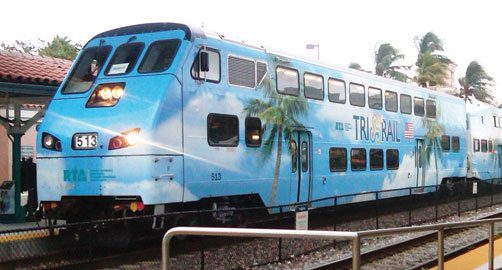
A Tri-Rail train
Going In. Sun Life Stadium is probably best known under its original name, Joe Robbie Stadium, named for the owner of the NFL’s Miami Dolphins, who had it built for them and for a hypothetical MLB team that became the Marlins. It’s 15 miles north of downtown Miami, in a location that’s been called, at various times, Miami, Miami Lakes, Miami Gardens, Carol City and Opa-Locka. Sounds like a bad variety show sketch.
The best way to get there from downtown is to take I-95 North to the Florida Turnpike (renamed the Ronald Reagan Turnpike, and, contrary to "conservative principles," the Gipper did believe in good roads), to Exit 2X for Northwest 199th Street. NW 199th is also known as Dan Marino Boulevard, named after some guy who never won a championship, college or pro. The Stadium is between 199th and 203rd, and between the Turnpike and 27th Avenue, across 203rd and Snake Creek from Calder Race Course. The exact address is 347 Don Shula Drive, for the coach who won the Dolphins' 2 titles and the record number of NFL coaching wins he has.
Like tickets, parking is expensive: $40. Tailgating is permitted.

Before the renovation, with the seats in Dolphin aqua & orange
Public transportation there is a bit trickier. You'd have to take Metrorail from downtown to M.L. King Rail Station, then transfer to the Number 27 bus, riding that to NW 199th Street & NW 27th Court. And then you'd have to walk down 199th for about 15 minutes and turn into the parking lot. Not exactly ideal. (Somehow, I don't think a situation like this, especially with a transit station with his name on it, was part of Martin Luther King's dream. But he certainly would have approved of a racially mixed crowd watching racially mixed teams playing each other.)
The gates go from A, on the 1st base side, around the stadium clockwise, to H, in the right field corner. Gates G and H open an hour and a half before first pitch, all others one hour before.
In spite of South Florida’s climate – the stadium probably gets more rain than any other in the NFL, including Seattle – umbrellas are not permitted inside. "Safety concerns," No, I’m not making that up, it’s on the Dolphins' website. The field runs northwest-to-southeast, and is natural grass.

In mid-renovation. Note the all-aqua seats,
and that the upper deck is no longer fully-enclosed.
By the start of next season, there will be a roof
to shield the fans from sun and rain.
The corner spaces will be filled by giant video screens.
The stadium has been home to the Dolphins since 1987; the Orange Bowl game in 1996, 1997, 1998 and since 2000; the University of Miami football team since 2008 (their games were the last thing the Orange Bowl stadium hosted before its demolition to make way for Marlins Park); the Marlins from 1993 to 2011; and the Champs Sports Bowl from 1990 to 2000.
It's hosted 5 Super Bowls: XXIII (1989, San Francisco over Cincinnati), XXIX (1995, San Francisco over San Diego), XXXIII (1999, Denver over Atlanta), XLI (2007, Indianapolis over Chicago, and the only Super Bowl that's yet been rained on) and XLIV (2011, Green Bay over Pittsburgh). Sites for Super Bowls LIII and LIV (2019 and 2020) have not yet been selected, but Sun Life Stadium (or whatever it would be named by that point) will likely be awarded one of them. (Update: It was awarded Super Bowl LIV.)
It's also hosted 2 World Series: 1997, Marlins over Cleveland; and 2003, Marlins over, uh, let's move on. It hosted 4 BCS National Championship Games: 2001 (Oklahoma over Florida State), 2005 (USC over Oklahoma), 2009 (Florida over Oklahoma) and 2013 (Alabama over Notre Dame).
The stadium is also a premier U.S. soccer venue. On August 6, 1989, North London giants Arsenal played Argentine club Independiente, each team coming off winning its national league title. Arsenal won, 2-1, but only 10,042 fans came out to see it in the oppressive Summer Florida heat. (Perhaps this is why Arsenal did not play in North America again for 25 years, coming to Red Bull Arena in 2014.) Other major club teams to play there include Mexico's Chivas of Guadalajara; England's Chelsea of London, Everton of Liverpool and Manchester United; Spain's Real Madrid, Barcelona and Valencia; and Italy's AC Milan, Internazionale and Juventus.
The U.S. national team has played there 4 times: A 1-0 loss to Colombia on April 22, 1990; a 1-1 draw with Bolivia on February 18, 1994; a 3-1 loss to Sweden on February 20, 1994; and a 1-0 win over Honduras on October 8, 2011.
Food. With a great Hispanic, and especially Cuban, heritage, and also being in Southeastern Conference country (hello, tailgating), you would expect the football team in Miami to have great food at their stadium. Centerplate runs their concessions, and the stadium renovations include better options. From the Miami Herald:
* Sloppy Joe's (based on the famous Key West bar) at Sections 106, 144 and 317.
* Kosher Central (Hey, a lot of ex-New Yorker Jews in South Florida) at 111.
* BurgerFi at 114, 124 and 350.
* Craft Beer Tap Room at 117 and 147.
* Versailles (A French theme?) at 119 and 317.
* Sushi Maki at 126.
* Bodega Taqueria at 142, 329 and 345.
* Paradise Cups at 155.
Team History Displays. The Dolphins are celebrating their 50th season (their 50th Anniversary would be next year), and while it's been over 40 years since their last title, they have lots of history. The Dolphins Honor Roll currently honors the undefeated 1972 team and 26 individuals:
* From the 1972 team that went undefeated and won Super Bowl VII, and the 1973 team that won Super Bowl VIII: Founding owner Joe Robbie, head coach Don Shula, defensive coordinator Bill Arnsparger, quarterback Bob Griese, running back Larry Csonka, receiver Paul Warfield, tight end Jim Mandich, center Jim Langer, guards Larry Little and Bob Kuechenberg, defensive end Bill Stanfill, defensive tackle Manny Fernandez, linebacker Nick Buoniconti, and safeties Jake Scott and Dick Anderson.
* From the 1982 team that reached Super Bowl XVII: Robbie, Shula, Arnsparger, center Dwight Stephenson, receivers Nat Moore and Mark Duper, defensive end Doug Betters and defensive tackle Bob Baumhower.
* From the 1984 team that reached Super Bowl XIX, the team's most recent appearance: Robbie, Shula, Moore, Duper, Betters, Baumhower, quarterback Dan Marino and receiver Mark Clayton.
* From the 1992 team that reached and hosted the AFC Championship Game, the team's most recent appearance: Shula, Marino, Duper, Clayton, offensive tackle Richmond Webb and linebacker John Offerdahl.
* From the 2000 team that won the AFC Eastern Division, a year after Marino retired: Webb, defensive end Jason Taylor and linebacker Zach Thomas.
As yet, no players have been inducted from the 2008 AFC East title, which remains the Dolphins' most recent Playoff appearance, although Taylor had left before that season, and would return.

Jim "Mad Dog" Mandich's notation
on the Dolphins Honor Roll revealed in 2012
Little, Warfield, Marino and Stephenson were named to The Sporting News' 100 Greatest Football Players in 1999. Warfield and Marino were named to the NFL Network's 100 Greatest Players in 2010.
The Dolphins have retired 3 numbers: Griese's 12, Marino's 13 and Csonka's 39. Prior to the renovation, those numbers were flown on flags on the stadium's rim.


As Florida's oldest major league sports team, there are a few books written about the Dolphins. In 2002, on the 30th Anniversary of the undefeated season, Shula collaborated with Dave Hyde on Still Perfect! The Untold Story of the 1972 Miami Dolphins. Interestingly enough, Hyde, a columnist for the Sun-Sentinel, is a graduate of Miami University... of Ohio, and published a book about Miami graduate Woody Hayes and his Ohio State National Champions of 1968. (Shula is also from Ohio, but went to John Carroll University, not The... Ohio State University or Miami, a.k.a. "the Cradle of Coaches.")
In August 2012, on the 40th Anniversary, Griese came out with Perfection: The Inside Story of the 1972 Miami Dolphins' Perfect Season, followed that same month by Undefeated: Inside the 1972 Miami Dolphins' Perfect Season, by Mike Freeman of Bleacher Report, who also wrote biographies of Jim Brown and Bobby Bowden, and a book that was critical of ESPN. Newly published is Douglas Todt's story of the Miami teams that couldn't go all the way: Deflated Dreams: The Miami Dolphins in the Dan Marino Era.
DVDs about the Dolphins available on Amazon.com include an official team history produced in 2010, a 40th Anniversary tribute to the undefeated 1972 team including a disc of the entire broadcast of Super Bowl VII, and another such tribute to the 1973 team including a disc of the entire broadcast of Super Bowl VIII.
During the Game. South Florida is loaded with people who came from elsewhere, including ex-New Yorkers. The stereotype is that, when a New Yorker gets old, if he has enough money to do so, he moves to Miami. Especially if he’s Jewish. Or Italian. As a result, you may see a lot of Jet or Giant fans, few of whom switched to the Dolphins.
However, despite Dolphin fans' hatred of the Jets (and, to a lesser extent, the New England Patriots, the Oakland Raiders and the Pittsburgh Steelers), your safety should not be an issue. Sun Life Stadium is an island in a sea of parking, nowhere near any high crime area.
After years of having a live dolphin mascot, named Flipper after the TV dolphin, in 1997 the Dolphins debuted a man in a costume, T.D. (standing for either "The Dolphin" or "Touchdown").

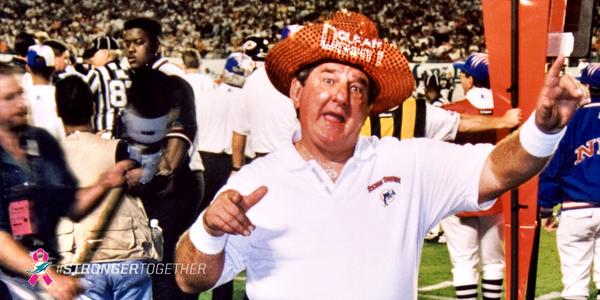
He looked a bit like Buddy Hackett.
The Dolphins hold auditions for National Anthem singers, instead of having a regular singer. "The Dolphins Fight Song" goes back to the Super Bowl years (and was ripped off by the Houston Oilers), but recently got an update by rapper T-Pain. And there's not much in the way of fan chants, aside from "Let's go, Dolphins!"
After the Game. Miami has some rough areas, but you’re starting out in the suburbs, so you should be safe. As for where to go after the game, I can’t be sure. I checked for area bars where New Yorkers gather, and found one for each of the city’s NFL teams.
J.C. Wahoo’s Sports Bar and Grill is supposedly the home of the South Florida fan club of the Giants. But it’s at 3128 N. Federal Highway (yes, the same U.S. Route 1 that goes through The Bronx and New Jersey), between Northeast 31st and 32nd Streets, 40 miles north of downtown -- further north than Fort Lauderdale, or even Pompano Beach, almost up to Boca Raton. It’s not even all that close to the stadium.
The South Florida Jets Fan Club meets at Hammerjack’s, at 5325 S. University Drive in Davie, a bit closer to the stadium, but still 24 miles north of downtown.
Don't bother looking for Dan Marino's restaurants: They've all closed. He's had financial setbacks, partly due to paying his extramarital baby mama millions of dollars in hush money.
Sidelights. Miami’s sports history is long, but aside from football, it's not all that involved.
* Site of Orange Bowl/Marlins Park. The home of the team that became known as the Miami Marlins when they moved in for the 2012 season was built at the site of the stadium known as the Miami Orange Bowl. It will be a long time before it builds up anything of history, but it will never match the history of the classic horseshoe with the palm trees at the open east end.
Opening in 1937, and known as Burdine Stadium until 1959, it hosted the Orange Bowl game on (or close to) every New Year’s Day from 1938 to 1995, and once more in 1999 when the Dolphins made the Playoffs to make their new stadium unavailable; the University of Miami football team from 1937 to 2007 (famed for its fake-smoke entrances out of the tunnel); the Miami Seahawks of the All-America Football Conference in 1946 (they moved to become the Baltimore Colts after just 1 season, but this was arguably the 1st “major league” team in any of the former Confederate States); the Bert Bell Benefit Bowl (a game involving the 2nd-place teams in each of the NFL’s divisions from 1960 to 1969, also known as the Playoff Bowl, a game so lame that Vince Lombardi once called it “the only game I never want to win” – and he didn’t); the Dolphins from 1966 to 1986; the Miami Toros of the North American Soccer League from 1972 to 1976; and 5 Super Bowls, most notably (from a New York perspective) Super Bowl III, when the Jets beat the Colts in one of the greatest upsets in sports history, on January 12, 1969. Super Bowl XIII, in 1979, was the last Super Bowl to be held here.
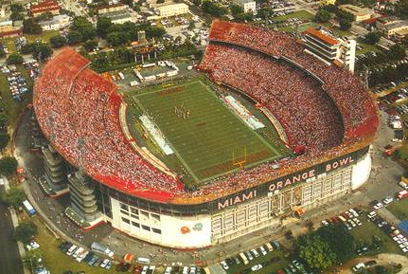
The Dolphins capped their perfect season by winning Super Bowl VII, and then Super Bowl VIII. And yet, despite having reached the Super Bowl 5 times, and Miami having hosted 10 of them, the Dolphins have never played in a Super Bowl in their home region. (They’ve done so in Los Angeles twice, and once each in New Orleans, Houston and San Francisco.) They also haven’t been to one in 30 seasons, or all of their history in their new stadium. "The Curse of Joe Robbie," anyone?
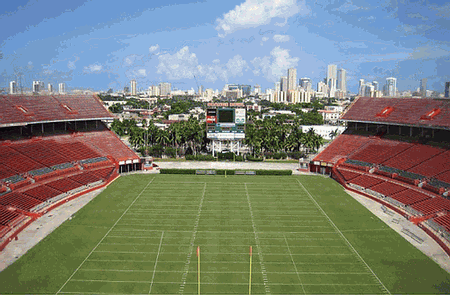
1501 NW 3rd Street, between 7th Street, 14th and 16th Avenues. Number 11 Bus west on Flagler Street from downtown, then 3 blocks north on 15th Avenue. Be careful, this is in Little Havana.
* Comfort Inn. This hotel, across 36th Street from the airport, was the site of the Playhouse, once considered one of South Florida’s finest banquet halls. It was here, on January 9, 3 days before the Super Bowl, at a dinner organized by the Miami Touchdown Club, that Joe Namath of the Jets was speaking, and some drunken Colts fan yelled out, “Hey, Namath! We’re gonna kick your ass on Sunday!” And Joe said, “Let me tell you something: We got a good team. And we’re gonna win. I guarantee it!” He was right.
NW 36th Street between Curtiss Parkway and Deer Run. MetroRail toward Palmetto, to Allapattah Station, then transfer to the 36 Bus.
* Site of Miami Stadium. Also known as Bobby Maduro Stadium, this was the home of the original Miami Marlins, of the Florida State League. Seating 13,000, it was known for its Art Deco entrance and a roof that shielded nearly the entire seating area, to protect fans from the intense Miami weather. The FSL team that played here was known as the Sun Sox from 1949 to 1954, the Marlins from 1956 to 1960, the Marlins again 1962 to 1970, the Miami Orioles 1971 to 1981, and the Marlins again from 1982 to 1988. These teams won FSL Pennants in 1969, 1970, 1971, 1972 and 1978 -- giving Miami 7 Pennants, counting those won by the NL Marlins.
Miami Stadium was the spring training home of the Brooklyn Dodgers from 1950 to 1957, the Dodgers in their first season in Los Angeles in 1958 (it can be said that “the Los Angeles Dodgers” played their 1st game here, not in California), and the Baltimore Orioles from 1959 to 1990.
It was demolished in 2001, and The Miami Stadium Apartments were built on the site. 2301 NW 10th Avenue, off 23rd Street. It’s just off I-95, and 8 blocks north and east from the Santa Clara MetroRail station.
* American Airlines Arena. The "Triple-A" has been the home of the NBA’s Miami Heat since 2000, including their 2006, 2012 and 2013 NBA Championship seasons. The Miami Sol of the WNBA also played here, from 2000 to 2002. 601 Biscayne Blvd. (U.S. Routes 1 & 41), between NE 6th and 8th Streets, across Port Blvd. from the Bayside Marketplace shopping center (not exactly their version of the South Street Seaport) and the Miami outlets of Hooters, the Hard Rock Café and Bubba Gump Shrimp. Freedom Tower station on Metromover.
* Site of Miami Arena. This was the home of the Heat from 1988 to 1999, the NHL’s Florida Panthers from 1993 to 1998, and the University of Miami basketball team from 1988 to 2003. When the Overtown race riot happened in January 16 to 18, 1989, in the week before Super Bowl XXIII, area residents took great pains to protect this arena from damage, and succeeded.
This building was demolished in 2008. Only 20 years? Apparently, like the multipurpose stadiums of the 1960s and ‘70s, and the Meadowlands Arena and the Nassau Coliseum, it served its purpose – getting teams to come in – and then quickly became inadequate. Grand Central Park, a public park, was built on the site. 701 Arena Blvd., between Miami Avenue, NW 1st Avenue, and 6th and 8th Streets. Overtown/Arena rail station.
* BB&T Center. This has been the home of the NHL’s Florida Panthers since 1998, and there’s a reason the team is called “Florida” instead of “Miami”: The arena is 34 miles northwest of downtown Miami, and 14 miles west of downtown Fort Lauderdale, in a town called Sunrise. 1 Panther Parkway, at NW 136th . If you don’t have a car, you’d have to take the 195 Bus to Fort Lauderdale, and then the 22 Bus out to the arena.
* Miami Beach Convention Center. Opened in 1957, it seats 15,000 people. The American Basketball Association’s Miami Floridians played here from 1968 to 1972. The 1968 Republican Convention, and both major parties’ Conventions in 1972, were held here. (Both Republican Conventions nominated Richard Nixon, the Democrats' nominated George McGovern.) Why? Simple, they wanted to be away from any city's downtown, putting water between themselves and wherever the hippies and another antiwar demonstrators were staying.
This building hosted the heavyweight title fights of 1961 (Floyd Patterson-Ingemar Johansson III, Floyd won) and 1964 (Cassius Clay-Sonny Liston I, Clay winning and then changing his name to Muhammad Ali). Just 9 days before Ali forced his “total eclipse of the Sonny,” on February 16, 1964, the Beatles played their 2nd full-length U.S. concert here. They visited Ali at his Miami training center, and a famous photo was taken. Elvis Presley gave a pair of concerts here on September 12, 1970.
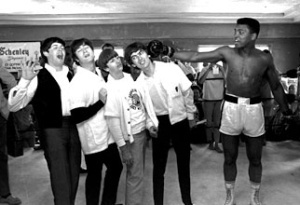
* Site of Coconut Grove Convention Center. This former Pan Am hangar, attached to the Dinner Key Marina in 1930, was used as a Naval Air Station, a convention center, a concert hall, a 6,900-seat sports arena (the Floridians played a few home games here), and as the indoor-scenes studio for the USA Network show Burn Notice.
It’s also been known as the Dinner Key Auditorium. Under that name, on March 1, 1969, The Doors gave a concert here, and lead singer Jim Morrison supposedly committed an indecent act there. (Yeah, he told the crowd, “I’m from Florida! I went to Florida State! Then I got smart and moved to California!”)
It was demolished in 2013, and a park is being built on the site. 2700 S. Bayshore Drive, at Pan American Drive & 27th Avenue, in the Coconut Grove section of town. Number 102 Bus to Number 48.
* Gusman Center for the Performing Arts. Formerly the Olympic Theater, Elvis sang here on August 3 and 4, 1956. 174 E. Flagler Street, downtown.
Several TV shows have been set in Miami. A restaurant called Jimbo’s Place was used to film scenes from Flipper and Miami Vice, and more recently CSI: Miami and the aforementioned Burn Notice. It’s at 4201 Rickenacker Causeway in Key Biscayne, accessible by the Causeway (by car) and the 102 Bus (by public transportation).
Greenwich Studios has been used to film Miami Vice, True Lies, There’s Something About Mary and The Birdcage. It’s at 16th Avenue between 121st and 123rd Streets, in North Miami, and often stands in for Miami Beach for the TV shows and movies for which it’s used. 93 Bus.
The penthouse used by the Kardashian Sisters to tape Kourtney & Khloe Take Miami is on Ocean Drive between 1st and 2nd Streets in Miami Beach, but I don’t think they use it anymore, especially since Kourtney and Kim have now “taken New York.”
If you’re a fan of The Golden Girls, you won’t find the house used for the exterior shots. It’s actually in Los Angeles. The address mentioned on the show was 6151 Richmond Street, but that address doesn't exist in Miami.
The largest college in the area is, as you might have guessed, the University of Miami. Its new Donna E. Shalala Student Center, named for the former University President and U.S. Secretary of Health and Human Services under President Bill Clinton, is at 1330 Miller Drive, about 7 miles southwest of downtown. University Station on Metrorail.
Florida International University is at 11200 SW 8th Street, 16 miles west of downtown. Its FIU Stadium, seating 23,500, is at 11310 SW 17th Street. Bus 8. It should not be confused with Florida Atlantic University in Boca Raton. Its 30,000 FAU Stadium is at FAU Blvd. & N. University Drive. Tri-Rail to Boca Raton station. On October 14, 2014, the U.S. soccer team had a 1-1 draw with Honduras at FAU Stadium.
While no President has ever been born in Florida, or grew up there, or even had his permanent residence there, Miami has a key role in Presidential history. On February 15, 1933, President-elect Franklin Roosevelt and Chicago Mayor Anton Cermak were at a rally in Bayfront Park, when Giuseppe Zangara started shooting. FDR was not hit, but Cermak was, and he died on March 6, just 2 days after FDR was inaugurated. Bayfront Park station on Metromover.
More recently, the building where the votes for Dade County were supposed to be counted in the 2000 election was besieged by protestors, hired by House Majority Leader Tom DeLay, so Miami was ground zero for the theft of the election by the George W. Bush campaign. The University of Miami's Convocation Center hosted a Presidential Debate between Bush and John Kerry in 2004. And Lynn University in Boca Raton hosted a Presidential Debate between Barack Obama and Mitt Romney in 2012. 3601 N. Military Trail. Tri-Rail to Boca Raton, then Bus 2.
Miami's top 2 museums are the Perez Art Museum Miami (PAMM), at 1103 Biscayne Blvd., Museum Park station on Metromover; and the Patricia and Philip Frost Museum of Science, at 3280 S. Miami Avenue, Vizcaya station on Metrorail.
At 789 feet, the tallest building in the State of Florida since 2003 has been the Four Seasons Hotel Miami, at 1435 Brickell Avenue downtown. Financial District station on Metromover. Indeed, Miami has seen a building boom, with the waterfront becoming home to a series of skyscrapers known as the Biscayne Wall. The tallest of Miami's older buildings is the Freedom Tower, built in 1925 as the home of the now-defunct Miami News. It now houses Miami-Dade College and a Museum. 600 Biscayne Blvd., downtown, across from the American Airlines Arena. Freedom Tower station on Metromover.
*
You don't have to be old to be a New Yorker in Miami -- but it helps to be a sports fan. Since this is Giants vs. Dolphins, not Jets vs. Dolphins, the intensity of the rivalry won't be there. You should be able to enjoy yourself, even if neither team is all that good at the moment.


