October 10, 1871 was Election Day in Philadelphia. Like most black men, Octavius Catto was a Republican, of the party of Abraham Lincoln and Ulysses S. Grant. White Protestants were mainly English and Republican. White Catholics were mainly Irish and Democratic. So, with the exception of the question of helping the poor and immigrants, it was then the Republicans who were the liberals, and the Democrats who were the conservatives. This was a long time ago: 146 years.
Catto had been harassed on the way to voting, and, anticipating this, he had a gun on him. So did Frank Kelly, a Democrat who, as far as I can determine, did not previously know Catto. Kelly shot Catto 3 times at 9th & South Streets, a few steps from his home at 812 South Street. Kelly was acquitted of the murder. Apparently, despite being a Northern city, in Philadelphia a white man could get away with murdering a black man.
Catto was just 32. He was buried at Eden Cemetery, the oldest surviving cemetery for black people in America, in suburban Collindale, Pennsylvania. Also buried there is opera singer Marian Anderson, a Philly native whose concert at Constitution Hall in Washington, for Easter 1939, was canceled by its owners, the Daughters of the American Revolution. First Lady Eleanor Roosevelt not only resigned from the DAR, but she talked her husband, President Franklin D Roosevelt, into allowing her to perform at the Lincoln Memorial, live over the national radio networks. Over 75,000 people attended, the biggest crowd to come to the Memorial until the 1963 March On Washington.
Lincoln named him U.S Secretary of State, and he served through both terms to which Lincoln had been elected. When Lincoln was assassinated on April 14, 1865, an attempt was made to kill Seward, too. It almost succeeded, as he was stabbed in his bed, but he recovered.
The new President, former Vice President Andrew Johnson -- whose intended assassin lost his nerve -- kept him on, and approved the Alaska Purchase from Russia in 1867 -- derided as "Seward's Folly," but, by the time of the Cold War, completely vindicated. And lest you think that Sarah Palin is too high a price to pay, think of what it would be like now, with Donald Trump in the White House, if Russia had a foothold in North America!
October 10, 1883: Jim Devlin dies of tuberculosis. He had been a 1st baseman and pitcher, but he and 3 teammates threw games for the Louisville Grays in 1877, costing them the 2nd National League Pennant. All were banned from baseball for life.
Devlin became a policeman in Philadelphia, but his mounting medical bills, his inability to get hired in any capacity in baseball, and the lack of a pension for baseball players in those early days, doomed his family to poverty. He was just 34 years old, and had led the NL in strikeouts in 1876, its 1st season. His career ERA was 2.05. He was a decent hitter, too, batting .287 over 3 seasons in the National Association and 2 in the NL.
Assuming he hadn't gotten sick, by 1883, he would probably still have been playing had he not been a part of professional baseball's 1st scandal. He was also professional baseball's 1st tragedy.
October 10, 1885: José Alfredo Holtreman Roquette is born in Lisbon, Portugal. Known as José Alvalade for his Portuguese noble family, he graduated from Harvard Medical School, on May 31, 1906, he founded Sporting Clube de Portugal, a.k.a. Sporting Lisbon. Along with Lisbon rivals SL Benfica and FC Porto, it becomes one of Portugal's "Big Three" soccer teams.
Unfortunately, he died in the worldwide "Spanish Flu" pandemic on October 19, 1918, shortly after his 33rd birthday. Sporting's last 2 stadiums, opening in 1956 and 2003, have born the name Estádio José Alvalade in his memory.
October 10, 1886: David Yulee dies in New York at age 76. A railroad executive, he became known as the Father of Florida Railroads. He served Florida in both houses of the U.S. Congress, elected to the House of Representatives in 1840, 1842 and 1844, and to the Senate in 1844 and again in 1854. Although he had converted to Protestantism, he was born David Levy, and his 1844 election made him the 1st person of Jewish heritage elected to the Senate.
October 10, 1889: Kermit Roosevelt is born in Oyster Bay, Long Island, New York. His mother was Edith Roosevelt, born Edith Kermit Carow, and she named him for a brother she never knew. His father was Theodore Roosevelt, and, like his father, he overcame childhood illnesses and became a great intellectual and adventurer.
When his father left the Presidency in 1909, he stepped away from his studies at Harvard University to join him on a year-long hunting trip to Africa. Together, they killed a lot of animals. They made up for it by sending a lot of specimens back to the Smithsonian Institution in Washington (which funded the trip) and the American Museum of Natural History in New York, which has a statue of Theodore out front and a memorial to him in the lobby. Kermit also accompanied Theodore on the 1913-14 River of Doubt expedition in Brazil, and probably saved his life.
He served in the U.S. Army in both World Wars. In between, in 1925 and again in 1929, he and his brother Theodore Jr. went on expeditions in China for the Field Museum in Chicago. But being wounded in World War II may have accelerated his bipolar disorder, and on June 4, 1943, he shot himself at Fort Richardson in Alaska. His wife was told it was heart disease, and that's how it was reported in the press. He was 53.
October 10, 1891: Stefano Magaddino is born in Castellammare del Golfo, Siciliy, Italy. A cousin of New York organized crime figure Joseph Bonnano, he arrived in Brooklyn in 1909, and eventually found the Buffalo-Niagara Falls area ripe for the picking.
"Don Stefano," also known as "The Undertaker," was the longest-running Mob boss in American history. From his base in Buffalo, he extended west to Cleveland, and also had Toronto and Montreal under his thumb. He was an original 1931 member of "The Commission," which Lucky Luciano set up to be the governing body of the American Mafia. But a split in the Buffalo Mob ended his power in 1968, and he died in 1974, at age 82 -- without having spent any time in prison.
October 10, 1896: Louis G. Wilke -- I can find no record of what the G stands for -- is born in Chicago. He coached one of the great early amateur basketball teams, the AAU Phillips 66ers -- a "company team" that got around amateur rules by getting its players jobs with the Phillips Petroleum Company of Bartlesville, Oklahoma. In the 1929-30 and 1930-31 seasons, he led them to a record of 98-8.
He served as Chairman of the AAU Basketball Committee, and on the U.S. Olympic Committee. He died in 1962, and was elected to the Basketball Hall of Fame in 1983.
*
October 10, 1900: The University of Texas and the University of Oklahoma play each other in football for the 1st time, on the Texas campus in Austin. This was 7 years before Oklahoma gained Statehood. Texas wins, 28-2.
The game became an institution, and has several nicknames: The Red River Showdown (the Red River separates the States), the Red River Rivalry, the Red River Classic and the Red River Shootout. It was 1st played in 1900, 7 years before Oklahoma gained Statehood. It was played in Austin from 1900, 1901, 1902, 1903, 1904, 1907, 1909, 1910, 1911 and 1923; Norman in 1901, 1903 (played twice in those seasons), 1908 and 1922; Oklahoma City in 1905 and 1906; Houston in 1913; and in Dallas every other time, including every season since 1929. A deal has been made to keep the game at the Cotton Bowl through at least 2025.
Going into this year's game, last Saturday, ranked Number 19 in the country, Texas upset Number 7 Oklahoma, 48-45. Texas leads the rivalry 62-45-5. A running joke is that, unlike the Longhorns' rivalries with Texas A&M and Arkansas, and the Sooners' with Oklahoma State and Nebraska, this is a rivalry not for the people but the rich, and that millionaires have bet ranches and oil wells on the outcome, many regretting it.
October 10, 1904: For the first time, and not for the last, an American League Pennant comes down to New York and Boston. The last day of the season features a doubleheader at Hilltop Park, at 165th Street & Broadway in Manhattan's Washington Heights.
The New York Highlanders, forerunners of the Yankees, need to sweep the Boston Americans, forerunners of the Red Sox, in order to win. Otherwise, Boston will win it. Hilltop Park seats about 16,000, but there's perhaps 30,000 jammed into the confines, including thousands of standees roped off in the massive outfield area.
Pitching the 1st game for the Highlanders is Jack Chesbro, who has already won 41 games, which remains the single-season record for pitching from 60 feet, 6 inches away. And that's pronounced CHEESE-bro, not CHEZ-bro.
With the score 2-2 in the top of the 9th and Lou Criger on 3rd base, Chesbro throws a spitball – then a legal pitch – but it’s a wild pitch, going over the head of his catcher, Jim "Deacon" McGuire, and Criger scores the Pennant-winning run. The Yankees win the nightcap, 1-0, but it’s meaningless, as the Red Sox-to-be win the Pennant.
But, faced with the prospect of losing a postseason series not just to the champions of what they view as "an inferior league," but to the other New York team, the National League Champion New York Giants refuse to participate in the World Series. Manager John McGraw, on this day, issues a statement that it was his decision, not that of owner John T. Brush, to refuse to play the AL Champions, regardless of who they turned out to be. The 1904 World Series is called off, and it will be 90 years before such a thing happens again – over a very different kind of stupidity, and a more egregious one at that.
Brush and McGraw were so shamed in the press for chickening out that they agreed that they would participate in any future World Series – and they participated in 14 before moving to San Francisco, their total now 20.
Today, over a century later, the Red Sox organization does not claim a forfeit win and call themselves the 1904 World Champions, which would give them 9 World Championships, rather than 8. But they might as well -- after all, who can stop them, and how?
And yet, the plaque at Polo Grounds Towers lists the Giants as World Champions for 1904, as well as for 1905, 1921, 1922, 1933 and 1954 -- but not for 1888 and 1889, possibly because those titles were not won at that location, but rather at a different location with a facility called the Polo Grounds.
After 1904, the Americans/Red Sox would win 4 more Pennants in the next 14 seasons. The Highlanders/Yankees would have to wait another 17 years before winning their 1st, but then, they would pretty much keep winning them for the next 43 years.
John Dwight Chesbro, a.k.a. Happy Jack, won 41 games that season, and 198 in his Hall of Fame career for the Pirates and the Yankees (and, for the very last game of his career, the North Adams, Massachusetts native came home and pitched and lost one for the Red Sox). Sadly, he is mainly remembered not for all the games he won, but for one he lost, basically for one bad pitch that he threw. He died in 1931, age 57.
A shocking percentage of the 1904 Americans died young, what with that being the pre-antibiotic era, although the man named Denton True Young, a.k.a. Cy Young, lived to be 87. The last survivor of the 1904 Americans, and the 1903 team that won the 1st World Series, was shortstop Freddy Parent, a New England native, from Biddeford, Maine, who lived on until 1972, at the age of 96. The last surviving 1904 Highlander was 2nd baseman Jimmy Williams (no relation to later Red Sox manager Jimy Williams), who died in 1965.
October 10, 1905: Walter Anton Berger is born in Chicago. An outfielder, Wally Berger was a shining light on a very bad team, the Boston Braves of the 1930s, making the 1st 4 All-Star Games from 1933 to 1936. In 1935, he led the National League in home runs, RBIs, and putouts by an outfielder, so he wasn't a one-dimensional player.
In 1937, desperate for cash, the Braves sent him to the Giants, and he played on his 1st Pennant winner. He also won a Pennant with the Cincinnati Reds in 1939, but they traded him to the Philadelphia Phillies in 1940, before they could play and win that year's World Series. That was his final season in the major leagues. He finished with a lifetime batting average of .300 and 242 home runs, a pretty good total considering he played most of his home games at Braves Field.
He later worked in the Yankee organization, scouting, and managing a farm team, the Manchester Yankees of the New England League, Class B. Baseball-Reference.com has no record of how well the team did, but they do say that Manchester, New Hampshire didn't have another professional team for 20 years, and Wikipedia makes no mention of Berger ever managing except for that one season. He settled in the Los Angeles suburb of Redondo Beach, California, and lived until 1988.
*
October 10, 1910: Millwall Athletic (soon to be renamed just "Millwall") defeat Woolwich Arsenal (renamed just "Arsenal" in 1914) 1-0 in the London FA County Cup. This turns out to be the last game Millwall play at their original ground, on the Isle of Dogs. Their next stadium, The Den, soon opened. It eventually became known as the roughest ground for away fans in the entire country. It was replaced by The New Den in 1993.
It wasn't planned this way -- Arsenal had advanced on merit -- but Arsenal were an appropriate opponent for the ground's last game. The Isle of Dogs ground was the site of Arsenal's 1st match, a 6-0 win over Eastern Wanderers on December 11, 1886. It's not clear why they were playing at Millwall's home, although Millwall were away that weekend, and Arsenal had yet to choose a home field. They would soon select a site in Plumstead, Southeast London, not far from Woolwich, moving to Highbury in North London in 1913.
October 10, 1913: Adolphus Busch dies of edema (then usually called "dropsy" while on vacation in Lindschied, Hesse, Germany, not far from his birthplace of Kastel. He was 74, and one of the richest men in America.
His family had produced beer and wine, but he was the 21st of 22 children, and he and 3 of his older brothers, not expecting to inherit much, went to America in 1857, to a city with many German immigrants, St. Louis.
He served in the Union Army during the American Civil War, and founded a brewing supply company. One of his customers was a soapmaker named Eberhard Anheuser. Adolphus married Eberhard's daughter Lilly, Eberhard bought a brewery, and Anheuser-Busch was born.
Adophus created a variety of beer that he named for a region of Austria that produced good beer, the Budweis region. But it would be Adolphus' grandson, August Anheuser Busch Jr., a.k.a. Gussie Busch, that would make Budweiser the biggest brand of beer in the world. In 1953, Gussie bought the St. Louis Cardinals, because they had a huge radio network, and he was told that this was just the thing to promote Budweiser nationwide. It worked, and Budweiser and sports have been intertwined ever since.
October 10, 1914: Thomas Morgan Fine is born in the Dallas suburb of Cleburne, Texas. In 1946, pitching for the Scranton Red Sox, he won 15 consecutive games to set what was then an Eastern League record. But he wasn't quite good enough for the major leagues: While he went 157-110 in the minors, he was 1-3 in the majors, for the 1947 Boston Red Sox and the 1950 St. Louis Browns. He died in 2005, age 90.
Also on this day, Ivers Whitney Adams dies in Boston at age 84. The founder of the American Net and Twine Company had gotten rich enough to found Boston's 1st professional baseball team, on January 20, 1871.
Since they had 4 players from the Cincinnati Red Stockings team that had made professional baseball profitable in 1869 and 1870, it was named the Boston Red Stockings, and it won 4 straight National Association Pennants from 1872 to 1875. Entering the National League, it would win 8 more Pennants in what remained of the 19th Century. By that point, Adams had had to sell the team, in order to concentrate on his business.
So Ivers Adams was the founder of the team known today as the Atlanta Braves. And yet, he is not in the Baseball Hall of Fame. He appears not to have been related to the family that produced Presidents John and John Quincy Adams; nor to the family that produced the founder of the Boston Bruins, Charles Francis Adams; nor, despite his middle name to the Whitney family that is connected to the Mets, due to their founding owner, Joan Whitney Payson.
October 10, 1915: William Leroy Chadwick is born in Manhattan, and grows up in Jamaica, Queens. Bill played hockey for an amateur team in New York, but in a 1935 game, he was struck in his right eye by a puck, and lost the vision in it. He still went on to play with the New York Rovers, a minor-league team owned by the Rangers, and also playing home games at the old Madison Square Garden.
In 1937, he was asked to come off the bench and officiate, because the intended referee was stuck in the snow. That caught the attention of NHL President (they didn't call the job "Commissioner" until 1993) Frank Calder, who hired Chadwick as the League's 1st American-born linesman in 1939. Just a year later, Calder was so impressed, he promoted Chadwick, still only 25 years old, to full referee -- apparently not knowing that he only had one good eye.
Chadwick invented many of the hand signals that hockey refs still use. He officiated until 1955 -- retiring before turning 40 is unusual for a referee these days -- and called 42 Stanley Cup Finals matches, 13 of them deciding games (in just 15 seasons!), both still records after 63 years. He was the 5th on-ice official, and the 1st American-born official, elected to the Hockey Hall of Fame.
Bill Chadwick was just getting warmed up. In 1967, he became Marv Albert's broadcast partner on Ranger radio broadcasts, and in 1972 was switched to WOR-Channel 9. This was the era when the Rangers, Islanders (no Devils yet), Knicks and Nets might (not would, might) have their games broadcast on tape delay at 11:30 PM, after the local news. For most of that time, his broadcast partner was Jim Gordon. Again, despite having just the one working eye, Bill's insight into the game was invaluable to a generation of new hockey fans (including myself), and, because of his officiating background, he became known as The Big Whistle.
He died on October 24, 2009, in Cutchogue, Suffolk County, Long Island, just 2 weeks after his 94th birthday.
October 10, 1916: Robert E. Stevens -- I can find no record of what the E stood for -- is born in San Francisco. Aside from while he served in the U.S. Navy in World War II, he wrote for the San Francisco Chronicle from 1936 to 1981, including the Giants' 1st 21 seasons in the City By the Bay.
In 1999, the Baseball Hall of Fame gave him its sportswriters' awarded, the J.G. Taylor Spink Award. The following year, what is now named AT&T Park opened in San Francisco, including the Bob Stevens Press Box was named for him. He died in 2002.
October 10, 1917: Thelonious Sphere Monk is born in Rocky Mount, North Carolina. One of the leading innovators of jazz, the pianist is 1 of 5 jazz musicians to appear on the cover of Time magazine. The others are Louis Armstrong, Duke Ellington, Dave Brubeck and Wynton Marsalis. He died in 1982, after years of declining physical and mental health.
October 10, 1918, 100 years ago: Yigal Allon is born in Kfar Tavor, in what is now Israel. A hero of that nation's War of Independence, he served in its Parliament, the Knesset, from 1955 until his death in 1980. In 1969, being Deputy Prime Minister, he briefly served as Prime Minister between the death of Levi Eshkol on February 26 and the appointment of Golda Meir as Leader of the Labor Party on March 17 -- 19 days.
October 10, 1919: Edgar Louis Laprade is born in Mine Centre, Ontario, and grows up nearby in Port Arthur. Another Ranger legend, he won the Calder Trophy as NHL Rookie of the Year in 1946, played in the 1st 4 regularly-scheduled NHL All-Star Games (there had previously been benefit games that are counted as official games, in 1934, 1937 and 1939), and in 1950 helped the Rangers reach the Stanley Cup Finals, and won the Lady Byng Memorial Trophy.
He and a friend, Guy Perciante, later operated a sporting goods store in Thunder Bay, Ontario and an arena in Port Arthur. He also served on the Thunder Bay City Council in the 1960s. He was elected to the Hall of Fame, and died in 2014 -- like Bill Chadwick, at the age of 94.
*
October 10, 1920: Perhaps the most eventful game in World Series history unfolds at League Park in Cleveland, and we barely even have photographs of it. No film. Radio broadcasting was in the process of being invented. Television was still just an idea. The Internet wasn't yet an idea.
In the bottom of the 1st inning, Brooklyn Dodger pitcher Burleigh Grimes – 1 of 17 pitchers who will soon be allowed to continue throwing the spitball because it was their "bread-and-butter," or what we would call today his "out pitch," though the pitch will be outlawed for everyone else – gives up hits to Charlie Jamieson, Bill Wambsganss, and Indians center fielder/manager/legend Tris Speaker. Tribe outfielder Elmer Smith then hits the 1st grand slam in Series history.
In the 3rd‚ Jim Bagby comes up with 2 on, and crashes another Grimes delivery for a 3-run blast‚ the 1st home run ever by a pitcher in Series play.
In the 5th, with Pete Kilduff on 2nd and Otto Miller on 1st with nobody out, Dodger reliever Clarence Mitchell hits a line drive at 2nd baseman Wambsganss. One out. "Wamby" takes a couple of steps and tags Kilduff before he can get back to 2nd base. Two out. Then he tags the off-and-running Miller, before he can see what’s happening and get back to 1st base. Three out. An unassisted triple play. And, 98 years later, this remains the only triple play of any kind in World Series history.
The Indians win, 8-1, and their 1st appearance in the World Series will soon be a successful one. But Wambsganss, suddenly nationally famous, will later lament that he had a pretty good career (and a case can be made that he was right), but that, for most people, he might as well have been born the day before this game and died the day after. As it turns out, Wamby dies on December 8, 1985, in a suburb of Cleveland, where he'd lived all his life, making him 89 years old.
Also on this day, the Chicago Cardinals -- founded as the Normal Athletic Club in 1898 -- play their 1st game in the new league they'd help found, the American Professional Football Association. The APFA would become the NFL in 1922.
Anyway, they play the other Chicago team -- not the Bears, who are still the Decatur Staleys in Downstate Illinois at this point, but the Chicago Tigers, at Cubs Park, which was renamed Wrigley Field in 1926. The game ends in a 0-0 tie.
Neither of these teams plays in Chicago today: The Tigers folded at the end of the season, and the Cardinals moved to St. Louis in 1960 and Arizona in 1988.
Also on this day, Frank Francis Sinkwich is born in Starjak, Croatia, outside Zagreb, and grows up in Youngstown, Ohio. A running back, he led the University of Georgia to the 1942 National Championship, and became the 1st player from a Southeastern Conference team to win the Heisman Trophy. Georgia retired his Number 21, and he was elected to the College Football Hall of Fame.
He enlisted in the U.S. Marine Corps, but received a medical discharge, allowing him to play in the NFL during World War II. He was drafted by the Detroit Lions, and was named NFL Most Valuable Player in 1944. He then tried to get back into the armed forces, and was accepted into the U.S. Army Air Force. A knee injury suffered while playing for an Air Force team shortened his career, as he last played for the Baltimore Colts in 1947. He returned to Athens, Georgia, and lived out his life near the Georgia campus until 1990.
October 10, 1921: Game 5 of the World Series. Waite Hoyt outpitches Art Nehf again, and the Yankees beat the Giants 3-1. But it will be Game 2 of 1923 before the Yankees win another Series game.
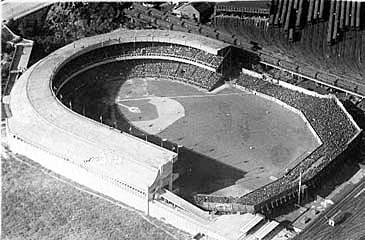
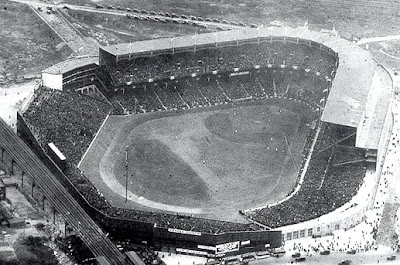
October 10, 1923: For the 1st time, the brand-new Yankee Stadium hosts a World Series game. The Yankees take a quick 3-0 lead over the 2-time defending champion Giants, but Heinie Groh triples in 2 runs in a 4-run 3rd that drives Waite Hoyt to cover.
A 4-4 tie is broken in the top of the 9th by the Giants, when a shot by Giant outfielder Charles Dillon Stengel rolls to the outfield wall. The sore-legged veteran hobbles around the bases, having lost a shoe while running, to score the winning run against reliever Bullet Joe Bush before 55‚307 spectators, a record for a Series game at the time.
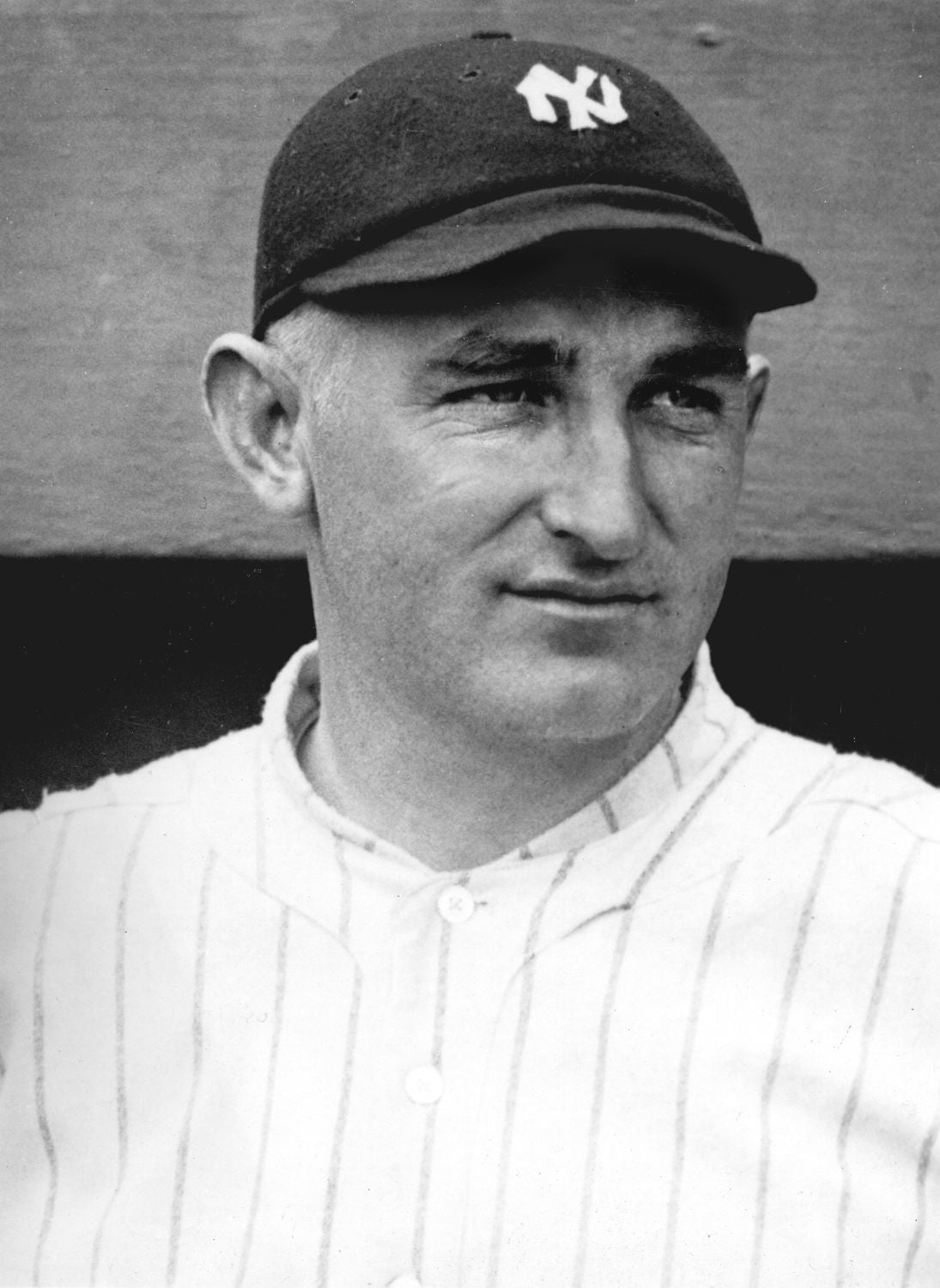
Yes, Casey Stengel. As he told a rookie Mickey Mantle, shocked that he'd played, "What, do you think I was born old?" He was actually a decent player, from 1912 to 1925, a good-fielding right fielder with a .284 lifetime batting average and a career OPS+ of 120. In 1914, playing for the Dodgers, he led the NL with a .404 on-base percentage. One of the few players to win Pennants with both of New York's NL teams, he did so with the Dodgers in 1916 and the Giants in 1921, '22 and '23.
This is also the 1st Series to be broadcast on a nationwide radio network. Graham McNamee‚ aided by baseball writers taking turns‚ is at the mike. Grantland Rice had broadcast an earlier World Series‚ but not nationally. Rice was on hand, though, and wrote a column about Stengel's inside-the-park job, opening with the immortal words, "This is the way old Casey ran." Old? The man who would one day be known as "the Ol' Perfesser" wasn't yet old: He was 33, younger than a lot of great players, then and now.
October 10, 1924: With the score tied at 3-3 and one out in the bottom of the 12th in Game 7 of the World Series, Senators' backstop Muddy Ruel lifts a high catchable foul pop-up which Giant catcher Hank Gowdy misses when he stumbles over his own mask. Given a second chance, Ruel doubles. Earl McNeely then hits a grounder that strikes a pebble, and soars over the head of rookie Giant 3rd baseman Freddie Lindstrom, and drives home Ruel with the winning run making the Senators World Champions.
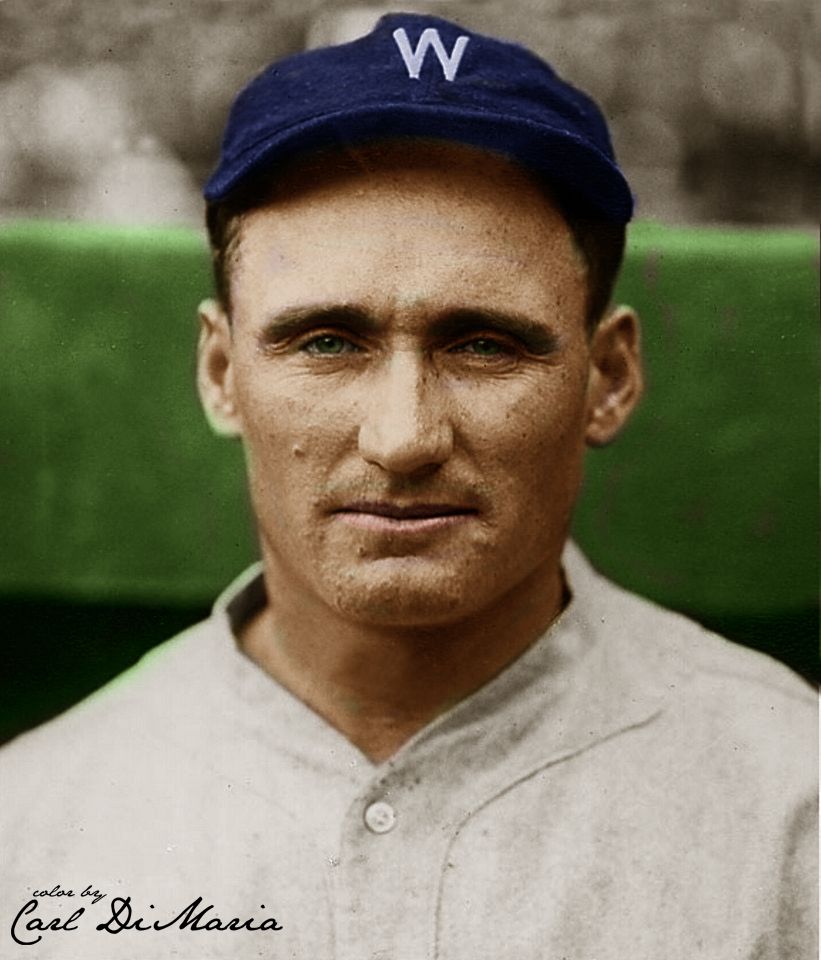
Walter Johnson, who had brilliantly toiled 18 seasons for a team known as "Washington: First in war, first in peace, and last in the American League," and had lost Games 1 and 4, pitched the 9th through 12th innings in relief, and not only had finally won a World Series game, but had won a World Series.
The Senators had their 1st World Championship in 24 years of trying. Outfielder George "Showboat" Fisher was the last survivor of the 1924 Senators, living until 1994, age 95. In the 92 years since, no Washington baseball team has won another, with the Nationals having squandered good chances in 2012 and '14. They have another great chance in 2016. We'll see.
October 10, 1925: James Buchanan Duke dies at his mansion at 1 East 78th Street, on 5th Avenue across from Central Park in New York. He was 68. "Buck" Duke is essentially the father of the American cigarette industry, and is thus responsible for the deaths of millions of people.
He's also responsible for the Duke Endowment, which contributed $40 million after his death (about $555 million in today's money) to Trinity College in his hometown of Durham, North Carolina. In his memory, it was renamed Duke University. So he's also responsible, if rather indirectly, for Coach K and the Cameron Crazies.
The James B. Duke House now hosts the New York University Institute of Fine Arts.
October 10, 1926: For the 1st time, Yankee Stadium hosts a Game 7 of the World Series. The Yankees trail the St. Louis Cardinals 3-2 in the bottom of the 7th inning, but Cardinal starter Jesse Haines, a future Hall-of-Famer, develops a blister on his hand, and can’t pitch any further.
Rogers Hornsby, the great-hitting 2nd baseman who doubles as the Cardinal manager, brings in another future HOFer, Grover Cleveland Alexander. Old Alex (also nicknamed "Pete") had pitched and won Game 6 yesterday, but celebrated afterward, and legend has it that he was really hungover.
Even if he wasn't, he had gone the distance the day before. And he was 39, and an alcoholic, and also suffered from epilepsy, and was troubled by what he had seen in World War I (which, along with his epilepsy, he tried to treat with his drinking.) One of the greatest pitchers of all time, and he would retire with a total of 373 victories, tied for 3rd all-time with Christy Mathewson (sharing 1st all-time in National League wins, as Walter Johnson’s 417 were all in the American League and Cy Young's 511 were split between both Leagues), but he was now a shadow of his former self.
And he comes in with a 1-run lead, the bases loaded, and a dangerous hitter at the plate, Tony Lazzeri. Although just a rookie at the major-league level, Lazzeri had hit 60 home runs in a Pacific Coast League season, and would have been Rookie of the Year had the award existed in 1926.
Lazzeri hits a long drive down the left-field line, but just foul. That brings the count to 0-and-2. Alexander fires in, and Lazzeri strikes out.
It is the most famous strikeout in baseball history -- unless you want to count "the mighty Casey" in Ernest Thayer's poem "Casey At the Bat" -- and, according to legend, it ended the World Series, turning Alexander into a bigger hero than ever.
Except it didn't end the game. There were 2 more innings to play. Alexander got through the 8th, and with 1 out to go in the 9th, he walked Babe Ruth. Then, for reasons known only to him – Yankee manager Miller Huggins said he hadn't given him the signal to try – the Babe tried to steal 2nd base. Catcher Bob O’Farrell threw in, and Hornsby slapped the tag on him.
The Babe was out, the game was over, and for the 1st time in 40 years – since the Cardinals, then known as the Browns, won the 1886 American Association Pennant and defeated the Chicago team now known as the Cubs in a postseason series – a St. Louis baseball team was World Champions.
This was also the 1st time the Yankees had played a Game 7 of a World Series, and they lost it. Actually, the Yankees' record in World Series Game 7s isn't especially good. They've won in 1947, 1952, 1956, 1958 and 1962; they've lost in 1926, 1955, 1957, 1960, 1964 and 2001, for a record of 5-6. At home at the old Yankee Stadium, it was even worse: 1-3. But they've still won more World Series in a Game 7 than all but 6 franchises have won Series regardless of how long they've gone – and the number drops to 4 if you only count the Series they've won in their current cities.
Alexander was a hero all over again, true, but it was a last stand. He helped the Cards back into the World Series in 1928, but this time the Yankees knocked him around. He spent much of his retirement trading his story of how he struck out Lazzeri for drinks. In 1945, interviewed for John P. Carmichael’s book My Greatest Day In Baseball, he told of meeting Lazzeri on the street in New York, and telling him, "Tony, I'm getting tired of fanning you." And Lazzeri told him, "Perhaps you think I'm not." Alexander's health problems killed him in 1950, aged only 63.
Incredibly, he outlived Lazzeri. Lazzeri would rebound from this strikeout to help the Yankees win 5 World Series, bridging the 1920s Ruth-Gehrig Yankees to the 1930s Gehrig-DiMaggio Yankees. But he, too, had epilepsy. In 1946, he suffered a seizure at his home, fell down the stairs, and broke his neck. He was just 43.
And, unlike Alexander, he did not live long enough to see his election to the Baseball Hall of Fame. He was finally elected in 1991, 53 years after Alexander was so honored. Sadly, for all each man did, each had a hard life, and each is still best remembered for that one at-bat.
The last survivor from the 1926 World Champion St. Louis Cardinals was infielder George "Specs" Toporcer -- so nicknamed because he was one of the few players to wear glasses on the field in that era -- a Manhattan native who died in 1989 on Long Island, age 90.
Also on this day, Richard Hanley Jaeckel is born in Long Beach, Long Island, New York. A veteran of the U.S. Merchant Marine in World War II, he appeared in 2 of the most popular movies made about that war: As Private 1st Class Frank Flynn in Sands of Iwo Jima in 1949, and as Sergeant Clyde Bowren in The Dirty Dozen in 1967. He also played Gallagher in the film version of one of the most famous novels written about that war, Norman Mailer's The Naked and the Dead, released in 1958.
He also played a fictional baseball player, Bobby Bronson, in the 1953 film Big Leaguer, starring Edward G. Robinson as real-life player-turned-scout Hans Lobert. Lobert's former New York Giants teammate, Hall of Fame pitcher Carl Hubbell, and Brooklyn Dodger scout Al Campanis played themselves.
The closest Richard Jaeckel came to winning an Oscar was being nominated for his role as Joe Ben Stamper in the 1971 film Sometimes a Great Notion, based on a novel by Ken Kesey. He died in 1997.
October 10, 1927: Joseph Gryzik (no middle name) is born in Katowice, Poland. A halfback, he moved to Chicago, a city with a large Polish community, in 1949, and played for the Chicago Eagles of the National Soccer League from then until 1965 -- only an injury ending his career, at age 38. He is a member of the National Soccer Hall of Fame, and is still alive.
October 10, 1928, 90 years ago: Justus Thorner dies in Cincinnati at age 80. A founder of the Cincinnati Red Stockings in 1880 -- not the same team that competed in 1869 -- he was expelled from the National League because he insisted on selling beer at his ballpark and playing on Sunday, 2 no-nos in the NL.
So he founded the American Association, the league that produced his team, now known as the Cincinnati Reds, and the teams now known as the Los Angeles Dodgers, the St. Louis Cardinals and the Pittsburgh Pirates. And yet, he is not in the Baseball Hall of Fame.
Also on this day, Salvatore D'Aquila is shot and killed on Manhattan's Lower East Side. Since 1910, "Toto" D'Aquila had been running one of New York's 1st major crime organizations. Eventually, it became known as the Gambino crime family.
*
October 10, 1930: Joe McCarthy, who had managed the Chicago Cubs to the 1929 National League Pennant, but was fired after a clash with management a few days ago, is hired to manage the New York Yankees. It will prove to be the greatest managerial hiring baseball has yet seen, as he will lead the Yanks to 8 Pennants and 7 World Championships.
In other words, all by himself, McCarthy will have led the Yanks to more Pennants than all but 7 teams have won to this day (if you count combined city totals, all but 10), and more World Series than all but 2 (if you count combined city totals, all but 3).
October 10, 1931: With John "Pepper" Martin tying a World Series record with 12 hits, the St. Louis Cardinals defeat the Philadelphia Athletics, 4-2 in Game 7, and take the Series, denying the A's the chance to become the 1st team to win 3 straight Series.
Burleigh Grimes, as I mentioned the last pitcher legally allowed to throw a spitball, and still very much at it 11 years after that epic game in Cleveland, had a shutout going in the 9th, but tired, and Cardinal manager Gabby Street had to call on Bill Hallahan to nail down the win. "Wild Bill" did not live up to his nickname, and finished the A's off.
The A's would not win another Pennant for 41 years, and that would only come after moving twice. By that point, the Cards had won another 8 Pennants.
Infielder Ray Cunningham, who played just 3 games that season, and not at all in the Series, plus 11 more games the next season before fading, was the last survivor of the 1931 World Champion Cardinals, dying in 2005, age 100.
October 10, 1932: Harold Herman Raether is born in the Milwaukee suburb of Lake Mills, Wisconsin. Hal Raether pitched 1 game, 2 innings, for the Athletics in their final season in Philadelphia in 1954, then did the same for them in 1957. He had no major league decisions. I have no record of him after 1957, only knowing that he is still alive, 1 of 13 living former Philadelphia Athletics.
October 10, 1935: Albert Joseph Scanlon is born in Hulme, Lancashire, England. An outside left, he was one of manager Matt Busby's "Busby Babes" that won the Football League for Manchester United in 1956 and 1957. He survived the Munich Air Disaster, stayed with Man U until 1960, and continued playing until 1966. He lived until 2009.
October 10, 1937: The Yankees defeat the Giants, 4-2 in Game 5 at the Polo Grounds, and win their 2nd straight World Series, their 6th overall. This moves them past the Giants and the A's to become the team with the most Series won. They have never seriously been threatened as such.
This is the last game in a Yankee uniform for the aforementioned Tony Lazzeri. "Poosh-em-up Tony" went 1-for-3. Joe DiMaggio and Myril Hoag hit home runs, to make a winner out of Lefty Gomez. The Yankees released Lazzeri, making him a free agent and allowing him to sign with anyone he wanted. He signed with the Cubs, and won another Pennant in 1938, but lost to the Yankees in the World Series.
As for the Giants, here is a team that had Hall-of-Famers in Mel Ott, Carl Hubbell and player-manager Bill Terry, and had won their 3rd Pennant in the last 5 seasons, but had only won the Series in 1 of them, and would only win 1 more over the next 72 seasons. So not only did the club not get the credit it deserved at the time, but the franchise has never really been the same, either.
The last survivor of the 1937 Yankees was Tommy Henrich, who died in 2009, at the age of 96. He was also the last survivor of the Yankee World Championship teams of 1938, 1939, 1940 and 1941.
*
October 10, 1940: James Gabriel (no middle name) is born in Dundee, Scotland. A midfielder, Jimmy Gabriel helped Everton win the League title in 1963 and the FA Cup in 1966. He later played in America for the original versions of the Seattle Sounders and the San Jose Earthquakes. He still lives and coaches in the U.S.
October 10, 1943, 75 years ago: Game 4 of the World Series. Marius Russo outpitches Harry Brecheen, and the Yankees beat the Cardinals 2-1. They can wrap up the Series tomorrow.
October 10, 1945: The Detroit Tigers beat the Chicago Cubs, 9-3 at Wrigley Field, to win Game 7 and the World Series. Hal Newhouser, the American League's Most Valuable Player this year and last, strikes out 10. Bloomfield, New Jersey native Hank Borowy, who had helped the Yankees win the '43 Series and had already won 20 games in the regular season and 2 in this Series, has nothing left to give, and gives up 6 runs in the 1st inning.
With several players still in the service, this game marks the end of the World War II era in baseball. This also remains, 70 years later, the last World Series game the Chicago Cubs have ever played. Left fielder Ed Mierkowicz is the last survivor from the '45 Tigers. Shortstop Lennie Merullo, who died on May 30, 2015, was the last living person to have played in a World Series for the Chicago Cubs.
Also on this day, Vanburn Alonzo Holder is born in St. Michael, Barbados. I don't know what makes a cricket player great, but he was a bowler (equivalent to a pitcher) in the golden age of West Indies cricket, playing in 40 Tests and 12 One Day Internationals (ODIs) from 1969 to 1979, bowling alongside the likes of Charlie Griffith and West Hall. He later served as a cricket umpire in England, and is still alive.
October 10, 1946: Peter Joseph Mahovlich is born in Timmins, Ontario. At 6-foot-5 and 210 pounds, he really shouldn't have been called "Little M," but his brother Frank, 6-foot-1 and 205, was already an NHL superstar and known as "Big M" by the time Pete arrived with the Detroit Red Wings in 1966.
In 1969, Pete was traded to the Montreal Canadiens, and he was joined by Frank a year later. (They'd also been teammates in Detroit, after Frank won 4 Stanley Cups with the Toronto Maple Leafs.) Together, they won Stanley Cups in 1971 and '73. Frank was already 33 and in decline at the time of the 1972 Canada-Soviet "Summit Series," but Pete was not yet 26 and approaching his prime, and was chosen for Team Canada, scoring a shorthanded goal in Game 2 to help save his countrymen. He also played on Canada's 1976 Canada Cup winners, the 1st time hockey had anything resembling a World Cup.
Pete also won Cups with the Habs (without Frank) in 1976 and '77, and continued playing until 1982, scoring 288 goals. He is now a scout for the Florida Panthers.
Also on this day, John Prine is born in Maywood, Illinois, outside Chicago. As far as I know, he has nothing to do with sports, and I only know one of his songs, but it should have been written decades earlier, as a memo to Pete Townshend, Jimi Hendrix and so many others:
There oughta be a law, with no bail:
Smash a guitar and you go to jail.
With no chance for early parole.
You don’t get out ‘til you get some soul.
It breaks my heart to see these stars
smashing a perfectly good guitar.
I don’t know who they think they are
smashing a perfectly good guitar.
Also on this day, Walter Charles Dance is born in Redditch, Worcestershire, England. As far as I know, the man who (having dropped his first name) played Lord Tywin Lannister on Game of Thrones has nothing to do with sports.
October 10, 1948, 70 years ago: The largest crowd ever to attend a World Series game, 86,288 fans, jams into Cleveland Municipal Stadium to witness a showdown between two future Hall-of-Famers. Braves' southpaw Warren Spahn beats Bob Feller and the Indians in Game 5 of the Fall Classic, 11-5.
This remains the largest crowd ever to attend a single game that counts in an American League stadium. The Indians and Yankees would get 86,563 for a 1954 doubleheader, and the Dodgers would cram over 92,000 into the Los Angeles Coliseum for 3 games of the '59 Series. It is also the last postseason game ever won by the Boston franchise of the National League. When they win another, 9 years later, they will be the Milwaukee Braves. No Boston baseball team will win a World Series game again for 19 years.
Unlike Walter Johnson, who finally won a World Series game on this date in 1924, and would win 2 more in 1925, Feller will not appear in the 1954 Series, and it wouldn't have done any good if he had, as the Giants swept, and would retire without winning a World Series game.
*
October 10, 1950: Charles Frederick George is born. A true "local boy made good," he was born and grew up in the Islington section of North London, standing on the North Bank of the Arsenal Stadium (a.k.a. "Highbury," after the neighborhood), supporting The Arsenal.
In 1966, he was an apprentice carpenter, and helped build the ring at Highbury for the Heavyweight Championship fight between World Champion Muhammad Ali and European Champion Henry Cooper. Ali won by knockout.
By that point, Charlie George had been signed as a forward by Arsenal, reaching the first team in 1968, and becoming a regular by 1970. He helped Arsenal win the Inter-Cities Fairs Cup (the precursor of today's Europa League) in 1970, the club's first trophy of any kind in 17 years.
As author and Arsenal fan Nick Hornby put it in Fever Pitch, the next season, 1970-71, was Arsenal's annus mirabilis. On the League season's final day, away to their North London arch-rivals, Tottenham Hotspur (who finished 3rd and won the League Cup that season), Ray Kennedy scored a header in the 88th minute to clinch the League title.
The Final was against Liverpool on May 8, 1971, and Arsenal had several close calls in regular time, including a screamer by Charlie that just sailed over the crossbar. But it ended scoreless, and went to extra time. Liverpool scored early in extra time (we would call it "overtime"), and it looked like Arsenal were done.
But Arsenal soon equalized, and then, in the 111th minute, John Radford came up the left wing, and sidefooted a pass to Charlie, who launched a net-seeking missile from 20 yards out. For the 1st time, but not the last, netminder Ray Clemence faced a big moment against Arsenal. Brian Moore, English soccer's greatest-ever announcer, had the call:
Radford... Oh, Charlie George, who can hit 'em, oh, a great goal! Charlie George! Oh, what a fabulous goal by George! Clemence had no chance with that!
Charlie fell to the ground with his arms outstretched, the most famous celebration in English soccer history. Arsenal's defense held, and the 2-1 win clinched "The Double." Charlie became a national hero.
That celebration, combined with his soon-to-be-iconic long hair, reminded fans of the musical Jesus Christ Superstar, which had recently debuted in the West End (London's theater district, of which New York's Broadway was a copy), giving rise to the title song being reworked as, "Charlie George, superstar, how many goals have you scored so far?" But opposing fans, seeing the hair, tried it another way: "Charlie George, superstar, looks like a woman and he wears a bra!" But Arsenal fans had the last laugh, singing, to the tune of "The First Noel," "Charlie, Charlie, Charlie, Charlie! Born is the King of Highbury!"
King Charles -- or King George, if you prefer -- with the FA Cup
He would continue to play for Arsenal until 1975, and even briefly played in America with the Minnesota Kicks of the North American Soccer League in 1978. He played for a few other teams before retiring in 1983. He again works for Arsenal, as a tour guide at Highbury's 2006 replacement, the Emirates Stadium. He turns 68 today, and is still beloved by Arsenal fans, who know that he was no saint, but he was one of their own.
October 10, 1951: The Yankees defeat the New York Giants, 4-3 in Game 6 at Yankee Stadium, and win their 3rd straight World Series, their 14th World Championship. The Giants had taken 2 of the 1st 3 games in this Series, but the Yanks took 3 straight to win.
Joe DiMaggio goes 1-for-2 with 2 walks. In the bottom of the 8th, he laces a double to left-center off Larry Jansen. It turns out to be the last at-bat of his career, as he announces his retirement 2 months later.
His intended center field successor, Mickey Mantle, had gotten hurt in right field in Game 2, and missed the rest of the Series, and the knee he injured would never be the same again, the beginning of a cloud over his career that would only grow. The "other" great rookie center fielder, Willie Mays of the Giants, had a poor Series, and would spend most of the next 2 seasons in the Army in the Korean War. But both Mantle and Mays would be back, and would resume building their legends.
With the recent deaths of Yogi Berra and Bob Kuzava, the battery who closed this Series out, there is only 1 Yankee who still survives from the '51 title: Bobby Brown. Whitey Ford is still alive, but spent the '51 and '52 seasons in the U.S. Army, due to the Korean War.
October 10, 1953: Helene Mayer dies of breast cancer in Munich, Germany. She was only 42 years old. She was a fencer, a competitive swordfighter, but became a "political football."
At 17, she won a Gold Medal in foil fencing at the 1928 Olympics in Amsterdam, and was a national hero in Weimar Germany. She competed again in 1932 in Los Angeles, but just before a match, she was told that her boyfriend had died in a military training exercise. This was only a year after losing her father. Shaken, she only finished 5th.
She stayed in America to attend college as an exchange student. But when Adolf Hitler seized power in 1933, her membership at her native fencing club was terminated, because she was Jewish. She taught at California colleges, and then in 1935 her German citizenship was canceled with the Nuremberg Laws.
There was a movement to boycott the 1936 Olympics, scheduled for Berlin. To avoid this, Nazi authorities chose her as the token Jew on the German Olympic team. She won a Silver Medal, and, on the podium, in an effort to protect her family, gave a Nazi salute.
She went back to America, and won the U.S. women's foil championship 8 times in 13 years from 1934 to 1946. In 1952, with World War II over and freedom back in place, but perhaps knowing she was dying, she returned to her homeland, and got married, spending her last months in happiness. She was posthumously elected to the U.S. Fencing Association Hall of Fame.
Also on this day, Gus Williams -- apparently, his entire name -- is born in Mount Vernon, Westchester County, New York. A guard, the 2-time All-Star starred on the Seattle SuperSonics team that won back-to-back NBA Eastern Conference Championships, including the NBA title in 1979. The Sonics retired his Number 1, and, thus far, the Oklahoma City Thunder have honored that retirement. His brother Ray Williams played for the Knicks and the Nets.
October 10, 1954: Fernando Manuel Costa Santos is born in Lisbon, Portugal. A mediocre right back with soccer teams Maritimo and Estoril, he managed F.C. Porto to a Primeira Liga title in 1999 and the Taça de Portugal (their version of the FA Cup) in 2000 and '01.
Fernando Santos managed AEK Athens to the Greek Cup in 2002, and was chosen as Greek Football Manager of the Year 4 times. (Ironically, in that stretch, Greece beat Portugal in Lisbon in the Final of Euro 2004.) He manages the Portugal national team, and did so to victory in Euro 2016, the country's 1st-ever major tournament win.
October 10, 1955: William Reid dies. A former head basketball coach and athletic director at Colgate, University, the Detroit native later became an NCAA administrator. He was posthumously elected to the Basketball Hall of Fame.
October 10, 1956: Game 7 at Ebbets Field. A pair of Jersey boys start: Johnny Kucks of Hoboken, Hudson County, for the Yankees; Don Newcombe of Elizabeth, Union County, for the Dodgers. The
New York Post’s headline reads:
Kucks vs. Newk and…
THERE’S
NO
TOMORROW
(Sorry, I looked for a photo of it, and couldn't find it.)
The
Post is right: Win or lose, this is it for one of the best seasons in New York baseball history, as the Yankees had Mantle's Triple Crown & MVP season; the Dodgers had a fantastic Pennant race, over the Reds, Cardinals and Braves, edging the Braves by 1 game, a season highlighted by no-hitters from Carl Erskine and former Giant nemesis Sal Maglie; and the World Series had Don Larsen's perfect game in Game 5 and a 1-0 10-inning Dodger win in Game 6. This is Game 7. This is it.
The Yankees turn out to be "it": They shell Newk, with 2 homers from Yogi Berra and a grand slam from Bill "Moose" Skowron. Kucks hardly needs to pitch a shutout, but does, and the Yankees win, 9-0. The Dodgers had been World Champions of baseball for 372 days.
The last out turns out to be the last play in the career of Jackie Robinson: He strikes out swinging, but Yogi drops the ball, a flash of the Mickey Owen & Tommy Henrich play 15 years earlier. His weight up and his speed down, but his instincts as keen as ever, Robinson sees what's happening, and runs to 1st base. But, as I said, his great speed is gone, and Yogi quickly picks up the ball, and throws him out. Jackie retires 2 months later.
What no one knows at the time -- not Robinson, not even Dodger owner Walter O'Malley -- is the extent of the finality of this game. It is not just the end of a terrific baseball season. It is the last Subway Series game for 44 years -- 33 years if you count the 1989 "BART Series." It is the last home game in a World Series for a National League team from New York for 13 years. And it is the last postseason game that Ebbets Field, or Brooklyn, will ever host. The next season, the Giants will announce they are moving to San Francisco, and the Dodgers will announce they are moving to Los Angeles. "There’s no tomorrow," indeed.
With the recent death of Yogi, there are 3 surviving Yankees from the 1956 World Champions: Hall-of-Famer Whitey Ford, perfect game hero Don Larsen, and catcher Charlie Silvera.
Also on this day,
Giant premieres. The story of Texas oilmen in the early 20th Century is the last film made by James Dean, who died a year earlier in a car crash. It also stars Rock Hudson and Elizabeth Taylor.
October 10, 1957: Game 7 of the World Series. Warren Spahn, the only remaining Brave from the 1948 Boston Pennant winners, is the intended starter for the Milwaukee Braves, but he's got the flu. So manager Fred Haney turns to Lew Burdette on 2 days' rest.
Lew comes through, notching his 3rd win and 2nd shutout of the Series, as the Braves beat the Yankees 5-0. A 4-run 3rd inning does the job, including a double by Eddie Mathews, followed by a single by Hank Aaron. The last out, in front of a stunned 61,207 at Yankee Stadium, is Skowron grounding to Mathews, who steps on 3rd base for a force play.
It was stunning because most people outside the Upper Midwest -- the Braves' "territory" at the time included Wisconsin, the Upper Peninsula of Michigan, and States that would later belong to the Twins, such as Minnesota, North Dakota, South Dakota and even northern Iowa -- didn't give the Braves a chance. Some Yankees had actually called Milwaukee "Bushville" for the way they'd reacted to their team, after having been a minor-league town for half a century.
Many years later, in 2012, John Klima would title his book about the '57 Braves
Bushville Wins! The Wild Saga of the 1957 Milwaukee Braves and the Screwballs, Sluggers, and Beer Swiggers Who Canned the New York Yankees and Changed Baseball. It's a wonder he had room for the actual book.
Burdette, a 30-year-old righthander from West Virginia, is named the Series MVP, having tossed 24 consecutive scoreless innings -- longest in Series play to that point except for Babe Ruth's 29 2/3rds -- and posted a 0.64 ERA in his 3 Fall classic victories. Oh yeah: The losing pitcher in Game 7 was the previous season's Series hero, Don Larsen.
At the time, the Yankees were criticized for having traded Burdette to the Braves in 1951, for All-Star pitcher Johnny Sain. However, Sain helped the Yankees win 3 World Series; the Braves won just 1 with Burdette.
Amazingly, considering how long their careers lasted, this was the only World Championship won by either Aaron or Spahn. But it was the 2nd for Red Schoendienst, Del Rice and Nippy Jones, who had been on the 1946 Cardinals. And Mathews would win another, closing his career with the 1968 Tigers.
This remains the only World Series ever won by a Milwaukee team, 60 years later. Despite all that talent, the Braves lost the Series in 1958, and never got back into the Series until 1991. From 1914 (in Boston) to 1995 (in Atlanta), this was the only World Series they won in a span of 81 years.
Indeed, from 1898, when they won the Pennant of the only major league then available, to today, 118 years, they've won just 3 World Championships. That's 1 every 39 years. I like to joke about the Mets, but they've won 2 in 54 years -- 1 every 27 years. The Red Sox, since 1918? 3 in 98 years -- 1 every 33 years. No matter what city they're in, the Braves are underachievers. And the Brewers, having won only 1 Pennant in 47 seasons, haven't helped Milwaukee improve their record.
In fact, the only other World Championship won by a Milwaukee team is the NBA Title won by the Milwaukee Bucks in 1971. Unless, of course, you count the 13 NFL Championships won by the Green Bay Packers -- and Lambeau Field is 117 miles from downtown Milwaukee, even further to the north than arch-rival Chicago is to the south. The Brewers have only made the postseason 4 times since they arrived in 1970, replacing the Braves who left 5 years earlier.
There are 11 players still alive from the '57 Braves: Aaron, catcher Del Crandall, shortstop Felix Mantilla, Newark native infielder Bobby Malkmus, infielder Mel Roach, infielder Dick Cole, outfielder John "Thumper" DeMerit, and pitchers Juan Pizarro, Taylor "T-Bone" Phillips and Joey Jay (who only appeared in 1 game that year, but would go on to become the ace of the 1961 Reds, and won their only victory in that year's World Series against the Yankees).
October 10, 1959: James Murphy (no middle name) is born in DeLand, Florida. A receiver, he played for the Kansas City Chiefs in 1981, then went north to play for the Winnipeg Blue Bombers. He was named the CFL's Most Outstanding Player in 1986, made 4 All-Star Teams, and helped the Bombers win the Grey Cup in 1984, 1988 and 1990. They haven't won it since, the CFL's longest current drought.
He retired as the Bombers' all-time leader in receiving yards, and was named to their 20 All-Time Greats and the Canadian Football Hall of Fame.
Also on this day, Bradley Whitford (no middle name) is born in Madison, Wisconsin. Not to be confused with the Aerosmith guitarist of the same name, this guy was a "character actor" -- one of those guys whose name you couldn't quite remember, so you called him, "Oh yeahhhh… Him!" Then he began to play White House Deputy Chief of Staff Joshua Lyman on
The West Wing, and he went from character actor to legend.
Josh, a native of Westport, Connecticut, was a great character, a devoted public servant, and a hard but fair fighter. He had one flaw: He was a Mets fan. In a 2001 episode titled "The Stackhouse Filibuster," he mentioned that he wanted to fly down to Florida to see a spring-training game, and hoped to get a "Hey, dude" from Met catcher Mike Piazza. Whitford has never mentioned a favorite team in real life, but, being from Wisconsin, he has expressed fandom for the Green Bay Packers, and may also be a fan of the Milwaukee Brewers and Bucks.
In 2016, HBO aired
All the Way, in which Whitford, back in politics, played Vice President Hubert Humphrey to Bryan Cranston's Lyndon Johnson. In real life, he is married to actress Jane Kaczmarek.
Also on this day, Julia Anne Sweeney is born in Spokane, Washington. A performer on
Saturday Night Live from 1990 to 1994, and is best known for playing the androgynous Pat.
*
October 10, 1960: Game 5 of the World Series. Despite the Yankees having already beaten them 16-3 and 10-0, the Pittsburgh Pirates refuse to go away quietly. The Pirates knock Art Ditmar out of the game in the 2nd inning, and, despite a Roger Maris home run, the Pirates win, 5-2, and take a 3 games to 2 lead in the Series.
The Pirates now need to win just 1 out of 2 games at Forbes Field to win their 1st World Series in 35 years. The Yankees will score 12 runs in Game 6, and 9 runs in Game 7. Sounds like a Yankee win, right? Wrong.
October 10, 1961: An expansion draft is held to stock the New York Mets and the Houston Colt .45's (forerunners of the Astros). Houston's 1st selection is Giants infielder Eddie Bressoud, but they soon trade him to the Red Sox for shortstop Don Buddin. He doesn't last a full season with the team, either.
The Mets' 1st pick is also a Giant, catcher Hobart "Hobie" Landrith. Asked why, manager-to-be Casey Stengel says, "You gotta have a catcher. If you don't have a catcher, you're gonna have a lot of passed balls." Landrith washes out, and the Mets choose Clarence "Choo Choo" Coleman as their catcher for the rest of their 1st season. This proves to be a mistake. Landrith plays all of 24 games for the Mets before he becomes the player to be named later in the trade with the Baltimore Orioles that gets them... Marv Throneberry. He played 1 more season in the majors, and that was it.
Hobie Landrith, the original Met, grew up in Detroit, played 14 major league seasons, batted .233 lifetime, and never played for a postseason team. He worked for Volkswagen, married and had 5 children, and is now 88 years old.
October 10, 1962: Tom Tresh belts an 8th-inning homer off Jack Sanford to give the Yankees a 5-3 comeback win over the Giants in Game 5 of the World Series, at the original Yankee Stadium. The rookie shortstop’s dad, Mike Tresh, who hit only 2 home runs in his 12 big league seasons, left his seat behind home plate prior to the at-bat, to bring his son good luck.
October 10, 1963: Jolanda de Rover is born in Amstelveen, the Netherlands. A swimmer, she won a Gold Medal at the 1984 Olympics in Los Angeles. She also swam in the 1980 Olympics in Moscwe and the 1988 Olympics in Seoul. Her daughter, Kira Toussaint, swam for the Netherlands in the 2016 Olympics in Rio de Janeiro.
Also on this day, Vegard Ulvang is born in Kirkenes, Norway. He won 3 Gold Medals in cross-country skiing in the 1992 Winter Olympics in Albertville, France. When the Olympics began staggering the Winter and Summer Games, and the 1994 Winter Olympics were held in his homeland, in Lillehammer, Norway, he led the athletes in taking the Olympic Oath.
Also on this day, Roy Cazaly dies in Hobart, Tasmania. He was 70. One of the greatest players in the history of Australian Rules Football, he starred for Melbourne club St. Kilda in the 1910s and South Melbourne in the 1920s. During World War II, Australian soldiers took the fans' old cheer of "Up there, Cazaly!" and turned it into a battle cry.
October 10, 1964: The Yankees and Cardinals are tied 1-1 in Game 3 of the World Series at Yankee Stadium, going into the bottom of the 9th. Barney Schultz, a knuckleballer, comes on to relieve for the Cardinals. In the on-deck circle, Mickey Mantle watches Schultz warm up, times Schultz's knuckler in his head, and says to Elston Howard, standing there with him, "You can go back to the clubhouse, Elston. This game is over."
Schultz threw Mantle one pitch. Mickey deposited it in the upper deck in right field. Yankees 2, Cardinals 1 -- which was also now the Yankees' lead in the Series. It was Mickey's 16th home run in World Series play, surpassing the record he shared with Babe Ruth. He would hit a 17th in Game 6 and an 18th in Game 7, but the Cards would come back and win the Series. Still, Mickey would often speak of this homer, his only walkoff homer in postseason play, as the highlight of his career.
Whether Ruth called his shot in the 1932 World Series is still debated, but Mickey sure called his shot here. He was asked how many others he called. "Well, I called my shot about 500 times," he would say with a laugh. "This was about the only one that worked."
Mickey would later call this home run the highlight of his career. It was understandable: Not only did it win a World Series game, something only 4 other players had ever done with a home run to that point (Tommy Henrich of the '49 Yankees, Dusty Rhodes of the '54 Giants, Eddie Mathews of the '57 Braves and Bill Mazeroski of the '60 Pirates), but it was against the Cardinals, the team he grew up rooting for as a boy (since they were the closest team to Commerce, Oklahoma, over 300 miles away).
Also on this day, the Olympic Games open in Tokyo, Japan. Tokyo had been chosen as the site of the 1940 Olympics, which were canceled due to World War II. These were the 1st Olympics held in Asia, and the 1st from which South Africa was banned due to its apartheid policy. (They would be restored in time for the 1996 Olympics.)
Yoshinori Sakai, 19 years old, was chosen to light the cauldron with the Olympic flame, as a symbol of peace, as he was born on the day of the Hiroshima atomic bomb, August 6, 1945. He later won a relay Gold Medal in track in the 1966 Asian Games, though he never competed in the Olympics, and went into television production. He died in 2014, age 69.
Among the stars of this Olympics were Soviet gymnast Larissa Latynina, who raised her medal total to 18 (9 Gold, 5 Silver, 4 Bronze), a record until surpassed by Michael Phelps in 2012; Czech gymnast Věra Čáslavská, who won 3 Gold Medals, including dethroning Latynina in the women's all-around; Ethiopian runner Abebe Bikila, who became the 1st winner of back-to-back Olympic marathons; American sprinter Bob Hayes, who became the 1st man to run the 100 meters in under 10 seconds, although this was not accepted as a world record, since it was wind-aided; American boxer Joe Frazier, who followed up his heavyweight Gold Medal by eventually becoming Heavyweight Chamion of the World; and several swimmers, including 4 Golds by American Don Schollander and a 3rd straight 100-meter win by Australian Dawn Fraser.
October 10, 1965: Game 4 of the World Series at Dodger Stadium. Don Drysdale rebounds from his Game 1 loss, giving up no runs other than solo home runs by Harmon Killebrew and Tony Oliva. Wes Parker and Lou Johnson homer off Jim "Mudcat" Grant, and the Los Angeles Dodgers beat the Minnesota Twins, 7-2. The Series is now tied.
October 10, 1966: Another great day for The Arsenal, although it's not yet obvious that even the 1950 entry has made it so: Tony Alexander Adams (not "Anthony") is born in the Romford section of East London. The centreback arrived at the club in 1983, and in 1986-87 was named England's Young Player of the Year, helping Arsenal win the League Cup, ending an 8-year trophy drought.
That season was the 1st as Arsenal manager for George Graham, another member of the 1970-71 Double side. At the start of the 1988-89 season, after making several key personnel changes, pushing out the players who had earned the nickname "Boring, Boring Arsenal" in the 1980s, he made Adams, only 22 years old, Captain.
It worked: Arsenal won their 1st title since the Double season, again defeating Liverpool, this time at Liverpool's ground, Anfield, needing to win by at least 2 goals for the tiebreakers to fall their way. They did, as Alan Smith, who led the League in scoring that year, scored early in the 1st half, and then, in stoppage time, Michael Thomas became the Bobby Thomson of English soccer. As Captain, Adams lifted the League trophy.
A drunken car crash in 1990 kept him off the England team for the World Cup, perhaps changing soccer history. (He had played for England at Euro 1988, but not at Euro 1992 or the 1994 World Cup -- not through his own fault, but because England didn't qualify.) He ended up spending 2 months in prison, and would later be very critical of England's prison system, saying they need to help substance abusers beat their addictions before releasing them.
He returned in time to captain Arsenal to another League title in 1991, to the FA Cup and the League Cup in 1993 -- the 1st time the "Cup Double" had ever been done, and his late header beat Tottenham in the Semifinal of the FA Cup -- and the Cup Winners' Cup in 1994. They also reached the Final of the Cup Winners' Cup in 1995. Their defensive line, "the back four," of right back Lee Dixon, centrebacks Adams and Steve Bould, and left back Nigel Winterburn became legend, giving all they had, and giving the attack enough to win games, as the fans' song went, "One-nil to The Arsenal."
But as the old Football League Division One was replaced by the Premier League for the 1992-93 seasons, Arsenal's League form began to slip. Graham sold some players too soon (something Mee and Terry Neill had done, and something Arsène Wenger would later do), and his financial shenanigans would lead to his firing in 1995. Meanwhile, Adams' drinking got worse and worst.
Finally, in the Summer of 1996, after helping England reach the Semifinal of Euro 1996 on home soil, he got help. When he returned for the 1996-97 season, he admitted the worst-kept secret in British sports: Tony Adams was an alcoholic. He founded Sporting Chance Clinic, which also includes as its patrons his former Arsenal teammate and drinking buddy Paul Merson, and singer and former Watford F.C. chairman Sir Elton John.
The 1996-97 season was also when Wenger arrived as Arsenal manager. Wenger had won France's League 1 and the French and Japanese equivalents of the FA Cup. But in those days, the dawn of the Internet and of international cable TV coverage of soccer, most English fans hadn't heard of him. Adams, no dummy, said, "What does this Frenchman know about English football?"
Plenty, as it turned out. He changed the team's diet and exercise routine, getting them healthier. He was exactly what Adams needed as his recovery began in earnest. Merson wouldn't reform, but Adams and another noted boozer, Ray Parlour, did. They finished 3rd that season, and in 1998, won the Double again. And in the game that clinched the League title, a 4-0 win at home to Everton, Adams scored the last goal, and soaked in the adulation for his rebirth and redemption.
He remained with the team through the 2002 season, and won another Double, his 4th League title, his 3rd FA Cup, and his club record 10th trophy -- his 9th as Captain. He is the only man in English history to captain League titles in 3 different decades.
After the season, his testimonial match helped raise £500,000 for Sporting Chance. He is also a Patron for NACOA, a charity that provides information, advice and support for anyone affected by their parents' drinking.
His experience in management has not been as good. He managed lower-division side Wycombe Wanderers in 2003-04, without success. In 2008, he was named assistant manager at Portsmouth by Harry Redknapp, and they won the FA Cup. But when Redknapp was offered the job at Tottenham, he left Adams holding the bag. Redknapp had essentially bankrupted the club to win their 1st major trophy in 48 years (and the only trophy he's won in 33 years as a manager), and due to going into administration, Portsmouth fell from a top-half-of-the-table club in the Premier League to the 4th division, and twice came within hours of going out of business.
Adams managed the club as best he could in 2008-09, but as the saying goes, you can't make chicken salad out of chicken shit. When Portsmouth visited Arsenal, the fans once again sang, "There's only one Tony Adams." But after the season, he was sacked -- not because of his performance, but because the club literally couldn't afford his salary. He later managed Gabala in the former Soviet "republic" of Azerbaijan, and earlier this year managed Granada for 7 games in Spain's La Liga, losing them all.
In 2011, at Arsenal's 125th Anniversary celebrations, the club dedicated a statue of the man known as "Mr. Arsenal," in his pose after scoring the title-clinching goal in 1998.
Also on this day, Derrick Wayne McKey is born in Meridian, Mississippi. Along with Nate McMillan and Xavier McDaniel, he was part of the Seattle SuperSonics' "Big Mac" offense of the late 1980s and early 1990s. He played 15 seasons as an NBA forward, reaching the Finals with the 2000 Indiana Pacers.
Also on this day, Charlotte Cooper dies in Helensburgh, Scotland. She was 96. Despite being deaf for most of her adult life, the native of Ealing, West London won the women's title at Wimbledon 5 times between 1895 and 1908, and 2 Gold Medals in tennis at the 1900 Olympics in Paris.
October 10, 1967: Frank Keaney dies at age 81. The head basketball coach at the University of Rhode Island from 1920 to 1948, he is credited as the inventor of the fast break offense. URI's arena, built in 1953, was named Keaney Gymnasium in his honor. He was elected to the Basketball Hall of Fame in 1960.
Also on this day, Jacek Marek Zieliński is born in Wierzbica, Poland. A centreback, he starred for Poland's most celebrated sports team, Legia Warsaw, winning the national league (the Ekstraklasa) in 1994, 1995 and 2002, and the Polish Cup in 1994 (a Double), 1995 and 1997. He is now an assistant manager for the Poland national team.
Also on this day, Gavin Christopher Newsom is born in San Francisco. He was elected to his hometown's city council, the Board of Supervisors, in 1997, and was elected Mayor in 2003 and 2007. As some Mayors are legally entitled to officiate at wedding ceremonies, he was the 1st Mayor in the country to officiate at a same-sex wedding. His tenure also included the Giants' 1st World Series win since moving to San Francisco.
He was elected Lieutenant Governor in 2010 and 2014, and is currently the Democratic nominee for Governor, and favored to win.
October 10, 1968, 50 years ago: Mickey Lolich wins his 3rd game of the Series – matching Harry Brecheen as the only lefthander ever to do it thus far – and the Detroit Tigers win their 1st World Series in 23 years (to the day), beating the indomitable Bob Gibson and the defending champion St. Louis Cardinals in Game 7, 4-1 at Busch Memorial Stadium.
Mike Shannon hits a home run for the Cardinals, Jim Northrup's triple over the normally sure-fielding Curt Flood in the top of the 7th makes the difference. In the bottom of the 7th, Roger Maris, the Cardinals' right fielder pops up to short, closing an 0-for-3 day. It is the last at-bat of his career, as he has already decided to retire.
After the race riot and near-miss for the Pennant in 1967, after 23 years without a Pennant (let alone a title), after 11 years without a World Championship in any sport (since the 1957 NFL Champion Lions), and after 16 years without a Pennant for their legendary star Al Kaline, Detroit needed this World Championship very badly. With Kaline, Lolich, Northrup and Willie Horton being the stars of the Tigers' comeback from 3-games-to-1 down, the '68 Tigers remain the most beloved team in the history of Michigan sports, ahead of any Lions, Pistons, Red Wings, Michigan Wolverine or Michigan State Spartan team.
Lolich, who would retire with 217 wins and as the all-time strikeout leader among lefthanders with 2,832, was criticized for being fat. He was the original "hefty lefty." He was 6 feet even, and is usually listed as having been 210 pounds. Seriously, that was considered fat for a pitcher in 1968. Paging David Wells. Paging CC Sabathia. And on the right side, paging Bartolo Colon. Paging Rich Garces.
There are 15 surviving members of the 1968 Tigers, 50 years later: Kaline, Lolich, Horton, Denny McLain, Bill Freehan, Dick Tracewski, Mickey Stanley, Don Wert, Jim Price, John Hiller, Tom Matchick, Fred Lasher, Wayne Comer, John Warden and Daryl Patterson.
Also on this day, Marinos Ouzounidis is born in Alexandroupoli, Greece. A centreback, he led Athens-based Panathinaikos to the Super League Greece title in 1995 and 1996, and the Greek Football Cup in 1993, 1994 and 1995 (the last of these, a Double).
He later moved to APOEL, based in Nicosia, Cyprus, and led them to the League title in 2002. He managed them to the League title in 2007. While he was Captain of the Greece national team from 1999 to 2001, he was not a member of their team that won Euro 2004.
October 10, 1969: This is the day on which the 2000 film
Frequency begins, a sort-of time travel story involving a fireman father (Dennis Quaid) and a cop son (Jim Caviezel) who must solve a mystery across time and a ham radio set, while the Mets pursue their "Miracle" World Series, which becomes a plot point in the film. The film's "present" begins on October 10, 1999.
In 2016, a TV show would be based on it, but "the past" was in 1996, there was no subplot involving the Yankees' postseason run, the father was also a cop, and the cop child was a woman instead of a man.
Also on this day, Brett Lorenzo Favre is born in Gulfport, Mississippi. Seriously, he's only 47? He seems a lot older. Well, that's what happens when you retire 3 times and you end up requiring a 4th (at least). What should we get him for his birthday? How about something he's not used to having: A clue!
Like Joe Namath, he received that hype despite only winning 1 Super Bowl. (So did Johnny Unitas, but then, he won 2 NFL Championships in the pre-Super Bowl era.) An 11-time Pro Bowler, he once held holds NFL quarterbacking records for most starts (298), wins (186, tied by Peyton Manning), pass attempts (10,169), completions (6,300), and yards (71,838, surpassed by Manning). He holds the record for consecutive starts by any player (297), from September 27, 1992 to December 5, 2010.
He led the Packers into Super Bowl XXXI which they won, and Super Bowl XXXII which they lost. In 2007,
Sports Illustrated named him Sportsman of the Year, and it wasn't a "lifetime achievement award," either, as he was on his way to his 4th NFC Championship Game (which they would lose to the Giants), playing through the death of his father.
He recently reconciled with the Packers, and they retired his Number 4 and inducted him into their team Hall of Fame. He first mentioned wanting to retire in 2002, having finally retired in 2010 and making it stick, though all his speculation about coming back, and having done so a couple of times, leading Lisa Swan of
Subway Squawkers to call him the Roger Clemens of football. This was deepened after we found out he was a pervert (the "sexting" scandal with
Jets GameDay reporter Jenn Sterger). He is among the newest inductees into the Pro Football Hall of Fame -- which does separate him from Clemens.
*
October 10, 1970: Game 1 of the World Series. The game is played at Cincinnati's new Riverfront Stadium, making it the 1st Series game ever played on artificial turf. The year's biggest musical sensation, the Jackson 5 (including 12-year-old Michael), sings the National Anthem.
The Baltimore Orioles come from 3-0 down to beat the Cincinnati Reds 4-3, on home runs by Boog Powell, Elrod Hendricks and Brooks Robinson. Brooks will be the big star of this Series, but due to his defensive wizardry, his many offensive contributions (including a few in this Series) have been nearly forgotten.
Also on this day, Northwestern University beats their cross-State rivals, the University of Illinois, 48-0 at Dyche Stadium in Evanston. It remains the biggest win the Wildcats have ever had over the Fighting Illini, and leads them to a 2nd-place finish in the Big Ten Conference, their best performance between their 1936 and 1995 Conference Championships. A loss to Ohio State kept them from the title.
Also on this day, the Buffalo Sabres make their NHL debut. They play away to the Pittsburgh Penguins, who will become their arch-rivals, and beat them 2-1 at the Civic Arena. They are coached by George "Punch" Imlach, also their 1st general manager, who had coached and managed the Toronto Maple Leafs (who became another Sabres rival, also due to proximity) to 4 Stanley Cups in the 1960s.
The Sabres have usually been a good team, but have only made the Stanley Cup Finals twice, losing in 1975 and, controversially, in 1999. They played at the Buffalo Memorial Auditorium until 1996, moving a short walk away to the arena now known as the KeyBank Center.
October 10, 1971: The San Francisco 49ers, after 25 seasons at Kezar Stadium, play their 1st game at an expanded Candlestick Park. They lose 20-13 to their arch-rivals, the Los Angeles Rams.
October 10, 1972: Oleksiy Mykolaiovych Zhitnik is born in Kiev, Ukraine. With his first name usually spelled the Russian way, "Alexei," he starred on defense for the legendary hockey club at CSKA Moscow before 17 NHL seasons, reaching the Stanley Cup Finals with the aforementioned 1999 Sabres, and playing 2 seasons with the Islanders.
He won a Gold Medal for "The Unified Team" (in the wake of the breakup of the Soviet Union) at the 1992 Winter Olympics. His 1,085 NHL games are the most of any Soviet-born or Russian-born defenseman.
Also on this day, Ricardo Manuel Andrade e Silva Sá Pinto is born in Porto, Portugal. A forward, he helped Lisbon-based Sporting Clube de Portugal win the Taça de Portugal, the Portuguese Cup, 1995; and both the Cup and the Primeira Liga, "the Double," in 2002.
Ricardo Sá Pinto managed Sporting to the Taça Final in 2012. Last season, he managed Standard Liège to the Belgian Cup, and now manages the leading club in Poland, Legia Warszawa (Warsaw Legion).
October 10, 1973: As Vice President Spiro Agnew is pleading no contest to income-tax evasion and resigning his office, Tom Seaver holds off the Reds, the Mets win, 7-2, and the fans storm the field at Shea Stadium to celebrate the Mets' 2nd Pennant in 5 seasons.
Also on this day, John Ulysses Mobley is born outside Philadelphia in Chester, Pennsylvania. A linebacker, he was with the Denver Broncos when they won Super Bowls XXXII and XXXIII. He was an All-Pro in 1997.
But an injury cost him most of the 1999 season, and another ended his career in 2003. He is a cousin of former Houston Rockets star Cuttino Mobley.
Also on this day, Zach Thornton (his entire name) is born in the Baltimore suburb of Edgewood, Maryland. He was an original New York/New Jersey MetroStar (forerunners of the New York Red Bulls) in 1996, as backup goalkeeper to Tony Meola. He was also an original member of the Chicago Fire, winning the MLS Cup with them in 1998; the U.S. Open Cup in 1998 (a Double), 2000, 2003 and 2006; and the Supporters' Shield in 2003.
He was named MLS Goalkeeper of the Year in 1998 and 2009. But since the U.S. national team has usually been loaded with good goalies (that is no longer the case), he only got 8 caps, and was never named in the squad for a major tournament. He is now an assistant coach at Elizabethtown College in Pennsylvania.
October 10, 1974: Christopher Robert Pronger is born in Dryden, Ontario. The 6-foot-6, 220-pound defenseman has been named to 6 All-Star teams, won the Hart Trophy as Most Valuable Player and the Norris Trophy as best defenseman in 2000, and Olympic Gold Medals for Canada in 2002 and 2010.
He starred for the St. Louis Blues, but didn't reach the Stanley Cup Finals until 2006 with the Edmonton Oilers, and finally won the Cup with the 2007 Anaheim Ducks. He reached the Finals once more, with the 2010 Philadelphia Flyers. He was elected to the Hockey Hall of Fame in 2016, and works in the NHL's Player Safety Division -- a tad ironic, since he is considered one of the game's dirtiest players since the turn of the 21st Century.
Also on this day, Julio Ricardo Cruz is born in Santiago del Estero, Argentina. A forward, he won Argentina's League with Buenos Aires giants River Plate in 1996 and 1997; the Dutch Eredivisie with Rotterdam's Feyenoord in 1999; and Italy's Serie A with Internazionale Milano in 2006, 2007, 2008 and 2009, and the Coppa Italia in 2005 and 2006 (a Double). He played for Argentina in the 2006 World Cup, and now runs a charitable foundation.
Also on this day, Ralph Dale Earnhardt Jr. is born in Kannapolis, North Carolina. But auto racing is not a sport, so let's move on.
October 10, 1975: Plácido Enrique Polanco is born in Santo Domingo, the Dominican Republic. The 2nd baseman helped the Detroit Tigers win the 2006 American League Pennant, and was named Most Valuable Player of the ALCS, but was also a part of their 2009 collapse. A 2-time All-Star and a 3-time Gold Glove, he batted .297 for his career.
Also on this day, Eric Johnson (no middle name) is born in Dallas. A member of the Texas House of Representatives, he is a candidate for the office of his hometown's Mayor. (UPDATE: He won.)
October 10, 1976: Giants Stadium opens at the Meadowlands Sports Complex in East Rutherford, New Jersey. For the 1st time in their 52-season history, the New York Giants football team has a home field where they get priority for scheduling.
What they don't get is exclusive use. The New York Jets will move in for the 1984 season. The football team at Rutgers University will also use it for home games too big for their 23,000-seat on-campus stadium from 1976 to 1992, for their entire 1993 season when their stadium is rebuilt, and occasionally from 1994 onward.
Other college football games will be played there, including the short-lived Kickoff Classic and the even-shorter-lived Garden State Bowl. A few high school State Championship games will be played there. Lots of soccer games, including the New York Cosmos (1977-84), the New York/New Jersey MetroStars/Red Bulls (1996-2009), and games of the 1994 World Cup. Lots of concerts. And a 1995 Mass by Pope John Paul II.
What the Giants also don't get is a successful debut. In front of a sellout crowd of 76,042, they are beaten 24-14 by the Dallas Cowboys. However, for the most part, the stadium will be good to the Giants, and they win 7 NFC Eastern Division titles, 4 NFC Championships and 3 Super Bowls while playing there, until they and the Jets move into the new MetLife Stadium next-door in 2010.
Also on this day, Patrick Brian Burrell is born in Eureka Springs, Arkansas. He helped the Philadelphia Phillies win the 2008 World Series, then signed as a free agent with the team the Phils beat in said Series, the Tampa Bay Rays. "Pat the Bat" (a nickname he hated, though he liked his other nickname, "Met Killer") won another ring with the 2010 Giants, retired after the 2011 season with 292 career home runs, and now works in the Giants' front office.
Also on this day, Shane Albert Doan is born in Halkirk, Alberta. A right wing, he was a rookie with the original Winnipeg Jets in their last season, 1995-96, moved with them to become the Phoenix Coyotes, and remained with the team now named the Arizona Coyotes throughout his career, having been their Captain from 2003 until his retirement at the end of last season.
This makes him not only the last active player from the original Jets, but the only one to play against the new version, which had been the Atlanta Thrashers from 1999 to 2011.
A 2-time All-Star, he was awarded the King Clancy Memorial Trophy in 2010 for his humanitarian work. He never competed for Canada in the Winter Olympics, but he did score the winning goal for them, against Finland, in the 2004 World Cup. He played more games without winning a Stanley Cup, or even reaching the Finals, than any other player: 1,595, including 55 Playoff games. The Coyotes have announced that they will retire his Number 19 in a pregame ceremony on February 24, 2019.
October 10, 1977: The Chicago Bears beat the Los Angeles Rams 24-23 at Soldier Field. Joe Namath completes 16 of 40 passes for the Rams. The former Jet hero never plays another professional game.
Also on this day, Thomas F. Ashworth (I can find no record of what the F stands for) is born in Denver. An offensive tackle, he was with the New England Patriots when they won Super Bowls XXXVIII and XXXIX, and caught a touchdown pass from Tom Brady on a tackle-eligible play in 2005.
October 10, 1978, 40 years ago: The 75th World Series gets underway at Dodger Stadium. The Yankees were upset at being Las Vegas underdogs despite not only being the defending World Champions, but facing the team they'd beaten the previous season.
The reasoning was that the Dodgers now had an improved bullpen (as if the Yankees didn't), and that the Dodgers would be emotionally lifted by dedicating the Series to their coach Jim Gilliam, who died 2 days earlier, a day after they clinched the Pennant against the Philadelphia Phillies, and whose Number 19 they officially retire on this day.
The Dodgers did make their point in Game 1: Although Reggie Jackson homered for the 4th straight game in Series play, off a Tommy John sinker, Ed Figueroa was knocked out early, and Yankee pitching was tagged by 2 homers from Davey Lopes (mainly a contact hitter and base stealer, but against the Yankees he became a slugger) and 1 by Dusty Baker, and the Dodgers won 11-5.
Also on this day, Ralph Metcalfe dies of a heart attack at age 68. He had represented a Congressional district on Chicago's South Side since 1970, and was running for re-election again. He had once set world records in the 100 and 200 meters, but only got Silver Medals in them in the 1936 Olympics in Berlin, because Jesse Owens. They did, however, combine for a Gold Medal the 4x100 relay.
October 10, 1979: Wayne Gretzky, 18 years old, makes his NHL debut, after lighting up the World Hockey Association in its last season. He collects an assist, but the Edmonton Oilers lose to the Chicago Blackhawks, 4-2 at Chicago Stadium.
Also on this day, Game 1 of the World Series is played at Memorial Stadium, in Baltimore, delayed a day due to a mix of rain and snow. The Baltimore Orioles score 5 runs off Bruce Kison in the 1st inning, including a home run by Doug DeCinces. Despite a later home run by Willie Stargell, the Pirates can't quite come back, and the O's hold on, 5-4.
This was the worst-looking World Series of all time. I don't mean it was poorly-played; that was hardly the case. I mean it looked bad. The Orioles had those bright orange home jerseys with the black lettering, and those dumb black caps with the white front panels and the Oriole head. The Pirates, while I didn't mind the 19th Century-style caps, being the only team to keep them after wearing them for the National League's 100th Annviersary in 1976, their mix-and-match of white, white with yellow pinstripes, gold, and black, sometimes mixing up the jerseys and pants, was atrocious.
The stadiums were little better: Memorial Stadium had terrible lighting, and a grass field that was already chopped up by Colts games; while Three Rivers Stadium was a concrete ashtray with a hideous pea-green carpet of artificial turf. This was a World Series made for radio, not television.
Also on this day, Joel Przybilla (no middle name) is born in the Minneapolis suburb of Monticello, Minnesota. He was named Minnesota's Mr. Basketball in 1998, played at the University of Minnesota, and played 13 seasons in the NBA. But the closest he ever got to a title was in his rookie season, 2000-01, reaching the Western Conference Finals with the Milwaukee Bucks.
Also on this day, Kawika Uilani Mitchell is born outside Orlando in Winter Springs, Florida, and grows up in nearby Winter Park. A linebacker, he sacked Tom Brady during the Giants' Super Bowl XLII win over the New England Patriots.
Also on this day, Mýa Marie Harrison is born in Washington, D.C. The singer claims "My Love Is Like... Wo." She teamed up with Christian Aguilera, Lil' Kim and Pink to cover "Lady Marmalade," and appeared in the "Cell Block Tango" scene of the film version of Chicago: "Lipshitz!" It wouldn't be the last time she played a killer: She was on NCIS, playing a woman who killed her sister, a Navy officer.
*
October 10, 1980: After 3 failed attempts, the 4th time is the charm for the Kansas City Royals. George Brett's mammoth home run off Goose Gossage gives the Royals a 4-2 win and a sweep of the American League Championship Series, for the 1st major league Pennant for a Kansas City team – the 1st Pennant won by any KC team since the Blues won the American Association Pennant in 1953.
It is one of the most humiliating series in Yankee history. If you don't believe me, ask
Squawker Lisa: She says she's still bitter about it, too. And we're both still bitter about the 1981 World Series.
On the same day, Game 3 of the National League Championship Series is held at the Astrodome. The Phillies and the Astros are tied at 1 game apiece. Before the game, Phillies broadcaster Harry Kalas, whose previous team had been the Astros (his 1st MLB broadcast was the Astrodome's debut in 1965), tells his broadcast partners, Richie Ashburn and the recently-retired Tim McCarver, that this Game 3 is the key game of the series. "I don't agree," says Ashburn. "I think whoever wins the 5th game is going to win the series." Of course, that makes sense, since Game 5, if necessary, will decide it.
Joe Niekro pitches 10 shutout innings for the Astros, and Dave Smith pitches a scoreless 11th, while the Phils get 10 scoreless from Larry Christenson, Dickie Noles and Tug McGraw. But Joe Morgan leads off the bottom of the 11th with a triple off Tug, and Denny Walling's sacrifice fly brings him home with the winning run. Astros 1, Phillies 0. The Astros are now 1 win away from their 1st Pennant.
They don't get it. The Phils win Games 4 and 5, proving that Whitey Ashburn was right, and Harry the K was wrong: Game 3 was
not the key to the series. It would be another 25 years before the Astros finally got their 1st Pennant.
Also on this day, the Edmonton Oilers retire a number for the 1st time, the Number 3 of Al Hamilton, before their season opener at the Northlands Coliseum. They lose 7-4 to the Quebec Nordiques.
October 10, 1981: George Vukovich hits a home run in the bottom of the 10th inning, to give the Phillies a 6-5 win over the Montreal Expos, and send the 1st-ever, Strike-forced National League Division Series to a decisive Game 5 at Veterans Stadium.
Also on this day, Eddie Murphy plays a grownup version of the
Our Gang/
Little Rascals character Buckwheat on
Saturday Night Live for the 1st time, complete with speech impediment. Ironically, the real Buckwheat, Billie Thomas, had died exactly 1 year to the day before, at age 49. The surviving members of the Rascals did not appreciate the performance.
On March 12, 1983,
SNL showed a sketch in which Murphy's Buckwheat was assassinated, in a sequence very similar to President Ronald Reagan's shooting 2 years earlier. The following week, "Buckwheat's funeral" was shown, with scenes of Soviet leader Leonid Brezhnev's funeral the previous November standing in, complete with goose-stepping Red Army soldiers and tanks. Footage of a very somber-looking Princess Diana was inserted, to make it look like she attended.
Eddie also played Buckwheat's assassin, John David Stutts -- 3 names, just like John Wilkes Booth, Lee Harvey Oswald and Mark David Chapman. Stutts said his dog told him to kill Buckwheat, the excuse of David "Son of Sam" Berkowitz. Then Stutts himself was shot and killed while in police custody, like Oswald.
October 10, 1982: The Milwaukee Brewers win their 1st Pennant, the 1st by any Milwaukee team since the '58 Braves, beating the California Angels, 4-3 at Milwaukee County Stadium -- and on the 25th Anniversary of the Braves' World Series win, no less.
The Angels had blown a 2-games-to-none lead, the 1st time this had ever happened in an LCS. In their 1st World Series, the Brewers will play the St. Louis Cardinals, who win their Pennant in 14 years today by beating the Atlanta Braves, 6-2 to complete a sweep. Atlanta-Fulton County Stadium had now hosted exactly 3 postseason games in its 17 seasons. It would be 9 years before it hosted another, but then it would host many more.
Also on this day, Cy Wentworth dies in Toronto at age 78. Like baseball player Cy Young, Marvin Palmer Morris Wentworth's nickname had been shortened from "Cyclone," due to his speed. A defenseman, he played in the NHL from 1926 to 1940. He played in the Ace Bailey Benefit Game in 1934, and won the Stanley Cup with the 1935 Montreal Maroons.
October 10, 1983: Nikolaos Spyropoulos is born in Ioanna, Greece. A left back, "Nikos" was a member of the Panathinaikos team that won the Double, the Superleague Greece and the Greek Cup, in 2010. He also played for Greece in that year's World Cup. He last played in 2015, and is currently a free agent.
Also on this day, Tolga Zengin is born in Hopa, Turkey. He was the starting goaltender for the Istanbul-based Beşiktaş team that won the Turkish Super Lig in 2016 and 2017. He also helped Turkey reach the Semifinal of Euro 2008.
October 10, 1984: Game 2 of the World Series. Kurt Bevacqua hits a pinch-hit home run, and Andy Hawkins pitches 5 1/3 innings of 1-hit scoreless relief, as the San Diego Padres beat the Tigers 5-3. This remains the only World Series game the Padres have ever won.
Also on this day, Troy Trevor Tulowitzki is born in Santa Clara, California. With a 3-T name like that, he should have been nicknamed "3T" or "T3" or "Trey." Instead, he's "Tulo." In 2007, the shortstop pulled an unassisted triple play, helped the Colorado Rockies win their 1st postseason series and their 1st National League Pennant, and was named NL Rookie of the Year. He had them back in the Playoffs in 2009.
He is a 5-time All-Star and a 2-time Gold Glove. He says he wears Number 2 in honor of Derek Jeter. In 2015, he was traded to the Toronto Blue Jays, and is the main reason they won their 1st AL East title in 22 years in 2015, and made it back-to-back ALCS's in 2016.
Also on this day, Paul Michael Posluszny is born in the Pittsburgh suburb of Butler, Pennsylvania. Part of Penn State's "Linebacker U" tradition (one of their safer traditions), the Jacksonville Jaguar was a Pro Bowler in 2013. He retired this past off-season.
October 10, 1985: Within hours, 2 giants of film die: Orson Welles, his enormous appetite finally catching up with him, a heart attack in Los Angeles, at age 70; and Yul Brynner, of lung cancer in New York, at 65.
Also on this day,
The Cosby Show airs the episode "Happy Anniversary." Dr. Cliff Huxtable (Bill Cosby) and his family salute his parents Russell (Earle Hyman) and Anna (Clarice Taylor) on their 49th wedding anniversary, by doing a dance routine, while Cliff's son Theo (Malcolm-Jamal Warner), in a 1950s suit and fedora, lip-synchs to Ray Charles' 1958 hit "The Night Time Is the Right Time," with daughter Rudy (Keshia Knight Pulliam) doing the "Baby!" sequence sung by Margie Hendrix. It's the show's best-remembered sequence.
October 10, 1986: Andrew Stefan McCutchen is born in Fort Meade, Florida. The center fielder is already a 5-time All-Star, and helped the Pittsburgh Pirates reach the NL Wild Card stage in 2013, '14 and '15. He won a Gold Glove in 2012 and was NL MVP in 2013. The Yankees acquired "Cutch" for this season's stretch drive, and he's helped them get into the Playoffs.
Also on this day, Ezequiel Marcelo Garay González is born in Rosario, Argentina. A centreback, Ezequiel Garay won Argentina's league with Newell's Old Boys in 2004, and Spain's Copa del Rey (King's Cup) with Real Madrid in 2011. With Lisbon's Benfica. he won Portugal's domestic Treble in 2014: The Primeira Liga, the Taça de Portugal, and the Taça da Liga. He reached the Final of the UEFA Europa League with them in 2013 and 2014.
With Zenit St. Petersburg, he won the Russian Premier League in 2015 and the Russian Cup in 2016. For Argentina, he was a runner-up at the 2014 World Cup and the 2015 Copa América. He is now back in Spain, with Valencia.
October 10, 1987: Princeton University beats Columbia University, 39-8 at Palmer Stadium in Princeton, New Jersey. Columbia thus loses their 35th straight game, a new record for Division I college football. They would extend the record to 44 the next year, before beating, of all teams, Princeton. But Prairie View A&M, a historically black school outside Houston, would double the disaster: 88 games. The old record, still the Division I-A/Football Bowl Subdivision record, is 34, by Northwestern, which broke their streak in 1982.
I was at this game, and there was a small contingent of Northwestern fans at the top of the east side of the Palmer Stadium horseshoe, holding up a banner reading, "THANK YOU COLUMBIA." I sat on the west side, and saw Princeton's last touchdown scored on an interception by a safety, wearing Number 11, who was so fast, he looked like he was flying.
Just 6 years later, he
would be flying. His name was Dean Cain, and from 1993 to 1997, he starred with Teri Hatcher in
Lois & Clark: The New Adventures of Superman.
By a weird coincidence, the man who was then the movies' Superman, Christopher Reeve, grew up in Princeton, and graduated from Princeton Day School and was accepted at Princeton University, but chose another Ivy League school, Cornell in Western New York. Cain, who dated Brooke Shields while they both attended Princeton, grew up in Malibu, California, attending Santa Monica High School with acting brothers Rob and Chad Lowe, and Charlie Sheen (but not Charlie's older brother Emilio Estevez).
Also on this day, Ryan Jefforey Mathews (that's how his name is spelled) is born in Riverside, California. A 2011 Pro Bowler with the San Diego Chargers, the running back later played for the Philadelphia Eagles, and is currently a free agent.
Also on this day, Colin Slade is born in Christchurch, New Zealand. He starred for their national rugby team, the All Blacks, in the 2011 Rugby World Cup, which they won. They won it again in 2015, although he only played in 1 game.
October 10, 1988, 30 years ago: Game 5 of the NLCS. With momentum from their dramatic win in Game 4, the Dodgers ride a home run from Kirk Gibson off Sid Fernandez to beat the Mets 7-4, and send the series back to Los Angeles with the Dodgers up 3 games to 2. Lenny Dykstra homers in defeat for the Amazin's.
Also on this day, Linval Clement Joseph is born in St. Croix, in the U.S. Virgin Islands, and grows up in Alachua, Florida. A defensive tackle for the Minnesota Vikings, he's made 2 Pro Bowls with them, and was with the Giants when they won Super Bowl XLVI.
*
October 10, 1990: The Oakland Athletics win their 3rd straight Pennant, the 1st team since the 1976-78 Yankees to do so, beating the Red Sox, 3-1 at the Oakland Coliseum. Red Sox starter Roger Clemens is ejected after arguing with plate umpire Terry Cooney over a ball-four call in the 2nd inning.
Clemens remains the last player to be thrown out of a postseason game. Funny, but, at the time, nobody suspected "roid rage."
Also on this day, Eugene Cyril Smith III is born in Miami. The former West Virginia University star was once the starting quarterback for the Jets. However, he was hounded out of the Meadowlands in 2016. Temporarily, as it turned out: The Giants made him Eli Manning's backup.
On December 3, 2017, he became the 1st black starting quarterback for the Giants -- Matt Robinson had preceded him as such on the Jets, 40 years earlier -- and the 1st quarterback ever to have started for both the Giants and the Jets. But the Giants lost, and he was released after the season. He now backs up Philip Rivers on the Los Angeles Chargers.
October 10, 1991: Game 2 of the NLCS. Steve Avery pitches a 6-hit shutout, outpitching Zane Smith, and gets a 6th-inning RBI single from Mark Lemke. The Atlanta Braves beat the Pittsburgh Pirates 1-0, to tie up the series. It is the 1st postseason game won by the Braves franchise in 33 years, since Game 4 of the 1958 World Series.
Also on this day, Michael Carter-Williams is born in the Boston suburb of Hamilton, Massachusetts. The 2014 NBA Rookie of the Year with the Philadelphia 76ers, he now plays for the Houston Rockets.
Also on this day, Xherdan Shaqiri is born in Gjilan, Yugoslavia -- now in Kosovo. His family escaped the Yugoslav Civil War and settled in Switzerland, where he now plays as a winger for the national soccer team.
He starred for FC Basel and Bayern Munich, winning the Swiss Super League 3 times and the Bundesliga twice. But his career went downhill, and Bayern sent him to Italian giants Internazionale Milano. They also decided he was no good anymore (at age 24), and sold him to Stoke City, an English Midlands club known for its dirty play and its barely linguistic hooligan following.
The joke was that, if you look at Shaqiri's career backwards, it's the story of a kid from Stoke who gets picked up by the great "Inter," and then wins the Champions League at Bayern Munich in 2013, before coming home to Switzerland. The joke was ruined this past off-season, when he was purchased by Liverpool.
October 10, 1992: Saturday Night Live parodies the upcoming Presidential debates, but there's a problem: Both the Republican incumbent, President George H.W. Bush, and independent candidate Ross Perot are played by Dana Carvey. Perot had dropped out of the race, and the writers hadn't expected him to get back in. So the segment isn't done live. Phil Hartman plays the Democratic nominee, Governor Bill Clinton.
Julia Sweeney plays NBC's Jane Pauley as the moderator. Kevin Nealon, as he had 4 years earlier, plays ABC's Sam Donaldson, who essentially calls Clinton's Arkansas a hillbilly haven, and Hartman starts spouting statistics about Arkansas like the real Clinton did. Carvey does what Bush had been doing, avoiding the criticism of the failing economy and his broken "Read my lips: No new taxes" pledge, and falling back on knowledge, leadership and experience. Carvey's Perot does an exaggeration of the real thing, making him sound even crazier than he is.
Each candidate's fantasies are inserted: Bush sees Clinton as a pot-smoking hippie, Clinton sees Bush as a puritanical Queen Victoria, and both of them see the diminutive, weird-sounding Perot as the Mayor of Munchkinland from
The Wizard of Oz.
Also on this day, Cody Derek Latimer is born in Dayton, Ohio. A receiver, he was with the Denver Broncos when they won Super Bowl 50. He now plays for the Giants.
October 10, 1994: A day after the Buffalo Bills beat the Miami Dolphins 21-11 at Rich Stadium, Marv Levy appears on his regular Monday-night coaches' show, and reveals that he had made a deal with his team.
The previous week, they'd lost to the Chicago Bears at Soldier Field. Although a Chicago native, Marv may have grown up as a fan of the Chicago Cardinals, the team now known as the Arizona Cardinals, because, apparently, he really hated hearing the fight song "Bear Down, Chicago Bears" during that game. So he told his Bills players that if they beat the Dolphins, he would write them a fight song.
They won, and he kept his word, and handed out sheets to various people in the TV studio where the show was taped. Here's the chorus:
Go Bills! For we are here to cheer for you!
Go Bills! We are your fans so true!
With victory in sight
we'll yell with all our might!
So go Bills! Fight Bills! Go!
C'mon, let's win for Buffalo!
He sang it for the team at their meeting earlier in the day, and they liked it. Bruce Smith asked for a rap version. "I told him I don't do rap," Levy said on the show. Good: When Liverpool Football Club recorded "The Anfield Rap" as their 1988 FA Cup Final song (they won the game), manager Kenny Dalglish participated, and it was horrible.
October 10, 1996: The Orioles beat the Yankees in Game 2 of the ALCS, 5-3, to tie the series. The key blow is a 7th inning home run by Rafael Palmeiro. Funny, but when O's fans talk about how the Yankees benefited unfairly from the Jeffrey Maier play the day before, they never follow it up with how
they benefited from a home run by a proven steroid user.
The next 3 games will be at Camden Yards, and the O's and their fans are sure they will beat the Yankees and win the Pennant. Instead, they will not win another game that counts until April 2, 1997.
Also on this day, the Phoenix Coyotes play their 1st home game. They get goals from veterans Mike Gartner, Craig Janney and Kris King, and from Shane Doan on his 20th birthday, and beat the San Jose Sharks 4-1 at the AmericaWest Arena (now the Talking Stick Resort Arena) in downtown Phoenix.
The team will move to what's now named the Gila River Arena in suburban Glendale in 2003, and rename themselves the Arizona Coyotes in 2014. Their best performance to date has been in the 2010-11 season, reaching the Western Conference Finals. Despite their recent success and their relatively new arena, they are still struggling financially -- the NHL's salary cap not a cure-all after all -- and could still move within the next few years.
October 10, 1998, 20 years ago: El Duque to the rescue. Having pitched for the 2 most demanding bosses in the Western Hemisphere, George Steinbrenner and Fidel Castro, no way was a little bit of Cleveland cold going to stop Orlando Hernandez. He pitches a 4-hit shutout (with 1 inning of help each from Mike Stanton and Mariano Rivera), and the Yankees win, 4-0, and tie up the ALCS at 2 games apiece.
Chuck Knoblauch, whose "brainlauch" in Game 2 put the Yankees on a minor slide, starts a key 4-6-3 double play in the 8th to eliminate the last Indian threat. He is on his way to redemption.
Also on this day, the Nashville Predators make their NHL debut -- 3 years after the League threatened to move the New Jersey Devils to Nashvillee, despite the Devils being in the Stanley Cup Finals (which they won). They host the Florida Panthers at the Nashville Arena (since renamed the Bridgestone Arena), but lose 1-0.
It would take them 6 years to qualify for the Playoffs for the 1st time, and 12 to win a Playoff series. It took them until 2011 to win a Playoff series, but they've won at least 1 in each of the last 3 seasons, including making their 1st trip to the Stanley Cup in 2017.
October 10, 1999: Game 4 of the ALDS. The Red Sox set an all-time postseason play record by scoring 23 runs in defeating the Indians 23-7 at Fenway Park. The win ties the series at 2 games apiece.
Boston gets 24 hits in the contest‚ including 5 by Mike Stanley and 4 each by John Valentin and Jason Varitek. Valentin hits a pair of homers and drives home 7 runs‚ while Jose Offerman and Trot Nixon bring home 5 apiece. The Sox had outscored 19 of the 30 teams playing in the NFL that day.
Game 4 of the NLDS is also played. The Atlanta Braves score 5 runs in the top of the 6th, and lead 7-0 going into the bottom of the 7th. The Houston Astros fight back, including hom runs by Tony Eusebio and Ken Caminiti that chase John Smoltz. But it's not enough, and the Braves win 7-5, winning the series 3-1. This is the last competitive sporting event held at the Astrodome, which closes after 35 seasons of Astros baseball.
*
October 10, 2000: Dick Klein dies in Greenville, South Carolina at age 80. A pro basketball player and minor-league baseball player in the 1940s, he got rich in the banking industry, and in 1966 led the group that founded the Chicago Bulls, a group which included AFL and Kansas City Chiefs founder Lamar Hunt. He sold the team in 1972, and later became a scout for the Phoenix Suns.
October 10, 2001: Eddie Futch dies at age 90. Born in Mississippi, and raised in Detroit at the same time as Alabama-born Joe Louis, he became a Golden Gloves winner, but is better known as a trainer. In 1958, he trained his 1st world champion: Don Jordan, who took the Welterweight title.
Among the fighters he trained were Joe Frazier, Ken Norton, Larry Holmes and Trevor Berbick -- 4 of the 5 men who defeated Muhammad Ali. He also trained Riddick Bowe when he gave Evander Holyfield his 1st professional loss, and Montell Griffin when he did the same to Roy Jones Jr. He also trained Alexis Arguello.
But he's probably best known for not letting a badly beaten, practically blinded Frazier go back out for a 15th and final round in his 3rd fight with Ali, "The Thrilla in Manila," on October 1, 1975. Frazier badly wanted to continue, but Futch said, "The fight's over, Joe. No one will forget what you did here today."
This would be mirrored a year later in the film Rocky when Apollo Creed's trainer Duke told him, "Champ, you're bleeding inside. I'm going to stop the fight." Unlike Smokin' Joe, who made a cameo appearance in the ring before that fight, Apollo, foreshadowing his death 10 years later at the hands of Ivan Drago, told Duke, "You ain't stoppin' nothin'!" Frazier listened to Futch, and Ali was declared the winner... and then collapsed in the ring. Did Futch save Frazier from serious injury, or even death... or victory? We'll never know.
October 10, 2003: Kill Bill: Volume 1 premieres. Quentin Tarantino made this film so long, he had to break it into 2 films, with
Volume 2 premiering 6 months later, on April 16, 2004.
Volume 1 is 1 hour and 51 minutes, while
Volume 2 is 2 hours and 16 minutes. Total: 4 hours and 7 minutes. Given that he probably had to cut a lot of footage to get it down to that much, he probably could have made a trilogy.
It's a revenge fantasy, and, like so many of Tarantino's films, a tribute to the kind of movies he loved as a kid. In this case, the martial arts films of the 1970s. Uma Thurman, whose character is known in
Volume 1 only as "The Bride," spends much of the film wearing a yellow jumpsuit with black piping, like Bruce Lee did in Game of Death.
Volume 2 establishes The Bride's name as Beatrix Kiddo. When she comes face-to-face with ex-boss and ex-boyfriend Bill, played by David Carradine, he goes on a monologue about how, in spite of being one of the most dangerous bad guys in the world, he has a fondness for superhero stories, and explains that Superman is different: He's the only one for whom the civilian identity is the "mask," while the person he is in costume is his real personality.
If that was ever true -- Carradine was 67 years old when filming, so Bill's live-action version of Superman would have been George Reeves in the 1950s TV show
The Adventures of Superman -- the 1985 reboot of DC Comics changed that. As Dean Cain said on the 1990s TV series
Lois & Clark: The New Adventures of Superman, "Superman is what I can do. Clark Kent is who I am." If anything, Batman is the exception: He plays Bruce Wayne, wealthy businessman and playboy, but, in his own mind, Bruce died with his parents in that alley, and he's been Batman ever since.
October 10, 2004: Ken Caminiti dies of a drug overdose, after injuries (related to his steroid use) had ended his career in 2001. The 1996 NL MVP was 43.
Also dying on this day was actor Christopher Reeve, from complications from his 1995 horseback-riding accident and subsequent paralysis. He was 52.
On June 29, 2002, I was at Yankee Stadium for one of the Yankee-Met Interleague games, and waited for the players to arrive, when a van pulled up at the media entrance. Suddenly, somebody yelled out, "It's Superman! It's
Superman!" Not seeing Derek Jeter anywhere, I became confused. Then I stood on my toes and saw… Chris Reeve, in his motorized wheelchair, having been lowered out of his handicap-access van.
He was completely bald, his head probably shaven to alleviate what the headpiece of his chair was doing to his hair, and (I hate to say this) he looked more like Superman's arch-enemy Lex Luthor than the Man of Steel himself. But, even though he couldn't turn his head to see us, and had to work hard just to breathe air into the tube that operated the chair, he still had more charisma than most of us will ever have. And, apparently, the native of Princeton was a Yankee Fan. Well, of course: He knew heroes when he saw them. (The Yankees could have used a hero that day: The Mets beat them 11-2.)
It had been 15 years since he last put on the Superman costume for a movie (and 23 years since he did so for a good one), but, to those of us who were kids when he made those movies, he will forever be Superman – with all due respect to Bud Collyer, Kirk Alyn, George Reeves, Dean Cain, Tom Welling, Brandon Routh, Henry Cavill and Tyler Hoechlin.
In the days after Reeve's death, a cartoon would appear in the New York
Daily News, showing an empty wheelchair, and Superman flying away from it.
*
October 10, 2005: The Los Angeles Angels of Katella Boulevard, Anaheim, Orange County, California, U.S.A., North America, Western Hemisphere, Planet Earth, Sol System, United Federation of Planets, Milky Way Galaxy, Known Universe, beat the Yankees‚ 5-3‚ to win their Division Series in 5 games. Rookie Ervin Santana gets the win in relief of Bartolo Colon. Garret Anderson homers for L.A., while Derek Jeter connects for the Yanks.
It is a humiliating defeat for the Yankees, who lose to the Angels in a Division Series for the 2nd time in 4 years. Naturally, I blamed Alex Rodriguez. And Randy Johnson. But, the truth is, just about nobody did a good job for the Yankees in this series. It took until the 2009 ALCS for the Yankees to beat the Angels in a postseason series.
October 10, 2007: The Sprint Center opens in downtown Kansas City. Its 1st official event comes 3 days later, a concert by Sir Elton John. Although Kansas City has been looking to lure an NBA or NHL team -- supposedly, they came very close to getting the Pittsburgh Penguins, and the Islanders also seriously considered a move there -- their only major tenant is the Big 12 Conference Basketball Tournament.
October 10, 2008, 10 years ago: Senator John McCain of Arizona, the Republican nominee for President, takes questions at a rally in Minneapolis. Gayle Quinnell, a supporter from the suburb of Shakopee, tells him she doesn't trust the Democratic nominee, Senator Barack Obama of Illinois: "He's an Arab."
Barack Obama Sr., the candidate's father, was a native of Kenya, born into a Muslim family, later converted to Anglicanism, and finally became an atheist. Ann Dunham, the candidate's mother, was a native of Kansas, of mostly British Isles descent. Neither had any family connections to ethnic Arabs. Nor was either of them, during their lifetimes -- the father dying in a car crash in 1982, the mother of cancer in 1995 -- suspected of criminal activity, including terrorism.
Mrs. Quinnell wasn't lying, but she was repeating erroneous information. And McCain, who'd heard enough of this kind of crap on the campaign trail, finally decided to say something: "No, ma'am. He's a decent family man, citizens, that I just happen to have disagreements with on fundamental issues."
This reflected what Senator Obama had said about Senator McCain: "It's not that he's a bad man, it's that he just doesn't get it" -- "it" being how Americans who weren't rich were being hurt by Republican policies. Each of those statements was completely fair.
McCain would tell many lies on the campaign trail, and the media usually called him out on them. That had not been the case with outgoing President George W. Bush in 2000 and 2004. It would be the case with Governor Mitt Romney when President Obama ran for re-election in 2012. It would not be the case with Donald Trump in 2016.
October 10, 2009: For the 1st time, a postseason MLB game is postponed due to Winter conditions. Game 3 of the NLDS between the Phillies and Rockies at Coors Field is pushed back not so much due to the 2 inches of snow that fell on Denver, but to the 17-degree cold and the ice on the local streets.
*
October 10, 2010: With their 3-2 victory over the Braves in Game 4 of the NLDS series at Turner Field, the Giants advance to the National League Championship Series to play the Philadelphia Phillies. After the last out of the game, the Giants players come onto the field to salute the opposing manager, Bobby Cox, who has announced his retirement and just managed his last game after 29 years of managing for the Braves and the Toronto Blue Jays.
October 10, 2011: Game 2 of the ALCS. In the 11th inning, Nelson Cruz hits the 1st walkoff grand slam in postseason history, giving the Rangers a 7-3 win over the Tigers. (Officially, Robin Ventura's hit to win Game 5 of the 1999 NLCS for the Mets was ruled a single because his teammates, so eager to celebrate, wouldn't let him past 1st base.
Cruz will be named MVP of the ALCS, setting a new record with 6 home runs in a single postseason series. And the Mets, while he was still in the minor leagues, let him get away. However, in 2013, the steroid police gotcha him.
October 10, 2012: Game 3 of the ALDS. The Yankees come from 2-1 down in the bottom of the 9th when Raul Ibanez hits a home run. He hits another in the 12th, and the Yankees win 3-2. This remains the most recent postseason walkoff homer by a Yankee -- the 12th overall.
Also on this day, Alex Karras dies of kidney failure in Santa Monica, California. He was 77, and was also suffering from dementia, which he believed had been caused by his football contact.
My generation knew him as an actor, punching a horse in
Blazing Saddles, and starring as the football player-turned-stepdad on
Webster, the latter alongside his real-life wife, Susan Clark. Before that, he was a sportscaster, having done
Monday Night Football on ABC. Seeing steam rising off a player's head on a really cold night, he said, "He looks like he's from the University of Mars." After O.J. Simpson had a spectacular game for the Buffalo Bills, Alex said, "You're telling me he's got 7,500 career yards already? I got a 10-year-old truck that don't got that much mileage on it!"
Before that, he was a defensive tackle for the Detroit Lions, reaching 4 Pro Bowls and being named to the NFL's 1960s All-Decade Team. He was suspended for the entire 1963 season for admitting to having bet on sporting events -- but not on football. This may be the reason he's still not in the Pro Football Hall of Fame, although Green Bay Packer great Paul Hornung was suspended for the same reason at the same time, and he was eventually elected.
He is in the College Football Hall of Fame, for his play at Iowa, but not the Pro Football Hall. Why? As the man himself might have said, "Don't know. Mongo only pawn in game of life."
October 10, 2015: One of the most controversial games in Met history is played at Dodger Stadium in Los Angeles. The Mets lead 2-1 in the bottom of the 7th, thanks to solo home runs by Yoenis Cespedes and Michael Conforto, but Dodger starter Zack Greinke has only allowed 3 other hits.
Thus far, Noah Syndergaard has lived up to his "Thor" nickname. But with 1 out in the 7th -- 8 outs from going up 2 games to none with the next 3 games set for New York -- Enrique Hernández draws a walk. The Dodgers' manager, a guy you might have heard of, named Don Mattingly, sends former Philadelphia Phillies hero and longtime Met nemesis Chase Utley up to pinch-hit for Greinke.
Hernández steals 2nd, and Utley singles him over to 3rd. Terry Collins sends 42-year-old big fat steroid cheat Bartolo Colón in to relieve Syndergaard.
The batter is Howie Kendrick, who lines a shot over Colón's outstretched arm. Daniel Murphy takes it on a hop, and he attempts to start a double play by throwing to shortstop Rubén Tejada, who covers 2nd. But Utley slides late, and his batting helmet, with his head inside it, crashes into Tejada's leg. Tejada goes down, injured and out for the rest of the postseason. Hernández scores, Kendrick is safe at 1st, and the game is tied 2-2.
Mattingly challenges the ruling, to make it even better for the Dodgers: He argues that Tejada never touched 2nd, and that Utley should be safe. The umpires give him the call, enraging Met fans, who already don't like Mattingly, given his Yankee connection; and are sure that Utley should have been called out (and thrown out of the game) for sliding outside the baseline and attempting to purposely injure Tejada.
Now, it's 1st and 2nd with 1 out, and the roof caves in on the Mets. They get Corey Seager to fly out, but Adrian Gonazalez and Justin Turner hit back-to-back doubles, and the Dodgers win 5-2. The series is tied. To the Mets' credit, though, they got themselves together, and won the rest of the games in the series.
When the season is over, it becomes clear that the way to beat the Mets was to stand up to them. In the regular season, the Yankees did. In the NLDS, Chase Utley did. In the World Series, the Kansas City Royals did. In the regular season, nobody did, certainly not the Washington Nationals, and the Mets won the NL East; the rest of the Dodgers didn't, and the Mets won the NLDS; and the Chicago Cubs didn't, and the Mets swept them in the NLCS.
Stand up to the Mets, and you can beat them. As former Arsenal manager Arsène Wenger would say, The Mets lack a little bit the mental strength.
Also on this day, for the 1st time, the Chicago Cubs win a postseason game against their arch-rivals, the St. Louis Cardinals. Jorge Soler hits a home run to spark a 5-run 2nd inning, and the Cubbies win 6-3 at Busch Stadium, to even the series at 1 game apiece.
October 10, 2016: Game 3 of the AL Division Series at Fenway Park. It turns out to be the last game for steroid-cheating Boston Red Sox legend David Ortiz. He draws a walk in the bottom of the 2nd inning, grounds to 1st in the 4th, hits a sacrifice fly to center to drive in a run in the 6th, and draws another walk in the 8th. Despite this, former Red Sock Coco Crisp hits a home run, and the Red Sox lose 4-3 to the Cleveland Indians, who complete the sweep.
The big fat lying cheating bastard ends his career with a lifetime batting average of .286, 2,472 hits, 541 home runs, and an OPS+ of 141. He will be eligible for the Hall of Fame in 2022 -- as will Alex Rodriguez, who was a better player in every way, either with or without performance-enhancing drugs. Take a wild guess as to which of them will get in on the 1st ballot, and which may never get in.
Also on this day, the Trump Taj Mahal closes in Atlantic City, New Jersey. Imagine being dumb enough to run 3 casinos, and they all go bankrupt.
Ironic, isn't it? The last remaining Trump casino had a Middle East theme. And the actual Taj Mahal isn't in the Middle East! It's in India! Dumb Donald is so dumb!
October 10, 2017: George Weah is elected President of his homeland, the African nation of Liberia. He is the 1st former professional soccer player to be elected as a head of government.
In a career that lasted from 1985 to 2003, in addition to teams in Africa, among the European teams he played for are AS Monaco, Paris Saint-Germain, AC Milan, Chelsea of London, Manchester City, and Olympique de Marseille.
In his inaugural address on January 22, 2018, Weah credited his manager at Monaco with being the man who put him on the path to not only becoming a great player, but President: Arsène Wenger, who would go on to greater success at London's Arsenal.
Also on this day, the expansion Vegas Golden Knights, who have been surprisingly good coming out of the gate, host their 1st home game at T-Mobile Arena. The NBA's Utah Jazz had played a few games at UNLV's Thomas & Mack Center in the 1984-85 season, and Vegas had previously had teams in the World League of American Football, the Canadian Football League, and the XFL. But this will be the 1st regular season home game of any major league sports team representing Las Vegas, or anywhere in the State of Nevada.
Just 9 days after the mass shooting in Las Vegas that killed 59 people and wounded 600, the pregame ceremonies honor the victims. The Knights play the team that, presuming they stay in the Phoenix area, will be their natural geographical rivals, the Arizona Coyotes, and win 5-2.


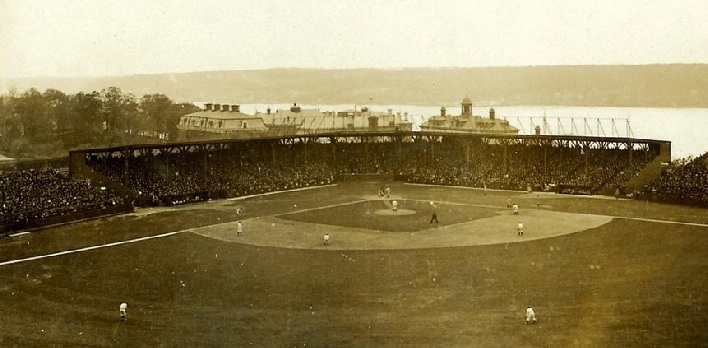
.jpg?id=dca20ace-77bd-407e-b035-92d7bdd46a60&size=biggerthumb)
 The Yanks went on to lose 102 games and finish last, something they've done only twice since. The Red Sox went on to win the World Series.