Showing posts with label hartford whalers. Show all posts

Wednesday, September 20, 2017

How to Go to a Game at East Hartford FC


After 3 years of trolling the New York Red Bulls and their fans about having the New York name but playing in New Jersey -- as if that hasn't been true of the Giants and Jets for far longer -- and calling themselves "the real New York team," fans of New York City Football Club have an entire carton of eggs on their faces.

This Saturday afternoon, at 3:00, NYCFC will play the Houston Dynamo. But because the Yankees needed Yankee Stadium II for a rainout makeup, the field cannot be prepared for soccer in time for the game, so NYCFC were forced to move the game -- not elsewhere in The City, or even elsewhere in the New York Metropolitan Area, but to East Hartford, Connecticut.

The Internet blowback has been merciless, and completely deserved.

Before You Go. Hartford is a bit to the north of New York and New Jersey, but the weather won't be appreciably different from home on the same day. This game will be played in late September, so no jacket will be necessary. The Hartford Courant is currently predicting the low 80s for Saturday afternoon, and the low 60s for the evening.

Hartford is in the Eastern Time Zone, so you won't have to adjust your timepieces.

Tickets. NYCFC have been averaging 23,428 at Yankee Stadium, but this game is a one-off, so as for how hard it will be to get tickets, your guess is as good as mine. But the club have said that all fans who had tickets to the match before the move will have those tickets honored.

Midfield tickets are $60, sideline seats are $35, corner seats are $30, and end seats are $25.

Getting There. Hartford is too close to fly, and doesn't have much of an airport, anyway. If you're driving, it's 124 miles from Midtown Manhattan to Pratt & Whitney Stadium. Take Interstate 95 to New Haven. Take Exit 48 to Interstate 91 North, to Exit 29, bypassing downtown Hartford. Take State Route 15 North to State Route 502 East, that's Silver Lane, and the stadium will soon be on your right.
If all goes well, once you get past the City Line into Westchester, you should spend about half an hour in New York, and about an hour and 45 minutes in Connecticut before reaching the arena. Depending on from where you leave, the trip should take between 2 and a half hours to 3 and a half hours.

Union Station, which is served by both Amtrak and Greyhound, is 2 blocks to the west of the Hartford Civic Center, at 1 Union Place between Church & Asylum Streets. But Amtrak is out of the question this time. The 1st train of the day out of Penn Station doesn't get there until 2:19 PM, leaving you with 41 minutes to get to the game. That's cutting it awfully close. Worse: The last train out leaves at 3:26 PM, in the 1st half. All later trains for that day have been canceled, due to track work. Round-trip fare would have been $124.

Greyhound runs 13 buses per day between Port Authority Bus Terminal in New York and Union Station in Hartford. The fare is $64, but can drop to $39 with advanced purchase.
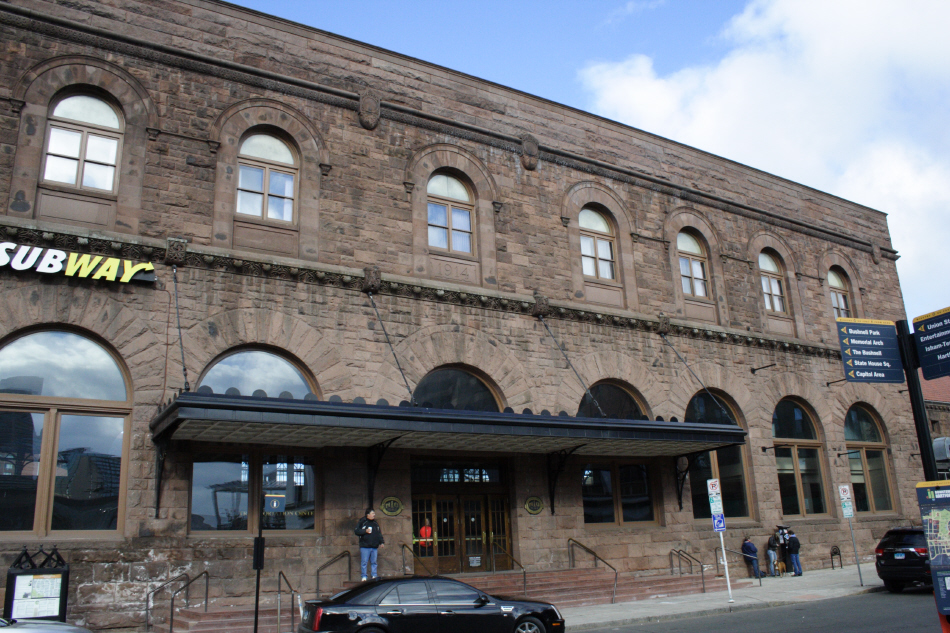
Union Station

Once In the City. Hartford, named for the English country of Hertfordshire, is home to about 125,000 people, making it around the same size as New Haven and Bridgeport, each competing to be the largest city in the State of Connecticut. When the Hartford metropolitan area is separated from the Boston metropolitan area, it's got about 1.5 million. Hartford is the State capital.
It is known for being the home of the Colt Firearms Company, Stanley Tools, and several insurance companies. (Hence "Hardware City" and "Insurance City.") The sales tax in Connecticut is 6.35 percent. It does not rise within the County or the City of Hartford. The Hartford Courant is the largest-circulating newspaper in Connecticut, and the oldest continuously-published daily newspaper in America.
The State House

Hartford doesn't seem to have a centerpoint, from which street addresses increase. However, the addresses do seem to increase from south to north, and from east to west. This is also true of the City of East Hartford, across the Connecticut River. CT Transit runs the area's buses, and a 1-Day Pass is $3.00.
Hartford Electric Light Company runs the area's electricity. "White flight" after the 1960s led to a de facto segregation: The city's North Side is mostly black, the South Side mostly Hispanic, and the West Side and suburban East Hartford mostly white. The city was about 64 percent white in 1970, but is now about 43 percent Hispanic, 39 percent black, 15 percent white, 3 percent Asian.

East Hartford is home to about 51,000 people, and is quite diverse. Pratt & Whitney, maker of aircraft engines, is the city's largest employer.
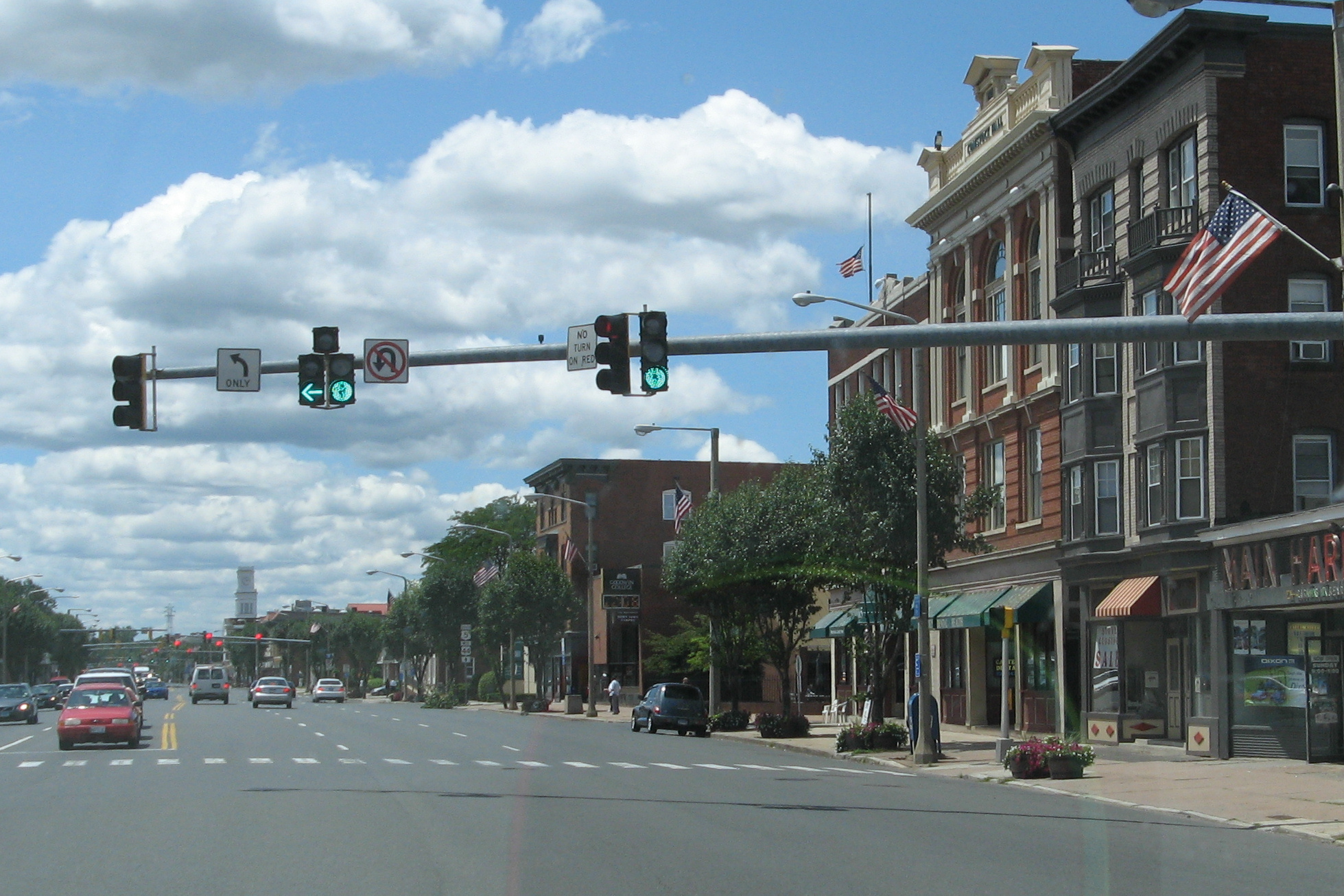
Main Street, East Hartford

ZIP Codes in Connecticut begin with the digits 06. They're 060 to 062 around Hartford, 063 and 064 in the South, 065 around New Haven, 066 around Bridgeport, 067 around Waterbury, and 068 and 069 around Stamford, in the part closest to New York. Area Code 203 serves the part of the State that tilts toward New York, including New Haven, with 475 overlaid. In 1995, Area Code 860 was split off of 203, to serve the part of the State that tilts toward Boston, including Hartford, with 959 overlaid. The city does not have a "beltway."

Going In. The official address of Pratt & Whitney Stadium at Rentschler Field is 615 Silver Lane. Parking costs $15. It is about 3 1/2 miles east of Union Station, across the Connecticut River. Bus 83 or 121 from downtown.

Built in 2003, Rentschler Field was meant to be the 60,000-seat new home of the New England Patriots, thus enabling them to keep their regional name. But team owner Robert Kraft merely used the Connecticut capital as a pawn to get a new stadium from Massachusetts next-door to the old one in Foxborough. As a result, the East Hartford stadium was replanned, and seats 40,642. (Foxborough is 99 miles northeast of Hartford.)
"The Rent" was built on the site of an airfield, also named Rentschler Field. Frederick B. Rentschler founded Pratt & Whitney, and later its now-parent company, United Technologies. P&W bought the naming rights in 2015.

The field has always been natural grass, and runs northwest-to-southeast. It is home to University of Connecticut football and the high school State Championships. The U.S. national soccer team is 4-1-1 while playing there, most recently in a 2-1 win over Ghana in a friendly this past July 1. The women's team is 3-0-2 there. Two games of the 2013 CONCACAF Gold Cup were played there.
A crowd of 15,000 attended Whalers Hockey Fest 2011, which featured games of the UConn men's and women's hockey teams, a game between alumni of the Hartford Whalers and the Boston Bruins (a 4-4 tie), and a regular-season game between the Connecticut Whale and the Providence Bruins.

Food. P&WS@RF is not kidding around: Roma Pizza, Hot Dog Nation at Sections 100 & 129; Fresh Classics (including loaded baked potatoes) at 102, 118 & 130; Tamales (including Mexi Bratwurst and Bacon JalapeƱo Mac & Cheese) at 108 & 136; Chicken Fry Fry (including fried pickle chips) at 109 & 139; Grill Masters (including "gourmet burgers") at 110 & 137; Chef Express (including New England-style clam chowder) at 125 & 145; Bears Smokehouse Barbeque at 126.

Team History Displays. None. NYCFC have never played here before, so they wouldn't have anything anyway. UConn football? They've only been Division I-A/Football Bowl Subdivision since 2000, although they did win co-championships in the Big East in 2007 and 2010 and 24 titles in minor conferences before that. The Huskies won the Lambert-Meadowlands Trophy, annually awarded to "the best college football team in the East," in 2010.

They are now in the American Athletic Conference, with schools like Navy, Temple, Central Florida, South Florida. Cincinnati, Memphis, Tulane, SMU and the University of Houston.

Stuff. There is no team store, just souvenir stands. It is not clear how much NYCFC stuff would be sold at them anyway.

During the Game. Hartford does not have a reputation for a crime problem. And since you're probably going to be rooting for NYCFC, the home fans shouldn't bother you, because you are the "home" fans.

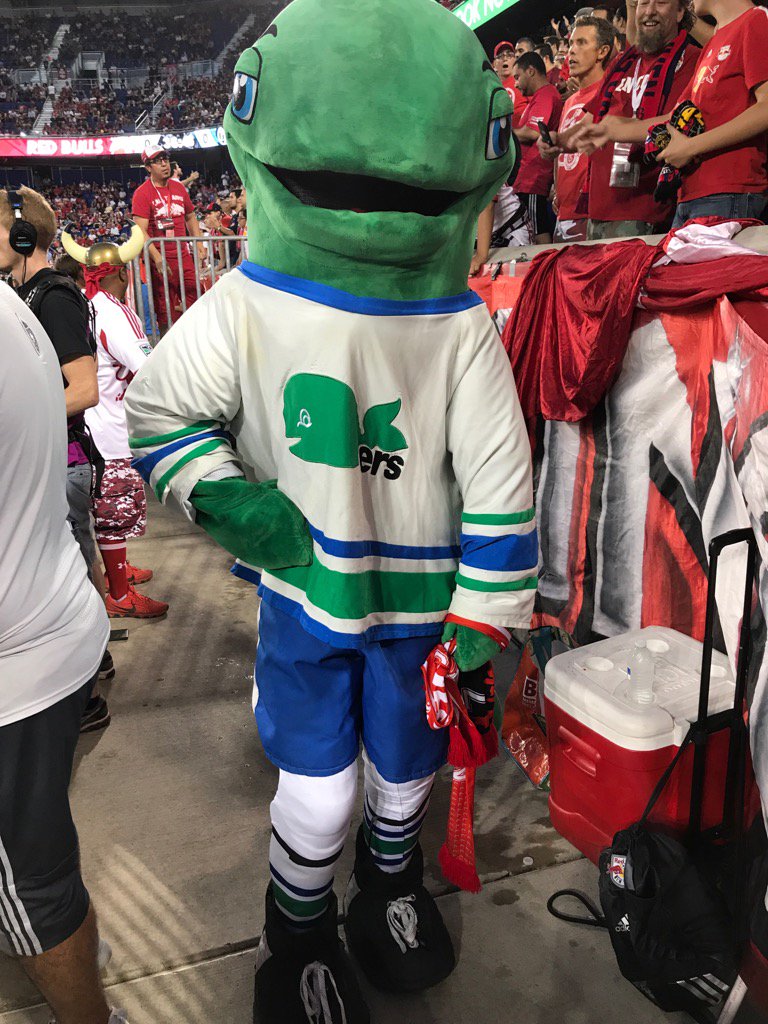
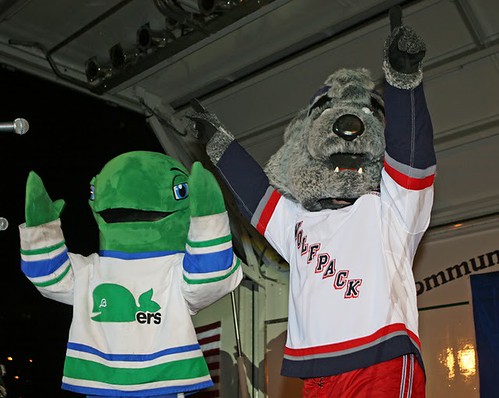
Red Bulls fans, upon hearing the news that this game would be played in East Hartford, hired Pucky the Whale, the former Whalers mascot who still does Hartford Wolf Pack games, to come. I don't know if he'll be at this one.
Gotta admit, it was one hell of a pisstake.

Jack Say wrote the Whalers' theme song, "Brass Bonanza." It was introduced in 1975 after the move to Hartford, and became an integral part of the Whalers experience, played after ever home team goal. Red Bulls fans played that at the game in question, too. Will the sound-effects guy at Rentschler play it if and when NYCFC score? Stay tuned.

The song is still played at the XL Center, including at Wolf Park and UConn games, and has even become a fixture at Fenway Park. After all, the Hartford Civic Center is closer to Downtown Crossing, Boston (100 miles) than it is to Midtown Manhattan (119).

After the Game. You should be safe walking back to your car or the bus, but if you're looking for a postgame meal, or just a pint, you'll have to go back to downtown Hartford. There are several places around Union Station and the Civil Center. I don't know of any that are known hangouts for New York or New Jersey teams' fans.

If you get into Hartford early enough to watch your favorite European soccer team, your best bet is the home bar of the local branch of the U.S. national team supporters' group, the American Outlaws: The Tavern Downtown, at 210 Ann Uccello Street, across the street from the west side of the Civic Center. (Uccello was the 1st female Mayor of Hartford, and the street was previously Pleasant Street.)

Sidelights. Hartford's sports history isn't much, and is even less since Peter Karmanos took the Whalers away 20 years ago. But there is some.

The official address of the Hartford Civic Center Coliseum is 1 Civic Center Plaza. It's bounded by Church Street (north), Trumbull Street (east), Asylum Street (south) and Pleasant Street (west). The name of the arena was changed to the XL Center in 2007, after XL Group, an insurance company.
Known simply as "The Civic Center" or "The Mall," because it's attached to one, it opened on January 9, 1975, seating 10,507, and the New England Whalers of the World Hockey Association moved right in.

The University of Connecticut (UConn) basketball team, based 25 miles to the east in Storrs, also began playing selected home games there. The Boston Celtics played an average of 8 games a year there from 1975 to 1978 and again from 1980 to 1995, until the FleetCenter opened. Elvis Presley sang there on July 28, 1976. (The Beatles never played a concert in Connecticut.)

On January 17, 1978, UConn played the University of Massachusetts in basketball, in a game sparsely attended due to snowfall. It kept on snowing, and, just 6 hours after the final horn -- in the middle of the night, fortunately, when the arena was empty, so no one was hurt -- the roof collapsed. The building was just 3 years old. (In contrast, the Boston Garden stood for 70 years before it was finally demolished, and it never had a structural issue.) It took 2 years for the building to be repaired, while the Whalers played 25 miles to the north in Springfield, Massachusetts, and UConn and the Celtics returned to Storrs and Boston, respectively.
January 18, 1978. It could have been a whole lot worse.

On January 17, 1980, the Civic Center reopened, with a new seating capacity of 14,460. It is now 15,635. The Whalers moved back in, and UConn and the Celtics resumed their partial home schedules there.

The New England Blizzard of the all-women's American Basketball League played 2 seasons there, 1996-98, before the league folded. The now-defunct Connecticut Coyotes of the Arena Football League played there. The Civic Center has also hosted both men's and women's NCAA basketball tournament games.
Immediately after the Whalers moved, in 1997, a minor-league team was brought to the Civic Center, named the Hartford Wolf Pack. Although they were named the Connecticut Whale from 2010 to 2013, as a tip of the hat (or helmet) to the Whalers, they remain at the XL Center, having reclaimed the Wolf Pack name. And the Civic Center Mall was redeveloped in the mid-2000s, creating residential, office and retail space.
The Whalers played their 1st 2 seasons in Boston, alternating between the Boston Garden and, when the Bruins (who owned the Garden and now own the new arena) shut them out of available dates, the Boston Arena (Matthews Arena at Northeastern University). Fed up with this, they signed the deal to move to Hartford as soon as the Civic Center opened.

Except it wasn't ready for the start of the 1974-75 season, so the Whalers moved to the Eastern States Coliseum, better known as the Big E, longtime home of the AHL's Springfield Indians. It was old (built in 1926), it was small (just 6,000 seats), it wasn't in Hartford (28 miles to the north), and it wasn't even the best arena in town anymore, but they had something they'd never had before: First choice of scheduling in an arena. 1305 Memorial Avenue, West Springfield, Massachusetts.
The Big E. Already, by this point,
they should've stopped calling themselves the Whalers,
and started calling themselves the New England Wanderers.

When the Civic Center roof collapsed, the Whalers went back north, and played the rest of the 1977-78 season, all of 1978-79, and the first part of 1979-80 at the Springfield Civic Center. Opening in 1972, it hosted the Springfield Indians until 1994, and the Springfield Falcons since then. It seats 6,866. Elvis sang there on July 14 and 15, 1975; and July 29, 1976.

The Springfield Civic Center is now known as the MassMutual Center. It still hosts minor-league hockey. The Big E does not, but it is still open for various events.
The MassMutual Center

Boston Bruins legend Eddie Shore long ran the Springfield Indians, and is buried in Springfield, at Hillcrest Park Cemetery, 895 Parker Street.

Of course, Springfield's biggest connection to sports is as the definitive birthplace of basketball. Dr. James Naismith invented the game at the International YMCA Training School, which grew into Springfield College. That's why the Basketball Hall of Fame is located in the city, at 1000 Hall of Fame Avenue, on the Connecticut River.
It sort of resembles the "Trylon and Perisphere"
centerpiece of the 1939-40 New York World's Fair.

The best way to reach any site in or around Springfield from Hartford is by Amtrak. Fortunately, it's one of their cheapest runs, since it's not on the Boston-New York-Washington Northeast Corridor.

The New Britain Red Sox, a Class AA team in the Eastern League, played at the 4,700-seat Beehive Field from 1983 to 1995.
In 1996, they became a Minnesota Twins farm team, and changed their name to the New Britain Rock Cats, playing at the 6,146-seat New Britain Stadium, which was built next door, at 230 John Karbonic Way, 13 miles southwest of downtown Hartford. Bus 101 to New Britain Station, then transfer to Bus 510 or 512.

The "BritSox" won the Pennant in 1983, but the Rock Cats have yet to win a Pennant in their new stadium. The Rock Cats were in the EL Championship Series in 2001 when the 9/11 attacks occurred, with the series being canceled and co-champions being declared.
In 2014, it was announced that the Rock Cats would move to Hartford for the 2016 season. They will be a farm team of the Colorado Rockies, and will become the Hartford Yard Goats, playing at brand-new Dunkin' Donuts Park, at 1214 Main Street at Trumbull Street, just a walk over I-84 from the XL Center. In the meantime, the Camden Riversharks of the Atlantic League are moving into New Britain Stadium, to become the New Britain Bees.

According to an April 23, 2014 article in The New York Times, the Yankees are actually the most popular MLB team in Hartford proper, with about 49 percent of those polled, to about 35 percent for the Red Sox. However, when you get into Hartford's eastern suburbs, the Sox take over, about 44 to 40 percent.

In spite of the Yankees' strength in the area, the Bruins are easily the most popular NHL team now (probably because of Bobby Orr, who gave them a toehold even before the Whalers came along), the Celtics are far more popular than the Knicks (due to their "home games" at The Mall as much as to their 1980s success), and the Patriots (who do, after all, call themselves "New England") are more popular than the Giants.

Veterans Memorial Stadium is a football field at 635 South Main Street in New Britain. The U.S. soccer team played 4 games there between 1973 and 1996, going 3-1. Dillon Stadium is a football stadium at 250 Huyshope Avenue at Curcombe Street, near Charter Oak Landing, a mile and a half southeast of downtown Hartford. The U.S. soccer team beat Bermuda there on September 9, 1973.

Hartford briefly had a major league team in the early days of baseball. The Hartford Dark Blues played at the Hartford Ball Club Grounds in the seasons of 1874 and 1875 in the National Association, and 1876 in the National League, before finances led them to move to Brooklyn. Good Shepherd Church was built on the site. 155 Wyllys Street at Osten Blvd., about a mile southeast of downtown.
Best picture of it that I could find.

There was also a Hartford Blues playing in the NFL, albeit only in the 1926 season, finishing just 3-7. They had Harry Stuhldreher of Notre Dame's Four Horsemen at quarterback, and future Giants legend Steve Owen as a two-way tackle. They played at the East Hartford Velodrome, at a site bounded by Pitkin Street, Founders Plaza, Hartland Street and East River Drive. Albertus Magnus College and a Hampton Inn were built on the site.
This team photo was the best picture of the Velodrome that I could find.

Don't get any ideas about major league teams returning to Hartford, with the possible exception of in the NHL. The area's low population base would rank it 31st and last among MLB markets, 32nd in the NFL (ahead of only New Orleans), 28th in the NBA (ahead of New Orleans, Oklahoma City and Memphis), and 27th in the NHL (ahead of only Ottawa, Calgary, Edmonton and Winnipeg, and last among U.S. cities). Hartford has no professional soccer team.

Since 2003, the Connecticut Sun of the WNBA have played at the 10,000-seat Mohegan Sun Arena. This Arena also hosted a Heavyweight Championship fight, with Lennox Lewis defending the title by beating Zeljko Mavrovic on September 26, 1998.

The Arena is at Casey Plaza, in Uncasville, 46 miles southeast of Hartford, 106 miles southwest of Downtown Boston, and 132 miles northeast of Midtown Manhattan. Mohegan Sun advertises itself as "closer to New York than Atlantic City." This is true: Caesar's Atlantic City is 128 miles from Times Square. What Mohegan Sun doesn't tell you is that it's closer to Boston than to New York, and will have as many Chowdaheads as Pinstripers.
Nearby is Foxwoods Resort in Mashantucket, 139 miles from New York, 97 miles from Boston, and 48 miles from Hartford. Neither Mohegan Sun nor Foxwoods is reachable by public transportation from Hartford, but private bus companies run service from Hartford, New York and Boston.

The Sun won the WNBA's Eastern Conference in 2004 and 2005, but lost in the Finals both times. Despite being a natural attraction for players from the University of Connecticut -- UConn's Harry A. Gampel Pavilion is just 30 miles northwest of Mohegan Sun -- they've never won a title.

They've retired 3 numbers: 12, for Margo Dydek; 23, for Katie Douglas; and 42, for UConn graduate Nykesha Sales. Former Sun player Lindsay Whalen was named to the WNBA Top 20 at 20 in 2016 -- in the 20th Season, rather than at the 20th Anniversary.
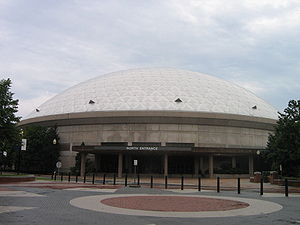
Gampel Pavilion

Hartford isn't all that close to any beach towns. Old Saybrook, Connecticut is 43 miles to the southeast; Newport, Rhode Island, 86 miles to the east; and Cape Cod, Massachusetts a minimum of 140 miles to the east.

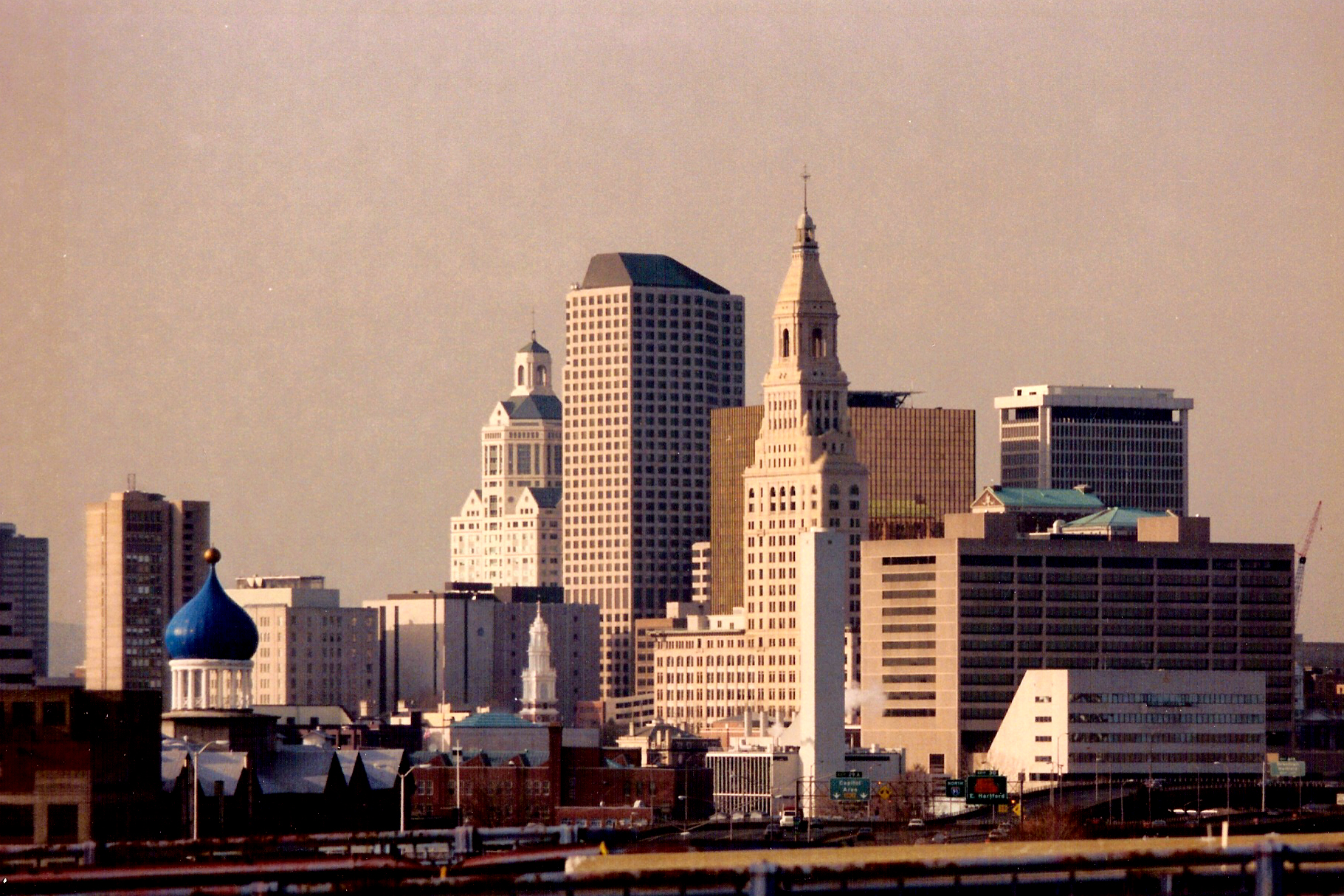
The Travelers Tower, headquarters of the insurance company of the same name, opened in 1919, and is Hartford's most familiar landmark besides the State House. It is 527 feet tall. In 1980, it was surpassed as the tallest building in the State of Connecticut by City Place I, at 185 Asylum Street, a short walk from the Civic Center: 534 feet.

Hartford is home to the nation's oldest public art museum, the Wadsworth Atheneum, at 600 Main Street at Gold Street. The Connecticut Science Center is at 250 Columbus Blvd. at Grove Street. The Mark Twain House, the last home of the author born Samuel Langhorne Clemens, is at 351 Farmington Avenue at Forest Street, adjacent to Hartford Public High School, about a mile west of downtown. Bus 60.

No President has ever been born in Connecticut, although George Bush grew up in Greenwich and attended Yale University in New Haven. William Howard Taft also graduated from Yale, and, like Gerald Ford and Bill Clinton, went to Yale Law School. But New Haven is 36 miles from Hartford.

Yale is also the only Connecticut-based school to win hockey's National Championship, in 2013.

His son, George W. Bush, was born at Yale-New Haven Hospital in 1946, and, like his father and grandfather, is a Yale graduate (however the hell that happened). But you'll never be able to convince him that he's anything other than Texas through and through.

The 1st Presidential Debate of 1996, between Clinton and Bob Dole, was held at the Bushnell Performing Arts Center. 166 Capitol Avenue, across Trinity Street from the State House.

There's another Presidential site nearby: Calvin Coolidge, although from Vermont, was Mayor of Northampton, Massachusetts before being elected that State's Governor, and Vice President, and becoming President in 1923 when Warren Harding died. His Presidential Library and Museum is there, at 20 West Street, a 10-minute walk west of the bus terminal. 45 miles north of Hartford, and 17 miles north of Springfield.

In addition to Hartford, Elvis Presley sang at the 11,171-seat New Haven Veterans Memorial Coliseum on July 16 and 17, 1975; and July 30, 1976. State and George Streets. The Coliseum replaced the 4,000-seat New Haven Arena, which stood from 1926 to 1974 at State and Grove Streets, 5 blocks away. Like its successor, it hosted minor-league sports, especially hockey, and concerts, including the one on December 3, 1967 when Jim Morrison of The Doors got arrested onstage. Built in 1972, the New Haven Coliseum was demolished in 2007. It has not been replaced.

Lots of movies have been filmed in Connecticut, but none that I can find were shot in Hartford. The play and film Who's Afraid of Virginia Woolf? were set at Hartford's Trinity College, but not filmed there. Same with TV shows: Bewitched was set in Westport and Who's the Boss? in Fairfield, but neither in Hartford. I guess the capital city simply isn't glamorous enough for Hollywood honchos.

Various versions of Mark Twain's story A Connecticut Yankee in King Arthur's Court include Connecticut scenes. Mr. Blandings Builds His Dream House had the house in Connecticut, but considerably closer to Manhattan than to Hartford (or Boston). Eugene O'Neill's play Long Day's Journey Into Night and its film versions have been set in a seaside community in Connecticut, although the best-known version, from 1962, was filmed on City Island in The Bronx.

Holiday Inn, the 1942 film that debuted Bing Crosby singing "White Christmas," has its "country" scenes set in Connecticut, although the 1955 film White Christmas takes place in Vermont. Orson Wells played a Nazi war criminal turned prep school teacher in fictional Harper, Connecticut, in The Stranger.

Rally Round the Flag, Boys! takes place in fictional Putnam's Landing. Beetlejuice takes place in fictional Winter River. Mystic Pizza actually was filmed and set in Mystic. The Ice Storm was set in New Canaan, but that's closer to New York than Hartford. So is Stepford, the fictional setting of Ira Levin's novel The Stepford Wives and its film versions.

Christmas in Connecticut was filmed twice, in 1945 with a fraudulent food writer played by Barbara Stanwyck and a returning World War II hero played by Dennis Morgan; and in 1992 with Dyan Cannon as the host of a TV cooking show and Kris Kristofferson as a hero fireman. The remake was the 1st movie directed by Arnold Schwarzenegger, who has a brief cameo. Until I learned of the 1945 version, I presumed the remake was a parody of Martha Stewart, who famously lives in Westport.

Judging Amy took place in Hartford, running on CBS from 1999 to 2005. Gilmore Girls, which ran on The WB from 2000 to 2007, did some filming in Hartford, but was set in the fictional town of Stars Hollow, said to be half an hour's drive away. Late in the run of I Love Lucy, the Ricardos and the Mertzes moved to the New York suburb of Westport, Connecticut, which also became the setting of Bewitched, and the hometown of Josh Lyman on The West Wing.

New York suburbs of Connecticut also include Fairfield, the setting of Who's the Boss?; and Stamford, the setting of My Wife and Kids. In addition to Stars Hollow, Connecticut's fictional TV settings include Castleberry, established as the hometown of Sex and the City's Carrie Bradshaw in the prequel series The Carrie Diaries; and Dunn's River, the setting of Soap. Benson established that Gene Gatling was a cousin of Soap's Jessica Tate, but it didn't specifically say that the State of which Gatling was Governor was Connecticut, or any other.

*

So now you have a taste of what it might be like to attend a New York City FC game in East Hartford.

Maybe, someday, you'll know what it's like to attend a game where NYCFC aren't a massive joke.

UPDATE: NYCFC could only manage a 1-1 draw against Houston. Attendance: 10,165, in a 40,000-seat stadium. Like I said: A massive joke.

Sunday, November 6, 2016

Top 5 Reasons You Can't Blame Peter Karmanos for Moving the Hartford Whalers to the Carolinas

Right now, the New Jersey Devils are playing the Carolina Hurricanes in Raleigh, North Carolina.

They should be playing them in Hartford, Connecticut, where, until 1997, they were the Hartford Whalers.

But team owner Peter Karmanos moved them from a city and a region that loves hockey to a city and a region that doesn't.

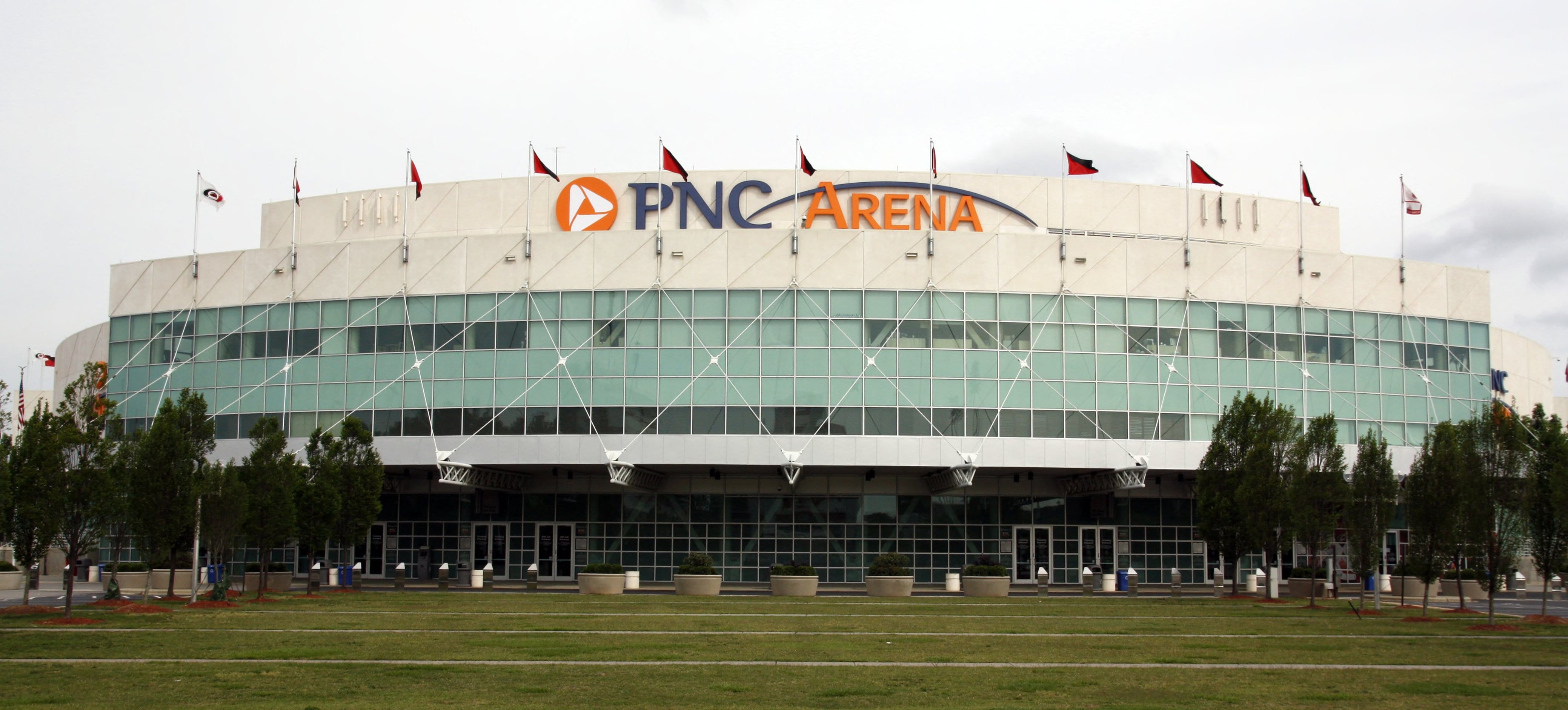
Indeed, last season, the 'Canes averaged 12,007 fans per game, or 64 percent of capacity at the PNC Arena, both 30th and dead last in the NHL.

In spite of usually making the Playoffs, reaching the Stanley Cup Finals in 2002 and winning the Cup in 2006, the Carolina Hurricanes have been a commercial failure.

However, you can't just judge Karmanos by how stupid he looks now. You have to consider how the decision looked in 1997, when he made it.

Top 5 Reasons You Can't Blame Peter Karmanos for Moving the Hartford Whalers to the Carolinas

First, a couple of reasons that didn't make the cut: The Best of the Rest.

Bobby Orr. Whaaaaaaaat?!? One of the biggest heroes in the history of hockey is one of the big villains in the history of the Hartford Whalers? Well, not directly, and certainly not intentionally. But hear me out:

Up until Orr's arrival in the NHL in 1966, the defining teams in American hockey were the Detroit Red Wings, led by Gordie Howe; and the Chicago Blackhawks, led by Bobby Hull. There were only 2 other teams in the U.S.: The Boston Bruins, who signed Orr; and the New York Rangers, who, while they didn't exactly "suck," did pretty much stink for most of the preceding 20 years.

Whether Orr, or Howe, or Wayne Gretzky, or someone else is the greatest player in hockey history is a debate for another time. But while the Bruins had had the occasional success before Orr arrived in 1966, he made them an iconic franchise of North American sports, well beyond Greater Boston.
Thanks to him, the Bruins would always be the most popular hockey team in New England. Until the return to glory of the Red Wings in the 1990s, followed by the bandwagon effects of the Los Angeles Kings and the Chicago Blackhawks in this decade, the Bruins' 1970 and '72 Stanley Cups, led by Orr and Phil Esposito, insured that the Bruins would rule New England in the Winter, more than the Celtics ever have, just as the Red Sox rule the Summer.

Because of Orr, even having Howe in his last 3 seasons and Hull for the last few games of his career didn't help the Whalers. They were always going to be the Clippers to the Bruins' Lakers, the Nets to the Bruins' Knicks, the Vanderbilt to the Bruins' University of Tennessee. Even if the Whalers had won a Cup, it would merely have made them the Mets to the Bruins' Yankees. (New England fans will hate that analogy, but they will certainly understand it.)

And it didn't matter how much the NHL promoted Steve Yzerman and Eric Lindros in the late 1990s and early 2000s, and Sidney Crosby since: None of them was ever going to be Bobby Orr. There is not a damn thing that Commissioner Gary Bettman can do to make Crosby mean as much to American hockey fans as Orr -- especially after the 2010 Winter Olympics.

There is, of course, a reason why making Orr a reason why the Whalers were doomed is flawed: Without the increase in popularity of hockey in America, and especially in New England, in the early 1970s, the World Hockey Association, and thus the Whaler franchise itself, wouldn't even have been economically feasible.

Even if Orr had played for the Rangers, the Wings or the Hawks, and led them to glory, it would have had a residual effect on New England. And it might even have led the WHA to put a team in Boston, and they probably would have had to move anyway, possibly to Hartford. But there's no way hockey would have been popular enough in Connecticut to sustain the Whalers after the fall of the WHA in 1979. Orr is much more responsible for the Whalers' birth than he is for their death -- but, perhaps, he provided them with a "birth defect" that led indirectly to their doom.

John Rowland. In the middle of the 1996-97 season, Karmanos announced that the Whalers were definitely moving -- though he didn't say where, a rarity for a sports team owner. At first, he wanted to go to Norfolk, Virginia, but a deal fell through. Rowland, the Governor of Connecticut, announced that he was not going to spend the State's tax dollars to fund a new arena that would replace the Hartford Civic Center and save the Whalers.

Then he backtracked, and a deal was cut for a $147.5 million arena. Then Karmanos raised the ante, and wanted another $45 million, to cover the money he expected to lose during the 3 years it would take to build the arena. Rowland said the deal was off, and, to this day, the Civic Center, now named the XL Center, is the biggest arena in the State of Connecticut.

In addition, Rowland seemed to be more interested in bringing the NFL to Connecticut, by building a 60,000-seat stadium in East Hartford, presumably to be a home field for the University of Connecticut and the Patriots, who, though leaving the immediate Boston area, could have kept their New England name. It seems that Rowland, a Republican, was a conservative when it came to spending tax dollars on hockey, but a liberal when it came to football.

In early 1998, after the Whalers had already left, Pats owner Robert Kraft backed out of the East Hartford deal, and made one with Massachusetts to build a new stadium next-door to the one he had in Foxboro. So Rowland not only blew it with the NHL, he blew it with the NFL, too.
In the words of the immortal Redd Foxx, "You big dummy."

Rowland was elected Governor in 1994, 1998 and 2002, but resigned in 2004, and ended up going to prison -- twice. In other words, Rowland was both a fool and a crook. In contrast to other Northeastern States, Rowland is the only Governor of Connecticut ever to go to jail.

The Other Carolina Teams. The NBA's Charlotte Hornets arrived in 1988. The NFL's Carolina Panthers arrived in 1995. They made the Carolinas a viable market for major league sports teams. Even now, there are people who want to fill out the card of "all four sports," and give Charlotte a Major League Baseball team. (They don't have the ballpark for it, and are unlikely to have it anytime soon, so the best they can hope for is an expansion with enough lead time to build an MLB-sized ballpark.)
The Hornets moved in 2002 not because they were unpopular, but because their owner, George Shinn, was. The NBA had no problem with replacing them with the expansion Bobcats in 2004. (They have since been allowed to change their name to the Hornets.) The new Hornets and the Panthers (defending NFC Champions as I write this) were popular in both North and South Carolina in the mid-1990s, and so Karmanos had reason to believe the NHL could succeed in the Carolinas as well.
He was half-right: The Panthers and the new Hornets aren't going anywhere. But how long can he sustain the Hurricanes in Raleigh? Will he have to move them to Charlotte, to share the arena with the Hornets? (It would allow him to keep the Carolina name.) Or will he have to move them somewhere else? (Quebec City? Seattle? Houston? Hamilton, Ontario?) Or will he have to sell them to someone who will, maybe, just maybe, move them back to Hartford where they belong? Stay tuned.

Now, for the Top 5:

5. Transplants. Maybe Carolinians, North and South, aren't natural hockey fans. But a lot of people from the Northeast and Midwest have moved to Charlotte and to Raleigh-Durham over the last 25 years. Karmanos saw this as it was happening, and presumed (correctly, as it turned out) that it would continue to happen.
Charlotte, North Carolina

Okay, this hasn't (yet) translated into great attendance for the 'Canes, any more than it did for the Atlanta Thrashers, any more than it has (yet) for the Arizona Coyotes and the Florida Panthers -- although the Tampa Bay Lightning, unlike the Rays and the Buccaneers, are doing very well in attendance. Nor has the 2006 Stanley Cup and the 2002 Finals berth helped, long-term. But the potential is there. The 'Canes may just have bad marketing.
Raleigh, North Carolina

4. The Arena Situation. The Hartford Civic Center (now the XL Center) was too small, with 15,635 seats for hockey, and didn't have enough luxury boxes or parking spaces. The Raleigh Entertainment & Sports Arena (now the PNC Arena) seats 18,680, and has plenty of luxury boxes and parking spaces.
A recent photo of the Hartford Civic Center,
now named the XL Center

It should be noted that, unlike some other team owners that moved, Karmanos never used his lease as an excuse. True, he didn't own the arena, but he did not complain about the terms of his lease, only about the number of seats and how much revenue they were generating.

3. Market Size. Hartford simply isn't a big enough market to support a major league sports team. A big reason why Karmanos moved the Whalers was corporate support. While Hartford is home to some big insurance companies, that's about it.

Hartford's population, according to a 2014 estimate, is 124,893. That's only a little larger than that of Green Bay, Wisconsin, which never would have survived as the home of a professional football team without the NFL's revenue-sharing agreement. The metropolitan area (counted separately from Boston) has less than 1.5 million people, less than any U.S. city currently in the NHL (but more than the Canadian cities of Ottawa, Calgary, Edmonton and Winnipeg, and the former NHL outpost of Quebec City).
Hartford, Connecticut

Charlotte, on the other hand, is a major banking center. It has 810,000 people, and a metro area of 2.5 million. The Raleigh-Durham-Chapel Hill area is a scientific-corporate center, a.k.a. the Research Triangle. Raleigh has 432,000 people, Durham 252,000, and the metro area a shade over 2 million. The Carolinas had more money to spend on seats, especially luxury boxes, than did Connecticut.
2. Market Saturation. The Hartford Civic Center was only 102 miles from the Boston Garden and its successor arena (now the TD Garden), and Madison Square Garden was just 115 miles away. The Meadowlands Arena was just 117 miles away.The Nassau Coliseum is just 122 miles away, and the Islander dynasty of the early 1980s took a few fans from the New York side of Connecticut away from the Whalers. The new Philadelphia arena (now the Wells Fargo Center) is 214 miles away. There wasn't really room for another hockey team in the Northeast.
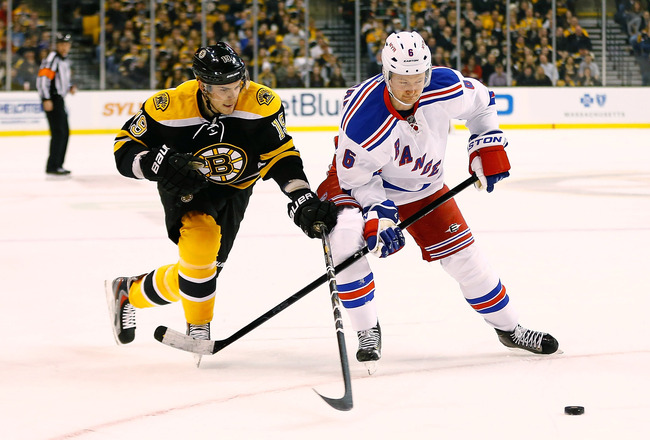
Even when it was just Bruins vs. Rangers,
the market was pretty well filled.

Whereas, in the Carolinas, who were they competing with? College football and the Panthers from October to December, and college basketball and the Hornets from November to April. No other hockey teams. The Washington Capitals were 275 miles away, and the expansion Atlanta Thrashers were going to be 400 miles away. (And they're gone now, anyway.)
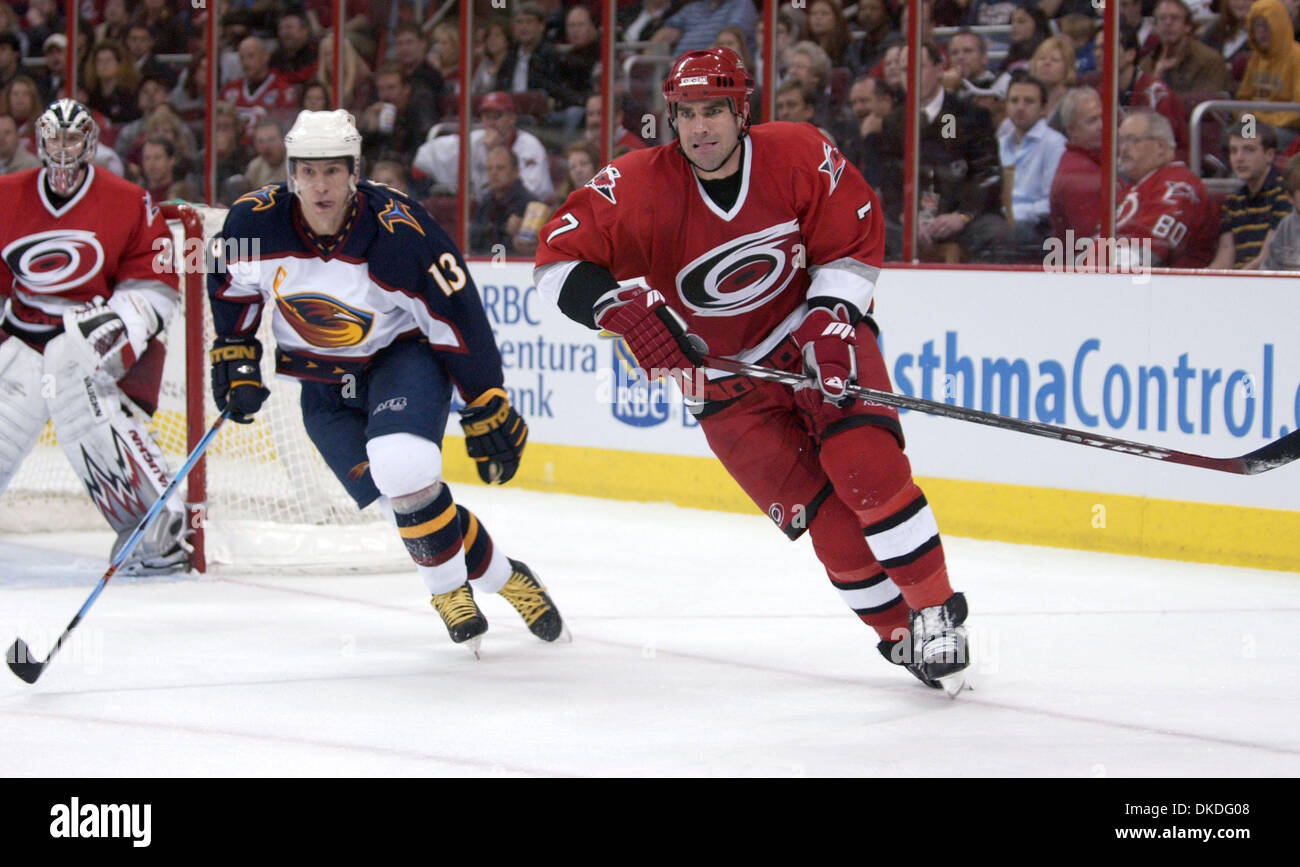
Thrashers vs. Hurricanes: A rivalry that never happened.

1. Gary Bettman. He's the Commissioner. What he wants, he nearly always gets. If he'd wanted the Whalers to stay in Hartford, they would have. Instead, he was pleased to see another Snow Belt team move to the Sun Belt.
"Because I said so, that's why!"

Sounds pretty clear that Karmanos can't be blamed, right?

VERDICT: Guilty. Yes, Karmanos can still be blamed! Let's look at the top 5 reasons again:

5. Transplants. Hartford had transplants, people from New York City and Boston, who loved hockey. If it didn't, the Whalers wouldn't have been possible in the first place.

4. The Arena Situation. If Karmanos hadn't gotten greedy and demanded the extra $45 million from the State government, the new arena would have opened on time in 2000, and the Whalers would probably still be there, and would have given Connecticut the 2006 Stanley Cup. Karmanos was then the CEO of Compuware, a computer software company. Then as now, he was worth over $1 billion. And he was whining about $45 million? Bitch, please!

3. Market Size. If Hartford didn't have enough people, Karmanos could have gone the regional route. He could have promoted the Whalers all over Connecticut, in New Haven and Bridgeport, in Fairfield County where people who couldn't get into Ranger games would have an option not a whole lot further away. At its furthest point, the closest Connecticut town to New York City, Greenwich, is 84 miles from downtown Hartford.

Springfield, Massachusetts is closer to Hartford than Greenwich is to Madison Square Garden. Worcester, Massachusetts isn't all that much further from Hartford than it is from Boston. Nor is Providence, Rhode Island. And Bruin tickets are about as tough to get as Ranger tickets. (This is as true now as it was 20 years ago.) Albany, New York is closer to Hartford than it is to Madison Square Garden.

2. Market Saturation. As I said, Ranger tickets and Bruin tickets are tough to get. If Karmanos had figured out that Connecticut was his territory, he could have gotten the Fairfield County people who were frozen out of one Garden, and the Tolland County and Windham County people who were frozen out of the other. The New York Tri-State Area does support 3 NHL teams; there's no reason why New England as a whole can't support 2.

1. Gary Bettman. The owners hire the Commissioner. If they choose, they can overrule him. If Karmanos had wanted to stay in Hartford, and had gotten 20 out of 26 owners (75 percent, including himself), to go along with him, what was Bettman going to do? He could have stopped a move, but he couldn't have forced one.

This time, the owner who moved is guilty, guilty, guilty. You are guilty, Peter Karmanos.

Friday, June 10, 2016

Gordie Howe, 1928-2016

The greatest hockey player who ever lived has died.

No, I don't mean Bobby Orr. Last I heard, he's fine.

And that other guy? The one who wore Number 99? Well, he sided with the owners in the 2004-05 lockout, so you won't find a working heart in him. But he's still alive, too.

But today, we lost Mr. Hockey. The greatest of them all. Just 1 week after we lost the greatest of all boxers, Muhammad Ali.

PelƩ, take care of yourself. (UPDATE: He died on December 29, 2022.)

*

Gordon Howe, no middle name, was born on March 31, 1928 in Floral, Saskatchewan, Canada. The family soon moved to nearby Saskatoon. Gordie quit school to work alongside his father Ab in the construction industry.

At the age of 15, his hockey skills had attracted the attention of the New York Rangers, who invited him to a training camp they were holding in Winnipeg, Manitoba. He impressed them enough that they offered him a "C form," which would have given them his NHL rights. But they wanted to enroll him at a Catholic school in nearby Wilcox, Saskatchewan that was already known for turning out good hockey players. Gordie didn't want to go to that school, and turned the Rangers down.

It would be much more difficult for New Jersey Devils and New York Islanders fans to use the "Rangers suck" chant if Gordie Howe had been the Rangers' big star in the 1950s and '60s. The team was bad for much of that period, but since the Rangers lost to Howe's team in a Finals, that's at least one more Stanley Cup the Rangers would have won. And, admit it: "NINE-teen-FIF-ty!" doesn't sound as strong as "NINE-teen-FOR-ty!"

However, Gordie's younger brother Vic Howe, also a right wing, did play for the Rangers: 3 games in 1951, 1 game in 1954, and 29 games in the 1954-55 season.

In 1944, when he was 16, the Detroit Red Wings invited Gordie to their camp in Windsor, Ontario, across the river from Detroit. This time, he and his father signed the C form. He was sent to the Galt Red Wings, in what's now the city of Cambridge, Ontario, near Hamilton. Due to a technicality, the Wings had to move him to another farm team, the Omaha Knights -- so Gordie got a taste of the American West well before his famed move to Houston.

There was another moment at which Gordie Howe could have become a legend for anoher NHL team. Frank Selke noticed another technicality, which showed that Gordie was not properly listed as property of the Red Wings. Selke was then working for the Toronto Maple Leafs, with whom he had helped to build 3 Stanley Cups, and his efforts would result in 4 more. But, due to a dispute with Leafs coach and general manager Conn Smythe, Selke soon left, and was hired by the Montreal Canadiens, whom he helped build 6 more Cup winners.

Selke, whose name is now on the trophy given annually to the NHL's best defensive forward, was friends with Wings coach Jack Adams, and let him know about the problem, thus securing Gordie's services for the Wings for a generation. A less principled man might have tried to get Howe to the Leafs... or waited until he was with the Canadiens, and tried to get Howe there.

The Leafs of the late 1940s and early '50s with Howe? That would have been pretty amazing, at least as amazing as what actually happened in Detroit. But a Canadiens team on which a line change meant that Maurice "The Rocket" Richard was replaced on the right wing with Gordie Howe? With Toe Blake, Elmer Lach and Butch Bouchard already on the roster? And, in a few years, Jean Beliveau, Bernie Geoffrion, Dickie Moore, Doug Harvey, Jacques Plante, and the Rocket's brother Henri Richard? That might have been the greatest team in the history of North American sports.

*

Gordie Howe made his NHL debut on October 16, 1946, at the Olympia Stadium in Detroit (like the Chicago Stadium, it was named a "stadium" but was actually an indoor arena), wearing Number 17. He was just 18 years old, but he scored, and against future Hall-of-Famer Walter "Turk" Broda of the Maple Leafs, no less. But the game ended in a 3-3 tie.

Before the next season, the Wings traded Roy Conacher, and Gordie was offered Conacher's Number 9. (Roy was the brother of legendary hockey players Charlie and Lionel Conacher. Charlie was one of the 1st players to be a star while wearing Number 9, as uniform numbers began to be worn in the 1920s.) Gordie was told that, with a single-digit number, he would get a lower berth in the sleeping car of the team's train. So he took it.

Howe, Maurice Richard, Ted "Teeder" Kennedy of the Leafs, and later Andy Bathgate of the Rangers, Bobby Hull of the Chicago Blackhawks, and Johnny Bucyk of the Boston Bruins would make 9 hockey's most iconic uniform number. Indeed, all of the "Original Six" now have the number retired, including the Leafs, who just changed their former "Honoured Number" system, and have retired 9 for both Charlie Conacher and Teeder Kennedy.

Number 9 became so identified with hockey greatness, mainly due to Howe, Richard and Hull in the early days of television, that, when he was a boy, and he wanted to wear 9 on a youth team, and was told it was already being worn, Wayne Gretzky asked for Number 99.
Gordie quickly became known for his physicality. The nickname "Elbows" would stick with him through his entire career. The term "Gordie Howe Hat Trick" would come to mean a player scoring a goal, assisting another, and winning a fight, all in the same game. Oddly, Gordie did that only twice in his career, both times in the 1953-54 season.

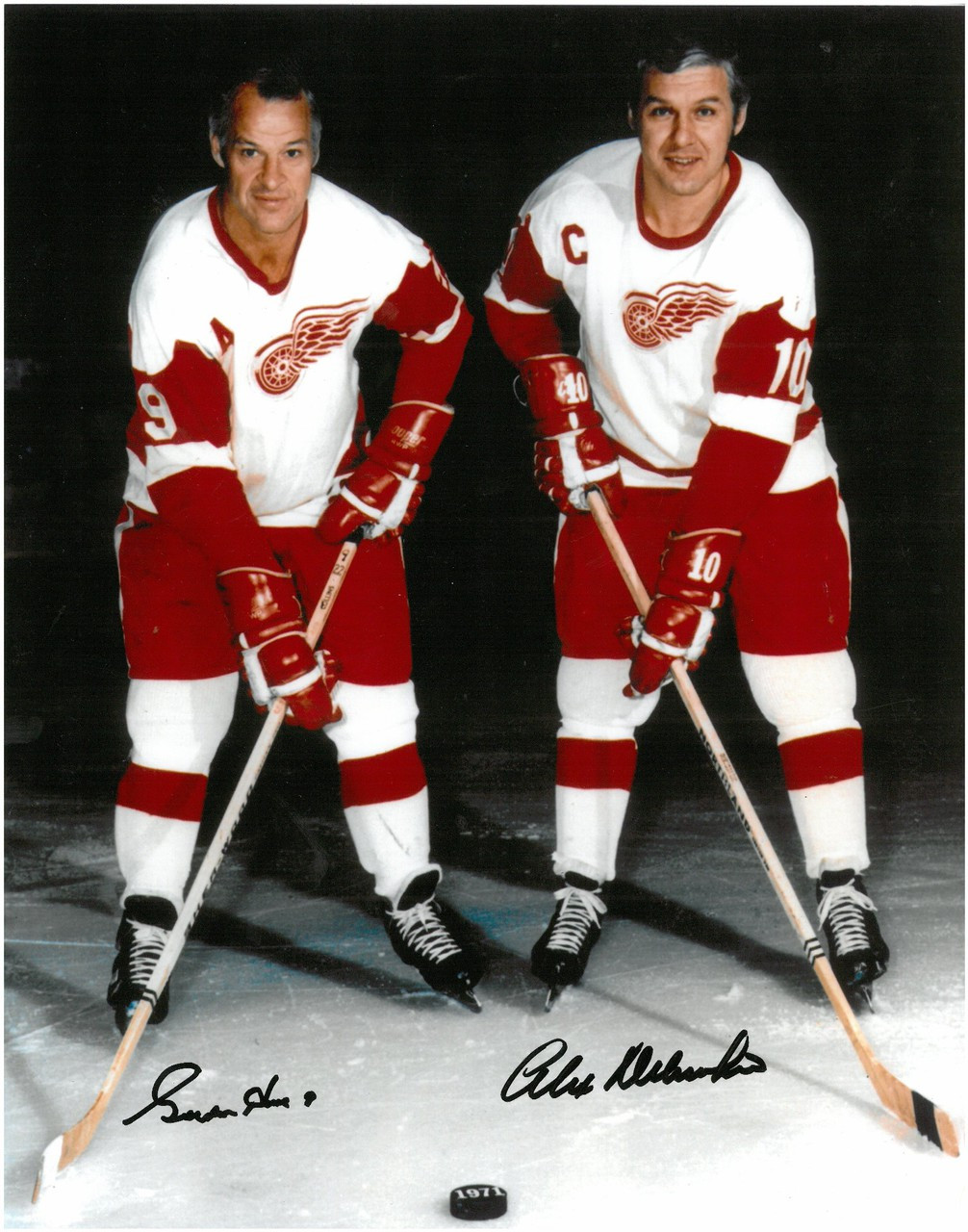
Gordie played on the right wing with center Sid Abel and left wing Ted Lindsay. With Detroit's auto industry in mind, this forward line became known as the Production Line. When Abel retired after the 1952 Stanley Cup, he was replaced at center by Alex Delvecchio, and this became known as Production Line II, which held until Lindsay was controversially traded, due to his players-union activism, in 1957.
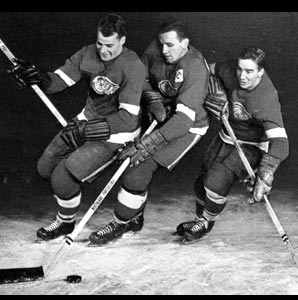
The Production Line: Howe, Abel, Lindsay

From 1949 to 1956, the Wings finished 1st overall in the NHL in 7 straight seasons. This was before that particular achievement was rewarded with the Presidents' Trophy, but it was still considered a big deal. It had never been done before, nor has since, not even by any of the great Montreal teams.

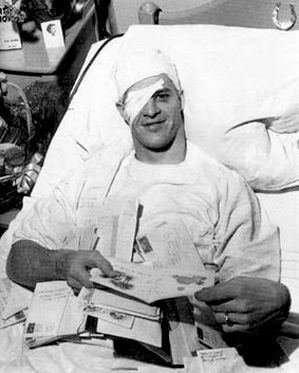
The Wings reached the Stanley Cup Finals in 1948 and 1949, but lost to the Leafs both times. In 1950, Howe led the NHL in scoring (winning the Art Ross Trophy), Abel finished 2nd, and Lindsay finished 3rd. This time, they faced the Leafs in the Semifinals, and won, but not before Howe tried to check Kennedy, and ended up crashing head-first into the boards. He was taken to the hospital, and needed emergency surgery to relieve pressure on his brain. At one point, a newspaper published a story that he had died. The Wings went on to beat the Rangers for the Cup without him. The next season, he recovered well enough to win the scoring title by 20 points.
Gordie in the hospital, with get-well cards

In 1952, the Wings did something that had never been done before: With 2 rounds of Playoffs, each a best-4-out-of-7, they swept to the Cup in the minimum 8 games, beating first the Wings, then the Canadiens.

Pete Cusimano, owner of a local fish market, noted that an octopus has 8 legs, 1 for each necessary win. So he brought an octopus from his store to the Olympia, and threw it onto the ice. This started a rather disgusting tradition that the NHL has tried, without much success, to curb. It has been copied in other cities: Boston with lobster, Edmonton with steak, San Jose with a leopard shark (bigger than most of these, but smaller than most sharks), Nashville with catfish. (Did I mention that the tradition was disgusting?)

At any rate, the Wings completed the 8-game sweep, and Gordie Howe finally got to be on the ice to receive the Stanley Cup with his teammates. Only once more, in the 2-round structure of the Playoffs before the 1967 expansion, would a team go 8-0 in the Playoffs: The 1960 Canadiens.

The Wings lost in the Semifinals in 1953, but beat the Canadiens in the Finals in 1954 and 1955, making it 4 Cups in 6 years. In addition to Howe, Lindsay, Abel and Delvecchio, defensemen Leonard "Red" Kelly and Marcel Pronovost, and goaltender Terry Sawchuk, would all make the Hockey Hall of Fame. In other words, the Wings could field an entire starting lineup of future Hall-of-Famers. They couldn't make it 3 straight Cups in 1956, losing the Finals to the Canadiens, who began a streak of 5 straight Cups.

Richard retired after that 5th straight Cup, and on November 10, 1963, Howe scored the 545th goal of his career, breaking Richard's record. At that point, Richard and Howe were usually considered the 2 greatest players in the game's history. Howe never publicly said he was the best ever, although he didn't exactly refuse the nickname he already had, "Mr. Hockey." Richard, however, understood, saying, "I wasn't the best player. I was the best scorer," and "Gordie could do everything."

When Gordie broke the Rocket's record, he was 35 years old. What nobody yet knew was that a child could have been born in the Wings' home State of Michigan that day, and get his driver's license before Gordie Howe played what turned out to be his last NHL game.

The Wings reached the Finals again in 1961, losing to the Blackhawks; in 1963 and 1964, losing to the Maple Leafs; and in 1966, losing to the Canadiens. They would not get that far again until 1995, largely due to the machinations of Bruce Norris, who had inherited ownership of the team from his father, James E. Norris (for whom the trophy for best NHL defenseman is named). He also inherited his father's stubbornness, his cheapness, and his authoritarianism, but not his sharp mind.

With the expansion of 1967, the schedule was expanded as well. In the 1968-69 season, turning 41, and playing a 76-game schedule on a "Production Line III" with Delvecchio and former Leafs star Frank Mahovlich, Gordie topped 100 points for the 1st time: 44 goals and 59 assists, for 103 points.
Howe and Delvecchio, near the end of Howe's career.
Notice the numbers on Delvecchio's gloves.
This was to assist TV viewers in recognizing players.
By this point, for the same reason, players were also wearing
their numbers in white stickers on their black skates.
This practice would stop once more close-up cameras were added.

But after the season, Gordie discovered that he was only the team's 3rd-highest-paid player, at $45,000. Norris gave him a raise to $100,000, making him the 1st hockey player to make that much. (In today's money, that $45,000 amounts to about $300,000; $100,000, about $660,000. So he was still making less than today's rookies.) But Norris fumed: He was one of those sports team owners who couldn't stand to have his authority challenged. To him, players were merely means to an end.

Especially angering this old-school old-boy-networker was the fact that Gordie's agent was a woman: His wife, Colleen Howe, who would eventually be known as "Mrs. Hockey." Norris blamed Colleen for Gordie being out of order enough to demand a raise. (This foreshadowed M. Donald Grant blaming Nancy Seaver for Tom's demand for a raise on the 1977 Mets.) The relationship between Norris and the Howes had begun to be poisoned, and it was all Norris' fault: If he had paid Gordie as if he was the best player in the game, all the trouble afterward could have been avoided.

*

After the 1971 season, his record 25th in the NHL, Gordie was convinced by a nagging wrist injury to retire at age 43. He was given a job in the Wings' front office, but, essentially, he was just a schmoozer, shaking hands with corporate clients at the Olympia, and allowing the Wings to put his magic name on their corporate letterhead.

Baseball legend Stan Musial, when asked what he did for the St. Louis Cardinals in his nice office at Busch Memorial Stadium, smiled and said, "I don't know, but they pay me a lot of money for it!" In contrast, Gordie grumbled about not having any actual input in the running of the organization. He wasn't the head coach, or an assistant coach, or the general manager, or the director of scouting, or anything of substance. In his words, he was "vice president in charge of paper clips."

Before the 1972-73 season, the expansion New York Islanders, thinking they needed a big name to get attention in the nation's biggest market, offered to make him their 1st head coach. He turned it down. It was probably for the best: The World Hockey Association was launching at the same time, and their Quebec Nordiques offered their head coaching job to Maurice Richard. He took it, and hated it. He lost his 1st game, quit on the spot, was talked into keeping the job until they could find someone else, won his 2nd game, and left anyway, and never coached again. But that's 2 more games than Gordie ever had as a head coach.

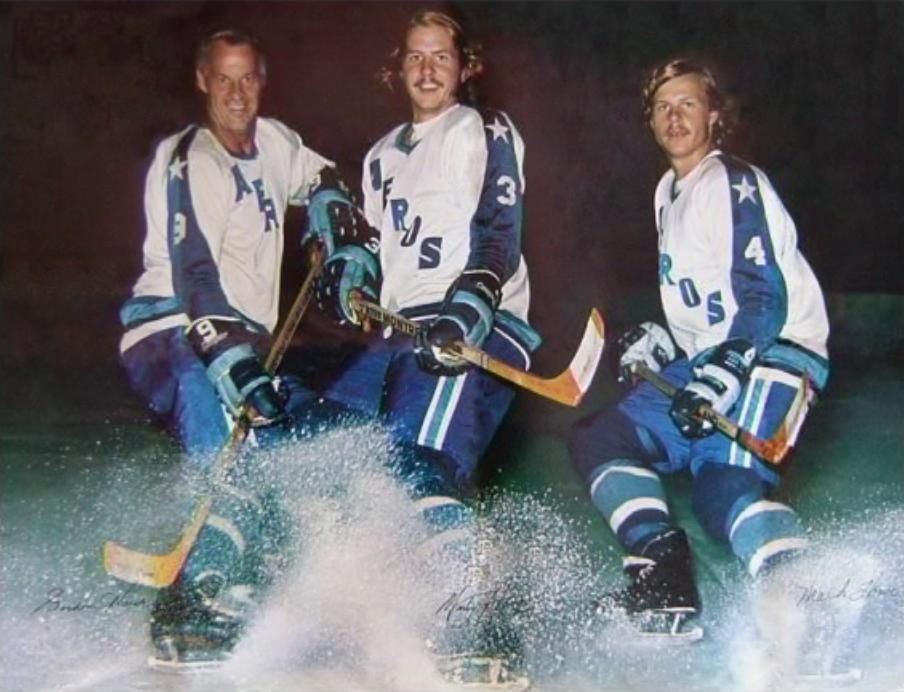
Bill Dineen, a teammate of Gordie's on the '54 and '55 Cup winners, was named head coach of the WHA's Houston Aeros. Another '55 (but not '54) teammate, Larry Hillman, was his assistant. In the 1973 WHA Draft, Dineen took Gordie's sons Mark and Marty.

To help the WHA get better publicity -- they'd already gotten Hull onto the Winnipeg Jets, a team essentially named for him (the Golden Jet, although their uniforms were blue and had no gold), Dineen asked Gordie to come out of retirement. He was willing to get surgery on his troubled wrist, and give it a shot.

Bruce Norris told the Howes that if Gordie quit the Wings' front office and went to "the rebel league," not only would he be blackballed from the NHL, never to work in it again in any capacity, but that Mark and Marty would also be blackballed -- and since they were players just starting out, this would affect them much more. In other words, he gave Gordie and Colleen an anti-incentive that would have hurt them much more than Gordie's own blackballing would have. It may not be the biggest dick move in the history of hockey, but it's the best-known dick move in NHL history.

And it backfired. Few decisions in the history of sports have backfired this much. Gordie and Mark -- or Gordie and Marty -- became the 1st father and son teammates in professional hockey history. They played on a line together. Mark and Marty got the traditional rookie hazings, and Gordie did not use his influence to stop it. On the other hand, the sons referred to their father as "Gordie," and even called him that to his face, in their teammates' presence, knowing that if they called him "Dad," they'd never hear the end of it.

Attendance went up all over the WHA, as people wanted to see the Howes. It probably kept the league going long enough for a merger with the NHL to be plausible. The Aeros won the AVCO World Trophy as WHA Champions in 1974. And Gordie, age 46, was awarded the Gary Davidson Trophy as Most Valuable Player.
Gordie, Marty, Mark

Davidson was the founder of the league. He was also a co-founder of the American Basketball Association and the World Football League. (There would be 4 teams each from the ABA and the WHA that would be admitted to the established leagues. The WFL, on the other hand, totally flopped.)

The next season, the WHA MVP award was renamed the Gordie Howe Trophy. Gordie didn't win it again, but the Aeros again won the AVCO Trophy. They reached the Finals again in 1976, but lost to the Jets.

Meanwhile, from the time that Gordie signed with the Aeros in 1973 until 1983, the Wings made the Playoffs only once. From 1970 until 1987, they only won 1 Playoff series. From 1966, Gordie's last trip to the Finals, until 1986, 20 seasons -- ending the year Norris died, although he'd sold the team to Mike Ilitch in 1982 -- they played in only 17 Playoff games, winning 4 of them. They became known as "The Dead Things."

They moved from the Olympia, in a bad neighborhood on Detroit's northwest side, and built the Joe Louis Arena downtown, but that was about the only thing they had to draw fans. They certainly weren't caring about what Larry Aurie and Ebbie Goodfellow did in the 1930s, or what the Production Line did in the 1950s.

I'm not saying the Wings would have been appreciably better if they still had Gordie, and had drafted Mark and Marty, and had paid them all what they were worth. It would have been tough to break through in a League that had the Big Bad Bruins in Boston, the Broad Street Bullies in Philadelphia, and the Flying Frenchmen in Montreal. But at least they would have been better. Instead, Bruce Norris found out that karma's a bitch.

The 1970s were a thrilling time for performances on the ice, in both leagues. But most hockey teams, in both leagues, were struggling financially. The Aeros needed money badly, and the New England Whalers were one of the few WHA teams that had it. So they bought all 3 Howes. Gordie was still a WHA All-Star.

In the 1979 off-season, the WHA folded, and 4 of its teams were admitted to the NHL. One was the renamed Hartford Whalers. The Wings still held Gordie's NHL rights, meaning that he could not legally play for any NHL team except Detroit. And Norris still owned the Wings.

But, despite being Chairman of the NHL's Board of Governors, Norris was outflanked by a former Wings executive, now President of the NHL, John Ziegler. Gordie was allowed to play in the NHL for Hartford. In that final season, Gordie played all 80 games, scored 15 goals, and helped the Whalers make the Playoffs.
Bobby Hull also closed his career with the 1980 Whalers,
switching to the 1st number he had with the Blackhawks, 16.

Bruce Norris' world had fallen in on him. The Wings had become laughably bad in Gordie's absence. And building the Joe Louis Arena had put a major kink in his finances. Now, he had to watch as his blackballing of the Howes and they were welcomed back into the NHL, and not for his team.

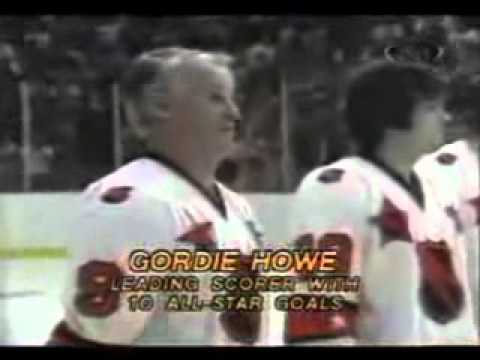
The 1980 NHL All-Star Game was given to Detroit and its new arena, as kind of a "gold watch" for Norris, as it was clear he would soon have to sell. And when Scotty Bowman, coaching the Wales Conference All-Star Team in that game, used his prerogative to fill out the roster with non-starters, he chose 3 legends: Jean Ratelle, Phil Esposito... and the nearly 52-year-old Gordie Howe, who was introduced as "Mr. Hockey, Number 9," and got an ovation from the Detroit crowd that went on and on and on. It was a massive middle finger to Norris -- not from any member of the Howe family, but from the Detroit fans.
This was the 32nd time the NHL had held an official All-Star Game. Howe had now appeared in 23 of them. He assisted on a goal by Real Cloutier of the Quebec Nordiques, and the Wales Conference team beat the Campbell Conference team 6-3. Playing for the Campbell was 19-year-old Wayne Gretzky, of another team that came in from the WHA, the Edmonton Oilers.

The previous year, Howe and Gretzky had played together on a WHA All-Star Team that played legendary Soviet club Dinamo Moscow. It was the only time that "Mr. Hockey" and the man who would surpass him as the NHL's all-time leader in goals, assists and points would play together.

After playing professional hockey in 5 different decades, Gordie was offered the chance to make it 6. At the start of the 1997-98 season, the Detroit Vipers, an International Hockey League team playing at The Palace of Auburn Hills (then the home of the NBA's Detroit Pistons), signed him to a one-day contract, and he played the opening shift of their opening game. He played 45 seconds, and didn't touch the puck. When the line shift came, he received a standing ovation from a sellout crowd, most of which had never seen him play before. He was 69 years old.

This came right after the Wings, led by Captain Steve Yzerman, finally won their 1st Stanley Cup in 42 years, since Howe and his Production Line were at their peak -- and since Bruce Norris had first been in charge. Of Yzerman, then 32 years old, Howe said, "I'm just so dang happy for the kid, it's unbelievable."
Kid Yzerman and Old Man Howe

The Wings would win again in 1998, 2002 and 2008. Gordie would live to see all of them.
Five Red Wing Hall-of-Famers with the Stanley Cup: Nicklas Lidstrom,
Gordie Howe, Ted Lindsay, Steve Yzerman and Brendan Shanhan

*

In NHL play, Gordie scored 801 goals and 1,049 assists, for 1,850 points. Counting the WHA, he scored 975 goals and 1,383 assists, for 2,358 points. Throw in what he did in the Playoffs, and his totals were 1,071 goals and 1,518 assists, for 2,589 points.

He still holds the records for seasons (26, shared with Chris Chelios, but is all alone with 32 counting the WHA) and games played (1,767 in regular season play, 2,421 counting the WHA and the Playoffs of both leagues). He appeared in 23 NHL All-Star Games and 6 WHA All-Star Games -- meaning he played 32 seasons and was named an All-Star in 29 of them. He was the 1st player to score at least 1,000 goals at the top level, counting the Playoffs, and only Gretzky has joined him.

He was elected to the Hockey Hall of Fame immediately upon his 1st retirement, the 3-year waiting period waived. The Detroit Red Wings and the Hartford Whalers retired his Number 9. The Whalers are now the Carolina Hurricanes, but they have continued to consider 9 retired.

He was honored (or, since it's "spelt" that way there, "honoured") by his country, by being awarded the Order of Canada in 1971, and being inducted into the country's Walk of Fame on Parliament Hill in Ottawa in 2000.

Statues of him have been dedicated outside the Joe Louis Arena in Detroit (presumably, it will be moved to the new Little Caesars Arena when it opens) and the SaskTel Centre in Saskatoon. He lived long enough to know that a new bridge over the Detroit River, linking Detroit with Windsor, will be named the Gordie Howe International Bridge. Construction is scheduled to begin next month, and it is currently scheduled to open in late 2024.

In 1998, to commemorate their 50th Anniversary, The Hockey News named their 100 Greatest Hockey Players. Gordie Howe came in at Number 3, behind Wayne Gretzky and Bobby Orr. Orr said, however, that Gordie was the best. Gretzky said that, had he been on the voting panel, he would have voted for Orr or Howe.

Who was really the greatest hockey player of all time? Sadly, injuries prevented Orr from reaching that status. He ended up playing only 12 seasons, enough games to add up to 8 full seasons. And he is still widely regarded as the best defenseman ever.

So it comes down to Howe and Gretzky. Yes, Gretzky blew away Howe, Maurice Richard, and everybody else in terms of offensive production. Yes, he had more assists than anyone else has had points. But he didn't play defense. He didn't have to. But he didn't. Howe did.

To put it another way: In 1999, Gretzky's recurring back injury led him to retire, at the age of 38. When he was 38, in 1966, Howe was still 1 of the NHL's 5 best players, and its best defensive forward. In 1969, at 41, he had 103 points, in a 12-team league with a 76-game schedule; Gretzky's last time coming close to that was at age 36, in a 26-team league with an 82-game schedule.

Wayne Gretzky was, at his peak, the best hockey player ever: He rewrote the offensive records in his sport the way Babe Ruth and Wilt Chamberlain did for theirs. But the greatest hockey player for a career was Gordie Howe. It's not just the longevity: He was 1 of the 3 best players in the NHL for 20 years. Or, to put it another way: If Gretzky was his sport's Ruth or Chamberlain, then Howe, despite preceding Gretzky and Chamberlain, was his sport's Hank Aaron.

In 2013, Mr. Hockey: The Gordie Howe Story aired on CBC and the Hallmark Channel. It focused on a specific part of Howe's story: The comeback with his sons in the WHA and the feud with Bruce Norris. Most of the film takes place in that landmark 1973-74 season, but it ends with his standing ovation at the 1980 All-Star Game in Detroit. Fittingly, the actor who played Norris is not shown at that moment. Michael Shanks, of the Stargate franchise and now the Canadian medical drama series Saving Hope, played Howe.

*

As 2013 turned to 2014, Gordie appeared at the NHL Winter Classic between Detroit and Toronto, at Michigan Stadium in Ann Arbor, Michigan, and at the warmup act, an alumni game at Comerica Park in downtown Detroit. Shortly thereafter, he suffered a devastating stroke, and never truly recovered.
Gordie and Johnny Bower, the great goalie
of the Maple Leafs' 4-time Cup winners of the 1960s

Gordie Howe died today, June 10, 2016, at the age of 88, in Toledo, Ohio, at the home of his son Murray Howe, a radiologist.

Since his wife Colleen, who managed the family's many enterprises, fell victim to a long-term illness before dying in 2009, Gordie had been living with their 4 children on a rotating basis: Mark, Marty, Murray, and daughter Cathy in Lubbock, Texas.

Both Mark Howe and Marty Howe were moved to defense after their family line was broken up by their father's retirement. Marty remained with the Whalers until 1985. He made a brief, 3-game comeback with the minor-league Flint Bulldogs in 1993, and is now a house designer and builder, having gone into the previous family business, construction, except, unlike his father Gordie and his grandfather Ab, he's running it.

Mark would be traded by the Whalers to the Philadelphia Flyers in 1982, helping them reach the Stanley Cup Finals in 1985 and 1987. They sent him back home to Detroit in 1992, and he closed his playing career by helping the Wings reach the Finals in 1995, their 1st trip there in 29 years. But they were swept by the New Jersey Devils.

He was a 5-time NHL All-Star, and holds the league record for most shorthanded goals by a defenseman: 28. He joined his father in the Hockey Hall of Fame (unlike other sports, there are plenty of father-son combinations in the Hockey Hall), and the Flyers retired his Number 2 in 2012 -- their only officially-retired number for a player not on their back-to-back Cup winners of 1974 and 1975. (No Flyer has wore 88 since Eric Lindros left, but it hasn't been retired.) (UPDATE: The Flyers retired 88 in 2018, after Lindros was elected to the Hall.)

Gordie and Mark joined Bobby and Brett Hull as the only father-son pair to both have their numbers retired in North American sports. Although no Baltimore Oriole has worn the 7 of Cal Ripken Sr. since his death, it is not officially retired, while the 8 of Cal Ripken Jr. is. Despite all the other fine father-son combos in professional sports, this is the closest that any of them comes to this achievement of the Howes and the Hulls.
Based on the clothes, the hair, and the Mr. Hockey film,
this photo was probably taken at their Houston home.

With Gordie's death, there are now 5 surviving players from the 1950 Stanley Cup Champion Detroit Red Wings, 66 years later: Ted Lindsay, Red Kelly, Marty Pavelich, Doug McKay, and Pete Babando, whose overtime goal in Game 7 beat the New York Rangers. (Pavelich appears not to be related to 1980 U.S. Olympic hockey hero Mark Pavelich.) (UPDATE: McKay died on May 11, 2020, leaving Pavelich as the last survivor.)

From the 1952 Champion Wings, 7 players are still alive: Lindsay, Kelly, Pavelich, Glenn Hall, Alex Delvecchio, Vic Stasiuk and Benny Woit. (Hall would soon be displaced by Terry Sawchuk, and become better known for  playing for the Chicago Blackhawks.) (UPDATE: As of January 1, 2023, they're down to 4: Pavelich, Hall, Delvecchio and Stasiuk.)

From the 1954 Champion Wings, 10 players are still alive: Lindsay, Kelly, Pavelich, Delvecchio, Stasiuk, Woit, Bill Dineen, Gilles DubĆ©, Jim Hay and Dave Gatherum. (UPDATE: As of January 1, 2023, they're down to 4: Pavelich, Delvecchio, Stasiuk and Gatherum.)

From the 1955 Champion Wings, 11 players are still alive: Marcel Bonin, Larry Hillman, and all of the surviving '54 Wings except Gatherum, who was Sawchuk's backup in goal and never played in the NHL again after '54. (UPDATE: As of January 1, 2023, they're down to 4: Pavelich, Delvecchio, Stasiuk and Bonin.)

UPDATE: Both Gordie and Colleen were cremated, and their remains were transferred to the base of a statue of Gordie at the SaskTel Centre arena in Saskatoon, Saskatchewan.

Thursday, December 3, 2015

Faux Flashback: How to Be a Devils Fan In Hartford

Tonight, the New Jersey Devils will play the Carolina Hurricanes in Raleigh.

Until 1997, the 'Canes were the Hartford Whalers. The Devils don't go to Hartford anymore. But they should be going there tonight, instead of to Raleigh.

The Devils haven't played in Hartford since February 12, 1997 -- 19 seasons ago. What was it like to see a Devils-Whalers game in Hartford? Let me go back into my archives, and show you this blog entry from February 5, 1997.

(Yes, I know: There were no blogs back then. Humor me. Updates will be given in italics.)

*

Before You Go. Hartford is a bit to the north of New York and New Jersey, but the weather won't be appreciably different from home on the same day. This game will be played in mid-February, so a winter jacket will be necessary.

Hartford is in the Eastern Time Zone, so you won't have to wind your watch back.

Tickets. The Whalers averaged just 11,983 fans per game in 1995-96, out of a seating capacity of 15,635, about 76 percent of capacity. New owner Peter Karmanos threatened to move the team if he didn't get at least 11,000 season tickets sold for this season. He got it, and Whaler attendance is better, but he still wants a new arena, and it doesn't look like Governor John G. Rowland is going to get the Connecticut legislature to pass funding for it. So tickets shouldn't be hard to get.

Karmanos announced on March 26, 1997 that the team was moving -- without having picked out a new city. He got an agreement from Raleigh, North Carolina to build a new arena, to open in the 1999-2000 season, while they would use the Greensboro Coliseum for 2 years.

It is now believed that Rowland was holding back from pushing the legislature, because what he really wanted was to lure the New England Patriots with a new football stadium, and he didn't think the State could afford a new stadium and a new arena. Instead, he lost the Whalers, the Patriots decided to build their new stadium next to their old one, a smaller-than-expected 40,000-seat stadium was built in East Hartford for the University of Connecticut, and Rowland has since gone to prison for fraud. Twice.

Tickets are $50 in the upper level, and $25 in the lower level.

Getting There. Hartford is too close to fly, and doesn't have much of an airport, anyway. If you're driving, it's 128 miles from the Brendan Byrne -- excuse me, Continental Airlines Arena to the Hartford Civic Center. Take the New Jersey Turnpike to Exit 18W (or 18E, if you're not leaving right from the Meadowlands), go over the George Washington Bridge, and take Interstate 95 to New Haven. To Exit 48 to Interstate 91 North, to Exit 29A for downtown Hartford.

The Byrne Arena got its name changed to the Continental Airlines Arena in 1996, and then to the IZOD Center in 2007, after the Devils left for the Prudential Center. It was closed at the beginning of 2015, and will be demolished in the next few years.

If all goes well, once you get over the Bridge, you should spend about half an hour in New York, and about an hour and 45 minutes in Connecticut before reaching the arena. Depending on from where in New Jersey you leave, the trip should take between 2 and a half hours to 3 and a half hours.

Union Station, which is served by both Amtrak and Greyhound, is 2 blocks to the west of the arena, at 1 Union Place between Church & Asylum Streets. The Amtrak round-trip fare is $60. Greyhound runs 13 buses per day between Port Authority Bus Terminal in New York and Union Station in Hartford. The fare is $39, but can drop to $26 with advanced purchase.
Union Station

I don't know what the actual fares would have been. This is based on what they are now, and using the Consumer Price Index Inflation Calculator, going backwards for once, and knowing that, while, in those early days of the Internet as we know it, it wasn't possible to order tickets online, it was still possible to show up at a station's ticket office and make an advanced purchase.

Once In the City. Hartford, named for the English country of Hertfordshire, is home to about 140,000 people, making around the same size as New Haven and Bridgeport, each competing to be the largest city in the State of Connecticut. When the Hartford metropolitan area is separated from the Boston metropolitan area, it's got about 1.5 million. Hartford is the State capital.

Hartford is now home to about 125,000 people, trailing Bridgeport at 144,000, New Haven at 130,000, and now also Stamford at 128,000. The metro area population is about the same.
The State House

It is known for being the home of the Colt Firearms Company, Stanley Tools, and several insurance companies. (Hence "Hardware City" and "Insurance City.") The sales tax in Connecticut is 6.35 percent. It does not rise within the County or the City of Hartford. The Hartford Courant is the largest-circulating newspaper in Connecticut, and the oldest continuously-published daily newspaper in America.

Hartford doesn't seem to have a centerpoint, from which street addresses increase. However, the addresses do seem to increase from south to north, and from east to west. This is also true of the City of East Hartford, across the Connecticut River. CT Transit runs the area's buses, and a 1-Day Pass is $2.00.

It's now $3.00.

Hartford Electric Light Company runs the area's electricity. "White flight" after the 1960s led to a de facto segregation: The city's North Side is mostly black, the South Side mostly Hispanic, and the West Side and suburban East Hartford mostly white. The city was about 64 percent white in 1970, but is now about 43 percent Hispanic, 39 percent black, 15 percent white, 3 percent Asian.

Those census figures are for 2010, as I don't have them for 1990, which would be the correct one for this post.

ZIP Codes in Connecticut begin with the digits 06. They're 060 to 062 around Hartford, 063 and 064 in the South, 065 around New Haven, 066 around Bridgeport, 067 around Waterbury, and 068 and 069 around Stamford, in the part closest to New York. Area Code 203 serves the part of the State that tilts toward New York, including New Haven, with 475 overlaid. In 1995, Area Code 860 was split off of 203, to serve the part of the State that tilts toward Boston, including Hartford, with 959 overlaid. The city does not have a "beltway."

Going In. The official address of the Hartford Civic Center Coliseum is 1 Civic Center Plaza. It's bounded by Church Street (north), Trumbull Street (east), Asylum Street (south) and Pleasant Street (west). Parking is $7.50.

The name of the arena was changed to the XL Center in 2007, after XL Group, an insurance company. Again, I'm plugging the current parking price, $11.00, into the inflation calculator. Pleasant Street between Jewell Street and Morgan Street, including on the west side of the arena, has been renamed Ann Uccello Street, after the 1st female Mayor of Hartford.
Known simply as "The Civic Center" or "The Mall," because it's attached to one. If you're coming in from Union Station, you'll be entering from the west end; from I-91, either the north side or the east end. The rink is laid out east-to-west. The Whalers attack twice toward the west end.

The building opened on January 9, 1975, seating 10,507, and the New England Whalers of the World Hockey Association moved right in. The University of Connecticut (UConn) basketball team, based 25 miles to the east in Storrs, also began playing selected home games there. The Boston Celtics played an average of 8 games a year there from 1975 to 1978 and again from 1980 to 1995, until the FleetCenter opened. Elvis Presley sang there on July 28, 1976. (The Beatles never played a concert in Connecticut.)

On January 17, 1978, UConn played the University of Massachusetts in basketball, in a game sparsely attended due to snowfall. It kept on snowing, and, just 6 hours after the final horn -- in the middle of the night, fortunately, when the arena was empty, so no one was hurt -- the roof collapsed. The building was just 3 years old. (In contrast, the Boston Garden stood for 70 years before it was finally demolished, and it never had a structural issue.) It took 2 years for the building to be repaired, while the Whalers played 25 miles to the north in Springfield, Massachusetts, and UConn and the Celtics returned to Storrs and Boston, respectively.
January 18, 1978. It could have been a whole lot worse.

On January 17, 1980, the Civic Center reopened, with a new seating capacity of 14,460. It is now 15,635. The Whalers moved back in, and UConn and the Celtics resumed their partial home schedules there. The New England Blizzard of the all-women's American Basketball League play there. The now-defunct Connecticut Coyotes of the Arena Football League played there. The Civic Center has also hosted both men's and women's NCAA basketball tournament games.
Immediately after the Whalers moved, in 1997, a minor-league team was brought to the Civic Center, named the Hartford Wolf Pack. Although they were named the Connecticut Whale from 2010 to 2013, as a tip of the hat (or helmet) to the Whalers, they remain at the XL Center. The Celtics' new arena is now called the TD Garden. The women's ABL played just 2 seasons before folding, 1996-97 and 1997-98. And the Civic Center Mall was redeveloped in the mid-2000s, creating residential, office and retail space.

The Wolf Pack's current general manger is former Devils head coach Jim Schoenfeld, who famously got us into our 1st Playoffs in 1988, all the way to Game 7 of the Conference Finals. And, infamously, called a referee "you fat pig" and told him to "have another donut!"
Food. Like too many arenas built in the 1960s and 1970s, including the Meadowlands, the Nassau Coliseum and the Spectrum, the Civic Center has one level of concourse for two levels of seats. That just doesn't work when you've got a crowd of 12,000 or more. You could lose half a period on line for food or the bathroom.

Concessions aren't especially interesting, pretty much standard fare. But with the number of families attending with kids, a lot of cotton candy and Carvel ice cream gets sold.

A renovation in time for the 2014-15 season expanded food options significantly, including Dunkin Donuts at the southwest and northeast corners.

Team History Displays. The Whalers' history has been weak. And they don't help themselves: Unlike the New Jersey Nets and the Indiana Pacers, who hang ABA title banners, and formerly the Winnipeg Jets and the Quebec Nordiques (since moved), the Whalers do not hang a banner for winning the 1st WHA title in the 1972-73 season, as they were still playing at the Boston Garden at the time. (No banner for it hangs in the FleetCenter: The Bruins would like to forget the WHA ever existed. Indeed, changing the team's name from "New England" to "Hartford" was a condition of entering the NHL in 1979.)

The Whalers do hang banners for titles won while playing in Hartford. All 2 of them: The 1974-75 WHA Eastern Division title, and the 1987 NHL Adams Division title. That's all they've won: Since they entered the NHL, 17 season ago, they've won exactly 1 Playoff series, beating the Nordiques in the 1986 Adams Division Semifinal, before losing the Final to the Montreal Canadiens. They then lost in the 1st round 6 straight times, and haven't made the Playoffs since 1992. The lobby contains a large mural of some of the highlights of the Whalers' history. There is also a banner for the UConn women's team that won the 1995 National Championship.

The Whalers have retired 3 numbers: 2, defenseman Rick Ley, 1972-81 and head coach 1989-91; 9, right wing Gordie Howe, 1977-80; and 19, right wing John McKenzie, 1977-79, signed by the Whalers because of his popularity with the Bruins.

Howe was already in the Hockey Hall of Fame before he began his comeback in the WHA. Bobby Hull played 9 games with the Whalers at the end of his career in 1980. Toronto Maple Leafs legend Dave Keon played for the Whalers 1976-82, and is in the Hall. And a 4th Whaler in the Hall of Fame is Emile Francis, their general manager 1983-89, although he was already in for his service as GM and head coach of the Rangers. Still, 4 Hall-of-Famers in 25 years isn't bad, especially for a team that hasn't reached the Stanley Cup's quarterfinals except for once.

No members of the Team Canada that beat the Soviet Union in the 1972 Summit Series ever played for the Whalers. Two members of the 1980 U.S. Olympic team did: Mark Johnson and Rob McClanahan.

In 1998, The Hockey News named its 100 Greatest Players. Howe was the only player who spent significant time with the Whalers/Hurricanes franchise to be named. to it. He, his sons Mark and Marty, Ley, McKenzie, Al Smith, Andre Lacroix, Dave Keon, Ron Plumb, Ted Green and Tom Webster were named to the WHA All-Time Team.

In 2006, the Wolf Pack raised 3 more banners in honor of Whalers stars: 5, defenseman Ulf Samuelsson, 1984-91; 10, center Ron Francis, 1981-91; and 11, right wing Kevin Dineen, 1984-92 and 1996-97, the Whalers' last Captain. Five other Whalers have been elected to the Hall, although only Francis and Gordie's son Mark Howe, 1977-82, can really be considers "Whalers Hall-of-Famers." The others only played 4 seasons in green & white between them: Paul Coffey, Brendan Shanahan and Chris Pronger.

UConn has now won 4 National Championship in men's basketball and 13 in the women's game, and banners for those titles, as well as banners honoring coaches Jim Calhoun and Geno Auriemma, hang in the XL Center, as well as at Gampel Pavilion in Storrs.

The Wolf Pack hang banners for their 2000 Calder Cup as champions of the AHL, and Division Championships in 2000, 2004, 2009 and 2015. They've also retired Number 12, for Ken Gernander, the Captain of their Calder Cup winners and their current head coach. Ryan Bourque, Ray's son, is their current Captain.
Gordie and Mark Howe, former player and head coach Larry Pleau, former head coach Paul Holmgren, and former scout Bob Crocker received the Lester Patrick Trophy for contributions to hockey in America. In 2017, Gordie Howe and Ron Francis were named to the NHL's 100th Anniversary 100 Greatest Players.

Stuff. The Whalers Gift Store is at the arena's west end. The front door is shaped like a cutout of their old logo from the WHA days.
No, I'm wasn't joking about the Whalers logo door.
Although it is now called the Hartford Wolf Pack Hockey Club Store,
and the Whalers logo is gone.

With such a lackluster history, books and videos about the team are few and far between. If only there was way to use that Internet I've heard so dang much about to search for books and videos.

In 1987, Jack Lautier published Fifteen Years of Whaler Hockey: The History of the Hartford Whalers. In 1995, John Gilbert and Gary Olson published Hartford Whalers, as part of the NHL Today series.

Amazon.com was founded in 1994, and by 1997, it was possible to search it, and the websites of Barnes & Noble and the now-defunct Borders for such items before setting foot in a brick-and-mortar store. Amazon still doesn't have any listings for videos about the Whalers, and only 2 books stand out. In 2007, Brian Codagnone published The Hartford Whalers. In 2005, Ed Willes published the definitive story of the WHA: The Rebel League: The Short and Unruly Life of the World Hockey Association.

During the Game. Hartford does not have a reputation for a crime problem. And Whaler fans consider the Rangers and the Bruins -- 2 teams we also don't like -- to be their rivals. They shouldn't bother you.

The mascot is Pucky the Whale, although it's a little weird to see a big green whale on legs. Tony Harrington is the Whalers' regular National Anthem singer. The main chant is the rather ordinary, "Let's go, Whalers!"
Pucky the Whale and Wolf Pack mascot Sonar the Wolf

Jack Say wrote the Whalers' theme song, "Brass Bonanza." It was introduced in 1975 after the move to Hartford, and became an integral part of the Whalers experience, played after ever home team goal. In 1992, GM Brian Burke ordered that it no longer be played, because, in his words, "There were players who were embarrassed by it." He substituted Gary Glitter's "Rock and Roll Part 2." After just 1 year, he was hired for a post in the NHL office by Commissioner Gary Bettman, and left, and new head coach and GM Paul Holmgren ordered "Brass Bonanza" reinstated.

The players who were "embarrassed" by "Brass Bonanza" have never been identified. I think Burke simply didn't like it. Since the Whalers left, Burke has failed as GM of Vancouver, Anaheim and Calgary, although he was GM of the Anaheim Ducks when they won the 2007 Stanley Cup. Gary Glitter has twice gone to prison for offenses that make "Rock and Roll Part 2" far more embarrassing than Burke thought "Brass Bonanza" was.

The song is still played at the XL Center, including at Wolf Park and UConn games, and has even become a fixture at Fenway Park. After all, Hartford is closer to Boston (100 miles) than it is to New York (119).

After the Game. You should be safe walking back to your car or to Union Station. There are several places around the arena where you can get a postgame meal, or even just a drink, although the mall might be closed by the time the final horn sounds, and I don't know of any that are known hangouts for New York or New Jersey teams' fans.

As I said, the mall has been redeveloped. Agave Grill is a Mexican restaurant at 100 Allyn Street, across Ann Uccello Street from the XL Center. Black Eyed Sally's is a Southern-themed restaurant at 350 Asylum Street, about halfway between the arena and the station. The Russian Lady, at 191 Ann Uccello Street, calls for "Neat Professional" attire, so it might not be a good idea for a postgame hockey crowd. And, as I said, there are Dunkin Donuts at opposite corners of the arena, which may be open after the game. I can't be sure if any of these places were open while the Whalers were still there.

Sidelights. Hartford's sports history isn't much, and is even less if you, as Peter Karmanos is threatening to do, take away the Whalers. But there are non-sports things to do in the city.
Boston Garden, the Whalers' 1st home

The Whalers played their 1st 2 seasons in Boston, alternating between the Boston Garden and, when the Bruins (who owned the Garden and now own the new arena) shut them out of available dates, the Boston Arena (Matthews Arena at Northeastern University). Fed up with this, they signed the deal to move to Hartford as soon as the Civic Center opened.
Matthews Arena

Except it wasn't ready for the start of the 1974-75 season, so the Whalers moved to the Eastern States Coliseum, better known as the Big E, longtime home of the AHL's Springfield Indians. It was old (built in 1926), it was small (just 6,000 seats), it wasn't in Hartford (28 miles to the north), and it wasn't even the best arena in town anymore, but they had something they'd never had before: First choice of scheduling in an arena. 1305 Memorial Avenue, West Springfield, Massachusetts.
The Big E. Already, by this point,
they should've stopped calling themselves the Whalers,
and started calling themselves the New England Wanderers.

When the Civic Center roof collapsed, the Whalers went back north, and played the rest of the 1977-78 season, all of 1978-79, and the first part of 1979-80 at the Springfield Civic Center. Opening in 1972, it hosted the Springfield Indians until 1994, and the Springfield Falcons since then. It seats 6,866. Elvis sang there on July 14 and 15, 1975; and July 29, 1976.

The Springfield Civic Center is now known as the MassMutual Center. It still hosts minor-league hockey. The Big E does not, but it is still open for various events.
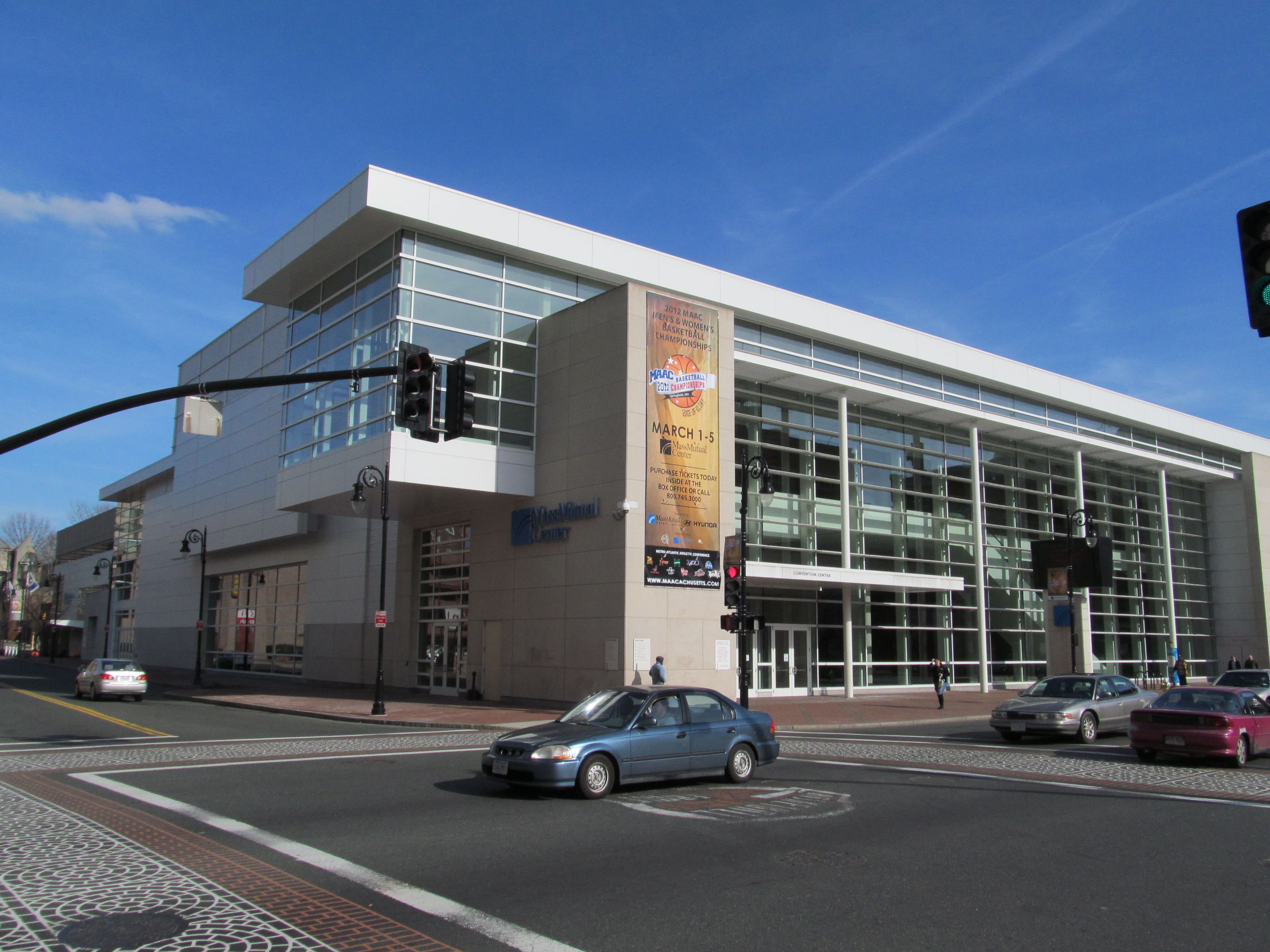
The MassMutual Center

Boston Bruins legend Eddie Shore long ran the Springfield Indians, and is buried in Springfield, at Hillcrest Park Cemetery, 895 Parker Street.

Of course, Springfield's biggest connection to sports is as the definitive birthplace of basketball. Dr. James Naismith invented the game at the International YMCA Training School, which grew into Springfield College. That's why the Basketball Hall of Fame is located in the city, at 1000 Hall of Fame Avenue, on the Connecticut River.
The best way to reach any site in or around Springfield from Hartford is by Amtrak. Fortunately, it's one of their cheapest runs, since it's not on the Boston-New York-Washington Northeast Corridor.

The New Britain Red Sox, a Class AA team in the Eastern League, played at the 4,700-seat Beehive Field from 1983 to 1995.
In 1996, they became a Minnesota Twins farm team, and changed their name to the New Britain Rock Cats, playing at the 6,146-seat New Britain Stadium, which was built next door, at 230 John Karbonic Way, 13 miles southwest of downtown Hartford. Bus 101 to New Britain Station, then transfer to Bus 510 or 512. The "BritSox" won the Pennant in 1983, but the Rock Cats have yet to win a Pennant in their new stadium.
The Rock Cats were in the EL Championship Series in 2001 when the 9/11 attacks occurred, with the series being canceled and co-champions being declared. In 2014, it was announced that the Rock Cats would move to Hartford for the 2016 season. They will be a farm team of the Colorado Rockies, and will become the Hartford Yard Goats, playing at brand-new Dunkin' Donuts Park, at 1214 Main Street at Trumbull Street, just a walk over I-84 from the XL Center. In the meantime, the Camden Riversharks of the Atlantic League are moving into New Britain Stadium, to become the New Britain Bees.

According to an April 23, 2014 article in The New York Times, the Yankees are actually the most popular MLB team in Hartford proper, with about 49 percent of those polled, to about 35 percent for the Red Sox. However, when you get into Hartford's eastern suburbs, the Sox take over, about 44 to 40 percent.

In spite of the Yankees' strength in the area, the Bruins are easily the most popular NHL team now (probably because of Bobby Orr, who gave them a toehold even before the Whalers came along), the Celtics are far more popular than the Knicks (due to their "home games" at The Mall as much as to their 1980s success), and the Patriots (who do, after all, call themselves "New England") are more popular than the Giants.

Veterans Memorial Stadium is a football field at 635 South Main Street in New Britain. The U.S. soccer team played 4 games there between 1973 and 1996, going 3-1. Dillon Stadium is a football stadium at 250 Huyshope Avenue at Curcombe Street, near Charter Oak Landing, a mile and a half southeast of downtown Hartford. The U.S. soccer team beat Bermuda there on September 9, 1973.

Hartford briefly had a major league team in the early days of baseball. The Hartford Dark Blues played at the Hartford Ball Club Grounds in the seasons of 1874 and 1875 in the National Association, and 1876 in the National League, before finances led them to move to Brooklyn. Good Shepherd Church was built on the site. 155 Wyllys Street at Osten Blvd., about a mile southeast of downtown.
Best picture of it that I could find.

There was also a Hartford Blues playing in the NFL, albeit only in the 1926 season, finishing just 3-7. They had Harry Stuhldreher of Notre Dame's Four Horsemen at quarterback, and future Giants legend Steve Owen as a two-way tackle. They played at the East Hartford Velodrome, at a site bounded by Pitkin Street, Founders Plaza, Hartland Street and East River Drive. Albertus Magnus College and a Hampton Inn were built on the site.
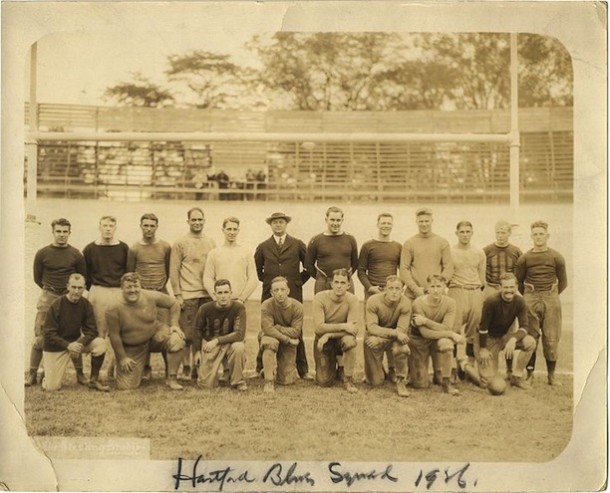
This team photo is the best one I could find of the Velodrome.

In 2003, football returned to East Hartford. Pratt & Whitney Stadium at Rentschler Field was meant to be the 60,000-seat new home of the New England Patriots, thus enabling them to keep their regional name. But team owner Robert Kraft merely used the Connecticut capital as a pawn to get a new stadium from Massachusetts next-door to the old one in Foxboro. As a result, the East Hartford stadium was replanned, and seats 40,642. (Foxboro is 99 miles northeast of Hartford.)

It is the new home for UConn football and the high school State Championships. The U.S. national soccer team is 3-1-1 while playing there, most recently in a 1-1 draw with Ecuador on October 10, 2014. The women's team is 2-0-2 there.
A crowd of 15,000 attended Whalers Hockey Fest 2011 at Rentschler Field, which featured games of the UConn men's and women's hockey teams, a game between alumni of the Whalers and the Bruins (a 4-4 tie), and a regular-season game between the Connecticut Whale and the Providence Bruins. 615 Silver Lane in East Hartford. Bus 83.

Don't get any ideas about major league teams returning to Hartford, with the possible exception of in the NHL. The area's low population base would rank it 31st and last among MLB markets, 32nd in the NFL (ahead of only New Orleans), 28th in the NBA (ahead of New Orleans, Oklahoma City and Memphis), and 27th in the NHL (ahead of only Ottawa, Calgary, Edmonton and Winnipeg, and last among U.S. cities). Hartford has no professional soccer team.

Since 2003, the Connecticut Sun of the WNBA have played at the 10,000-seat Mohegan Sun Arena at Casey Plaza, in Uncasville, 46 miles southeast of Hartford, 106 miles southwest of Downtown Boston, and 132 miles northeast of Midtown Manhattan. Mohegan Sun advertises itself as "closer to New York than Atlantic City." This is true: Caesar's Atlantic City is 128 miles from Times Square. What Mohegan Sun doesn't tell you is that it's closer to Boston than to New York, and will have as many Chowdaheads as Pinstripers.
Nearby is Foxwoods Resort in Mashantucket, 139 miles from New York, 97 miles from Boston, and 48 miles from Hartford. Neither Mohegan Sun nor Foxwoods is reachable by public transportation from Hartford, but private bus companies run service from Hartford, New York and Boston.

Hartford isn't all that close to any beach towns. Old Saybrook, Connecticut is 43 miles to the southeast; Newport, Rhode Island, 86 miles to the east; and Cape Cod, Massachusetts a minimum of 140 miles to the east.

The Sun won the WNBA's Eastern Conference in 2004 and 2005, but lost in the Finals both times. Despite being a natural attraction for players from the University of Connecticut -- UConn's Harry A. Gampel Pavilion is just 30 miles northwest of Mohegan Sun -- they've never won a title. They've retired 3 numbers: 12, for Margo Dydek; 23, for Katie Douglas; and 42, for UConn graduate Nykesha Sales.
Gampel Pavilion

The Travelers Tower, headquarters of the insurance company of the same name, opened in 1919, and is Hartford's most familiar landmark besides the State House. It is 527 feet tall. In 1980, it was surpassed as the tallest building in the State of Connecticut by City Place I, at 185 Asylum Street, a short walk from the Civic Center: 534 feet.

City Place I is still the State's tallest building.

Hartford is home to the nation's oldest public art museum, the Wadsworth Atheneum, at 600 Main Street at Gold Street. The Connecticut Science Center is at 250 Columbus Blvd. at Grove Street. The Mark Twain House, the last home of the author born Samuel Langhorne Clemens, is at 351 Farmington Avenue at Forest Street, adjacent to Hartford Public High School, about a mile west of downtown. Bus 60.

No President has ever been born in Connecticut, although George Bush grew up in Greenwich and attended Yale University in New Haven. William Howard Taft also graduated from Yale, and, like Gerald Ford and Bill Clinton, went to Yale Law School. But New Haven is 36 miles from Hartford.

Yale is also the only Connecticut-based school to win hockey's National Championship, in 2013.

His son, George W. Bush, was born at Yale-New Haven Hospital in 1946, and, like his father and grandfather, is a Yale graduate (however the hell that happened). But you'll never be able to convince him that he's anything other than Texas through and through.

Of course, since this post would have been written, George W. assumed the office of the Presidency, so Connecticut does now have a Presidential Birthplace. Not that very many people in the State are proud of this one.

There's another Presidential site nearby: Calvin Coolidge, although from Vermont, was Mayor of Northampton, Massachusetts before being elected that State's Governor, and Vice President, and becoming President in 1923 when Warren Harding died. His Presidential Library and Museum is there, at 20 West Street, a 10-minute walk west of the bus terminal. 45 miles north of Hartford, and 17 miles north of Springfield.

The 1st Presidential Debate of 1996, between Clinton and Bob Dole, was held at the Bushnell Performing Arts Center. 166 Capitol Avenue, across Trinity Street from the State House.

In addition to Hartford, Elvis Presley sang at the 11,171-seat New Haven Veterans Memorial Coliseum on July 16 and 17, 1975; and July 30, 1976. State and George Streets. The Coliseum replaced the 4,000-seat New Haven Arena, which stood from 1926 to 1974 at State and Grove Streets, 5 blocks away. Like its successor, it hosted minor-league sports, especially hockey, and concerts, including the one on December 3, 1967 when Jim Morrison of The Doors got arrested onstage.

Built in 1972, the New Haven Coliseum was demolished in 2007. It has not been replaced.

Lots of movies have been filmed in Connecticut, but none that I can find were shot in Hartford. The play and film Who's Afraid of Virginia Woolf? were set at Hartford's Trinity College, but not filmed there. Same with TV shows: Bewitched was set in Westport and Who's the Boss? in Fairfield, but neither in Hartford. I guess the capital city simply isn't glamorous enough for Hollywood honchos.

Various versions of Mark Twain's story A Connecticut Yankee in King Arthur's Court include Connecticut scenes. Mr. Blandings Builds His Dream House had the house in Connecticut, but considerably closer to Manhattan than to Hartford (or Boston). Eugene O'Neill's play Long Day's Journey Into Night and its film versions have been set in a seaside community in Connecticut, although the best-known version, from 1962, was filmed on City Island in The Bronx.

Holiday Inn, the 1942 film that debuted Bing Crosby singing "White Christmas," has its "country" scenes set in Connecticut, although the 1955 film White Christmas takes place in Vermont. Orson Wells played a Nazi war criminal turned prep school teacher in fictional Harper, Connecticut, in The Stranger.

 Rally Round the Flag, Boys! takes place in fictional Putnam's Landing. Beetlejuice takes place in fictional Winter River. Mystic Pizza actually was filmed and set in Mystic. The Ice Storm was set in New Canaan, but that's closer to New York than Hartford. So is Stepford, the fictional setting of Ira Levin's novel The Stepford Wives and its film versions.

Christmas in Connecticut was filmed twice, in 1945 with a fraudulent food writer played by Barbara Stanwyck and a returning World War II hero played by Dennis Morgan; and in 1992 with Dyan Cannon as the host of a TV cooking show and Kris Kristofferson as a hero fireman. The remake was the 1st movie directed by Arnold Schwarzenegger, who has a brief cameo. Until I learned of the 1945 version, I presumed the remake was a parody of Martha Stewart, who famously lives in Westport.

Westport was also where the Ricardos and the Mertzes moved late in the run of I Love Lucy, and the setting of Bewitched. Nearby Fairfield was the setting of Who's the Boss? Fictional Dunn's River was the setting of Soap. The spinoff Benson established that Gene Gatling was a cousin of Soap's Jessica Tate, but it didn't specifically say that the State of which Gatling was Governor was Connecticut, or any other.

Judging Amy took place in Hartford, running on CBS from 1999 to 2005. Gilmore Girls, which ran on The WB from 2000 to 2007, did some filming in Hartford, but was set in the fictional town of Stars Hollow, said to be half an hour's drive away. Westport was established as the hometown of Josh Lyman on The West Wing.

New York suburbs of Connecticut also Stamford, the setting of My Wife and Kids. In addition to Stars Hollow, Connecticut's fictional TV settings include Castleberry, established as the hometown of Sex and the City's Carrie Bradshaw in the prequel series The Carrie Diaries.

*

So now you have a taste of what it would have been like to attend a New Jersey Devils game away to the Hartford Whalers.

And the result of that last Devils game in Hartford, on February 12, 1997? The Devils won, 3-2. The last Whalers game, home or otherwise, was on April 13, 1997, a 2-1 win over the Tampa Bay Lightning at the Civic Center.

Perhaps, someday, when Gary Bettman's successor as Commissioner decides that his predecessor was an idiot, and that putting so many teams in the Sun Belt was not the answer, the NHL will return to Hartford.

In the meantime, the city and the arena have the Wolf Pack, and the memories of the Whalers.