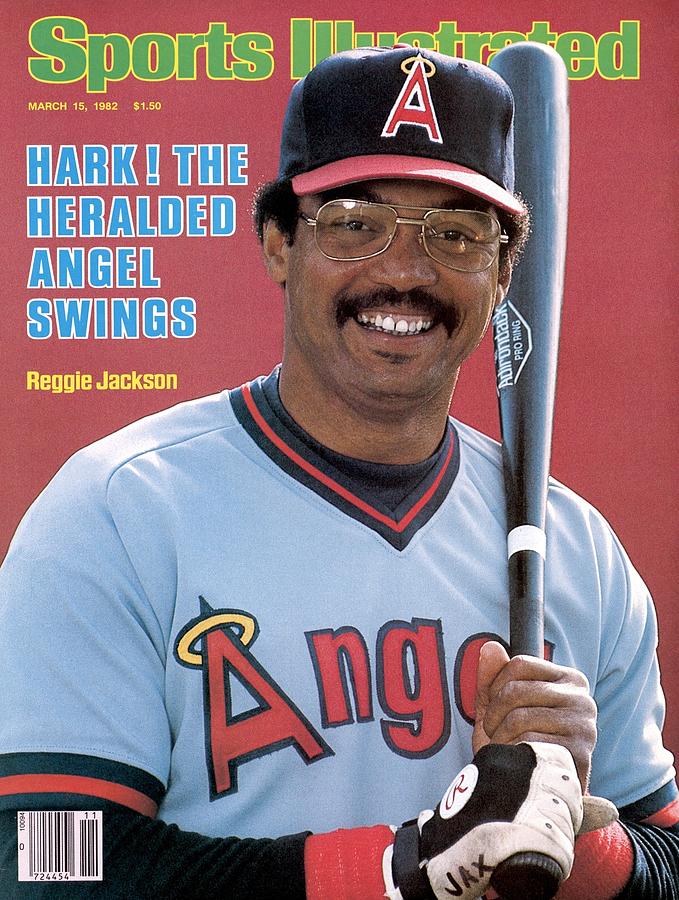
You'll notice that, since the 2016 season, they no longer use the least-appropriate name in Major League Baseball, "the Los Angeles Angels of Anaheim."
Which is just as well. There's no "New York Giants of East Rutherford," or a "Boston Patriots of Foxboro," or a "Washington Commanders of Landover," or an "Atlanta Braves of Cumberland," or a "Miami Panthers of Sunrise," or a "Tampa Rays of St. Petersburg," or a "Milwaukee Packers of Green Bay," or a "Dallas Rangers of Arlington," or a "Phoenix Cardinals of Glendale," or a "San Francisco Athletics of Oakland," or a "San Francisco 49ers of Santa Clara," or a "San Francisco Sharks of San Jose," or an "Ottawa Senators of Kanata."
There was never a "New York Islanders of Uniondale," or a "Cleveland Cavaliers of Richfield," or a "Dallas Cowboys of Irving," or a "Detroit Lions of Pontiac," or a "Detroit Pistons of Auburn Hills," or a "Los Angeles Lakers of Inglewood," or a "Minneapolis Twins of Bloomington."
With the establishment of a "Minnesota Twins," renaming the team the "California Angels" was okay. But "Los Angeles Angels of Anaheim"?
In their history, this team has been officially known as...
* 1961-64: The Los Angeles Angels.
* 1965-96: The California Angels.
* 1997-2004: The Anaheim Angels.
* 2005-15: The Los Angeles Angels of Anaheim.
* 2016-present: The Los Angeles Angels.
That was 5 names in 56 seasons, even though they never left their original metropolitan area. They are also nicknamed the Halos. But not the A's: That's what their geographical rivals, the Oakland Athletics, are called.
Before You Go. Unlike the Seattle and San Francisco Bay Areas, the Los Angeles area has very consistent weather. It's a nice place to visit. If you don't mind earthquakes. And mudslides. And wildfires. And smog.
The Angels' hometown (well, home County, anyway) newspaper, the Orange County Register, is predicting high 80s for daylight and mid-60s for evenings throughout the series, with zero chance of rain. The region's (and indeed the Western U.S.') largest newspaper, the Los Angeles Times, mostly concurs. Therefore, short-sleeve shirts, and staying hydrated, should be all that's necessary.
Anaheim is in the Pacific Time Zone, 3 hours behind New York. So there will be some clock & watch fiddling.
Tickets. Unlike their American League Pacific Coast bretheren, the Oakland Athletics and the Seattle Mariners, the Angels usually do very well at the box office. This season, their average of 30,698 is 13th in the majors, and 5th in the American League behind the Yankees, Houston, Boston and Toronto.
And with a capacity of 45,477, that means the Angels are operating at 67 percent of capacity, which, especially post-COVID, is pretty good for baseball. So this may be one where it helps to order your tickets beforehand.
But the prices for these games are insane, much higher than in previous years. Field Box seats (lower level) will be $250, Field Reserved will be $62, Terrace Boxes (middle level) will be $125, the Outfield Pavilions $60, View Boxes (upper deck) $40, and View Reserved $35.
Getting There. It's 2,789 miles from Yankee Stadium to Angel Stadium). In other words, if you're going, you're flying. You could get round-trip fare on a nonstop flight on United Airlines from Newark to Los Angeles International Airport (LAX) for as little as $575.
Driving all that way, and all that way back, is not a good idea: Even if you get someone to go with you, and you take turns, one drives while the other one sleeps, and you pack 2 days' worth of food, and you use the side of the Interstate as a toilet, and you don't get pulled over for speeding, you'll still need over 2 full days. Each way.
But, if you really, really want to... Take Interstate 80 West across New Jersey, Pennsylvania, Ohio, Indiana, Illinois, Iowa and Nebraska. Just before leaving Nebraska for Colorado, you'll get on Interstate 76, and shortly before reaching Denver you'll get on Interstate 70 West. You'll take that all the way to its end in Utah, where you'll take Interstate 15 south. You'll go through a short strip of Arizona before getting into Nevada (where you'll see the Strip, Las Vegas), before getting into California.
Assuming you're not going to a hotel first (and you really should, keeping in mind that those near the stadium will be cheaper than those near Disneyland or in downtown L.A.), you'll get off I-15 at Exit 106, and get on State Route 60, the Pomona Freeway. You'll get off Route 60 at Exit 24, for State Route 57, the Orange Freeway. Take Exit 1E for Orangewood Avenue, turn right, and soon you'll be able to turn right on State College Blvd. Right after that, you'll turn right onto East Gene Autry Way, and there's the stadium.
Given an average speed of 60 miles an hour, you'll be in New Jersey for an hour and a half, Pennsylvania for 5:15, Ohio for 4 hours, Indiana for 2:30, Illinois for 2:45, Iowa for 5:15, Nebraska for 6 hours, Colorado for 7:15, Utah for 6 hours, Arizona for half an hour, Nevada for 2 hours, and California for 3 hours; for a total of 46 hours. Factor in rest stops, you'll need more like 3 full days. And, remember, that's just one way. And if you end up using Las Vegas as a rest stop, well, you might end up missing the series and end up, yourself, as what "stays in Vegas."
That's still faster than Greyhound and Amtrak. Greyhound will take about 68 hours, you'll be changing buses as many as 3 times, and it could cost $804 round-trip, though it can drop to $540 with advanced purchase.
If you do go all the way to Los Angeles for your hotel, it's a 40-minute drive from downtown L.A. to Angel Stadium down Interstate 5, and a 42-minute trip on Amtrak or a 45-minute trip down the Metrolink Orange County Line from L.A.'s Union Station to the Anaheim Regional Transportation Intermodal Center, a.k.a. ARTIC, a.k.a. The Iceberg, at 2626 East Katella Avenue, a short distance from center field at the ballpark.

Anaheim Station, a.k.a. the Iceberg
If you follow this advice, you'll be taking Amtrak's Lake Shore Limited out of New York's Penn Station at 3:40 PM Eastern Time on Friday, arriving at Chicago's Union Station at 9:45 AM Central Time on Saturday, leaving Chicago on the Southwest Chief at 3:00 PM on Saturday, and arriving at L.A.'s Union Station at 8:15 AM Pacific Time on Monday. That's $523 round-trip -- possibly cheaper than Greyhound.
Except you can't do it this time: The Friday Lake Shore Limited is sold out.
The last Metrolink train from L.A. that will get you to Anaheim in time for a 7:00 start on Thursday night leaves at 5:40 and arrives at 6:26. The fare is $8.75 one-way, $17.50 round-trip. Unfortunately, Metrolink is a rush hour-only service, and you'll have to find another way to get back to L.A. An Amtrak Pacific Surfliner leaves Anaheim at 11:10 and gets back to Union Station at 11:57.
Unlike the Northeast Corridor, this Amtrak train is relatively cheap: $32 round-trip. Considering what New Jersey Transit, Metro-North, or the Long Island Rail Road would be to Manhattan, and then the $5.50 round-trip Subway fare to Yankee Stadium or Citi Field, this doesn't sound so bad. And it's a lot cheaper than a taxi or an Uber.
Once In the City. Orange County, California is home to 3 million people, about 350,000 of them in the City of Anaheim, a city founded in 1857 and, since its first settlers were German, they named it "Anaheim," German for "home by the Ana," meaning the Santa Ana River.
That total of 350,000 people would make Anaheim smaller than the smallest of New York City's Boroughs, Staten Island; but larger than any city in New York State other than New York City (topped by Buffalo with 260,000), New Jersey (Newark has 275,000) or Connecticut (Bridgeport has 145,000). Add neighboring Riverside County, and there's over 5.2 million people that are, by the standard I use for each of the various teams' spheres of influence, in the Angels' "market."
The Angels have played with that idea over the years. The change of name from "Los Angeles Angels" to "California Angels" upon their move to Anaheim in 1966 was to suggest them as a team for all of California, as an alternative to the high and mighty Dodgers, much more than it was to ride on the coattails of memories of the old Los Angeles Angels of the Pacific Coast League.
This was also before the A's arrived in Oakland and the Padres arrived in San Diego (like the Angels, replacing a PCL team of the same name), and when both of those teams arrived over the next 3 years, it pretty much took the wind out of the Angels' pan-California sails.
Angels owner Arturo "Arte" Moreno's 2005 change of name to "the Los Angeles Angels of Anaheim" was designed to tap into the nearly 10 million people then living in Los Angeles County, and the nearly 18 million people in the L.A. metropolitan area, 2nd in North America behind New York's 19 million. It didn't work, and in 2016, Moreno gave up the pretense, but dropped "of Anaheim" rather than "Los Angeles," and now, they're "the Los Angeles Angels" again.
But who's kidding who? Especially now that basketball legend Earvin "Magic" Johnson has bought the Dodgers, there's no way he's going to let Moreno outbid his team for the hearts and minds of Southern Californians, let alone Los Angelenos.
ZIP Codes in Orange County start with the digits 925, 926, 927 and 928; while the Area Code is 714, overlaid by 657. The sales tax in California is 7.5 percent, although it's an even 8 percent in Orange County. The Orange County Transportation Authority (OCTA) sells daily bus passes for $5.00. Despite its extensive freeway network, Los Angeles does not have a "beltway." The Los Angeles Department of Power and Water (LADPW) runs the electricity and the water for Los Angeles County, but Anaheim Public Utilities does it for Anaheim.
The population of the City of Los Angeles is about 47 percent Hispanic, 32 percent white, 11 percent Asian, and 10 percent black. For Orange County, it's very different: 47 percent white, 33 percent Hispanic, 18 percent Asian, but only 2 percent black.
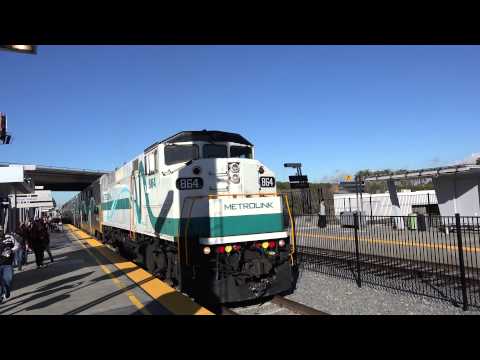
A Metrolink train
Once In the City. Orange County, California is home to 3 million people, about 350,000 of them in the City of Anaheim, a city founded in 1857 and, since its first settlers were German, they named it "Anaheim," German for "home by the Ana," meaning the Santa Ana River.
That total of 350,000 people would make Anaheim smaller than the smallest of New York City's Boroughs, Staten Island; but larger than any city in New York State other than New York City (topped by Buffalo with 260,000), New Jersey (Newark has 275,000) or Connecticut (Bridgeport has 145,000). Add neighboring Riverside County, and there's over 5.2 million people that are, by the standard I use for each of the various teams' spheres of influence, in the Angels' "market."
The Angels have played with that idea over the years. The change of name from "Los Angeles Angels" to "California Angels" upon their move to Anaheim in 1966 was to suggest them as a team for all of California, as an alternative to the high and mighty Dodgers, much more than it was to ride on the coattails of memories of the old Los Angeles Angels of the Pacific Coast League.
This was also before the A's arrived in Oakland and the Padres arrived in San Diego (like the Angels, replacing a PCL team of the same name), and when both of those teams arrived over the next 3 years, it pretty much took the wind out of the Angels' pan-California sails.
Angels owner Arturo "Arte" Moreno's 2005 change of name to "the Los Angeles Angels of Anaheim" was designed to tap into the nearly 10 million people then living in Los Angeles County, and the nearly 18 million people in the L.A. metropolitan area, 2nd in North America behind New York's 19 million. It didn't work, and in 2016, Moreno gave up the pretense, but dropped "of Anaheim" rather than "Los Angeles," and now, they're "the Los Angeles Angels" again.
But who's kidding who? Especially now that basketball legend Earvin "Magic" Johnson has bought the Dodgers, there's no way he's going to let Moreno outbid his team for the hearts and minds of Southern Californians, let alone Los Angelenos.
ZIP Codes in Orange County start with the digits 925, 926, 927 and 928; while the Area Code is 714, overlaid by 657. The sales tax in California is 7.5 percent, although it's an even 8 percent in Orange County. The Orange County Transportation Authority (OCTA) sells daily bus passes for $5.00. Despite its extensive freeway network, Los Angeles does not have a "beltway." The Los Angeles Department of Power and Water (LADPW) runs the electricity and the water for Los Angeles County, but Anaheim Public Utilities does it for Anaheim.
The population of the City of Los Angeles is about 47 percent Hispanic, 32 percent white, 11 percent Asian, and 10 percent black. For Orange County, it's very different: 47 percent white, 33 percent Hispanic, 18 percent Asian, but only 2 percent black.
Southern California has been plagued by racial strife since the beginning. People remember the Watts Riot of 1965 and the South Central Riot of 1992. But there was also the 1871 Los Angeles Anti-Chinese Riot, the 1907 Pacific Coast Race Riots, the 1929 Exeter Riot, the 1943 Zoot Suit Riot, the 1975 Chaffey High School Race Riot, the 2006 Fontana High School Riot, the 2006 California Prison Riots, and the 2008 Locke High School Riot.
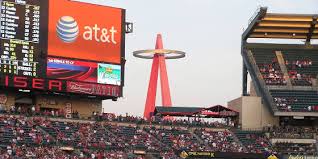
Going In. The official address of Angel Stadium is 2000 East Gene Autry Way. Originally known as Anaheim Stadium, built in 1966, the place was known as the Big A (sometimes hyphenated as "Big-A") because of the A-shaped scoreboard in left field.

In 1980, that board was moved out to the parking lot to be used as a message board, and replaced with a smaller A-shaped "crown" over the board on top of the football bleachers, used by the NFL's Los Angeles Rams when they played at the Big A from 1980 to 1994.
This increased capacity from the original 42,000 to 64,593, and got the stadium tagged "The Bigger A," before those bleachers were demolished in 1996 in an effort to restore a baseball-like sense of intimacy.

As could be expected from a suburban and/or California stadium, there is as much parking as you'll see anywhere. Parking is $20.
 Anaheim Stadium was renamed Edison International Field of Anaheim, or "Big Ed," for Southern California's electric company (equivalent to New York's Consolidated Edison), in 1998, and held that name when the Angels finally won a World Series in 2002. In 2003, new owner Moreno changed the name to Angel Stadium.
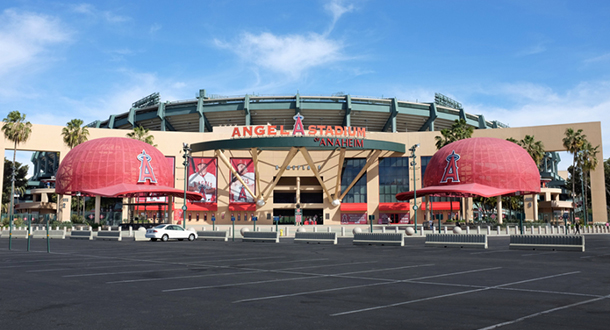
You'll most likely be going into the stadium through the home plate entrance. When you do, you're going to think you've been here before, even if you haven't. This is because of the vision of Arthur "Red" Patterson.
Red, the former publicity director for the Yankees (and the man who coined the phrase "tape measure home run" to describe the wallops of Mickey Mantle) and the Dodgers (including when they moved from Brooklyn to Los Angeles), worked for the early Angels, and wanted a stadium that would be like Yankee Stadium, but, by the standards of the 1960s, modern – in other words, no support poles, and more bathrooms and concession stands.
The result ended up being very much like an updated old Yankee Stadium, and the 1973-76 renovation of the Bronx ballyard made it resemble the Big A in main structure (though not in color).

The sign reading ANGEL STADIUM behind the home plate entrance is held up by giant crossed bats, and flanked by giant red Angel batting helmets.
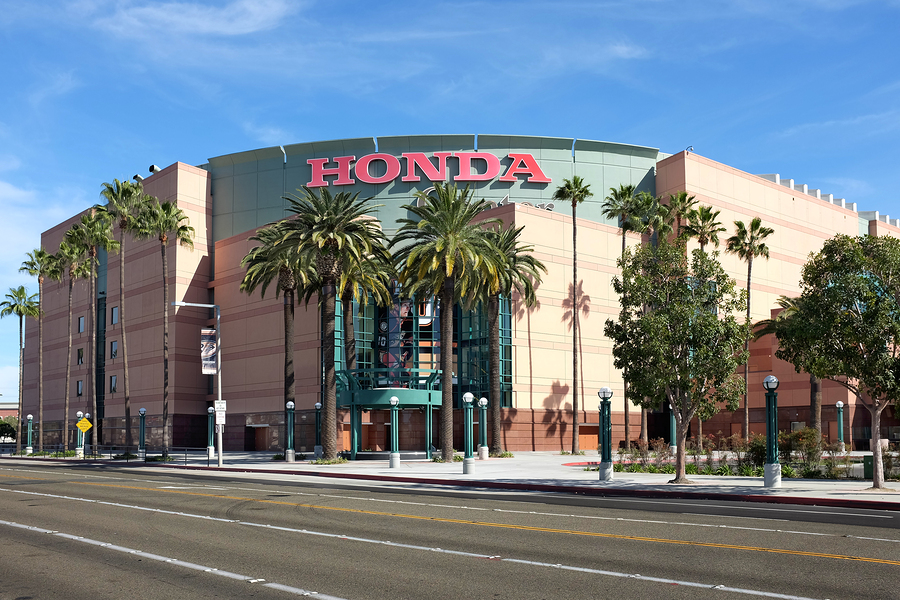
 Like all the West Coast ballparks, the Big A has real grass. The field points northeast, but the view is ordinary, as Anaheim doesn't exactly have a skyline. You can, however, see the Ducks' arena, the Honda Center, beyond the center-field fence.
The field is not quite symmetrical: It's 330 feet down the foul lines, 387 to left-center, 370 to right-center, and 400 to center. Like all the current West Coast ballparks, it is generally considered to be a pitchers' park. The longest home run in the stadium's 53-season history is fairly recent, a 484-footer hit by outed PED user Nelson Cruz in 2012.
 Beyond the outfield, installed as part of the 1997 renovation, there is a fountain, "the California Spectacular," which sends geysers of water down a tree-lined rocky area – and brings up thoughts of Royals Stadium/Kauffman Stadium in Kansas City.
And, while the old Big A scoreboard still stands, the biggest scoreboard inside the stadium is no longer in left field but in right, echoing the home of the original Los Angeles Angels, Wrigley Field. (More about this West Coast version of Wrigley later.)
 And on top of the scoreboard is an ad for... the Los Angeles Times, not the Orange County Register. Moreno has decided to do what the owners of the other "second teams" – the Mets, the Chicago White Sox and the Oakland Athletics – have in recent times refused to do: Fight the older, established teams for a majority of fans in the metro area.
He won't move the team into the County, much less into the City, of Los Angeles -- after all, why waste a perfectly suitable, if not perfect, ballpark? -- but he was the one who changed the names of the team and the ballpark, so that it would no longer be an Anaheim or an Orange County team, but a team that, theoretically, would represent all of Southern California.
 Which was exactly the opposite of what was intended when the Walt Disney Company bought the team from Gene Autry's widow Jackie: They figured that Orange County, growing like gangbusters during the team's existence, now over half a century, was enough, and building loyalty to Orange County would work. They were right: It did. But Moreno thinks bigger, and he is fighting the Dodgers for command of the metropolitan area.
It hasn't worked: 2011, the 51st season of combined play by the two area teams, was the 1st time the Angels had a higher attendance than the Dodgers: 39,090 to 36,236. But with Magic running the Dodgers and heavily committed to restoring their former glory, Moreno -- who went from being the richest MLB owner on the West Coast to being the poorest MLB owner in the Los Angeles area -- is losing the fight for area fans' hearts and minds.
Still, the Angels have been seen as a model franchise the last few years, and the Dodgers, under the ownership of Frank McCourt, were not. And the Angels were by far the more successful team in the 2000s, but that has completely turned around in the 2010s. While the Angels still have SoCal's most recent World Series win, they no longer have its most recent Pennant.
In addition to the Angels and the Rams, Angel Stadium, under the Anaheim Stadium name, was the home field for the Southern California Sun of the World Football League in 1974 and '75, the California Surf of the old North American Soccer League from 1978 to '81, and college football's Freedom Bowl from 1984 to '94. It has hosted 2 games by the U.S. soccer team, within 4 days of each other in January 1996, both wins, over Trinidad & Tobago and El Salvador. Also in 1996, the stadium hosted 5 games of the CONCACAF Gold Cup.
The Honda Center, home of the Ducks, is 1 mile away; Dignity Health Sports Park in Carson, home of the Galaxy, 24; the Crypto.com Arena in downtown Los Angeles, home of the Lakers, Clippers and Kings, 30; Dodger Stadium, 31; the Los Angeles Coliseum, home of USC football and temporary home of the Rams, and Banc of California Stadium, home of MLS' Los Angeles FC, 32; the Forum and SoFi Stadium in Inglewood, 33; the Rose Bowl in Pasadena, also the home of UCLA football, 35; Pauley Pavilion and the UCLA campus, 42.
Food. Aramark Sports & Entertainment, the successor corporation to the Harry M. Stevens Company that invented ballpark concessions, provides food and beverage services for the Big A. However, there is little that is unusual or special about Anaheim food.
In fact, back in 1985, when the football bleachers were up, Bob Wood, a junior high school history teacher who was going to all 26 ballparks then in the majors, reported for his book Dodger Dogs to Fenway Franks that the main purpose of the Anaheim Stadium scoreboard (the successor to the Big-A board) was not to give you details about the game you were watching, but "to remind you... that Coke is It!"
(Hey, at least it wasn't that giant "This Bud's For You" sign on top of the Shea Stadium scoreboard, which, during the scoreboard's electronic rotation, would occasionally remind you to not drink and drive.)
A recent Thrillist article discussed the best food at each MLB stadium. What's the best in Anaheim? Fish, specifically trout, in honor of Mike Trout? Nope: They named Chronic Tacos, a local chain with a stand at Section 223. The article calls them "Five-tool tacos (delicious, cheap, pork, spicy, for sale)." Sounds like typical suburban Southern California: They want the benefits of Los Angeles multiculturalism, without actually having to be around large numbers of people in said cultures.
Team History Displays. A series of flagpoles beyond the left-field fence has pennants for the Angels' 2002 World Series win and their AL West titles of 1979, '82, '86, 2004, '05, '07, '08, '09 and '14.
 The team's retired numbers are displayed beneath the big scoreboard in right field: 11, Jim Fregosi, shortstop 1961-71 & manager 1978-81; 26, Gene Autry, owner 1961-98 (number chosen for him because he was "the 26th Man"); 29, Rod Carew, 1st base 1979-85; 30, Nolan Ryan, pitcher, 1972-79 (obtained in a trade with the Mets for Fregosi, just thought I'd rub that in); 50, Jimmie Reese, coach 1972-94 (also L.A. area native, and Yankee teammate of Babe Ruth); and the universally-retired Number 42 of Jackie Robinson.
 Not officially retired, but removed from circulation, are: 1, Bengie Molina, catcher, 1998-2005; 15, Tim Salmon, right field 1992-2006; 34, Nick Adenhart, pitcher, 2008-09, killed by a drunk driver at the start of his 2nd big-league season; and 45, Tyler Skaggs, pitcher, 2014-19, dead of a drug overdose in his hotel room during a team roadtrip.
Going In. The official address of Angel Stadium is 2000 East Gene Autry Way. Originally known as Anaheim Stadium, built in 1966, the place was known as the Big A (sometimes hyphenated as "Big-A") because of the A-shaped scoreboard in left field.

1966-79 configuration
This increased capacity from the original 42,000 to 64,593, and got the stadium tagged "The Bigger A," before those bleachers were demolished in 1996 in an effort to restore a baseball-like sense of intimacy.

1980-96 configuration

The Big A scoreboard today, as seen over the right field stands
You'll most likely be going into the stadium through the home plate entrance. When you do, you're going to think you've been here before, even if you haven't. This is because of the vision of Arthur "Red" Patterson.
Red, the former publicity director for the Yankees (and the man who coined the phrase "tape measure home run" to describe the wallops of Mickey Mantle) and the Dodgers (including when they moved from Brooklyn to Los Angeles), worked for the early Angels, and wanted a stadium that would be like Yankee Stadium, but, by the standards of the 1960s, modern – in other words, no support poles, and more bathrooms and concession stands.
The result ended up being very much like an updated old Yankee Stadium, and the 1973-76 renovation of the Bronx ballyard made it resemble the Big A in main structure (though not in color).
1997-present configuration
The field is not quite symmetrical: It's 330 feet down the foul lines, 387 to left-center, 370 to right-center, and 400 to center. Like all the current West Coast ballparks, it is generally considered to be a pitchers' park. The longest home run in the stadium's 53-season history is fairly recent, a 484-footer hit by outed PED user Nelson Cruz in 2012.
And, while the old Big A scoreboard still stands, the biggest scoreboard inside the stadium is no longer in left field but in right, echoing the home of the original Los Angeles Angels, Wrigley Field. (More about this West Coast version of Wrigley later.)
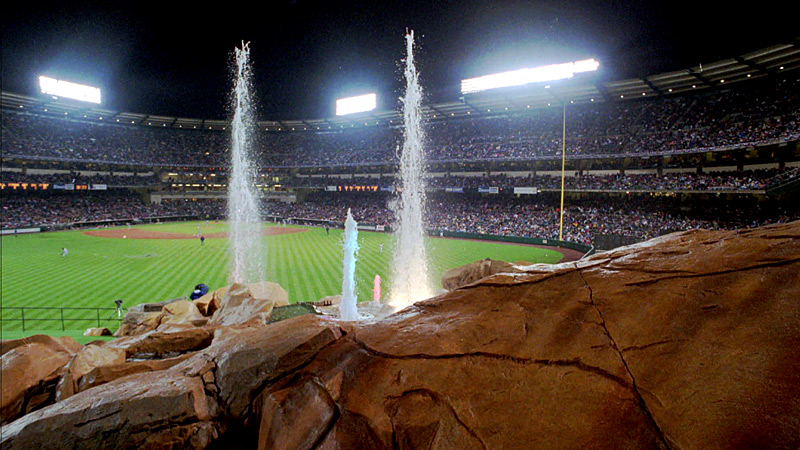
He won't move the team into the County, much less into the City, of Los Angeles -- after all, why waste a perfectly suitable, if not perfect, ballpark? -- but he was the one who changed the names of the team and the ballpark, so that it would no longer be an Anaheim or an Orange County team, but a team that, theoretically, would represent all of Southern California.
It hasn't worked: 2011, the 51st season of combined play by the two area teams, was the 1st time the Angels had a higher attendance than the Dodgers: 39,090 to 36,236. But with Magic running the Dodgers and heavily committed to restoring their former glory, Moreno -- who went from being the richest MLB owner on the West Coast to being the poorest MLB owner in the Los Angeles area -- is losing the fight for area fans' hearts and minds.
Still, the Angels have been seen as a model franchise the last few years, and the Dodgers, under the ownership of Frank McCourt, were not. And the Angels were by far the more successful team in the 2000s, but that has completely turned around in the 2010s. While the Angels still have SoCal's most recent World Series win, they no longer have its most recent Pennant.
In addition to the Angels and the Rams, Angel Stadium, under the Anaheim Stadium name, was the home field for the Southern California Sun of the World Football League in 1974 and '75, the California Surf of the old North American Soccer League from 1978 to '81, and college football's Freedom Bowl from 1984 to '94. It has hosted 2 games by the U.S. soccer team, within 4 days of each other in January 1996, both wins, over Trinidad & Tobago and El Salvador. Also in 1996, the stadium hosted 5 games of the CONCACAF Gold Cup.
The Honda Center, home of the Ducks, is 1 mile away; Dignity Health Sports Park in Carson, home of the Galaxy, 24; the Crypto.com Arena in downtown Los Angeles, home of the Lakers, Clippers and Kings, 30; Dodger Stadium, 31; the Los Angeles Coliseum, home of USC football and temporary home of the Rams, and Banc of California Stadium, home of MLS' Los Angeles FC, 32; the Forum and SoFi Stadium in Inglewood, 33; the Rose Bowl in Pasadena, also the home of UCLA football, 35; Pauley Pavilion and the UCLA campus, 42.
Food. Aramark Sports & Entertainment, the successor corporation to the Harry M. Stevens Company that invented ballpark concessions, provides food and beverage services for the Big A. However, there is little that is unusual or special about Anaheim food.
In fact, back in 1985, when the football bleachers were up, Bob Wood, a junior high school history teacher who was going to all 26 ballparks then in the majors, reported for his book Dodger Dogs to Fenway Franks that the main purpose of the Anaheim Stadium scoreboard (the successor to the Big-A board) was not to give you details about the game you were watching, but "to remind you... that Coke is It!"
(Hey, at least it wasn't that giant "This Bud's For You" sign on top of the Shea Stadium scoreboard, which, during the scoreboard's electronic rotation, would occasionally remind you to not drink and drive.)
A recent Thrillist article discussed the best food at each MLB stadium. What's the best in Anaheim? Fish, specifically trout, in honor of Mike Trout? Nope: They named Chronic Tacos, a local chain with a stand at Section 223. The article calls them "Five-tool tacos (delicious, cheap, pork, spicy, for sale)." Sounds like typical suburban Southern California: They want the benefits of Los Angeles multiculturalism, without actually having to be around large numbers of people in said cultures.
Team History Displays. A series of flagpoles beyond the left-field fence has pennants for the Angels' 2002 World Series win and their AL West titles of 1979, '82, '86, 2004, '05, '07, '08, '09 and '14.

In fact, the team has had an inordinate amount of tragedy. In addition to Adenhart and Skaggs:
* Dick Wantz, a pitcher, pitched 1 inning in the major leagues, with the Angels on April 13, 1965, and was dead of a brain tumor just 1 month later. His Number 25 has been worn since, including by All-Star outfielder Don Baylor, and is currently assigned to pitcher Michael Lorenzen.
* Bruce Heinbechner, also a pitcher, had 2 good seasons with the Angels' Class AAA affiliate, and was expected to make the team out of Spring Training in 1974, but was killed in a car crash, less than half a mile from the team's hotel.
* Mike Miley had been a star quarterback at Louisiana State University, and had played shortstop for the Angels in the 1975 and '76 seasons, but was killed in a car crash before the 1977 season. His Number 21 has been given out since, including to All-Star 1st baseman Wally Joyner, but is not currently being worn.
* Lyman Bostock, one of the top young hitters in the game, was shot and killed toward the end of the 1978 season, in a case of mistaken identity. His Number 10 is not retired, officially or otherwise, but is not currently being worn.
* Donnie Moore had been the Angels' closer for most of the 1980s, but never emotionally recovered from giving up a key home run in the 1986 American League Championship Series. He was released by the Angels during the 1988 season. A year later, he shot his wife, then himself. She survived. He didn't. His Number 37 remained in circulation, and is currently worn by outfielder Magneuris Sierra.
The team has an Angels Hall of Fame, although I don't know where in the ballpark the display is. The 14 individual members include:
* From the 1960s: Autry, Fregosi, pitcher Dean Chance (Number 31), and 2nd baseman Bobby Knoop (Number 1).
* From the 1979 Division Champions: Autry, Fregosi, Reese, Knoop (now a coach), Ryan, Carew, 2nd baseman Bobby Grich (Number 4), outfielder-DH Don Baylor (Number 25), and catcher Brian Downing (Number 5).
* From the 1982 Division Champions: Autry, Reese, Knoop, Carew, Grich, Baylor, Downing, and pitcher Mike Witt (Number 39).
* From the 1986 Division Champions: Autry, Reese, Knoop, Downing (by this point, a left fielder), Witt, and pitcher Chuck Finley (Number 31).
* From the 1995 team that led the Division most of the way, but had an epic collapse and lost a Playoff to the Seattle Mariners: Autry, Knoop, Finley, Salmon, and left fielder Garret Anderson (Number 16).
* From the 2002 World Champions; Salmon and Anderson. In addition, the 2002 team was elected as a whole. Salmon was also there for the Division titles of 2004, but not '05, as he was injured all season, and retired after '06. Anderson was there for the 2004, '05, '07 and '08 Division Champions. Right fielder Vladimir Guerrero Sr. arrived in 2004, and was there for the '04, '05, '07, '08 and '09 Division Champions. As yet, no players who played on the 2014 Division Champions has been elected.

Brian Downing's Angels Hall of Fame plaque.
He hit 222 of his 275 career home runs with the Angels.
When he left in 1990, he was their career leader in games,
at-bats, runs, hits, total bases, doubles, home runs, RBIs,
extra-base hits, walks and sacrifice flies.
In 1990, the idea of either the Cubs or the Angels reaching the World Series was "fantasy baseball": It could only take place in the movies. The Angels also won a Pennant in the 1994 version of Angels In the Outfield, in which they, like the Pittsburgh Pirates in the 1951 original version, were considered so bad that they needed divine intervention. How much of a fantasy was that? As it turned out, nobody won the Pennant in 1994, because Commissioner Bud Selig canceled the postseason due to the strike.
It's not that Gene Autry wasn't willing to spend big to try. In 1982, the Angels had Reggie Jackson (leading the league in home runs), Rod Carew, Don Baylor, Fred Lynn, Brian Downing, Bobby Grich Bob Boone, Rick Burleson and Doug DeCinces. Their pitching staff included Tommy John, Luis Tiant, Stan Bahnsen, Ken Forsch, Steve Renko, Bruce Kison, John Curtis and Mike Witt. They had all of those guys, all at the same time. The Yankees, the Red Sox and the Royals all had down years compared to what they had been doing. And the Orioles just missed the Playoffs. And they had a two games to none lead in the ALCS, when it was best three out of five. And they still couldn't win a Pennant.
A lot of sports movies are set in the Los Angeles area, to be close to the Hollywood studios and the stars' homes. Particularly when they need outdoor sports, they will use Dodger Stadium or the Los Angeles Coliseum. But Anaheim Stadium couldn't be used for the Angels In the Outfield remake, because damage from the Northridge Earthquake was still being repaired. Overhead shots from file footage were used, but while the damage to the stadium was repaired in time for Opening Day, filming was moved to the Oakland Coliseum.
The Angels were also the home team in the 1988 film The Naked Gun, with Leslie Nielsen doing his deadpan comedy/dumb hero bit, as LAPD Lieutenant Frank Drebin trying to stop a brainwashed Reggie from assassinating Queen Elizabeth II: "I... must kill... the Queen." Drebin stopped Reggie. Of course, this wasn't in October.
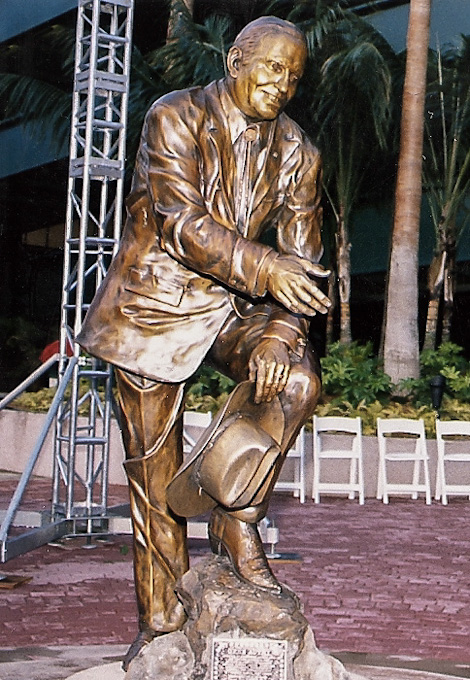
There is also a statue of Autry, near the front entrance. It shows him removing his cowboy hat, and bending down and reaching out, as if to shake hands with a child.
 In 1999, Ryan was named to the Major League Baseball All-Century Team. That same year, he, Carew and Reggie were named to The Sporting News' 100 Greatest Players. In 2006, Angels fans chose Carew, rather than Ryan or Reggie, in the DHL Hometown Heroes poll. In 2022, ESPN
named its 100 Greatest Baseball Players. Among players who played
significant time for the Angels, Mike Trout was (very prematurely) ranked 15th, Albert Pujols 30th, Nolan Ryan 42nd, Reggie Jackson 55th, Rod Carew 75th, and Vladimir Guerrero 77th.
In 1999, Ryan was named to the Major League Baseball All-Century Team. That same year, he, Carew and Reggie were named to The Sporting News' 100 Greatest Players. In 2006, Angels fans chose Carew, rather than Ryan or Reggie, in the DHL Hometown Heroes poll. In 2022, ESPN
named its 100 Greatest Baseball Players. Among players who played
significant time for the Angels, Mike Trout was (very prematurely) ranked 15th, Albert Pujols 30th, Nolan Ryan 42nd, Reggie Jackson 55th, Rod Carew 75th, and Vladimir Guerrero 77th.
A lot of sports movies are set in the Los Angeles area, to be close to the Hollywood studios and the stars' homes. Particularly when they need outdoor sports, they will use Dodger Stadium or the Los Angeles Coliseum. But Anaheim Stadium couldn't be used for the Angels In the Outfield remake, because damage from the Northridge Earthquake was still being repaired. Overhead shots from file footage were used, but while the damage to the stadium was repaired in time for Opening Day, filming was moved to the Oakland Coliseum.
The Angels were also the home team in the 1988 film The Naked Gun, with Leslie Nielsen doing his deadpan comedy/dumb hero bit, as LAPD Lieutenant Frank Drebin trying to stop a brainwashed Reggie from assassinating Queen Elizabeth II: "I... must kill... the Queen." Drebin stopped Reggie. Of course, this wasn't in October.
There is also a statue of Autry, near the front entrance. It shows him removing his cowboy hat, and bending down and reaching out, as if to shake hands with a child.
The Angels' rivalries with the other AL Western Division teams -- present members the Oakland Athletics, the Seattle Mariners and the Texas Rangers; and former members the Chicago White Sox, the Kansas City Royals and the Minnesota Twins -- don't mean as much to their fans as the so-called "Freeway Series" in Interleague Play with the Los Angeles Dodgers. Despite the Dodgers being the more successful team, both historically and recently, the Angels lead the series, 73-67. The Angels have won 11 season series, the Dodgers 7, and there have been 8 season splits.
Stuff. The Angels have Team Stores in a few locations in the Big A. Additional merchandise locations and novelty kiosks are open throughout the stadium during all home games. I do not know if they sell plastic halos or stuffed Rally Monkeys, but it would understandable (if silly) if they did.
There haven't been a whole lot of books written about the Angels, in spite of their no longer being an expansion team. Amazon.com lists The Official History of the Los Angeles Angels of Anaheim as being available, and there are a few generic books about the team, including Salmon's recently-released memoir Always an Angel: Playing the Game With Fire and Faith.
There is no team-history DVD available, no Essential Games of the Angels or Essential Games of Angel Stadium DVD collection. But the 2002 World Series official highlight film is available.
During the Game. A recent Thrillist article on "Baseball's Most Intolerable Fans" ranked Angel fans 16th, right in the middle. The article suggests that Angel fans aren't particularly smart: "Deep down they all know 'Los Angeles Angels of Anaheim' is the dumbest shit ever, but none of them will actually admit it."
There is no team, except maybe the Dodgers, that Angel fans hate more than the Yankees, but they do fit the Southern California "laid-back" stereotype. They will not initiate violence against you.
None of the 3 games in this Yankees-Angels series will feature a promotion. The Angels take the field to the song "Calling All Angels" by Train – not to be confused with "Trouble In Paradise" by the Brooklyn doo-wop group Johnny Maestro & the Crests, which starts with the words "Calling all angels." I like that song, but I don't like the Train song. They hold auditions for National Anthem singers, instead of having a regular.
The Angels don't have a guy in a suit to act as a mascot, but they do have the Rally Monkey. Thankfully, the damn thing only appears on the video board if the Angels are losing or tied during the 7th inning, holding a sign saying, "RALLY TIME!" and jumping to the song "Jump Around" by House of Pain – whose frontman, Erik "Everlast" Schrody, is a Long Island native who, due to his New York and Irish heritage, sometimes calls himself "Whitey Ford." (He even titled an album Whitey Ford Sings the Blues and another Eat at Whitey's.)

I hope both Everlast and the Yankees' Whitey Ford get royalties from the Angels. If the Angels win, he returns to the video board, holding up a sign saying, "ANGELS WIN!"
The Angels also appear to have been the 1st North American sports team to give their fans those annoying long plastic balloons called Thunderstix. Like the damn monkey, that, alone, is a reason to be furious with them.
During the 7th Inning Stretch, after playing "Take Me Out to the Ballgame," they play "Build Me Up Buttercup" by the Foundations. I don't like that song, either. (Remember, just because it's an old song doesn't necessarily mean I like it.) Their postgame victory song is "Paradise City." Even though Guns N' Roses were a Los Angeles-based band, the video for the song was filmed at Giants Stadium.
Stuff. The Angels have Team Stores in a few locations in the Big A. Additional merchandise locations and novelty kiosks are open throughout the stadium during all home games. I do not know if they sell plastic halos or stuffed Rally Monkeys, but it would understandable (if silly) if they did.
There haven't been a whole lot of books written about the Angels, in spite of their no longer being an expansion team. Amazon.com lists The Official History of the Los Angeles Angels of Anaheim as being available, and there are a few generic books about the team, including Salmon's recently-released memoir Always an Angel: Playing the Game With Fire and Faith.
There is no team-history DVD available, no Essential Games of the Angels or Essential Games of Angel Stadium DVD collection. But the 2002 World Series official highlight film is available.
During the Game. A recent Thrillist article on "Baseball's Most Intolerable Fans" ranked Angel fans 16th, right in the middle. The article suggests that Angel fans aren't particularly smart: "Deep down they all know 'Los Angeles Angels of Anaheim' is the dumbest shit ever, but none of them will actually admit it."
There is no team, except maybe the Dodgers, that Angel fans hate more than the Yankees, but they do fit the Southern California "laid-back" stereotype. They will not initiate violence against you.
None of the 3 games in this Yankees-Angels series will feature a promotion. The Angels take the field to the song "Calling All Angels" by Train – not to be confused with "Trouble In Paradise" by the Brooklyn doo-wop group Johnny Maestro & the Crests, which starts with the words "Calling all angels." I like that song, but I don't like the Train song. They hold auditions for National Anthem singers, instead of having a regular.
The Angels don't have a guy in a suit to act as a mascot, but they do have the Rally Monkey. Thankfully, the damn thing only appears on the video board if the Angels are losing or tied during the 7th inning, holding a sign saying, "RALLY TIME!" and jumping to the song "Jump Around" by House of Pain – whose frontman, Erik "Everlast" Schrody, is a Long Island native who, due to his New York and Irish heritage, sometimes calls himself "Whitey Ford." (He even titled an album Whitey Ford Sings the Blues and another Eat at Whitey's.)
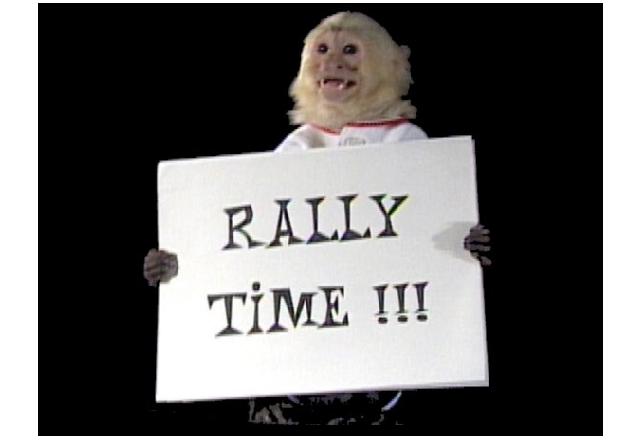
The damn thing
I hope both Everlast and the Yankees' Whitey Ford get royalties from the Angels. If the Angels win, he returns to the video board, holding up a sign saying, "ANGELS WIN!"
The Angels also appear to have been the 1st North American sports team to give their fans those annoying long plastic balloons called Thunderstix. Like the damn monkey, that, alone, is a reason to be furious with them.
During the 7th Inning Stretch, after playing "Take Me Out to the Ballgame," they play "Build Me Up Buttercup" by the Foundations. I don't like that song, either. (Remember, just because it's an old song doesn't necessarily mean I like it.) Their postgame victory song is "Paradise City." Even though Guns N' Roses were a Los Angeles-based band, the video for the song was filmed at Giants Stadium.
After the Game. Angel Stadium is yet another of those 1960s-70s suburban islands in a sea of parking, so you won't be in any neighborhood, much less in a bad one.
The closest thing I could find to a Yankee-friendly bar near the Anaheim arena and stadium was the Katella Grill, at 1325 W. Katella Avenue in Orange, about 3 miles away, across the Santa Ana River. It got some praise from New Yorkers as a nice place. But it is now listed as permanently closed.
Rick's Tavern On Main is the home of the L.A. area's Yankees fan club. 2907 Main Street in Santa Monica, 2 blocks in from the beach. Bus 733 from downtown L.A. (While the 1970s sitcom Three's Company was set in Santa Monica, close to the beach, I cannot confirm that Rick's was the basis for the Regal Beagle.) West 4th & Jane is owned by a New Yorker and is an L.A.-area haven for Met fans. 1432 4th Street, Santa Monica. Bus R10.
O'Brien's Irish Pub at 2226 Wilshire Blvd. in Santa Monica is the home of the local fan club of the New York Giants football team. Bus R10. (Although it's also in Santa Monica, it's 3 miles in from the beach and Rick's.) On The Thirty is the home of L.A. area Jets fans. 14622 Ventura Blvd., Sherman Oaks. Metro Red Line to Universal/Studio City, then transfer to Bus 150. I have been unable to find a corresponding Met fans' bar.
If your visit to Los Angeles is during the European soccer season (which is in progress), the best soccer bar in the L.A. area is The Fox & Hounds (that's plural), 11100 Ventura Blvd., Studio City. Metro Red Line to Universal/Studio City, then Bus 150 or 240 to Ventura & Arch.
Sidelights. On November 30, 2018, Thrillist published a list of "America's 25 Most Fun Cities." As you might guess, the country's 2nd biggest metropolitan area came in 2nd, behind the biggest, New York.
The Los Angeles metropolitan area, in spite of not having Major League Baseball until 1958, has a very rich sports history. And while L.A. is still a car-first city, it does have a bus system and even has a subway now. You'll need it to visit during the 2028 Olympics, which L.A. has been awarded.
* Honda Center. Previously known as the Arrowhead Pond of Anaheim, it is across the railroad, the Orange Freeway and Katella Avenue from Angel Stadium. It has been home from the beginning of the franchise in 1993 to the NHL's Anaheim Ducks – formerly the Mighty Ducks of Anaheim, and I still tend to call them the Mighty Dorks and the Mighty Schmucks (and one of my regular readers likes to call them the Lame Ducks).
* Anaheim Convention Center. With the Angels having opened house in Orange County in 1966, prospective owners of teams in other sports began to consider the area. This complex opened in 1967, and includes a 7,500-seat arena.
That year, it became the home of a charter team in the American Basketball Association, the Anaheim Amigos, who couldn't even come close to filling the small capacity, averaging just 1,293 fans per home game. I've been to many a high school basketball game with more attendees than that. So the team moved up the freeway to the L.A. Sports Arena, and became the Los Angeles Stars. They were no more successful there, and moved to Salt Lake City, where, as the Utah Stars, they won the 1971 ABA title.
The ACC was home to the Anaheim Oranges of World Team Tennis in 1978, the California Surf of the indoor version of the old North American Soccer League in 1979-80, the wrestling matches of the 1984 Olympics, and the Big West Conference basketball tournaments (men's and women's) from 2001 to 2010. But if you don't count the ABA, then it's hosted exactly 1 major league sporting event ever, and then only as an emergency: On May 3, 1992, with the South Central riots still raging mere blocks from the Sports Arena, the Clippers moved Game 4 of their Playoff series with the Utah Jazz to the ACC, and won 115-107.
The Los Angeles Kings have never played at the Anaheim Convention Center. Nor have the Sacramento Kings. But the King of Rock and Roll, Elvis Presley, sang here on April 23 and 24, 1973 and November 30, 1976.
The ACC is now the largest exhibit facility on the West Coast. 800 W. Katella Avenue, across the street from Disneyland, about 2 miles west of Angel Stadium, and about 2 1/2 miles west of the Honda Center. Bus 50 goes down Katella between the venues.
* Dodger Stadium. Walter O'Malley's Temple of Greed has been home to the Bums since 1962 -- shockingly, for those of us raised on the myth of the Brooklyn Dodgers, that not only means it's lasted longer than Ebbets Field did, but it's now the 3rd-oldest stadium in the majors, behind only Fenway Park and Wrigley Field. (Angel Stadium is 4th, a few months older than the Oakland Coliseum.) However, the place is now in the process of being modernized, little by little, and Magic fully intends that, having seen a 50th Anniversary, the Chavez Ravine amphitheatre will see a 100th.
The Dodgers groundshared with the Angels from 1962 to 1965, although the Angels, not wanting to promote the Dodgers, printed tickets that gave the name of the neighborhood, "Chavez Ravine," instead of "Dodger Stadium." Fed up with O'Malley, Gene Autry had the Anaheim stadium built, and got out.

It has never hosted a pro football or soccer team, but there have been college football games played there. The Beatles played their next-to-last concert at Dodger Stadium on August 28, 1966, before concluding their last tour up the coast at Candlestick Park the next night. It didn't host another concert until 1975, when Elton John sold it out on back-to-back nights (wearing a sequined Dodger jersey designed by Bob Mackie), and then not again until the Jacksons' 1984 Victory Tour. Pope John Paul II delivered a Mass there in 1987, and the Three Tenors held a concert there, telecast worldwide, on July 16, 1994, in conjunction with the World Cup. During a 2008 concert, Madonna brought on Britney Spears (they didn't kiss this time) and Justin Timberlake as guests.
1000 Vin Scully Avenue (formerly Elysian Park Avenue), Los Angeles. Too far to walk from the nearest subway stop, and while there is a Dodger Stadium Express bus, it only operates on Dodger home game days.
* Wrigley Field. Yes, you read that right: The Pacific Coast League's Los Angeles Angels played here from 1925 to 1957, and the AL's version played their first season here, 1961. The PCL Angels were a farm team of the Chicago Cubs, and when chewing-gum magnate William Wrigley Jr. bought them both, he built the Angels' park to look like what was then known as Cubs Park, and then named this one, and then the Chicago one, Wrigley Field. So this ballpark was Wrigley Field first. The Angels' PCL rivals, the Hollywood Stars, shared it from 1926 to 1935. Its capacity of 22,000 was too small for the Dodgers, and the AL Angels moved out after one season.

Torn down in 1966, it lives on in ESPN Classic rebroadcasts of Home Run Derby, filmed there (because it was close to Hollywood) prior to the 1960 season. Mickey Mantle was a fixture, but the only other guy thought of as a Yankee to participate was Bob Cerv (then with the Kansas City A's). Yogi Berra wasn't invited, nor was Moose Skowron, nor Roger Maris (who had yet to play his first game in Pinstripes).
This Wrigley Field hosted 2 fights for the Heavyweight Championship of the World, both won by the defending Champions: Joe Louis knocking Jack Roper out in the 1st round on April 17, 1939; and Floyd Patterson defeating Roy Harris by decision on August 18, 1958.
* Gilmore Field. Home to the Hollywood Stars, this 13,000-seat park didn't last long, from 1939 to 1957. The Stars won PCL Pennants here in 1949, 1952 and 1953. A football field, Gilmore Stadium, was adjacent. CBS Television City was built on the site. 7700 Beverly Blvd. at The Grove Drive. Metro Red Line to Vermont/Beverly station, then either the 14 or 37 bus.
* Los Angeles Memorial Coliseum. Probably the most famous building in the State of California, unless you count San Francisco's Golden Gate Bridge or the HOLLYWOOD sign. The University of Southern California (USC) has played football here since 1923. The University of California at Los Angeles (UCLA) played here from 1928 to 1981, when they inexplicably moved out of the Coliseum, and the city that forms their name, into a stadium that could arguably be called USC's other home field.
The Coliseum was the centerpiece of the 1932 and 1984 Olympic Games. It was home to the NFL's Rams from 1946 to 1979 and the Raiders from 1982 to 1994, and to a number of teams in other leagues, including the AFL's Chargers in 1960 before they moved down the coast to San Diego.
The Dodgers played here from 1958 to 1961 while waiting for Dodger Stadium to be ready, but the shape of the field led to a 251-foot left-field fence, the shortest in modern baseball history. They got the biggest crowd ever for an official baseball game, 92,706, for Game 5 of the 1959 World Series; 93,103 for Roy Campanella's testimonial, an exhibition game against the Yankees on May 7, 1959; and the largest crowd for any baseball game played anywhere in the world, 115,300, for a preseason exhibition with the Red Sox on March 29, 2008, to celebrate their 50th Anniversary in L.A.
A crowd of 102,368 on November 10, 1957, for a rivalry game between the Rams and the San Francisco 49ers, stood as a regular-season NFL record until 2005. Ironically, the first Super Bowl, held here on January 15, 1967 (Green Bay Packers 35, Kansas City Chiefs 17) was only 2/3rds sold -- the only Super Bowl that did not sell out. Super Bowl VII (Miami Dolphins 14, Washington Redskins 7) was also played here.
It has hosted 20 matches of the U.S. soccer team -- only Robert F. Kennedy Stadium in Washington has hosted more. The U.S. has won 9 of those games, lost 7 and drawn 4.
Officially, the Coliseum now seats 93,607, and will be the stopgap home for the returned Rams until the 2019 season, as their new stadium in Inglewood won't be ready until 2020. Oddly, since both teams moved away after the 1994 season, the Oakland Raiders seem to be the most popular NFL team in Los Angeles County, but the much closer San Diego Chargers, 90 miles away, are the most popular team in Orange County. Both teams have been rumored to be among those moving to Los Angeles. The Jacksonville Jaguars have also been mentioned as a possibility.
In 2018, wanting the money from selling naming rights, but not wanting to ruin the brand name that "The Los Angeles Memorial Coliseum" has become, or to insult the veterans of the City and the County of Los Angeles by taking the name off, the Coliseum Commission sold naming rights to the field, but not the stadium. It is now United Airlines Field at Los Angeles Memorial Coliseum.
* Banc of California Stadium and site of Los Angeles Memorial Sports Arena. Next-door to the Coliseum, The Sports Arena opened in 1959, and hosted the Democratic Convention the next year, although John F. Kennedy gave his acceptance speech at a packed Coliseum, debuting his theme of a "New Frontier."
The NBA's Lakers played there from 1960 to 1967, the NHL's Kings their first few home games in 1967 before the Forum was ready, the NBA's Clippers from 1984 to 1999, the ABA's Stars from 1968 to 1970, the WHA's Sharks from 1972 to 1974, the 1968 and 1972 NCAA Final Fours (both won by UCLA even though it was USC's home court, the 1st over North Carolina, the 2nd over Florida State), USC basketball from 1959 to 2006, and UCLA basketball a few times before Pauley Pavilion opened in 1965 and again in 2011-12 due to Pauley's renovation.
Due to its closeness to Hollywood studios, the Sports Arena was often used for movies that need an arena to simulate a basketball or hockey game, a fight (including the Rocky films), a concert, or a political convention. Lots of rock concerts were held here, and Bruce Springsteen, on its stage, called the building "the joint that don't disappoint" and "the dump that jumps."
Bruce played the Sports Arena's last event. It has been demolished, so that Banc of California Stadium, the home of the Major League Soccer expansion team, Los Angeles FC, could be built on the site. LAFC will play its 1st home game there on Sunday, April 29, the day this Yankees-Angels series ends. Angel City FC of the National Women's Soccer League began play there this year.
3900 Block of S. Figueroa Street, just off the USC campus in Exposition Park. The California Science Center (including the space shuttle Endeavour), the Natural History Museum of Los Angeles County, and the California African American Museum are also there, and the Shrine Auditorium, former site of the Academy Awards, is but a few steps away. Metro Expo Line to Expo Park/USC. Although this is on the edge of South Central, you will probably be safe.
* Galen Center. In 2006, USC basketball finally had a home it owned, and at which it had first choice of scheduling -- ironic, considering their having first choice at the Coliseum infuriated the Rosenblooms of the Rams, the Hiltons of the Chargers, and Al Davis of the Raiders, and made the Spanoses of the Chargers decide not to use it until the Inglewood stadium opens.
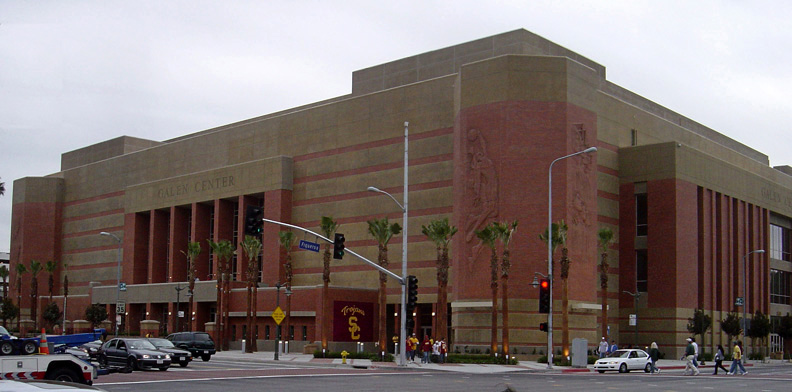 Seating 10,258, it is named for Louis and Helen Galen, bankers and longtime USC fans who donated $50 million, which turned out to be 1/3rd of the building's cost. The Jim Sterkel Court is named for a USC basketball player who died of cancer. On May 10, 2014, the vacant WBC Heavyweight Championship was awarded there when Bermane Stiverne knocked Chris Arreola out there.
3400 S. Figueroa Street, 5 blocks north of the Coliseum, and to the east of USC's main campus.
* Rose Bowl. Actually older than the Coliseum by a few months, it opened in 1922 and, except for 1942 (moved to Durham, North Carolina for fear of Japanese attack right after Pearl Harbor), it has hosted the Rose Bowl game every New Year's Day (or thereabouts) since 1923. As such, it has often felt like a home away from home for USC, Michigan and Ohio State. UCLA has used it as its home field since the 1982 season.
It hosted 5 Super Bowls, including the first ones won by the Raiders (XI) and Giants (XXI), plus the all-time biggest attendance for an NFL postseason game, 103,985, for SB XIV (Pittsburgh Steelers 31, Rams 19, the "home" field advantage not helping the Hornheads). And it hosted the 1983 Army-Navy Game, with Hollywood legend Vincent Price serving as the referee. The transportation of the entire Corps of Cadets, and the entire Brigade of Midshipmen, was said to be the largest U.S. military airlift since World War II.
It's hosted 17 games of the U.S. soccer team, the most recent being a 3-2 loss to Mexico in last year's CONCACAF Gold Cup. It's hosted several games of the 1994 World Cup, including a Semifinal and the Final. It also hosted several games of the 1999 Women's World Cup, including the Final, a.k.a. the Brandi Chastain Game. It was the original home of MLS' L.A. Galaxy, from 1996 to 2002. And it has been selected by the U.S. Soccer Federation as a finalist to be one of the host venues for the 2026 World Cup.
Rose Bowl Drive & Rosemont Avenue. Number 485 bus from Union Station to Pasadena, switch to Number 268 bus.
* Edwin W. Pauley Pavilion. Following their 1964 (and soon their 1965) National Championship, UCLA coach John Wooden wanted a suitable arena for his ever-growing program. He got it in time for the 1965-66 season, and it has hosted 9 more National Championships, making for 11 banners (10 coached by Wooden).
The building was named for an oil magnate who was also a Regent of the University of California system, whose donation to its building went a long way toward making it possible. Edwin Pauley was a friend of, and appointee to several offices by, Presidents Franklin Roosevelt and Harry Truman, but the student protests of the 1960s led him to switch sides and support Ronald Reagan for Governor.
Pauley Pavilion was the site of the 2nd debate of the 1988 Presidential campaign, where CNN anchor Bernard Shaw asked the question that shattered the campaign of Governor Michael Dukakis – not that the Duke helped himself with his answer. Oddly, he held his Election Eve rally there, despite being a Bostonian. (In contrast, Boston's JFK held his Convention in the Coliseum complex but his Election Eve rally at the Boston Garden.)
Metro Purple Line to Wilshire/Normandie station, switch to Bus 720, then walk up Westwood Plaza to Strathmore Place. A few steps away is Drake Stadium, the track & field facility that was home to 1960 Olympic Decathlon champion Rafer Johnson and another UCLA track star you might've heard of, named Jackie Robinson. On the way up Westwood Plaza, you'll pass UCLA Medical Center, now named for someone who died there, Ronald Reagan. (John Wayne, Coach John Wooden and Michael Jackson also died there.) The UCLA campus also has a Dykstra Hall, but I'm 99 percent sure it wasn't named after Lenny Dykstra.
* The Forum. Home of the Lakers and the Kings from 1967 to 1999, built by their then-owner, Jack Kent Cooke, who went on to sell them and buy the NFL's Washington Redskins. Known from 1988 to 2003 as the Great Western Forum, after a bank. The Lakers appeared in 14 NBA Finals here, winning 6, with the Knicks clinching their last title over the Lakers here in 1973; the Kings appeared in just 1 Stanley Cup Finals here, losing it.
Now owned by the Madison Square Garden Corporation, thus run by James Dolan, which means it's going to be mismanaged. Elvis Presley sang here on November 14, 1970 and May 11, 1974. The Forum is not currently being used by any professional team, but was recently the stand-in for the Sunshine Center, the arena in the short-lived ABC sitcom Mr. Sunshine.
3900 W. Manchester Blvd. Metro Silver Line to Harbor Transitway station, switch to Number 115 bus. (Be careful, this transfer is in South Central.)
* City of Champions Stadium. The site of the Hollywood Park horse racing track in Inglewood was cleared to make way for a 70,000-seat retractable-roof stadium that will become home to the Rams in September 2020.
It has been awarded Super Bowl LVI, which will be played on February 6, 2022; and the College Football National Championship Game for the 2022-23 season. SoFi Stadium was selected as a venue for the 2026 World Cup, and it might host the Final. Same access as for the Forum.
* Galen Center. In 2006, USC basketball finally had a home it owned, and at which it had first choice of scheduling -- ironic, considering their having first choice at the Coliseum infuriated the Rosenblooms of the Rams, the Hiltons of the Chargers, and Al Davis of the Raiders, and made the Spanoses of the Chargers decide not to use it until the Inglewood stadium opens.
3400 S. Figueroa Street, 5 blocks north of the Coliseum, and to the east of USC's main campus.
* Rose Bowl. Actually older than the Coliseum by a few months, it opened in 1922 and, except for 1942 (moved to Durham, North Carolina for fear of Japanese attack right after Pearl Harbor), it has hosted the Rose Bowl game every New Year's Day (or thereabouts) since 1923. As such, it has often felt like a home away from home for USC, Michigan and Ohio State. UCLA has used it as its home field since the 1982 season.
It hosted 5 Super Bowls, including the first ones won by the Raiders (XI) and Giants (XXI), plus the all-time biggest attendance for an NFL postseason game, 103,985, for SB XIV (Pittsburgh Steelers 31, Rams 19, the "home" field advantage not helping the Hornheads). And it hosted the 1983 Army-Navy Game, with Hollywood legend Vincent Price serving as the referee. The transportation of the entire Corps of Cadets, and the entire Brigade of Midshipmen, was said to be the largest U.S. military airlift since World War II.
It's hosted 17 games of the U.S. soccer team, the most recent being a 3-2 loss to Mexico in last year's CONCACAF Gold Cup. It's hosted several games of the 1994 World Cup, including a Semifinal and the Final. It also hosted several games of the 1999 Women's World Cup, including the Final, a.k.a. the Brandi Chastain Game. It was the original home of MLS' L.A. Galaxy, from 1996 to 2002. And it has been selected by the U.S. Soccer Federation as a finalist to be one of the host venues for the 2026 World Cup.
Rose Bowl Drive & Rosemont Avenue. Number 485 bus from Union Station to Pasadena, switch to Number 268 bus.
* Edwin W. Pauley Pavilion. Following their 1964 (and soon their 1965) National Championship, UCLA coach John Wooden wanted a suitable arena for his ever-growing program. He got it in time for the 1965-66 season, and it has hosted 9 more National Championships, making for 11 banners (10 coached by Wooden).
The building was named for an oil magnate who was also a Regent of the University of California system, whose donation to its building went a long way toward making it possible. Edwin Pauley was a friend of, and appointee to several offices by, Presidents Franklin Roosevelt and Harry Truman, but the student protests of the 1960s led him to switch sides and support Ronald Reagan for Governor.
Pauley Pavilion was the site of the 2nd debate of the 1988 Presidential campaign, where CNN anchor Bernard Shaw asked the question that shattered the campaign of Governor Michael Dukakis – not that the Duke helped himself with his answer. Oddly, he held his Election Eve rally there, despite being a Bostonian. (In contrast, Boston's JFK held his Convention in the Coliseum complex but his Election Eve rally at the Boston Garden.)
Metro Purple Line to Wilshire/Normandie station, switch to Bus 720, then walk up Westwood Plaza to Strathmore Place. A few steps away is Drake Stadium, the track & field facility that was home to 1960 Olympic Decathlon champion Rafer Johnson and another UCLA track star you might've heard of, named Jackie Robinson. On the way up Westwood Plaza, you'll pass UCLA Medical Center, now named for someone who died there, Ronald Reagan. (John Wayne, Coach John Wooden and Michael Jackson also died there.) The UCLA campus also has a Dykstra Hall, but I'm 99 percent sure it wasn't named after Lenny Dykstra.
* The Forum. Home of the Lakers and the Kings from 1967 to 1999, built by their then-owner, Jack Kent Cooke, who went on to sell them and buy the NFL's Washington Redskins. Known from 1988 to 2003 as the Great Western Forum, after a bank. The Lakers appeared in 14 NBA Finals here, winning 6, with the Knicks clinching their last title over the Lakers here in 1973; the Kings appeared in just 1 Stanley Cup Finals here, losing it.
Now owned by the Madison Square Garden Corporation, thus run by James Dolan, which means it's going to be mismanaged. Elvis Presley sang here on November 14, 1970 and May 11, 1974. The Forum is not currently being used by any professional team, but was recently the stand-in for the Sunshine Center, the arena in the short-lived ABC sitcom Mr. Sunshine.
3900 W. Manchester Blvd. Metro Silver Line to Harbor Transitway station, switch to Number 115 bus. (Be careful, this transfer is in South Central.)
* City of Champions Stadium. The site of the Hollywood Park horse racing track in Inglewood was cleared to make way for a 70,000-seat retractable-roof stadium that will become home to the Rams in September 2020.
It has been awarded Super Bowl LVI, which will be played on February 6, 2022; and the College Football National Championship Game for the 2022-23 season. SoFi Stadium was selected as a venue for the 2026 World Cup, and it might host the Final. Same access as for the Forum.
Hollywood Park Racetrack stood at the site from 1938 to 2013. Citation, the 1948 Triple Crown winner, won his last race there in 1951, becoming the 1st horse to win over $1 million. It hosted the Breeders' Cup in 1984, 1987 and 1997.
* Crypto.com Arena. Home of the Lakers, Clippers and Kings since 1999, and usually the home of the Grammy Awards, this arena was known as the Staples Center until 2021. They might as well name it after a cryptocurrency: The arena is already expensive enough to make people go bankrupt.
Before the Rams, the Los Angeles Buccaneers were admitted to the NFL in 1926, but were a "traveling team," and never played a game in Los Angeles. They were made up of players from California colleges, but were based in Chicago. The Los Angeles Wildcats of the 1st American Football League were the same deal, a traveling team made up of West Coast athletes, naming them for George "Wildcat" Wilson of the University of Washington. Both teams folded the next year.
That same year, Abe Saperstein would found a basketball team in Chicago, but, like the Bucs and the Cats, make them a traveling team, and name them for a place that wasn't their real home: Since they were all-black, he named them the Harlem Globetrotters.
That same year, Abe Saperstein would found a basketball team in Chicago, but, like the Bucs and the Cats, make them a traveling team, and name them for a place that wasn't their real home: Since they were all-black, he named them the Harlem Globetrotters.
The Kings won the Stanley Cup over the Devils here in 2012, and the Lakers have won 5 of their 7 NBA Finals since moving in. The Democratic Convention was held here in 2000, nominating Al Gore. On 3 occasions, Vitali Klitschko fought for the WBC edition of the Heavyweight Championship of the World at the Staples Center. On June 21, 2003, he was knocked out by Lennox Lewis. But after Lewis vacated the title by retiring (there hasn't been an undisputed Heavyweight Champion of the World since), Klitschko was awarded the title by knocking Corrie Sanders out there on April 24, 2004. On September 26, 2009, he won a decision over Chris Arreola.
1111 S. Figueroa Street, Los Angeles. Nearest Metro stop is Westlake/MacArthur Park, 8 blocks away. Yes, that MacArthur Park, the one where songwriter Jimmy Webb used to take the girlfriend who ended up leaving him and inspiring the song of the same title recorded by Richard Harris and later Donna Summer, and "By the Time I Get to Phoenix" by Glen Campbell, and "The Worst That Could Happen" by Johnny Maestro's later group, the Brooklyn Bridge. The worst that could happen there now, you don't want to know: Since the 1980s, it's been a magnet for gang violence, although this was significantly reduced in the 2000s.
The Clippers plan to move for the 2024-25 season, to the Intuit Dome. It will be located just south of SoFi Stadium, and seat 18,000. This will be the first time in the franchise's history -- in Buffalo, San Diego, or the Los Angeles area -- that the Clippers will control their own venue.
* Titan Stadium. On the campus of California State University, Fullerton, this 10,000-seat facility is better known for soccer, having been used for NCAA Tournament games, U.S. Open Cup matches by the Los Angeles Galaxy, and 8 games by the U.S. national team -- which is undefeated there, winning 4 and drawing 4. 800 N. State College Blvd. Metrolink Blue Line from L.A. to Buena Park, then Number 24 bus. Or Number 57 bus from Angel Stadium.
* Dignity Health Sports Partk. Formerly the Home Depot Center and the StubHub Center, this 30,500-seat stadium has been home to MLS' Los Angeles Galaxy since it opened in 2003, and Chivas USA from its formation in 2004 until it went out of business in 2014. Now, for the 2017, '18 and '19 seasons, it will be the home field of the Los Angeles Chargers, until the City of Champions Stadium opens.
Aside from the regular-season title of the Western Conference in 2007, Chivas USA, a subsidiary of the legendary Guadalajara, Mexico-based Chivas, won nothing. But the Gals -- yes, they get that feminized nickname -- have won more MLS Cups than any other team, 5: 2002, 2005, 2011, 2012 and 2014, all but the 1st while playing here. They also won the CONCACAF Champions League, in 2000, and the U.S. Open Cup in 2001 and 2005.
It's hosted the MLS Cup Final in 2003, 2004, 2008, 2011, 2012 and 2014. It's hosted 12 games by the national team, most recently a win over Canada on February 5, 2016, winning 8, losing 2 and drawing 2. It hosted 6 games of the 2003 Women's World Cup, including the Final, in which Germany beat Sweden.
It's been renamed the Dignity Health Sports Park, and the Chargers have moved out. The football team of San Diego State University used it for the 2021 football season, while their Snapdragon Stadium was built on the site of Jack Murphy Stadium.
18400 Avalon Blvd. in Carson, adjacent to Cal State-Dominguez Hills. Public transport is difficult. You'd have to take 2 buses: First, the 910 or 950 Silver Line from downtown to the Harbor Gateway Transit Center, then the 246 San Pedro-Point Fermin line. That will get you to the corner of Avalon Blvd. and Victoria Street, the northwestern corner of the stadium's property.
* Veterans Memorial Stadium. This 11,600-seat stadium, opening in 1948, was the home field for the football program at California State University at Long Beach, a.k.a. Cal State-Long Beach, CSU-Long Beach or Long Beach State, from 1955 until the program was folded in 1991.
On April 28, 1957, it was the site of the 1st game for the U.S. soccer team against Mexico on home soil. Of the 10 previous meetings, starting at the 1934 World Cup, 1 (the 1st ) was in Italy, 1 was in a tournament in Cuba, and the rest were in Mexico City. It was a qualifier for the 1958 World Cup, and it didn't go so well: About 12,500 fans attended, most of them Mexicans coming over the border or Mexican-Americans choosing heritage over homeland, and Mexico won 7-2. Aside from that 1st match in 1934, the U.S. would not beat Mexico until 1980.
Like the old Veterans Stadium in Philadelphia, it is locally known as simply "The Vet." 5000 E. Lew Davis Street, about 19 miles southeast of downtown Los Angeles. Not easy to get to by public transportation: Bus 910 or 950 to Harbor/Century Transitway Station, then Metro Green Line to Lakewood Blvd., then Bus 266 to Lakewood & Michelson, then Bus 112 to Clark & Lew Davis.
* Murdock Stadium. This 12,127-seat stadium on the campus of El Camino College was home to the NASL's Los Angeles Aztecs in 1975 and '76. It also hosted CONCACAF Gold Cup games, 2 in 1985 and 1 in 1989, and a game in the 1991 North American Nations Cup. The U.S. was the home team in all of them, winning 2, drawing 1 and losing 1. 16007 Crenshaw Blvd, in Torrance, 15 miles southwest of downtown Los Angeles. Bus 45 to Figueroa/Harbor Freeway Station, then Bus 2 to Redondo Beach Blvd, then a half-mile walk west.
* Gersten Pavilion. This 4,156-seat arena opened in 1981 as the home court for Loyola Marymount University, best known for their 1990 postseason run that included the death of Hank Gathers. For this reason, it is known as Hank's House. 1 LMU Drive. Bus 733 to Venice & Lincoln, then Bus 3 to Manchester & Loyola.
* Murdock Stadium. This 12,127-seat stadium on the campus of El Camino College was home to the NASL's Los Angeles Aztecs in 1975 and '76. It also hosted CONCACAF Gold Cup games, 2 in 1985 and 1 in 1989, and a game in the 1991 North American Nations Cup. The U.S. was the home team in all of them, winning 2, drawing 1 and losing 1. 16007 Crenshaw Blvd, in Torrance, 15 miles southwest of downtown Los Angeles. Bus 45 to Figueroa/Harbor Freeway Station, then Bus 2 to Redondo Beach Blvd, then a half-mile walk west.
* Site of Naud Junction Pavilion. Naud Junction was the site of a warehouse built by Edouard Naud, including a signal tower at Alameda and Ord Streets. It lasted until 1940, when Union Station was built.
From 1905 to 1913, the site also included the Naud Junction Pavilion, also known as the Pacific Athletic Club. At this building, 4 fights for the Heavyweight Championship of the World were held, all successful defenses for Champion Tommy Burns: Against Marvin Hart, from whom he'd won the title the year before, on February 23, 1906; against Fireman Jim Flynn on October 2, 1906; against Light Heavyweight Champion Philadelphia Jack O'Brien on November 28, 1906; and against O'Brien again on May 8, 1907.
* Santa Anita Park. Opening on Christmas Day 1934, the West Coast's premier thoroughbred horse racing track annually hosts the Santa Anita Derby, one of the warmup races for the Triple Crown. It has also hosted the Breeders' Cup more times than any other track. How many times, Ed Rooney? "Nine times!": 1986, 1993, 2003, 2008, 2009, 2012, 2013, 2014 and 2016.
It's yet another location which, due to its proximity to Hollywood, has frequently served as a filming location for its usual subject: The Marx Brothers' A Day at the Races and the original version of A Star Is Born in 1937, and The Story of Seabiscuit in 1949. Seabiscuit had famously won his last race there, the 1940 Santa Anita Handicap. The ill-fated 2012 TV series Luck was also filmed there.
It also includes statues of several horses, including Seabiscuit, John Henry and Zenyatta; and jockeys such as Johnny Longden, Bill Shoemaker and Laffit Pincay Jr. 285 Huntington Drive in Arcadia, about 13 miles northeast of downtown Los Angeles. Metro Gold to Arcadia.
2301 N. Highland Avenue. Metro Red Line to Hollywood/Highland Station, then walk almost a mile up Highland.
* Academy Award ceremony sites. The Oscars have been held at:
** 1929, Hollywood Roosevelt Hotel (7000 Hollywood Blvd.).
** 1930-43, alternated between the Ambassador Hotel, 3400 Wilshire Blvd.; and the Biltmore Hotel, 506 S. Grand Avenue, downtown.
** 1944-46, Grauman's Chinese Theater (more about that in a moment).
** 1947-48, Shrine Auditorium, 665. W. Jefferson Blvd., Los Angeles (Metro Silver Line to Figueroa/Washington, transfer to Number 81 bus). Elvis sang here on June 8, 1956.
** 1949, Academy Award Theatre, at Academy headquarters on Melrose Avenue.
** 1950-60, Pantages Theatre, 6233 Hollywood Blvd., Los Angeles.
** 1961-68, Santa Monica Civic Auditorium, which also hosted the legendary televised rock concert The T.A.M.I. Show in 1964, 1855 Main Street, Santa Monica (Number 10 bus from Union Station).
** 1969-2001, alternating between the Shrine Auditorium and the Dorothy Chandler Pavilion, 135 N. Grand Avenue, downtown;
** 1988-2001, Shrine Auditorium again.
** 2002-present, Dolby Theatre (formerly the Kodak Theatre, which also hosts American Idol), 6801 Hollywood Blvd (Metro Red Line to Hollywood/Highland).
In addition to the above, Elvis sang at the Long Beach Municipal Auditorium on June 7, 1956; November 14 and 15, 1972; and April 25, 1976 (300 E. Ocean Blvd.); the Pan Pacific Auditorium on October 28 & 29, 1957 (7600 Beverly Blvd near CBS and the Gilmore stadiums, 1935-89); and the Swing Auditorium in San Bernardino on November 12 & 13, 1972, and May 10 & 13, 1974 (1949-81, demolished, 689 S. E Street, 58 miles east of downtown L.A.).
Oh yeah: He also sang at NBC's Burbank Studios, a complex which also includes, among other things, the studio where Johnny Carson from 1972 to 1992, and Jay Leno from then until 2014, hosted The Tonight Show. Elvis taped his "Comeback Special" there on June 24 and 25, 1968. 3000 W. Alameda Avenue. Metro Red Line to North Hollywood, then Bus 501 to Alameda & Olive.
The Los Angeles area is home to a few interesting museums, in addition to those mentioned at Exposition Park. The Getty Center is an art museum at 1200 Getty Center Drive, off I-405. The Autry National Center, 4700 Western Heritage Way at Zoo Drive, was founded by the Singing Cowboy and Angels founder-owner to celebrate and study the Western U.S. and Native Americans. (Metro Red Line, Hollywood/Western.) Also at Griffith Park, the Griffith Observatory, at 2800 E. Observatory Avenue, should be familiar from lots of movies (including Rebel Without a Cause) and TV shows.
The Hollywood section of town (not a separate city) has a few interesting sites,and the studio tours may be worth it, but do yourself a favor and skip the tours of stars' homes. You're probably not going to see any of the celebrities. You've got a better chance of seeing one back home on the streets of New York.
And stay away from the HOLLYWOOD sign. You might remember the shot of it in the ESPN film The Bronx Is Burning, when the Yankees went out to L.A. to play the Dodgers in the 1977 World Series, their shot of the sign was accurate: In 1977, it was falling apart, a genuine ruin. A year later, it was restored, but it's still no big deal up close. It was meant to be seen from afar.
Grauman's Chinese Theater, with its cemented signatures and footprints of stars, is the centerpiece of the Hollywood Walk of Fame at the legendary intersection of Hollywood Blvd. & Vine Street (6931 Hollywood Blvd. at Orange Drive, also at the Hollywood/Highland Metro stop).
If you're interested in American history, especially recent history, Southern California is home to 2 Presidential Libraries. Richard Nixon's is not far from Anaheim, built adjacent to the house where he was born in 1913 at 18001 Yorba Linda Blvd. in Yorba Linda, Orange County. (All year long, they are running commemorations of his 100th birthday this past January 9.) Metrolink Orange County Line from Union Station to Fullerton, then Number 26 bus to Yorba Linda.
His "Western White House" at San Clemente can be reached by I-5 or by Amtrak's Pacific Surfliner to San Juan Capistrano (the former Spanish mission where, as the song goes, the swallows return on the first day of spring) and then transferring to the Number 191 bus; however, the house, which Nixon called La Casa Pacifica, is privately owned (not by the Nixon family), and is not open to the public.
Ronald Reagan's Library is at 40 Presidential Drive in Simi Valley in Ventura County. (Reagan was born in 1911, in Tampico, Illinois, about 130 miles west of Chicago, and grew up in various northern Illinois towns before moving to California to start his acting career.) Unfortunately, the Reagan Library is next to impossible to reach without a car. Reagan's Western White House, Rancho del Cielo (Ranch in the Sky) outside Santa Barbara, is owned by a private foundation that can be contacted for tours.
The Reagans lived together at 668 St. Cloud Road, in the Bel Air section of L.A., until Ron's death in 2004. Nancy continued to live there until her death earlier this year. 668 St. Cloud Road, in Bel Air. Metro Red Line to Vermont & Sunset, then Bus 2 to Sunset & Bel Air, and then nearly a half-hour walk. It's been remarked that the ranch was his home, whereas anyplace they lived in "Hollywood" was her home.
The tallest building in Los Angeles, and the tallest building west of the Mississippi River, is the newly-completed Wilshere Grand Center, at 1,100 feet, at 900 Wilshere Blvd. at Figueroa. It surpassed the 1,018-foot Library Tower, a.k.a. the U.S. Bank Tower.
For Yankee history buffs, Casey Stengel and his wife Edna (they had no children) are buried at Forest Lawn Memorial Park. 1712 S. Glendale Avenue, in Glendale, Los Angeles County. Lots of major Hollywood stars are also buried there, including Clark Gable and Humphrey Bogart. Bus 90 or 91 can get you to the corner of Glendale and Cerritos Avenues, then an 8-minute walk east.
Gene Autry and John Wooden are both buried at Forest Lawn Hollywood Hills Cemetery. 6300 Forest Lawn Drive, 11 miles northwest of downtown. Not easily reachable by public transportation. New York-born baseball legend Hank Greenberg, considered the 1st Jewish baseball superstar, is buried at Hillside Memorial Park & Mortuary, 6001 West Centinela Avenue. Bus 745 to Broadway & Gage, then Bus 110 to Bristol & Centinela.
Among the sports-themed movies set and/or filmed in or around Los Angeles is the 1976 kids' baseball film The Bad News Bears, whose home field was Mason Park, 10500 Mason Avenue in Chatsworth, 29 miles northwest of downtown (Bus 92 to 1st & Olive, then Bus 164 to Victory & Woodman, then Bus 158 to Mason & Devonshire); and the basketball hustlers' film White Men Can't Jump, filmed at the courts at the Boardwalk in Venice Beach (Bus 733).
As with movies, TV shows filmed, or specifically set, in Orange County are much rarer than those set in Los Angeles County. Newport Beach was the setting for The O.C. and Arrested Development, and was also the hometown of Sam Seaborn (Rob Lowe) on The West Wing. Considering that it's definitely in California and definitely has a beach, Sunnydale, the fictional location of Buffy the Vampire Slayer, might be in Orange County.
Anyway, the address is 1313 S. Harbor Blvd. in Anaheim, and if you're staying in Los Angeles, just drive down I-5. Public transportation is possible, but it's a mile and a half from the closest bus stop to Disneyland's gates.
Also nearby is another theme park, Knott's Berry Farm, which preceded Disneyland by 15 years (opening in 1940). With its association with the Peanuts characters such as Charlie Brown and Snoopy (much as Disneyland and Disney World have Mickey Mouse and friends, and Six Flags uses the Warner Brothers cartoon characters such as Bugs Bunny), it remains one of the top 15 most-visited theme parks in North America. Its Supreme Scream rollercoaster, 312 feet tall, is currently the tallest structure of any kind in Orange County.
8039 Beach Blvd., Buena Park. About 6 miles due west of downtown Anaheim, 9 miles northwest of Angel Stadium, 22 miles southeast of downtown Los Angeles. From Anaheim, Number 50 bus to 29 bus. From Los Angeles, Number 707 to Number 460.
*
So, if you can afford it, go on out and join your fellow Yankee Fans in going coast-to-coast, and enjoy the Yanks-Angels matchup, and enjoy the sights and sounds of Southern California.