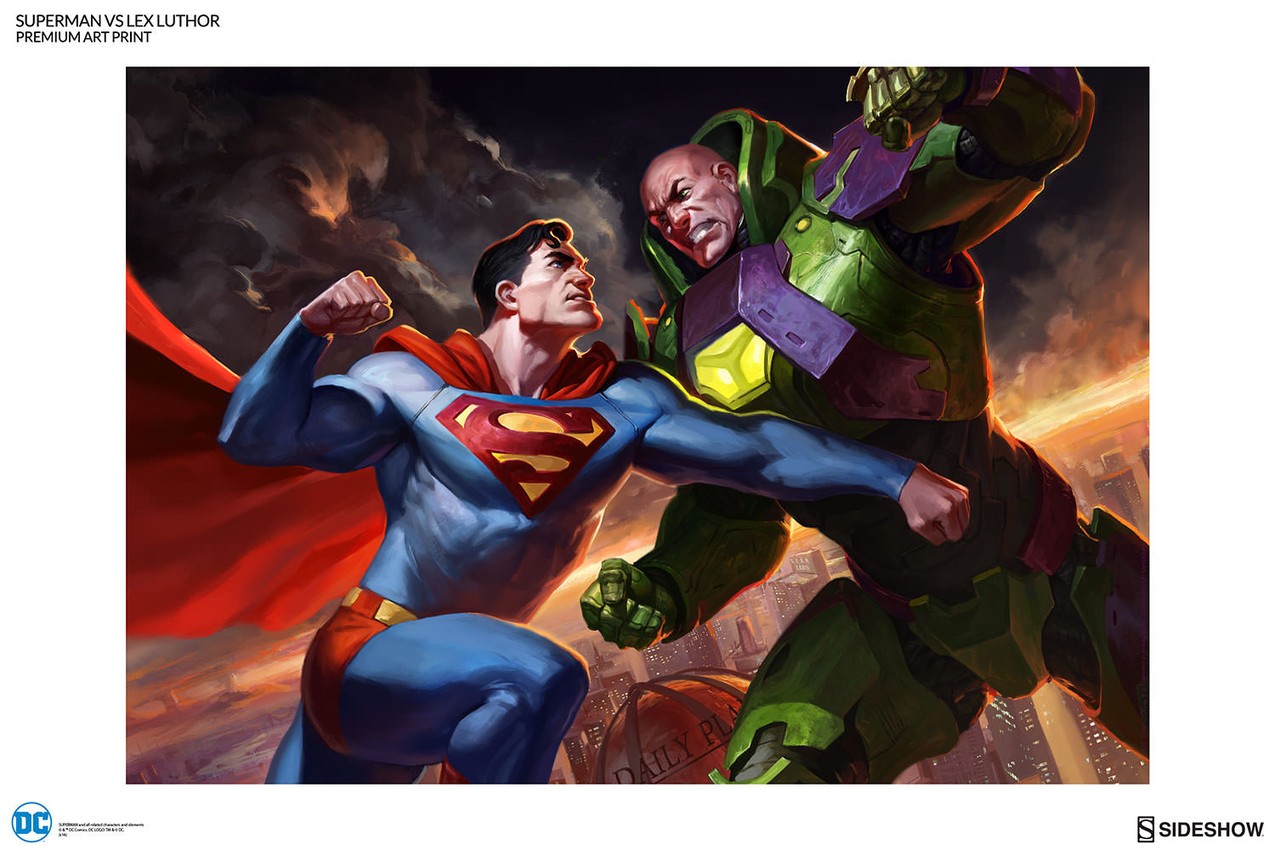
Tomorrow, a new film premieres: Superman, directed by James Gunn, starring David Corenswet as Superman, a.k.a. Clark Kent, a.k.a. Kal-El; Rachel Brosnahan as Lois Lane; and Nicholas Hoult as Lex Luthor.
Superman is unusual among superheroes in that, while he does have opponents who wear costumes and develop themes based on their powers and/or personalities, his Number 1 opponent is a mortal man without powers: Luthor.
Debuting in Action Comics #23, published on February 23, 1940, nearly 2 years after Superman's introduction in Action Comics #1, Luthor was, like Superman himself, created by writer Jerry Siegel and illustrator Joe Shuster. From 1940 to 1985, he was usually portrayed as a stereotypical "mad scientist," whose defining feature was complete baldness, perhaps to contrast with the image of a brilliant scientist being the wild-haired Albert Einstein.
He acted like the previous best-known version of a "superman," Friedrich Nietzsche's Übermensch, which was originally translated as "overman" but came to be thought of as "superman" after his death, as someone "beyond good and evil," beyond any definition of morality, not bound by any religious commandments, a man with "the will to power." Luthor wanted to control the world, not such much out of greed or a lust for power, but because he thought he could run it better. And Superman stood in his way.
Eventually, he was given a backstory to explain his specific hatred of Superman: They had grown up together in Smallville, and were friends. One day, the teenage Luthor made a mistake in his lab, starting a fire. Superboy, as Clark Kent's costumed identity was then known, blew out the fire, but the fumes caused Luthor's hair to fall out, and he blamed Superboy for this. And so, his schemes to stop him were personal, unlike his schemes to "take over the world."
Luthor appeared in his mad scientist form in the 1950 film Atom Man vs. Superman, played by Lyle Talbot; and as a more refined version, with a sadistic sense of humor, played by Gene Hackman, in the Superman films that starred Christopher Reeve: Superman in 1978, Superman II in 1981, and Superman IV: The Quest for Peace in 1987. (Hackman was not available for Superman III in 1983, so Robert Vaughn played Ross Webster, a character that was basically a carbon copy of him.) A cartoon version of Luthor, voiced by G. Stanley Jones, led the opposing group of villains, the Legion of Doom, in the Super Friends cartoons from 1978 to 1985.
After Crisis On Infinite Earths in 1985, there was a complete reboot of DC Comics. Now, Luthor was several years older than Superman, and, instead of Superboy, his childhood friend-turned-enemy was Daily Planet editor Perry White. Unbeknownst to either of them for a while, Lex was the actual father of Perry's son Jerry.
Lex's baldness -- not yet complete in the introductory series The Man of Steel by John Byrne -- was due to nothing more dramatic than advancing age. He hadn't even met Superman yet, much less could blame him for his hair loss, or anything else. He had lived in Metropolis his whole life, had abusive parents (whom his backstory later revealed he'd had killed), and rose to become a tech billionaire, one of the wealthiest men in the world.
Like the Marvel Comics superhero Iron Man, he seemed a variation on science wizard Howard Hughes. But where Iron Man (Tony Stark) and Hughes were merely quirky and difficult to get along with despite having done some heroic things, Luthor was pure evil, using people, and being especially cruel to women, not just because he benefited financially, but because he gained a perverse pleasure from it.
This version of him hated Superman not just because he was now getting the headlines in Metropolis' leading newspaper, The Daily Planet, that Luthor himself used to get, but because Luthor believed that the best of humanity -- himself, and people like him -- should be the best of Earth, not some super-powered alien "interloper."
This version of Luthor first appeared in live-action in the 1993-97 ABC TV series Lois & Clark: The New Adventures of Superman. His portrayer, John Shea, insisted on keeping his real hair, explaining that, if Luthor was one of the richest men in the world, and he went bald, for whatever reason, he would buy the best hairpiece that money can buy. (Which doesn't explain why, on the same network a few years earlier, the well-paid sportscaster Howard Cosell had one of the worst.) Such vanity, as well as other aspects of his personality, led to comparisons to a man then considered a localized annoyance, New York real estate developer Donald Trump.
The 2001-11 The WB/The CW series Smallville rewrote the story again, with Michael Rosenbaum playing a version of Luthor who grew up in the titular rural community, which the 1978 film had placed in Kansas, and every subsequent version of Superman has followed that. The show gradually showed how a strong friendship between Clark and Lex deteriorated until they were arch-enemies.
The 2006 film Superman Returns was a "soft reboot," a sequel to Superman II that acted as though Superman III and IV had never happened. In it, Kevin Spacey did for Luthor what Jack Nicholson, in the 1989 Batman film, did for the Joker in relation to the 1966-68 ABC TV show with Cesar Romero: He reminded us that this guy is no joke, he is a homicidal maniac, he is sadistic, he is supposed to be scary, and he is a serious threat to humanity, both on an individual basis and as a whole.
The "Snyderverse" series of movies had Jesse Eisenberg playing a very different, but no less evil, version of Luthor, with no connection to Smallville. From 2019-21, The CW series Supergirl showed him played by Jon Cryer, who had played the Hackman version's nephew in Superman IV. In 2023, The CW series Superman & Lois introduced the most sadistic version of Luthor yet, played by Michael Cudlitz. Both of these CW versions were consistent with the post-Crisis reboot. In the new film, he's played by Nicholas Hoult.
In most earlier versions, Luthor did not know that Clark Kent was Superman. Early in the 1986 reboot, he learns the truth, but rejects it, believing that Superman would never lower himself to be seen as a normal mortal man -- because he, Luthor, wouldn't lower himself, and his ego leads him to believe that Superman must be just as vain as he is. The classic villain conceit: "We're not so different, you and I." In most recent versions, Luthor starts out not knowing, and eventually learns, although sometimes he loses his memory of learning it.
*
In the DC universe, heroes and villains alike seem to believe: "Lex Luthor is the smartest man on Earth. Except maybe for Batman."
No. He's not. He's a fool.
Let me use the 1978 Gene Hackman version as an example. Suppose you are in the position he was in at the start of the movie's "present day" sequence. You are on the verge of a long-in-the-making plan going into effect. Everything is set. All you need to do is actually carry it out.
But before you can, Superman makes his public debut. Here is somebody who, at least theoretically, has the ability to stop you. What do you do?
If you're actually one of the greatest criminal minds of all time, what you do is... absolutely nothing. That is, you make no adjustments to account for the presence of Superman. You go forward with your plan, as if he hadn't appeared.
You see, you know about him, but he doesn't know about you. He has no idea of what you're planning. You have the element of surprise. Just lie low until you're ready to push the button, and then... push it.
What happens? Superman gets taken by surprise by the news of these missiles going off course. He has time to stop one of them, but probably not the other. People die. Damage is caused. Presumably, enough for you to move on the next phase of your plan.
And Superman still doesn't know who did it. Over the next few days, his reporter's instincts as Clark Kent will kick in, and he'll see Lex Luthor making his move, and put it all together. After all, a reporter is also a detective, and while Batman is "the world's greatest detective," Superman is no slouch in that department. He'll figure out it's you. But you'll have a significant head start. So when he confronts you, will he have enough proof? If you're as smart as you think you are, you will have installed enough "plausible deniability" to get away with it, like Luthor usually did in the post-Crisis, pre-New 52 era of comics (1986-2011).
What you wouldn't do is what Hackman's Luthor did: Find a way to summon Superman to (Cliché Alert) your underground lair, then tell him your plan, then zap him with the Kryptonite, and then (Cliché Alert) leave him to die instead of actually sticking around to make sure that the one guy who can actually stop you (as far as you know) is, in fact, dead.
And, in 2006, for all intents and purposes, Spacey's Luthor did the same thing, the same way: Real estate scam that would kill millions, luring Superman in, killing him with Kryptonite, and then leaving before the killing is actually completed, with the result being that Superman gets saved, and he foils the plan.
Only, in this case, it's worse. The land that 2006 Luthor creates is Kryptonian. How's he going to build anything on it? Shovels? Dynamite? Please! The land is useless to him. He's done all that for nothing. And if that were the extent of it, that would be enough to expose him as a fool, which his ego wouldn't be able to handle.
But that's not the extent of it. Had Superman not gotten that Krypton-dense land off Earth, it would have kept growing until it overwhelmed the Earth and destroyed it. And if there had been enough time to get anybody off Earth and send them to another habitable planet, those people would know that it was Lex Luthor who literally destroyed the world. So instead of a billionaire, Lex goes down as a man who made Hitler, Stalin and Mao look like beginners. Someone who would slightly impress Thanos.
No, let's tell the truth: Lex Luthor is not one of the smartest people on Earth. He is a fool.
*
On the Facebook page Comic Book Clique, someone (unidentified) wrote:
In "Lex Luthor: Man of Steel," Lex doesn't just hate Superman -- he fears what he represents. To Lex, Superman is the end of human potential. Why would humanity keep pushing its limits when a godlike alien is always there to save the day? Lex believes that Superman's presence makes us passive, stunting our ambition and growth.
But it runs deeper than that -- Lex doesn't trust the fate of humanity in the hands of someone who isn't human. No matter how benevolent Superman seems, Lex sees him as an outsider with the power to shape our world without our consent. And that terrifies him.
To Lex, getting rid of Superman isn't villainy -- it's self-preservation. It's about protecting the idea that we should shape our destiny, not an alien god. He sees Superman as the end of free will, of progress, of human greatness.
It's a twisted worldview -- but it's what makes Lex one of the most fascinating villains in comics. He's not trying to destroy us. He's trying to save us... from ourselves.
This is an accurate description of Luthor's thoughts and feelings toward Superman, at least in post-Crisis continuity.
Again, let's tell the truth: Lex Luthor is full of shit.
Wanting to "save humanity" is just Lex's excuse for why he wants to eliminate Superman. If Lex's goal was to save humanity, he wouldn't kill people to achieve his sub-goals, be they building a new machine to help humanity, or synthesizing a helpful new drug, or building a factory to employ thousands of people. If he wanted to do those things, he'd just do them. And if he had to kill people to achieve them, being supposedly one of the smartest people alive -- he confesses that Batman is the only man he considers to be smarter than himself -- he'd find a way around killing to achieve them.
Lex Luthor: Man of Steel, written by Brian Azzarello and illustrated by Lee Bernejo, and showing things from Luthor's perspective, was released in 2005. Immediately afterward came All-Star Superman, considered one of the best Superman stories, written by Grant Morrison and illustrated by Frank Quitely.
In this series, Superman points out that, once Lex became as rich as he is, he could have "saved humanity," whatever those words meant to him, any time he wanted to. And he hasn't even tried. Some of the other brilliant scientists in the DC canon have tried, with limited success, particularly on a local scale (Bruce Wayne, a.k.a. Batman, in Gotham City; Oliver Queen, a.k.a. Green Arrow, in Star City, and so on). Luthor simply uses his genius and his resources for his own benefit.
Indeed, the post-Crisis version of Luthor is a callback to the war profiteers -- and, through the Lex 2000 storyline that saw Luthor get elected President of the United States in the DC universe, the corrupt Senator Barrows -- who appeared in Action Comics #1, at a low point during the Great Depression: The enemies of humanity are greed, hatred, and the use of new technology without morality.
Lex Luthor was a perfect villain for that time, for our current time, and for all time. Which makes Superman the perfect hero, for any and all times.
Sadly, the world has several Luthors, if on a smaller scale, but no Superman. Or, as someone put it, America has over 500 billionaires, but not one of them has become Batman.
I wonder: If Kamala Harris had won last November, finishing Donald Trump forever, would the new Superman movie succeed? I don't know. But, in a world where Trump and Elon Musk have remade America in their own grotesque images, we need inspiration more than ever.
The crest on Superman's chest looks like the letter S. But, within the comics and their related media, it has been rewritten as the crest of Superman's Kryptonian family, the House of El, and their language's symbol for "hope."
The 1940s radio series, and the 1950s TV series, both titled The Adventures of Superman, gave us the line that Superman "fights a never-ending battle for truth, justice, and the American Way!" In the 21st Century, trying to show that Superman is the protector of Earth as a whole, of all of humanity, it's been rewritten as "Truth, Justice, and a Better Tomorrow."
Superman is not real. Too many people come too damned close to being a real Lex Luthor. As much as at any time in human history, we need truth, justice, and a better tomorrow.