Showing posts with label frank thomas. Show all posts

Wednesday, August 29, 2018

Chicago's 10 Greatest Athletes

Clockwise from top left: His Airness,
Mr. Cub, Sweetness and the Golden Jet.

This week, the Yankees are hosting the Chicago White Sox.

Chicago's 10 Greatest Athletes

Once again, in many cases, a player would rank higher if he spent all or most of his career in Chicago. Some of these guys did, most did not.

Honorable Mention to Chicago Cubs in the Baseball Hall of Fame, who did not otherwise make this list: Al Spalding, Adrian "Cap" Anson, Mike "King" Kelly, John Clarkson, Clark Griffith, Joe Tinker, Johnny Evers, Frank Chance, Mordecai "Three-Finger" Brown, Rogers Hornsby, Charles "Gabby" Hartnett, Lewis "Hack" Wilson, Hazen "Kiki" Cuyler, Billy Herman, Billy Williams, Ron Santo, Ferguson Jenkins, Bruce Sutter, Dennis Eckersley, Ryne Sandberg, Andrew Dawson and Greg Maddux.

Honorable Mention to Chicago White Sox in the Baseball Hall of Fame, who did not otherwise make this list: Ed Walsh, George Davis, Ray Schalk, Eddie Collins, Red Faber, Ted Lyons, Luke Appling, Early Wynn, Nellie Fox, Luis Aparicio, Hoyt Wilhelm, Goose Gossage, Carlton Fisk, Tim Raines and Jim Thome. Paul Konerko will probably join them, Mark Buehrle might, and Harold Baines should.

Honorable Mention to Chicago Bears in the Pro Football Hall of Fame, who did not otherwise make this list: George Halas (yes, he was a very good player, and we can count him as such, in addition to a coach, executive and owner), George Trafton, Ed Healey, William "Link" Lyman, John "Paddy" Driscoll, Bill Hewitt, George Musso, Joe Stydahar, Dan Fortmann, George McAfee, Clyde "Bulldog" Turner, George Connor, George Blanda, Bill George, Stan Jones, Doug Atkins, Mike Ditka (he was elected as a player), Gale Sayers, Dick Butkus, Alan Page, Dan Hampton, Mike Singletary, Richard Dent and Brian Urlacher.

Honorable Mention to Chicago Cardinals in the Pro Football Hall of Fame, none of whom made this list: Paddy Driscoll, Ernie Nevers, Walt Kiesling, Charley Trippi, Ollie Matson and Dick "Night Train" Lane.

When The Sporting News named its 100 Greatest Football Players in 1999, George was ranked 49th, Singletary 56th, and Ditka 90th. When the NFL Network named its 100 Greatest Players in 2010, George dropped off the list, but Singletary only dropped to 57th, Ditka Rose to 59th, and Nevers, despite having played over 80 years before, was brought onto the list at 89th.

Honorable Mention to Chicago Bulls in the Basketball Hall of Fame, who did not otherwise make this list: Chet Walker, Artis Gilmore, Scottie Pippen and Dennis Rodman. Jerry Sloan is in the Hall, but as a coach. If Steve Kerr ever gets in, it will also be as a coach. I don't think Derrick Rose is getting in.

Honorable Mention to Chicago Blackhawks in the Hockey Hall of Fame, who did not otherwise make this list: Lionel Conacher, Roy Conacher, Charlie Gardiner, Art Coulter, Earl Seibert, Clint Smith, Doug Bentley, Max Bentley, Bill Mosienko, Bill Gadsby, Glenn Hall, Pierre Pilote, Bobby Hull, Stan Mikita, Tony Esposito, Michael Goulet, Denis Savard, Chris Chelios and Ed Belfour. Jonathan Toews and Patrick Kane might join them.

Honorable Mention to Karl-Heinz Granitza, the greatest player of the NASL's Chicago Sting.

Honorable Mention to Ante Razov, the all-time leading scorer of MLS' Chicago Fire.

Now, the Top 10:

10. Gale Sayers, running back, Chicago Bears, 1965-71. He scored a record-breaking 22 touchdowns in his rookie season, including 6 in a single game against the San Francisco 49ers despite a torrential rain that turned Wrigley Field into a mud pit. He was named NFL Rookie of the Year, led the League in rushing twice, and was named to 4 Pro Bowls. His average of 5.0 yards per carry is 2nd only to Jim Brown.

But he wrecked both knees, and ended up playing only 68 games -- enough to add up to, by today's standards, only 4 full seasons. He only appeared in 4 games past his 26th birthday, and none past his 28th. His career rushing yards total was just 4,956; had he a full career, he almost certainly would have followed Brown as the 2nd man to 10,000 yards.

The University of Kansas retired his Number 48, and the Bears his Number 40. He remains the youngest man ever elected to the Pro Football Hall of Fame, 34. He was named to the NFL's 1960s All-Decade Team and its 75th Anniversary Team. In 1999, despite having played so little, The Sporting News ranked him 21st on its list of the 100 Greatest Football Players. In 2010, the NFL Network ranked him 22nd on its list of the 100 Greatest Players.

9. Sid Luckman, quarterback, Chicago Bears, 1939-50. New York City has produced a lot of great baseball and basketball players, but there's no doubt who's the City's greatest football player. A single-wing tailback at Brooklyn's Erasmus Hall High School and at Columbia University, George Halas saw Luckman as the man to quarterback his T formation.

Good vision: He led the Bears to 4 NFL Championships, plus an undefeated season but losing the Championship Game, in 7 seasons. He and his big rival, Sammy Baugh of the Washington Redskins (Luckman was 2-1 in NFL Championship Games against him), were the 1st 2 true quarterbacks, as we now understand that term, in NFL history.

A 6-time All-Pro, Sid was the 1st quarterback to throw 7 touchdown passes in a single game (there are now 8), and the 1943 NFL Most Valuable Player. Players went both ways in those days, and he also intercepted 17 passes and had a career punting average of 38.6 yards. The Bears retired his Number 42. He was named to the College and Pro Football Halls of Fame and the NFL's 1940s All-Decade Team.

It's been 68 years since Sid Luckman played his last game for the Bears, and 20 years since he died. He is still the greatest quarterback in Bears history.

8. Bronislau "Bronko" Nagurski, running back and offensive and defensive tackle, Chicago Bears, 1930-37, with a return in 1943. At 6-foot-2 and 230 pounds, he wouldn't be considered all that big today. But in the 1930s, he was considered huge, and was the prototype for the big bruising fullback, the progenitor of Marion Motley, Jim Brown, Larry Csonka, John Riggins, Jerome Bettis, etc.

The University of Minnesota didn't win anything while he was there, but, in the same backfield as Red Grange, he helped the Chicago Bears win the NFL Championship in 1932 and 1933. He played in the NFL from 1930 to 1937, and was a professional wrestler in the off-season, because, at the time, it made him more money.

He was the Heavyweight Champion of the World. And while pro wrestling was always a bit theatrical, it was not like today's WWE. He would have made mincemeat out of Hulk Hogan in the 1980s, Stone Cold Steve Austin in the 1990s, Dwayne "The Rock" Johnson (also a college football star) in the 2000s and John Cena today. And he would never have done Vince McMahon's bidding. In 1943, due to the wartime manpower shortage, the Bears asked him to return, and he did, and helped them win another title.

"Who would you pick to win a football game?" asked the great sportswriter Grantland Rice. "11 Jim Thorpes? 11 Glenn Davises? 11 Red Granges? Or 11 Bronko Nagurskis? The 11 Nagurskis would be a mop-up. It would be something close to murder and massacre. For the Bronk could star at any position on the field, with 216 pounds of authority to back him up."

Try 230, Mr. Rice. Otherwise, you're right. One year, Nagurski hurt his back, and, instead of sitting out and healing, accepted a switch to offensive tackle, and was great at it. He played defensive tackle. Oh yeah, he could also pass, pretty well by the standards of the time. Imagine Bettis throwing an option pass, and having it result in a touchdown: Nagurski did it. In an interview late in life, he said he'd probably be a linebacker, admitting he wouldn't be carrying the ball 30 times a game. I have no doubt that, with his speed, he would have excelled.

The University of Minnesota retired its Number 72 for him, and named its football facility the Gibson-Nagurski Football Complex. The Chicago Bears retired Number 3 for him. He was a charter inductee into the Pro Football Hall of Fame in 1963.

He was named to the NFL's 50th Anniversary Team in 1969, and its 75th Anniversary Team in 1994.
The Sporting News ranked him 35th on their 100 Greatest Football Players in 1999. and the NFL Network's 100 Greatest Players in 2010, 73 years after he was a regular player, actually boosted him to 19th. In 2008, ESPN named ranked him 17th on their list of the Top 25 College Football Players of All Time.

Presuming that the NFL names a 100th Anniversary Team in 2019 or 2020, I have no doubt that, despite it having been 76 years since he last so much as played a down, he will be named to it.

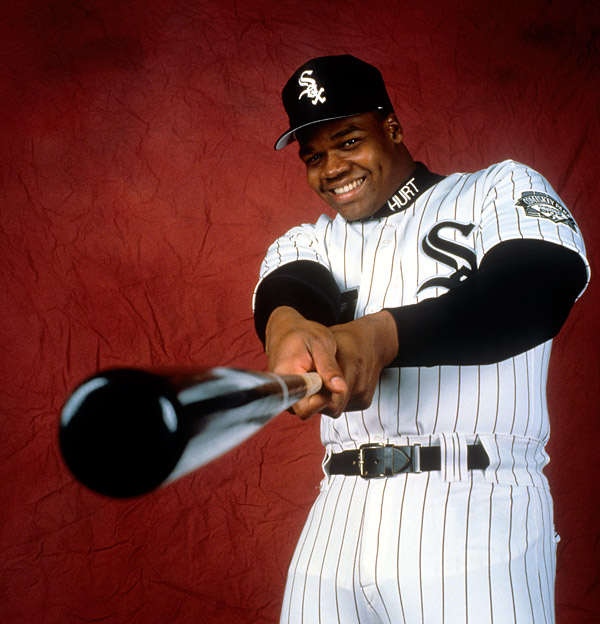
7. Frank Thomas, 1st base and designated hitter, Chicago White Sox, 1990-2005. Not to be confused with the 1960s slugger known as Big Donkey, this man had the best nickname in his era of baseball: The Big Hurt. Fortunately, much like earlier sluggers Harmon "the Killer" Killebrew and Frank "the Monster" Howard, he's actually a nice guy.

Born on May 27, 1968, the same exact day as fellow Baseball Hall-of-Famer Jeff Bagwell (and during Don Drysdale's then-record streak of 58 2/3rds consecutive scoreless innings), Frank was a 5-time All-Star, the American League MVP in 1993 and 1994, and a batting champion in 1997. He is 1 of 9 players to have a .300 lifetime batting average (in his case, .301) and 500 career home runs (in his case, 521). The others are Babe Ruth, Jimmie Foxx, Mel Ott, Ted Williams, Willie Mays, Hank Aaron, Albert Pujols and, dubiously, Manny Ramirez.

He appeared in the postseason with the Chicago White Sox in 1993 and 2000, and with the Oakand Athletics in 2006. But he was robbed of a shot at playing on a World Series winner in 1994 because of the strike and 2005 because of injury. (He was given a ring in 2005, though.) The White Sox retired his Number 35, and dedicated a statue to him at Guaranteed Rate Field.

6. Dick Butkus, linebacker, Chicago Bears, 1965-73. He was a victim of timing: Although he was with Illinois, enabling him to help them win the 1963 Big Ten title, he not only arrived with the Chicago Bears just as they were ending a strong era, but his playing career included the era in which the NFL, including the Bears in 1971, was switching to artificial turf, which wrecked his knees. As a result, he never played in so much as a Playoff game, and played his last game when he was only 31 years old.

Which makes his legendary reputation all the more remarkable. He was named Big Ten Most Valuable Player in 1963, as both a center and a linebacker -- an offensive lineman and a defensive player. That alone is astounding. He played 9 seasons in the NFL, and was named to the Pro Bowl in 8 of them. He was named NFL Defensive Player of the Year in 1969 and 1970, despite the Bears going just 1-13 and 6-8 in those seasons.

He was named to the College and Pro Football Halls of Fame, the NFL's 1960s and 1970s All-Decade Teams (he and Larry Wilson were the only men named to both), and the NFL's 75th Anniversary Team. Illinois retired his Number 50, and the Bears retired his Number 51.

The NCAA created the Butkus Award to honor the best linebacker of the season. In 1999, The Sporting News named him Number 9 on its list of the 100 Greatest Football Players, 2nd only to Lawrence Taylor among defensive players. On the CBS special honoring those players, NFL Today analyst and former coach Jerry Glanville, who specialized on defense, called him the greatest football player he ever saw. Not the greatest defender, the greatest player.

In 2008, ESPN ranked Butkus 19th on their list of the Top 25 College Football Players of All Time. In 2010, the NFL Network ranked him Number 10 on its list of the 100 Greatest Players, again trailing only Taylor on defense.

He remains, even more than L.T., Mean Joe Greene and Ray Lewis, the last word in mean, hard-hitting defensive football players, the definitive Chicago "Monster of the Midway." Sylvester Stallone named one of his dogs Butkus, and even cast the dog as Rocky Balboa's dog in Rocky, keeping the name "Butkus."

All of which made it all the more fun when Dick Butkus became an actor, including starring alongside fellow defensive behemoth Bubba Smith in Miller Lite beer commercials. Deacon Jones, another contender for the titles of greatest and meanest defensive player ever, and who also did some Miller Lite commercials, said, "Dick was an animal. I called him a maniac. A stone maniac. He was a well-conditioned animal, and every time he hit you, he tried to put you in the cemetery, not the hospital."

5. Harold "Red" Grange, running back and cornerback, Chicago Bears, 1925 and 1929-34. The 2-way back led the University of Illinois to the National Championship in 1923, then dedicated their Memorial Stadium the next year with a 6-touchdown performance against Michigan.

The following year, "the Galloping Ghost" became the 1st real star of professional football, following Halas' path from the Illini to the Chicago Bears, drawing crowds that, essentially, saved the NFL from going under after only 6 seasons -- making him easily the most influential athlete on this list, and maybe the single most important player in NFL history.

His manager, C.C. Pyle, founded the American Football League in 1926, started a team called the New York Yankees, and, wanting his biggest star in the biggest city, paid Halas off and put Grange on his team. The 1st AFL lasted just 1 year, but the Yankees were admitted to the NFL for 1927. That year, they played the Bears, and got his knee injured in a tackle by former teammate George Trafton. "After that," he said, "I was just another straight-ahead runner, and the world is full of straight-ahead runners."

But like many great athletes who lost their speed, he raised their game on defense. He was brought back to the Bears after sitting out the rest of '27 and all of '28, and helped them win the 1st 2 NFL Championship Games, in 1932 and 1933, in a backfield with Nagurski. Just as Nagurski was the prototype for the big bruising fullback, so was Grange the one for the speedy halfback. And in that 1933 title game, he made a game-saving tackle in the final minute that Halas called "the greatest defensive play I've ever seen." And from 1920 until his death in 1983, Halas saw them all.

He was a charter inductee into both the College and the Pro Football Hall of Fame. He was named to the NFL's 1920s All-Decade Team. Football used uniform numbers earlier than baseball and basketball (although hockey preceded them), and so the Number 77 that Grange wore with both the Fighting Illini and the Bears became sports' 1st iconic uniform number, and both retired it. In 1969, he was the only unanimous choice on the 100th Anniversary All-America Team. He lived long enough to receive all of these honors.

After his death in 1991, he was ranked 80th on The Sporting News' 100 Greatest Football Players in 1999, named the greatest player in college football history by ESPN in 2008, had a statue of him dedicated outside Illinois' Memorial Stadium in 2009, was named to the NFL's 100 Greatest Players by the NFL Network in 2010 (ranked 48th, actually gaining 32 places in the intervening 11 years), and was named the Big Ten Conference's greatest sports icon by the Big Ten Network in 2011. Keep in mind, most of those honoring him had never seen him play, as he played his last NFL game in 1934, and there is precious little surviving footage of him.

4. Ernie Banks, shortstop and 1st base, Chicago Cubs, 1953-71. "Mr. Cub" is so identified with Chicago that it's easy to forget that it's not where he's from. Indeed, he's from Big D, not the City of the Big Shoulders. It's just as well that he played baseball: Nobody ever played football and said, "Let's play two!"

A 14-time All-Star, he won back-to-back National League Most Valuable Player awards in 1958 and 1959, despite the Cubs not being anywhere near the Pennant race. He won a Gold Glove in 1960, and finished his career with 2,583 hits, including 512 home runs, an astonishing number for a player who spent the 1st half of his career as a shortstop, before moving to 1st base.

The Cubs retired his Number 14, and erected a statue of him outside Wrigley Field. He was named to the Baseball Hall of Fame, The Sporting News' 100 Greatest Baseball Players, and the Major League Baseball All-Century Team. in 2013, President Barack Obama awarded him the nation's highest civilian honor, the Presidential Medal of Freedom

In spite of the achievements of Red Grange, Walter Payton, Bobby Hull and even Michael Jordan, Ernie may still be, even after his death, the most popular athlete in Chicago's history.

3. Bobby Hull, left wing, Chicago Black Hawks, 1957-72. His relationship with the Hawks has been complicated, but he and owner Rocky Wirtz are on good terms now. Of his 913 major league goals, 608 were with the Hawks. These included 5 seasons of 50 or more, and those included 1965-66, when he became the 1st player to score more than 50 in a season; and 1968-69, when he topped out at 58. (In 1974-75, with the WHA's Winnipeg Jets, he got 77 in 78 games.)

"The Golden Jet" made 12 NHL All-Star Games. He won the Art Ross Trophy as leading scorer in 1960, 1962 and 1966. He won the Hart Memorial Trophy as regular season Most Valuable Player in 1965 and 1966. he won the Lady Byng Memorial Trophy as "most gentlemanly player" in 1965. He helped the Black Hawks win the 1961 Stanley Cup, and also to reach the Stanley Cup Finals in 1962, 1965 and 1971. (In the WHA, he was MVP in 1973 and 1975, and helped the Jets, who were named for him and of which he was part-owner, win the title in 1976, 1978 and 1979, losing in the Finals in 1973.)

In 1969, while still active, he was awarded the Lester Patrick Trophy for contributions to hockey in America. When he retired in 1980, he was 2nd in goals and 9th in points in NHL history -- and that didn't count his WHA stats. In 1983, he was elected to the Hockey Hall of Fame, and the Hawks retired his Number 9. In 1998, The Hockey News ranked him 8th on their list of the 100 Greatest Players. In 2011, the Hawks dedicated a statue of him outside the United Center (and also one for Stan Mikita). In 2017, he was named to the NHL's 100th Anniversary 100 Greatest Players.

2. Walter Payton, running back, Chicago Bears, 1975-87. "Sweetness" was a 9-time Pro Bowler. He was named NFL Most Valuable Player in 1977 and 1985. He once held the records for rushing yards in a game (275) and in a career (16,725). He also caught 492 passes. He had 110 touchdowns rushing, 15 more receiving... and 8 passing. He even had a punt go 39 yards. He was as close to being an all-around threat as existed in his era.

He had already surpassed Jim Brown in 1984 to become the NFL's all-time rushing leader (since himself surpassed by Emmitt Smith), when the Chicago Bears roared through the 1985 season toward Super Bowl XX, wanting to win it for him as much as for themselves and their city. They did.

The Bears retired his Number 34. He was elected to the College and Pro Football Halls of Fame, and to the NFL's 1970s and 1980s All-Decade Teams and its 75th Anniversary Team. In 1999, The Sporting News listed him 8th on their 100 Greatest Football Players. He died of liver disease later that year, and his reputation grew: In 2010, when the NFL Network did the 100 Greatest Players, he came in 5th. Both times, he was 2nd among running backs to Jim Brown.

There are 2 Walter Payton Awards: The NCAA's "Heisman Trophy" for Football Championship Subdivision (FCS, formerly known as Division I-AA) players, in honor of Payton having played at Mississippi's Jackson State University; and the NFL's Man of the Year award, for humanitarian contributions off the field.

1. Michael Jordan, guard, Chicago Bulls, 1984-98. No, he's not the greatest basketball player who ever lived. That's Wilt Chamberlain. But he did define an era of basketball.
He hit the shot that gave North Carolina the winning margin in the 1982 National Championship Game, as a freshman. He was National Player of the Year in 1984, giving up his senior year to turn pro.

At the 1984 Olympics in Los Angeles, he was a member of the best amateur basketball team that has ever been assembled. When the International Olympic Committee allowed professionals starting in 1992 in Barcelona, he was the centerpiece of the U.S. "Dream Team" that may have been the best team ever assembled, under any circumstances, in any sport. (It was so good, that year's college player of the year, Christian Laettner, was the 12th man, and is the only one not yet in the Basketball Hall of Fame.)

He played 15 seasons in the NBA, and was a 14-time All-Star -- the only time not making it was in 1994-95, when he ended the 1st of his 3 "retirements" too late to qualify for the All-Star Game. He won the 1985 NBA Rookie of the Year award, 5 NBA MVP awards, 3 All-Star Game MVP awards, and 6 Bill Russell Awards as MVP of the NBA Finals. Whether he deserved all 6 of those is debatable, but the fact is that he got into 6 NBA Finals, won them all, and none of them got to a Game 7.

His Number 23 was retired by North Carolina and the Chicago Bulls. The Bulls dedicated a statue of him outside the United Center. In 1991, Sports Illustrated named him its Sportsman of the Year. He was named to the NBA's 50th Anniversary 50 Greatest Players before his 34th birthday. Of course, he was elected to the Basketball Hall of Fame. In 2016, President Barack Obama awarded him the nation's highest civilian honor, the Presidential Medal of Freedom.

True, Jordan never won a title without Phil Jackson and Scottie Pippen. And he got all the calls. And he made a fool of himself coming out of his 2nd retirement to play for the Washington Wizards. And, so far, he has been a bust as the owner of the Charlotte Hornets. And his personal life turned out to be messy. And the contrast between his "Republicans buy sneakers, too" copout in 1990 and LeBron James' "I Can't Breathe" T-shirt and tweet calling Donald Trump "U bum" should not be forgotten.

Nobody's perfect. Not even Michael Jordan. But for millions of people who never saw Wilt, Russell, Oscar, Clyde, Kareem, Dr. J, or young Magic, he still is basketball.

Tuesday, January 2, 2018

Top 10 Athletes From Georgia

January 2, 1788: Georgia becomes the 4th State to ratify the Constitution of the United States.

Top 10 Athletes From Georgia

Remember: Golf is not a sport. This eliminates Bobby Jones and Larry Mize from consideration. Jones did, however, win the 1st James E. Sullivan Award for America's most outstanding amateur athlete, in 1930.

And auto racing is not a sport. This eliminates Bill Elliott, a.k.a. "Awesome Bill from Dawsonville."

Remember also: It's where the person was trained to play his sport that matters, not where he was born. Jackie Robinson was born in Cairo, Georgia, but became an athlete in Pasadena, California.

Honorable Mention to Baseball Hall-of-Famers Bill Terry and Luke Appling, both of Atlanta. Although Terry was nicknamed "Memphis Bill," and Appling was born in North Carolina, they both grew up in Georgia.

Terry joined the New York Giants in 1923, and was the 1st baseman on their National League Pennant winners in 1923, 1924, 1933 and 1936, also managing them to Pennants in 1933, 1936 and 1937, including winning the 1933 World Series.

He batted .341 lifetime, including a .401 in 1930, making him still the last NL player to bat at least .400. He was the NL's starting 1st baseman in the 1st 3 All-Star Games (1933-35), and was named to The Sporting News' 100 Greatest Baseball Players. The Giants retired his Number 3.

Luke Appling batted .310 lifetime, including .388 in 1936, an American League record for shortstops. He won the AL batting title that year, and in 1943. He was a 7-time All-Star, and collected 2,749 hits. The Chicago White Sox retired his Number 4, and dedicated a statue of him at Guaranteed Rate Field. Both he and Terry are in the Baseball Hall of Fame.

Honorable Mention to Spurgeon "Spud" Chandler of Commerce, who helped the Yankees win 6 World Series and was the 1943 American League Most Valuable Player.

Honorable Mention to Donn Clendenon of Atlanta and Ray Knight of Albany. The Mets once had a rivalry with the Atlanta Braves, which is odd, because they've only won 2 World Series, and, each time, the Series MVP was from Georgia: Clendenon in 1969, and Knight in 1986.

Honorable Mention to the Heisman Trophy winners from Georgia: George Rogers of Duluth, 1980; Herschel Walker of Wrightsville, 1982; Charlie Ward of Thomasville, 1993; and Cam Newton of Atlanta, 2010. Newton still might make the Top 10 if I do this list again in a few years. In 2008, ESPN named ranked Walker 3rd on their list of the Top 25 College Football Players of All Time.

Honorable Mention to Super Bowl MVP Winners from Georgia: Jake Scott of Athens (1973), Richard Dent of Atlanta (1986), Deion Branch of Albany (2005), and Hines Ward of Forest Park (2006).

Honorable Mention to Pro Football Hall-of-Famers from Georgia who did not otherwise make the Top 10: Dent, Rayfield Wright of Griffin, Ray Guy of Thomson, and Shannon Sharpe of Glennville. Herschel Walker is in the College Football Hall of Fame. So is Sharpe's brother, Sterling Sharpe. Walker, Sterling Sharpe and Hines Ward are eligible for the Pro Football Hall, but none of them is in it yet.

Honorable Mention to Jason Elam of the Atlanta suburb of Snellville.  3-time Pro Bowler and a 2-time Super Bowl winner with the Denver Broncos, on October 25, 1998, he tied the NFL record with a 63-yard field goal. He is a member of the Broncos' Ring of Fame and their 50th Anniversary Team.

Honorable Mention to Theresa Edwards of Cairo. A guard, she helped the women's basketball team at the University of Georgia reach the NCAA Final Four in 1983 and 1985, and her Number 5 was retired. She later played in the WNBA for the Minnesota Lynx. She won Olympic Gold Medals with the U.S. team in 1984 in Los Angeles, 1988 in Seoul, 1996 in Atlanta and 2000 in Sydney, and the Bronze Medal in 1992 in Barcelona. She has since gone into coaching, and has been elected to the Basketball Hall of Fame.

Honorable Mention to Linda Hamilton of Atlanta, who played on the U.S. team that won the 1st Women's World Cup in 1991.

Honorable Mention to Kelley O'Hara of Peachtree City and Morgan Brian of St. Simons, who played on the U.S. team that won the 2015 Women's World Cup.

Honorable Mention to Theodore "Tiger" Flowers of Camilla. He was the 1st black fighter to win the Middleweight Championship of the World, knocking out Harry Greb to do it and holding it through most of 1926, before losing it to Mickey Walker. Oddly, he died in 1927 due to complications from surgery, only a year after Greb also had. He was posthumously elected to the International Boxing Hall of Fame.

Honorable Mention to Sidney Walker, a.k.a. Beau Jack, of Waynesboro. He was twice Lightweight Champion of the World from 1942 to 1944, and The Ring magazine named him Fighter of the Year for 1944.

Honorable Mention to Alice Coachman of Albany. A star in basketball and track at Tuskegee Institute in Alabama, she lost her chance at Olympic glory in 1940 and 1944 due to World War II. But in 1948 in London, she won the high jump to become the 1st black American woman to win a Gold Medal.

Honorable Mention to Roger Kingdom of Vienna. He went to the University of Pittsburgh on a football scholarship, but was better at track & field, excelling in the high jump and the discus throw. But his specialty became sprint hurdles. He could have been an Olympic decathlon contender, but that event was dominated by Britain's Daley Thompson in the 1980s.

Still, Roger won the 110-meter hurdles in Los Angeles in 1984, and repeated his Gold Medal in Seoul in 1988. To this day, he and Lee Calhoun (1956 and 1960) are the only men to have successfully defended that title.

After Bob Hayes in 1964, there was a trend of pro football teams hiring sprinters to be receivers, and aside from Hayes, it didn't work. But Renaldo Nehemiah, whom Kingdom succeeded as the best American sprint hurdler (as opposed to Edwin Moses, who specialized in the 440-meter hurdles), did have a decent career as a receiver with the San Francisco 49ers. In 2014, Roger Kingdom finally reached the NFL -- as the strength and conditioning coach of the Arizona Cardinals.

Now, the Top 10:

10. Gwen Torrence of Decatur. At the 1992 Olympics in Barcelona, she won 2 Gold Medals and a Silver Medal. At the 1996 Olympics in her home State, she won another Gold and a Bronze. Total: 5 Medals, 3 of them Gold.

9. Wyomia Tyus of Griffin. She followed Wilma Rudolph as one of Tennessee State University's track "Tigerbelles," and won the 100 meters at the 1964 Olympics in Tokyo, succeeding Rudolph herself as the winner of that event. Tyus was succeeded by... herself, as she won it again in 1968 in Mexico City, becoming the 1st person, male or female, to repeat as the 100-meter winner. In the 4x100-meter relay, she won Silver in 1964 and Gold in 1968.

8. Johnny Mize of Demorest. To look at "The Big Cat" (a nickname also given to one of my Honorable Mentions, Rayfield Wright), you'd have sworn he was a football player. Actually, football wasn't even his 2nd-best sport: Tennis was. He was connected to possibly the 2 best players in baseball history: He was a distant cousin of Ty Cobb, and his 2nd cousin, Claire Hodgson, became the 2nd Mrs. Babe Ruth.

But with the way he hit, Big Jawn didn't have to take a back seat to anyone. He batted .312 lifetime, with 359 home runs -- 2 less than Joe DiMaggio and 1 more than Yogi Berra. He was a 10-time All-Star, won the National League batting title in 1939 with the St. Louis Cardinals, whom the NL home run title 4 times and the NL RBI title 3 times, although he just missed the Triple Crown with the New York Giants in 1947.

In 1949, the Giants thought he was washed up. The Yankees didn't, and traded for him. He helped them win the next 5 World Series. In 1952, his home runs earned him the Babe Ruth Award as World Series MVP. It took a long time, but he was finally elected to the Baseball Hall of Fame in 1981. The Cardinals have also elected him to their team Hall of Fame.

7. Frank Thomas of Columbus. Not to be confused with the 1960s slugger known as Big Donkey, this man had the best nickname in his era of baseball: The Big Hurt. Fortunately, much like earlier sluggers Harmon "the Killer" Killebrew and Frank "the Monster" Howard, he's actually a nice guy.

Born on May 27, 1968, the same exact day as fellow Baseball Hall-of-Famer Jeff Bagwell (and during Don Drysdale's then-record streak of 58 2/3rds consecutive scoreless innings), Frank was a 5-time All-Star, the American League MVP in 1993 and 1994, and a batting champion in 1997. He is 1 of 9 players to have a .300 lifetime batting average (in his case, .301) and 500 career home runs (in his case, 521). The others are Babe Ruth, Jimmie Foxx, Mel Ott, Ted Williams, Willie Mays, Hank Aaron, Albert Pujols and, dubiously, Manny Ramirez.

He appeared in the postseason with the Chicago White Sox in 1993 and 2000, and with the Oakand Athletics in 2006. But he was robbed of a shot at playing on a World Series winner in 1994 because of the strike and 2005 because of injury. (He was given a ring in 2005, though.) The White Sox retired his Number 35, and dedicated a statue to him at Guaranteed Rate Field.

6. Maya Moore of Suwanee. She is practically the Bill Russell of women's basketball. She won 3 national player of the year awards at the University of Connecticut, the 2009 and 2010 National Championships, and the 2010-11 Honda-Broderick Cup as the nation's outstanding female collegiate athlete of the schoolyear.

She was just getting warmed up. In the WNBA, she can count among her honors the 2011 Rookie of the Year, 5 All-Star Game appearances including 2 MVPs, the league's 2014 scoring title and regular-season MVP, and 4 league championships including the Finals MVP in 2013. She was named to their 20th Anniversary 20 Greatest Players. She's also won Olympic Gold Medals in 2012 in London and 2016 in Rio de Janeiro. And she's only 28 years old. Barring injury, she is far from done.

5. Mel Blount of Lyons. Today, approaching his 70th birthday, Mel usually appears clean-shaven, wearing a sharp suit, a cowboy hat, and a big smile. He looks like a black man who beat the white oilmen at their own game. But as a Pittsburgh Steeler cornerback, sitting on the sideline with his helmet off, with his big black bald head, a thick beard, and a scowl, he looked like the last man a wide receiver wanted to meet.

You know an athlete is effective when a new rule is added and his name is attached to it. In 1972, Mel played every game, and didn't allow a single receiving touchdown. He was named NFL Defensive Player of the Year in 1975.

His size and speed allowed him to specialize in bump-and-run coverage. This was banned in 1978, and became known as the Mel Blount Rule. It's one of the reasons the passing and receiving yards records up to that point now seems small and quaint. Did the rule stop the man for whom it was nicknamed? Before it, Blount made 2 Pro Bowls and won 2 Super Bowls. After it, he made 3 Pro Bowls and won 2 Super Bowls. So, in total, 5 Pro Bowls and 4 Super Bowl wins. So, no.

He was named to the Pro Football Hall of Fame, the Pittsburgh Steelers' All-Time Team, the NFL's 1980s (but, oddly, not the 1970s) All-Decade and 75th Anniversary All-Time Teams, The Sporting News' 100 Greatest Football Players and the NFL Network's 100 Greatest Players. The Steelers generally don't retire uniform numbers, and his 47 is not one of those considered to be "unofficially retired," but no current Steeler wears it.

4. Fran Tarkenton of Athens. He grew up in the town that is the seat of the University of Georgia, and quarterbacked them to the 1959 Southeastern Conference Championship, at a time when LSU and Ole Miss might have been better than they've ever been. Then he went to the Minnesota Vikings, then to the Giants, and then back to the Vikings, making 9 Pro Bowls, and being named NFL MVP in 1975.

By the time he retired, he held most of the major NFL passing records, including most passes, most completions, most passing yards, and most touchdown passes. But he couldn't win the big one: He helped the Vikings win the NFC Championship in 1973, 1974 and 1976, but they lost all 3 Super Bowls.

The Vikings retired his Number 10, and named him to their Ring of Honor. He was elected to the College and Pro Football Halls of Fame, and was named to The Sporting News' 100 Greatest Football Players in 1999 and the NFL Network's 100 Greatest Players in 2010.

3. Walt Frazier of Atlanta. He led Southern Illinois University to the 1967 NIT Championship at the old Madison Square Garden, and was named the Tournament's MVP. The Knicks took notice, and drafted him, and he became the greatest sports star of the new Garden. Yes, greater than Mark Messier. Certainly, greater than Patrick Ewing.

Nicknamed Clyde because his teammates thought he dressed like Warren Beatty in the film Bonnie and Clyde, he was a 7-time All-Star, including a 2-time All-Star Game MVP. He was a 7-time All-Defensive First Teamer. While Game 7 of the 1970 NBA Finals is remembered for Willis Reed limping onto the court and psyching the Los Angeles Lakers out with just 2 baskets, it was Frazier's greatest game, and the Knicks won their 1st NBA Championship. He would lead them to another in 1973.

His Number 52 was retired by SIU, and his Number 10 by the Knicks. He was named to the Basketball Hall of Fame and the NBA's 50th Anniversary 50 Greatest Players. He is the greatest player ever to play for an NBA team in the New York Tri-State Area -- yes, better than Julius Erving or Jason Kidd as a Net.

He became a Knick broadcaster, and also runs a restaurant near the Garden. And he has kept his reputation as the coolest athlete in New York history, despite playing at the same time as Joe Namath.

2. Ty Cobb of Royston. This isn't about how nice a guy he was. This is about him being the best baseball player in the world pretty much continuously through the entire Presidencies of William Howard Taft and Woodrow Wilson. That's 12 full seasons.

The Georgia Peach won 12 American League batting titles, 4 RBI titles, and the home run title in 1909, making him the AL's 1st Triple Crown winner. He led the Detroit Tigers to Pennants in 1907, 1908 and 1909. Under the old system, he was named AL MVP in 1911.

He was once recognized as having held the records for stolen bases in a season (96) and a career (892), although checks of 19th Century totals have thrown those marks into question. He once held the record for most runs scored in a career, 2,245. He once held the record for most hits in a career, 4,191, although that was later revised to 4,189. He still holds the record for highest career batting average, the revision bringing it from the old familiar .367 to .366.

Since he played before the era of uniform numbers, the Tigers dedicated a plaque in his memory, and placed it on the outer wall of Tiger Stadium. They have since added his name, but no number, to the retired number wall at Comerica Park, and dedicated a statue to him as well. (Footage of him at Yankee Stadium for Old-Timers' Day 1947 shows him wearing a Tiger uniform with the Number 25 on it. There is no known explanation for the number.)

When the 1st election for the Baseball Hall of Fame was held in 1936, Cobb got the most votes, which, in a manner of speaking, makes him the 1st person elected to the Hall of Fame -- in any sport. In 1999, The Sporting News listed him 3rd on their 100 Greatest Baseball Players, behind only Babe Ruth and Willie Mays. That same year, he was named to the Major League Baseball All-Century Team.

Tyrus Raymond Cobb was difficult to like, and impossible to put up with -- but you had to admire him.

But even he is not the greatest athlete from Georgia. He excelled for 24 years, but this man actually held World Championships, 15 years apart:

1. Evander Holyfield of Atlanta. A lot of people, himself included, thought he was robbed in his Semifinal fight at the 1984 Olympics in Los Angeles. That U.S. boxing team produced 9 of the Games' 12 Gold Medal fighters, including Meldrick Taylor, Pernell Whitaker and Mark Breland. None of them went on to anywhere near the professional success of "The Real Deal."

He won the WBA Cruiserweight Championship in 1986, the IBF version in 1987, and unified the titles by taking the WBC version in 1988. He was supposed to fight Mike Tyson for the undisputed Heavyweight Championship in 1990, but Tyson's loss to James "Buster" Douglas, and then his arrest and imprisonment, sidetracked that. Holyfield fought Douglas instead, and won the title.

He then lost the title to Riddick Bowe in 1992, regained it from Bowe in 1993 (the only pro fight Bowe ever lost), then lost it a few months later to Michael Moorer. He fought Bowe a 3rd time, with neither man as Champion, and lost.

Holyfield was, at the time, the only man ever to knock down Ray Mercer (but not the only one to beat him), and the only man to knock down Riddick Bowe (and remained the only one to beat him). He had also beaten Dwight Muhammad Qawi (twice), his fellow 1984 Olympian Henry Tillman, James "Quick" Tillis, Pinklon Thomas, Michael Dokes, Alex Stewart (twice), Buster Douglas, the older but still very potent George Foreman, and the aging Larry Holmes. But the 3rd Bowe fight looked to have finished him as a serious heavyweight contender.

Bert Sugar, the sportswriter and sports historian who probably knew more about boxing than any other human being who has ever lived, went on the Sunday night sports-wrapup show on WCBS-Channel 2 in New York after Bowe-Holyfield III. He rightly pointed out Holyfield's statuses (stata? statii?) in regard to Mercer and Bowe. He had seen boxers such as Archie Moore and Sugar Ray Robinson do big things when considerably older than 33, Hoylfield's age at the time. But he concluded by saying, "In boxing terms, Holyfield is a very, very old man."

Holyfield didn't listen. Like Yankee star Paul O'Neill, he was called "The Warrior." He picked himself up, and knocked out Bobby Czyz, setting up, at long last, a fight with Tyson. Iron Mike was 45-1, and the Douglas fight was now seen, in Sugar's words, as "a blip on the radar screen." He was invincible.

Holyfield disagreed, and, on November 9, 1996, changed boxing history, taking the WBA title by clobbering Tyson to the point that referee Mitch Halpern stopped the fight in the 11th of the intended 12 rounds. This was a methodical destruction, made possible because, as Sugar rightly pointed out, Holyfield knew that Douglas won because he wasn't afraid of Tyson, thus taking away Tyson's greatest weapon: Fear. "This is the end of the Tyson legend," Sugar said. 'The Baddest Man On the Planet' ain't, no mo'!"
There was, of course, a rematch. Holyfield was winning going away in that, too, when Tyson started to bite him on the ears, and referee Mills Lane disqualified him. Holyfield went on to avenge his defeat to Moorer, taking back the IBF title. But his fights with WBC Champion Lennox Lewis in 1999 did him no good, escaping with an undeserved draw and then losing badly by decision. He got the WBA title back in 2000 after Lewis vacated it, beating John Ruiz, but lost it back to Ruiz.

The Ring magazine named him Fighter of the Year in 1987, 1996 and 1997. He has been elected to the International Boxing Hall of Fame.

Friday, January 10, 2014

Living Members of the Baseball Hall of Fame, As Of January 10, 2014

Ernie Banks

A player is counted with the team if he played at least 4 seasons with them.  Teams are ranked in order of most HOFers.

If there is a tie, it will be broken by which team has more non-managers.  If there is still a tie, then I go to which has more non-broadcasters.  If it's still a tie, which has more players whose contributions were mostly with that club.  If it's still a tie, which team has played fewer seasons will be ranked ahead -- since, for example, 5 HOFers is more impressive for a team that's been around since 1977 than it would be for one that's been around since 1961.

Teams that no longer exist in that form will be listed in italics and in the position where they would be ranked if they still did.

Players are listed in chronological order of when they arrived at the club, then managers, then broadcasters.

1. St. Louis Cardinals, 10: Red Schoendienst, Bob Gibson, Lou Brock, Orlando Cepeda, Steve Carlton, Bruce Sutter, Ozzie Smith, Whitey Herzog, Tony LaRussa, Joe Garagiola.

2. New York Yankees, 10: Yogi Berra, Whitey Ford, Reggie Jackson, Goose Gossage, Dave Winfield, Rickey Henderson, Wade Boggs, Joe Torre, Joe Garagiola, Tony Kubek. The Cards win the tiebreaker because, while both have 7 players, the Cards have 2 managers and 1 broadcaster, while the Yankees have 1 manager and 2 broadcasters.

3. Baltimore Orioles, 8: Brooks Robinson, Luis Aparicio, Frank Robinson, Jim Palmer, Eddie Murray, Cal Ripken, Roberto Alomar, Jon Miller.

4. Chicago Cubs, 7: Ernie Banks, Billy Williams, Ferguson Jenkins, Bruce Sutter, Ryne Sandberg, Andre Dawson, Greg Maddux.

5. Cincinnati Reds, 7: Frank Robinson, Johnny Bench, Tony Perez, Joe Morgan, Tom Seaver, Barry Larkin, Marty Brennaman.

6. Atlanta Braves, 7: Hank Aaron, Phil Niekro, Tom Glavine, Greg Maddux, Bobby Cox, Joe
Torre, Milo Hamilton.

7. San Francisco Giants, 7: Willie Mays, Orlando Cepeda, Willie McCovey, Juan Marichal, Gaylord Perry, Lon Simmons, Jon Miller.

8. Boston Red Sox, 6: Bobby Doerr, Carl Yastrzemski, Carlton Fisk, Jim Rice, Dennis Eckersley, Wade Boggs.

9. Oakland Athletics, 6: Reggie Jackson, Rollie Fingers, Rickey Henderson, Dennis Eckersley, Tony LaRussa, Lon Simmons.

10. San Diego Padres, 5: Dave Winfield, Ozzie Smith, Rollie Fingers, Rich Gossage, Tony Gwynn.

11. Chicago White Sox, 5: Luis Aparicio, Goose Gossage, Carlton Fisk, Frank Thomas, Tony LaRussa.

12. New York Mets, 5: Tom Seaver, Tom Glavine, Yogi Berra, Joe Torre, Tim McCarver.

13. Los Angeles Dodgers, 5: Sandy Koufax, Don Sutton,  Tommy Lasorda, Vin Scully, Jamie Jarrin.

14. Los Angeles Angels of Anaheim, 4: Nolan Ryan, Rod Carew, Reggie Jackson, Bert Blyleven.

15. Philadelphia Phillies, 4: Jim Bunning, Steve Carlton, Mike Schmidt, Pat Gillick.

16. Milwaukee Brewers, 4: Robin Yount, Paul Molitor, Rollie Fingers, Bob Uecker.

17. Houston Astros, 4: Joe Morgan, Nolan Ryan, Gene Elston, Milo Hamilton.

18. Texas Rangers, 3: Ferguson Jenkins, Gaylord Perry, Nolan Ryan.

19. Pittsburgh Pirates, 3: Ralph Kiner, Bill Mazeroski, Bert Blyleven.

20. Kansas City Royals, 3: George Brett, Whitey Herzog, Denny Matthews.

21. Toronto Blue Jays, 3: Roberto Alomar, Pat Gillick, Tony Kubek.

22. Minnesota Twins, 2: Rod Carew, Bert Blyleven.

23. Detroit Tigers, 2: Al Kaline, Jim Bunning.  Quite a drop, from 15 to 2.

Milwaukee Braves, 2: Hank Aaron, Red Schoendienst.

New York Giants, 2: Monte Irvin, Willie Mays.  With the death of Duke Snider, there are no more living Brooklyn Dodgers in the Hall of Fame.

Montreal Expos, 2: Andre Dawson, Dave Van Horne.

24. Miami Marlins, 2: Felo Ramirez and Dave Van Horne.

Newark Eagles (Negro Leagues), 1: Monte Irvin.

25. Washington Nationals, 1: Frank Robinson.

26. Seattle Mariners, 1: Pat Gillick.

Washington Senators, 1: Bob Wolff.

27. Cleveland Indians, 1: Gaylord Perry.  114 seasons, just 1 living Hall-of-Famer.  Which tells you what kind of decisions the Tribe's front office was making from 1960 to 1990.

28. Arizona Diamondbacks, none.

29. Tampa Bay Rays, none.

30. Colorado Rockies, none.

Baseball Hall-of-Famers By Team

With the announcement of the elections of Greg Maddux, Tom Glavine and Frank Thomas, and last fall's election via the Veterans' Committee of Joe Torre, Bobby Cox and Tony LaRussa, it is time to update this list.

A player is counted with the team if he played at least 4 seasons with them.  Teams are ranked in order of most HOFers.

If there is a tie, it will be broken by which team has more non-managers.  If there is still a tie, then I go to which has more non-broadcasters.  If it's still a tie, which has more players whose contributions were mostly with that club.  If it's still a tie, which team has played fewer seasons will be ranked ahead -- since, for example, 5 HOFers is more impressive for a team that's been around since 1977 than it would be for one that's been around since 1961.

Teams that no longer exist in that form will be listed in italics and in the position where they would be ranked if they still did.

Players are listed in chronological order of when they arrived at the club, then managers, then broadcasters.

1. New York Yankees, 39: It almost works out to 1 for every Pennant the team has won:

Clark Griffith (the team's first manager, elected as a pitcher and he was still a solid pitcher while he was their manager), Willie Keeler, Jack Chesbro, Frank "Home Run" Baker, Waite Hoyt, Herb Pennock, Babe Ruth, Lou Gehrig, Tony Lazzeri, Earle Combs, Bill Dickey, Red Ruffing, Lefty Gomez, Joe DiMaggio, Joe Gordon, Phil Rizzuto, Yogi Berra, Johnny Mize, Whitey Ford, Mickey Mantle, Enos Slaughter, Jim "Catfish" Hunter, Reggie Jackson, Rich "Goose" Gossage, Dave Winfield, Rickey Henderson, Wade Boggs.

Also, Miller Huggins (manager), Joe McCarthy (manager), Casey Stengel (manager), Joe Torre (manager), Jacob Ruppert (owner), Ed Barrow (executive), George Weiss (executive), Mel Allen (broadcaster), Red Barber (broadcaster), Joe Garagiola (broadcaster), Jerry Coleman (played for the Yankees but elected as a broadcaster, first for the Yankees, then for the Padres), Tony Kubek (played for the Yankees but elected as a broadcaster).

Bucky Harris managed the Yankees to the 1947 World Championship, but was only their manager for 2 seasons (1947 & '48), so I'm not counting him with the Yankees.  In this case, according to the rule I set, I have to count Rickey Henderson as a Yankee.  If Lou Piniella is elected as a manager, I'll have a decision to make as to whether to count him as a Yankee HOFer, since he was good but not HOF quality for them as both player and manager.

Rizzuto was also a longtime broadcaster.  Lee MacPhail was elected for what he did as American League President, not as Yankee general manager.  Don Mattingly and Paul O'Neill are now eligible, but let's not kid ourselves.  And then there's Roger Clemens: Even if he does get in, would you want to count him as a Yankee? George Steinbrenner, now being dead, is now eligible through the Veterans' Committee.

2. St. Louis Cardinals, 30: Charlie Comiskey (played for them before managing and owning teams elsewhere), Jake Beckley, Roger Bresnahan, Rogers Hornsby (won a World Series as their player-manager), Jesse Haines, Grover Cleveland Alexander, Jim Bottomley, Charles "Chick" Hafey, Burleigh Grimes, Frankie Frisch (elected as a player, won a World Series as their player-manager), Dizzy Dean, Joe Medwick, Johnny Mize, Enos Slaughter, Stan Musial, Red Schoendienst (elected as player, also managed them to a title), Bob Gibson, Lou Brock, Orlando Cepeda, Steve Carlton (7 seasons), Bruce Sutter, Ozzie Smith.

Also, Miller Huggins (manager, also played several years for the Cards), Billy Southworth (manager, also played for them), Whitey Herzog (manager-executive), Tony LaRussa (manager), Branch Rickey (executive), Harry Caray (broadcaster), Jack Buck (broadcaster), Joe Garagiola (broadcaster).

Jesse Burkett won a batting title with the Cards, but only played 3 seasons with them, so he just misses qualifying.  On the other hand, Cepeda didn't even play 3 full seasons with the Cards, but his tenure included the 1967 title and the 1968 Pennant, and he, as much as Gibson, was a symbol of that team, and he may be better remembered as a Cardinal than as a Giants, so I'm bending the rule for him.  Leo Durocher was a good player for the Cards, but was elected as a manager and never managed them, so he doesn't qualify here.

Jim Edmonds is not yet eligible.  Mark McGwire is eligible, but he's not getting in.  Surprisingly, longtime owner Gussie Busch has never been elected.

New York Giants, 26: Roger Connor, Buck Ewing, Tim Keefe, Mickey Welch, John Montgomery Ward, Roger Bresnahan, Christy Mathewson, Joe McGinnity, George Davis, Richard "Rube" Marquard, Dave Bancroft, Ross Youngs, Frankie Frisch, George "Highpockets" Kelly, Fred Lindstrom, Travis Jackson, Bill Terry, Mel Ott, Carl Hubbell, Johnny Mize, Monte Irvin, Willie Mays, Hoyt Wilhelm.

Also, John McGraw (manager, also played for them), Leo Durocher (manager), Russ Hodges (broadcaster).

Irvin is the only living HOFer who had been elected based in part upon his performance in the Negro Leagues, mainly with the Newark Eagles.  Casey Stengel played for the Giants, but was elected as a manager, so I can't count him as a Giant HOFer.  

Counting all figures who played or managed at least one game for the Giants, in New York and San Francisco, they have 66, more than any other team; however, many of those were with the club only briefly.  But even by my definitions, they are ahead of the arch-rival Dodgers.

3. Chicago Cubs, 27: Adrian "Cap" Anson, Mike "King" Kelly, Clark Griffith (a pitcher for them, later a manager and owner elsewhere), Joe Tinker, Johnny Evers, Frank Chance (elected as a player but should have been elected as a manager instead), Mordecai "Three-Finger" Brown, Grover Cleveland Alexander, Hazen "Kiki" Cuyler, Lewis "Hack" Wilson, Charles "Gabby" Hartnett (also managed them to a Pennant), Rogers Hornsby, Billy Herman, Ernie Banks, Billy Williams, Ron Santo, Ferguson Jenkins, Bruce Sutter, Ryne Sandberg, Andre Dawson, Greg Maddux (spent enough time with them).

Also, Al Spalding (elected as an executive but was also a great pitcher), Frank Selee (manager), Joe McCarthy (manager, managed them to a Pennant before going to the Yankees), Leo Durocher (manager), Jack Brickhouse (broadcaster), Harry Caray (broadcaster).

Sammy Sosa is eligible, but he's not getting in.  Lee Smith is eligible, but now that he's no longer the all-time saves leader, the biggest reason for electing him is gone.  If Lou Piniella is elected as a manager, I'll have a decision to make as to whether to count him as a Cub HOFer, since he was good but not HOF quality for them.

Lou Boudreau was a beloved broadcaster for the Cubs after his playing and managing career, but never played or managed for them, and so I can't count him as a Cub HOFer.  Santo was also a longtime broadcaster. Surprisingly, longtime owner Phillip K. Wrigley is not in.

4. Pittsburgh Pirates, 23: James "Pud" Galvin, Vic Willis, John "Honus" Wagner, Fred Clarke (elected as a player, also won Pennants as their manager), Jack Chesbro, Jake Beckley, Max Carey, Hazen "Kiki" Cuyler, Waite Hoyt (5 seasons with them), Harold "Pie" Traynor (also managed them), Paul Waner, Lloyd Waner ("Big Poison" and "Little Poison," though Lloyd was actually taller), Joseph "Arky" Vaughan, Al Lopez (elected as a manager but was an All-Star catcher for the Pirates), Ralph Kiner, Bill Mazeroski, Roberto Clemente, Willie Stargell, Bert Blyleven.

Also, Bill McKechnie (manager), Barney Dreyfuss (owner), Branch Rickey (executive), Bob Prince (broadcaster).

Blyleven was only a Pirate for 3 seasons, but I'm bending the rule because he was a key cog on their last World Championship team in 1979.  Barry Bonds is eligible, but who's kidding who?

Boston Braves, 22: Harry Wright (player and manager), George Wright, Al Spalding, Jim "Orator" O'Rourke, James "Deacon" White, Charlie "Old Hoss" Radbourne, Mike "King" Kelly, John Clarkson, Charles "Kid" Nichols, Cy Young, Hugh Duffy, Tommy McCarthy (he and Duffy were known as "the Heavenly Twins"), Billy Hamilton, Vic Willis, Jimmy Collins, Johnny Evers, Walter "Rabbit" Maranville, Dave Bancroft.

Also, Frank Selee (manager), Bill McKechnie (manager, though with no success with the Braves), Casey Stengel (ditto, also played for Braves), Billy Southworth (manager).

5. Boston Red Sox, 21: Jimmy Collins (elected as a player but also managed them to the first World Series title in 1903), Cy Young, Tris Speaker, Harry Hooper, Babe Ruth (6 seasons with Sox before going to Yanks), Herb Pennock (7 seasons before Yanks), Red Ruffing (also 7 seasons before Yanks), Joe Cronin (elected as a player, but also managed them to the 1946 Pennant, though unlike Collins had already retired as a player; was also longtime AL President), Rick Ferrell, Jimmie Foxx, Lefty Grove, Bobby Doerr, Ted Williams, Carl Yastrzemski, Carlton Fisk, Jim Rice, Dennis Eckersley, Wade Boggs, Dick Williams (manager, no relation to Ted), Tom Yawkey (owner), Curt Gowdy (broadcaster).

I am bending the rule slightly for Dick Williams, who only managed 3 seasons for the Red Sox, but one, 1967, was the most important season in the club's modern history.  Pedro Martinez is not yet eligible.  Roger Clemens and Curt Schilling are.  I don't know if any of those will get in, even though all are members of the 3,000 Strikeout Club, and Clemens is also a member of the 300 Win Club.

At age 95 and having debuted in the major leagues in 1937, Doerr is now the oldest and earliest living member of the Hall of Fame.  Luis Aparicio played 3 seasons for the Red Sox, so by my rule he is not eligible to be counted with them.  Dennis Eckersley, however, played 7 seasons with them, so from now on I have to count him with them, and with their living HOFers for as long as he lives.

It was long suspected that owner Jean Yawkey would become the first woman elected to the Hall of Fame, but Effa Manley, who owned the Negro Leagues' Newark Eagles, is in, while Mrs. Yawkey is still out.

6. Chicago White Sox, 21: Ed Walsh, George Davis, Eddie Collins, Ray Schalk, Red Faber, Ted Lyons, Luke Appling, Nellie Fox, Luis Aparicio, Early Wynn, Hoyt Wilhelm, Goose Gossage (5 years with them), Carlton Fisk, Frank Thomas, Al Lopez (manager), Tony LaRussa (manager), Charlie Comiskey (owner), Bill Veeck (owner), Jack Brickhouse (broadcaster), Bob Elson (broadcaster), Harry Caray (broadcaster).

Although Clark Griffith pitched for them in their first 2 seasons and won the first American League Pennant as their manager, those 2 seasons are not enough to qualify with the White Sox.  Although Tom Seaver notched his 300th victory with the Pale Hose, he pitched for them in just 3 seasons, and can't be counted as one of their HOFers.

Brooklyn Dodgers, 21: Willie Keeler, Joe Kelley, Richard "Rube" Marquard, Zack Wheat, Burleigh Grimes, Charles "Dazzy" Vance, Joseph "Arky" Vaughan, Billy Herman, Joe Medwick, Pee Wee Reese, Jackie Robinson, Duke Snider, Roy Campanella, Ned Hanlon (manager), Wilbert Robinson (manager), Leo Durocher (elected as a manager but was also a good player), Walter Alston (manager), Branch Rickey (owner), Walter O'Malley (owner), Red Barber (broadcaster), Vin Scully (broadcaster).

Casey Stengel played 6 seasons for the Dodgers, and was good, but not Hall of Fame good.  He managed 3 seasons for them; in spite of their poor performance under him, had he managed them for 1 more season, he would still qualify as one of theirs under my rule.  Dick Williams played 5 seasons for them, but was elected as a manager and never managed the Dodgers.  Owner Charles Ebbets is not in.
7. Cincinnati Reds, 17: Bid McPhee, Jake Beckley, Joe Kelley, Sam Crawford, Edd Roush, Eppa Rixey, Ernie Lombardi, Frank Robinson, Johnny Bench, Tony Perez, Joe Morgan, Tom Seaver (6 seasons with Reds), Barry Larkin, Bill McKechnie (manager), Sparky Anderson (manager), Red Barber (broadcaster), Marty Brennaman (broadcaster).

Pete Rose, of course, is ineligible.  John Franco is not yet in, but if he gets in, he pitched enough seasons with the Reds to qualify for this list.  If Lou Piniella is elected as a manager, I'll count him as a Reds HOFer.  Miller Huggins played several years for the Reds, but was elected as a Yankee manager.  Longtime owner Powel Crosley and GM Bob Howsam should be in, but they're not.  Waite Hoyt broadcast for the Reds, and was beloved in that role, but was not given the Ford Frick Award, so I can't count him with the Reds.

And while 2 members of the first openly professional baseball team, the 1869-70 Cincinnati Red Stockings, are in the Baseball Hall of Fame, Harry and George Wright -- the other Wright Brothers who "invented" something important in American life -- that team was not the same team as the current Reds franchise, which began in the old American Association of 1882 and joined the NL in 1892.

8. Cleveland Indians, 16: Napoleon "Nap" Lajoie, Elmer Flick, Addie Joss, Tris Speaker (elected as player but also managed them to a title), Stan Coveleski, Joe Sewell, Earl Averill, Bob Feller, Lou Boudreau, Bob Lemon, Larry Doby, Early Wynn, Gaylord Perry, Al Lopez (manager), Bill Veeck (owner), Jimmy Dudley (broadcaster).

Satchel Paige reached the majors with the Indians, but only pitched 2 seasons for them; although I can count him with 3 different Negro League teams on this list, I can't count him with any major league team.  Indeed, that fact is the reason I've included the Negro League teams on this list, along with moved and defunct major league teams.

Jim Thome will probably make it, but, barring a major shift in voters' attitudes, Manny Ramirez is probably out of luck.

9. Philadelphia Phillies, 16: Billy Hamilton, Ed Delahanty, Sam Thompson, Grover Cleveland Alexander, Eppa Rixey, Dave Bancroft, Chuck Klein, Richie Ashburn, Robin Roberts, Jim Bunning, Steve Carlton, Mike Schmidt, Harry Wright (manager), Pat Gillick (executive), By Saam (broadcaster), Harry Kalas (broadcaster).

Ashburn was also a longtime broadcaster for the Phils.  If Curt Schilling and Jim Thome get in, they can be counted with the Phillies.  Pete Rose, of course, is ineligible.

10. Detroit Tigers, 15: Sam Crawford, Ty Cobb, Harry Heilmann, Henry "Heinie" Manush, Charlie Gehringer, Goose Goslin, Hank Greenberg (the last 3 nicknamed the "G-Men" in those early days of the FBI), Mickey Cochrane (elected as a player, also managed them to 2 Pennants), Hal Newhouser, George Kell, Al Kaline, Jim Bunning, Hughie Jennings (manager, also played for the team), Sparky Anderson (manager), Ernie Harwell (broadcaster).

Jack Morris, Alan Trammell and Lou Whitaker are all eligible, but it's doubtful that any of them will ever get in.  Ivan Rodriguez is not yet eligible, and while he's never been publicly revealed to be a steroid user, he's been seriously suspected, so it's a big question mark as to whether he'll ever get in.

Kaline and Kell were also longtime broadcasters.  Longtime owners Frank Navin, Walter Briggs and John Fetzer are not yet in.  Former executive Will Harridge is in, but for what he did as President of the AL, so I can't count him as a Tiger HOFer.

Philadelphia Athletics, 13: Eddie Plank, Rube Waddell, Frank "Home Run" Baker, Chief Bender, Eddie Collins, Herb Pennock, Al Simmons, Mickey Cochrane, Jimmie Foxx, Lefty Grove, George Kell, Connie Mack (owner-manager), By Saam (broadcaster).
 11. Baltimore Orioles, 12: Brooks Robinson, Hoyt Wilhelm, Robin Roberts (4 seasons with O's), Luis Aparicio (5 seasons with O's including 1966, his only title), Frank Robinson, Jim Palmer, Eddie Murray, Cal Ripken, Roberto Alomar, Earl Weaver (manager), Chuck Thompson (broadcaster), Jon Miller (broadcaster).

Although he won his only World Series with the Orioles, we don't usually associate Aparicio with them, but he did play 4 seasons with them, so by my own rule I've got to count him here.  Rafael Palmeiro is eligible, but he's not getting in.  Frank Cashen should be in as an executive.  Dick Williams played enough seasons with the O's to qualify, but was elected as a manager and never managed them, so he doesn't qualify as an O's HOFer.

Washington Senators, 11: Walter Johnson, Bucky Harris (elected as a manager but was also a great player), Sam Rice, Henry "Heinie" Manush, Goose Goslin, Joe Cronin (elected as a player but also managed them to a Pennant), Rick Ferrell, Early Wynn, Clark Griffith (owner), Arch McDonald (broadcaster), Bob Wolff (broadcaster). 

No, you can't count Ted Williams as a manager.

12. New York Mets, 9: Tom Seaver, Gary Carter, Tom Glavine (5 seasons), Casey Stengel (manager), Yogi Berra (manager, also played a few games for them in 1965), Joe Torre (manager), Lindsey Nelson (broadcaster), Bob Murphy (broadcaster), Tim McCarver (broadcaster).  So that's 3 broadcasters, 3 managers, and 3 players.

Still, you didn't realize the Mets had so many, did you? And that's without counting Ralph Kiner, who was elected as a Pirates' player, not as a Mets' broadcaster. Nor can you count Richie Ashburn, Duke Snider, Warren Spahn, Willie Mays or Nolan Ryan -- and why would you want to count Eddie Murray, Rickey Henderson or Roberto Alomar as Mets? As for Torre: Yes, he managed in 4 seasons for them. They were awful then, and there wasn't much he could do about it, but he now counts as a Met Hall-of-Famer. Although I notice that, unlike Yogi and Willie, he wasn't invited to the farewell ceremony at Shea Stadium.

Frank Cashen should be in as an executive.  Mike Piazza will probably get in eventually.  If John Franco is ever elected, you can count him.

Chicago American Giants (Negro Leagues), 8: Andrew "Rube" Foster (also manager and owner), Bill Foster (a.k.a. Willie Foster, Rube's brother), Cristobal Torriente, Pete Hill, George "Mule" Suttles, John Henry "Pop" Lloyd, Norman "Turkey" Stearnes, Willie Wells.
 Kansas City Monarchs (Negro Leagues), 8: Jose Mendez, Leroy "Satchel" Paige, James "Cool Papa" Bell, Wilber "Bullet" Rogan, Norman "Turkey" Stearnes, Andy Cooper (also manager), Hilton Smith, J.L. Wilkinson (owner).

Bell played 3 seasons for them, but because Negro League players bounced around as much as international soccer players do, and also like club soccer there were often loan deals involved, I'll bend my 4-season rule.  John "Buck" O'Neil, first baseman and manager, is not in the Hall of Fame, a terrible oversight, especially given that his contributions to the game include what he did in the last 15 or so years of a very long life.

Jackie Robinson played his first season in professional baseball, 1945, with the Monarchs.  They were also the first pro team of Ernie Banks.

13. Oakland Athletics, 8: Jim "Catfish" Hunter, Reggie Jackson, Rollie Fingers, Rickey Henderson, Dennis Eckersley, Dick Williams (manager), Tony LaRussa (manager), Lon Simmons (broadcaster).

Mark McGwire is eligible, but he's not getting in.  Owner Charlie Finley is eligible, but I don't think he'll ever get in, either.  I am bending the rule slightly for Williams, who only managed 3 seasons for the A's, but got them into the postseason in all 3, including 2 World Championships.

14. Los Angeles Dodgers, 8: Duke Snider (played 5 seasons for them in L.A.), Don Drysdale, Sandy Koufax, Don Sutton, Walter Alston (manager), Tommy Lasorda (manager), Walter O'Malley (owner), Vin Scully (broadcaster), Jamie Jarrin (broadcaster).

Steve Garvey is not getting in.  I think Mike Piazza eventually will, and if he does, he can be counted as a Dodger.

Homestead Grays (Negro Leagues), 7: Cumberland "Cum" Posey (pitcher, then manager, then owner), Smokey Joe Williams, Josh Gibson, Buck Leonard, James "Cool Papa" Bell, Jud Wilson, Ray Brown.

Oscar Charleston and Judy Johnson each played 2 seasons for them, but I'm not willing to bend the rules THAT much.  Gibson was known as the Black Babe Ruth, Leonard as the Black Lou Gehrig, and together they were known as the Thunder Twins or the Dynamite Twins.  Williams was sometimes known as Cyclone Joe, sometimes as Smokey Joe (but never as Smokin' Joe like boxer Frazier).

As for Posey, "Cum" was short for "Cumberland," and it is possible that, like James "Pud" Galvin, his nickname was not considered sexually explicit in his time.  As an athlete, he was probably better in football, and Wendell Smith, the leading black sportswriter of the between-the-wars years and a winner of the Hall's Taylor Spink Award for media work, called him "the smartest man in Negro baseball and certainly the most successful."

Newark Eagles (Negro Leagues), 7: George "Mule" Suttles, Ray Dandridge, Leon Day, James "Biz" Mackey (also manager), Monte Irvin, Larry Doby, Effa Manley (owner, the only woman in the Baseball Hall of Fame).  Don Newcombe also played for the Eagles, and if his service there is counted, I believe that it makes him worthy of election to the Hall.

15. San Diego Padres, 7: Dave Winfield, Ozzie Smith, Rollie Fingers, Rich Gossage, Tony Gwynn, Dick Williams (manager), Jerry Coleman (broadcaster).

Yes, the Wizard and the Goose each played 4 seasons in Mission Valley.  Considering how many they have in a comparatively short history, you shouldn't also count Willie McCovey, Gaylord Perry or Roberto Alomar.  Longtime owner Ray Kroc, who saved the team from being moved to Washington in 1974, is not in. Steve Garvey, who is not my Padre, is not getting in.

16. San Francisco Giants, 7: Willie Mays, Orlando Cepeda, Willie McCovey, Juan Marichal, Gaylord Perry, Lon Simmons (broadcaster), Jon Miller (broadcaster).

Barry Bonds is eligible, but who's kidding who? And I'm surprised that longtime owner Horace Stoneham isn't in, and that neither is his son-in-law, Chub Feeney, a Giant executive who became President of the NL.

17. Atlanta Braves, 7: Hank Aaron, Phil Niekro, Tom Glavine, Greg Maddux, Bobby Cox (manager), Joe Torre (managed them in between Cox's 2 tenures there, also a player), Milo Hamilton (broadcaster).

John Smoltz, Fred McGriff, Chipper Jones and Andruw Jones will be listed with them if they are elected.  Don Sutton broadcasts for the Braves, but can't be counted among their HOFers.  Former owners Bill Bartholomay and Ted Turner are not in, nor do I ever expect them to be elected.
 Baltimore Orioles, AA & NL 1882-1899, 6: John McGraw, Wilbert Robinson, Hughie Jennings, Willie Keeler, Joe Kelley, Ned Hanlon (manager).

While McGraw, Robinson and Jennings were all elected as managers, all could have been elected on the basis of their playing for the old Orioles.  Indeed, to this day, McGraw has the highest lifetime batting average of any 3rd baseman, .334.  Dan Brouthers played 2 seasons with them, the 1894 and '95 Pennant seasons, but can't be counted with them.
 St. Louis Browns, 6: Bobby Wallace, George Sisler, Rogers Hornsby (also managed them), Rick Ferrell, Branch Rickey (executive), Bill Veeck (owner).

Rube Waddell, Goose Goslin, Heinie Manush and Satchel Paige just miss, each having played 3 seasons for the Browns.  That was also the length of time that Veeck owned the team, but since he (and his one-at-bat midget Eddie Gaedel) are now the people most identified with this team, I'm bending the rule for him.

Pittsburgh Crawfords (Negro Leagues), 5: Oscar Charleston, Satchel Paige, Josh Gibson, James "Cool Papa" Bell, WIlliam "Judy" Johnson.
 
18. Minnesota Twins, 5: Harmon Killebrew, Rod Carew, Bert Blyleven, Kirby Puckett, Herb Carneal (broadcaster).

Tom Kelly could be elected as a manager, but Tony Oliva seems unlikely to ever be elected as a player.  No, you can't count Dave Winfield, Paul Molitor, or, if he ever gets in, Jack Morris: Although hometown heroes, none played 4 seasons with the Twins.  Founder Calvin Griffith is not in, nor should he be.

19. Houston Astros, 5: Joe Morgan, Nolan Ryan, Gene Elston (broadcaster), Milo Hamilton (broadcaster), Harry Kalas (broadcast 6 seasons for them before joining the Phillies' broadcast team).

Jeff Bagwell and Craig Biggio are eligible, and both should already be in.  Roger Clemens is eligible, but even with a legal exoneration, he may never get in.

Milwaukee Braves, 4: Warren Spahn, Eddie Matthews, Hank Aaron, Red Schoendienst. Joe Torre began his playing career with them, but can't be counted here.

Buffalo Bisons (NL 1879-1885), 4: Dan Brouthers, Jim "Orator" O'Rourke, James "Deacon" White, James "Pud" Galvin.

20. Los Angeles Angels of Anaheim, 4: Nolan Ryan, Rod Carew, Reggie Jackson, Bert Blyleven. Jim Edmonds is not yet eligible.  Founder-owner Gene Autry is not in, but should be.

21. Milwaukee Brewers, 4: Robin Yount, Paul Molitor, Rollie Fingers, Bob Uecker (broadcaster).  No, you can't count Hank Aaron.  And I hope former owner, now Commissioner, Bud Selig is never elected, but he probably will be.

Montreal Expos, 4: Gary Carter, Andre Dawson, Dick Williams (manager), Dave Van Horne (broadcaster).  If Tim Raines and Larry Walker get in, they can be counted with the Expos.  Duke Snider could not, although he broadcast for the Expos and had played in Montreal for the Dodgers' farm team, the Montreal Royals.  So did Tommy Lasorda.

22. Texas Rangers, 3: Ferguson Jenkins, Gaylord Perry, Nolan Ryan.  Bert Blyleven pitched just 2 seasons for them.  Ivan Rodriguez is not yet eligible.  Rafael Palmeiro and Juan Gonzalez are, but who's kidding who? No, you can't count Ted Williams as a manager.  And I sure hope former owner George W. Bush is never elected; since the team won nothing while he was in control, it seems safe.

Lincoln Giants/Brooklyn Royal Giants (Negro Leagues), 3: Louis Santop, Smokey Joe Williams, John Henry "Pop" Lloyd.  Imagine that, a Brooklyn team called the Giants.  What the heck, from 1944 to 1948 the NFL had a Boston Yanks (defunct), and in the 1961-62 season the NBA had a Chicago team called the Packers (today's Washington Wizards).

Cuban Giants (Negro Leagues, based in New York), 3: Frank Grant, Sol White, Pete Hill.  Unlike the later Cuban Stars and New York Cubans, both also based in New York, this 1880s-90s team had no Cubans: They were called "Cuban" so their all-black roster would be better accepted.  Grant has been called the best black player of the 19th Century.

Cuban Stars (Negro Leagues, based in New York), 3: Jose Mendez, Martin Dihigo, Alex Pompez (owner).

Detroit Stars (Negro Leagues), 3: Pete Hill, Andy Cooper, Norman "Turkey" Stearnes.  Stearnes now has a statue at Comerica Park, alongside several Tiger greates.

Indianapolis ABCs (Negro Leagues), 3: Oscar Charleston, Ben Taylor, James "Biz" Mackey.  A later team, the Indianapolis Clowns, was the first professional team of Hank Aaron.

Philadelphia Giants (Negro Leagues), 3: Sol White, Pete Hill, John Henry "Pop" Lloyd.

Philadelphila Hilldale (Negro Leagues), 3: Martin DiHigo, James "Biz" Mackey, William "Judy" Johnson.

St. Louis Stars (Negro Leagues), 3: George "Mule" Suttles, James "Cool Papa" Bell, Willie Wells.

23. Kansas City Royals, 3: George Brett, Whitey Herzog (manager), Denny Matthews (broadcaster).  Founder-owner Ewing Kauffman, surprisingly, is not in.

24. Toronto Blue Jays, 3: Roberto Alomar, Pat Gillick (executive), Tony Kubek (broadcaster).  No, you can't count Dave Winfield, Rickey Henderson, Paul Molitor or Frank Thomas.  Or Roger Clemens, if he ever gets in.

Providence Grays (NL 1878-1885), 2: John Montgomery Ward, Charlie "Old Hoss" Radbourne.  Their 1879 Pennant was managed by original 1869 Cincinnati Red Stocking George Wright, but he only played with them for 2 seasons.

Cleveland Spiders (NL, 1887-1899), 2: Cy Young and Jesse Burkett.

Detroit Wolverines (NL, 1881-1888), 2: Sam Thompson, Ned Hanlon (elected as a manager but played 8 seasons for them).  Dan Brouthers and Deacon White played 3 seasons for them.

25. Miami Marlins, 2: Felo Ramirez and Dave Van Horne (both broadcasters).  If Gary Sheffield gets in, he can be counted as a Marlin, but I don't think he's getting in.  No, you can't count Miami native Andre Dawson, although he did close his career with the club and is now working in their front office.  So is Tony Perez, who briefly managed the team, but you can't count him, either.

Baltimore Black Sox (Negro Leagues), 2: Jud Wilson, Ben Taylor.  This team is not to be confused with the Elite Giants.
 Washington/Baltimore Elite Giants (Negro Leagues), 2: James "Biz" Mackey (also manager), Roy Campanella. And that's pronounced EE-light, not the usual Eh-LEET.

Birmingham Black Barons (Negro Leagues), 2: George "Mule" Suttles, Satchel Paige.  Willie Mays played his first professional season, 1948, for the Black Barons.

Kansas City Stars (Negro Leagues), 2: James "Cool Papa" Bell, Willard Brown.

New York Cubans (Negro Leagues), 2: Martin DiHigo, Alex Pompez.  Although DiHigo and Pompez were also involved with the Cuban Stars, and that team was also based in New York, it was not the same team as the New York Cubans.  Like several of the Negro League owners, Pompez got some funding from the black organized crime bosses of the era, and eventually turned state's evidence to avoid prison.  He later worked as an unofficial scout for the New York/San Francisco Giants, helping to sign Hispanic stars like Orlando Cepeda, Juan Marichal, and the Alou brothers.

Philadelphia Stars (Negro Leagues), 2: James "Biz" Mackey, Jud Wilson.

26. Seattle Mariners, 1: Pat Gillick (executive).  Ken Griffey Jr. and Randy Johnson are not yet eligible.  Edgar Martinez is, but I don't think he'll ever get in.  If Lou Piniella is elected as a manager, I'll have a decision to make as to whether to count him as a Mariner HOFer, since he was good but not HOF quality for them.

27. Washington Nationals, 1: Frank Robinson, their first manager, was already in the Hall long before MLB returned to D.C., but he did manage for them for 5 years, 1 more than my rules allow, and I do have to abide by my own rules.  But you can't count the HOFers from their previous incarnation, the Montreal Expos.

Bacharach Giants (Negro Leagues), 1: John Henry "Pop" Lloyd.  This team played its home games in Atlantic City, and were named for Harry Bacharach, who was that city's Mayor on and off from 1912 to 1935.  He's played by John Rue on the TV series "Boardwalk Empire." Lloyd stayed in Atlantic City after he retired, died there, and a youth baseball facility there is named for him.

Harrisburg Giants (Negro Leagues), 1: Oscar Charleston.
 San Antonio Black Bronchos (Negro Leagues, pronounced like Broncos), 1: Smokey Joe Williams.

28. Arizona Diamondbacks, none: If Randy Johnson and Curt Schilling get in, both can be counted with them.

29. Tampa Bay Rays, none: If Fred McGriff gets in, he can be counted with them.  Wade Boggs cannot.  Nor, if he is ever elected as a manager, can Lou Piniella.

30. Colorado Rockies, none: If Larry Walker gets in, he can be counted with them.

Kansas City Athletics, none: No player in the Hall of Fame was with the A's in their K.C. tenure for at least 4 seasons.

Wednesday, January 8, 2014

Analyzing the 2014 Baseball Hall of Fame Vote; Eusébio, 1942-2014

Greg Maddux, 97.2 percent. No argument: 300 wins, 3000 strikeouts. The former milestone has been automatic, presuming no PED taint. The latter hasn't. But both? Now, the only one with both who isn't in is Roger Clemens. We'll get to him later.

Tom Glavine, 91.9. No argument: 300 wins, 3000 strikeouts.

Frank Thomas, 83.7. No argument: 500 homers. In the 1990s and early 2000s, the Big Hurt not only had one of the few really good nicknames of the era, but he was right up there with Barry Bonds and Ken Griffey Jr. as the best hitter in baseball. At the very least, he and Jeff Bagwell were the 2 best righthanded hitters -- 3 once Alex Rodriguez hit his prime, and began to take Frank's place. When he was at his best, the South Side of Chicago really was the baddest part of town.

Those 3 guys made it, all deservedly getting at least the necessary 75 percent of the vote. These guys didn't:

Craig Biggio, 74.8. He missed by 2 votes. Two freakin' votes? What pair of morons thought 3,060 hits with no PED taint wasn't worthy of the Hall of Fame? Probably Sandra Day O'Connor and Anthony Kennedy, the pair of morons who thought it wasn't worth counting all the votes in Florida in 2000.

Nellie Fox, who finished his career in Biggio's later role as the 2nd baseman for the Astros, also once missed by 2 votes, and fell off the BBWAA ballot, before being elected by the Veterans' Committee. He died young, while still on the BBWAA ballot. Let's hope nothing happens to Biggio before the BBWAA finally comes to their senses... and that they do! (UPDATE: He was elected in 2015.)

Mike Piazza, 62.2. There are steroid questions, but not much evidence. Without the steroid questions, he would be in: He put up big numbers, he played in big markets (L.A. and New York), he was good to the media (the voters). Whether I like him personally should not be an issue. I think he'll get in next year, especially since, among the 1st-time-eligibles, only Randy Johnson is an obvious Yes. (Another great who I didn't like personally.) (UPDATE: Piazza was elected in 2016.)

Jack Morris, 61.5. This was his last time on the BBWAA ballot. His career ERA is over 4? Yeah, well, Rollie Fingers has a career losing record, and he's in. As Hall of Fame broadcaster Vin Scully once said, "Statistics are like lampposts: Use them for illumination, not for support."

I said it after Morris pitched a 10-inning shutout in Game 7 in the homer-happy Metrodome, before he made it 3 rings with 3 different clubs with the Blue Jays the next year, and I'll say it again, 22 years and 3 months later: Before that game, he was a borderline case for the Hall; after it, he put himself in. And over 60 percent of the voters agree with me. My guess is, the first or second time he's on the VC ballot, he gets in. (UPDATE: He was elected in 2018.)

Jeff Bagwell, 54.3. Not as obvious a case as his teammate Biggio, and there are steroid questions. But there is no evidence at all. He deserves it. (UPDATE: He was elected in 2017.)

Tim Raines, 46.1. Let me get this straight: A guy who stole 808 bases -- eight hundred and eight, more than all but 4 human beings who have ever lived -- and won 2 World Series rings isn't worthy of even getting half the votes of the BBWAA? Is it that he played in Montreal? Well, he also played in New York and Chicago, and superbly. Put Rock in the Hall! (UPDATE: He was elected in 2017.)

Roger Clemens, 35.4; Barry Bonds, 34.7; Mark McGwire, 11.0; Sammy Sosa, 7.2; Rafael Palmeiro, 4.4; Luis Gonzalez, 0.9 (5 votes); Eric Gagne, 0.4 (2 votes). Let's get this out of the way first: Even if we didn't know they were guilty, Gonzalez would be a question mark, and Gagne wouldn't have a chance.

If we didn't know they were guilty, or if we did know but we didn't care, Clemens, Bonds, McGwire, Sosa and Palmeiro would be easy choices.

But ask yourself this: Presuming they are, in fact, guilty (and Clemens is the only one for whom there's much doubt of that, as the evidence presented has been ridiculous), which of those 5 would have built a Hall of Fame career if they hadn't cheated?

Without question, Clemens and Bonds would have had the numbers: The former would still have won 300 (if not 350) and fanned 3,000 (if not 4,000); the latter would still have hit 500 homers, maybe 600 (if not 700, or 756) and stolen 500 bases. Palmeiro might have made it: He hit 569 home runs, exceeding the old benchmark of 500 by 13.8 percent. Did PEDs help him by at least 13.8 percent? Is there any way to measure that?

But without cheating, Sosa might have been a very good player, but never a great one. He might have had 2 or 3 Hall-worthy seasons, like fellow right fielders Roger Maris or Rocky Colavito. But would he even have been as good as Al Oliver or Harold Baines, 2 guys who probably should be in? I don't think so.

McGwire? He was given up for dead by the time the Strike of '94 hit: He was about to turn 31, had played just 74 games in 2 years (and was on the Disabled List when the Strike hit, so he might not have played again that season anyway), and had just 18 homers and 49 RBIs in those 2 seasons.

Not being able to play probably gave him the time he needed to allow the PEDs to get him back in playing shape, and become the Big Mac we all cheered in 1998. Without those PEDs, Mark McGwire would almost certainly have been a "What If?" player, perhaps his generation's Tony Conigliaro (without the beaning).

Lee Smith, 29.9. The biggest argument in his favor, that he was the all-time saves leader, is no longer true. That means he's not getting in, not even via the VC. (UPDATE: Never assume. The VC elected him in 2019.)

Curt Schilling, 29.2. If 3,000 strikeouts gets you in, then he should be in. If that milestone, by itself, is not enough, then he's going to have a tough time, no matter what he did in postseason play, no matter what the voters think of him personally, and no matter whether you think he used PEDs.

Which may not be much, because he can be such a jerk. Remember what former Phillies GM Ed Wade said about Schill when he was pitching at the Vet? "One day out of five, he's a horse. The other four, he's a horse's ass."

Edgar Martinez, 25.2. It is time for Mariner fans to admit the truth: Edgar is not failing to get in because he was a DH, or because he played outside the glamour markets (New York, Boston, Philadelphia, Washington and its former subsidiary Baltimore, Atlanta, Chicago, St. Louis, Los Angeles, San Francisco). Rather, he is failing to get in because he doesn't have the stats. (UPDATE: Some people must have changed their minds and decided he does have the stats, because he was elected in 2019.)

Alan Trammell, 20.8. The only chance he and his Tiger teammate Lou Whitaker have is to have the VC elect them together. And even that will take several more years. (UPDATE: I was wrong again. Trammell was elected in 2018 -- along with Tiger teammate Morris. Through the election of 2023, Whitaker is still on the outside looking in.)

Mike Mussina, 20.3. Okay, I get it: He wasn't likely to get in the first time. But only 20 percent? For a guy who won 270 games in the Five Man Rotation Era and struck out 2,813 batters against just 785 walks? That's a slap in the face, especially since he did play his career in two glamour markets, Baltimore while it was where the D.C. elite went to watch MLB, and New York.

Hopefully, next year, when the first-time-eligible pitchers are Randy Johnson and Pedro Martinez, Moose will get reassessed, and he'll be let in. In fact, it would be nice if he got in and that forced Pedro the Punk to wait a year. (UPDATE: He was elected in 2019.)

Jeff Kent, 15.2. How much is being the all-time leader in home runs by a 2nd baseman worth? Apparently, not much. (The player he surpassed was Joe Morgan, but he was a five-tool player. Kent was one-dimensional.)

Fred McGriff, 11.7. The guy hit 493 home runs, as many as Lou Gehrig, with no serious accusation of cheating, despite spending most of his career in ballparks that weren't especially friendly to hitters. He had a 134 OPS+, and appeared in 5 postseasons, including getting a ring. Not enough? Come on! (UPDATE: He was elected by whatever they're now calling the Veterans Committee in 2022.)

Larry Walker, 10.2. Clearly, voters are holding Coors Field against him. Well, he was a pretty good hitter when his home park was Le Stade Olympique and the 1966 Busch Stadium, and those were pitchers' parks. (UPDATE: He was elected in 2020.)

Don Mattingly, 8.2. Like his friend Joe Torre, himself a really good hitter once, the only way he's going to get into the Hall is as a manager. But that means he'd have to win Pennants, and Donnie Regular Season Baseball has never won a Pennant, in any capacity, and he never will.

The following guys got less than 5 percent, and thus drop off the BBWAA ballot forever, and have to take their chances with the VC. (Good luck.)

Moises Alou and Hideo Nomo, 1.1 percent -- 6 votes. Both were credits to the game, but neither is getting into the Hall. No, Nomo doesn't get points for opening the door for Asian players. With that status and his wacky windup, he can get into the Hall of Baseball Cult Heroes, along with guys like Dick Allen, Tony Conigliaro, Luis Tiant, Oscar Gamble,  Mark Fidrych, Joe Charbonneau and Lenny Dykstra, but not the Baseball Hall of Fame.

J.T. Snow, 0.4 percent -- 2 votes. He won 6 Gold Gloves, had 2 100-RBI seasons, reached 4 postseasons, and has never been accused of PED use. Good player, good guy -- not a Hall of Fame player.

Armando Benitez, Kenny Rogers and Jacque Jones, 0.2 percent -- 1 vote. I forgot that Jones even existed. Benitez? The Worst Closer Who Ever Lived? (At least, until someone makes Boone Logan a closer.) I'm guessing that vote didn't come from Bobby Valentine. And Kenny Rogers got a vote? Clearly, that voter doesn't know when to hold 'em, know when to fold 'em, or know when to walk away. He'd better know when to run.

Sean Casey, Ray Durham, Todd Jones, Paul Lo Duca, Richie Sexson and Mike Timlin, 0.0 percent -- no votes. All very good players. All good guys -- except for Lo Duca, who was an ass long before he became a Met. None of them ever had a chance.

Yes, Casey had a .302 lifetime batting average, the same as Willie Mays -- and a lot higher than Sexson's .261. But think about this: Casey and Sexson combined had 436 homers and 2,817 hits, and even that, especially in the Steroid Era, might not be enough to get a man in.

*

Eusébio has died. He was the greatest player in his sport ever to come from his continent. And most Americans have never heard of him.

I never heard of him until 2008. This, despite the fact that he played 4 home games just 8 miles from where I grew up. That is a failure of the American sports media, which treated soccer like an afterthought for most of my life.

Eusébio da Silva Ferreira was born on January 25, 1942, in Lourenço Marques, in Mozambique, on the east coast of southern Africa, then a colony of Portugal. 

In 1975, after the Carnation Revolution overthrew Portugal's fascist government, the overseas empire was broken up, and Mozambique gained its independence. Lourenço Marques was the capital, and its name was changed to Maputo. It is home to about 1.8 million people, more than any city in Portugal itself other than the capital of Lisbon.

Eusébio was the son of a black Mozambican woman, and a white railroad worker who'd come from another Portuguese colony in Africa, Angola (which also gained its independence in 1975). His father died when he was 8, and the family became even more desperately poor.

He and his friends formed what we would call a "sandlot" soccer team, Os Brasileiros, named for the great Portuguese-speaking Brazil team that won the 1958 World Cup. Like the Brazilian stars, he used just one name when he played, in his case his first name rather than a nickname. (Brazilian players have used either one.) 

He grew up as a fan of Grupo Desportivo de Lourenço Marques (now Desportivo Maputo), which sent Mário Coluna to the Lisbon club for which they were a feeder club (we would say a "farm team"), Sport Lisboa e Benfica. (Benfica is a neighhborhood in Lisbon, its name meaning "It is well.")

Eusébio wanted a tryout with his favorite team, but they turned him down. So he went to their arch-rivals, Sporting Clube de Lourenço Marques (now Clube de Desportos do Maxaquene), and they took him. 

By 1960, age 18, he led his team to the Campeonato Distrita (District Championship). And Juventus, the Turin, Italy club that was already a worldwide legend, was interested in him. Benfica saw the error of their ways, and bought him, bringing him to Lisbon before Juve could swoop in.

Benfica won Portugal's Primeira Liga and the European Cup (the precursor tournament to today's UEFA Champions League) in 1961, but Eusébio played only 1 senior game that season. But in 1961-62, the season in which he turned 20, he became a world "football" superstar, leading them to win the Taça de Portugal (Portuguese Cup) and a repeat of the European Cup, scoring 5 goals in the tournament, including 2 goals in the Final against Real Madrid. 

(Infamously, Benfica have not won a European Final since, losing the European Cup/Champions League Final in 1963, '65, '68, '88 and '90; and the 2014 UEFA Europa League Final.)

With Eusébio, Benfica won the Premeira Liga 11 times: 1961, '63, '64, '65, '67, '68, '69, '71, '72, '73 and '75; and the Taça de Portugal 5 times: 1962, '64, '69, '70 and '72. In other words, they "did The Double" twice, in 1964 and '72. He scored 638 goals in 614 official matches for Benfica. 

In 1965, he was awarded the Ballon d'Or (Golden Ball) for world player of the year. He became known as O Rei (The King), the Black Pearl and the Black Panther. I don't know how Portuguese natives generally treated black people on the soil of the empire's seat, but he remained beloved in Portugal throughout his life. (Pelé was also nicknamed O Rei and the Black Pearl.)
In 1966, Portugal had its best-ever performance in the World Cup, 3rd place, including Eusébio's 4 goals against North Korea in the Quarterfinal, turning a 3-0 deficit into a 5-3 win.

At that point, with Portugal's success in Europe, its African colonies, the Portuguese influence in Brazil making Benfica very popular there, and with Asian fans watching him stun North Korea, he was probably the most famous soccer player in the world aside from Brazil's Pelé and England stars Bobby Moore and Bobby Charlton.
Captains Eusébio of Portugal and Bobby Moore of England
meet before the Semifinal of the 1966 World Cup
at the old Wembley Stadium in London.
Note Eusébio wearing Number 13. It wasn't bad luck for him.

In 1975, 33 years old, he did what so many aging soccer players were doing, and would do, and continue to do today: He came to North America to make a lot of money. He played in the original North American Soccer League. In 1975, he played for the Boston Minutemen, who played their home games at Boston University's Nickerson Field. 

In 1976, he played for Toronto Metros-Croatia (a merger of the Toronto Metros and Toronto Croatia), at the University of Toronto's Varsity Stadium, and they won the NASL title.

In 1977, he played for the Las Vegas Quicksilvers, at Sam Boyd Stadium, home of UNLV. But he was 35, and dealing with constant pain and medical treatment on his knees. He scored only 2 goals. 

In 1978, he signed with the New Jersey Americans of the American Soccer League, who played their home games at Memorial Stadium in New Brunswick, Middlesex County. As a native of East Brunswick, I've seen many sporting events at that complex: Football, soccer, baseball. But I didn't know Eusébio played at Memorial Stadium until 2011 -- 33 years later. In 1979, he played with the Buffalo Stallions of the Major Indoor Soccer League, and then he retired, to work for Portugal's national team.

In 1965, Eusébio married Flora Claudina Burheim. They remained married for 38 years, 'til death did they part, and had 2 daughters, Carla and Sandra. Although he visited Mozambique many times, he remained a resident of Lisbon throughout his adult life.

His awards were numerous. He was named to the FIFA 100 in 2004, and when UEFA named the "Golden Players" for each member nation in 2003, he was named Portugal's Golden Player. He was given the Order of Prince Henry, Portugal's equivalent of a knighthood. 

A statue of him was erected outside Benfica's new Estadio da Luz (Stadium of Light), and at Gillette Stadium in the Boston suburb of Foxboro, Massachusetts -- a reflection not just of his play for the Boston Minutemen, but of the large Portuguese community in New England. I wonder how many American football fans go to Foxboro, and see his statue, and haven't heard of him, or have but can't figure out why it's there. (The New England Revolution are owned by Patriots owner Bob Kraft.)
Eusebio and his statue in Foxboro

(UPDATE: In 2015, the statue was moved to Lusitano Stadium in Ludlow, home of the United Soccer League's Western Mass Pioneers.)

In 2008, Benfica began hosting the Eusébio Cup at Estadio da Luz. Until his recent illness, Eusébio presented the trophy to the winning team: Benfica themselves in 2009, 2011 and 2012; Internazionale Milano in 2008; London's Tottenham Hotspur in 2010; and Brazil's São Paulo in 2013.

Eusébio had been weakened by heart trouble the last few years, and died on January 5, 2014. He was just short of turning 72. The tributes have been overwhelming.
Outside Estadio da Luz

No less a personage than Alfredo Di Stéfano, the great Real Madrid star of the 1950s and '60s, said, "For me, Eusébio will always be the best player of all time." That's a difficult statement to make about a player who didn't win the World Cup -- but then, Di Stéfano didn't, either. Nor did Johan Cruijff. Nor, yet, have Cristiano Ronaldo, the greatest Portuguese player since Eusébio, or Lionel Messi. And no one questions their places in the conversation about "the greatest players of all time."

Bobby Charlton of England and Manchester United won it, and he said, "Without doubt, Eusébio was one of the finest players I ever had the privilege to play against... I met him on numerous occasions after our playing careers had finished, and he always represented both his club and his country in exemplary fashion." 

Franz Beckenbauer of West Germany and Bayern Munich won it, and he said, "One of the greatest football players ever has passed away. My friend Eusébio died last night. My thoughts are with his family." 

And the President of Mozambique, Armando Gebuza, said of his homeland's greatest son, "He's a figure who has contributed to the deep and rich history of Mozambique. Eusébio came here from time to time. He always maintained a link with Mozambique. He's a very well-known and respected figure in our country."

Eusébio is a very well-known and respected figure in most countries. Yet most Americans don't know about him. They should. He was an all-time sports legend on this planet. And he was a man worthy of his accolades. On and off the field, he was a hero.

UPDATE: His Benfica and Portugal teammate Mário Coluna died on February 25, 2014, just 51 days later. He was 78, and, unlike Eusébio, had returned to Mozambique to live, and even served as its Minister of Sport.

Eusébio was buried in the National Pantheon, at the Church of Santa Engrácia in Lisbon.