Showing posts with label fort lauderdale. Show all posts

Sunday, March 5, 2023

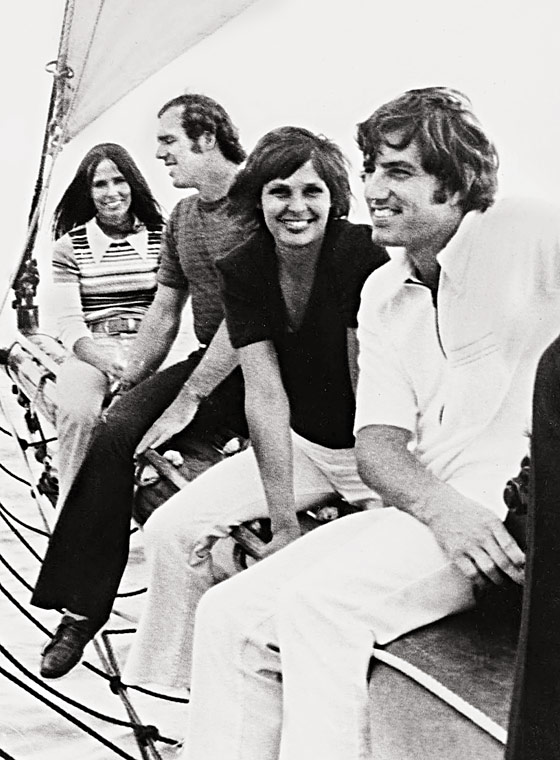
March 5, 1973: The Yankee Wife-Swap

Left to right: Marilyn and Fritz Peterson,
Susanne and Mike Kekich -- as they were then known.

March 5, 1973, 50 years ago: At the New York Yankees' Spring Training camp in Fort Lauderdale, Florida, pitchers Fred "Fritz" Peterson, a 31-year-old lefthanded starter from Chicago, and Mike Kekich, a 27-year-old lefthanded reliever from San Diego, announce that they have engaged in an oh-so-1970s activity: Wife-swapping.

It actually went well beyond that. They'd been teammates since 1969, and they ended up switching entire families. Fritz moved in with Susanne Kekich, while Mike moved in with Marilyn Peterson. The pitchers swapped wives, houses, children, even dogs.

The media ate this story up: It had sports and sex. What a combination.

This must have driven George Steinbrenner crazy. Only 43 years old, and apparently at the peak of his business career, he had bought the Yankees from CBS just 2 months earlier. He wanted to rebuild the organization in what he perceived to be his own image: Straitlaced, almost military, very businesslike, and successful.

What's more, he wanted them to win and -- equally important to him, because he wanted to fill the seats -- to make headlines, to take attention away from the New York Mets. The old Yankee dynasty had collapsed after the 1964 season, and fans had stopped going to the bad neighborhood that Yankee Stadium was in, because, without the winning, and with superstar Mickey Mantle retired, there was no more reason to go to the South Bronx.

In contrast, the Mets had a new stadium in a parking lot in Flushing Meadow-Corona Park, so there was no neighborhood at all, and had won a "miracle" World Series in 1969, and still had most of the players on that team. Indeed, the Mets would win another Pennant in 1973.

The Mets were making headlines by winning and providing fun for their fans. The Yankees were making a totally different kind of headline. Now, they were seen as a team of perverts, even though it was only 2 players involved. But Peterson was 1 of their top 2 pitchers, along with Mel Stottlemyre. He had won 20 games in 1970, and 17 in 1969 and 1972. He led the American League in WHIP (Walks + Hits, divided by Innings Pitched) twice. Kekich, on the other hand, was a journeyman: He'd gone 10-9 in 1971, but 10-13 in 1972, and he was never even that good again.

Despite Peterson and Kekich getting booed in just about every AL ballpark, including Yankee Stadium, the '73 Yankees stayed in the AL Eastern Division race through August, then tailed off, and the Baltimore Orioles won the Division, then lost the AL Championship Series to the Oakland Athletics, who then beat the Mets in the World Series -- thanks in large part to 3 players that Steinbrenner would eventually acquire for the Yankees: Slugging outfielder Reggie Jackson, and pitchers Jim "Catfish" Hunter and Ken Holtzman.

Kekich wasn't there for most of that: On June 12, Steinbrenner had him traded to the Cleveland Indians for pitcher Lowell Palmer, then stuck in the minors with a 3-13 career major league record. He ended up never throwing a pitch for the Yankees.

On April 26, 1974, the Yankees traded Peterson, Fred Beene, Tom Buskey and Steve Kline, all pitchers, to the Indians for 1st baseman Chris Chambliss, and pitchers Dick Tidrow and Cecil Upshaw. They traded 1/3rd of their pitching staff for Chambliss, a former AL Rookie of the Year, and 2 pitchers nobody had ever heard of. With Watergate's Saturday Night Massacre having happened just 6 months earlier, this trade became known as the Friday Night Massacre, and was very unpopular at the time, both in the clubhouse and in the stands.

But it was a great trade for the Yankees. As one observer wrote, it "broke up the country club." Upshaw never did much for them, but Tidrow became a key pitcher, both starting and relieving, on the team that would win 3 straight Pennants from 1976 to 1978. And Chambliss had both a Gold Glove and a power bat, hitting the home run that clinched the 1976 Pennant.

Peterson went 14-8 for the Indians in 1975, but pitched only 1 more season and change in the majors, due to a shoulder injury. He would finish his career at 133-131, pitching mostly for bad Yankee teams. His career WHIP was 1.191, and he led the American League in that category twice. Kekich was taken by the expansion Seattle Mariners, and threw the 1st complete-game victory in franchise history. That was it for him, as he finished 39-51.

And what about the swap? Well, Mike Kekich and Marilyn Peterson's relationship suffered, probably due to the other swap, the one where he was sent to Cleveland. He eventually found happiness by marrying a nurse. As of March 5, 2023, he and his wife were living outside Albuquerque, New Mexico.

But Fritz Peterson and his wife, formerly known as Susanne Kekich, stayed together. In 2013, on the 40th Anniversary, he told a reporter, "It's a love story. It wasn't anything dirty. I could not be happier with anybody in the world." He wrote 3 books about his time with the Yankees, and, with some irony, became an evangelical Christian (as did Susanne), working with Baseball Chapel.

In 2018, Peterson announced that he had Alzheimer's disease, and was withdrawing from public life. In March 2021, with assistance from his daughter Lindsay, he said on his Facebook page that he had forgotten how to use a computer. But Lindsay said that he was "having a blast" hearing from fans. (UPDATE: He died on October 19, 2023, although it wasn't publicly announced for another 6 months, until April 12, 2024.)

Since 2015, Ben Affleck and Matt Damon have been trying to get a movie made about the Yankee Wife-Swap. Of course: They're Boston Red Sox fans, trying to make the Yankees look bad. Let the record show that, in 1973, the Sox didn't get close to making the Playoffs, either, finishing 8 games behind the Orioles.

Wednesday, May 18, 2022

How to Be a Red Bulls Fan In Miami -- 2022 Edition

Next Sunday, the New York Red Bulls will visit one of Major League Soccer's newest teams, Inter Miami -- or, in full, Club Internacional de FĂștbol Miami. They debuted in 2020, but, because of COVID restrictions messing with the MLS schedule, I wasn't able to do a Trip Guide for them in either season.

Stereotypically, South Florida in general, and Miami in particular, is where old Italian and Jewish New Yorkers go to retire. Along with the railroad and air-conditioning, New Yorkers essentially made that region possible.

And how has Miami thanked New York? Well, the Dolphins have made fools out of the Jets (not that the Jets have needed much help), the Marlins have beaten the Yankees in a World Series (2003) and tormented the Mets in 2 season-ending knock-'em-out-of-Playoff-contention games (2007 and '08), and the Heat have fought with the Knicks, figuratively and literally (1997 & '98).

Before You Go. It's South Florida: Presume that it will be hot, and that it will be rainy. This is why the new ballpark has a retractable roof. Most likely, it will be closed. Check the Miami Herald
website for their local forecast before you go.

Currently, they're saying that next weekend's daytime temperatures will be in the mid-80s, while nighttime will be in the high 70s, with the threat of rain. In all honesty, if you're one of these fans who has to visit all of your team's league opponents, you might want to wait until next year for this one.

Miami is in the Eastern Time Zone, so you won't have to fiddle with your watch or the clock on your smartphone. And, while Florida was a Confederate State, and parts of Miami may seem like an extension of Cuba or the Dominican Republic, you won't have to bring your passport or change your money.

Tickets. Inter have played 2 seasons, both under COVID restrictions. Attendance figures are meaningless. Still, they are a new team, and perhaps the novelty has not worn off.

Fortunately, this is soccer, where sections are set aside for visiting fans. In the case of the 18,000-seat DRV PINK Stadium, that's in Section 123, on the east side of the south end zone. Tickets are $26.

Getting There. It's 1,283 miles from Times Square in New York to downtown Miami, and 1,245 miles from Red Bull Arena in Harrison to DRV Pink Stadium in Fort Lauderdale. Knowing this distance, your first reaction is going to be to fly down there. This is not a horrible idea, as the flight is just 3 hours, but you'll still have to get from the airport to wherever your hotel is.

If you're trying to get from Miami International Airport to downtown, you'll need to change buses – or change from a bus to Miami's Tri-Rail rapid transit service. You could fly into Fort Lauderdale Executive Airport: The stadium is right next-door, and doesn't have the plane-noise problem that Shea Stadium had from being so close to La Guardia Airport. Either way, it is possible, if you order quickly, to find nonstop flights for under $300 round-trip.

The train is not a very good idea, because you'll have to leave Penn Station on Amtrak's Silver Star at 11:02 AM and arrive in Miami at 6:35 the next day's evening, a 31 1/2-hour ride, requiring a 2-night hotel stay. The return trip will leave at 11:40 AM and return to New York at 7:10 AM, the same amount of time. No, as I said earlier, there's no time-zone change involved. Round-trip, it'll cost $324 And the station isn't all that close, at 8303 NW 37th Avenue. Fortunately, there's a Tri-Rail station there that will take you downtown.

There is an Amtrak station in Fort Lauderdale, and the Silver Star gets there at 5:57 PM, and leaving the next afternoon at 12:18. But even though the trip is shorter, it's more expensive: $372. The Fort Lauderdale Amtrak station is at 200 SW 21st Terrace, 6 miles south of the stadium, and is connected to Tri-Rail.

How about Greyhound? The ride, including the changeovers in Richmond and/or Orlando, takes about 30 hours. Round-trip fare is $581, but you can get it for $367 on advanced-purchase.

The station is at 4111 NW 27th Street and, ironically, is right across 42nd Avenue from the airport. It's worth the fact that it'll cost twice as much to simply fly down. Plus, you might be reminded of the end of the movie Midnight Cowboy, and nobody wants to be reminded of that. The Fort Lauderdale Greyhound station is at 515 NE 3rd Street, also about 6 miles south of the stadium, and you would need 2 buses to get there.

If you want to drive, it'll help to get someone to go down with you, and take turns driving. You'll be going down Interstate 95 (or its New Jersey equivalent, the Turnpike) almost the whole way. It’ll be about 2 hours from the Lincoln Tunnel to the Delaware Memorial Bridge, 20 minutes in Delaware, and an hour and a half in Maryland, before crossing the Woodrow Wilson Bridge, at the southern tip of the District of Columbia, into Virginia. Then it will be 3 hours or so in Virginia, another 3 hours in North Carolina, about 3 hours and 15 minutes in South Carolina, a little under 2 hours in Georgia, and about 6 hours and 15 minutes in Florida before you reach downtown Miami.

Given rest stops, preferably in one in each State from Maryland to Georgia and 2 in Florida, you're talking about a 28-hour trip. If you're only going as far as Fort Lauderdale, take half an hour off these figures.

Once In the City. A lot of people don't realize it, because Miami is Florida's most famous city, but the most populous city in the State is Jacksonville. However, while Miami has about 450,000 people within the city limits, there are 6.4 million living in the metro area, making it far and away the largest in the South, not counting Texas.

Because Florida is so hot (How hot is it?), and air-conditioning didn't become common until the mid-20th Century, Miami was founded rather late by the standards of the East coast, in 1825, and wasn't incorporated as a city until 1896. The name is derived from the Mayaimi tribe of Native Americans. Miami Avenue is the east-west divider, Flagler Street the north-south. The city has no beltway.

The Herald is the only major newspaper left in the city, but the Sun-Sentinel of Fort Lauderdale should also be available. And, considering how many ex-New Yorkers are around, you might also be able to get the Times, the Daily News, or, if you're really desperate (or really conservative), the Post.

The sales tax in Florida is 6 percent, but it's 7 percent within Miami-Dade County. ZIP Codes in Miami start with the digits 330, 331 and 332; in the Fort Lauderdale area, 333; and in the Palm Beach area, 334 and 349. Florida Power & Light runs the Miami area's electricity.

No longer thought of as a haven for retired Jewish New Yorkers, Miami is the most Hispanic city east of Texas: 70 percent, with half of that, 34 percent of the total, being of Cuban origin, many of them refugees from the 1959 Castro Revolution and their descendants.

It should be noted, though, that, after 2 generations, there are Cubans in South Florida who don't remember living under the Castros, and find out that things weren't so great under the Batista regime, either, and thus don't automatically vote Republican because of the single issue.

The city is 19 percent black, 10 percent white, and only about 1 percent Asian. Miami-Dade County as a whole is about 65 percent Hispanic, 17 percent black, 15 percent white, 2 percent Asian, and 1 percent Middle Eastern. North of the river is mostly black, and a few miles north of that mostly white; while south of the river is mostly Hispanic.

Miami had a race riot in downtown in 1980, after the acquittal of policemen who had beaten a black man to death late the previous year; a riot in the Overtown section in early 1989, after a white policeman ran over a black bicyclist; and a riot in the Wynwood section in late 1990, after the acquittal of officers who had beaten a drug dealer to death.

Since 1984, Miami has had a rapid-transit rail service, Metrorail. However, the ballpark isn't all that close to it. You will need to take the Number 7 bus from downtown. The fare for the Metrorail and the Metrobus is $2.25. There is also the downtown Metromover. Brightline service now connects Miami with Fort Lauderdale and West Palm Beach (its only stops), hoping to open an extension to Orlando in 2021.
A Metrorail train (upstairs) and a Metromover train (downstairs)
at a downtown station

The seat of Broward County, Fort Lauderdale is home to about 182,000 people. The U.S. Army put a stockade there in 1838, and it was named for its 1st commanding officer, Major William Lauderdale. It was abandoned a few years later, but building activity returned to the area in the late 19th Century, and the city was founded in 1911. Its biggest newspaper is the Fort Lauderdale Sun-Sentinel.

Along with Daytona Beach, Fort Lauderdale is Florida's Spring Break capital. From 1962 to 1995, it was the Yankees' Spring Training headquarters.

Going In. DRV PNK Stadium -- pronounced like "Drive Pink," and named for automotive retailer AutoNation's breast cancer awareness campaign -- opened on July 18, 2020, on the site of Lockhart Stadium, at 1350 NW 55th Street, at 12th Avenue. For both stadiums, take Bus 14 from downtown Fort Lauderdale to Powerline Road & 56th Street, then walk 2 blocks west.

Built in 1959, Lockhart was a 17,417-seat high school football stadium, across 55th Street from Fort Lauderdale Stadium, along 12th Avenue. Named for Doug Lockhart, the City Commissioner who got it built, it was home to 4 different teams called the Fort Lauderdale Strikers, including the original NASL's version from 1977 to 1983, and the new NASL's version from 2011 to 2016. It hosted MLS' Miami Fusion from 1998 to 2001, and Miami FC of the United Soccer League in 2009 and '10.
It was the only stadium I know with more seats
in the end zones than along the sidelines.

It hosted 3 games of the U.S. national soccer team, including the November 23, 1980 2-1 victory that was the 1st time the U.S. ever defeated Mexico on home soil, the 1st time anywhere since the countries' 1st meeting, in the 1934 World Cup in Rome. It also hosted Florida Atlantic University's football team from 2003 to 2010, after which their on-campus stadium opened.
It was demolished in 2019, to be replaced by DRV PNK Stadium, with a slightly higher seating capacity. Inter Miami began playing there in 2020, and will remain there until the proposed Miami Freedom Park opens, probably in the 2025 season. At that point, DRV PNK Stadium will serve as a training ground and reserve team home for Inter Miami. The field is real grass, and is aligned north-to-south.
Food. With a great Hispanic, and especially Cuban, heritage, and also being in Southeastern Conference country (hello, tailgating), you would expect the soccer team in South Florida to have great food at their stadium.

There are burger stands behind Sections 108, 113, 118, 120 and 123; the Heineken Supporters Bar in the northeast corner, between 111 and 112; and the Branca Bar under the east stand, at 115.

Team History Displays. Not much. They finished near the bottom of MLS in each of their 1st 2 seasons, and with COVID leading to the cancellation of the U.S. Open Cup in each of those seasons, they couldn't find glory in that tournament, either. Nor are they doing much better this season.

The Florida Sports Hall of Fame is located at Lake Myrtle Sports Park in Auburndale, 232 miles northwest of downtown Miami. Only 2 soccer players are in: Winston Dubose, an Orlando native who starred for the Tampa Bay Rowdies in the old North American Soccer League; and Michelle Akers, who starred in Orlando for the University of Central Florida, helped the U.S. win the 1991 and 1999 Women's World Cups, and is now an assistant manager for the Orlando Pride.

With the arrival of Inter Miami, the nasty rivalry between the Orlando Magic and the Miami Heat has carried over to soccer. Against OCSC, Inter are 2-3 with 3 ties.

Stuff. The Team Store is located in the northwest corner of the stadium, between Sections 105 and 106. There are smaller merchandise stands in the northeast and southeast corners.

As a relatively new team that hasn't won anything yet, there are no team history books or great moments videos.

During the Game. Your safety will not be an issue. Miami has had a crime problem ever since the Mob discovered air conditioning, but this is interior Fort Lauderdale, and the stadium is an island in a sea of parking. You and your car should be fine.

Inter hold auditions for National Anthem singers, instead of having a regular. Their mascot is named Golazo, for a spectacular goal. Like the Vancouver Whitecaps' mascot, he's a belted kingfisher, a bird, but considerably more colorful than his Western Canadian counterpart. This is in spite of the bird on Inter's badge being a heron -- not a pink flamingo, a bird often associated with South Florida.
There are 3 main supporters' groups. Together, they form La Familia (The Family), and occupy the North Stand. The earliest formed, in 2006 while Miami FC were still in operation, were the Southern Legion. Although Florida was a Southern State that seceded from the Union in the run-up to the American Civil War, this group has no connection to that, not even implied: They go out of their way to say, "We are an inclusive supporters group founded on family values and driven by our passion for the game."

They sing in both English and Spanish, and their main song is "Inter, Eres Mi Obsesion" (Inter, you are my obsession). Many of their songs are based on the team colors, "Rosa y Negro" (Pink and Black).

The Siege claim, "Like the herons of our club's crest, we lead with passion, unity and unwavering loyalty." Then there is Vice City 1896:

Vice City 1896 is the official hardcore supporters group of Inter Miami CF. Our aim is to create and spread passion throughout our communities and ultimately create an unparalleled environment in support of our local soccer team. 

​

In a city built around Latin culture, we strive to resemble a dynamic environment similar to what we grew up around in Latin American soccer stadiums. Vice City 1896 is revolutionizing what it means to be a fĂștbol fan in The US. We are bringing the community together to create a “family” that will represent the passion of Miami day in and day out.


Vice City 1896 hasta la muerte.

The group's name, the year the City of Miami was founded, "until the death." Despite these pronouncements, it bears pointing out that these are supporters groups, similar to "ultras" in Europe, not an attempt to copy the hooligans of England and some other European nations. While the barras brava of South American soccer fandom have engaged in violence, these groups seek to emulate the community aspect of them, not the aggressiveness.

After the Game. As I said, the DRV PNK Stadium area is relatively safe. You and your car (if that's how you came) should be fine.

However, the whole "island in a sea of parking in the suburbs of the city" concept so common to stadium and arena building from the 1950s to the 1980s -- and the stadiums first built there opened in 1959 and 1962 -- leads to issues, including where to go for a postgame meal. The Lockhart/For Lauderdale Stadium site is bordered by NW 12th Avenue on the east, and the Fort Lauderdale Executive Airport complex on the other 3 sides. You may have to go south to Commercial Blvd. (Florida Route 870, effectively 50th Street), or north to Cypress Creek Road (effectively 62nd Street) to get anything.

As for where to go after the game, I can't be sure. I checked for area bars where New Yorkers gather, and found one for each of the city's NFL teams.

The South Florida Jets Fan Club meets at Hammerjack's, at 5325 S. University Drive in Davie, a bit closer to the stadium, but still 24 miles north of downtown. But what had been the home of the local Giants fan club, J.C. Wahoo's, 40 miles north of downtown, went under during the depths of the COVID pandemic.

Don't bother looking for Dan Marino's restaurants: They've all closed. He's had financial setbacks, partly due to paying his extramarital baby mama millions of dollars in hush money.

If you visit Miami during the European soccer season, your best bet is American Social, 690 SW 1st Court, of 7th Street, downtown. Churchill's Pub, at 5501 NE 2nd Avenue, 4 miles north of downtown, in Little Haiti, was a popular location, but it closed due to COVID, and it is not yet known if it will ever reopen. Bus 9.

Sidelights. On November 30, 2018, Thrillist published a list of "America's 25 Most Fun Cities," and Miami came in a surprisingly low 12th. Miami's sports history is long, but aside from football, it's not all that involved.

* Fort Lauderdale Stadium. Built in 1962, next-door to Lockhart Stadium (and therefore, retroactively, to DRV PNK Stadium), the Yankees moved their spring training headquarters to the 8,340-seat Fort Lauderdale Stadium after being assured that, unlike their spring home of St. Petersburg at the time, their black players could stay in the same hotel as their white players. The Yankees remained there until 1995, by which point Tampa was not only long since integrated, but was willing to do pretty much anything city resident George Steinbrenner wanted, including build him a new spring home for the Yankees.
The Yankees' Class A team in the Florida State League also used it as a home field. After the Yankees left, the Orioles used it from 1996 to 2009. Although it no longer has a permanent tenant, or even a spring training tenant, it still stands, and the Fort Lauderdale Strikers use it as a practice facility. 1401 NW 55th Street.

* Miami Freedom Park. The proposed 25,000-seat stadium for Inter Miami is set to be built on the grounds of International Links Melreese Country Club, bounded by 37th and 42nd Avenues, and 14th and 21st Streets, across from Miami International Airport. It is set to open during the 2025 season. MetroRail to Airport Station.

* Marlins Park and site of Orange Bowl. Opened in 2012, the official address used to be 1390 NW 6th Street, but it's now 501 Marlins Way. It's 2 miles west of downtown, between 4th and 6th Streets, and 14th and 16th Avenues.
It was built on the site of the stadium known as Burdine Stadium from its 1937 opening until 1959 and the Miami Orange Bowl thereafter. It was best known for hosting the Orange Bowl game on (or close to) every New Year’s Day from 1938 to 1995, and the NFL's Miami Dolphins from their debut in 1966 until 1986.

It was home to the University of Miami football team from 1937 to 2007 (famed for its fake-smoke entrances out of the tunnel). It was also the home of, if you count the All-America Football Conference of the 1940s, the first "major league" team in any of the former Confederate States: The 1946 Miami Seahawks. But the black players on the Cleveland Browns would not accept being housed away from their white teammates in segregated Florida, and in that league, what the Browns wanted, the Browns got. So the Seahawks (in no way connected the NFL's Seattle team of the same name) were moved to become the Baltimore Colts after just 1 season.
The Orange Bowl game hosted de facto National Championships for the seasons of 1938-39, Tennessee over Oklahoma; 19556-56, Oklahoma over Maryland; 1971-72, Nebraska over Alabama; 1981-82, Clemson over Nebraska; 1983-84, Miami over Nebraska; 1987-88, Miami over Oklahoma; 1990-91, Colorado over Notre Dame; 1991-92, Miami over Nebraska; 1993-94, Florida State over Nebraska; and 1994-95, Nebraska finally getting revenge over both Miami and their own history in the building.

The Orange Bowl also hosted the Bert Bell Benefit Bowl, a game involving the 2nd-place teams in each of the NFL's divisions from 1960 to 1969, a charity game, a glorified exhibition. Also known as the Playoff Bowl, it was considered so lame that Green Bay Packers coach Vince Lombardi publicly called it "the only game I never want to win" – and he didn't. The stadium also hosted the Miami Toros of the North American Soccer League from 1972 to 1976.

And it hosted 5 Super Bowls, most notably (from a New York perspective) Super Bowl III, when the Jets beat the Colts in one of the greatest upsets in sports history, on January 12, 1969. It also hosted Super Bowls II (1968, Green Bay over Oakland), V (1971, Baltimore over Dallas), X (1976, Pittsburgh over Dallas) and XIII (1979, also Pittsburgh over Dallas). All subsequent South Florida Super Bowls, including the one the Giants won in 2012, Super Bowl XLVI, have been held at the Dolphins' stadium.

The U.S. national soccer team played 19 matches at the Orange Bowl, from 1984 to 2004. They didn't do so well, though, winning only 2 of them, drawing 10 and losing 7. And the biggest crowd they could get was 49,000 -- you'd think that, being in a heavily Hispanic city, they could draw "futbol" fans. Instead, most of the Hispanics came to see them play Latin American teams, and root for those teams.

It was also the home of the North American Soccer League's Miami Gatos and Miami Toros, before they moved up I-95 to become the Fort Lauderdale Strikers. Arsenal played their 1st game in North America at the Orange Bowl, on May 31, 1972, beating the Gatos 3-2. Only 4,725 attended, which is why you shouldn't schedule a soccer game for Miami during Memorial Day Weekend. It also hosted the 1974 NASL Final, in which the host Toros lost on penalties to the Los Angeles Aztecs. It hosted the CONCACAF Gold Cup 6 times: 2 games in 1998, 8 games in 2000, 8 games in 2002, 6 games in 2003, 6 games in 2005, and 6 games in 2007.

The Orange Bowl was where the Dolphins put together what remains the NFL's only true undefeated season, in 1972. The Canton Bulldogs had gone undefeated and untied in 1922, but there was no NFL Championship Game in those days. The Chicago Bears lost NFL Championship Games after going undefeated and untied in the regular seasons of 1932 and 1942. And the Browns went undefeated and untied in the 1948 AAFC season, but that’s not the NFL. The Dolphins capped their perfect season by winning Super Bowl VII, and then Super Bowl VIII.

And yet, despite having reached the Super Bowl 5 times, and Miami having hosted 10 of them, the Dolphins have never played in a Super Bowl in their home region. They've done so in New Orleans, in Houston, in the San Francisco Bay Area, and twice in the Los Angeles area. They also haven’t been to one in 31 seasons, which includes all of their history in their new stadium. Curse of Joe Robbie, anyone? Which brings me to...

* The facility currently, officially, named Hard Rock Stadium. Better known by its original name, Joe Robbie Stadium, after the Dolphins' original owner (although legendary entertainer Danny Thomas also had a stake in the team in its first few years), it's also been known as Dolphin Stadium, Dolphins Stadium, Pro Player Stadium and Landshark Stadium.

The Marlins reached the postseason here twice, in 1997 and 2003, and won the World Series both times. In other words, they've never lost a postseason series. Contrast that with the Dolphins: Only once, in their first 29 seasons in the Dolphin Tank, have they even reached the AFC Championship Game (in January 1993, and they lost at home to the Bills).

But don't think that the stadium was better for the Marlins: It was a football stadium, with a baseball field wedged into it, and it wasn't really adequate for the horsehide game. It is, however, still regarded as one of the better stadiums in the NFL, despite having been built before Camden Yards rewrote the rules of stadium construction.

It's hosted Super Bowls XXIII (1989, San Francisco over Cincinnati), XXIX (1995, San Francisco over San Diego), XXXIII (1999, Denver over Atlanta), XLI (2007, Indianapolis over Chicago) and XLIV (2010, New Orleans over Indianapolis). It will host Super Bowl LIV (2020).

It has hosted 6 college football National Championship games: 1997-98, Nebraska over Tennessee; 2001-01, Oklahoma over Florida State; 2004-05, USC over Oklahoma; 2008-09, Florida over Oklahoma; 2012-13, Alabama over Notre Dame; and 2015-16, Clemson over Oklahoma. It will host the title game again for the 2020-21 season.

The stadium is also a premier U.S. soccer venue. On August 4, 1989, London's Arsenal played Argentine club Independiente, each team coming off winning its national league title. Arsenal won, 2-1, but only 10,042 fans came out to see it in the oppressive August Florida heat. (Perhaps this is why Arsenal did not play in North America again for 25 years, coming to Red Bull Arena in 2014.)

Other major club teams to play there include Mexico's Chivas of Guadalajara; England's Chelsea of London, Liverpool, Manchester City and Manchester United; Spain's Real Madrid and Barcelona; France's Paris Saint-Germain; Germany's Bayern Munich; and Italy's AC Milan, Internazionale and Juventus.

The U.S. national team has played there 4 times: A 1-0 loss to Colombia on April 22, 1990; a 1-1 draw with Bolivia on February 18, 1994; a 3-1 loss to Sweden on February 20, 1994; and a 1-0 win over Honduras on October 8, 2011. Other national teams to play there have been England, Croatia, Mexico, Brazil, Educador, Peru, Venezuela, Chile, Ghana and South Korea. It hosted 2 games of the 2013 CONCACAF Gold Cup, and has been selected by the U.S. Soccer Federation as a finalist to be one of the host venues for the 2026 World Cup. (UPDATE: It was chosen as a venue.) The Three Tenors -- Luciano Pavarotti, Placido Domingo and JosĂ© Carreras -- sang there on March 8, 1997.

Now that the Marlins are out, the official address of the stadium is 347 Don Shula Drive, for the number of games that Shula won as an NFL head coach -- although that counts the postseason, and the games he won as boss of the Colts. (But not Super Bowl III, which he lost as coach of the Colts.) It's between NW 199th and 203rd Streets (199th is renamed Dan Marino Blvd.), and NW 21st and 26th Avenues. Take Metrorail toward Palmetto, and get off at the Martin Luther King Jr. station. (I doubt if a sports stadium in the Miami suburbs was a part of Dr. King’s dream, although stadiums and performing-arts venues with racially-integrated seating, particularly in the South, sure were.)

* Comfort Inn. This hotel, across 36th Street from the airport, was built on the site of the Playhouse, once considered one of South Florida’s finest banquet halls. It was here, on January 9, 1969, 3 days before the Super Bowl, at a dinner organized by the Miami Touchdown Club, that Joe Namath of the Jets was speaking, and some drunken Colts fan yelled out, "Hey, Namath! We’re gonna kick your ass on Sunday!" And Joe said, "Let me tell you something: We got a good team. And we're gonna win the game. I guarantee it!" He was right. NW 36th Street between Curtiss Parkway and Deer Run. MetroRail toward Palmetto, to Allapattah Station, then transfer to the 36 Bus.

* Site of Miami Stadium. Also known as Bobby Maduro Stadium, this was the home of the original Miami Marlins, of the Florida State League. Seating 13,000, it was known for its Art Deco entrance and a roof that shielded nearly the entire seating area, to protect fans from the intense Miami weather.

The FSL team that played here was known as the Sun Sox from 1949 to 1954, the Marlins from 1956 to 1960, the Marlins again from 1962 to 1970, the Miami Orioles from 1971 to 1981, and the Marlins again from 1982 to 1988.  It was the spring training home of the Brooklyn Dodgers from 1950 to 1957, the Dodgers in their first season in Los Angeles in 1958 (it can be said that "the Los Angeles Dodgers" played their 1st game here, not in California), and the Baltimore Orioles from 1959 to 1990. The FSL Pennant was won here 7 times: 1950, 1952 (Sun Sox), 1969, 1970 (old Marlins), 1971, 1972 and 1978 (Orioles).

It was demolished in 2001, and The Miami Stadium Apartments were built on the site. 2301 NW 10th Avenue, off 23rd Street. It’s just off I-95, and 8 blocks north and east from the Santa Clara MetroRail station.

* FTX Arena. Formerly known as the American Airlines Arena, this has been the home of the NBA's Miami Heat since 2000, including their 2006, 2012 and 2013 NBA Championship seasons. 601 Biscayne Blvd. (U.S. Routes 1 & 41), between NE 6th and 8th Streets, across Port Blvd. from the Bayside Marketplace shopping center (not exactly their version of the South Street Seaport) and the Miami outlets of Hooters, the Hard Rock CafĂ© and Bubba Gump Shrimp.

The closest rapid-rail station is Overtown – ironically, the same stop for the previous sports arena…

* Site of Miami Arena. Home of the Heat from their 1988 debut until 1999 (the new arena opened on Millennium Eve, December 31, 1999), and the NHL's Florida Panthers from their 1993 debut to 1998, this building was demolished in 2008. Only 20 years? Apparently, like the multipurpose stadiums of the 1960s and '70s, and the Meadowlands Arena and (soon?) the Nassau Coliseum, it served its purpose – getting teams to come in – and then quickly became inadequate.

Nevertheless, when the Overtown race riot happened in January 1989, just before Super Bowl XXIII, area residents took great pains to protect this arena from damage (and the Miami area from the public-relations nightmare that would have occurred had there been a riot during Super Bowl week), and succeeded. 701 Arena Blvd., between Miami Avenue, NW 1st Avenue, and 6th and 8th Streets. Overtown/Arena rail station.

* FLA Live Arena. The home of the Panthers since 1998, and there's a reason the team is called "Florida" instead of "Miami": The arena is 34 miles northwest of downtown Miami, and 14 miles west of downtown Fort Lauderdale, in a town called Sunrise. 1 Panther Parkway, at NW 136th. If you don't have a car, you'd have to take the 195 Bus to Fort Lauderdale, and then the 22 Bus out to the building, whose name has been changed several times already.

Florida International University is at 11200 SW 8th Street, 16 miles west of downtown. Its Riccardo Silva Stadium, formerly FIU Stadium, opened in 1995 and seating 23,500, is at 11310 SW 17th Street. Bus 8. It is home to Miami FC, and hosted 2 games each in the 2009 and 2011 CONACAF Gold Cups.

FIU should not be confused with Florida Atlantic University in Boca Raton. Its 29,419-seat FAU Stadium, which opened in 2011, is at 777 Glades Road, or FAU Blvd. & N. University Drive. Tri-Rail to Boca Raton station. On October 14, 2014, the U.S. soccer team had a 1-1 draw with Honduras at FAU Stadium.

* Gulfstream Park. Built in 1939, this racetrack is home to the annual Florida Derby, one of several warmup races for thoroughbred racing's Triple Crown. It's hosted the Breeders' Cup in 1989, 1992 and 1999. 901 S. Federal Highway (U.S. Route 1), in Hallandale Beach, 16 miles north of downtown Miami. Bus 9 to 29th Place & Aventura Blvd., then Bus 1 to 9th Street.

* Hialeah Park Race Track. The other great thoroughbred course in Florida (South or otherwise) opened in 1922, closed in 2001, and reopened in 2013. It also hosts a warmup for the Triple Crown, the Flamingo Stakes. 2200 E. 4th Avenue in Hialeah, about 10 miles northwest of downtown. MetroRail to Hialeah.

* Sports Immortals Museum. This museum is in Boca Raton, at 6830 N. Federal Highway (Route 1), 50 miles north of downtown Miami. It's got a statue of Babe Ruth, and some memorabilia on display. However, some people have reported that much of the memorabilia they sell has been judged to be fake by authenticators, so buyer beware.

Theoretically, it's reachable by public transportation from Miami, but you'd need to take a bus to a train to a bus to a bus (32 to Tri-Rail to 70 to 1), and it would take about 3 hours. If you don't have the time to make for this, by car or otherwise, skip it.

* Joe DiMaggio Children's Hospital. For the last 30 or so years of his life, the Yankee Clipper lived in South Florida, and while he pretty much ignored his one and only child, son Joe Jr., he adored his grandchildren and children in general. He was a heavy donor to local hospitals, and the Children's Hospital named for him was established in 1992. There is now a statue of him there.

1005 Joe DiMaggio Drive, Hollywood. about 20 miles north of downtown Miami. 22 bus to Hollywood Tri-Rail station, then a mile's walk.

Someone got a copy of an expired DiMaggio driver's license (possibly at an auction), and posted it online. It shows the Yankee Clipper's address as 5151 Collins Avenue in Miami Beach. This, and any other Miami Beach location, can be reached via the 103, 113 or 119 Bus, or car, over the MacArthur Causeway. If you do visit, remember that it is still a private residence, and you will not be allowed inside, and you should not bother whoever's living there now.

* Miami Beach Convention Center. Opened in 1957, it seats 15,000 people. The American Basketball Association's Miami Floridians played here from 1968 to 1972. The 1968 Republican Convention, and both major parties' Conventions in 1972, were held here. Why? Simple: They wanted to be away from downtown, putting water between themselves and wherever the hippies and another antiwar demonstrators were staying.

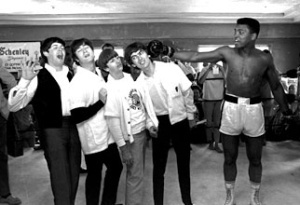
This building hosted the heavyweight title fights of 1961 (Floyd Patterson-Ingemar Johansson III, Floyd won) and 1964 (Cassius Clay-Sonny Liston I, Clay winning and then changing his name to Muhammad Ali). Just 9 days before Ali forced his "total eclipse of the Sonny," on February 16, 1964, the Beatles played their 2nd full-length U.S. concert here. (A photo exists of the Beatles visiting Ali at his Miami training center, and he knocks the 4 of them over like dominoes.) Elvis Presley gave a pair of concerts here on September 12, 1970.

Convention Center Drive between 17th Street and Dade Blvd. The Jackie Gleason Theater, where "The Great One" taped his 1960s version of The Jackie Gleason Show (including a revival of The Honeymooners) is next-door.

* Coconut Grove Convention Center. This former Pan Am hangar, attached to the Dinner Key Marina, was used as a Naval Air Station, convention center, concert hall and sports arena (the Floridians played a few home games here).

It was also known as the Dinner Key Auditorium. On March 1, 1969, The Doors gave a concert here, and lead singer Jim Morrison supposedly committed an indecent act there. (Yeah, he told the crowd, "I'm from Florida! I went to Florida State! Then I got smart and moved to California!")

More recently, it was used as a TV studio, particularly for the Miami-based series Burn Notice. It was demolished in 2013, shortly after that series wrapped production. Pan American Drive at 27th Avenue. Number 102 Bus to Number 48.

* Gusman Center for the Performing Arts. Formerly the Olympic Theater, Elvis sang here early in his career, on August 3 and 4, 1956. 174 E. Flagler Street, downtown.

On March 26, 1960, Elvis taped a segment for The Frank Sinatra Timex Show, subtitled Welcome Home Elvis, in the ballroom of the Fontainebleau Hotel. It was his 1st TV appearance since his discharge from the Army 3 weeks earlier.

Frank was not initially a fan of Elvis, but his 2-year peacetime-but-Cold-War hitch for Uncle Sam -- further emphasized by the fact that an ear condition left Frank himself 4-F, meaning he didn't serve in World War II -- convinced a lot of grownups that he was all right after all, and Frank and his fellow Rat Packers were now happy to go along -- down to Frank's daughter, 15-year-old Nancy (6 years from becoming a star in her own right), being the first "name" he saw when he got off the plane.

Elvis sang both sides of his 1st post-service single, "Fame and Fortune" and the soon-to-be-Number 1 hit "Stuck On You." Then he sang Frank's "Witchcraft," and Frank sang his "Love Me Tender," and they closed the latter song together. They remained friends for the rest of Elvis' life.

The Fontainebleau, then as now, was the most famous hotel in Miami, in Florida, indeed in the entire Southern U.S. 4441 Collins Avenue in Miami Beach.

In addition to the preceding, Elvis sang in South Florida in Fort Myers at the City Auditorium on May 9 and July 25, 1955; in West Palm Beach at the Palms Theater on February 20, 1956 and the West Palm Beach Auditorium on February 13, 1977; and in Hollywood at the Sportatorium on February 12, 1977.

Mets legend Gary Carter is buried at Riverside Memorial Park. So is another Baseball Hall-of-Famer, 1930s Chicago Cubs 2nd baseman Billy Herman. 19351 SE County Line Road in Jupiter, 91 miles north of downtown Miami, and 42 miles south of the Mets' Spring Training home in Port St. Lucie. Not reachable without a car. Hall-of-Fame slugger Jimmie Foxx is buried at Flagler Memorial Park, 5301 W. Flagler Street, 6 miles west of downtown Miami. Bus 11.

Miami isn't a big museum city. The big two are the Miami Science Museum, at 3280 S. Miami Avenue (Vizcaya Station on Tri-Rail); ; and the Miami Art Museum, at 101 W. Flagler Street (downtown).

No President has ever been born in Florida, or grew up there, or even had his permanent residence there. Two men who served as Governor ran for the Democratic Party's nomination for the office, but neither came particularly close to the nomination: Reubin Askew (served 1971 to 1979) dropped out after the 1984 New Hampshire Primary, and Bob Graham (1979 to 1987, U.S. Senate 1987 to 2005) didn't even make it to calendar year 2004, much less the Iowa Caucuses.

Nevertheless, Miami has a key role in Presidential history. On February 15, 1933, President-elect Franklin Roosevelt and Chicago Mayor Anton Cermak were at a rally in Bayfront Park, when Giuseppe Zangara started shooting. FDR was not hit, but Cermak was, and he died on March 6, just 2 days after FDR was inaugurated. Bayfront Park station on Metromover.

More recently, the building where the votes for Dade County were supposed to be counted in the 2000 election was besieged by protesters, hired by House Majority Leader Tom DeLay, so Miami was ground zero for the theft of the election by the George W. Bush campaign. Because of the suits the protesters wore, it's become known as the Brooks Brothers Riot. The Stephen P. Clark Government Center, 111 NW 1st Street, downtown. Government Center station.

The Watsco Center, formerly the University of Miami Convocation Center, hosted a Presidential Debate between Bush and John Kerry in 2004. 1245 Dauer Drive, in Coral Gables. Tri-Rail to University. And Lynn University in Boca Raton hosted a Presidential Debate between Barack Obama and Mitt Romney in 2012. 3601 N. Military Trail. Tri-Rail to Boca Raton, then Bus 2.

The Kennedy family had a compound in Palm Beach, but sold it in 1995. It's still in private hands, and not open to the public. Also in Palm Beach is the Mar-a-Lago Club, a hotel and members-only club built in 1927 by cereal company heiress and socialite Marjorie Merriweather Post. In 1985, it was bought by Donald Trump, and he's turned it into his "Southern White House," disgracing the nation there every other weekend. 1100 S. Ocean Blvd. Bus 1 from downtown West Palm Beach will get you to Dixie Highway & Southern Blvd. (U.S. Routes 1 & 98), but you'd have to walk almost 2 miles over Southern Blvd., across Lake Worth Lagoon and Bingham Island, to get to the sandbar on which Palm Beach sits.

There was a "Little White House" in Key West (111 Front Street), used by Harry Truman (and, to a lesser extent, his immediate successors Dwight D. Eisenhower and Kennedy), and it's open to tours. But that's a long way from Miami: 160 miles, with no public transportation between the 2 cities, and Greyhound charges $110 round-trip for a 4 1/2-hour ride.

For the moment, the tallest building in Miami, and in the entire State of Florida, is the 868-foot Panorama Tower, at 1101 Brickell Avenue. Tenth Street Promenade station on Metromover. And that won't last long as the tallest, since it will be surpassed in 2020 by the 1,005-foot One Bayfront Plaza, at 100 S. Biscayne Blvd. Bayfront Park station on Metromover. The building boom in downtown Miami includes the bayfront skyscrapers that have become known as the "Biscayne Wall."

The tallest of Miami's older buildings is the Freedom Tower, built in 1925 as the home of the now-defunct Miami News. It now houses Miami-Dade College and a Museum. 600 Biscayne Blvd., downtown, across from the American Airlines Arena. Freedom Tower station on Metromover.

* Movies & TV. Several TV shows have been set in Miami. A restaurant called Jimbo's Place was used to film scenes from Flipper and Miami Vice, and more recently CSI: Miami and Burn Notice. It's at 4201 Rickenbacker Causeway in Key Biscayne, accessible by the Causeway (by car) and the 102 Bus (by public transportation).

If you're a fan of The Golden Girls, you won't find the house used for the exterior shots. It's actually in Los Angeles. The address mentioned on the show was 6151 Richmond Street, but that address doesn't exist in Miami. The exterior shot used for the hospital in its spinoff Empty Nest was also in Southern California.

If you're a fan of those not-quite-golden girls, the Kardashian sisters, the penthouse they use to tape the Miami edition of their "reality show" is on Ocean Drive between 1st and 2nd Streets in Miami Beach. But I don't think they use it anymore, especially since Kourtney and Kim have since "taken New York."

Greenwich Studios has been used to film Miami Vice, True Lies, There's Something About Mary
and The Birdcage. It's at 16th Avenue between 121st and 123rd Streets, in North Miami, and often stands in for Miami Beach for the TV shows and movies for which it's used. 93 Bus.

Other shows set in Miami include Surfside 6, Dave's World (based on the Miami Herald columns of Dave Barry), Nip/Tuck, Dexter, and Jane The Virgin.

*

You don't have to be old to be a New Yorker in Miami -- but it helps to be a sports fan. Who knows, the Mets might even get a little bit of revenge for those season-ending series of 2007 and '08.

Sunday, November 14, 2021

How to Be a Devils Fan In South Florida -- 2021-22 Edition

Fort Lauderdale

One of the last Trip Guides I did before COVID shut everything down was for New Jersey hockey fans going south to watch the Devils play the Florida Panthers.

This Thursday, the Devils will go down there again. This may be the only NHL arena that Devils fans can "take over," meaning have more fans than the locals. If you'd like to be one of them, take heed.

Before You Go. It's Florida. If you're still worried about COVID, don't go. If you do go, keep your mask on all the while you're either outdoors or in the arena. If anybody complains, just remember: They weren't tough enough to handle New Jersey and New York, and you are. Nevertheless, you should just say you're leaving the mask on. If they still give you a hard time, call security.

It's South Florida, so it will be warmer than it is here. Check the Miami Herald and Fort Lauderdale Sun-Sentinel websites for their local forecasts before you go. Currently, they're saying that Thursday will be in the 70s with rain throughout the day. That won't affect you during the game, but you won't be indoors the entire time. You should pack at least 2 days' worth of Summer clothes.

Florida is a former Confederate State, and parts of Miami sure seem like a foreign country. But you won't need to bring your passport or change your money. And it's in the Eastern Time Zone, so you won't have to fool with your timepieces.

Tickets. In the 2014-15 season, the Panthers averaged 11,265 fans per home game, last in all 5 North American major sports leagues, including Major League Soccer. In 2019-20, before COVID shut everything down, they were averaging 13,682, just 80.3 percent of capacity. In each case, they ranked 29th, ahead of only the Islanders and Ottawa. 

Their low attendance might have something to do with the fact that the FLA Live Arena -- the 5th name the building has had in its 23 years of existence -- is 20 miles west of downtown Fort Lauderdale, and 35 miles northwest of downtown Miami.

Apparently, the Panthers' organization did not learn the lesson of the Richfield Coliseum. The Cleveland Cavaliers thought that people would no longer go into the city to watch their awful team, so they should move it to the suburbs, where their fan base (read: White people who would pay to watch basketball played by black men, as long as they didn't have huge Afros or bad attitudes but did have some white teammates) lived. So the Coliseum was built in the middle of farmland, 20 miles south of downtown Cleveland and 20 miles northwest of downtown Akron, and their attendance sucked for 20 years until they moved to downtown Cleveland. The Panthers made the same mistake.

Therefore, tickets should be easy to get. You can probably show up 5 minutes before puck drop and buy any ticket you can afford. And they're cheap by NHL standards -- law of supply and demand, I suppose. Lower level seats are $66 between the goals and $57 behind them. In the upper level, they're $29 between and $25 behind.

Getting There. It's 1,253 miles from the Prudential Center in Newark to the BB&T Center in Sunrise. Knowing this distance, your first reaction is going to be to fly down there. This is not a horrible idea, as the flight is just 3 hours.

Fort Lauderdale does have an international airport, and you could fly round-trip, non-stop, on United Airlines for as little as $157 -- an unbelievable bargain. More likely, though, you will flying in and out of Miami, which would be twice as much.

The train is not a very good idea, because you'll have to leave Newark's Penn Station on Amtrak's Silver Star at 11:22 AM and arrive in Fort Lauderdale at 3:50 the next day's afternoon, a 29-hour ride, which, in this case, might not leave you with enough time to get to your hotel and then to the game in time for puck-drop. The return trip will leave at 8:50 AM and return to Newark at 11:37 AM the next day.

Round-trip, it'll cost as much as $422. And the station isn't all that close, at 200 SW 21st Terrace. Fortunately, the Number 22 bus will take you to a short walk from the arena. Unfortunately, that sounds a lot like trying to get a bus to and from the Nassau Coliseum, which was not fun.

How about Greyhound? The ride takes about 32 hours. Round-trip fare will be as much as $600, but you can get it for as little as $386 on advanced-purchase. The Fort Lauderdale station is at 515 NE 3rd Street. You'll need to take the Number 50 bus to the Number 72 bus to get to the arena.

If you want to drive, it'll help to get someone to go down with you, and take turns driving. You'll be going down Interstate 95 (or its New Jersey equivalent, the Turnpike) almost the whole way. It'll be about 2 hours from the Lincoln Tunnel to the Delaware Memorial Bridge, 20 minutes in Delaware, and an hour and a half in Maryland, before crossing the Woodrow Wilson Bridge, at the southern tip of the District of Columbia, into Virginia. Then it will be 3 hours or so in Virginia, another 3 hours in North Carolina, about 3 hours and 15 minutes in South Carolina, a little under 2 hours in Georgia, and about 5 hours and 45 minutes in Florida before you reach Fort Lauderdale.

Given rest stops, preferably in one in each State from Maryland to Georgia, and 2 in Florida, you're talking about a 28-hour trip.

Once In the City. Naming a Florida town "Sunrise" makes some sense. The U.S. Army established a stockade named Fort Lauderdale in 1836, named for the commander of the detachment of soldiers who built the first fort, Major William Lauderdale. The town was incorporated in 1911, at the beginning of the first building boom in Florida. The Miami-Fort Lauderdale metropolitan area is a big market, with about 6.4 million people. But while Miami has about 453,000 people within the city limits, Fort Lauderdale has just 178,000, and Sunrise only 94,000.

Because Florida is so hot (How hot is it?), and air-conditioning didn't become common until the mid-20th Century, Miami was founded rather late by the standards of the East coast, in 1825, and wasn't incorporated as a city until 1896. The name is derived from the Mayaimi tribe of Native Americans. Miami Avenue is the east-west divider, Flagler Street the north-south.

The Miami Herald, Fort Lauderdale's Sun-Sentinel, and the Palm Beach Post are the major newspapers in the area. And, considering how many ex-New Yorkers are around, you might also be able to get the Times, the Daily News, or, if you're really desperate (or really conservative), the Post.

Numbered Streets go east-west in Fort Lauderdale, while numbered Avenues and Terraces go north-south. The east-west divider is Andrews Avenue, and the north-south divider is Broward Blvd. The city has no beltway.

The sales tax in Florida is 6 percent, and it doesn't rise further in Broward County, which includes Fort Lauderdale and Sunrise. But it's 7 percent within Miami-Dade County. ZIP Codes in Miami start with the digits 330, 331 and 332; in the Fort Lauderdale area, 333; and in the Palm Beach area, 334 and 349. Florida Power & Light runs the Miami area's electricity.

No longer thought of as a haven for retired Jewish New Yorkers, Miami is the most Hispanic city east of Texas: 70 percent, with half of that, 34 percent of the total, being of Cuban origin, many of them refugees from the 1959 Castro Revolution and their descendants.

It should be noted, though, that, after 2 generations, there are Cubans in South Florida who don't remember living under the Castros, and find out that things weren't so great under the Batista regime, either, and thus don't automatically vote Republican because of the single issue.

The city is 19 percent black, 10 percent white, and only about 1 percent Asian. Miami-Dade County as a whole is about 65 percent Hispanic, 17 percent black, 15 percent white, 2 percent Asian, and 1 percent Middle Eastern. North of the river is mostly black, and a few miles north of that mostly white; while south of the river is mostly Hispanic.

Miami had a race riot in downtown in 1980, after the acquittal of policemen who had beaten a black man to death late the previous year; a riot in the Overtown section in early 1989, after a white policeman ran over a black bicyclist; and a riot in the Wynwood section in late 1990, after the acquittal of officers who had beaten a drug dealer to death.

Since 1984, South Florida has had a rapid-transit rail service, Metrorail. However, the arena can't be reached from it. You will need to take the Number 7 bus from downtown. The fare for the Metrorail and the Metrobus is $2.25.
Metrorail above, and the smaller Metromover below

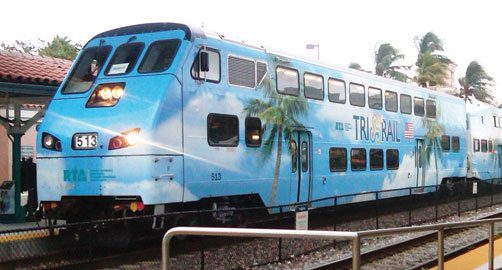
Tri-Rail has run commuter rail service since 1989, linking 3 Counties: Dade (Miami), Broward (Fort Lauderdale) and Palm Beach. Brightline service now connects Miami with Fort Lauderdale and West Palm Beach, with an extension to Orlando, hoping to open it in 2020.
A Tri-Rail train

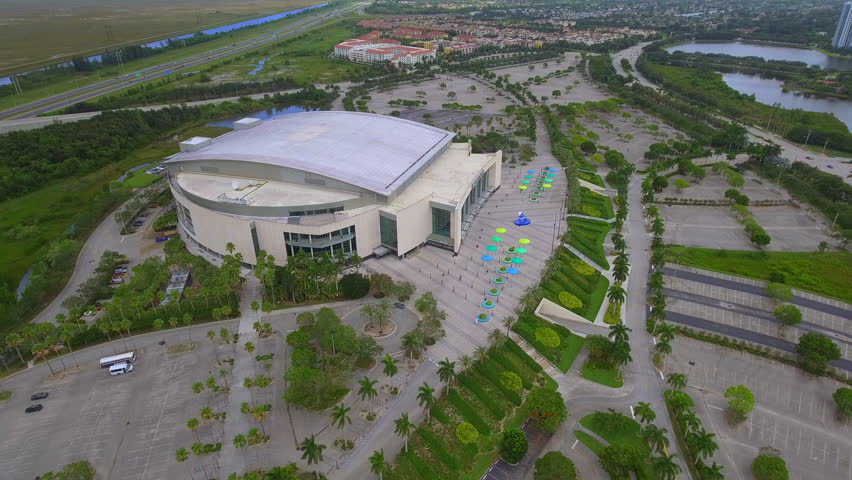
Going In. The NHL's Florida Panthers have been playing at their current arena since 1998, and there's a reason the team is called "Florida" instead of "Miami": The arena is 34 miles northwest of downtown Miami, and 14 miles west of downtown Fort Lauderdale, in a town called Sunrise. It's 22 miles from Hard Rock Stadium, home of the Dolphins; 34 miles northwest of downtown Miami, and 35 miles each from the homes of the Marlins and the Heat.

It was known as the National Car Rental Center from its opening until 2002, then the Office Depot Center until 2005, then the Bank Atlantic Center until 2012, and the BB&T Center (after Branch Banking & Trust Company bought out Bank Atlantic) until earlier this year, when it was named the FLA Live Arena.

The arena's official address is 1 Panther Parkway, Sunrise, FL 33323. As near a I can tell, "Panther Parkway" is NW 136th Street. To get there from I-95 South, take Exit 129 onto Florida Route 70/Okeechobee Road. Take that to Florida's Turnpike South. Get off at Exit 71, for FL-869 S/Sawgrass Expressway. Take Exit 3 for FL-816/Oakland Park Blvd. Turn right from Oakland Park Blvd. onto N. Flamingo Road. The 2nd right is NW 136th Street.
To get there from downtown Fort Lauderdale, take U.S. Route 1/Federal Highway South to Interstate 595/Port Everglades Expressway West, to the Sawgrass Expressway. Take Exit 1B to Pat Salerno Drive, and the arena and its parking lot will be on your right.

To get there from downtown Miami, take I-95 North to Exit 12A onto Florida's Turnpike. Take Exit 54 to the Port Everglades Expressway, and then follow the directions from Fort Lauderdale. For general parking, enter through Gate 1, 2, 3 or 7. Parking costs $20.

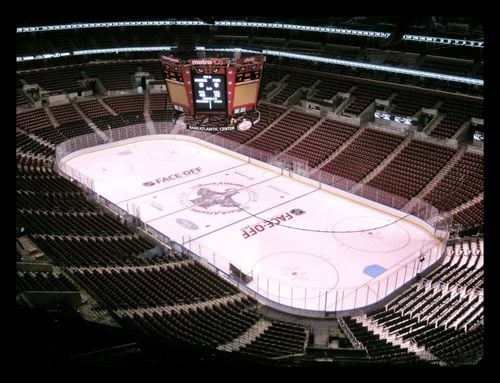
The rink runs east-to-west -- well, northeast-to-southwest. The Panthers attack twice toward the west (southwest) end of the arena.
The arena opened with a concert by Celine Dion, and on Millennium Eve, December 31, 1999, it hosted the last full Bee Gees concert with Barry, Robin and Maurice Gibb all still alive. It has hosted the 2003 NHL All-Star Game, professional "wrestling" and UFC events, one of Barack Obama's final rallies in his 2008 Presidential campaign, and, in 2018, a CNN Town Hall on Gun Control in response to the massacre at Marjory Stoneman Douglas High School in nearby Parkland. (Mrs. Douglas was a journalist who fought for women's right to vote and the preservation of the Florida Everglades, and lived to be 108: 1890-1998.)

UPDATE: The arena has been awarded the 2023 NHL All-Star Game.

Food. With a great Hispanic, and especially Cuban, heritage, and also being in Southeastern Conference country (hello, tailgating), you would expect the hockey team in South Florida to have great food at their arena. But it looks like food is just about an afterthought at the BB&T Center.

It has restaurants accessible through their premium seating, such as the Penalty Box, the BB&T Chairman's Club and the Legends Lounge. There are also several bars that any fan at least age 21 and with money can use.

There are 3 food courts on each of the Plaza and Mezzanine Levels that include a wide selection of items on the menu. Guests also have an opportunity to enjoy dining on the two Party City Patios outside the Plaza Level food courts.

Team History Displays. Not much. The Panthers won the Eastern Conference in 1996, the Southeast Division in 2012, and the Atlantic Division in 2016, and hang banners for those titles. 
But their 1st 2 retired numbers aren't for players: 37, for original owner Wayne Huizenga, born in 1937; and 93, for their 1993 founding, for Bill Torrey, the former Islander boss who was their 1st general manager and built their conference title. Not until 2020, just before COVID shut everything down, did they finally retire a number for a player: 1, for Roberto Luongo, goaltender from 2000 to 2006, and again from 2014 to 2019.
There are 7 individuals with a Panther connection who are in the Hockey Hall of Fame, but only 1, Pavel Bure, played more than 2 seasons for them (in his case, 3: 1999-2002). The other players are Dino Ciccarelli, Igor Larionov, Joe Nieuwendyk and Ed Belfour. In the "Builders" category, there's Torrey and 1st head coach Roger Neilson, for whom their press box is named.

Torrey has received the Lester Patrick Trophy for contributions to hockey in America. Bure has been elected to the International Ice Hockey Federation (IIHF) Hall of Fame, and was named to the NHL's 100th Anniversary 100 Greatest Players in 2017.

They don't have a team Hall of Fame, but they do have a "Den Of Honor," located on the Plaza Level between Sections 115 and 121. It's a museum, featuring photos, jersey and other equipment, and other items connected to the franchise's 28-year history. According to their website, "It also honors the people and organizations that continue to help South Florida grow as a hotbed for youth and high school hockey." (Hockey hotbed? South Florida? I think someone's been out in the Sun for too long.)

The Florida Sports Hall of Fame is located at Lake Myrtle Sports Park in Auburndale, 232 miles northwest of downtown Miami, and 213 miles northwest of the BB&T Center. Two Panther figures have been inducted: Huizenga and 1993-98 goaltender John Vanbiesbrouck.

Understandably, their main rivalry is intrastate, with the Tampa Bay Lightning. It was sparked before the Panthers had ever played a game, with legendary player Phil Esposito, the Lightning's 1st general manager, calling them "the stinking Panthers," and their 1st head coach, Terry Crisp, calling them "the Pussycats." The Panthers' 1st general manager, Crisp's former Philadelphia Flyers Captain, Bobby Clarke, didn't like that. Crisp ended up laughing it off, saying it was just entertainment, but Espo kept calling them "the stinking Panthers" for as long as he had the job.

In spite of the Bolts being the more successful franchise, the Panthers have won more games, 74-70-10. It took until 2021 for them to meet each other in the Playoffs, and the Lightning won in 6 games on their way to winning the Stanley Cup. In spite of the rivalry being called the Governor's Cup, there is no actual trophy. The Panthers have won it 14 times, the Lightning 12, with a split in 1996, and no award in 2005 due to the NHL lockout.

Stuff. The Panthers have Pantherland, a team store, on the south (southeast) side of the building; and both a CCM Heritage Store at Section 122 and an Old Time Hockey Store at Section 112, paying tribute to early hockey (which, by this point, means anything prior to the team's establishment in 1993). There's also a Panthers IceDen in the nearby town of Coral Springs.

Since the Panthers don't have much history,  don't expect to find too many books and DVDs about them. After their 1996 Conference Championship, Dave Rosenbaum wrote Miami Ice: Winning the NHL Rat Race With the Florida Panthers. (I'll explain the "rat" reference shortly.)

When the team began in 1993, they released a Florida Panthers Video Hockey Guide. The next year, an Inaugural Year tape, Heart & Soul. That's right, tape. Videotape. Amazingly, these 2 VHS releases and Miami Ice are available on Amazon.com. But that's about it.

During the Game. A November 19,2014 article on The Hockey News' website ranked the NHL teams' fan bases, and listed the Panthers' fans at 25th out of 30, pointing out that "They'll watch a winner." Maybe, but the arena being far from the downtowns of either Miami or Fort Lauderdale doesn't help. Nor does Florida's skewing toward a higher age.

Safety should not be an issue. The arena is an island in a sea of parking, and is nowhere near the ghettos of Miami.

South Florida is loaded with people who came from elsewhere, including ex-New Yorkers. The stereotype is that, when a New Yorker gets old, if he has enough money to do so, he moves to Miami. Especially if he's Jewish. Or Italian. As a result, you may see a lot of people who used to go to Ranger or Islander games, some of whom maintain their old allegiances, get the MSG Network on their cable system, and have adopted the Panthers as their "second team."

Be advised that, just 5 seasons ago, the arena had a problem with the plumbing. The toilets clogged up and overflowed. You'd expect this at an older arena like the Meadowlands or the Nassau Coliseum. But this is not an old arena. I'm not saying it will happen again, just that it has happened fairly recently, and that it could happen again.

The Panthers' mascot is Stanley C. Panther, obviously named for the Stanley Cup (which, of course, hasn't yet been won by the team). He used to wear Number 93, in honor of the team's founding, until the number was retired for Torrey. Now, like so many other sports mascots, including our own N.J. Devil, he wears Number 00. Information about Stanley can be found at Stanley's Den.
Maybe Stanley C. Panther should've been named Tom Cat instead.

Ghaleb Emachah is the Panthers' regular National Anthem singer. A Venezuelan-born tenor of Arab descent, he came to the U.S. at age 21, settled in Fort Lauderdale, and became a contestant on American Idol. Their goal song is "Out of Our Heads" by the Dropkick Murphys, adding a panther growl sound effect. But their biggest chant is the generic, "Let's go, Panthers!"
No, I don't know why Emachah is posing like Napoleon.

During the 1996 season, the Panthers' Scott Mellanby saw a rat in the locker room, and whacked it with his stick. He then used the same stick to score 2 goals in that night's game. John Vanbiesbrouck, the former Ranger goalie by then with the Panthers, called it not a hat trick, but a "rat trick." Thereafter, instead of fans throwing hats onto the ice when a players scored 3 goals in a game, they threw plastic or rubber rats when a player scored 2.

By the time they reached the Conference Finals, and knocked off the Philadelphia Flyers to advance to the Stanley Cup Finals, they were throwing the rats after every goal. Even when Uwe Krupp scored the triple-overtime winner to give the Colorado Avalanche the Cup in Game 4 of the Finals, the fans used that last opportunity of the season to throw all their rats onto the ice, making it difficult to award the Cup. This resulted in an off-season rule change by the NHL that allowed for referees to penalize the home team if fans disrupt the game by throwing objects onto the ice. Nevertheless, on occasion, the fans still throw the plastic and rubber rats onto the ice, after 18 years.

After the Game. As I said, the arena isn't in a neighborhood. There's a mall with chain restaurants across 136th Avenue, but if that's not your cup of tea (or mug of beer), you may have to head back to Fort Lauderdale or Miami.

I checked for area bars where New Yorkers gather, and found one for each of the city's NFL teams. The South Florida Jets Fan Club meets at Hammerjack's, at 5325 S. University Drive in Davie, 11 miles southeast of the arena. American Social is the home of the local Giants fan club, and also caters to fans of the Yankees and Knicks, at 721 East Las Olas Blvd., 18 miles east in downtown Fort Lauderdale. Bokamper's, a bar chain run by former Miami Dolphin linebacker Kim Bokamper, has several outlets nearby.

Don't bother looking for Dan Marino's restaurants: They've all closed. He's had financial setbacks, partly due to paying his extramarital baby mama millions of dollars in hush money.

If you visit Miami during the European soccer season (now drawing to a close but starting again in mid-August), your best bet is American Social, at 690 SW 1st Court, off 7th Street. 

Sidelights. On November 30, 2018, Thrillist published a list of "America's 25 Most Fun Cities," and Miami came in a surprisingly low 12th. The Miami-Fort Lauderdale area's sports history is long, but aside from football, it's not all that involved. I'll get the Fort Lauderdale ones out of the way first.

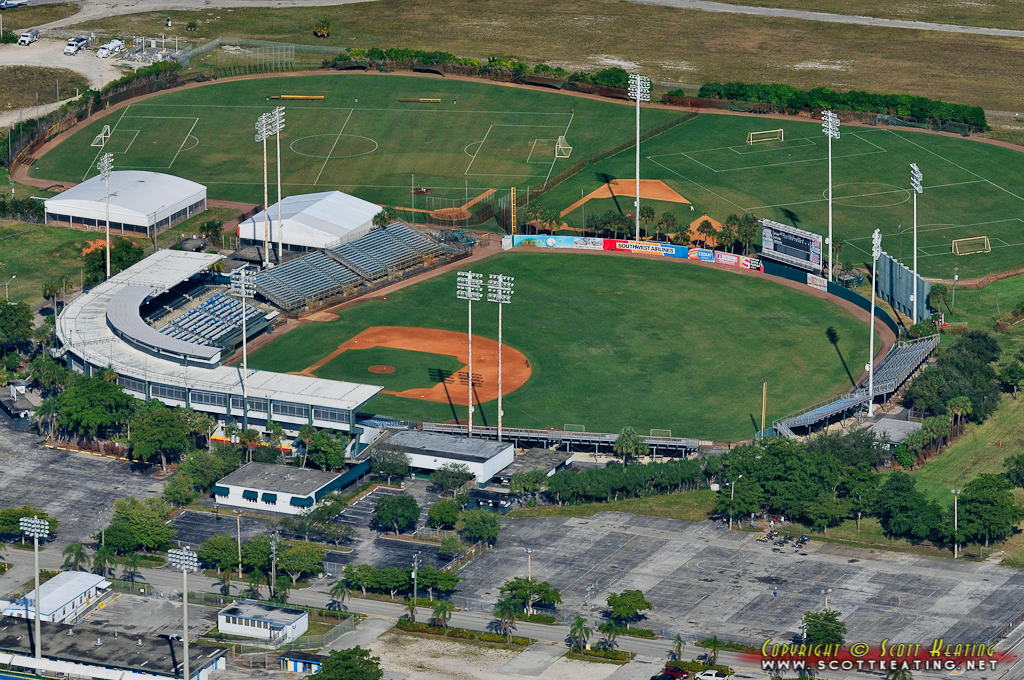
* Fort Lauderdale Stadium and Lockhart Stadium. Built in 1962, the Yankees moved their spring training headquarters to the 8,340-seat Fort Lauderdale Stadium after being assured that, unlike their spring home of St. Petersburg at the time, their black players could stay in the same hotel as their white players. The Yankees remained there until 1995, by which point Tampa was not only long since integrated, but was willing to do pretty much anything city resident George Steinbrenner wanted, including build him a new spring home for the Yankees.
The Yankees' Class A team in the Florida State League also used it as a home field. After the Yankees left, the Orioles used it from 1996 to 2009. Although it no longer has a permanent tenant, or even a spring training tenant, it still stands, and the Fort Lauderdale Strikers use it as a practice facility. 1401 NW 55th Street.

Built in 1959, Lockhart was a 17,417-seat high school football stadium, across 55th Street from Fort Lauderdale Stadium, along 12th Avenue. It was home to 4 different teams called the Fort Lauderdale Strikers, including the original NASL's version from 1977 to 1983, and the new NASL's version from 2011 to 2016. It hosted MLS' Miami Fusion from 1998 to 2001.

It hosted 3 games of the U.S. national soccer team, including the November 23, 1980 2-1 victory that was the 1st time the U.S. ever defeated Mexico on home soil, the 1st time anywhere since the countries' 1st meeting, in the 1934 World Cup. It also hosted Florida Atlantic University's football team from 2003 to 2010, after which their on-campus stadium opened.
It was the only stadium I know with more seats
in the end zones than along the sidelines.

It was demolished in 2019, to be replaced by what is currently named DRV PNK Stadium (pronounced like "Drive Pink"), of about the same capacity. Inter Miami CF will play their home games there until Miami Freedom Park is built. Construction has yet to begin. But when it does open, DRV PNK Stadium (or whatever it will be called by that point) will serve as a training ground and reserve team home for Inter Miami.

1350 NW 55th Street, at 12th Avenue. For both stadiums, take Bus 14 from downtown Fort Lauderdale to Powerline Road & 56th Street, then walk 2 blocks west.

* Marlins Park and site of Orange Bowl. The home of the team that became known as the Miami Marlins when they moved in for the 2012 season was built at the site of the stadium known as the Miami Orange Bowl. It will be a long time before it builds up anything of  history, but it will never match the history of the classic horseshoe with the palm trees at the open east end.

Opening in 1937, and known as Burdine Stadium until 1959, it hosted the Orange Bowl game on (or close to) every New Year's Day from 1938 to 1995, and once more in 1999 when the Dolphins made the Playoffs to make their new stadium unavailable.

It also hosted the University of Miami football team from 1937 to 2007 (famed for its fake-smoke entrances out of the tunnel); the Miami Seahawks of the All-America Football Conference in 1946 (they moved to become the Baltimore Colts after just 1 season, but this was arguably the 1st "major league" team in any of the former Confederate States); the Bert Bell Benefit Bowl (a game involving the 2nd-place teams in each of the NFL's divisions from 1960 to 1969, also known as the Playoff Bowl, a game so lame that Vince Lombardi once called it "the only game I never want to win" – and he didn't); the Dolphins from 1966 to 1986; and the Miami Toros of the North American Soccer League from 1972 to 1976, including the 1974 NASL Final, where they lost on penalties to the Los Angeles Aztecs.

And it hosted 5 Super Bowls, most notably (from a New York perspective) Super Bowl III, when the Jets beat the Colts in one of the greatest upsets in sports history, on January 12, 1969. It also hosted Super Bowls II (1968, Green Bay over Oakland), V (1971, Baltimore over Dallas), X (1976, Pittsburgh over Dallas) and XIII (1979, also Pittsburgh over Dallas). All subsequent South Florida Super Bowls, including the one the Giants won in 2012, Super Bowl XLVI, have been held at the Dolphins' stadium.

The Orange Bowl was where the Dolphins put together what remains the NFL's only true undefeated season, in 1972. The Canton Bulldogs had gone undefeated and untied in 1922, but there was no NFL Championship Game in those days. The Chicago Bears lost NFL Championship Games after going undefeated and untied in the regular seasons of 1932 and '42. And the Cleveland Browns went undefeated and untied in the 1948 AAFC season, but that's not the NFL.

The Dolphins capped their perfect season by winning Super Bowl VII over the Washington Redskins, and then Super Bowl VIII over the Minnesota Vikings. And yet, despite having reached the Super Bowl 5 times, and Miami having hosted 10 of them, the Dolphins have never played in a Super Bowl in their home region. (They've done so in Los Angeles twice, and once each in New Orleans, Houston and San Francisco.) They also haven't been to one in 31 seasons, including all of their history in their new stadium. "The Curse of Joe Robbie," anyone?

The Orange Bowl game hosted de facto National Championships for the seasons of 1938-39, Tennessee over Oklahoma; 19556-56, Oklahoma over Maryland; 1971-72, Nebraska over Alabama; 1981-82, Clemson over Nebraska; 1983-84, Miami over Nebraska; 1987-88, Miami over Oklahoma; 1990-91, Colorado over Notre Dame; 1991-92, Miami over Nebraska; 1993-94, Florida State over Nebraska; and 1994-95, Nebraska finally getting revenge over both Miami and their own history in the building.

North London soccer club Arsenal played their 1st game in North America at the Orange Bowl, on May 31, 1972. Because it was Miami on Memorial Day Weekend and thus really hot, only 4,725 fans came out to see the Gunners beat the Miami Gatos 3-2.

1501 NW 3rd Street, between 7th Street, 14th and 16th Avenues. Number 11 Bus west on Flagler Street from downtown, then 3 blocks north on 15th Avenue. Be careful: This is in Little Havana, a high-crime neighborhood.

* Hard Rock Stadium. Probably best known under its original name, Joe Robbie Stadium, the Dolphins' home was named for their longtime owner, who had it built for them and for a hypothetical MLB team that became the Marlins. It's 15 miles north of downtown Miami, in a location that's been called, at various times, Miami, Miami Lakes, Miami Gardens, Carol City and Opa-Locka. Sounds like a bad variety show sketch.

The Stadium is between 199th and 203rd, and between the Turnpike and 27th Avenue, across 203rd and Snake Creek from Calder Race Course. The exact mailing address is 347 Don Shula Drive, for the coach who won the Dolphins' 2 titles and the record number of NFL coaching wins he has.

Public transportation there is a bit tricky. You'd have to take Metrorail from downtown to M.L. King Rail Station, then transfer to the Number 27 bus, riding that to NW 199th Street & NW 27th Court. And then you'd have to walk down 199th for about 15 minutes and turn into the parking lot. Not exactly ideal. (Somehow, I don't think a situation like this, especially with a transit station with his name on it, was part of Martin Luther King's dream. But he certainly would have approved of a racially mixed crowd watching racially mixed teams playing each other.)

The stadium has been home to the Dolphins since 1987; the Orange Bowl game in 1996, 1997, 1998 and since 2000; the University of Miami football team since 2008 (their games were the last thing the Orange Bowl stadium hosted before its demolition to make way for Marlins Park); the Marlins from 1993 to 2011; and the Champs Sports Bowl from 1990 to 2000.

It's hosted 6 Super Bowls: XXIII (1989, San Francisco 49ers over Cincinnati Bengals), XXIX (1995, 49ers over San Diego Chargers), XXXIII (1999, Denver Broncos over Atlanta Falcons), XLI (2007, Indianapolis Colts over Chicago Bears, and the only Super Bowl that's yet been rained on), XLIV (2011, Packers over Steelers), and LIV (2020, Chiefs over 49ers).

It has hosted 7 college football National Championship games: 1997-98, Nebraska over Tennessee; 2001-01, Oklahoma over Florida State; 2004-05, USC over Oklahoma; 2008-09, Florida over Oklahoma; 2012-13, Alabama over Notre Dame; 2015-16, Clemson over Oklahoma; and 2020-21, Alabama over Ohio State. It will host the title game again for the 2020-21 season.

It's also hosted 2 World Series: 1997, Marlins over Cleveland; and 2003, Marlins over, uh, let's move on. It hosted 4 BCS National Championship Games: 2001 (Oklahoma over Florida State), 2005 (USC over Oklahoma), 2009 (Florida over Oklahoma) and 2013 (Alabama over Notre Dame).

The stadium is also a premier U.S. soccer venue. On August 4, 1989, London's Arsenal played Argentine club Independiente, each team coming off winning its national league title. Arsenal won, 2-1, but only 10,042 fans came out to see it in the oppressive August Florida heat. (Perhaps this is why Arsenal did not play in North America again for 25 years, coming to Red Bull Arena in 2014.)

Other major club teams to play there include Mexico's Chivas of Guadalajara; England's Chelsea of London, Liverpool, Manchester City and Manchester United; Spain's Real Madrid and Barcelona; France's Paris Saint-Germain; Germany's Bayern Munich; and Italy's AC Milan, Internazionale and Juventus.

The U.S. national team has played there 4 times: A 1-0 loss to Colombia on April 22, 1990; a 1-1 draw with Bolivia on February 18, 1994; a 3-1 loss to Sweden on February 20, 1994; and a 1-0 win over Honduras on October 8, 2011. Other national teams to play there have been England, Croatia, Mexico, Brazil, Educador, Peru, Venezuela, Chile, Ghana and South Korea. It has been selected by the U.S. Soccer Federation as a finalist to be one of the host venues for the 2026 World Cup. (UPDATE: It was chosen as a venue.) The Three Tenors -- Luciano Pavarotti, Placido Domingo and JosĂ© Carreras -- sang there on March 8, 1997.

* Miami Freedom Park. The proposed 25,000-seat stadium for Inter Miami is set to be built on the grounds of International Links Melreese Country Club, bounded by 37th and 42nd Avenues, and 14th and 21st Streets, across from Miami International Airport. Construction has not yet begun, so we can't be sure of when it will open. MetroRail to Airport Station.

* Comfort Inn. This hotel, across 36th Street from the airport, was the site of the Playhouse, once considered one of South Florida's finest banquet halls. It was here, on January 9, 3 days before the Super Bowl, at a dinner organized by the Miami Touchdown Club, that Joe Namath of the Jets was speaking, and some drunken Colts fan yelled out, "Hey, Namath! We're gonna kick your ass on Sunday!" And Joe said, "Let me tell you something: We got a good team. And we're gonna win. I guarantee it!" He was right.

NW 36th Street between Curtiss Parkway and Deer Run. MetroRail toward Palmetto, to Allapattah Station, then transfer to the 36 Bus.

* Site of Miami Stadium. Also known as Bobby Maduro Stadium, this was the home of the original Miami Marlins, of the Florida State League. Seating 13,000, it was known for its Art Deco entrance and a roof that shielded nearly the entire seating area, to protect fans from the intense Miami weather.

The FSL team that played here was known as the Sun Sox from 1949 to 1954, the Marlins from 1956 to 1960, the Marlins again 1962 to 1970, the Miami Orioles 1971 to 1981, and the Marlins again from 1982 to 1988. These teams won FSL Pennants in 1969, 1970, 1971, 1972 and 1978 -- giving Miami 7 Pennants, counting those won by the NL Marlins.

Miami Stadium was the spring training home of the Brooklyn Dodgers from 1950 to 1957, the Dodgers in their first season in Los Angeles in 1958 (it can be said that "the Los Angeles Dodgers" played their 1st game here, not in California), and the Baltimore Orioles from 1959 to 1990.

It was demolished in 2001, and The Miami Stadium Apartments were built on the site. 2301 NW 10th Avenue, off 23rd Street. It's just off I-95, and 8 blocks north and east from the Santa Clara MetroRail station.

* FTX Arena. Named the American Airlines Arena until this year, tThe "Triple-A" has been the home of the NBA's Miami Heat since 2000, including their 2006, 2012 and 2013 NBA Championship seasons. 601 Biscayne Blvd. (U.S. Routes 1 & 41), between NE 6th and 8th Streets, across Port Blvd. from the Bayside Marketplace shopping center (not exactly their version of the South Street Seaport) and the Miami outlets of Hooters, the Hard Rock CafĂ© and Bubba Gump Shrimp. The closest rapid-rail station is Overtown, the same stop for the previous sports arena…

* Site of Miami Arena. This was the home of the Heat from 1988 to 1999, the NHL's Florida Panthers from 1993 to 1998, and the University of Miami basketball team from 1988 to 2003. When the Overtown race riot happened in January 16 to 18, 1989, in the week before Super Bowl XXIII, area residents took great pains to protect this arena from damage, and succeeded.

This building was demolished in 2008. Only 20 years? Apparently, like the multipurpose stadiums of the 1960s and '70s, and the Meadowlands Arena and the Nassau Coliseum, it served its purpose – getting teams to come in – and then quickly became inadequate. Grand Central Park, a public park, was built on the site. 701 Arena Blvd., between Miami Avenue, NW 1st Avenue, and 6th and 8th Streets. Overtown/Arena rail station.

* Riccardo Silva Stadium and FAU Stadium. Florida International University is at 11200 SW 8th Street, 16 miles west of downtown. Its Riccardo Silva Stadium, formerly FIU Stadium, opened in 1995 and seating 23,500, is at 11310 SW 17th Street. Bus 8. It is home to Miami FC, the largest team in the area until the Beckham team finally takes the field, if it ever does.
FIU should not be confused with Florida Atlantic University in Boca Raton. Its 29,419-seat FAU Stadium, which opened in 2011, is at 777 Glades Road, or FAU Blvd. & N. University Drive. Tri-Rail to Boca Raton station. On October 14, 2014, the U.S. soccer team had a 1-1 draw with Honduras at FAU Stadium.
* Gulfstream Park. Built in 1939, this racetrack is home to the annual Florida Derby, one of several warmup races for thoroughbred racing's Triple Crown. It's hosted the Breeders' Cup in 1989, 1992 and 1999. 901 S. Federal Highway (U.S. Route 1), in Hallandale Beach, 16 miles north of downtown Miami. Bus 9 to 29th Place & Aventura Blvd., then Bus 1 to 9th Street.

* Hialeah Park Race Track. The other great thoroughbred course in Florida (South or otherwise) opened in 1922, closed in 2001, and reopened in 2013. It also hosts a warmup for the Triple Crown, the Flamingo Stakes. 2200 E. 4th Avenue in Hialeah, about 10 miles northwest of downtown. MetroRail to Hialeah.

* Sports Immortals Museum. This museum is in Boca Raton, at 6830 N. Federal Highway (Route 1), 50 miles north of downtown Miami. It's got a statue of Babe Ruth, and some memorabilia on display.  However, some people have reported that much of the memorabilia they sell has been judged to be fake by authenticators, so buyer beware. Theoretically, it's reachable by public transportation from Miami, but you'd need to take a bus to a train to a bus to a bus (32 to Tri-Rail to 70 to 1), and it would take about 3 hours. If you don't have the time to make for this, by car or otherwise, skip it.

* Joe DiMaggio Children's Hospital. For the last 30 or so years of his life, the Yankee Clipper lived in South Florida, and while he pretty much ignored his one and only child, son Joe Jr., he adored his grandchildren and children in general. He was a heavy donor to local hospitals, and the Children's Hospital named for him was established in 1992. There is now a statue of him there. 1005 Joe DiMaggio Drive, Hollywood. about 20 miles north of downtown Miami. 22 bus to Hollywood Tri-Rail station, then a mile's walk.

* Miami Beach Convention Center. Opened in 1957, it seats 15,000 people. The American Basketball Association's Miami Floridians played here from 1968 to 1972. The 1968 Republican Convention, and both major parties' Conventions in 1972, were held here. (The Republicans nominated Richard Nixon each time, and the Democrats nominated George McGovern.) Why? Simple: They wanted to be away from any city's downtown, putting water between themselves and wherever the hippies and another antiwar demonstrators were staying.

This building hosted the heavyweight title fights of 1961 (Floyd Patterson-Ingemar Johansson III, Floyd won) and 1964 (Cassius Clay-Sonny Liston I, Clay winning and then changing his name to Muhammad Ali). Just 9 days before Ali forced his "total eclipse of the Sonny," on February 16, 1964, the Beatles played their 2nd full-length U.S. concert here. They visited Ali at his Miami training center, and a famous photo was taken. Elvis Presley gave a pair of concerts here on September 12, 1970.
"Float like a butterfly, sing like a Beatle!"

Convention Center Drive between 17th Street and Dade Blvd. The Jackie Gleason Theater, where "The Great One" taped his 1960s version of The Jackie Gleason Show (including a now rarely-seen revival of The Honeymooners) is next-door. This, and any other Miami Beach location, can be reached via the 103, 113 or 119 Bus, or a car, over the MacArthur Causeway.

* Site of Coconut Grove Convention Center. This former Pan Am hangar, attached to the Dinner Key Marina in 1930, was used as a Naval Air Station, a convention center, a concert hall, a 6,900-seat sports arena (the Floridians played a few home games here), and as the indoor-scenes studio for the USA Network show Burn Notice.

It's also been known as the Dinner Key Auditorium. Under that name, on March 1, 1969, The Doors gave a concert here, and lead singer Jim Morrison supposedly committed an indecent act there. (Yeah, he told the crowd, "I'm from Florida! I went to Florida State! Then I got smart and moved to California!")

It was demolished in 2013, and a park is being built on the site. 2700 S. Bayshore Drive, at Pan American Drive & 27th Avenue, in the Coconut Grove section of town. Number 102 Bus to Number 48.

* Gusman Center for the Performing Arts. Formerly the Olympic Theater, Elvis sang here on August 3 and 4, 1956. 174 E. Flagler Street, downtown.

On March 26, 1960, Elvis taped a segment for The Frank Sinatra Timex Show, subtitled Welcome Home Elvis, in the ballroom of the Fontainebleau Hotel. It was his 1st TV appearance since his discharge from the Army 3 weeks earlier.

Frank was not initially a fan of Elvis, but his 2-year peacetime-but-Cold-War hitch for Uncle Sam -- further emphasized by the fact that an ear condition left Frank himself 4-F, meaning he didn't serve in World War II -- convinced a lot of grownups that he was all right after all, and Frank and his fellow Rat Packers were now happy to go along -- down to Frank's daughter, 15-year-old Nancy (6 years from becoming a star in her own right), being the first "name" he saw when he got off the plane.

Elvis sang both sides of his 1st post-service single, "Fame and Fortune" and the soon-to-be-Number 1 hit "Stuck On You." Then he sang Frank's "Witchcraft," and Frank sang his "Love Me Tender," and they closed the latter song together. They remained friends for the rest of Elvis' life.

The Fontainebleau, then as now, was the most famous hotel in Miami, in Florida, indeed in the entire Southern U.S. 4441 Collins Avenue in Miami Beach.

In addition to the preceding, Elvis sang in South Florida in Fort Myers at the City Auditorium on May 9 and July 25, 1955; in West Palm Beach at the Palms Theater on February 20, 1956 and the West Palm Beach Auditorium on February 13, 1977; and in Hollywood at the Sportatorium on February 12, 1977.

* Museums. Miami isn't a big museum city. There's the Miami Science Museum, at 3280 S. Miami Avenue (Vizcaya Station on Tri-Rail); the Miami Art Museum, at 101 W. Flagler Street (downtown); the Perez Art Museum Miami (PAMM), at 1103 Biscayne Blvd., Museum Park station on Metromover; and the Patricia and Philip Frost Museum of Science, at 3280 S. Miami Avenue, Vizcaya station on Metrorail.

* Colleges. The largest college in the area is, as you might have guessed, the University of Miami. Its new Donna E. Shalala Student Center, named for the former University President and U.S. Secretary of Health and Human Services under President Bill Clinton, is at 1330 Miller Drive, about 7 miles southwest of downtown. University Station on Metrorail.

Florida International University is at 11200 SW 8th Street, 16 miles west of downtown. Its FIU Stadium, seating 23,500, is at 11310 SW 17th Street. Bus 8. It should not be confused with Florida Atlantic University in Boca Raton. Its 30,000 FAU Stadium is at FAU Blvd. & N. University Drive. Tri-Rail to Boca Raton station. On October 14, 2014, the U.S. soccer team had a 1-1 draw with Honduras at FAU Stadium.

No President has ever been born in Florida, or grew up there, or even had his permanent residence there. Two men who served as Governor ran for the Democratic Party's nomination for the office, but neither came particularly close to the nomination: Reubin Askew (served 1971 to 1979) dropped out after the 1984 New Hampshire Primary, and Bob Graham (1979 to 1987, U.S. Senate 1987 to 2005) didn't even make it to calendar year 2004, much less the Iowa Caucuses.

Nevertheless, Miami has a key role in Presidential history. On February 15, 1933, President-elect Franklin Roosevelt and Chicago Mayor Anton Cermak were at a rally in Bayfront Park, when Giuseppe Zangara started shooting. FDR was not hit, but Cermak was, and he died on March 6, just 2 days after FDR was inaugurated. Bayfront Park station on Metromover.

More recently, the building where the votes for Dade County were supposed to be counted in the 2000 election was besieged by protesters, hired by House Majority Leader Tom DeLay, so Miami was ground zero for the theft of the election by the George W. Bush campaign. Because of the suits the protesters wore, it's become known as the Brooks Brothers Riot. The Stephen P. Clark Government Center, 111 NW 1st Street, downtown. Government Center station.

The Watsco Center, formerly the University of Miami Convocation Center, hosted a Presidential Debate between Bush and John Kerry in 2004. 1245 Dauer Drive, in Coral Gables. Tri-Rail to University. And Lynn University in Boca Raton hosted a Presidential Debate between Barack Obama and Mitt Romney in 2012. 3601 N. Military Trail. Tri-Rail to Boca Raton, then Bus 2.

The Kennedy family had a compound in Palm Beach, but sold it in 1995. It's still in private hands, and not open to the public. Also in Palm Beach is the Mar-a-Lago Club, a hotel and members-only club built in 1927 by cereal company heiress and socialite Marjorie Merriweather Post. In 1985, it was bought by Donald Trump, and he's turned it into his "Southern White House," disgracing the nation there every other weekend. 1100 S. Ocean Blvd. Bus 1 from downtown West Palm Beach will get you to Dixie Highway & Southern Blvd. (U.S. Routes 1 & 98), but you'd have to walk almost 2 miles over Southern Blvd., across Lake Worth Lagoon and Bingham Island, to get to the sandbar on which Palm Beach sits.

There was a "Little White House" in Key West (111 Front Street), used by Harry Truman (and, to a lesser extent, his immediate successors Dwight D. Eisenhower and Kennedy), and it's open to tours. But that's a long way from Miami: 160 miles, with no public transportation between the 2 cities, and Greyhound charges $110 round-trip for a 4 1/2-hour ride.

* Movies & TV. Several TV shows have been set in Miami. A restaurant called Jimbo's Place was used to film scenes from Flipper and Miami Vice, and more recently CSI: Miami and Burn Notice. It's at 4201 Rickenbacker Causeway in Key Biscayne, accessible by the Causeway (by car) and the 102 Bus (by public transportation).

If you're a fan of The Golden Girls, you won't find the house used for the exterior shots. It's actually in Los Angeles. The address mentioned on the show was 6151 Richmond Street, but that address doesn't exist in Miami. The exterior shot used for the hospital in its spinoff Empty Nest was also in Southern California.

If you're a fan of those not-quite-golden girls, the Kardashian sisters, the penthouse they use to tape the Miami edition of their "reality show" is on Ocean Drive between 1st and 2nd Streets in Miami Beach. But I don't think they use it anymore, especially since Kourtney and Kim have since "taken New York."

Greenwich Studios has been used to film Miami Vice, True Lies, There's Something About Mary
and The Birdcage. It's at 16th Avenue between 121st and 123rd Streets, in North Miami, and often stands in for Miami Beach for the TV shows and movies for which it's used. 93 Bus.

Other shows set in Miami include Surfside 6, Dave's World (based on the Miami Herald columns of Dave Barry), Nip/Tuck, Dexter, and Jane The Virgin.

For the moment, the tallest building in Miami, and in the entire State of Florida, is the 868-foot Panorama Tower, which opened in 2017 at 1101 Brickell Avenue. Tenth Street Promenade station on Metromover. And that won't last long as the tallest, since there are currently 2 buildings under construction, and 4 planned, that stand to surpass it.

The tallest of Miami's older buildings is the Freedom Tower, built in 1925 as the home of the now-defunct Miami News. It now houses Miami-Dade College and a Museum. 600 Biscayne Blvd., downtown, across from the American Airlines Arena. Freedom Tower station on Metromover.

*

You don't have to be old to be a New Yorker or a New Jerseyan in South Florida -- but it helps to be a sports fan. You should be able to enjoy yourself, especially since the Florida Panthers are a team the Devils should be able to beat.