Showing posts with label dusty rhodes. Show all posts

Thursday, November 3, 2016

World Series Walkoff Home Runs

New York's Mickey Mantle
We didn't get one in this World Series. That's okay, though -- unless you're a Cleveland fan.

1. October 5, 1949: Tommy Henrich, New York Yankees, Game 1, off Don Newcombe of the Brooklyn Dodgers, at the original Yankee Stadium in The Bronx.

Henrich's blast was not only the 1st walk-off home run in postseason history but remains one of just 2 that came with the score 0-0. Nicknamed "Old Reliable" for his clutch hitting, played alongside Joe DiMaggio and Charlie Keller in one of the greatest outfields ever assembled. The home run also seems to have put a hex over Newcombe, who had taken a 4-hit shutout into the 9th: He'd make 4 more World Series starts in his career, and allow 20 runs in 14 innings.

2. September 29, 1954: Dusty Rhodes, New York Giants, Game 1, off Bob Lemon of the Cleveland Indians, at the Polo Grounds in Manhattan.

To many, the 1954 Indians seemed unbeatable, winners of 111 games with a rotation that featured Lemon, Early Wynn, Mike Garcia and veteran Bob Feller. In the 8th inning of the opener, Willie Mays made his famous catch to keep the game tied. Lemon was in his 10th inning of work when Leo Durocher sent Rhodes -- who hit .341 in part-time duty that season -- in to hit for Monte Irvin with two runners on and one out.

Rhodes didn't hit it far, but the right-field wall at the Polo Grounds was only 258 feet down the line. His home run had just enough distance. Rhodes would later add game-tying pinch-single and home run in Game 2 and a two-run single in Game 3 as the Giants pulled off the sweep. "I couldn't buy a drink in New York after that '54 Series," Rhodes once said.

3. October 6, 1957: Eddie Mathews, Milwaukee Braves, Game 4, off Bob Grim of the Yankees, at Milwaukee County Stadium.

One of the forgotten great World Series games, the Yankees led the Series 2 games to 1 when Elston Howard's 2-out, 3-run homer off Warren Spahn tied the game in the 9th inning. The Yankees added another run in the 10th on Hank Bauer's RBI triple to take a 5-4 lead.

Bob Grim, the Yankee closer who had gone 12-8 with a league-leading 19 saves that year, came on. He hit Nippy Jones, hitting for Spahn, to lead off the inning. The pitch was originally called a ball, and then overturned when Jones showed umpire Augie Donatelli a shoe-polish mark on the ball. After an RBI double, Mathews launched his game-winning home run. The Braves went on to win in 7 games.

4. October 13, 1960: Bill Mazeroski, Pittsburgh Pirates, Game 7, off Ralph Terry of the Yankees, at Forbes Field in Pittsburgh.

The granddaddy of them all. His home run off the ivy-draped wall not only won the World Series but capped off maybe the greatest baseball game ever played.

5. October 10, 1964: Mickey Mantle, Yankees, Game 3, off Barney Schultz of the St. Louis Cardinals, at Yankee Stadium.

Mantle was a wreck by the time the 1964 World Series rolled out, playing on a bad knee and through a bum shoulder that required offseason surgery. His error earlier in the game allowed the Cardinals to score their only run in a 1-1 game. Schultz, a 37-year-old knuckleballer, warmed up and Mantle declared in the dugout, "I'm gonna hit one outta here."

Mantle swung at the 1st pitch, and crushed into the upper deck. It was his 16th career World Series home run, breaking Babe Ruth's record. The Cardinals would win in 7 games, however, although Mantle hit 2 more home runs.

6. October 21, 1975: Carlton Fisk, Boston Red Sox, Game 6, off Pat Darcy of the Cincinnati Reds, at Fenway Park in Boston.

Actually, since this one happened after midnight (12:34 AM), it was on October 22. Its a little overrated -- the Red Sox did lose Game 7, after all -- but Fisk's 12th-inning home run came in the midst of a brilliant game and hard-fought, exciting World Series with a lot on the line. Everybody knows about Boston's curse at the time, but Reds were also trying to win for the first time since 1940 after their superstar-laden lineup had failed to win in 1970, 1972 and 1973.

Add it up, throwing in the iconic image of Fisk willing the ball fair it crossed over the Green Monster, and you have a home run that will be remembered for a long time.

7. October 15, 1988: Kirk Gibson, Los Angeles Dodgers, Game 1, off Dennis Eckersley of the Oakland Athletics, at Dodger Stadium in Los Angeles.

Gibson's home run is so legendary, so awesome, that it almost makes us forget how Orel Hershiser carried that Dodgers that postseason: 3-0, one save, 1.05 ERA in 42.2 innings, .171 average allowed.

8. October 18, 1988: Mark McGwire, Oakland Athletics, Game 3, off Jay Howell of the Dodgers, at the Oakland-Alameda County Coliseum.

Two games after Kirk Gibson's home run, McGwire's game-ender gave A's fans hope. Alas, Tim Belcher won Game 4 and Orel Hershiser won Game 5 and the Bash Brothers had gone down. For both Gibson and McGwire, their home runs were their sole hit of the Series.

9. October 26, 1991: Kirby Puckett, Minnesota Twins, Game 6, off Charlie Leibrandt of the Atlanta Braves, at the Metrodome in Minneapolis.

The Twins trailed the Braves, 3 games to 2. Puckett told the story years later to Tim Kurkjian: "I went to the clubhouse, and I gathered (everyone) up. I said, 'Everybody together, we're going to have a short meeting.' Everybody comes in, and I said, 'Guys, I just have one announcement to make: You guys should jump on my back tonight. I'm going to carry us.'" He did.

10. October 23, 1993: Joe Carter, Toronto Blue Jays, Game 6, off Mitch Williams of the Philadelphia Phillies, at the SkyDome (now the Rogers Centre) in Toronto.

Williams was a big reason the Phillies got to the postseason in the first place, and nailed down the Pennant-clinching outs in the National League Championship Series against the Atlanta Braves. But he had already blown 3 saves that postseason when Jim Fregosi called upon him to protect a 6-5 lead in Game 6 of the World Series.

He walked Rickey Henderson on 4 pitches. Devon White flew out after a tough 9-pitch at-bat. Paul Molitor singled to center. And then Carter hooked the ball to left field and touched 'em all. Blue Jays 8, Phillies 6.

11. October 26, 1999: Chad Curtis, Yankees, Game 3, off Mike Remlinger of the Atlanta Braves, at Yankee Stadium.

This is how the Yankees won games in those days: It wasn't just Williams and Jeter coming up with the big hits. Curtis had homered in the 5th inning off Tom Glavine, and then won the game in the 10th. The Yanks completed the sweep the next day.

12. October 31, 2001: Derek Jeter, Yankees, Game 4, off Byung-Hyun Kim of the Arizona Diamondbacks, at Yankee Stadium.

Another one that happened after midnight: 12:03 AM on November 1, making Jeter baseball's 1st "Mr. November," after he'd been a "Mr. July" and a "Mr. October" the season before, the only man to be named MVP of both the All-Star Game and the World Series in the same season.

He hit Kim's 61st pitch of the night into the right-field bleachers, after Tino Martinez had already tied the game with a 2-run homer off him in the bottom of the 9th. You probably won't be surprised to discover this: Since then, 15 relievers have thrown more pitches in a postseason game, but all were long guys who entered before the fifth inning. And, yes, Bob Brenly brought him to pitch the next night, and Scott Brosius hit his own game-tying 2-run homer in the 9th.

13. October 22, 2003: Alex Gonzalez, Florida Marlins, Game 4, off Jeff Weaver of the Yankees, at Pro Player (now Hard Rock) Stadium, Miami Gardens.

Weaver had posted an unseemly 5.99 ERA during the season, but Joe Torre brought him in the 11th inning of a tie game. ''I mean, if he's not in the game there, he shouldn't be on our roster,'' Torre said after Gonzalez beat Weaver in the 12th inning to tie the Series. No kidding, he shouldn't be on the roster, Joe!

Where was Mariano Rivera, who went unused in the game, you ask? He had thrown 23 pitches in Game 3 (although he went unused in the 1st 2 games), and perhaps Torre was saving him for the save situation that never came.

As for Weaver, it was the last pitch he threw in pinstripes. By the way, the bigger story at the time: Many believed it was the final game of Roger Clemens' career. He even doffed his cap to the Marlins' crowd, tears welling up in his eyes, as he received a standing ovation after coming out of the game. "It was a very touching moment," Marlins manager Jack McKeon said. "He's a class act. We're gonna miss guys like him." (I'm thinking that maybe Roger should have actually retired.)

14. October 23, 2005: Scott Podsednik, Chicago White Sox, Game 2, off Brad Lidge of the Houston Astros, at U.S. Cellular Field in Chicago.

You could make a case that this was the least likely home run in World Series history, and certainly the least likely walk-off home run. Podsednik, after all, had batted 568 times all season, and hit exactly zero home runs.

The Astros had tied the game in the top of the inning on Jose Vizcaino's 2-out, 2-run single, setting up Podsednik's home run. In his previous appearance, in the NLCS, Lidge had served up a mammoth, game-losing home run to Albert Pujols of the Cardinals. He said that home run wasn't on his mind. "Unfortunately, because I happened to give up home runs in back-to-back games, it may look like I was. But the fact is, I threw a fastball to Podsednik that I wanted to throw. He may have hit it out. But that had nothing to do with Albert Pujols."

The count was 2-1. He didn't want to fall behind 3-1. Podsednik was sitting on the heater. "I was thinking that he was probably going to challenge me with a fastball," he said. "And I said, 'Hey, let's put a good swing on this fastball.'"

15. October 27, 2011: David Freese, St. Louis Cardinals, Game 6, off Mark Lowe of the Texas Rangers, at Busch Stadium in St. Louis.

In 1986, the Boston Red Sox led by 2 runs in the 10th inning, and were 1 out away from winning Game 6, and thus the Series for the 1st time in 68 years, but lost the game, before losing the Series in Game 7. In 2011, the Rangers topped that -- or bottomed it: They lwere 1 out away from winning Game 6, and thus the Series for the 1st time in their franchise's 51-season history (40 seasons in Texas), and blew 2-run leads in both the 9th and the 10th, before Freese won it for the Cardinals in the 11th, and the Cards won Game 7, too.

In World Series play, thus far, no Game 2 or Game 5 has been won by a walkoff home run. Only Mantle in '64, Fisk in '75, McGwire in '88 and Jeter in 2001 did it for teams that ended up losing the Series.

UPDATE:

16. October 26, 2018: Max Muncy, Los Angeles Dodgers, Game 3, off Nathan Eovaldi of the Boston Red Sox, at Dodger Stadium in Los Angeles.

This was in the bottom of the 18th inning, making it the longest game in World Series history by innings. At 5 hours and 41 minutes, it was also the longest game in World Series history by time. But it was the only game the Dodgers won in the Series.

Saturday, November 15, 2014

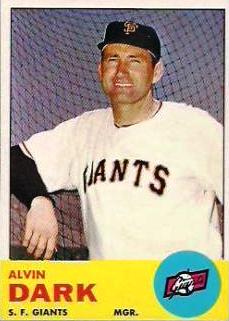
Alvin Dark, 1922-2014

When I was a kid, there was a book called Benchwarmer's Sports Trivia, by Bob Alexander. (He's still alive, and published a book about the Wild West this year.) One of the questions was, "Who is the only man to hit a home run off Sandy Koufax and catch a touchdown pass from Y.A. Tittle?"

Some men had done one or the other. Alvin Dark is the only one who did both. Until now, Dark, Koufax and Tittle were all still alive, although Tittle is in the throes of Alzheimer's disease.

Alvin Ralph Dark was born on January 7, 1922, in Comanche, Oklahoma, about halfway between Oklahoma City and Dallas. He grew up in Lake Charles, Louisiana, about halfway between Baton Rouge and Houston. He attended Southwestern Louisiana University (now the University of Louisiana at Lafayette, later attended by another New York baseball star, Ron Guidry) before transferring to Louisiana State University in Baton Rouge, where he played football and caught the aforementioned touchdown pass from Tittle. In 1945, he was drafted by the Philadelphia Eagles.

But the NFL didn't pay much in those days, and Dark was better at baseball anyway. He signed with the Boston Braves, and made his major league debut on July 14, 1946, at Forbes Field in Pittsburgh. Wearing Number 23, he came in as a defensive replacement at shortstop in the 9th inning, and didn't come to bat. The Pirates won, 5-2.

After spending most of 1946 and 1947 in the minor leagues, he was called back up in 1948, was given Number 2, and was made the Braves' starting shortstop. It was their last great season in Boston. He batted .322 to win the National League Rookie of the Year award, and finished 3rd in the Most Valuable Player voting behind Stan Musial of the St. Louis Cardinals and his Braves teammate, pitcher Johnny Sain -- possibly splitting the Braves' vote to throw the award to Stan the Man. But the Braves won the Pennant, their 1st in 34 years. They lost the World Series to the Cleveland Indians, however.

*

The Braves couldn't sustain their success, and, needing to save money, they traded Dark and their starting 2nd baseman, former Brooklyn Dodger star Eddie Stanky, to, of all teams, the Dodgers' arch-rivals, the New York Giants, where Stanky's former manager Leo Durocher was running things. In return, the Braves got Sid Gordon, who'd finished 4th behind Dark in the '48 MVP race, and 3 guys you don't need to know about.

Wearing his now-familiar Number 19, Dark was able to thrive under Leo the Lip, playing in 3 All-Star Games in 4 seasons. In 1951, he batted .303, his 1st season over .300, and hit a League-leading 41 doubles. The Giants won the Pennant in a dubious stretch run and Playoff victory over the Dodgers, and Dark played in the game where Bobby Thomson hit the home run that meant, as broadcaster Russ Hodges said over and over again, "The Giants win the Pennant!" But they lost the World Series to the Yankees.

As the Durochermen's leadoff hitter, Dark led the NL in at-bats in 1953 and 1954, and in the latter year, the Jints won the Pennant again. This time, Dark was on the field in Game 1 of the World Series against the Indians, when Willie Mays made the most famous catch in baseball history; and in the dugout when Dusty Rhodes hit the pinch-hit home run that won the game in the 10th inning. The Giants swept the Indians, and Dark had his World Series ring on his 3rd try.

Yankee pitcher Jim Bouton likes to tell a story about a game he went to after his family moved from Rochelle Park, Bergen County, New Jersey, where they'd been Giants fans, to Chicago Heights, Illinois. They waited for the Giants to come to Wrigley Field to play the Chicago Cubs, and Jim and his brother Pete went to the game. They got seats behind the visitors' dugout, on the 1st base side, and, in a time-honored tradition, the older brother held the younger brother by his ankles, dangling him over the dugout roof, so he could see in, pen in one hand, program in the other, so he could get autographs.

The dangling Jim saw Dark, and said, "Hey, Al, my name's Jim, I'm not a Cub fan, I'm a Giant fan, I'm from New Jersey, can you sign my program, please?" After a minute, Pete pulled Jim back up, saw that he didn't get an autograph, and asked him what happened. Jim said Dark told him, "Take a hike, son."

Pete wasn't furious that a player had so coldly dismissed his brother. He was thrilled that a real live major league ballplayer had spoken to his brother: "No kidding? Alvin Dark told you to take a hike?" When they got home, their mother asked them what happened. Rather than tell her who won, or about anything that happened in the actual game, Pete said, "Alvin Dark told Jim to take a hike!" After that, whenever someone in the Bouton family wanted to get rid of somebody, even if it was one of the parents, it would be, "Take a hike, Jim," "Take a hike, Mom," or, "Take a hike, Dad."

Asked about the incident years later, Dark denied it, saying, "That's not true. I didn't even know Bouton when he was a kid."

As a veteran ballplayer in his early 30s, Dark had probably completely forgotten about it. He may have told dozens of kids, "Take a hike, son." But Jim has never forgotten it.

Think of it this way: How many of those 1950s Giants are remembered today? Willie Mays is, and so is Bobby Thomson, and so is Dusty Rhodes. Monte Irvin, maybe Sal Maglie. That's about it. But Dark is remembered, because Jim Bouton told the story in Ball Four. People generally don't know what kind of player Dark was, but they remember that he played for the Giants in New York, and that he told Jim Bouton as a boy, "Take a hike, son."

*

He should be remembered: While not as celebrated as the other New York shortstops of the time, Phil "the Scooter" Rizzuto of the Yankees and Harold "Pee Wee" Reese of the Giants, Alvin "Al," "Blackie" or "the Swamp Fox" Dark was a better hitter than either one.

He would hit .300 a total of 4 times, and, in a time when shortstops simply didn't hit much -- Ernie Banks was about to offer the first real change of that idea -- he was the 1st NL shortstop to hit 20 home runs more than once. (Playing in the Polo Grounds with its short foul lines helped.) At the time he retired, only Banks (already) and early Giant Travis Jackson had hit more home runs as an NL shortstop than Dark's 126. He was a good fielder, too, as he led the NL in putouts and double plays 3 times each.

He was traded to the Cardinals in 1956, and to the Cubs in 1958, remaining a starting shortstop until 1959. He was with the Milwaukee Braves in 1960 when, after the season, the Giants, now in San Francisco, reacquired him, and offered him their manager's job. At just 39 years of age, he would be a manager for the 1st time.

*

The 1961 Giants won 85 games to finish 3rd in the NL. The next year, there was a classic Giants vs. Dodgers Pennant race, and, although it was on the opposite coast and it began much later, there was yet another Dodger collapse and yet another Giant surge, and yet another best-2-out-of-3 playoff for the Pennant that wasn't decided until the 9th inning of the last game.

It was decided at the Dodgers' home field this time, the brand-new Dodger Stadium in Los Angeles, and it wasn't nearly as dramatic -- the key play was a bases-loaded walk -- but the Giants again won the Pennant, finishing with 103 wins in their 165 games.
And, again, they lost the World Series to the Yankees. They traded wins, the Yankees winning the odd-numbered games and the Giants the even-numbered ones, until the Yankees won Game 7, 1-0.

The Dodgers won 3 of the next 4 Pennants, with the Giants getting close but falling short of the Cardinals in 1964 and the Dodgers in 1965 and 1966. The 1964 season should have been the Giants' big chance, with Sandy Koufax's injury opening the door to 5 teams finishing within 5 games of 1st, and the Dodgers not being one of them.

But the Giants weren't in the right frame of mind that season. In an interview with the Long Island paper Newsday, Dark -- a Southerner, remember -- lamented the large number of black and Hispanic players on his team. He had Willie Mays, Willie McCovey, Orlando Cepeda, Juan Marichal, and the brothers Felipe, Mateo ("Matty") and Jesus Alou. It wasn't baseball that was ahead of the curve in signing Jackie Robinson in 1947, it was Branch Rickey. In so many ways, baseball was behind the times.

And, in this year of the Civil Rights Act, the Mississippi Freedom Summer, and Martin Luther King receiving the Nobel Peace Prize -- with civil rights for Hispanics hardly even on anyone's radar -- Dark said of black and Hispanic players, "They are just not able to perform up to the white player when it comes to mental alertness."

In a multicultural metropolitan area like San Francisco, this was like sticking your finger in a light bulb socket. The uproar was huge. Dark responded that he had been severely misquoted. Mays, who had been Dark's teammate and whom Dark had named team Captain, came to his defense, and helped calm things down. Jackie Robinson himself came to the defense of his former Giant opponent: "I have found Dark to be a gentleman and, above all, unbiased. Our relationship has not only been on the ballfield but off it."

Dark lasted through the season, but the Giants fell short, 3 games back but in 4th place, and owner Horace Stoneham fired him on the last day of the season, and, had he so chosen, could have fairly said that it had been for competitive reasons, that the Giants should have won the Pennant, and should have won a World Series by then, but hadn't.

Dark knew he'd blown it. One by one, he found the players he'd offended, and apologized to them. Cepeda and Marichal accepted his apology. The Alou brothers did not.

*

Charlie Finley, a native of Birmingham, Alabama, hired him as a coach for the Kansas City Athletics, and promoted him to manager in 1966. But in August 1967, with Finley preparing to move the team to Oakland and just beginning to build the 1970s A's dynasty -- Reggie Jackson made his debut that season, and Catfish Hunter, Bert Campaneris and Sal Bando were already up -- he and Dark had a disagreement over player discipline, and Dark was fired.

He was immediately picked up by Cleveland, and the Indians finished 3rd in 1968, their best finish between 1959 and 1994. But owner Vernon Stouffer made the mistake of giving Dark the general manager's job as well, and since World War II that has rarely worked, as the 2 jobs are too much for any 1 man, partly because of the contradictory needs of the field manager to have the best players available and of the GM to reduce costs. The Indians started losing again, and Dark was fired from both jobs in 1971.

After Dick Williams had had enough of Finley after winning back-to-back World Series in Oakland, Finley hired Dark back for the 1974 season. It didn't start out well, as the players presumed (with some justification) that he would be a yes-man for the cheap owner, who was absentee when he was needed in Oakland and was in Oakland when it would have been better if he had stayed in his adopted hometown of Chicago.

He had recently rediscovered religion, and proselytized to his players, and they didn't like it. The black players saw a taste of his attitudes, and wondered if he even realized that he was being racist. And his bad decisions, particularly pulling starting pitchers too early -- shades of Joe Girardi and his pitch-count-reliant binder -- piled up. By June, with the A's trailing the Kansas City Royals in the American League Western Division, it got to the point where Bando, the A's captain, yelled for all the locker room to hear, "He couldn't manage a meat market!"

Dark heard this, and had enough. He didn't yell, but he calmly asserted his authority, and let them know that, while they didn't have to like the man, they were going to respect the manager. The players got the message: Things turned around, and the A's caught the Royals, and beat the Baltimore Orioles in the American League Championship Series for their 3rd straight Pennant. They'd won the Playoff in 4 games instead of the maximum 5, something they hadn't been able to do the previous 2 years under the much more discipline-minded Williams.

Dark became the 3rd manager, after Joe McCarthy (1929 Cubs and 1932 Yankees) and Yogi Berra (1964 Yankees and 1973 Mets) to win Pennants in both Leagues, and the 3rd after Yogi and Durocher
(1941 Dodgers and 1954 Giants), and still the last to this day, ever to do it with 2 teams in the same metro area. The A's faced his old rivals, the Dodgers, in the World Series, and won. He had now won a title as a player and as a manager.
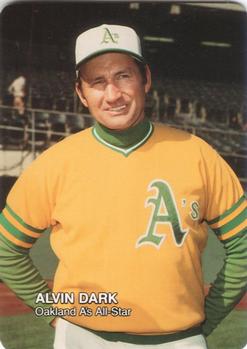
One of Finley's tinkerings with mainstream baseball
was to have the A's manager and coaches wear white caps, 
while the players retained the green ones.

With Finley's stinginess having led to the team's best pitcher, Jim "Catfish" Hunter, being declared a free agent, Dark had his work cut out for him in 1975. But he did perhaps his best managing job, tinkering with a rotation that included Vida Blue, Ken Holtzman, and whoever else had been getting the job done. As they had in the 3 preceding years (they'd run away with it in 1971), the A's won a 5th straight AL West title in 1975. But with their rotation gutted, they lost the ALCS to the Boston Red Sox, and Finley fired Dark again.

His last managing job was with the San Diego Padres in 1977, managing the 2nd half of the season. He was fired in spring training in 1978, for insisting that a rookie be the team's starting shortstop, because of his fielding. The kid couldn't hit a lick, but Dark, who knew the shortstop position as well as any man alive, was sure the kid was ready for the majors. The Padres never did give the kid a fair chance, and ended up trading him to St. Louis for a more established shortstop, Garry Templeton.

Templeton helped the Padres win the Pennant in 1984, but the kid grew up, and became a Cardinal icon. He was Ozzie Smith. Dark was right to stand up for him, and lost his last job in baseball because of it. (The fact that he stood up for a flashy young black player should say something about how he'd changed.) He was 994-954 as a major league manager.

*

In 1980, Dark wrote a memoir with Sports Illustrated writer John Underwood, titled When in Doubt, Fire the Manager. He focused mostly on his career as manager, especially under Charlie Finley, and how his conversion to Christianity affected how he chose to manage his teams. He also remarked in it, "The Lord taught me to love everyone, but I learned to love the sportswriters last."
Dark gave an interview for Major League Baseball Productions in the late 1990s, and quotes from that interview were used in films like 100 Years of the World Series and various YES Network
Yankeeography installments. But he developed Alzheimer's disease, and died this Thursday, November 13, 2014, in Easley, South Carolina, at the age of 92.

With Dark's death, there are 4 men who played in the Bobby Thomson Game, 63 years ago, who are still alive: Giants Willie Mays and Monte Irvin, and the 2 men who pitched for Dodgers that day, Don Newcombe and Ralph Branca.

Still alive from the game where Mays made The Catch and Dusty Rhodes hit the pinch-hit walkoff home run, 60 years later, are 4 men: Mays, Irvin, and Indians Al Rosen and Rudy Regalado.

Dark is no longer among them. The Pearly Gates are that way. Take a hike, son.

Thursday, September 29, 2011

September 29: 1954, The Catch; 2011, The Choke

On September 29, 1954, in Game 1 of the World Series, Willie Mays made the most famous defensive play in the history of sports.

It preserved a 2-2 tie, and the New York Giants went on to win 5-2 in the bottom of the 10th, when, with Willie on 1st, Dusty Rhodes pinch-hit and hit a home run down the right-field line.

I had to include the official highlight film for all of Game 1, as the only YouTube stuff under the name "Dusty Rhodes" are of some idiot who calls himself a "professional wrestler."

Some game: Vic Wertz hits the ball 440 feet (that wall was 450 from home plate, not 460 like it's often been said), and it's a long out; Dusty Rhodes hits the ball 260 feet, and it's a home run.

Anyway, the Giants went on to sweep the Indians. It took until 2010 for the Giants, now in San Francisco, to win another. The Indians still haven't won one since 1948.

Mays, left fielder Monte Irvin, shortstop Alvin Dark, and right fielder Don Mueller (a.k.a. "Mandrake the Magician") are the only Giants players from this game who are still alive; third baseman Al Rosen, right fielder Dave Philley (who, in case you're wondering, did play for the Philadelphia Phillies), first baseman Bill Glynn and pinch-runner Rudy Regalado survive from the Indians.

Willie has said that even before the ball got to him, he was thinking about the throw. This was a 23-year-old guy... although not in his first World Series.

The best ones never look like they're working hard, even though they are. A pair of later San Francisco sports legends, Joe Montana and Jerry Rice, were the same way.

*

So... on this September 29, 2011, what's the big news in baseball?

Well, it ain't the World Series, that's for damn sure. But it does involve eligibility for this season's World Series, as the full 162 games have been played.

The New York Yankees will play the Detroit Tigers in one of the American League Division Series; the Texas Rangers will play the Tampa Bay Rays in the other.

The Philadelphia Phillies will play the St. Louis Cardinals in one of the National League Division Series; the Milwaukee Brewers will play the Arizona Diamondbacks in the other.

The Atlanta Braves were supposed to get the NL Wild Card, but they choked. Do I care? Yeah, a little. Dumb rednecks and their annoying Tomahawk Chop.

But the Boston Red Sox...

In my next post, I'm going to rank the biggest baseball collapses of all time. That this Red Sox collapse has just happened, and hasn't had the time to sink in, may not rank it all that high (or low, depending on how you look at it).

But it was one hell of a choke.

*

In order for the choke to be completed, 1 of 3 things had to happen: Either both the Red Sox and the Rays had to win last night, thus forcing a 1-game Playoff that the Rays would then have to win; both the Red Sox and the Rays had to lose last night, thus forcing a Playoff; or the Rays had to win and the Red Sox had to lose, making a Playoff unnecessary.

The Yankees did their part to screw over their old enemies by tanking the last 3 games of the regular season.

How do I know Yankee manager Joe Girardi tanked this one? Here's the lineup he started with:

1. SS Derek Jeter
2. CF Curtis Granderson
3. 1B Mark Teixeira
4. DH Robinson Cano
5. RF Nick Swisher
6. LF Andruw Jones
7. C Jesus Montero
8. 2B Eduardo Nunez
9. 3B Brandon Laird

And here's the lineup Girardi ended the game with:

1. 2B Ramiro Pena
2. LF Greg Golson
3. 3B Eric Chavez
4. DH Jorge Posada
5. RF Chris Dickerson
6. CF Brett Gardner
7. C Austin Romine
8. SS Eduardo Nunez
9. 1B Brandon Laird

A team that's trying to win does not have Eduardo Nunez or Brandon Laird in the lineup. Does not pinch-hit Ramiro Pena for Derek Jeter. Does not pinch-hit Greg Golson for Curtis Granderson. Does not pinch-hit Chris Dickerson for Nick Swisher. Doesnot pinch-hit Austin Romine for, well, anybody. Not in 2011, anyway.

A team that's trying to win might use 11 pitchers. But Dellin Betances, making his major league debut, only went 2 innings -- both scoreless -- before Girardi pulled him. Why? Was he not pitching well? He was.

George Kontos got the 1st 2 outs in the 3rd. Aaron Laffey finished it and the 4th. Phil Hughes pitched the 5th. Raul Valdes the 6th. A.J. Burnett, Andrew Brackman, and Boone Logan each got an out in the 7th.

It didn't seem to matter: It was 7-0 Yankees going into the bottom of the 8th, thanks in part to Teixeira hitting his 38th and 39th home runs of the season, and Jones hitting his 13th.

But, as John Sterling is always reminding us, "You can't predict baseball." He didn't preface it last night with, "You know, Suzyn... " Because Suzyn Waldman, who is Jewish, was not working last night, due to it being Rosh Hashanah, the Jewish New Year. Instead, Tampa native Tino Martinez was in the WCBS booth with Sterling.

And what happened next made me wonder if Sterling was having flashbacks to a game he did for the Atlanta Braves' station WSB on July 4, 1985, when the Braves and the Mets went 19 innings, enduring 2 rain delays, and ended at 3:55 AM, following multiple ejections and a game-tying home run in the bottom of the 18th by the last man the Braves had on their roster, relief pitcher Rick Camp, who came into the game batting .067 for his career.

Sterling told his broadcast partner, the late Ernie Johnson Sr., "I'll tell you, Ernie, if he hits one out, that certifies this game as the nuttiest in the history of baseball." Camp hit it out, and Sterling said, "That certifies this game as the wildest, the wackiest, most improbable in history!"

Last night's Yanks-Rays game might be another contender. This game meant absolutely nothing to the Yankees -- unless they truly wanted to screw over the Red Sox, which I would understand completely and even encourage. It meant everything to the Rays.

It seemed to mean everything to the Rays' fans, too. And they got a bigger crowd for this game than they did for the 1st 2 games of this series: 29,518. Only about 10,000 empty seats.

Logan, as he has done so many times this season, imploded in the 8th, and Luis Ayala struggled to stop the bleeding. When it was over, it had gone from 7-0 Yanks to 7-6 Yanks.

In the bottom of the 9th, Girardi had just 4 pitchers remaining. One was Mariano Rivera. Another was David Robertson. No reason at all to use either one, because, as has been said a jillion times, this game meant absolutely nothing to the Yankees, so why risk your 2 most valuable relievers -- maybe your 2 most valuable players, period?

That left Cory Wade and Scott Proctor. Wade got the 1st 2 outs, but allowed a game-tying home run, juuuust inside the foul pole, to Dan Johnson, only his 2nd homer of the season.

Girardi brought in the execrable Proctor, who, somehow, got the last out in the 9th. The 10th, the 11th, and the top half of the 12th passed without incident.

In the bottom of the 12th, Proctor faced Evan Longoria, who had already homered in the 8th. Boom. Screamer down the left-field line. Like Johnson's, it was just barely over the fence, and just barely fair. But, in baseball, there's no style points. This ain't figure skating, and this ain't gymnastics. There's no penalty for "just barely." There's no credit for "almost." As Yoda would say, "There is only do, or do not."

Final score: Rays 8, Yankees 7. WP: Jake McGee (5-2). LP: Proctor (2-6).

The Rays still had a chance at the Playoffs.

*

The Rays still had a chance at the Playoffs because the Red Sox' game, in Baltimore against the Orioles, was as yet unresolved, in a rain delay, with the Sox leading 3-2 in the 7th.

Play was resumed -- under the circumstances, with this game having a direct effect on the Playoff race, there was no way they were simply going to call it and make it official -- and the Sox held their 3-2 lead into the bottom of the 9th. On the mound was their closer, their big-mouthed fireballer, Jonathan Papelbon.

He struck out Adam Jones and Mark Reynolds. One more out, and the Sox would be guaranteed a Game 163 -- if not, as yet, a Game 164.

But Papelbum gave up a double to Chris Davis, who was then replaced by pinch-runner Kyle Hudson. Tying run on 2nd. Winning run at the plate.

He gave up another double, to Nolan Reimold. Game tied. Winning run on 2nd.

Robert Andino up. Base hit, single to left. Reimold scored.

Final score: Orioles 4, Red Sox 3.

The Orioles, who had just won their 69th game of the season against 93 losses, in a season in which they had expected to make a serious run at the Playoffs, celebrated as if they had clinched.

The Red Sox slunk off the field like the losers and bums that they are.

*

So the Playoffs will begin tomorrow night, with the Yankees, but not with the Boston Red Scum.

And any Red Sox fan who still mentions 2004 can kiss my Pinstriped ass. You cheated. You lied about it. It was proven. And we've won a World Series since the new rules came into effect, you haven't.

Again, the Yankees are the title contenders, the Sox are the chokers.

As God intended it.

Or, as Hank Steinbrenner might say, the universe has been restored to order.

Thursday, October 1, 2009

There's Only One October, and It Is Pinstriped

Believe it or not, there was a time when the World Series began in September.

In both 1932 and 1955, it began on September 28.

September 28, 1955: Game 1 of the World Series at Yankee Stadium. The Yankees defeat the Brooklyn Dodgers, but Jackie Robinson steals home plate. And after 54 years, Yogi Berra still says Jackie was out. Whitey Ford, who was pitching at the time, also says Jackie was out. In the last few years of his life, Phil Rizzuto said he had the best view of it from shortstop, and Jackie was safe. Not content with this answer, the Scooter's fellow Queens native Ford looked it up, and the Yankee shortstop that day was Jerry Coleman, not Rizzuto. Oh well.

September 28 sports-themed birthdays: 1930s heavyweight champ and Joe Louis nemesis Max Schmeling, Eight Men Out director John Sayles, Hall of Fame football receiver turned right-wing Congressman Steve Largent, Hall of Fame hockey goaltender Grant Fuhr, 2-time Devils and 1-time Red Wings Stanley Cup defenseman Brian Rafalski, Flyers goalie Ray Emery, Connecticut basketball star Emeka Okafor and Nationals 3rd baseman Ryan Zimmerman.

September 29, 1954: Game 1 of the World Series at the Polo Grounds. The Giants and Cleveland Indians are tied 2-2 in the top of the 8th, and have runners on first and second, when Vic Wertz hits a ball 460 feet (or so the legend says, it may have been more like 440, not that this makes a huge difference in how amazing the play was) to dead center field at the bathtub-shaped ballpark, and Willie Mays catches it over his shoulder, and throws back to the infield to keep Larry Doby from advancing only from 2nd to 3rd.

In the bottom of the 10th, James "Dusty" Rhodes pinch-hits, and hits the ball maybe 260 feet -- but it bounces off the hand of a fan in the upper deck and falls back onto the field. Home run. (No, it's not a "Jeffrey Maier" situation: The fan was in his seat, not reaching over. As short as the home run was, by the rules in place in that crazy ballpark, the homer was legit.) Giants 5, Indians 2.

The Giants go on to sweep the Series, defeating an Indians team that won 111 games, an American League record until 1998.

September 29 sports-themed birthdays: Actor, singer and Angels owner Gene Autry, Prime Minister of Italy and president of A.C. Milan Silvio Berlusconi, sportscaster Bryant Gumbel, Expos outfielder Warren Cromartie, British track Olympic Gold Medalist Sebastian Coe, Chicago Bulls star John Paxson, Hockey Hall-of-Famer Dave Andreychuk, Ukrainian soccer star (Dynamo Kiev, A.C. Milan and Chelsea) Andriy Shevchenko, Cleveland Indians outfielder Jake Westbrook and Oklahoma City Thunder prodigy Kevin Durant.

September 30 sports-themed birthdays: Chewing-gum magnate and Cubs owner William Wrigley Jr., Dodgers pitcher Johnny Podres, Dutch soccer legend Frank Rijkaard, Falcons running back Jamal "Dirty Bird" Anderson, lesser baseball brother Jeremy Giambi, Tigers slugger Carlos Guillen, tennis star Martina Hingis, American gymnast Dominque Moceanu, and football thug Adam "Pacman" Jones.

*

October 1, 1903: The 1st World Series game is played at the Huntington Avenue Grounds in Boston. The Pittsburgh Pirates defeat the host Boston Pilgrims, forerunners of the Red Sox, 7-3. Deacon Phillippe outpitches Cy Young, and Pirate right fielder Jimmy Sebring, a local boy from Liberty, Pennsylvania, hits the 1st-ever World Series home run. Sadly, Sebring will later contract Bright’s disease, a kidney disorder, which will kill him on December 22, 1909.

October 1, 1932: Game 3 of the World Series at Wrigley Field. It would not be for another 6 years that the familiar hand-operated scoreboard and ivy-covered outfield wall would go up. At the time, Wrigley was nothing special; it was the years of history and the meetings of other contemporary ballparks with the wrecking ball, every bit as much as the press releases of Philip K. Wrigley and the prose of Jack Brickhouse and Ernie Banks, that made it the beloved "Friendly Confines." After launching a few shots in batting practice, Babe Ruth says, "I'd play for half my salary if I could play in this dump all the time." Nobody doubted that it was a dump, or that a great slugger would love to play there.

The Cubs had Rogers Hornsby, Hack Wilson, Gabby Hartnett and Riggs Stephenson -- the 1st 3 are in the Hall of Fame and the 4th probably would be if his career hadn't been shortened by injuries.

In the top of the 5th, with the game tied 4-4 and Ruth and Lou Gehrig having both already homered, Cub pitcher Charlie Root gets a 2-2 count on the Babe. The Babe makes some sort of gesture -- even with a home movie of this game having been found, it's hard to tell exactly what he meant -- and then hits a tremendous blast to dead center field. It becomes known as Babe Ruth's Called Shot, and the Yankees win the game 13-5 and finish off the sweep the next day.

Did the Babe really call his shot? He gave contradictory answers over the rest of his life. It's almost certain he didn't point to the center-field stands and say something like, "I'm going to hit the ball there." But, equally certain, he pointed at pitcher Root and said something, sending some kind of message, and then made it stand up with that homer. So, by my defintion (obviously biased since I'm a Yankee Fan), he did call his shot.

October 1, 1945: Rod Carew is born. Member of the Hall of Fame and the 3,000 Hit Club. Number 29 retired by both the Minnesota Twins and the team known when he played for them as the California Angels. Although raised in New York, he was the 1st native of Panama elected to the Hall. Mariano Rivera will almost certainly be the 2nd. (I don't see him doing anything to disgrace the game and blow his near-certain chance, nor do I see any other Panamanian sneaking in ahead of him.)

October 1, 1949, 60 years ago today: The Yankees have led the American League race for most of the season, but have blown a 12-game lead over the Boston Red Sox. That's right, the Yankees choked to the Red Sox. As the schedulemaker would have it, the last two games of the season are at Yankee Stadium, the Yanks hosting the Sox. The Yanks have to win both to win the Pennant: If the Sox win either, they win, and go on to face either the Brooklyn Dodgers or the St. Louis Cardinals in the World Series.

It is Joe DiMaggio Day: After a season that saw him miss the first two months with a heel injury, come back with a flourish of 4 home runs in 3 games against the Sox -- including his brother and fellow All-Star center fielder, Dom DiMaggio -- at Fenway Park, the Yankee Clipper has been sick the last few days, dealing with pneumonia. He looks thin and tired. A crowd of 69,551 turns out, more than turned out for Lou Gehrig Day in 1939, more than turned out for Babe Ruth Day in 1947, more than can fit in any current big-league ballpark -- even if the tarps are taken off the upper deck at the Marlins/Dolphins stadium in the Miami suburbs.

With broadcaster Mel Allen as master of ceremonies, Joe receives lots of gifts, and cash which goes to some charities he patronizes. He says, "I want to thank my fans, my friends, my manager Casey Stengel, my teammates, the gamest, fightingest bunch of guys that ever lived. And I want to thank the Good Lord for making me a Yankee."

About half a century later, that last line is later placed on a sign leading from the Yankee clubhouse to the dugout. Derek Jeter asked for that sign after the old Stadium closed, and, as the closest thing the Yankees have had to DiMaggio since, he got it.

In the game, Mel Parnell outduels Allie Reynolds, and the Sox jump out to a 4-0 lead. Joe Page comes in to relieve for the Yankees, and holds them to one hit over the last 6 2/3 innings. DiMaggio doubles to start a 4th-inning rally that makes it 4-2, and gains an infield hit to tie the game in the 5th. Left fielder Johnny Lindell hits a home run off Boston reliever Joe Dobson in the 8th, and Page finishes the job. Yankees 5, Red Sox 4. Tomorrow the Pennant will be decided between these 2 teams. A rivalry is being born.

*

October 1, 1950: The Philadelphia Phillies win their first National League Pennant in 35 years, on a 10th-inning home run by right fielder Dick Sisler, son of Hall-of-Famer George Sisler, into the left-field stands at Ebbets Field, beating the Brooklyn Dodgers. A Dodger win would have forced a Playoff for the Pennant.

The Dodgers almost scored the winning run in the bottom of the 9th, but left fielder Cal Abrams ran too wide an arc coming around 3rd base, and Phils center fielder Richie Ashburn threw him out at the plate. Abrams would be remembered as a Dodger goat. For one year and two days, until Ralph Branca threw an ill-advised fastball to Bobby Thomson.

This was the last National League Pennant won by an all-white team, and the Phillies would also go on to become the last NL team to integrate, with an infielder named John Kennedy in 1957.

October 1, 1953: Pete Falcone is born. Like Sandy Koufax, he was a lefthanded pitcher who graduated from Lafayette High School in Brooklyn. Unlike Koufax, he never did learn how to pitch properly at the major league level.

He pitched for the Mets from 1979 to 1982, and had this nasty habit of walking batters with the bases loaded. I remember watching a game on WOR-Channel 9 with my father, and seeing Falcone walk 2 batters with the bags juiced. From that point on, walking someone with ducks on the pond became "pulling a Falcone."

I thought of Falcone when Kenny Rogers ended the Mets' amazin' Playoff run of 1999 against the Atlanta Braves with a bases-loaded, Pennant-losing walk of Andruw Jones. I've barely thought of him since. Nevertheless, let the record show that on May 1, 1980, he tied a record by striking out the game's 1st 6 batters. But the Mets didn't hit for him, and he ended up losing to the Phillies, 2-1. That's a Mets game for you.

October 1, 1961: 61 in '61. Phil Rizzuto had the call on WPIX-Channel 11: "Hit deep to right, this could be it! Way back there! Holy cow, he did it! Sixty-one for Maris! And look at the fight for that ball out there! Holy cow, what a shot! Another standing ovation for Roger Maris, and they're still fighting for that ball out there, climbing over each other's backs. One of the greatest sights I've ever seen here at Yankee Stadium."

To this day, while Ken Griffey Jr. and Ryan Howard have both gotten to 58, no other Major League Baseball player has hit 61 home runs. Not honestly, anyway. The record still belongs to Roger Maris, and if Mark McGwire, Sammy Sosa and Barry Bonds don't like me saying that, then the lying, cheating bastards can sue my Pinstriped ass. And then they'll have to say, under oath, that they didn't cheat.

October 1, 1973: John Thomson is born. No relation to Bobby Thomson, he pitched briefly for the Mets in 2002, but has been out of the game since 2007.

October 1, 1975: The Thrilla in Manila. For the 3rd time, Muhammad Ali and Joe Frazier fight. It is an epic. Frazier hits Ali so hard in the 10th round, Ali later describes it as the closest to death he's ever felt.

He survives it, and in the 13th, he knocks Frazier's mouthpiece out, sending it flying out of not just his mouth but all the way out of the ring. Another Ali flurry in the 14th, and, despite Smokin' Joe's protestations that he can go on and fight the 15th and final round, trainer Eddie Futch, sensing his man may be hurt worse than he's letting on, says, "The fight's over, Joe," and throws in the towel. Ali, victorious but exhausted, rises from his stool to claim the victory, and then collapses.

Both men should have retired after that fight. Neither did. Sometimes, a boxer's most dangerous opponent is himself.

October 1, 1981: Johnny Oduya is born. He has never played professional baseball, but he is one of my favorite players on my favorite hockey team, the New Jersey Devils. Not because he's a good player (although, sometimes, he is), but mainly because I like saying his name, pronounced like, "Oh, do ya?" He is half-Kenyan and half-Swedish, born in Sweden and a citizen of that nation.

I've often tried to figure out how a black man could come from Sweden, but then, Sweden's top soccer player is the former Inter Milan, now Barcelona, star Zlatan Ibrahimovic. He's half-Bosnian, half-Croatian, and his parents moved to Sweden after they married.

October 1, 1984: Walter Alston dies at age 73. Hall of Fame manager for the Dodgers, winning the World Series in Brooklyn in 1955 and in Los Angeles in 1959, 1963 and 1965, plus additional National League Pennants in 1956, 1966 and 1974. Number 24 retired.

*

October 1, 2007: A Playoff for the National League Wild Card is held at Coors Field in Denver, between the surging host Colorado Rockies and the collapsing San Diego Padres. One thing that is often forgotten about this game is that, early on, a Colorado drive hit a seat beyond the outfield fence, fair, and bounced back onto the field, but was called a double instead of a home run. If the correct call had been made then, the game would not have gone into extra innings, and the controversial call that ended the game would never have happened.

In the top of the 13th, Scott Hairston hit a home run to put the Padres up 8-6. But in the bottom of the inning, Kazuo Matsui led off with a double, followed by a double from Troy Tulowitzki to make it 8-7. Matt Holliday tripled Tulowitzki home to tie it. After an intentional walk, Jamey Carroll came to the plate, and flied out, but Holliday tagged up at third, and slid across the plate. Plate umpire Tim McClelland called him safe, and the Rockies had a 9-8 victory and their first appearance in the postseason proper in 12 years. Replays suggest that Holliday never touched the plate and should have been called out, but – keep in mind, this is Denver vs. San Diego, so I don’t have a dog in the fight – it’s always looked to me like he really was safe.

It is October. Let the fun begin.

Friday, June 19, 2009

Dusty Rhodes, 1927-2009; How Old Are You Now?

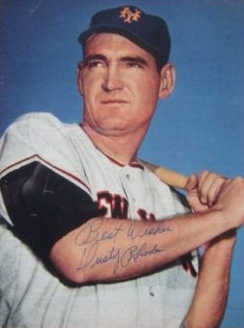
James Lamar Rhodes has died. Like many men with the name Rhodes, he was nicknamed "Dusty." 1927-2009.

He was a left fielder who played his entire major league career, 1952 to 1959, with the Giants, in both New York and San Francisco. He missed the Giants' 1951 "Miracle at Coogan's Bluff" Pennant, but was an integral part of their 1954 World Series win, still the last for the franchise, and was with them in 1957 when they moved across the country.

In Game 1 of the '54 Series -- it is shocking, knowing how late the season ends now, to know it was played on September 29, 1954 -- the Giants were playing the Cleveland Indians at the Polo Grounds in upper Manhattan. In the 8th inning, with the score tied 2-2, Vic Wertz hit a ball about 440 to center field, where it was actually caught, by a guy you might have heard of named Willie Mays. Mays then made an equally amazing throw that forced Indians star Larry Doby to tag up from 2nd to 3rd, but not score, as he and the other baserunner surely would have had Mays not made what has become the most famous defensive play in the history of sports.

(I've long wanted to do "Top 10 Most Famous Defensive Plays In Sports History." Maybe this is the year.)

In the bottom of the 10th inning, Giant manager Leo Durocher pinch-hit Rhodes for his future Hall-of-Fame left fielder, Monte Irvin. Good guess: He hit the ball just 260 feet down the right-field line. Any other ballpark on the planet, and Indian right fielder Wally Westlake could have made the catch, or at least held it to a single. But it was a home run.

Actually, the film reveals a possible "Jeffrey Maier situation." A fan was sitting in the upper deck, and the ball bounced off his hand and back onto the field. But the hand wasn't out over the field, so, as close as the fence was, the homer was still legal. It was for three runs, and the Giants won, 5-2.

Rhodes also pinch-hit for Irvin in Game 2, and singled, staying in the game to play left, and hit another home run. Now, while the Polo Grounds was a ridiculously-shaped stadium, and these were cheapo home runs, they were not totally ridiculous: They were hit off Bob Lemon and Early Wynn, respectively, a pair of future Hall-of-Famers. The Giants went on to sweep the favored Indians, who also haven't won the World Series since.

These homers did not count along with Rhodes' regular-season totals. He hit 54 for his career. His lifetime batting average was .253. He wore Number 26, which has not been retired by the Giants, for Rhodes or for anyone else.

Rhodes was a native of Alabama, but appears to have had no problem with his black teammates Mays, Irvin or Hank Thompson. He appears to have been an ideal team player, if not a particularly impressive one. Durocher said he couldn't field, "But, boy, could he hit!"

After his retirement from baseball, he had a job on a tugboat in New York. Yankee pitcher Jim Bouton, a Giant fan in the Fifties, remembered being on a tour bus at the 1964 World's Fair in Flushing Meadow, across from then-brand-new Shea Stadium, and Rhodes was driving it. Bouton considered it an awful come-down for such a World Series hero.

But Rhodes never bemoaned his fate, saying he loved his tugboat job. If he was ever disappointed at playing baseball well before the era of big player salaries, he never publicly said so. He retired to Las Vegas, and attended the occasional memorabilia show and reunion with his teammates, before dying on Wednesday at age 82.

Dusty Rhodes may have been a superstar for only a week, but it's a week most of us will never get to enjoy.

It was a week nearly 55 years ago. And that's not the only thing that reminds me of how much time has gone by.

It's been 75 years since Babe Ruth last played for the Yankees, and Carl Hubbell struck out 5 straight batters in the All-Star Game.

It's been 60 years since the epic Yankees-Red Sox Pennant race of 1949, including Joe DiMaggio's comeback from injury.

It's been 50 years since the 1st West Coast World Series, between the Los Angeles Dodgers and the Chicago White Sox.

It's been 40 years since the start of Divisional Play, Mickey Mantle's retirement, and the combination of the Chicago Cubs' "September Swoon" and the Mets' "Miracle" World Series, including their coming together in the fulcrum of the "Black Cat Game."

It's been 30 years since Thurman Munson's crash and the "Family" winning Pittsburgh's last World Series.

It's been 25 years since Detroit last won a World Series, and since Harry Caray and Ryne Sandberg made the Chicago Cubs a national phenomenon over "SuperStation WGN."

It's been 20 years since the Pete Rose gambling scandal and the earthquake that stopped a World Series -- still the last one won by a San Francisco Bay Area team (the A's over the Giants).

And it's been 10 years since David Cone's perfect game, Robin Ventura's "Grand Slam Single," Kenny Rogers' Pennant-losing walk and the Yanks winning their 25th World Series, thanks in part to the Chad Curtis Game.

This year, I will turn... 40. Yeah. The Big Four Oh.

Reggie Jackson, my guy, just turned 63. That's impossible: Mister October can't be 2 years away from Social Security. (Like he needs the money.) He's now as old as DiMaggio was when I first became aware of him -- and as old as Mantle was when he died.

I did the math. Presuming that a fan was approximately 7 years old when he first began regularly watching baseball on television, as I was...

If you remember the Yankees' return to glory in 1996, or Milwaukee being an American League city, then you're at least 20 years old.

If you remember the Mets winning the World Series at all, Bill Buckner as something other than an unfairly-cast goat, and Barry Bonds, Mark McGwire and Roger Clemens as skinny rookies, then you're at least 30.

If you remember Chris Chambliss' Pennant-winning homer, Reggie's three-homer game, Billy Martin as a World Series-winning manager, the Boston Massacre, the Bucky Dent Game, Thurman's crash, Rickey Henderson as a rookie, and Joe Morgan as a great player and not an annoying, clueless broadcaster, then you're pushing or past 40.

If you remember Carlton Fisk doing the Fenway Twist, or the Oakland dynasty of Reggie and Catfish, or Lou Brock rewriting base-stealing records, Pete Rose picking fights with Ray Fosse and Bud Harrelson, or Hank Aaron, Willie Mays, Frank Robinson, Harmon Killebrew and Al Kaline as active players -- and Roberto Clemente as a living, breathing, still pretty effective player -- then you're around 45, or more.

If you remember the Mets winning in '69, and Brooks Robinson's third-base clinic of the following October, or Washington being an American League team, then you're at least 47.

If you remember Sandy Koufax as an active pitcher, the Red Sox "Impossible Dream" season, and the Year of the Pitcher (Bob Gibson's 1.12 ERA and 17 Ks in Game 1 of the Series, Don Drysdale's six straight shutouts, Denny McLain winning 31 games and Mickey Lolich saving the Tigers' bacon in the Series), or Caray as a fully-engaged broadcaster for the Cardinals (either half of that would be shocking to people who only know him as a doddering Cub announcer), or Kansas City having a team wearing green instead of blue, then you're at least 50.

If you remember Shea Stadium as brand-new, and Mantle, Yogi Berra, Whitey Ford and Roger Maris as productive players, Stan Musial as an active player, and the Braves being in Milwaukee, then you're at least 52.

If you remember Ted Williams as an active player, Casey Stengel managing the Yankees, and Mantle and Maris gunning for 60 homers, and there being no Mets at all, then you're at least 55. As you would be if you remember Tampa Bay, Phoenix, Denver, Miami, Toronto, Seattle, San Diego, Montreal, Houston and Minneapolis all as minor league cities.

If you remember the Giants being in Manhattan and the Dodgers being in Brooklyn, with guys like Mays, Irvin, Jackie Robinson, Roy Campanella, Duke Snider and Gil Hodges being on the field, then you're at least 60. That's right, the youngest Brooklyn Dodger fan is now 60. You're a long way from Erasmus Hall High School, bubbe.

If you remember the Dodgers winning their only Series in '55, or the '54 heroics of Mays and Rhodes, or Bob Feller as an active pitcher, or Ralph Kiner as an active slugger instead of a malaprop-prone Met broadcaster, or Phil Rizzuto as an active shortstop instead of a teller of strange stories on Yankee broadcasts, or there being American League teams in Philadelphia and St. Louis and a National League team in Boston, and Baltimore, Milwaukee and Kansas City as minor league cities, then you're at least 62.

If you remember "the Shot Heard 'Round the World" describing something that happened at Lexington, Massachusetts, not something that Bobby Thomson hit, then you're at least 65. (Even if you don't know baseball, you know someone who does, and you've heard the name Bobby Thomson.) As you would be if you remember the Phillies being the Whiz Kids of Richie Ashburn and Robin Roberts, and the A's still being managed by Connie Mack.

If you remember before Jackie Robinson, if you remember when baseball was all-white, which means you also remember when DiMaggio, Williams, Musial and Feller were at their peaks, then you're at least 70.

If you remember DiMag's 56-game hitting streak, Williams batting .406, and Mickey Owen unable to handle Hugh Casey's curve (spitball?), then you're at least 75.

If you remember Lou Gehrig as an active player, and Hank Greenberg hitting 58 home runs while Jimmie Foxx (who'd previously done it) also hit 50, then you're at least 78.

If you remember Babe Ruth at anything close to his best, and John McGraw as manager of the Giants, then you're well over 80.

If you remember the Babe at his very best, and Ty Cobb, Tris Speaker, Walter Johnson, Grover Cleveland Alexander and George Sisler as active players, then you're approaching or past 90.

If you remember when Ruth was a pitcher, Shoeless Joe Jackson was an untainted player, Honus Wagner and Christy Mathewson were still active and home runs were hard to come by, then you're almost 100 years old.

And if you remember the Chicago Cubs actually winning the World Series, you're probably dead -- or lying. The Guinness Book of World Records lists 30 people alive today in the U.S. who are at least 110 years old, the oldest being a woman in Los Angeles named Gertrude Baines, who's 115. No word on whether she likes baseball, but if she does, then she might be old enough to remember Jack Chesbro, Wee Willie Keeler, and even Ed Delahanty. But, being black and from Georgia, they probably never let her into a big-league ballgame until she came to L.A.

All those years ago...

Tomorrow, and tomorrow, and tomorrow creeps in this petty pace from day to day, to the last syllable of recorded time. And all our yesterdays have lighted fools the way to dusty death. Out, out, brief candle! Life’s but a walking shadow, a poor player that struts and frets his hour upon the stage, and then is heard no more. It is a tale told by an idiot, full of sound and fury, signifying nothing.
-- William Shakespeare, Macbeth

Shakespeare was right... until the end. I would love to see what he would have done with baseball. There is a line of his where talks about "base players," but that's got nothing to do with sports.

Baseball is the most fun game there is, but time flies when you're having fun.