Showing posts with label delaware. Show all posts

Sunday, August 16, 2026

August 16, 1951: The Delaware Memorial Bridge Opens

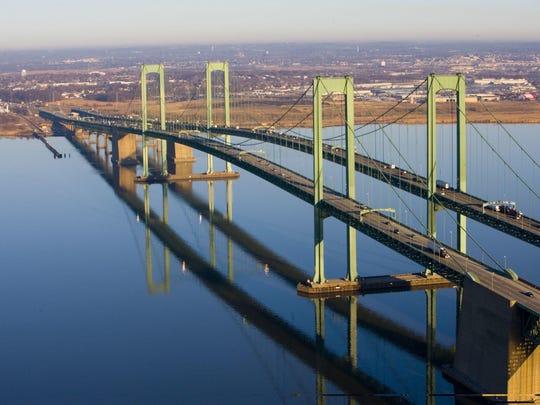
August 16, 1951, 75 years ago: The Delaware Memorial Bridge opens, connecting New Castle, New Castle County, Delaware and Pennsville, Salem County, New Jersey, over the Delaware River. It is operated by the Delaware River and Bay Authority.

It is 5 miles southeast of Rodney Square in Wilmington; 34 miles southwest of Center City, Philadelphia; 50 miles north of Legislative Hall (Delaware's State Capitol building) in Dover, 118 miles southwest of Midtown Manhattan; 70 miles northwest of Atlantic City; 73 miles northeast of downtown Baltimore; 91 miles northwest of Rehoboth Beach; and 108 miles northeast of downtown Washington, D.C.

Until 1926, the year what's now known as the Ben Franklin Bridge opened between Philadelphia and Camden, there was no way to get from Delaware's largest city, Wilmington in New Castle County, to New Jersey, except by train. But if, say, you only needed to go 20 miles to Salem, New Jersey, it made no sense to make the 30-mile train trip to Philadelphia, and then another 40 miles to Salem. The aforementioned Bridge only made things a little easier.

A ferry was established as a stopgap measure. Some stopgap: After debating whether a bridge or a tunnel should be built, Congress approved construction of a bridge in 1946. It finally opened 5 years later, bannered as U.S. Route 40 (which had been using the ferry). Soon, it became the southern end of the New Jersey Turnpike. In 1956, the Delaware Turnpike opened, connecting each State's most important highway.

The opening of the Turnpikes put too many cars on the span, and a 2nd bridge was ordered. On September 12, 1968, what's now the westbound span (toward Delaware) was opened, with the original span carrying eastbound traffic (toward New Jersey). In addition to Route 40, the "Twin Span" now carried Interstate 295. Its 174-foot-high towers are arguably the most famous structures in Delaware.

Even though the Bridges were 84 miles from the house in Central Jersey where I grew up, if a trip takes me in that direction, getting over the eastbound span meant I was back in New Jersey, so it felt like I was close to home, just as it did when I would come through the Lincoln Tunnel getting back from New York, 36 miles from home.

Monday, November 9, 2020

My Ranking of the States, 2020 Edition

I did this in 2015. I thought it was time for an update.

Here's what I'm looking for:

* Looks. Is your State nice to look at, on the average?

* History. Is it long? Is it good? Being 1 of the 1st 13 States in 1776 helps. Being a Union State in the Civil War from 1861 to 1865 helps, while being a Confederate State hurts. Being a segregated State from 1865 to 1965 hurts. Anything else important, or at least something I find interesting, happen there?

* Politics. Do you vote right -- or, rather, correctly? (If you're a regular reader, you know where I stand on this.)

* Sports. If you favor baseball or hockey, that's a plus. If you favor football, that doesn't help you as much. Success in sports also helps.

* Food. What kind of food is thought of when we think of the State?

* Transport. Is it easy to get around the State to see the State's good stuff?

* Weather. Could I handle it on a regular basis?

* Have I been there? If so, did I find the experience enjoyable? If I haven't been there, that doesn't hurt. But if I have, and have enjoyed it, that helps.

So, here goes, in descending order:

50. Mississippi. This is the State where Elvis Presley, Oprah Winfrey, William Faulkner, and the blues as we know it were born. And, um, nice Gulf Coast beaches. Still doesn't make up for so much foulness. Also, it's too damn hot!

49. Alabama. This is the State where Hank Williams, Hank Aaron and Willie Mays were born, America learned to appreciate Southern football, and the Civil Rights Movement began. But then, there's a reason the Movement began there. Also, it's too damn hot!

48. Idaho. Natural beauty and the world's greatest potatoes don't make up for being the birthplace of the Aryan Nations. Or the birthplace of Sarah Palin, for that matter. Compared to that, Boise State University's horrid blue "Smurf Turf" is a minor offender.

47. North Dakota. Aside from being staunchly Republican, there's not much that's bad about it. In fact, the biggest bad thing about it is that there's hardly any good things about it. Also, it's too damn cold!

46. Arkansas. This is the State where Johnny Cash, Bear Bryant and Bill Clinton were born. But if the last 20 years has proven anything, it's that it's still more Orval Faubus', Mike Huckabee's and Jim Bob Duggar's State than Clinton's. Also, it's too damn hot!

45. Oklahoma. The home State of Will Rogers, Jim Thorpe, Mickey Mantle and Johnny Bench is also Tornado Alley and a hotbed of Teabaggers. Also, it's too damn hot!

44. Wyoming. It's got Yellowstone National Park. It's also got Dick Cheney. They cancel each other out. After that, what's left? Not much.

43. Alaska. Lots and lots of natural beauty. But there's so little of anything but natural beauty. And the people... Let's face it, anybody who watched Northern Exposure wasn't surprised by Palinmania. Also, it's too damn cold!

42. South Dakota. Mount Rushmore helps, but that's pretty much all there is to do there. Unless you like to hunt and/or fish. And I don't and/or don't. Also, it's too damn cold!

41. Montana. As Red Skelton once said of Texas, they got miles and miles of nothing but miles and miles. There's no State that has a worse size-to-stuff ratio.

40. Kansas. "What's the matter with Kansas?" Not enough Jayhawk basketball fans and too many Tea Partiers. Also, it's too damn hot!

39. Nebraska. Nice, friendly people -- if you're just like them. If you're not, you'd better be male, between the ages of 18 and 23, and be able to play football. There is, however, Omaha and its suburbs, with black voters and white liberals that got it nicknamed "Obamaha," and gave one Electoral Vote to Hillary Clinton in 2016 and Joe Biden this time.

38. Utah. Salt Lake City is quickly becoming what Atlanta is to Georgia and Austin is to Texas: A liberal enclave in the capital of a seriously backward State. Also, it's too damn hot!

37. New Mexico. A lot more nice scenery than Montana, and they've voted Democratic in every election since 2008. But that's about it. Also, it's too damn hot!

36. South Carolina. The good news is, the history keeps it from being a bottom-tenner. The bad news is, so much of that history is bad. And Myrtle Beach proves that rednecks can't do beach towns. At least the food is good. Also, it's too damn hot!

35. Iowa. The Hawkeye State is becoming increasingly liberal, to the point where the worst thing I can say about it is that there isn't much to attract your attention, unless you like politics, and even then, the Caucuses only happen once every 4 years.

34. Indiana. The Colts, IU, Purdue and Notre Dame help. The Indy 500? It's big, but I don't like auto racing. And it's a conservative State: Aside from Barack Obama in 2008 and Lyndon Johnson in 1964 -- both outlier elections -- it hasn't voted for a Democratic nominee for President since Franklin Roosevelt in 1936. That's 1 in the last 15 elections, and 2 in the last 21.

33. Louisiana. New Orleans is pretty much the only thing keeping this former Confederate State from being another Mississippi or Alabama. Also, it's too damn hot!

32. Vermont. Like skiing? You'll love it. Don't like skiing? Uh... Well, there's Lake Champlain. And... that's about it. Ben & Jerry's? You can buy that anywhere.

31. Maine. "Vacationland"? I've never gotten around to visiting, and hopefully I'll get to do so next year, once all the restrictions are lifted. But it doesn't seem to be a very interesting place. Also, Red Sox fans.

30. West Virginia. With natural beauty and good sports fans, it used to rank much higher, until they started to believe that Democrats were going to take all their guns away, and failed to notice that Republicans took a lot of their jobs away.

29. Missouri. Sports and history keep it in the top 30, but they're going to have to overcome the legacies of Rush Limbaugh, John Ashcroft and Branson. Also, it's too damn hot!

28. Kentucky. College basketball, horse racing and natural beauty help. Little else does.

27. Texas. History and sports put it a lot higher than its blatant stupidity in politics and its chauvinism in just about everything else would suggest. Also, it's too damn hot!

26. Tennessee. Great music. Great food. Great for college sports. Not so good for pro sports, or politics, and it was a Confederate State. Also, it's too damn hot!

25. Georgia. College football and food can't offset Confederacy and Coke. Also, it's too damn hot! But then, it is one of the States that helped to save us from Trump. 

24. Hawaii. Beautiful and liberal, but it's too damn far, and not sports-oriented enough.

23. New Hampshire. Another relatively close State that I have never visited, and it will probably help if I do. Still, not a lot to do there, and too many Red Sox fans.

22. Florida. The highest-ranking Southern State, and despite that history, and being too damn hot and too damn humid, there's so much to see and do, even if you don't want to visit Disney World. Great college sports State, and its pro sports status has gotten better lately. But the natives, and the Cubans with their misunderstanding of "socialism," are nasty and dumb, and there aren't yet enough old New York Jews and young Puerto Ricans and gays to offset them.

21. Colorado. My only visits have been in changing planes. I should rectify that, as it's beautiful, it's an increasingly liberal State, and it's a good sports State.

20. Washington. Looks nice. Good liberal people. Good sports State. Food. Another one that would probably rise significantly if I visited.

19. Minnesota. Thank you for what you tried to do in 1984. (But what's your explanation for 1972?) Thank God the Metrodome is gone now. Good sports State. Nice people. But it's too damn cold!

18. Arizona. Natural beauty? Check. Good sports State? Check. Good food? Check. Good politics? They're working on it. But it's too damn hot! Don't tell me it's a dry heat: It's a heat!

17. Nevada. Las Vegas is an acquired taste, but I acquired it. Lots of nice scenery. Good on politics. But it's too damn hot!

16. Oregon. It seems like a place I'd love to visit, but I never have, due to the distance. For politics, sports, food and natural beauty, it looks terrific.

15. Ohio. Great for college sports, good for pro sports, improving in politics, and Cleveland is a great food city. I've never been to Cincinnati, and I need to change that.

14. North Carolina. Beautiful, great food, great college sports, getting better in pro sports. Evolving into a better political State, and was one of the Original 13. Still, it was a Confederate State.

13. Delaware. A neighboring State for New Jersey, and thus one I've visited a few times. Rehoboth Beach alone might get this State into the top half. And having given us Joe Biden helps.

12. Virginia. Only its Confederate/segregation status keeps it out of the Top 10. Its Revolutionary role, its many tourist attractions, its natural beauty from mountains to bay, and its generous people make it the 2nd-highest of the ex-Confederate States.

11. Rhode Island. The smallest State by area, but one of the nicest. Its only real flaw: Too many Red Sox fans.

10. Wisconsin. I love Milwaukee. I've never been to Green Bay or Madison, but I'm sure I'd love them, too. Away from Lake Michigan, though, it's not much to look at, and it gets cold. That's all that's keeping it out of the Top 5.

9. Connecticut. Very nice. Great State for college sports. Losing the NHL's Whalers hurt. Also, too many Red Sox fans. Other than that, I like Connecticut a lot.

8. Michigan. Yes, Detroit needs serious help. But it's a great sports town, and the rest of the State supports the pro and college teams very well. Michigan has lots of natural beauty, and the many ethnic groups provide lots of fine food. And while they stupidly elected and re-elected some horrible Governors in John Engler and Rick Snyder, they usually vote Democratic for President and Senator.

7. California. Yes, it's got Los Angeles and its vacuous suburbs, and Oakland is a bit dodgy. But is there a better State for Sports? Is there a better State for showing that liberalism works and conservatism doesn't? Is there a State where the people better show their appreciation for that truth by voting? And with L.A. and San Francisco, there aren't many better States for ethnic food variety. As for natural beauty, there's San Francisco, San Diego, the Sierra Nevadas, the Redwoods, and Yosemite National Park.

6. Illinois. Chicago alone gets it into the Top 10, and the historical stuff elsewhere in the State helps. (Thanks, Abe.)

5. Maryland. Some parts of the State -- the mountainous Panhandle and the Eastern Shore -- aren't too palatable. Otherwise, this beautiful State with one great (if troubled) city, Baltimore, and access to another, Washington, might well be Number 1.

4. Massachusetts. Between the history, the natural beauty, the food, and the sports, this State could have been Number 1 if their sports fans weren't so, how shall I put this... Boston.

3. New Jersey. I'd have loved to be able to put my home State at Number 1. I just couldn't, because, well, Jersey City. And Paterson. And Trenton. And Camden. And Atlantic City. And the industrial blight along the Turnpike (North and South). And the tax whiners in the "McMansion" suburbs. But pretty much anything you could want, we've got it, and we've got it good. Too bad we can't claim either New York City or Philadelphia as our own, as close as we come to them. Speaking of which:

2. Pennsylvania. James Carville once said, "Pennsylvania is Philadelphia and Pittsburgh, with Alabama in between." He wasn't kidding, and he wasn't referring only to the State's love of football. There's a reason that the 280 miles in between the suburbs of those cities, and the rural mining areas in the north of the State, are called "Pennsyltucky." And they were too quick to defend the indefensible from Joe Paterno. But with Philly, Pitt, its role in the Revolution, it's role in the Civil War, and its having made up for voting for Trump by rejecting him this time, how can you not put Pennsylvania in the Top 5?

1. New York. Admittedly, most of this is due to New York City. But even the rest of the State, by itself, would make the Top 20. Buffalo. Rochester, Syracuse. Lake Placid. And, oh yeah, Cooperstown. Plus, the Hudson Valley, West Point, the Catskills, the Adirondacks, Lake Champlain, the Finger Lakes, and Niagara Falls. And, yes, New York City.

Disagree? Set your own guidelines, and then make your own list.

Thursday, December 7, 2017

Top 10 Athletes From Delaware

December 7, 1787: Delaware becomes the 1st State to ratify the Constitution of the United States -- making it forever "The First State."

Top 10 Athletes From Delaware

All of these are from Wilmington, unless otherwise stated.

Honorable Mention to William "Judy" Johnson. Since Negro League records are sketchy, and he never got a chance to show what he could do in the white majors, I can't list him in the Top 10. But he is in the Baseball Hall of Fame.

Honorable Mention to Dallas Green of Newport. He wasn't much of a pitcher, although the 1964 Philadelphia Phillies' collapse cannot be blamed on him. But in 1980, he managed the Phillies to their long-awaited 1st World Series win. He became the general manager of the Chicago Cubs, and built the teams that won National League Eastern Division titles in 1984 and 1989. He later served as a consultant for the Phillies, and helped build their 2008 World Champions.

10. Val Whiting. Born in East Orange, Essex County, New Jersey, she moved to Wilmington during her school years, and became perhaps the greatest basketball player of either gender produced by Delaware. A forward, she won National Championships at Stanford University in 1990 and 1992, and was Pac-10 Player of the Year in 1992 and 1993. She played 6 seasons of pro ball, 1 in the ABL and 5 in the WNBA.

9. Vicki Huber. One of the many legends in track & field at Philadelphia's Villanova University, the middle-distance runner won the 1988-89 Honda-Broderick Cup as the best female collegiate athlete of the schoolyear. But her best Olympic performance was 6th in the 3,000 meters in 1988 in Seoul.

8. Delino DeShields of Seaford. He was good enough in high school basketball to be offered a scholarship by Villanova, but chose baseball after being drafted by the Montreal Expos. He played 13 seasons as a major league 2nd baseman, reaching the postseason with the Los Angeles Dodgers in 1995 and 1996. However, he may be best known for the Expos trading him to the Dodgers for Pedro Martinez, which may have cost the Dodgers the Pennant both times.

His son Delino DeShields Jr. is a center fielder for the Texas Rangers. His daughter Diamond DeShields played basketball at the University of Tennessee.

7. Ed Michaels. A guard, he was nearly deaf, which kept him out of World War II, but he played pro football for 11 years, including with the 1937 NFL Champion Washington Redskins.

6. Frank Shakespeare. He was the 1st Delaware resident to win an Olympic Gold Medal, in rowing in 1952 in Helsinki, Finland.

5. Dionna Harris. A 2nd baseman (basewoman?), she was the batting average leader on the U.S. team that won the Gold Medal in softball at the 1996 Olympics in Atlanta.

4. Steve Watson. A 1981 Pro Bowler, he reached Super Bowls XXI and XXII with the Denver Broncos.

3. Creighton Miller. A running back, he helped Notre Dame win the 1943 National Championship, leading the nation in rushing and finishing 4th in the Heisman Trophy voting. (His quarterback, Angelo Bertelli, won it.) Doctors told him not to play pro football because of high blood pressure. Good thing he went to law school.

Born in Cleveland, he played his high school football in Wilmington, before returning to Cleveland, coaching with the Browns' 1946 AAFC Champions, then helped found the NFL Players Association, serving as their legal counsel from 1956 until they were recognized by the NFL in 1968.

2. Vic Willis of Newark. He threw his last pitch in 1910. He was elected to the Baseball Hall of Fame in 1995. Even given that the Hall didn't hold its 1st election until 1936, that's still his 59th year of eligibility.

He was 249-205 in a 13-season big-league career. He pitched a no-hitter for the Boston Beaneaters (forerunners of the Atlanta Braves) in 1899. He led the National League in earned run average in 1899 and in strikeouts in 1902. He won the World Series with the Pittsburgh Pirates in 1909.

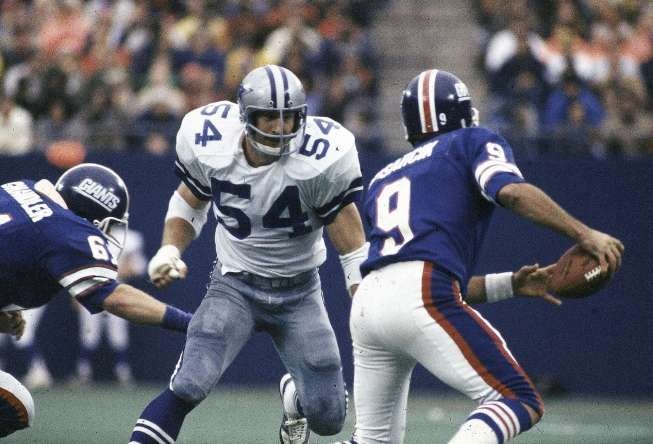
1. Randy White. Nicknamed "Manster," because he was half-man, half-monster. He's the best football player the University of Maryland has ever produced, winning the 1974 Lombardi Trophy as the nation's best lineman, and the year's Outland Trophy as the nation's best interior lineman. The school retired his Number 94.

The Dallas Cowboys traded up to draft him, and moved him from defensive tackle to linebacker. A 9-time Pro Bowler, he helped them win Super Bowl XII, and was named Co-Most Valuable Player along with Harvey Martin. He also helped them reach Super Bowls X and XIII, and 6 NFC Championship Games.
Randy White, ordering a Pisarcik sandwich to go.

The Cowboys don't retire numbers, and Jaylon Smith currently wears his Number 54. But they did elect him to their Ring of Honor. He was named to the College and Pro Football Halls of Fame, and the NFL's 1980s All-Decade Team.

Thursday, August 24, 2017

How to Go to a Delaware Football Game

I've wanted to do a trip guide for a team in each of the 50 States. But I need a corresponding event for each. And NASCAR is not a sport. So that lets out Dover Downs.

With college football season upon us, it becomes easier again. I have 34 down, 16 to go. Number 35 is Delaware. On Thursday, August 31, the Fightin' Blue Hens -- I'll explain later -- will host Delaware State in their season opener.

Before You Go. We're talking about a place that's within a 3-hour drive, so the weather will be, essentially, the same as it is in New York whenever you go.

Delaware is in the Eastern Time Zone, so you won't have to adjust any timepieces.

Tickets. Delaware Stadium seats 22,000, and the UD football team is the most popular sports team in the State, making it the 4th-largest "city" in the State, behind Wilmington, Dover, and the rest of Newark. They are the only NCAA FCS (what used to be named Division I-AA) team to average more than 20,000 fans a game every season since 1999. So getting tickets might be an issue.

Prime Reserved, Sections D and K, midfield on the west and east stands, respectively, cost $35. Preferred Reserved, Sections C, E, J and L, between the 20-yard lines, are $30. Sideline Reserved are $20. General Admission, the north end zone, are $15.

Getting There. It's 134 miles from Times Square in Midtown Manhattan to Delaware Stadium in Newark, Delaware. The driving directions are not hard: Take the New Jersey Turnpike South, all the way to the Delaware Memorial Bridge, take the Delaware Turnpike to Exit 1B, to State Route 896 North, and you'll soon cross over State Route 4, the Christina Parkway, at which point the school's athletic complex will be on your right.
The Delaware Memorial Bridge, a.k.a. the Twin Span,
in a photo taken from the New Jersey side.
The eastbound lanes, on the left here, opened in 1951.
The westbound lanes opened in 1968.

It's too close to fly. Amtrak would be an issue, as this Newark, unlike New Jersey's, is not a priority station, with few trains stopping there in either direction. Round-trip fare is $117.

Greyhound doesn't go to Newark, Delaware: It goes to Wilmington, and you'd have to take a local bus, which would be fine for every home game after the season opener, but not that night, as the last bus from Wilmington back to New York would leave at 10:45 PM. It would cost about $60 round-trip. For a regular Saturday game, which they usually kick off at 3:30 PM, you'd take the Number 6 bus from the train station to Pomeroy Lane at Main Street, then either transfer to the Number 33 bus or walk the 2 miles south from the main campus to the stadium. The 2 buses would take an hour and 35 minutes. So, yeah, it's best to drive.

Once In the State. Delaware calls itself "The First State." It was 1 of the Original 13 Colonies, and it was, indeed, the 1st State to ratify the Constitution of the United States, on December 7, 1787.

The 2nd-smallest State by area (ahead of only Rhode Island), Delaware is 96 miles from north to south, 30 miles from east to west at its widest point, and only 16 miles from the Delaware Memorial Bridge to the Delaware-Maryland Line. It is home to just under 1 million people, most of whose sports tastes run toward Philadelphia, but a few, in the westernmost and southernmost areas, support the Baltimore Orioles and Ravens.
Until New Jersey's latest design,
Delaware was the only State with flat license plates.

Thomas West, 3rd Baron De La Warr (and that's pronounced the same as the State, "DELL-ah-where"), was the 1st colonial Governor of Virginia, and the later colony of Delaware was named for him. The name De La Warr could be an anglicization of "La Guerre," meaning "the war."

The Dutch settled first, at Lewes, in 1631. In 1638, New Sweden (including some of what became South Jersey) was established at Fort Christina, named for the Queen of Sweden famously played by Sweden's own Greta Garbo in the 1933 film Queen Christina. Fort Christina became Wilmington. The Dutch founded New Castle in 1651 and conquered New Sweden in 1655, annexing it to New Netherland, which included what became New York and New Jersey. But the English conquered New Netherland in 1664, including what became Delaware.
The peninsula from which Delaware extends, including the Eastern Shore of Maryland and Cape Charles, Virginia, is named Delmarva for all 3 States. It is considerably more conservative, and Southern in style, than the Northeast Corridor that includes Wilmington, Newark, Baltimore, Washington and Virginia's D.C. suburbs. Rehoboth Beach, Delaware's main shore town, is an exception, the former Methodist camp site (as was Ocean City, New Jersey) being welcoming to all, and having a notable gay community.

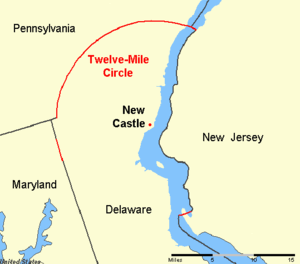
The definition of the northern boundary of the State is unusual. Most of the boundary between the States of Delaware and Pennsylvania was originally defined by an arc extending 12 miles, a.k.a. the Twelve-Mile Circle, from the cupola of the courthouse in the city of New Castle.
This border extends all the way east to the low-tide mark on the New Jersey shore of the Delaware River, then continues south along the shoreline until it again reaches the 12-mile arc in the south. Then the boundary continues in a more conventional way in the middle of the main channel of the river.

For this reason, from the Pennsylvania-Delaware line on south, the border between New Jersey and Delaware is not the middle of the River, but the edge of New Jersey's shore. And for that reason, there are 2 places in Salem County in mainland New Jersey that are officially part of Delaware, because they are the result of landfill: A section of Pennsville, known as the Delaware River Nature Reserve, west of Supawna Meadows National Wildlife Reserve and Finns Point National Cemetery (its mailing address is New Castle, DE); and an artificial island jetting north from Hope Creek Generating Station, a nuclear power plant, in Hancocks Bridge, known as "The Baja" (its mailing address is Middletown, DE), and a haven for local young miscreants.

To the west, a portion of the arc extends past the easternmost edge of Maryland. The remaining western border runs slightly east of due south from its intersection with the arc. A section of land between the northwest part of the arc and the Maryland border, known as The Wedge, was claimed by both Delaware and Pennsylvania until 1921, when Delaware's claim was confirmed.
Delaware famously has no sales tax. Its leading newspaper is The News Journal, based in Wilmington. ZIP Codes in Delaware begin with the digits 197 for Newark and the area around the University, 198 for Wilmington and its suburbs, and 199 on south, including Dover and the beach towns. For the entire State, the Area Code is 302.
Downtown Wilmington

The State capital is Dover, near the center of the State, 53 miles south of downtown Wilmington, 44 miles south of the University in Newark, and 44 miles northwest of the Rehoboth Beach Boardwalk.
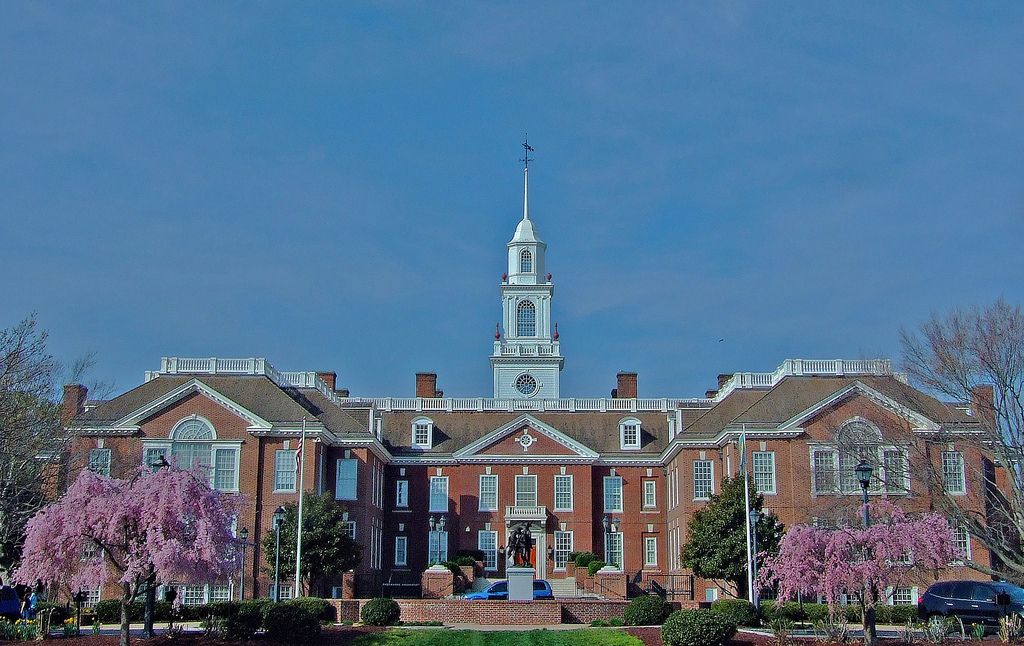
The State House, the Legislative Hall, in Dover

The largest city, Wilmington, is not a large city, with about 71,000 people. New Castle County, Delaware; Salem County, New Jersey; and Cecil County, Maryland are sometimes counted as Wilmington's "metropolitan area"; if so, that's a total of 720,000, over 10 times as many. But Wilmington counts as part of Philadelphia's metropolitan area.

Wilmington is centered on Rodney Square, bordered by 9th, 10th, King and Market Streets. The Square is dominated by a statue of Caesar Rodney, who famously rode 70 miles from Dover to Philadelphia through a thunderstorm, arriving at what is now Independence Hall covered in mud, without having removed his boots and spurs, because Delaware and thus the country as a whole needed his vote for independence. This image also appears on Delaware's State Quarter. A residence hall at the University of Delaware is also named for him.
Wilmington's street addresses go up, east and west, from Market Street, and north and south from Front Street, which becomes Martin Luther King Jr. Blvd. west of Market Street. In contrast, Newark -- and that's pronounced NOO-ark, almost with the accent on both syllables, unlike New Jersey's city, pronounced NOO-erk -- has as its centerpoint the intersection of Main Street (north and south) and College Avenue (east and west).

Delaware's bus service is called DART. A 1-County ride is $2.00, but an all-day pass can be bought for $4.20. From New Castle County, which includes both Wilmington and Newark, south to Kent and Sussex Counties, it's $2.00 per zone. Going from downtown Wilmington to the capital of Dover would be $6.00, while going all the way to Rehoboth Beach would be $10.00. In each case, that's one-way.

The only rail service, besides Amtrak's Northeast Corridor, is SEPTA service to and from Philadelphia, formerly known as their R2 Line (save your Star Wars references), now the Wilmington/Newark Line. It has stops at Newark, Churchmans Crossing, Wilmington and Claymont.
Union Station, Wilmington

Along with Maryland, Kentucky and Missouri, Delaware was 1 of 4 States that stayed in the Union during the American Civil War, despite still having slavery be legal there. And segregation was still the norm there into the 1960s. Wilmington was one of the cities that had race riots in the wake of the assassination of Martin Luther King in 1968.

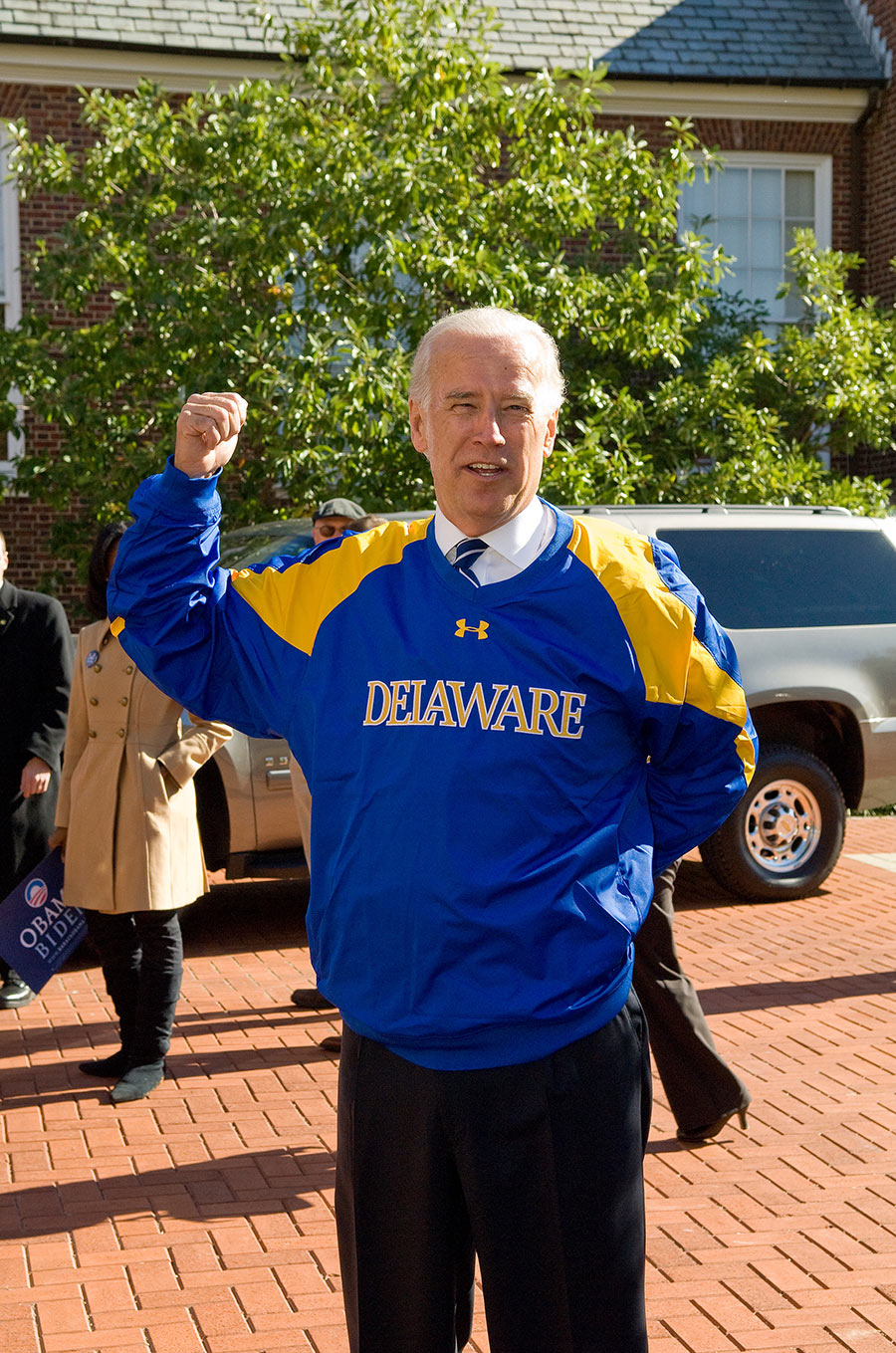
Joe Biden, the State's most successful politician, told a story about the racial tensions in Wilmington. In 1962, he was a security guard at a swimming pool. Biden was white, but the pool was "for colored only." There was an all-black gang, nonetheless using the Italian name the Romans, and their leader was a man calling himself CornPop.

On this occasion, CornPop came to the pool, but disobeyed one of the rules: He refused to wear a bathing cap. When Biden saw him on the diving board, he shouted, "You! Off the board, or I'll come up and drag you off!" Invoking the name of a prominent female swimmer, he also called CornPop "Esther Williams."

Now, Joe wasn't an especially big guy. But he was a former high school football player. He was tough, his father having instilled him a classic lesson, "Joey, it's not whether you get knocked down, it's whether you get back up."

CornPop got down, but told Biden he would be waiting for him outside the pool. True to his word, he was waiting, armed with a straight razor, a nasty weapon, and accompanied by 2 flunkies. He didn't care what the guard's name or background were, only that he wanted to intimidate this white man who seemed to be in charge of black people.

Biden was no fool: He grabbed a chain, intending to use it as his weapon, if necessary. He walked over to CornPop, and told him that he had enforced the rule, that it applied to everybody, and it always would as long as he was in charge. But he also apologized for calling CornPop "Esther Williams."

CornPop said, "Okay," closed the razor, and walked away with his flunkies. Both men had backed down some, both men had mostly saved face, and it was settled peacefully.

Naturally, Republicans accused Biden of lying, making the story up. Except Richard "Mouse" Smith, who became President of the Delaware branch of the NAACP, said he was there that day, and said it happened exactly as Biden described it. And in 2016, an obituary was published for a man named William L. Morris, listing his nickname as "CornPop." So the story is almost certainly true. Today, that pool is open to all, and is named for Biden.

Public pools are important. But Delaware is known for its beaches. Rehoboth Beach is 92 miles southeast of both Wilmington Union Station and the University. Just to the north, Lewes, the Delaware end of the Cape May Ferry from New Jersey, begins a string of beach towns that includes, going north to south, Rehoboth, Dewey Beach, Bethany Beach, York Beach, Fenwick Island, and then, across the State Line in Maryland, Ocean City.
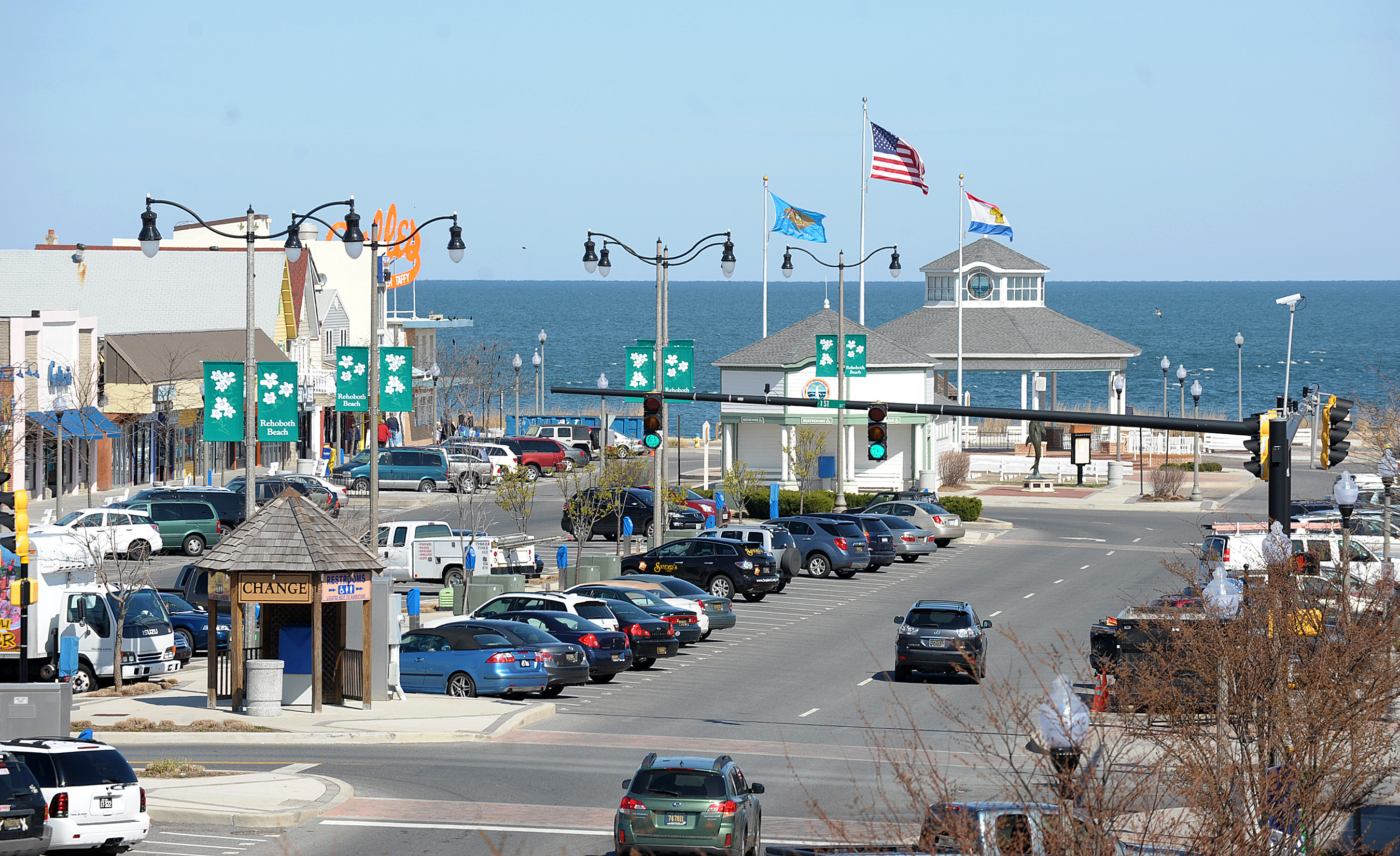
Rehoboth Avenue, terminating at the boardwalk and its gazebo

Francis Alison, a Presbyterian minister, opened "The Free School" in his home in New London, Pennsylvania in 1743. It was moved to become the Academy of Newark in 1769. Up until independence in 1776, the British government considered Delaware to be part of the Province of Pennsylvania, known as "The Lower Counties on the Delaware." For this reason, the Academy was denied a charter as a college.

It took until 1833 for the Delaware General Assembly to pass "An Act to Establish a College at Newark." Newark College opened the next year, and in 1843 it merged with the Academy of Newark in 1843, becoming Delaware College. It became the University of Delaware in 1921, and became coed in 1945 when it absorbed the Women's College of Delaware. In addition to the main campus in Newark, there are also campuses in Dover, Wilmington, Lewes and Georgetown.

Aside from football players I'll get to momentarily, notable sports personalities who were University of Delaware graduates include Baseball Hall of Fame pitcher Vic Willis, basketball star Elena Delle Donne, and 3 noteworthy Philadelphia Phillies: Former Phillies owner Bob Carpenter Jr. (his son Ruly is a Yale graduate), former pitcher and manager Dallas Green, and Dave Raymond, the original Phillie Phanatic, serving from 1978 to 1993. Dave was a punter for the Blue Hens, coached by his father, Tubby Raymond, more about whom shortly.

In other fields, UD graduates include:

* Politics: Signers of the Declaration of Independence Thomas McKean (Class of) 1750, Caesar Rodney 1750, George Read 1753; Vice President Joe Biden '65, and his wife Jill Biden '76; Senators Biden, Thomas Clayton 1799, Louis McLane 1807, George Riddle 1839, L. Heisler Ball 1882, Allen Frear '24, Cale Boggs '31; Governors Boggs, John McCullough 1855 (he served as Attorney General of California and later Governor of Vermont) and Chris Christie '84 (now closing his tenure as Governor of New Jersey, his wife Mary Pat Christie is Class of '85 and they met there).

Also, both 2008 major party Presidential nominees' campaign managers, David Plouffe and Steve Schmidt. Both left before graduating, though, and went back to get their UD degrees: Barack Obama manager Plouffe, who should have been Class of '85, got his in 2010; John McCain manager Schmidt '93 got his in 2013. 

George Read is 1 of only 2 men to have signed the Petition to the King of 1774, the Declaration of Independence in 1776, and the Constitution of the United States in 1787. The other is Roger Sherman of Connecticut, who also signed the Continental Association in 1774 and the Articles of Confederation in 1781, and was part of the committee to draft the Declaration, along with Benjamin Franklin, Philip Livingston, John Adams, and the man who actually wrote it, Thomas Jefferson.

* Journalism: Pulitzer Prize-winning Washington Post writer David E. Hoffman '77; and 2 news TV news anchors in Philadelphia, from UD's Class of '94: Susan Barnett  a former Miss Pennsylvania and news anchor at KYW-Channel 3's Eyewitness News; and Matt O'Donnell, morning news anchor at WPVI-Channel 6's Action News.

* Science: Robert W. Gore '59, inventor of Gore-Tex.

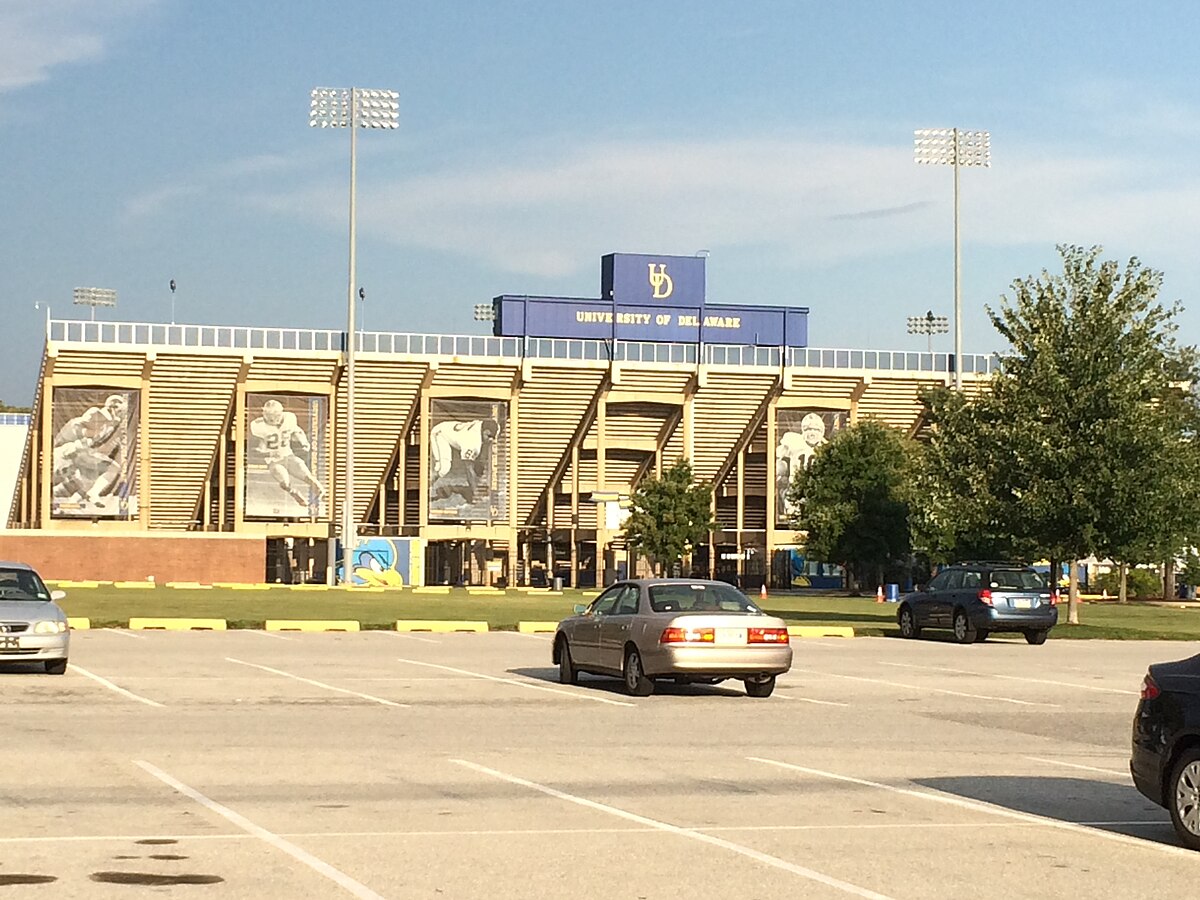
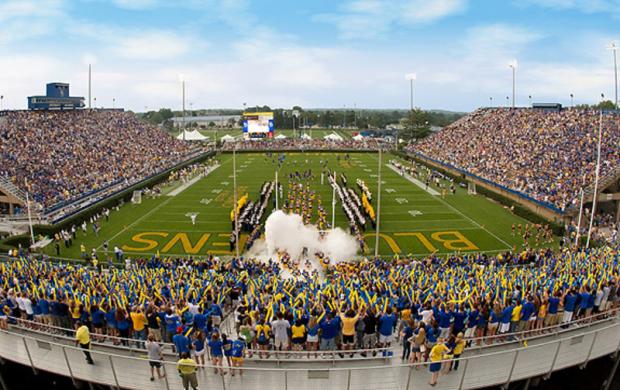
Going In. Delaware Stadium opened in 1952, and seats 22,000 -- far from acceptability in the NCAA's Football Bowl Subdivision (FBS, formerly named Division I-A), but ideal for the Football Championship Subdivision (FCS, formerly Division I-AA). The official address is 625 Marvin Drive, and is the centerpiece of an athletic complex that is separated from the main campus by the railroad. Parking is $15.
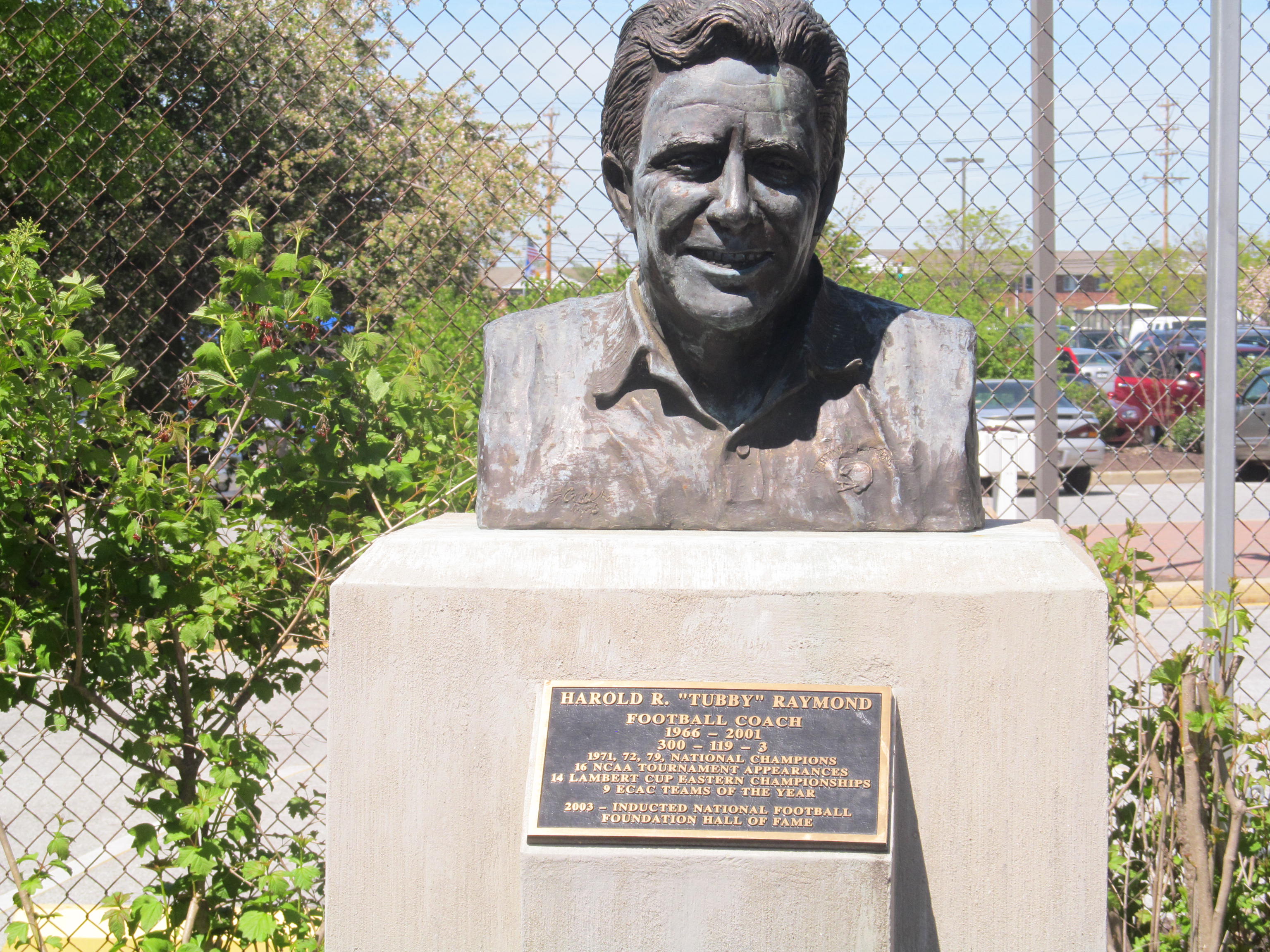
The field was switched to artificial turf in 2010, runs north-to-south, and in 2002 was named Tubby Raymond Field, a.k.a. "The Tub." Harold R. "Tubby" Raymond, now 90 years old, was an assistant coach from 1954 to 1965, and head coach from 1966 to 2001. He also coached baseball at the school from 1956 to 1964.

A Michigan native, he went to the University of Michigan, and gave Delaware the same uniform: Blue jerseys (a slightly lighter shade than Michigan's) with gold numbers and trim, and the "winged" helmet.
Food. The school's website advertises the following options at Delaware Stadium:

  • Smoker Station: Open outside the southwest area of the stadium for the two hours prior to kick-off. 
  • Grotto's Pizza: Section C on the West Concourse & in the Northeast corner concession booth.
  • Chick-fil-A: Section B on the West concourse.
  • Fryer Trailer: Northwest corner (French Fries and Chicken Fingers).
  • Botto's Italian Sausage: Section C on the West Concourse & in the Northeast corner concession booth.
  • Vegetarian Options: In the northwest corner (salads, sandwiches, wraps, & fruit cups).

Team History Displays. The Blue Hens won small-school National Championships in 1946, 1963, 1971 and 1972; an NCAA Division II National Championship in 1979; and an NCAA Division I-AA National Championship in 2003. So that's 6 "National Championships." The 1971, '72 and '79 wins were won under Tubby Raymond, who is honored with a bust outside the stadium.
Currently a member of the Atlantic 10 Conference, the Blue Hens have won their league 16 times, 9 times under Raymond. There is no display showing these titles in the fan-viewable parts of the stadium.

Current Delaware players in the NFL include Super Bowl XLVII winners Joe Flacco and Gino Gradkowski of the Baltimore Ravens. Other noted UD players include 1980s Giants quarterback Scott Brunner (once Phil Simms' backup), 1990s Kansas City and 2000s Oakland quarterback Rich Gannon, 2000s Arizona tight end Ben Patrick, and 1980s L.A. Rams safety Ivory Sully. However, the most famous Delaware-born football player went to the University of Maryland, and starred for the Dallas Cowboys: Hall of Fame 1970s linebacker Randy White.

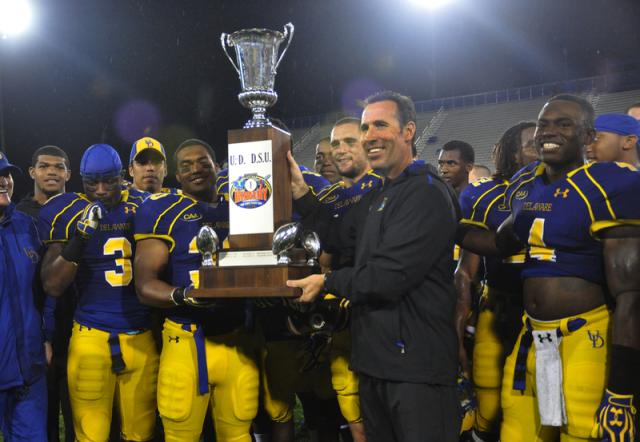
As a member of the Atlantic 10 Conference, Delaware maintains rivalries with Delaware State, Villanova, and the Virginia schools James Madison University and the College of William & Mary. Although Delaware State is slightly closer, 40 miles to 43, UD's biggest rivalry is "The Battle of the Blue" with Villanova, which is a national collegiate power in basketball but only Division I-AA/FCS in football. They play for the Battle of the Blue Trophy, and Villanova leads the rivalry 28-21-1.
Gino Gradkowski with the trophy in 2011

Delaware State, one of the nation's HBCUs (Historically Black Colleges & Universities), is in Dover, and the "Route 1 Rivalry" (that's State Route 1 -- U.S. Route 1 bypasses Delaware, going from Pennsylvania directly into Maryland) has only run since 2007 (also the year that Delaware State won the Black College National Championship), and only annually since 2011, and the Blue Hens have won all 10 against the DSU Hornets. In fact, it hasn't even been close: Only in the 2009 meeting has DSU come within 17 points of UD. The trophy between them is the First State Cup.
UPDATE: Through the 2018 season, UD now leads DSU 9-0, but trails Villanova 31-21-1.

Stuff. There are souvenir stands at the stadium, but your best bet for school memorabilia is the University Bookstore, at 83 East Main Street.

There are 2 notable books about Fightin' Blue Hens football. After the 1979 title season -- his 3rd in the preceding 9 years -- the coach wrote Tubby: The Story of Coach Raymond and Championship Football at Delaware. And in 2002, Elbert Chance published 100 Plus: The Story of Delaware Football.

During the Game. You are a visitor, and not rooting for the visiting team. Act like you want to be invited back, and your safety will not be an issue.

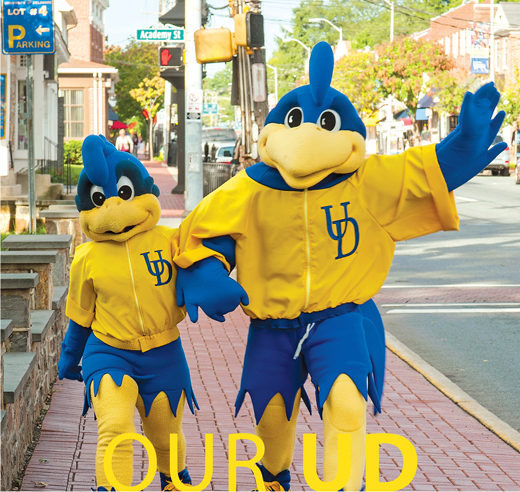
As with Rutgers, the south stand is student seating, and, in connection with the "Hen" theme, it's called the Cock Pit. Save your jokes. The mascot is a blue hen named YoUDee, a variation on "UD." He has a "son" who sometimes mascots with him, Baby Blue. YoUDee has been elected to the Mascot Hall of Fame.
Baby Blue and YoUDee on Main Street in Newark

Why "Blue Hens"? Especially for the men's teams at the University? And why a chicken at all, with all that connotes -- especially one that wears yellow, a color that, like the term "chicken" itself, is associated with cowardice? Maybe it's a Small State thing: The only smaller State in area has its own breed, the Rhode Island Red. (Even though the University of Rhode Island's teams are called the Rams, and wear blue.)

The Blue Hen Chicken is common in Delaware, and in the War of the American Revolution, Colonel John Haslet commanded the 1st Delaware Regiment. One of the companies was from Kent County, and was sub-commanded by Captain John Caldwell, who ran cockfights, and brought his Blue Hen roosters with him to entertain the men. The Blue Hen rooster gained a reputation for toughness, as did the 1st Delaware itself, and the State and the Blue Hen became synonymous.

So, long after cockfighting became illegal in most of America (only in 2008 did Louisiana become the 50th and last State to ban it, and it's still legal in Puerto Rico, which is American soil), UD's teams are the Blue Hens, and there's nothing especially feminine or cowardly about it. See also: The University of South Carolina Gamecocks.

The fight song has the rather unimaginative title of "UD Fight Song." But it's pretty good:


And then we'll fight! fight! fight! for Delaware,
Fight for the Blue and Gold,
And when we hit that line, our team is there
with a daring spirit bold
And when we strike with might, let foes beware
Our glorious name we'll uphold
And then we'll fight! fight! fight! for Delaware,
Fight for the Blue and Gold,
Delaware will shine to-night,
Delaware will shine.
When the sun goes down and the moon comes up,
Delaware will shine.
And then we'll fight! fight! fight! for Delaware!
After the Game. Delaware is below the Mason-Dixon Line, and it was a slave State until 1865. But it was a Union State. And while this is further south than you're used to, we're not talking about a game in the Southeastern Conference. And while this is further west than you're used to, we're not talking about a game in the Big Ten. Even if UD is playing Delaware State or Villanova, you should be fine.

The UDairy Creamery is a 5-minute walk north of the stadium. If you're looking for something a bit more substantial than ice cream, you may have to go 2 miles north to the main campus. Main Street, between New London Road at the west and Chapel Street to the east has chains like Chik-fil-A, Brew HaHa!, Dunkin Donuts, Dairy Queen, Orange Julius, Taverna, Chipotle, Panera, Insomnia Cookies, Jimmy John's, Cheeburger Cheeburger and Starbucks; and old Delaware standbys like the Deer Park Tavern, Grotto Pizza, Del Pez Mexican Gastropub, the Stone Balloon, Klondike Kate's, and Catherine Rooney's (an offshoot of the main bar on Wilmington's Trolley Square, which is Delaware's leading bar to watch European soccer).

Sidelights. Going around Delaware Stadium, clockwise starting at north, are the University of Delaware Ice Arenas (apparently, more than one), the David M. Nelson Athletic Complex, Bob Hannah Stadium (baseball), Stuart & Suzanne Grant Stadium (track), the Bob Carpenter Center (arena), Fred P. Rullo Stadium (an artificial field for grass sports other than football), and athletic dorms.

The Bob Carpenter Center, named for the former Phillies owner and Delaware native, is home to the Delaware 87ers, named for 1787, the year Delaware became the First State. They are a D-League farm team of the Philadelphia 76ers.

Delaware's only other pro sports team is the Wilmington Blue Rocks, a farm team of the Kansas City Royals in the Class A Carolina League. They play at Judy Johnson Field at Daniel S. Frawley Stadium, which includes the Delaware Sports Hall of Fame. Johnson was a Negro League star, who was born on Maryland's Eastern Shore, and grew up in Delaware. Frawley was the Mayor who got the 6,404-seat ballpark built, opening in 1993. 801 Shipyard Drive, across from The Westin Wilmington. Bus 12 from Union Station.

The team is named for the blue granite found along Wilmington's Brandywine River. They won the Pennant in 1994, 1996, 1998 and 1999, and made the Playoffs as recently as 2015. There was a previous Blue Rocks franchise in the Interstate League from 1940 to 1952, and it won 4 Pennants in its 13 seasons. They played at 7,000-seat Wilmington Park, which was demolished in 1963. It's an industrial area now. 2900 Governor Printz Blvd., about 2 miles northeast of downtown. Bus 14.

Wilmington did, however briefly and however dubiously, have a major league baseball team once. They were called the Wilmington Quicksteps, and they played in the Union Association, a league which played just 1 season, 1884.

The Quicksteps won the Pennant of the Eastern League that year, but Henry Lucas, the UA's founder and the owner of its dominant team, the St. Louis Maroons, needed a team to take the place of the folded Philadelphia club. The Quicksteps joined, and it was a mistake: Given that the season that they'd signed for was completed, half their players considered their contracts no longer valid, and they jumped to other teams.

As a result, the rump team may have been the worst team in MLB history: They went 2-16 before folding. They played at Union Street Park, bounded by N. Union Street, W. 2nd Street, Lincoln Street and Lancaster Avenue, about 2 miles west of downtown. Bus 6 or 18.

According to an April 23, 2014 New York Times article, the Phillies, unsurprisingly, dominate Delaware baseball fandom. In Wilmington, the Phils have 72 percent of fans, the Yankees 12, the Boston Red Sox 5. In Newark, it's Phillies 66, Yankees 13, Red Sox 5. In Dover, further south and thus within Baltimore's range, it's Philllies 50, Yankees 14, Orioles 13. By the time you get down to Rehoboth Beach, it's close: Phillies 33, Orioles 30, Yankees 15. Even across the State Line, in Elkton, northeasternmost Maryland, the Phillies are preferred over the Orioles.

The September 2014 issue of The Atlantic shows roughly the same major league city allegiances for the NFL: The Philadelphia Eagles are the most popular team in New Castle County and Kent County, while the Baltimore Ravens are more popular in Sussex County.

An October 3, 2014 New York Times article showed college football allegiances. Since it only looked at the FBS (formerly known as Division I-A), the Fightin' Blue Hens are not a factor. So, naturally, the most-hyped school in the Northeast, Penn State, leads with 20 percent, despite the Joe Paterno-Jerry Sandusky scandal already having sunk in. With a large Catholic population, it's not surprising that the 2nd-most popular team is Notre Dame. The University of Maryland? Support for the Terrapins is not noticeable until you get to the Beaches, near the State Line, Ocean City, and the Eastern Shore.

A May 12, 2014 New York Times article is now way out of date, seeing as how LeBron James has gone back to the Cleveland Cavaliers, and we've seen the rise of the Golden State Warriors and the retirement of Los Angeles Lakers star Kobe Bryant.

But it gave the 76ers 24 percent of fandom in Wilmington, the Lakers 16, and the Miami Heat 13 -- meaning 47 percent, nearly a majority, is other teams. In Newark, it's almost the same: 76ers 24, Lakers 13, Heat 13. By the time you get to Dover, 75 miles from the South Philly sports complex, Sixer support collapses: They don't even make the Top 3, which is Lakers 18, Heat 17, Boston Celtics 11. In Rehoboth, it's Lakers 18, Heat 16, Celtics 12. Again, this was taken before LeBron went back to Cleveland, Kobe retired, and the Warriors got great.

According to a January 2016 Business Insider article, the Philadelphia Flyers are easily the most popular hockey team: Even in Rehoboth Beach, you won't find too many Washington Capitals fans; if Baltimore had an NHL team, maybe they'd make a dent in the Flyers' support, but they don't have one.

Delaware is a good museum State. In or near downtown Wilmington: The Delaware History Museum, 504 N. Market Street; Delaware Children's Museum, 550 Justison Street, a long right field home run from Frawley Stadium; Old Swedes Church, 606 N. Church Street, a reminder that England, France and Spain, were not alone in settling North America. (New Sweden also includes parts of South Jersey. The Dutch? Try Lewes.)

Further afield: Delaware Art Museum, 2300 Kentmere Parkway, Bus 28; Delaware Museum of Natural History, 4800 Kennett Pike, Bus 10; Nemours Estate, Alfred I. du Pont's mansion and gardens, 850 Alapocas Drive, Bus 28.

There are plenty of historic sites in old Delaware towns like New Castle in the north, Dover in the middle, and Lewes in the south. Bethel Heritage Museum in Bethel, in the southwestern corner, is like a mini-Williamsburg. The Colonial one, not the Hipsterville in Brooklyn.

I visited Lewes during Thanksgiving Weekend 2016. If your reason for visiting is that you're taking the Cape May-Lewes Ferry, by all means, park you car and walk around. But if your sole reason is to see the Cannonball House, which has a cannonball embedded in the brick from when the British Royal Navy shelled Lewes during the War of 1812, don't go. The house itself is okay to look at, but the "cannonball" is no bigger than a baseball, and it's so low on the building, you could easily miss it.

Neither Elvis Presley nor the Beatles ever performed live in Delaware. The State has never produced a President, either, although Joe Biden served in the U.S. Senate for 36 years, and then as Barack Obama's Vice President for 8 years. He is a University of Delaware graduate, Class of '65, although he went to law school at Syracuse.

Since he didn't get to become President, he won't get a Presidential Library. Since he's still alive, it's unclear whether -- and, if so, when -- his house in the Claymont section of Wilmington, near the Pennsylvania State Line, would become an official historic site.
Delaware's Uncle Joe

Delaware doesn't have any "tall buildings" as we understand that term. The tallest is River Tower at Christina Landing, just 341 feet high, at 105 Christina Landing Drive, across the river from downtown. A 509-football building, currently named only "1001-1011 Jefferson Street," for its downtown address, has been approved to surpass it, but it probably won't open until 2020 at the earliest.

Remember all those TV shows set in Delaware? Yeah, me neither. The think tank that produced the title character in the late 1990s NBC drama The Pretender was set in the fictional town of Blue Cove. Movies? Wayne's World joked about how there was nothing much to talk about in Delaware. Apparently, Fight Club was set in Delaware, and Tyler Durden's house was filmed in Wilmington... California. Anyway, we're not supposed to talk about it... although, by a weird coincidence, singer Meat Loaf, who isn't from Delaware (he's from Dallas), was in both Wayne's World and Fight Club.

*

Wayne and Garth were wrong. There's lots to see in Delaware. Including some good old-fashioned traditional college football. Check it out.
Friday, January 27, 2017

Most Famous Fictional Character from Each State

The recent death of Mary Tyler Moore, and the identification of her with her eponymous show, set in Minneapolis, led me to wonder who was the most famous fictional character from each State.

Alabama: Atticus Finch of To Kill a Mockingbird. Sorry, Forrest Gump.

Alaska: Commander William T. Riker of Star Trek: The Next Generation. Ahead of Colonel Maurice Minnifield of Northern Exposure.

Arizona: John Rambo of the Rambo films. Sylvester Stallone will show up again.

Arkansas: Coach Wood Newton of Evening Shade.

California: Charlie Brown of Peanuts. Yes, ol' Chuck, Snoopy and the rest live in Sebastopol, a suburb of San Francisco where their creator, Charles M. Schulz, lived most of his adult life after leaving St. Paul, Minnesota to fight in World War II. Of all the characters on all the TV shows ever set in California -- whether in Los Angeles, San Francisco, or elsewhere -- none is as famous as Good Ol' Charlie Brown.

Colorado: Mork McConnell of Mork & Mindy. No, not Eric Cartman of South Park. Weirder than Mork, maybe. More foul-smelling, certainly. More foul-mouthed, definitely. But more famous? No chance.

Connecticut: Dr. Henry Walton "Indiana" Jones. Although born and raised in Princeton, New Jersey, where his father, Dr. Henry Walton Jones Sr., was teaching at Princeton University, Indy taught at fictional Marshall College, somewhere in Connecticut.

Delaware: Lois Lane of the Superman stories. While not definitive, DC Comics has, on occasion, shown a map of the Northeastern United States, such as the one in the picture above, with their 2 most famous fictional cities on opposite sides of Delaware Bay: Metropolis, home of Superman and his supporting characters, in Delaware; and Gotham City, home of Batman and his friends and foes, in southern New Jersey.

District of Columbia: Alex Cross of James Patterson's novels. Although the 1975-79 TV version of Wonder Woman placed her first in Washington, then in Los Angeles, the comic books never give her a permanent base of operations, other than Paradise Island/Themiscyra, which is not under U.S. jurisdiction.

Florida: Detective James "Sonny" Crockett of Miami Vice. His partner, Ricardo "Rico" Tubbs, was from New York.

Georgia: Scarlett O'Hara of Gone With the Wind.

Hawaii: Special Agent Steve McGarrett of Hawaii Five-O.

Idaho: Napoleon Dynamite, of the film of the same name.

Illinois: Jake & Elwood Blues of The Blues Brothers. Well ahead of William "Studs" Lonigan of the James T. Farrell novel trilogy.

Indiana: Dr. Richard Kimble of The Fugitive.

Iowa: Captain James T. Kirk of Star Trek.

Kansas: Clark Kent, a.k.a. Superman. who grew up in fictional Smallville, which the 1978 film Superman definitively placed in Kansas, and every version since has followed this, before moving to Metropolis (whose State has never been definitively pinned down). Sorry, Wizard of Oz and
Gunsmoke fans, but Superman is ahead of both Dorothy Gale and Marshal Matt Dillon.

Kentucky: Sheriff Rick Grimes of The Walking Dead. The show takes place in Georgia, but the Grimes family is from Kentucky.

Louisiana: Johnnie B. Goode of the Chuck Berry song of the same title.

Maine: Dr. Benjamin Franklin "Hawkeye" Pierce of M*A*S*H. No, not Barnabas Collins of Dark Shadows. Nor Jessica Fletcher of Murder, She Wrote. Nor any character created by Stephen King.

Maryland: Flash Gordon from the comic strip and film franchise of the same name. Although the 1980 film has him introduce himself as the quarterback of the New York Jets, and a comic book series that began in 1995 made him a former Boston Celtic, the original version, a polo player at Yale University, was from Maryland.

Massachusetts: Sam "Mayday" Malone of Cheers. Ahead of Chief Martin Brody of Jaws, who may not have originally been from the Bay State, anyway. If you want to say Hester Prynne of The Scarlet Letter is the most famous native, well, maybe that was true until 1982, but Sammy not only surpassed her, but, if it were possible for them to meet, he might have tried to intensify that letter. Jo March of Louisa May Alcott's Little Women novels might also be a candidate, but no film version made her fame as widespread as Cheers did Sammy's.

Michigan: Tim "the Tool Man" Taylor of Home Improvement.

Minnesota: Mary Richards of The Mary Tyler Moore Show. Sorry, Coach Hayden Fox.

Mississippi: Quentin Compson of William Faulkner's novels. Ahead of Billie Joe McCallister of the song "Ode to Billie Joe."

Missouri: Huckleberry Finn of Mark Twain's novels. Ahead of Jed Clampett and his brood, The Beverly Hillbillies.

Montana: Catherine Willows of CSI: Crime Scene Investigation.

Nebraska: Scott Summers, a.k.a. Cyclops, of The X-Men.

Nevada: Spencer Reid of Criminal Minds. Most of the cast of the original CSI do not come from its home base of Las Vegas, or anywhere else in Nevada. Nor was Ben Cartwright of Bonanza, nor any of his sons, born there.

New Hampshire: President Josiah Edward "Jed" Bartlet of The West Wing.

New Jersey: Bruce Wayne of the Batman stories, if you believe that DC Comics map I mentioned earlier and showed above. Ahead of Tony Soprano of The Sopranos. Batman would appreciate beating (out) a crime boss.

New Mexico: Bruce Banner, the Incredible Hulk. He grew up in Los Alamos, where his father was also a scientist. Ahead of Walter White of Breaking Bad. No Batman ahead of this crime boss, but Hulk would smash.

New York: Peter Parker, a.k.a. Spider-Man. Ahead of such legendary New York-based sitcom characters as Lucy Ricardo of I Love Lucy, Ralph Kramden of The Honeymooners, Rob Petrie of The Dick Van Dyke Show, Captain Barney Miller of the show of the same name, Dr. Cliff Huxtable of The Cosby Show, and the fictional version of Jerry Seinfeld of Seinfeld. Also ahead of Rick Blaine of Casablanca and the entire Corleone family of The Godfather films.

Marvel Comics placed most of their heroes in New York City, as opposed to DC Comics, who placed theirs all over a fictional version of the map. Besides Superman and Batman, they placed the Barry Allen version of The Flash in Central City and the Jay Garrick version in Keystone City, suggesting that they're based on Kansas City, Missouri and adjoining Kansas City, Kansas. But Chicago (and Gary, Indiana) and St. Louis (and East St. Louis, Illinois) have also been suggested as analogues for them.

They placed Green Lantern in Coast City (based on Los Angeles), Green Arrow in Star City (San Francisco), and the Atom in Ivy Town (somewhere in New England, possibly a suburb of Boston, like Cambridge).

But Spidey grew up in Queens, while the Fantastic Four's Baxter Building, Iron Man's Stark Tower, the X-Men's X-Mansion, Dr. Strange's Sanctum Sanctorum, and Thor's medical practice as Dr. Don Blake are all said to be in Manhattan.

North Carolina: Sheriff Andy Taylor of The Andy Griffith Show.

North Dakota: James Gatz, a.k.a. Jay Gatsby, of The Great Gatsby.

Ohio: Freddy Krueger of the Nightmare On Elm Street movies. I didn't say "best" or "most virtuous," I said "most famous." If you want a good guy, you'll have to settle for a flamboyant but essentially good woman, Stella Johnson of the song "Harper Valley PTA" and the movie and TV series based on it. WKRP in Cincinnati was an ensemble show, so it's hard to put any of its characters ahead of any of the others, much less ahead of Freddy. And don't even think about putting the fictional version of Drew Carey from The Drew Carey Show ahead of Freddy.

Oklahoma: Mike Doonesbury of Doonesbury.

Oregon: Ramona Quimby of Beverly Cleary's novels.

Pennsylvania: Rocky Balboa of the Rocky films. Ahead of Special Agent Leroy Jethro Gibbs of NCIS, whose hometown of Stillwater does exist, about 140 miles northwest of Philadelphia, 160 miles west of New York, and 210 miles north of the show's base in D.C.

Rhode Island: Peter Griffin of Family Guy. Again, not "best."

South Carolina: Frank Underwood of House of Cards. Again, not "most virtuous."

South Dakota: Desmond Miles of Assassin's Creed.

Tennessee: Miley Stewart of Hannah Montana. It is a sad state of affairs that a State with such a rich history of real people hasn't produced a character with a higher profile. Granted, most of the stories about Davy Crockett were were baloney, but he was a real person. Same with Elvis Presley, who's had some whoppers told about him. And, as far as I know, neither DC nor Marvel has ever put a superhero in Memphis or Nashville.

Texas: J.R. Ewing of Dallas. Again, not "most virtuous."

Utah: Dean Moriarty of Jack Kerouac's On the Road. Kerouac based him on his friend Neal Casady. Again, not "most virtuous."

Vermont: Jack Torrance of The Shining. Again, not "most virtuous." No, not Larry, nor his brother Darrell, nor his other brother Darrell from Newhart.

Virginia: John Carter of Edgar Rice Burroughs' novels of Mars. Don't even think about putting John-Boy Walton, Thomas Magnum or Nicholas Brody of Homeland ahead of him.

Washington: Dr. Frasier Crane of Cheers and Frasier.

West Virginia: Special Agent Clarice Starling of the Hannibal Lecter films.

Wisconsin: Arthur Fonzarelli of Happy Days.

Wyoming: Yogi Bear of the cartoon of the same name. His home of Jellystone Park is considered an analogue of Yellowstone National Park, most of which is in Wyoming.

Monday, March 31, 2014

Philadelphia's All-Time Baseball Team

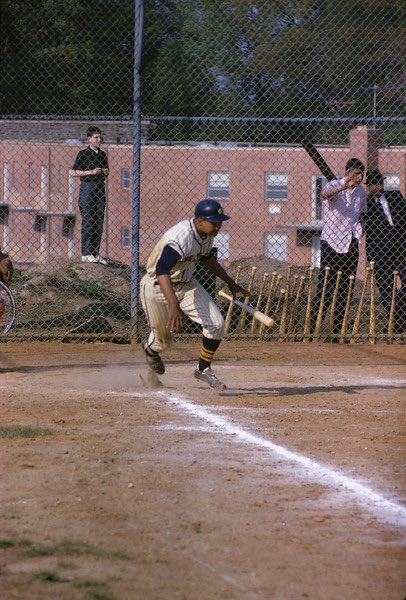
Reggie Jackson playing baseball for Cheltenham High School,
outside Philadelphia, Spring 1964. The color is real.

Angelo Cataldi, the morning man on all-sports radio station 610 WIP says of Philadelphia, "This town is wired for football."

I disagree. Pennsylvania is definitely a football State, but Philadelphia is a basketball city.

And yet, the city has a long and storied baseball history.

Note that I didn't say the stories were all good.

12. Philadelphia's All-Time Baseball Team

The Phillies' region is Pennsylvania between the Delaware and Susquehanna Rivers, New Jersey south of Interstate 195 plus the State capital of Trenton, and the entirety of Delaware.

Despite the fact that the Trenton Thunder are a Yankee farm team, the city is 30 miles from Philly and 60 miles from New York, and I usually see more people wearing Phils gear than Yankee gear at Thunder games (supposedly, more than half their season-ticket base lives across the river in Bucks County, Pennsylvania), so I'm counting players from Trenton as being in Philly's region, with one exception that I'll make when I do the Yankees' all-time regional team.

Each of these figures is from Pennsylvania unless otherwise stated. This team has got plenty of power, and if you're thinking about outpitching them, think again.

1B Mickey Vernon of Eddystone, Delaware County. How unlucky was this guy? He always seemed to be with losing teams, or with winning teams, before or after but never during.

He spent the majority of his career with the Washington Senators: "First in war, first in peace, and last in the American League." He got to the Cleveland Indians after they won the 1948 World Series, went back to Washington, went to Boston after the Red Sox' 1946-51 period of contention, went back to Cleveland after their 1954 Pennant, went to the Milwaukee Braves after their 1957 and '58 Pennants. And while he did play the last 9 games of his career with the 1960 Pittsburgh Pirates, he was not included on the World Series roster and did not get a ring.

But he won the AL batting title in 1946 and 1953, led the AL in doubles in 1946, '53 and '54, had a career OPS+ of 116, and collected 2,495 hits, 490 of them doubles. He hit only 172 homers, but probably would have had a lot more if he hadn’t played so many games at Griffith Stadium, Cleveland Municipal, and as a lefty at Fenway Park.

It would be nice if he were in the Hall of Fame. Alas, he's not, and the Senators are no longer around to retire any of the numbers he wore for them (more games in Number 3 than any other). He is, however, honored in the Washington Hall of Stars display at Nationals Park.

Honorable Mention to Andre Thornton of Phoenixville, Chester County. Though born in Tuskeegee, Alabama, he's a Delaware Valley man, who had a 122 OPS+, and 253 homers despite playing most of his home games at Cleveland Municipal Stadium. He was a 2-time All-Star who had 2 (very nearly 3) 100-RBI seasons. One of the most decent baseball men of his era, he is a member of the Cleveland Indians Hall of Fame.

2B Eddie Stanky of Northeast Philadelphia. Leo Durocher, his manager for the Brooklyn Dodgers and later the New York Giants, said of him, "He can't hit, he can't run, and he can't throw. All he can do is beat you." He won Pennants with the Dodgers in 1947, the Boston Braves in 1948, and the Giants in 1951. (The reason the Dodgers traded him after '47 is that he wouldn't get along with Jackie Robinson. He had a house and business interests in Alabama, and went coward on that basis.)

He was just a .268 hitter lifetime, but drew 996 walks in just 7 full seasons, leading the NL 3 times and thus in on-base percentage twice. He made 3 All-Star teams. He also managed in the majors, but the closest he came to a Pennant was with the 1967 Chicago White Sox, 3 games back but in 4th place.

SS Hugh Jennings of Pittston, Luzerne County. I had to go back a ways for the shortstop on this team, but found a good one. He starred on the NL Champion Baltimore Orioles of 1894, '95 and '96 with John McGraw and Willie Keeler, and also played with them on the 1899 and 1900 NL Champion Brooklyn Superbas (forerunners of the Dodgers). Brooklyn wouldn't win another major-league World Championship without him as a player until 1955, and Baltimore not until 1966.

I could also have made Jennings the manager of this team, as he led the Detroit Tigers to the 1907, '08 and '09 Pennants. He later became one of McGraw's coaches on the Giants, and briefly subbed for him as manager in the 1924 and '25 seasons. Known for, and by, his shout of "Ee-yah!", and for being hit with more pitches than any player in baseball history (287), he is in the Hall of Fame.

3B George "Whitey" Kurowski of Reading, Berks County – not to be confused with Reading in Berkshire, England. A 4-time All-Star, he played on 4 Pennant winners for the St. Louis Cardinals, and was a key figure in 2 World Series. In Game 5 in 1942, he hit a 9th-inning home run at Yankee Stadium to give the Cards the lead, enabling them to clinch. But in Game 2 in 1943, also at Yankee Stadium, Johnny Lindell slid into 3rd base, and kicked away a throw that would have nailed him, and the Yankees won that game and the next 3 to win the Series.

Kurowski also played on the Cards' World Series winners in 1944 and 1946, although an injury finished him at age 31. His lifetime batting average was .286, and he had a 125 OPS+. He only played 6 full seasons, but had 100 RBIs in 2 of them.

Honorable Mention to William Julius "Judy" Johnson of Wilmington, New Castle County, Delaware. Because he played in the Negro Leagues, mostly for the Philadelphia Hilldales, we can only guess as to how good he really was, but he impressed the Hall of Fame's Committee on the Negro Leagues to elect him to the Hall.

He was also the 1st person inducted into the Delaware Sports Hall of Fame. The home of the Carolina League's Wilmington Blue Rocks, the only professional team in Delaware at the moment, is named Judy Johnson Field at Daniel S. Frawley Stadium (Frawley being the Mayor who brought minor-league ball back to Wilmington).

LF Leon "Goose" Goslin of Salem, Salem County, New Jersey. The only South Jersey native in the Hall of Fame, he had a .316 lifetime batting average, an OPS+ of 128, 2,735 hits, 500 doubles, 173 triples, 248 homers, 12 100-RBI seasons, the 1928 AL batting title at .379, and played in the World Series with the Washington Senators in 1924 (won) and '25 (lost), and the Detroit Tigers in 1934 (lost) and ’35 (his bottom of the 9th single won Game 6 and the Series). When The Sporting News announced its 100 Greatest Baseball Players in 1999, he came in at Number 89.

Honorable Mention to Del Ennis of Olney, North Philadelphia. A hometown hero, he led the NL in RBIs in 1950, 1 of 7 100-RBI seasons for him, and was the biggest bat on the 1950 Pennant-winning Phillies "Whiz Kids." An injury knocked him out age 34, but he hit 288 home runs, 259 of them as a Phillie, making him the franchise's all-time leader until Mike Schmidt came along. With a career OPS+ of 117, and over 2,000 hits, he is a member of the Philadelphia Baseball Wall of Fame.

Honorable Mention to George Case of Trenton, Mercer County, New Jersey. A graduate of The Peddie School, a prep school in Hightstown, Case played most of his career with the Washington Senators, and led the AL in stolen bases 6 times. The closest he came to a Pennant was in 1945, when the Senators finished a game behind the Tigers. But in an era when few players ran like that, he stood out.

CF Mike Trout of Millville, Cumberland County, New Jersey. Yes, already. The Los Angeles Angels of Anaheim star is just 22, and has played only 2 full seasons in the majors, but look at them. In the 1st, 2012, he batted .326, led the AL in runs, stolen bases and OPS+, was named Rookie of the Year. In the 2nd, 2013, he batted .323, led the league in runs and walks, and came close to a 100-RBI season. In each year, he made the All-Star Team and finished 2nd in the MVP voting. He's already hit 62 home runs and stolen 86 bases. He's already the greatest player ever to come from Cumberland County.

Looking at the rest of that part of New Jersey that tilts toward Philadelphia rather than New York, aside from Goslin’s Salem, Case’s Mercer and Trout's Cumberland, the best player from South Jersey's Counties are:

Atlantic County: John Henry "Pop" Lloyd, who was born in Florida but grew up and played part of his professional career in Atlantic City, where a local park is named for him, and is one of the Negro Leaguers in the Hall of Fame. Unfortunately, since I don't have big-league stats for this man, often called the greatest shortstop in Negro League history, I can't make him a starter on this team.

Burlington County: See below.

Camden County: Ray Narleski of Collingswood, a star reliever for the 1950s Indians including their 1954 Pennant winners.

Gloucester County: Abram Harding "Hardy" Richardson of Clarksboro, an 1880s star with 2 teams that no longer exist, the NL's Buffalo Bisons and Detroit Wolverines, winning the 1887 Pennant with Detroit, while Dan Meyer of Woolwich is currently pitching for the Florida Marlins.

RF Carl Furillo of Stony Creek Mills, Berks County. Grew up just outside Reading, and with his powerful right arm became known as the Reading Rifle. His love of scungilli also got him the nickname "Skoonj."

At the bottom of the scoreboard in right field at Ebbets Field was a sign, posted by a man who would ride that sign's fame to the Presidency of first the New York City Council and then the Borough of Brooklyn: "HIT SIGN WIN SUIT. ABE STARK. Brooklyn's Leading Clothier." With Dixie Walker and then Furillo playing right field, it was believed that Mel Ott was the only player to hit that sign on the fly. When it was suggested to Stark that he give Furillo a free suit, for having saved him from having to give out so many, he did.

Furillo was a good hitter, too: Lifetime batting average .299, OPS+ of 112, 5 times a .300 hitter including the 1953 NL batting title at .344. He played on 7 Pennant winners with the Dodgers, including the 1955 (Brooklyn) and 1959 (Los Angeles) World Championships.

Even more notably, he retired due to injury in 1960, and sued the Dodgers over not telling him how bad his injury was… and won. Imagine that, suing Dodger owner Walter O’Malley, the most powerful man in baseball (who pulled the strings for Commissioner Ford Frick), and himself a lawyer, and winning! Furillo went to work for Otis Elevators, and helped install the elevators in the World Trade Center as it went up in the late 1960s and early 1970s.

DH Reginald Martinez Jackson of Wyncote, Bucks County. I was going to put Reggie in right field, even with his glove, but I couldn't resist putting Furillo in there. Because of when and where I first came into sports awareness, Reggie remains my favorite athlete of all time.

With the Oakland Athletics, New York Yankees and California Angels (as the Anaheim franchise was then known), he reached 11 postseasons, winning 6 Pennants (and just missing 3 others by a game) and 5 World Championships: 1972, '73 and '74 with the A's, and 1977 and '78 with the Yanks. He is the only man to win World Series MVP awards with 2 teams, with the '73 A's and the '77 Yanks, featuring his 5 homers in the latter Series, 3 in the clinching Game 6. His career total is 563, making him the leader among all players born between 1936 (Harmon Killebrew) and 1963 (Mark McGwire).

Hall of Fame, Number 9 retired by the A's, Number 44 retired and Monument Park plaque dedicated by the Yanks. (The Angels have a team Hall of Fame, but Reggie has not yet been elected to it or had his Number 44 retired by them.) When The Sporting News announced its 100 Greatest Baseball Players in 1999, he came in at Number 48. They call him Mr. October, but he remains a man for all seasons.

C Roy Campanella of Nicetown, North Philadelphia. Don't let the name fool you: For as long as I can remember, "Nicetown" has been a ghetto and not very nice. But Campy was. In the 1940s with the Baltimore Elite Giants of the Negro Leagues, and in the 1950s with the Brooklyn Dodgers, he built a Hall of Fame career, including 3 NL MVPs, 5 Pennants and the 1955 World Championship.

A car crash ended his career and paralyzed him for life at age 36, but for years, Dodger fans said he was better than Yogi Berra across town. He remained on the Dodger payroll until his death in 1993, long after the Dodgers moved to Los Angeles, and his Number 39 was retired, along with Jackie Robinson’s 42 and Sandy Koufax's 32, in a 1972 ceremony at Dodger Stadium, the 1st numbers retired by the franchise. When The Sporting News announced its 100 Greatest Baseball Players in 1999, he came in at Number 50.

Mike Piazza of Norristown, Montgomery County is not on this team. Never mind the steroid accusations, for which we have every bit as much proof as we do for his nemesis, Roger Clemens: He couldn't play the position of catcher, and Campy was a better hitter. He can be the righthanded platoon at DH with the lefthanded Reggie.

Honorable Mention to Doug Allison of Philadelphia: He was the catcher on the 1st openly professional team, the 1869-70 Cincinnati Red Stockings, and lasted long enough to be a member of the 1879 NL Champion Providence Grays. He is also the earliest known player to use a glove, using buckskin mittens to protect his hands with the 1870 Red Stockings.

Honorable Mention also to Allison's teammate, Dick Hurley of Honesdale, Wayne County, who is listed as the "substitute" for the 1869-70 Red Stockings. It seems the position he most played in pro ball after leaving Cincinnati was right field. Not all that well, apparently: He appears to have last played for the 1872 Washington Olympics of the National Association, not a good team even by the standards of the Ulysses S. Grant Administration.

SP Christopher "Christy" Mathewson of Factoryville, Wyoming County. Was he the greatest pitcher of them all? We'll never know how he would have done in the Lively Ball Era, unlike Walter Johnson and Grover Cleveland Alexander who pitched well into the 1920s. But "Big Six" (he was 6-foot-1 when that was considered very tall) was, from 1901 to 1914, probably the greatest pitcher the planet had yet seen.

His 373 wins are tied for 3rd all-time, 1st in NL play, with Alexander. (Cy Young's 511 were split between the Leagues, and Walter Johnson had 417, all in the AL.) A 2.13 ERA, an ERA+ of 136, so he was 36 percent better in ERA than the pitchers of his time. WHIP 1.058 -- that is sick. His 2,507 strikeouts were 2rd all-time behind Young at the time of his retirement. His 79 shutouts were a record until surpassed by Johnson.

He pitched the Giants to the 1904 Pennant, and in 1905 pitched 3 shutouts as the Giants won the World Series over the Philadelphia Athletics. But that was his last title: The Giants just missed the Pennant in 1908 (Mathewson started the "playoff" forced by Fred Merkle's Boner and lost it), and they lost the World Series in 1911, 1912 (Mathewson lost the deciding Game 8) and 1913. Still, he was the most beloved player of his day.

Exposure to poison gas while training for World War I, and the subsequent Spanish flu epidemic, both damaged his lungs, and when tuberculosis struck, he never had a chance. He died in 1925, just 45 years old, and a nation mourned.

He was one of the 1st 5 players elected to the Hall of Fame in 1936 -- the only one already dead. (Ty Cobb, Babe Ruth, Honus Wagner and Johnson were still alive.) Although he played before uniform numbers were worn, the Giants, long after moving to San Francisco, placed an "NY" alongside their retired numbers, first at Candlestick Park and then at AT&T Park. He was elected to the All-Century Team. That same year, when The Sporting News announced its 100 Greatest Baseball Players, he came in at Number 7.

He also played football at Bucknell University, and their stadium is named for him. His brother Henry also briefly pitched in the majors.

SP Ed Walsh of Plains, Luzerne County. "Big Ed Walsh?" Hall-of-Famer Sam Crawford said of the great Chicago White Sox spitballer. "You talk about spitballs? I think that ball disintegrated, and came back together when the catcher got a hold of it! I swear, when it went past the plate, it was just the spit went by!"

It was an easy thing to believe: Then a legal pitch, Walsh used the spitter to win 195 games against just 126 losses, with a career WHIP of exactly 1.000 and an all-time record low ERA of 1.82 -- for an ERA+ of 146, so he wasn't just taking advantage of the Dead Ball Era.

In 1906, he helped the White Sox win the World Series in a big upset over the crosstown Cubs. In 1908, he went 40-15, pitching a 20th Century record 484 innings. That included a 15-strikeout performance late in the season against the Cleveland Indians -- but Walsh lost the game, because opposing pitcher Addie Joss threw a perfect game. (Ty Cobb's Tigers edged them both for the Pennant.)

In 1910, architect Zachary Taylor Davis supposedly consulted Walsh on how to design the Sox' new home, and this is believed to be why Comiskey Park, for all of its 80-year life, was a pitchers' park. (Davis would also design what became Wrigley Field in 1914.) After back-to-back 27-win seasons in 1911 and '12, Walsh appeared to lose it, having had his last good season at age 31. Still, he's in the Hall of Fame.  When The Sporting News announced its 100 Greatest Baseball Players in 1999, he came in at Number 82.

He died on May 26, 1959 -- the day Harvey Haddix outdid both Walsh and Joss by pitching a perfect game for 12 innings, and losing the game in the 13th! Big Ed's son, Ed Walsh Jr., also pitched for the White Sox, while Big Ed was a Sox coach, though not nearly as well.

SP Stan Coveleski of Shamokin, Northumberland County. "There was nothing strange in those days about a twelve-year-old Polish kid working in the mines for 72 hours a week at a nickel an hour," he said late in life. "What was strange is that I ever got out of there."

He pitched for the hometown Athletics, but was sold because Connie Mack and the Shibe brothers needed the money. Big mistake. He was the ace of the 1920 World Champion Indians, and also pitched in the Series for the 1925 Washington Senators (though they lost) and the 1928 Yankees (they won). He went 216-142 for his career, and he was elected to the Hall of Fame. He lived his post-baseball life in South Bend, Indiana, where the minor-league ballpark is named Stanley Coveleski Regional Stadium and is home to the South Bend Silver Hawks.

SP Orel Hershiser of Cherry Hill, Burlington County, New Jersey. Born in Buffalo, New York, but a graduate of Cherry Hill High School East. Putting together a superb career record of 204-150, he reached the postseason with the Dodgers in 1985 and '88 (and almost in '91, and would have again if the Strike of '94 hadn't hit), the Indians in '95, 96 and '97, the Giants in '98 and the Mets in '99.

He went 23-8 with a 2.26 ERA in 1988, including pitching a record 59 consecutive scoreless innings to close the regular season. He was one of the rare pitchers who deserved a regular-season MVP, it went instead to his teammate Kirk Gibson; while Gibson is remembered for his walkoff homer in Game 1 of the World Series, Hershiser won Games 2 and 5 (the clincher) to take the Series MVP. He was 8-3 with a 2.59 ERA in postseason play. He is now a broadcaster with ESPN, and is generally regarded as one of the smartest men in baseball.

Does he deserve to be in the Hall of Fame? He’s been eligible since 2006. Baseball-Reference.com's HOF Monitor has him at 90 of 100, meaning he comes close but doesn't get in; and their HOF Standards have him at 34 out of 50, meaning he doesn't come all that close. Of their 10 Most Similar Pitchers, only 2, Catfish Hunter and Dazzy Vance, are in; the others include Bob Welch, Kevin Brown, Vida Blue and Dave Stieb.

SP Mike Mussina of Montoursville, Lycoming County. From 1991 to 2000, "Moose" won 147 games and lost just 81 for the Orioles, with an ERA+ of 130 and a WHIP of 1.175. He helped them reach the ALCS in 1996 and '97. Once he retired from the game, he was elected to their team Hall of Fame.

He left the O's for their rivals, the Yankees, where he won another 123 games and lost just 72. In total, he went 270-153, a winning percentage of .638. He never won a World Series, although he did pitch in the 2001 and 2003 editions for the Yankees. He went 20-9 in 2008, finally winning 20 at age 39, and then retired. (Maybe it was for the best: I was at the 2009 Old-Timers' Game at Yankee Stadium II, and he pitched in it, and he was awful, letting guys in their 50s and 60s get hits off him, and David Cone had to come in to bail him out; 4 years older, Coney had better stuff that day than the Moose.)

Mussina is now eligible for the Hall of Fame, but didn't get in this time. As video producer Sean C. Dunn, who sponsors Mussina's Baseball-Reference.com page, points out, there's only 6 pitchers with at least that many wins and a better winning percentage. In chronological order: John Clarkson, Christy Mathewson, Grover Cleveland Alexander, Lefty Grove, Roger Clemens and Randy Johnson. B-R's HOF Monitor has him at 121 (meaning he absolutely should be in), and their HOF Standards have him at 54 (which also qualifies him).

Honorable Mention to SP William "Bucky" Walters of Germantown, North Philadelphia. He pitched for his hometown Phillies from 1934 to 1938, in Baker Bowl with its dilapidated condition and a 280-foot right-field fence. Needing cash, the Phils traded him to the Cincinnati Reds, and that was the best thing that could have happened to him.

In 1939 the Reds won the Pennant, and in 1940 they won the World Series. Walters led the NL in wins, ERA, ERA+, innings pitched, WHIP, fewest hits per 9 IP and complete games in both seasons, going 49-21 – not counting going 2-0 in the '40 Series, although he was 0-2 in the '39 edition. He also led the NL in strikeouts in '39. He went 27-11 in '39, 22-10 in '40, and 23-8 in '44.

His career record was 198-160 ,with an ERA+ of 115, and if he hadn't pitched all those games for a lousy team in a lousy ballpark, he'd probably have about 230 wins and he might be in the Hall of Fame. The Reds have elected him to their team Hall of Fame, although his Number 31 remains in circulation. (John Franco, for one, wore it for the Reds.)

Honorable Mention to Curt Simmons of Egypt, Lehigh County. Another local guy on the Phillies, he was the 2nd-best pitcher on the 1950 "Whiz Kids," going 17-8, but with the Korean War raging, he was drafted right before the regular season ended, costing him an appearance in the World Series (and, quite possibly, denying the Phils a good chance at beating the Yankees).

He got another chance at glory in 1964, going 18-9 at age 35, helping the Cardinals win the Series over the Yankees, but had to beat the Phillies with that amazing comeback (and Phils choke) to do it. He won 193 games in his career, and would have won a lot more had he not spent the first half of his career with the Phils.

Honorable Mention to Bobby Shantz of Pottstown, Montgomery County. Officially, he was 5-foot-6. Unofficially, he was the last in a long line of great pitchers for his hometown Philadelphia Athletics. In 1951, with an A's team that won only 70 games, he went 18-10, and he was just getting warmed up. In 1952, with the A's winning just 79 and finishing 4th, he went 24-7 with a 2.48 ERA (an ERA+ of 159) and a 1.048 WHIP. He was named AL MVP that season, ahead of World Champion Yankees like Mickey Mantle and Yogi Berra.

After moving to Kansas City, the cash-strapped A's traded him to the Yankees, and in 1957 he led the AL in ERA with 2.45, helping the Yankees win the Pennant. Becoming a reliever, he was a major factor in the Yanks winning the 1958 World Series. He ended his career back in his home market; unfortunately, this was with the 1964 Phillies.

He finished 119-99, a good record considering he was mainly a reliever from age 31 onward. He is a member of the Philadelphia Baseball Wall of Fame, although his plaque is now at the Philadelphia Athletics Historical Society display in Spike's Trophies in Northeast Philly.

Honorable Mention to Danny McDevitt of Hallstead, Susquehanna County, near the New York State Line in the northeastern corner of Pennsylvania. He had only a 22-27 career record, but he did pitch a shutout to win the last game ever played at Ebbets Field, a 2-0 Brooklyn win over Pittsburgh. He was also on the Los Angeles staff that won the 1959 World Series.

In 2007, he threw out the first ball before a Brooklyn Cyclones game to commemorate the 50th Anniversary of the Dodgers' forced farewell to the Borough.

Honorable Mention to Chris Short of Milford, Kent County, Delaware. There have been 52 MLB players born in The First State, and the greatest of them -- aside from Judy Johnson, for whom we don't have reliable stats -- is probably Short, another pitcher for the '64 Phils. He won 135 games in he major leagues, all but 3 for the Phils, and is in the Philadelphia Baseball Wall of Fame.

RP Bruce Sutter of Mount Joy, Lancaster County. Injury limited him to only 1 full season after age 32, but from 1976 to 1984 (ages 23 to 31), he was as good a reliever as there ever was. In 1977, with a good but not great Chicago Cub team, he went 7-3 with 31 saves, a 1.34 ERA and a 0.857 WHIP. He pitched 107 innings, struck out 129, and walked just 23 (only 16 unintentionally). That's unreal. In 1979 with 37, he tied the NL single-season record for saves; in 1984 with 45, he broke it.

He went to the Cubs' arch-rivals, the St. Louis Cardinals, and led them to the 1982 World Series against the Milwaukee Brewers, striking out Gorman Thomas for the last out. The Cards traded him to the Atlanta Braves prior to 1985, and they would pay dearly for that as they lost the Series in ’85 and again in '87. But maybe, due to his injuries, Sutter couldn’t have helped.

He finished with 300 saves (2nd all-time behind Rollie Fingers at that point and the most in the NL), an ERA+ of 136 and a WHIP of 1.140. In 2006, he was elected to the Hall of Fame, and the Cards retired his Number 42 (which, of course, he wore before it was retired for all of baseball for Jackie Robinson).

MGR and GM Dallas Green of Newport, New Castle County, Delaware. A mediocre pitcher for the Phillies, going 2-1 with a 5.79 ERA, mostly in relief, for the infamous 1964 squad, he redeemed himself as their manager, leading them to their 1st World Championship in 1980. He also led the Phils to the 1st-half NL East title in the strike-split 1981 season, before the Chicago Cubs hired him away to be their general manager. As such, he made the trade that brought Ryne Sandberg to Chicago, and the Cubs won the 1984 and 1989 NL East crowns as a result of his deals. He later managed both the Yankees and the Mets, neither with success.

For the last few years, he has been back in Philadelphia as a special adviser to the Phils. He is a member of the Philadelphia Baseball Wall of Fame, and the fact that he led both the Phillies and the Cubs, perennial losers, to more than one postseason berth suggests that he belongs in Cooperstown as well. Certainly, the Phillies should retire his Number 46.

Tommy Lasorda of Norristown was also a mediocre pitcher before managing, but I didn't make him the manager of this team, for one simple reason: I don't like him. Okay, maybe for a second simple reason: Dallas Green might bite my head off otherwise. What's Tommy gonna do, sit on me?

Wilmington, New Castle County natives Robert Ruliph Morgan Carpenter Jr. and his son Robert III, a.k.a. "Bob" and "Ruly" Carpenter, who owned the Phillies from the 1940s to the 1980s, are the owners of this team.