Showing posts with label dan fouts. Show all posts

Sunday, January 2, 2022

January 2, 1982: The Kellen Winslow Game

January 2, 1982, 40 years ago: History calls it "The Epic in Miami" or "The Kellen Winslow Game." Sports Illustrated called it "The Game No One Should Have Lost." San Diego Chargers fans called it "The Greatest Game Ever Played." Miami Dolphins fans call it "The Miracle That Died."

The AFC Eastern Division Champion Dolphins hosted the AFC Western Division Champion Chargers at the Orange Bowl. Despite a starting time of 5:00 PM, it was hot, 88 degrees. That shouldn't have bothered a team from San Diego. But, like Arizona, San Diego usually has a dry heat. This game also came with a lot of humidity, and that would have seemed to favor the Miami team.

The 1st quarter was all Chargers. Dan Fouts, engineer of head coach Don Coryell's "Air Coryell" attack, drove them down the field, but all they could get was a 32-yard field goal from Rolf Benirschke. Still, their much-maligned defense forced the Dolphins to punt, and Wes Chandler returned that punt 56 yards for a touchdown.

The Dolphins fumbled the ensuing kickoff, and the Chargers recovered. They drove until Chuck Muncie scored from 1 yard out. And then Glen Edwards intercepted Dolphin quarterback David Woodley, setting up a touchdown pass from Fouts to James Brooks. At the end of the 1st quarter, the Chargers led, 24-0. The game looked over already.

The 2nd quarter didn't start out to disabuse anyone of that notion: The Dolphins' next drive was an incompletion, 2 sacks and a fumble. Finally, head coach Don Shula pulled young quarterback David Woodley, and replaced him with veteran Don Strock, who had waited for years behind Hall-of-Famer Bob Griese. Strock got the Dolphins moving, and Uwe von Schamann kicked a 34-yard field goal to get them onto the ledger.

(Benirschke was the Boston-born, San Diego-raised son of a German immigrant, who overcame ulcerative colitis to become a star kicker; while von Schamann was a German immigrant, who moved to Fort Worth, Texas as a teenager and switched from soccer to American-style football.)

Now, the game was going the Dolphins' way: They forced a fumble by Fouts, and Strock took his team down the field and threw a touchdown pass to Joe Rose. The Dolphins' defense, known as the Killer B's for all their players with names beginning with B -- Bob Baumhower, Doug Betters, Kim Bokamper, Doug Barnett, Bob Brudzinski, and the brothers Glenn and Lyle Blackwood -- held the Chargers, and Coryell chose to sent Benirschke out to try a 55-yard field goal, which fell a little short.

That gave the Dolphins great field position. Shula was in his 29th season in the NFL, his 22nd as a coach, his 19th as a head coach, and his 12th with the Dolphins -- totals that would eventually reach 43, 36, 33 and 26, respectively -- and he was a very conservative coach, not known for calling trick plays. This time, with 6 seconds left in the half and the ball on the Charger 40-yard line, he called one: Strock threw to Duriel Harris, who caught the ball, and immediately lateraled to Tony Nathan, who took it in for a touchdown. At halftime, it was Chargers 24, Dolphins 17, and anybody's ballgame.

Early in the 3rd quarter, Strock threw a 15-yard touchdown pass to Rose. The Chargers had now blown a 24-point lead: The game was tied.

Finally, the Chargers woke up. Fouts led them 60 yards in 6 plays, and threw a 25-yard touchdown pass to Kellen Winslow. Along with Ozzie Newsome of the Cleveland Browns, Winslow was considered the best tight end in the game at the time. But Strock came right back, and threw a touchdown pass to his own tight end, Bruce Hardy. It was 31-31, and still only in the 3rd quarter.

Late in the quarter, Charlie Joiner, a future Hall-of-Famer, slipped, allowing Lyle Blackwood to intercept Fouts, and to then lateral the ball to Gerald Small, who took it to the Charger 15. On the 1st play of the 4th quarter, Nathan ran 12 yards for a touchdown. For the 1st time in the game, the Dolphins led: 38-31.

Now, the clock was the Dolphins' ally, just the way Shula liked it. They kept the ball on the ground, and tried to run the clock out. But with 4:39 left in regulation, Louie Kelcher stripped the ball from Andra Franklin, and Pete Shaw recovered the ball on the Charger 18. Fouts took control, got the Chargers to the Dolphin 9, and, with 1:06 left threw a pass intended for Winslow. It went over his head, but was caught in the end zone by Brooks. It was 38-38.

The Dolphins had time for one more drive, but could only get to the Charger 26. von Schamann tried a game-winning field goal, but Winslow deflected it with his fingertips. This hot, humid, wild game was not done yet: It was going to overtime.

Both teams were tired. Both teams were dehydrated. Both teams wanted it over quickly. Many people in the stadium remembered a game the Dolphins had played 10 years earlier, beating the Kansas City Chiefs in a game that went to a 2nd overtime. That game was in Kansas City, and the weather was unseasonably warm. The people in the Orange Bowl would have taken that at this point.

The Chargers won the coin toss, and got inside the Dolphin 10, but got no further. Benirschke came on for a 27-yard field goal attempt. It should have been easy. But the snap and hold were both bad, and the kick went wide left. The Dolphins took this great chance, and got close enough for von Schamann to try a 35-yard field goal. But he kicked it low, and Leroy Jones became the 2nd Charger player of the game to block a field goal attempt.

The Chargers took over on their own 16. Fouts got his team a little closer, and a little closer, with the exception of a 39-yard catch by Joiner. Finally, he got close enough for Benirschke to try a field goal from 29 yards out. It was good: After 73 minutes and 52 seconds, the final score was Chargers 41, Dolphins 38.

This game set new NFL Playoff records: Most points by both teams (79), most total yards by both teams (1,036), and most passing yards by both teams (809). Strock had 403 yards passing, still a record, regular season or Playoff, for any NFL quarterback coming off the bench. Fouts completed 33 of 53 passes for 433 yards, a new team record. Each of those totals was a new NFL Playoff record.

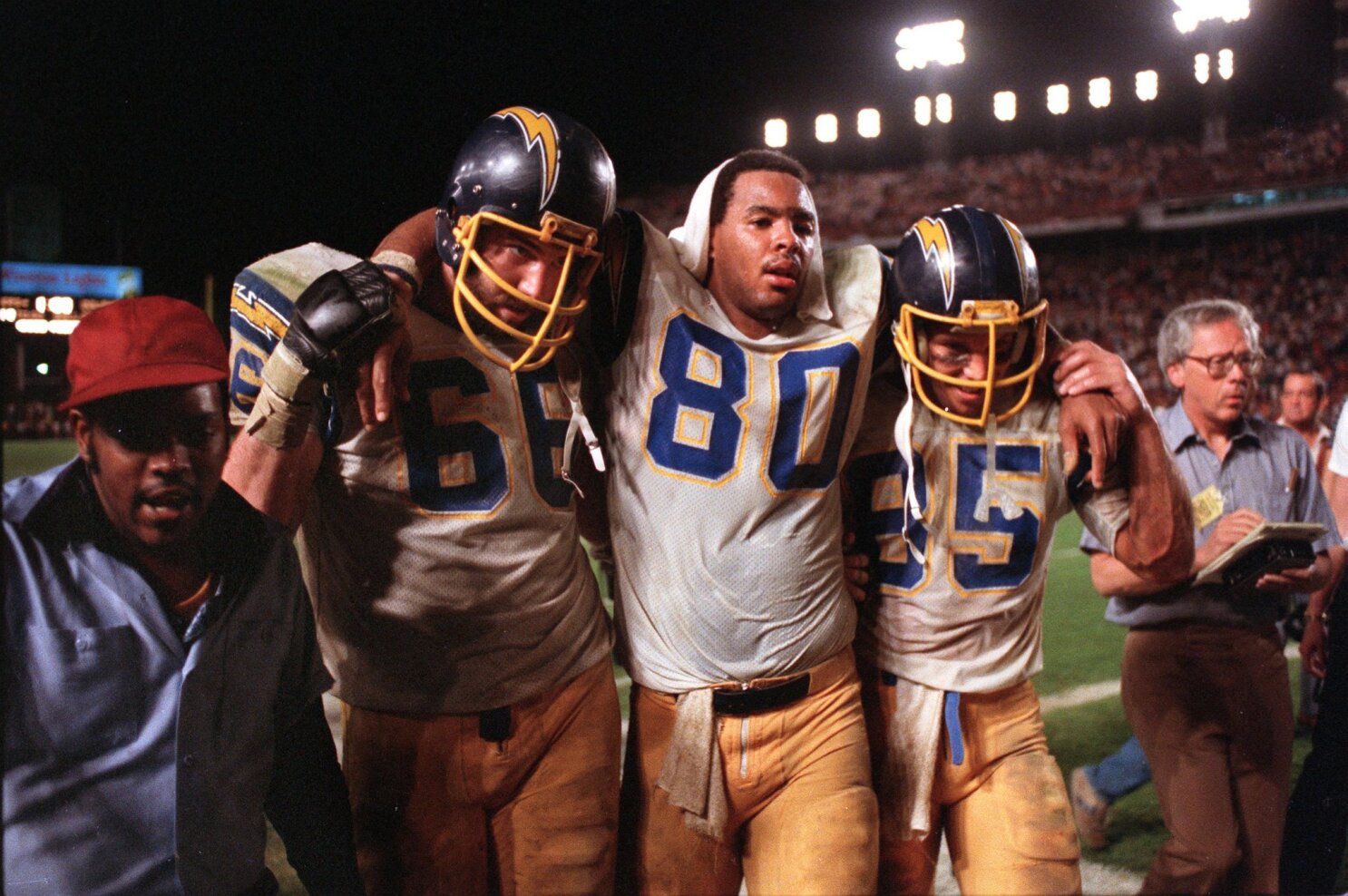
But what everyone remembers is Kellen Winslow. He caught 13 passes, then an NFL Playoff record, for 166 yards and a touchdown. During the game, he was treated for a pinched nerve in his shoulder, a cut on his lip that needed 3 stitches, dehydration and cramps. The defining image of the game was of Winslow being helped off the field by offensive tackle Billy Shields and receiver Eric Sievers.

He cited the 3rd fight between Muhammad Ali and Joe Frazier, in 1975: "I've never felt so close to death before. That's what Muhammad Ali said in Manila, and that's how I felt out there at the end."

Coryell said, "There has never been a game like this. It was probably the most exciting game in pro football history." Sure, he could say that: His team won, so he didn't have to explain why they had blown a 24-point lead. But Shula, who blew a 4th-quarter lead at home, agreed with him: "A great game, maybe the greatest ever." And Bryant Gumbel, calling the game for NBC, said, "If you didn't like this football game, you didn't like football."

Just 8 days later, the Chargers played the AFC Championship Game against the Cincinnati Bengals -- and it was the biggest shift in temperature in the history of sports, from 88 degrees to 9 degrees below zero. With the name "Ice Bowl" already taken, this one was called the "Freezer Bowl," and they couldn't handle it, losing 27-7. The Chargers never got this close to the Super Bowl again for 13 years.

The Dolphins, on the other hand, got back the next season, though they lost Super Bowl XVII to the Washington Redskins.

Saturday, April 28, 2018

San Diego's 10 Greatest Athletes

This weekend, the Mets play a series in San Diego against the Padres.

San Diego's 10 Greatest Athletes

Honorable Mention to Baseball Hall-of-Famers who played for the Padres but didn't make the Top 10: Willie McCovey, Rollie Fingers, Gaylord Perry, Ozzie Smith, Goose Gossage, Roberto Alomar, Rickey Henderson and Greg Maddux.

Honorable Mention to Fred Dean, defensive end, San Diego Chargers, 1975-81. A member of the Pro Football Hall of Fame, I might have put him in this Top 10 if he'd played his entire career for the Bolts. He later won 2 Super Bowls with the San Francisco 49ers. Maybe Chargers owner Gene Klein shouldn't have traded him.

Honorable Mention to Bill Walton, center, San Diego Clippers, 1979-84 (plus 1984-85 in Los Angeles). Injuries prevented him from making much of a contribution for his hometown team, but he did have enough great moments in the NBA to make the Basketball Hall of Fame.

10. Ron Mix, offensive tackle, San Diego Chargers, 1960-69 (including the 1st season, in Los Angeles). He played in the AFL for its entire 10-season existence, helping the Chargers reach 6 Championship Games, winning in 1963, and making the All-Star Team every season except the last, 1969, when he was playing hurt.

After that season, he announced his retirement, and Klein made Mix's Number 74 the 1st number ever retired by a San Diego sports team. Then he signed a replacement, Gene Ferguson. Mix suddenly changed his mind, and said he wanted to play again. He asked to have his rights traded to the Jets. Klein instead traded him to the Oakland Raiders for high draft picks, and unretired Mix's number. It remains officially available for the Chargers, and was worn by All-Pro defensive tackle Louie Kelcher.

Ron Mix is 1 of 3 Jewish players in the Pro Football Hall of Fame, along with 1930s Giants quarterback Benny Friedman and 1940s Chicago Bears quarterback Sid Luckman. And while the also-Jewish Klein unretired his number, subsequent owner Alex Spanos named Mix to the Chargers Hall of Fame.

9. Charlie Joiner, wide receiver, San Diego Chargers, 1976-86. He previously played 4 seasons each with the Houston Oilers and the Cincinnati Bengals. If he had spent his entire career with the Chargers, he would be much higher on this list.

A 3-time Pro Bowler, he caught 750 passes for 12,146 yards and 65 touchdowns, big numbers by 1970s standards. The Chargers named him to their team Hall of Fame, but have not retired his Number 18. He was elected to the Pro Football Hall of Fame, and in 1999, The Sporting News began its list of the 100 Greatest Football Players by selecting Joiner at Number 100.

8. Dave Winfield, right field, San Diego Padres, 1973-80. If he had spent his entire career with the Padres, he would easily be Number 1 on this list. Instead, he only spent the 1st 1/3rd of his career with them, but was arguably the best player in baseball over a 3-year stretch from 1978 to 1980, resulting in the Yankees giving him the 1st contract in baseball worth more than $1 million a year. (Nolan Ryan got the 1st contract at an even $1 million from Houston the year before.)

He was a 12-time All-Star, 4 with the Padres; and a 7-time Gold Glove, 2 with the Padres. Of his 3,110 career hits, 1,134 were with the Padres, who retired his Number 31, and elected him to their team Hall of Fame. He was elected to the Baseball Hall of Fame in 2001. The Sporting News listed him 94th on their list of the 100 Greatest Baseball Players in 1999.

7. Junior Seau, linebacker, San Diego Chargers, 1990-2002. No defensive player had a more appropriate pronunciation to his name: Junior made many, many players "Say ow." I wonder if he ever hit Drew Bledsoe hard enough that he made him say ow and he bled so?

A 12-time Pro Bowler, he was named NFL Defensive Player of the Year in 1992, and was a member of the Chargers' 1994 AFC Championship team. He won another AFC title with the 2007 New England Patriots, but was on the losing side of the Super Bowl both times.

He was named to the Pro Football Hall of Fame and the NFL's 1990s All-Decade Team. The Chargers named him to their team Hall of Fame and retired his Number 55. But he became the face of NFL brain trauma following his suicide. He did not live to see his election to Canton.

6. Dan Fouts, quarterback, San Diego Chargers, 1973-87. A few years ago, he was broadcasting a college football game on ABC, proving color commentary for Keith Jackson, and it was pouring. Keith asked him if he'd ever played in weather as bad as that. "Keith," he said, "I played in the State of Oregon, where rain was invented!"

He was born and raised in San Francisco, a city which has had its share of weird weather, before becoming one in a long line of University of Oregon quarterbacks to brave the Pacific Northwest's climate. His 15 seasons in sunny San Diego were his reward.

He was a 6-time Pro Bowler, and NFL Most Valuable Player in 1982. At the time he retired, his 43,040 passing yards were 2nd-most all-time, behind Fran Tarkenton and ahead of Johnny Unitas, who, interviewed on CBS' The NFL Today, called him the quarterback playing then that he liked the best. He led the Air Coryell attack that included Charlie Joiner, Kellen Winslow and John Jefferson, but couldn't get closer to the Super Bowl than defeats in the 1980 and '81 AFC Championship Games.

He was elected to the Pro Football Hall of Fame and named to the NFL's 1980s All-Decade Team. The Chargers named him to their team Hall of Fame and retired his Number 14. He was 92nd on The Sporting News' 100 Greatest Football Players in 1999, but did not make the 2010 list of the NFL Network's 100 Greatest Players.

5. Kellen Winslow, tight end, San Diego Chargers, 1979-87. He's been called the greatest tight end ever. He made 5 Pro Bowls, and his 541 catches (leading the NFL -- as a tight end -- in 1980 and '81), 6,741 receptions and 45 touchdowns were the standards by which all later tight ends have been measured. His exhausting performance in the January 2, 1982 "Epic in Miami" has given that Playoff classic another name: "The Kellen Winslow Game."

He was named to the Pro Football and San Diego Chargers Halls of Fame, and the NFL's 75th Anniversary All-Time and 1980s All-Decade Teams. He was 73rd on The Sporting News' 100 Greatest Football Players and actually ranked higher, 67th, on the NFL Network's 100 Greatest Players.

4. Lance Alworth, wide receiver, San Diego Chargers, 1962-70. The 1st great San Diego-based major league athlete, he was a 7-time All-Star, he was named American Football League Player of the Year in 1963, leading the San Diego Chargers to the AFL Championship -- the only time a San Diego team has ever gone as far as it could go at the major league level.

He caught 542 passes for 10,266 yards, huge numbers before the 1978 rule change regulating bump-and-run coverage. The Chargers made his Number 19 the 1st they retired (and kept retired, see the entry for Ron Mix), and he was elected to their team Hall of Fame. The University of Arkansas graduate was elected to the College Football Hall of Fame, and was the 1st player whose career was mainly in the AFL to be elected to the Pro Football Hall of Fame.

He was also named to the NFL 75th Anniversary Team and the AFL All-Time Team. He was 31st on The Sporting News' 100 Greatest Football Players and 38th on the NFL Network's 100 Greatest Players.

Some people have suggested that trading "Bambi" (nicknamed because he "ran like a deer" to the Dallas Cowboys after the 1970 season led to The Curse of Bambi, dooming all San Diego teams.

Here's what's happened since: Alworth won Super Bowl VI with the Cowboys his 1st season in Dallas, the Chargers only reached the Super Bowl once in the ensuing 46 seasons and finally moved, the Padres have won only 2 Pennants and exactly 1 World Series game, while the NBA's Clippers, the ABA's Conquistadors/Sails, and the WHA's Mariners all moved, with the city not getting another major league basketball or hockey team since. Only the Padres are left, and they nearly moved to Washington in 1974, and probably would've moved if voters hadn't approved a bond issue for Petco Park following the team's 1998 Pennant.

3. LaDainian Tomlinson, running back, San Diego Chargers, 2001-09. A 5-time Pro Bowler, he was named NFL Most Valuable Player in 2006, when he set records for most rushing touchdowns (28), most overall touchdowns from scrimmage (31) and most consecutive games with a touchdown (eventually reaching 18 to tie a record).

Of his 13,684 rushing yards, 12,490 were for San Diego. Of his 624 catches and 4,772 receiving yards, 530 and 3,955 were for the Chargers. He is a member of the Pro Football Hall of Fame and the NFL's 2000s All-Decade Team, and the Chargers elected him to their team Hall of Fame and retired his Number 21.

2. Trevor Hoffman, pitcher, San Diego Padres, 1993-2008. Formerly baseball's all-time leader in saves, he still holds the National League record with 601. In the 1998 season, he led the Padres to the Pennant every bit as much as Tony Gwynn did.

Coming in to the tune of AC/DC's "Hell's Bells," "Trevor Time" became the most intimidating time in the League, especially in the postseason, when 64,000 fans would pack Jack Murphy Stadium, waving their white towels. Of course, he had to pitch to Scott Brosius in the World Series...

His career ERA+ was a whopping 141, his WHIP a nasty 1.058. He is a new inductee into the Bsaeball Hall of Fame. Maybe he was never better than Mariano Rivera, who broke his record, but he was better than just about every other reliever of the 1990s and 2000s.

The only bad thing I can say about him is that he bears a striking resemblance to my ex-brother-in-law, whom I'm not crazy about, and not just because he (the ex-brother-in-law, not Hoffman) is a Philadelphia Flyers fan.

1. Tony Gwynn, right field, San Diego Padres, 1982-2001. He started slowly, started in center field, and there was an interregnum in 1981 when the team had neither Winfield nor Gwynn, but someone must have had an appreciation for right field in Mission Valley: From the 2nd term of Richard Nixon to the 1st term of George W. Bush, there was nearly always a Hall-of-Famer playing right field for the Padres.

Gwynn helped them win their only 2 Pennants, in 1984 and 1998. His .394 batting average in the strike-shortened 1994 season remains the highest in MLB since 1941. It was 1 of 8 National League batting titles he won, tying Honus Wagner for the most in NL history. He collected 3,141 hits, leading the NL in the category 7 times, with a lifetime batting average of .338, the highest of any player whose career began after Ted Williams' in 1939.

The Padres retired his Number 19, and they dedicated a statue to him outside Petco Park. As well they should have: If not for his heroics in leading the team to the 1998 Pennant, that ballpark might not be in San Diego, and even the Padres might not be. He's not just Mr. Padre, he's the man who saved the Padres, and maybe major league sports in San Diego at all.