Showing posts with label coors field. Show all posts

Monday, May 26, 2025

Yankees Shouldn't Have Had That Much Trouble vs. Rockies

The Colorado Rockies started the season 8-42. They were on pace to be worse than last year's Chicago White Sox, worse than the 1962 New York Mets, worse than any team since the 1899 Cleveland Spiders.

And now, the Yankees were coming into Coors Field on Friday night, to start a 3-game series, with their bats, swinging at altitude.

A funny thing happened on the road to utter annihilation... 

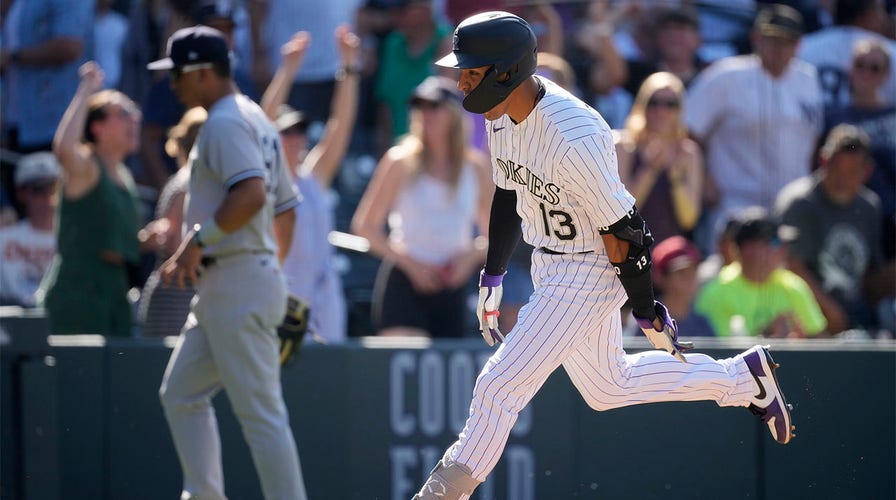
On Friday night, in the top of the 1st inning, Aaron Judge singled, and Paul Goldschmidt tripled him home. Judge hit a home run in the top of the 5th.

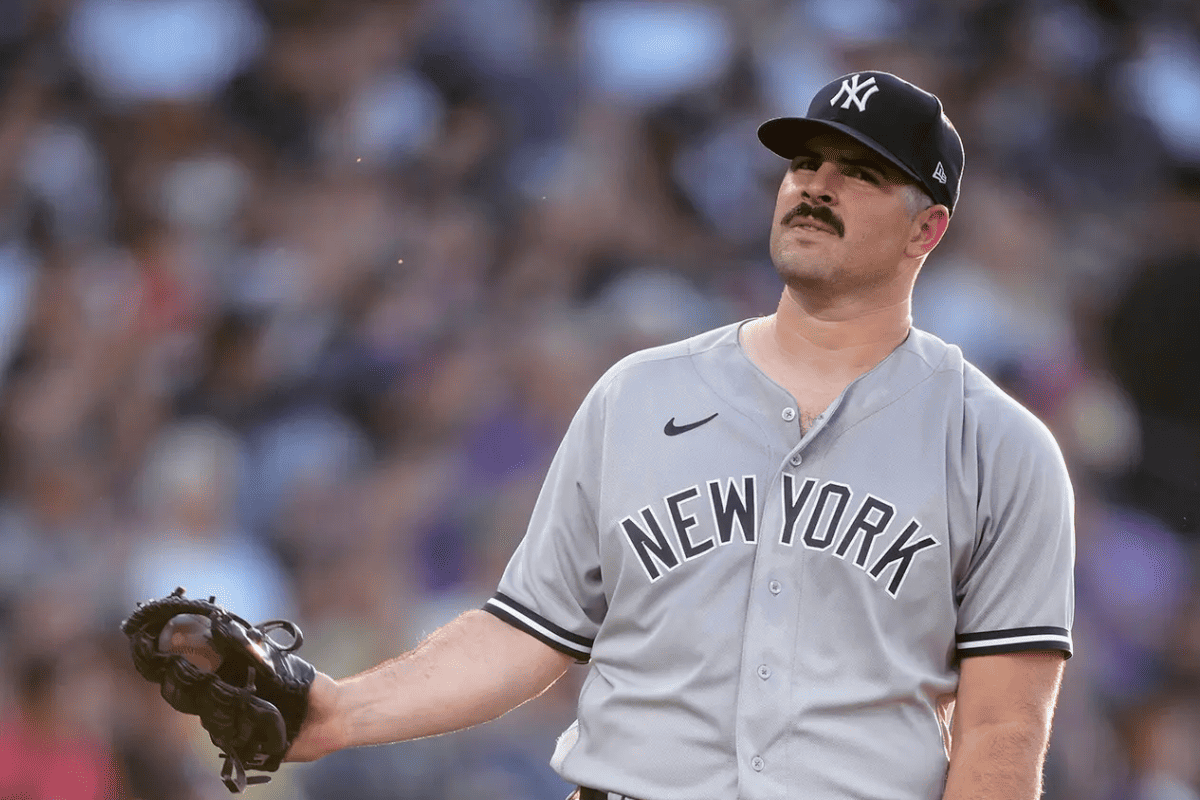
But those 3 runs weren't enough for Clarke Schmidt. Cliché Alert: Walks can kill you, especially the leadoff variety. In the bottom of the 4th, he gave up a walk, a wild pitch and a single for a run. He got the 1st 2 outs in the 5th, needing only 1 more out to qualify as the winning pitcher, and gave up 2 singles and a double, and fell behind 3-2.

Judge got 2 hits on the night. The rest of the Yankees combined, 3. Rockies 3, Yankees 2. It was the most embarrassing Yankee loss since... Game 5 of last year's World Series.

*

A response was needed on Saturday afternoon. It came. Judge homered in the 1st. It looked like all Max Fried would need, but not quite: He allowed 1 run in 7 1/3rd innings.

It was in the top of the 5th that the Rockies resembled the team that had lost 42 of its 1st 50 games. Austin Wells hit a leadoff single, Oswald Peraza doubled to score Wells, Goldschmidt drew a walk, Trent Grisham reached on an error to score Peraza, Judge was intentionally walked to load the bases and set up the double play (or the play at any base), Cody Bellinger hit a sacrifice fly to score Goldschmidt, Anthony Volpe singled home Grisham, Jasson Domínguez hit a sacrifice fly to score Judge, DJ LeMahieu singled, Wells doubled home Volpe and LeMahieu, Peraza walked, Goldschmidt singled Wells home, and Grisham doubled Peraza and Goldschmidt home, before Judge struck out to end the carnage. That's 10 runs, 7 hits, 2 walks, and an error. 

The Yankees added 2 more runs in the 8th, to make it 13-1. Too bad they couldn't take 2 of those runs and transfer them to the night before, to make it a 4-3 win. Unfortunately, it doesn't work that way.

*

Will Warren started the Sunday afternoon game. Over the 1st 4 innings, he allowed 2 runs on 2 hits and 2 walks, striking out 7. The Yankees gave him a 4-2 lead in the top of the 5th. Then the rain came, and there was a delay of over an hour.

When play resumed, both teams decided not to send their starters back out. Jonathan Loáisiga finished the 5th, but allowed a run in the 6th, and had to be bailed out by Mark Leiter Jr. J.C. Escarra came up with his 2nd RBI hit of the game in the top of the 8th, to make it 5-3. Devin Williams was a little shay in the bottom of the 8th.

Luke Weaver ran into trouble in the bottom of the 9th. He allowed a leadoff homer, got the 1st out, and allowed 2 more singles, before getting the last 2 outs. Yankees 5, Rockies 4.

*

So the Yankees took 2 out of 3 in Denver, but it shouldn't have been that hard. But then, as John Sterling said on the air until he retired last season, "You just can't predict baseball." That is, sometimes you can, but, often, you can't.

At any rate, the Yankees lead the American League Eastern Division by 6 games over the Tampa Bay Rays, 6 1/2 over the Boston Red Sox, 7 over the Toronto Blue Jays, and 14 over the Baltimore Orioles.

Today is Memorial Day, and, instead of a traditional afternoon doubleheader, they play at night, starting a series against the Los Angeles Angels, at Angel Stadium of Anaheim.

Monday, March 4, 2024

MLB Ballpark Corporate Names, Ranked

This is a ranking of the teams in Major League Baseball based not on how much I like the team, but on how much I like the product that holds their ballpark's naming rights.

I'm not doing this for the other sports, simply because there are too many of them with companies that I know too little about.

30. Colorado Rockies, Coors Field: I don't like Coors beer. Worse still, the Coors family have long been heavy donors to right-wing extremist causes. To Hell with them and their barley-flavored water.

Note: The first time I tried to type that, it came out "Coors Light is barely-flavored water." I decided not to edit it, because it was still true.

29. Boston Red Sox, Fenway Park: The old yard is named for its section of Boston, The Fenway, or The Fens. Fens are a swampy area. The Meadowlands Sports Complex was built on a former swamp, too, but they didn't keep that in the name. The Red Sox did. And it's one of the less disgusting things about them.

28. Los Angeles Dodgers, Dodger Stadium: The Dodgers no longer represent Brooklyn, or Ebbets Field, or Jackie Robinson. At this point, they no longer even represent Sandy Koufax or Fernando Valenzuela. But the fact that this stadium still stands, on land taken from its residents by the City of Los Angeles, and given to Walter O'Malley, just so he could make more money than he was making in Brooklyn, makes it, and what its name represents, despicable.

27. Pittsburgh Pirates, PNC Park: The city and the ballpark are terrific. Not the name: I have had a lot of difficulty with PNC Bank, and its initials are said to stand for "People Never Count."

26. Oakland Athletics, Oakland Coliseum. After going through a few corporate names, the most-mocked stadium in baseball is once again identified by its city, which, within the last 5 years, has already lost the Warriors to nearby San Francisco, and the Raiders to not-even-close Las Vegas, and may be about to lose the A's to Vegas as well. Maybe that shows that the City of Oakland, and/or the County of Alameda, have better priorities. Or maybe it shows that they can't get their act together.

25. San Diego Padres, Petco Park: I don't have a problem with Petco as a company, but I can't stand the smell of pet stores. It's not the pets, it's the pet food. And the fishtanks smell terrible, too.

24. Milwaukee Brewers, American Family Field: American Family is an insurance company, and I have no familiarity with it. Had they kept their previous name, Miller Park, it would be higher, because Miller Lite is one of the few beers that I actually like.

23. Cincinnati Reds, Great American Ball Park: Great American is an insurance company, and I have no familiarity with it.

22. Cleveland Indians, Progressive Field: Progressive is an insurance company, and I have no familiarity with it, beyond enjoying their TV commercials.

21. Seattle Mariners, T-Mobile Park: I've heard that T-Mobile is rather unreliable. Catherine Zeta-Jones, whom regular readers of this blog know that I love, used to do commercials for them, but that was years ago.

20. Miami Marlins, LoanDepot Park: I've never had any reason to use a mortgage company, but having "loan" in the name makes me suspicious.

19. Chicago White Sox, Guaranteed Rate Field: I've never had any reason to use a mortgage company.

18. Toronto Blue Jays, Rogers Centre: Rogers Communications is a Canadian media corporation, which also has its name on the arenas of the NHL's Vancouver Canucks and Edmonton Oilers, and seems to find nothing confusing in that. None of their networks are available on my cable TV system.

17. Atlanta Braves, Truist Park: I have never had any dealings with Truist Bank, not even one of their ATMs.

16. Detroit Tigers, Comerica Park: See the previous answer. Detroit ranks ahead of Atlanta because I like it better as a city.

15. San Francisco Giants, Oracle Park: As far as I know, I have never had to use Oracle software.

14. Kansas City Royals, Kauffman Stadium: The ballpark is named for the founding owners of the team, pharmaceutical magnate Ewing Kauffman and his wife Muriel. They restored the city's baseball respectability after the Charlie Finley-led Kansas City Athletics years, and I have no reason not to like them, other than that I hated their team in the George Brett years of 1976 to 1985.

13. New York Mets, Citi Field: As banks go, Citi is not well-liked, due to their role in the 2008 economic crash. I've personally never had a problem with them, and have used their ATMs without trouble.

12. Chicago Cubs, Wrigley Field: I haven't chewed any brand of Wrigley's gum in many years, but I have no ill will against the company.

11. Philadelphia Phillies, Citizens Bank Park: As banks go, Citizens is pretty good. My only dealing with them has been through their ATMs, which operate well.

10. Arizona Diamondbacks, Chase Field: As banks go, Chase is among the most trustworthy.

9. Houston Astros, Minute Maid Park: Minute Maid makes good orange juice, but they're owned by Coca-Cola, which I don't like.

Once, the Yankees were playing the Astros, and broadcast John Sterling turned to partner Charley Steiner, and said, "You know Charley, I hear, at Minute Maid Park, the balls are juiced." Steiner didn't miss a beat, or maybe they planned it out beforehand, because he immediately said, "Ah, that's just pulp fiction."

8. Los Angeles Angels, Angel Stadium of Anaheim: Although the Orioles as a team have given me trouble, I have no reason to actively dislike them now.

7. Baltimore Orioles, Oriole Park at Camden Yards: Although the Orioles as a team have given me trouble, the organization has usually been a class act.

6. St. Louis Cardinals, Busch Stadium: Anheuser-Busch is one of the best companies to work for in America. Their give their employees terrific benefits. I don't like Budweiser, or Bud Light, but I do like Michelob.

5. Texas Rangers, Globe Life Field: Globe Life insurance has proven to be trustworthy for my family.

4. Minnesota Twins, Target Field: Target is a good store, especially now that they have Starbucks stands.

3. Washington Nationals, Nationals Park: The Nationals have a class organization that restored baseball to the nation's capital, and they certainly can't be blamed for MLB removing the Expos from Montreal. I will always be grateful to them for 2 reasons, both connected with the 2019 World Series: Their fans booing Donald Trump in Game 5, and beating the cheating Astros in Game 7.

2. Tampa Bay Rays, Tropicana Field: The worst stadium in MLB, but good products. I practically grew up on Tropicana orange juice.

1. New York Yankees, Yankee Stadium: And, of course, Yankee Stadium is also a powerful brand.

Monday, July 17, 2023

The Yankees Grind My Gears

Over their last 180 games, the Yankees are. Barely more than a .500 team. 91-89.

I can hear Aaron Boone now: "But they're grinding! They're savages in that box! They're not far away!"

Sorry, I forgot to say "Cliché Alert."

Hearing Boone say they're "grinding" makes me think of coffee. Actually watching them makes me want a stronger drink.

Gerrit Cole started the finale of their series away to the Colorado Rockies, and went 6 innings, allowing 1 run on 2 hits and 1 walk, striking out 11. But in so doing, he threw 102 pitches, and Aaron Boone didn't have the guts to break Brian Cashman's rule and leave him in there longer. Thus did the bullpen musical chairs begin.

The Yankees led 3-1 when he left, and Wandy Peralta pitched a perfect 7th inning. But Boone didn't leave him in, either, bringing Tommy Kahnle in to pitch the 8th, and he loaded the bases. Boone brought Clay Holmes in, and he gave up a grand slam. It was 5-3 Rockies.

A 9th-inning comeback was necessary. Billy McKinney led off by being hit by a pitch. That would be a dumb thing for a pitcher to do to start an inning, but the pitcher was Daniel Bard, who used to pitch for the Red Sox, so you never know. Gleyber Torres grounded to 3rd, but Rockies 3rd baseman Ryan McMahon threw the ball away. McKinney came all the way around to score, and Torres wound up on 2nd. 5-4.

Giancarlo Stanton flew out, advancing Torres to 3rd. Anthony Rizzo drew a walk. Oswald Peraza was sent in to pinch-run for Rizzo. Boone put the delayed double steal on: Peraza stole 2nd, but the Rockies didn't take the bait, and Torres had to stay put. DJ LeMahieu was intentionally walked to set up the double play.

They got it, but not how they intended. Harrison Bader hit a line shot to left. It was caught, but Torres was able to score. And then Peraza was thrown out at 3rd. Unwritten Rule of Baseball: Never make the 1st or last out of an inning at 3rd base. Corollary question: Why make any out at any base?

At any rate, the game was tied, and Ian Hamilton pitched a scoreless 9th. Extra innings. Neither team could score in the 10th. In the top of the 11th, Oswaldo Cabrera singled home ghost runner Anthony Volpe. One thing led to another, and Peraza, who had stayed in the game, singled home a run. It was 7-5 Yankees. All they had to do in the bottom of the 11th was get 3 outs without allowing more than 1 run.

Boone brought Nick Ramirez in to pitch. This was a stupid thing to do. He gave up a leadoff home run to Nolan Jones. With the ghost runner, this meant tie ballgame. Then he got 2 outs, thus pitching to the minimum 3 batters. No reason to bring in another reliever, though. But Boone did, bringing in Ron Marinaccio, and he gave up a walkoff homer to Alan Trejo. It was his 1st homer of the season, and only the 6th of his career.

Rockies 8, Yankees 7. WP: Gavin Hollowell (1-0, his 1st major league win, having made his debut only 2 weeks ago). No save. LP: Marinaccio (4-5).

The Yankees blew a 2-run lead in the 8th, and another in the 11th. "Grinding"? After this game, the only that's grinding is my gears.

Tonight, the Yankees begin a series away to the Los Angeles Angels, featuring Shohei "Not Better Than Babe Ruth" Ohtani and Mike "Not Comparable to Mickey Mantle" Trout. Luis Severino starts against Griffin Canning. Yeah, another one of those families that turned a last name into a first name, making their son's full name sound like the name of a law firm.

Sunday, July 16, 2023

Stanton Homer Backs Schmidt, Yanks Beat Rockies

After starting the 2nd half of the season with a loss away to the Colorado Rockies, the Yankees needed a win, very badly. Not because of anything about the Rockies -- although they did deserve to lose on the basis of those horrid "City Connect" uniforms -- but simply because they needed a win.

Clarke Schmidt started, and, again, pitched decently. He went 6 innings, allowing 2 runs on 3 hits and just 1 walk, striking out 8. Who knows, maybe he's finally filled that "hole in the rotation" himself.

But the pattern this season has been that, when he's pitched well, the Yankees haven't hit well, and vice versa. This time, the Yankees got him the runs he needed. Gleyber Torres led off the game with a triple, and a groundout by Giancarlo Stanton got him home before the Rockies could so much as get an out. But they tied the game in the bottom of the 1st,

But the 2nd inning told the story of the ballgame. The Yankees got a double by DJ LeMahieu, a strikeout from Billy McKinney, a single by Harrison Bader, a walk by Anthony Volpe to load the bases, an RBI sacrifice fly by Kyle Higashioka, an RBI single by Torres, and a 3-run home run by Stanton. That put the Yankees up 6-1.

Stanton allowed a run in the 7th. Wandy Peralta was brought in to finish the inning. Tommy Kahnle allowed a run in the 8th, but Clay Holmes made sure they would get no closer in the 9th.

Yankees 6, Rockies 3. WP: Schmidt (5-6). SV: Holmes (11). LP: Connor Seabold (1-7).

The series concludes this afternoon. Gerrit Cole starts against Chase Anderson.

Saturday, July 15, 2023

Fasten Your Seatbelts

The Yankees began the official, if not numerical, 2nd half of the regular season pretty much the way they played much of the 1st. And now, you're thinking, "Oh boy, here we go again."

Yeah. It was like that.

They began a 3-game Interleague series with the Colorado Rockies at Coors Field in Denver. They started Carlos Rodón, now back from injury, and much-hyped. Austin Gomber started for the Rockies. He came in with an ERA of 6.42.

The result was the opposite of what was being set up. The Yankees started off all right, with Gleyber Torres leading off the game with a single and Giancarlo Stanton hitting a home run. But the rest of the way, the Yankees only got a double (also by Stanton), 3 singles and a walk.

And Rodón didn't waste much time in giving up the lead. After getting the 1st out in the bottom of the 2nd, he gave up walk, single, RBI single, flyout, wild pitch, 2-RBI double, followed by another wild pitch that ended up not meaning anything, because he struck the next batter out, too late.

He gave up a home run to start the bottom of the 4th, and the rest of the game was pretty much a formality. Michael King was shaky in the 6th, and gave up a home run in the 7th. Albert Abreu faced only 4 batters, all in the 8th, but one of them hit a home run.

Rockies 7, Yankees 2. WP: Gomber (8-7). No save. LP: Rodón (0-2).

The series continues tonight. Clarke Schmidt starts against Connor Seabold. To paraphrase Bette Davis, Fasten your seatbelts. It could be another bumpy night.

Saturday, May 14, 2022

How to Be a Met Fan In Colorado -- 2022 Edition

Next Friday, the Mets arrive in Denver to play 3 games against the Colorado Rockies.

Before You Go. Denver is a city of unusual weather, because of its elevation. I still remember that Monday Night Football game in 1984, when the Green Bay Packers, thinking they'd escaped the Wisconsin chill, got surprised by a blizzard when they played the Broncos at Mile High Stadium. On October 15. Check the Denver Post website before you decide to go.

For the moment, they're looking at daytime temperatures in the low 70s on Friday, dropping to the high 50s on Saturday, and the low 60s on Sunday, with nighttime temperatures in the low 40s throughout. Bring a jacket. There's about a 24 percent change of rain on Friday and Sunday, rising to 38 percent on Saturday. In other words, there could be a rain delay, or even a rainout. If Coors Field isn't yet a ballpark you've "checked off your list," maybe you should "Wait till next year."

Denver is in the Mountain Time Zone, so you'll be 2 hours behind New York time. And there's a reason it's called the Mile High City: The elevation means the air will be thinner. Although the Rocky Mountain region is renowned for outdoor recreation, if you're not used to it, try not to exert yourself too much. Cheering at a sporting event shouldn't bother you too much, but even if the weather is good, don't go rock-climbing or any other such activity unless you've done it before and know what you're doing.

Tickets. When the Rockies began play in 1993, there had never been a major league team in the entire Mountain Time Zone, and the Denver Bears and their successors the Denver Zephyrs had been among the best-attended teams in the minor leagues.

That, plus the huge capacity of Mile High Stadium, allowed Colorado fans to set several major league attendance records that are unlikely to be broken in my lifetime, including most fans for an Opening Day game (80,227), most fans for a single regular-season game (same -- the old Yankee Stadium and Cleveland Municipal Stadium had a few bigger crowds for doubleheaders, but the Dodgers didn't top that at the L.A. Coliseum in the regular season), most fans in a single season (4,483,350 in that 1st season of 1993) and most fans per home game (56,094 in the strike-shortened 1994 season).

When Coors Field opened in 1995, with a capacity around 47,000 (now officially 50,398), every game was still sold out, until 1999. The Rockies averaged 37,703, about 78 percent of capacity, in 2019, the last pre-COVID season. So tickets may not be easy to come by.

For tickets that are available, a Rockies game is the most economical in the major leagues: Infield Boxes are $70, Lower Outfield Reserved are $45, Right Field Box are $35, Left Field Reserved are $30, Right Field Mezzanine are $29, Upper Reserved Infield are $25, Upper Right Field Reserved are $19, and the center field "Rockpile" seats -- a holdover from the bleachers of that nickname at Mile High Stadium -- are the cheapest seats in Major League Baseball, just $8. That's right: Eight dollars. For a Major League Baseball game. In the 21st Century.

Getting There. It's 1,779 miles from Times Square in New York to the Denver plaza that contains the State House and the City-County complex, and 1,790 miles from Citi Field to Coors Field. You're probably thinking that you should be flying.

Denver International Airport, like its predecessor Stapleton International Airport (named for 1923-47 Mayor Benjamin F. Stapleton), is a major change-planes-here spot for going to the West Coast and Las Vegas, so there are lots of nonstop flights available. If you play your cards right, you could get in and out for under $500.

Amtrak's Lake Shore Limited leaves Penn Station at 3:40 PM Wednesday, and arrives at Union Station in Chicago at 10:12 AM Central Time on Thursday. The California Zephyr leaves Chicago at 2:00 PM Thursday and arrives at Denver's Union Station at 7:15 AM Mountain Time on Friday. The return trip would leave Denver at 7:10 PM Sunday, arrive in Chicago at 2:50 PM Monday, leave Chicago at 9:30 PM Monday, and get back to New York at 6:42 PM Tuesday. The round-trip fare is a whopping $682, more than flying.

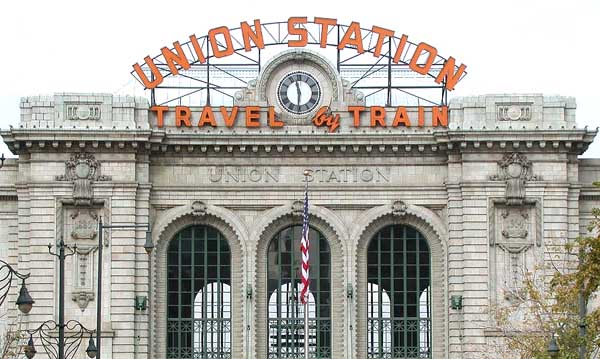
Conveniently, Union Station is at 1700 Wynkoop Street at 17th Street, just 3 blocks from Coors Field. The front of the building is topped by a clock, framed by an old sign saying UNION STATION and TRAVEL by TRAIN.
Greyhound takes about 44 hours to get from Port Authority Bus Terminal to Denver. Round-trip fare is $648,but it can drop to $459 with advanced purchase. The Denver Bus Center is at 1055 19th Street, 5 blocks from Coors Field.

If you actually think it's worth it to drive, get someone to go with you, so you'll have someone to talk to, and one of you can drive while the other sleeps. You'll be taking Interstate 80 most of the way, through New Jersey, Pennsylvania, Ohio, Indiana, Illinois, Iowa and Nebraska, before taking Interstate 76 from Nebraska to Colorado, and then Interstate 25 into Denver. (An alternate route: Take the New Jersey and Pennsylvania Turnpikes to Interstate 70 and then I-70 through Pennsylvania, Ohio, Indiana, Illinois, Missouri, Kansas and Colorado into downtown Denver. It won't save you an appreciable amount of time over the I-80 route, though.)

If you do it right, you should spend about an hour and a half in New Jersey, 5 hours and 15 minutes in Pennsylvania, 4 hours in Ohio, 2 hours and 30 minutes in Indiana, 2 hours and 45 minutes in Illinois, 5 hours and 15 minutes in Iowa, 6 hours in Nebraska, and 3 hours and 15 minutes in Colorado. Including rest stops, and accounting for traffic (you'll be bypassing Cleveland and Chicago, unless that's where you want to make rest stops), we're talking about a 40-hour trip.

Even if you're only going for one game, no matter how you got there, get a hotel and spend a night. You'll be exhausted otherwise. Trust me, I know: Trains and buses are not good ways to get sleep.

Once In the City. Founded in 1858 as a gold rush city, and named for James W. Denver, then Governor of Kansas Territory from which Colorado was separated, Denver is a city of 716,000 people, in a metro area of 3.4 million -- roughly the population of Brooklyn and Staten Island combined. It's easily the biggest city in, and thus the unofficial cultural capital of, the Rocky Mountain region.
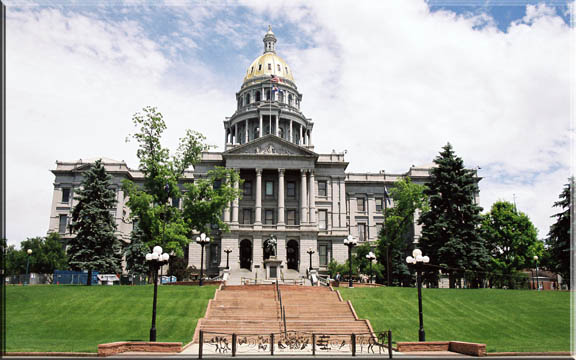
The State House in downtown Denver

Broadway is the main north-south drag, separating East addresses from West. But the northwestern quadrant of the street grid is at roughly a 45-degree angle from the rest of the city, and this area includes the central business district, Union Station and the ballpark.

The sales tax in the State of Colorado is 2.9 percent, however, the City of Denver adds a 3.62 percent sales tax, for a total of 6.52 percent. ZIP Codes in Colorado start with the digits 80 and 81, with the Denver area running from 800 to 810. The Area Code for Denver is 303, with 720 overlaid. Xcel Energy runs the electricity for the Denver area. The city is about 52 percent white, 32 percent Hispanic, 10 percent black, and 3 percent Asian. Colorado is basically two States: "The People's Republic of Boulder," and the far more conservative "East Utah."

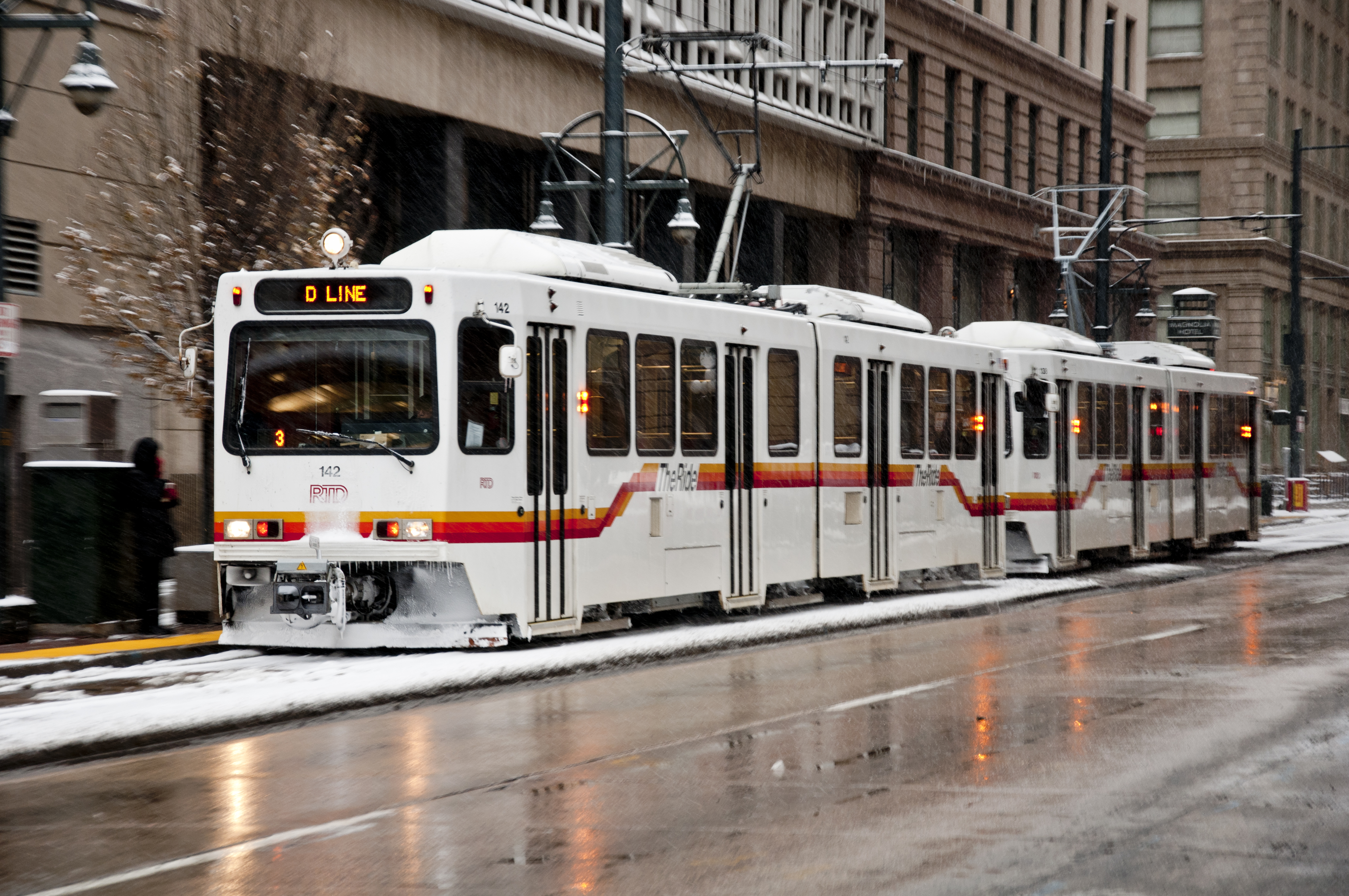
The Denver Post is a good paper, but don't bother looking for the Rocky Mountain News: It went out of business in 2009. State Route 470 serves as Denver's "beltway." Bus and light rail service in Denver is run by the Regional Transportation District (RTD), and goes for $2.25 for a single ride, and $6.75 for a DayPass. Denver switched from tokens to farecards in 2013.
Don't worry, the weather isn't forecast to look like this during your visit.
I chose this picture for the look of the train, not for the snow and wet streets.

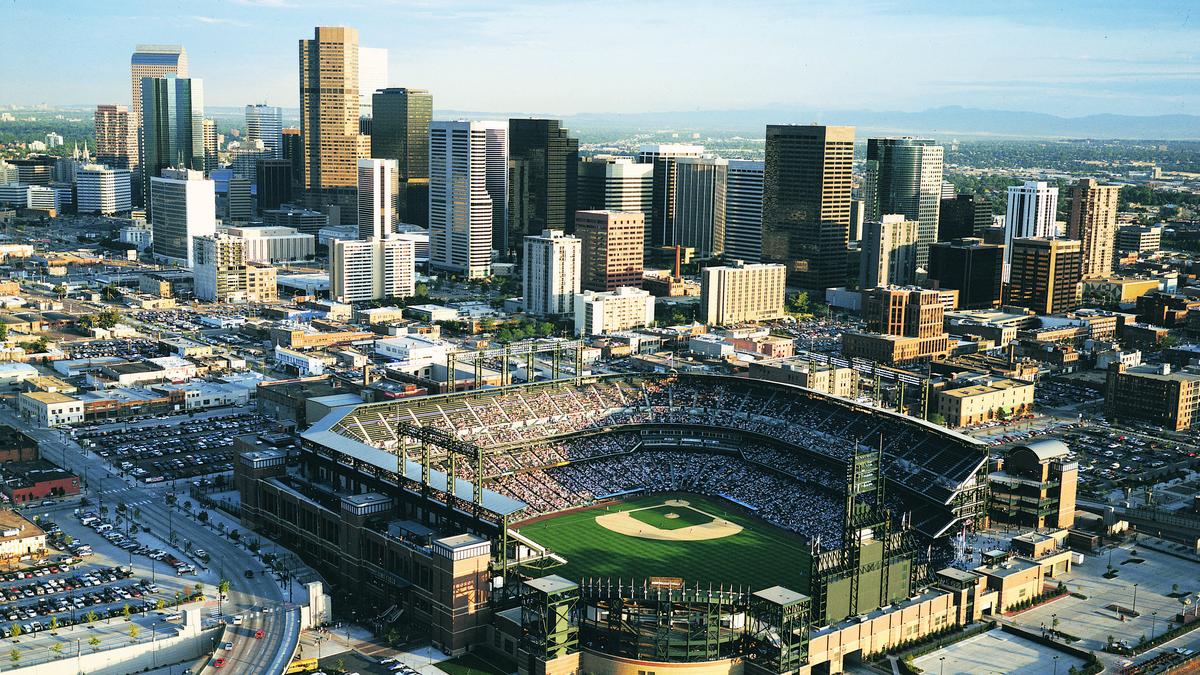
Going In. Coors Field is in the Lower Downtown, or LoDo, section of Denver, a mile and a half northwest of Civic Center Park, the government center which contains the City & County Building and the Colorado State House. The Number 60 bus will get you to within 3 blocks of the ballpark. Denver has a light rail system, RTD, but chances are your hotel will be downtown, and you'd have to change trains at least once, so the 60 bus is the way to go. If you're driving, parking is $13.

The mailing address is 2001 Blake Street. Blake bounds the 1st base side, 20th Street the 3rd base side, 22nd Street the right field stands, and Wewatta Street and the light rail tracks the left field side.
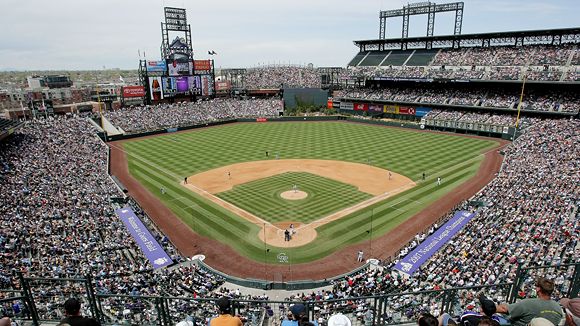
Most likely, you'll enter through the home plate gate, at 20th & Blake (shown above). I like that: All visits to the ballpark should make your first view of the field from behind home plate. This was rarely possible with the old New York ballparks: The stadiums pointed east, and both subway exits put you at the right field corner (if you entered Yankee Stadium from the 157th Street plaza, or the left field corner if you came down 161st Street). In the case of Coors, it's just more convenient.
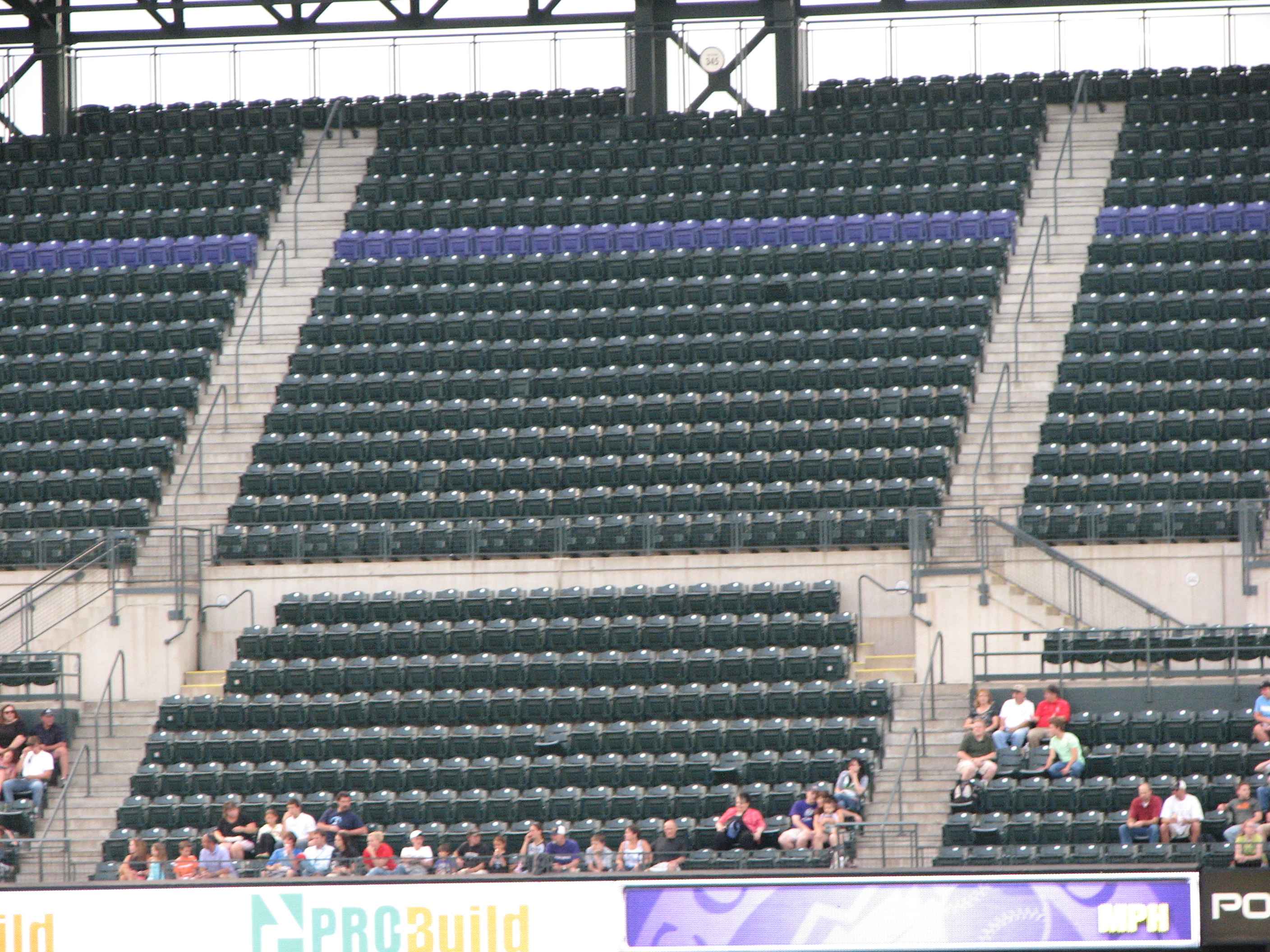
The field is natural grass, and points due north. The home plate from Mile High Stadium was moved to Coors Field in 1994-95. Outfield distances are 347 feet to left field, 390 to left-center, 415 to center, 375 to right-center, and 350 to right. Why so far? To counteract the easy home runs that were hit at Mile High, due to the thin mountain air. A line of purple seats, 6 rows from the top of the upper deck, shows the exact point at which the elevation of the park is 5,280 feet above sea level, making it "a mile high."
After years of opposing teams complaining that the highest elevation in MLB history resulting in too many home runs, prior to the 2002 season the team ordered a study to determine if the elevation was the cause. As it turned out, the study suggested it was not thin air, but dry air that was doing it.

So a giant humidor – a room-sized version of the kind of box where a smoker would store his cigars – was put into the ballpark, and the baseballs were stored there. As a result, the ball is no longer going as far as it once did, although the thin air does make it go farther than at most ballparks. The thin air also makes curveballs curve less, which means it's still not a good park for pitchers. Nevertheless, the team's pitching staff can no longer be called, as it once was, "the Rocky Horror Pitching Show." The longest home run was by Giancarlo Stanton, a 504-foot shot on August 6, 2016. (UPDATE: C.J. Chron tied that mark on September 9, 2022.)
In February 2016, Coors Field hosted 2 hockey games. The University of Denver beat arch-rival Colorado College 4-1 in a game billed as the Battle On Blake. And as part of the NHL Stadium Series, the Colorado Avalanche hosted the Detroit Red Wings, perhaps perversely celebrating the 20th Anniversary of the birth of their brief but nasty rivalry. The Wings won 5-3.

Food. Being a "Wild West" city, you might expect Denver to have Western-themed stands with "real American food" at its ballpark. Being in a State with a Spanish name, in a land that used to belong to Mexico, you might also expect to have Mexican food. And you would be right on both counts.

A stand called Buckaroos is at Section 148, Burritos is at 134, the Helton Burger Shack (named for Rockies star Todd Helton) at 153, a full-service bar called the Camarena Loft behind 201, another called Margaritas at 330, 3 Monster Nacho stands, and, for club-seaters, the Mountain Ranch Club Bar.

There's also stands with baseball-themed names, including several Fan Fare stands, Fair Territory in 106, and Yard Ball Yogurt at 330. There's a Starbucks-type place called Madeline's at 151, a pair of sandwich bars called the Club Carvery behind 219 and 238, a coffee bar call Java City at 223, a Chinese-themed Wok in the Park at 150, and a Blue Moon Brewing Co. outlet at 111. The Rooftop at Coors Field has, according to a recent Thrillist article on the best food at each major-league ballpark, the best item at Coors Field: The CHUBurger, made by Colorado brewer Oskar Blues.

Buckaroos has "Dinger Nuggets," which I'm hoping is standard chicken nuggets, not dinosaur meat. (I'll get to that in "During the Game.")

Team History Displays. The Rockies' history is short. They have made the Playoffs 5 times (in 1995, 2007, 2009, 2017 and 2018, all through the National League Wild Card, they haven't yet won the Western Division in the regular season), have won just 1 Pennant (2007), and have won a grand total of zero World Series games.

The Rockies have retired the Number 17 of 1997-2013 1st baseman Todd Helton, and the 33 of 1995-2004 right fielder Larry Walker, as well as the universally-retired 42 for Jackie Robinson. Walker is their 1st member of the Baseball Hall of Fame.

Those numbers are on the outfield wall, as is the 2007 Pennant, and also a display reading "KSM," for Keli Scott McGregor. McGregor was a native of the Denver suburbs who played for Colorado State, and then briefly with the Broncos in 1985. He joined the Rockies' front office in the Autumn of 1993, after the 1st season, and was team president from 2001 until 2010, when he died of an undetected heart virus at age 47.
The 1995 NL Wild Card banner used to be on the wall, but once a Pennant was won, it seemed a bit silly. (Nevertheless, the Mets still have that 1999 Wild-Card display on the third-base facing of Citi Field, along with their 2 World Championship, 3 other Pennant, and 2006 NL East stanchions.)

No Rockies players were named to The Sporting News' 100 Greatest Players in 1999. In 2006, Walker won the Rockies' edition of the DHL Hometown Heroes contest. In 2022, ESPN named its 100 Greatest Baseball Players. None of the selections played significant time for the Rockies.

There are 8 men with Rockies connections in the Colorado Sports Hall of Fame, whose display is at the new Broncos' stadium: Helton, Walker, McGregor, 1993-2005 (original) owner Jerry McMorris, 1993-98 (original) manager Don Baylor, 1993-97 1st baseman Andrés Galarraga, 1993-99 left fielder Dante Bichette, and 1993-99 3rd baseman Vinny Castilla.

There is no mention, anywhere in the stadium, of the Pennants won by the Rockies' minor-league predecessors: The 1900, 1911 and 1912 Denver Grizzlies; the 1913, 1952, 1957, 1971, 1976, 1977, 1981 and 1983 Denver Bears; and the 1991 Denver Zephyrs.

Stuff. Coors Field has the Majestic Team Store behind Section 149, in the left-field corner. I don't know if the Rockies gear they sell includes cowboy hats with team logos on them, to tie in with the State's Western heritage. In addition, there are 7 Rockies Dugout Stores throughout Colorado, including 1 in Denver at 535 16th Street.

Don't look for old Rockies videos on DVD – there aren't any. Unless you want to find the official highlight film of the 2007 World Series, in which the Rockies got swept by the Boston Red Sox. You'd think that, having won 14 of their last 15 regular-season games, making it 21 out of 22 counting the Playoffs, winning their 1st-ever Pennant, and setting a major league record for highest team fielding percentage (.989), there would be a commemorative DVD. But there isn't.

There are, however, a few books about the team, including A Magical Season: Colorado's Incredible 2007 Championship Season, by the staff of the Denver Post. With the 25th Anniversary celebration underway, Paul T. Parker and Bill Nowlin of the Post wrote Major League Baseball A Mile High: The First Quarter Century of the Colorado Rockies. You can also pick up Colorado Rockies: The Inaugural Season, by Rich Clarkson, which came out right after that 1993 season ended.

The first-year Rockies probably got more respect than any 67-95 team ever. To compare, the 1969 Seattle Pilots went 64-98. They also played in a stadium that was inappropriate for the major leagues – albeit because it was an expanded 1930s Triple-A park, not a 1940s Triple-A park converted into a 1970s football stadium like Mile High. They got fewer fans in a homestand than the '93 Rox got in their home opener, got moved to Milwaukee right before their second season started, and today are remembered only for being in Jim Bouton's book Ball Four. Even Seattle fans would prefer to believe their major league history started with the Mariners in 1977.

During the Game. A recent Thrillist article ranked Rockies fans 29th among the "most intolerable" fans. More accurately, that makes them the 2nd-most tolerable.

Coloradans love their sports, but they're not known as antagonistic. Although the Jets came within a half of derailing a Bronco Super Bowl in 1999 (at the end of the 1998 season), and the Devils came within a game of short-circuiting their Stanley Cup run in 2001, the people of the Centennial State don't have an ingrained hatred of New Yorkers and New Jerseyans. As long as you don't wear Kansas City Chiefs or Oakland Raiders gear, you'll probably be completely safe. (But, as always, watch out for obnoxious drunks, who know no State Lines.)


25th Anniversary Patch

The Friday night game will feature an as-yet-unspecified promotion from Southwest Airlines. Saturday night will be Military Appreciation Day. The Sunday afternoon game will not feature a promotion.

The Rockies hold auditions for National Anthem singers, as opposed to having a regular, but they give priority to groups, even letting their Group Sales department handle applications.

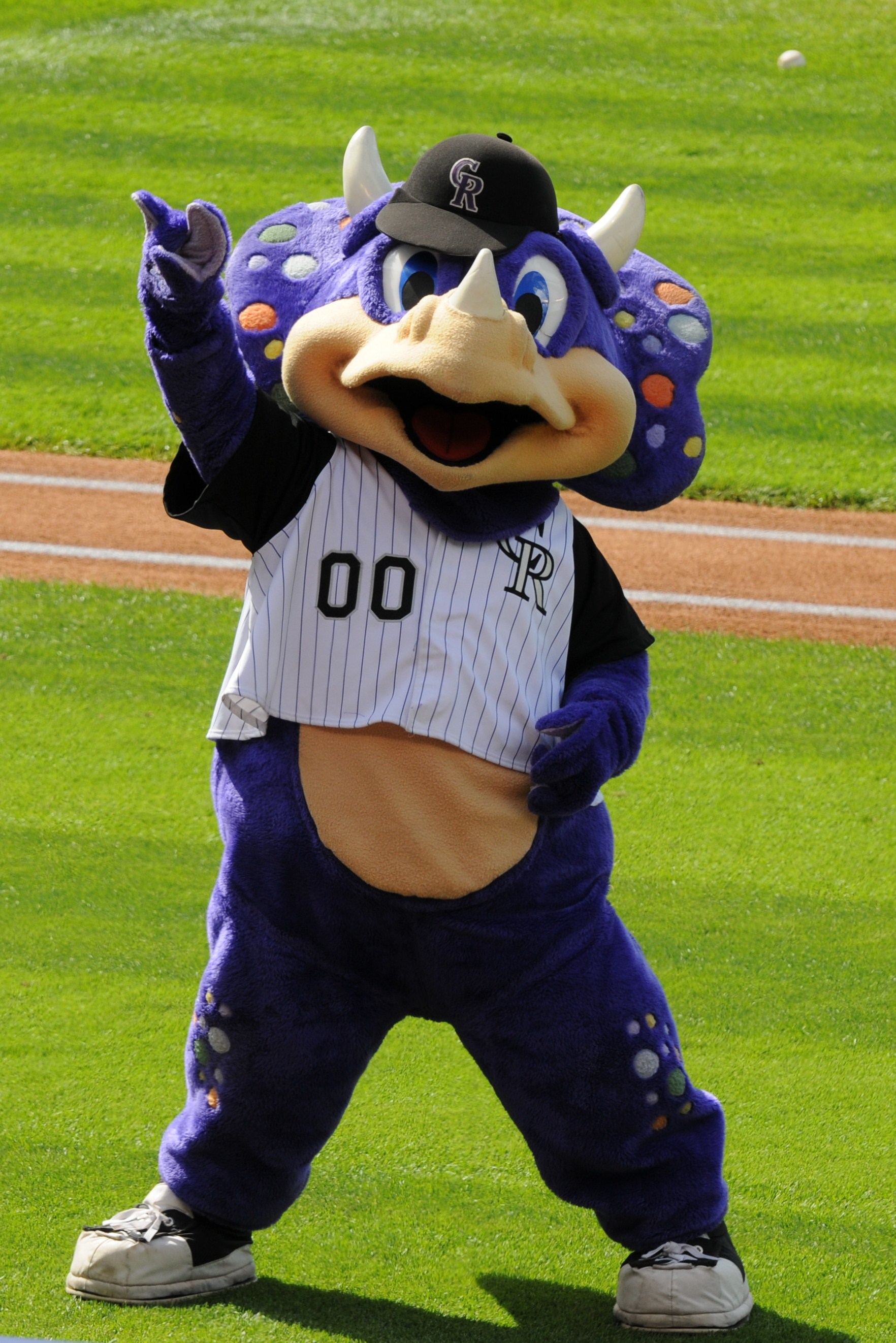
When construction workers were excavating to build Coors Field, they found dinosaur bones. So the Rockies' mascot was made a dinosaur. In honor of the thin air's propensity for allowing home runs, the mascot was named Dinger the Dinosaur. Great idea, right? Well, a Tyrannosaurus Rex (or even a "Tyrannosaurus Rox") would probably scare kids, so Dinger is a purple triceratops, wearing a Rockies jersey, Number 00. Think of him as Barney's cousin from the weird side of the family.
The Rockies play Bruce Channel's song "Hey! Baby" after "Take Me Out to the Ball Game" during the 7th inning stretch. Why? I have no idea. Channel isn't from Colorado, or any other Rocky Mountain State (he's from Texas). Why not a Colorado singer's song? You got me.

I guess "Rocky Mountain High" – whose singer used the stage name John Denver, for crying out loud – isn't particularly rousing. And his "Thank God I'm a Country Boy" was already the 7th inning stretch song for the Baltimore Orioles. Also not especially crowd-cranking is "How to Save a Life" by The Fray, who, unlike John, are from Denver. Sometimes the Rockies play "Get Free" by the Australian rock band The Vines.

Their postgame victory song used to be "Rocky Mountain Way" by Joe Walsh of The Eagles, but it's been replaced by "Take the Field," as recorded by the Colorado Symphony.

After the Game. Denver has had crime issues, and just 3 blocks from Coors Field is Larimer Street, immortalized as a dingy, bohemian-tinged, hobo-strewn street in Jack Kerouac's novel On the Road. But that scene was written in 1947, and LoDo has become, with the building of Coors Field and the revitalization of Union Station, a sort of mountain Wrigleyville. So you'll probably be safe.

LoDo is loaded with bars that will be open after the game, including Scruffy Murphy's at Larimer & 20th. But the only baseball-named place I can find anywhere near Coors is Sandlot Brewery, at 22nd & Blake, outside the park's right-field corner. Behind home plate, at 1930 Blake Street, is The Sports Column, hailed by a recent Thrillist article as the best sports bar in the State of Colorado. However, like most of their outlets, the Denver version of Fado Irish Pub chain, at Wynkoop & 19th, went out of business due to COVID. 

Perhaps the most famous sports-themed restaurant in Denver is Elway's Downtown, a steakhouse at 1881 Curtis Street. Several downtown buses will place you within a block of it. It's owned by the same guy who owns John Elway Chevrolet in the southern suburb of Englewood.

Tap & Burger Sloan's Lake is said to be a Yankee Fan bar. 1515 N. Raleigh Street, about 2 miles west of downtown. Bus 20. Occidental is the home of the local New York Giants fan club. 1950 W. 32nd Avenue, about a mile north of Ball Arena and Coors Field. Bus 44. Jet fans gather at Chopper's Sports Grill, possibly named for Chopper Travaglini, at 80 S. Madison Street at Bayaud Avenue, 3 miles southeast of downtown, in the Pulaski Park neighborhood. Bus 83, then a mile's walk.

If your visit to Denver is during the European soccer season (which is now in progress), your best bet for watching your favorite club is at The British Bulldog, 2052 Stout Street, just north of Downtown. The previous best choice, The Three Lions at 2239 E. Colfax Avenue, recently closed.

Sidelights. On November 30, 2018, Thrillist published a list of "America's 25 Most Fun Cities," and Denver came in 13th. On February 12, 2019, they published an article calling Denver "America's Must-Visit City for 2019."

Denver is a fantastic city, and a good sports city, with much to look for. On February 3, 2017, Thrillist made a list ranking the 30 NFL cities (New York and Los Angeles each having 2 teams), and Denver came in 8th, in the top 1/3rd. They said:

Ah, Denver! Breathe in that fresh mountain air with just a hint of cannabis and green chile. Drink in the hoppy splendor of a craft beer scene that was bustling back when everyone still called them "microbreweries." Tolerate the alarmingly in-shape bro who stuck around after four years at Boulder to work as a part-time ski instructor and won't stop talking to you about fourteeners. Denver often gets championed for all the fantastic stuff to do right outside the city, what with the skiing and the hiking and the Red Rocks, but that does a disservice to all the good times to be had in Denver proper. The fact that said times can be had with herbal enhancement with nary a legal concern is just a bonus. 

Empower Field at Mile High, formerly Invesco Field at Mile High, has been the home of the NFL's Denver Broncos since 2001. Everyone just gives it the same name as the old facility: "Mile High Stadium." It includes the Colorado Sports Hall of Fame, and the Broncos' Ring of Fame.

It was built on the site of the McNichols Sports Arena, home to the NBA's Denver Nuggets from 1975 to 1999, the NHL's Colorado Avalanche from 1995 to 1999, and the first major league team called the Colorado Rockies, the NHL team that became the Devils, from 1976 to 1982. The Denver Dynamite played there from 1987 to 1991, made the Arena Football League Playoffs every season, and won the 1st ArenaBowl in 1987. But the cost of running the team was too high, and it folded.

It hosted the NCAA Final Four in 1990, with UNLV (the University of Nevada at Las Vegas) clobbering Duke. (The University of Colorado, in Boulder, made the Final Four in 1942 and 1955, although it wasn't yet called the Final Four.  No other Colorado-based school has made it, and none has won a National Championship -- not in basketball, anyway.)

When the time came to play the final concert at McNichols, the act that played the first concert there was brought back: ZZ Top. This fact was mentioned on a Monday Night Football broadcast, leading Dan Dierdorf to note the alphabetic distinction of the long red-bearded men, and say, "The first one should have been ABBA." Which would have been possible, as they were nearly big in the U.S. at the time. However, the fact that the arena only lasted 24 years, making it not that hard for the act that played the first concert there to also play the last, says something about America's disposable culture.

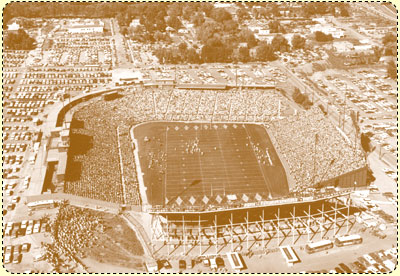
The old stadium was just to the north of the new stadium/old arena. The current address is Mile High Stadium Circle, but the old intersection was W. 20th Avenue & Bryant St. (2755 W. 17th Avenue was the mailing address.) It was built in 1948 as Bears Stadium, an 18,000-seat ballpark.
When the American Football League was founded in 1960, it was expanded to 34,000 seats with the addition of outfield seating. The name was changed to Mile High Stadium in 1966, and by 1968 much of the stadium was triple-decked and seated 51,706.
In 1977 – just in time for the Broncos to make their first Super Bowl run and start "Broncomania" – the former baseball park was transformed into a 76,273-seat horseshoe, whose east stands could be moved in to conform to the shape of a football field, or out to allow enough room for a regulation baseball field. The old-time ballpark had become, by the standards of the time, a modern football stadium.
The biggest complaint when the Rockies arrived in 1993 wasn't the thin air, or the condition of the stadium (despite its age, it was well-maintained, and was not falling apart), but the positioning of the lights: Great for football fans, but terrible for outfielders tracking fly balls. But it was only meant to be a temporary ballpark for the Rockies, as a condition for Denver getting a team was a baseball-only stadium. What really led to the replacement of Mile High Stadium, and its demolition in 2002, was greed: The Broncos' desire for luxury-box revenue.
At Bears/Mile High Stadium, the Broncos won AFC Championships in 1977, 1986, 1987, 1989, 1997 and 1998, winning the Super Bowl in the last 2 years after losing the first 4 in blowouts.  (They've now won an AFC title at the new stadium, but not a Super Bowl.) The Denver Bears won Pennants while playing there in 1957 (as a Yankee farm team), 1971, 1976, 1977, 1981, 1983 and 1991 (winning the last one under the Denver Zephyrs name).

The old stadium also hosted the Denver Gold of the United States Football League, the 1983 USFL Championship Game, the Colorado Caribous of the original North American Soccer League, and the Rapids from their 1996 inception until 2001 -- in fact, they played the stadium's last event, before playing at the new stadium from 2002 to 2006. The U.S. national soccer team played a pair of games at Mile High Stadium in the 1990s, and beat Mexico at the new stadium in 2002 (the only game they've played there so far). It has been selected by the U.S. Soccer Federation as a finalist to be one of the host venues for the 2026 World Cup.

While the 2008 Democratic Convention was held at the Pepsi Center, Senator Barack Obama gave his nomination acceptance speech outdoors in front of 80,000 people at New Mile High Stadium.

The Red Lion Hotel Denver and the Skybox Grill & Sports Bar are now on the site of the old stadium. At McNichols, the Nuggets reached the ABA Finals in 1976, and the Avalanche won the 1996 Stanley Cup (albeit clinching in Miami). The Denver Dynamite won the 1st ArenaBowl in 1987, and again in 1989, 1990 and 1991, before finances forced them to fold anyway. Elvis Presley sang at McNichols on April 23, 1976.

The complex that included Mile High Stadium and the McNichols Arena was supposed to be the centerpiece of the 1976 Winter Olympics. But in a 1972 referendum, Colorado voters rejected funding that would have built more facilities, and, in what remains the only example of this ever happening, Winter or Summer, a city withdrew as host for an Olympic Games. They were awarded, instead, to Innsbruck, Austria, which already had the facilities in place from hosting them in 1964.

The new stadium, and the site of the old stadium and arena, are at Mile High Station on the light rail C-Line and E-Line.

The Nuggets, known as the Denver Rockets until 1974, played at the Denver Auditorium Arena, at 13th & Champa Streets, from their 1967 inception until McNichols opened in 1975. It was also the home of the original Nuggets, who played in various leagues from 1935 to 1948, and then in the NBA until 1950.

It opened in 1908, and its seating capacity of 12,500 made it the 2nd-largest in the country at the time, behind the version of Madison Square Garden then standing. It almost immediately hosted the Democratic National Convention that nominated William Jennings Bryan for President for the 3rd time – although it's probably just a coincidence that the Democrats waited exactly 100 years (give or take a few weeks) to go back (it's not like Obama didn't want to get it right the 1st time, as opposed 0-for-3 Bryan).

The Auditorium Arena hosted Led Zeppelin's 1st American concert on December 26, 1968. It was demolished in 1990 to make way for the Denver Performing Arts Complex, a.k.a. the Denver Center. Theatre District/Convention Center Station on the light rail's D-Line, F-Line and H-Line.

The Ball Arena, known as the Pepsi Center from its 1999 opening until 2020, is across Cherry Creek from downtown, about 2 miles northwest of City Hall. The intersection is 11th Street & Auraria Parkway, but the mailing address is 1000 Chopper Circle, in honor of Robert "Chopper" Travaglini, the beloved former trainer (and amateur sports psychologist) of the Nuggets, who share the arena with the NHL's Colorado Avalanche. It is 1 of 10 current arenas that is home to both an NBA team and an NHL team.

Chopper was actually a Jersey Boy, albeit from Woodbury on the Philly side. He died in 1999, age 77, right before the new arena opened. Chopper Circle is an extension of Wewatta Street.

Pepsi Center/Elitch Gardens station on the RTD light rail. If you're coming in that way, you'll probably enter from the west gate, the Grand Atrium. If you're driving, parking starts at just $5.00. The rink is laid out east-to-west, and the Avs attack twice toward the east end.

In addition to hosting the Avs and the Nugs, the Pepsi Center has also hosted NCAA Tournament basketball games, the 2008 edition of NCAA's hockey "Frozen Four," and the 2008 Democratic National Convention.

The Denver area's Major League Soccer team, the Colorado Rapids, plays at Dick's Sporting Goods Park in Commerce City, about 8 miles northeast of downtown. They'e won the MLS Cup since moving there, in 2010.

The U.S. national team has played there 3 times: A 2-0 win over Guatemala in a World Cup Qualifier on November 19, 2008; a 1-0 win over Costa Rica in a World Cup Qualifier on March 22, 2013 (the famous Snow Classico); and a 2-0 win over Trinidad & Tobago in a World Cup Qualifier this past June 8. The women's team has played there twice: A 2008 win over Brazil, and a 2012 win over Australia. It's also hosted football, rugby, lacrosse and concerts.

6000 Victory Way. If you're going in by public transportation from downtown Denver, Number 48 bus to 60th Avenue & Dahlia Street, then Number 88 bus to 60th & Monaco. Then they make you walk 10 blocks on 60th to get to the stadium.

The Beatles played Red Rocks Amphitheatre in suburban Morrison on August 26, 1964. It is still in business, and a Colorado Music Hall of Fame is a short walk away. 18300 W. Alameda Parkway, 10 miles west of downtown. Sorry, no public transportation.

Elvis played 2 shows at the Denver Coliseum on April 8, 1956, and 1 each on November 17, 1970 and April 30, 1973. Built in 1951, it still stands, seating 10,500, and is best known for concerts and the National Western Stock Rodeo. 4600 Humbolt Street at E. 46th Avenue, off Interstate 70, 3 miles northeast of downtown. Apparently, no public transportation to there, either.

On June 5, 1897, the Heavyweight Championship of the World was contested in Colorado. The British-born Champion, Bob Fitzsimmons – supposedly, in response to being told he was too small to fight heavyweights, the originator of the saying, "The bigger they are, the harder they fall" – knocked Lew Joslin out in the 2nd round. The fight happened in Leadville, 100 miles southwest of Denver.

Theoretically, it is possible to get there via public transportation. You'd have to take Greyhound from Denver to Vail, and then a local bus for over an hour to Leadville. And I can't find a source that lists the name of the fight's venue, or its address. So, unless you're a fanatic about boxing history and have to see the sites of every heavyweight title fight, I'd say skip this one.

Denver has some renowned museums, including the Denver Museum of Nature & Science (their version of the Museum of Natural History) at 2001 Colorado Blvd. at Montview Blvd. (in City Park, Number 20 bus), and the Denver Art Museum (their version of the Metropolitan Museum of Natural History), at 100 W. 14th Avenue Parkway at Colfax Avenue (across I-25 from Mile High Stadium, Auraria West station on the C-Line and E-Line).

Denver's history only goes back to a gold rush in 1859 – not to be confused with the 1849 one that turned San Francisco from a Spanish Catholic mission into the first modern city in the American West. The city isn't exactly loaded with history.

There's no Presidential Library – although Mamie Doud, the eventual Mrs. Dwight D. Eisenhower, grew up there, and her house is now a historic site. Mamie and "Ike" were married there, their son John (a future General, Ambassador and military historian) was born there, and the Eisenhowers were staying there when Ike had his heart attack in 1955. The house is still in private ownership, and is not open to the public. However, if you're a history buff, or if you just like Ike, and want to see it, it's at 750 Lafayette Street, at 8th Avenue. The Number 6 bus will get you to 6th & Lafayette.

After his heart attack, Ike was treated at Fitzsimmons Army Medical Center in nearby Aurora, 12 years after Senator John Kerry, nearly elected President in 2004 and now Secretary of State, was born there. It's not a Presidential Birthplace, because Kerry narrowly lost. It is now the University of Colorado Hospital. The Fitzsimmons Golf Course is across Montview Boulevard – it figures that Ike would be hospitalized next to a golf course! 16th Avenue & Quentin Street. Number 20 bus from downtown.

The University of Denver's Newman Center for the Performing Arts hosted a 2012 Presidential Debate between Barack Obama and Mitt Romney. 2344 East Iliff Avenue, about 5 miles south of downtown. The University's Magness Arena hosted the Frozen Four in 1961, 1964 and 1976. 2250 E. Jewell Avenue. Both can be reached via H Line light rail to University of Denver Station.

Byron "Whizzer" White was a star football and basketball player at the University of Colorado in the late 1930s, a Rhodes scholar, a running back for the Pittsburgh Steelers and the Detroit Lions, a Bronze Star-winning Navy officer in World War II, one of Colorado's finest lawyers, the chairman of John F. Kennedy's Presidential campaign in the State, and one of the longest-serving Justices on the U.S. Supreme Court. He is buried at the Cathedral of St. John in the Wilderness, 1350 N. Washington Street at 14th Avenue. Bus 6.

Denver doesn't have as many tall buildings as the nation's bigger cities, nor are they as interesting, architecturally. The tallest building in the State of Colorado is Republic Plaza, 714 feet high, at 17th Street & Tremont Place downtown. A 1,000-foot, 90-story residential/hotel tower, currently named Six Fifty 17 for its address (650 17th Street), has been proposed by Uruguay-born, New York-based architect Carlos Ott and local real estate firm Greenwich Realty Capital. They hope to break ground on it in Summer of 2018.

The University of Colorado is in Boulder, 30 miles to the northwest. At Market Street Station, 16th & Market, take the BV Bus to the Boulder Transit Center, which is on campus. The ride should take about an hour and 20 minutes. Colorado State University is in Fort Collins, 65 miles up Interstate 25 north, and forget about reaching it by public transportation.

The U.S. Air Force Academy is outside Colorado Springs, 60 miles down I-25. As with Fort Collins, you'd need Greyhound. Unlike CSU, you might not be able to just go there: Some of the area is restricted.  It is, after all, a military base.

Their football facility, Falcon Stadium, hosted an NHL Stadium Series game on February 15, 2020, before COVID shut everything down. The Avalanche hosted, but lost to the Los Angeles Kings, 3-1.

Colorado Springs was also home to the Broadmoor Ice Palace, which hosted what's now called the Frozen Four every year from its inception in 1948 until 1957, and again in 1969. The 3,000-seat arena at The Broadmoor Resort & Spa was home ice to Colorado College from 1938 to 1994. 1 Lake Avenue, across Cheyenne Lake from the main hotel. Its 7,750-seat 1998 replacement, the Broadmoor World Arena, is 4 miles to the east, at 3185 Venetucci Blvd.

A few TV shows have been set in Denver, but you won't find their filming locations there. The old-time Western Whispering Smith and the more recent one Dr. Quinn, Medicine Woman were set in old Colorado (Colorado Springs), but filmed in Southern California. And Greendale, the setting of
Community, is fictional.

Probably the most famous show set in Colorado is South Park, and that's a cartoon, so forget seeing anything from that. Not quite as cartoonish was Mork & Mindy, set in Boulder. The McConnell house actually is in Boulder, at 1619 Pine Street. But don't try to copy the opening-sequence scene with Robin Williams and Pam Dawber on the goalposts at the University of Colorado's Folsom Field. You could fall, and end up saying, "Shazbot!"

The most famous show ever set in Colorado was Dynasty, ABC's Excessive Eighties counterpart to CBS' Dallas, starring John Forsythe as Blake Carrington, an oilman and a thinly-veiled version of Marvin Davis, who nearly bought the Oakland Athletics from Charlie Finley in 1978 with the idea of moving them to Mile High Stadium, but the deal fell through. Right, you don't care about Blake, all you care about is the catfights between the 2nd and 1st Mrs. Carrington's: Krystle (Linda Evans) and Alexis (Joan Collins).

The Carrington mansion seen in the opening credits is in Beverly Hills, but the building that stood in for the headquarters of Denver Carrington is in Denver, at 621 17th Street, while the one that stood in for Colbyco is at 1801 California Street. The show is being rebooted, premiering on The CW Network on October 11. It may take place in Denver, but is being filmed in Atlanta. 

Movies set in Denver or its suburbs include The Unsinkable Molly Brown, the original Red Dawn, and, of course, Things to Do In Denver When You're Dead. Films involving skiing often take place in Colorado towns such as Aspen or Vail. City Slickers, a film with loads of baseball references, has a cattle drive that ends in Colorado, but there's no indication of how close it is to Denver. Flashback
takes place on the Pacific Coast, but Denver's Union Station stands in for a train station in San Francisco.

*

Denver had been considered a potential destination for Major League Baseball many times: The Continental League planned a team for there for 1961, it was a finalist for expansion teams in 1969 and 1977, and, as I said, the A's came within inches of moving there for the 1978 season.

When they finally got a team in 1993, they were embraced as perhaps no expansion team has ever been embraced -- even more than the Mets themselves in 1962. And, the way it's worked out, the Rockies' 1st-ever game was against the Mets (a Met win at Shea), and their 1st game at Coors Field was against the Mets (a Rockies win in 14 innings).

The Rockies have seen the bloom come off the rose, but they've also seen some real success. The experience of Coors Field should be a good one. Have fun! 

Thursday, June 14, 2018

How to Be a Met Fan In Colorado -- 2018 Edition

Next Monday, the Mets arrive in Denver to play the Colorado Rockies.

Before You Go. Denver is a city of unusual weather, because of its elevation. I still remember that Monday Night Football game in 1984, when the Green Bay Packers, thinking they'd escaped the Wisconsin chill, got surprised by a blizzard when they played the Broncos at Mile High Stadium. On October 15. Check the Denver Post website before you decide to go.

For the moment, the projections are not looking good. They're talking high 70s by day, high 50s by night. (I know the joke: "Of course it's 'high,' it's Colorado, the mountains and the legal pot.") But it's also going to be in the middle of a weeklong stretch of "PM thunderstorms." In other words, there could be a rainout. If Coors Field isn't yet a ballpark you've "checked off your list," maybe you should "Wait till next year."

Denver is in the Mountain Time Zone, so you'll be 2 hours behind New York time. And there's a reason it's called the Mile High City: The elevation means the air will be thinner. Although the Rocky Mountain region is renowned for outdoor recreation, if you're not used to it, try not to exert yourself too much. Cheering at a sporting event shouldn't bother you too much, but even if the weather is good, don't go rock-climbing or any other such activity unless you've done it before and know what you're doing.

Tickets. When the Rockies began play in 1993, there had never been a major league team in the entire Mountain Time Zone, and the Denver Bears and their successors the Denver Zephyrs had been among the best-attended teams in the minor leagues.

That, plus the huge capacity of Mile High Stadium, allowed Colorado fans to set several major league attendance records that are unlikely to be broken in my lifetime, including most fans for an Opening Day game (80,227), most fans for a single regular-season game (same -- the old Yankee Stadium and Cleveland Municipal Stadium had a few bigger crowds for doubleheaders, but the Dodgers didn't top that at the L.A. Coliseum in the regular season), most fans in a single season (4,483,350 in that 1st season of 1993) and most fans per home game (56,094 in the strike-shortened 1994 season).

When Coors Field opened in 1995, with a capacity around 47,000 (now officially 50,398), every game was still sold out, until 1999. The Rockies are averaging 35,061 this season, about 1,400 less than last season, but still a good total. So tickets may not be easy to come by.

For tickets that are available, a Rockies game is the most economical in the major leagues: Infield Boxes are $55, Lower Outfield Reserved are $32, Right Field Box are $27, Left Field Reserved are $20, Right Field Mezzanine are $19, Upper Reserved Infield are $17, Upper Right Field Reserved are $16, and the center field "Rockpile" seats -- a holdover from the bleachers of that nickname at Mile High Stadium -- are the cheapest seats in Major League Baseball, just $8. That's right: Eight dollars. For a Major League Baseball game. In the 21st Century.

Getting There. It's 1,779 miles from Times Square in New York to the Denver plaza that contains the State House and the City-County complex, and 1,790 miles from Citi Field to Coors Field. You're probably thinking that you should be flying.

The good news: Denver International Airport, like its predecessor Stapleton International Airport (named for 1923-47 Mayor Benjamin F. Stapleton), is a major change-planes-here spot for going to the West Coast and Las Vegas, so there are lots of nonstop flights available.

The bad news: Ordinarily comparatively cheep, this week, flying to Denver is not. You'be lucky to get in and out for under $1,100.

Amtrak's Lake Shore Limited leaves Penn Station at 3:40 PM Saturday, and arrives at Union Station in Chicago at 9:45 AM Central Time on Sunday. The California Zephyr leaves Chicago at 2:00 PM Sunday and arrives at Denver's Union Station at 7:15 AM Mountain Time on Monday. The return trip would leave Denver at 7:10 PM Thursday, arrive in Chicago at 2:50 PM Friday, leave Chicago at 9:30 PM Friday, and get back to New York at 6:23 PM Saturday. The round-trip fare is a whopping $706.

Conveniently, Union Station is at 1700 Wynkoop Street at 17th Street, just 3 blocks from Coors Field. The front of the building is topped by a clock, framed by an old sign saying UNION STATION and TRAVEL by TRAIN.
Greyhound allows you to leave Port Authority Bus Terminal at 4:00 PM Saturday, and arrive at Denver at 10:50 AM on Monday, a trip of just under 45 hours, without having to change buses. That 44:50 does, however, include layovers of 40 minutes in Philadelphia, an hour and a half in Pittsburgh, an hour in Columbus, an hour in Indianapolis, 2 hours in St. Louis, half an hour in Salina, Kansas, and another half-hour in Burlington, Colorado; plus half-hour meal stops in Pennsylvania, Illinois and Kansas.

Round-trip fare is $450,but it can drop to $403 with advanced purchase. You can get a bus back at 7:10 PM Thursday and be back in New York at 3:50 PM Saturday. The Denver Bus Center is at 1055 19th Street, 5 blocks from Coors Field.

If you actually think it's worth it to drive, get someone to go with you, so you'll have someone to talk to, and one of you can drive while the other sleeps. You'll be taking Interstate 80 most of the way, through New Jersey, Pennsylvania, Ohio, Indiana, Illinois, Iowa and Nebraska, before taking Interstate 76 from Nebraska to Colorado, and then Interstate 25 into Denver. (An alternate route: Take the New Jersey and Pennsylvania Turnpikes to Interstate 70 and then I-70 through Pennsylvania, Ohio, Indiana, Illinois, Missouri, Kansas and Colorado into downtown Denver. It won't save you an appreciable amount of time over the I-80 route, though.)

If you do it right, you should spend about an hour and a half in New Jersey, 5 hours and 15 minutes in Pennsylvania, 4 hours in Ohio, 2 hours and 30 minutes in Indiana, 2 hours and 45 minutes in Illinois, 5 hours and 15 minutes in Iowa, 6 hours in Nebraska, and 3 hours and 15 minutes in Colorado. Including rest stops, and accounting for traffic (you'll be bypassing Cleveland and Chicago, unless that's where you want to make rest stops), we're talking about a 40-hour trip.

Even if you're only going for one game, no matter how you got there, get a hotel and spend a night. You'll be exhausted otherwise. Trust me, I know: Trains and buses are not good ways to get sleep.

Once In the City. Founded in 1858 as a gold rush city, and named for James W. Denver, then Governor of Kansas Territory from which Colorado was separated, Denver is a city of 700,000 people, in a metro area of 3.4 million -- roughly the population of Brooklyn and Staten Island combined. It's easily the biggest city in, and thus the unofficial cultural capital of, the Rocky Mountain region.
The State House in downtown Denver

Broadway is the main north-south drag, separating East addresses from West. But the northwestern quadrant of the street grid is at roughly a 45-degree angle from the rest of the city, and this area includes the central business district, Union Station and the ballpark.

The sales tax in the State of Colorado is 2.9 percent, however, the City of Denver adds a 3.62 percent sales tax, for a total of 6.52 percent. ZIP Codes in Colorado start with the digits 80 and 81, with the Denver area running from 800 to 810. The Area Code for Denver is 303, with 720 overlaid. Xcel Energy runs the electricity for the Denver area. The city is about 52 percent white, 32 percent Hispanic, 10 percent black, and 3 percent Asian. Colorado is basically two States: "The People's Republic of Boulder," and the far more conservative "East Utah."
The Denver Post is a good paper, but don't bother looking for the Rocky Mountain News: It went out of business in 2009. State Route 470 serves as Denver's "beltway." Bus and light rail service in Denver is run by the Regional Transportation District (RTD), and goes for $2.25 for a single ride, and $6.75 for a DayPass. Denver switched from tokens to farecards in 2013.
Don't worry, the weather isn't forecast to look like this during your visit.
I chose this picture for the look of the train, not for the snow and wet streets.

Going In. Coors Field is in the Lower Downtown, or LoDo, section of Denver, a mile and a half northwest of Civic Center Park, the government center which contains the City & County Building and the Colorado State House. The Number 60 bus will get you to within 3 blocks of the ballpark. Denver has a light rail system, RTD, but chances are your hotel will be downtown, and you'd have to change trains at least once, so the 60 bus is the way to go. If you're driving, parking is $13.

The mailing address is 2001 Blake Street. Blake bounds the 1st base side, 20th Street the 3rd base side, 22nd Street the right field stands, and Wewatta Street and the light rail tracks the left field side.
Most likely, you'll enter through the home plate gate, at 20th & Blake (shown above). I like that: All visits to the ballpark should make your first view of the field from behind home plate. This was rarely possible with the old New York ballparks: The stadiums pointed east, and both subway exits put you at the right field corner (if you entered Yankee Stadium from the 157th Street plaza, or the left field corner if you came down 161st Street). In the case of Coors, it's just more convenient.
The field is natural grass, and points due north. The home plate from Mile High Stadium was moved to Coors Field in 1994-95. Outfield distances are 347 feet to left field, 390 to left-center, 415 to center, 375 to right-center, and 350 to right. Why so far? To counteract the easy home runs that were hit at Mile High, due to the thin mountain air. A line of purple seats, 6 rows from the top of the upper deck, shows the exact point at which the elevation of the park is 5,280 feet above sea level, making it "a mile high."
After years of opposing teams complaining that the highest elevation in MLB history resulting in too many home runs, prior to the 2002 season the team ordered a study to determine if the elevation was the cause. As it turned out, the study suggested it was not thin air, but dry air that was doing it.

So a giant humidor – a room-sized version of the kind of box where a smoker would store his cigars – was put into the ballpark, and the baseballs were stored there. As a result, the ball is no longer going as far as it once did, although the thin air does make it go farther than at most ballparks. The thin air also makes curveballs curve less, which means it's still not a good park for pitchers. Nevertheless, the team's pitching staff can no longer be called, as it once was, "the Rocky Horror Pitching Show." The longest home run was by Andres Galarraga, a 529-footer in 1997.
In February 2016, Coors Field hosted 2 hockey games. The University of Denver beat arch-rival Colorado College 4-1 in a game billed as the Battle On Blake. And as part of the NHL Stadium Series, the Colorado Avalanche hosted the Detroit Red Wings, perhaps perversely celebrating the 20th Anniversary of the birth of their brief but nasty rivalry. The Wings won 5-3.

Food. Being a "Wild West" city, you might expect Denver to have Western-themed stands with "real American food" at its ballpark. Being in a State with a Spanish name, in a land that used to belong to Mexico, you might also expect to have Mexican food. And you would be right on both counts.

A stand called Buckaroos is at Section 148, Burritos is at 134, the Helton Burger Shack (named for Rockies star Todd Helton) at 153, a full-service bar called the Camarena Loft behind 201, another called Margaritas at 330, 3 Monster Nacho stands, and, for club-seaters, the Mountain Ranch Club Bar.

There's also stands with baseball-themed names, including several Fan Fare stands, Fair Territory in 106, and Yard Ball Yogurt at 330. There's a Starbucks-type place called Madeline's at 151, a pair of sandwich bars called the Club Carvery behind 219 and 238, a coffee bar call Java City at 223, a Chinese-themed Wok in the Park at 150, and a Blue Moon Brewing Co. outlet at 111. The Rooftop at Coors Field has, according to a recent Thrillist article on the best food at each major-league ballpark, the best item at Coors Field: The CHUBurger, made by Colorado brewer Oskar Blues.

Buckaroos has "Dinger Nuggets," which I'm hoping is standard chicken nuggets, not dinosaur meat. (I'll get to that in "During the Game.")

Team History Displays. The Rockies' history is short. They have made the Playoffs 4 times (in 1995, 2007, 2009 and 2017, all through the National League Wild Card, they haven't yet won the Western Division in the regular season), have won just 1 Pennant (2007), and have won a grand total of zero World Series games.

As yet, they have no figures in their history who are members of the Baseball Hall of Fame. No Rockies players were named to The Sporting News' 100 Greatest Players in 1999. In 2006, Larry Walker won the Rockies' edition of the DHL Hometown Heroes contest.

However, there are 8 men with Rockies connections in the Colorado Sports Hall of Fame, whose display is at the new Broncos' stadium: Original owner Jerry McMorris, original manager Don Baylor, team president Keli McGregor; early stars Dante Bichette, Andres Galarraga, Larry Walker and Vinny Castilla; and more recent star Todd Helton.

And while Walker's Number 33 has not been reissued, officially, their only retired number, aside from the universally-retired 42 for Jackie Robinson, who died over 20 years before the Rockies ever played a game, is the Number 17 of 1997-2013 1st baseman Helton. (UPDATE: Walker's 33 was retired in 2021, after his election to the Baseball Hall of Fame.)

Those numbers are on the outfield wall, as is a display reading "KSM," for Keli Scott McGregor. McGregor was a native of the Denver suburbs who played for Colorado State, and then briefly with the Broncos in 1985. He joined the Rockies' front office in the Autumn of 1993, after the 1st season, and was team president from 2001 until 2010, when he died of an undetected heart virus at age 47.
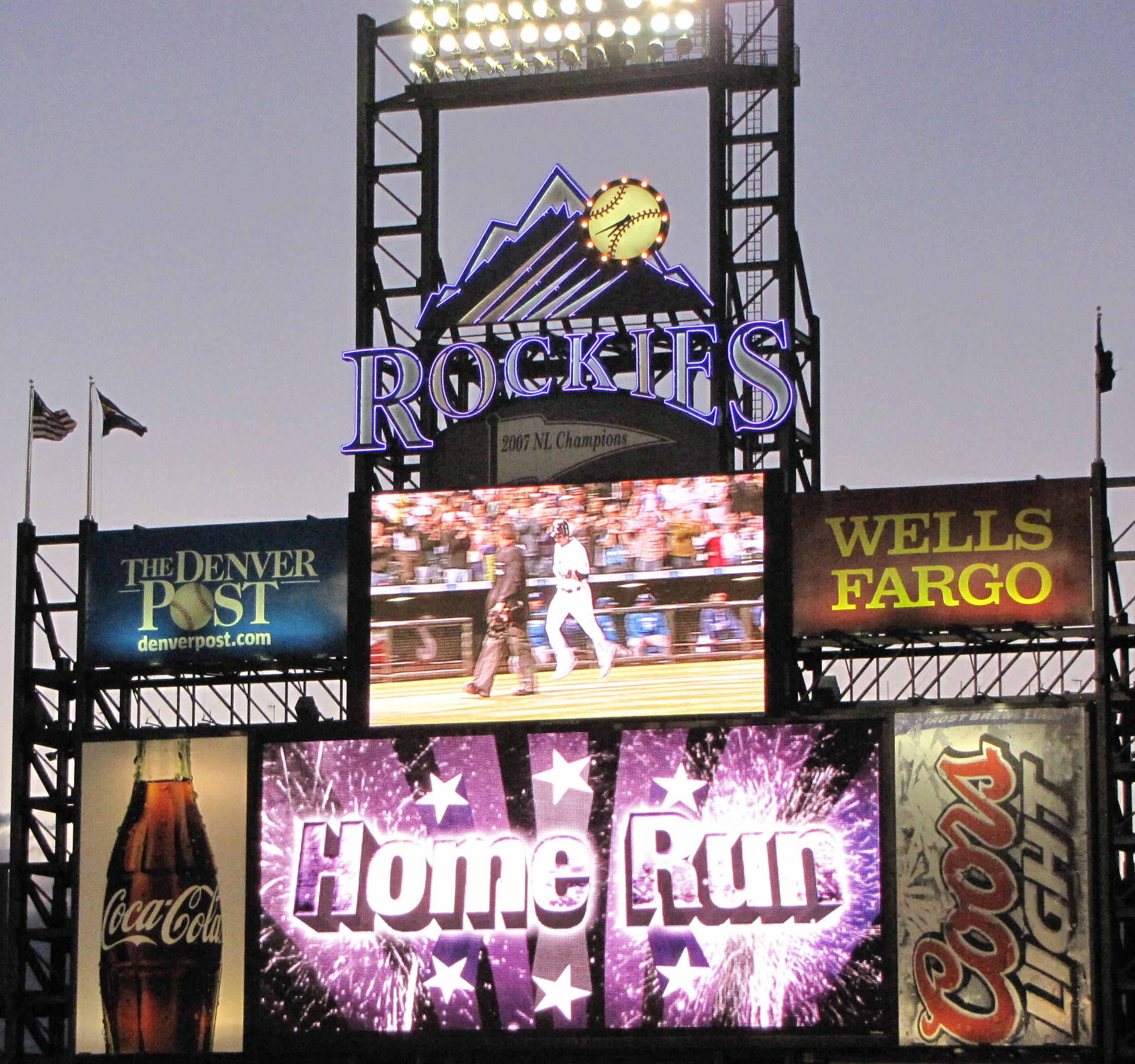
The 2007 Pennant is displayed top the left field scoreboard, under the giant Rockies logo. The 1995 NL Wild Card banner used to be on the wall, but once a Pennant was won, it seemed a bit silly. (Nevertheless, the Mets still have that 1999 Wild-Card display on the third-base facing of Citi Field, along with their 2 World Championship, 3 other Pennant, and 2006 NL East stanchions.)
There is no mention, anywhere in the stadium, of the Pennants won by the Rockies' minor-league predecessors, the Denver Bears (also briefly known as the Denver Zephyrs).

Stuff. Coors Field has the Majestic Team Store behind Section 149, in the left-field corner. I don't know if the Rockies gear they sell includes cowboy hats with team logos on them, to tie in with the State's Western heritage. In addition, there are 7 Rockies Dugout Stores throughout Colorado, including 1 in Denver at 535 16th Street.

Don't look for old Rockies videos on DVD – there aren't any. Unless you want to find the official highlight film of the 2007 World Series, in which the Rockies got swept by the Boston Red Sox. You'd think that, having won 14 of their last 15 regular-season games, making it 21 out of 22 counting the Playoffs, winning their 1st-ever Pennant, and setting a major league record for highest team fielding percentage (.989), there would be a commemorative DVD. But there isn't.

There are, however, a few books about the team, including A Magical Season: Colorado's Incredible 2007 Championship Season, by the staff of the Denver Post. With the 25th Anniversary celebration underway, Paul T. Parker and Bill Nowlin of the Post wrote Major League Baseball A Mile High: The First Quarter Century of the Colorado Rockies. You can also pick up Colorado Rockies: The Inaugural Season, by Rich Clarkson, which came out right after that 1993 season ended.

The first-year Rockies probably got more respect than any 67-95 team ever. To compare, the 1969 Seattle Pilots went 64-98. They also played in a stadium that was inappropriate for the major leagues – albeit because it was an expanded 1930s Triple-A park, not a 1940s Triple-A park converted into a 1970s football stadium like Mile High. They got fewer fans in a homestand than the '93 Rox got in their home opener, got moved to Milwaukee right before their second season started, and today are remembered only for being in Jim Bouton's book Ball Four. Even Seattle fans would prefer to believe their major league history started with the Mariners in 1977.

During the Game. A recent Thrillist article ranked Rockies fans 29th among the "most intolerable" fans. More accurately, that makes them the 2nd-most tolerable.

Coloradans love their sports, but they're not known as antagonistic. Although the Jets came within a half of derailing a Bronco Super Bowl in 1999 (at the end of the 1998 season), and the Devils came within a game of short-circuiting their Stanley Cup run in 2001, the people of the Centennial State don't have an ingrained hatred of New Yorkers and New Jerseyans. As long as you don't wear Kansas City Chiefs or Oakland Raiders gear, you'll probably be completely safe. (But, as always, watch out for obnoxious drunks, who know no State Lines.)

The Rockies are wearing 25th Anniversary sleeve patches. Wednesday night will be Dollar Dog Night, though 1 $1.00 hot dog to a customer. That's the only promotion during this series.
The Rockies hold auditions for National Anthem singers, as opposed to having a regular, but they give priority to groups, even letting their Group Sales department handle applications.

When construction workers were excavating to build Coors Field, they found dinosaur bones. So the Rockies' mascot was made a dinosaur. In honor of the thin air's propensity for allowing home runs, the mascot was named Dinger the Dinosaur. Great idea, right? Well, a Tyrannosaurus Rex (or even a "Tyrannosaurus Rox") would probably scare kids, so Dinger is a purple triceratops, wearing a Rockies jersey, Number 00. Think of him as Barney's cousin from the weird side of the family.
The Rockies play Bruce Channel's song "Hey! Baby" after "Take Me Out to the Ball Game" during the 7th inning stretch. Why? I have no idea. Channel isn't from Colorado, or any other Rocky Mountain State (he's from Texas). Why not a Colorado singer's song? You got me.

I guess "Rocky Mountain High" – whose singer used the stage name John Denver, for crying out loud – isn't particularly rousing. And his "Thank God I'm a Country Boy" was already the 7th inning stretch song for the Baltimore Orioles. Also not especially crowd-cranking is "How to Save a Life" by The Fray, who, unlike John, are from Denver. Sometimes the Rockies play "Get Free" by the Australian rock band The Vines.

Their postgame victory song used to be "Rocky Mountain Way" by Joe Walsh of The Eagles, but it's been replaced by "Take the Field," as recorded by the Colorado Symphony.

After the Game. Denver has had crime issues, and just 3 blocks from Coors Field is Larimer Street, immortalized as a dingy, bohemian-tinged, hobo-strewn street in Jack Kerouac's novel On the Road. But that scene was written in 1947, and LoDo has become, with the building of Coors Field and the revitalization of Union Station, a sort of mountain Wrigleyville. So you'll probably be safe.

LoDo is loaded with bars that will be open after the game, including Scruffy Murphy's at Larimer & 20th, and an outlet of the Fado Irish Pub chain at Wynkoop & 19th. But the only baseball-named place I can find anywhere near Coors is Sandlot Brewery, at 22nd & Blake, outside the park's right-field corner. Behind home plate, at 1930 Blake Street, is The Sports Column, hailed by a recent Thrillist article as the best sports bar in the State of Colorado.

Perhaps the most famous sports-themed restaurant in Denver is Elway's Downtown, a steakhouse at 1881 Curtis Street. Several downtown buses will place you within a block of it. It's owned by the same guy who owns John Elway Chevrolet in the southern suburb of Englewood.

Tap & Burger Sloan's Lake is said to be a Yankee Fan bar. 1515 N. Raleigh Street, about 2 miles west of downtown. Bus 20. Occidental is the home of the local New York Giants fan club. 1950 W. 32nd Avenue, about a mile north of Ball Arena and Coors Field. Bus 44. Jet fans gather at Chopper's Sports Grill, possibly named for Chopper Travaglini, at 80 S. Madison Street at Bayaud Avenue, 3 miles southeast of downtown, in the Pulaski Park neighborhood. Bus 83, then a mile's walk.

If your visit to Denver is during the European soccer season (which is now in progress), your best bet for watching your favorite club is at The British Bulldog, 2052 Stout Street, just north of Downtown. The previous best choice, The Three Lions at 2239 E. Colfax Avenue, recently closed.

Sidelights. Denver is a fantastic city, and a good sports city, with much to look for. On February 3, 2017, Thrillist made a list ranking the 30 NFL cities (New York and Los Angeles each having 2 teams), and Denver came in 8th, in the top 1/3rd. They said:

Ah, Denver! Breathe in that fresh mountain air with just a hint of cannabis and green chile. Drink in the hoppy splendor of a craft beer scene that was bustling back when everyone still called them "microbreweries." Tolerate the alarmingly in-shape bro who stuck around after four years at Boulder to work as a part-time ski instructor and won't stop talking to you about fourteeners. Denver often gets championed for all the fantastic stuff to do right outside the city, what with the skiing and the hiking and the Red Rocks, but that does a disservice to all the good times to be had in Denver proper. The fact that said times can be had with herbal enhancement with nary a legal concern is just a bonus. 

UPDATE: On November 30, 2018, Thrillist published a list of "America's 25 Most Fun Cities," and Denver came in 13th. On February 12, 2019, they published an article calling Denver "America's Must-Visit City for 2019."

Sports Authority Field at Mile High, formerly Invesco Field at Mile High, has been the home of the NFL's Denver Broncos since 2001. Everyone just gives it the same name as the old facility: "Mile High Stadium." It includes the Colorado Sports Hall of Fame, and the Broncos' Ring of Fame.

It was built on the site of the McNichols Sports Arena, home to the NBA's Denver Nuggets from 1975 to 1999, the NHL's Colorado Avalanche from 1995 to 1999, and the first major league team called the Colorado Rockies, the NHL team that became the Devils, from 1976 to 1982. The Denver Dynamite played there from 1987 to 1991, made the Arena Football League Playoffs every season, and won the 1st ArenaBowl in 1987. But the cost of running the team was too high, and it folded.

It hosted the NCAA Final Four in 1990, with UNLV (the University of Nevada at Las Vegas) clobbering Duke. (The University of Colorado, in Boulder, made the Final Four in 1942 and 1955, although it wasn't yet called the Final Four.  No other Colorado-based school has made it, and none has won a National Championship -- not in basketball, anyway.)

When the time came to play the final concert at McNichols, the act that played the first concert there was brought back: ZZ Top. This fact was mentioned on a Monday Night Football broadcast, leading Dan Dierdorf to note the alphabetic distinction of the long red-bearded men, and say, "The first one should have been ABBA." Which would have been possible, as they were nearly big in the U.S. at the time. However, the fact that the arena only lasted 24 years, making it not that hard for the act that played the first concert there to also play the last, says something about America's disposable culture.

The old stadium was just to the north of the new stadium/old arena. The current address is Mile High Stadium Circle, but the old intersection was W. 20th Avenue & Bryant St. (2755 W. 17th Avenue was the mailing address.) It was built in 1948 as Bears Stadium, an 18,000-seat ballpark.
When the American Football League was founded in 1960, it was expanded to 34,000 seats with the addition of outfield seating. The name was changed to Mile High Stadium in 1966, and by 1968 much of the stadium was triple-decked and seated 51,706.
In 1977 – just in time for the Broncos to make their first Super Bowl run and start "Broncomania" – the former baseball park was transformed into a 76,273-seat horseshoe, whose east stands could be moved in to conform to the shape of a football field, or out to allow enough room for a regulation baseball field. The old-time ballpark had become, by the standards of the time, a modern football stadium.
The biggest complaint when the Rockies arrived in 1993 wasn't the thin air, or the condition of the stadium (despite its age, it was well-maintained, and was not falling apart), but the positioning of the lights: Great for football fans, but terrible for outfielders tracking fly balls. But it was only meant to be a temporary ballpark for the Rockies, as a condition for Denver getting a team was a baseball-only stadium. What really led to the replacement of Mile High Stadium, and its demolition in 2002, was greed: The Broncos' desire for luxury-box revenue.

At Bears/Mile High Stadium, the Broncos won AFC Championships in 1977, 1986, 1987, 1989, 1997 and 1998, winning the Super Bowl in the last 2 years after losing the first 4 in blowouts.  (They've now won an AFC title at the new stadium, but not a Super Bowl.) The Denver Bears won Pennants while playing there in 1957 (as a Yankee farm team), 1971, 1976, 1977, 1981, 1983 and 1991 (winning the last one under the Denver Zephyrs name).

The old stadium also hosted the Denver Gold of the United States Football League, the 1983 USFL Championship Game, the Colorado Caribous of the original North American Soccer League, and the Rapids from their 1996 inception until 2001 -- in fact, they played the stadium's last event, before playing at the new stadium from 2002 to 2006. The U.S. national soccer team played a pair of games at Mile High Stadium in the 1990s, and beat Mexico at the new stadium in 2002 (the only game they've played there so far). It has been selected by the U.S. Soccer Federation as a finalist to be one of the host venues for the 2026 World Cup.

While the 2008 Democratic Convention was held at the Pepsi Center, Senator Barack Obama gave his nomination acceptance speech outdoors in front of 80,000 people at New Mile High Stadium.

The Red Lion Hotel Denver and the Skybox Grill & Sports Bar are now on the site of the old stadium. At McNichols, the Nuggets reached the ABA Finals in 1976, and the Avalanche won the 1996 Stanley Cup (albeit clinching in Miami). The Denver Dynamite won the 1st ArenaBowl in 1987, and again in 1989, 1990 and 1991, before finances forced them to fold anyway. Elvis Presley sang at McNichols on April 23, 1976.

The complex that included Mile High Stadium and the McNichols Arena was supposed to be the centerpiece of the 1976 Winter Olympics. But in a 1972 referendum, Colorado voters rejected funding that would have built more facilities, and, in what remains the only example of this ever happening, Winter or Summer, a city withdrew as host for an Olympic Games. They were awarded, instead, to Innsbruck, Austria, which already had the facilities in place from hosting them in 1964.

The new stadium, and the site of the old stadium and arena, are at Mile High Station on the light rail C-Line and E-Line.

The Nuggets, known as the Denver Rockets until 1974, played at the Denver Auditorium Arena, at 13th & Champa Streets, from their 1967 inception until McNichols opened in 1975. It was also the home of the original Nuggets, who played in various leagues from 1935 to 1948, and then in the NBA until 1950.

It opened in 1908, and its seating capacity of 12,500 made it the 2nd-largest in the country at the time, behind the version of Madison Square Garden then standing. It almost immediately hosted the Democratic National Convention that nominated William Jennings Bryan for President for the 3rd time – although it's probably just a coincidence that the Democrats waited exactly 100 years (give or take a few weeks) to go back (it's not like Obama didn't want to get it right the 1st time, as opposed 0-for-3 Bryan).

The Auditorium Arena hosted Led Zeppelin's 1st American concert on December 26, 1968. It was demolished in 1990 to make way for the Denver Performing Arts Complex, a.k.a. the Denver Center. Theatre District/Convention Center Station on the light rail's D-Line, F-Line and H-Line.

The Pepsi Center is across Cherry Creek from downtown, about 2 miles northwest of City Hall. The intersection is 11th Street & Auraria Parkway, but the mailing address is 1000 Chopper Circle, in honor of Robert "Chopper" Travaglini, the beloved former trainer (and amateur sports psychologist) of the Nuggets, who share the arena with the NHL's Colorado Avalanche. It is 1 of 10 current arenas that is home to both an NBA team and an NHL team.

(UPDATE: In 2020, the arena was renamed the Ball Arena.)

Chopper was actually a Jersey Boy, albeit from Woodbury on the Philly side. He died in 1999, age 77, right before the new arena opened. Chopper Circle is an extension of Wewatta Street.

Pepsi Center/Elitch Gardens station on the RTD light rail. If you're coming in that way, you'll probably enter from the west gate, the Grand Atrium. If you're driving, parking starts at just $5.00. The rink is laid out east-to-west, and the Avs attack twice toward the east end.

In addition to hosting the Avs and the Nugs, the Pepsi Center has also hosted NCAA Tournament basketball games, the 2008 edition of NCAA's hockey "Frozen Four," and the 2008 Democratic National Convention.

The Denver area's Major League Soccer team, the Colorado Rapids, plays at Dick's Sporting Goods Park in Commerce City, about 8 miles northeast of downtown. They'e won the MLS Cup since moving there, in 2010.

The U.S. national team has played there 3 times: A 2-0 win over Guatemala in a World Cup Qualifier on November 19, 2008; a 1-0 win over Costa Rica in a World Cup Qualifier on March 22, 2013 (the famous Snow Classico); and a 2-0 win over Trinidad & Tobago in a World Cup Qualifier this past June 8. The women's team has played there twice: A 2008 win over Brazil, and a 2012 win over Australia. It's also hosted football, rugby, lacrosse and concerts.

6000 Victory Way. If you're going in by public transportation from downtown Denver, Number 48 bus to 60th Avenue & Dahlia Street, then Number 88 bus to 60th & Monaco. Then they make you walk 10 blocks on 60th to get to the stadium.

The Beatles played Red Rocks Amphitheatre in suburban Morrison on August 26, 1964. It is still in business, and a Colorado Music Hall of Fame is a short walk away. 18300 W. Alameda Parkway, 10 miles west of downtown. Sorry, no public transportation.

Elvis played 2 shows at the Denver Coliseum on April 8, 1956, and 1 each on November 17, 1970 and April 30, 1973. Built in 1951, it still stands, seating 10,500, and is best known for concerts and the National Western Stock Rodeo. 4600 Humbolt Street at E. 46th Avenue, off Interstate 70, 3 miles northeast of downtown. Apparently, no public transportation to there, either.


On June 5, 1897, the Heavyweight Championship of the World was contested in Colorado. The British-born Champion, Bob Fitzsimmons – supposedly, in response to being told he was too small to fight heavyweights, the originator of the saying, "The bigger they are, the harder they fall" – knocked Lew Joslin out in the 2nd round. The fight happened in Leadville, 100 miles southwest of Denver.

Theoretically, it is possible to get there via public transportation. You'd have to take Greyhound from Denver to Vail, and then a local bus for over an hour to Leadville. And I can't find a source that lists the name of the fight's venue, or its address. So, unless you're a fanatic about boxing history and have to see the sites of every heavyweight title fight, I'd say skip this one.

Denver has some renowned museums, including the Denver Museum of Nature & Science (their version of the Museum of Natural History) at 2001 Colorado Blvd. at Montview Blvd. (in City Park, Number 20 bus), and the Denver Art Museum (their version of the Metropolitan Museum of Natural History), at 100 W. 14th Avenue Parkway at Colfax Avenue (across I-25 from Mile High Stadium, Auraria West station on the C-Line and E-Line).

Denver's history only goes back to a gold rush in 1859 – not to be confused with the 1849 one that turned San Francisco from a Spanish Catholic mission into the first modern city in the American West. The city isn't exactly loaded with history.

There's no Presidential Library – although Mamie Doud, the eventual Mrs. Dwight D. Eisenhower, grew up there, and her house is now a historic site. Mamie and "Ike" were married there, their son John (a future General, Ambassador and military historian) was born there, and the Eisenhowers were staying there when Ike had his heart attack in 1955. The house is still in private ownership, and is not open to the public. However, if you're a history buff, or if you just like Ike, and want to see it, it's at 750 Lafayette Street, at 8th Avenue. The Number 6 bus will get you to 6th & Lafayette.

After his heart attack, Ike was treated at Fitzsimmons Army Medical Center in nearby Aurora, 12 years after Senator John Kerry, nearly elected President in 2004 and now Secretary of State, was born there. It's not a Presidential Birthplace, because Kerry narrowly lost. It is now the University of Colorado Hospital. The Fitzsimmons Golf Course is across Montview Boulevard – it figures that Ike would be hospitalized next to a golf course! 16th Avenue & Quentin Street. Number 20 bus from downtown.

The University of Denver's Newman Center for the Performing Arts hosted a 2012 Presidential Debate between Barack Obama and Mitt Romney. 2344 East Iliff Avenue, about 5 miles south of downtown. The University's Magness Arena hosted the Frozen Four in 1961, 1964 and 1976. 2250 E. Jewell Avenue. Both can be reached via H Line light rail to University of Denver Station.

Byron "Whizzer" White was a star football and basketball player at the University of Colorado in the late 1930s, a Rhodes scholar, a running back for the Pittsburgh Steelers and the Detroit Lions, a Bronze Star-winning Navy officer in World War II, one of Colorado's finest lawyers, the chairman of John F. Kennedy's Presidential campaign in the State, and one of the longest-serving Justices on the U.S. Supreme Court. He is buried at the Cathedral of St. John in the Wilderness, 1350 N. Washington Street at 14th Avenue. Bus 6.

Denver doesn't have as many tall buildings as the nation's bigger cities, nor are they as interesting, architecturally. The tallest building in the State of Colorado is Republic Plaza, 714 feet high, at 17th Street & Tremont Place downtown. A 1,000-foot, 90-story residential/hotel tower, currently named Six Fifty 17 for its address (650 17th Street), has been proposed by Uruguay-born, New York-based architect Carlos Ott and local real estate firm Greenwich Realty Capital. They hope to break ground on it in Summer of 2018.

The University of Colorado is in Boulder, 30 miles to the northwest. At Market Street Station, 16th & Market, take the BV Bus to the Boulder Transit Center, which is on campus. The ride should take about an hour and 20 minutes. Colorado State University is in Fort Collins, 65 miles up Interstate 25 north, and forget about reaching it by public transportation.

The U.S. Air Force Academy is outside Colorado Springs, 60 miles down I-25. As with Fort Collins, you'd need Greyhound. Unlike CSU, you might not be able to just go there: Some of the area is restricted.  It is, after all, a military base.

Their football facility, Falcon Stadium, hosted an NHL Stadium Series game on February 15, 2020, before COVID shut everything down. The Avalanche hosted, but lost to the Los Angeles Kings, 3-1.

Colorado Springs was also home to the Broadmoor Ice Palace, which hosted what's now called the Frozen Four every year from its inception in 1948 until 1957, and again in 1969. The 3,000-seat arena at The Broadmoor Resort & Spa was home ice to Colorado College from 1938 to 1994. 1 Lake Avenue, across Cheyenne Lake from the main hotel. Its 7,750-seat 1998 replacement, the Broadmoor World Arena, is 4 miles to the east, at 3185 Venetucci Blvd.

A few TV shows have been set in Denver, but you won't find their filming locations there. The old-time Western Whispering Smith and the more recent one Dr. Quinn, Medicine Woman were set in old Colorado (Colorado Springs), but filmed in Southern California. And Greendale, the setting of
Community, is fictional.

Probably the most famous show set in Colorado is South Park, and that's a cartoon, so forget seeing anything from that. Not quite as cartoonish was Mork & Mindy, set in Boulder. The McConnell house actually is in Boulder, at 1619 Pine Street. But don't try to copy the opening-sequence scene with Robin Williams and Pam Dawber on the goalposts at the University of Colorado's Folsom Field. You could fall, and end up saying, "Shazbot!"

The most famous show ever set in Colorado was Dynasty, ABC's Excessive Eighties counterpart to CBS' Dallas, starring John Forsythe as Blake Carrington, an oilman and a thinly-veiled version of Marvin Davis, who nearly bought the Oakland Athletics from Charlie Finley in 1978 with the idea of moving them to Mile High Stadium, but the deal fell through. Right, you don't care about Blake, all you care about is the catfights between the 2nd and 1st Mrs. Carrington's: Krystle (Linda Evans) and Alexis (Joan Collins).

The Carrington mansion seen in the opening credits is in Beverly Hills, but the building that stood in for the headquarters of Denver Carrington is in Denver, at 621 17th Street, while the one that stood in for Colbyco is at 1801 California Street. The show is being rebooted, premiering on The CW Network on October 11. It may take place in Denver, but is being filmed in Atlanta. 

Movies set in Denver or its suburbs include The Unsinkable Molly Brown, the original Red Dawn, and, of course, Things to Do In Denver When You're Dead. Films involving skiing often take place in Colorado towns such as Aspen or Vail. City Slickers, a film with loads of baseball references, has a cattle drive that ends in Colorado, but there's no indication of how close it is to Denver. Flashback
takes place on the Pacific Coast, but Denver's Union Station stands in for a train station in San Francisco.

*

Denver had been considered a potential destination for Major League Baseball many times: The Continental League planned a team for there for 1961, it was a finalist for expansion teams in 1969 and 1977, and, as I said, the A's came within inches of moving there for the 1978 season.

When they finally got a team in 1993, they were embraced as perhaps no expansion team has ever been embraced -- even more than the Mets themselves in 1962. And, the way it's worked out, the Rockies' 1st-ever game was against the Mets (a Met win at Shea), and their 1st game at Coors Field was against the Mets (a Rockies win in 14 innings).

The Rockies have seen the bloom come off the rose, but they've also seen some real success. The experience of Coors Field should be a good one. Have fun!