Showing posts with label calgary. Show all posts

Thursday, March 10, 2022

How to Be a Devils Fan In Calgary -- 2022 Edition

This coming Wednesday, March 16, the Devils travel to play the Calgary Flames. With their "C of Red" fans, the Flames are never an easy team to beat at the Saddledome.

Before You Go. Aside from Edmonton's Rogers Place, no arena in the NHL is further north than the Saddledome -- indeed, aside from each Alberta city's CFL stadium, no venue in North American sports is further north except Rogers Place. 

But it won't be that cold: The Calgary Herald is predicting that temperatures will be in the mid-40s by day and the high 20s by night. You'll need a Winter jacket, but you won't have to bundle up. 

This is Canada, so you will need your passport. You will need to change your money. At this writing, C$1.00 = US 78 cents, and US$1.00 = C$1.28. And I advise you to call your bank and let them know that you will be in a foreign country, so they won't see credit or debit card purchases from a foreign country pop up and think your card has been stolen.

Also, remember that they use the metric system. A speed limit of 100 kilometers per hour means 62 miles an hour. And don't be fooled by the seemingly low gas prices: That's per liter, not per gallon, and, in spite of Canada being a major oil-producing nation, you'll actually be paying more for gas up there. So, in order to avoid both confusion and "sticker-shock," get your car filled up before you reach the border.

Calgary is in the Mountain Time Zone, so they are 2 hours behind New York and New Jersey. Adjust your timepieces accordingly.

Tickets. The Flames averaged 18,681 fans per home game in 2019-20, the last pre-COVID season, about 97 percent of capacity. A bit less than you might expect from a Canadian city. Tickets will probably still be hard to get.

Even with the exchange rate, these tickets, listed in U.S. dollars, are expensive. Seats in the lower level, the 100 sections, are $106 between the goals and $72 behind them. In the next level, the 200 sections, they're $53 between the goals and $46 behind them. The uppermost level, labeled PL (for "Press Level"), has seats for $14.

Getting There. It's 2,385 miles from Times Square to downtown Calgary (158 miles from the closest border crossing, at Babb, Montana), and 2,376 miles from the Prudential Center in Newark to the Saddledome. It would be natural if your first thought would be to fly.

If you're driving, you'll need to get into New Jersey, and take Interstate 80 West. You'll be on I-80 for the vast majority of the trip, through New Jersey, Pennsylvania and Ohio. In Ohio, in the western suburbs of Cleveland, I-80 will merge with Interstate 90. From this point onward, you won’t need to think about I-80 until you head home; I-90 is now the key, through the rest of Ohio and Indiana.

Just outside Chicago, I-80 will split off from I-90, which you will keep, until it merges with Interstate 94. For the moment, though, you will ignore I-94. Stay on I-90 through Illinois, until reaching Madison, Wisconsin, where you will once again merge with I-94. Now, I-94 is what you want, taking it into Minnesota and the Twin Cities.

However, unless you want to make a rest stop actually in Minneapolis or St. Paul, you're going to bypass them entirely. Take Exit 249 to get on Interstate 694, the Twin Cities' beltway, until you merge with Interstate 494 to reform I-94.

Crossing Minnesota and North Dakota, you'll take Exit 211 to Montana Route 200, and take that up to the town of Circle. There, you take Montana Route 13 until it splits and forms Montana Route 25. After just 6 miles, that takes a right turn in the town of Wolf Point, and then a quick left to U.S. Route 2 West. In Shelby, you'll leave US-2 for Interstate 15, and take that to the Canadian border.

Presuming you don't do anything stupid that makes Customs officials keep you out of Canada, I-15 will become Alberta Provincial Route 4. At Lethbridge, you'll turn onto Provincial Route 3 West. Take Provincial Route 23 to Provincial Route 519 to Provincial Route 2. From Route 2, take Exit 245 for Southland Drive, make a left on Southland, and then a quick right onto Blackfoot Trail. A left on 42nd Avenue and a right on MacLeod Trail, and you'll be at the edge of downtown Calgary, with the Saddledome on your right.

If you do it right, you should spend about an hour and a half in New Jersey, 5 hours and 15 minutes in Pennsylvania, 4 hours in Ohio, 2 and a half hours in Indiana, an hour and a half in Illinois, 2 and a half hours in Wisconsin, 4 and a half hours in Minnesota, 6 hours in North Dakota, 7 and a half hours in Montana, and 6 hours and 45 minutes in Alberta.  That's 42 hours. Throw in rest stops, and we're talking closer to 56 hours -- 2 and one-third days. You'd have to really love both driving and hockey, and not mind cold weather, to do that.

Forget the bus: For a reason I could not find, Greyhound is not currently offering service to Calgary. The Greyhound station is at 850 16th Street NW at Bow Trail.

Forget the train: You'll have to switch from Amtrak to VIA Rail Canada in Toronto, take a train to Edmonton, and then take a bus to Calgary -- which, for the moment, apparently, you can't do anyway. Round-trip, it would take 8 days. No, the train is no good.

So flying is easily the best way to get there. You can fly Air Canada from Newark to Calgary and back, changing planes in Toronto, for $1,071. Calgary International Airport was originally named McCall Field, after Frederick McCall, a Canadian flying ace of World War I.

On October 14, 2016, President Obama finally ended the ban on bringing Cuban cigars into America. This also applies to rum, for which Cuba is also renowned. It is still considerably easier to buy these items in Canada than in America, but, now, you can bring them back over the border.

Once In the City. At 1.2 million people, Calgary is the 3rd-largest city in Canada, behind Toronto and Montreal, and ahead of Vancouver and Edmonton. However, like most of Canada's larger cities, the huge amount of land area contained within its city limits means it has almost no suburbs, and its metropolitan area gives it only 1.4 million, 4th behind Toronto, Montreal and Vancouver -- but still ahead of national capital Ottawa and Provincial capital Edmonton.

Founded in 1882 at the confluence of the Bow and Elbow Rivers, there is some dispute as to the origin of the name, although both accepted versions are Scottish in origin. Some say it's from the Gaelic meaning "beach of the meadow," or "pasture." Others say it comes from the words the Vikings brought to northern Scotland's Hebrides, meaning "cold garden."

The Bow River and, east of its bend, Memorial Drive separate Calgary addresses into North and South, while Centre Street separates them into East and West. The sales tax in the Province of Alberta is 5 percent, and it doesn't go up in the City of Calgary. The city has buses and a light rail system nicknamed CTrain, and a single fare is $3.00 (which works out to about $2.35, so it's less expensive than New York's).
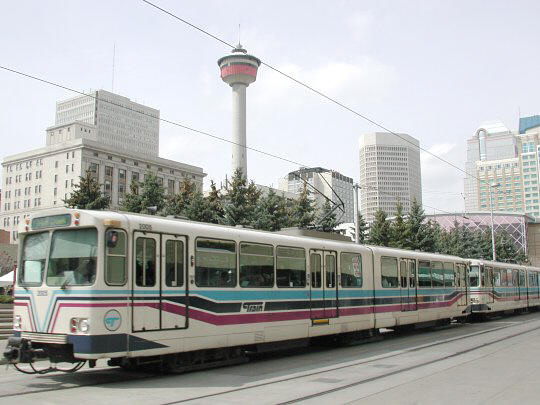
CTrain downtown, with Calgary Tower in the background

The drinking age in Alberta is 18. Postal Codes in the Province start with the letter T. The Area Code is 403, with 587 and 825 as overlays for the entire Province. The city has no highway "beltway." ENMAX Power Corporation runs the city's electricity. Calgary's ethnic makeup is 61 percent white, 16 percent East Asian, 9 percent South Asian, 4 percent black, 3 percent Aboriginal/Native North American/First Nations, 3 percent Middle Eastern, 2 percent Hispanic.

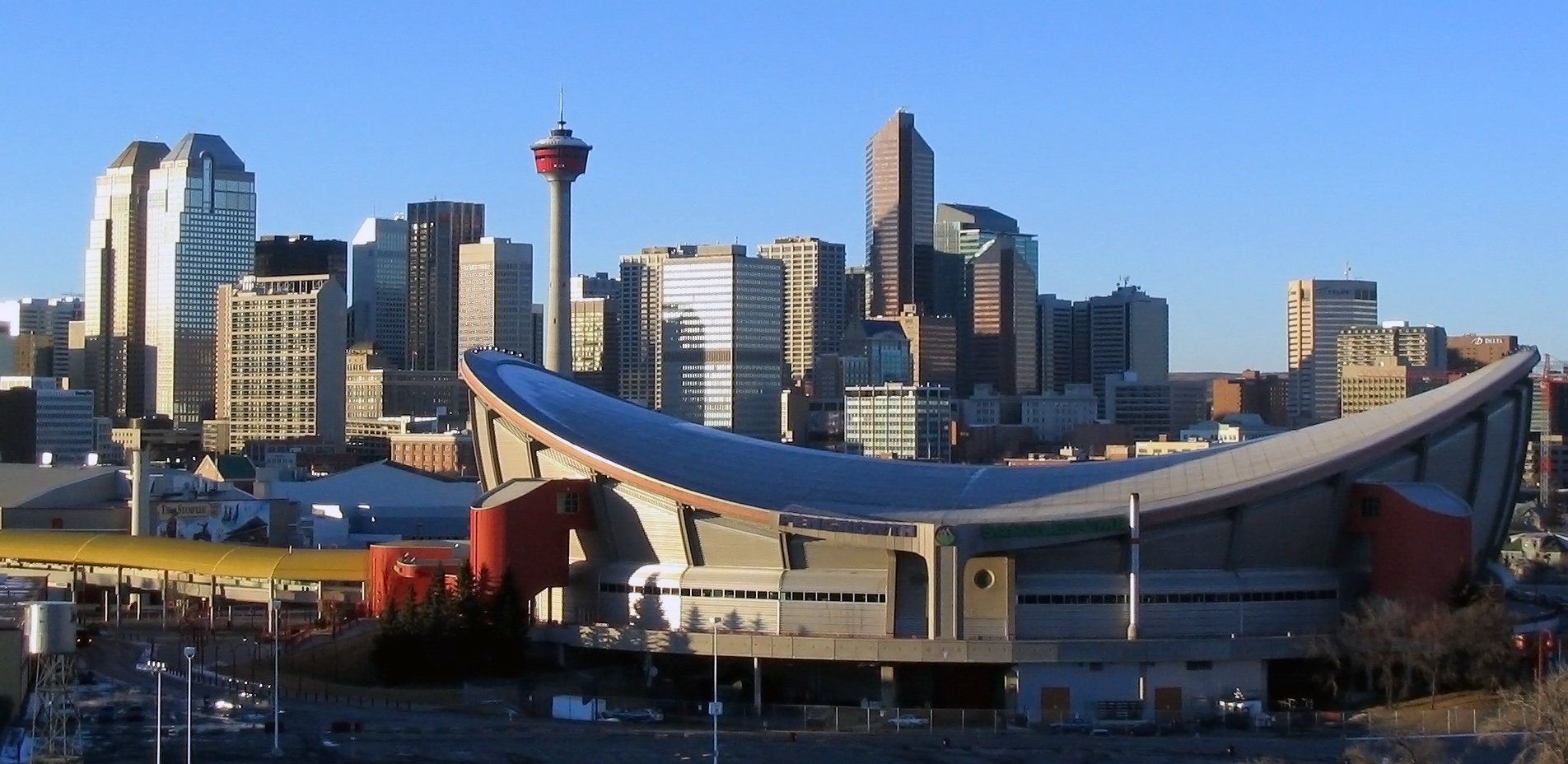
Going In. The Scotiabank Saddledome -- originally the Olympic Saddledome, built in 1983 for the Flames and as the centerpiece of the 1988 Winter Olympics, and now named for the Halifax-based bank -- is at 555 Saddledome Rise SE, across Olympic Way from the Stampede Corral, site of the world's largest rodeo, the Calgary Stampede. It's about a mile and a quarter southeast of the downtown shopping district. If you're driving, parking is $10. (US$7.82.) If you're coming in by light rail, it's about a 12-minute ride to Victoria Park-Stampede station, and then you'll have to walk across a big parking lot to get to the arena, entering from the west.

Like the Capital Centre, the suburban Washington arena that was once home to the Bullets (now Wizards) and Capitals, and the Arizona Veterans Memorial Coliseum, the still-standing former home of the Phoenix Suns, it has a saddle-shaped roof; hence, the name "Saddledome." (Why a bank based in Nova Scotia, in Canada's eastern Maritime Provinces, bought the naming rights to a western arena, I have no idea.)

The rink is laid out north-to-south, and the Flames attack twice to the north end. The arena is also home to the minor-league Calgary Hitmen, and their rivalry with the Edmonton Oil Kings is nearly as intense as the "Battle of Alberta" between the Flames and the Oilers.
The Saddledome is the 2nd-oldest arena in the league, behind Madison Square Garden. A plan to build a new arena, called the Calgary Event Centre, in the parking lot to the north of the Saddledome and the Corral, fell through in 2021. For the time being, the Flames are staying put.

Food. There's not much information available online about Saddledome concession stands, but the arena's website mentions several onsite restaurants, including Dutton's Lounge, the Alumni Lounge and the King Club. The Saddleroom Restaurant is on the arena's east side (another thing I had wrong last year), and the Platinum Club on the west side (ditto), but these are open only to season-ticket holders, much like the Prudential Center's Fire Lounge and Ice Lounge.

According to the arena website, concessions include: 

Time Out (Hot Dogs, Popcorn, Snacks)
Centre Ice (Hot Dogs, Popcorn, Snacks)
Pizza 73
Skyline Deli
Spolumbos Italian Eatery
Mac Shack (Mac 'n Cheese)
Flame Broiled Burgers
The Dog House (Specialty Hot Dogs)
The Zone
The Rotisserie

Cash or credit cards are accepted at all concession stands.


Team History Displays. All in a row, over the center red line, the Flames hang banners for their various championships and their retired numbers. The title banners including: The 1989 Stanley Cup; the 1986, 1989 and 2004 Conference Championships; the 1986, 1989, 1994, 1995, 2006 and 2019 Division titles; and the 1988 and 1989 President's Trophy for best overall record in the NHL regular season.
The Flames have 3 retired numbers. From the 1986 Cup Finalists and the 1989 Cup winners, they have retired: 9, for right wing Lanny McDonald; and 30, for goaltender Mike Vernon. From the 2004 Cup Finalists, 12, for right wing Jarome Iginla.

Right wing Theoren Fleury, a rookie on the 1989 Cup winners, has not had his Number 14 retired, but it has not been given out since he was traded in 1999. A banner for Brad Moran, whose Number 20 was retired by the Calgary Hitmen, is also hung at the Saddledome. (Although he holds several Hitmen club records, he played all of 8 games in the NHL, between 2002 and 2007.)

In 2012, the Flames organization introduced "Forever A Flame," to honor team legends while still allowing future Flames the opportunity to wear the numbers of some of the team's all-time greats -- essentially, a team hall of fame. Defenseman Al MacInnis was the 1st to earn this distinction, with a banner with his picture and the Number 2 raised to the rafters. Center Joe Nieuwendyk (who also won the 2003 Cup with the Devils) followed him, with a banner with his Number 25 on it. So that's 4 honorees, all from the 1989 Cup win.
McDonald, Iginla, MacInnis and Nieuwendyk are in the Hockey Hall of Fame. Vernon, as yet, is not. Also in the Hall are Joe Mullen (from 1989), Doug Gilmour (ditto), Phil Housley (starred for them after the '89 Cup), Sergei Makarov (ditto), general manager Cliff Fletcher (1989), longtime owner Harley Hotchkiss, and broadcaster Peter Maher.

There were no Flames named to The Hockey News' 100 Greatest Players in 1998, not even McDonald, Vernon or Gilmour. MacInnis was the only player usually identified with the Flames who was named to the NHL's 100th Anniversary 100 Greatest Players in 2017.

There is no reference to the Flames' time in Atlanta (the name references the burning of Atlanta during the American Civil War), unless you count the "A" for Alternate Captain being the Flames' old A logo. (The "C" for Captain is the current C logo.) The Flames didn't win anything in Atlanta, so there are no banners to raise, although they did make the Playoffs there. The only Atlanta Flames player in the Hockey Hall of Fame is Pat Quinn, and he's in the Hall for what he did elsewhere as an executive.

At the north end of the arena are Canadian and U.S. flags. At the south end are Canadian and British flags (Canada remains in the British Commonwealth), an Olympic flag, and a banner representing the 1988 Winter Olympics, for which the Saddledome and McMahon Stadium, home of the CFL's Stampeders, were the leading venues.

No members of the Team Canada that beat the Soviet Union in the 1972 "Summit Series" played for the Flames, in either Atlanta or Calgary. From the 1980 U.S. Olympic team that beat the Soviets and then Finland for the Gold Medal, Jim Craig played some of their final Atlanta games, while Steve Christoff played for them in Calgary.

Craig, Quinn, Makarov, and Swedes Kent Nilsson and Hakan Loob are members of the International Ice Hockey Federation (IIHF) Hall of Fame. Mullen and former coach Bob Johnson, who got them to the 1986 Stanley Cup Finals, received the Lester Patrick Trophy for contributions to hockey in America.

In addition to the Flames' achievements, the Memorial Cup, the championship of Canadian junior hockey, has been won by the following Calgary-area teams: The 1926 Calgary Canadians, the 1987 and 1988 Medicine Hat Tigers, the 2001 Red Deer Rebels and the 2002 Kootenay Ice.

The Battle of Alberta with the Edmonton Oilers is as intense as any in the NHL. It's close, but the Flames lead it, 138-129-18. They've faced each other in 5 Playoff series, all during the Wayne Gretzky era in Edmonton, and the Oilers won 4 of them: In 1983, 1984, 1988 and 1991.

The only Flames win came in the 1986 Smythe Division Final, when an own goal by Oiler defenseman Steve Smith led to the Flames winning in Game 7. Either the Oilers or the Flames won the NHL Clarence Campbell Conference (analogous to the current NHL Western Conference) every season from 1983 to 1990.

Stuff. There is a Flames Fan Attic (as in "fanatic") team store at the Saddledome, although I can't find a reference as to where in the arena. There are also Flames Fan Attics at the North Hill Centre mall and Calgary International Airport. I suspect that, due to the city's Western heritage, you can buy cowboy hats with the Flames' logo on them.

In spite of having won a Stanley Cup, and nearly winning 2 others, there aren't many books about the Flames. The Calgary Herald staff put together a coffee-table book titled Calgary Flames: The Fire Inside, but that's a big book at a big price. Last month, Mark Spector published The Battle of Alberta: The Historic Rivalry Between the Edmonton Oilers and the Calgary Flames.

The NHL has released a DVD set, Calgary Flames: 10 Great Playoff Games. They include a Game 7 win over the Philadelphia Flyers in 1981, their 1st season in Calgary; the shocking Game 7 win over the arch-rival Oilers in 1986, won by Steve Smith's own goal; another Game 7 win in 1986, over the St. Louis Blues; a Game 7 win over the Vancouver Canucks in 1989; the Cup-clincher of 1989, the only time a team ever clinched over the Montreal Canadiens at the Montreal Forum; the 1991 Game 6 win over the Oilers won by Theoren Fleury's goal that produced a memorable celebration; the Game 7 win over Vancouver in 2004; the Game 5 win over the Tampa Bay Lightning in 2004; and the Game 3 win over the San Jose Sharks in 2008.

During the Game. A November 19, 2014 article on The Hockey News' website ranked the NHL teams' fan bases, and listed the Flames' fans 8th: "Consistent turnout at games despite rebuild. Lackluster social media presence."

You are not Edmonton Oilers fans. You will not be wearing Oilers gear. Therefore, you will almost certainly be safe. This game will not feature a promotion.

The seats are blue, but they become "the C of Red." (Never "the Red C.") The Flames' home jerseys are red, like the Devils'. I don't know if it would be better to wear a red Devils jersey to fit in, or a white one to stand out. But the C of Red is as pervasive as the one in the St. Louis Cardinals' Busch Stadium.
The C of Red

George Canyon, a country singer from Nova Scotia who now lives in Calgary, and has been appointed the Colonel Commandant of the Royal Canadian Air Cadets, is the Flames' regular singer of the National Anthem(s). There isn't much in the way of fan chants or songs, just "Go, Flames, Go!" Their goal song is "Righteous Smoke" by Monster Truck.
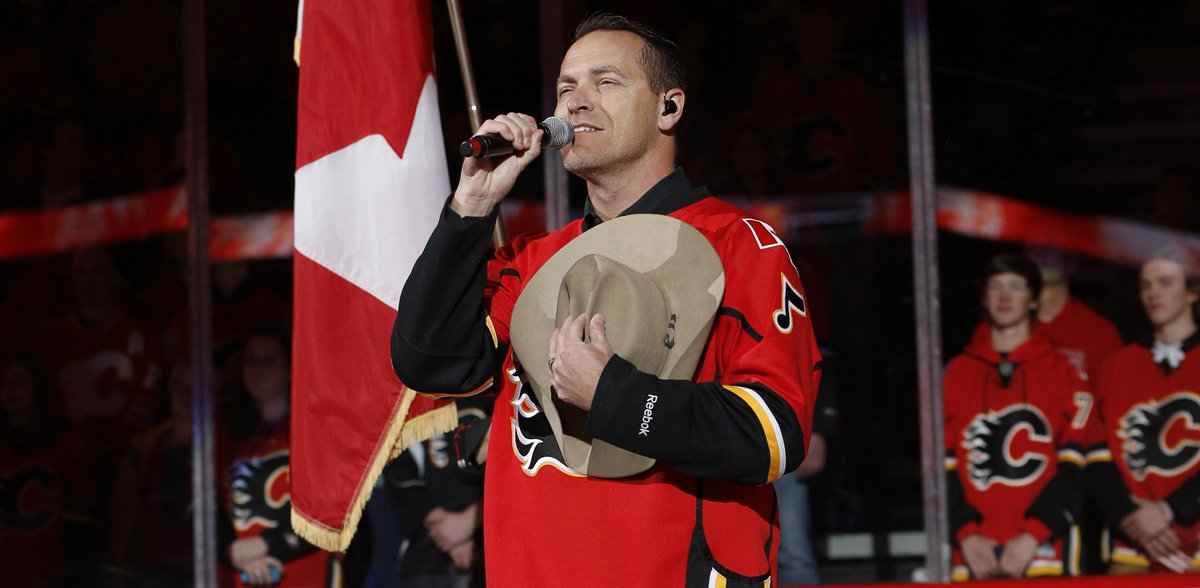
George Canyon

Although they sometimes wear a 3rd jersey with a fire-breathing dragon on it, their mascot is Harvey the Hound, a big white silly-looking dog with its tongue hanging way out -- which has driven some frustrated fans, and even one opposing coach (Craig MacTavish of the arch-rival Oilers), to grab it and try to rip it out. He was introduced in 1983, and was the 1st mascot in NHL history. (His name has confused me: I thought it was not Harvey, but Harley, named for longtime owner Harley Hotchkiss.)

After the Game. Canada does not have much of a problem with crime, and while hockey fans like to drink, Flames fans will probably leave you alone. Just don't praise the Oilers, and you should be safe.

Mavericks Dining Room & Lounge is on 2nd Street, at the southwest edge of the parking lot. Effectively, it marks the beginning (or the end) of the Red Mile, a strip of bars and restaurants along 17th Avenue that gained fame for its party atmosphere during the 2004 Playoffs.

If your visit to Calgary is during the European soccer season (which we are now in), the best soccer pub in town is The Pig & Duke, 1312 12th Avenue SW, about 2 miles west of downtown. Bus 7.

Sidelights. As with the other major cities of Canada, Calgary isn't just about hockey.

* Stampede Corral. Home to the Calgary Stampede, the world's largest rodeo, since 1950, the Flames played here from their 1980 move from Atlanta until the Saddledome opened across the street in 1983. At just 6,475 seats, it was too small to be their long-term home, but with the Saddledome already planned, they could afford to wait. Several minor-league hockey teams had used it before the Flames arrived. 10 Corral Trail SE at Olympic Way.
The Corral's long-term future depends on that of the Saddledome. One idea is that, when the Saddledome is torn down, an arena about the same physical size, but with a few thousand more seats than the Corral, be built on the site, so that the Corral's operations can be moved in, and the Corral would then be demolished.

* McMahon Stadium. Home to the Calgary Stampeders of the Canadian Football League (who are owned by the Flames), and the University of Calgary football team, since 1960, it was named for a pair of brothers who funded its construction. Its current capacity is 37,317. Temporary seating raised it to 60,000 so that it could host the Opening and Closing Ceremonies of the 1988 Winter Olympics.

The Stampeders, a.k.a. the Stamps, won the Grey Cup, Canada's Super Bowl, while playing here in 1971, 1992, 1998, 2001, 2008, 2014 and 2018. Previously, they played at Mewata Stadium, and won the 1948 Grey Cup while playing there. That facility was built in 1906 and demolished in 1999.

The stadium hosted the Grey Cup in 1975, 1993, 2000 and 2009. The University of Calgary Dinos (yes, named for dinosaurs) have won Canada's national college football title, the Vanier Cup, in 1983, 1985, 1988, 1995 and 2019. (They haven't won any hockey titles.) The stadium hosted an NHL Heritage Classic between the Flames and the Canadiens in 2011, which the Flames won, 4-0. 1817 Crowchild Trail NW at 23rd Avenue.

* Foothills Stadium. Adjacent to McMahon Stadium, this 6,000-seat ballpark went up in 1966, and is the home of the University of Calgary baseball team. It was home to several minor league teams, including the Calgary Expos, who won Pioneer League Pennants there in 1979 and 1981. The Pacific Coast League's Calgary Cannons won Division titles in 1985, 1987, 1989 and 1991, but never won a Pennant. 2255 Crowchild Trail NW. Both stadiums can be reached via the Banff station on light rail.
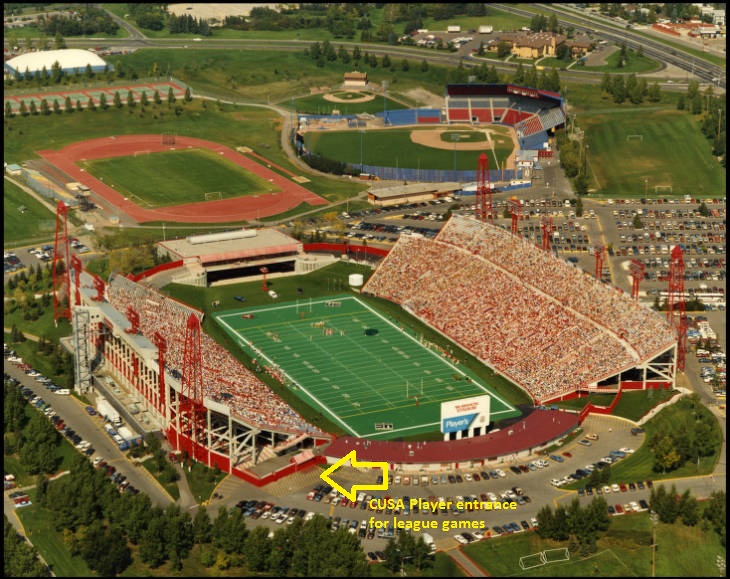
The University of Calgary sports complex,
including Foothills Stadium (top) and McMahon Stadium (bottom)

* Spruce Meadows. The Canadian Premier League has debuted, and Calgary-based Cavalry FC has now won its 1st title. They have opened 6,000-seat ATCO Field at Spruce Meadows, famed as a venue for equestrian competitions. 18011 Spruce Meadows Way SW, about 12 miles south of downtown. Free shuttles will bring fans to the stadium from the Somerset-Bridlewood C-Train station.
While the University of Calgary is, of course, in Calgary, the University of Alberta is in Edmonton. The University of Lethbridge, 130 miles to the southeast, won the University Cup, Canada's national college hockey title, in 1994.

The closest Major League Baseball team to Calgary is the Seattle Mariners, and they're not close: 673 miles away. The closest NBA team, the Portland Trail Blazers, is even further away: 775 miles. Don't count on Calgary ever getting a team in either sport: Population-wise, its metro area would rank dead last in each, 31st. The closest Major League Soccer team is the Vancouver Whitecaps, 604 miles.

* Museums. Calgary's best-known museum is the Glenbow, which is both their Museum of Natural History and their Metropolitan Museum of Art. 130 9th Avenue SE at 1st Street downtown, across from the iconic Calgary Tower.

Gasoline Alley Museum at Heritage Park Historical Village sounds like a copy of the Henry Ford Museum outside Detroit, as it documents the dawn of the automobile age, with first- and second-generation automobiles and a recreated turn-of-the-20th-Century street scene -- significant because Alberta didn't turn from Territory to full Province until 1905. visitcalgary.com says of it, "It's probably the only time you'll ever find yourself in the thick of a traffic jam without a hint of road rage." 1900 Heritage Drive SW at 14th Street, on Glenmore Reservoir. Light rail to Heritage station, then switch to 502 bus.

Calgary has produced 2 Prime Ministers. The recently-defeated PM, Stephen Harper, represents a Calgary district (or "riding" as they'd say in Canada). The other is Richard B. Bennett, who served from 1930 and 1935, rising to power after the 1929 stock market crash but was seen as doing nothing to ease the Depression, and became the most hated man in the country's history, so much so that he left Canada for the mother country, Britain. He's the only head of government in either America or Canada who died on foreign soil, or is buried in it. As you might guess, there's no historic site in his memory, either in Calgary or in his hometown in the Province of New Brunswick.

The tallest building in Calgary, and in Canada between Toronto and Vancouver, is Brookfield Place East, a newly-completed 810-foot tower that just succeeded the 774-foot "The Bow" as the tallest. 225 6th Avenue NW.

TV shows set in Calgary are generally not shown in America, but the science fiction/Western
Wynonna Earp films at Heritage Park Historical Village, kind of a "Western Williamsburg." Probably the best-known movie to use Calgary and/or its environs as a filming location was Brokeback
Mountain.

*

Calgary is Canada's Denver, its great Western city of toughness, and its Dallas, its great Western city of excess, rolled into one. And it's a great hockey town, a good roadtrip for Devils fans. 

Saturday, November 2, 2019

How to Be a Devils Fan In Calgary -- 2019-20 Edition

This coming Thursday, the Devils travel to play the Calgary Flames. With their "C of Red" fans, the Flames are never an easy team to beat at the Saddledome.

Before You Go. Aside from Edmonton's Rogers Place, no arena in the NHL is further north than the Saddledome -- indeed, aside from each Alberta city's CFL stadium, no venue in North American sports is further north except Rogers Place. And this is early November. It will be cold.

The Calgary Herald is predicting that temperatures will be in the low 20s by day and the single digits by night. That is very cold by our standards. Bundle up. And they are predicting snow for Monday and Tuesday, so it should still be on the ground on Thursday, so mind your step.

This is Canada, so you will need your passport. You will need to change your money. At this writing, C$1.00 = US 76 cents, and US$1.00 = C$1.32. And I advise you to call your bank and let them know that you will be in a foreign country, so they won't see credit or debit card purchases from a foreign country pop up and think your card has been stolen.

Also, remember that they use the metric system. A speed limit of 100 kilometers per hour means 62 miles an hour. And don't be fooled by the seemingly low gas prices: That's per liter, not per gallon, and, in spite of Canada being a major oil-producing nation, you'll actually be paying more for gas up there. So, in order to avoid both confusion and "sticker-shock," get your car filled up before you reach the border.

Calgary is in the Mountain Time Zone, so they are 2 hours behind New York and New Jersey. Adjust your timepieces accordingly.

Tickets. The Flames averaged 18,501 fans per home game last season, about 96 percent of capacity. A bit less than you might expect from a Canadian city. Tickets will probably still be hard to get.

Even with the exchange rate, these tickets, listed in Canadian dollars, are expensive. Seats in the lower level, the 100 sections, are $198 throughout the level. In the next level, the 200 sections, they're $131 between the goals and $79 behind them. The uppermost level, labeled PL (for "Press Level"), has seats for $47.

Getting There. It's 2,385 miles from Times Square to downtown Calgary (158 miles from the closest border crossing, at Babb, Montana), and 2,376 miles from the Prudential Center in Newark to the Saddledome. It would be natural if your first thought would be to fly.

If you're driving, you'll need to get into New Jersey, and take Interstate 80 West. You'll be on I-80 for the vast majority of the trip, through New Jersey, Pennsylvania and Ohio. In Ohio, in the western suburbs of Cleveland, I-80 will merge with Interstate 90. From this point onward, you won’t need to think about I-80 until you head home; I-90 is now the key, through the rest of Ohio and Indiana.

Just outside Chicago, I-80 will split off from I-90, which you will keep, until it merges with Interstate 94. For the moment, though, you will ignore I-94. Stay on I-90 through Illinois, until reaching Madison, Wisconsin, where you will once again merge with I-94. Now, I-94 is what you want, taking it into Minnesota and the Twin Cities.

However, unless you want to make a rest stop actually in Minneapolis or St. Paul, you're going to bypass them entirely. Take Exit 249 to get on Interstate 694, the Twin Cities' beltway, until you merge with Interstate 494 to reform I-94.

Crossing Minnesota and North Dakota, you'll take Exit 211 to Montana Route 200, and take that up to the town of Circle. There, you take Montana Route 13 until it splits and forms Montana Route 25. After just 6 miles, that takes a right turn in the town of Wolf Point, and then a quick left to U.S. Route 2 West. In Shelby, you'll leave US-2 for Interstate 15, and take that to the Canadian border.

Presuming you don't do anything stupid that makes Customs officials keep you out of Canada, I-15 will become Alberta Provincial Route 4. At Lethbridge, you'll turn onto Provincial Route 3 West. Take Provincial Route 23 to Provincial Route 519 to Provincial Route 2. From Route 2, take Exit 245 for Southland Drive, make a left on Southland, and then a quick right onto Blackfoot Trail. A left on 42nd Avenue and a right on MacLeod Trail, and you'll be at the edge of downtown Calgary, with the Saddledome on your right.

If you do it right, you should spend about an hour and a half in New Jersey, 5 hours and 15 minutes in Pennsylvania, 4 hours in Ohio, 2 and a half hours in Indiana, an hour and a half in Illinois, 2 and a half hours in Wisconsin, 4 and a half hours in Minnesota, 6 hours in North Dakota, 7 and a half hours in Montana, and 6 hours and 45 minutes in Alberta.  That's 42 hours. Throw in rest stops, and we're talking closer to 56 hours -- 2 and one-third days. You'd have to really love both driving and hockey, and not mind cold weather, to do that.

Forget the bus: For a reason I could not find, Greyhound is not currently offering service to Calgary. The Greyhound station is at 850 16th Street NW at Bow Trail.

Forget the train: You'll have to switch from Amtrak to VIA Rail Canada in Toronto, take a train to Edmonton, and then take a bus to Calgary -- which, for the moment, apparently, you can't do anyway. Round-trip, it would take 8 days. No, the train is no good.

So flying is easily the best way to get there. You can fly Air Canada from Newark to Calgary and back, changing planes in Toronto, for $971. Calgary International Airport was originally named McCall Field, after Frederick McCall, a Canadian flying ace of World War I.

On October 14, 2016, President Obama finally ended the ban on bringing Cuban cigars into America. This also applies to rum, for which Cuba is also renowned. It is still considerably easier to buy these items in Canada than in America, but, now, you can bring them back over the border.

Once In the City. At 1.2 million people, Calgary is the 3rd-largest city in Canada, behind Toronto and Montreal, and ahead of Vancouver and Edmonton. However, like most of Canada's larger cities, the huge amount of land area contained within its city limits means it has almost no suburbs, and its metropolitan area gives it only 1.4 million, 4th behind Toronto, Montreal and Vancouver -- but still ahead of national capital Ottawa and Provincial capital Edmonton.

Founded in 1882 at the confluence of the Bow and Elbow Rivers, there is some dispute as to the origin of the name, although both accepted versions are Scottish in origin. Some say it's from the Gaelic meaning "beach of the meadow," or "pasture." Others say it comes from the words the Vikings brought to northern Scotland's Hebrides, meaning "cold garden."

The Bow River and, east of its bend, Memorial Drive separate Calgary addresses into North and South, while Centre Street separates them into East and West. The sales tax in the Province of Alberta is 5 percent, and it doesn't go up in the City of Calgary. The city has buses and a light rail system nicknamed CTrain, and a single fare is $3.00 (which works out to about $2.25, so it's less expensive than New York's).
CTrain downtown, with Calgary Tower in the background

The drinking age in Alberta is 18. Postal Codes in the Province start with the letter T. The Area Code is 403, with 587 and 825 as overlays for the entire Province. The city has no highway "beltway." ENMAX Power Corporation runs the city's electricity. Calgary's ethnic makeup is 61 percent white, 16 percent East Asian, 9 percent South Asian, 4 percent black, 3 percent Aboriginal/Native North American/First Nations, 3 percent Middle Eastern, 2 percent Hispanic.

Going In. The Scotiabank Saddledome -- originally the Olympic Saddledome, built in 1983 for the Flames and as the centerpiece of the 1988 Winter Olympics, and now named for the Halifax-based bank -- is at 555 Saddledome Rise SE, across Olympic Way from the Stampede Corral, site of the world's largest rodeo, the Calgary Stampede. It's about a mile and a quarter southeast of the downtown shopping district. If you're driving, parking is $10. (US$7.60.) If you're coming in by light rail, it's about a 12-minute ride to Victoria Park-Stampede station, and then you'll have to walk across a big parking lot to get to the arena, entering from the west.

Like the Capital Centre, the suburban Washington arena that was once home to the Bullets (now Wizards) and Capitals, and the Arizona Veterans Memorial Coliseum, the still-standing former home of the Phoenix Suns, it has a saddle-shaped roof; hence, the name "Saddledome." (Why a bank based in Nova Scotia, in Canada's eastern Maritime Provinces, bought the naming rights to a western arena, I have no idea.)

The rink is laid out north-to-south, and the Flames attack twice to the north end. The arena is also home to the minor-league Calgary Hitmen, and their rivalry with the Edmonton Oil Kings is nearly as intense as the "Battle of Alberta" between the Flames and the Oilers.
The Saddledome is the 2nd-oldest arena in the league, behind Madison Square Garden. For the moment, the Flames organization says it has a plan to replace the Dome, called the Calgary Event Centre. The proposed location is in the parking lot to the north of the Saddledome and the Corral, ona plot bounded by 13th and 14th Avenues SE, 5th Street and Olympic Way. Groundbreaking is planned for 2021, the arena should open for the 2023-24 season, and the Saddledome would then be demolished.

Food. There's not much information available online about Saddledome concession stands, but the arena's website mentions several onsite restaurants, including Dutton's Lounge, the Alumni Lounge and the King Club. The Saddleroom Restaurant is on the arena's east side (another thing I had wrong last year), and the Platinum Club on the west side (ditto), but these are open only to season-ticket holders, much like the Prudential Center's Fire Lounge and Ice Lounge.

According to the arena website, concessions include: 

Time Out (Hot Dogs, Popcorn, Snacks)
Centre Ice (Hot Dogs, Popcorn, Snacks)
Pizza 73
Skyline Deli
Spolumbos Italian Eatery
Mac Shack (Mac 'n Cheese)
Flame Broiled Burgers
The Dog House (Specialty Hot Dogs)
The Zone
The Rotisserie

Cash or credit cards are accepted at all concession stands.


Team History Displays. All in a row, over the center red line, the Flames hang banners for their various championships and their retired numbers. The title banners including: The 1989 Stanley Cup; the 1986, 1989 and 2004 Conference Championships; the 1986, 1989, 1994, 1995, 2006 and 2019 Division titles; and the 1988 and 1989 President's Trophy for best overall record in the NHL regular season.
The Flames have 3 retired numbers. From the 1986 Cup Finalists and the 1989 Cup winners, they have retired: 9, for right wing Lanny McDonald; and 30, for goaltender Mike Vernon. From the 2004 Cup Finalists, 12, for right wing Jarome Iginla.

Right wing Theoren Fleury, a rookie on the 1989 Cup winners, has not had his Number 14 retired, but it has not been given out since he was traded in 1999. A banner for Brad Moran, whose Number 20 was retired by the Calgary Hitmen, is also hung at the Saddledome. (Although he holds several Hitmen club records, he played all of 8 games in the NHL. between 2002 and 2007.)

In 2012, the Flames organization introduced "Forever A Flame," to honor team legends while still allowing future Flames the opportunity to wear the numbers of some of the team's all-time greats -- essentially, a team hall of fame. Defenseman Al MacInnis was the 1st to earn this distinction, with a banner with his picture and the Number 2 raised to the rafters. Center Joe Nieuwendyk (who also won the 2003 Cup with the Devils) followed him, with a banner with his Number 25 on it. So that's 4 honorees, all from the 1989 Cup win.
Other possible future honorees could be Hockey Hall-of-Famers Joe Mullen (from 1989), Doug Gilmour (ditto), Phil Housley (starred for them after the '89 Cup), Sergei Makarov (ditto), general manager Cliff Fletcher (1989), longtime owner Harley Hotchkiss, and broadcaster Peter Maher.

There were no Flames named to The Hockey News' 100 Greatest Players in 1998, not even McDonald, Vernon or Gilmour. MacInnis was the only player usually identified with the Flames who was named to the NHL's 100th Anniversary 100 Greatest Players in 2017.

There is no reference to the Flames' time in Atlanta (the name references the burning of Atlanta during the American Civil War), unless you count the "A" for Alternate Captain being the Flames' old A logo. (The "C" for Captain is the current C logo.) The Flames didn't win anything in Atlanta, so there are no banners to raise, although they did make the Playoffs there. The only Atlanta Flames player in the Hockey Hall of Fame is Pat Quinn, and he's in the Hall for what he did elsewhere as an executive.

At the north end of the arena are Canadian and U.S. flags. At the south end are Canadian and British flags (Canada remains in the British Commonwealth), an Olympic flag, and a banner representing the 1988 Winter Olympics, for which the Saddledome and McMahon Stadium, home of the CFL's Stampeders, were the leading venues.

No members of the Team Canada that beat the Soviet Union in the 1972 "Summit Series" played for the Flames, in either Atlanta or Calgary. From the 1980 U.S. Olympic team that beat the Soviets and then Finland for the Gold Medal, Jim Craig played some of their final Atlanta games, while Steve Christoff played for them in Calgary.

Craig, Quinn, Makarov, and Swedes Kent Nilsson and Hakan Loob are members of the International Ice Hockey Federation (IIHF) Hall of Fame. Mullen and former coach Bob Johnson, who got them to the 1986 Stanley Cup Finals, received the Lester Patrick Trophy for contributions to hockey in America.

In addition to the Flames' achievements, the Memorial Cup, the championship of Canadian junior hockey, has been won by the following Calgary-area teams: The 1926 Calgary Canadians, the 1987 and 1988 Medicine Hat Tigers, the 2001 Red Deer Rebels and the 2002 Kootenay Ice.

The Battle of Alberta with the Edmonton Oilers is as intense as any in the NHL. It's close, but the Flames lead it, 131-119-18. They've faced each other in 5 Playoff series, all during the Wayne Gretzky era in Edmonton, and the Oilers won 4 of them: In 1983, 1984, 1988 and 1991.

The only Flames win came in the 1986 Smythe Division Final, when an own goal by Oiler defenseman Steve Smith led to the Flames winning in Game 7. Either the Oilers or the Flames won the NHL Clarence Campbell Conference (analogous to the current NHL Western Conference) every season from 1983 to 1990.

Stuff. There is a Flames Fan Attic (as in "fanatic") team store at the Saddledome, although I can't find a reference as to where in the arena. There are also Flames Fan Attics at the North Hill Centre mall and Calgary International Airport. I suspect that, due to the city's Western heritage, you can buy cowboy hats with the Flames' logo on them.

In spite of having won a Stanley Cup, and nearly winning 2 others, there aren't many books about the Flames. The Calgary Herald staff put together a coffee-table book titled Calgary Flames: The Fire Inside, but that's a big book at a big price. Last month, Mark Spector published The Battle of Alberta: The Historic Rivalry Between the Edmonton Oilers and the Calgary Flames.

The NHL has released a DVD set, Calgary Flames: 10 Great Playoff Games. They include a Game 7 win over the Philadelphia Flyers in 1981, their 1st season in Calgary; the shocking Game 7 win over the arch-rival Oilers in 1986, won by Steve Smith's own goal; another Game 7 win in 1986, over the St. Louis Blues; a Game 7 win over the Vancouver Canucks in 1989; the Cup-clincher of 1989, the only time a team ever clinched over the Montreal Canadiens at the Montreal Forum; the 1991 Game 6 win over the Oilers won by Theoren Fleury's goal that produced a memorable celebration; the Game 7 win over Vancouver in 2004; the Game 5 win over the Tampa Bay Lightning in 2004; and the Game 3 win over the San Jose Sharks in 2008.

During the Game. A November 19, 2014 article on The Hockey News' website ranked the NHL teams' fan bases, and listed the Flames' fans 8th: "Consistent turnout at games despite rebuild. Lackluster social media presence."

You are not Edmonton Oilers fans. You will not be wearing Oilers gear. Therefore, you will almost certainly be safe. This game will not feature a promotion.

The seats are blue, but they become "the C of Red." (Never "the Red C.") The Flames' home jerseys are red, like the Devils'. I don't know if it would be better to wear a red Devils jersey to fit in, or a white one to stand out. But the C of Red is as pervasive as the one in the St. Louis Cardinals' Busch Stadium.
The C of Red

George Canyon, a country singer from Nova Scotia who now lives in Calgary, and has been appointed the Colonel Commandant of the Royal Canadian Air Cadets, is the Flames' regular singer of the National Anthem(s). There isn't much in the way of fan chants or songs, just "Go, Flames, Go!" Their goal song is "Righteous Smoke" by Monster Truck.
George Canyon

Although they sometimes wear a 3rd jersey with a fire-breathing dragon on it, their mascot is Harvey the Hound, a big white silly-looking dog with its tongue hanging way out -- which has driven some frustrated fans, and even one opposing coach (Craig MacTavish of the arch-rival Oilers), to grab it and try to rip it out. He was introduced in 1983, and was the 1st mascot in NHL history. (His name has confused me: I thought it was not Harvey, but Harley, named for longtime owner Harley Hotchkiss.)

After the Game. Canada does not have much of a problem with crime, and while hockey fans like to drink, Flames fans will probably leave you alone. Just don't praise the Oilers, and you should be safe.

Mavericks Dining Room & Lounge is on 2nd Street, at the southwest edge of the parking lot. Effectively, it marks the beginning (or the end) of the Red Mile, a strip of bars and restaurants along 17th Avenue that gained fame for its party atmosphere during the 2004 Playoffs.

If your visit to Calgary is during the European soccer season (which we are now in), the best soccer pub in town is The Pig & Duke, 1312 12th Avenue SW, about 2 miles west of downtown. Bus 7.

Sidelights. As with the other major cities of Canada, Calgary isn't just about hockey.

* Stampede Corral. Home to the Calgary Stampede, the world's largest rodeo, since 1950, the Flames played here from their 1980 move from Atlanta until the Saddledome opened across the street in 1983. At just 6,475 seats, it was too small to be their long-term home, but with the Saddledome already planned, they could afford to wait. Several minor-league hockey teams had used it before the Flames arrived. 10 Corral Trail SE at Olympic Way.
The Corral's long-term future depends on that of the Saddledome. One idea is that, when the Saddledome is torn down, an arena about the same physical size, but with a few thousand more seats than the Corral, be built on the site, so that the Corral's operations can be moved in, and the Corral would then be demolished.

* McMahon Stadium. Home to the Calgary Stampeders of the Canadian Football League (who are owned by the Flames), and the University of Calgary football team, since 1960, it was named for a pair of brothers who funded its construction. Its current capacity is 37,317. Temporary seating raised it to 60,000 so that it could host the Opening and Closing Ceremonies of the 1988 Winter Olympics.

The Stampeders, a.k.a. the Stamps, won the Grey Cup, Canada's Super Bowl, while playing here in 1971, 1992, 1998, 2001 and 2008. Previously, they played at Mewata Stadium, and won the 1946 Grey Cup while playing there. That facility was built in 1906 and demolished in 1999.

The stadium hosted the Grey Cup in 1975, 1993, 2000 and 2009. The University of Calgary Dinos (yes, named for dinosaurs) have won Canada's national college football title, the Vanier Cup, in 1983, 1985, 1988 and 1995. (They haven't won any hockey titles.) The stadium hosted an NHL Heritage Classic between the Flames and the Canadiens in 2011, which the Flames won, 4-0. 1817 Crowchild Trail NW at 23rd Avenue.

* Foothills Stadium. Adjacent to McMahon Stadium, this 6,000-seat ballpark went up in 1966, and is the home of the University of Calgary baseball team. It was home to several minor league teams, including the Calgary Expos, who won Pioneer League Pennants there in 1979 and 1981. The Pacific Coast League's Calgary Cannons won Division titles in 1985, 1987, 1989 and 1991, but never won a Pennant. 2255 Crowchild Trail NW. Both stadiums can be reached via the Banff station on light rail.
The University of Calgary sports complex,
including Foothills Stadium (L) and McMahon Stadium (R)

* Spruce Meadows. The Canadian Premier League has debuted, and Calgary-based Cavalry FC has now won its 1st title. They have opened 6,000-seat ATCO Field at Spruce Meadows, famed as a venue for equestrian competitions. 18011 Spruce Meadows Way SW, about 12 miles south of downtown. Free shuttles will bring fans to the stadium from the Somerset-Bridlewood C-Train station.
While the University of Calgary is, of course, in Calgary, the University of Alberta is in Edmonton. The University of Lethbridge, 130 miles to the southeast, won the University Cup, Canada's national college hockey title, in 1994.

The closest Major League Baseball team to Calgary is the Seattle Mariners, and they're not close: 673 miles away. The closest NBA team, the Portland Trail Blazers, is even further away: 775 miles. Don't count on Calgary ever getting a team in either sport: Population-wise, its metro area would rank dead last in each, 31st. The closest Major League Soccer team is the Vancouver Whitecaps, 604 miles.

* Museums. Calgary's best-known museum is the Glenbow, which is both their Museum of Natural History and their Metropolitan Museum of Art. 130 9th Avenue SE at 1st Street downtown, across from the iconic Calgary Tower.

Gasoline Alley Museum at Heritage Park Historical Village sounds like a copy of the Henry Ford Museum outside Detroit, as it documents the dawn of the automobile age, with first- and second-generation automobiles and a recreated turn-of-the-20th-Century street scene -- significant because Alberta didn't turn from Territory to full Province until 1905. visitcalgary.com says of it, "It's probably the only time you'll ever find yourself in the thick of a traffic jam without a hint of road rage." 1900 Heritage Drive SW at 14th Street, on Glenmore Reservoir. Light rail to Heritage station, then switch to 502 bus.

Calgary has produced 2 Prime Ministers. The recently-defeated PM, Stephen Harper, represents a Calgary district (or "riding" as they'd say in Canada). The other is Richard B. Bennett, who served from 1930 and 1935, rising to power after the 1929 stock market crash but was seen as doing nothing to ease the Depression, and became the most hated man in the country's history, so much so that he left Canada for the mother country, Britain. He's the only head of government in either America or Canada who died on foreign soil, or is buried in it. As you might guess, there's no historic site in his memory, either in Calgary or in his hometown in the Province of New Brunswick.

The tallest building in Calgary, and in Canada between Toronto and Vancouver, is Brookfield Place East, a newly-completed 810-foot tower that just succeeded the 774-foot "The Bow" as the tallest. 225 6th Avenue NW.

TV shows set in Calgary are generally not shown in America, but the science fiction/Western
Wynonna Earp films at Heritage Park Historical Village, kind of a "Western Williamsburg." Probably the best-known movie to use Calgary and/or its environs as a filming location was Brokeback
Mountain.

*

Calgary is Canada's Denver, its great Western city of toughness, and its Dallas, its great Western city of excess, rolled into one. And it's a great hockey town, a good roadtrip for Devils fans.

Friday, June 14, 2019

Metro Areas' Last World Championships

Won in Trump's term
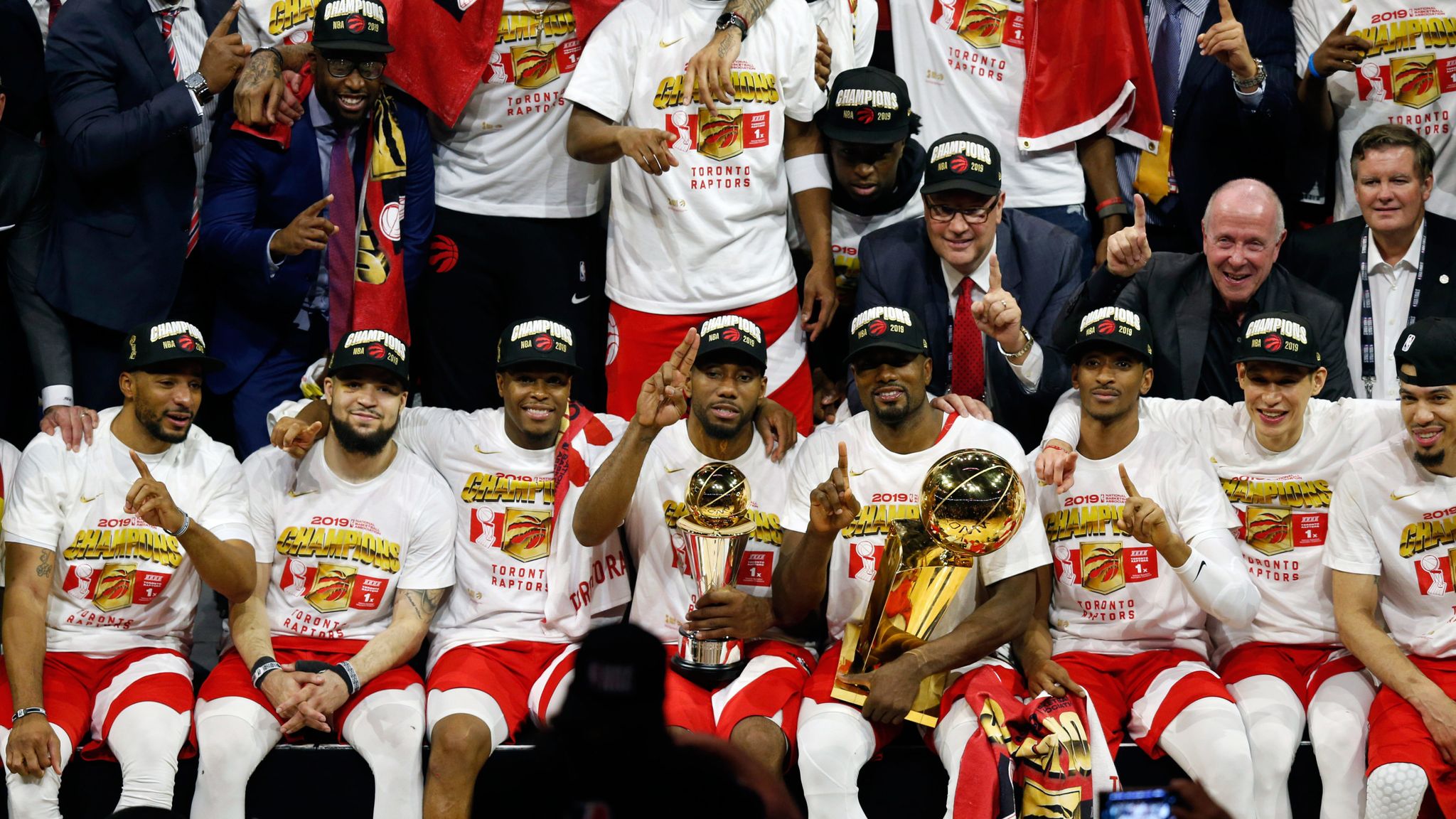
1. Toronto: Raptors, June 13, 2019
2. St. Louis: Blues, June 12, 2019
3. Boston: New England Patriots, February 3, 2019
4. Atlanta: United (MLS), December 9, 2018
5. Calgary: Stampeders (CFL), November 25, 2018
6. Seattle: Storm (WNBA), September 12, 2018
7. San Francisco: Golden State Warriors, June 8, 2018
8. Washington: Capitals, June 7, 2018
9. Philadelphia: Eagles, February 4, 2018
10. Houston: Astros, November 1, 2017
11. Pittsburgh: Penguins, June 11, 2017

Won in Obama's 2nd term
12. Ottawa: Redblacks (CFL), November 27, 2016
13. Chicago: Cubs, November 2, 2016
14. Los Angeles: Sparks (WNBA), October 20, 2016
15. Cleveland: Cavaliers, June 19, 2016
16. Denver: Broncos, February 7, 2016
17. Portland: Timbers (MLS), December 6, 2015
18. Edmonton: Eskimos (CFL), November 29, 2015
19. Kansas City: Royals, November 1, 2015
20. San Antonio: Spurs, June 15, 2014
21. Regina: Saskatchewan Roughriders (CFL), November 24, 2013
22. Miami: Heat, June 20, 2013
23. Baltimore: Ravens, February 3, 2013

Won in Obama's 1st term
24. Indiana: Fever (WNBA), October 21, 2012
25. New York: Giants, February 5, 2012
26. Vancouver: BC Lions (CFL), November 27, 2011
27. Dallas: Mavericks, June 12, 2011
28. Wisconsin: Green Bay Packers, February 6, 2011
29, Montreal: Alouettes (CFL), November 28, 2010
30. New Orleans: Saints, February 7, 2010
31. Utah: Real Salt Lake (MLS), November 22, 2009

Won under Bush
32. Columbus: Crew (MLS), November 23, 2008
33. Detroit: Red Wings, June 4, 2008
34. Carolina: Hurricanes, June 19, 2006
35. Tampa Bay: Lightning, June 7, 2004
36. Phoenix: Arizona Diamondbacks, November 4, 2001

Won under Clinton
37. Hamilton: Tiger-Cats (CFL), November 28, 1999

Won under the 1st Bush
38. Minnesota: Twins, October 27, 1991
39. Cincinnati: Reds, Ocober 20, 1990

Won under LBJ
40. Buffalo: Bills (AFL), December 26, 1965
41. San Diego: Chargers (AFL), January 5, 1964

So, New York ranks 25th. If you don't count the CFL, then that drops Edmonton to 1990, Calgary to 1989, and Ottawa to 1927, and eliminates Regina entirely. If you don't count MLS, then that drops Atlanta to 1995, and Portland to 1977. If you don't count the WNBA, it doesn't help New York much: While it drops Indiana to 2007, it drops both Seattle and Los Angeles only to 2014. So, factor those in, and New York rises only to 18th. Still far too low.

Five metropolitan areas with current major league sports teams have never won a World Championship.

42. Tennessee: The Nashville Predators reached the Stanley Cup Finals in 2017, and the Tennessee Titans reached Super Bowl XXXIV in 2000.

43. Orlando: The Magic have reached the NBA Finals in 1995 and 2009.

44. Oklahoma City: The Thunder have reached the NBA Finals in 2012. The franchise was previously the Seattle SuperSonics, winning the NBA Championship in 1979 and losing in the Finals in 1978 and 1996.

45. Sacramento: The Kings were infamously robbed in the 2002 NBA Western Conference Finals, and that franchise's only title as as the Rochester Royals, on April 21, 1951.

46. Jacksonville: The Jaguars have reached the AFC Championship Game 3 times, in 1996, 1999 and 2017.

Wednesday, March 6, 2019

How to Be a Devils Fan In Calgary -- 2019 Edition

This coming Tuesday, the Devils travel to play the Calgary Flames. With their "C of Red" fans, the Flames are never an easy team to beat at the Saddledome.

Before You Go. Aside from Edmonton's Rogers Place, no arena in the NHL is further north than the Saddledome -- indeed, aside from each Alberta city's CFL stadium, no venue in North American sports is further north except Rogers Place. And this is early November. It will be cold.

The Calgary Herald is predicting that temperatures will be in the mid-30s by day and the teens by night. That's not dangerously cold, but, still, bundle up. And they are predicting snow for the day, so mind your step.

This is Canada, so you will need your passport. You will need to change your money. At this writing, C$1.00 = US 74 cents, and US$1.00 = C$1.34. And I advise you to call your bank and let them know that you will be in a foreign country, so they won't see credit or debit card purchases from a foreign country pop up and think your card has been stolen.

Also, remember that they use the metric system. A speed limit of 100 kilometers per hour means 62 miles an hour. And don't be fooled by the seemingly low gas prices: That's per liter, not per gallon, and, in spite of Canada being a major oil-producing nation, you'll actually be paying more for gas up there. So, in order to avoid both confusion and "sticker-shock," get your car filled up before you reach the border.

Calgary is in the Mountain Time Zone, so they are 2 hours behind New York and New Jersey. Adjust your timepieces accordingly.

Tickets. The Flames are averaging 18,281 fans per home game this season, about 95 percent of capacity. A bit less than you might expect from a Canadian city. Tickets will probably still be hard to get.

Even with the exchange rate, these tickets, listed in Canadian dollars, are expensive. Seats in the lower level, the 100 sections, are $292 throughout the level. In the upper level, the 200 sections, they're $132 between the goals and $90 behind them. The uppermost level, labeled PL (for "Press Level"), has seats for $46.

Getting There. It's 2,385 miles from Times Square to downtown Calgary (158 miles from the closest border crossing, at Babb, Montana), and 2,376 miles from the Prudential Center in Newark to the Saddledome. It would be natural if your first thought would be to fly.

If you're driving, you'll need to get into New Jersey, and take Interstate 80 West. You'll be on I-80 for the vast majority of the trip, through New Jersey, Pennsylvania and Ohio. In Ohio, in the western suburbs of Cleveland, I-80 will merge with Interstate 90. From this point onward, you won’t need to think about I-80 until you head home; I-90 is now the key, through the rest of Ohio and Indiana.

Just outside Chicago, I-80 will split off from I-90, which you will keep, until it merges with Interstate 94. For the moment, though, you will ignore I-94. Stay on I-90 through Illinois, until reaching Madison, Wisconsin, where you will once again merge with I-94. Now, I-94 is what you want, taking it into Minnesota and the Twin Cities.

However, unless you want to make a rest stop actually in Minneapolis or St. Paul, you're going to bypass them entirely. Take Exit 249 to get on Interstate 694, the Twin Cities' beltway, until you merge with Interstate 494 to reform I-94.

Crossing Minnesota and North Dakota, you'll take Exit 211 to Montana Route 200, and take that up to the town of Circle. There, you take Montana Route 13 until it splits and forms Montana Route 25. After just 6 miles, that takes a right turn in the town of Wolf Point, and then a quick left to U.S. Route 2 West. In Shelby, you'll leave US-2 for Interstate 15, and take that to the Canadian border.

Presuming you don't do anything stupid that makes Customs officials keep you out of Canada, I-15 will become Alberta Provincial Route 4. At Lethbridge, you'll turn onto Provincial Route 3 West. Take Provincial Route 23 to Provincial Route 519 to Provincial Route 2. From Route 2, take Exit 245 for Southland Drive, make a left on Southland, and then a quick right onto Blackfoot Trail. A left on 42nd Avenue and a right on MacLeod Trail, and you'll be at the edge of downtown Calgary, with the Saddledome on your right.

If you do it right, you should spend about an hour and a half in New Jersey, 5 hours and 15 minutes in Pennsylvania, 4 hours in Ohio, 2 and a half hours in Indiana, an hour and a half in Illinois, 2 and a half hours in Wisconsin, 4 and a half hours in Minnesota, 6 hours in North Dakota, 7 and a half hours in Montana, and 6 hours and 45 minutes in Alberta.  That's 42 hours. Throw in rest stops, and we're talking closer to 56 hours -- 2 and one-third days. You'd have to really love both driving and hockey, and not mind cold weather, to do that.

Forget the bus: For a reason I could not find, Greyhound is not currently offering service to Calgary. The Greyhound station is at 850 16th Street NW at Bow Trail.

Forget the train: You'll have to switch from Amtrak to VIA Rail Canada in Toronto, take a train to Edmonton, and then take a bus to Calgary -- which, for the moment, apparently, you can't do anyway. Round-trip, it would take 8 days. No, the train is no good.

So flying is easily the best way to get there. You can fly Air Canada from Newark to Calgary and back, changing planes in Toronto, for $942. Calgary International Airport was originally named McCall Field, after Frederick McCall, a Canadian flying ace of World War I.

On October 14, 2016, President Obama finally ended the ban on bringing Cuban cigars into America. This also applies to rum, for which Cuba is also renowned. It is still considerably easier to buy these items in Canada than in America, but, now, you can bring them back over the border.

Once In the City. At 1.2 million people, Calgary is the 3rd-largest city in Canada, behind Toronto and Montreal, and ahead of Vancouver and Edmonton. However, like most of Canada's larger cities, the huge amount of land area contained within its city limits means it has almost no suburbs, and its metropolitan area gives it only 1.4 million, 4th behind Toronto, Montreal and Vancouver -- but still ahead of national capital Ottawa and Provincial capital Edmonton.

Founded in 1882 at the confluence of the Bow and Elbow Rivers, there is some dispute as to the origin of the name, although both accepted versions are Scottish in origin. Some say it's from the Gaelic meaning "beach of the meadow," or "pasture." Others say it comes from the words the Vikings brought to northern Scotland's Hebrides, meaning "cold garden."

The Bow River and, east of its bend, Memorial Drive separate Calgary addresses into North and South, while Centre Street separates them into East and West. The sales tax in the Province of Alberta is 5 percent, and it doesn't go up in the City of Calgary. The city has buses and a light rail system nicknamed CTrain, and a single fare is $3.00 (which works out to about $2.25, so it's less expensive than New York's).
CTrain downtown, with Calgary Tower in the background

The drinking age in Alberta is 18. Postal Codes in the Province start with the letter T. The Area Code is 403, with 587 and 825 as overlays for the entire Province. The city has no highway "beltway." ENMAX Power Corporation runs the city's electricity. Calgary's ethnic makeup is 61 percent white, 16 percent East Asian, 9 percent South Asian, 4 percent black, 3 percent Aboriginal/Native North American/First Nations, 3 percent Middle Eastern, 2 percent Hispanic.

Going In. The Scotiabank Saddledome -- originally the Olympic Saddledome, built in 1983 for the Flames and as the centerpiece of the 1988 Winter Olympics, and now named for the Halifax-based bank -- is at 555 Saddledome Rise SE, across Olympic Way from the Stampede Corral, site of the world's largest rodeo, the Calgary Stampede. It's about a mile and a quarter southeast of the downtown shopping district. If you're driving, parking is $10. (US$7.50.) If you're coming in by light rail, it's about a 12-minute ride to Victoria Park-Stampede station, and then you'll have to walk across a big parking lot to get to the arena, entering from the west.

Like the Capital Centre, the suburban Washington arena that was once home to the Bullets (now Wizards) and Capitals, it has a saddle-shaped roof; hence, the name "Saddledome." (Why a bank based in Nova Scotia, in Canada's eastern Maritime Provinces, bought the naming rights to a western arena, I have no idea.)

The rink is laid out north-to-south (I apologize for getting that wrong last year), and the Flames attack twice to the north end. The arena is also home to the minor-league Calgary Hitmen, and their rivalry with the Edmonton Oil Kings is nearly as intense as the "Battle of Alberta" between the Flames and the Oilers.
With the Oilers and the Detroit Red Wings recently having moved into new arenas, the Saddledome is the 2nd-oldest arena in the league, behind Madison Square Garden. For the moment, the Flames organization says it has a plan to replace the Dome, called CalgaryNEXT. The proposed location is on the south bank of the Bow River, at 1910 Pumphouse Road SW, about 2 miles west of downtown, light rail to Sunalta.

But they refuse to out up more than half the cost, even though the owners can easily afford it. The re-election in 2017 of Mayor Naheed Nenshi, who refuses to budge, and NHL Commissioner Gary Bettman's hatred of Canada and love of the Sun Belt, means the Flames could start the 2021-22 season in a new arena, but also in a new city.

Food. There's not much information available online about Saddledome concession stands, but the arena's website mentions several onsite restaurants, including Dutton's Lounge, the Alumni Lounge and the King Club. The Saddleroom Restaurant is on the arena's east side (another thing I had wrong last year), and the Platinum Club on the west side (ditto), but these are open only to season-ticket holders, much like the Prudential Center's Fire Lounge and Ice Lounge.

According to the arena website, concessions include: 

Time Out (Hot Dogs, Popcorn, Snacks)
Centre Ice (Hot Dogs, Popcorn, Snacks)
Pizza 73
Skyline Deli
Spolumbos Italian Eatery
Mac Shack (Mac 'n Cheese)
Flame Broiled Burgers
The Dog House (Specialty Hot Dogs)
The Zone
The Rotisserie

Cash or credit cards are accepted at all concession stands.


Team History Displays. All in a row, over the center red line, the Flames hang banners for their various championships and their retired numbers. The title banners including: The 1989 Stanley Cup; the 1986, 1989 and 2004 Conference Championships; the 1986, 1989, 1994, 1995 and 2006 Division titles; and the 1988 and 1989 President's Trophy for best overall record in the NHL regular season.
The Flames have only 3 retired numbers. From the 1986 Cup Finalists and the 1989 Cup winners, they have retired: 9, for right wing Lanny McDonald; and 30, for goaltender Mike Vernon. From the 2004 Cup Finalists, they just retired 12, for right wing Jarome Iginla.

Right wing Theoren Fleury, a rookie on the 1989 Cup winners, has not had his Number 14 retired, but it has not been given out since he was traded in 1999. A banner for Brad Moran, whose Number 20 was retired by the Calgary Hitmen, is also hung at the Saddledome.

In 2012, the Flames organization introduced "Forever A Flame," to honor team legends while still allowing future Flames the opportunity to wear the numbers of some of the team's all-time greats -- essentially, a team hall of fame. Defenseman Al MacInnis was the 1st to earn this distinction, with a banner with his picture and the Number 2 raised to the rafters. Center Joe Nieuwendyk (who also won a Cup with the Devils) followed him, with a banner with his Number 25 on it. So that's 4 honorees, all from the 1989 Cup win.
Other possible future honorees could be Hockey Hall-of-Famers Joe Mullen (from 1989), Doug Gilmour (ditto), Phil Housley (starred for them after the '89 Cup), Sergei Makarov (ditto), general manager Cliff Fletcher (1989), longtime owner Harley Hotchkiss, and broadcaster Peter Maher.

There were no Flames named to The Hockey News' 100 Greatest Players in 1998, not even McDonald, Vernon or Gilmour. MacInnis was the only player usually identified with the Flames who was named to the NHL's 100th Anniversary 100 Greatest Players in 2017.

There is no reference to the Flames' time in Atlanta (the name references the burning of Atlanta during the American Civil War), unless you count the "A" for Alternate Captain being the Flames' old A logo. (The "C" for Captain is the current C logo.) The Flames didn't win anything in Atlanta, so there are no banners to raise, although they did make the Playoffs there. The only Atlanta Flames player in the Hockey Hall of Fame is Pat Quinn, and he's in the Hall for what he did elsewhere as an executive.

At the north end of the arena are Canadian and U.S. flags. At the south end are Canadian and British flags (Canada remains in the British Commonwealth), an Olympic flag, and a banner representing the 1988 Winter Olympics, for which the Saddledome and McMahon Stadium, home of the CFL's Stampeders, were the leading venues.

No members of the Team Canada that beat the Soviet Union in the 1972 "Summit Series" played for the Flames, in either Atlanta or Calgary. From the 1980 U.S. Olympic team that beat the Soviets and then Finland for the Gold Medal, Jim Craig played some of their final Atlanta games, while Steve Christoff played for them in Calgary.

Craig, Quinn, Makarov, and Swedes Kent Nilsson and Hakan Loob are members of the International Ice Hockey Federation (IIHF) Hall of Fame. Mullen and former coach Bob Johnson, who got them to the 1986 Stanley Cup Finals, received the Lester Patrick Trophy for contributions to hockey in America.

In addition to the Flames' achievements, the Memorial Cup, the championship of Canadian junior hockey, has been won by the following Calgary-area teams: The 1926 Calgary Canadians, the 1987 and 1988 Medicine Hat Tigers, the 2001 Red Deer Rebels and the 2002 Kootenay Ice.

The Battle of Alberta with the Oilers is as intense as any in the NHL. It's close, but the Flames lead it, 131-126. They've faced each other in 5 Playoff series, all during the Wayne Gretzky era in Edmonton, and the Oilers won 4 of them: In 1983, 1984, 1988 and 1991.

The only Flames win came in the 1986 Smythe Division Final, when an own goal by Oiler defenseman Steve Smith led to the Flames winning in Game 7. Either the Oilers or the Flames won the NHL Clarence Campbell Conference (analogous to the current NHL Western Conference) every season from 1983 to 1990.

Stuff. There is a Flames Fan Attic (as in "fanatic") team store at the Saddledome, although I can't find a reference as to where in the arena. There are also Flames Fan Attics at the North Hill Centre mall and Calgary International Airport. I suspect that, due to the city's Western heritage, you can buy cowboy hats with the Flames' logo on them.

In spite of having won a Stanley Cup, and nearly winning 2 others, there aren't many books about the Flames. The Calgary Herald staff put together a coffee-table book titled Calgary Flames: The Fire Inside, but that's a big book at a big price. Last month, Mark Spector published The Battle of Alberta: The Historic Rivalry Between the Edmonton Oilers and the Calgary Flames.

The NHL has released a DVD set, Calgary Flames: 10 Great Playoff Games. They include a Game 7 win over the Philadelphia Flyers in 1981, their 1st season in Calgary; the shocking Game 7 win over the arch-rival Oilers in 1986, won by Steve Smith's own goal; another Game 7 win in 1986, over the St. Louis Blues; a Game 7 win over the Vancouver Canucks in 1989; the Cup-clincher of 1989, the only time a team ever clinched over the Montreal Canadiens at the Montreal Forum; the 1991 Game 6 win over the Oilers won by Theoren Fleury's goal that produced a memorable celebration; the Game 7 win over Vancouver in 2004; the Game 5 win over the Tampa Bay Lightning in 2004; and the Game 3 win over the San Jose Sharks in 2008.

During the Game. A November 19, 2014 article on The Hockey News' website ranked the NHL teams' fan bases, and listed the Flames' fans 8th: "Consistent turnout at games despite rebuild. Lackluster social media presence."

You are not Edmonton Oilers fans. You will not be wearing Oilers gear. Therefore, you will almost certainly be safe. This game will not feature a promotion.

The seats are blue, but they become "the C of Red." (Never "the Red C.") The Flames' home jerseys are red, like the Devils'. I don't know if it would be better to wear a red Devils jersey to fit in, or a white one to stand out. But the C of Red is as pervasive as the one in the St. Louis Cardinals' Busch Stadium.
The C of Red

George Canyon, a country singer from Nova Scotia who now lives in Calgary, and has been appointed the Colonel Commandant of the Royal Canadian Air Cadets, is the Flames' regular singer of the National Anthem(s). There isn't much in the way of fan chants or songs, just "Go, Flames, Go!" Their goal song is "Righteous Smoke" by Monster Truck.
George Canyon

Although they sometimes wear a 3rd jersey with a fire-breathing dragon on it, their mascot is Harvey the Hound, a big white silly-looking dog with its tongue hanging way out -- which has driven some frustrated fans, and even one opposing coach (Craig MacTavish of the arch-rival Oilers), to grab it and try to rip it out. He was introduced in 1983, and was the 1st mascot in NHL history. (His name has confused me: I thought it was not Harvey, but Harley, named for longtime owner Harley Hotchkiss.)

After the Game. Canada does not have much of a problem with crime, and while hockey fans like to drink, Flames fans will probably leave you alone. Just don't praise the Oilers, and you should be safe.

Mavericks Dining Room & Lounge is on 2nd Street, at the southwest edge of the parking lot. Effectively, it marks the beginning (or the end) of the Red Mile, a strip of bars and restaurants along 17th Avenue that gained fame for its party atmosphere during the 2004 Playoffs.

If your visit to Calgary is during the European soccer season (which we are now in), the best soccer pub in town is The Pig & Duke, 1312 12th Avenue SW, about 2 miles west of downtown. Bus 7.

Sidelights. As with the other major cities of Canada, Calgary isn't just about hockey.

* Stampede Corral. Home to the Calgary Stampede, the world's largest rodeo, since 1950, the Flames played here from their 1980 move from Atlanta until the Saddledome opened across the street in 1983. At just 6,475 seats, it was too small to be their long-term home, but with the Saddledome already planned, they could afford to wait. Several minor-league hockey teams had used it before the Flames arrived. 10 Corral Trail SE at Olympic Way. (There are no plans to build a new arena to replace the Saddledome.)
* McMahon Stadium. Home to the Calgary Stampeders of the Canadian Football League (who are owned by the Flames), and the University of Calgary football team, since 1960, it was named for a pair of brothers who funded its construction. Its current capacity is 37,317. Temporary seating raised it to 60,000 so that it could host the Opening and Closing Ceremonies of the 1988 Winter Olympics.

The Stampeders, a.k.a. the Stamps, won the Grey Cup, Canada's Super Bowl, while playing here in 1971, 1992, 1998, 2001 and 2008. Previously, they played at Mewata Stadium, and won the 1946 Grey Cup while playing there. That facility was built in 1906 and demolished in 1999.

The stadium hosted the Grey Cup in 1975, 1993, 2000 and 2009. The University of Calgary Dinos (yes, named for dinosaurs) have won Canada's national college football title, the Vanier Cup, in 1983, 1985, 1988 and 1995. (They haven't won any hockey titles.) The stadium hosted an NHL Heritage Classic between the Flames and the Canadiens in 2011, which the Flames won, 4-0. 1817 Crowchild Trail NW at 23rd Avenue.

* Foothills Stadium. Adjacent to McMahon Stadium, this 6,000-seat ballpark went up in 1966, and is the home of the University of Calgary baseball team. It was home to several minor league teams, including the Calgary Expos, who won Pioneer League Pennants there in 1979 and 1981. The Pacific Coast League's Calgary Cannons won Division titles in 1985, 1987, 1989 and 1991, but never won a Pennant. 2255 Crowchild Trail NW. Both stadiums can be reached via the Banff station on light rail.
The University of Calgary sports complex,
including Foothills Stadium (L) and McMahon Stadium (R)

* Spruce Meadows. The Canadian Premier League is about to debut, and includes Cavalry FC, with a 6,000-seat stadium opening at Spruce Meadows, famed as a venue for equestrian competitions. 18011 Spruce Meadows Way SW, about 12 miles south of downtown. Free shuttles will bring fans to the stadium from the Somerset-Bridlewood C-Train station.
While the University of Calgary is, of course, in Calgary, the University of Alberta is in Edmonton. The University of Lethbridge, 130 miles to the southeast, won the University Cup, Canada's national college hockey title, in 1994.

The closest Major League Baseball team to Calgary is the Seattle Mariners, and they're not close: 673 miles away. The closest NBA team, the Portland Trail Blazers, is even further away: 775 miles. Don't count on Calgary ever getting a team in either sport: Population-wise, its metro area would rank dead last in each, 31st. The closest Major League Soccer team is the Vancouver Whitecaps, 604 miles.

* Museums. Calgary's best-known museum is the Glenbow, which is both their Museum of Natural History and their Metropolitan Museum of Art. 130 9th Avenue SE at 1st Street downtown, across from the iconic Calgary Tower.

Gasoline Alley Museum at Heritage Park Historical Village sounds like a copy of the Henry Ford Museum outside Detroit, as it documents the dawn of the automobile age, with first- and second-generation automobiles and a recreated turn-of-the-20th-Century street scene -- significant because Alberta didn't turn from Territory to full Province until 1905. visitcalgary.com says of it, "It's probably the only time you'll ever find yourself in the thick of a traffic jam without a hint of road rage." 1900 Heritage Drive SW at 14th Street, on Glenmore Reservoir. Light rail to Heritage station, then switch to 502 bus.

Calgary has produced 2 Prime Ministers. The recently-defeated PM, Stephen Harper, represents a Calgary district (or "riding" as they'd say in Canada). The other is Richard B. Bennett, who served from 1930 and 1935, rising to power after the 1929 stock market crash but was seen as doing nothing to ease the Depression, and became the most hated man in the country's history, so much so that he left Canada for the mother country, Britain. He's the only head of government in either America or Canada who died on foreign soil, or is buried in it. As you might guess, there's no historic site in his memory, either in Calgary or in his hometown in the Province of New Brunswick.

The tallest building in Calgary, and in Canada between Toronto and Vancouver, is Brookfield Place East, a newly-completed 810-foot tower that just succeeded the 774-foot "The Bow" as the tallest. 225 6th Avenue NW.

TV shows set in Calgary are generally not shown in America, but the science fiction/Western Wynonna Earp films at Heritage Park Historical Village, kind of a "Western Williamsburg." Probably the best-known movie to use Calgary and/or its environs as a filming location was Brokeback
Mountain.

*

Calgary is Canada's Denver, its great Western city of toughness, and its Dallas, its great Western city of excess, rolled into one. And it's a great hockey town, a good roadtrip for Devils fans.
Friday, March 16, 2018

Larry Kwong, 1923-2018

In Field of Dreams, Ray Kinsella (played by Kevin Costner) and Terence Mann (James Earl Jones) discuss whether 5 minutes, even in a sporting event, can change the world.

Larry Kwong proved it can take even less than that.

Eng Kai Geong was born on June 17, 1923 in Vernon, British Columbia, in the Southern Interior of that Province of Canada, about halfway between Vancouver and Calgary. He was 1 of 15 siblings.

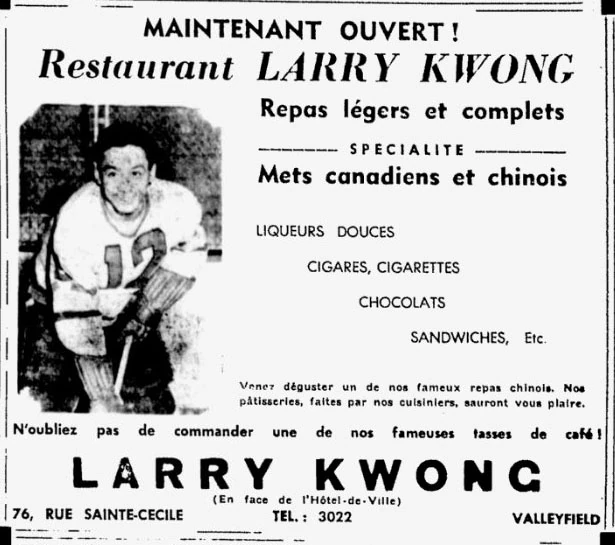
His father owned a grocery store, named Kwong Hing Lung, which roughly translates as "Abundant Prosperity." Locals, knowing that Chinese names began with the family name, rather than ending with it as in Western cultures, presumed that the family name must be "Kwong," and called Eng's father "Mr. Kwong." Eventually Eng had his name legally changed to Lawrence Kwong, becoming known as "Larry."

A right wing, he helped his hometown team, the Vernon Hydrophones, to BC's midget championship in 1939, and its juvenile title in 1941. He then played for the Trail Smoke Eaters in Trail, British Columbia. This was a senior hockey team, meaning it was at the highest-ranking amateur level. But, like many such hockey (and basketball) teams of this time, it was really "semi-professional": They'd get you a job, so you would have income. If you were particularly good, the job would be nominal at best, so you'd qualify as a pro at "work" and an amateur at your sport.

But while most of his teammates were working at a local smelter, he wasn't allowed to, because he was Chinese. But because he was Canadian, and World War II was raging, in 1944, he was drafted into the Canadian Army.

He was assigned to a service team, the Red Deer Wheelers of the Central Alberta Garrison Hockey League, which also features goaltender "Sugar Jim" Henry and right wing Matthew "Mac" Colville, who had already played for the NHL's New York Rangers -- as had Colville's brother Neil.

The War over, Kwong returned to the Smoke Eaters, and helped them win the Provincial senior title, the Savage Cup, in 1946, scoring the Final-winning goal. Henry and Colville must have told Rangers boss Lester Patrick about their experience with Kwong on the Wheelers, because he was signed to the Rangers' top farm team, the New York Rovers, who also played at the old Madison Square Garden from 1935 to 1952. In 1947-48, he led the Rovers in scoring.

Just as another New York sports star of that era, Joe DiMaggio, was known as the Yankee Clipper after what was already an old-time sailing ship, Kwong was nicknamed the China Clipper. (To match a famous movie about a big ape, he was also nicknamed King Kwong.) And, just as DiMaggio was an icon for Italian-Americans, and Hank Greenberg (a New Yorker playing in Detroit) was a hero for Jewish Americans, particularly New Yorkers, people in Lower Manhattan's Chinatown found a hero in Kwong.

But he wasn't getting called up, to receive his just due from white fans. It wasn't just his Asian heritage that stood in his way: It was also his size, just 5-foot-6 and 150 pounds. With guys like Maurice "the Rocket" Richard and Kenny Reardon of Montreal, Gus Mortson of Toronto, and Black Jack Stewart of Detroit prowling the ice, fast and willing to check hard, the days when a guy could be the size of 1920s Ottawa and 1930s Toronto star Frank "King" Clancy (generously listed as 5-7, 155) and still play in the NHL were over.

It was also the fact that there were only 6 teams in the NHL: New York, Boston, Montreal, Toronto, Detroit and Chicago. That meant just 120 jobs, almost all of them held by white Canadians. Even white Americans found it hard to make it, because, at the time, the idea that an American could be trained at hockey as well as a Canadian could was, to be completely fair, while possible, incredibly unlikely.

Finally, on March 13, 1948, wearing Number 11, he was called upon to take a late shift in one of the last games of the regular season, against the Montreal Canadiens at the Montreal Forum. His shift lasted perhaps a minute, and he registered neither a goal nor an assist. The Canadiens won, 3-2.

That was it. He never appeared in another NHL game. But, 11 months after Jackie Robinson had reintegrated Major League Baseball, a year and a half before 4 players reintegrated pro football, 2 1/2 years before the NBA would be integrated by 3 players, and 10 years before Willie O'Ree became the 1st black player in the NHL, Larry Kwong had become the 1st Asian player, and the 1st person of color, to play in the NHL.

*

Realizing that this was as good as it as going to get in post-World War II America -- he would later say, "You wonder. Who knows?" -- Kwong accepted an offer from the Valleyfield Braves of the Quebec Senior Hockey League. The Rangers let him go without objection.

The Braves were coached by former Canadiens star Hector "Toe" Blake, and he and Kwong led them to the league title in 1951. Kwong was named the league's Most Valuable Player -- ahead of Jean Béliveau of the Québec Aces.

Blake said, "I would not trade Larry Kwong under any circumstances." Béliveau said, "Larry made his wingmen look good, because he was a great passer. He was doing what a centerman is supposed to do."

Kwong opened a restaurant in Valleyfield, and remained with the Braves through 1955, at which point the Canadiens kicked coach Dick Irvin Sr. (father of their legendary broadcaster) upstairs, and hired Blake as head coach, where he led them, along with Richard, his brother Henri Richard, Béliveau, Jacques Plante and other stars, to 8 Stanley Cups. Kwong played elsewhere in Quebec, and in 1957 moved to England's East Midlands to play for the Nottingham Panthers, one of the most successful British hockey teams.
Translation: Now open! Larry Kwong's Restaurant.
Light and complete meals. Specialty:
Canadian and Chinese dishes. Sweet liquors,
cigars, cigarettes, chocolates, sandwiches, etc.

It was in Nottingham that he met Audrey Craven. They married, and had a daughter named Kristina. In 1958, he was hired by HC (Hockey Club) Ambri-Piotta in Switzerland, making him the 1st person of Chinese ethnicity to coach a professional hockey team, anywhere in the world. He later coached at HC Lugano and HC Lausanne in Switzerland, and also coached tennis.

In 1972, he returned to Canada, and took over his family's supermarket, now named Food-Vale. In 1979, Audrey died. In 1989, he married Janine Boyer, but she died in 1999. He retired from the grocery business, and lived in Calgary.

*

He was not related to Norman Kwong, another Calgary-based sports legend, who was the 1st Asian-ancestry player in the Canadian Football League. He won 4 Grey Cups (1948 with the Calgary Stampeders; 1954, 1955 and 1956 with the Edmonton Eskimos). Like Larry, "Normie" Kwong was nicknamed the China Clipper.
Also born with a family name other than Kwong, he was elected to the Canadian Football Hall of Fame, became a part-owner of the NHL's Calgary Flames, and later served as Lieutenant Governor of Alberta. He died in 2016, shortly before he would have turned 87.

It would be October 11, 1975 before another Asian-North American player, forward Mike Wong of Minneapolis, reached the NHL, playing a little longer with the Detroit Red Wings.
In 1990, Robin Bawa, a right wing from the Vancouver suburbs, became the 1st player descended from India to play in the NHL. He would also play 61 games for Washington, Vancouver, San Jose and Anaheim over the next 4 years, scoring 6 goals.
Only 1 other Indian player has reached the NHL: Emmanuel "Manny" Malhotra, born and raised in Mississauga, outside Toronto, and a center for the Rangers from 1998 to 2002. He later played for Dallas, Columbus, San Jose, Vancouver, Carolina and Montreal, and is now an assistant coach for Vancouver.
Jim Paek of Korea was the 1st player born in Asia to reach the NHL, growing up in Toronto, and playing as a defenseman for the Pittsburgh Penguins. With them, he won the Stanley Cup in 1991 and 1992, and remains the only Asian player to win it.
Paul Kariya, born in Vancouver to Japanese parents, didn't quite win the Cup, losing the 2003 Finals to the New Jersey Devils while with the Anaheim Ducks, but did become the 1st Asian player elected to the Hockey Hall of Fame.
In 2015, the New York Islanders drafted Andong Song, a defenseman born in Beijing, raised in the suburbs of Toronto, and played high school hockey at the prestigious Lawrenceville School in Mercer County, New Jersey. He is now 21 years old, attending Cornell University, and played for the Isles' farm team is Wisconsin, the Madison Capitals. He is the only Chinese-born player ever drafted by an NHL team.
Ivan Wilfred Johnson, an original Ranger in 1926 who remained with the team through 1937, played in the Stanley Cup Finals in 1928 (won), 1929 (lost), 1932 (lost), 1933 (won) and 1937 (lost). Although he was an Irishman from Winnipeg, and received the Russian-themed nickname "Ivan the Terrible," somehow, people got the idea that he looked Chinese, and he became known as "Ching" Johnson.
Frankly, I don't see it. I think he looks more like Bob Hope.

A roughhouse defenseman, he is a member of the Hockey Hall of Fame. The Rangers have retired his Number 3 -- but for a later Hall of Fame defenseman, Harry Howell.

*

In 2009, Larry Kwong's hometown's current team in the British Columbia Hockey League, the Vernon Vipers, honored him in a pregame ceremony. So did the Calgary Flames, in recognition of his service to hockey in the Province of Alberta, of which Calgary is the capital. He was elected to the British Columbia Sports Hall of Fame in 2013 and the Alberta Sports Hall of Fame in 2016.
Larry Kwong died on March 15, 2018, at age 94, in Calgary, 2 days after the 70th Anniversary of his toe-dip into history.

The Rangers have retired Number 11, but for Mark Messier. They have announced that, next season, they were retire it again, completing the honors of the late 1960s, early 1970s "GAG Line" (Goal A Game): 7, Rod Gilbert; 19, the newly-honored Jean Ratelle; and 11, for Vic Hadfield.

Have the Rangers, who play in a city with one of the largest Chinese communities in the world outside of China, ever honored Larry Kwong?

UPDATE: Larry Kwong's final resting place is not publicly known. Norm Kwong's is Eden Brook Memorial Gardens in Calgary.